

Image Gallery
1A seventeenth-century physician. This special costume was designed to protect the wearer from ‘miasma’, considered to spread disease. The beak-like protuberance was filled with aromatic herbs, often lavender. Wellcome Collection. Public domain mark
2A woodcut showing a plague scene: the title page of Londons Lamentation (1641), which ‘described certaine causes of this affliction and visitation of the plague […] which the Lord hath been pleased to inflict upon us, and withall what meanes must be used to the Lord, to gaine his mercy and favor […].’ Wellcome Collection. Image attribution CC BY 4.0
3Sixteenth-century woodcut of a physician, perhaps William Bullein. The long stick allowed the physician to examine patients without touching them. Wellcome Collection. Image attribution CC BY 4.0
4Death as an apothecary’s assistant, supervised by its master, making up medicines for a female patient. The watercolour has been ascribed to the well-known caricaturist Thomas Rowlandson (1757–1827), or to one of his followers. Wellcome Collection. Public domain mark
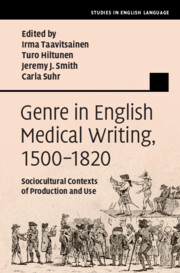
5The quack Dr Bossey selling medicines in London in 1792. Behind him are his attendant, who points him out to the crowd, a rather dejected ‘patient’, and a monkey holding a phial of medicine: an engraving by William Russell Birch. Wellcome Collection. Public domain mark
6A ‘man-midwife’ (male obstetrician) represented by a figure divided in half, one half representing a man and the other a woman: a coloured etching from 1793 by the caricaturist Isaac Cruikshank (1764–1811). Wellcome Collection. Public domain mark
7From the Lentaigne manuscript: Dublin, Royal College of Surgeons in Ireland, MS 97, f. 128v. The manuscript was used in the seventeenth century by Walter Hamond (d. 1648), ‘Cirurgian’. Image courtesy of the Royal College of Surgeons in Ireland
8Instruments to be used for the treatment of fistula in ano, drawn by Walter Hamond. The drawings are versions, interestingly modified, of those originally provided for the medieval treatise composed by John Arderne (c.1307–c.1377). From the Lentaigne manuscript, Dublin, Royal College of Surgeons in Ireland, MS 97, f. 83r. Image courtesy of the Royal College of Surgeons in Ireland
9London, Wellcome Collection, MS 674, p. 48: a description of environments suitable for exercise from the Regiment of Healthe, a late sixteenth-century version of a treatise first composed by John Mirfield (d. 1407). Author’s photo, by permission of the Wellcome Collection
10The first page of Dat Boek der Wundenartzstedye. yn latin geheten Cirurgia (1518), showing the so-called wound man. Image reproduced by permission of the Landesbibliothek Mecklenburg-Vorpommern Günther Uecker
11The first page of the fragment of a Low German translation of Hans von Gersdorff’s Feldtbuch der Wundarzney known as Dat velt bock. Image reproduced by permission of the Kongelige Bibliotek, Copenhagen
12A copy of John of Burgundy’s plague tract, once owned by Margaret Beaufort (1443–1509), mother of Henry VII. Cambridge Fitzwilliam Museum MS 261, f. 23v. Image reproduced by permission of the Fitzwilliam Museum
13The frontispiece to the second edition (1831) of Mary Shelley’s Frankenstein; or The Modern Prometheus. Getty Images
14The title page of Anthony Daffy’s pamphlet advertisement (1675) for his proprietary medicine, Elixir Salutis. A manicule at the foot of the page draws attention to a warning against counterfeiters. Wellcome Collection. Public domain mark
15The remains of King Richard III showing scoliosis, or severe curvature of the spine. The wounds to his skull may also be noted, inflicted at the Battle of Bosworth Field (1485). Image courtesy of University of Leicester
