

One day during the summer of 2017, I was in a city in Japan and entered a large bookshop to avoid the excruciating heat outside. In the section displaying bestsellers, I found a sensational caption on a book titled The Future Chronology.Footnote 1 Evoking a sense of crisis over the aging and shrinking population, the caption, written in bold gothic style with a red and white background, read:
2020: Half the women are over fifty years old
2024: One-third of the total population is sixty years old and over
2027: There is a shortage of blood for blood transfusions
2033: One in three households is empty
2039: There is a shortage of crematories
2040: Half of the local authorities are gone
2042: The population of the aged peaks at forty million
A similar image of Japan’s dystopic demographic future is found in the 2016 version of the government’s White Paper of Health, Labour and Welfare. In it, the then Minister of Health, Labour, and Welfare Shiozaki Yasuhisa stated: “Our country … is a ‘low-fertility and aging society’ … It is estimated that by 2060, two in five will be older people and the total population will go under 90 million.”Footnote 2 Attached to the White Paper was the annually updated leaflet, “Japan as Seen from the Perspective of a Population of 100” (Figure 0.1).

Figure 0.1 Japan as seen from the perspective of a population of 100.
Despite the cute characters surrounding the demographic figures and the upbeat tone typically associated with government publications of this kind, the message it conveyed was rather gloomy. It said that 12.7 persons out of the 100 people were fifteen years old or younger, while 26.7 persons were aged sixty-five years or more. According to demographers Satō Ryuzaburō and Kaneko Ryūichi, these figures clearly indicate Japan is making headway as a country in a “post-demographic transition phase.”Footnote 3 The phase is inundated with “many difficult problems,” for instance rural communities disappearing due to the aging and contracting population.Footnote 4 Precisely for this reason, demographers and policymakers across the world are closely watching Japan’s population trend and the government’s response to it.
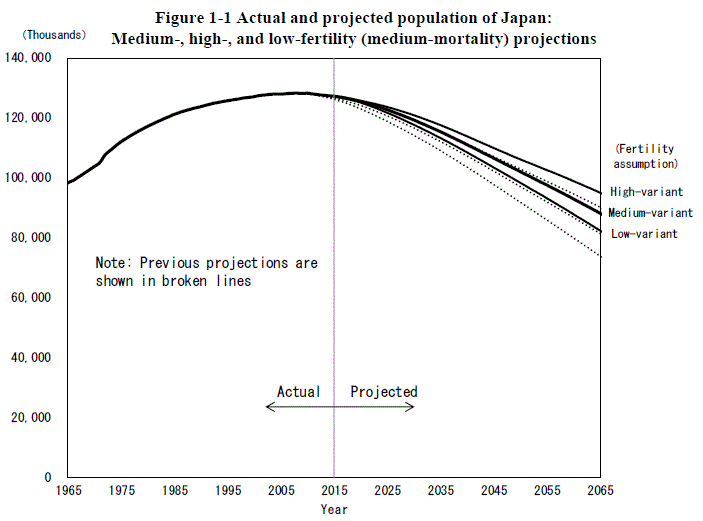
What is so obvious that we tend to overlook is that the public narrative of a population crisis is substantiated by numerical facts. The 2016 White Paper drew data from the population census conducted in 2015.Footnote 5 In turn, The Future Chronology was based on the results of the medium fertility projection presented in “Population Projections for Japan (2016–2065),” produced by the National Institute of Population and Social Security Research in 2017 (Figure 0.2).Footnote 6

Figure 0.2 Actual and projected population of Japan: medium-, high-, and low-fertility.
The results, based on the 2015 data, estimated the population of Japan would “decrease to around 110.92 million by 2040, fall below 100 million to 99.24 million by 2053, and drop to 88.08 million by 2065.” The population aged sixty-five years and more was expected to grow from 33.87 million in 2015 to 37.16 million by 2030, and peak at 39.35 million by 2042.Footnote 7 Public life in Japan today is dominated by what historian Barbara J. Shapiro once called a “culture of fact,” a firm consensus that facts, especially those represented in numbers, provide a credible perspective with which to view the natural and human world.Footnote 8
What is more, we also take for granted that these demographic data should necessarily urge official or societal responses to the population crisis. The Future Chronology and White Paper are significant, not simply because they have contributed to constructing a public discourse about the population crisis, but also because they illustrate how population facts are problematized as public issues and what solutions are considered viable. In fact, half of The Future Chronology is dedicated to the section, “10 Prescriptions for Saving Japan.” For instance, one of these “prescriptions,” following a proposal made in January 2017 by a working group of gerontologic scholars, is to raise the minimum age for the demographic category of “the elderly” (kōreisha) from the current sixty-five years old to seventy-five.Footnote 9 Using this new definition, Japan’s aging population problem would appear less pressing.Footnote 10 The White Paper, with its overall theme of considering “a social model with which to overcome the population aging,” contained an entire section mapping out policy suggestions.Footnote 11 Though less provocative than the “prescriptions” proposed by The Future Chronology, the White Paper also made recommendations, such as the creation of a system to encourage the employment of the elderly population.Footnote 12 Both publications clearly illustrate how the sense of a social crisis generated by the demographic facts drove social critics and the government to come up with suggestions for policy measures. They also display how making policy recommendations is self-evident in this type of publication.
However, historically speaking, this way of presenting, interpreting, and responding to population facts is relatively new. As I show in this book, the idea that humans could be represented in decimal numbers – a practice we regard as natural today – was literally foreign to many Japanese intellectuals in the early 1860s. The same was the case with the notion that the numerical presentation and analysis of a population could inform the characteristics and chronological trend of a society. Though many local rulers prior to the 1860s collected the details of people’s life events (e.g., births and deaths), as well as their status within the family, for the purpose of religious control, corvée, or taxation, the practice of collecting this demographic information was based on neither the mathematical nor the sociological understanding of population we are familiar with today. Our assumptions about the inherent link between numerical data, population trends, and social phenomena, as well as the roles assigned to government and public intellectuals to come up with solutions to the population problems by means of policy, have been constructed gradually throughout Japan’s history over the past 160 years or so.
This book illustrates how these assumptions and roles were normalized alongside the changing contours of Japan as a modern sovereignty by focusing on the critical, yet hitherto overlooked, role that science played in the Japanese state’s attempts to govern its population for the sake of its sovereignty. It analyzes how discourses related to the Japanese population mobilized scientists to conduct policy-oriented population research and state administrative activities and how, in turn, their practices and knowledge shaped the mode of governance. It also considers how population scientists constructed medico-scientific disciplines and their own professional identities through policymaking, while the government’s political agenda, which required the redefinition and management of its population – be it for nation-building, colonialism, war mobilization, or postwar reconstruction – shaped the contours of the scientific fields they wished to promote. This book demonstrates that the creation of the human and social science of the population, as well as the state sovereignty predicated on population management, had a symbiotic relationship, each driven by surrounding ideologies, institutional agendas, sociopolitical and material conditions, and personal motivations.
To elaborate on these points, this book draws on interrelated lines of inquiry in disciplines and subfields that have been particularly beneficial for my analysis. One is historical studies on science, technology, and medicine in modern Japan.Footnote 13 The studies have stressed the mutually exclusive relationship between the development of modern science, knowledge production, and the formation of Japan as a modern state and empire.Footnote 14 Within the field, works on sciences dealing with human subjects, for instance anthropology and medicine, have specifically considered the implications of scientific knowledge and practice for changing modes of governing people.Footnote 15 They have illustrated how scientific theories about people and race resulted from research activities provided foundations for the fundamental decisions Japan made about nation- and empire-building, for instance, where to draw the “boundaries of the Japanese,” and who would need policy interventions.Footnote 16 They have also demonstrated how the knowledge production process reinforced, and was reinforced by, preexisting socioeconomic conditions, institutional constraints, the political agenda affecting Japan’s nation- and empire-building exercise, and the social norms and cultural work on the Japanese in relation to the marginalized Other.Footnote 17 At the same time, they have also shown that the interplay between the knowledge produced by human sciences, citizenship, and nationhood was often messy, in part because of the inconsistencies in how people as constituents of the Japanese nation, were articulated in the language with multiple yet overlapping expressions: kokumin, shinmin, minzoku, and jinshu.Footnote 18 The elephant in the room is “population” (jinkō), a concept coterminous with all these expressions. Like other categories that undergirded concepts of nationhood, the notion of population was omnipresent in the areas of public life that touched on the issues of citizenship, national/racial identification, sovereignty, and the disciplining of bodies throughout Japan’s modern history. However, surprisingly few studies have focused on the concept of population and the sciences that engaged with it.Footnote 19
This book is built on the wealth of knowledge created by scholarship and examines how the scientific communities or disciplines predicated on the modern concept of population were formed while engaging in activities and producing knowledge that contributed to the Japanese state’s attempts to govern its people. In so doing, the book elaborates on the relationship between population science and modern governance, which relied on the state’s population management effort.
Modern Governance and Issues with “Demography”
A great advantage to focusing on population science for studying modern governance is that its subject matter is thoroughly entangled with running the state as a modern, sovereign power. According to the theory of governmentality first elaborated by Michel Foucault, population was a central object of power that shaped the specific ways people as “species bodies” were governed in the modern era.Footnote 20 Inspired by Foucault’s canonical theory, a number of works on modern Japanese history have also depicted how people’s lives became subjected to modern power through the enhancement, disciplining, and management of bodies and health through the diffused network that prevailed in the government, schools, hospitals, and other nonstate and private institutions, at the specific historical moment that Japan was rising as a modern nation-state with imperial aspirations.Footnote 21 The population depicted in this literature is primarily carnal, made up of individuals with quotidian bodily needs, such as demands for better food, sex, and sleep, the desire or duty to stay healthy and have robust offspring, and yearnings for a better life in general.Footnote 22
However, more recent literature has pointed out that the areas of entanglement between the population and modern governance were far more exhaustive, precisely because of the vast range of associations the idea of population evoked throughout modern history.Footnote 23 Population, in the words of historian Alison Bashford, “touched on almost everything: international relations; war and peace; food and agriculture; economy and ecology; race and sex; labor, migration, and standards of living.”Footnote 24 This book shows that this applied to modern Japanese history, as evidenced by the representation of population as “national power” (kokuryoku), for example. This notion, on the one hand, embraced the Foucauldian formulation of the corporeal population, which stressed its capacity to expand or perish as “species bodies.” The population shaped the “politics of life,” affecting issues related to the workings of the human body – sex, race, food, health, etc. On the other hand, population as national power was also described in abstract terms, as itself constituting power in the sense of physics. Population imagined in this way was described with terms such as “military force,” “workforce,” “manpower,” and “human resources.” It supported the modern military and capitalist (and during the war, controlled) economy that the Japanese government endorsed in the process of nation- and empire-building. Population problems based on this conceptualization dovetailed with issues related to political economy (e.g., labor, urban-rural divide, poverty, migration, and security). Furthermore, the interpretation of population dynamics changed over time depending on the context. For instance, critics in the late 1930s celebrated a large population size as embodying the “racial power” that would bring economic and political prosperity to the nation-state-empire at war (Chapter 4).Footnote 25 However, in the decades prior to and after, the same phenomenon was stigmatized as “overpopulation” (kajō jinkō), a “surplus” that could disrupt economic, social, and political orders (Chapters 3, 5, and 6). Because of population’s far-reaching implications and multiple meanings and, in the case of modern Japan, because these associations were matters of national importance at one time or another, the domains of people’s lives that were subjugated to state intervention under the name of population were expansive. For historians, the comprehensive manner in which population was entwined with national affairs is what makes population a great subject for studying the specific mode of modern governance that Japan organized while yearning to become a “modern” sovereign power.
This book incorporates this expansive rendering of population within the study of the population science that developed in Japan. When doing this, I avoid using the established nomenclature, “demography” (jinkōgaku). Instead, I adopt a more extensive – perhaps to specialists somewhat unconventional – definition that also includes diverse scientific, medical, and healthcare fields and practices that are less immediately associated with population studies today. This statement might come as puzzling to those who know the field of demography well, because demography is actually one of the most inclusive academic disciplines. In fact, interdisciplinarity – or in the words of Henrich Hartmann and Corinna R. Unger, “transdisciplinary character” – is what has defined the field from the onset.Footnote 26 This is certainly the case in Japan, too, as evidenced by the vast array of disciplines introduced in the canonical publication of the Population Association of Japan (PAJ), The Population Encyclopedia.Footnote 27
I argue that demography would be a less productive heuristic device for this book for two main reasons: The first is the fact that demography as a scientific discipline did not exist in Japan during most of the period covered in this book. If we apply the concept of scientific discipline offered by the sociology of science and regard factors such as the formation of organizational structures and the foundation of communication through standardized publication as markers of a disciplinary formation in modern science, in Japan, demography certainly did not exist as a scientific discipline until the middle of the twentieth century.Footnote 28 Yet, this did not mean communities dedicated to, and mobilized by, scientific inquiries into the concept of population were absent prior to this period. On the contrary, as the book shows, wide-ranging medico-scientific communities were formed through engagement with population politics from the 1860s onward. Furthermore, it was their various modes of engagement that provided a foundation for the rise of demography in the mid-twentieth century. Thus, rather paradoxically, by dodging the term demography, this book also historicizes the discipline of demography as it appears today.
Linked to the one above, the second reason behind the decision to stay away from the term “demography” is because it masks the complexities that shaped the interactions between medico-scientific activities and the state’s population management efforts. As the book demonstrates, if I used “demography” to approach the book’s subject, the convoluted history, which can be captured only through the analysis of practice, would be difficult to grasp. For instance, if I examine the vital statistics developed under the Meiji state only through the lens of demography, I would pass over the significant role medical midwifery played in this history. In turn, if we examine the day-to-day paperwork and regulatory activities involved in the collection of vital statistics – as I do in Chapter 2 – we can see medical midwifery’s contributions to both the making of population statistics and to population statistics’ role in the governing of Japan’s population. This latter approach enables the book to clarify the mostly parallel, yet at times intertwined, relationship between the formation of medical midwifery, the modern administrative system, and population statistics; the part of the history critical for understanding the role of science in the Japanese state’s engagement with population politics, which has been obscured thus far.
Instead of demography, I follow some critical studies of demography and use the expressions “population science” or the “science of population.”Footnote 29 However, instead of simply referring to a disciplinary category, I also use these terms to depict the site where the sciences catalyzed by the modern concept of population intersected with the state-led population management endeavor. So, among the sciences represented by the terms are included more obvious disciplinary fields, such as population statistics, but because population’s extensive links with the issues of labor, industrial production, the distribution of wealth, and migration were the subjects of national policy, policy-relevant debates on these topics, in which diverse scholar-advisors such as economists and social policy specialists participated, are also included in the definition of population science in this book. Finally, due to population’s corporeal quality, activities related to reproductive medicine, public health, and social and welfare policy, triggered for the sake of population management, are also included. In fact, this take on population science makes it impossible for the book to cover every field and activity linked to the natural, human, or social sciences of population. Yet, it at least permits me to show the diverse modes of interaction between medico-scientific activities and the statecraft that affected the science of population in modern Japan.
But, what about science? How did science interact with statecraft? The following section explains the strands of inquiry that address these questions – to which this book is indebted.
Conceptual Frameworks for Understanding “Science”
I draw from two bodies of research to explain how the science of population and state-led population-governing exercises mutually interacted in Japan.Footnote 30 The first is studies that clarified the instrumental role of population works vis-à-vis modern governance, and the second is the history of science that intersects with science and technology studies (STS).Footnote 31 The works in the first group, in part built on Foucault’s work on governmentality, have long argued that population works – or, more generally, systematic explorations of demographic facts – acted as an “instrument of modern governance” by providing rhetorical devices with which to capture individuals or groups as legally and socially contained population groups amenable to political interventions.Footnote 32 For instance, according to Tong Lam, the knowledge production accompanying the national census in Republican-era China “fundamentally transformed the nature of governance by making the complex human world appear to be knowable and manipulable in ways that were not possible before.”Footnote 33 In a similar vein, population works in Japan in the nineteenth century normalized the statistical representation of individuals as closely related to the health and wealth of a nation at the specific moment when the new political elites were striving to construct a strong nation-state. In the 1930s, population works constructed images of enemy populations in a way that was legible to the Japanese nation-state-empire at war. Therefore, based on this scholarship, this book examines how population science shaped the narrative of the modern political subject and, in so doing, highlights the critical role population science played, not only as a technology of the nation-state and empire, but also in the process of nation- and empire-building.
The history of science that overlaps with STS is the second field to which this book is indebted.Footnote 34 Specifically, the following three frameworks have been beneficial for my analysis: the quantification of social facts, the coproduction of natural and social orders, and micropolitics. First, engaging with the sociology of quantification, historians of science have clarified how trust in numbers in legal and social transactions shaped epistemologies and methodologies in the modern science of statistics, while statistics verified social facts by quantification.Footnote 35 This book, by incorporating this framework, also examines how the formation of population science was predicated on the ways in which Japanese society and government conferred authority upon the act of counting numbers to recognize facts about human endeavors. In turn, it also depicts how the specific way of discerning the population’s relationship with human endeavors mobilized the government to act on the population. On this point, Ishii Akiko’s work, which argues that what she called the “statistical vision” formed a foundation for liberal governance in Japan, is particularly useful.Footnote 36 While borrowing from Ishii’s insightful work, I also show that the ways in which this “statistical vision” interacted with the mode of governance in Japan was not always constant, but was susceptible to change depending on the institutional and political context. The “statistical vision” and modern governance might have almost always been coconstituted, but the ways they were and the effects this had were contingent upon history.
Linked to this point, the book also builds on the second, STS framework mentioned above. Scientific knowledge, in the words of Sheila Jasanoff, “embeds and is embedded in … all the building blocks of what we term the social” because “the ways in which we know and represent the world (both nature and society) are inseparable from the ways in which we choose to live in it.”Footnote 37 More recently, the coproduction concept has been applied to the examination of the forms of “scientific sense-making” in the context of a political regime.Footnote 38 This book adopts the coproduction idiom to analyze how the science of population and the state’s effort to govern the population established a mutually exclusive relationship in Japan. In so doing, I describe two specific ways in which natural and social/political orders were coproduced in the science of population. First, I show how knowledge about the naturalized concept of population, constructed through policy-relevant scientific research, was coproduced with vectors that consolidated existing social orders. Second, the book also depicts how population science was coproduced with the consolidation of state power in order to intervene in people’s lives via policymaking. For instance, Chapters 5 and 6 describe how the population research after World War II that was accountable for the national birth control policy inscribed certain ideas of class and nationality, as well as economic rationale, in the representation of the research subjects, and how the demographic knowledge produced as a result of the research served to perpetuate social hierarchies that implicitly privileged the heteronormative sexual behaviors of Japanese married couples. At the same time, these policy-oriented population studies contributed to the rise of a scientific field around the Institute of Population Problems at the Ministry of Health and Welfare and the Department of Public Health Demography at the Institute of Public Health, while justifying the national policy that aimed to popularize birth control practices among people for the sake of postwar reconstruction. In the case of Japan, too, the making of science, social orders, and the political regime were clearly coconstituted.
Finally, the history of science/STS helps my analysis by offering the understanding of science as essentially a human endeavor buttressed by micropolitics.Footnote 39 This view makes it easier for me to contextualize the history of population science in Japan using the framework provided by more recent work on modern governance and the state, which stresses the importance of locally grounded discourse, practice, system, and human agency. “Governing,” argues historian Tom Crook, is a “matter of discourse and practice: a combination of cultural-intellectual and material-logistical forces,” while the modern state is “rooted in … intricate systems and the work of the myriad agents that operate and maintain them.”Footnote 40 Taken together, this book emphasizes that the demographic discourse and knowledge produced for the governing of Japan’s population was at times informed by fortuitous human factors that were inscribed in the everyday actions of collecting, documenting, analyzing, and storing numerical demographic data. In addition, the personal, institutional, and material conditions surrounding the population scientists sometimes brought unexpected results into their research. This individually and locally situated everyday practice shaped the contours of the population science that constituted modern governance. This perspective thus aims to interrupt the smooth narrative of the relationship between science and governance implied by governmentality studies by depicting scientific practice as a human practice that contains elements of messiness and randomness, even as it appears to be loyally fulfilling an ascribed utilitarian role for the state.
Official Administration, Bureaucrats, and the Transnational: What the Science for the Governing of Japan’s Population Reveals
Narrating the story of the science for governing Japan’s population, this book aims to contribute to the fields of modern Japanese history and the history of population science.Footnote 41 Below, I explain how I will achieve this objective by elaborating on three facets of the interplay between science and the state-led population management that unfolded in the Japanese context. In so doing, I incorporate keywords that highlight the critical elements that shaped the main arguments I wish to present in this book: official administration, bureaucrats, and the transnational.
First, in this book, I stress that the official administration acted as a central site where the two modes of coproduction mentioned above determined population science’s relation with the Japanese state and empire. To further this line of analysis, the point of vital statistics historian Libby Schweber that the boundaries between science and administration were fluid and even endorsed the “abandonment of a priori distinctions on science on the one hand and politics, administration, and the state on the other” is useful.Footnote 42 In the case of Japan, the administrative office supporting Japanese colonial rule in Taiwan helped the technical development of population statistics in the metropole. The importance of the official administration was additionally compounded by the fact that, from the mid-1910s, population research became integrated into the official effort to solve population issues by means of policies. Similar to the population science developed in Western Europe, an official administration certainly buttressed the interplay between science and the state governance of population as a site of knowledge production and as where the state governance of population was planned and executed.
However, the Japanese case was distinctive because the role of the official administration was ascertained in a political context in which the profile of the nation-state – for which the official administration was accountable – was itself in flux a number of times in its modern history. One crucial point to note for the study of population science in Japan is that the science-state interplay emerged and was elaborated on during a specific moment in world history: When Japan had just entered international politics, and thus its status and future were yet unknown. When the official administration began to collect vital statistics in the 1870s, Japan was a novice in world politics, which was dominated by western colonial powers. Its status as an independent, sovereign nation was precarious due to the successive unequal treaties the country signed with the United States and Western European nations in the 1860s. When the Government-General of Taiwan decided to conduct population census work, Japan’s authority as the only non-western colonial ruler was far from established. The Ministry of Health and Welfare authorized the state-endorsed birth control surveys and pilot projects in the late 1940s, when Japan’s political profile vis-à-vis countries in the Asia Pacific region was fundamentally reconfigured. In contrast to England and France, for instance, where population science developed in relation to existing states, the science of population in Japan developed along with Japan as a political unit. In this context, Japan’s state-making/state-running process relied heavily on the science of population. It provided tools that would facilitate the governing of populations. It stabilized knowledge about a population as a governable entity. It offered technical support to the official effort to discipline the populations in the metropole and colonies. It justified population policies that aimed to promote national productivity and colonial management. Thus, for the history of population science, the Japanese case not only illustrates the fluid boundaries between science, politics, and state administration but also shows how the science was an integral part of the process of nation- and empire-building. Population science was a constitutive force in the formation of Japan’s unique position in the world as the only nonwhite, non-Christian modern nation and empire and, during the Cold War era, as an active player in constructing the “buffer zone” in East Asia. For modern Japanese history, the story of population science confirms the quintessential and continuous role that science played throughout Japan’s transformations as a political entity since the 1860s – as a modern state, an empire, an occupied nation, and a postwar “reconstructed” democratized state – contributing to the normalization of the use of numerical demographic facts to govern its subjects.
The centrality of state administration for the development of population science in modern Japan also points to the second element that critically shaped the trajectory of the science-state interplay in modern Japan: The participation of bureaucrats in policy-relevant research and policymaking. Recently, historical works focusing on “technical bureaucrats” (gijutsu kanryō) have illustrated how they contributed directly to nation-building from the Meiji period onward by applying their technical expertise in fields such as heavy industry, railway, and mintage, which were deemed essential for the formation of a modern state.Footnote 43 These studies have also depicted how the group of technical bureaucrats oriented toward engineering came to constitute a powerful political force from the 1910s onward and ultimately shaped the state’s science policy and colonial administration based on the vision buttressed by the mixture of nationalism and technocracy.Footnote 44 But, scientifically trained bureaucrats involved in government administration and policymaking were in fact a diverse group who went beyond the confinement of engineering.Footnote 45 Furthermore, the diversity is characterized in the ways in which their participation in these official activities constructed certain modes of delivering science and technology in Japan. To illustrate these points, this book depicts the bureaucrats as experts who engaged in modern science and medicine, and who thrived within the domain of statecraft. For this part of the analysis, population science provides a particularly effective lens precisely because of its proximity to the official administration and the vast range of subject areas it touched on. Technical and research bureaucrats mobilized for state and colonial administration for the sake of population management were indeed a diverse group. They included Mizushina Shichisaburō, a mid-ranking statistician with initial training in meteorology; Tachi Minoru, an up-and-coming social scientist with an academic background in economics; Shinozaki Nobuo, a research bureaucrat at the Institute of Population Problems who was initially trained in anthropology; and, finally, one of the most renowned medical technocrats, racial hygienists, and political advisors in wartime and postwar Japan, and the Director-General of the Institute of Public Health, Koya Yoshio. The book illustrates how these bureaucrats, each with distinctive intellectual backgrounds and ranks within the state bureaucracy, shaped different aspects of population science while engaging in the governance of Japan’s population through their work as bureaucrats and scientific experts.
A benefit of studying these bureaucrat-scientists is that it allows us to illustrate the diverse range of actions involved in the governing of Japan’s population. Technical bureaucrats engaged in population policies and policy-relevant population studies were not just bureaucrats or scientists but often had other roles as policy advisors, public intellectuals, and activists. For this reason, they took part in a wide range of activities for the sake of population management, such as fieldwork, data collection and preservation, draft-writing, meetings, and networking. Thus, through the analysis of population bureaucrats, we can confirm that micropolitics informed the relationship between science and statecraft. State-led population governance, including policymaking, was more than a mere intellectual or political exercise, as it tends to be depicted, but took place alongside scientific activities that involved material production, circulation, paperwork, and legwork.
Another advantage of analyzing the technical bureaucrats is that it complicates a common understanding of bureaucrats as docile “servants of the state.” As mentioned above, the bureaucrats participating in the science of population had multiple roles. For the most part, these multiple identities did not cause conflicts with their official duties as bureaucrats, but at times they did. In other words, precisely because of their multiple identities, the technical bureaucrats sometimes acted in ways that were not entirely aligned with official interests. Thus, the analysis of population bureaucrats, which effectively shows the elements of dissonance in the interactions between science and state governance, is another way to complicate the smooth narrative of science-statecraft interplay.
The focus on state administration and bureaucrats as state institution/actors does not necessarily mean the book privileges a domestic perspective on the subject matter. On the contrary – and this is the third point I would like to make – transnational forces molded the interplay between population science and the governing of Japan’s population via nation-centered discourse and reproductive policies.Footnote 46 Because the science of population became thoroughly embedded in the transnational population control movement that was realized through fertility regulations in the middle of the twentieth century, the story of population science in Japan during this period effectively highlights elements of transnational medico-scientific exchanges that constituted what, on the surface, looked like categorically domestic efforts to govern the population in Japan. In turn, through the science of governing Japan’s population, Japanese population scientists during the period became important constituents who shaped the transnational effort to curb the growth of the world population. Chapter 6 elaborates on the exchange between Japanese population scientists based at the Department of Public Health Demography at the Institute of Public Health and their colleagues, mostly in the United States and India, and depicts how the transnational exchange acted as a critical background for the production of knowledge about abortion and birth control that directly contributed to the domestic policy within Japan, and simultaneously to the transnational discussion on population control in Asia. With this case study, the book not only points out these transnational elements that participated in the domestic politics of population but also complicates the category of “the national” articulated in policymaking. By showing how transnational connections and vectors shaped the specific ways population science interacted with state politics in Japan, this book enriches the growing body of scholarship that contextualizes modern Japanese history within the framework of transnational history.Footnote 47
Scope and Structure
To fulfill the abovementioned objectives, the book’s main text focuses on the long period between the 1860s and the 1960s. It begins with the decade that witnessed the rise of the idea of population, which had a lasting impact on the ways in which sovereignty, society, and subjecthood were elucidated and enacted by the new generation of officials and intellectuals in Japan. The book then ends with the decade in which an even broader approach to engaging with demographic issues, with more explicit links to social welfare and international cooperation in family planning, was institutionalized within the government. This longue durée approach effectively illustrates how the symbiotic relationship between science making and politics, which was woven into the governing of the population, developed in tandem with the formation of a modern sovereign state in Japan. At the same time, with this scope, the book effectively problematizes the model of historical development as linear progress by showing the different social and political conditions and events that shaped the relationship. Along with examining various medico-scientific fields and practices, this book illustrates different ways this symbiotic relationship unfolded or waned at different points in a given historical period.
Based on this scope, the book’s six chapters elaborate on either a scientific discipline developed through its engagement with the state-led population management or a topic in policymaking associated with population studies. Chapter 1 examines the development of modern population statistics c.1860s–1910s. It describes the institutionalization of population statistics in Japan, first in tandem with the making of a modern official administration in the late 1860s–80s and, from the latter half of the 1890s, alongside the colonial rule of Taiwan. I explore how the emerging cohort of individuals centering around Sugi Kōji established a scientific community, in part by taking advantage of their positions within the new government. At the same time, it depicts how these modern statisticians’ position as coterminous with political authority did not automatically grant them the power to implement the scientific practices for which they lobbied. I illustrate this point by exploring their campaign to implement a national census in Japan, which, despite the authoritative positions held by statisticians, was not immediately successful: Higher-ranking officials believed the koseki household registration system, a survivor from the previous era and reformed in the early 1870s, adequately fulfilled this role. Their campaign only came to fruition in 1905 in the context of Japan’s colonial rule over Taiwan. Gotō Shinpei, a then high-ranking officer in the Government-General of Taiwan, actively promoted a population census, deeming it a valuable tool for scientific colonial governance. Finally, I examine the activities of Mizushina Shichisaburō to describe how the scientific practice and community surrounding the census work thrived in Taiwan and how the Taiwanese experience ultimately fed back into the statistical activities in the metropole. Overall, this chapter presents a nuanced understanding of the relationship between the building of a modern sovereignty and the development of a scientific field.
Chapter 2 studies medical midwifery in the 1860s–1930s in parallel with the administrative management of vital statistics. Drawing on existing work, I depict how medical midwifery thrived as the nascent government assigned midwives a critical role in efforts to establish a reproductive surveillance system.Footnote 48 The chapter describes how the profile of midwives was significantly transformed, from regionally diverse birth attendants, often implicated in abortion and infanticide, to medically informed and licensed healthcare practitioners, defined by their role in enhancing – and simultaneously monitoring – people’s everyday reproductive experiences. At the same time, this chapter goes beyond the scope of the current literature by suggesting that this transformation of midwives is a story intimately tied to public health officers’ desire to collect and manage more “accurate” data about infant births and deaths, which they judged would be essential for constructing a genuinely “modern” public health system. By juxtaposing the history of the professionalization of midwives with the establishment of vital statistics in public health, this chapter shows how the burgeoning statistical rationale acted as a pivotal background for the making of medical midwifery in modern Japan.
Chapter 3 studies how an amorphous group of population experts became prominent in policymaking during the 1920s, which is when the phrase “population problem” (jinkō mondai) entered the Japanese lexicon. This catchall term was used to refer to various kinds of socioeconomic ills, many of which were deemed to require state intervention. I first describe how policy-oriented debate about the “population problem” developed in the 1920s, mostly among social scientists long familiar with the “Karl Marx versus Thomas Malthus” argument introduced from Western Europe. I then explore how the “population problem” became a policy priority in the late 1920s by examining research and policy discussions that took place in the Investigative Commission for the Population and Food Problem (Jinkō Shokuryō Mondai Chōsakai), established in 1927 as the first government organization dedicated to population issues. By scrutinizing policy deliberations within the Investigative Commission about emigration and population control, I point out that population experts, in response to the governmental endorsement of overseas migration as a solution to the “population problem,” tended to value eugenic measures as well as overseas migration. I confirm that although the policy deliberation and research mobilized by the Investigative Commission did not lead directly to specific population policies, it laid a critical foundation for the institutionalization of government research on population problems and for the establishment of the Ministry of Health and Welfare, both of which were realized as Japan entered into war with China in 1937.
Chapter 4 sheds light on the population distribution under “national land planning” (kokudo keikaku), a hitherto less visible topic in modern Japan’s wartime population policies. Research has thus far concentrated on eugenics and other maternal and infant health measures intended to maximize the population’s potential by improving the physical and mental quality of the Japanese race.Footnote 49 Less studied, yet equally important in the minds of the contemporary policymakers and population scientists, was the balanced distribution of the population. This was deliberated in the process of creating policies for “national land planning,” the wartime government’s “sacred mission” to construct the “new order” in East Asia by establishing the Greater East Asia Co-Prosperity Sphere. This chapter analyzes the debates related to population distribution policies as well as policy-oriented research activities mobilized for national land planning. By focusing on the technical bureaucrat Tachi Minoru, I describe how his research reflected the political agenda of the wartime government, which primarily viewed the population as an invaluable resource to be deployed for the nation at war. I detail how the policy-oriented population research saw population in racialized and gendered terms and focused on certain demographic subjects, seeing them either as undergirding or undermining the prosperity of Japan as a nation. This chapter also illustrates the fragile nature of demographic knowledge produced for policymaking and concludes that the role of policy-oriented scientific investigation in wartime statecraft was by no means as stable as it appeared on paper.
Chapter 5 examines the birth control survey research conducted by population technocrats after World War II (WWII), c.1947–60, and analyzes how this research resonated with government efforts to manage the emerging problem of “overpopulation” via fertility regulation. Focusing on the leading population technocrat Shinozaki Nobuo, this chapter depicts how human agency participated in the at times precarious relationship between policy and practice. It also shows how the epistemological framework inscribed in the scientific knowledge produced by the survey research harmonized with the economic and political rationale that buttressed the post-WWII state’s reconstruction efforts.
Chapter 6 traces the development of a field of population science that emerged from the activities at the Department of Public Health Demography, which was established in 1949 at the Institute of Public Health by Koya Yoshio, the Director-General of the Institute and leading wartime racial hygienist who became a birth control activist after the war. Drawing on existing work that locates Japanese birth control advocacy in transnational histories, I suggest that domestic efforts to discipline reproductive bodies within Japan in the 1950s, realized by population scientists such as Koya, became linked to collaborative working relationships with international colleagues in the 1960s to restrict world population growth by popularizing contraceptive practices in so-called underdeveloped nations through development aid programs.Footnote 50 At the same time, going beyond the existing literature, I also depict how the transnational movement fostered inter-Asian scientific interactions between Japanese and Indian colleagues via funding support from US charitable foundations, most notably the Population Council and Clarence J. Gamble. Ultimately, this chapter portrays the Japanese state’s efforts to regulate citizens’ fertility as a complex practice based on the coproduction of scientific knowledge, scientific field, and social order involving multilayered interactions at local, national, regional, and transnational levels.
Finally, the concluding chapter gives a brief account of the continued interplay between population science and the governing of Japan’s population from the 1960s to the present. In addition, it reflects on the Japanese science-policy nexus that became increasingly globalized in the late 1960s. In particular, it questions the autonomy of the people as a governed entity, a topic that receives limited attention in the book. I explain how the specific ways the population was imagined in relation to statecraft elided the agency of the governed population.
To fully grasp the interplay between the making of population science and the governing of the population in modern Japan, we must first comprehend how new clusters of administrative, educational, and scientific activities were organized around the modern discourse of population. The novel understanding of a “population” emerged in Japan in the nineteenth century in tandem with the transformation of Japan’s polity from a feudal system based on the relationship between the shogunate and domains scattered across the country to one constitutive of the Westphalian system. The story around the development of population statistics from the 1860s onward helps us to understand this part of the history.


 Open access