Acknowledgements
A list of the friends, colleagues, and organisations to whom I am indebted for assistance with this project would be a long one. The person who deserves to top that list, however, is Martin Stuart-Fox. Martin and I first met as classmates in zoology at university and soon became good friends. He was the son of an Anglican priest, and we spent many a lunchtime break discussing religion in the light of Darwin’s theory of evolution. After graduating, we both worked as biologists in Papua New Guinea before going our separate ways, Martin to Hong Kong, Japan, and Indochina, I to Southeast Asia, India, and Europe. Our next meeting came years later in the north of Thailand. I was a newly ordained Buddhist monk, and he was at the start of an overland trip to Paris to get married. We kept in touch, and later spent six months in India together, researching Buddhist symbolism.
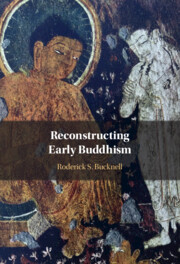
Somehow we both gravitated back to our alma mater, the University of Queensland, and before long we were collaborating in writing a book: The Twilight Language. When I told him, years later, of my plan to produce a book that would be entitled Reconstructing Early Buddhism, he was immediately interested. Over the next decade and more he read, with a critical eye, every draft chapter as I produced it, and finally edited the entire manuscript. I derived much help and encouragement from his expert feedback, and the resulting book might well not have seen the light of day without him. “Thank you, Martin.”
I am also most grateful to Peter Harvey, Professor Emeritus of Buddhist Studies at the University of Sunderland and author of probably the most widely read Introduction to Buddhism, for the meticulous critique he provided of the manuscript of this book, even though disagreeing with several of my interpretations. His corrections and suggestions have greatly improved the finished work.
Among others to whom I am indebted, I would like to acknowledge the two people who most influenced my early study of Buddhism, both now deceased. The first is Bhikkhu Buddhadāsa, an influential Thai monk whose many Dhamma talks and resulting booklets proved to be a constant source of inspiration. Translating some of these into English greatly contributed to my understanding of Buddhism. The second is Chao Chuen, a devout Buddhist layman and hardworking supporter of the monastery where I stayed for four years, who constantly encouraged me in my study and practice. I learned from his example much about the role Buddhism played in Thai society.
I would also like to record my thanks to two scholars of Buddhism with whom I have collaborated: Bhikkhu Anālayo, a prodigiously productive scholar-monk from Germany, with whom I worked to produce the English translation of the Chinese Madhyamāgama, and Kuan Tse-Fu (Jeff), a lecturer in Buddhist Studies in Taiwan and author of several significant research articles on Buddhism, including one with myself as co-author.
And finally I would like to record my thanks to my good friend Eskandar de Vos for his encouragement and practical assistance throughout the whole time I have been working on this book. Thanks also go to Alex Wright, senior executive publisher and head of humanities at Cambridge University Press, and to Katie Idle and the team at CUP for their patience and perseverance in guiding this book through publication.
To all of the above I am deeply grateful. Not all would agree with the conclusions I have reached. For these, I alone am responsible.