

A textbook on organizational stress and well-being wouldn’t be complete without taking a closer look at the stress and well-being of line managers, the formal leaders within organizations. It seems almost intuitive to identify leadership with stress since high demands, such as long working hours and complex decision-making, seem to be linked to the job description of an organization’s leadership roles. Interest in leaders’ stress (and well-being more generally) has increased – in recognition of the fact that leaders’ physical and psychological health can decline, partly due to the demands of their jobs (Barling & Cloutier, Reference Barling and Cloutier2017; Zwingmann et al., Reference Zwingmann, Wolf and Richter2016). Furthermore, leaders’ psychological well-being is of high importance since it affects not only their own leadership behaviors (Kaluza et al., Reference Kaluza, Boer, Buengeler and van Dick2020) but also the well-being of their employees (e.g. Arnold, Reference Arnold2017; Inceoglu et al., Reference Inceoglu, Thomas, Chu, Plans and Gerbasi2018). However, leaders are an ambiguous case when it comes to stress, and it is difficult to form a generalized judgment about whether it is stressful at the top. While the job demands of a leadership position are higher than those of other employees, leaders typically have more access to various types of resources than their employees and therefore may show lower levels of stress (Sherman et al., Reference Sherman, Lee, Cuddy, Renshon, Oveis, Gross and Lerner2012) and higher levels of well-being (e.g. Warr & Inceoglu, Reference Warr and Inceoglu2018). Leaders do enjoy a great deal of job control and autonomy, which are well-established stress buffers (e.g. Wall et al., Reference Wall, Corbett, Martin, Clegg and Jackson1990; Warr, Reference Warr2007), and seem motivated to work long hours, due to financial and psychological rewards (Brett & Stroh, Reference Brett and Stroh2003). In this chapter, we assess whether it is indeed more stressful at the top or not. We also attempt to understand the impact of context by contrasting times of stability with times of crises.
Drawing on the current scientific literature, we begin this chapter by briefly addressing the stressor–strain relationship (e.g. De Jonge & Dormann, Reference De Jonge and Dormann2006), taking the demands-resources perspective (e.g. Demerouti et al., Reference Demerouti, Bakker, Nachreiner and Schaufeli2001), and explaining why it is important to consider context when discussing the demands leaders face today. The impact of stress on their well-being and behavior in contexts that are characterized by a fast-paced but generally stable environment is further described. We then discuss how the altered context of a major crisis can shift leaders’ experience of work demands. To that end, we refer to the COVID-19 pandemic and the various effects it has had on leaders’ roles (Higgins et al., Reference Higgins, Roney, Crowe and Hymes1994).
Leaders nowadays generally work in fast changing times and work environments with high demands, which can be stressful. However, (effective) leadership is even more relevant during times of high pressure for organizations and in times of crisis, with decisions having potentially significant consequences for organizations, employees, and even society more broadly. Especially in these contexts, organizations need leaders who handle demands well, make good decisions, and hold the reins (Van Vugt et al., Reference Van Vugt, Hogan and Kaiser2008).
The chapter concludes by giving some suggestions on how to cope with stress by looking at two potential strategies for leaders to use – mindfulness and the social identity approach. Both have been shown to be beneficial for health and well-being as well as reducing stress (Haslam et al., Reference Haslam, Cruwys, Haslam, Dingle and Chang2016; Khoury et al., Reference Khoury, Sharma, Rush and Fournier2015). Moreover, recent literature suggests the “fruitful” combination of mindfulness and social identity processes when delivering well-being programs in high-stress environments (Adarves‐Yorno et al., Reference Adarves‐Yorno, Mahdon, Schueltke, Koschate‐Reis and Tarrant2020).
Mindfulness refers to the ability to willingly bring one’s awareness to the present moment, while maintaining a nonjudgmental attitude (e.g. Kabat-Zinn, Reference Kabat-Zinn2006). The literature linking an individual’s disposition for and practice of mindfulness to stress relief and positive effects on psychological health and well-being has long featured in organizational research (Bartlett et al., Reference Bartlett, Martin, Neil, Memish, Otahal, Kilpatrick and Sanderson2019; Khoury et al., Reference Khoury, Sharma, Rush and Fournier2015; Tomlinson, Reference Tomlinson, Yousaf, Vittersø and Jones2018). However, besides the individual approach for stress coping that mindfulness provides, leaders in organizations may also rely on social strategies to cope with stress. Just like mindfulness, social identity processes are important predictors of psychological well-being (Adarves‐Yorno et al., Reference Adarves‐Yorno, Mahdon, Schueltke, Koschate‐Reis and Tarrant2020; Haslam et al., Reference Haslam, Steffens, Peters, Maughan, Williams, Kemmp, Haslam, Haslam, Bhui and Bailey2019; Steffen et al., Reference Steffens, LaRue, Haslam, Walter, Cruwys, Munt and Tarrant2021). Leaders are part of the team they lead, as well as the group of peer level leaders. Cultivating a sense of belonging to a social group has proven to have tremendous health boosting and stress buffering effects (e.g. Haslam et al., Reference Haslam, Jetten, Postmes and Haslam2009, Reference Haslam, Cruwys, Haslam, Dingle and Chang2016). Fostering their own attachment to the groups and strengthening their followers’ social identification with the organization may therefore constitute another way to counter stress and improve high-level leaders’ well-being. Thus, while mindfulness provides a strategy for an individual leader’s self-care, the social identity approach considers the leader within the social context of the organization. We focus on these two approaches because they are supported by evidence, although we are well aware that there are alternative ways of coping with the demands that come with a leadership position.
Demands of Leadership and Impact on Well-Being
We experience stress (psychologically and physically) in response to appraising specific events or demands (e.g. Folkman et al., Reference Folkman, Lazarus, Dunkel-Schetter, DeLongis and Gruen1986). According to cognitive appraisal theory, in the transaction between an individual and their environment, the individual first assesses whether the situation contains well-being relevant demands (primary appraisal) and then appraises the resources available to overcome the posed demands (Folkman et al., Reference Folkman, Lazarus, Dunkel-Schetter, DeLongis and Gruen1986). Leaders are no exception to this process. If both a leader’s well-being is threatened as demands are too high and a leader’s resources to confront those demands are scarce or unavailable, the leader will most probably feel stressed according to the job demands-resources model (Demerouti et al., Reference Demerouti, Bakker, Nachreiner and Schaufeli2001). Recent approaches of job demands and well-being (e.g. Crawford et al., Reference Crawford, LePine and Rich2010) have built on this theory and differentiate between challenge demands, which promote personal growth (e.g. high levels of job responsibility, time pressure) and hindrance demands (e.g. role conflict, red tape, organizational politics), which interfere with goal attainment and are typically perceived as more stressful (e.g. Cavanaugh et al., Reference Cavanaugh, Boswell, Roehling and Boudreau2000; LePine et al., Reference LePine, LePine and Jackson2004). Mindfulness and the social identity approach both seem to be important factors influencing this appraisal process. For instance, mindfulness has been shown to positively affect the ability to cognitively reappraise an event, and social identity processes strengthen the perceived social support, which has soothing effects on individual stress experience (Haslam et al., Reference Haslam, O’Brien, Jetten, Vormedal and Penna2005; Troy et al., Reference Troy, Shallcross, Davis and Mauss2013).
Leading in the Context of Today’s World of Work
As the interaction between a leader and the environment or context he or she operates in influences a leader’s cognitive appraisal of workplace demands, contextual factors may help us understand whether leaders are in a stressful role at the top. Let us therefore review the importance of context, which helps us to consider the relationships between leadership and well-being (e.g. Inceoglu et al., Reference Inceoglu, Arnold, Leroy, Lang and Stephan2021) and ultimately performance. Context has been defined by Johns (Reference Johns2006, p. 386) as “situational opportunities and constraints that affect the occurrence and meaning of organizational behavior as well as functional relationships between variables”. Oc (Reference Oc2018) added to this that with regard to leadership, it is important to consider in which context leadership is taking place and how leadership processes (e.g. perceptions of leaders, leader–member exchange) unfold within a specific context.
The fast changing and globalized world of work implies that leadership has existed in a context aptly described as a “global rat race”. While business opportunities have grown all around the world with continuing globalization, so too have volatility, uncertainty, complexity, and ambiguity (VUCA) in business environments. This has been felt strongly among those leading teams, departments, or even organizations. Having found its way into the business dictionary, the “catchy” acronym VUCA is a poignant description of the context of leadership, which is particularly pertinent to organizations participating in the global economic market across different countries. This context involves challenges such as having to lead internationally located and culturally diverse teams, traveling to attend global strategy meetings, or leading teams virtually. VUCA originated from the military vocabulary (introduced by the US Army War College in the 1990s, describing the post–Cold War circumstances in warfare; Jamil & Humphries-Kil, Reference Jamil, Humphries-Kil, Nandram and Bindlish2017). The comparison of today’s globalized world of work to a modern-day warzone clearly indicates the high demands and the stress mentality prevailing in the managerial environment. In fact, scholars have claimed that one consequence of the financial crisis at the end of the first decade of this century is that a cocktail of high stakes, urgency, and uncertainty form the new norm in terms of demands on leaders in organizations (Heifetz et al., Reference Heifetz, Grashow and Linsky2009). With that in mind, we first consider the specific job demands leaders face in the context of this “global rat-race” before examining how they can change during a global crisis like the COVID-19 pandemic.
Leader Job Demands in Today’s World of Work
Job demands refer to aspects of one’s work requiring some type of continued physical or psychological effort (e.g. Demerouti et al., Reference Demerouti, Bakker, Nachreiner and Schaufeli2001). Job resources refer to aspects that are key to goal achievement and can help reduce the strenuous impact of job demands (Crawford et al., Reference Crawford, LePine and Rich2010; Demerouti et al., Reference Demerouti, Bakker, Nachreiner and Schaufeli2001). As stated above, it is the individual’s (i.e. the leader’s) appraisal that determines whether a demand will be experienced as a challenge or a hindrance. What are the common job demands currently faced by leaders, and are they experienced more as challenges or hindrances?
Leaders’ Workload
A major influence on well-being and health at the workplace is the workload, which can either cause individuals to thrive or, when it’s too high or too low, impair their performance and stress levels (Alsuraykh et al., Reference Alsuraykh, Wilson, Tennent and Sharples2019). Naturally, workload is a major job demand in a leadership position. Leaders’ high workload is tied to the expectation that they coordinate and navigate their organization toward goal achievement (Hogg & Vaughan, Reference Hogg and Vaughan2011). They have to prepare for the unexpected and make sure information is gathered, evaluated, and communicated in order to deal with high VUCA (Bennett & Lemoine, Reference Bennett and Lemoine2014). To do so, they typically spend a large amount of time in meetings, often back-to-back, sharing information, communicating tasks, and coordinating the goals to be achieved. They often have a tight schedule due to traveling and attending meetings in different places, while still carrying important operative responsibilities. Such high workload often results in long working hours.
Workload is likely to be perceived as a challenge demand (Crawford et al., Reference Crawford, LePine and Rich2010). Viewing workload as a challenge demand goes along with a higher work engagement, which in turn lowers perceived stress (Crawford et al., Reference Crawford, LePine and Rich2010). However, leaders described as transformational might overstretch themselves, going the extra mile while already feeling exhausted (Zwingmann et al., Reference Zwingmann, Wolf and Richter2016). This greater engagement can take its toll and lead to work–nonwork conflict (e.g. Halbesleben et al., Reference Halbesleben, Harvey and Bolino2009), with leaders finding it difficult to balance the demands at work with possible demands arising from their parenting or other nonwork role commitments. High workload can therefore negatively impact leaders’ health, despite leaders viewing it as a challenge demand or having greater access to health-ameliorating resources, such as more job autonomy (Crawford et al., Reference Crawford, LePine and Rich2010; Ilies et al., Reference Ilies, Dimotakis and De Pater2010; Smith & Cooper, Reference Smith and Cooper1994).
Leaders’ Job Complexity
Another demand that could be stressful to leaders is the tremendous complexity they encounter in their jobs. The globalized world of work exposes them to an environment in which there is a high interconnectivity and interdependence among multiple dimensions in a system, which causes complexity (Sinha & Sinha, Reference Sinha and Sinha2020). High job complexity refers to jobs with difficult tasks, requiring many cognitive resources (Rosopa et al., Reference Rosopa, McIntyre, Fairbanks and D’Souza2019). The example of leaders having to lead culturally diverse teams that are dispersed over different localities and doing so in virtual work settings has been mentioned before. This can be very demanding on leaders’ cognitive resources (Salas et al., Reference Salas, Burke, Fowlkes, Wilson and Kaplan2004). Many leaders also face complex tasks as they are leading within contexts of foreign market regulations and laws. Today’s fast changing environments require strong mental effort. Alongside their other job demands, leaders could see such complexity as a threat to their well-being (Chung-Yan, Reference Chung-Yan2010; Folkman et al., Reference Folkman, Lazarus, Dunkel-Schetter, DeLongis and Gruen1986).
Yet, even though job complexity is a highly demanding aspect of work, it can be positively associated with job satisfaction and work engagement (Crawford et al., Reference Crawford, LePine and Rich2010; Srivastava et al., Reference Srivastava, Locke, Judge and Adams2010). Job complexity calls for strong mental effort, abilities, and skillfulness, which all tend to be motivating when perceived as challenge (Ali et al., Reference Ali, Said, Yunus, Kader, Latif and Munap2014; Crawford et al., Reference Crawford, LePine and Rich2010). This is especially true if individuals experience the possibility of learning and high levels of autonomy, as would be the case for leaders (Ali et al., Reference Ali, Said, Yunus, Kader, Latif and Munap2014; Chung-Yan, Reference Chung-Yan2010; Nurmi & Hinds, Reference Nurmi and Hinds2016). The complexity of a job has furthermore been shown to be crucial in the alleviation of burnout (Kubicek & Korunka, Reference Kubicek and Korunka2015). Job complexity therefore has the potential to benefit a leader’s well-being.
Communication When Leading Virtual Teams
Years ago, Fiedler (Reference Fiedler1992) noted that besides job tasks, interpersonal interactions at work, and difficult ones in particular, can be highly demanding. Leaders carry great responsibility for the relationships among their personnel, their well-being, and how they work together. Globalization has implied that leaders increasingly oversee geographically dispersed teams, adding complexity to their job. Poor communication can be more prevalent in virtual teams, especially when work is characterized by volatility, uncertainties, complexity, and ambiguities. Resulting conflicts can easily be perceived as a hindrance demand (Smith & Cooper, Reference Smith and Cooper1994).
Virtual communication channels tend to be less rich, making communication more ambiguous, especially when it involves highly complex or emotional-laden content (Daft & Lengel, Reference Daft and Lengel1986). Virtual communication is also less direct, less frequent, and less conducive to being openly shared (Schulze & Krumm, Reference Schulze and Krumm2017) and has been associated with higher levels of fatigue (Shockley et al., Reference Shockley, Gabriel, Robertson, Rosen, Chawla, Ganster and Ezerins2021; Shoshan & Wehrt, Reference Shoshan and Wehrt2022). As a result, it can be more difficult to build relationships and trust in teams that primarily work together virtually and over distance (Powell et al., Reference Powell, Piccoli and Ives2004). Also, as organizations and teams become increasingly diverse (e.g. Roberson & Stevens, Reference Roberson and Stevens2006), ambiguity in communication due to virtuality may be compounded by greater diversity in norms, backgrounds, knowledge, and culture.
Leaders’ Role Ambiguity
The high VUCA world (Bennett & Lemoine, Reference Bennett and Lemoine2014) also affects the context of organizational leadership through its volatility, meaning the fast pace of change. This may affect specific tasks or even the market situation unexpectedly and unpredictably. Irrespective of whether changes are small, big, negative, or positive, they appear to cause uncertainty (Sinha & Sinha, Reference Sinha and Sinha2020). In fact, the situation might change faster than information can be communicated to decision-makers, further exposing leaders to uncertainties. Leaders’ role can thus become more ambiguous to them. Typically, work role ambiguity negatively affects individuals (Garst et al., Reference Garst, Frese and Molenaar2000). It is linked to poor mental health, such as increased depression (Schmidt et al., Reference Schmidt, Roesler, Kusserow and Rau2014). As such, it can easily constitute a hindrance demand for leaders (Garst et al., Reference Garst, Frese and Molenaar2000; LePine et al., Reference LePine, LePine and Jackson2004).
Organizational Politics
The high VUCA world has significantly transformed the way professional careers have to be approached, laying a greater responsibility on individuals to be their own career brokers (Shaffer & Zalewski, Reference Shaffer and Zalewski2011). Therefore, being strategic and skillful in organizational politics, especially when it comes to positioning oneself for a next career step in the VUCA world, may be very important. Organizational politics denote self-interested attempts to influence others. They can range from self-promoting behavior and ingratiation, occasional rule bending for the sake of goal achievement, to backstabbing (e.g. Landells & Albrecht, Reference Landells and Albrecht2017). Such actions can be demanding on leaders in a hindering or a challenging way.
Employees who start politicking can be a hindrance. Seeking informal relationships with their leaders with the aim of paving the way to personal advantages may be a problematic demand to handle for leaders (Guo et al., Reference Guo, Kang, Shao and Halvorsen2019). Highly engaged employees, who typically are less involved in organizational politics, tend to react quite poorly to perceived politicking within the team, perceiving it as unfair (Guo et al., Reference Guo, Kang, Shao and Halvorsen2019; Rosen et al., Reference Rosen, Chang, Johnson and Levy2009). Perceived organizational politics may consequently cause a toxic atmosphere, and interpersonal conflicts in the manipulated leader’s team can negatively impact team performance and become a hindrance to the leader (Fiedler, Reference Fiedler1992; Guo et al., Reference Guo, Kang, Shao and Halvorsen2019; Rosen et al., Reference Rosen, Chang, Johnson and Levy2009; Zulfadil et al., Reference Zulfadil, Hendriani and Machasin2020).
On the other hand, leaders who are more politically skilled can experience less stress and better personal well-being (Cullen et al., Reference Cullen, Gerbasi and Chrobot-Mason2018). Their skill can lead to recognition by superiors, which would build well-being and health (Grebner et al., Reference Grebner, Elfering, Semmer, Perrewé and Ganster2010; Landells & Albrecht, Reference Landells and Albrecht2017). Furthermore, being more politically skilled can be beneficial to informal relationships with influential peers and leaders, which could increase the availability of social support. More politically skilled leaders could also get more opportunities to promote their own ideas, which can generate feelings of autonomy and control, and experience greater career advancement, all of which can counter perceived stress (Grebner et al., Reference Grebner, Elfering, Semmer, Perrewé and Ganster2010; Landells & Albrecht, Reference Landells and Albrecht2017). As such, leaders’ political skill could help them view their organization’s politics more as a challenge than a hindrance.
Leaders’ Loneliness
Loneliness appears to be a professional hazard growing with the level of leadership (Zumaeta, Reference Zumaeta2019). This seems to be especially true for leaders in the VUCA world, which itself can be described as demanding and lonely for leaders (e.g. Waller et al., Reference Waller, Lemoine, Mense, Garretson and Richardson2019). Especially, in times of situational uncertainties, employees expect more guidance and decision-making of their leaders, and social support decreases the higher the leadership level is (e.g. Kark & Van Dijk, Reference Kark and Van Dijk2019; Zumaeta, Reference Zumaeta2019). Although political skill can contribute to the formation of informal relationships with peers and supervisors that are beneficial for a leaders’ career advancement, it may not help with their popularity among peers in general (Guo et al., Reference Guo, Kang, Shao and Halvorsen2019; Landells & Albrecht, Reference Landells and Albrecht2017). Being at the “top” may be a lonely place.
The competitiveness that goes along with career advancement can create animosity that stands in the way of closeness to peers or subordinates (Rokach, Reference Rokach2014). Extending on the aspect of strategically seeking out social contacts that may serve a specific egocentric agenda, these contacts don’t equal intimate connections and therefore the quality of such relationships might be experienced as poor (Rokach, Reference Rokach2014; Szostek, Reference Szostek2019; Zumaeta, Reference Zumaeta2019). Once the relationship no longer serves a purpose, it is likely to be dropped by one of the involved parties, as it has become a liability, losing its benefits and leading to disengagement, which consequently may contribute to social distance (Rokach, Reference Rokach2014).
Also, while leaders can be effective at creating a common vision and uniting a team of employees, they may not necessarily feel part of that team. Leaders’ relationships with followers typically are imbalanced. This may be due to subordinates conveying an expectation of leaders having to support them without any obvious need to reciprocate (Rokach, Reference Rokach2014). As a result, leaders may develop feelings of being ostracized and lonely. Silard and Wright (Reference Silard and Wright2020) proposed that this can be due to status differences between leaders and their followers and that it may be especially true for leaders new to their role and those who are less likely to share their emotions. As loneliness has so many known negative effects on mental health and well-being, it can be seen as another hindrance demand on leaders.
Above we have charted the major demands faced by those in formal positions of leadership in a context of relative economic stability. These demands can sometimes be viewed as challenges, which could benefit leaders’ well-being. Others can be seen as hindrances, thus hampering their well-being. Leader job demands like job complexity appear to be challenge demands, which have positive and motivating effects, potentially buffering the stress of leadership. Having to lead virtual teams, greater role ambiguity stemming from the fast pace of change, and loneliness seem to be hindrance demands potentially increasing stress for leadership – with workload and organizational politics potentially having both challenging and hindering effects in a context of relative economic stability. Below we turn our attention to leader job demands in the context of a major crisis.
Demands of Leadership and Impact on Well-Being in Times of Crisis
Leader Job Demands in Times of Crisis
Job demands that leaders face in times of crisis are amplified, while access to resources that buffer stress decreases. The VUCA acronym provides an accurate description for the globalized context of the world of work we have come to know throughout the second decade of the twenty-first century. In fact, globalization has turned aspects of past crises into permanent demands of the working world ever since the financial crisis in the early 2000s (Heifetz et al., Reference Heifetz, Grashow and Linsky2009). To make matters worse, the spread of COVID-19 in late 2019 and throughout 2020 and 2021 has further elevated those demands to new crisis levels. These heightened demands are likely to stay as greater reliance on remote working and virtual communication have become the “new normal”.
A crisis can be seen as a particular episode, unexpectedly and strongly affecting contextual factors. Scholars define organizational crisis as a “low-probability, high-impact event that threatens the viability of the organization and is characterized by ambiguity of cause, effect, and means of resolution, as well as by a belief that decisions must be made swiftly” (Pearson & Clair, Reference Pearson and Clair1998, p. 60). The COVID-19 pandemic is such an event. It has impacted nations across the globe, costing the lives of millions of people and threatening the health of even more. Governments had to impose drastic measures such as forcing their citizens into confinements and lockdown in order for people to remain socially distanced and flatten the infection curves. For some periods, only professionals involved in essential services were able to leave their households. Everybody else stayed home until further notice. Children had to be homeschooled and remote work turned the homes of many into offices, substantially blurring the lines between work and personal lives (e.g. Allen et al., Reference Allen, Merlo, Lawrence, Slutsky and Gray2021; Wood et al., Reference Wood, Michaelides, Inceoglu, Hurren, Daniels and Niven2021). The unpredictability of spread, mutations, and measures to combat the virus have shocked all areas of societal life, also affecting the context of leadership in organizations within the global economy (Buckley, Reference Buckley2020). The previously mentioned demands of leadership and their impact on leader well-being were clearly affected. Similarly, like after the financial crisis at the beginning of the millennium, the demands heightened since the COVID-19 crisis have led to changes in work flexibility, mobility and a greater reliance on virtual work. We address how the earlier-mentioned demands of leadership can be affected in times of crisis by using the particular context of COVID-19 as an example.
Leaders’ Workload: In Times of Crisis
Workload has been described as a possible source for leaders to thrive on or as a hinderance, depending on whether the demands are too high or too low (Alsuraykh et al., Reference Alsuraykh, Wilson, Tennent and Sharples2019). We had concluded that under noncrisis circumstances workload could be seen as a challenge, although this can occur at the expense of well-being and work–nonwork commitments. We know that resources such as job control can potentially buffer the effects of workload on stress (Alsuraykh et al., Reference Alsuraykh, Wilson, Tennent and Sharples2019; Ilies et al., Reference Ilies, Dimotakis and De Pater2010; Rigotti et al., Reference Rigotti, De Cuyper and Sekiguchi2020).
In times of crisis, employees need a comforting vision and orientation from their leaders (Day et al., Reference Day, Sin and Chen2004; Jetten et al., Reference Jetten, Reicher, Haslam and Cruwys2020; Kark & Van Dijk, Reference Kark and Van Dijk2019; Shamir & Howell, Reference Shamir and Howell1999; Stam et al., Reference Stam, van Knippenberg, Wisse and Nederveen Pieterse2018; Van Vugt et al., Reference Van Vugt, Hogan and Kaiser2008). As a result, leaders could experience more subordinate endorsement and perceive more decision-making freedom. Experiencing more job control and autonomy could mitigate the negative effects of leaders’ increased workload.
However, psychological detachment from work, sleep quality, and positive work–family interaction in the safe space of home are all important for workload recovery (e.g. Ilies et al., Reference Ilies, Keeney and Goh2015; Sanz‐Vergel et al., Reference Sanz‐Vergel, Demerouti, Mayo and Moreno‐Jiménez2011; Sonnentag & Fritz, Reference Sonnentag and Fritz2015), but have been curtailed during the COVID-19 pandemic (Rigotti et al., Reference Rigotti, De Cuyper and Sekiguchi2020). The situation at home during the COVID-19 pandemic was demanding in and of itself. Lockdowns forced parents to work from home while taking on extraordinary caring and teaching responsibilities for their children (Rigotti et al., Reference Rigotti, De Cuyper and Sekiguchi2020; Shockley et al., Reference Shockley, Clark, Dodd and King2020). So, if under normal circumstances it has been shown that workload can cause strain-inducing work–family conflict, it is fair to assume that this has been even more the case during the COVID-19 crisis.
In conclusion, leader’s workload in times of crisis is heightened, although the stress experience through this increased demand may be mitigated by the greater experience of decision-making freedom. In the particular case of the COVID-19 crisis; however, a leader’s workload was likely to be amplified by nonwork commitments and limited possibilities to create psychological detachment from work. Workload was therefore likely to be perceived as hindrance.
Leaders’ Job Complexity: In Times of Crisis
Job complexity is generally associated with better well-being, suggesting that it is typically viewed more as a challenge than a hinderance. During a crisis, job complexity increases. More cognitive resources are required to perform the job of a leader as many new and swiftly changing contextual variables manifest themselves.
During the COVID-19 pandemic, the already complex task of leading international and virtual teams has increased further in complexity. Infection varied across locations; governments varied in the strategies and measures used to combat the virus. Leaders had to keep those factors in mind when thinking about how tasks could be assigned. Team members’ reduced availability due to homeschooling or other personal issues made task assignments more difficult. Personal issues or tragedies had to be made a priority in order to keep teams performing effectively (Hu et al., Reference Hu, He and Zhou2020). In situations that require high emotional and task complexity, leaders’ cognitive resources might suffer, especially with the complexity of leading in a crisis such as COVID. Awareness of shortcomings in leading and not being able to make satisfactory decisions would have easily resulted in stress and ill-health (Folkman et al., Reference Folkman, Lazarus, Dunkel-Schetter, DeLongis and Gruen1986). Hence, complexity in times of crisis could become a hindrance demand to leaders.
Communication When Leading Virtual Teams: In Times of Crisis
Clear communication has been described as a crucial skill when leading virtual teams (Schulze & Krumm, Reference Schulze and Krumm2017) and is even more important in times of crisis (Eldridge et al., Reference Eldridge, Hampton and Marfell2020). The acute levels of stress experienced during the COVID-19 pandemic, coupled with the dramatic increase in virtual work (D’Auria & De Smet, Reference D’Auria and De Smet2020), exacerbated demands placed on leaders. Not only were more leaders forced to lead virtually, but they were tasked with doing so in a context where many employees were in greater distress than usual.
This abrupt change likely had overwhelming effects on leaders. Many leaders had been thrown into the deep end, having to catch up on many skills (e.g. Schulze & Krumm, Reference Schulze and Krumm2017) to make their virtual teams work effectively, likely causing role ambiguity or conflict. New structures and methods of communicating had to be established. New ways of keeping team members engaged and connected had to be developed, all on the fly, further adding to leaders’ workload and job complexity. Such circumstances were likely experienced more as a hindrance than a challenge.
Leaders’ Role Ambiguity: In Times of Crisis
The (noncrisis) context of VUCA has been described as consisting of constant volatile and unpredictable changes, exposing leaders to a prevailing uncertainty on many levels (Sinha & Sinha, Reference Sinha and Sinha2020). This is likely to increase leaders’ role ambiguity. Its negative effects on mental health clearly makes it a hindrance demand for leaders (Garst et al., Reference Garst, Frese and Molenaar2000; LePine et al., Reference LePine, LePine and Jackson2004; Schmidt et al., Reference Schmidt, Roesler, Kusserow and Rau2014). Uncertainties and ambiguities increase in times of crisis by definition (Pearson & Clair, Reference Pearson and Clair1998), giving to assume that leaders’ role ambiguity does so as well.
Interestingly enough, it can be argued that in times of crisis the leaders’ role ambiguity increase might be compensated by several challenge demands like job control and autonomy. Followers explicitly seek for guidance from their superiors, desiring to reduce subjective uncertainties prevailing in times of crisis (Cicero et al., Reference Cicero, Pierro and Knippenberg2010; Day et al., Reference Day, Sin and Chen2004; Jetten et al., Reference Jetten, Reicher, Haslam and Cruwys2020; Shamir & Howell, Reference Shamir and Howell1999; Van Vugt et al., Reference Van Vugt, Hogan and Kaiser2008). The leader becomes the designated decision-maker, typically being less restricted, which favors those who prefer autonomy (Day et al., Reference Day, Sin and Chen2004; Parker et al., Reference Parker, Laurie, Newton and Jimmieson2014). During the COVID-19 crisis, leaders certainly had more freedom, such as trying out and choosing new online tools to enable virtual teamwork or allocate rotations for office hours. The pandemic brought a welcome trend for reduction in organizational bureaucracy and red tape, reducing burdensome rules and regulations and increasing employee ownership (Ellerman & Gonza, Reference Ellerman and Gonza2020; Wise, Reference Wise2020). In general, leaders tend to receive more endorsement for quick decisions by followers during a crisis, in particular when a leader’s communication is opportunity-oriented (Dirani et al., Reference Dirani, Abadi, Alizadeh, Barhate, Garza, Gunasekara, Ibrahim and Majzun2020; Kark & Van Dijk, Reference Kark and Van Dijk2019; Stam et al., Reference Stam, van Knippenberg, Wisse and Nederveen Pieterse2018).
Under different circumstances, leaders might not have so easily been able to take the decisions they did during the COVID crisis, or they at least wouldn’t have had the necessary follower support for successful implementation. This fuels a leader’s perception of higher amount of freedom in a crisis, which can counter leader stress and potentially increase leader well-being even though the economy is in dire straits (Smith & Cooper, Reference Smith and Cooper1994).
Organizational Politics: In Times of Crisis
As times of crisis often provide an opportunity for leaders to arise, being more politically skilled could be quite helpful. Earlier we mentioned that leaders’ political skill can facilitate relationships with influential individuals within the organization. This can enhance opportunities for social support that can relieve leaders’ stress (Haslam et al., Reference Haslam, O’Brien, Jetten, Vormedal and Penna2005), which would be especially welcome in times of crisis when expectations of the leader are high. Nonetheless, the self-interested nature of politically skilled individuals could be poorly looked upon by subordinates during a crisis, as implied by Haslam and colleagues (Reference Haslam, Steffens, Reicher and Bentley2021). While followers are particularly receptive to charismatic leaders in times of crisis, leader behavior seen in such a context as motivated by self-interest is likely to result in poor leader–follower or leader–peer relationships, which can in turn increase leaders’ stress (Fiedler, Reference Fiedler1992).
Leaders’ Loneliness: In Times of Crisis
Due to employees’ insecurities and desire for charismatic leadership during times of crisis, leaders may actually feel that during such times, they are shouldering an even greater burden (Stam et al., Reference Stam, van Knippenberg, Wisse and Nederveen Pieterse2018). Despite any insecurities or fears they could be feeling themselves, leaders might continue to refrain from sharing negative emotions (Silard & Wright, Reference Silard and Wright2020) to serve the interests of followers needing “the woman or man of the hour” to lead them out of the crisis (Shamir & Howell, Reference Shamir and Howell1999; Stam et al., Reference Stam, van Knippenberg, Wisse and Nederveen Pieterse2018). This could have exacerbated leaders’ hindering feelings of loneliness (Silard & Wright, Reference Silard and Wright2020).
Table 4.1 provides an overview of the differences between leaders’ challenge and hindrance demands in times of stability and those in times of crisis.
Table 4.1 Leaders’ challenge and hindrance demands
| Leader job demand | Times of stability | Times of crisis | ||
|---|---|---|---|---|
| Challengea | Hindranceb | Challengea | Hindranceb | |
| Leaders’ workload | X | X | X | |
| Leaders job complexity | X | X | ||
| Communication when leading virtual teams | X | X | ||
| Leaders’ role ambiguity | X | X | ||
| Organizational politics | X | X | X | |
| Leaders’ loneliness | X | X | ||
a Challenge: Demands that promote personal growth
b Hindrance: Typically, more stressful and in the way of goal attainment
What Can Be Done?
Leader Resources
The literature on job resources states that aspects like autonomy, task significance, variety of tasks, the ability to take part in decision-making, and many more spark motivation and negatively affect stress and burnout (Demerouti & Nachreiner, Reference Demerouti and Nachreiner2019). These aspects may all be associated with leadership positions. A growing body of literature therefore argues that leaders may actually experience less stress than subordinates (e.g. Sherman et al., Reference Sherman, Lee, Cuddy, Renshon, Oveis, Gross and Lerner2012). Leaders dispose of resources like autonomy, power, or recognition more than followers typically do. Autonomy, decision-making, and job control, for instance, are all inherent to the leadership position. They have been linked to workplace health and performance (Bond & Bunce, Reference Bond and Bunce2003; Boswell et al., Reference Boswell, Olson-Buchanan and LePine2004; Rigotti et al., Reference Rigotti, De Cuyper and Sekiguchi2020).
Sometimes however, these leader role-related characteristics are not sufficient to prevent stress, and leaders require support through training and interventions. Leadership training and interventions targeting stress reduction have been proven to effectively foster intra- and interpersonally relevant skills (e.g. Lacerenza et al., Reference Lacerenza, Reyes, Marlow, Joseph and Salas2017). The two approaches we want to focus on for that matter have been introduced already: mindfulness and the social identity approach. Both are salient to the leader job demands discussed in this chapter.
Mindfulness and Social Identity Processes
Mindfulness and social identity processes affect individuals’ stress experience through intra- and interpersonal processes, respectively. Mindfulness, referring to the dispositional or trained ability to practice present-moment awareness with a nonjudgmental attitude can be considered an intrapersonal resource for leaders to cope with stress. The social identity approach, on the other hand, seems to influence interpersonal aspects like social support, which is crucial when facing stress.
Mindfulness and Stress. Individuals with a well-developed mindfulness are typically able to better deal with stress. They possess a wide set of skills (internal and external observation, acceptance without judgment, acting with awareness, cognitive diffusion, etc.; e.g. Baer et al., Reference Baer, Smith and Allen2004; Hayes et al., Reference Hayes, Luoma, Bond, Masuda and Lillis2006), that directly or indirectly affect how they appraise demands that they face. Mindfulness facilitates cognitive reappraisal (Garland et al., Reference Garland, Gaylord and Fredrickson2011), which can help to reevaluate stressors as challenges instead of hindrances. Cognitive reappraisal is defined as changing the way emotional stimuli are thought of, with the aim of changing the emotional impact of an event, thus helping to reduce the intensity of the strain experienced (Garland, Reference Garland2007; Gross & John, Reference Gross and John2003; Gross & Thompson, Reference Gross, Thompson and Gross2007; Troy et al., Reference Troy, Shallcross, Davis and Mauss2013). Higher mindfulness goes along with higher positive cognitive reappraisal, and more mindful individuals allocate more positive meaning to stressful events, using benefit-finding as a coping strategy (Garland, Reference Garland2007; Garland et al., Reference Garland, Gaylord and Fredrickson2011; Troy et al., Reference Troy, Shallcross, Davis and Mauss2013).
Looking at stress from a challenge–hindrance perspective, positive reappraisal fostered by mindfulness may help leaders to perceive stressors as challenges rather than hindrances. Mindfulness skills contribute to the ability to prevail in a metacognitive state of disengagement with thoughts and feelings (Troy et al., Reference Troy, Shallcross, Davis and Mauss2013). More mindful leaders are likely to benefit from a greater cognitive flexibility, making it easier for them to disengage and reappraise, rather than identifying with stressful feelings caused by the initial appraisal of demands (Baer et al., Reference Baer, Smith and Allen2004; Fletcher & Hayes, Reference Fletcher and Hayes2005; Troy et al., Reference Troy, Shallcross, Davis and Mauss2013). Garland (Reference Garland, Gaylord and Fredrickson2011) found support for an upwards spiraling process of mindfulness leading to positive reappraisal and thereby stress reduction. After the stress appraisal occurred, disengagement from the negative first appraisal is crucial in order to reappraise the situation, and mindfulness helps the internal process to achieve this. Hence, leaders who develop their mindfulness can thereby reduce their perceived stress or even avoid the development of feelings of distress.
In terms of stress reduction and stress prevention, developing leader mindfulness certainly isn’t the only existing remedy, but it appears to be a key element from an intrapersonal perspective.
Social Identity and Stress. Tajfel and Turner developed the theory of social identity in the late 1970s which, extended by the theory of self-categorization by Turner and colleagues in the 1980s, forms the social identity approach (Jetten et al., Reference Jetten, Reicher, Haslam and Cruwys2020). One of the key statements the social identity approach makes is that people define themselves as “we and us” rather than “I and me”, in diverse social contexts, through an internalization of their group membership. As a consequence, social identity affects the mental, cognitive, and physical well-being of individuals, and consequently, a person’s psyche is under the influence of the state of the group with which they identify (Haslam et al., Reference Haslam, Jetten, Postmes and Haslam2009; Häusser et al., Reference Häusser, Kattenstroth, van Dick and Mojzisch2012; Jetten et al., Reference Jetten, Haslam, Haslam, Dingle and Jones2014).
The interpersonal effects of social identification on cognitive appraisal processes are as follows. With a salient social identification, the appraisal taking place will be based on whether the ingroup’s well-being is threatened. If so, then social support will be included in the evaluation of available resources to confront this threat (van Dick, Reference van Dick2015). The social support within a group of people who strongly identify with each other increases in the face of adversity, which is a helpful mechanism for eventually overcoming a problem and buffering stress (Haslam et al., Reference Haslam, O’Brien, Jetten, Vormedal and Penna2005).
Thereby, the interpersonal component of the social identity approach explains how leaders who strongly identify with their organization, their peers, and their team may actually feel social support, as well as an abundance of resources to overcome stressors.
How Mindfulness and Social Identity Help Leaders Cope with Job Demands
Mindfulness and social identity processes are both helpful in predicting well-being and alleviating stress and can be combined in interventions designed to help people cope with highly stressful environments (Adarves‐Yorno et al., Reference Adarves‐Yorno, Mahdon, Schueltke, Koschate‐Reis and Tarrant2020). Both mindfulness and social identity impact the cognitive appraisal processes and can add to leaders’ resources for coping with the demands they face.
To improve intrapersonal processing, leaders can bolster their mindfulness skills by introducing a regular mindfulness practice to their daily routine. Of course, organizational programs providing mindfulness training to employees and leaders are helpful as well and have become increasingly popular (Reb et al., Reference Reb, Allen and Vogus2020).
To use the social identity approach to coping, leaders could look at their leadership role as one of social identity management. Such identity leadership is built around the development of a shared social identity surrounding the leader and his or her team, peers, and organization (Steffens et al., Reference Steffens, Haslam, Reicher, Platow, Fransen, Yang, Ryan, Jetten, Peters and Boen2014). Identity leadership involves leaders clearly showing that they are “of the group” (identity prototypicality), that what they do is done with the best interests of the team at heart (identity advancement), that they craft a clear sense of “us” (identity entrepreneurship) and make it matter to be part of the team (identity impresarioship). A social identity approach to leadership that provides leaders and their followers a stronger social identity is very likely to lower stress for all concerned. Combining mindfulness and identity leadership principles in training programs on leader coping strategies seems promising as both mindfulness and social identity–oriented trainings have been shown to be effective in high-stress environments (Adarves‐Yorno et al., Reference Adarves‐Yorno, Mahdon, Schueltke, Koschate‐Reis and Tarrant2020).
Leaders with a stronger social identity would more easily feel like they have more social support and therefore more resources to deal with workload, job complexity, or the uncertainties of the fast-paced change of today’s world of work. Leader loneliness would be less of a stressor as social identity provides a sense of social and emotional belonging (Peterson, Reference Peterson2005). Social identification could also buffer against organizational politics by fostering social support and engagement. Furthermore, shared identity is a key aspect of good communication, which helps to prevent hindrance stress through virtual collaboration (Greenaway et al., Reference Greenaway, Wright, Willingham, Reynolds and Haslam2015).
Leader mindfulness provides leaders with the ability to be more accepting of circumstances and less rigidly tied to the first appraisal, allowing for more positive reappraisal resulting in stress reduction (Garland et al., Reference Garland, Gaylord and Fredrickson2011). More mindful leaders should more easily view workload, job complexity, the fast pace of change, and uncertainty as well as virtual leadership as challenge rather than hindrance demands. Furthermore, mindfulness has been related to the reduction of loneliness (Lindsay et al., Reference Lindsay, Young, Brown, Smyth and Creswell2019) and the reduction of destructive, deviant, or unethical pro-organizational politicking behavior (Wan et al., Reference Wan, Zivnuska and Valle2020), which would both reduce the stress of leadership.
Not All That Glitters Is Gold
We caution readers not to consider mindfulness and social identity as panaceas for leaders’ stress. Even though these seem promising, more research, specifically looking at the proposed relationships, is necessary to understand how to best make use of both coping strategies and especially on how to best combine them. Leader mindfulness and social identity processes are neither a guarantee against stress at the top, nor the only way to alleviate or prevent it. For example, job design remains an important consideration for alleviating or preventing stress in leadership (and other) roles.
Today’s world of work poses many demands on both leaders and followers, and the price of the wear and tear of such a stressful work environment is high. Leaders do in fact hold a great responsibility for the stress their employees experience and play a crucial role in occupational health (Montano et al., Reference Montano, Reeske, Franke and Hüffmeier2017). Leaders have to be aware that they are role models and set the tone for their subordinates to follow (Inceoglu et al., Reference Inceoglu, Thomas, Chu, Plans and Gerbasi2018). This means that leaders must set an example by taking their self-care seriously.
The integral role that leaders play in employee well-being has been the subject of numerous systematic reviews and meta-analyses in recent years (see for example Harms et al., Reference Harms, Credé, Tynan, Leon and Jeung2017; Inceoglu et al., Reference Inceoglu, Thomas, Chu, Plans and Gerbasi2017; Montano et al., Reference Montano, Reeske, Franke and Huffmeir2017). Due to this impressive body of work, it has become generally accepted that constructive styles of leadership promote positive employee well-being and mitigate negative employee well-being, while the opposite can be said for destructive styles of leadership (e.g., Arnold, Reference Arnold2017; Tepper et al., Reference Tepper, Simon and Park2017).
Even with this expansive body of literature, many questions remain unanswered. Leaders of present-day organizations are challenged to support employee well-being amid contextual forces such as an increasingly globalized economy, changing gender norms, an unprecedented pace of technological change, and global crises such as the Covid-19 pandemic. Thus, the field has emphasized the need to begin to address questions of ‘how’, ‘why’, and ‘when’ certain leadership behaviors can affect employee well-being using robust research designs and innovative methodologies (e.g., Fischer et al., Reference Álvarez‐Pérez, Carballo‐Penela and Rivera‐Torres2017). Furthermore, given the extensive range of constructive and destructive leadership styles and behaviors in the extant literature (e.g., Dinh et al., Reference Dinh, Lord, Gardner, Meuser, Liden and Hu2014), researchers have called for examining patterns of leadership characteristics, styles, and behaviors to understand if, and how, they cooccur (e.g., Arnold et al., Reference Arnold, Connelly, Gellatly, Walsh and Withey2017) and how these combinations are related to employee well-being (e.g., Mäkikangas et al., Reference Mäkikangas, Kinnunen, Feldt and Schaufeli2016).
To consolidate the latest research on how line managers affect employee well-being, we examined empirical work published in the last decade focused on constructive and destructive leadership styles, behaviors, and characteristics as predictors of employee well-being. In this chapter, we summarize this recent literature, describe its strengths and limitations, and highlight areas for future work. Based on the results of a comprehensive literature review, we offer frameworks linking constructive and destructive leadership to employee well-being, including a summary of explanatory processes and contextual factors affecting these relationships.
We begin with an outline of leadership in organizations as both constructive and destructive. Then we position the concept of a line manager within the broader leadership literature and outline the definition of employee well-being considered in our review. Next, we explain two research-supported frameworks linking leadership and employee well-being (see Figures 5.1 and 5.2). Finally, we integrate findings into key themes, discuss methodological issues, and future research directions which, if pursued, would advance our understanding in this area.
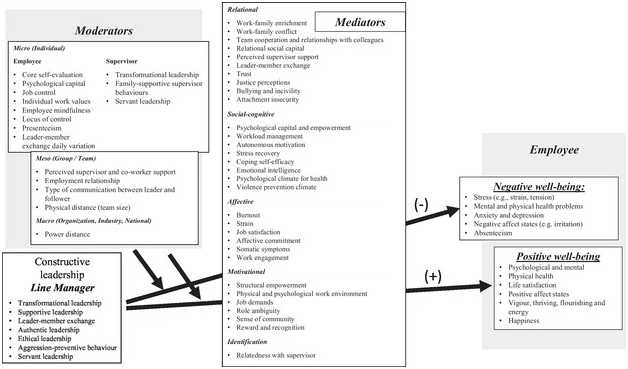
Figure 5.1 Summary of research linking constructive leadership and employee well-being

Figure 5.2 Summary of research linking destructive leadership and employee well-being
Construct Clarity: Leadership, Line Managers, and Employee Well-Being
Constructive and Destructive Leadership
Constructive and destructive leadership are typically viewed at opposite ends of the leadership continuum. Constructive leaders are said to enhance the motivation and well-being of followers by using engaging behaviors and encouraging involvement and participation in decision processes (Einarsen et al., Reference Einarsen, Aasland and Skogstad2007). As indicated by previous work on the desirable characteristics of leadership, constructive leaders are concerned with the welfare of their employees (e.g., Bass, Reference Bass1985).
Destructive leadership, on the other hand, describes repeatedly harmful and/or deviant behaviors targeted towards followers, which may be either physical or verbal, active or passive, direct or indirect (Schyns & Schilling, Reference Schyns and Schilling2013). These behaviors tend to take a toll on employee psychological well-being and motivation by depleting the stores of personal resources that allow individuals to cope with adversity and have negative associations with employee physical health (e.g., Barling & Frone, Reference Barling and Frone2017; Einarsen et al., Reference Einarsen, Aasland and Skogstad2007; Hobfoll, Reference Hobfoll1989). The introduction of Tepper’s (Reference Tepper2000) abusive supervision measure over 20 years ago was an important development in the destructive leadership literature, but this work is still relatively new in comparison to over a century of research on constructive aspects of leadership.
Line Managers as Leaders: Direct Supervisors Matter
Leadership behavior at all levels of the organization is important, but the actions of immediate (i.e., direct) supervisors and/or managers are probably most salient to the well-being of those reporting to them (Kozlowski & Doherty, Reference Kozlowski and Doherty1989; Nielsen, Reference Nielsen2013). This is likely due to the fact that an immediate supervisor is one of the most influential people in an employee’s work environment (e.g., Kozlowski & Doherty, Reference Kozlowski and Doherty1989).
Within this area of research, the term line manager is used in several different ways. Without a specific description of the level of leadership under study, this ambiguous pattern of usage can lead to confusion. For example, in a qualitative study of employees with depression, Sallis and Birkin (Reference Sallis and Birkin2014) described any direct supervisor below the senior management level as a line manager, effectively eliminating the middle manager category (e.g., Yammarino et al., Reference Yammarino, Dionne, Chun and Dansereau2005). Another study suggests a line manager can be anyone’s immediate supervisor (Lundmark et al., Reference Lundmark, Hasson, von Thiele Schwarz, Hasson and Tafvelin2017). In other cases, line manager is equated with team leader (e.g., Nielsen, Reference Nielsen2013) or middle manager (e.g., Nielsen & Randall, Reference Nielsen and Randall2009). Finally, in an examination of the mental health of Executive Directors in the nonprofit sector, the ‘line manager’ or the individual(s) to whom the Executive Director reports directly, was a representative of the Board of Directors (Olinske & Hellman, Reference Olinske and Hellman2017).
Despite this lack of clarity, in much of the research in the area of leadership and employee well-being, researchers ask participants to rate their direct supervisors’ leadership style or report frequencies of their supervisors’ behaviors. This approach recognizes that actions taken by direct supervisors (as perceived and rated by employees) have implications for employee well-being. Throughout this chapter, the term line manager is used synonymously with direct or immediate manager/supervisor and leader, and where available, details are provided on the level of organizational hierarchy in each study. We revisit this issue later in the chapter.
Employee Well-Being
Well-being is a multidimensional phenomenon with a range of positive and negative states that relate to employees both at work and outside of work (e.g., Danna & Griffin, Reference Danna and Griffin1999; Ganster & Rosen, Reference Ganster and Rosen2013; Mäkikangas et al. Reference Mäkikangas, Kinnunen, Feldt and Schaufeli2016; Montano et al., Reference Montano, Reeske, Franke and Huffmeir2017). It is measured using a broad range of self- and other report scales and physiological measures. Warr (Reference Warr, Kahneman, Diener and Schwarz1999) described context-specific well-being as a limited view of people’s feelings in relation to their job through focused measurements. Examples of context-specific constructs in well-being research include burnout, job satisfaction and engagement, employee performance, and others.
Context-free well-being is a broader concept that takes into consideration the ‘whole person’ by measuring life experiences that are not specific to one domain, such as work (Danna & Griffin, Reference Danna and Griffin1999). For example, the context-free equivalent of job satisfaction would be life satisfaction (Warr, Reference Warr, Kahneman, Diener and Schwarz1999). Positive indicators of context-free well-being could include high ratings on indicators of psychological functioning or physical health, while negative context-free well-being is often conceptualized as stress, strain, negative affect, and a range of physical and psychological conditions (e.g., depression, anxiety, substance abuse). Generally, there is a positive and reciprocal relationship between context-specific and context-free well-being, with some variation between individuals and contexts. This is grounded in the reality that experiences at work affect the overall person even when they are not at work, referred to as a ‘spillover effect’. Indeed, recent studies show that high general, context-free well-being is associated with job-specific well-being (Liang et al., Reference Liang, Hanig, Evans, Brown and Lian2018; Weziak-Bialowolska et al., Reference Weziak-Bialowolska, Bialowolski, Sacco, VanderWeele and McNeely2020).
In this chapter, we focus on summarizing empirical research predicting context-free psychological and physical well-being. This approach emphasizes the importance of line managers in their employees’ overall wellness – a phenomenon that is not limited to inside the (virtual) walls of organizations. Given these criteria, important context-specific outcomes such as burnout, job engagement, and other domain-specific variables are not reflected in this review.
Linking Line Managers’ Behaviors with Employee Well-Being
Literature Search
Through examination of the literature in this area, we developed two frameworks that summarize the published research on leadership styles, behaviors, and characteristics as predictors of psychological and physical well-being. These frameworks are based on a comprehensive literature search of peer-reviewed articles in 90 databases published in English between January 2010 and May 2020. An initial search retrieved a total of 615 titles. Our inclusion criteria required papers to be empirical studies in which leadership was a predictor and context-free well-being was an outcome. After eliminating duplicates and studies that were unrelated to the topic of interest, such as papers focused on the well-being of leaders themselves (see Chapter 4 of this book), or examinations of a leadership style without employee well-being outcomes, we retained 322 articles.
Consistent with literature emphasizing the need for employee well-being to extend beyond job-focused measures (Inceoglu et al., Reference Inceoglu, Thomas, Chu, Plans and Gerbasi2017; Mäkikangas et al., Reference Mäkikangas, Kinnunen, Feldt and Schaufeli2016; Montano et al., Reference Montano, Reeske, Franke and Huffmeir2017), we excluded articles focused on outcome variables that were not aligned with our definition of well-being (job satisfaction, turnover intentions, employee performance, etc.). To supplement our initial search, we also performed searches of reference lists of systematic reviews and meta-analyses on related topics. Based on these further criteria, 76 papers were identified for inclusion in the present review.
Description of Studies Included for Review
Most of these studies employed quantitative methods (N = 71), followed by mixed methods (N = 3), with qualitative studies being the minority (N = 2). Of the 76 papers included in our review, nearly one-third (N = 25) drew samples of individuals from diverse or varied industries, while others did not indicate the context from which the sample was drawn (N = 5). Where industry was specified, healthcare (N = 13), manufacturing / technology industries (N = 5), and education (N = 4) were the most frequently studied industries. The majority of studies took place in western settings (North America [N = 27]; European Union [N = 26]), with another 21 in an Asian context.
In terms of analytic approach, 36 of 76 papers examined mediators using either simple mediation (N = 23) or moderated mediation (N = 13). Of these articles, 23 looked at one mediator, while the rest analyzed two or more. To understand the mediational processes through which leadership behavior affects context-free well-being, we used the five mediator groupings proposed in a recent qualitative review of leadership and well-being research by Inceoglu et al. (Reference Inceoglu, Thomas, Chu, Plans and Gerbasi2017). These categories included: (1) social-cognitive, which is grounded in social learning theory or social information processing and includes variables such as self-efficacy, confidence, perceptions of one’s own abilities, and psychological empowerment; (2) motivational, which is rooted in self-determination theory and includes variables associated with job design, such as job autonomy and task variety; (3) affective, which is based on affective events theory and consists of emotional variables such as thriving, engagement, and vigor; (4) relational, which relies on social exchange theory and includes concepts such as justice, trust, and employee perceptions of leader–member exchange; and (5) identification, which is rooted in social identity theory and includes concepts relating to how employees identify with their leader, work group, or organization (e.g., job involvement and group identification). The theoretical rationale for when or why variables were found to occupy the positions of predictor, mediator, or moderator was often lacking or unclear, which at times made it challenging to assign mediators to the appropriate categories. Where a case could be made for assigning one variable to multiple categories (e.g., emotional intelligence), the three authors discussed alternative categorizations and eventually reached consensus. Challenges associated with categorizing mediating variables are discussed in a later section.
Of the 36 papers examining mediators, 15 studied relational mediators, 13 focused on social-cognitive variables, 13 on affective constructs, 6 analyzed motivational variables and 1 article explored a mediator that fell under the identification category. Moderators are discussed according to level, where micro includes individual factors pertaining to either the employee or the line manager, meso includes group/team factors, and macro encompasses factors at the organizational, industry, or national level (Miner, Reference Miner2002). Twenty-nine of the 76 articles examined moderators. Of these, 21 focused on one moderator while the rest included two or more; 15 focused on micro, 12 looked at meso, and 4 analyzed macrolevel variables (sum of mediator and moderator categories greater than totals of 36 and 29 due to multiple mediators and moderators in some studies).
Constructive Leadership Studies
The most frequently studied constructive leadership styles were transformational and leader–member exchange. Constructive leadership behaviors, in general, have been associated with a number of social-cognitive, motivational, affective, relational, and identification mediators. Relational mediators were studied most frequently. In this category, leadership behaviors that were positively associated with work–family enrichment and negatively related to employee perceptions of work–life/family conflict, related positively to employee well-being (Hill et al., Reference Hill, Morganson, Matthews and Atkinson2016; Munir et al., Reference Munir, Nielsen, Garde, Albertsen and Carneiro2012; Zhang & Tu, Reference Zhang and Tu2018). Other relational mediators include team cooperation (Diebig et al., Reference Diebig, Bormann and Rowold2017), relational social capital (Read & Laschinger, Reference Read and Laschinger2015), trust (Alilyyani et al., Reference Alilyyani, Wong and Cummings2018), positive relationships with colleagues (Karanika-Murray et al., Reference Karanika-Murray, Bartholomew, Williams and Cox2015), less bullying and incivility (Alilyyani et al., Reference Alilyyani, Wong and Cummings2018), justice perceptions (Kiersch & Byrne, Reference Kiersch and Byrne2015; Tripathi & Ghosh, Reference Tripathi and Ghosh2018), and attachment insecurity (Rahimnia & Sharifirad, Reference Rahimnia and Sharifirad2015). It is important to note here that studies focused on mediation (regarding both constructive and destructive leadership) did not always utilize methodology appropriate to testing mediation (i.e., data collected over time to meet the temporal occurrence criteria). Hence, the relationships outlined in the following paragraphs and Figures 5.1 and 5.2 should not necessarily be interpreted as causal.
The second most frequently studied category of mediators was social-cognitive. This included different forms of personal resources such as: psychological capital (Alilyyani et al., Reference Alilyyani, Wong and Cummings2018), empowerment (Audenaert et al., Reference Audenaert, Vanderstraeten and Buyens2017), autonomous motivation (Pauli et al., Reference Pauli, Chambel, Capellari and Rissi2018), emotional intelligence (Rajesh et al., Reference Rajesh, Prikshat and Shum2019), coping self-efficacy (Laschinger et al., Reference Laschinger, Borgogni, Consiglio and Read2015), stress recovery (Dunkl et al., Reference Dunkl, Jiménez, Žižek, Milfelner and Kallus2015), psychological climate for health (Gurt et al., Reference Gurt, Schwennen and Elke2011) and violence-prevention climate (Yang & Caughlin, Reference Yang and Caughlin2017). Thus, constructive leadership behaviors have a positive association with employees’ personal resources and their psychological well-being.
In terms of affective mediators, both positive and negative states appear to play a role in explaining the relationship between constructive leadership and employee well-being. Context-specific well-being factors such as work engagement (Adil & Kamal, Reference Adil and Kamal2016), job satisfaction (Gurt et al., Reference Gurt, Schwennen and Elke2011), as well as negative affective factors, such as burnout (Kara et al., Reference Kara, Uysal, Sirgy and Lee2013) and context-free well-being factors such as stress (Dunkl et al., Reference Dunkl, Jiménez, Žižek, Milfelner and Kallus2015), have been proposed to explain this relationship. The most frequently studied affective mediators were burnout and satisfaction, followed by stress and affective commitment. Constructive leadership appears to facilitate employee well-being by decreasing levels of stress (Wang et al., Reference Wang, Xing and Zhang2019), burnout (Alilyyani et al., Reference Alilyyani, Wong and Cummings2018; Laschinger et al., Reference Laschinger, Borgogni, Consiglio and Read2015), and somatic symptoms (Biron, Reference Biron2013), which was positively related to levels of satisfaction (Rajesh et al., Reference Rajesh, Prikshat and Shum2019; Yang, Reference Yang2014), mental health (Laschinger et al., Reference Laschinger, Borgogni, Consiglio and Read2015), and well-being (Adil & Kamal, Reference Adil and Kamal2016).
In the motivational category, the literature focused on the mediating role of variables that were either inherent to one’s role at work or related to factors that might be considered social but associated with the motivational aspect of job design. Thus, the positive relationship between constructive leadership and employee well-being has been found to be mediated by factors including structural empowerment (Alilyyani et al., Reference Alilyyani, Wong and Cummings2018; Read & Laschinger, Reference Read and Laschinger2015), physical work environment (Karanika-Murray et al., Reference Karanika-Murray, Bartholomew, Williams and Cox2015), psychological work environment (e.g., social support, meaningful work: Nielsen & Daniels, Reference Nielsen and Daniels2012; relationships with colleagues: Karanika-Murray et al., Reference Karanika-Murray, Bartholomew, Williams and Cox2015), job demands (Ogbonnaya & Messersmith, Reference Ogbonnaya and Messersmith2019), role ambiguity (Gurt et al., Reference Gurt, Schwennen and Elke2011), sense of community (McKee et al., Reference McKee, Driscoll, Kelloway and Kelley2011), and reward and recognition systems (Karanika-Murray et al., Reference Karanika-Murray, Bartholomew, Williams and Cox2015).
Finally, one article addressed an identification mediator by studying how relatedness with one’s supervisor mediates the positive relationship between leader–member exchange and employees’ well-being (Ellis et al., Reference Ellis, Bauer, Erdogan and Truxillo2019). When employees perceived a higher quality relationship with their supervisor, they reported a sense of belongingness and felt more vigorous.
In addition to these mediators, there were also a number of micro, meso, and macro factors that have been found to moderate the positive relationship between constructive leadership and employee well-being. Micro moderators were most commonly studied under the individual category of employee or supervisor. Some of these variables were related to employees’ psychological states, for example, psychological capital (Adil & Kamal, Reference Adil and Kamal2016; Agarwal, Reference Agarwal2019), core self-evaluation (Beattie & Griffin, Reference Beattie and Griffin2014; Wang et al., Reference Wang, Xing and Zhang2019), employee mindfulness (Walsh & Arnold, Reference Walsh and Arnold2020), locus of control (Huyghebaert et al., Reference Huyghebaert, Gillet, Becker, Kerhardy and Fouquereau2017), and job control (Steiner & Wooldredge, Reference Steiner and Wooldredge2015).
Generally speaking, higher ratings on followers’ positive psychological states, such as employee mindfulness (Walsh & Arnold, Reference Walsh and Arnold2020), core self-evaluations (Booth et al., Reference Booth, Shantz, Glomb, Duffy and Stillwell2020), internal locus of control (Huyghebaert et al., Reference Huyghebaert, Gillet, Becker, Kerhardy and Fouquereau2017), and job control (Steiner & Wooldredge, Reference Steiner and Wooldredge2015), have been found to enhance the positive relationship between constructive leadership and employee well-being. On the other hand, follower ratings on external locus of control (Huyghebaert et al., Reference Huyghebaert, Gillet, Becker, Kerhardy and Fouquereau2017) and presenteeism (Nielsen & Daniels, Reference Nielsen and Daniels2016) tend to weaken this relationship. With regard to supervisor micro moderators, heightened employee perceptions of servant leadership (Wang et al., Reference Wang, Xing and Zhang2019) and supervisors who displayed family-supportive behaviors (e.g., Zhang & Tu, Reference Zhang and Tu2018) strengthened the positive relationship between constructive leadership and employee well-being. Similarly, employees who perceived low day-to-day variation in the quality of their relationship with their supervisor reported higher vigor (Ellis et al., Reference Ellis, Bauer, Erdogan and Truxillo2019).
With regard to meso-level moderators, most studies focused on social support provided by either colleagues or supervisors and how this can bolster the well-being of employees who perceive their leader as constructive (Beattie & Griffin, Reference Beattie and Griffin2014; Biron, Reference Biron2013; Hammer et al., Reference Hammer, Wan, Brockwood, Bodner and Mohr2019; Mohr & Wolfram, Reference Mohr and Wolfram2010; Steiner & Wooldredge, Reference Steiner and Wooldredge2015). Other factors in this category included leader–member exchange, employment relationship, communication, and team size. Likewise, mutual investment employment relationships (Audenaert et al., Reference Audenaert, Vanderstraeten and Buyens2017), indirect communication between leaders and followers (Diebig et al., Reference Diebig, Bormann and Rowold2017), and a small team size (Vignoli et al., Reference Vignoli, Depolo, Cifuentes and Punnett2018) increased the positive association between constructive leadership and employee well-being. Finally, Zwingmann et al. (Reference Zwingmann, Wegge, Wolf, Rudolf, Schmidt and Richter2014) studied power distance as a macrolevel moderator and found that the positive association between constructive leadership and employee well-being was even stronger in high-power distance cultures.
Destructive Leadership Studies
Our review showed that abusive supervision was the most frequently studied destructive leadership style. The study of variables that mediate the negative relationship between destructive leadership and employees’ well-being has received less attention than mediators associated with constructive leadership. Within destructive leadership, social-cognitive mediators appeared most frequently and included a range of measures of employees’ personal resources. Thus, as shown in Figure 5.2, destructive leadership behaviors have been reported to decrease employees’ well-being through employee personal resources such as coping strategies (Yagil et al., Reference Yagil, Ben-Zur and Tamir2011), psychological capital (Agarwal, Reference Agarwal2019; Li et al., Reference Li, Wang, Yang and Liu2016), and perceptions of safety climate (Mullen, Reference Mullen, Fiset and Rhéaume2018). Moreover, the literature also explored other social-cognitive mediators that explained the negative relationship between destructive leadership and positive well-being whereby destructive supervisor behaviors were mediated by factors such as employee perceptions of psychological distress (Rafferty et al., Reference Rafferty, Restubog and Jimmieson2010) and surface acting (Adams & Buck, Reference Adams and Buck2010). These mediators were then positively associated with increases in insomnia and strain and negatively associated with psychological health.
Under the umbrella of relational mediators, the literature suggests that destructive leadership has negative implications for employee well-being through a decrease in the quality of their relationships at work. Destructive behavior from leaders is associated with reduced levels of employee trust in their leader (Belschak et al., Reference Belschak, Muhammad and Den-Hartog2018), as well as lower perceptions of felt understanding from the supervisor (Booth et al., Reference Booth, Shantz, Glomb, Duffy and Stillwell2020) and leader–member exchange (Agarwal, Reference Agarwal2019). Similarly, destructive forms of leadership were positively associated with conflict with one’s supervisor (Liu et al., Reference Liu, Yang and Nauta2013) and abusive supervision (Li et al., Reference Li, Wang, Yang and Liu2016), which can be detrimental to well-being. The motivational and affective categories were the least frequently studied mediating processes of destructive leadership. This category includes job satisfaction (Peltokorpi & Ramaswami, Reference Peltokorpi and Ramaswami2019) and rumination (Liang et al., Reference Liang, Hanig, Evans, Brown and Lian2018), such that destructive leadership relates to lower job satisfaction and greater rumination, each of which would have unfavorable outcomes for employee well-being. Finally, no mediators in the identification category were reported in the review of destructive leadership.
In terms of moderators, Figure 5.2 shows that the destructive leadership literature has explored mostly microlevel factors along with a handful of meso and macro moderators. There was some overlap with moderators that were studied in the context of constructive leadership (i.e., employee mindfulness, core self-evaluation, and psychological capital), and other moderating factors were specific to destructive literature, such as gender and trait self-control (Abubakar, Reference Abubakar2018; Jimmieson et al., Reference Jimmieson, Tucker and Campbell2017). When employees perceived that their job was enriched along different aspects such as high trust in management (Booth et al., Reference Booth, Shantz, Glomb, Duffy and Stillwell2020) and supportive coworkers (Blomberg & Rosander, Reference Blomberg and Rosander2019), the negative relationship between destructive leadership and employees’ well-being was buffered. It appears that gender affects this relationship such that women experience greater detrimental effects on their well-being when they are exposed to destructive leaders than men (Abubakar, Reference Abubakar2018). Furthermore, when employees perceive their supervisor as unsupportive (Blomberg & Rosander, Reference Blomberg and Rosander2019), or when leaders rate highly on Machiavellian personality type (Belschak et al., Reference Belschak, Muhammad and Den-Hartog2018), the already detrimental relationship between destructive leadership and employee well-being is worsened. Counterintuitively, employee mindfulness seems to amplify the already damaging relationship between abusive supervision and vigor (Walsh & Arnold, Reference Walsh and Arnold2020).
At the meso-level, outcomes of abusive supervision were more destructive when team performance was lower in comparison to higher-performing teams (Li et al., Reference Li, Wang, Yang and Liu2016). Investigations of the macro moderator, power distance, illustrated the negative relationship between destructive leadership and employee well-being was stronger when power distance orientation was low (Liu et al., Reference Liu, Yang and Nauta2013; Peltokorpi & Ramaswami, Reference Peltokorpi and Ramaswami2019; Zhang & Liao, Reference Zhang and Liao2015).
Summary and Future Directions
Towards a Model Linking Leadership and Employee Well-Being
Upon examination of the two frameworks (Figures 5.1 and 5.2) that were developed based on recent research, it is evident that certain constructs occupy multiple positions. For example, some variables have been positioned as both predictors and moderators (servant leadership and Machiavellian leadership); predictors and mediators (abusive supervision); mediators and moderators (psychological capital, perceived supervisor, and coworker support); mediators and outcomes (stress); or predictors, mediators, and moderators (leader–member exchange). This illustrates the complexity of this area of research and a clear need for a unifying theoretical model. Such a model would ideally provide a basis for examining and clarifying the roles that the different constructs measured in the reviewed literature could play in these relationships.
Another observation that resulted from examining constructive and destructive leadership categories as separate predictors of employee well-being was the overlap between these two frameworks. We found five common mediating variables (i.e., trust, LMX, psychological capital, job satisfaction, and coping) and four common moderating variables (i.e., employee mindfulness, core self-evaluation, psychological capital, and power distance), which suggests that these variables operate similarly in positive and negative leadership contexts. However, there were also some interesting differences noted between these two research streams. For example, the mediators most commonly studied in constructive leadership research were relational versus social-cognitive in destructive leadership research. Below we elaborate on these observations, discuss limitations, and highlight additional areas for future research.
Predictors: Construct Validity
Our review illustrates that transformational leadership and leader–member exchange continue to dominate this area of research, which is consistent with previous leadership reviews (e.g., Barling et al., Reference Barling, Christie, Hoption and Zedeck2011; Dinh et al., Reference Dinh, Lord, Gardner, Meuser, Liden and Hu2014; Meuser et al., Reference Meuser, Gardner, Dinh, Hu, Liden and Lord2016). Both transformational leadership and leader–member exchange have been criticized for a lack of a clear conceptual definitions and problematic measurement scales (e.g., Gottfredson et al., Reference Gottfredson, Wright and Heaphy2020; Van Knippenberg & Sitkin, Reference Van Knippenberg and Sitkin2013). To some degree this issue is reflected in the current review, where leader–member exchange was investigated as a predictor, moderator, and a mediator. This suggests a lack of parsimony and potential for construct redundancy, which may limit the potential of research to advance theory in this area (Banks et al., Reference Banks, Gooty, Ross, Williams and Harrington2018).
Comparable theoretical and conceptual concerns were also present in the destructive leadership literature where abusive supervision remains a central construct that overlaps with related constructs, such as bullying (e.g., Krasikova et al., Reference Krasikova, Green and LeBreton2013; Schyns & Schilling, Reference Schyns and Schilling2013; Tepper et al., Reference Tepper, Simon and Park2017). To introduce greater parsimony in both constructive and destructive leadership research, scholars are encouraged to perform thorough literature reviews before launching investigations, to conduct factor analyses to demonstrate that constructs are empirically distinct, and to focus on identifying conceptually distinct moderating factors to explain contextual differences before introducing new predictor variables (e.g., Meuser et al., Reference Meuser, Gardner, Dinh, Hu, Liden and Lord2016).
Setting these concerns aside, the research continues to support the broad premise that constructive leadership is associated with positive employee well-being, and destructive leadership is associated with reduced employee well-being. Arguably, the most interesting aspect of this research is not the direct relationships between predictor and outcome. It is the who, how, and when of these relationships that offer a more compelling focus for future research.
Mediators: How Is Leadership Linked to Employee Well-Being?
A theoretically driven categorization system was used to organize mediators, which allowed us to compare our findings with a recent review in terms of how frequently each mediator was examined (Inceoglu et al., Reference Inceoglu, Thomas, Chu, Plans and Gerbasi2017). Mediators included in the relational category present a particular limitation. By definition, exchange-based constructs should require data from both parties in a dyad. Yet, the relational category includes mediating variables measured from one party’s perspective (Inceoglu et al., Reference Inceoglu, Thomas, Chu, Plans and Gerbasi2017). While reflective of the current practice for researchers in this area to rely only on the follower perspective, this practice has been described as ‘theoretically deficient’ (Krasikova & LeBreton, Reference Krasikova and LeBreton2012, p. 741). It represents a departure from (intended) theoretical roots of exchange constructs (Gottfredson et al., Reference Gottfredson, Wright and Heaphy2020; Krasikova & LeBreton, Reference Krasikova and LeBreton2012) and introduces high potential for bias, redundancy, and error. We return to this issue in a subsequent section.
Grouping similar mediators allowed us to infer that social-cognitive mediators were frequently examined in the destructive leadership literature, potentially due to the substantial personal resources required to respond to and/or protect oneself from destructive leadership. Similarly, the strong focus on relational mediators in the constructive literature may be reflective of the relationship focus that is a consistent theme throughout constructive leadership paradigms. As empirical investigation of mediators progresses, it would be desirable to reach a stage where results pertaining to one variable have been studied enough to allow for meta-analysis. Currently, the infrequency with which many of these intervening variables are studied makes it difficult to draw broad conclusions on how leadership is related to employee well-being. For now, this area of research will continue to benefit from integrative, systematic, and comprehensive study (both qualitative and quantitative) of mediating and moderating factors. Studies that test multiple categories of mediators in the same study that help us begin to understand whether certain categories are more important than others would be beneficial.
The least frequently studied mediating pathways fell into the affective and identification categories. Both categories would benefit from future studies that examine mediators within these currently understudied areas, such as leader–follower affect (e.g., mood and emotions) and personal identification with the leader, group, and organization. There is a theoretical rationale to support the notion that employees would be affected by constructs related to affect and identity in both constructive and destructive streams. For example, transformational leadership emphasizes the value of energizing and inspiring followers to pursue a future state (i.e., vision) and the possibility of emotional contagion between leaders and followers (e.g., Huang et al., Reference Huang, Wang, Wu and You2016). Similarly, in destructive literature, identity threat is a known predictor of abusive supervision and supervisor’s displaced aggression (Tepper et al., Reference Tepper, Simon and Park2017).
Moderators: The ‘Who’ and ‘When’ of Well-Being
Almost half of the published papers in our review examined moderating factors, which are critical to addressing questions of context. Of these studies, most were focused on microlevel characteristics of either leaders or followers, followed by meso-level factors. Compared to the micro and meso categories, macrolevel moderators were the least frequently examined. High-power distance was found to enhance well-being of employees with constructive leaders and protect well-being of employees with destructive leaders (Liu et al., Reference Liu, Yang and Nauta2013; Peltokorpi & Ramaswami, Reference Peltokorpi and Ramaswami2019; Zhang & Liao, Reference Zhang and Liao2015; Zwingmann et al., Reference Zwingmann, Wegge, Wolf, Rudolf, Schmidt and Richter2014). Gender and culture are known to play an important moderating role at the individual level of abusive supervisory behavior, and it would be worthwhile to investigate these as moderators of well-being outcomes at the meso and macro levels in future studies of this destructive behavior (e.g., Mackey et al., Reference Mackey, Frieder, Brees and Martinko2015; Vogel et al., Reference Vogel, Mitchell, Tepper, Restubog, Hu, Hua and Huang2015).
Outcomes: What Types of Well-Being Are Studied?
Sixty of the reviewed papers focused on negative well-being, while 32 investigated positive well-being (total is greater than 76 due to 13 papers that examined positive and negative indicators of well-being). Regardless of whether the focus was on constructive or destructive leadership, negative well-being outcomes were more frequently studied than positive well-being outcomes, and psychological well-being was studied more frequently than physical well-being.
Given the relatively novel conceptualization of well-being as having both positive and negative indicators (e.g., Danna & Griffin, Reference Danna and Griffin1999; Inceoglu et al., Reference Inceoglu, Thomas, Chu, Plans and Gerbasi2017; Mäkikangas et al. Reference Mäkikangas, Kinnunen, Feldt and Schaufeli2016; Montano et al., Reference Montano, Reeske, Franke and Huffmeir2017), this area of research could become more balanced by including more focus on positive indicators of eudaimonic well-being and health-related occupational outcomes, such as thriving and vigor. Recent studies also suggest that other constructs from positive psychology, such as employee mindfulness, do not necessarily protect employees’ psychological well-being from abusive supervision (Walsh & Arnold, Reference Walsh and Arnold2020). At present, understanding the positive effects of leadership on employee well-being is limited by an abundance of research on negative well-being outcomes. It was encouraging to see use of both subjective and objective measures, indicative of a shift away from reliance on subjective self-report measures and increased focus on physical well-being (e.g., blood pressure, psychosomatic complaints; Busch et al., Reference Busch, Koch, Clasen, Winkler and Vowinkel2017).
Theory
From a theoretical perspective, most articles derived hypotheses from an integrated perspective consisting of both focal and supporting theories. Focal theories are the central phenomenon of interest, while supporting theories provide alternative and/or additional insights such as conceptualizing antecedents, outcomes, or moderators/mediators (Meuser et al., Reference Meuser, Gardner, Dinh, Hu, Liden and Lord2016). Approaching this area of research using both focal and supporting theories is useful for advancing this work given recent efforts to distinguish employee well-being from job-specific constructs, such as job satisfaction, and to treat well-being as a multidimensional construct with both positive and negative states.
As is common in employee well-being research, resource-based frameworks such as Hobfoll’s (Reference Hobfoll1989) Conservation of Resources and the Job Demands-Resources model (Bakker & Demerouti, Reference Bakker and Demerouti2007) were the most commonly used focal theories to predict outcomes of both constructive and destructive leadership behaviors. There was noticeable variety in the supporting theories used to justify predictions about outcomes of leadership styles, behaviors, and characteristics with some secondary theories appearing only once (e.g., functional leadership theory, Fiset & Boies, Reference Fiset and Boies2018; uncertainty management theory, Herr et al., Reference Herr, Van Harreveld, Uchino, Birmingham, Loerbroks, Fischer and Bosch2019). In the name of parsimony and theoretical integration, more consideration should be given to the selection of appropriate theoretical frameworks to justify inclusion of mediators, moderators, and outcomes. Furthermore, research design and methodological approach should be informed by theory.
Methodological Directions
Research Design: Increasing Methodological Diversity
When selecting a study design and method of analysis, researchers should be guided by the research question(s) (e.g., Howard & Hoffman, Reference Howard and Hoffman2018). Complex issues in modern-day organizations are yielding new and different research questions that may require researchers to consider the full range of research designs and methodological approaches to address relevant questions in leadership and employee well-being research.
It was encouraging to see diverse methodological approaches such as experience sampling methodology (ESM), intervention studies, and experimental vignettes with increased frequency compared to a similar review completed a decade ago (Skakon et al. Reference Skakon, Nielsen, Borg and Guzman2010). For example, consistent with calls for leadership research to recognize the dynamic (changing) nature of leader–follower relationships (Van Knippenberg & Sitkin, Reference Van Knippenberg and Sitkin2013), ESM approaches have illustrated that follower perceptions of the quality of their relationship with their leader (Ellis et al., Reference Ellis, Bauer, Erdogan and Truxillo2019) and of transformational leadership can change throughout a workday (Diebig et al., Reference Diebig, Bormann and Rowold2017).
Similarly, intervention studies that embrace a participatory design show great potential to improve employee well-being (Nielsen, Reference Nielsen2013) and provide causal evidence related to these relationships. As a highly salient local influence, line managers are in a position to encourage adoption of interventions targeted at employee health and well-being; ensuring buy-in of line managers can make or break the success of an intervention. For example, Busch et al. (Reference Busch, Koch, Clasen, Winkler and Vowinkel2017) determined that line managers were less effective than senior managers at encouraging employees to participate in well-being intervention because the line managers felt too stressed about their own work situation and well-being to dedicate time to improving the health and well-being of their direct reports (see Chapter 4 of this book). This relates to the importance of specifying the level of leadership in this research area. There is also opportunity for qualitative methods to advance research questions of an exploratory nature (e.g., Sallis & Birkin, Reference Sallis and Birkin2014) and progress towards theoretical integration (e.g., Meuser et al., Reference Meuser, Gardner, Dinh, Hu, Liden and Lord2016). Finally, increased usage of mixed methods approaches will be positioned to offer the empirical rigor required to match the complexity of organizational phenomenon (Molina-Azorin et al., Reference Molina-Azorin, Bergh, Corley and Ketchen2017).
Despite these notable changes over the past decade, and consistent with previous reviews of leadership and employee well-being, quantitative survey methodology was still the most common methodology, and most papers in our review were based on cross-sectional data (N = 62) collected from followers about their perceptions of leadership (i.e., single source). Of particular concern is that many of the published papers examining mediators relied upon cross-sectional design, potentially generating biased estimates of longitudinal parameters (Maxwell & Cole, Reference Maxwell and Cole2007). Shifting to longitudinal research designs will offer enhanced ability to understand mediating processes, as well as the role of time and the nature of variables that change over time (Bono & McNamara, Reference Bono and McNamara2011). This is especially important for leadership research due to the dynamic nature of leadership (Van Knippenberg & Sitkin, Reference Van Knippenberg and Sitkin2013) and paramount for theoretical precision and practical relevance (Fischer et al., Reference Fischer, Dietz and Antonakis2017).
Rigor in Data Collection and Analysis
Further related to enhanced data quality offered by longitudinal designs, we echo the importance of recent movements towards collecting dyadic (e.g., Breevaart et al., Reference Breevaart, Bakker, Demerouti and Derks2016) and multisource data (e.g., Magalhães et al., Reference Magalhães, Santos and Pais2019). Collecting data from only one party introduces simultaneity bias and amplifies existing concerns about endogeneity and confounded estimates in leadership research where outcomes are jointly influenced by the leader and follower (for a full discussion see Güntera et al., Reference Güntera, Klonek, Lehmann-Willenbrock and Kauffeld2020). Recommendations to address simultaneity bias and endogeneity include increased use of experimental designs and rigorous analytical techniques such as two-stage least squares regression analysis (Güntera et al., Reference Güntera, Klonek, Lehmann-Willenbrock and Kauffeld2020).
Multisource data offers an advantage over same source data because it provides a more balanced view in which multiple perspectives of the same reality are reflected in the data. Despite these advantages, this type of data can be more challenging to collect. Hence, our recommendation is tempered with this reality in mind. It may be more realistic in the study of destructive leadership where the source or event in which the untoward behavior occurs may be observed and reported by not only the perpetrator or the target, but also leaders, coworkers, or clients/customers (e.g., Beattie & Griffin, Reference Beattie and Griffin2014). Thus, scholars could measure abusive supervision using supervisor self-reports, other reports, objective measures of well-being, and/or experimental designs in addition to follower self-reports (Tepper et al., Reference Tepper, Simon and Park2017).
Organizational Context: Where to Situate Our Studies?
In our review, the majority of studies did not explicitly delineate the level of leadership being addressed. Similarly, from the perspective of survey participants, it is uncertain whether they are responding to survey questions about ‘your supervisor’ or ‘your leader’ with reference to their direct supervisor, or a more remote supervisor without further specifications of the supervisor’s role or proximity (Yagil et al., Reference Yagil, Ben-Zur and Tamir2011). Hence, future work should aim to provide clear descriptions of the level of leadership under investigation and use analytical techniques that take into account the nested nature of the data at multiple levels. Leaders at many organizational levels may have a combined effect on employee well-being, and it will take a deliberate approach to parse out and understand the role and magnitude of various levels due to the interconnected nature of these relationships.
In addition to this issue of level, much of the published work we reviewed was nonspecific about the industry and cultural composition of the sample. Given the significant moderators discussed in the frameworks (Figures 5.1 and 5.2), this is an important consideration going forward and we would encourage researchers to report details on the context from which the sample is drawn, such as organizational characteristics, industry description, and timing of data collection(s), as well as relevant demographic, cultural and geographic information.
Promising Future Research Directions
In addition to our suggestions regarding future work provided above, we have identified three areas of fruitful focus for future work in this area.
Cooccurrence of Leadership Behaviors
Leaders are not all good or all bad, yet research on leadership styles and behaviors as they relate to well-being are typically framed as either constructive or destructive (as they are in this review) (Einarsen et al., Reference Einarsen, Aasland and Skogstad2007). The concept of individual leaders engaging in multiple styles of behavior simultaneously (i.e., code switching: Anicich & Hirsh, Reference Anicich and Hirsh2017) is not new; for example, Bass (Reference Bass1985) theorized an augmentation effect where transactional leadership behaviors would be augmented by enactment of transformational leadership. Line managers, in particular, may tweak their style multiple times in a day – sometimes in the course of a single situation (Anicich & Hirsh, Reference Anicich and Hirsh2017; Peterson et al., Reference Peterson, Abramson and Stutman2020). Nonetheless, studies that examine employee well-being outcomes based on exposure to multiple kinds of leader behavior from one leader, both constructive and destructive, are rare (e.g., Fiset et al., Reference Fiset, Robinson and Saffie-Robertson2019).
Person-centered methodologies, such as latent profile analysis, are useful for examining this type of cooccurrence (e.g., Arnold et al., Reference Arnold2017). Studies might adopt this methodological approach as it allows researchers to test competing combinations of leadership approaches as they relate to employee well-being (Mäkikangas et al. Reference Mäkikangas, Kinnunen, Feldt and Schaufeli2016; Meuser et al., Reference Meuser, Gardner, Dinh, Hu, Liden and Lord2016). Furthermore, this approach may answer calls for leadership theory integration by examining whether certain combinations of leadership styles/behaviors are more effective in achieving positive employee well-being outcomes than others.
Virtual Leadership
In the midst of the Covid-19 global pandemic, many workplaces have shifted to virtual or remote models of work (Wong, Reference Wong2020). Investigations of this shift and what it means for employee well-being would provide important information for both leaders and organizations. The research we reviewed has not yet initiated specific examinations of virtual leadership; however, some work on virtual communication can provide useful direction in this area. Diebig et al.’s (Reference Diebig, Bormann and Rowold2017) study on types of communication that moderate the relationship between transformational leadership and stress found that employees perceived less stress when leaders used indirect forms of communication (i.e., email and messenger) compared to direct communication (i.e., face-to-face interactions or telephone). Future research that draws from construal level theory to enhance our understanding of near or far leaders operating virtually (Bligh & Riggio, Reference Bligh and Riggio2013), and how this relates to employee well-being, could be beneficial.
Gender and Well-Being
Gender inequalities in the workplace have been exacerbated by disproportionate effects on women during the pandemic (McKinsey & Company, 2020). This recent realization may have shed light on the need to understand gender and gender identity as an important consideration in employee well-being research. Few studies in our review offered a gender-based examination of the link between leadership and employee well-being (N = 4), with only some controlling for gender in the analysis (N = 10). Future investigations would offer value through a greater focus on examining and reporting gendered effects and incorporating gender into research questions and designs. Future research could also examine how these trends affect gender-diverse individuals in the workplace with respect to leadership and employee well-being, reflecting current knowledge that gender is nonbinary (e.g., Hyde et al., Reference Hyde, Bigler, Joel, Tate and van Anders2019).
Conclusion
This chapter has reviewed the role of constructive and destructive leadership as predictors of employee context-free physical and psychological well-being and the theories, mediators, and moderators involved in these relationships. Key methodological issues were discussed and several areas have been suggested for future research. We look forward to an increase in robust research that is grounded in theory to further explain why, how, and when direct supervisors are important with regard to employee well-being, and the application of these findings to create healthier workplaces.


