Book contents
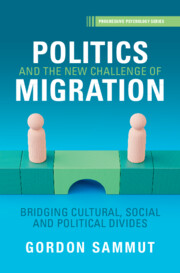
- Politics and the New Challenge of Migration
- The Progressive Psychology Book Series
- Politics and the New Challenge of Migration
- Copyright page
- Dedication
- Contents
- Figures
- Tables
- Acknowledgements
- Chapter 1 In Search of the Promised Land
- Chapter 2 The Social Contract
- Chapter 3 Social Cognition
- Chapter 4 Social Identity
- Chapter 5 The Public Sphere
- Chapter 6 Multiculturalism and Competing Policies
- Chapter 7 The Populist Backlash
- Chapter 8 Democracy
- Chapter 9 Building a Bridge over Babylon
- Chapter 10 Ethics–Politics Morality
- Chapter 11 The Dark Side of Politics
- Appendix
- References
- Index
Chapter 4 - Social Identity
Published online by Cambridge University Press: 23 December 2025

Book contents
- Politics and the New Challenge of Migration
- The Progressive Psychology Book Series
- Politics and the New Challenge of Migration
- Copyright page
- Dedication
- Contents
- Figures
- Tables
- Acknowledgements
- Chapter 1 In Search of the Promised Land
- Chapter 2 The Social Contract
- Chapter 3 Social Cognition
- Chapter 4 Social Identity
- Chapter 5 The Public Sphere
- Chapter 6 Multiculturalism and Competing Policies
- Chapter 7 The Populist Backlash
- Chapter 8 Democracy
- Chapter 9 Building a Bridge over Babylon
- Chapter 10 Ethics–Politics Morality
- Chapter 11 The Dark Side of Politics
- Appendix
- References
- Index
Summary
Chapter 4 extends the discussion of cognition as a human adaptation to its effects on social relations. It looks at social categorisation as a process that enables human beings to identify with similar others and to engage in collaborative relations with them that serve mutual interests. It looks at the origins of social identity theory by reviewing the minimal group experiments, which demonstrate an inclination for discrimination in the human species that favours similar others even in arbitrary conditions. It concludes by considering the implications of these cognitive characteristics on identity politics and their effects on democratic systems.
Information
- Type
- Chapter
- Information
- Politics and the New Challenge of MigrationBridging Cultural, Social and Political Divides, pp. 39 - 51Publisher: Cambridge University PressPrint publication year: 2025
Accessibility standard: Inaccessible, or known limited accessibility
Why this information is here
This section outlines the accessibility features of this content - including support for screen readers, full keyboard navigation and high-contrast display options. This may not be relevant for you.Accessibility Information
The HTML of this chapter is known to have missing or limited accessibility features.
We may be reviewing its accessibility for future improvement, but final compliance is
not yet assured and may be subject to legal exceptions. If you have any questions,
please contact
accessibility@cambridge.org.
Content Navigation
Table of contents navigation
Allows you to navigate directly to chapters, sections, or non‐text items through a linked table of contents, reducing the need for extensive scrolling.
Allows you to navigate directly to chapters, sections, or non‐text items through a linked table of contents, reducing the need for extensive scrolling.
Index navigation
Provides an interactive index, letting you go straight to where a term or subject appears in the text without manual searching.
Provides an interactive index, letting you go straight to where a term or subject appears in the text without manual searching.
Reading Order & Textual Equivalents
Single logical reading order
You will encounter all content (including footnotes, captions, etc.) in a clear, sequential flow, making it easier to follow with assistive tools like screen readers.
You will encounter all content (including footnotes, captions, etc.) in a clear, sequential flow, making it easier to follow with assistive tools like screen readers.
Short alternative textual descriptions
You get concise descriptions (for images, charts, or media clips), ensuring you do not miss crucial information when visual or audio elements are not accessible.
You get concise descriptions (for images, charts, or media clips), ensuring you do not miss crucial information when visual or audio elements are not accessible.
Full alternative textual descriptions
You get more than just short alt text: you have comprehensive text equivalents, transcripts, captions, or audio descriptions for substantial non‐text content, which is especially helpful for complex visuals or multimedia.
You get more than just short alt text: you have comprehensive text equivalents, transcripts, captions, or audio descriptions for substantial non‐text content, which is especially helpful for complex visuals or multimedia.
Visual Accessibility
Use of colour is not sole means of conveying information
You will still understand key ideas or prompts without relying solely on colour, which is especially helpful if you have colour vision deficiencies.
You will still understand key ideas or prompts without relying solely on colour, which is especially helpful if you have colour vision deficiencies.
Use of high contrast between text and background colour
You benefit from high‐contrast text, which improves legibility if you have low vision or if you are reading in less‐than‐ideal lighting conditions.
You benefit from high‐contrast text, which improves legibility if you have low vision or if you are reading in less‐than‐ideal lighting conditions.