

Part I provides an introductory account of the core of what I call, “mainstream economics” – that is, the dominant approach to economics accepted by a large majority of the world’s economists. To avoid endlessly repeating “mainstream,” when I speak of economics, unless otherwise indicated, I mean mainstream economics. Its core consists of:
A model of rationality.
Models of exchange, consumption, and production. Microeconomic models focus on individual markets or groups of related markets. General equilibrium models attempt to characterize the general interdependence of economic actions.
Models of aggregate outcomes, including especially economic growth and fluctuations such as recessions. In principle, these macroeconomic models should dovetail with general equilibrium models, but because it is impossible to construct completely disaggregated general equilibrium models that can be used to guide policies, macroeconomic models take short cuts.
Econometrics designed to connect microeconomic and macroeconomic models with data, especially data concerned with prices and quantities.
Welfare economics. Welfare economics offers moral evaluations of outcomes, institutions, policies, and processes. This requires ethical reflection, specifying evaluative criteria, as well as positive investigation of how well institutions, policies, and processes satisfy those criteria.
This book’s philosophical interpretation and assessment of the “core” of economics – rationality, microeconomics, general equilibrium theory, macroeconomics, econometrics, and welfare economics – is selective. A comprehensive treatment of its subject matter would be too large for a single book. The discussion here has nothing to say about other approaches to economics, such as Austrian, Institutional, and Marxian economics. It ignores important branches of economics such as agricultural economics, business economics (marketing, accounting, and administration), economic development and growth, economic history, environmental economics, financial economics, industrial organization, international economics, law and economics, labor economics, public economics, and the economics of health, education, and housing.
Part I of this book attempts to characterize the core of economics and to clarify the philosophical questions that its models, assumptions and practices give rise to. Although the first five chapters provide an introduction to microeconomics, welfare economics, and macroeconomics, their presentation differs from that found in standard textbooks, whether advanced, like Mas-Colell, Whinston, and Green’s Microeconomic Theory and David Roemer’s Advanced Macroeconomics, or introductory like Mankiw’s Principles of Economics or Krugman and Wells Microeconomics and Macroeconomics. The presentation here is highly selective, and the criteria of selection reflect philosophical concerns. The eight chapters of this part do not show readers how to put the models to work and solve practical problems. They are notably short on facts about real economies. The point of this part of the book is to give the reader a sense of the philosophical peculiarities of mainstream economics. Well-trained economists will learn little about the nitty-gritty of economic practice, though they may find that they see the fundamentals of their work in a different light.
Part I begins in Chapter 1 with the concept of preferences, which is the central concept in mainstream economics, and with the theory of rationality that focuses on preferences. The fact that a normative theory lies at the foundation of economics raises philosophical questions. What are requirements of rationality doing in what purports to be a scientific theory of economic phenomena? The succeeding chapters offer an answer, showing how the model of rational choice ties together the theory of consumer choice (Chapter 2), the theory of production and general equilibrium (Chapter 3), the normative theory of economic welfare (Chapter 4), and macroeconomics (Chapter 5). Chapter 6 fills a lacuna in the first five chapters which repeatedly talk about models, theories, and laws without clearly specifying what they are or how they are related to one another. Building on the first six chapters, Chapter 7 offers a general characterization of the structure and strategy of (mainstream) economic modeling. Chapter 8 presents a case study that aims to put some flesh on the philosophical bones laid out in Chapter 7.
The first five chapters raise questions concerning economic modeling that Chapter 6 does not address, which I try to answer later. In particular, I postpone questions about how well the evidence supports the conclusions that economists draw. In Part I, I have for the most part kept the characterization of economic modeling separate from its evaluation or criticism, but along the way, I do make some specific criticisms. In particular, Chapter 1 criticizes revealed preference theory, and Chapter 4 criticizes the view that the satisfaction of preferences constitutes well-being. My questions concerning apparently odd features of economics are genuine, not rhetorical. When I offer my appraisals, they will not be veiled.
Mainstream economics portrays individual agents as choosing rationally. Many of its generalizations concerning how people actually choose are also claims about how agents ought rationally to choose. This fact distinguishes economics from the natural sciences, whose particles do not choose and are neither rational nor irrational, and whose theories have no similar normative aspect. Chemists offer no advice to benzine molecules, which would not listen to advice if given. I have a good deal to say in Chapters 4, 13, and 16 about the significance of this distinctive feature of economics. In this chapter, my goal is to describe the fundamental elements of models of both rational and actual choice. Most of the chapter is devoted to the simplest model: “ordinal utility theory.” However, Section 1.3 provides a sketch of expected utility theory, which is central to decision theory and plays an important role in mainstream economics.
1.1 Rational Choice with Perfect Knowledge: Preferences and Ordinal Utility Theory
What is it to choose rationally? This is an old philosophical question, which, like other old philosophical questions, is hard to answer. One can say, accurately, albeit unhelpfully, that rational choice consists in choice that is properly responsive to reasons. There are many ways to fail to be properly responsive to reasons and thus many kinds of irrationality. Furthermore, the notion of choice is ambiguous. It can refer to deliberating, or it can refer to the action that is the outcome of deliberation. Economists regard choice as action and regard it as determined by three factors: physical constraints, beliefs (or expectations), and preferences. Choices are rational if they are governed by rational preferences and rational beliefs. Noneconomists take “preferences” to be subjective states of individuals, which are reflected in their words and actions. Although preferences in economics differ from preferences in ordinary discourse in ways to be explained later, this chapter argues that preferences in economics, like preferences in ordinary discourse, are subjective states that combine with beliefs to cause choices.
If people are approximately rational, then a model of rational choice can be used to predict actual choice. A normative theory is concerned with value – that is, with what is good or bad – and with which actions are obligatory, permissible, or impermissible. Unlike “positive” theories that describe, predict, and explain what actually happens, normative theories evaluate what happens and say what ought to happen. Rationality is a normative notion, although not a moral notion. To fail to do what one rationally ought to do is foolish or self-defeating rather than evil.
This sketch of the distinction between positive and normative inquiries is subject to caveats. Among other difficulties, there is no sharp boundary between positive and normative. Just consider statements such as “members of the SS were cruel” or “Margaret Thatcher was shrewd.” They state matters of fact, but they also offer evaluations. However, for our purposes, the rough distinction between what is, on the one hand, normative, prescriptive, or evaluative and, on the other hand, positive or factual will serve. As we shall see, the normative model of rational preference, belief, and choice this chapter presents can also play a central role in positive economics when joined with the hypothesis that people are largely rational.
The objects of choice can be many different things. In consumer choice theory, they are limited to bundles of commodities and services. In the theory of the firm, the alternatives may be combinations of inputs. Preferences range more widely. An individual, Marty, may have preferred that Hillary Clinton be elected president in 2008, that Apple stock double in value, or that no hurricane strikes Puerto Rico, but none is a state of affairs that Marty can choose.
The description of the objects of both choice and preference must include “everything that matters to the agent” (Arrow Reference Arrow1970, p. 45). Otherwise, preferences would change with context. For example, I have no preference among the alternatives described merely as “a cup of coffee” or “a bottle of beer.” Which I prefer depends on the time of day, what I am eating, what the weather is like, and many other things. The states of affairs ranked by preferences must instead be described as “drinking a cup of coffee versus a bottle of beer at 7 a.m. with cereal and …” or “drinking a bottle of beer versus a cup of coffee on a hot afternoon after mowing the lawn and … . ” I often simplify and speak of a preference for beer rather than speaking of a preference for the complete state of the world with drinking a beer versus the complete state of the world without doing so.Footnote 1
The economist’s model of rational choice largely abstracts from deliberation: constraints and beliefs fix which alternative actions are feasible and believed to be feasible, and agents choose whatever action is at the top of their already given preference ranking of the actions they believe to be feasible. Taken by itself, Yolanda’s preference for blueberries over strawberries is not subject to rational appraisal, but there are rational constraints on sets of preferences. For example, if she also prefers cherries to blueberries, then she ought to prefer cherries to strawberries. The model of rational choice does not condemn as irrational Peter’s preference for a side serving of mouse droppings over a portion of carrots, but it does find it irrational if Peter also prefers being healthy to being unhealthy.
1.1.1 Certainty and Perfect Knowledge
In unusual circumstances in which agents possess complete knowledge and there is neither risk nor uncertainty, what agents believe coincides with the facts, and nothing need be said about belief, rational or otherwise. The account of rationality in these circumstances is called “ordinal utility theory.” Economists have a simple model of rational choice shown in Figure 1.1. Agents who have complete knowledge rank the alternatives among which they choose (represented here by different foods). Constraints may rule out some alternatives (bread in this case). Agents choose from the remaining options whatever is at the top of their preference ranking. In positive economics, an agent’s preference ranking governs the agent’s choices. In normative (welfare) economics, the objective is to help people move up their preference ranking. The principles of positive microeconomics are mainly generalizations concerning preferences and their implications for choice. The imperatives of normative economics specify how best to satisfy preferences. Preferences lie at the core of mainstream economics.

Figure 1.1 Preference and choice.
1.1.2 Preference Axioms
Mainstream economists agree on the following axioms concerning preferences in the special circumstances in which there is no uncertainty and agents possess perfect knowledge. Because, as Section 1.1.3 explains, preferences that satisfy these axioms can be represented by an ordinal utility function, these are called the axioms of ordinal utility theory. Although economists agree on these axioms, few think these axioms are universal truths. Some economists believe that the axioms of ordinal utility theory are good approximations and that the violations can be regarded as unsystematic noise. Many question whether these axioms are generally true of people and regard them more as a point of comparison than as a guide to reality. Even those who have the fewest qualms about the model recognize that these axioms are simplifications of a more complicated reality. This is not just an armchair observation. As discussed in Chapters 13 and 14, there are experimental data revealing systematic violations of these axioms, and psychologists and behavioral economists have formulated generalizations concerning preferences that explain these violations. Nevertheless, for most economists, even behavioral economists, these axioms are the standard starting place for theorizing concerning individual choice.
The following two axioms (quoted from Mas-Colell et al. 1995, p. 6) are ubiquitous:


“ ” is the set of alternatives over which agents have preferences – commodity bundles in the case of consumer choice theory – and
  ,
,  , and
, and  are alternatives in
  . According to Mas-Colell et al., “[w]e read
  as ‘
as ‘ is at least as good as
  ’” (1995, p. 6; see also Varian Reference Varian1984, p. 111). This definition of “
 ” might seem surprising, since the axioms are supposed to govern preferences within the (positive) science of economics, not judgments of goodness. It is better to read “
 ” as “the agent either prefers
  to
to  or is indifferent between
  and
and  .” “
.” “ ” means “the agent prefers
  to
to  ,” and “
 ” means that the agent is indifferent between
  and
and  . Employing the weak preference relation “
 ” is convenient, because one does not have to specify separately the transitivity of strong preference, indifference, and mixtures of the two, such as the claim that if
  and
and  , then
  .
.
Varian (Reference Varian1984, pp. 111–12) includes two additional axioms, which, as I explain shortly, are needed to prove a crucial theorem:
(Reflexivity) For all  in
in  ,
,  .
.
(Continuity) For all  in
in  and
and  are closed sets.Footnote 2
Reflexivity is trivial and arguably a consequence of completeness, while continuity is automatically satisfied for any finite set of alternatives.
In contrast to Varian, who presents the axioms as assumptions about people’s actual preferences, Mas-Colell et al. maintain that completeness and transitivity are axioms of rationality: people’s preferences are rational if they satisfy the axioms (1995, p. 6). Since Mas-Colell and his co-authors are concerned to offer an account of people’s actual preferences, they must also maintain that to some extent people’s preferences are in this sense rational.
1.1.3 Utilities and the Ordinal Representation Theorem
The ordinal representation theorem proves that when people’s preferences satisfy these axioms,Footnote 3 then they can be represented by a continuous utility function that is unique up to a positive monotone (order-preserving) transformation (Debreu Reference Debreu1959, pp. 56–7). The “utility” of an alternative merely indicates the alternative’s place in an agent’s preference ranking. It is not something people seek or accumulate.
Here is a simple way to understand how a utility function “represents” preferences and what it means for it to be unique up to a positive order-preserving transformation. Suppose that an agent, Jill, who has preferences over a finite set of alternatives, adopts the convention of listing the alternatives on lined paper with preferred alternatives in higher rows and alternatives among which she is indifferent in the same row. Since Jill’s preferences are complete, every alternative must find a place in the list. Since Jill’s preferences are transitive, no alternative can appear in more than one row. Given such a list, one can assign numbers arbitrarily to rows, with the proviso that higher numbers are assigned to higher rows. Any numbering of the rows that is consistent with the ordering is an ordinal utility function. The numbers – the utilities – merely indicate where alternatives are located in Jill’s preference ranking. Utility is not pleasure or usefulness or anything substantive at all. It is merely an indicator of an alternative’s location in a preference ranking. Figure 1.2 provides an illustration of how ordinal utilities represent preferences.
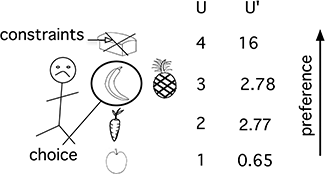
Figure 1.2 Ordinal utility.
The pictures of food represent the ordered list of alternatives.  and
and  are two of the infinite number of utility functions that assign higher numbers to alternatives in higher rows, and the same number to alternatives in the same row. The numbers are arbitrary apart from their order. In Figure 1.2, Jill chooses the banana rather than an apple because she prefers it to the apple. The picture says nothing about why she prefers the banana to the apple; it certainly does not say that the reason is that the banana has more utility. That claim mistakenly supposes that utility is something like pleasure, which is found in different quantities in the objects of preference. Utility is an indicator of preference. It is not an object of preference.
Jill does not choose the bread, despite preferring the bread to the banana, because she cannot have the bread, perhaps because the store has run out of bread or because she cannot afford to purchase it. Because she is indifferent between the banana and the pineapple, she could just as well have chosen the pineapple.
1.1.4 Further Assumptions Concerning Preferences
Economists make other assumptions governing preferences in addition to the axioms listed earlier. Some of these are occasionally called “axioms,” but most often these assumptions about preferences are implicit. Here is a list:
1. Preferences are stable and “given” – that is, known and fixed before individuals choose. Preferences may change, but only infrequently. Because economists take preferences as given, it appears that they have nothing to say about how preferences are formed or modified. However, it is also the case that preferences among the immediate objects of choice depend on beliefs about their consequences and preferences among their consequences.
2. Preferences are independent of context or framing; they depend exclusively on the alternative states of affairs to be ranked.
3. Preferences are independent of irrelevant alternatives. If an agent prefers
 from the set of alternatives , then the agent does not prefer from a larger set of alternatives including and , and if an agent prefers from any set of alternatives including and , then the agent does not prefer from the set .
4. Preferences determine choices: among the alternatives they believe to be accessible, agents choose one that is at the top of their preference ranking.Footnote 4 This assumption, which I call “choice dependence,” provides the crucial link between preference and choice.


Identifying these additional assumptions concerning preferences helps to pin down the concept of preferences that economists rely on. This is true even though these further assumptions, like the axioms, are problematic. Experiments carried out by psychologists and behavioral economics cast doubt on these further claims about preferences, especially the first two. The first assumption reveals an internal conflict. If economists can link preferences among the immediate objects of choice to preferences among their consequences and beliefs about the probabilities of those consequences, then they have something to say about preference formation and modification, and preferences are not merely given.
It is fortunate that economists have something to say about the formation and revision of preferences. If economists had nothing to say about what determines preferences among the immediate objects of choice, then their explanations and predictions would be trivial. In every case, the explanation for why an agent chose action A would be “the agent preferred A to the alternatives.” To explain or to predict any choice would be merely to point to its location atop the ranking of feasible alternatives. There would be nothing to say about what determines and changes the preference ranking. For example, economists would be unable to predict how preferences among investors in a company’s stock change with the settlement of a lawsuit against the company.
The second assumption of context independence is vulnerable to experimental critiques, and it is scarcely tenable even as an extreme idealization. This unavoidable complication risks trivializing conditions on rational choice. Suppose, for example, that Jack has intransitive preferences. He prefers  to
to  ,
,  to
to  , and
, and  to
to  . However, if “
 when the alternative is
  ” and “
 when the alternative is
  ” are different states of affairs,
  and
and  respectively, then Jack prefers
  to
to  ,
,  to
to  , and
, and  to
to  , and the violation of transitivity has disappeared. To block this trivialization requires a substantive principle requiring indifference between alternatives such as
  and
and  . John Broome (Reference Broome1991b, pp. 103–4) argues for “a rational requirement of indifference” such as “[o]utcomes should be distinguished as different if and only if they differ in a way that makes it rational to have a preference between them” (1991b, p. 103). Whether it is rational to have a preference between two outcomes depends on a substantive theory of rationality.
Choice determination is of special importance. On the assumption of complete knowledge, there is no need to mention beliefs. But restating choice determination more simply as “agents choose an alternative at the top of their ranking of feasible alternatives” contributes to the mistaken espousal of revealed preference theory, which is discussed in Section 1.2. Agents can prefer  to
to  , yet choose
  from the set of alternatives
  , because they falsely believe themselves to be choosing from some other set of alternatives such as
  .
.
What I have called “choice determination” is often called “utility maximization.” Choosing an alternative that is at the top of one’s preference ranking among feasible alternatives is choosing to maximize utility, but the terminology can be misleading. When economists say that individuals maximize utility, they are only saying that people do not rank any feasible option above the option they choose. Although the “utility” language was inherited from the utilitarians, some of whom thought of utility as a sensation with a certain intensity, duration, purity, or propinquity (Bentham Reference Bentham and Harrison1789, chapter 4), there is no such implication in contemporary microeconomic theory. Economists sometimes speak misleadingly of individuals as seeking more utility, but they do not mean that utility is an object of choice: some ultimately good thing that people want in addition to good health or a faster internet connection. The theory of rational choice specifies no distinctive aims that all people must embrace. Utility is just an indicator of where an alternative is located within a preference ranking. Individuals who are utility maximizers just do what they most prefer. To say that individuals are utility maximizers says nothing about the nature of their preferences. All it does is connect preference and choice (or action) in a particularly simple way. Rational individuals rank available alternatives and choose what they most prefer from among the alternatives they believe to be feasible.
1.1.5 Ordinal Utility Theory as a Theory of Rationality?
Because rationality is a normative notion, ordinal utility theory, as a theory of rational choice, is a normative theory. It purportedly tells us what our preferences should be like and how they should influence our choices. To define what rational preference and choice are is ipso facto to say how one ought rationally to prefer and to choose.
With the additional claim that people are in fact (approximately) rational in the sense just defined, utility theory implies a positive theory concerning how constraints, choice, preference, and belief are related. Utility theory, as a positive theory of preference and choice, is a crucial part of consumer choice theory. Because most of the axioms and the additional assumptions of utility theory appear to be false, there are many questions to ask about the role of ordinal utility theory in the explanation and prediction of economic phenomena. Part III addresses these methodological questions and considers the significance of the two faces of ordinal utility theory as both a theory of actual and of rational choice. Let us ask here merely whether the model of choice presented by ordinal utility theory is a plausible normative theory of rational choice. Is it irrational to violate its axioms and implicit conditions?
Some of the elements of ordinal utility theory are not intended as substantive principles of rationality. They function instead to define and simplify the domain to which the theory applies. For example, agents who deliberate about their preferences rather than taking them as given are not behaving irrationally. Requiring that preferences be already fixed is instead intended to separate the questions of interest to economists from other questions about decision-making. Although rationality may require some stability in preferences, there is nothing irrational in changing one’s preferences. The assumption of stability serves mainly to make the theory usable and to limit the circumstances to which the theory applies. Similarly, there seems to be nothing irrational in the inability to rank some alternatives, which violates completeness. However, one can regard completeness as a boundary condition on rational choice. If people cannot compare alternatives, then they cannot choose on the basis of reasons. Similarly, it is hard to see what would be irrational about violating continuity (Elster Reference Elster1983, p. 8). But rather than regarding continuity as a boundary condition, one can regard it as trivial, because it is automatically satisfied if the set of alternatives is not uncountably infinite. Choice determination is questionable, too, but one can regard it more as a modeling decision than as a substantive requirement. By taking preferences to encompass everything that influences choices other than beliefs and constraints, only random errors fail to satisfy it.
One can make a plausible case that the remaining conditions are requirements of rationality. Reflexivity only demands indifference between identical alternatives. If preferences (as I argue) constitute or imply judgments about which alternatives are better, then, as John Broome argues (1991a), transitivity is implied by the logic of comparative adjectives such as “better than,” and transitivity is hence a demand of rationality. Nevertheless, it would be surprising if experimenters could not find intransitivities in everybody’s preferences among a sufficiently long and complicated series of choices among pairs of options. But, like miscalculations in arithmetic, the mistakes people make in following rules do not show that the rules themselves are mistaken. In defense of transitivity, one can also argue that, if our preferences fail to be transitive, then others can make fools of us. Suppose, for example, that I prefer  to
to  and
and  to
to  and
and  to
to  , and that I start out possessing
  . Then I should, in principle, be willing to pay a fee for each of the following three exchanges: trade
  away for
  , trade
  away for
  , and trade
  away for
  . I am then back where I started, except that I am poorer by the amount of the expense of the three fees. I have become a “money pump,” and this argument is known as the money pump argument. (See Schick Reference Schick1986 for a critical discussion.) Transitivity appears to be a requirement of rationality.
If one relaxes the simplifications, takes a step toward greater realism, and recognizes that people typically do not have a ready-made preference ordering to guide their choice, then, as Herbert Simon argues (1982), it may be rational to adopt strategies that reduce the cognitive burden of decision-making and take account of the limits to one’s information and information-processing abilities. Adopting these strategies will sometimes lead people to choose options that are later ascertained to be inferior to feasible alternatives. To economize on deliberation and to be a predictable partner in collective enterprises, it may also be rational to carry through with one’s intentions or plans, even if changing course appears to be more advantageous. However, if one happens to have a preference ranking handy that actually manages to satisfy all the conditions concerning preferences and choices, then it is rational to allow one’s preferences to determine one’s choices.
These comments explain why economists regard ordinal utility theory as a fragment of a theory of rational choice that specifies conditions that preferences must satisfy in order to justify choices. This theory of rational choice purports to be purely formal and to say nothing about what things it is rational to prefer. Because it is purely formal, this view of rationality might be regarded as too weak. As just noted, without substantive assumptions that rule out some preferences as irrational, the axioms turn out to be trivial. And it seems that some preferences, such as Derek Parfit’s example of “future Tuesday indifference” (1984, p. 124 – indifference to anything that happens on a future Tuesday), should be regarded as irrational, regardless of their consistency with other preferences.
Critics have also argued that this model of rational choice is too demanding. Must an agent  be able to rank all feasible options, or is it enough that
  be able to rank all the options that are available in the given context or in some set of alternatives worth considering? Is full transitivity necessary or is it enough that A’s choices never form a cycle? Such possible weakenings of the standard axioms have their own formal developments, and one can prove a variety of theorems relating these conceptions to each other (see Sen Reference Sen1971 and McClennen Reference McClennen1990, chapter 2). Most economic theory relies on standard ordinal utility theory, and the details of formal developments of weaker alternatives are not germane here.
1.2 Revealed Preference Theory
Revealed preference theory is an interpretation of formal results explored initially by Paul Samuelson (Reference Samuelson1938, Reference Samuelson1947), generalized and developed by many others (especially Houthakker Reference Houthakker1950), and elegantly summarized by Arrow (Reference Arrow1959), Richter (Reference Richter1966), and Sen (Reference Sen1971). Samuelson sought to reformulate the positive theory of consumer choice so as to eliminate reliance on a subjective notion of preference. His motivation appears to have been philosophical. The empiricism (see §A.1) prevalent in the 1930s made reference to subjective preferences methodologically suspect. Apart from some technicalities, Samuelson succeeded in showing that if choices among commodity bundles satisfy a consistency condition, then a complete and transitive preference ranking can be constructed from the choices. Preferences can be “revealed” by choices, and the empirical legitimacy of talk of preferences can be secured by reducing it to talk of observable choices. In this work, Samuelson is concerned with the positive theory of choice, not with the normative theory of rationality, but his results apply to both. For further discussion of Samuelson’s methodological views, see Section 11.2.
The basic idea of revealed preference theory is that, if Mimi chooses option  , when she might have chosen option
  , then she has revealed that she prefers
  to
to  or is indifferent between them. Her choices are consistent if they satisfy the “weak axiom of revealed preference” (WARP). It says that if
  and
and  are both in the set of alternatives among which Mimi chooses, and she chooses
  , then she never chooses only
  from any set including both
  and
and  . In consumer choice theory, the statement of WARP is somewhat more complicated, because prices influence choices by determining which bundles of commodities are available rather than by influencing preferences. If choices satisfy sufficiently strong consistency conditions, then, in principle, economists can construct a complete and transitive revealed preference ordering from them (Sen Reference Sen1971, Reference Sen1973). Samuelson’s hope was to purge economics of unobservable and hence (in his view) unscientific content by replacing the axioms governing subjective preferences with an axiom requiring consistency of choice.Footnote 5 His view is still popular. For example, in an influential essay, Faruk Gul and Wolfgang Pesandorfer write, “[i]n the standard approach, the terms ‘utility maximization’ and ‘choice’ are synonymous” (2008, p. 7).
In fact, revealed preference theory mischaracterizes the notion of preferences that economists employ. Economists do not and cannot employ a notion of preference defined in terms of choices. Economists in fact employ a conception of preferences as subjective states that determine choices only in conjunction with beliefs.
This argument may appear beside the point to economists, who often take “revealed preference” to mean nothing more than inferring preferences from market data given often implicit assumptions about people’s beliefs. For example, Boardman et al. write that “[t]he indirect market methods discussed in this chapter are based on observed behavior, that is, revealed preference” (2010, p. 341). No one doubts that claims about preferences are inferred from behavior (including verbal behavior) and assumptions about beliefs. If only that were all that is meant by speaking of revealed preference theory. Samuelson is after bigger game.
The central claim of revealed preference theory can be formulated as:  prefers
  to
to  if and only if
  sometimes chooses
  from sets of alternatives that include
  , and
, and  never chooses
  from any set that includes
  . Many economists mistakenly believe that this claim has been proven. For example, Henderson and Quandt write, “the existence and nature of her [an agent’s] utility function can be deduced from her observed choices among commodity bundles” (1980, p. 45).
The theorem that Henderson and Quandt have in mind is the following. Suppose that  is a two-place relation such that for some set of alternatives
  , available to an individual, Jeff,
  if and only if Jeff chooses
  from
from  that includes
  – that is, if and only if
  is in
is in  , the set of choices that Jeff makes when he repeatedly chooses from
  .
.
The revelation theorem: WARP implies that  is complete and transitive and the set of maximal elements of
  according to
  ,
,  , is identical with
  .Footnote 6
 is supposed to be interpreted as “weak preference”
  . If Jeff weakly prefers
  to
to  , then he satisfies the WARP if and only if Jeff’s choice set for any set of alternatives including both
  and
and  never includes
  unless it also includes
  . The revelation theorem establishes that if Jeff’s choices satisfy WARP, then there is a relation
  that is complete and transitive and that implies Jeff’s choices. In other words, Jeff acts as if maximizing
  .
.
On the intended interpretations, the revelation theorem establishes that preferences can be defined in terms of choices when choice behavior satisfies WARP. Some economists take the revelation theorem to show that economists can dispense with the notion of preference. On this view, the theorem shows that anything economists need to say about the behavior of individuals can be said in the language of choice (Mas-Colell et al. 1995, p. 5). Other economists regard the correspondence between choice and preference as legitimating talk of subjective preferences. In Sen’s words, “[t]he rationale of the revealed preference approach lies in the assumption of revelation and not in doing away with the notion of underlying preferences” (1973, p. 244).
These interpretations of the theorem are not defensible. The binary relation that the revelation theorem proves to be implicit in choices that satisfy the WARP is not the preference relation and cannot serve the functions that the preference relation serves in economic theory and practice. The identity between  and
and  does not reveal “underlying preferences.” Talk of preferences cannot be eliminated from economics without gutting the discipline.
Among the many objections to revealed preference theory,Footnote 7 two stand out. First, if preference is defined by choice, then where there is no choice, there is no preference. Revealed preference theory limits preferences to those alternatives among which agents choose. It thus denies that an agent has preferences among infeasible alternatives or among of states of affairs among which the agent faces no choice. Restricting preferences to those alternatives among which people have chosen would cripple economics.Footnote 8 Nothing could be said about how preferences among the consequences of choices affect choices, because preferences are limited to the objects of choice themselves. The only thing economists could say to predict an agent’s choice would be that the agent chooses whatever the agent has chosen.
The obvious response to this serious problem is to reinterpret the theory. Rather than maintaining that an agent such as Jessica prefers  to
to  if and only if she never chooses
  when
when  is available, revealed preference theorists might say that Jessica prefers
  to
to  if and only if she would never choose
  if
if  were available (Binmore Reference Binmore1994). On this interpretation of revealed preference theory, whether agents actually face a choice between
  and
and  is irrelevant to their preferences, which are defined by how they would choose, if they were to face such a choice.
In switching from actual to hypothetical choice, economists abandon the empiricist project of avoiding references to anything that is not observable. How King Charles would choose if it were up to him whether the USA remains in NATO is no easier to observe than his preference. Hypothetical choices are not choices. They can be predicted, but not observed. Predictions about how Charles would choose rely on no different or better evidence than claims about what he prefers. Notice, in addition, that claims about what he would do in a hypothetical situation cannot be answered until his beliefs are specified. Suppose that Charles were given an apparatus with a blue button that keeps the USA in NATO and a red button that leads it to leave. Without knowing what Charles believes about the buttons, we cannot predict what he would do.
The second problem with revealed preference theory, whether it attempts to define preference in terms of actual or hypothetical choices, is that its fundamental claim is false. It is not the case that if Martha prefers  to
to  , then she never chooses
  or would never choose
  , when she could have chosen
  . If Martha mistakenly believes that
  is not among the available objects of choice, then she may choose
  despite preferring
  to
to  . For example, at the end of Romeo and Juliet, Romeo enters the tomb of the Capulets and finds Juliet apparently dead. He does not know that she took a potion that simulates death. Unwilling to go on living without Juliet, Romeo takes poison and dies. He chooses death from a set of alternatives that in fact includes eloping with Juliet. If choice defines preference, then Romeo prefers death to eloping with Juliet. In fact, of course, he prefers eloping with Juliet to death and chooses death only because he does not know that eloping with Juliet is a (so-to-speak) live option.
Defenders of revealed preference might respond as follows:
The second criticism shows only that beliefs mediate between choices and preferences, when preferences are understood as they are in everyday conversation. In contrast, in economics, as the revelation theorem shows, consistent choice demonstrates the existence of a complete and transitive relation that gives a top ranking to the alternatives individuals choose. This relation, call it “preference*,” is the preference relation that economists rely on, and it is provably derivable from choice. Unless Romeo violates WARP – and given the nature of his choice, his future consistency is guaranteed – his choice reveals his preference* for death over eloping with Juliet.
On this view, economists employ a technical concept, preference*, that is defined in terms of choice. It is unfortunate that their use of the same term confuses outsiders, but the economist’s notion of preference* is defined by choice.
Economists are entitled to define their own technical concepts and to proscribe the use of everyday concepts, but only if they actually use the concepts they define rather than the concepts they proscribe. In fact, economists rely on a concept of preferences that is not revealed by choices and they cannot avoid doing so without eviscerating their theories. For example, when Donald Trump was elected, the price of stock in private prisons, which Hillary Clinton had proposed shutting down, shot upward. To explain and predict this, economists need to cite the beliefs of investors as well as their preference for higher returns. But earning a higher return is not an object of choice, and the preference for higher returns is not a revealed preference. Preferences, as understood by economists, explain behavior only in conjunction with beliefs.
Moreover, if economists took preferences to be revealed preferences, they could not do game theory. Consider, for example, the scene from Pride and Prejudice where Darcy, overcome by his love for Elizabeth, proposes marriage to her, despite her lack of dowry, her mother’s vulgarity, and her younger sister’s silliness and impropriety. Regarding Darcy as arrogant and unfeeling, Elizabeth turns him down. Their interaction can be modeled as a game (Figure 1.3).
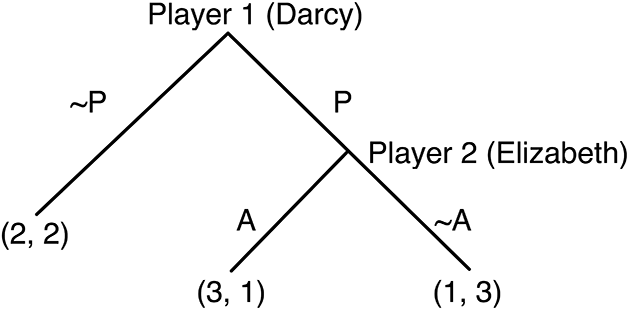
Figure 1.3 Darcy and Elizabeth.
The numbers in Figure 1.3 are ordinal utilities – that is, indicators of preference order. Higher numbers indicate more preferred alternatives. The first number in each pair expresses Darcy’s utility, and the second number expresses Elizabeth’s utility. Darcy moves first and can either propose (P) or not propose (~P). Not proposing ends the game with the second-best outcome for both players.Footnote 9 If Darcy proposes, then Elizabeth gets to choose whether to accept (A) or reject his proposal (~A). Rejecting the proposal is the best outcome for Elizabeth (at this point in the novel) and the worst for Darcy, while accepting is best for Darcy and worst for Elizabeth.
Some of the preferences in Figure 1.3 are revealed by choices. For example, Elizabeth’s refusal reveals that she prefers rejecting to accepting the proposal. However, other preferences, which are needed to define the game, rank alternatives between which agents do not and cannot choose. For example, Darcy cannot choose whether Elizabeth accepts, but the game is not well defined without specifying his preference over her acceptance or rejection. To predict whether Darcy will propose, a game theorist needs to know Darcy’s preferences among the outcomes, including outcomes between which he cannot choose, as well as his beliefs about whether Elizabeth will accept his proposal. Preferences in games are not preferences* (Rubinstein and Salant 2008, p. 119).
Beliefs mediate the relationship between choices and preferences. Economists can infer preferences from choices or choices from preferences only given premises concerning beliefs. Neither beliefs nor preferences can be identified from choice data without assumptions about the other. Choices can be evidence of preferences, but they cannot define them.Footnote 10
Economists have paid little attention to these objections because they often restrict their models to circumstances where what people believe coincides with what is truly the case. If beliefs match the reality, then economists need not mention them. That fact makes beliefs no less important.Footnote 11 Preferences cannot be defined by choices, because preferences cannot be limited to the immediate objects of choice and because they cannot be inferred from choices without premises concerning beliefs.
1.3 Rationality and Uncertainty: Expected Utility Theory
The theory of rationality can be extended to choices involving risk and uncertainty. Economists and decision theorists commonly speak of risk when agents know the possible outcomes of their choices and their probabilities. In situations involving uncertainty, it is not known what are the probabilities of the outcomes of the alternatives or even what the outcomes may be.Footnote 12 I treat the cases of risk and uncertainty together by allowing the probabilities mentioned in Section 1.3.1 to be either limits to relative frequencies or subjective degrees of belief. This simplification begs the question against those who maintain that situations of uncertainty involve more radical ignorance and different principles of rational decision-making.
1.3.1 Conditions on Choice When There Is Risk or Uncertainty
An action whose outcome is not known can be treated as if it is a lottery with its possible outcomes as the prizes. For example, suppose that Amy has the option of approaching a lost dog in the hope of returning it to its owner. She does not know what the outcome will be, but she thinks there are three possibilities: it runs away with or without biting her first, or she succeeds in returning it. The subjective probability or degree of belief that Amy attaches to the three outcomes are: Pr(dog runs away without biting her) = 0.3; Pr(dog runs away and bites her) = 0.1; and Pr(Amy returns dog to owner) = 0.6. The alternative of approaching the stray can then be represented as a lottery with three prizes that occur with the respective probabilities. Explaining or predicting what Amy winds up doing requires knowing not only her subjective probabilities but also her preferences among the alternatives. If she cares much more about whether she is bitten than whether she gets the dog back to its owner, then despite the low probability of getting bitten, she will not approach the stray.
One can represent lotteries as a pair  , where
  is a set of mutually exclusive and jointly exhaustive pay-offs, and
  a probability measure defined on
  . The lottery that pays off
  with probability
  and
and  with probability
  can be denoted conveniently as
  or as
or as  . Since the choice of an action that leads with certainty to a particular outcome
  can be represented as a “degenerate” lottery
  or as
or as  , one can without loss of generality conceive of all the objects of preferences as lotteries. These lotteries include alternatives such as bets on ball games, where the probabilities are subjective degrees of belief. One should not be misled by the lottery terminology. Economists set aside (via “the reduction postulate”) the pleasures of gambling.
In offering a normative theory of decision-making under risk and uncertainty, economists assert – as before – that preferences (whose objects are now conceived of as lotteries) are complete, transitive, reflexive, continuous, and stable. In addition, one needs a “reduction postulate” relating compound and simple lotteries. Harsanyi calls it a “notational convention” (1977b, p. 24), and it serves as a criterion of identity for lotteries. For example, suppose Peter faces the following compound gamble: if a coin comes up heads, then he can roll a die and win  if the die comes up 6 and
  otherwise. If the coin comes up tails, he draws from an urn containing three red balls and one white ball, winning
  if he draws a red ball and losing
  if he draws a white ball. The reduction postulate says that this complex lottery,
  , is equivalent to the simple lottery one gets when one substitutes for the embedded lotteries their expected values – in this case
  , which looks like it would be less fun than the gamble Peter faces. The reduction postulate implicitly rules out preferences for gambling itself.
Expected utility theory, the theory of rationality under circumstances of risk and uncertainty, relies on one other substantial and important axiom, called the “independence” condition or “the sure-thing” principle. It should not be confused with the context independence discussed earlier. The independence principle says that, if two lotteries differ only in one prize (which may itself be a lottery), then preferences between the two lotteries should match preferences between the prizes: If  and
and  , then the independence axiom states that
  prefers
  to
to  if and only if
  prefers
  to
to  .
.
1.3.2 The Cardinal Representation Theorem
Given completeness, transitivity, reflexivity, continuity, the reduction postulate, and the independence principle, it is possible to prove a (cardinal) representation theorem, which is much stronger than the ordinal representation theorem discussed in Section 1.1.3:Footnote 13
If all of these axioms are true of an agent’s preferences, then those preferences can be represented by a utility function with the expected utility property, which is unique up to a positive affine transformation.
A utility function possesses the expected utility property if and only if the (expected) utility of any lottery is equal to the utilities of its outcomes weighted by their probabilities, for example  . A positive affine transformation of an expected utility function
  is a linear function
  , where a is a positive real number and
  is any real number. The representation theorem establishes that if an agent’s preferences satisfy all the conditions, then the agent’s expected utilities are as measurable as temperature is on the centigrade or Fahrenheit scales. The zero point and units in an expected utility scale are arbitrary, but nothing else about the scale is. Comparisons of utility differences are independent of the scale chosen. If
  (
( ) −
) −  −
−  (
( ),and
),and  ′ is a positive affine transformation of
  then
then  ′(
′( ) −
) −  ′
′ ′(
′( ) − U′(
 ).Footnote 14
As in ordinal utility theory, economists assume choice determination: among the alternatives that agents believe to be feasible, agents choose an alternative at the top of the ranking. When economists speak of agents “maximizing utility,” this is what they mean – nothing more. Utility is still only an indicator of preferences, although now it indicates preference intensity as well as preference order.
If the axioms of expected utility theory are true of an agent A and  ’s preferences are stable, it is in principle possible to determine both
  ’s utility function and
  ’s probability judgments by observing
  ’s choices among lotteries. For example, suppose that, as in Figures 1.1 and 1.2, Marianne prefers bread to bananas and pineapple, among which she is indifferent, and that she prefers bananas and pineapple to carrots and carrots to apples. Since the zero point and the units of her utility function are arbitrary, one can stipulate the values for utility of an apple
  and the utility of bread
  Given these axioms, for some probability
  , Marianne will be indifferent between pineapple for certain and a lottery that pays off bread with probability
  and an apple with probability
  (that is, the lottery
  ). The utility of a pineapple,
  will then equal
  . The probability an agent attaches to an event
  can be determined when one knows the expected utilities of a lottery and its prizes when the prizes depend on whether
  occurs.Footnote 15
The probabilities invoked in such an elicitation process are personal subjective probabilities, that is, the degrees of belief of individuals; and the axioms for rational choice under conditions of uncertainty imply that these degrees of belief must satisfy the axioms of the probability calculus. Moreover, if Greg’s degrees of belief do not satisfy the axioms of the probability calculus, then Greg can be led to accept a series of bets on some chance event  , leading to a certain loss whether
  occurs or not. This demonstration is known as the “Dutch Book argument” (see Schick Reference Schick1986 for a critical discussion). Expected utility theory is a theory of rational belief as well as a theory of rational preference and choice. Subjective probabilities may arise from knowledge of objective frequencies, but they need not. The formal theory of choice is itself silent on the origin and justification of probability judgments. Those who have made the most of this theory, so-called personalist Bayesian philosophers and statisticians, are permissive about the grounds for these probability judgments.
1.3.3 Expected Utility Theory and Its Anomalies
In summary, expected utility theory, as a theory of rationality, can be presented as follows:
1. An agent A’s choices are rational if and only if: (a) A’s preferences and beliefs are rational and (b)
prefers no option to the one chooses among the options that believes to be feasible.2. An agent
’s preferences are rational if and only if:
a.
’s preferences are complete, transitive, reflexive, and continuous,b. A is indifferent between options the reduction postulate identifies, and
c.
’s preferences satisfy the independence condition.
3. An agent
’s degrees of belief are rational if and only if they satisfy the axioms of the probability calculus.


Expected utility theory is a stunning intellectual achievement, which forms the foundation for contemporary decision theory. Although it often puts in an appearance in economics, it is not nearly as important to day-to-day economic theorizing as ordinal utility theory.
Unlike ordinal utility theory, which is testable only in the unusual circumstances in which there is perfect knowledge and no uncertainty, expected utility theory purports to apply to ordinary decision contexts both as a source of predictions concerning what people will choose (if they choose rationally) and as a source of normative recommendations concerning what choices are rational. Economists and psychologists can study whether people actually choose the option that expected utility theory says they do and should. Claims about how people actually choose are much more easily testable than claims about how they should choose. Investigations showing that the predictions of expected utility theory are not borne out might only show that people fail to choose rationally. But it is important to assess the normative adequacy of both ordinal utility theory and especially expected utility theory, because they claim to guide decision-making. They matter. The account of rationality one relies on influences policy-making. Although the issues are highly theoretical, their resolution is deeply practical.
What are the issues? First, questions concerning completeness, independence, and continuity become more troubling once uncertainty is admitted. When individuals are unable to rank options, is the uniquely rational response to make guesses about the probabilities of outcomes in order to compute expected utilities? Why should a rational agent’s ranking of two lotteries  and
and  never be affected by the discovery of other options? Continuity implies that, if a rational individual Arlo prefers
  to
to  and
and  to slow fatal torture, then there is some probability
  less than one such that the lottery that pays off
  with probability
  and slow fatal torture with probability
  would be worth at least
  to Arlo. Is he irrational to refuse to accept this lottery?
The new axioms that expected utility theory adds to ordinal utility theory are problematic, too. The reduction postulate is questionable, because there seems to be nothing irrational about someone who enjoys gambling preferring a compound lottery to the simple lottery to which it reduces.Footnote 16 Although controversy concerning expected utility theory has focused on the independence condition, it actually seems at first glance easier to defend. In the case of indifference, it serves as a substitution principle. If agents are indifferent between options  and
and  , then substituting one for the other in a gamble should make no difference. When there is a strict preference, the independence principle seems to follow from considerations of dominance. Suppose, for example, that lotteries
  and
and  involve flipping a coin. If the coin comes up heads,
  has a better prize than
  , while the prizes if they come up tails are the same. One can do no worse with
  and may do better. On the basis of an argument like this one, Savage called a version of the independence principle the “sure-thing” principle (for a simple exposition see Friedman and Savage Reference Friedman and Savage1952, pp. 468–9).Footnote 17
Yet, many have found the independence condition unacceptable. As the case study in Chapter 14 illustrates, there are instances in which individuals not only seem to violate it, but in which the violations appear to be rational. Echoes of the controversies concerning expected utility theory are heard within economics, but less often than one might expect, because economic models so often employ only ordinal utility theory. The challenges to expected utility theory raise interesting methodological issues about the role of evidence in economics, which I discuss in Chapters 15 and 16, but I do not attempt to resolve the deep problems concerning the nature of rationality touched on earlier.
1.4 What Are Preferences?
The discussion of the axioms of ordinal and expected utility theory, the implicit assumptions concerning preferences, and the mistakes of revealed preference theory jointly pin down the conception of preferences that lies at the heart of mainstream economics.Footnote 18 One can read off an interpretation of preferences from the following assumptions about preferences: preferences are (at least to some degree of approximation) complete, transitive, reflexive, and continuous; and they satisfy the independence condition. They are given and largely stable over time and across contexts, and the alternatives that they rank are complete states of the world. These assumptions imply:
1. Preferences are comparative evaluations. They are evaluative, because they can be expressed in the form of a ranking in terms of better or worse. They are comparative: to say that Mary prefers to go dancing is elliptical. She prefers dancing to something else.
2. Preferences are “total” comparative evaluations that motivate choices. They rank states of affairs, including the immediate objects of choice, as better or worse with respect to everything the agent considers to be relevant. Note that I make no assumption concerning what the agent considers to be relevant, nor concerning whether the agent is rational or well informed concerning her judgment of what is relevant to a choice. An agent’s preference ranking may depend on a few largely irrelevant properties of alternatives, or it may reflect an exhaustive investigation of the options.
3. Preferences are subjective states that determine choices in combination with beliefs and constraints. As subjective states, they are not directly observable. They can be inferred from choices – but only with the help of premises concerning beliefs.
4. Preferences are subject to rational criticism. They are not just gut feelings, even if sometimes they depend on nothing else.
Preferences must be total evaluations (point 2) because in combination with beliefs and constraints, they determine choices. They thus cannot be “partial” comparative evaluations of alternatives. From the agent’s perspective, preferences rest on a comparison in every relevant regard. I take it as implicit in the notion of an evaluation that it motivates choices. As total comparative evaluations, preferences in economics differ from preferences in everyday conversation, in which obligations and commitments compete with preferences in determining choices and the value of alternatives. Whereas noneconomists might say, “Bonnie preferred to go out with her friends to staying home; nevertheless, she stayed home because she promised to babysit,” economists would say that Bonnie preferred to stay home because she promised to babysit. In economic models of rational choice, whatever influences choices, other than beliefs and constraints, does so via influencing preferences.
More should also be said about the vulnerability of preferences to rational criticism, because many economists have denied it. Although in their famous paper “De Gustibus Non Est Disputandum” (“There is no arguing about tastes”) (1977), George Stigler and Gary Becker deny that preferences among commodity bundles should be regarded as primitives in economics, beyond explanation, they attribute to most economists the belief that “when a dispute has been resolved into a difference of tastes,” “there is no further room for rational persuasion” (1977, p. 76). They are right that such a view is prevalent among economists. Nevertheless, it is mistaken. Although Margaret may regard taste as the only factor that is relevant to her preference for a strawberry ice cream cone over a coffee ice cream cone, even a preference such as this one lays hostages to rational criticism. A newspaper article concerning an  . coli outbreak caused by eating strawberry ice cream may change Margaret’s preferences.Footnote 19 With new experiences and information, she may change the list of factors that she considers to be relevant to her preference. Satisfying the axioms of ordinal or cardinal utility theory can sometimes be a demanding cognitive task. Mas-Colell et al. maintain that “[i]t takes work and serious reflection to find out one’s own preferences” (1995, p. 6). In short:
Preferences are total subjective comparative evaluations, which are subject to rational criticism.
The models of rational and actual choice employed by economists explain and predict behavior by citing the constraints on choices and the agent’s beliefs and preferences. Constraints on choices typically limit choices via beliefs. People who are late to an appointment do not flap their arms in a futile attempt to fly. Because they know that flying unassisted is not possible, they do not try. The axioms concerning preferences say nothing about what people prefer. Unusual people, who long for pain and suffering, could satisfy the axioms. Positive economic theory supplements the axioms of ordinal utility theory with axioms concerning the content of preferences, such as the claim that people prefer more commodities to fewer. These additional axioms are among the subject matter of Chapters 2 and 3.
1.5 Preferences and Self-interest
Neither ordinal utility nor expected utility say anything about the extent to which individuals are self-interested. However, the fact that the standard models of rational choice take an agent’s choices to be determined by the agent’s own preferences has misled economists and commentators on economics into thinking otherwise. Even the Nobel laureate, Amartya Sen, has on occasion mistakenly taken preference to imply self-interest. He maintains that “preference in the usual sense” has “the property that if a person prefers  to
to  then he must regard himself to be better off with
  than with
  ” (1973, p. 67). “Preference can be … defined so as to keep it in line with welfare as seen by the person in question” (1973, p. 73), and “the normal use of the word permits the identification of preference with the concept of being better off” (1977, p. 329). Similarly, Daniel Kahneman maintains that economists typically equate what people choose with what they anticipate will result in the most enjoyment (2006, pp. 489, 501).
Self-interest or expected advantage cannot be what people mean by preference, because there is no contradiction in maintaining that people’s preferences may depend on things that people do not expect to influence their own well-being. Most people do not apportion their donations to disaster relief by considering how much those donations will contribute to their own well-being. Drivers in the grip of road rage, who have shot and killed other drivers, are focused on harming others rather than benefiting themselves. Consider the humdrum instrumental decisions that fill one’s life. People often have no idea how they bear on their interests. When deciding among shoes for a seven-year-old, parents are thinking about which pair would be best for the seven-year-old, not for themselves. The mere possibility that people have preferences among alternatives, without considering how they influence their own interests or that people sometimes sacrifice their interests in order to accomplish something that matters more to them, shows that doing as one prefers is not by definition acting in one’s self-interest or promoting one’s expected benefits.
And these are not mere possibilities: apart from sociopaths, people are capable of distinguishing what they want most of all from what they judge to be best for themselves, and most people sometimes carry out actions whose consequences they believe to be worse for themselves than some feasible alternative. Moreover, if, as many welfare economists assume, well-being is defined as preference satisfaction, then preferences cannot be defined by expected well-being.
What leads to the conflation of preference and self-interest is that one’s preferences reflect one’s interests, and speaking of acting on one’s interests invites an equivocation between acting “in pursuit of one’s objectives (whether self-benefiting or not)” and acting “in pursuit of one’s own advantage.” There may be some individuals whose objectives are limited to benefiting themselves. But most people have all sorts of objectives. The pursuit of some project that is not intended to benefit oneself may of course wind up benefiting oneself. Indeed, venerable advice for living well counsels devoting oneself to something other than one’s own interests. But there is nothing in this good advice that equates preference and self-interest.
Many economic models take people to be self-interested, and for specific purposes, such models are often useful. I would be skeptical of a model of private equity companies that attributes to the executives of those firms entirely altruistic preferences. But self-interest is not built into the meaning of preferences. Utility theory places no constraints on what individuals may want; it only requires consistency of preferences and that choices manifest preference, given belief. Utility theory has a much wider scope than economics. As is appropriate in a theory of rationality, it says nothing specifically about commodities or services. It says nothing about people’s aims, about whether agents are acquisitive and self-interested or generous and otherworldly, or about whether humans are saints or sinners.
1.6 Conclusions
Mainstream economists employ a model of rational choice, which they also take to be an approximate characterization of actual choice. In this model, choice is determined by constraints, beliefs, and preferences. While not providing an explicit definition of preferences, economists are committed to a set of axioms and standard assumptions concerning preferences that together imply that preferences are total subjective comparative evaluations. Preferences are not beyond criticism, nor is it the case, as some economists have maintained, that economists have nothing to say about their formation and modification. Ordinal utility theory is a convenient way of expressing the consequences of the conditions economists impose on choices and preferences (and, in the case of expected utility theory, beliefs as well). As Chapters 2 and 3 show, this model of rational choice is embedded in microeconomics, general equilibrium theory, and macroeconomic models.
Although the normative model of rationality discussed in Chapter 1 is central to microeconomics, microeconomics is a positive theory describing, predicting, and explaining actual choices and their consequences. This chapter examines the microeconomic theory of consumer choice. Along the way we shall see an example of an economic model and, in reflecting on the theory of consumer choice and the explanation of demand, many questions will arise concerning the structure of economic theory and whether the propositions of economic theory are in accord with the evidence. The material here should be familiar to economists.
2.1 Market Demand for Consumption Goods
One central generalization of economics is the law of demand, which can be stated as: higher prices diminish demand for commodities and services, while lower prices increase demand. For example, an increase in the price of gasoline leads consumers to purchase less gas.
There are several things to note about the law of demand:
1. It is not mysterious or deeply theoretical. It is part of the experience of retailers who hold sales to eliminate excess inventory.
2. It is a generalization about markets, not about individuals.
3. The law of demand cannot be stated simply as: price and quantity demanded are inversely correlated. For example, in August, when many families take car trips, both the price of gasoline and the amount purchased may be larger than in February. Economists distinguish between the effects of a change in the price of gasoline, which is a movement “along a demand curve” and the effects of other factors, such as whether families go on vacation, which imply a shift in the demand curve. The law of demand is a causal claim that price increases cause decreases in quantity demanded, and price decreases cause increases in quantity demanded. Unlike inverse correlation, which is a symmetric relation, there is an asymmetric causal relation here.
How is one to make a generalization such as the law of demand more precise and serviceable? One might start by attempting to list the major factors that influence market demand:Footnote 1
Demand for any commodity or service causally depends on its price:
; .Footnote 2Demand depends on the price of substitutes. If
and are substitutes then and . For example, demand for tea causally depends not only on the price of tea but also on the price of coffee. Groups of commodities or services such as coffee and tea that meet similar needs or satisfy similar wants are called “substitutes” by economists.Demand causally depends on the price of complements. If
and are complements, then and . For example, people want jam with bread and DVDs with their DVD players. Groups of commodities or services that are consumed together are called “complements” by economists.Demand causally depends on income and wealth. If
is a normal good, then income and income . An increase in the average income and wealth of buyers causes people in societies such as ours typically to demand more of “normal” goods and less of “inferior” goods.Footnote 3Demand causally depends on tastes or fads. When I was a child in the suburbs of Chicago, yogurt was an unusual specialty item and kiwifruit were unheard of. Demand for these commodities increased because people came to want them.


These additional generalizations provide a more detailed grasp of market behavior than does the law of demand by itself. However, without further generalizations about the strength and stability of these different causal factors, economists have no general way to predict even the direction of a change in demand in response to price changes. Furthermore, even if economists were able to use these generalizations to predict changes in prices and quantities purchased, these generalizations provide little theoretical depth. If economists stopped here, they would have no explanation for why these generalizations obtain, and their explanations of market phenomena would be superficial.
Empirical research can flesh out these generalizations. With sufficient data, it is possible to estimate the magnitude of the change in demand for  with respect to changes in the price of
  , ceteris paribus or the changes in demand ceteris paribus, in response to changes in the prices of substitutes or complements. Large firms devote substantial resources to the empirical study of market behavior, and there is a well-established body of econometric techniques that are employed to estimate the responsiveness of demand (and supply) to various causal influences.
Market generalizations, rendered quantitative by econometric inferences from statistical data and by empirical research are precarious. Fads are quirky. The introduction of new products can disrupt settled patterns of consumption. Although it is possible that incomes, tastes, and the prices of complements and substitutes happen not to change so that the change in demand  ceteris paribus with a change in the price of
  is the actual change in demand, it is more often the case that ceteris is not paribus – that is, other things apart from the particular causal variable one is interested in also change. So, in addition to determining the causal relations between individual causal variables and
  , economists need to know how to combine the effects of multiple causes.
Moreover, no matter how useful generalizations relating  to various causal factors may be to firms who seek advice concerning how to price or package their products, these generalizations by themselves must be disappointing to economic theorists who aspire to imitate the great achievements of the natural sciences. For, apart from statistical techniques and empirical research methods, there is little theory here.
Those economists interested in theory – and not all economists are or should be interested in theory – have attempted to put demand and consumer choice on a deeper and more secure theoretical footing. Starting with the basic model of rational choice, they have attempted to find further generalizations concerning the choice behavior of individuals that explain, systematize, and unify causal generalizations concerning market behavior. Just as Newton’s theory of motion and gravitation accounts for (and corrects) Galileo’s law of falling bodies and Kepler’s laws of planetary motion, so a deeper theory of the economic behavior of individuals might account for and possibly correct generalizations concerning market behavior. This strategic choice is neither inevitable nor guaranteed to succeed. More superficial and less unified models seem to be lesser scientific achievements than a deeper and more unified model of consumer choices, but the deeper account may not be attainable or more useful.
2.2 The Theory of Consumer Choice
Consumer choice theory is supposed to explain the causal generalizations discussed in Section 2.1 concerning market demand. It is made up of the following three “behavioral postulates” or “laws” (§A.4):
1. Consumers are rational – that is, they have complete, transitive, reflexive, and continuous preferences and do not prefer any known (affordable) option to the one they choose.
2. Consumers are acquisitive – that is:
a. the objects of every individual
’s preferences are bundles of commodities consumed by ,b. there are no interdependencies between the preferences of different individuals,
c. up to some point of satiation (that is typically unattained), individuals prefer larger commodity bundles to smaller (bundle
is larger than bundle if contains at least as much of every commodity or service as does and more of some commodity or service), andd. although a consumer may be acquisitive because of some ultimate altruistic aim (of no interest to consumer choice theory), the proximate goals of acquisitive consumers are self-interested.
3. The preferences of consumers for commodities and services show diminishing marginal rates of substitution – DMRS. For all individuals
and all commodities or services and , is willing to exchange more of for a unit of as the amount of has increases relative to the amount of has.Footnote 4


In Chapter 1, I discussed the definition or model of rationality that is used here. An individual  is rational if and only if
  ’s preferences are complete, transitive, reflexive, and continuous, and
  never prefers any option
  knows to be available to the option
  chooses. In the context of consumer choice theory, an available option is an affordable commodity bundle. Whether taken as normative or positive, utility theory has a much wider scope than economics. The second “law,” which asserts that consumers are acquisitive, brings utility theory to bear on economic behavior.Footnote 5 This generalization is a cluster of claims. One might call it “nonsatiation,” but doing so overemphasizes one element in the cluster. One might call it “self-interest,” but doing so would not highlight the limitation of preferences to commodity bundles. One might speak of “greed,” but that would sound pejorative. To say that it regards consumers as acquisitive seems the best compromise, although the label may misleadingly suggest a preference for money rather than what money can buy.
To say that consumers are acquisitive is to say that, unless satiated, they want more of all commodities and services. As economists recognize, this claim is a caricature of human behavior. Like the other generalizations, it might be defended as a reasonable first approximation; as a harmless distortion of reality that is required for the construction of a manageable theory. One might argue that it captures a causal “tendency” that is central to economic behavior. Alternatively, one might argue that, given the presence of markets, to regard people as acquisitive is not such a gross exaggeration after all. Since one can always sell one’s fifth computer and donate the money to a favorite charity, even altruists might prefer a commodity bundle containing five computers to one containing only four. The objection that selling a used computer is not costless in terms of time and hassle misses the mark, because, to the extent that it is correct, it is not the case that the five-computer commodity bundle differs from the four-computer bundle only in the number of computers. On the contrary, the five-computer bundle arguably possesses less leisure.Footnote 6
If individuals are acquisitive, then their immediate objectives are self-interested, for their preferences are over bundles of goods and services, and by denying any interdependence of preferences economists rule out commodities or services such as food for starving Ethiopians, which might be on sale from Oxfam. Acquisitiveness demands that the satisfaction of the preferences of others not be included, even implicitly, among the arguments of my utility function.Footnote 7 Acquisitiveness identifies options with commodity bundles and implies that choices are based on wanting more of everything. Whereas utility theory is perfectly consistent with altruism, the claim that people are acquisitive rules out immediately altruistic objectives. It is the assumption that consumers are acquisitive that confines attention not only to “rational man” but to “economic man,” who is motivated by the pursuit of what money can buy. The claim that people are acquisitive rules out both direct concern with the plight of others and envious concern with the successes of others. Although overly cynical economists and students of economics may believe that people are exclusively acquisitive, a more charitable interpretation attributes to economists the view that, although false, acquisitiveness is a useful exaggeration with respect to market behavior.
The “law” of DMRS implies that the amount that a consumer such as Penelope will pay for a portion of some good or service  diminishes as the amount of
  that Penelope possesses increases. She is willing to pay less for her second bag of French fries than for her first. It is difficult to state DMRS in its full generality without the help of mathematics. A helpful way to grasp what it says is to use some old-fashioned language. Suppose that rather than merely indicating preferences, utility functions measure some quantity, such as pleasure, and that, as is the case in expected utility theory, utilities have cardinal, not merely ordinal, significance – that is, differences between the utilities of different alternatives are not arbitrary.
Employing a cardinal notion of utility, nineteenth-century economists formulated a law of diminishing marginal utility. This law, which was independently discovered by several economists, was one cornerstone of the so-called neoclassical or marginalist revolution in economics in the last quarter of the nineteenth century. If commodity bundle  differs from bundle
  only in containing more of some commodity
  , then acquisitive consumers will prefer
  to
to  . The law of diminishing marginal utility offers the further generalization that the size of this (positive) increment in the utility of
  as compared to
  is a decreasing function of the amount of
  already in
  . As Penelope keeps eating French fries, the amount by which an additional French fry increases her total pleasure becomes smaller and smaller.
Apart from qualms about identifying utility with some substantive good such as pleasure, the law of diminishing marginal utility seems plausible. There are grounds to deny that it is universally true (see Karelis Reference Karelis1986), but it is plausible in many contexts. It neatly explains the paradoxical fact that useful but plentiful goods, such as water, are often cheaper than relatively useless but scarce goods, such as diamonds – a fact that bothered eighteenth- and early nineteenth-century economists. But if, as in contemporary economics, utility functions are no more than a means of representing preference rankings, differences in utilities are arbitrary, and one cannot sensibly speak of diminishing marginal utility.
The law of DMRS is Edgeworth’s (Reference Edgeworth1881) and Pareto’s (Reference Pareto1909, chapters 3 and 4) trick for capturing the implications of diminishing marginal utility for consumer choice without commitment to cardinal utilities. The idea was rediscovered and popularized by J. R. Hicks and R. G. Allen (Reference Hicks and Allen1934). The essence is that an individual is willing to trade away more of  to get a unit of
  when he or she has little of
  than when he or she has a great deal of
  . Instead of looking at the utility increment provided by an additional unit of
  as a function of the amount of
  , economists can look at the terms of exchange between
  and other commodities. The notion of marginal utility may still be lurking in the background as an explanation for DMRS, but all that consumer choice theory needs are ordinal utilities, acquisitiveness, and diminishing marginal rates of substitution.
One no more understands consumer choice theory by learning its constituent generalizations than one understands quantum theory by learning the Schrödinger equation. One needs to see how rationality, acquisitiveness, and DMRS are used together and what simplifications and mathematical techniques are required to bring them to bear on economic phenomena. When we see how the theory of consumer choice accounts for market demand, we shall have a better sense of the theory.
Regardless of its success in accounting for market phenomena, the theory of consumer choice is a troubling theory, for it is hard to regard its basic claims as “laws” without the scare quotes. This problem lies at the heart of most methodological discussion concerning economics and is discussed in Part II.
In treating theories as sets of “laws” or “lawlike” statements, I am assuming the answer to the philosophical question, “what is a scientific theory?” (§A.4). This view of scientific theories is defended Chapter 6.
2.3 Market Demand and Individual Demand Functions
Economists explain market demand in terms of individual demand. With preferences, prices, and budgets already fixed, consumers possess, as it were, a shopping list for commodities and services upon which they can spend their budgets. The market demand for each commodity or service  is the sum of all the individual demands – that is, the sum of the quantities of
  ,
,  , etc. that are on the shopping lists. The market demand function (for
  ) is a mapping from prices, incomes, and preferences to amounts of
  demanded. As in many elementary treatments, the discussion here oversimplifies and takes market demand functions to be the sum of individual demand functions (for a careful treatment, see Friedman Reference Friedman1962).
A more substantive step in the explanation of market demand is the derivation of individual demand functions from consumer choice theory and from further statements concerning the institutional and epistemic (belief or knowledge) circumstances in which consumers choose. An individual demand function for a commodity or service  states how much of
  (as a flow of
  per unit time) is demanded by an individual
  as a function of causal variables, some of which may be left implicit within a ceteris paribus condition. For example, when economists treat the quantity of
  that
that  demands as a function only of the price of
  (ceteris paribus), they are not denying that
  ’s demand for
  also depends on income, tastes, and other prices. When these other causal determinants of
  ’s demand for
  change, the demand curve – that is, the functional relationship between the price of
 and the quantity of
  demanded by
  will shift. Suppose for concreteness that
  is coffee and that there is a change in both its price and in the price of a substitute for coffee such as tea. The change in demand for coffee with a change in the price of coffee will differ from what it would have been had the price of tea not changed. If in a particular application such changes are small or rare, it is handy to consider explicitly only the causal dependence of
  on
on  and to hide the impact of the other causal influences in a ceteris paribus clause.
The simplest models of demand, which suppose that individuals can choose among quantities of only two commodities, have special limitations and serve as pedagogical devices much more than explanatory or predictive tools. I focus on them here, because they permit a graphical treatment and are easy to understand. They also illustrate central features of economic modeling and how fundamental theory is employed to derive and to explain useful but more superficial economic generalizations.
2.4 The Model of a Two-Commodity Consumption System
To derive features of individual demand functions from the generalizations of consumer choice theory, economists employ models of consumer choice. I call the simplest of these models a “two-commodity consumption system.” This is my terminology. You will not find it in any economics textbooks.
A two-commodity consumption system is supposed to model the behavior of some individual agent,  , faced with a choice between bundles of only two commodities
  and
and  in the context of a market economy, where prices are already posted and
  ’s income is already determined. Obviously, consumption possibilities include many more than two commodities or services, but one might treat all commodities except one as a single composite commodity. Let us suppose that Alice chooses a consumption bundle consisting of coffee (
 ) and “everything-else-Alice-consumes” (
 ). One then formulates the model of a two-commodity consumption system as follows.
A quadruple  is a two-commodity consumption system if and only if:
1.
is an agent, and are kinds of commodities or services, and is the agent’s income.2.
faces a choice over a convex set of bundles of commodities , where and are non-negative real numbers representing quantities of and respectively.Footnote 83.
’s income, , is a fixed amount known to , and it is entirely spent on the purchase of a bundle .4. The prices of
and , and , are fixed and known to .5.
’s utility function is a strictly quasi-concave, increasing, and differentiable function of and (or, alternatively, ’s indifference curves are continuous and convex to the origin).6.
chooses the bundle that maximizes ’s utility function subject to the constraint that (or the bundle is on the highest attainable indifference curve).Footnote 9


These six assumptions fall into three classes: (a) simplified specifications of the institutional and epistemic setting – for example, fixed and known prices and income; (b) restatements or specifications of the “laws” of consumer choice theory – for example, maximization of utility functions that show acquisitiveness and DMRS; and (c) further simplifications whose role is to make the analysis easy and determinate – for example, only two infinitely divisible commodities. The model is not an uninterpreted mathematical structure. It defines a quadruple of agent, commodities, and income.
Here are some further details concerning the three groups of assumptions that define a two-commodity consumption system:
(a) Institutional and epistemic assumptions. The highly simplified specification of the institutional and epistemic setting in the two-commodity consumption system is common in many economic models. By attributing perfect knowledge to individuals, economists spare themselves any inquiry into the beliefs of agents (§1.2). The assumption that the agent is a “price taker” – that is, that the agent cannot intentionally influence prices – is common and part of the definition of what economists call “perfect competition.” Introducing the possibility of bargaining would make the outcome depend on bargaining power and skill, which would complicate the model and reduce its determinacy.
(b) Specifications of the “laws.” The generalizations concerning preference and choice that make up the theory of consumer choice appear in mathematical dress. Assumption 6 of the model says that
chooses a commodity bundle that maximizes ’s utility, subject to the constraint that the value of ’s consumption must not exceed ’s income. This is just a restatement of what I called the choice determinacy axiom. It means nothing more than that, subject to the budget constraint, chooses what most prefers.The continuous utility function mentioned in assumptions 5 and 6 is an ordinal utility function and is definable only if
’s preferences are complete, transitive, reflexive, and continuous. Stipulating that ’s utility is an increasing function of both and is asserting that is acquisitive. Demanding that the utility function be differentiable is merely a mathematical convenience.Footnote 10 Finally, to stipulate that the utility function must be strictly quasi-concave restates the law of DMRS. Suppose that for any bundles of the two commodities and , . Then the function is strictly quasi-concave if and only if for all strictly between and (Malinvaud Reference Malinvaud1972, p. 26). The alternative formulation of assumption 5 in terms of indifference curves is discussed in the next section.(c) Further simplifications in the model. Although the institutional and epistemic specifications and the restatements of the “laws” of the theory of consumer choice are problematic, what seems strange or perhaps even bizarre (until one becomes accustomed to the habits of economists) are the extreme simplifications – a convex consumption set containing only two commodities and all income spent. (A set is convex if a line between any two points in the set is entirely contained in the set. So, among other things, the convexity of the set of commodity bundles implies that commodities are infinitely divisible.)


Despite the extreme simplifications, models such as the two-commodity consumption system are not silly. Some of the simplifications are avoidable and one can investigate whether those that are not avoidable are likely to lead to significant error. At the cost of mathematical complexities and some indeterminacies, one can analyze consumer choice among indivisible commodities. Taking income as fixed separates decisions to consume from decisions to devote resources to increasing income or future consumption. Depending on which questions the model is intended to answer, economists may regard this separation as a helpful first approximation. When at the supermarket, people typically take their incomes as given.
2.5 Deriving Individual Demand
In principle, it is possible to derive a fully specified demand function for a particular individual from information about the individual’s preferences and incomes and the price and availability of commodities and services. However, economists never know enough to carry out such a derivation. Instead, they show how such a derivation could be carried out, and they show that axioms concerning preferences specified by consumer choice theory imply the generalizations concerning market demand with which this chapter began.
Since the commodity bundles among which  chooses contain only two infinitely divisible commodities, the whole set of consumption possibilities may be represented by the portion of the
  plane bounded below and to the left by the lines
  and
and  (see Figure 2.1). Each point
  in this quadrant represents a commodity bundle consisting of
  units of commodity
  and
and  units of commodity
  . This is an instance of what economists call a “commodity space,” and
  utility function assigns a utility (ranking) to each point. If commodity bundle
  is northeast of
  (above and to the right of it), then because
  is acquisitive,
  prefers
  to
to  .
.
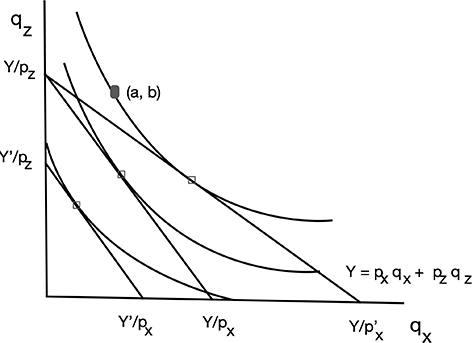
Figure 2.1 Indifference curves.
One can represent  ’s budget constraint by the line,
  It is a straight line with the slope
  that intersects the
  axis at
  and the
  axis at
  .
.  wants to move as far northeast as possible but cannot spend more than
  , which means that
  ’s consumption lies somewhere along the budget line.
 ’s preferences, in the form of
  ’s “indifference curves,” determine where
  ’s consumption lies along the budget line. A point in the commodity space
  lies on the indifference curve through the point
  if and only if
  is indifferent between
  and
and  . Since commodities are infinitely divisible and
  ’s utility function is continuous,
  ’s indifference curves will be continuous. If
  is northeast (or southwest) of
  , then
  cannot lie on the indifference curve passing through
  , and, given the transitivity of indifference, the indifference curve including
  cannot intersect the indifference curve including
  .
.
Because  ’s utility function depends on two variables,
  and
and  , its graph would require three dimensions, but, since the values of the utilities, apart from the ordering, do not matter, one loses nothing by representing
  ’s preferences by indifference curves, which can be drawn in two dimensions. Instead of relying on the strict quasi-concavity of the utility function to draw inferences concerning
  ’s consumption choice, economists can make use of the closely related claim that
  ’s indifference curves are convex to the origin, that is, that they have the shape represented in Figure 2.1. The claim that
  ’s indifference curves are everywhere convex to the origin is a perspicuous mathematical restatement of the law of DMRS. The absolute value of the marginal rate of substitution, given that
  possesses commodity bundle
  , is the slope of the indifference curve passing through
  at point
  . As
. As  relative to
  increases, the magnitude of the slope of the indifference curve increases ever more slowly. If
  is small, a small amount of
  sacrificed for a large amount of
  keeps
keeps  on the same indifference curve.
 does what he or she most prefers if and only if
  chooses a bundle on the highest indifference curve that intersects the budget line. That indifference curve will be tangent to the budget line, except in the case of a so-called corner solution, where the highest indifference curve intersects the budget line at one of the axes.
Suppose  were coffee and
  were “
 ” (the composite commodity consisting of everything else that
  consumes). Suppose also that
  is some particular person, Alice. Economists could predict exactly how much coffee Alice buys if they knew Alice’s income, the price of coffee, some index price for
  , and Alice’s indifference curves. However, economists obviously do not know enough to make such quantitative applications.
Knowing little beyond what is stipulated in the assumptions of the model, economists would like to be able to predict or explain changes in consumption as a consequence of changes in prices or income. To do this, further assumptions about the shape of Alice’s indifference curve are necessary. Almost anything is possible in general. A larger income may lead to a smaller demand for inferior goods, and a price decrease can even go with a decrease in demand for “Giffen goods.”Footnote 11 Given indifference curves shaped like those in Figure 2.1, which are reasonable in the case of many consumers and goods such as coffee, more definite conclusions can be reached. If income decreases to  in Figure 2.1, Alice will consume less of both coffee and
  . If the price of coffee decreases, then Alice will consume more coffee and less of
  . Alice’s demand for coffee is a decreasing function of the price of coffee, an increasing function the price of
  (which is a substitute), and an increasing function of Alice’s income, and, of course, it depends upon Alice’s preferences. These claims say nothing about the dynamics of adjustment (see §3.4). They state how demand would differ, as it were, after the dust has settled.
Since market demand is the sum of individual demands, economists can explain the generalizations concerning market demand. And, moreover, just as economists who sought to emulate Newton might have hoped, economists also have corrections for these market generalizations. The theory of consumer choice shows how those generalizations, including even the law of demand, can break down. It would be nice to have a quantitative account of market demand, and it would be nice to make use of a less idealized model, but the descent from the level of market generalization to theoretical underpinnings appears to be a success.
This success is modest, because data concerning market demand provide weak support for consumer choice theory. For example, as Gary Becker has shown (1962), completely random behavior could account for downward-sloping demand curves and the influence of income on demand; and habitual behavior could account for all of the market generalizations discussed earlier. So the theory of consumer choice is only weakly confirmed by its ability to explain the general facts concerning market demand.
2.6 Conclusions
This chapter has sketched the basic components of consumer choice theory and shown how they imply relatively superficial generalizations concerning market demand. In describing the way that microeconomics characterizes the demand side of markets, this account has also been accumulating philosophical debts. It has spoken of rational choice theory and consumer choice theory, without saying much about what constitutes a “theory.” It has taken the fundamental constituents of those theories to be laws, albeit typically with scare quotes, since presumably false claims are not really laws. But I have said nothing about what a law might be. Chapter 1 spoke of models of rational choice, and this chapter delineated one simple model. But little has been said about what a model is or how models, laws, and theories are related. And Section 2.5 ended with some concerns about confirmation, which has also not yet been discussed.
Consumer choice theory purports to predict and explain the demand “side” of markets. To understand markets, one must also consider supply. A theory is also needed to account for how the “forces” of supply and demand jointly determine economic outcomes. In this chapter, I fill in these pieces of microeconomic theory, before turning in Chapter 4 to normative economics. The material here – especially in Sections 3.1–3.4 – should again be familiar to economists. Sections 3.5–3.7 make more controversial claims.
3.1 Market Supply of Consumption Goods and the Theory of the Firm
Just as market demand depends on prices, incomes, and tastes, so market supply depends on the prices of outputs and inputs and on technology. A higher price for  brings forth a larger supply; a lower price diminishes supply.Footnote 1 Higher prices of inputs either increase the price of output or decrease its supply. Improvements in technology can make it cheaper to produce something and increase the supply of it at a given price. The fate of older coal-fired electric-generating plants illustrates these claims. Changes in technology, especially in fracking and in wind turbines, have lowered electricity-generating costs, and many older coal-fired plants with high operating costs have shut down.
As in the case of generalizations concerning demand, empirical work and statistical analysis can add a quantitative dimension; and the results can be of practical use. Just as in the case of demand, economists seek more than such superficial theorizing. They aim to uncover deeper laws and provide a more systematic explanation of the behavior of firms and the owners of resources.
In theorizing about the supply of unproduced services, such as labor, the theory of consumer choice can itself be adapted, with quantity supplied depending on the choices of individuals between leisure, job amenities, and consumption goods and services. However, most consumer goods and services are produced by firms. Because firms (unlike consumers) are abstractions, standing in for entities as unlike one another as Microsoft and the corner locksmith, economists focus on generalizations concerning the transforming of inputs into outputs rather than characteristics of specific enterprises. The point is to clarify how changes in technology and prices of inputs and outputs influence supply.
As in the case of consumer choice theory, I characterize the theory of the firm in terms of the substantive generalizations that, together with simplifications about the circumstances, explain more superficial generalizations about supply. The presentation here may appear less familiar to economists than in the case of consumer choice theory. For example, in their influential microeconomics text, Mas-Collel et al. (Reference Mas-Collel, Whinston and Green1995) list eleven fundamental characteristics of “production sets,” making no distinction between (1) those that characterize specific markets such as free entry; (2) those, like infinite divisibility of inputs and outputs, that are simplifications needed for the application of mathematical tools; (3) those that are everyday generalizations, such as the general impossibility of transforming outputs back into inputs; and (4) substantive generalizations or “laws” that economists have identified in order to advance the understanding of the supply of goods and services. Unlike their presentation, the account presented here emphasizes the distinction between “laws,” background knowledge, and simplifications, although the central content is the same.
The theory of the firm is made up of two (or arguably three) “laws”:
1. Diminishing returns. In the neighborhood of the actual levels of a firm’s output and inputs, output increases with increases in the quantity of each input. However, holding fixed all but any one input, output increases with additional units of that input at a decreasing rate.Footnote 2
2. Profit maximization. Firms attempt to maximize net returns.Footnote 3
There is a third generalization whose status as a law in the theory of the firm is more questionable:
3. Constant returns to scale. In the neighborhood of the actual levels of a firm’s output and inputs, if all of the inputs into production are increased or decreased in the same ratio, then output will increase or decrease in that ratio.
Just as acquisitiveness and diminishing marginal utility state that utility increases at a decreasing rate when consumption increases, so the law of diminishing returns, or diminishing marginal productivity, states that the increase in output from an increase in the quantity of input  is a decreasing function of
  . At extremely low levels of input
  , relative to the other inputs there may be increasing returns, and, with enough of any input, output can actually be reduced, as excess quantities of an input get in the way and gum up the works. Diminishing returns does not deny these facts; it merely claims that they do not obtain within the range of mixes of inputs found in actual firms. Just as in the case of marginal utility, one speaks of diminishing marginal productivity because it is claimed that the marginal product (the marginal increase in output due to an increase in the quantity of some input) decreases, not that total product decreases.
Constant returns to scale says roughly that if one doubles all inputs, one gets double the output. There is no conflict between constant returns to scale and diminishing returns, although the terminology might suggest otherwise. Constant returns to scale is a troubling generalization. Some, such as Samuelson (Reference Samuelson1947, p. 84), regard it as a trivial definitional truth – whenever it appears not to hold, economists invent some further input that has not been augmented enough or has been augmented too much. There is no reason why returns to scale should be constant, unless the economy is always in equilibrium. If there were increasing or decreasing returns to scale, then, contrary to the assumption of equilibrium, firms would wish to be larger or smaller than they in fact are. Constant returns to scale helps make economic models coherent and mathematically tractable rather than functioning as a substantive generalization concerning economies.
Profit maximization has been controversial. From the armchair, it appears to be a reasonable approximation, but profit maximization by firms may conflict with utility maximization by individuals. What happens when, as is usually the case, managers have preferences for other things in addition to higher profits for the firms they manage? How can individuals be motivated so that firms will aim to maximize profits? Much work in agency theory has been done on this question (Fama Reference Fama1980; Jensen and Meckling Reference Jensen and Meckling1976; Williamson Reference Williamson1985).
By themselves, these “laws” provide the skeleton of a theory of the firm. As was the case in consumer choice theory, one needs to see how the laws are used together and what sorts of simplifications and mathematical techniques are needed to bring them to bear on particular problems. Although the law of diminishing returns is relatively solid, the “laws” that make up the theory of the firm give rise to qualms (to be addressed in Chapter 9) like those that consumer choice theory provokes.
3.2 Market Supply and the Model of a Two-Input Production System
Just as economists explain market demand in terms of individual demand, so they explain market supply in terms of the supply of individual firms, treating the quantity supplied in markets for consumer goods as the sum of the quantities firms supply. The substantive step is the derivation of a firm’s supply function from the theory of the firm and from additional premises concerning the institutional and epistemic circumstances in which production decisions are made. Some firms transport, distribute, or market goods rather than produce them, but these activities can be regarded as kinds of production. The supply function relates the output of a firm (as a flow per unit time) to its inputs. To simplify the discussion, assume that the firm buys its inputs and sells its single output in competitive markets. There are many complexities here and, as in the case of demand, I confine my treatment to the simplest case.
In the most elementary treatments, economists employ a simple model of the firm, which I call a “two-input production system.” This model, like the two-commodity consumption system discussed in Section 2.2, illustrates characteristic features of models in economics:
 is a two-input production system if and only if:
1.
is a firm; is its output; and and are its inputs.2. In “the short run”
is fixed as .3.
, where is continuous and differentiable and known to . The first partial derivatives of are positive, and the second partial derivatives are negative.4. The prices,
, , and , are given and known to .5.
aims to maximize net returns: .


Only two of the laws of the theory of the firm are employed here: diminishing returns and profit maximization. Since the quantity of one of the inputs of production,  , is fixed, the scale is unchanging, and returns to scale are irrelevant. The analysis makes use of Marshall’s insight (1930, book V, chapters 1–5; see also Boland Reference Boland1982a) that economists can regard factors that take a long time to adjust as fixed “in the short run.” The institutional and epistemic assumptions mirror those in the two-commodity consumption system. The firm is operating in a competitive market, where it cannot influence the price it must pay for inputs or the price it can get for its output.Footnote 4 The firm knows these prices, which is a stronger assumption than in the case of consumption, since firms often make their production decisions well before they sell their product. This model leaves out capital, time, and uncertainty. It simplifies by assuming infinite divisibility (implicit in 3), one output, and only one variable input into production.
3.3 Deriving a Competitive Firm’s Supply Function
With the quantity of  fixed at some
  , output is a function only of
  , or, alternatively, economists can regard the input requirements of a as a function of the level of output. Economics can thus think about a firm’s decision-making technologically, with output determined by input, or economically, with the level of input determined by the desired level of output.
Economists can then graph the partial derivative of  with respect to
  (with
(with  fixed at
  ) or the derivative of the inverse function relating
  to the desired level of
  . In other words, one can consider the marginal productivity of
  – the marginal difference in output owing to a marginal increment of
  – as a function of
  , or one can consider the marginal input requirements as a function of
  . If one multiplies by
  in the first case and
  in the second, one can, as in Figure 3.1, graph the relationship between
  and the value of the marginal product of
  and, as in Figure 3.2, one can graph the relationship between marginal cost and
  .
.

Figure 3.1 Marginal productivity.

Figure 3.2 Marginal cost.
As diminishing returns implies, the marginal productivity curve will have a negative slope over the relevant range of input mixes. Figure 3.1 also shows the fixed price firm  must pay per unit of
  ,
,  , as a horizontal line. Since
  attempts to maximize profits and knows both
  and the marginal productivity of
  , the amount of input
  employed will be
  , and the level of output is then
  . If the firm,
  , were to employ less of
  than
than  , then it could increase its profits by increasing production, for an additional unit of
  will result in an increment of output that is worth more than the cost of the additional input. If more than
  is employed, then
  is decreasing its net return by employing units of input that cost more than the value of output they produce.
In Figure 3.2, diminishing returns implies that the marginal cost curve (the marginal input requirements of  multiplied by
  ) is upward sloping. Just as one can represent the given input price,
  , as a horizontal line Figure 3.1, so one can represent
  as a horizontal line in Figure 3.2. The intersection of the price and the marginal cost curves represents the profit-maximizing output,
  . If output is less than this, further net revenue can be obtained by producing more units, since their cost is less than their price. If more than
  is produced, revenue is being lost on producing units that cost more than their price.
It is possible to derive a supply function from the production function  , the specifications of institutional and epistemic conditions, and the various simplifications. Moreover, firms may sometimes know their production functions. However, as in the case of demand, the object is not usually to derive a precise supply function. Instead, the goal is to derive and explain features of the supply functions of firms that do not depend on idiosyncratic details of a particular firm’s production function.
Economists can predict changes in the quantity of output supplied by a firm as a consequence of changes in prices or technology without knowing much about the firm’s production function except that its first partial derivative with respect to a variable input such as  is positive and its second partial derivative negative. If the price of its output increases, the horizontal line representing this price in Figure 3.2 shifts upward and
  increases. A change in
  causes (other things being equal) a change in the same direction in the quantity of output. If, on the other hand,
  increases, the marginal cost curve shifts upward and its intersection with the line representing the price of
  is shifted left.
  is a decreasing function of
  . A change in
  has no effect at all on marginal cost and no effect at all on
  . Since a technological change will only be adopted by a profit-maximizing firm if it lowers costs, technological changes that affect prices in the short run will tend to lower them. As in the case of consumer theory, economists are mainly concerned with properties of equilibria, not with the dynamics of adjustment.
Since market supply is the sum of the supplies of individual firms, economists can thus explain the generalizations concerning market supply sketched earlier. And, moreover, just as in the case of demand, they have learned how to refine these generalizations. For it is not the case that changes in input prices always affect supply. If the price change concerns a relatively fixed factor, then its influence on output will not register immediately. It would be nice to have a quantitative account of market supply, and indeed, with further information concerning the production functions of actual firms, such a quantitative account would appear to be possible. It would also be nice to transcend such a simple model. But, again, as in the case of demand, the descent from the level of market generalization to supposed theoretical underpinnings seems to be a success.
3.4 Market Equilibrium and Price Determination
The accounts of supply and demand take prices to be among the causes of quantities demanded and supplied. Firms and consumers take prices as given and unalterable. But, in a market economy, prices arise as a consequence of the choices of firms and households. We still need a theory of how market economies coordinate individual behavior, and not merely how, given that coordination, prices separately influence the quantities supplied and demanded.
Showing how the behavior of firms and consumers determine prices is a task for general equilibrium theory as well as microeconomics.Footnote 5 However, before turning to general equilibrium theory, one can sketch the basic story about how prices are determined. Even though economies are characterized by general interdependence among markets, it can still be reasonable sometimes to focus on markets singly or in small groups. Such theorizing has been aptly called “partial equilibrium theory,” for one is abstracting from the general interdependencies among markets.
A good explanation of price determination, whether in a particular market or in a whole economy, requires a well-articulated theory of how demand and supply at the currently prevailing prices give rise to changes in prices. In models of perfect competition, in which buyers and sellers cannot influence prices, bargaining is ruled out.Footnote 6 In equilibrium there can be no excess demand and no excess supply (unless the price is zero). That means that no buyer has an incentive to offer to pay more than the going price and no seller has an incentive to lower the price. Individual buyers who offer to pay less than the going price will find no sellers, and individual sellers who attempt to charge more than the going price will find no buyers. An account of price determination thus requires a consideration of dynamic disequilibrium processes.
Although there are sophisticated attempts at modeling disequilibrium processes, the basic story concerning price determination in individual markets is essentially Adam Smith’s:
[When the quantity of a commodity] which is brought to market falls short of the effectual demand, all those who are willing to pay … [its natural price] cannot be supplied with the quantity which they want. Rather than want it altogether, some of them will be willing to give more. A competition will immediately begin among them, and the market price will rise more or less above the natural price, according as either the greatness of the deficiency, or the wealth and wanton luxury of the competitors, happen to animate more or less the eagerness of the competition.
If at any given price there is an excess demand, competition among those who want the commodity or service will bid up the price until the excess demand is eliminated. Because Smith supposes that the equilibrium price, which he calls “the natural price,” is determined entirely by supply, he describes the competitive bidding that changes the price entirely from the side of demand. Contemporary economists tell a similar story on the supply side: if at any given price there is an excess supply, competition between those who supply the commodity or service will bid down the price until the excess inventories of the suppliers have been eliminated (see Arrow and Hahn Reference Arrow and Hahn1971, chapters 11–13). Thus, economists draw the famous graph shown in Figure 3.3.Footnote 7 At any price above the equilibrium price  , such as
  , there will be an excess supply (
 ), and competition among those who supply the commodity or service will lower the price.

Figure 3.3 Supply and demand: price determination.
Economists do not have a theory describing in detail how such competition among buyers or sellers determines prices, and presumably in reality there are many different mechanisms of price adjustments. It might be argued that Smith’s account of price determination is ruled out in models in which buyers and sellers are all price takers and hence incapable of adjusting the prices they personally offer or require. In a notable paper, Robert Aumann (Reference Aumann1964) shows that in a model with a continuum (an uncountable infinity) of buyers and sellers it is possible to reconcile the determination of prices through the behavior of buyers and sellers with the inability of any buyer or seller to influence the price he or she pays. Whether this helps understand actual markets may be questioned. The tension between the models of competitive market supply or demand and models of price determination by competitive bidding illustrates the fact that models can be useful and enlightening, even if they are not consistent with one another.
Moreover, despite the apparent inconsistency between the models determining quantities supplied and demanded and the sketchy model of price determination, economists in fact combine the two into an account of how prices adjust to changes in determinants of supply or demand. Each price determines a supply and a demand as explained by the theories of consumer choice and of the firm. For example, a shift in demand as in the movement from  to
to  in Figure 3.3 causes a price shift. The new prices call forth new supplies and demands and the hypothetical process that begins with a change in some factor affecting supply or demand iterates until (partial) market equilibrium is restored. A market is in “equilibrium” when there is no excess demand or (unless the price goes to zero) excess supply. Little more is said about the real (processes of) equilibration within a single market, although there has been a good deal of discussion of hypothetical mechanisms such as Walras’ “tâtonnement” and Edgeworth’s “recontracting.”
“Comparative statics” supply and demand explanations can easily get confusing. Economists are often reluctant to regard them as causal, because they are inclined to distinguish a comparison of equilibrium states from an explicitly dynamic causal account. To be sure, comparative statics accounts skip over the intricate causal details of adjustments to shocks such as shortages of Covid-19 tests. Moreover, it is bound sometimes to be the case that the details of adjustment processes influence outcomes. That is certainly the case in adjustments to Covid-19. But qualitative causal claims about how prices will change can be made without describing the dynamic processes. Indeed, in many markets, such as those for commodity futures, it seems entirely reasonable to ignore the dynamics of adjustments, which occur nearly instantaneously in response to second-by-second fluctuations in demand and supply.
In abstracting from the actual sequence of events and time ordering, comparative statics accounts differ from paradigm cases of causal explanation. But they may be causal nonetheless. Supply and demand functions and the market institutions may causally explain equilibrium prices and quantities. Although the distinction between dynamic and comparative statics accounts is important, both may be causal.
The causal structure of comparative statics analysis is straightforward. In the background is an implicit temporal story in which the shift whose effects one is exploring precedes the establishment of a new equilibrium. Figure 3.4 depicts the implicit story that economists have in mind.

Figure 3.4 Implicit dynamics.
Except in the equilibrium conditions at the beginning and end, all the causal arrows point to the right from previous to later times. The supply function  and the equilibrium price
  determine the quantity of the commodity supplied,
  . Suppose it is corn. The demand function
  and the equilibrium price determine the quantity of corn demanded
  .
.  and
and  are equal in equilibrium, and so there is nothing to cause the equilibrium price,
  , to change. There is then some shock to supply or demand – in Figure 3.4, it is a shock,
  , to the supply of corn. Perhaps there is an outbreak of corn blight. Because of the blight, the function relating the quantity of corn supplied to the market price of corn changes at
  from
from  to
to  . The changed supply function and the as-yet unchanged price lead jointly to a new quantity of corn supplied
  . However, at
  , price and demand have not yet changed.
  and
and  combine with the workings of the market mechanism,
  , to give rise to a changed price,
  . Jointly with
  and
and  ,
,  gives rise to
  and
and  – that is, new quantities of corn demanded and supplied. Jointly with the market mechanism,
  and
and  give rise to a new price
  . Although nothing in the story so far guarantees that the process will ever reach an equilibrium, if it does, the new equilibrium price of corn coupled with the supply and demand functions will give rise to quantities supplied and demanded that are equal to one another at a new equilibrium price. The comparative statics account shown in Figure 3.5 greatly simplifies the story.

Figure 3.5 Comparative statics.
In abstracting from the actual course of adjustment to the shock, as Figure 3.5 does, economists are assuming that the adjustment process will not appreciably affect those aspects of the final outcome that are of interest to them. When this assumption is mistaken, a comparative statics account of shifts in market equilibrium explanation will be incorrect. But making such an assumption and then leaving the intermediate steps out does not preclude a causal interpretation.
In the comparative statics account, the explanatory factors consist of the supply and demand functions ( and
and  ), the unspecified market mechanisms,
  , and the shock,
  , that initiates the change in
  . Supply and demand functions, unlike specific quantities supplied or demanded, can have a role in explaining prices if, as in Figure 3.4, they do not shift as other prices and tastes and production processes evolve over time. In a paradigm case of a supply and demand explanation, such as explanation for a lower price of soybeans in the United States owing to the imposition of restrictions on the importation of American soybeans by the Chinese government (which shifts the demand function), the other factors that determine the supply and demand functions – that is, how the supply and demand for soybeans are functionally related to the price of soybeans (factors such as the price of fertilizer or the popularity of Chinese food) – do not themselves depend appreciably on the price of soybeans or the amount of them sold. Thus, the explanation for the new lower price of soybeans in terms of market mechanisms, the shift in the demand function for soybeans owing to the import restrictions, and the more or less unchanging supply function makes good causal sense.Footnote 8
3.5 Microeconomic Theory
Both the microeconomic problems and analytical techniques economists work with are more sophisticated than the simple examples mentioned so far. Nevertheless, this chapter and Chapter 2 have set forth the basics of microeconomic theory. It consists in my view of seven laws:Footnote 9 those of the theory of consumer choice, those of the theory of the firm, and the assertion that markets reach equilibrium. Economists generally regard the claim that markets are in equilibrium as a theorem rather than an axiom; they formulate their models in order to prove that equilibria obtain. When economists have not yet succeeded in proving that an equilibrium obtains in some new economic model, they are inclined to assume that it does. I have more to say about the commitment to equilibrium in later chapters.
There are disquieting aspects to the claim that microeconomic theory consists of these seven “laws.” First, not all microeconomic models employ all of these laws, even when they are relevant to the explanatory and predictive tasks at hand. Some models, such as the two-input production system, leave out laws (constant returns to scale in this case) that have no implications for the case at hand. More disturbingly, others incorporate contraries to some of the fundamental laws of microeconomic theory. There are models with satiation, models with increasing or decreasing returns to scale, models without profit maximization, and even models without completeness, models without continuity, and models with intransitive preferences. It is as if physicists supposed that force is sometimes proportional to acceleration and sometimes not.
These facts suggest two conclusions: economic models need not be consistent with one another, and the “laws” of microeconomics do not have the same status as fundamental natural laws. Economists regard many as expedient first approximations, which theorists may supersede or reject in particular investigations. Some, such as transitivity, choice determination, DMRS, and diminishing returns, are more central than others. Theoretical work that rejects these may cross the boundaries dividing economics from other social inquiries. These facts raise difficult questions about what unites the discipline and explains its boundaries, which I address in Chapter 7. What sort of a science can economics be?
A further problem with identifying microeconomic theory with these seven generalizations is that other claims are also distinctive features of microeconomic models. For example, although general equilibrium theory and microeconomics rely on the same behavioral generalizations, they are distinct from one another.Footnote 10 What distinguishes them are not their laws, but the explanatory questions they address and the simplifications they employ. Microeconomics focuses on single markets or small groups of markets and thus on partial equilibrium, while general equilibrium theory is concerned with the economy as a whole. I call the behavioral generalizations that form the core of both microeconomics and general equilibrium theory simply “equilibrium theory.” Microeconomics and general equilibrium theories are augmentations of equilibrium theory.
Figure 3.6 summarizes the view of equilibrium theory or the basic behavioral generalizations of equilibrium models presented in Chapters 1–3.

Figure 3.6 The basic equilibrium model.
In addition to its laws and questions, microeconomics is characterized by distinctive simplifications. Buyers and sellers are price takers, monopolists, or monopsonists. Commodities are infinitely divisible. Economic agents have perfect knowledge of all relevant data. Many models distinguish between the “short run” in which some inputs are fixed and the “long run” in which all inputs can be adjusted. These simplifications are prevalent and characteristic of microeconomic models, even though they are less essential to them than equilibrium theory. Economists do not regard them as truths, let alone economic discoveries. If anything, economists seek to relax or to avoid such assumptions, not to maintain them in the face of criticism.
3.6 General Equilibrium Theories
General equilibrium theories aim in principle to explain how market economies coordinate individual behavior via the price system. Markets do not work flawlessly, but the fact that the goods people want are produced and distributed without central direction is amazing, and in need of explanation. To some extent, general equilibrium models are continuous with microeconomic models, and they are built upon the same “laws.” Some idea of general equilibrium goes back to the eighteenth century, but Leon Walras (Reference Walras1926) was the first economist to take seriously the task of elucidating an abstract general equilibrium theory.
Models that can justifiably be called “general equilibrium models” come in at least six varieties:
1. models of highly simplified fictional economies with few commodities, resources, and individuals;
2. models of the interrelations between aggregates such as total consumption and the money supply;
3. structural macroeconomic forecasting models;
4. input–output models with dozens or hundreds of commodities;
5. DSGE (dynamic stochastic general equilibrium) models; and
6. abstract models of economies with few constraints on individual choices, production, endowments, etc.
These six kinds of general equilibrium model differ in complexity, level of aggregation, and especially their purposes. In attempting to address large-scale questions, it can be helpful to employ highly aggregative general equilibrium models in which there are, for example, only two commodities (a consumption good and a capital good), only one unproduced input into production (labor), and only two kinds of agents (workers and capitalists). Such models of whole “toy” economies can explore the interdependencies among the three markets for labor and the two commodities. By representing the myriad actual commodities as merely one capital and one consumption good, such models assume away many of the complexities of the relations among markets. When such simplified “small” general equilibrium models are built around equilibrium theory, as they typically are, these models are similar in intention to the partial equilibrium work characteristic of microeconomics.
Simple Keynesian models, such as John Hick’s IS-LM model, which is discussed in Chapter 5, are instances of the second kind of general equilibrium theorizing. They describe a general – that is, economy-wide – equilibrium, but it is an equilibrium among aggregates such as total savings and output; these models do not attempt to show how the choices of individuals generate a general equilibrium. The third variety of general equilibrium models – large-scale macroeconomic forecasting models, such as those developed in the 1950s and 1960s by economists such as Lawrence Klein (Reference Klein1980) – are elaborations of modeling such as IS-LM relying on a wider set of decision rules and aggregate relations.
The fourth variety, input–output models, are directed toward narrower practical, predictive ends (Whalley Reference Whalley, Aaron, Galper and Pechman1988). By assuming, for example, that there are constant production coefficients and that demands for different commodities and services satisfy certain constraints, economists can construct a model of an economy with dozens or hundreds of commodities and industries and investigate how the outputs of some commodities are affected by government policies and shocks of various kinds. Economists might, for example, use input–output models to predict how a drop in oil prices would affect the cost of clothing.
General equilibrium models of the fifth variety play a large role in contemporary macroeconomics, which models the economy as stochastic – that is, subject to random shocks – and dynamic, in the sense of examining how shocks are propagated through the economy, typically via the choices of a single immortal representative agent. Thus the name “dynamic stochastic general equilibrium” models. Although driven by the rational choices of the representative agent, these models are implicitly highly aggregative, because the choices of the representative agent implicitly aggregate the choices of actual individuals.
That brings us to the sixth variety of general equilibrium theorizing, which many economists have regarded as the theoretical foundations for mainstream economics, while others regard it as having instead cast those foundations in doubt.
3.7 Abstract General Equilibrium Models
Abstract general equilibrium theories are augmentations of (some substantial subset of) the eleven laws that together make up the theories of rationality, consumer choice, and the firm. Furthermore, abstract general equilibrium models, unlike other applications or augmentations of the basic equilibrium model, involve many commodities and investigate a fully general interdependence among the markets in an economy. What distinguishes general equilibrium models from microeconomic models are assumptions of this last kind and the apparent explanatory task of accounting for the operation of whole economies.
Abstract general equilibrium models are puzzling, since they abstract so radically from the details of real economies. Gerard Debreu in his classic Theory of Value states that his theory is concerned with the explanation of prices (1959, p. ix). Others as distinguished as Kenneth Arrow and Frank Hahn deny that general equilibrium theories are explanatory (1971, pp. vi–viii). Some prominent economists (Blaug Reference Blaug1980a, pp. 187–92) and philosophers (Rosenberg Reference Rosenberg1983) have argued that abstract general equilibrium theory is not empirical science at all.
Abstract general equilibrium theories place no limitations on the interdependence of markets or on the nature of production and demand beyond those implicit in the “laws” of equilibrium theory. Given the abstractness and lack of specification in abstract general equilibrium theory, many economists regard it as the fundamental theory of contemporary economics. As the previous discussion suggests, I contend that equilibrium theory is the fundamental theory. Abstract general equilibrium theory is one way to apply the fundamental theory.
What good are abstract general equilibrium theories? Owing to their abstraction and simplifications, they do not appear able to explain or predict anything. For example, models of intertemporal general equilibrium commonly assume that agents have complete knowledge concerning production possibilities and the availability and prices of commodities for the whole of the future. They also stipulate that there is a complete set of commodity futures markets on which present commodities and titles to future commodities of all kinds and dates can be freely exchanged (see Koopmans 1957, pp. 105–26; Malinvaud Reference Malinvaud1972, chapter 10; Bliss Reference Bliss1975, chapter 3). Because economic reality does not satisfy, even approximately, such extreme assumptions, abstract general equilibrium theories have little predictive worth and are consequently untestable. In that case, what role can they play within an empirical science?
Abstract general equilibrium theorizing aimed to prove that under idealized circumstances there exist stable and unique economy-wide equilibria that render compatible the choices of individual producers and consumers and that also have desirable welfare features. In the 1950s and 1960s, this project had some major successes. In particular, economists proved that equilibria exist for perfectly competitive markets and that those equilibria are optimal in the sense that no alternative to a perfectly competitive equilibrium  exists that satisfies some preferences better and everyone else’s preferences at least as well as
  does. These proofs appeared to justify Adam Smith’s view that it is as if there is an invisible hand coordinating the actions of individuals, leading them to promote the public good in the course of pursuing their private interests. These abstract inquiries have the form of explanatory arguments where the explanandum is the existence of an economic equilibrium. Yet, construing general equilibrium theories as explanations of general equilibria is problematic, because they rely on false premises and because it is questionable whether actual economies are in equilibrium.
Whatever else one can say on its behalf, abstract general equilibrium theorizing has played a powerful critical role. Indeed, it bears some responsibility for the transformation of economics over the past generation. Although proofs of the existence of equilibria were a triumph for abstract general equilibrium theorizing, further investigation led to theoretical disaster. General equilibrium theorists failed to show that the equilibria whose existence they proved were unique or stable, except under such restrictive conditions as to make the demonstrations irrelevant to actual economies. In addition, in a series of theorems proven in the 1970s, theorists showed that the conditions imposed on individuals – the generalizations that I called equilibrium theory – have virtually no implications concerning aggregate phenomena. These theorems also cast serious doubt on the reliance on representative agents in DSGE models. They show that the assumption that individual preferences satisfy axioms such as transitivity or DMRS does not imply that market behavior (or the preferences of a representative agent) will be consistent with these axioms. Unlike what we saw in the case of partial equilibrium (where, crucially, incomes are independently fixed), economists cannot prove that market demand curves are downward sloping from the fact that individual demand curves are downward sloping. As Shafer and Sonnenschein (Reference Shafer, Sonnenschein, Arrow and Intriligator1982, p. 672) put it:
Market demand functions need not satisfy in any way the classical restrictions which characterize individual demand functions … Only in special cases can an economy be expected to act as an “idealized consumer.” The utility hypothesis tells us nothing about market demand unless it is augmented by additional requirements.Footnote 11
The only constraints on aggregate demand functions implied by the conditions on individual demand and preference are that they must be continuous and homogeneous of degree zero, and they must obey Walras’ law.Footnote 12
General equilibrium theory is downtown Econville, where macroeconomics, microeconomics, and normative economics cross paths. Extremely abstract theorem proving rubs shoulder with rough and ready simple models. General equilibrium models have appeared to many economists to be the starting point on an endless voyage to sublime climes, while others believe that the roads in the center of town are in such bad repair that there is nowhere to go and a new starting place must be found. Many questions remain.
3.8 Conclusions
This chapter completes the sketch of equilibrium theory that began with the theory of rationality in Chapter 1, its embedding in consumer choice theory in Chapter 2, and its account of production and supply in this chapter, culminating in partial equilibrium accounts of price determination and general equilibrium forays into extending the account of price determination into an account of what determines the overall coordination of the actions of market participants.
In the course of this chapter, the list of philosophical IOUs has grown. Questions about the nature of models have become more pressing, and philosophically minded readers may by now be thoroughly annoyed at my apparently arbitrary shifting between talking about models and talking about theories. How do they differ, and how are they related? How can economists sensibly make use of models that contradict one another? Are models of individual interactions superior to models that specify relations among aggregates? Does it make sense to regard variables as simultaneously cause and effect? What is causation and how does it differ from mere association? What is the role of theorem proving in an empirical science?
Before tackling these questions, we need a more complete picture of mainstream economics. Welfare economics is the topic of Chapter 4. Chapter 5 discusses macroeconomics.
The central aim of normative economics is to help guide economic policy. There are many kinds of economic policies: taxes, transfers, tariffs, licensing, and patents, plus regulations on employment, housing, transportation, retirement benefits, immigration, food safety, land use, drugs and medical procedures, and many other things. These policies matter deeply to people. They affect people’s freedoms and opportunities. They contribute to or mitigate inequalities. They limit or aggravate discrimination against disfavored social groups. They shore up or threaten individual rights and political voice. Economic policies clearly matter to individual welfare, which is the central concern of mainstream normative economics. Indeed, normative economics is often called “welfare economics.”
Talk of “welfare” is ambiguous. In everyday political discussion, “welfare” consists of programs for the poor such as nutritional or housing assistance. Welfare economics is concerned with a different sense of the term. In this sense, “welfare” is a matter of how well people’s lives are going. Welfare in this sense is synonymous with “well-being” – the overall metric in terms of which to judge how well people’s lives are going.
What counts as well-being is a matter of philosophical controversy. There are three main views: (1) well-being is, as the classical utilitarians believed, a matter of mental states or, for short, happiness; (2) well-being is constituted by the satisfaction of preferences (cleansed of false beliefs and irrationality); and (3) well-being consists in possessing some set of “objective” goods, such as happiness, close friends, good health, and achieving worthwhile goals. These accounts of well-being are problematic. Those who are happy because they are deluded about their lives are not living well. Satisfying my preference for an end to the Covid-19 pandemic in 2023 may not make me better off if I die first. Taking well-being to consist in a list of goods does not explain why some things are on some people’s lists while others things are not, or how to make trade-offs among items on the list.
If one steps back from these philosophical theories of well-being and lowers one’s expectations, it is obvious that people do not need an adequate philosophical theory in order to know something about well-being. We know, for example, that generally people live better if they are healthy or have intimate friends than if they are ill and friendless. Platitudes such as these do not constitute a satisfactory philosophical theory, and they leave many questions about well-being unanswered. But sets of such platitudes, which I call a “folk theory” of well-being, provide some meaning for the term “welfare” and a touchstone against which to test more detailed claims about welfare.
Specifically, economic welfare is that portion of an individual’s well-being that depends upon the institutions, policies, and outcomes with which economists are concerned. It is tempting to identify economic welfare with wealth, but the connection between wealth and economic welfare needs to be examined. There is a correlation between economic welfare and overall welfare, and very low levels of economic welfare make it impossible to live well. Yet, economic welfare and overall welfare do not always go together. Wealth is no guarantee of well-being.
Mainstream normative economics is an offspring of utilitarianism (see Bentham Reference Bentham and Harrison1789; Mill Reference Mill1863; Sidgwick Reference Sidgwick1901). Utilitarianism maintains that the evaluation of policies and individual actions depends on their consequences for the welfare of individuals. One can summarize the view as follows:
An action or policy is morally permissible if and only if it results in no less total welfare than any alternative.
This formulation hides many complexities. Should one be concerned with total welfare or average welfare? The answer is crucial to the evaluation of population growth. Whose welfare counts? Only people currently alive? All people in the present and future? All sentient beings? Should moral appraisal focus on the consequences of actions and policies or instead on the consequences of rules governing policies and actions? What constitutes welfare? Bentham took welfare to consist in pleasure. Mill claims that welfare is happiness, but sometimes it sounds as if he regards welfare as preference satisfaction. Sidgwick takes welfare to consist in desirable mental states. Utilitarian policy evaluation depends on how all these questions are answered. What best satisfies preferences often differs from what most contributes to happiness.
Despite its utilitarian roots, contemporary mainstream normative economics is not utilitarian, mainly because economists are skeptical about comparing the welfare gains and losses of different people, and, of course, there is no way to judge whether the benefits policies bring to some people are larger than the harms they cause others without the ability to compare benefits and harms across individuals. It may seem odd that welfare economists deny that interpersonal comparisons of welfare are possible. Who would deny that indigent children impressed into the Lord’s Resistance Army are worse off than the typical child born into a middle-class Japanese home? Sections 4.2.1 and 4.3 will have more to say about welfare economics and interpersonal comparisons.
The problems that welfare economics must address are diverse and difficult. A broad social consensus in affluent societies supports providing minimum amounts of food, housing, medical care, and education to everyone, because these appear to be universal or nearly universal prerequisites to living well. But how much of these should be provided and by means of which institutions? While most people support ensuring that people’s basic needs are met, they also believe that it is not the state’s responsibility to hold the hands of individuals and make their lives successful. When someone’s spouse dies, it is not up to the state to console them or to provide a replacement. It may not be entirely up to those individuals who suffer tragedies to pick up the pieces of their life, but it is not mainly up to public policy. Provided that people’s basic needs are met and they have the necessary physical and mental capabilities, people should be responsible for their own well-being. Economic policy has narrower goals than the flourishing of individuals.
Consider just a few examples. First, what, if anything, should be done about the breathtakingly unequal distribution of income and wealth within the United States and across the world? Fewer than 100 individuals (some estimate as few as five or eight individuals) have more wealth than half the world’s population combined – nearly four billion people! While international inequalities have diminished, owing especially to rapid economic development in China and India, inequalities within those two nations are glaring and growing. Income and wealth inequalities in the United States, after narrowing in the middle third of the twentieth century, have exploded over the past four decades. What, if anything, should be done?
Second, to what extent does international trade exacerbate or mitigate inequalities, and how does this bear on welfare? While economists have generally been enthusiastic supporters of lowering tariff barriers, there are costs to lessening the protection of domestic enterprises. Some firms, facing competition from abroad, go bankrupt. Workers in some industries lose their jobs. Are the benefits sufficient to justify harms such as these?
Third, consider the challenges of macroeconomic policy. By 2009, with an official end to the severe recession that began in 2008, economic activity in the USA was no longer shrinking, but the unemployment rate was about 10 percent and the budget deficit was $1.3 trillion. Economists disagreed about what to do, with some arguing for additional government expenditures, especially on infrastructure, in the hope of getting the economy moving again, while others argued that governments needed to cut back on their budgets to lower deficits and thereby reassure investors that there was no risk of fueling inflation or defaulting on the debt. Whether “stimulus” or “austerity” was the correct policy had enormous consequences both for economic recovery and for the well-being of the least well-off members of society, who would suffer in the immediate future from austerity, even if the policy were successful.
In all these examples, positive theory is challenged to explain the relevant phenomena and make predictions about the consequences of policies, and normative theory is challenged to appraise proposed policies and their consequences. As these examples illustrate, the challenges for economic policy differ greatly. Normative economists need to analyze and evaluate long-lasting economic trends. They need to defend general conclusions concerning perennial questions such as how to evaluate international trade policies. They need to help answer pressing policy questions around which political controversies swirl.
To address the many challenges, normative economics requires a great deal of positive economic knowledge. Economists cannot appraise economic inequalities, determine whether lower tariffs are on the whole beneficial, or favor stimulus or austerity without knowledge of the effects of the phenomena of concern and of the policies under discussion. But positive theorizing is not enough. Even if economists reduce the normative appraisal of economic outcomes to a consideration of their consequences for welfare, economists still need some normative theorizing to get from the conclusions positive economics establishes concerning prices, quantities, and incomes to judgments concerning what most promotes welfare.
This chapter lays out the normative theory employed by mainstream economics. Section 4.1 begins with the fundamental question: what is welfare or, synonymously, well-being? Section 4.2 explains why the answer that economists give led them to eschew utilitarianism, and it links this chapter to Chapters 1–3, presenting the fundamental theorems of welfare economics, the grounds for the admiration economists have for the operation of perfectly competitive markets, the problems of markets that are not perfectly competitive, and further theorems concerning social choice and welfare. Section 4.3 turns to practical work in welfare economics and the foundations of cost–benefit analysis. Section 4.4 is concerned with the peculiar moral authority of economists. Section 4.5 ends with an overview, including some remarks about alternatives to mainstream normative economics.
4.1 Welfare and the Satisfaction of Preferences
As Chapters 1–3 document, preferences are the central concept that economists employ to predict and explain the choices of economic agents. To assert that preferences motivate choices says nothing by itself about welfare. However, if economists assume, as they often do, that individuals are self-interested – that is, that they usually aim to benefit themselves – then the rankings by individuals of the objects of choice reflect their evaluation of how beneficial those objects of choice are for themselves. Choice determination implies that an agent such as Penelope chooses an alternative  if and only if she believes there is no feasible alternative that she prefers to
  . If Penelope is trying to benefit herself in her choices, then she chooses
  if and only if she believes there is no feasible alternative that is better for her than
  . If her beliefs are true and her judgments of value are sound, then what best satisfies Penelope’s preferences coincides with what most enhances her well-being. In other words, for any two alternatives
  and
and  , Penelope prefers
  to
to  if and only if
  is better for her than
  . Since, in addition, the same word, “utility,” is used both to refer to an indicator of preferences and as a synonym for welfare, the identification of welfare and preference satisfaction strikes many economists as unproblematic.
One important implication of identifying welfare with preference satisfaction is that it rules out paternalism – that is, overruling the preferences of an individual with the intention of benefiting that individual. For example, laws requiring that people wear seat belts are largely paternalistic even if they may have small or indirect benefits for others. If whatever Morrie chooses is best for him, then it is impossible to make Morrie better off by overruling his choice. Although this implication of identifying preference satisfaction and welfare may be attractive to economists, who typically strongly oppose paternalism, the claim that one can never benefit individuals by overruling their choices is false. For example, suppose Morrie is a tourist in London. Looking the wrong way, he steps in front of a speeding bus. Clare grabs him and pulls him back on to the curb. She overrules his mistaken choice, much to Morrie’s benefit.
Note that to say that welfare is preference satisfaction is to say only that those states of affairs that are higher up in Penelope’s preference ranking are better for her. It says nothing about feelings of satisfaction. Satisfying a preference need not result in any feeling of satisfaction (or any feeling at all). Whether Penelope finds out that some preference of hers is satisfied and is pleased at the information is a separate question from whether her preference is satisfied. Satisfying preferences is like satisfying degree requirements: preference satisfaction obtains when states of affairs that are ranked more highly come about, whether or not those outcomes are known or enjoyed.
4.1.1 Constitutive versus Evidential Views
Welfare and preference satisfaction can coincide because preference satisfaction constitutes well-being or because what people prefer is evidence of what promotes their welfare. The view that preference satisfaction constitutes well-being is a substantive philosophical theory concerning well-being. The evidential view, in contrast, says nothing about what constitutes well-being. It supposes only that Penelope has her own view of well-being and, because she is self-interested, her preference ranking reflects her judgment of what is better for her. If, in addition, she is a good judge of what is good for herself, then economists can make inferences concerning Penelope’s well-being by determining how well satisfied her preferences are.
It is more charitable to economists to attribute to them the evidential rather than the constitutive view of the coincidence of well-being and preference satisfaction. That way, economists do not have to stick their necks out and defend a controversial philosophical theory of well-being. This philosophical modesty is wise, because the philosophical thesis that well-being is constituted by the satisfaction of preferences is refuted by the facts that people sometimes prefer what is bad for them when (1) they have false beliefs or lack information, (2) they are irrational, and (3) their preferences are not directed toward their own well-being. If Penelope has false beliefs (like Romeo’s mistaken belief that Juliet is dead, or Morrie’s false belief that it is safe to cross the street), then she may prefer actions that are harmful to her. After consuming some psilocybin mushrooms, Penelope may adopt the unwise plan of flying out the window rather than walking to work. In addition, Penelope’s preferences need not be directed toward enhancing her own well-being. Acting on non-self-interested preferences could turn out to benefit Penelope, but there is no reason to believe that when Penelope aims to sacrifice her well-being to bring about some objective that is more important to her, she always winds up benefiting herself. When choosing to sacrifice their own well-being, agents do not always fail.Footnote 1
These facts about preferences show that welfare is not constituted by preference satisfaction. They do not show that preferences cannot sometimes be good evidence concerning well-being. If, as many philosophers believe, well-being consists in the satisfaction of preferences that are self-directed and “cleansed” of mistakes and irrationality, then people’s actual preferences may be fallible guides to their “true” spruced-up preferences. Moreover, in taking preferences to indicate what enhances well-being, economists need not accept this or any other theory of well-being, taking instead the position that, whatever well-being may be, if people are self-interested and good judges of what promotes their interests, then their preferences will be a guide to what enhances their welfare.
It is meaningless to maintain that individuals seek to enhance their own well-being or that they are good judges of how well alternatives promote their well-being if one has no idea concerning what well-being might be. Thus, it might appear that welfare economists cannot avoid commitment to some philosophical theory of well-being. This objection is correct to point out that economists must have some idea of what is good and bad for people to determine whether they generally prefer what is good for themselves. However, the objection is wrong to maintain that economists must commit themselves to any philosophical theory of well-being. What I called the “folk theory” of welfare suffices. Economists presumably accept platitudes such as the claim that those who are healthier or wealthier are generally better off. Those platitudes attach meaning to talk of well-being, including the assumptions that justify taking preference as a guide to well-being – at least in those circumstances in which individuals are likely to be self-interested and well informed.
4.1.2 Should Satisfying Preferences Be the Objective of Normative Economics?
Satisfying preferences does not always promote people’s well-being. For example, many Americans prefer not to be vaccinated against Covid-19 because they believe that the vaccines are part of a nefarious plot of some sort. In addition, preferences that are not based on false beliefs or non-self-interested objectives may nevertheless be racist, misogynist, or otherwise antisocial, and for that reason their satisfaction may not enhance overall welfare. So there are serious reasons to question whether satisfying preferences always promotes welfare.
One radical response to this query is to defend preference satisfaction as a free-standing objective of public policy regardless of any connection it may have to welfare. The measurement of preferences and inquiries into the causes and consequences of preference satisfaction can then apparently proceed without any evaluative commitments. A few economists, such as Vining and Weimer (Reference Vining and Weimer2010, p. 22), have explicitly defended this view. It offers a way of short-circuiting all doubts about the relationship between welfare and preference satisfaction. Robert Sugden (Reference Sugden2018) argues that the findings of behavioral economics, which undermine the connection between preference satisfaction and welfare by demonstrating the context-sensitivity of preferences, should lead normative economists to abandon their concern with welfare and focus instead on the opportunities individuals have to satisfy their preferences (2018, chapter 5). In Sugden’s view of normative economics:
Whether there are good reasons for those preferences is a matter for the individual himself; the economist can quite properly bracket out that question. Indeed, the individual might reasonably say that it is not the economist’s business to enquire into his reasons for wanting what he wants.
On this view, the task of the economist is (other things being equal) to figure out how best to follow the wishes of the population, no questions asked. One might support Sugden’s view by invoking the idea of democratic sovereignty, understood as the principle that policies should be determined by the will of the population. Such an interpretation of democratic sovereignty is untenable. For example, it condemns representative government, which obviously takes day-to-day public decision-making out of the hands of the citizenry. On a more reasonable interpretation, democratic sovereignty demands only that the procedures for choosing public policies reflect the will of the population.
A second argument in support of directing policy toward preference satisfaction regardless of its connection to welfare maintains that respect for the autonomy of citizens supports satisfying preferences, no questions asked. For example, the public authorities should not forbid religious practices on the grounds that they judge them to be superstitions. A liberal state should instead aim to be neutral among competing visions of a good life. However, this consideration shows only that public policies should avoid frustrating rational aims or violating rights. Achieving some success in pursuing a significant rational aim, whether it be carrying out the tasks demanded by one’s profession, taking care of dependents, or pursuing a religious calling, is not just satisfying a desire. Devoting policy to satisfying preferences goes far beyond avoiding interfering with individuals’ pursuit of projects that are important to them.
I maintain that Sugden is mistaken to suggest that economists should not inquire into the reasons people have for their preferences. Although economists do not have the legal authority to overrule popular sentiments, they can and should question them when they are based on mistakes or malevolence. If people favor policies for confused or mistaken reasons, economists should point this out, and they should sometimes advise legislators to vote against the wishes of their constituents. For example, as is evidenced by the actions of affluent countries, there is little support for major efforts to vaccinate the entire population of the world, even though (setting benevolence to the side) doing so is an unbelievably favorable investment in limiting new variants and enhancing the world economy. In a case such as this one, economists should attempt to convince the populace of its error.Footnote 2
Why? What reason do economists have to oppose an unjustified policy? One good reason is a normative commitment to making people better off. False beliefs about the benefits and risks of vaccination lead to decisions that make people worse off. Although there is much more to be said, I conclude that the justification for directing policy toward the satisfaction of preferences lies in the connection between preference satisfaction and well-being. When satisfying preferences does not make people better off (as judged by the folk theory of well-being), then there is little reason to satisfy preferences.
4.2 How Is Welfare Economics Possible?
4.2.1 Disavowing Utilitarianism
The great nineteenth-century utilitarians, Bentham, Mill, and Sidgwick, all believed that when assessing actions and policies, it is possible to make interpersonal welfare comparisons. Otherwise, utilitarianism provides no guidance when a policy increases the welfare of some individuals and decreases the welfare of others. Although there is no simple empirical test that determines the magnitudes of welfare gains or losses, economists might propose, as a first approximation, that on average (despite huge variations) people in similar circumstances are equally well-off and that gains or losses of income have similar effects on the welfare of similarly situated agents. This assumption makes it possible roughly to implement utilitarianism in circumstances in which large numbers of individuals are concerned, and, in fact, a good deal of policy-making is implicitly utilitarian.
For example, early in the twentieth century, economists argued that welfare would be maximized by equalizing incomes as much as was consistent with retaining incentives to work and invest. Citing diminishing marginal utility of income, they argued that, for example, $1,000 contributes less to the well-being of someone with an income of $500,000 than to the well-being of someone with an income of $15,000. Slicing the “pie” – distributing shares in goods and services – more equally increases total welfare, unless by diminishing incentives it shrinks the pie.
Welfare economists have nevertheless moved away from utilitarianism, because most of them deny that it is possible to make interpersonal comparisons, or they argue that interpersonal comparisons rely on value judgments that are inadmissible in economic science. One fundamental difficulty in making interpersonal comparisons of well-being derives from identifying well-being with preference satisfaction. Recall that in the basic model of rational choice and in much of positive economics, preferences are represented by ordinal utilities. That means that the only information that Patricia’s utilities convey concerns her ranking of alternatives. The size of Patricia’s preference for  over
over  ,
,  , is entirely arbitrary. It says nothing about the intensity of her preferences. Thus, it is impossible to compare the gains in utility that one policy brings to Patricia to the losses in utility that the policy brings to Maxwell. Since welfare economists take utilities to be indicators of well-being as well as indices of preferences, it follows that interpersonal utility or welfare comparisons are impossible.
However, the most influential argument for the impossibility of interpersonal utility comparisons is not this one (which can be met by shifting from ordinal to cardinal utility). In An Essay on the Nature and Significance of Economic Science (1932, 1935), Lionel Robbins argues that there is no evidence for interpersonal comparisons and that interpersonal comparisons rest instead on value judgments about the relative importance of benefiting one person rather than another. Robbins’ argument faces challenges. For example, John Harsanyi has argued (especially in his 1977b, chapter 3), that there is, in effect, a single utility function governing human appraisals of states of affairs. Its ranking of states of affairs depends not only on their properties but also on causal variables affecting the tastes of individuals. Psychological theory cannot specify this underlying utility function, but, nevertheless, there is a fact of the matter about, for example, how being Norma with an extra cup of coffee compares to being Gary with one fewer pair of shoes. Harsanyi maintains that people employ their empathic abilities to determine their “extended preferences” between alternatives such as these.Footnote 3
An inability to make interpersonal welfare comparisons rules out utilitarianism. Indeed, it might appear to rule out any substantive normative conclusions except in the case of unanimity in preferences. However, welfare economists have found some ways to work around the problems.
4.2.2 The Fundamental Theorems of Welfare Economics
As discussed in Section 3.6, in the middle decades of the twentieth century, general equilibrium theorists attempted to provide a rigorous demonstration of Adam Smith’s surmise that unfettered markets would bring about mutually beneficial coordination of the self-interested pursuits of individuals (1776, book IV, chapter 2, p. 423). Although the program did not achieve all that its proponents hoped, it still managed to prove that general equilibria of perfectly competitive markets exist and that they are “Pareto optimal” or, equivalently, “Pareto efficient.” This is the first fundamental theorem of welfare economics:
Every perfectly competitive equilibrium is Pareto optimal.
A state of affairs  is Pareto optimal, if no alternative is Pareto superior to
  . A state of affairs,
  is Pareto superior to
  or, equivalently,
  is a Pareto improvement over
  , if and only if someone prefers
  to
to  , and no one in the population in question prefers
  to
to  . Because economists identify welfare with preference satisfaction, they often restate these definitions: a Pareto improvement makes someone better off without making anyone worse off, and in a Pareto optimum, it is impossible to make anyone better off without making someone else worse off. These concepts are called “Pareto improvements” and “Pareto optimality,” because the Italian sociologist and economist, Vilfredo Pareto, played an important role in their formulation. Pareto optimality constitutes efficiency with respect to the satisfaction of preferences (Le Grand Reference Le Grand1991). No opportunity has been missed of better satisfying someone’s preferences “costlessly” – that is, without lessening the extent to which anyone else’s preferences are satisfied.
A competitive general equilibrium is, roughly, an economic state of affairs in which the laws of equilibrium theory are true, there are so many buyers and sellers in every market that everyone is a price taker, and there are no market failures due to uncertainty, monopolies, externalities, and the like. The first theorem of welfare economics might be called “the invisible hand theorem,” after Adam Smith’s famous claim, and it might appear to provide a theoretical justification for a laissez-faire policy of leaving the market alone.
However, it would be a misunderstanding to attach this much significance to the theorem. The assumptions that imply the existence of a Pareto efficient general equilibrium are not satisfied in real economies. Moreover, as the so-called theorem of the second best demonstrates, government interference in markets can sometimes bring about Pareto improvements (Lipsey and Lancaster Reference Lipsey and Lancaster1956–7). Much of welfare economics is devoted to the study of “market failures” and of ways to overcome them.
Even if the market were to provide a Pareto efficient outcome, Pareto efficiency does not guarantee fairness or an attractive result with respect to well-being. So long as the rich do not want to part with any of their wealth, grotesquely unequal outcomes may be Pareto optimal. It is here, and also in relation to the possible role of markets in socialist planning, that the second welfare theorem appears to be important. It says:
Every Pareto optimal economic outcome can be achieved as a competitive general equilibrium given an appropriate distribution of initial endowments among the market participants.
In other words, every Pareto optimal outcome (including those to the taste of the most egalitarian) is attainable as a competitive equilibrium. Concerns about justice do not require interference with market transactions. The second theorem of welfare economics shows that in principle, it is sufficient to shift initial endowments by such means as taxation and education to remedy apparent economic injustices. Welfare economists can then focus on market imperfections and policy implementation.
Obviously, aspects of outcomes other than Pareto optimality, such as the distribution of incomes, are morally significant. It is not a matter of indifference if some people are starving and homeless while others live in luxury. The second welfare theorem encourages the thought that questions of efficiency in the satisfaction of preferences can be separated from other morally relevant considerations such as the fairness of distribution. The possibility of separation suggests a division of labor, whereby welfare economists address problems of efficiency and policy-makers strike a balance between promoting efficiency and ensuring fairness. With such a division of labor, it might seem that the only task for economists would be to examine the welfare consequences of interfering with perfectly competitive markets.
Such a view exaggerates the significance of the two welfare theorems. In fact, it is rarely possible to carry out the redistribution of “initial” endowments that would enable competitive market interactions to bring about a Pareto optimal state of affairs with the distribution of preference satisfaction that is sought. Moreover, the theorem applies only to perfectly competitive economies, which do not exist.
4.2.3 Externalities and the Limits of Markets
The first welfare theorem establishes the efficiency of (nonexistent) perfectly competitive economies. What about actual economies? Among the sources of inefficiency, externalities are of particular importance. ExternalitiesFootnote 4 exist when the costs and benefits of an agent’s actions do not fully register as costs or benefits for that agent. For example, suppose that Barry owns a lakeside cottage and he is deciding how many fish to take from the lake. The costs to the owners of the other cottages of the depletion of the fish do not enter into Barry’s self-interested calculation of what is best for him. Conversely, if Barry is considering replenishing the stock of fish that someone else has depleted, the benefits to the other owners do not benefit him. Externalities are the benefits and harms that result from one’s actions for which there are no markets and hence no prices. Crucially, when there are externalities, market interactions are not necessarily Pareto improving. The welfare theorems apply only when there are no externalities.
One solution to the problems posed by externalities is to refine the assignment of property rights. If Barry has sole fishing rights and charges others to fish, then the harmful effects of his fishing on others would register as costs to Barry, because the amount others are willing to pay him for the right to fish goes down as the fish stocks decline. On the other hand, if all the cottage owners, including Barry, have rights to only a certain number of fish, then Barry will have to pay others for the right to take more than his share. With either assignment of rights, excess fishing will be equally costly to Barry, but when others have rights to the fish, Barry has to pay to take more, while when Barry owns the rights, taking more fish means that he is paid less by others for fishing rights. This is an instance of Coase’s theorem (1960). Since transaction costs – that is, the costs of finding the parties one needs to bargain with and striking and enforcing these bargains – are often prohibitive, clarifying the assignment of rights, as in the example of Barry’s fishing, does not solve all the problems externalities cause. Government provision of collective goods (such as lighthouses), government restrictions (such as hunting and fishing limits or limits on pollution), and government taxes or subsidies can mitigate the suboptimal outcomes that may result when there are externalities.
Most economists recommend that public policies address externalities through taxes, subsidies, and markets rather than by restrictions or mandates, because taxes, subsidies, and markets are usually Pareto superior to less flexible requirements. Moreover, they permit a greater range of individual choice. However, taxing pollution or setting up a market where rights to pollute can be bought and sold expresses a different attitude toward behavior than does legal prohibition. Regardless of considerations of efficiency, no one would propose a market in licenses to assault rather than prohibiting assaults. To tax rather than to fine pollution is to treat pollution as socially acceptable (as it sometimes is). We are still some distance from being able to make do without burning fossil fuels, which contributes to global warming. Taxes on greenhouse gas emissions or markets in emission rights are efficient ways to reduce these emissions. On the other hand, dumping arsenic, which is a by-product of gold mining, into a stream from which people downstream get their drinking water calls for prohibition, not taxation.
Where to set the limits to markets is a controversial matter. While no one would defend a market in permits to beat up others, what about allowing markets for sex, children for adoption, organs for transplantation, or votes? Markets in these goods and services may have far-reaching externalities. Allowing the buying and selling of votes threatens the legitimacy of representative government, while prostitution arguably cheapens intimate relations among those who would never think of paying or being paid for sex. On the other hand, restrictions on individual freedom need a strong justification; and provided that the exchanges are truly voluntary, the individuals engaged in them presumably think they are advantageous for them. Banning market exchanges can be very costly: literally thousands of people die every year because it is illegal to pay for kidneys for transplantation (Ashlagi and Roth Reference Ashlagi and Roth2021).
4.2.4 Social Choice Theory and Arrow’s Theorem
The two theorems of welfare economics are only a sliver of the theoretical welfare conclusions that economists have derived from the “laws” of equilibrium theory supplemented with additional axioms. Some of this work has established striking conclusions, most notably John Harsanyi’s demonstration that a form of utilitarianism follows deductively from the two premises that (1) both individual preferences among alternatives and their social ranking satisfy the axioms of expected utility theory, and (2) if everyone is indifferent between any two alternatives, then they have the same social ranking (Harsanyi Reference Harsanyi1977)!
However, the history of social choice theory or social welfare theory, of which Harsanyi’s theorem is an instance, hit a serious bump in the road just as it was getting started in the middle of the twentieth century. That bump consists in an impossibility theorem Kenneth Arrow proved (1963, 1967). Arrow’s thought was that a society’s ranking of alternative policies and outcomes should follow in an ethically appropriate way from individual preferences among those alternatives. Arrow states five assumptions:
1. Collective rationality: both individual preferences and the social ranking of alternatives satisfy the axioms of ordinal utility theory.
2. Universal domain: the rule deriving social rankings from individual preferences should determine a social ranking for every array of individual preferences.
3. The weak Pareto principle: if everybody prefers
to , then in the social ranking is above .4. Nondictatorship: the social ranking should not depend on the preferences of a single individual regardless of the preferences of others.
5. Independence of irrelevant alternatives: the social ranking of any pair of alternatives should depend exclusively on the individual rankings of those alternatives.


At first glance, these appear to be plausible normative constraints on how social evaluation or choice should be related to individual preferences, and Arrow attempted to discover what sort of constitutional order would satisfy them. What he found instead is that it is impossible jointly to satisfy all the conditions. Dictatorship is the only method of ranking alternatives that satisfies collective rationality, universal domain, the weak Pareto principle, and independence of irrelevant alternatives.
Arrow’s results can be interpreted in different ways, depending on whether economists are concerned with social choice or with social evaluation and on whether economists regard individual preferences as indicators of well-being or instead as something like responses to an opinion poll concerning which alternative individuals believe to be better for society. On any of these interpretations, Arrow’s result is unsettling, and it set off a period of soul searching and damage control among theorists. Considerable philosophical scrutiny was called for, and it has been fruitful. Amartya Sen has argued persuasively that the theoretical basis of Arrow’s theorem and mainstream economics in general is too impoverished to address general questions of social welfare (see especially Sen Reference Sen1979a and Reference Sen1979b). In my view, Arrow’s independence of irrelevant alternatives condition is unacceptable. One should not decide whether one policy is better than another merely by examining how members of the population rank them. People’s preferences may be irrational, or they may derive from false beliefs or malevolence. Even when their preferences are not faulty in such ways, other facts are relevant to social choices, such as preference intensities, fairness, prior expectations, and rights. Economists may complain that their general theoretical perspective – equilibrium theory – does not help them to address these other questions, but they cannot reasonably claim that these other questions need not be addressed.
4.3 Welfare Economics in Practice
The Pareto concepts often fail to justify any normative conclusions. For example, suppose that in some hypothetical economy there are ten loaves of bread, which is the sole consumption good, and everybody prefers more rather than less of it. Then every distribution of bread that exhausts the bread supply is a Pareto optimum.Footnote 5 Moreover,  may be Pareto optimal and
  may be suboptimal without
  being a Pareto improvement over
  . An allocation where
  gets seven loaves and
  gets three is Pareto optimal, but it is not Pareto superior to the suboptimal distribution that wastes two loaves and gives four loaves to both
  and
and  . As the example suggests, few economic states can be ranked in terms of Pareto superiority.
The Pareto concepts not only fail to discriminate among alternatives that appear, pretheoretically, to differ with respect to total well-being, they also have little bearing on questions of fairness, which many economists are happy to leave to others (Okun Reference Okun1975). This factoring is questionable, if for no other reason than the efficiency implications of perceptions of fairness (Hirsch Reference Hirsch1976, pp. 131–2). Welfare economists are not of much help if they can only recommend policies that are not worse for anyone.
Welfare economists in fact found a way of surpassing these limits. Nicholas Kaldor (Reference Kaldor1939) and John Hicks (Reference Hicks1939) argued in separate essays that if the winners from a new policy could in principle compensate the losers and still be better off, then, but for its distributional consequences, the new policy would be a Pareto improvement. The new policy is a potential Pareto improvement. Economists, whose self-imposed remit is limited to the assessment of efficiency, can judge the new policy to be more efficient, on the grounds that it has the capacity to satisfy everyone’s preferences better than the old policy. Whether a potential Pareto improvement is a good thing, all things considered, is a separate question, since it makes some people worse off. But that is a distributional question that economists can claim no special competence to address.
The notion of a potential Pareto improvement underlies cost–benefit analysis (Boadway Reference Boadway, Adler and Fleurbaey2016; Mishan Reference Mishan1981).Footnote 6 If the gains to the winners from the new policy are large enough to compensate the losers fully, then the proposed policy provides a “net benefit.” The policy with the largest net benefit is most economically efficient, in the sense of creating the greatest capacity to satisfy preferences. If, contrary to fact, compensation were paid to the losers, then the policy with the largest net benefit would be Pareto superior to the status quo. In practice, it is costly to ask people how much they would pay or how much compensation they would require, and their answers may not be truthful or accurate. But economists have devised methods of inferring willingness to pay from data on prices and quantities traded. Much of cost–benefit analysis is devoted to devising, criticizing, and improving methods of imputing costs and benefits.
Unfortunately, this understanding of potential Pareto improvements, along with the hope of separating questions of efficiency from questions of equity, cannot be defended. It turns out that it is possible for  to be a potential Pareto improvement over
  , and also for
  to be a potential Pareto improvement over
  . But
. But  cannot have both a greater and a lesser capacity to satisfy preferences than
  . Because the distribution of gains affects which policy satisfies preferences better, the separation between questions of efficiency and questions of equity cannot be sustained. The diagram in Figure 4.1, borrowed from Samuelson (Reference Samuelson1950), illustrates the problems.

Figure 4.1 Potential Pareto improvement is not asymmetric.
Each point in the plane represents a possible pair of utilities for the individuals or groups  and
and  . The two curves represent the maximum levels of utility for
  and
and  that the technologies
  and
and  make possible.
  is a potential Pareto improvement over
  ,because
  can compensate
  (that is, the social allocation moves up and to the left along the
  frontier until a Pareto improvement over
  , such as
  is reached). However,
  is also a potential Pareto improvement over
  , because
  could compensate
  and thereby move along the economy along the
  frontier to
  , which is a Pareto improvement over
  .
.
Although cost–benefit analysis cannot be defended as a way of identifying which policy has the greatest capacity to satisfy preferences, it is the only practical tool for overall detailed quantitative policy evaluation.Footnote 7 An alternative way to justify reliance on cost–benefit information is to argue that it is a way to operationalize utilitarianism. If willingness to pay indicates preference intensities (which in turn indicate contributions to well-being), then economists can take the size of a net benefit – that is, the net gain of the winners from a policy after compensating the losers – as measuring the increase in total well-being the policy provides. The net benefit of a policy is a rough measure of the policy’s contribution to total welfare (Layard and Glaister Reference Layard and Glaister1994, pp. 1–2).
This justification for the use of cost–benefit analysis is unsatisfactory. Not only are there the problems discussed in Section 4.1 concerning whether preferences are good indicators of well-being, but willingness to pay depends on wealth as well as preference intensity. Those who own fossil fuel companies may require billions in compensation for agreeing to clean energy legislation, while those who would benefit from such legislation may be confused about its benefits to them and, owing also to their limited budgets, be willing to pay very little. The only way to forge even a tenuous link between net benefit and an increase in well-being is to assign “distributional weights” to the willingness to pay of individuals whose wealth differs. Although many welfare economists support assigning distributional weights (Fankhauser et al. Reference Fankhauser, Tol and Pearce1997), it is difficult to do, and cost–benefit analyses often do not employ distributional weights.
If economists treat cost–benefit analysis as a method for making social choices, rather than as a technique for organizing information that is relevant to making social choices, it is easy to see why many are uneasy about it. Like the other Pareto criteria, the notion of a potential Pareto improvement ignores questions of justice, and in addition it does not limit the sanctioned changes to those that make none worse off. Because there are losers as well as winners, questions of fairness are pressing. Moreover, there is a systematic bias in cost–benefit analysis against the preferences of the poor: preferences in cost–benefit analysis are weighted with dollars, and the poor have fewer of these (Baker Reference Baker1975).
4.4 Rationality and Benevolence: The Moral Authority of Economists
There are strong connections between positive economic theory and normative economic theories of rationality and of welfare. Making these explicit helps one to understand both theoretical welfare economics and some of the methodological peculiarities of positive economics.
Economists are often impatient with discussions of ethics. Concerning differences in basic values, Milton Friedman remarks that “men can ultimately only fight” (1953c, p. 5). Economists do not see themselves as moral philosophers, and they attempt to steer clear of controversial ethical commitments when doing theoretical welfare economics. Indeed, economists have sometimes supposed that welfare economics, as the investigation of the consequences of policies for preference satisfaction, is independent of all value judgments. But economists cannot limit themselves to providing technical knowledge that may be relevant to the choice and implementation of policies (§A.9.3). Moreover, as George Stigler has remarked, studying economics leads people to value private enterprise (1959). When economists address normative questions of economic welfare, they speak with an air of moral authority. They purport to know how to make society better off.
The solution to this paradox of economists denying that they make value judgments while giving policy advice lies in the following line of thought. Suppose:
1. it is good to make individuals better off (which I call “minimal benevolence”);
2. well-being is the satisfaction of preferences;
3. it is possible to separate questions about efficiency in satisfying preferences from other normative concerns relevant to policy; and
4. conclusions about satisfying preferences in a nearly perfectly competitive economy are relevant to the actual economy.
Then economists can tell policy-makers how to enhance welfare. A perfectly competitive economy serves as a moral ideal, which actual economies do not live up to, and whether society should rest content with the result, as defenders of laissez-faire would urge, or whether government has work to do to address market imperfections such as monopolies or externalities is a matter of controversy among economists. But perfect competition serves both parties as an ideal.
This shared commitment to the ideal of perfect competition explains why economists are so concerned with the analysis of market failures. (Why should they matter if market successes are not a good thing?) The fact that this commitment appears to presuppose nothing more controversial than minimal benevolence explains how economists can feel that they possess moral authority without troubling with moral reflection. The theoretical commitment to equilibrium theory and nothing more sets off an economic domain within social life (see §7.4 and §13.7) and apparently permits definite moral conclusions (other things being equal) that rely on only the least controversial of moral premises. With one big step into the theoretical world of equilibrium theory, rationality, morality, and the “facts” of economic choice become tightly interlinked. These linkages not only explain the attractions of welfare economics, but they go a long way toward explaining the pervasive commitment to equilibrium theory among contemporary economists.
4.5 Conclusions and Alternatives
Mainstream normative economics, the subject of this chapter, dominates the appraisal of economic policies. However, before closing this discussion of normative economics, a few words should be said about alternatives and competitors. Two of these are especially notable. One, defended most prominently by Amartya Sen, proposes to reorient normative economics from its fixation on welfare to a concern with capabilities, which are sets of possible ways to function (Nussbaum and Sen Reference Nussbaum and Sen1993; Nussbaum Reference Nussbaum2000). For example, literacy is a capability which enables the functions of reading books or writing tweets. Sen’s proposal is attractive, but he provides no general method to rank different capabilities or functionings unless one fully encompasses another. This means that there is no optimal way to enhance capabilities. However, on the one hand, one may doubt whether the calculations of net benefit economists make to determine which policies are optimal with respect to welfare are well founded, and, on the other hand, it is possible to define rough and ready indicators of levels of capability such as the human development index, which depends on life expectancy, education, and income.Footnote 8
The other alternative that should be mentioned retains the mainstream economists’ focus on welfare. However, it identifies welfare with subjective feelings or attitudes rather than preference satisfaction.Footnote 9 This view of welfare is questionable, because many things contribute to a good life in addition to feelings. Moreover, as the following comments from Adam Smith’s Theory of Moral Sentiments dramatize, feelings are sometimes very poor indicators of well-being:
Of all the calamities to which the condition of mortality exposes mankind, the loss of reason appears, to those who have the least spark of humanity, by far the most dreadful, and they behold that last stage of human wretchedness with deeper commiseration than any other. But the poor wretch, who is in it, laughs and sings perhaps, and is altogether insensible of his own misery.
If living well consists in being in a good mood, then life is going great for Smith’s “poor wretch.”
This chapter’s excursion into welfare economics reinforces the methodological point that equilibrium theory is central to the theoretical perspectives, problems, and projects of contemporary mainstream economists. Equilibrium theory determines the most fundamental questions to be addressed, and it constrains the techniques employed to answer them. Without an appreciation of the vision inherent in equilibrium theory, welfare economics would be deeply puzzling. With such an appreciation, one can see it as a clever attempt to address a set of pressing practical problems with a conceptual apparatus that is unfortunately not up to the task.
But how then is one to understand this commitment to equilibrium theory? What general sense can one make of neoclassical theorizing? We need to probe more deeply. Before doing so, something needs to be said about macroeconomics, the other central branch of mainstream economics.
Macroeconomic models of economic growth and fluctuations and of the interactions between “real” and monetary phenomena are too complicated and controversial to be surveyed competently in a single chapter. The objective here is instead to highlight some of the philosophical questions that macroeconomic models raise and to relate them to equilibrium theory. Consequently, this chapter only scratches the surface of elementary macroeconomics. Section 5.1 discusses how growth theory is linked to equilibrium theory. Section 5.2 considers how growth theory can be adapted to address questions about economic fluctuations, including recessions. Section 5.3 focuses on a simple influential Keynesian model of economic fluctuations. Section 5.4 discusses a specific relationship between employment and the rate of inflation that highlights methodological issues concerning causal inference and microfoundations that led many economists to reject Keynesian economics. Section 5.5 develops these methodological issues further, highlighting the role of identities in macroeconomics. Section 5.6 concludes.
5.1 Equilibrium Theory and Models of Economic Growth
General equilibrium models encompass the entire economy and should form the basis for an understanding of economic growth, the ups and downs to which competitive economies are subject, and how the “real” circulation of goods and services interacts with monetary policy and the financial sector. A fully disaggregated account of the economy is out of the question. The detailed causal interactions of thousands of firms and millions of households are too complicated. Even if economists knew all the relevant mechanisms, it is impossible to gather the data needed to draw detailed inferences from a perfected economic theory. In addition, as discussed in Section 3.7, the Sonnenschein, Mantel, and Debreu results show that few inferences can be made concerning overall economic outcomes from axioms governing the choices of individual consumers and entrepreneurs.
Theories of the growth and of the hiccups of actual monetized economies with their “real” and financial interactions are, of necessity, aggregative, and the properties of the aggregates in macroeconomic models cannot be derived from the generalizations of equilibrium theory. When economic outcomes are depicted as the results of the rational choices of a single representative agent, the aggregation is disguised, but the representative agent is no less an aggregate than is the bond market.
Partly because it is aggregative without fully specified microfoundations, macroeconomics is a realm of uncertainty and approximation. Aggregative models need not be like this. They can sometimes be highly precise, as is the case in statistical mechanics. But the subject matter of economics is unlike the subject matter of statistical mechanics. Although there are many economic actors, their numbers pale beside the number of gas molecules in a small balloon. Moreover, unlike molecules, the behavior of economic agents is not uniform, and some individuals or groups of economic agents may, by themselves, have significant influence on economic outcomes. Generalizations about the behavior of individual markets for nonfinancial goods and services often break down when applied to financial markets or labor markets. The fact that one person’s spending is another’s income, which means little in the context of markets for shoes or breakfast cereal, matters crucially when one is looking at an economy as a whole. When Margaret decides to cut down on her lattes and save for a vacation, her savings increase. When everyone does so, the economy slumps, individuals such as Margaret lose their jobs, and savings, which depend on incomes as well as the desire to consume one’s income, diminish rather than increase. If Herbert goes into debt and then dies, his debts must be repaid out of his estate, and he has to that extent impoverished his descendants. If, in contrast, a government goes into debt by borrowing from its own citizens, the debt its borrowing imposes on some is balanced by the repayments it promises to others. Individuals and households are poor models for whole economies.
Although theories of economic fluctuations – booms and busts – are especially pressing, it is convenient to begin, as modern macro texts typically do, with theories of economic growth. For the moment, let us set aside the role of government. In that case, economic growth occurs just in case the goods and services that firms produce and sell to consumers increase. This additional output requires either an increase in the inputs or an improvement in the processes that transform inputs into outputs. Unlike a description of the production and exchange of some single commodity or service, such as wheat or aluminum, there is no sensible way to measure the quantity of the economy’s inputs or outputs in some scalar physical unit. When manufacturers of all sorts update their technology – installing robots in their factories, replacing mechanical with computer controls, or varying the kinds of inputs they employ – it is meaningless to ask whether they are using more or fewer inputs. Economists instead measure the size of an economy and the extent to which it grows or shrinks by the value of its output, not by tons of steel or bushels of wheat. However, the value of outputs or inputs depends on prices as well as the quantities. To have a measure of “real” as opposed to “nominal” economic growth, economists must make adjustments for inflation or deflation.
Although models of economic performance and growth are aggregative, they differ widely in the extent and kind of aggregation they involve. At one extreme, economists construct models that specify relationships between dozens or even hundreds of sectors so that, for example, the outputs of the steel industry equal the steel inputs into construction, consumer durables, and vehicles. Although less aggregative than other models, these input–output models are not, and are not intended to be, fully disaggregated. They might, for example, contain a market for a single commodity such as steel or wheat, when in fact there are many grades of both. Although useful for economic forecasting, models of this sort are not suited to explain economic growth or fluctuations.
The general equilibrium models employed to theorize about growth and fluctuation abstract from the heterogeneity of firms and consumers. In that regard, they are much simpler, but in other ways they are difficult to grasp. For example, economists often begin their accounts of economic growth with the Solow growth model. Its fundamental relation is the following aggregate production function:

 , output at time
  , depends upon
  , the capital stock at time
  ,
,  , the labor stock available at
  , and
, and  , the technological “know-how” at
  that directs the combination of labor and capital to produce output.
  is a catch-all for all the factors other than the quantities of capital and labor that affect output, including human capital and technology. In this equation, technology is modeled as enhancing labor inputs, but this is not an essential feature of this style of growth theory.
  includes land and natural resources.
  ,
,  ,
,  , and
, and  are all aggregates. Even in relatively simple economies, there is a mind-boggling heterogeneity among actual outputs, actual inputs (both labor and nonlabor), and all the nitty-gritty knowledge and other background factors required to transform inputs into outputs. In simple applications, economists assume that
  is increasing over time at a constant rate. Economists can then focus on the growth of capital per capita as a cause of per capita growth in output.
The Solow growth model omits any direct influence of government policy. This is not to deny that government has a huge role in determining growth. It is merely a first step in modeling the complexities in growth. It assumes that the aggregate production function shows constant returns to scale and diminishing returns to individual inputs, just like the production functions for specific outputs. These are substantive assumptions that are not implied by the generalizations of equilibrium theory. If, for example, there are gains from greater specialization in larger economies, then there should be increasing rather than constant returns to scale.
Despite its simplicity, the Solow growth model suggests some strong conclusions concerning economic growth. In particular, it is possible to explain only a small portion of economic growth by the increase in labor or capital inputs. Given the limits of the model, that means the main driver of economic growth has been  – that is, developments in technology, knowledge, and other background factors. This is an empirical finding, not an economic law. Moreover, the development of technology depends on investments. As Solow notes (1957, p. 316), “[o]f course this is not meant to suggest that the observed rate of technical progress would have persisted even if the rate of investment had been much smaller or had fallen to zero. Obviously much, perhaps nearly all, innovation must be embodied in new plant and equipment to be realized at all.”
5.2 Equilibrium and Booms and Busts
By itself, this growth model is not intended as an account of the overall functioning of an economy. It says nothing about how the choices of individuals concerning consumption and the willingness to work and invest depend upon and influence the size or rate of change of the variables in the model. To address economic fluctuations, the Solow model needs to be supplemented or replaced. The simplest account, which goes back nearly a century to work by Frank Ramsey, abstracts from financial markets and assumes fully competitive conditions. The economy is populated by firms and households. Firms are all the same. Each has the production function from the Solow model. Firms rent identical capital goods from their owners, and they hire labor of uniform productivity from households. Firms take technology,  , as given. It grows at a constant rate, which does not depend on anything in the model. Under competitive conditions, the prices of the inputs of firms and their outputs are also given. Firms adjust their use of capital and labor to maximize profits.
To avoid dealing with relations among different generations, the Ramsey model assumes that households are identical and infinitely long lasting. Households grow in size at a constant rate, and each household member supplies the same amount of undifferentiated labor. Households begin with equal shares of the economy’s capital, and they rent the capital they own to firms. Households save some of the income they receive from the labor and capital they supply to firms, and they consume the rest. They adjust their consumption in order to maximize the lifetime utility of their members – that is, each household allocates its earnings between consumption and savings in order to achieve the consumption stream it most prefers.
Growth is steady, although it may be shifted by changes in  or by factors that lead consumers to change the allocation of their income between savings and consumption. Unless there are “shocks,” the (fictional) history of such an economy is a dull story of smooth expansion. Indeed, there is a venerable argument that purports to show that it is impossible for economies to experience recessions, where goods pile up unsold in warehouses, investment is unprofitable, and large numbers of people are unemployed.
It is clearly possible for there to be an excess supply of any particular commodity or service, but if one thinks of exchange in terms of barter, then the notion that people could collectively seek to sell more than they are willing to buy makes no sense. John Stuart Mill (Reference Mill1836b, p. 69) explains this conclusion as follows:
[W]hoever offers a commodity for sale, desires to obtain a commodity in exchange for it, and is therefore a buyer by the mere fact of his being a seller … When two persons perform an act of barter, each of them is at once a seller and a buyer. He cannot sell without buying.
However, recessions are not just a mirage. How are they possible? Mill answers that money is the culprit:
If, however, we suppose that money is used, these propositions cease to be exactly true … In the case of barter, … you sell what you have, and buy what you want, in one indivisible act, and you cannot do one without doing the other … The buying and selling being now separated [through the use of money], … there may be, at some given time, a very general inclination to sell with as little delay as possible, accompanied with an equally general inclination to defer all purchases as long as possible.
In order to render the argument for the impossibility of an excess of all commodities applicable … money must itself be considered as a commodity … It must undoubtedly be admitted that there cannot be an excess of all other commodities and an excess of money at the same time …
What it [a general glut] amounted to was, that persons in general, at that particular time, from a general expectation of being called upon to meet sudden demands, liked better to possess money than any other commodity.Footnote 1
In Mill’s view, a desire for liquidity (cash on hand) – whether justified or not – can lead to the hoarding of money and create a disequilibrium, albeit one that cannot last. The excess supply of everything other than money means that prices (and wages) drop. With that drop, the purchasing power of money increases, and people need less of it to cover contingencies. The hoarding is thus self-correcting, even though its short-lived economic consequences may be painful.
Although John Maynard Keynes and his followers were not responding to growth models like those roughly sketched earlier, they were convinced, unlike Mill, that an account of fluctuations required modifying both the generalizations of equilibrium theory and the simplifications equilibrium models rely on, such as perfect competition, complete knowledge, and so forth. Moreover, unlike Mill, Keynes did not believe that recessions were necessarily short-lived and self-healing. Keynes believed that without a shot in the arm from government policy recessions could drag on for long periods. As people attempt to save, demand for commodities and labor diminishes, which in turn diminishes the earnings of firms and lessens demand for labor. Firms have less to invest and banks are unwilling to make loans to firms with poor prospects. Workers have less to spend. Demand diminishes further. If wages and prices can drop enough, the mechanism described earlier can kick in – with deflation the purchasing power of savings increases, and people do not attempt to save as much. Investments will again be profitable, and the economy can claw its way out of the chasm. But wages in particular are “sticky.” Workers vigorously oppose reductions in their wages, often making it impossible for firms to lower wages without suffering heavy costs in lessened productivity from a disgruntled labor force. Moreover, at the same time that deflation increases the purchasing power of savings, lower wages diminish savings and increase the burden of debtors, who are less affluent than creditors and more inclined to consume additional income. Keynesians believe that government can and should arrest the downward spiral and help to restore economic prosperity by increasing the money supply and by deficit spending that will directly increase demand.
Some of Keynes’ views are now widely challenged. In the last few decades of the twentieth century, a number of theorists demonstrated that it is possible to construct a model of an economy in perfectly competitive equilibrium that nevertheless shows fluctuations in output and employment like those in booms and busts.Footnote 2 What if, instead of constant growth in  – technology, knowledge, institutions, etc. – there are significant shocks that affect the ability to transform capital and labor into output? There might also be large shifts in taxation and government spending that could shift the balance of income between consumption and savings. To make this way of accounting for fluctuations feasible, it is necessary to relax the assumptions that labor supply is fixed and that household preferences depend only on lifetime consumption and not at all on whether household members are working. But these are presumably welcome steps toward somewhat greater realism. Because this way of accounting for economic fluctuations relies on real – that is, nonmonetary – factors, theories of this sort are called “real business cycle theories.”
Although many economists hope to be able to explain economic fluctuations and to understand how best to avoid and cure them, while maintaining their commitment to equilibrium theory, including the view that economies are always at or near general competitive equilibrium, few accept the implication of real business cycle models that monetary policy and financial institutions play no part in recessions and that monetary and fiscal policies cannot help to mitigate recessions. Indeed, Long and Plosser themselves argue for a much more modest interpretation of their model:
Although equilibrium real-business-cycle models of the type we suggest are capable of generating business-cycle-like behavior, we do not claim to have isolated the only explanation for fluctuations in real activity. We do believe, however, that models of this type provide a useful, well-defined benchmark for evaluating the importance of other factors (e.g. monetary disturbances) in actual business-cycle episodes.
In fact, there is little doubt that the financial sector played a major role in the monster recession that gripped most of the world in 2009, or that the actions of the Federal Reserve instigated the severe recession of 1982.
Real business cycle models and contemporary “new Keynesian” models represent the most recent iterations in a “new classical” research program initiated in the 1970s, especially in the work of Robert Lucas. Previous to Lucas, most economists regarded recessions as malfunctions of market economies. In recessions, large numbers of workers are unemployed, bankruptcies of both individuals and firms are rampant, and warehouses burst with unsellable inventories. If that’s an equilibrium, what would a disequilibrium look like? But science aims to discover the inner workings of things, not to describe their outward manifestations. Physics and chemistry tell us that solids are largely empty space inhabited by weird part-wave part-particle inhabitants. If science can spin yarns this bizarre, then might it not be the case that, as Robert Lucas claims, the many who are unemployed during a recession have rationally calculated that they are better off continuing to search for more attractive employment than accepting what the labor market offers them? Once one recognizes that people’s choices are governed by their expectations concerning the future as well as by their present circumstances, the prospects for describing outcomes as equilibria expand immensely. Choices that make agents worse off today and that hence seem to indict their rationality or cast into doubt other generalizations of equilibrium theory may be intertemporally optimal. If the expectations of individuals are “rational” both in the sense of conforming to the axioms of the theory of probability and in the tendentious sense of matching the predictions of mainstream economics, then it might be possible to trace disappointing economic outcomes to the vagaries of nature, such as crop failures, or to the deprecations of government in the form of wars, waste, and harmful policies. The disappointing outcomes that result, like the massive unemployment during the Covid-19 pandemic, can all be optimal, given the circumstances. Just as losses at cards may be due to having been dealt bad hands rather than to bad play, so mediocre economic outcomes may be due to the bad hands that technology or nature has dealt the economy. For those committed to equilibrium theory, and especially to the view that competitive markets will achieve an efficient equilibrium, such an approach is attractive. On such a view, only unexpected shocks and surprises can – albeit temporarily – create a disequilibrium. Section 5.4 presents an example that helps to clarify this abstract characterization of the program of “new classical” economists.
DSGE modeling was developed by the new classical economists, and it was initially associated with models that undermine the case for monetary and fiscal policies to mitigate recessions, such as those developed by real business cycle theorists. Yet these modeling techniques have a much wider application, and contemporary new Keynesian theorists have been able to formulate DSGE models that capture many of Keynes’ insights and defend the efficacy of monetary and fiscal policies to address recessions.
5.3 Simplified Keynesian Theory: IS-MP
One very simple Keynesian model of the aggregate workings of an economy, depicted in the diagram in Figure 5.1, is adapted from John Hicks.Footnote 3

Figure 5.1 IS-MP.
The MP (monetary policy) curve is easy to explain and captures a causal relationship, albeit one that depends on institutional facts concerning central bank policy. When the economy heats up, central banks raise the interest rate to prevent inflation and discourage unsustainable overinvestment. When the economy slows down, central banks lower the interest rate to encourage investment and spur output. The MP curve representing the relationship between output and the rate of interest is thus upward sloping.
The IS curve consists of those combinations of output and interest rate where investment equals savings. (Thus the “I” and the “S.”) Investment declines when the interest rate rises. Setting aside the effects of government,  , where
  is savings,
  is output, and
  is consumption. Consumption in turn is
  , where
  is the marginal propensity to consume out of income, which Keynes assumes is less than one. So
  . If investment, equals savings,
  . So if investment declines,
  declines, which means that either the marginal propensity to consume increases or output decreases. The marginal propensity to consume is typically treated as a constant, and, if anything, it is likely to fall when interest rates (and thus the return on savings) increase. Thus, an increase in interest rates implies a decrease in output and a downward-sloping IS curve. Both output and the rate of interest depend on and influence supply and demand for investment, savings, or “loanable funds.” Unlike a demand curve, the IS curve does not represent any direct causal dependence of output on the rate of interest that combines with an independent MP relationship.
Although investment depends on the interest rate, this dependence cannot be regarded as a mechanism that is separable from a variety of other mechanisms. Of course, microeconomic supply and demand curves also shift with changes in the values of other variables, such as income and the prices of substitutes and complements. However, unlike in microeconomics, variables that investment depends on other than the rate of interest are not causally independent of the rate of interest.
Figure 5.2 may help to clarify the causal complications in the IS relationship and in IS-LM or IS-MP analysis.

Figure 5.2 IS-LM causal complexities.
Figure 5.2a depicts demand for  ,
,  as causally depending on
  (the price of
  ),
),  (the price of complements),
  (the price of substitutes),
  (income), and
  (tastes), and it supposes (as a first approximation) that there are no causal relations among
  ,
,  ,
,  ,
,  , and
, and  . Although there may sometimes be causal dependencies among the separate causes of
  , it is perfectly reasonable to consider how
  depends on each of these factors, holding the others constant.
In contrast, in Figure 5.2b (which ignores government taxing and spending and foreign trade),  (savings) depends on
  (output), which depends on
  (investment), which depends on
  (the rate of interest), which depends on savings. The mutual dependence of
  and
and  (the money supply) reflects the ability of the monetary authority to change
  via controlling
  , and its need to adjust
  in response to a change in
  . Although the other arrows point predominantly in one direction, from any variable there is a unidirectional path of arrows to every other variable. Thus, all the variables are to some extent dependent on one another. Macroeconomists are dealing with a general interdependence among the variables. It is reasonable to suppose that there is an asymmetric causal relation among many pairs of these variables, but those causal relations should not be assumed to be isolated from the other causal connections among the variables.
The IS curve depicts a relationship between output and the rate of interest, but by itself it determines the values of neither. Equilibrium in the economy requires equilibrium in three interrelated markets.Footnote 4 There must be an equilibrium in supply and demand for goods, in supply and demand for money, and in supply and demand for bonds or loanable funds. Points on the IS curve are equilibria in supply and demand for bonds. Although points on the MP curve represent interest rates that the monetary authority will impose in response to levels of output, it can impose those interest rates only by maintaining equilibria in supply and demand for money. The intersection of the MP and IS curves is thus a point of equilibria in both these markets and, thanks to Walras’ law (discussed in note 1 of this chapter), it is an equilibrium in the markets for goods as well. In the IS-MP graph shown in Figure 5.1, if the central bank increases the money supply, the MP curve shifts downward, and the output where it intersects the IS curve increases.
However, as Figure 5.3 illustrates, conventional monetary policy can be ineffective. Suppose that the nominal interest rate has already diminished to zero (as a result of monetary policy and a general desire for greater liquidity). Zero is a lower bound on the nominal interest rate, because by holding cash, people can always earn zero interest.

Figure 5.3 The liquidity trap.
In a circumstance such as the one shown in Figure 5.3, there is no way to lower the nominal interest rate.Footnote 5 In Keynes’ view, the economy can be stuck in such a situation at a depressed level D. Government action is called for to increase aggregate demand – which in the case of the liquidity trap calls for deficit spending that shifts the IS curve upward. Since the monetary authority cannot change the point where the IS and MP curves intersect by printing more money, increases in the money supply will not lead to inflation. Relying on Figure 5.3 and the fact that nominal interest rates were close to zero, many Keynesian economists dismissed the worry that the massive expansion of the money supply in the USA during 2008 and the years following would lead to inflation. In the view of an economist such as Paul Krugman, the IS-MP model, despite its simplicity and its lack of microfoundations, proved its worth.
In early 2009, when the WSJ [Wall Street Journal], the Austrians, and the other usual suspects were screaming about soaring rates and runaway inflation, those who understood IS-LM were predicting that interest rates would stay low … Events since then have, as I see it, been a huge vindication for the IS-LM types …
Yes, IS-LM simplifies things a lot, and can’t be taken as the final word. But it has done what good economic models are supposed to do: make sense of what we see, and make highly useful predictions about what would happen in unusual circumstances. Economists who understand IS-LM have done vastly better in tracking our current crisis than people who don’t.
5.4 Microfoundations and the Confirmation of Macroeconomic Theories
Before becoming too impressed with the IS-MP model, it is worth noting that the US economy did manage to crawl its way back to full employment after 2010 without the additional stimulus in the form of deficit spending that Krugman called for. Does the slow pace of the recovery vindicate Krugman’s use of IS-MP or does the success of the recovery refute his views? How should economists interpret the data? How should they use data to support or question the claims that macroeconomic theories imply?
This question is both an instance of a general philosophical question concerning the nature of confirmation and theory appraisal (§A.7) and a challenge to practical econometric techniques. The empirical assessment of macroeconomic claims has distinctive features. The “predictions” or “empirical implications” whose accuracy guides the assessment of the theory are often merely qualitative, and they concern general properties of an economy rather than some precise and localized feature. Given the myriad influences on the overall functioning of an economy, why should economists think that the factors singled out in any particular model are significant contributors to the outcomes economists are attempting to explain or predict?
A controversy concerning the “Phillips curve” illuminates some of the complications concerning the confirmation of macroeconomic theories. The Phillips curve states that there is a trade-off between inflation and unemployment, as shown in Figure 5.4.

Figure 5.4 The Phillips curve.
Although the Phillips curve is not part of Keynes’ General Theory, it became an important part of Keynesian macroeconomics, and it is emblematic of methodological features of Keynesian economics about which new classical and real business cycle economists complain.
A correlation between lower unemployment and higher inflation was evident in the data in the 1950s, 1960s, and early 1970s, and it appeared to be reasonably stable. However, correlations do not wear their causal grounding on their sleeves, and what matters for the purposes of policy is causation rather than correlation.Footnote 6 Economists can tell various causal stories linking the two variables, unemployment,  , and inflation,
  . The most obvious causal stories depict unemployment as influencing inflation, which is also increasing with aggregate demand (
 ), which also lowers unemployment. Symbolically,
  . In that case, an intervention that raises the rate of inflation without affecting
  should have no effect on unemployment. But if an increase in the rate of inflation is a cause of greater
  as well as an effect, then monetary authorities can lower unemployment if they increase the rate of inflation, which in turn spurs
  , which diminishes unemployment
  . The bottom line is that the correlation expressed by the Phillips curve might reflect a variety of causal mechanisms with different policy implications.
If, for example, the correlation is mainly due to the causal mechanism  (where
  is unemployment,
  is wages, and
  is the rate of inflation), and the monetary authorities attempt to lower unemployment by raising
  , then the correlation between
  and
and  would break down. Intervening on an effect leaves its causal variables unaffected, which means that the relationship between the values of those variables and the effect no longer holds. Notice that the various plausible causal stories rely mainly on generalizations about markets rather than directly on claims about individual choices.
Four central points about the traditional Phillips curve are important to the controversy concerning its use:
1. It depicts a (negative) correlation between unemployment and the rate of inflation.
2. Many Keynesian economists believed this correlation meant that a central bank could lower unemployment at the cost of higher inflation.
3. Keynesian economists did not specify the causal basis for the correlation.
4. Keynesian economists did not specify how this correlation is grounded in individual rational choice.
In his 1968 presidential address to the American Economic Association, Milton Friedman argues that if economists attend more carefully to the circumstances of individual decision-makers, then they will see that the Phillips curve cannot be exploited to lower unemployment, except temporarily. Suppose that prices are initially stable and people expect them to remain so. Suppose that policy-makers try to use the Phillips curve relationship to lower unemployment by increasing the rate of monetary growth, which, in Friedman’s view, will increase inflation  . Here is Friedman’s critique:
This [increase] will be expansionary. By making nominal cash balances higher than people desire, it will tend initially to lower interest rates and in this and other ways to stimulate spending. Income and spending will start to rise …
Producers will tend to react to the initial expansion in aggregate demand by increasing output, employees by working longer hours, and the unemployed, by taking jobs now offered at former nominal wages. This much is pretty standard doctrine.
But it describes only the initial effects. Because selling prices of products typically respond to an unanticipated rise in nominal demand faster than prices of factors of production, real wages received have gone down … But the decline ex post in real wages will soon come to affect anticipations. Employees will start to reckon on rising prices of the things they buy and to demand higher nominal wages for the future. “Market” unemployment is below the “natural” level. There is an excess demand for labor so real wages will tend to rise toward their initial level.
Even though the higher rate of monetary growth continues, the rise in real wages will reverse the decline in unemployment, and then lead to a rise, which will tend to return unemployment to its former level …
To state this conclusion differently, there is always a temporary trade-off between inflation and unemployment; there is no permanent trade-off. The temporary trade-off comes not from inflation per se, but from unanticipated inflation.
Friedman argues (although not explicitly in these terms) that the beliefs of economic agents are a crucial link in a causal chain connecting an increase in the money supply to temporarily lower unemployment  . Firms increase their output because of a fact about their expectations: they do not recognize that there will be no greater demand for their products once the increase in the money supply has eventuated in a roughly proportional increase in all prices. Individuals also spend more because of a fact about their beliefs: they do not realize that the value of the additional money in their pockets will be diminished by the increasing prices of what they will purchase. Once expectations adjust to the new inflationary regime, there will be no additional output, and unemployment will be no lower. Only if inflationary expectations remained unchanged would there be a permanent decrease in unemployment. However, expectations adjust to the reality of inflation, and the effects of an increase in inflation are only temporary. The temporary effects are real, and Friedman estimates that they could last for years.
Robert Lucas offers a more radical critique of attempts to use the Phillips curve to lower unemployment. Whereas for Friedman, expectations are “adaptive” – that is, people expect past trends to continue – Lucas argues it is irrational for people to adjust their expectations only gradually as they experience the effects of the increased money supply. The increase in the money supply is not a secret, and there is nothing in Friedman’s argument that noneconomists cannot grasp. Agents with rational expectations will not be fooled, and the increased money supply will have no effect on employment. The mechanism whereby there is a short-run correlation between inflation and unemployment owing to the mistaken effect of an increase in the money supply collapses in the face of rational expectations. Monetary policy will be ineffective.
There is a great deal to question in Lucas’ argument. Most people pay little attention to the actions of the Federal Reserve that increase or decrease the money supply, and few draw the inferences Lucas suggests. Moreover, a rational agent, who recognizes that others are not rational, would not expect inflationary expectations to change immediately. But Lucas nevertheless makes a valuable methodological contribution: relations like the Phillips curve will not be robust to policy changes such as an increase in the money supply, because correlations among aggregate variables such as those identified in the Phillips curve depend on the choices of individuals, which may change in response to changes in policy. If economists have no theory of individual choices, they will find it difficult to know whether the mechanisms that link the aggregate variables will remain in operation when there are changes in policy. If the expectations of individuals are adaptive, as Friedman assumes, they change gradually, and, as they change, the causal force of the increased money supply on economic performance gradually diminishes. If the expectations of individuals are “rational,” as Lucas hypothesizes, then they change immediately in response to the policy changes so as to undermine the link between inflation and unemployment.
The cure for this policy variance of aggregate relations that Lucas and many economists espouse is to model the individual-level causal relations that give rise to aggregate relations. If the individual-level relations correctly model the causal response of individual choices to policies, then the relations will be invariant to policy changes, and they will be a reliable basis for policy-making.
Although Lucas does not put things this way and might take issue with my conclusions, I contend that what is crucial is accurate and explicit causal modeling. Determining microfoundations – the modeling of individual choices – is important insofar as it improves the causal modeling. Explicit microfoundations are needed only if the causal relations are sensitive to details concerning individual choices. Just as atomic theory contributes little or nothing to the explanation why a square peg will not fit into a round hole,Footnote 7 so one might argue that the details of individual choice behavior do not necessarily strengthen an explanation for why increases in inflation are correlated with decreases in unemployment and whether that correlation can guide policy. However, there is an important difference between atomic structure and the facts about individuals that constitute microfoundations. As I discuss at length in Chapters 10 and 13, everyday experience establishes the plausibility of claims concerning individual behavior, such as the generalization that (other things being equal) people will attempt to save more when banks offer higher interest rates. Citing microfoundations thus has an evidential function.Footnote 8
Recall what I described as the most obvious causal story, the dependence of inflation on higher  , which also lowers unemployment, which in turn increases inflation
  . Suppose that the central bank lowers real interest rates. Because borrowing will be cheaper,
  will increase. Unemployment will diminish, and prices, including wages, will increase both as a direct effect of the increase in
  and as a consequence of the diminished unemployment. Although the rate of inflation does not exert a significant causal influence on unemployment, policy-makers can in the short run rely on the negative correlation between unemployment and inflation to lower unemployment by intervening on their common cause.
The important methodological point is that causal thinking is crucial. Accordingly, “descending” to the level of individual choice, which forces economists to make clear the character and consequences of expectations, may be critical to formulating models that will predict the causal consequences and that will not break down when policies change. But in this case, it is by no means clear that an attempt to uncover the microfoundations of aggregative relations has much to contribute beyond facilitating persuasive narratives. Economists need to make clear the mechanisms or causal structure implicit in aggregative relations, but doing so need not require an inquiry into microfoundations.
5.5 Causation and Identities in Macroeconomics
One remarkable feature of macroeconomics is the prominence of identities. These are important, because merely to describe economies systematically requires bookkeeping. For example, economists measure economic output by gross national product (GNP) and gross domestic product (GDP). These need to be defined. GNP is the value of all the goods and services produced by the citizens of some country. Income is defined to be equal to the value of goods and services people produce. These definitions have many implications. For example, they imply that unpaid labor, such as most housework, does not contribute to GNP. If one is unhappy with this implication, one should not argue that it is false. On the contrary, it is true by definition. If one is unhappy with this implication, one needs a different conception of output.
Consider an economy without any foreign trade or investment and, for the moment, let us also set aside government taxes and expenditure. In this hypothetical economy, national income can be defined as consumption plus savings and also as consumption plus investment. If one is content with both of these as identities, then by definition savings and investment must be equal. Defining savings and investment to be the same may seem obviously wrong. After all, some people invest their savings in the stock market, while others stuff the cash they do not spend in a mattress.
But the identity between savings and investment applies to the economy as whole, not to the activities of individuals. When Alfred puts the $500 he was planning on using to buy a new stove in a mattress, he is saving $500. The $500 larger inventory of stoves in Alice’s warehouse is an (unintended and undesired) investment on her part. What Alfred saves need not be equal to what he invests; nor is Alice’s investment equal to her savings. But overall savings and investment are equal. Stipulating that national income,  (consumption plus savings), is of course a choice. If economists also stipulate that
  (consumption plus investment), then investment and savings must include everything that is not defined as consumption. Accordingly, the total of what is saved by whoever saves is equal to the total of what is invested by whoever invests.
It would be possible to develop a set of economic concepts in which savings are not equal to investment, but it would be less convenient. Taking the total of what people do not consume as something other than either investment or savings would make it harder to trace out the effects of savings decisions on the choices of others to consume, save, and invest. Note that identifying savings and investment does not rule out discrepancies between what people collectively want to save and what they collectively want to invest. The actions people take to achieve a certain mix of consumption and savings do not necessarily succeed and may be collectively self-defeating.
When macroeconomists address the simplest case, ignoring government and trade, they stipulate three identities:
 (5.1)
(5.1) (5.2)
(5.2) (5.3)
(5.3) is income,
  consumption,
  investment, and
  savings. I’ve used the symbol “
 ” rather than a simple equals sign to highlight the fact that these are definitions, not contingent generalizations about economies. Note that identities are not causal laws or equilibrium conditions, and they are not refutable or falsifiable. As a contrast, consider a causal relation, such as the law of demand. Because of its ceteris paribus condition, it is not easily refuted. Price may rise without an effect on demand owing to an increase in income or an increase in the cost of a substitute. Nevertheless, excuses for apparent failures of the generalization are not limitless. The law of demand can be tested, and it permits predictions about what will happen when prices change.
In the case of an identity such as  , all one knows is that if people attempt to save more or to invest more,
  will still equal
  . The law of demand says that
  , while
  says only that when people attempt to save more, then
  and
and  or
or  and
and  or neither changes.
  will still equal
  , whether both increase, decrease, or remain the same. Identities are matters of bookkeeping, not of causation. Given the interdependencies in economies, bookkeeping is a crucial first step.Footnote 9
Suppose an economist now complicates matters and adds government and trade to the model:
 (5.4)
(5.4) Income is consumption plus investment plus government expenditures ( ) plus net exports (
 ), which is negative, when there are net imports. Consider next:
 (5.5)
(5.5) (5.6)
(5.6)
Disposable income ( ) is income minus net taxes (
 ). Consumption is income minus taxes and savings.
Although these are identities, not causal laws, they can help economists to draw causal conclusions, if economists can rule out some ways in which the identity can persist in the wake of some change. For example, if government can control net taxation, then the identity 5.5 implies that an increase in net taxation diminishes disposable income, or it increases total income (or both). These identities get some traction because of other claims about what determines consumption, investment, and savings. These other claims must, however, be examined carefully. If government tries to increase net taxation by increasing the tax rate, it may fail. Income may fall enough that there is no increase in tax revenue. The identity will still hold, but there may be no way to know the values of any of the variables in it.
Caution is in order. For example, suppose one takes 5.4  to imply that, other things being equal, if the trade deficit (
 ) goes down,
  will increase. This argument mistakenly supposes that one can treat
  as a causal claim, with the right-hand side variables,
  ,
,  ,
,  , and
, and  as independent causes of
  . But the identity is consistent with many different causal relations. All the identity says is that if the trade deficit (
 ) is smaller, something has to give. Since every dollar of net imports is either a dollar of consumption, investment, or government expenditure, the drop in
  will be a drop in one or more of
  ,
,  , and
, and  . There is no reason to suppose that the value of only one variable changes, nor that that variable is
  , which would increase.
Things get more complicated when one considers what the identities say about trade, savings, foreign exchange, and budget deficits. Indeed, the distinction between an identity and an equilibrium condition can be murky. Suppose that the USA is running a trade deficit. In that case, traders are bringing goods of more value into the USA than the goods and the services Americans are exporting. The net imports must be paid for in some other way than sending additional goods abroad (because then there wouldn’t be a deficit). The only way for Americans to pay for imports whose value is larger than the value of exports is by sending abroad titles to some of their assets. Transferring assets to foreigners is, in effect, selling them IOUs in exchange for the net imports, and is just like borrowing money from them to pay for the net imports. The returns on the assets Americans transfer to trading partners are like interest payments on these loans. The trade deficit ( ) thus equals “net capital inflow” or “foreign savings.” (In return for sending America a greater value of goods and services than we send them, they purchase an asset or IOU – that is, they save and invest in the USA.) To finance the massive US trade deficit with China, the Chinese have invested heavily in the USA.Footnote 10
If the trade deficit is net capital inflow, then net exports,  , is equal to net foreign borrowing from us or net capital outflows (
 ). This gives us an additional identity:
 (5.7)
(5.7)
The trade surplus,  , equals
  , or equivalently, the trade deficit equals net capital inflow (
 ). Since net capital inflows function like saving, economists can elaborate the identity between domestic savings and investment as follows. Rearrange 5.5 as
  and rewrite it as:
 (5.8)
(5.8)
The first term consists of private savings. The second term consists of public savings. The third term consists of net capital inflows. Net capital outflow is the difference between savings and investment. If saving exceeds investment, then it must be invested abroad, and if saving is less than investment, the investment must be financed from abroad. If (as has been the case recently in the United States) government is running a deficit ( ) and in addition private savings are very low, then substantial investment requires capital from abroad, which means that there must be a substantial trade deficit. It is impossible to get rid of the US trade deficit without a massive increase in domestic savings or a massive decrease in US investment.
When one recognizes that trade requires the exchange of currency, things get trickier. Americans need foreign currency to pay for purchases of imports from other countries as well as to purchase assets in other countries. The money that Americans send abroad pays for what Americans import ( )Footnote 11 and covers the value of capital outflows,
  . The money that those outside the United States send to us equals the value of American exports (
 ) and capital inflows (
 ) (into the United States). The foreign exchange market will be in equilibrium if
  . This equilibrium condition implies that
  (or
(or  ) equals
  , which 5.8 claims to be an identity. Yet
  is an equilibrium condition rather than an identity. Economists have independent ways of measuring the four variables, and as foreign exchange markets adjust to changes in trading, there will be moments of disequilibrium in which, until exchange rates adjust, foreigners will want more or fewer dollars than Americans will want of their currency.
What is going on? Identities cannot be false, yet it is possible for  to drift slightly above or below
  , until the exchange rate adjusts. They rarely differ much, because exchange rates adjust very rapidly, but if
  were true by definition, then the circumstances in which, for example,
  were larger than
  would be impossible rather than transitory and unusual. An identity cannot be an equilibrium condition.
It seems that economists have to choose. They can define net  so that it is equal to the trade deficit, or they can define
  as the difference between the values of
  and
and  (which are measured in the separate currencies and compared at the going exchange rate). In the former case
  ; in the latter
  in equilibrium (Romer Reference Romer2018, pp. 26–27). This illustrates an important philosophical thesis defended by the twentieth-century philosopher, W. V. O. Quine, which is that the distinction between what is analytic (true by definition) and what is synthetic (true or false in virtue of experience) may break down in the course of the development of science. For example, in classical physics, momentum was defined as mass times velocity, with mass understood as equivalent in value to what relativistic physics calls “rest mass.” In relativistic physics this “definition” of momentum is false (Putnam 1962). Similarly, in the theory of demand, one can regard the claim that the quantity of
  demanded diminishes when
  becomes cheaper as defining what it is for
  and
and  to be economic substitutes, or one can define economic substitutes as goods that satisfy the same need and take the claim that
  demanded diminishes when
  goes down as a testable empirical generalization about substitutes.
In the case of exports and capital flows, the better choice is to define  (net capital outflow) as the difference between
  and
and  rather than as the value of net exports. Otherwise, one is short-circuiting a consideration of foreign exchange markets, whose working is crucial to making it the case that
  .
.
Finally, here is one more identity, “the equation of exchange”:  .
.  says that the quantity of money (
 ) times the “velocity of money” (
 : how many times a unit of money is used in a year) equals the value of everything purchased in the year (the annual transactions,
  , times their prices,
  ). This is an identity if
  is defined as
  . (If instead economists separately measure
  ,
,  , and
, and  , then
  becomes a contingent generalization: once again, the analytic–synthetic distinction can break down.)
  allows economists to draw causal conclusions if they assume that
  is constant and that the central bank has control over
  . In that case, increasing
  increases
  , whether by increasing economic activity (
 ) or causing inflation (increasing
  ). If, on the other hand,
  defines
  , then increasing
  tells us only that either
  decreases or
  increases.
5.6 Conclusions
This foray into macroeconomics has encountered philosophical quicksand at every turn. It is unclear how to construct or test causal conclusions concerning a massively interdependent system such as an economy. The tactic of descending to the level of individuals and building on the edifice of equilibrium theory is appealing. But there are theoretical barriers to unifying micro and macroeconomics, which are established in the Sonnenschein, Mantel, and Debreu theorems. In addition, equilibrium theory is not a bedrock of established truth, and aggregation is in practice unavoidable. The ambition of unifying equilibrium theory, growth theory, and the theory of economic fluctuations, or, more minimally, establishing their consistency, seems sensible, but it raises the question of how important unity is and whether it is legitimate to make use of a variety of models that are not consistent with one another.
This chapter and the previous ones have provided examples of economic models, without attempting any general characterization of a model. Chapter 6 addresses that lacuna, characterizing models and addressing related problems about the relations between models, theories, laws, and experiments.
Chapters 1–5 presented fundamental neoclassical theory – “equilibrium theory” – and explored how it is incorporated into partial and general equilibrium theories, microeconomics, macroeconomics, and welfare economics. The discussion showed how recourse to theory systematizes empirical generalizations, and it provided a highly simplified glimpse of theoretical work in the main branches of mainstream economic theory. These chapters sketched some of the challenging tasks of reformulating relevant parts of equilibrium theory, common simplifications, and specifications of the epistemological, institutional, and other circumstances so as to deduce enlightening theorems and testable predictions. These chapters aimed to demonstrate the significance and centrality of equilibrium theory to the theoretical enterprise of neoclassical economics.
These chapters have raised many philosophical questions. In particular, nothing has been said to connect the description of theoretical practice in mainstream economics to general philosophical theses concerning the nature, role, and importance of theories and models in science. Indeed, the discussion in the previous chapters may have been jarring to economists with its frequent use of old-fashioned talk of laws and theories. Economists typically prefer to speak of “models” rather than “theories” and of “generalizations” or “assumptions” rather than “laws.” Economists still speak of theories, but only when referring to subdivisions of the discipline, such as finance theory, trade theory, or game theory, or when they refer to intellectual frameworks designed to convey general conclusions, such as the theory of the second best or the theory of asymmetric information. Why? What are models and how are they related to theories? Why are economists so enamored of models? Do they supersede or incorporate laws?
Without settled definitions of theories or models, it is unclear whether the focus on models is just a change in terminology, or whether there is something interestingly different in the practice of contemporary economics. A superficial perusal of the literature on models is disheartening, because just about anything is called a model by some philosopher or scientist.Footnote 1 Moreover, it is hard to find any clear distinction between models and theories, other than the suggestion that theories are more abstract or have wider scope. Contributors to Morgan and Morrison’s Models as Mediators collection (1999) do not explain why Kalecki is offering a model of the business cycle rather than a theory (which is what Kalecki himself called it). In her contribution to that collection, Nancy Cartwright shifts from talking of the BCS model of superconductivity (Morgan and Morrison Reference Morgan and Morrison1999, pp. 262–4) to talking of the BCS theory of superconductivity (pp. 263, 266). What distinguishes “an (interpreted) formalism a story” (Hartmann 1999, p. 344) from a theory?
A great deal of ink has been spilled over scientific models during the last generation, in part because talk of models has played an increasingly prominent role in a number of sciences, not just in economics. Commentators have argued for many different views of models in science and economics. In an old but still influential essay, Gibbard and Varian (Reference Gibbard and Varian1978) describe models as caricatures. As part of her focus on the rhetoric of economics, Deirdre McCloskey takes models to be metaphors (1983). Morgan and Morrison describe models as mediators between abstract theory on the one hand and generalizations concerning phenomena. Uskali Mäki regards economic models as surrogates for “target systems.” In his view, economists carry out thought experiments on these surrogates in order to isolate the causal mechanisms governing the behavior of the target. In a more applied context, Dani Rodrik adopts a view that resembles Mäki’s. He takes models to simplify reality in order to isolate the central causal mechanisms (in Mill’s terminology, “the greater causes”) of phenomena. In Rodrik’s view, economists rely on a smorgasbord of models from which they choose when they face practical problems. They may rely on more than one model, and the models they rely on may not be consistent with one another. The challenge economists face is to figure out which models highlight the causal mechanisms that are most important to the current investigation. Only occasionally are economists called upon to add a new recipe to the smorgasbord or to spice up an existing option.
The previous paragraphs made a number of claims about how models are used, but they said little about what models are. That is probably wise, because models are not one kind of thing. For example, engineers test the aerodynamic properties of airplanes by building small-scale copies of portions of airplanes and examining how they behave in wind tunnels. Clearly such models differ from economic models that consist of text, equations, graphs, and tables. What permits such different sorts of things all to be called “models” is how models are used rather than a common constitution.
Claims about how models function are not, however, ontologically innocent. In The World in the Model (2012), Mary Morgan maintains that theoretical models in economics create, define, or describe alternative worlds or alternative versions of the actual world. What are these alternative worlds that models purportedly create, define, or describe? Robert Sugden (Reference Sugden2000) defends a similar view, although he takes models to describe or possibly to be counterfactual worlds rather than as blueprints for constructing them. Models “describe counterfactual worlds which the modeler has constructed.” Sugden maintains that the gap between model world and real world can be filled only by inductive inference. Economists can have more confidence in such inferences, the more credible the model is as an account of what could have been true (Sugden Reference Sugden2000, p. 1).
In Morgan’s view, creating models is “world-making” (2012, pp. 95, 405). “Model reasoning, as a generic activity in economics, typically involves a kind of experiment” (2012, p. 31). Economists “experiment within the small model world” (2012, p. 257). Indeed, Morgan argues that thought experiments on model worlds may be superior to actual experiments, “[r]elated elements or confounding causes may prevent experimental isolation and demonstration in the laboratory experiment whereas they can so easily be assumed away in the model experiment” (2012, p. 279).Footnote 2 Robert Lucas agrees:
One of the functions of theoretical economics is to provide fully articulated, artificial economic systems that can serve as laboratories in which policies that would be prohibitively expensive to experiment with in actual economies can be tested out at much lower cost. To serve this function well, it is essential that the artificial “model” economy be distinguished as sharply as possible in discussion from actual economies.
More ambitiously still, Morgan maintains that models have played a crucial role in an epistemic revolution in economics. She argues that they constitute a distinct “epistemic genre” (2012, p. 393) – that is, a method of acquiring knowledge that differs from the theorizing and hypothesis testing that characterized economics in earlier periods. In Morgan’s view, what makes working with models different is in part its reliance on metaphor, storytelling, and visualization. I am skeptical about whether this last claim is true of models generally. How much metaphor, storytelling, or visualization is there in the model of rational choice presented in Chapter 1 or in the Hicksian IS-MP model in Chapter 5?
These claims about models, which are only a small portion of a large and growing literature, raise many questions. It is not even clear whether there is any common subject matter under discussion. Characterizations of models tend to be impressionistic. Models are “worlds,” caricatures, or metaphors, with little in the way of specific criteria. Yet, as Roman Frigg maintains, “current philosophies of science of all stripes agree with a characterization of science as an activity aiming at representing parts of the world with the aid of scientific models” (2010, p. 98).
This chapter is not the occasion to take on the entire literature on models. My focus will be on discussions of models in economics, although I cannot provide a comprehensive treatment of even that smaller literature. Economists write their models down or depict them in graphs, and they draw conclusions from them with the help of mathematics and deductive logic.
I address three questions:
What are models in theoretical economics? How should one understand the claim that they constitute or create alternative “worlds”?
How do model systems represent the phenomena that the models are used to study?
What jobs do models do? Do they help explain or predict phenomena? What else might they do?
Section 6.1 looks back on logical positivist views of theories and models to situate the current discussions in their historical context. Section 6.2 argues that economic models should be understood as definitions of predicates that are true or false of the phenomena economists study. Section 6.3 then turns to the question of what work models like those in economics can do, given that they are typically not true of the phenomena concerning which they are supposed to be informative. Section 6.4 considers why models are of such great and growing importance in economics. Section 6.5 then considers whether economic models can do the jobs that economists want them to do and whether, as Morgan suggests, the centrality of models to economic inquiry transforms confirmation and theory appraisal in economics. Section 6.6 concludes.
6.1 Logical Positivism, Theories, and Models
It is helpful to situate the current philosophical literature on models in its historical context. Recent philosophical work concerning scientific theories derives from or reacts against the view of scientific theories developed by the logical positivists (§A.1), which, like a zombie, lives on after its apparent death.
6.1.1 Models and the Syntactic View of Theories
According to the logical positivists, scientific theories are sets of sentences, which are closed under logical deduction. These sentences should ideally be expressed in a formal language, such as the first-order predicate calculus. Sentences are syntactic objects, whose identity is independent of their interpretation. “ ” is a sentence. Its logical notation is a precise way of saying “everything is
  or not
  .” If “
 ” is interpreted as the predicate “mortal” and “
 ” is interpreted as the predicate “human,” then the interpreted sentence is true. If “
 ” is interpreted as “blue” and “
 ” as “red,” then the interpreted sentence is false. Logical relations among sentences, such as deducibility, are independent of the interpretation of the sentences or their truth or falsity. By focusing on the sentences of which a theory is composed, scientists can investigate the deductive consequences of these sentences without semantic distraction.
Obviously, few scientists identify their theories with a set of uninterpreted sentences. Scientific theories are not expressed in uninterpreted symbols but in terms that have meanings such as “income” or “marginal cost.” Economic theories carry with them a semantics – in particular, a standard interpretation, which consists of a specification of a domain for the “variables” (such as  in “
in “ ”), an assignment of “extensions” (sets of entities of which the predicates are true) to the predicates, of entities to constants (of which there are arguably none in economics), and of functions to function symbols.
As the positivists used the term “model,” a model of a theory is an interpretation of the theory in which all of the theory’s sentences are true. A model of a theory  for the logical positivists is an ensemble of entities, properties, and functions
  , such that the sentences of
  are true when they are interpreted as being about
  . Let us call models of this kind “semantic models” to distinguish them from other views of models.
Theories as syntactic objects may have multiple interpretations, whose entities and relations may be radically unlike one another. Apart from a theory’s standard interpretation (under which the theory may or may not be true of some portion of the real world), there may be other interpretations and other models, which may be useful in the development and assessment of the theory. Alfred Mackay has provided a particularly nice illustration of this possibility in his book on Arrow’s theorem (1980). Recall (§4.2.4) that Arrow proved that there is no social preference ordering whose relationship to individual preference orderings satisfies the following five conditions:
1. Individual and social preferences are complete and transitive (collective rationality).
2. For any profile of individual preferences there is a social ranking (universal domain).
3. If everybody prefers option
to , then is socially preferred to (weak Pareto principle).4. There is no individual whose preferences are decisive regardless of the preferences of others (nondictatorship).
5. The social ranking of
and depends exclusively on the individual rankings of and (independence of irrelevant alternatives).


Arrow’s proof, like all proofs, results from the syntax of the axioms, not their interpretation, and there may be alternative interpretations. Mackay (Reference MacKay1980) proposed that one consider the problem of deriving an overall ranking of athletic excellence in a multievent athletic competition such as a decathlon from the ranking of performance in individual events. Arrow’s five conditions on social choice translate into the following five conditions on a multiathlon scoring system:
1. Its ranking of performance in individual events and its overall ranking must be complete and transitive (universal domain).
2. For any profile of finishes in individual athletic events, it provides an overall ranking (collective rationality).
3. If athlete
beats in every event, then must rank higher than in the overall ranking (weak Pareto principle).4. There is no individual event, the outcome of which is decisive regardless of how competitors perform in other events (nondictatorship).
5. The overall ranking of athletes
and depends exclusively on how they rank in the individual events (independence of irrelevant alternatives).


When Arrow proved his theorem, he also proved (probably without realizing it) that there is no system of multiathlon scoring that conforms to the five conditions above.
Since Arrow’s conditions, no matter how they are interpreted, cannot be simultaneously satisfied, their conjunction has no model, but there are, as we have seen, multiple interpretations. By separating syntax and semantics, scientists can economize on logical effort, and they can see precisely the formal identity of distinct problems, such as scoring athletic events and making social choices. By seeing theories as syntactic objects and by formalizing them, scientists might, in the positivist’s view, put logic to work, gain just such an economy of logical effort, and recognize the formal connections between distinct problems. How much improved might science be! An application to economics of the logical positivist’s view of scientific theories can be found in Papandreou (Reference Papandreou1958, Reference Papandreou1963).
The logical positivists regarded the semantics of many theories in the natural sciences as problematic not because they failed to make the theories come out true, but because, on the standard interpretation, those theories made claims about entities whose true or falsity could not be determined directly by observation. The “correspondence rules” discussed by the logical positivists (§A.7) are supposed make it possible to provide empiricists with acceptable semantic models of physical theories that apparently make claims about unobservable entities and properties.
One might think that the notion of a semantic model provides a promising interpretation of the model “worlds” that Morgan, Sugden, and many others talk about. Speaking of a set of entities and relations of which the sentences in a model description are true is a great deal less sexy than talk of alternative worlds, but it is also a great deal more precise.
Yet this interpretation is awkward terminologically. Economists speak of the axioms or the assumptions as constituting the model, while a semantic model consists of interpretations of the axioms and assumptions according to which they are true. If the assumptions of what economists call a model are true of some actual market, then that actual market is a semantic model of the set of assumptions that economists call a model. Economists do not talk this way.
Interpreting economic models as semantic models is also stymied by the fact that the assumptions of models are often false. Consequently, economic phenomena only very rarely constitute semantic models of economic theories. In that case, either the language of models would have to be abandoned, or economists have to result to some make-believe, imagining some fictitious ensemble with respect to which the assumptions in the model are true. I return later to the possibility of interpreting the “worlds” that models allegedly create as semantic models.
6.1.2 Semantic, Predicate, and Lawlike Statement Views of Theories
The positivist syntactic view of scientific theories faces serious difficulties. First, if one identifies a theory with a particular syntactic object (or with a class of syntactic objects with certain morphological similarities), then any reformulation of a theory or even a translation of a theory into a different language may count as a different theory. There are ways around the objection, but they undercut the appeal of the syntactic view. Second, it is difficult to express scientific theories in formal languages and awkward, challenging, and time-consuming to do proofs in most formal languages. Scientists do not waste their time this way. Third, one can argue, as Bas van Fraassen (Reference van Fraassen1980) most effectively has, that the positivist emphasis on language is misplaced. The focus of both scientists and philosophers should be on the content of scientific theories, that is, on the semantic models in which their sentences are true, and on the relations among such models, not on the sentences used to express the theories. Indeed, van Fraassen argues that some significant relations cannot be expressed within a syntactic view of theories (1980, p. 44).
These difficulties led philosophers such as van Fraassen (Reference van Fraassen1980) and Frederick Suppe (Reference Suppe, Leinfeller and Kohler1974, Reference Suppe1988) to propose a semantic view of theories in place of the syntactic view. Van Fraassen and Suppe argue that scientific theories should be understood as the set of semantic models of the sentences that the logical positivists mistakenly regarded as the theory. On Suppe and van Fraassen’s view, theories are not propositions, or in any way linguistic or sentential.
I question whether the semantic view of theories differs more than terminologically from the syntactic view that it attempts to replace. What the logical positivists called the set of models with respect to which a theory is true, the semantic theorists call “theories,” and what the logical positivists called “theories,” the semantic theorists call sets of sentences that theories make true or false. This relabeling is not trivial, because it redirects philosophical interest from sentences to things. There is also some question about whether one can accurately interpret “theories” in van Fraassen’s and Suppe’s sense as merely sets of models that are true of interpreted theories in the positivist sense.Footnote 3 Apart from some terminological awkwardness, which the semantic view of theories shares with its predecessor and from some puzzles mentioned in note 3, I see nothing “wrong” with the semantic view of theories. But it does not fit the practice of economics very well.
The alternative I favor is to regard scientific theories not as syntactic or purely semantic but simply as a set of lawlike and interpreted statements (or as an equivalence class of such sets to allow one to count reformulations and restatements of theories as the same theories). Although my view might seem little different than that espoused by the logical positivists, it owes as much to a fourth view of scientific theories developed and defended by Patrick Suppes (Reference Suppes1957, chapter 12), Joseph Sneed (Reference Sneed1971), and Wolfgang Stegmueller (Reference Stegmueller1976, Reference Stegmueller1979). Ronald Giere provides a simplified exposition of this fourth view in his Understanding Scientific Reasoning (1979).
In Suppes’ view, scientific theories should be regarded as predicates. Like the “theories” of the semantic theorists, they are sets, but they assert or entail no propositions about which entities they are true of. The empirical claims of science consist of assertions that employ these predicates. Predicates may be understood extensionally as the set of whatever the predicate is true of. For example, the predicate “is wicked” can be identified with the set of everything wicked. Suppes hopes to provide set-theoretical formal restatements of scientific theories and thus takes theories to be set-theoretic predicates. I am not concerned to formalize scientific theories, and I shall not follow Suppes here. Other writers on economic methodology have provided formal reconstructions of economics patterned after the work of Suppes and, particularly, Sneed (see Händler Reference Händler1980; Stegmueller et al. Reference Stegmueller, Balzer and Spohn1982; Hands Reference Hands1985c; Balzer and Hamminga Reference Balzer and Hamminga1989).
In Giere’s presentation (1979, chapter 5), scientific theories are definitions of predicates rather than predicates themselves, but this convenient modification is terminological rather than substantive. For example, on Giere’s view, Newton’s laws of motion and his law of gravitation define what Giere calls “a classical particle system.” The predicate, “is a classical particle system,” is true of something if and only if Newton’s laws of motion and gravitation are true of it. The predicates or the definitions of predicates which constitute scientific theories are not uninterpreted. The terms in Newton’s laws – body, force, distance, etc. – all have interpretations, which are constrained by Newton’s laws. The interpretations of these terms do not determine (though they do constrain) the extension of the new predicate, that is, of the theory, in this sense of “theory.” Reformulations of a theory in this sense that do not change its extension do not count as theory changes.
On Giere’s view of scientific theories, the statements of what I have called “the basic equilibrium model” define a predicate, “is an economic equilibrium system,” or a kind of system of which the predicate is true. An actual economy is an economic equilibrium system if and only if the laws of consumer choice theory and the theory of the firm are true of it, and an equilibrium obtains. The two-commodity consumption system of Chapter 2 and the two-input production system of Chapter 3 are explicitly formulated as definitions of predicates.
On this view of scientific theories, there is no point in asking whether the claims of a theory are true or whether a theory provides reliable predictions. Predicates cannot be true or false or ground any predictions. Definitions are trivially true, and they do not imply any predictions.
On this view, formulating theories is only one part of science. The other crucial part is proposing theoretical hypotheses, which assert that the term the theory defines is true or false of some actual system. In Giere’s view, Newton not only defined a classical particle system, he also offered the theoretical hypothesis that the solar system is a classical particle system. Economists do more than merely define an economic equilibrium system. In using microeconomic theory to explain or to predict, they also assert or imply that some ensembles of actual economic objects and relations, at least to some degree of approximation, constitute economic equilibrium systems.
This account of scientific theories idealizes, for, in reality, theorizing and making claims about the world are not sharply separated, and there is often little point in attempting to pry them apart.Footnote 4 This account of scientific theories may also appear awkward, but much of the awkwardness can be avoided by a terminological change. What Suppes, Sneed, Stegmueller, and Giere (in 1979) call a “theory,” I call a “model.” To distinguish this notion of a model from a semantic model, I dub models of this sort “predicate models.” I then use the term “theory” for a set of lawlike assertions. Although terminological changes court confusion, this one better aligns the terminology with the usage of economists and avoids the predicate theory’s paradoxical denial that scientific theories make claims about the world.Footnote 5
6.2 Predicate Models, Semantic Models, and Model Systems
Economists use the term “model” in many ways (Machlup Reference Machlup1960, p. 569). For example, econometricians use the term “model” to contrast partially unspecified claims about some phenomena to fully specified “structures” (Marschak Reference Marschak1969). I am not concerned with the econometricians’ notion of models.
Economic models that are intended to apply or advance theory or to aid in the teaching of economics are regarded by commentators such as Mary Morgan and by many economists as hypothetical or simplified economies, as hypothetical or alternative “worlds,” or as “model systems.” Is there some way to rephrase the insights Morgan and others have to offer without committing oneself to the existence of “alternative worlds?” Can we understand models in a more ontologically modest way?
The discussion so far has identified two views of the ontology of models, predicates, and interpretations which make the claims of theories true. The latter – semantic models – seem to be literally something like a world. To understand economic models as literally worlds accords with a good deal of what economists say about models. Economists talk about what agents in models prefer and choose, how prices change, and so forth – just as if they were talking about real people and the prices posted on the shelves at Walmart. However, economists also talk about the implications of the assumptions of models, and it makes little sense to speak of the assumptions of worlds. One could call the things that economists write down “model descriptions,” rather than models. Associating models with their assumptions rather than the worlds of which their assumptions would be true has the advantage that model descriptions are real, while the alternative worlds that models supposedly constitute are fictions.
For reasons suggested by earlier comments, which will become clear later, I find it more natural and more plausible to take models in economics to be predicate models – that is, definitions of predicates or systems. Predicate models, like the model of a two-commodity consumption system in Chapter 2, define a predicate “is a two-commodity consumption system” by sets of assumptions or axioms. Interpreted as predicates, models are thus not true or false. Interpreted as definitions of predicates, they are trivially true. Either way, they are not subject to empirical testing, nor do they by themselves predict or explain anything. If “is a two-commodity consumption system” has an extension – if there are any two-commodity consumption systems, such as  – then the theoretical hypothesis “
 is a two-commodity consumption system” is true. It will then be possible to formulate a theory in the positivist’s sense of which
  is a semantic model.
The ultimate objective of science on my view is not to construct models but instead to generate theoretical hypotheses that are true (or, if one is an anti-realist (§A2), theoretical hypotheses that are empirically adequate). Predicate models are essential tools that facilitate the generation of true or empirically adequate theoretical hypotheses by providing the terms in which those hypotheses are expressed. In defining a two-commodity consumption system and offering the theoretical hypothesis that the quadruple consisting of Alice, her income, coffee, and the everything-else composite commodity is a two-commodity consumption system (§2.4), one is asserting that all the assumptions of the model are true of the relevant aspects of reality – that is, one is asserting that coffee is infinitely divisible, that Alice possesses a concave, increasing, and differentiable utility function, and so on. But Alice does not exist, coffee is not infinitely divisible, and so forth. The only semantic models of the assumptions of the two-commodity consumption system are fictitious.
From a theoretical hypothesis one infers what I call “closures” of the assumptions of the model. The model that Giere calls a “classical particle system” contains, for example, the assumption that any two bodies attract one another with a force inversely proportional to the square of the distance between them. Although the terms in the assumption are not uninterpreted, the assumption does not say what domain or system of entities it applies to. From the theoretical hypothesis that the solar system is a classical particle system, one can infer a closure of the assumption – that any two bodies in the solar system attract one another with a force inversely proportional to the square of the distance between them. In a closure of the assumptions, the domain is specified and the interpretation of the specific predicates within the assumptions may be sharpened. From a theoretical hypothesis one “recovers” the assumptions of the model as assertions about the world. A theoretical hypothesis entails closures of the assumptions of the model. Closures of assumptions are genuine statements that are true or false.
For example, one might take claims in Chapter 1 – that an agent’s preferences are complete, continuous, and transitive and that agents choose the option they most prefer among those they know to be available – as providing a model of rationality. In doing so, one is just defining rationality. One is not saying that people’s preferences are in fact complete, continuous, or transitive. One is not saying whether people are utility maximizers. All one is doing is defining a predicate: “is rational.” Whether people are rational and whether rationality as so defined encompasses a prudentially normative notion of rationality remain to be settled by empirical investigation on the one hand and normative reflection on the other. Having provided a model of rationality, one has said nothing about the world, but, if the model is fecund, one has provided the means for making assertions both about the world and about the demands of prudence. One might, for example, discover that in certain domains people are not rational, or one might maintain that people are largely rational in certain sorts of decision-making activities. The latter claim is, of course, equivalent to saying that with respect to those decision-making activities people’s preferences are complete, continuous, and transitive and they choose the option that they most prefer among those they know to be available. Formulating the model not only provides a useful abbreviation, it makes possible conceptual, logical, and mathematical explorations of the consequences of rationality so defined, without concern for their truth. One large part of economics consists in the exploration of models as mere possibilities. Every predicate model is, in a sense, a detour, but some models are very useful detours that greatly increase our conceptual resources. The expansion of our conceptual resources may be qualitative and theoretical, as is the case with the models discussed in this book, or it may be quantitative and practical, as in the case of detailed models of specific markets or policy interventions. The differences between models and theories on the predicate view of models is displayed in Table 6.1.
Table 6.1 Models vs. theories
Models | Theories |
|---|---|
Conceptual exploration and construction of tools for theorizing | Theorizing (describing, explaining, and predicting) |
Definitions of predicates or systems | Sets of lawlike assertions |
Trivially true or neither true nor false | True or false; empirically adequate or inadequate |
Goal: conceptual exploration and intellectual tool construction | Goal: make claims about the world, or at least the observable portion of it |
Assess mathematically, conceptually, and pragmatically: untestable | Assess empirically, testable |
Consists of assumptions | Consists of assertions |
A model plus a general theoretical hypothesis asserting that the assumptions of the model are true of some considerable portion of the world results in a theory. Some theoretical hypotheses, on the other hand, state that a particular real-world system, such as the solar system or the quadruple <Alice, coffee, everything-else, Alice’s income> belongs to the extension of the predicate defined by the model. When a theoretical hypothesis is a singular statement, one might call the resulting set of closures of the assumptions of the model an applied or restricted theory. To say that commodity traders are rational is to offer an applied or restricted theory; one is asserting that the predicate defined in the model of rationality applies to a particular hunk of the world. Some restricted theories have a much narrower scope than others, and indeed it may sometimes be misleading to speak of “theories.”
Philosophers are sometimes attracted to the predicate view of theories (which I am calling “models”) because they are instrumentalists (§A2). They see the goal of theorizing not as the discovering truths but as discovering or constructing tools that enable one to predict and to control phenomena. From an instrumentalist perspective, one virtue of the predicate view of theories is that it permits one to avoid judging whether Newton’s law of gravitation, for example, is a universal law. Instead, one can judge, case by case, whether it is true of particular ensembles of bodies.
Although instrumentalists may in this way make use of a predicate view of models, this view of models is fully consistent with a realist perspective, because theoretical hypotheses need not be restricted to singular claims about individual systems. The theoretical hypothesis that maintains that all bodies in the universe constitute a Newtonian particle system implies Newton’s laws in their full generality. Adopting a view of models as predicates or as definitions of predicates does not itself commit one to any thesis concerning the aims of science or whether general theoretical claims may be true.
Furthermore, instrumentalists are on dangerous ground if they tie their instrumentalism to a strategy of restricting the scope of generalizations. The methodological injunction to seek generalizations with a broad scope is an important part of scientific practice. It explains why unsuccessful tests of a generalization cast doubt on the generalization rather than merely revealing the limits to its scope. Without seeking broad scope and regarding successful generalizations as achieving it, how could scientists or engineers ever rely on laws in domains in which they have not been specifically tested? For example, in Economics Rules (2016), Dani Rodrik offers a picture of economists reaching into a storeroom of models for one that will enable them to deal with the phenomena they are concerned with. But they need guidance on which model to pick before they have checked how well they deal with the particular phenomena.
Although the theoretical hypotheses that Giere has in mind state that the predicates that models define are true or false of various “target” systems, there is no reason why theoretical hypotheses cannot be more nuanced. In particular, it is open to economists to say of a model such as a two-commodity consumption system not simply that it is true or false of consumers, but that its agents are idealizations of real consumers, devoid of traits that are of lesser importance to their consumption choices, and its causal mechanisms are the main influences on consumers. Rather than maintaining that consumer choices lie within the extension of the model, theoretical hypotheses can assert more complex relations between the predicates defined by the model and the entities and mechanisms of the target.
In summary, I understand models in economics as predicate models, although I offer no refutation of the alternative view of models as semantic models. In my view models are definitions of predicates, often of the form “is a system of such and such kind.” Models by themselves thus make no testable assertions, and, as definitions, they are either trivially true or, as predicates, they are neither true nor false. When I speak of “models,” unless otherwise indicated, I mean predicate models. Their point lies in conceptual exploration and in providing the conceptual means for making claims that are testable and true or false. Theories are sets of systematically related lawlike statements. Theories make true or false assertions about the world, and they can sometimes be tested. When one offers a general theoretical hypothesis asserting that something is the kind of system defined by a model, then one is enunciating a theory. Depending on the theoretical hypothesis, a model may be used to state a general theory, to explain or to predict, or merely to state a fact about an individual. Models in mainstream economics are used to formulate theoretical hypotheses at many different levels of generality, although they typically focus on market phenomena.
6.3 Model Systems as Representations of Target Systems
As noted at the beginning of the chapter, commentators have attributed many functions to models. They are caricatures, metaphors, mediators, and experiments. Crucial to these roles is the ability of a model to represent some target system. What constitutes representation? In some cases, representation collapses into predication. The solar system is not only represented by a model of a classical particle system; according to Newtonian theory, the solar system is a classical particle system. However, in the case of most, or perhaps all, economic models, it would be false to maintain that the predicate the model defines is true (without many qualifications) of any real-world economic situation. Actual consumer choices are not two-commodity consumption systems.
Even though in reality there are no two-commodity consumption systems, perhaps this model can in some way represent consumer choice – that is, what happens when real people, constrained by their incomes, go shopping. On this view, economists formulate models and investigate their properties. Even though they are only determining the implications of the assumptions of the model, such investigations are valuable, because models are easier to study than target systems; and because models represent target systems, it is possible to draw inferences concerning target systems from studying models.
Definitions or predicates can represent ensembles of entities, properties, relations, and functions, or, for short, “systems.” If models define predicates of the form “is a two-commodity consumption system” or “is a two-input production system,” then one can investigate whether the aspects of that “model system” represent aspects of some “target” system. So economists can make-believe that there are price-taking profit-maximizing firms with only one variable input with continuously increasing marginal costs. In investigating what would be the effect of a price change or a change in technology on such a firm, it does not matter that this system is fictitious, because one is only investigating the implications of the assumptions. Although Morgan and Sugden talk about alternative “worlds,” there is no reason why economists should believe that model systems are real or that their constituents have any interactions with real people and real economies. As already conceded, economists often talk in just the way that Morgan and Sugden do. They discuss perfectly competitive markets, complete futures markets, and so forth, and they do not pause to ask what sort of “things” these model entities might be. They happily invoke fictional entities in the “folk ontology” of economic modelers (Godfrey-Smith Reference Godfrey-Smith2006, p. 735).
In my view, this loose and handy way of speaking does not justify attributing an extravagant metaphysics to economists. Why not instead regard such talk as make-believe, without ontological import? The implications of models follow deductively from their assumptions, not from observations garnered during a mysterious visit to an alternative world: there is no reason to take such worlds seriously. Model systems represent target systems only insofar as the assumptions of the model describe entities whose relevant properties can be identified with entities in the target system and describe the causal mechanisms that largely govern aspects of the behavior of the target system. It is helpful to human beings, who are obviously not logically omniscient and whose thinking is in part directed by their imaginations, to think about the make-believe ensembles of which the assumptions of the model are true, and to think about how they may stand in for the real phenomena that are ultimately of concern. But model systems successfully represent target systems if and only if the assumptions of models are, with proper qualifications, true of aspects of the target system. So instead of joining other philosophers in describing models as fictitious worlds that are useful only if they are appropriately similar to the target system of interest, I define models as predicates that are useful only if actual systems lie approximately within their extensions.
For those who are not logically omniscient, there is more to model systems than the assumptions that define them. Because economists and other mere mortals cannot see all the implications of the assumptions that define the model, investigations of model systems resemble experiments. Even though there is no causal interaction with nature and hence nothing to be learned about a model system that is not implicit in the definition the model provides, the implications of the assumptions of the model coupled with other premises may be far from obvious and as surprising and revolutionary as an experimental discovery. (Recall the example of Arrow’s theorem.)
Understanding how economists’ explorations of models contributes to their knowledge of actual economies requires both understanding how economists construct their models and how they investigate their implications. In economics, the main way of interacting with models is mathematical derivation and logical deduction, often tinkering with the assumptions to see how the details affect the implications. Economists often play “make-believe” with model systems and ask “what if” questions that lead to modified models.
Asking whether aspects of the model system successfully represent aspects of the “target system” is a way of asking whether, with certain qualifications, the predicate defined by the model is true of the target system, or, in other words, whether the target system or some portion of it is in the extension of the predicate defined by the model. I suggest that representation is at most a heuristic matter; epistemologically, it is a red herring. Model system  represents target system
  if and only if the predicate(s)
  defines are true of
  (with appropriate qualifications, idealizations, and simplifications).
Figure 6.1 may help clarify how my view compares to the views of those like Morgan, Sugden, Mäki, and Rodrik who take models to be both sets of assumptions (which can easily be translated into my view that takes models to be definitions of predicates) and the entities of which these assumptions would be true if the world were as the assumptions take it to be.

Figure 6.1 Predication and approximation versus predication and representation.
Because the entities in the model system and the mechanisms affecting them are rarely identical with the entities and mechanisms in the target system, one can see how McCloskey can regard model systems as metaphors and Gibbard and Varian can regard them as caricatures. In taking models to be definitions of predicates, I may not always speak with economists, who often find it more natural to think in terms of fictitious systems rather than the assumptions that define them. But this account agrees with economists in taking the assumptions of models to determine their content and in denying that models themselves are true or false or testable, unlike the claims economists make with models. In providing the conceptual apparatus to formulate true or false theoretical hypotheses at various levels of generality, this account of models shows the role models have in describing, explaining, and predicting phenomena. At the same time, I can paraphrase other ways economists talk, in particular their view that model systems represent target economic systems, without having to elucidate an independent and epistemologically significant relation of representation. Moreover, if there are true theoretical hypotheses both linking models to theories and linking models to phenomena, then models can serve the mediating role that Morgan and Morrison emphasize.
This account is also consistent with the “autonomy” of models that many commentators insist on (Morgan and Morrison Reference Morgan and Morrison1999, p. 10; Cartwright Reference Cartwright1999, pp. 245–7, 251–4). What they mean is that the construction of models is not fully determined by commitments to abstract theories. Familiarity with the phenomena constrains models, as do commitments to theories and other models, but data and theory leave a huge space for eclectic ingenuity. Models can be inconsistent with some of the phenomena. They can specify relationships upon which theory is silent. Models and theoretical hypotheses can introduce simplifications and approximations that are flatly inconsistent with accepted theory. So the construction of models is a creative and wide-ranging task, and the relations between models and data on the one hand and between models and theory on the other are complex and often unstable.
It may be useful briefly to compare this account with the extremely detailed view of models Uskali Mäki has developed. He calls his view “models as isolations and surrogate systems”:
Agent A uses object M (the model) as a representative of target system R for purpose P, addressing audience E, prompting genuine issues of resemblances between M and R to arise; and applies commentary C to identify the above elements and to coordinate their relationships.
The account I have defended here agrees with Mäki in some regards and disagrees in others. Calling attention, as he does, to the importance of the audience to whom the model is addressed and noting the purpose(s) for which a model is employed are valuable contributions. But I am dubious about whether models should be regarded as objects, and, most importantly, I think that Mäki is mistaken to maintain that model systems should be representatives or surrogates for target systems, rather than providing the conceptual means to be make claims about them. In Mäki’s view, learning about target systems from model systems is like learning about sheep from studying goats. Success depends on the similarity between the two. Thinking of target systems in this way is hard to square with the ontological reservations I have expressed, and I think it is unhelpful to ask whether or in what regards a model system, which may be entirely fictitious, resembles the target system of which it is supposed to be a representative. I don’t think it is meaningful to ask “whether the resemblance between theoretical models and reality has been sufficiently close” (Mäki Reference Mäki2005, p. 305). The only reality that theoretical models resemble are jottings on paper.
The account of models I am defending does not apply directly to physical models such as wind tunnels or animal models of human conditions. The view that Mäki, Morgan, and Sugden defend is much more apt when the model system is not the fictional embodiment of a set of assumptions but instead an existing ensemble of objects that is distinct from the target system. On the one hand, a scaled-down airplane in a wind tunnel is a real model system, rather than some make-believe tale of which the assumptions of the model are true. On the other hand, and of greater importance from my perspective, the model airplane is not the target system whose behavior one wants to understand. Rather than addressing directly whether the assumptions of the model are true of (or close enough to true of) full-sized airplanes in the open air, scientists determine whether the assumptions are true of the model airplane in the wind tunnel and then ask whether the scaled-down airplane in the wind tunnel represents or is sufficiently similar to real airplanes. Whether, for example, a baboon’s response to a vaccine against Covid-19 is informative concerning how the vaccine will work among humans is an important question, but not, I think, relevant to understanding what economic models are or how economists can learn from them.
6.4 Why Are Models So Important in Economics?
One might wonder what purpose this detour through the predicate view of theories and the complexities of distinguishing models from model systems has served. Since the activities of making and testing theoretical hypotheses and of exploring models are constantly intertwined in fact, why bother with what I am calling “models” instead of considering theories directly?
Developing theoretical knowledge is not just discovering correlations among properties that are already understood. A crucial part of the scientific enterprise, which was underemphasized by the logical positivists, is the construction of new concepts, of new ways of describing and classifying phenomena. Even extremely simple models, such as the model of a two-commodity consumption system, provide such concepts.
Concepts or terms are important to empirical scientists only insofar as they enable them to say informative things about phenomena. But scientists may nevertheless wish partly to separate questions concerning their conceptual apparatus from questions concerning the extent to which that apparatus applies to the world. That is, they may sometimes wish to investigate the properties of models without worrying about whether those models depict or apply to any aspect of reality.
In defining a model of a two-commodity consumption system and in proving that the individual’s consumption will lie at the point of tangency between some indifference curve and the budget constraint, one is not making claims about the world. Nor need theorists regard themselves as revealing mysterious truths concerning hypothetical worlds, although this account permits economists to make a heuristic use of fictitious systems in investigating the implications of the assumptions that define models. In defining models, economists are constructing concepts and employing mathematics and logic to explore further properties which are implied by the definitions they have offered. Such model building and theorem proving does not presuppose that one believes that any particular model is of any use in understanding the world. An economist might, for example, be intrigued with a mathematical question or attempt to discredit certain assumptions by revealing their consequences.
Insofar as economists are only working with a model, they can dismiss any questions about the realism of the assumptions they make or about the target system of which the model system is to be predicated. But remember that the reason is that they are saying nothing about the world until they offer a theoretical hypothesis or take a model system to represent a target system. The irrelevance of questions about the realism of the assumptions to the mathematical investigation of properties of models has nothing to do with any questions concerning the assessment of scientific theories. Empirical assessment is out of order simply because there is nothing to assess: no empirical claims have been made.Footnote 6 Insofar as economists are only working with a model, their efforts are purely conceptual or mathematical. They are only developing a complicated concept or definition.
6.5 Epistemological Implications of Model Reasoning
As I mentioned near the beginning of the chapter, Mary Morgan believes that the refocusing of economics (and perhaps of sciences generally) around models marks an epistemological transformation. I’m skeptical. It seems to me that modeling, at least of the sort that one finds in economics, is nothing new in science. Aristotle modeled planetary motion by envisioning an array of nested spheres spinning within one another. Galileo modeled motion on a steadily spinning earth by thinking about movement inside a ship coasting at a constant speed on a calm sea. When Mill discusses international exchange rates in his Principles of Political Economy (1848, book III, chapter 18), he begins with a case of two nations (England and Germany) exchanging two commodities (broadcloth and linen) with no transportation costs. Unlike a modern text, he names the countries and commodities and gives numerical specifications to the prices and quantities; he also apologizes for using a fictitious rather than a real example. But his account is methodologically and epistemologically just like a modern economist’s use of “especially created, small-world examples of how bits of the economic system might work” (Morgan Reference Morgan2012, p. 45). A century ago, the language would have been different. Economists would have called models “theories” or “cases.” Contemporary models in economics are obviously more intricate and more mathematical, but I see no epistemological divide from the methods scientists or “natural philosophers” have been using for centuries.
Consider, for comparison, Max Weber’s “ideal types.” Like Mill’s special cases, they can be construed as model systems in the sense presented here. In a famous passage, Weber introduces the notion of an ideal type as follows:
We have in abstract economic theory an illustration of those synthetic constructs which have been designated as “ideas” of historical phenomena. It offers us an ideal picture of events on the commodity-market under conditions of a society organized on the principles of an exchange economy, free competition and rigorously rational conduct … Substantively, this construct in itself is like a utopia which has been arrived at by the accentuation of certain elements of reality. Its relationship to the empirical data consists solely in the fact that where market-conditioned relationships of the type referred to by the abstract construct are discovered or suspected to exist in reality to some extent, we can make the characteristic features of this relationship pragmatically clear and understandable by reference to an ideal-type. This procedure can be indispensable for heuristic as well as expository purposes. The ideal typical concept will help to develop our skill in interpretation in research: it is no “hypothesis” but it offers guidance to the construction of hypotheses. It is not a description of reality but it aims to give unambiguous means of expression to such a description … In its conceptual purity, this mental construct cannot be found empirically anywhere in reality. It is a utopia.
Historical research faces the task of determining in each individual case, the extent to which this ideal-construct approximates to or diverges from reality, to what extent for example, the economic structure of a certain city is to be classified as a “city-economy.”
Weber’s ideal types fit my general characterization of model systems (and occasionally my characterization of models), but they also have special features. “Laws” play a lesser role than in models such as Giere’s “classical particle system.” What is important to Weber is the specification of a sort of system. Most economists are less concerned with historical detail than was Weber and most are willing to use the term “model” to refer to what they write and draw.
This comparison to Weber suggests that the unit of theoretical analysis in economics is frequently not laws or theories but their application to particular ensembles of agents, markets, and institutions. Models are not applications, but once they are, as it were, on the shelf, economists can fashion narrow and qualified theoretical hypotheses that apply models to specific problems. Economists are often concerned with developing applications of theory, not theory itself; and they are concerned with particular, albeit often stylized, circumstances. In these regards they are more like chemists than physicists (§A.9).
Models in economics serve many purposes and are of many kinds. Models such as the two-commodity consumption system of Section 2.4 are crutches or pedagogical devices rather than conceptual innovations. Such models, which one might call “special case” models, simplify features of more general models and make them vivid. They are particularly useful for illustrating or evaluating more general models. “Model” is a particularly apt term for such constructions, because they resemble descriptions of the physical models that engineers build. Just as one can illustrate, develop, teach, and test claims about the properties of airplanes by means of scale models, so one can illustrate, develop, teach, and test features of theories and general models by means of special case models. However, as mentioned before, the value of “tests” of theories that rely on thought experiments employing special case models is limited (Hempel Reference Hempel1965, p. 165; Popper Reference Popper1968, pp. 442–56). Unlike wind tunnel tests on airplane models, for example, special case models do not provide us with occasions for the acquisition of new perceptual beliefs. The world does not intrude upon our thinking with any new inputs. Thought experiments only help us to bring to bear the beliefs we already have.
The fact that theoretical economics is devoted to the exploration of models does not distinguish economics from other sciences. In theoretical work, all scientists attempt to exclude the complications of reality. As Galileo showed, theoretical progress depends on developing and exploring models (1632, 1638). But, largely because of the possibility of creating simplified experimental circumstances, closures of assumptions in models in the natural sciences may often be regarded as truths of different degrees of universality. Model building in the natural sciences thus appears to be less distinct from empirical investigations, and the representation of target systems by model systems is relatively less important than the direct testing of theoretical hypotheses applying the predicates models define to the phenomena of interest.
In economics the problems of application are thornier. Even though models in economics need not be as abstract as those which characterize mainstream theorizing, they will never apply cleanly to economic reality. Insofar as one has any hopes for economic theory, there will always be some need to divorce conceptual development and empirical application. “Unrealistic” model making is unavoidable for theoretically inclined economists.
6.6 Conclusions
The distinction between models and theories helps one to understand the attitude of economists toward what I called “equilibrium theory.” Most are uncomfortable thinking of the fundamental generalizations of equilibrium theory as lawlike assertions that are either true or false. They prefer to think of these “behavior postulates” as the most fundamental assumptions of the discipline, not as assertions. Given the obvious difficulties in regarding these claims as laws, one can sympathize with this attitude, and few economists are committed to the truth of all these “behavioral postulates.”
Questions of assessment cannot, however, be postponed endlessly. If economists did not believe that there was a great deal of truth to these “laws,” if they only worked with “the basic equilibrium model” without any commitment to “equilibrium theory,” then their practice would be mysterious. Unless economists are uninterested in explaining or predicting economic phenomena, they must believe that (with sufficient qualifications and hedging) the assumptions they employ to explain and predict phenomena are true or that the conclusions of those models defined by these assumptions would still follow if the false assumptions were replaced with true ones.
As these last paragraphs and indeed Chapters 1–5 suggest, it is unhelpful to regard neoclassical economics as a collection of unconnected models. Without understanding what unites and directs specific theoretical endeavors, one understands little about economic theorizing. There are global questions about what unifies theorizing in economics to which we need to turn.
For at least a generation, beginning with Thomas Kuhn’s Structure of Scientific Revolutions, philosophers interested in scientific theory were especially concerned to supplement analyses of scientific theories and models with accounts of the broader structures which shape models and theories and are in turn shaped by particular theoretical achievements. The best known of these accounts were Kuhn’s and the account developed by a brilliant follower of Popper’s, Imre Lakatos.Footnote 1 Before offering my own abstract characterization of the structure and strategy of economic theorizing, let us consider whether Kuhn’s and Lakatos’ accounts help with this task.
7.1 Disciplinary Matrices
Although few philosophers of science have been satisfied with his particular formulations,Footnote 2 Kuhn (Reference Kuhn1970) deserves credit for devoting sustained attention to “metatheoretical structures,” which he initially called “paradigms,” then “disciplinary matrices” (1970, postscript, 1974). More a half-century later, Kuhn’s influence on the way in which commentators think about scientific communities is still considerable. Disciplinary matrices are the constellation of beliefs, presumptions, heuristics, and values that tie together the theoretical efforts of practitioners to solve some set of scientific problems. When Kuhn speaks of a “discipline” or a “community,” he has in mind specific theoretical enterprises which involve perhaps a few dozen scientists. But I shall not be stretching his remarks in an unusual way if I take them as also applying to equilibrium theory or mainstream economics as a whole.
In Kuhn’s view, disciplinary matrices consist of four main components: (1) “symbolic generalizations,” (2) metaphysical and heuristic commitments, (3) values, and (4) “exemplars.” In Kuhn’s view, symbolic generalizations resemble fundamental laws. They are held tenaciously and are not easily revisable. The basic claims of equilibrium theory are not quite symbolic generalizations in Kuhn’s sense, because economists are not firmly committed to all of them. Indeed, there are many mainstream models that assume the contraries of some of its basic behavioral postulates. Unlike contemporary commentators, Kuhn speaks of theories rather than models, but, as discussed in Chapter 6, this is best understood as a difference in vocabulary rather than a difference in substantive claims concerning the character of day-to-day science.
The second component of a disciplinary matrix is metaphysical or heuristic. The examples Kuhn provides include ontological claims such as “heat is the kinetic energy of the constituent parts of bodies,” and preferred models such as viewing the molecules of a gas as behaving “like tiny elastic billiard balls in random motion” (1970, p. 184). These metaphysical and heuristic commitments set the standards for acceptable answers to questions. This aspect is of particular importance in understanding the simplifications economists employ in constructing economic models. In studying economics, one learns the strategies for beating phenomena into mathematically tractable shape. Without knowing these strategies, one does not know economics. Furthermore, economists also have heuristic commitments (currently under challenge) against regarding aspects of human social life, such as emotion, irrationality, or mistakes as significant causal factors in economics (see §§7.3–7.6 and §16.1). Heuristics are crucial features of economics.
Although Kuhn treats “exemplars” as a separate component of a disciplinary matrix, it is useful to think of these as a further aspect of the discipline’s heuristics. One striking point Kuhn emphasizes is that scientists mirror past achievements. Rather than learning some set of rules, which are nowhere to be found, scientists, including economists, imitate their teachers or others whom they perceive to have made major contributions. Past achievements not only lead to “symbolic generalizations” and the metaphysical commitments that dominate a discipline, but they also determine myriad heuristic details. The importance of problem solving in learning economics or physics is solid evidence for the importance of exemplars.
Finally, by “values” Kuhn has in mind general commitments to honesty, consistency, respect for data, simplicity, plausibility, precision, problem solving, compatibility with other theories, and so forth. Kuhn’s most significant contribution concerning values is to point out that individuals may differ in how they apply these values and that such differences may contribute to scientific progress. The values of economic theorists are distinctive in the weight given to mathematical elegance, in their tolerance of strong idealizations, in the lesser (but rapidly growing) attention given to experimentation, data gathering, and testing, and in the concern for policy relevance. I explore later, particularly in Chapters 13 and 16, whether these facts about economics suggest a scientific failing.
Kuhn’s account of disciplinary matrices provides a checklist of what to look for in examining the large-scale structures of economic theorizing, but even after his terminology is updated, economics fits his schema only very loosely.Footnote 3 The role of the assumptions of the basic equilibrium model or of the fundamental laws of equilibrium theory is not well described in Kuhn’s categories. Nor does more contemporary talk of models match Kuhn’s characterization of the progressive articulation of scientific theories, either for general theoretical purposes or to apply theories to specific problems.
The awkward fit between Kuhn’s image of science and a faithful description of the practices of economists might be taken as a criticism of economics. For Kuhn’s purpose in characterizing disciplinary matrices is at least in part normative. He seeks to understand how well the structure of science serves the goals of science. If disciplinary matrices as described by Kuhn are necessary for the cognitive success of science, then equilibrium theorizing is to be condemned if its conduct does not conform to Kuhn’s picture. But Kuhn never offers a compelling normative defense of his account of disciplinary matrices, and his work provides little if any basis for criticizing economics. His account raises useful questions about the strategy of economics, but it does not have enough structure to improve upon a careful naive description of the conduct of mainstream economic inquiries.
7.2 Research Programs
In identifying the existence of larger-scale theoretical structures and their roles within scientific communities, Kuhn’s Structure of Scientific Revolutions poses a serious challenge to the views of theory assessment defended by logical empiricists and by Karl Popper (Chapter 12 and §A.1). Committed as they are to disciplinary matrices, scientists do not, in Kuhn’s view, confront theories with data that confirm or falsify them. In “normal science,” scientists do not test theories. Instead, they attempt to solve puzzles that arise in generating models that bring theories to bear on the phenomena to which their theories ought to be relevant. Kuhn singles out for criticism Popper’s view that scientists should seek hard tests of theories and reject theories that fail the test:
As has repeatedly been emphasized before, no theory ever solves all the puzzles with which it is confronted at a given time; nor are the solutions already achieved often perfect. On the contrary, it is just the incompleteness and imperfection of the existing data-theory fit that, at any time, define many of the puzzles that characterize normal science. If any and every failure to fit were ground for theory rejection, all theories ought to be rejected at all times.
Imre Lakatos, a follower of Popper, formulates a sophisticated Popperian view of theory assessment that aims to meet this challenge. Crucial to his response to Kuhn is a novel account of what Lakatos calls scientific “research programs.” This account was for at least a decade very influential in economics and among economic methodologists, though it has now fallen from favor among methodologists, who regard talk of models as superseding accounts such as Lakatos’. Lakatos’ views on large-scale theory structure are intertwined with his views of theory assessment, but I am separating them and postponing discussing Lakatos’ views on theory assessment until Chapter 12.
In developing his account of the global theoretical structure of developed sciences, Lakatos incorporates elements from Kuhn’s work, although Lakatos also owes a great deal to Popper’s lectures on metaphysical research programs and to Lakatos’ own earlier work on the philosophy of mathematics (1976). A research program for Lakatos consists of a series of theories (or in today’s terminology, models) that are linked to one another by heuristics and a common theoretical “core” (1970, pp. 48–9). The heuristics that define a research program are of two kinds. The negative heuristic forbids those who work within the research program from tinkering with what Lakatos calls “the hard core” of the research program. The hard core consists of fundamental laws, metaphysical presuppositions, or perhaps even some nonlaw factual assertions. Lakatos’ hard core is broader than Kuhn’s symbolic generalizations, for metaphysical commitments and preferred analogies may also belong to the hard core. For example, Lakatos regards Descartes’ metaphysical view that the fundamental properties of all matter are geometrical as the hard core of the Cartesian research program. Newton’s three laws of dynamics and his law of gravitation constitute the hard core of the Newtonian research program (1970, p. 48). Writers on economic methodology have disagreed concerning what constitutes the hard core of mainstream economics.Footnote 4
The other sort of heuristic in a research program, the “positive heuristic,” consists of instructions about how to use the hard core to generate specific models and what to do when models face anomalies. Lakatos gives the example of the way in which Newton first derived planetary orbits, ignoring interplanetary gravitational forces and planetary volumes, and then dealt successively with the complications left out of the initial derivations. Although suggestions such as “think of bodies first as point masses” belong to the positive heuristic of Newtonian dynamics, the example is misleading, because the sequence here is driven by a progressive relaxation of simplifications imposed for mathematical simplicity rather than by heuristics governing responses to empirical difficulties. Furthermore, the role of the positive heuristic directs the modification of already developed theories that confront anomalies in addition to guiding the development of an initial testable empirical theory. A follower of Lakatos would take the positive heuristic of mainstream economics as including suggestions such as: “think of choices as constrained maximization,” “make qualitative comparisons of equilibria,” and “regard moral commitments as having little effect on behavior.”
Although Lakatos plays down the role of what Kuhn calls “values” and says little about exemplars, his account of the global structure of theoretical science resembles Kuhn’s. With its more vivid and salient categories, it was more attractive to writers on economic methodology than Kuhn’s account (Blaug 1976), and, as we shall see later (§12.6, §12.7), Lakatos integrates his emphasis on heuristics into an account of scientific theory assessment.
Although not directly applicable to mainstream economics, Lakatos’ sketch of the structure of research programs helps one to understand or rationalize the structure and strategy of theoretical economics. His account of the structure of sciences is, like Kuhn’s, rather thin, but his categories are a useful starting place for characterizing the shape of mainstream economic inquiry.
Some considerable adjustments are needed. As noted before, Latsis takes the hard core of the theory of the firm to consist of four propositions:
(i) Decision-makers have correct knowledge of the relevant features of their economic situation.
(ii) Decision-makers prefer the best available alternative given their knowledge of the situation and of the means at their disposal.
(iii) Given (i) and (ii), situations generate their internal “logic” and decision-makers act appropriately to the logic of their situation.
(iv) Economic units and structures display stable, coordinated behavior.
In contrast, Leijonhufvud (1976, p. 71) and Blaug (1976, p. 162) claim that the hard core of pre-Keynesian neoclassical economics includes the claim that economies tend to converge rapidly to equilibrium. De Marchi (1976, p. 117) argues that Bertil Ohlin took the “mutual interdependence theory of pricing” as part of his hard core. Blaug regards the hard core of pre-Keynesian neoclassical economics as consisting of “weak versions of what is otherwise known as the ‘assumptions’ of competitive theory, namely rational economic calculations, constant tastes, independence of decision-making, perfect knowledge, perfect certainty, perfect mobility of factors, etc.” (1976, p. 161). E. Roy Weintraub sees the hard core of the “neo-Walrasian research program” as consisting of six propositions (1985b, p. 109):
HC1. There exist economic agents.
HC2. Agents have preferences over outcomes.
HC3. Agents independently optimize subject to constraints.
HC4. Choices are made in interrelated markets.
HC5. Agents have full relevant knowledge.
HC6. Observable economic outcomes are coordinated, so they must be discussed with reference to equilibrium states.
These different accounts of the hard core of the theory of the firm, of pre-Keynesian neoclassical economics, and of neo-Walrasian economics are not necessarily inconsistent, since these might be regarded as separate research programs. But there are tensions between these different accounts, and one may doubt how useful it would be to resolve the disputed questions.
In attempting to make economics fit Lakatos’ scheme, one must construe its hard core as extraordinarily weak, as, indeed, Weintraub in particular does. One cannot even specify that preferences are complete or transitive, for there are neo-Walrasian theoretical explorations which involve incomplete and intransitive preferences (McKenzie Reference McKenzie1979; Mas-Collel Reference Mas-Collel1974). The crucial fact that, for example, most neoclassical models embed the assumptions of rational choice theory is cast into the shadows, while one worries fruitlessly about which are the real entirely hard-core propositions.
7.3 The Structure of Economics
Kuhn’s and Lakatos’ visions of disciplinary matrices and research programs only vaguely characterize the overall structure and strategy of contemporary mainstream economics. Let us see whether, assisted by the hints and questions that Kuhn and Lakatos provide, we can do better.
Let us begin by listing salient features of the theoretical enterprise, which were discussed in previous chapters:
1. Most theoretical work in economics takes the form of formulating models, investigating their properties mathematically, and applying them to specific problems. Models are definitions of complex predicates. Their axioms or assumptions fall into three main classes:
a. Restatements of the core theory or model – that is, of the “laws” of the theory of consumer choice or of the theory of the firm. There is, however, considerable freedom here. Mainstream economists may construct models that contain as assumptions contraries to some of the “laws” of equilibrium theory.
b. Standard simplifications concerning information, divisibility of commodities, existence of markets, the nature of competition, and the like.
c. Specific assumptions concerning the particular phenomena to which the model will be applied. These assumptions may describe accurately the initial institutional, epistemic, or physical conditions, or they may be extreme simplifications.
2. Economic models are formulated with an eye to the possibility of mathematical derivations, and they show many common features.
3. In applying equilibrium models for purposes of prediction or explanation, economists at least tacitly assert that the assumptions of their models are either approximately true or inessential (in the sense that the same implications would follow if the obviously false assumptions were replaced with true assumptions).Footnote 5
4. Models in “positive” economics fall into three main classes: macroeconomic, partial equilibrium and general equilibrium models (§3.6). In partial equilibrium models one ignores the general interdependence of economic phenomena and focuses on the markets for only a few goods or services. These models are used both for teaching economics and in simple practical applications. Macroeconomic models are general equilibrium models that rely upon aggregation to help to draw informative conclusions. Some highly simplified general equilibrium models with only a small number of commodities or services involve extensive aggregation and abstract from complicated interrelations among different markets. Abstract general equilibrium models, on the other hand, permit consideration of the full range of economic interactions, but seem to be without predictive or explanatory use. They appear to be investigations of theoretical possibilities rather than attempts to describe, predict, or explain any particular market phenomenon.
5. In attempting to explain or to predict economic phenomena, economists examine how economic equilibria shift in response to changes in initial conditions (§3.4). This sort of inquiry is called “comparative statics,” because it abstracts from the dynamics of adjustment processes. As argued in Chapter 3, comparative statics explanations and predictions are causal. One examines changes in equilibria as effects of differences in initial conditions. Many of the derived generalizations of economics, such as the law of demand, are causal generalizations.
6. Crucial to equilibrium theory is a model of rationality (Chapter 1), and the fact that economics is so often both a theory of how people do behave and of how they rationally ought to behave is striking. Its significance has not yet been fully explored.
7. Equilibrium theory provides the “positive” or “descriptive” premises for a powerful argument in support of the conclusion that perfect competition is, other things being equal, a morally good thing (§4.4). This argument is central to the standard policy perspectives of economists, including those who insist on the need to regulate markets extensively.
8. In addition to exploring general interdependencies, macroeconomics is heavily shaped by what one might call the paradoxes of totality. In contrast to microeconomics, there is no saving without investment, borrowing without lending, importing without exporting, and the consequences of the behavior by a large portion of the population may be radically different than the consequences of the actions of a few.
9. The basic equilibrium model shapes the whole theoretical enterprise. Partial and general equilibrium models are augmentations of the basic model, and even normative theorizing shapes its questions and answers in terms of equilibrium modeling. Some of the conclusions of macroeconomics have been largely independent of equilibrium theory, which has alarmed some economists and made them skeptical of previous work in macroeconomics.
10. Equilibrium theorists have been hesitant about supplementing their theory with further behavioral generalizations, no matter how well confirmed, lest they lose the theoretical unity that gives economics its cohesiveness. With the maturing of behavioral economics, this reluctance has softened.
This theoretical enterprise bears some resemblances to science as described by Kuhn and especially Lakatos, but the differences are significant, too. Let us see whether we can grasp the underlying vision.
7.4 The Vision of Economics as a Separate Science
Economics is governed by a coherent theoretical mission. I argue later that this mission is too confining, but instead of passing judgment, my present purpose is to characterize it and to show how it explains the major features of economics. Although the following theses are rarely explicitly stated, they are tacitly accepted, and they define the global structure and strategy of economics.
The most important features of the global structure of economics that distinguish it from other investigations of human behavior are the following two:
1. Economists regard their discipline as possessing a distinct domain, which is defined in terms of the predominance of certain causal factors, whose laws are already reasonably well known.
2. Thus, economists regard their models, which conform to these laws, as permitting a unified, complete, but inexact account of its domain.
Moreover, as I explain in Section 7.5, these theses about the structure of economics have definite implications concerning what sorts of theory modifications or qualifications are permissible. But first let me clarify and explain these theses.
1. Economists regard their discipline as possessing a distinct domain, which is defined in terms of the predominance of certain causal factors.Footnote 6
As we saw in the introduction, John Stuart Mill defines economics as concerned with a particular domain, but that domain in turn is defined by the preponderance of a single causal factor. In Mill’s view, “[p]olitical economy … [is concerned with] such of the phenomena of the social state as take place in consequence of the pursuit of wealth. It makes entire abstraction of every other human passion or motive, except those which may be regarded as perpetually antagonising principles to the desire of wealth, namely aversion to labour, and desire of the present enjoyment of costly indulgences” (1843, 6.9.3). Lionel Robbins’ definition is less explicit about the causal factors and makes no reference to a particular domain. “Economics is the science which studies human behavior as a relationship between ends and scarce means which have alternative uses” (1932, p. 15). Robbins’ definition implies that economics is concerned with the causal factors that constitute scarcity of the relevant kind. Robbins’ definition makes economics a study of an aspect of most human behavior rather than a study of a particular domain, and some economists, such as Becker (Reference Becker1976, Reference Becker1981), have emphasized the relevance of economic theory to phenomena that have not been part of the traditional subject matter of economics.Footnote 7 But economics is more than utility theory, and few economists believe that the motivational “forces” with which it is mainly concerned (acquisitiveness and profit maximization) are dominant in all domains of human behavior.
2. Economics has a distinct domain, in which its causal factors predominate.
Mill makes a sophisticated case for this claim:
Notwithstanding the universal consensus of the social phenomena, whereby nothing which takes place in any part of the operations of society is without its share of influence on every other part…it is not the less true that different species of social facts are in the main dependent, immediately and in the first resort, on different kinds of causes; and therefore not only may with advantage, but must, be studied apart.
Mill is not claiming merely that some social phenomena depend principally on a limited number of causal factors. He is instead suggesting that a few causal factors are sufficient to account for the major features of a distinct and broad domain of social phenomena. Here is a fuller statement:
There is, for example, one large class of social phenomena in which the immediately determining causes are principally those which act through the desire of wealth, and in which the psychological law mainly concerned is the familiar one that a greater gain is preferred to a smaller … By reasoning from that one law of human nature, and from the principal outward circumstances (whether universal or confined to particular states of society) which operate upon the human mind through that law, we may be enabled to explain and predict this portion of the phenomena of society, so far as they depend on that class of circumstances only, overlooking the influence of any other of the circumstances of society … A department of science may thus be constructed, which has received the name of Political Economy.
I do not know of any comparable modern defenses of the existence of an “economic realm,” but what is taken for granted is often not defended. The substantive implications of this commitment to an economic domain are controversial. Since economics is defined by its causal factors, there can be an economic realm only if some domain of social life is dominated by the causal factors with which economics is concerned.
Not all of what is called economics, even orthodox neoclassical economics, is concerned with the economic realm. Inquiries in game theory, for example, which shade into work in standard economics and are carried on by many of the same theorists, often relax the specific motivational assumptions which I called “acquisitiveness.”Footnote 8 The strategic interactions with which game theorists are concerned consequently need not lie within the specifically economic realm or domain. But to recognize that some of what economists do does not concern this domain does not imply that there is no economic realm or that economists are not concerned that their theory spans this realm.
3. The “laws” of the predominating causal factors are already reasonably well known.
Mill and Robbins believe that they know the fundamental causal factors, and indeed they take them to be platitudes such as “a greater gain is preferred to a smaller” (Mill Reference Mill1843, 6.9.3) or “individuals can arrange their preferences in an order, and in fact do so” (Robbins Reference Robbins1935, p. 78). One might question whether most economists are committed to this thesis. After all, no good Popperian could accept it. The detailed methodological discussions of Chapters 9, 10, 13, 14, and 15 provide some evidence. Although economists may be uncomfortable with my claim that they believe that they know the fundamental causal factors determining economic outcomes, work in microeconomics rarely lacks apparent confidence that the fundamental principles have already been revealed. The extent to which economists embraced Kuhn’s views on normal science or Lakatos’ claims about the negative heuristic of research programs as applicable to economics is evidence that economists believe that the predominating causal factors are already reasonably well known. This fact has important implications for theory assessment in economics, which are explored in Chapters 10 and 15.
4. Thus, economic theory aims to provide a unified, complete, but inexact account of its domain.
Economic models explore the implications of sets of assumptions that include some subset of the fundamental generalizations of equilibrium theory. Since an economic phenomenon is defined in terms of the causes with which economics is concerned, or, in other words, the generalizations that make up equilibrium theory, mainstream economic theory thus provides in principle an account of all economic phenomena. And, since economic causal factors predominate in the economic domain, the scope of economic theory is the entire economic domain. Models in which the fundamental generalizations are embedded provide a unified account of all of economics. The laws of separate subdomains of economics (such as consumer choice theory and the theory of the firm) are not united into a single theory only by arbitrary conjunction. In general equilibrium models, the “laws” of equilibrium theory work together.
Since the laws of the major causes are joined together within economic models and are thought to be reasonably well known, mainstream economists may regard economic theory as complete. They would concede (of course) that equilibrium theory leaves out many causal factors. These introduce noise and sometimes lead to serious theoretical failures. Everybody knows that. Economic theory is inexact. It is only supposed to be complete at a high level of abstraction or approximation. It is as if one wanted a theory of an economy as seen from a distance through a low-resolution telescope. Although economics is not merely imprecise, because minor “disturbing” causes occasionally cause anomalies even at a low resolution, one might reasonably hope that economics theory provides the whole “inexact truth” (Chapter 9) concerning the economic realm.
Although I think there is still a good deal of truth to this picture, the development of behavioral economics, the expansion of field and laboratory experiments, and the increasing use of natural experiments and instrumental variable studies have broadened both economics’ empirical base and its sensitivity to additional causal factors with much narrower scope.
5. Implications.
The thesis that economic theory provides a unified, complete, but inexact account of the economic realm has many implications for the strategy of economic theorizing. It implies that the explanatory task of economics is done when economic phenomena have been traced to the fundamental economic causal factors. Any attempt to explain the fundamental laws of economics is not a part of economics.Footnote 9
Although Mill regards the formulation and pursuit of separate sciences as “preliminary” (1843, 6.9.4) to the development of an integrated social science, he holds that as things now stand, no explanatory or predictive purposes of economists would be served by fusing economics with any other science:
All these operations, though many of them are really the result of a plurality of motives, are considered by political economy as flowing solely from the desire of wealth … This approximation has then to be corrected by making proper allowance for the effects of any impulses of a different description which can be shown to interfere with the result in any particular case. Only in a few of the most striking cases (such as the important one of the principle of population) are these corrections interpolated into the expositions of political economy itself; the strictness of purely scientific arrangement being thereby somewhat departed from, for the sake of practical utility.
The right approach is to deduce the consequences in the economic domain of the fundamental economic causes “once for all, and then allow for the effect of the modifying circumstances” which are “ever-varying” (1843, 6.9.3). While not barred from entering, the generalizations of psychologists and sociologists are not entirely welcome in economic theorizing.
Furthermore, unlike in physics or biology, the search for fundamental laws is not a part of economics, for mainstream economists regard the fundamental principles as already reasonably well known. They are simple generalizations that are evident to introspection or everyday experience. Economists have work to do in refining them and in clarifying which of these generalizations are necessary to the explanation and prediction of economic phenomena. Moreover, there are specific generalizations with narrow scope that behavioral economists have identified, such as loss aversion,Footnote 10 but economists are not engaged in a search for fundamental laws. Unified and largely complete with respect to generalizations spanning the whole domain, economics is an inexact and separate science. The task of its practitioners is to apply the basic principles to particular problems.
Economics resembles individual theories such as Newtonian dynamics or Mendelian population genetics more closely than it resembles disciplines such as physics or biology. Economics is more like chemistry than physics, borrowing its fundamental laws and then with their help theorizing about particular ensembles. For many theorists, it is in effect a one-theory (though many-model) science. The explanations and predictions these models permit are not and will never be exact, for there will be many “disturbing causes” (see §9.1). Other social forces affect economic outcomes, and generalizations concerning these other forces are often incorporated into specific economic models for particular purposes. But in the pure science of economics a single unified theory is refined and applied.
Conceiving of mainstream economics as a separate science helps to explain the importance of abstract general equilibrium models, their existence proofs, and their demise as a consequence of the Sonnenschein, Mantel, and Debreu results. Since abstract general equilibrium theories seem to have no explanatory or predictive implications, many have wondered what good they are. Why has so much effort been devoted to proving the existence of general equilibrium in completely unrealistic circumstances? What role do abstract general equilibrium theories have in economics?
Theoretical investigation of abstract general equilibrium theories have demonstrated that, were the world much simpler, one could use the “laws” of equilibrium theory to explain how equilibria could arise. If one regards the resemblances between the defined worlds of the models and actual economies as significant, these demonstrations give one reason to believe, in Mill’s words (1843, 6.3.1), that economists know the laws of the “greater causes” of economic phenomena. Economists could thus have reason to believe that they are on the right track. Proofs of the existence of general equilibrium provide theoretical reassurance rather than explanations or predictions.
But such theoretical reassurance is to be had only if one focuses on the existence proofs and turns a blind eye on the other findings of abstract general equilibrium theorizing. For, in addition to addressing questions concerning existence, theorists also found that they could not prove that equilibria are unique or stable or have all the properties that economists expect without making assumptions that are known to be false of actual economies.
7.5 The Practice of the Separate Science of Economics
What does this vision of economics as a separate science mean in practice? If economists accept this vision (and also equilibrium theory itself), then they will take equilibrium theory as defining the general causal factors with which economics is concerned. The domain of economics is then the realm of social phenomena in which those causal factors predominate. In particular:
Economic phenomena are the consequences of rational choices that are governed predominantly by some variant of acquisitiveness and profit maximization. In other words, economics studies the consequences of rational acquisitiveness.
The exact content of rationality can be left open. One can modify utility theory and still be doing economics. The nature of the predominant motivational “force” is also rather loose. One can do economics with satiation and with some interdependence among utilities. But the rational pursuit by agents of their own material welfare and the pursuit of profits by firms are what mainstream economists regard as making economies run, and models which do not rely on these motives cease to be economics.
From the vision of equilibrium theory as the core of the separate science of economics, a central methodological commitment follows, which governs the use of additional behavioral generalizations in economic theorizing:
Further generalizations about preferences, beliefs, and constraints are legitimate and may be incorporated into economic theories only if they do not threaten the central place of rational acquisitiveness, the possibility of equilibrium, or the universal scope of economics.Footnote 11
Although very important, this is not the only methodological rule governing what generalizations can be added in the course of model construction in economics. For example, economists would insist that further generalizations be mathematically tractable, and behavioral economists would insist upon experimental evidence. This rule identifies a distinctive theoretical strategy. Further generalizations concerning constraints, beliefs, and preferences are permissible, for these are the factors which, according to utility theory, govern choice. Economists can add generalizations concerning time preference, as is common in theories of capital and interest, or about the extent to which economic agents believe economic theory, as the rational expectations theorists do. But additional generalizations about beliefs and preference must not dethrone the pursuit of material self-interest from its place as the dominant motive in the economic realm, and they must not make equilibrium impossible. The rules express not merely the preference for wide scope that is characteristic of all science, but virtually a requirement that fundamental theory retain maximal scope: that it span the entire domain.Footnote 12 This insistence on maximal scope is threatened by work in behavioral economics, whose predictive successes depend on generalizations of narrower scope. It remains to be seen how this tension will be resolved.
One sees these methodological rules at work, especially in the reactions of economists to macroeconomic theories that lack explicit microfoundations. Like the Phillips curve, Keynes’ assumption that the marginal propensity to consume is less than one is regarded as ad hoc (e.g., Leijonhufvud Reference Leijonhufvud1968, p. 187). In the view of most economists, such a generalization is acceptable in economic modeling only if it can be shown to follow from equilibrium theory and generalizations about beliefs, preferences, and constraints, such as Modigliani’s life-cycle hypothesis or Friedman’s permanent income hypothesis (see Modigliani and Brumberg Reference Modigliani, Brumberg and Kurihara1955; Ando and Modigliani Reference Ando and Modigliani1963; Friedman Reference Friedman1957). Modigliani’s and Friedman’s hypotheses about beliefs and preferences, like Lucas’ attribution to agents of rational expectations, are not ad hoc because they do not threaten the explanatory unity of equilibrium theory.Footnote 13 Generalizations about wage or price stickiness have been criticized as ad hoc on the same grounds (Olson Reference Olson1984, p. 299). Similarly, new classical and real business cycle theorists have called the attribution of adaptive expectations to individuals ad hoc, since the failure to use relevant information, which adaptive expectations implies, conflicts with rational acquisitiveness (e.g., Begg Reference Begg1982, pp. 26, 29).Footnote 14
7.6 Methodological Individualism, Rational Choice, and the Separate Science of Economics
The only general methodological principle governing economics and the other social sciences for which one finds much explicit argument in the philosophical literature is “methodological individualism”: the insistence that the ultimate or “rock-bottom” explanatory generalizations in economics concern features of individual human beings (see §A9; Hayek Reference Hayek1952; Lukes 1973; Ryan Reference Ryan1973; Sensat Reference Sensat1988). The demands of methodological individualism are much looser and less specific than the rules presented in previous sections. For example, Keynes’ purportedly ad hoc generalization that the marginal propensity to consume is less than one was cited approvingly by John Watkins in an article defending methodological individualism (1953). Notice that the prohibition against using ad hoc generalizations also seems to apply at a great number of theoretical “levels” than does methodological individualism, which is only intended as a constraint on the most fundamental generalizations.
The relations between the strategy of mainstream economics and methodological individualism are not straightforward. Mainstream economists have no objection to models in which firms respond to price changes or taxes. But firms are not, of course, individual people, and prices, taxes, tariffs, money, and so forth are institutional entities, which methodological individualists may regard as in need of reduction to terms referring only to individuals and physical quantities. Although roughly in the spirit of methodological individualism, the strategy of economic theorizing is more specific and more closely tied to equilibrium theory.
One should also mention the controversial intermediate methodological demand, which is entailed by Popper’s “situational analysis” (Popper Reference Popper1957; Latsis Reference Latsis1972), that all economic explanations must be in terms of the rational choices of individuals.Footnote 15 This demand has been effectively challenged by experimental investigations by psychologists and behavioral economists, although it still finds supporters. In some ways, this demand is more stringent than methodological individualism, which does not forbid explanations in terms of individual irrationality. But the insistence on rational choice models is also more permissive than some versions of methodological individualism, since rational choice explanations permit references to institutional facts among the constraints on individual choices. The limitation to rational choice explanations is implicit in the insistence on the separate science of economics and helps to explain why economists will accept some modifications and reject others. For example, to insist that further generalizations may only concern beliefs, preferences, and constraints follows from the methodological preference for rational choice explanations. But to insist on rational choice explanations is much weaker than insisting on the primacy of acquisitive preferences, the possibility of equilibrium, and maximal scope.
Implicit in the theoretical practice of economics are the requirements that all economic models employ some subset of equilibrium theory and that they should not admit additional generalizations concerning the behavior of economic agents unless they are compatible with acquisitive self-interested individual choice. The only justification for these restrictions is the fruitfulness of insisting on them. I think the jury is out. How successful economics has been is a matter of controversy, and these methodological restrictions are actively challenged by behavioral economists. I suggest that the demand that all of economics adhere strictly to the strategy of equilibrium theorizing is unreasonable. There is a strong case to be made for a plurality of competing research strategies. If unfamiliar forms of explanations can be well tested and can command empirical support, they should be pursued. Mainstream economic theory has not been so successful that it can demand theoretical or methodological purism.
Within a vision of economics as a separate science, the features we have seen in this chapter and the preceding ones fall into place. They are what one would expect of a discipline devoted to applying a single fundamental theory with only inexact implications. Partial equilibrium theorizing is a practical compromise: completely disaggregated general equilibrium theorizing, if only feasible, would get things right. Since mainstream economists take equilibrium theory to capture the fundamental causes of economic phenomena and the nature of individual rationality, they believe that normative thinking about economic welfare is properly cast in its terms. Later, when we consider questions about assessment of mainstream economics and the nature of progress in economics, this portrait of economics as a separate science will, I hope, seem even more enlightening.
Having now done what I can to make clear in general terms the structure and strategy of mainstream economic theory, the stage is set for a consideration of the vital problems of theory assessment. But before turning to them, a case study may help make the general claims of Part I clearer.
In this chapter I present a case study to illustrate and clarify the views of theories and models developed so far and to make more concrete the general claims in Chapter 7 concerning the character of the mainstream theoretical enterprise. I discuss a celebrated paper by Paul Samuelson (Reference Samuelson1958), “An Exact Consumption-Loan Model of Interest with or without the Social Contrivance of Money,” and on some of the discussion and applications it spawned. I selected this case study for several reasons:
1. This paper is a significant contribution to contemporary theoretical economics.Footnote 1 It was published in 1958 in the Journal of Political Economy by a leading economist (later a Nobel laureate) and attracted the attention of major theorists. Although even Samuelson himself came to think it deficient in some regards (1960, pp. 82–3), it has been cited more than 5,000 times. The device of conceiving of a long-lasting economy as constituted by overlapping generations has become a significant tool in macroeconomic inquiries.
2. Although largely a paper in “positive theory,” normative issues intrude. This overt concern with normative issues in what purports to be a paper in positive economics is atypical, but it illustrates the interplay between positive and normative in economics. No single paper is perfectly representative of contemporary economics. Work within mainstream economics is diverse, including inquiries into econometric techniques, heavily statistical empirical studies, abstract mathematical theorem proving, cost–benefit analyses, studies of rationality and game theory, and so forth.
3. “An Exact Consumption-Loan Model” illustrates strikingly the power and pitfalls of abstract model making in theoretical economics. It shows how easy it is to get carried away by fictions.
4. Samuelson’s essay vividly exemplifies the properties of economic theorizing that I have emphasized. Although the paper is in this regard typical, there is a great deal of diversity in the theoretical literature, and less favorable cases can be found. I present the case not to demonstrate the correctness of the views expressed in Chapter 7 but to illustrate them.
The problem Samuelson addresses is the following. Suppose individuals want to save for their old age, when they cannot produce anything, and there is nothing imperishable that they can lay by. All people can do is to strike a bargain with younger workers to support them later in exchange for some current consideration. In a world of endlessly overlapping generations of workers and retirees, what will the pattern of interest rates be? To isolate the effect of this desire to provide for one’s old age, from the effects of technological productivity, of subjective preference for present consumption over future consumption, and of expectations of improving or worsening economic circumstances (Böhm-Bawerk Reference Böhm-Bawerk1888; Kuenne Reference Kuenne1971, pp. 25–34), Samuelson abstracts from these other factors.
8.1 The Basic Model
1. Life has three periods. In the first two periods, workers each produce one unit of a single completely perishable output – call it “chocolate.” In the third period, retired workers produce nothing and consume only what younger producers transfer to them. The overlapping generations can be depicted as in Table 8.1, where I’ve called the individuals in the first, second, and third periods of their lives in period
, Jacob, Isaac, and Abraham. Abraham was born in period ; Isaac in period , and Jacob in period .2. All individuals have the same unchanging concave and increasing utility function
for consumption of chocolate in all three periods of their lives.3. This is a closed competitive market economy with unchanging technology. Nobody is a net creditor or debtor. Markets clear.
4. The discount rate in period
, , is the value in period of one unit of output in period divided by the value in period of one unit of output in period .5.
is the one period rate of interest in period and hence .6.
, , and are the amounts of chocolate consumed by Jacob in the first, second, and third periods of his life, which occupies periods , , and of the history of this economy.7.
, , and are Jacob’s net savings in the three periods of life. So Jacob’s net savings in period , , the first period of his working life, is . Similarly and .8. At birth, Jacob faces the budget equation:
. The left-hand side of the equation is the total value in period of Jacob’s lifetime consumption, while the right-hand side is the total value in period of Jacob’s lifetime production, which consists of one unit of output in each of periods and , with the latter multiplied by the discount factor to get its value in period In terms of savings, the budget condition becomes:


 (1)
(1)It is important to keep in mind that Jacob’s consumption or savings in the three periods of his life depend on the two discount rates  and
and  . For Jacob, like all individuals, decides on the lifetime pattern of consumption that maximizes his utility, and that pattern will depend on what the terms of trade are between output in the different periods. Samuelson always explicitly notes this dependence of savings on discount rates in his more detailed notation.
Table 8.1 Overlapping generations

The condition that markets clear provides a second equation. Let  be the number of Jacobs first entering the labor force in period
  In period
  there are
  Jacobs,
  people in the second period of their lives (Isaacs) and
  retirees (Abrahams). Since markets clear, one has the equation:
 (2)
(2)The savings decision of those entering the workforce in period  depends on
  and
and  , while the savings decision of those born in the preceding periods depends on the discount rates they will encounter in their lives as indicated. Knowing the utility functions, one could determine the savings if one knew the discount rates, but one has four unknowns and only two equations. If one adds the further equation stating that the market must clear in period
  (or period
  ), one picks up one equation, but one picks up another unknown too. Without further constraints, there is no way to determine the discount rates or the rates of interest.
8.2 Stationary and Constant Growth Cases
Consider the case of an unchanging economy with a constant population,  , and a constant discount rate,
  Equations 1 and 2 become:
 (1s)
(1s) (2s)
(2s)
One can see by inspection that one solution (and there are others) is  or
or  . Given that Samuelson has placed no constraints at all on the extent to which individuals might prefer present to future consumption, this is, as Samuelson notes, a remarkable result. The terms of trade across periods are entirely equal. In every period
  , individuals can secure exactly
  units of the consumption good in a future period by surrendering
  units of the consumption good in period
Suppose now that, instead of a stationary population, the population is growing at some constant exponential rate such that  . Suppose, as in the stationary case, that the rate of interest and discount rate are constant through time. Equations 1 and 2 now become:
 (1e)
(1e) (2e)
(2e)
One solution (and again there are others) is  or
or  . Samuelson thus proves the following theorem:
Every geometrically growing consumption-loan economy has an equilibrium market rate of interest exactly equal to its biological percentage growth rate. (1958, p. 472)
The stationary case is just a special case of an economy growing geometrically with  . Having found this result, one might have expected Samuelson to consider whether equations (1e) and (2e) have other roots and to consider which of these are economically relevant, and eventually he does just this. But his discussion takes two interesting turns.
8.3 “Hump-Saving” and Social Welfare
First, Samuelson addresses the question of whether the biological interest rate maximizes the “lifetime (ordinal) well-being of a representative person, subject to the resources available to him (and to every other representative man) over his lifetime” (1958, p. 472), and he finds that it does. Why ask this question here? One answer is that this is one way to determine whether this solution to these equations is “economically relevant.” Since individuals are attempting to maximize their (ordinal) utility, which depends on their consumption, one would expect a market rate of interest to arise that permits them to do just that. But this expectation need not always be met. A second reason, which is at least as important, is that Samuelson has an abiding interest in the welfare properties of competitive markets (which I attempted to explain in §4.4). He wants to know how well they would perform in hypothetical circumstances such as those envisioned. He is thinking of the model not as equations on paper but as a fictitious world. Note in addition how constrained the welfare question is by prior theoretical commitments.
Second, Samuelson considers whether there is some “common-sense market explanation of this (to me at least) astonishing result” (1958, p. 473) (whereby the retired consume more than the workers). It might appear that he is inquiring whether this mathematical solution to equations (1e) and (2e) makes economic sense. But note what he considers:
1. Samuelson first suggests that in a growing population workers outnumber retirees, so retirees can live better than in a stationary economy and this surplus shows up as a positive rate of interest. But, as Samuelson recognizes, this suggestion says nothing about how market interactions might give rise to this result.
2. Samuelson argues that, since there are more Jacobs than Isaacs, the Isaacs have more bargaining power and do not have to bribe the Jacobs so much to support them during their retirement period.
3. Although the second remark is superficially plausible, it implies that Isaacs are turning over goods to Jacobs in exchange for an agreement that Jacobs will support them later. But Samuelson points out that, if there is no time preference, consumption should be equal in every period in the stationary case, so Isaacs are not turning over goods to Jacobs.
4. In fact, within the institutional constraints specified, the mathematical solution
is economically impossible. Samuelson points out that in the two-period case where individuals work the first period then retire, one can derive the same mathematical solution, , but voluntary savings is impossible. Nonretirees have nobody with whom they can exchange who can support them in the next period. In the three (and ) period case, Isaacs can make repayable loans to Jacobs, but it is impossible (in the model as described) for representative workers to save in the first period of their lives.Footnote 2 There is nobody who can repay consumption foregone in the first period with additional consumption later. In a numerical example of a stationary population economy with completely symmetrical preferences for present as compared to future consumption, Jacobs consume more than they produce and the free market rate of interest that arises is strongly negative – approximately . Isaacs give up units of consumption to the Jacobs in exchange for a retirement income next period of .5. Two conclusions emerge: (a) the biological interest rate is not an “economically relevant” solution to the model – that is, it cannot arise from individual voluntary exchanges; and (b) whatever the economically relevant solution is, it is Pareto inferior to the biological interest rate (given an infinite time horizon). The invisible hand fails. The free market here leaves everybody worse off than they could have been.


This expository order, which is abbreviated and slightly simplified in this retelling, is curious. Why make arguments for the economic plausibility of mathematical solutions that cannot arise through market transactions? The (theoretical) normative relevance of the discussion seems to be crucial. Samuelson’s puzzle is of great interest to economists because of their strong presumption that free markets are efficient.Footnote 3 The (positive) theoretical question, “what’s going on here?” gets its interest from these normative concerns.
Samuelson argues that the model is instructive in five respects:
1. It shows what interest rates would be implied if they were determined only by the desire to save for retirement.
2. It shows that zero or negative interest rates are in no sense logically contradictory.
3. It helps to isolate the effects on interest rates of other causal influences such as technological productivity, innovations, time preference, government action, or uncertainty.
4. “It points up a fundamental and intrinsic deficiency in a free pricing system, namely, that free pricing gets you on the Pareto-efficiency frontier [in finite economies] but by itself has no tendency to get you to positions on the frontier that are ethically optimal in terms of a social welfare function; only by social collusions – of tax, expenditure, fiat, or other type – can an ethical observer hope to end up where he wants to be” (Samuelson Reference Samuelson1958, p. 479).
5. It gives one a new perspective on the importance of money as a store of wealth. Money appears to be a social compact that makes up for the perishability of goods.
The remainder of Samuelson’s essay is devoted largely to the fourth and fifth respects in which he finds the model instructive. The causal questions concerning the effect on interest rates of the desire to save are dropped rather than answered. Samuelson points out that, if individuals can reach an agreement whereby current workers support retirees in return for support from workers-to-be when the current workers are themselves retired, then (assuming an infinite horizon) everybody is better off and the biological interest rate can be attained. The contrivance of money has this effect, for even though (by assumption) goods do not keep, fiat money may keep. By purchasing consumption goods from producers, retirees pass on to them claims for consumption goods in the form of fiat money, which can be cashed in later. This feature of money is remarkable, but not miraculous, for it depends, as Samuelson reminds us, on each generation agreeing to accept the greenbacks of the previous generations.
Samuelson’s concern with issues 4 and 5 is peculiar. Why should one care about a “deficiency in a free pricing system” that only appears in an infinite-generation hypothetical economy? What makes this issue important is that it shows that perfectly competitive equilibria are not always Pareto optimal and are thus not always desirable (other things being equal) on the grounds of minimal benevolence (§4.4). Anything that shakes the status of perfect competition as a moral ideal (ceteris paribus) shakes welfare economics and thus commands attention. The issues about optimality are abstract theoretical questions, which are not themselves normative. But a large part of their importance and interest flow directly from their role in the normative argument for the moral desirability of perfect competition.
8.4 On the Reception and Influence of Samuelson’s Model
The histories of the influence of Samuelson’s essay and of the critical reactions to it are as interesting as the essay itself. In the immediate aftermath of its publication there were two substantial critical discussions by distinguished economists: Abba Lerner (Reference Lerner1959a, Reference Lerner1959b) and William Meckling (Reference Meckling1960a, Reference Meckling1960b). Both allege that Samuelson made mistakes in his positive analysis, and both are motivated by normative or ideological concerns. Samuelson replies in his (1959) and his (1960).
8.4.1 Objection from the Right: Samuelson Is Subversive
Meckling, from the right, made four criticisms:
1. First, and most importantly, he maintains that Samuelson misspecified his model. In the stationary case, in place of
(dividing by ), Meckling argues that Samuelson should have specified .Footnote 4 If one assumes, as Meckling does, that there can be no social contract, then retired Abrahams can only consume what last year’s Jacobs, who are Isaacs this year, must repay of the loans they received last year.2. Meckling insists on the fact that, in any finite economy, the competitive equilibrium, with its negative interest rate, will be Pareto optimal. The Samuelson biological interest rate “cheats” the young in the last period of the finite economy, who have transferred goods to the old and now receive nothing in return (1960a, p. 75).
3. Meckling objects that Samuelson does not consider the incentive effects of a biological interest rate, “[w]hether they choose more leisure or less, the terms of trade between work and leisure will be altered by the social contract
fact which makes even less appealing” (1960a, p. 75). Samuelson has, in Meckling’s view, abstracted from a factor that is central to the determination of interest rates.4. Finally, in his “Rejoinder,” Meckling argues that a zero interest rate in a stationary economy (or a biological interest rate in a growing one) “would not persist. Individuals entering the third year of life have nothing of value to offer to individuals entering the first and second years of life … the zero-interest-rate equilibrium can prevail only if the sheriff is retained on a permanent basis” (1960b, pp. 83–4).


One need not interpret Meckling’s criticisms as primarily normative or ideological, for, unlike Lerner, he is not explicitly offering normative criticisms. But the combination of (1) the mistake in Meckling’s last criticism (which I will explain in a moment), (2) the puzzling accusation that Samuelson overlooks incentive effects (which do not in any case necessarily support Meckling’s conclusions), and (3) a vague defense of the unattractive optimality of a nonmonetary negative interest rate competitive equilibrium are jointly a strong indication that what bothers Meckling is the implication in Samuelson’s essay that perfectly competitive equilibrium is not necessarily morally desirable (other things being equal). Indeed, Samuelson notes this feature of Meckling’s essay when he begins his response by telling an anecdote of a former teacher of his who complained about a talk of Samuelson’s: “Well, it wasn’t so much what Samuelson said as what I knew he was thinking” (1960, p. 76).
Meckling’s technical criticism is that Samuelson has misspecified his model by relying on condition  rather than
  . If one rules out a social contract and insists that the consumption of Abrahams must come from repayment of their loans last year to Isaacs, then Meckling’s equation is the correct one to include, and
  is not a general solution. But a central point of Samuelson’s article is that it is possible by means of a social contract or fiat money for the young to transfer goods to the old and to be compensated in turn by individuals who are not yet born.
Is this possibility a market possibility? Not, of course, without fiat money or a social contract. But, once a society with fiat money is functioning, the old buy goods from the young, who hold the money and use it in turn to purchase goods from the young of the next generations. Although one could not get into this state without a social contract, this state can, as Samuelson argues (1960, p. 80), be maintained by laissez-faire.
Not so, Meckling argues, because, as Samuelson acknowledges (1958, p. 482), the young have an incentive to repudiate the currency. Why should they care that the current old supported the old of a previous generation? Thus, Meckling’s view that only the sheriff (or a moral sheriff within) can keep the system going. But this objection is mistaken in two regards. First, each individual agent in a competitive economy, who (of course) takes the currency as an institutional given, has an incentive to sell some of his or her consumption goods and to save the money (see Cass and Yaari Reference Cass and Yaari1966, p. 362). If young Jacob doesn’t accept the fiat money that some old Abe is offering him, Jacob will starve when he is old. Only as a group do one-year-olds have any incentive to repudiate the currency. Since the Jacobs want there to be an institutional arrangement such as fiat money to provide for their own old age, it is hard to see how the Jacobs will myopically and self-destructively manage to solve the collective action problem that stands in the way of their repudiating the currency.Footnote 5 If the sheriff is needed to avoid short-sightedness in this regard, the sheriff is no less necessary in the nonmonetary competitive equilibrium to prevent Isaacs from reneging on their debts to retired Abrahams.
There is no economic mistake in Samuelson’s model. On the contrary, the model that Meckling prefers prevents one from noticing that there are biological interest rate equilibria and that these are sustainable by competitive market processes (though not attainable by them). There is no principled way to avoid facing the “unpleasant fact” that, without political interference, markets would work badly in the hypothetical circumstances envisioned by Samuelson. But why should such a hypothetical result be regarded as “a fundamental and intrinsic deficiency of a free pricing system”? Because, as I have argued, the demonstration of the Pareto optimality of perfect competition is central to welfare economics.
Table 8.2 A prisoner’s dilemma
Player 2 | |||
|---|---|---|---|
Cooperate | Defect | ||
Player 1 | Cooperate | 2,2 | 0,3 |
Defect | 3,0 | 1,1 | |
Meckling’s concern seems exaggerated. Although the fact that nonmonetary competitive equilibria in infinite economies may not be Pareto optimal may be uncomfortable for many economists (as is the fact that in finite economies the nonmonetary competitive equilibria may be unattractive), these results have been shown to obtain only in fictitious circumstances. It would be no great virtue of competitive markets if they functioned splendidly in such unreal circumstances. Nor have they been shown to have any great deficiency if they perform poorly in those circumstances. Second, markets only work well given that the coercive apparatus of the state (or some moral substitute) enforces contracts and protects property rights. No greater state interference is needed to maintain a biological rate of interest.
8.4.2 Objection from the Left: Against the Pretense of Individual Savings
Abba Lerner objects to Samuelson’s essay from the left. Although he, too, offers a technical criticism of Samuelson’s essay, his concerns are openly normative. Assuming similar concave and interpersonally comparable utility functions and ignoring incentive effects, welfare will be maximized with equal consumption by individuals of each generation. If there is no time preference, then this welfare maximum is attainable by taxing those who are earning and giving the proceeds to those who are not. In a growing economy, this welfare maximum is not attainable by the market. One should think of social security as a tax and gift program, not as “saving for the future,” which in Samuelson’s model, in which nothing can be saved, is impossible. Samuelson, in Lerner’s view, is confused about this feature of his model and mistaken in holding that the biological interest rate is optimal. On the contrary, it leads to wasteful scrimping by the young and wasteful overconsumption by the old.
Lerner has no significant formal objection. Samuelson demonstrates the optimality of the biological interest rate neatly in a two-generation example with a population doubling every generation. Under “the Samuelson plan,” each individual consumes half of his first-period one-unit output and “saves” the rest. This “saving,” which is the consumption of the retirees (who are half as numerous), thus leads to a second-period consumption of a full unit and a lifetime consumption of one and a half units. Under “the Lerner plan,” in contrast, individuals “save” one-third of their first-period one-unit output, and consumption in both periods is two-thirds of a unit, for a lifetime total of one and a third units. Baring time preference, everybody is better off under Samuelson’s plan.
This result may seem paradoxical if one does not keep in mind that there are fewer retirees than workers. As Lerner points out, Samuelson’s plan offers everybody more goods than does Lerner’s plan, when exactly the same amount is produced. However (assuming interpersonal comparability of utility), the total utility in every period is larger in Lerner’s plan, because, given the concavity of the utility functions, one gets more utility by distributing more goods to the workers who, on Samuelson’s plan, receive less than the retirees. The contradiction is only apparent, because in the Lerner plan, with an exponential growth rate, the greater utility of the many young in any given period outweighs the lesser utility of the less numerous old in that period. Samuelson’s plan offers everybody more lifetime consumption, because in each period, more is given to a less numerous group; and, since there is no end to time, there is never a moment of reckoning.
Although these remarks resolve all suspicion of mathematical contradiction, they do not, in Lerner’s view, acquit Samuelson of a normative mistake. For Samuelson has, in Lerner’s view, given the right answer to the wrong question. His biological interest rate avoids the fraudulence of a chain letter scheme only by its infinity. But economies do come to an end or lessen their growth rates, and consequently during some period the young will lose their “savings.” They will “loan” half of their output to the old in expectation of a repayment of one unit of output next period from the workers of that period, but the repayment will never come. For this reason, one might argue that Samuelson’s biological rate of interest is ethically unacceptable.
Might not one make a similar criticism of the Lerner plan? After all, in Lerner’s scheme, in the two-period model, each individual produces one unit of the consumption good but consumes over the two periods one and a third. If such an economy were to come to an end, the young, who gave a portion of their output to the old, would not be “repaid” by a portion of the output of the next generation. Lerner responds by insisting that the young are not saving. They are not making loans to the old that the next generation repays. On the contrary, there has been a social decision to provide pensions, and the young are being taxed to do so:
Yet there is no larceny in the Lerner plan because no individual is promised a refund of his tax, let alone interest. The tax-and-pension is nothing but a device by which today’s pensioners are maintained out of today’s social product, which is, of course, produced by today’s workers.
Notice how intermingled are issues of positive and normative in economics.
8.4.3 Later Influence
This discussion concluded in 1960. Although Samuelson’s “Exact Consumption-Loan Model” is obviously an impressive theoretical performance, bubbling with brilliance, one might question whether it accomplished anything of empirical significance. The circumstances such as those stipulated in the model do not exist, and no argument was given to believe that Samuelson identified a causal factor that continues to affect interest rates in the presence of durable goods and net technological productivity. Can one “add up” the “forces” of positive time preference, productivity, and the desire to save for one’s retirement, into a better theory of interest? Samuelson himself seemed to lose interest in the empirical questions with which he began. Apart from its technical innovations, the main contribution of the paper seems to be the demonstration that competitive markets can fail to achieve optimal outcomes in infinite economies and that money resembles a social contract. The model teaches conceptual rather than empirical lessons. Although empirical questions about the determinants of the rate of interest and about the properties of various social security schemes may have driven the inquiry, it is hard to see how any are answered by it.
It is unclear what one learns from the model. The participants in the discussion achieved some recognition of the oddities of infinite horizons and of the possibility not only of suboptimal nonmonetary market equilibria in the context of infinite horizons, but of the unattractiveness of Pareto optimal competitive equilibria in finite-generation overlapping-generations models. The model provides a neat account of one function that fiat money can play in a world without durable goods, but it is hard to see how to apply the model to address empirical questions.
In 1960, the history of overlapping-generations models had however scarcely begun. Nowadays, much of macroeconomics is grounded in the Solow growth model, which is supplemented either with the assumption that households are infinitely long-lived or that they are constantly dying out and being replenished in overlapping generations. These assumptions are necessary to address individual decisions to save or consume and questions about welfare implications of growth paths. In the later history of overlapping-generations models, the interplay between positive and normative is less striking and more variegated. Samuelson’s discovery of Pareto inefficiency lives on in the discussion of dynamic inefficiency in the Diamond model (Romer Reference Romer2012, pp. 88–90), but the application of the device of overlapping generations is predominantly positive rather than normative. In the remainder of this case study, I am mainly concerned to illustrate how Samuelson’s analytical construction came to have a life of its own and how strongly theoretical development in economics is dictated by the commitment to equilibrium theory.Footnote 6
In 1965, Peter Diamond succeeded in incorporating durable goods and production possibilities into a two-generation overlapping-generations model. He explored whether a competitive market solution is necessarily efficient in such a context (it isn’t) and considered the utility effects of government debt. A year later, Cass and Yaari explored other equilibrium rates of interest besides those discussed by Samuelson and argued that, if one incorporates durable goods into the model, then severe inefficienciesFootnote 7 can be expected, which cannot be alleviated by any privately run financial intermediary. These models are as abstract and unrealistic as Samuelson’s, and inferences concerning real economic phenomena are precarious. Like most overlapping-generations models since Samuelson’s, they avoid some of the complexities of intergenerational trades by encompassing only two generations.
Although the inquiries suggested by Samuelson’s essay and its extension by Diamond and by Cass and Yaari continue (Shell Reference Shell1971; Gale Reference Gale1973; Cass, Okuno, and Zilcha Reference Cass, Okuno, Zilcha, Kareken and Wallace1980; Okuno and Zilcha Reference Okuno and Zilcha1983; Esteban Reference Esteban1986), Samuelson’s device of overlapping generations should also be useful to new classical macroeconomists, since it is already implicitly a rational expectations model. Decisions to borrow and lend depend on expectations about what future generations will do and about what they will expect about the still more distant future. Results are obtained by assuming that everybody expects what actually occurs. As Samuelson notes in reaction to Meckling, different sets of expectations can justify themselves (1960, p. 83). However, incorporating overlapping generations into real business cycle theory faces considerable mathematical difficulties. In any case, overlapping-generations models in contemporary macroeconomics owe little to Samuelson apart from the general overlapping-generations framework.
I shall comment briefly on three of the many applications of overlapping-generations models in the decades after Samuelson’s essay. The first is Robert Barro’s essay, “Are Government Bonds Net Wealth?” (1974). In this essay, Barro utilizes an overlapping-generations model in an argument that government bonds do not represent any addition to private wealth because of the anticipated tax liabilities required to retire the debt. Although Barro uses a two-generation overlapping-generations model and acknowledges Samuelson’s essay, he is indebted to Samuelson’s model only for the general idea of overlapping generations. In Barro’s model there is no problem of retirement income, and both generations have endowments and outputs. The older generation makes a bequest to the younger, which adjusts almost perfectly to the amount of government debt. Barro is not concerned with what determines the rate of interest or with the functions of money. The model does not rely on an infinite horizon and is, despite its abstractions, more empirically persuasive than Samuelson’s.
More interesting in the context of this book is Neil Wallace’s (1980b) use of an overlapping-generations model to explain how fiat money (money that is inconvertible and of no intrinsic use) can have value.Footnote 8 Wallace argues:
In order to pursue the notion that fiat money facilitates exchange, one must abandon the costless multilateral market clearing implicit in the Walrasian (or Arrow-Debreu) general equilibrium model. Since exchange works perfectly in that model, there can be no role for a device that is supposed to facilitate exchange. In order to get a theory of fiat money, one must generalize the Walrasian model by including in it some sort of friction, something that will inhibit the operation of markets. On that there is agreement.
But what sort of friction? On that there is no agreement, which is to say that there is no widely accepted theory of fiat money. I will try to alter this situation by arguing that the friction in Samuelson’s Reference Samuelson1958 consumption loan model, overlapping generations gives rise to the best available model of fiat money.
Although Samuelson’s essay does contain a suggestion of how fiat money may have value, Wallace’s question is not Samuelson’s. Wallace, like Barro, gives members of both generations of his two-generation overlapping-generations models endowments of their own and is unconcerned with the problems of “hump” savings and with the hypothetical and normative issues that occupy Samuelson, Lerner, and Meckling. Wallace also offers what seems to me to be a premature empirical application of this abstract model to analyze the effect of credit controls (Wallace Reference Wallace1980a).
Although Wallace’s account of fiat money has received significant criticism (see especially Tobin 1980, Hahn 1980, 1982, and McCallum Reference McCallum, Brunner and Meltzer1983), it has been influential (see, e.g., Sargent Reference Sargent1987). Cass and Shell argue that regardless of whether one endorses Wallace’s particular model, dynamic and disaggregative theorizing is unavoidable in theories of money, government debt, or intertemporal allocation. And, Cass and Shell argue, the only manageable framework for such theorizing is the overlapping-generations model (1980, p. 260). Although McCallum is critical of Wallace’s specific theory (since it finds no place for the function of money as a medium of exchange), he too is a defender of the use of overlapping-generations models in monetary theory.
As McCallum correctly points out, there is no necessary connection between the use of overlapping-generations models and new classical economics. There is some affinity, since overlapping-generations models typically include rational expectations and since the infinity of such models permits theorists to offer a theory in which fiat money can have value without imputing mistakes to individuals or making money an argument in the utility functions. But despite these affinities, there is no necessary connection.
Indeed, Geanakoplos and Polemarchakis (Reference Geanakoplos and Polemarchakis1986) deploy overlapping-generations models to vindicate the consistency of Keynes’ view that “animal spirits,” that is, expectations of future economic performance, can have a dramatic effect on current economic activity. The same infinity that Wallace relies on to find a value for fiat money also introduces indeterminacies. Current prices can depend on prices expected next period which in turn depend on expectations about the prices for the period after, and so on forever. In one of Geanakoplos and Polemarchakis’ models there is a two-dimensional continuum of possible equilibrium paths depending on initial nominal wages and price expectations.
The overlapping-generations framework is appealing because it provides a tractable way to address the effects of the future on the present. It enables one to study an economy with heterogeneous individuals who are changing over time. The heterogeneity results from the effects of aging on an underlying homogeneity of taste and ability. The temporal constraints on the relations among different agents introduces complexities and frictions in a nonarbitrary way. Yet it seems to me that caution is still advisable: the large body of economic modeling that employs Samuelson’s construction continues to be nearly as remote from empirical applicability as Samuelson’s original model was.
8.5 Concluding Remarks: On Mainstream Modeling
Samuelson’s inquiry relies more heavily on equilibrium theory than may be apparent at first glance. There is no mention of the generalizations of the theory of the firm, since there are no firms and no variations in output. But he does assume that individuals are rational and acquisitive, and that their utility functions are concave, which is a way of incorporating DMRS into a one-commodity economy. Although the derivation of the biological interest rate and the demonstration of its economic untenability require little theory, an inquiry such as Samuelson’s would be inconceivable without equilibrium theory in the background. For his task is precisely to discover how equilibrium theory may be extended to account for the hypothetical phenomena with which he is concerned and to investigate whether the usual normative implications continue to hold. He has no interest in bringing to bear potentially relevant sociological or psychological generalizations or in modifying or augmenting the “laws” of economics. He is not concerned with how family structure or social norms affect the consumption of the elderly. Nor do theorists such as Barro, Wallace, or Geanakoplos and Polemarchakis (as different as they are in other regards) question equilibrium theory or attempt to introduce new behavioral generalizations about individuals. Their inquiries are driven by their commitment to equilibrium theory and to the puzzles that derive from that commitment.
From what does this commitment derive? In discussing Samuelson’s “Exact Consumption-Loan Model,” I have emphasized the centrality of equilibrium theory to the normative attitudes of economists. Although this factor is an important one, it is only one among many. Equilibrium theory is also captivating because it permits a separate science of economics – that is, because it holds out the possibility of a single unified theory providing (apart from possible further specifications of beliefs and preferences) the whole truth about a distinct “economic” sphere of social life. There is, moreover, a remarkable aesthetic appeal in the thought that order and prosperity could come virtually on their own from the selfish enterprises of individuals. Commitment to this model tells economists what questions to ask and how to answer them. Such commitment permits elegant mathematical theory development and spares economists the confusions and hard work of other social theorists who seek sometimes almost blindly for significant causal factors.
Conceptual and mathematical exercises such as Samuelson’s “Exact Consumption-Loan Model” would appear bizarre without an appreciation of economics as a separate science with equilibrium models at its core. This is, to be sure, only one sort of economics, which consists of a great variety of different kinds of work. But this case study has, I hope, done its job of illustrating how the global theory structure of mainstream economics shapes particular theoretical endeavors.


