

21.1 Introduction & Brief History of the Geography of Transitions
Over the past two decades, studies on sustainability transitions have developed into a thriving field of research that deals with long-term, systemic and fundamental transformation processes towards more sustainable modes of production and consumption through socio-technical innovation. Initial theory-building of sustainability transitions was structured around several ‘foundational’ frameworks – MLP (Chapter 2), SNM (Chapter 5), TM (Chapter 3) and TIS (Chapter 4) – which emerged in the early 2000s based on cross-overs between evolutionary economics, social constructivist accounts of technology development, reflexive modernisation and research on innovation systems (Grin et al., Reference Grin, Rotmans and Schot2010). Foundational research on sustainability transitions originated in the Netherlands but grew quickly into an international, if not global, scholarly community.
At its onset, questions concerning how sustainability transitions emerge across places and scales were largely off the radar with the focus instead on the development of universal, a-geographical explanations and singular scales of analysis (typically national-level case studies). In spite of the obvious relevance and importance of the profound impacts that globalisation and urbanisation were having on socioeconomic development and environmental change, early transition theorising showed little interest in its spatial dimensions and multi-scalar processes and provided limited analytical purchase to deal with them (Coenen et al. Reference Coenen, Benneworth and Truffer2012). The field’s often implicit methodological nationalism led many early transition studies to draw ex-ante national boundaries around sectors, technologies and systems in transition (Markard et al., Reference Markard, Raven and Truffer2012). This national bias has weakened substantially over time but still remains present. For example, Geels and Turnheim (Reference Geels and Turnheim2022, page 49) recently argued that:
the national scale has been the predominant scale at which transitions dynamics have been analysed in the literature. Reasons for this include the importance of national boundaries for technical infrastructure, institutions and policies, strategic innovation programmes, or user attitudes.
To further add to geographical misperceptions in transition theory, pioneering work on, especially, MLP and SNM made allusions to scales that by-and-large failed to disrupt the singular focus on the national. Geels and Raven (Reference Geels and Raven2006), for example, placed niche development trajectories into a ‘local–global’ perspective. Here, local niche experiments are considered to evolve to the global level as local outcomes are aggregated into more universal lessons and rules. Similarly, Geels and Deuten (Reference Geels and Deuten2006) argued that transitions depend on localised innovation networks evolving into inter-local, trans-local and finally global networks, paralleled by the emergence of higher-level epistemic communities shaping those technologies and innovations’ evolution. Both cases reflect an overly simplistic and containerised means of understanding scales; as aggregated products of lower-level processes (e.g. niche-to-landscape) rather than recognising the multi-scalar nature of the MLP’s three analytical levels. That is, landscapes can be localised in micro-social behaviours, practices and norms, while niches can be shaped by global forces and factors and multi-locational networks. In sum, transition scholars have often empirically equated (or, rather, conflated) landscape, regime and niche levels in MLP with spatial scales. Such allusions have been problematic when seeking to understand and explain geographical dimensions and aspects of transitions. Also, the complex translation and re-scaling processes that necessarily accompany the spatial diffusion of transformative ‘niche’ solutions have remained suspiciously absent from transition studies’ key conceptual frameworks (Miörner and Binz, Reference Miörner and Binz2021; Sengers and Raven, Reference Sengers and Raven2015).
The initial methodological nationalism (Heiberg et al., Reference Heiberg, Binz and Truffer2020; Fuenfschilling and Binz, Reference Fuenfschilling and Binz2018) and spatial/scalar naivety of transition studies has been readily met and criticised by geographers and scholars in other spatial sciences such as urban and regional studies (Bulkeley et al., Reference Bulkeley, Broto, Hodson and Marvin2010; Coenen et al., Reference Coenen, Benneworth and Truffer2012; Hansen and Coenen, Reference Hansen and Coenen2015; Hodson and Marvin, Reference Hodson and Marvin2010; Murphy, Reference Murphy2015; Truffer, Reference Truffer2008). These studies voiced a concern that transition theories were insufficiently equipped to assess the advantages, unevenness, conflicts and tensions that are constituted by the economical, institutional, social and cultural contexts in which transitions dynamics and pathways are embedded. Central to these criticisms was the notion that transition theories had failed to recognise why and for what reason transformative instances of institutional, entrepreneurial and innovation occur where they do and how factors and forces at multiple scales shape these processes. This blind spot could very easily lead to the naïve assumption that sustainability transitions can take place anywhere through generalised processes rather than place-specific, contingent and multi-scalar dynamics.
In response to these shortcomings, work on the ‘geography of sustainability transitions’ (GeoST) has been a relatively recent addition to transition theorising, addressing the need for greater sensitivity and attention to the scales, spatialities and context-specific factors that shape transitions. Interest and engagement with the geographical dimensions of sustainability transitions quickly grew into a prominent sub-field, characterised by a fruitful trading zone that is populated by geographers, transition scholars and other social scientists seeking to better account for place specificity, multi-scalarity and spatial unevenness in their studies of socio-technical change. In fact, the GeoST subfield now has its own thematic group within the STRN network, and it has become a core theme at the International Transition Conference series, as well as in major international conferences in (human/economic) geography. Nonetheless, however, misconceptions on the aims and scope of GeoST research prevail in human geography and the transitions community as exemplified by Köhler et al.’s (Reference Köhler, Geels, Kern, Markard, Onsongo, Wieczorek, Alkemade, Avelino, Bergek and Boons2019: 14) claim that the geography of transitions is ‘primarily concerned with understanding how and why transitions are similar or different across locations.’ Moreover, their (Köhler et al., Reference Köhler, Geels, Kern, Markard, Onsongo, Wieczorek, Alkemade, Avelino, Bergek and Boons2019) subsequent discussion on transitions in cities and the Global South further reifies the notion that empirical location is the only geography that matters (for a critique, see Binz et al. Reference Binz, Coenen, Murphy and Truffer2020). Such overly simplistic, descriptive and outcome-focused geographical understandings ignore the contributions that GeoST scholars are making with regard to the multi-scalar, context-specific mechanisms, processes and relationalities shaping transitions and their uneven outcomes within and between places and regions (North and South).
In the remainder of this chapter, we aim to transcend an empirical concern with the geography of transitions and, instead, outline the contours of the GeoST’s wider theoretical research agenda and ongoing debates, framing these specifically around conceptualisations of place and the scales in/through which transitions unfold. While many books and papers have been devoted to discussing these concepts, we need to limit ourselves to the following definitions. To start with the former, place refers to a location or a site in space where an activity or object is located and which relates to other sites or locations because of interactions, movements and diffusions between them (Agnew, Reference Agnew1987). Places are thus relationally constituted – that is they are (re)produced through socio-material, multi-scalar and power-laden relations that interconnect and situate actors, materials, histories, identities, markets and built environments within particular space-time contexts that condition the pathways and prospects for transitions, and which create a sense of place (Pierce et al., Reference Pierce, Martin and Murphy2011). Scale, on the other hand, refers to the socio-material size and areal extent of phenomena (Bridge et al., Reference Bridge, Bouzarovski, Bradshaw and Eyre2013). Human geography generally assumes that the scales at which social structures and dynamics (like transitions) unfold are not pre-set, but socially constructed and fluid. Key decisions on whether and how a given sector transforms may then not be allocated to one distinct scale, but rather depend on interactions between local, regional, national and global scales or be consciously ‘rescaled’, e.g. from being a ‘local’ to a ‘national’ problem.
Why do transitions occur in one place and not in another? How do transitions unfold across different geographical contexts? How do spatial features and scalar dimensions shape transition dynamics? These questions typically characterise a geographer’s perspective and provide highly relevant theoretical inroads to explore the spaces and spatiality of transition processes. Current research is relatively strong in explaining past transitions, focusing predominantly on qualitative case studies that draw on historical insights (Zolfagharian et al., Reference Zolfagharian, Walrave, Raven and Romme2019). Even though there is growing interest by transition scholars into the role played by geographical difference in shaping the co-evolution of technologies, actors and institutions (Bergek et al., Reference Bergek, Hekkert, Jacobsson, Markard, Sandén and Truffer2015), place and scale are all too often treated at best as a passive background variable providing little causal explanation or theoretical purchase.
21.2 Place
A review of studies on the geography of transitions (Hansen and Coenen, Reference Hansen and Coenen2015) found that the majority of the geographical analyses have zoomed in on the importance of spatial context for transition processes. Here they adopt a relational and evolutionary view of space, one that views it as a socially produced phenomenon that is the outcome of interactions between actors, institutions, practices, materials and routines that are historically and culturally situated in places and times. For example, an energy (socio-technical) regime where coal is the primary source (material) of (for) electricity will have associated with it relations, institutions and practices that reinforce interdependencies between mining communities, companies and workers, power utilities and generation facilities, state actors and consumers, among others. Importantly, each of these features, materials and actors is embedded in particular spatial (and multi-scalar) relations that shape regime-specific path dependencies, lock-ins and the prospects for realising a sustainability transition. Ignoring such geographies risks developing overly deterministic, and/or (universal) thin understandings of the drivers of, and strategies to achieve, transitions.
The greater spatial resolution adopted in geographical analyses of sustainability transitions has helped to specify that niche formation and formation processes in emergent technologies are contingent on place-dependent factors such as technological and industrial specialisation, natural resource endowments, market formation dynamics, urban and regional visions and policies and localised informal institutions (Hansen and Coenen, Reference Hansen and Coenen2015). While a higher level of sensitivity concerning the importance of locality is gained in these studies, it may have come with a bias towards emphasising particularities found in single case studies of distinct places, typically nation-states. As a result, the consensus is still that place matters while there is little generalisable knowledge about how spatial specificities matter for transitions. There is a risk that such analyses simply observe spatial specificity and establish differences in transition dynamics as an empirical matter-of-fact without seeking to typologise, explain or theorise the observed differences. This in turn may limit the contribution of geographical analysis to sustainability transitions to that of topical contrivance: of interest to geographers but with limited reach beyond this discipline (Bridge, Reference Bridge2008). This suggests that there are yet un-theorised sources of spatial difference in transition dynamics observed as place specificity.
One particularly prominent perspective afforded by adopting a geographical vantage point with regard to place is through the notion of territorial and spatial embeddedness. Here, economic geographers have drawn extensively on institutional analysis to successfully explain geographically uneven technology development, diffusion and innovation (Asheim and Gertler, Reference Asheim and Gertler2005). The basic tenet in these analyses is that institutions enable and constrain innovation in spatially differentiated, place-specific ways. However, geography of transitions requires an expanded understanding of institutional conditions beyond technological innovation, taking into account more diverse, non-technological forms of innovation and social adaption and configuration processes (Hansmeier and Kroll, Reference Hansmeier and Kroll2024). Importantly, it entails a focus on the institutional factors that shape emergent, ‘sustainability’ directionalities or transitions, and which help to contextualise the heterogeneity of societal challenges, problems and solutions such as those related to public health, security, basic services and the environment (Wanzenböck et al., Reference Wanzenböck, Wesseling, Frenken, Hekkert and Weber2020). Such an approach is essential for transitions studies to identify and conceptualise mechanisms that can account for contexts beyond the archetypical settings of Western Europe and conventional sectors such as energy and transport. In other words, to diversify the geographies, places, and socio-technical configurations that form the empirical basis for transitions frameworks and theories.
Instead, theorising institutional difference across locations will allow scholars to generalise the institutional contingencies and particularities of the various contexts where transitions take place. A well-known empirical example is provided by the comparison between the evolution of the Danish and US wind turbine industries as described by Garud and Karnøe (Reference Garud and Karnøe2003). The example demonstrates that the Danish success with developing wind turbines is not just a matter of picking the right strategy by firms and entrepreneurs but that these strategies are conditioned by specific territorial institutional advantages in terms of e.g. public-private co-ordination, collaboration practice and informal sharing of information in Denmark’s coordinated Variety of Capitalism (VoC). For a more extensive review of the VoC literature, in a context of sustainability transitions, we refer to Loewen (Reference Loewen2022). This study highlights that key concepts from VoC could enrich transitions’ political, economic, social and, ultimately geographical, perspectives which include a more analytically granular treatment of coordination, strategic interactions and comparative institutional advantage.
Beyond comparative analyses such as this, there is also a need for transitions researchers to critically rethink the ‘wheres’ with regard to the places from which transformative changes may originate. Here we take inspiration from recent work on peripheries that argues that their spatial isolation, distance and disconnection from so-called ‘cores’ creates opportunities for radical, novel experiments, niches and socio-technical configurations to emerge in sectors such as mobility, sanitation and agriculture (Feola and Nunes, Reference Feola and Nunes2014; Hautala and Ibert, Reference Hautala and Ibert2018; Zuev et al., Reference Zuev, Tyfield and Urry2019; Glückler et al., Reference Glückler, Shearmur and Martinus2023; Wainaina et al., Reference Wainaina, Truffer and Murphy2023). Despite the potential, such innovations are rarely able to diffuse widely thus raising critical questions regarding how and why ‘peripheralised’ transition configurations might diffuse or become rescaled into global regimes, best practices and strategic actions (Grabher, Reference Grabher2018; Miörner and Binz, Reference Miörner and Binz2021). Moreover, diversifying and expanding the ‘wheres’ of transitions research to include more studies of non-Western, developing/emerging and/or peripheralised places/regions offers a critical means for rethinking, contrasting and/or replacing the euro-centric, linear spatial diffusion models that underlie many pioneering transitions studies. A key concern here is to develop more varied models of transition pathways, ones that explicitly take more granular, place-based spatial perspectives that avoid methodological nationalism and account for innovation processes within cities, regions and contexts that differ significantly from the Anglo-European experience (Hansen, 2019; Van Welie et al., Reference Van Welie, Cherunya, Truffer and Murphy2018).
Concerns about place are also very much about context-specificity and, particularly, the kinds of localised institutional, social, cultural and political conditions that can foster sustainability transitions. Here we argue that an engagement with evolutionary economic geography offers a powerful approach through which to understand how place or region-specific combinations or varieties (related and unrelated) of skills, capabilities, institutions, industries and markets can facilitate structural, socio-technical transformations that lead to new industries and service (sectoral) provisioning regimes (Boschma et al., Reference Boschma, Coenen, Frenken and Truffer2017; Hidalgo et al., Reference Hidalgo, Balland, Boschma, Delgado, Feldman, Frenken, Glaeser, He, Kogler and Morrison2018). Results reported by van den Berge et al. (Reference van den Berge, Weterings and Alkemade2020) in their analysis using patent data for 201 European regions confirmed the assumption in evolutionary economic geography that technological relatedness enhances regional diversification potentials into cleantech industries. Qualitative studies have also drawn on the notion of relatedness to explain the emergence of green industries in space. For example, Simmie (Reference Simmie2012) shows how Danish agricultural machinery manufacturers, such as Vestas – a leading Danish manufacturer of mobile cranes and agricultural equipment at that time, saw a market opportunity to diversify their product ranges into wind turbines exploiting technological relatedness. Unrelated diversification, that is, leaps into development pathways that are not technologically or institutionally similar, may also be associated with sustainability transitions and is an area of place-based scholarships that demand further exploration by economic geographers and transitions researchers (Binz and Diaz Anadon, Reference Binz and Diaz Anadon2018; Grillitsch and Hansen, Reference Grillitsch and Hansen2019).
Place and its influence on transitions can also be understood relationally, namely as networks and other interconnections between actors, institutions and innovations that serve as socio-spatial contexts within and through which transition dynamics play out. Such relational contexts can facilitate learning processes (van Mierlo and Beers, Reference Van Mierlo and Beers2020), empower ‘green’ entrepreneurs (Yu and Gibbs, Reference Yu and Gibbs2018) and enable legitimisation and trust-building processes to occur such that niche and regime alignments come into being (Murphy, Reference Murphy2015). Gibbs and O’Neill (Reference Gibbs and O’Neill2014), for example, show how evolving networks of actors, institutions, innovations and entrepreneurs in the Boston metro region challenged the dominant regime in support of a green economy transition. Such processes are inherently power-laden and political, with relational places serving as contexts where state-society-economy struggles over development pathways play out, albeit often in exclusionary ways that can constrain the prospects for sustainability transitions (Pierce et al., Reference Pierce, Martin and Murphy2011; Johnstone and Newell, Reference Johnstone and Newell2018).
GeoST scholars have recently also engaged with relational views as a means to understand if and how sustainability concerns become integrated into place frames and to what degree these are mobilised in development policies and strategies (Murphy, Reference Murphy2015; Frantzeskaki et al., Reference Frantzeskaki, Van Steenbergen and Stedman2018). Here, especially place-making theories, which have a long tradition in human geography, primarily in the political, social and urban sub-fields, could add important insights (Massey, Reference Massey2005). Frames serve as views of, or visions for, a place’s past, present and future that provide a ‘gaze’ for local actors in how they frame a given place’s past and future development (Hommels, Reference Hommels2005). Most places have a diversity of frames associated with them that are held together by differing actor coalitions and associated institutions who may seek to mobilise them through social movements, politics, socio-technical innovations and initiatives that strive to ensure a particular status quo or transition. Place frames are thus key contributors to directionality (Parks, Reference Parks2022) and the development of transition pathways. They can also obstruct transitions, particularly in cases where deeply embedded place frames create cognitive, institutional, technological and/or political lock-ins that stifle change (Newey and Coenen, Reference Newey and Coenen2022), lead to watered-down, unambitious transformations (Westman and Castan Broto, Reference Westman and Castan Broto2022; Torrens and von Wirth, Reference Torrens and von Wirth2021) and/or even strategically prevent sustainability transitions.
Finally, place frames – and consequently place-based sustainability transitions – are fundamentally about identity and shaped by identity politics (Pierce et al., Reference Pierce, Martin and Murphy2011). That is, successful regime reconfigurations can occur when transition promoters, innovators, state actors and activists are able to align new technologies, institutions, markets, rules and routines with the (evolving) place frames and ‘selves’ of the users, firms and practitioners who will need to absorb them into their everyday actions (Murphy, Reference Murphy2015). Achieving such alignments is inevitably a contested, power-laden and contingent process that will vary significantly from place to place depending on whether the innovations and institutions associated with an emerging transition can be seen as legitimate and trusted; embedded in new, alternative place frames that reflect new identities or ‘senses’ of place. The geographically variegated outcomes of these processes ultimately produce uneven transition landscapes within and between communities, regions, cities and nation-states. Paying closer conceptual and empirical attention to their dynamics will thus generate critical insights to inform transition frameworks and policies.
21.3 Scale
Another general, oft criticised, tendency in transition studies, concerns an implicit assumption that transition processes play out (and can be analysed) within the boundaries of pre-given geographical scales such as ‘regions’ and ‘nations’ or seemingly fixed spatial categories such as ‘the global South’ or ‘the city’. Such an approach is problematic in that it fails to consider the fluidity, permeability and multi-scalarity of transitions processes.
Empirical research by GeoST scholarship has early on problematised these implicit spatial connotations. Adopting a relational and constructivist understanding of scale, economic geographers and transition scholars have explored the multi-scalarity of niche and regime structures (Fuenfschilling and Binz, Reference Fuenfschilling and Binz2018) with standards, rules and regulations institutionalised at supranational scales conditioning the variations of innovation processes at (sub-)national scales, noting at the same time that the configuration of ‘global’ structures often have an antecedent or formation at the local level (Binz and Truffer, Reference Binz and Truffer2017). Multi-scalar formations such as these can influence the direction and significance of transition processes by producing opportunity spaces for innovation and transformative change (Yap and Truffer, Reference Yap and Truffer2019; Chlebna et al., Reference Chlebna, Martin and Mattes2023) At the same time, overlooking essential cross-country relationships may lead to misinterpretations of actual transition dynamics. Quitzow (Reference Quitzow2015) for instance showed how the global shift of the photovoltaic industry around 2010 from Germany to China was less a consequence of Chinese government protection, but rather resulted from the strategies of German machine tool manufacturing to build up an export market for PV manufacturing equipment in China.
Central to a relational approach to scale is recognising that understanding actors’ behaviour requires understanding the influence of all of those scales (and relationships). This suggests to start from a network perspective and ‘following the network wherever it leads’ throughout its development over time (Coenen et al., Reference Coenen, Benneworth and Truffer2012) and using the relational properties of the actors to identify relevant places and scales of a TIS or regime a posteriori. Based on social network analysis of a co-publication dataset on innovative water reuse technology, Binz et al. (Reference Binz, Truffer and Coenen2014) illustrate that the spatial characteristics of collaborations in knowledge creation may vary greatly over relatively short periods of time. While the local scale may sometimes empirically be the most determining, this need not be the case a priori. Globally active actors develop particular dependencies on places with which they have key relationships (to which they are ‘structurally coupled’) to achieve their goals, yet they may also develop distinct strategies at supra-regional and -national scales, which largely diverge from any concrete territorial contexts.
Similarly, a constructivist notion of scale implies that scale is not something that exists ‘out there’, waiting to be discovered by objective researchers, but something that is constructed by social actors pursuing their goals through their relationships. A multinational electrical engineering company may have a renewable energy laboratory conducting R&D geared to global solutions while lobbying national governments around market regulation and price setting. Actors construct scales as they seek to look after their own interests within the networks most salient to them. The geographies of these networks are those that fit these actors – such as corporate structures – and not those convenient to either policy objectives or researchers studying those phenomena.
In sum, transition studies have started to develop concepts and methods that better account for the manifold ways in which apparently territory-specific processes are influenced by ‘distanciated’ policy interventions, narratives or institutional arrangements. Examples include works that examine the influence of multi-scalar ties on localised niches (Wieczorek et al., Reference Wieczorek, Raven and Berkhout2015; van den Heiligenberg et al. Reference van den Heiligenberg, Heimeriks, Hekkert and Raven2022), cross-scalar knowledge and legitimacy flows (Heiberg et al., Reference Heiberg, Binz and Truffer2020) or policy mobilities (Sengers and Raven, Reference Sengers and Raven2015). Moreover, multi-scalar approaches have been applied to studies of global innovation systems, regime-level dynamics, legitimation processes and the role that intermediary structures play in shaping transitions, (e.g. see Binz and Truffer, Reference Binz and Truffer2017; Heiberg et al., Reference Heiberg, Binz and Truffer2020; Bauer and Fuenfschilling, Reference Bauer and Fuenfschilling2019; Fuenfschilling and Binz, Reference Fuenfschilling and Binz2018; Späth and Rohracher, Reference Späth and Rohracher2012).
21.4 Final Reflections
The review above shows that GeoST constitutes a thriving and diverse field of study that promises key improvements and specifications to both human geography’s and transition studies’ conceptual and theoretical apparatus. A general tendency that can be observed in GeoST studies is that they layer geographic perspectives on scales and place ‘on top’ of existing theory in the transition literature, relying largely on concepts and frameworks related to MLP, TIS or SNM, while adding spatial and scalar sensitivity (Hansen and Coenen, Reference Hansen and Coenen2015; Sengers and Raven, Reference Sengers and Raven2015; Loorbach et al. Reference Loorbach, Wittmayer, Avelino, von Wirth and Frantzeskaki2020). This is problematic in that it may limit the scope of conceptual innovation, which could be achieved by more deeply engaging with related literature’s theorisations. Beyond the field of sustainability transitions, we find a growing literature grounded in alternative frameworks to study sustainability transitions that may challenge current theorisations of transitions geographies in more profound ways (Coenen et al., Reference Coenen, Hansen, Glasmeier and Hassink2021).
For example, Bridge et al. (Reference Bridge, Bouzarovski, Bradshaw and Eyre2013) suggest a conceptual language based on fairly traditional and well-known geographic terminology to explain and understand the spaces and places of energy transitions. Similarly, there is a burgeoning literature on urban sustainability transitions (Bulkeley et al., Reference Bulkeley, Broto, Hodson and Marvin2010; Frantzeskaki et al., Reference Frantzeskaki, Coenen, Castán Broto and Loorbach2017), see Chapter 22 for a more elaborate discussion. Such analyses often deal more explicitly and vigorously with aspects of power, governance and agency in instances of innovation and experimentation to produce particular transition outcomes and foreclose others in particular places (Bulkeley et al., Reference Bulkeley, Coenen, Frantzeskaki, Hartmann, Kronsell, Mai, Marvin, McCormick, van Steenbergen and Palgan2016; Grandin and Haarstad, Reference Grandin and Haarstad2021). This literature has also addressed a methodological limitation in (spatial) transition research geared to leveraging societal impact (Zolfagharian et al., Reference Zolfagharian, Walrave, Raven and Romme2019) by engaging directly with designing practical interventions, for example, through its focus on urban living labs (Bulkeley et al., Reference Bulkeley, Coenen, Frantzeskaki, Hartmann, Kronsell, Mai, Marvin, McCormick, van Steenbergen and Palgan2016). Last but not least, neo-institutional sociology provides a highly generative conceptual vocabulary to think through the multi-scalarity of transition processes and the manifold ways in which historically grown cultural-cognitive structures inhibit or support transformative socio-technical change (Fuenfschilling and Truffer Reference Fuenfschilling and Truffer2014; Miörner and Binz 2020).
Given these (and many other) highly promising conceptual trading zones with neighbouring social science disciplines, we would argue that our understanding and conceptualisation of the geography of transitions still stands at an early stage. Deepened and intensified dialogue between transitions and spatial scholarship will be highly relevant not only for scholarly advancements but also for improving the policy advice derived from transition studies conceived more broadly. In today’s world of increasing spatial inequalities, geopolitical tensions and shifts in value chains, having a solid grasp of the spatial and multi-scalar dynamics that condition transition dynamics is of ever more importance.
22.1 Societal Relevance of Urban Sustainability Transitions Research
Urban sustainability transition research has become a major field of study since the early 2000s. A rapidly growing number of scholars from a wide range of disciplinary strands engaging with urban change contributed to its emergence (cf. Frantzeskaki et al. Reference Frantzeskaki, Castán Broto, Coenen and Loorbach2017). Their shared concern for the urgent necessity to better understand and navigate transformative urban dynamics builds on the empirical observation that:
§ Urbanisation represents a global megatrend of the twenty-first century, fostering the expansion and sprawl of urban areas and proliferation of urban lifestyles in all societies (Brenner and Schmid Reference Brenner and Schmid2015),
§ Multiple sustainability problems and crises converge in urban areas (climate change, resource depletion, pollution, biodiversity loss, inequality, migration, etc.), creating massive pressure for change and investment in urban infrastructures and fabrics (Wolfram and Frantzeskaki Reference Wolfram and Frantzeskaki2016),
§ Urban areas form hotspots creativity and innovation (Florida Reference Florida2002) that concentrate knowledge diversity with great potential to initiate and accelerate systemic change,
§ Urban areas are characterised by institutional thickness (Amin and Thrift Reference Amin and Thrift1994), i.e. a high degree of the density, diversity, proximity and accessibility of their actors, institutions and networks, providing specific conditions that may in turn constrain or enable sustainability transitions.
This chapter summarises the historic development of the recent debates in this research field. In Section 22.2, we present the emergence of the field and provide basic definitions, epistemological entry points and methodological implications to study urban sustainability transitions. In Section 22.3, we outline very recent discussions and controversies in the field, while Section 22.4 gives an example of how urban sustainability transition research could be applied. Section 22.5 concludes with an outlook on further research topics and methodological prospects.
22.2 Introduction to Urban Sustainability Transitions Research
Since the formation of the field, sustainability transition research has largely overlooked spatial aspects, relegating them to the background. It was only in the late 2000s and early 2010s that a spatial perspective emerged within this community (Coenen et al. Reference Coenen, Benneworth and Truffer2012; cf. Chapter 21 on place and scale). Early critics argued that foundational frameworks like the Multi-level perspective (MLP) and Technological Innovation Systems (TIS) neglected the spatial configuration of institutional arrangements and niche–regime interactions, asserting that sustainability transitions play out differently in different locations. Later, other authors emphasised that cities would serve as geographical hubs where transitions across multiple sectors (e.g. mobility, energy, food) and dimensions (e.g. social, institutional, cultural, technological, ecological) intersect and influence one another (Frantzeskaki et al. Reference Frantzeskaki, Castán Broto, Coenen and Loorbach2017; Hoelscher and Frantzeskaki Reference Hölscher and Frantzeskaki2021). In this context, urban sustainability transitions are understood as place-based shifts within urban areas, emphasising the interplay between sustainability transitions and urban change to foreground the patterns and dynamics of local action in urban contexts (Bulkeley et al. Reference Bulkeley, Castán Broto, Hodson and Marvin2011; Torrens et al. Reference Torrens, Westman, Wolfram, Castán Broto, Barnes, Egermann, Ehnert, Frantzeskaki, Fratini, Håkansson, Hölscher, Huang, Raven, Sattlegger, Schmidt-Thomé, Smeds, Vogel, Wangel and von Wirth2021).
Pioneering work on urban sustainability transitions focused on single case studies, such as Berlin (Monstadt Reference Monstadt2007) and London (Hodson and Marvin Reference Hodson and Marvin2009), and specifically on low carbon transitions in cities (Bulkeley et al. Reference Bulkeley, Castán Broto, Hodson and Marvin2011). Some researchers drew on strategic niche management (Coenen et al. Reference Coenen, Raven and Verbong2010) or place-based experimentation (Nevens et al. Reference Nevens, Frantzeskaki, Gorissen and Loorbach2013) to underscore the significance of the urban dimension. Others explored the embedding of urban transitions in regional discourses (Späth and Rohracher Reference Späth and Rohracher2010) and multi-level governance systems (Späth and Rohracher Reference Späth and Rohracher2012). Some authors proposed a ‘second generation’ multi-scalar MLP explicitly incorporating spatial scale (Raven et al. Reference Raven, Schot and Berkhout2012), while Hansen and Coenen (Reference Hansen and Coenen2015) conducted the first systematic review of spatial aspects in sustainability transitions.
This foundational work on urban perspectives in sustainability transition research fuelled a growing number of empirical studies, especially in Europe. Examples include comparative studies on mechanisms to accelerate urban sustainability transitions (Ehnert et al. Reference Ehnert, Frantzeskaki, Barnes, Borgström, Gorissen, Kern, Strenchock and Egermann2018a and Reference Ehnert, Kern, Borgström, Gorissen, Maschmeyer and Egermann2018b) or the efficiency of local sustainability initiatives to address climate change (Celata et al. Reference Celata, Dinnie and Holsten2019), but also international single case studies that applied urban transition frameworks (Frantzeskaki et al. Reference Frantzeskaki, Castán Broto, Coenen and Loorbach2017). Reflecting on these and further studies, Hoelscher and Frantzeskaki (Reference Hölscher and Frantzeskaki2021) suggested three analytical lenses as a structuring approach for integrating knowledge about urban transitions: systemic change dynamics within cities (transformations in cities), systemic change outcomes for cities (transformations of cities) and systemic change driven by cities on global and regional levels (transformations by cities).
By 2019, a decade of research on urban sustainability transitions informed the Sustainability Transitions Research Network (STRN) agenda, emphasising the importance of urban and regional visions and related politics (Köhler et al. Reference Köhler, Geels, Kern, Markard, Wieczorek, Alkemade, Avelino, Bergek, Boons, Fünfschilling, Hess, Holtz, Hyysalo, Jenkins, Kivimaa, Martiskainen, McMeekin, Mühlemeier, Nykvist, Onsongo, Pel, Raven, Rohracher, Sandén, Schot, Sovacool, Turnheim, Welch and Wells2019). Torrens et al. (Reference Torrens, Westman, Wolfram, Castán Broto, Barnes, Egermann, Ehnert, Frantzeskaki, Fratini, Håkansson, Hölscher, Huang, Raven, Sattlegger, Schmidt-Thomé, Smeds, Vogel, Wangel and von Wirth2021) outlined a more specific agenda for the coming decade, advocating for a focus on urban ecology, urban change politics and the roles of urban planning and governance while also calling for a less Eurocentric perspective on urban sustainability transitions.
Theoretical and conceptual contributions in urban sustainability transition research draw from multiple scientific fields concerned with spatial development and sustainability dynamics. Some of these fields have long conceptualised ‘transformation’ as whole-system change (esp. in social-ecological research), which is why both ‘transition’ and ‘transformation’ remain relevant in the literature (cf. Hölscher et al. Reference Hölscher, Wittmayer and Loorbach2017). However, for consistency, this chapter will use the term ‘transition’. Within the broad range of urban sustainability transition studies, at least four interconnected perspectives on urban spaces can be identified, each explicitly or implicitly guiding the research.
§ First, a biophysical view emphasises the complex interplay of built environments and ecosystems in urban settings shaping options and constraints for deep structural change (Pickett et al. Reference Pickett, Cadenasso, Grove, Boone, Groffman, Irwin, Kaushal, Marshall, McGrath, Nilon, Pouyat, Szlavecz, Troy and Warren2011). The particular geology and topography and green, blue and grey infrastructures, (e.g. green corridors, rivers, settlement patterns) establish systemic conditions for domains like mobility, energy, water and construction transitions (Schiller and Roscher Reference Schiller and Roscher2023). Such factors create synergies and trade-offs, with feedback loops that influence multiple sectors and systems within specific locations.
§ Second, following a social constructionist perspective, space and place are seen as co-constructed through discourses, institutions, policies and everyday practices (Lefebvre Reference Lefebvre1974). This view highlights the critical role of social networks, democracy, community building and belonging in urban governance (Healey Reference Healey2015). When rethinking socio-technical aspects like values, identities, justice or power, this approach underscores urban agglomeration and diversity as key drivers for technological and social innovations, through mechanisms like place-based experimentation and participatory co-design and empowerment (Avelino Reference Avelino2021, cf. Chapter 12 on power).
§ Third, a relational geography approach focuses on social interactions within broader social contexts beyond the historical formation and identity of places, emphasising political-administrative territories, interdependent spatial scales (local, regional, national, etc.) and network relations (e.g. trade, political alliances) (Jessop et al. Reference Jessop, Brenner and Jones2008). This is reflected in research on multi-level urban transition governance, where agency, institutions and networks play a pivotal role (Hodson and Marvin Reference Hodson and Marvin2010). Studies on emerging territorial innovation systems (Fastenrath et al. Reference Fastenrath, Tavassoli, Sharp, Raven, Coenen, Wilson and Schraven2023) explore the mutual influence of urban characteristics – infrastructures, connectivity, knowledge and resource flows – on transition dynamics (Binz and Castaldi Reference Binz and Castaldi2024; Castaldi Reference Castaldi2024). Urban areas are interpreted in terms of actors, groups, organisations, institutions and processes that imply strong path dependencies and incumbent patterns for forming powerful urban regimes (Stoker and Mossberger Reference Stoker and Mossberger1994) but can also create a breeding ground for developing transformative capacity (Wolfram Reference Wolfram2016).
§ Fourth, drawing their sociomaterial perspective from social-ecological and socio-technical systems theory, assemblage thinking, actor-network theory and feminist neo materialism (cf. Deleuze and Guattari Reference Deleuze and Guattari2004; Farias and Bender Reference Farías and Bender2011; Barad Reference Barad2007), some urban transition scholars focus on the continuous mutual shaping of human, natural and technological systems, sometimes attributing agency to ecosystems or materials. It has led to studies on urban resilience within multi-scalar urban social–ecological systems (Ernstson et al. Reference Ernstson, van der Leeuw and Redman2010) and the enduring nature of urban infrastructures as socio-technical systems (Hommels Reference Hommels2005). It includes work on and biophilia (love of life) place attachment and sense of place (Stedman Reference Stedman2003), human-nature resonance in urban policies and practices (Artmann Reference Artmann2023), and the emotional dimensions of urban transitions (Raymond et al. Reference Raymond, Stedman and Frantzeskaki2023).
Given the complexity, urban sustainability transition research demands and has established inter- and transdisciplinary methodologies (see Section 22.4) that incorporate one or more of these spatial perspectives, extending beyond changes in socio-technical systems. Furthermore, this field embraces transformative research, which carries far-reaching methodological implications, sparking a fundamental debate on the role of science and scientists as societal actors (Wittmayer and Schäpke Reference Wittmayer and Schäpke2014). While opponents of transformative research argue for scientific neutrality, contending that science should observe realities without normative or pre-established assumptions (Strohschneider Reference Strohschneider, Brodocz, Herrmann, Schmidt, Schulz and Schulze Wessel2014), proponents assert that science has never been entirely neutral and advocate for a transparent approach that acknowledges and clarifies the normative perspectives and assumptions that shape research (Schneidewind and Singer-Brodowski Reference Schneidewind and Singer-Brodowski2014).
22.3 Unpacking Recent and Emerging Debates in Urban Sustainability Transitions Research
Urban sustainability transitions research has been implemented in many policy fields (energy, food, transport, etc.) and has addressed a large number of topics (e.g. climate change, nature-based solutions, circularity in cities). While each such study offers domain and topic specific insights, many share three key aspects informed by transition thinking. These include, first, an actor and agency perspective to understand the role of different actors (e.g. civil society, public officials, policymakers, entrepreneurs, scientists) and their interactions (e.g. intermediation, partnerships, conflicts) in urban change. Second, urban governance approaches to specifically address systemic change (e.g. Transition Governance, Transition Management, Strategic Niche Management). Third and most recently, a debate on urban transformative capacities that societies must develop to be able to adequately address urban transitions. This section gives additional insights into these three debates.
22.3.1 Urban Change Makers, Intermediary Actors and Urban Partnerships
There is consensus in literature that actors and agency are important aspects in sustainability transitions (cf. Chapters 17–20 on actors and agency in transitions). As demonstrated by studies on urban sustainability transitions, specific changemakers, communities of practices and intermediary actors play vital roles in driving systemic change towards sustainability in urban areas. Since 2000, a variety of global movements – such as Transition Towns, urban gardening, repair workshops, impact hubs, energy and food cooperatives and community supported agriculture – along with numerous single and place-specific initiatives have developed in urban contexts, all striving for sustainability transitions (Ehnert et al. Reference Ehnert, Frantzeskaki, Barnes, Borgström, Gorissen, Kern, Strenchock and Egermann2018a). Emerging primarily from civil society (Frantzeskaki et al. Reference Frantzeskaki, Dumitru, Anguelovski, Avelino, Bach, Best, Binder, Barnes, Carrus, Egermann, Haxeltine, Moore, Mira, Loorbach, Uzzell, Omman, Olsson, Silvestri, Stedman, Wittmayer, Durrant and Rauschmeyer2016; Gorissen et al. Reference Gorissen, Spira, Meyers, Velkering and Frantzeskaki2018), these communities address patterns of urban unsustainability – such as challenging the paradigm of the car-centric city – and seek urban specific solutions, like reconnecting urban lifestyles with nature (cf. Artmann Reference Artmann2023; Pereira et al. Reference Pereira, Frantzeskaki, Hebinck, Charli-Joseph, Drimiel, Dyer, Eakin, Galafassi, Karpouzoglou, Marshall, Moore, Olsson, Siqueiros-Garcia, van Zwanenberg and Vervoort2019; Pereira et al. Reference Pereira, Karpouzoglou, Frantzeskaki and Olsson2018). While these solutions have often demonstrated their potential to promote sustainable lifestyles and behaviour, their overall impact on changing urban spaces and society remains opaque. This has raised questions about the amplification of such solutions within scientific discourse, including the processes of scaling, replicating or embedding sustainability initiatives within broader urban contexts (Lam et al. Reference Lam, Martin-Lopez, Bennett, Frantzeskaki, Milcu-Horcea, Wiek and Lang2020). Additionally, there is a focus on empowering the actors and communities of practice engaged with these alternatives. The present research highlights the potential to foster such amplification (Ehnert et al. Reference Ehnert, Frantzeskaki, Barnes, Borgström, Gorissen, Kern, Strenchock and Egermann2018a) and to empower civil society, especially through place-based approaches (Baatz Reference Baatz2024; Baatz et al. Reference Baatz2024; Horlings et al. Reference Horlings, Roep and Mathijs2020; Frantzeskaki et al. Reference Frantzeskaki, van Steenbergen and Stedman2018), while also revealing certain limitations (Augenstein et al. Reference Augenstein, Bachmann, Egermann, Hermelingmeier, Hilger, Jaeger-Erben, Kessler, Lam, Palzkill, Suski and von Wirth2020; Ehnert et al. Reference Ehnert, Frantzeskaki, Barnes, Borgström, Gorissen, Kern, Strenchock and Egermann2018a). Notably, embedding these solutions in the wider urban physical, political and societal context – leading to a reconfiguration of systems – remains unproven, since longitudinal studies assessing the long-term impact of urban experimentation with sustainability solutions are still lacking.
In this context, intermediation has become a critical area of study in urban sustainability transitions (cf. Chapter 18 on intermediaries; Kivimaa Reference Kivimaa, Boon, Hyysalo and Klerkx2019). Similar to different economic sectors and specific systems, intermediation between urban change agents and communities of practice, on one hand, and system actors in public administration, policy, business and science, on the other, has been examined in terms of fostering new cross-sectoral partnerships and highlighting the diverse roles of intermediaries in enabling local transitions (Ehnert Reference Ehnert2023a; Ehnert et al. Reference Ehnert, Egermann and Betsch2022). Findings indicate that intermediaries can play a catalytic role in advancing transformative agendas, translating insights from place-based experiments into urban policies and programs to extend their impact outreach. For example, the Resilient Melbourne intermediary for the Urban Forestry strategy has facilitated transformative actions across metropolitan Melbourne area, demonstrating the potential of such outreach (Frantzeskaki and Bush Reference Frantzeskaki and Bush2022).
22.3.2 Governing Urban Sustainability Transitions
Considering the unique conditions, patterns, dynamics and the array of actors, institutions and networks within urban settings, the governance of urban sustainability transitions has garnered substantial research interest (cf. Chapter 3 on transition governance; Frantzeskaki et al. Reference Frantzeskaki, Castán Broto, Coenen and Loorbach2017). This focus includes understanding how specific conditions influence system change at the local level, which is embedded within a multi-level governance system that extends from regional and national structures to European and international frameworks. Research indicates that this embeddedness clearly impacts the limitations and opportunities for initiating systemic change at the local level (Ehnert et al. Reference Ehnert, Kern, Borgström, Gorissen, Maschmeyer and Egermann2018b), shaped by general capacities and formal authority to act (e.g. the strong local autonomy of federalism vs. centralism) and by national policy frameworks within which local actors operate (Kern et al. Reference Kern, Rogge and Howlett2019).
Empirical studies, however, reveal considerable differences in the progress toward urban sustainability, reflecting varying capacities to address transformative change at the urban level (see Section 22.3.3). Existing urban governance structures and instruments, shaped since World War II with the goal of growing and stabilising urban systems, still lack the capacity to fundamentally change these systems. As a result, transition scholars have proposed new governance approaches, such as Strategic Niche Management (Kemp et al. Reference Kemp, Schot and Hoogma1998; cf. Chapter 5 on strategic niche management) and Transition Management (Loorbach et al. Reference Loorbach, Wittmayer, Shiroyama, Fujino and Mizuguchi2016; cf. Chapter 3 on transitions governance), to address these gaps. The latter, in particular, has become a prominent framework to scientifically underpin the governance of sustainability transitions (Loorbach et al. Reference Loorbach, Rotmans and Kemp2012). Beyond theoretical developments, Transition Management provides practical tools to direct change in strategic orientations, practices and institutions, with variations being applied at the urban level (Hartl et al. Reference Hartl, Harms and Egermann2024; Hölscher Reference Hölscher, Frantzeskaki, Hölscher, Bach and Avelino2018; Roorda and Wittmayer Reference Roorda and Wittmayer2014). Its key components – system analysis, vision building, pathway development, experimentation and learning – have become integral to governing urban sustainability transitions more broadly.
However, emerging approaches to urban sustainability governance emphasise the need to move from hierarchical to horizontal, networked governance (Loorbach Reference Loorbach2022). This shift aims to forge new cross-sectoral partnerships among public, private and civil society actors, facilitating new processes and instruments for co-producing knowledge as part of transition governance. While transdisciplinary research has a long history dating back to the mid twenty-first century, urban transition studies have established urban experimentation (e.g. real-world labs, urban labs) as an instrument that promotes learning through action extending transdisciplinary research to more transformative methodologies (Schneidewind and Singer-Brodowski Reference Schneidewind and Singer-Brodowski2014) that purposefully shape the field of study and recognises the role of science and scientists as agents of societal change. It views research not as an isolated body of knowledge but as an integral component of the urban ecosystem itself.
Globally, urban experimentations in sustainability transitions have proliferated as components of urban governance systems (for a systematic overview, cf. Ehnert Reference Ehnert2023b). Although longitudinal studies on their impacts remain missing, initial empirical evidence points to outcomes of learning and actor empowerment (Baatz and Ehnert Reference Baatz and Ehnert2023) as well as potential disempowerment, resistance activation and the episodic nature of real-world interventions, which might reinforce ‘projectified’ urban governance (Torrens and von Wirth Reference Torrens and von Wirth2021).
22.3.3 Urban Transformative Capacities
Acknowledging both the specific challenges of urban settings and society’s limited capacity to address transformative change, urban and transition scholars have worked to identify the foundational capacities needed to govern urban sustainability transitions, extending beyond specific approaches and instruments. To this end, Wolfram (Reference Wolfram2016) introduced a framework to assess ‘urban transformative capacities’. Drawing on a broad multi-disciplinary systematic review of studies related to ‘capacity’ notions and development processes, it identifies ten components that critically influence the ability of cities and their stakeholders to initiate and navigate transformative change. This includes transformative leadership, governance modes and empowered communities of practice as key agency components. It also highlights the processes that contribute to capacity building, namely creating system awareness, sustainability foresight, urban experimentation, innovation embedding and social learning. Additionally, all these components are seen as interrelated through different levels of agency and spatial scales.
In turn, also Hölscher et al. (Reference Hölscher, Frantzeskaki, McPhearson and Loorbach2019) developed a framework for ‘transformative climate governance’ that identifies four types of capacities: Stewarding capacity to anticipate, protect and recover from uncertainty and risk; unlocking capacity to recognise and reduce drivers of unsustainability and mal-adaptation; transformative capacity to create and embed innovative alternatives; and orchestrating capacity to foster synergies and minimise trade-offs between multi-actor processes across scales, sectors and time. Both frameworks also address the need to move beyond the niche–regime dichotomy for explaining transition dynamics, looking instead at the more diverse relationships among actors, institutions and governance processes in urban transitions.
Subsequent studies have used the framework by Wolfram (Reference Wolfram2016) for empirical work, illustrating for instance a flagrant deficit in transformative capacity development through sustainability initiatives overall, especially due to the lack of social learning practices (Castán Broto et al. Reference Castán Broto, Trencher, Iwaszuk and Westman2019). Some have also further refined capacity aspects, primarily within transformation research and resilience studies (Sousa et al. Reference Sousa, Cruz and Breda-Vázquez2024). Recent research has also applied the framework to assess transformative design characteristics in urban experiments, further operationalising it through design thinking (Shahani et al. Reference Shahani, Pineda-Pinto and Frantzeskaki2022).
22.4 Transition Governance in Practice: Experimentation and Exploration in Dresden
Insights from the above three main topics of urban sustainability transition studies – agency, governance and capacities – have informed numerous transdisciplinary research projects, including the ‘City of the Future’project (2015–2022) in Dresden (Germany). This section provides an illustration of governing urban sustainability transitions in Dresden (Germany), a city in the Global North that is shifting from a post-socialist framework towards a socio-ecological transformation. ‘Dresden – City of the Future: Empowering Citizens, Transforming Cities!’ (DCF) was a transdisciplinary research project that built on the co-creation of knowledge from multiple stakeholders in science and society. Funded by the Federal Ministry of Research and Education’s ‘City of the Future’ programme, the project encouraged local public officials to explore participatory governance and co-creation, in contrast to traditional top-down governance. DCF was structured around three phases: Visioning (2015–2016), Planning (2017–2018) and Experimenting (2019–2022) (see Figure 22.1).
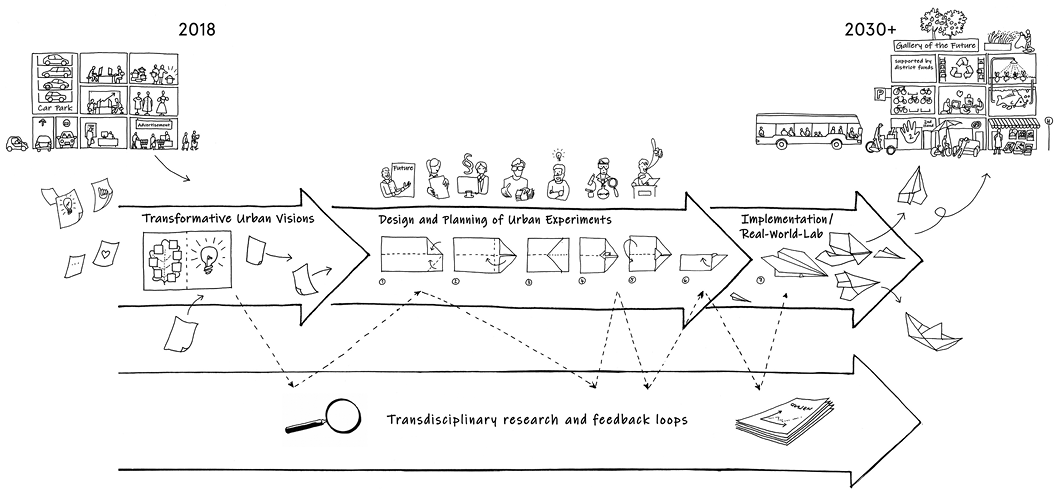
Figure 22.1 In this transdisciplinary research process based on co-creation, citizens developed transformative urban visions and designed and implemented urban experiments as part of ‘Dresden – City of the Future 2030+’
In the first phase, citizens envisioned the Dresden’s future for 2030 and beyond. Over 800 citizens participated in barcamps, where they developed urban sustainability visions (see Figure 22.1, up), hosted in collaboration with local institutions such as the public energy provider, the public transport company and a housing association. To broaden engagement, two city trams were repurposed for a day, allowing citizens to post their wishes and ideas for a sustainable city in over 700 notes on the windows of the trams (see Figure 22.2, down). These visions were synthesised into a unified vision, ‘Dresden – City of the Future 2030+’,Footnote 1 emphasising themes such as local action, global responsibility (though the Sustainable Development Goals), resilience, a local action framework, local cycles of production and consumption, community building and participation.
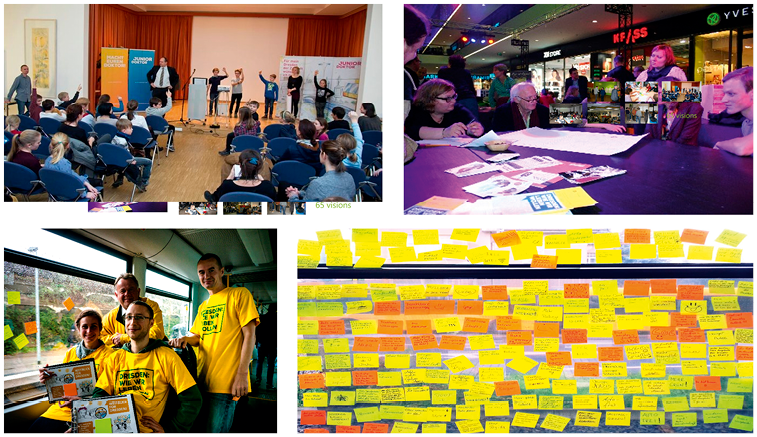
Figure 22.2 Impressions from the 25 barcamps (up) and the re-designed city trams (down), which gathered ideas and wishes from citizens who might not usually engage in city-led participatory formats
Building on this vision, citizens proposed transition experiments in the planning phase, which were finally implemented in the experimenting phase, covering a broad range of social innovations such as edible cities, car-free districts, sustainable business models, nature education, participatory governance within districts and the circular economy. An ‘Office of City of the Future’ was established in the Mayor’s Office to coordinate the overall project, acting as a mediator between the citizen-led initiatives and the municipal bodies.
The DCF project demonstrates the potential of bottom-up governance to cultivate alternative visions of sustainability, moving away from economic growth-centred paradigms and ecological modernisation towards sufficiency and the common good. However, this often competed with Dresden’s dominant political focus on economic development. DCF also provided a space to experiment with different forms of intermediation in transformative governance. ‘Transition intermediaries’ play critical roles by bridging innovative niches and dismantling entrenched regimes (Kivimaa et al. Reference Kivimaa, Boon, Hyysalo and Klerkx2019), fostering cross-sectoral cooperation and partnerships. Whereas ‘regime intermediaries’ are connected to the established regime through institutional ties, ‘niche intermediaries’ advocate for grassroots innovations (Kivimaa et al. Reference Kivimaa, Boon, Hyysalo and Klerkx2019; Sovacool et al. Reference Sovacool, Turnheim, Martiskainen, Brown and Kivimaa2020). Adopting an exploratory approach, the project studied both types of transition intermediaries to examine niche–regime interactions and their distinct roles in urban experimentation processes.
Empirical findings reveal that the DCF office, e.g. along with the ‘Material Mediation’ and the ‘Food Bin’ experiments, played a prominent role in mediation and translation. Project teams advancing these transition experiments functioned as niche intermediaries, acting as visionaries, knowledge brokers and advocates of change. By contrast, the DCF office operated as a regime intermediary, guiding and facilitating the process, establishing an institutional infrastructure and coordinating local activities (Ehnert Reference Ehnert2023a). The office fostered networks, resolved conflicts and mediated between the municipality, project teams and broader urban society, promoting new cross-sectoral collaboration. It had to bridge the gap between the hierarchical, rule-based culture of the administration and the open-ended, experimental and exploratory nature of the projects. Given its limited strategic connections and the lack of sustainability as a mandatory municipal responsibility (per the Saxon Municipal Code), the office had to actively mobilise support for the project and advocate for an administrative culture more open to co-creation and institutionalisation of sustainability initiatives within the city structures (Frantzeskaki and Bush Reference Frantzeskaki and Bush2022), posing the risk that real-world experimentation could remain fragmented and episodic (Evans Reference Evans2016; Karvonen et al. Reference Karvonen, Evans and van Heur2014; Torrens and von Wirth Reference Torrens and von Wirth2021).
In contrast, niche intermediaries like ‘Material Mediation’ and ‘The Food Bin’ played stronger roles in envisioning and advocating for sustainability, facilitating learning and mobilising support for change. Envisioning change, ‘Material Mediation’, for example, critiqued consumer culture, promoted resource cycles within a circular economy framework and also advocated for the common good, with resources and knowledge being shared rather than privatised. Through workshops on resource cycles and re-using materials (see Figure 22.3), it sought to redefine waste as a valuable resource and foster a do-it-yourself ethos, empowering consumers as opposed to established industry actors. The initiative also helped establish a national network of similar initiatives to support knowledge transfer and local innovation. However, it struggled and failed to secure municipal support for a civic–public partnership for a shared communal waste management infrastructure.
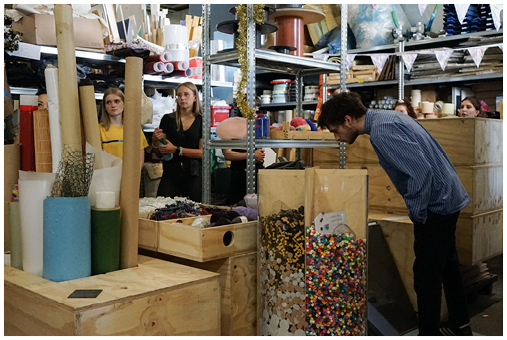
Figure 22.3 (left): ‘Material Mediation’ storage place
Similarly, the ‘Food Bin’ experiment aimed to raise awareness around food waste and to encourage regional, seasonal food consumption. Through educational workshops and cooking events, the ‘Food Bin’ engaged participants in both cognitive and emotional learning processes (see Figure 22.4), creating a space for shared emotional experiences around foods, including the senses of optics, taste and haptics. Like ‘Material Mediation’, it sought to empower individuals to become independent of the food industry, teaching them to cook with leftover and regional foods. The Food Bin cultivated a network of diverse community members, shifting from indoor events to novel forms of outreach including mobile formats involving a cargo bike, cooperation with neighbourhood cafés and churches and events held in public spaces to reach broader audiences.

Figure 22.4 (right): ‘Food Bin’ neighbourhood cooking event
In conclusion, DCF created a valuable space for experimenting with governance innovations such as participatory co-creation formats, intermediary actors and structures, and the social innovations generated by the transition experiments. However, it also revealed how the culture of experimentation, entailing openness and learning-by-failing, clashed with the accountability and rule-based orientation of public administration (Bulkeley et al. Reference Bulkeley, Marvin, Palgan, McCormick, Breitfuss-Loidl, Mai, von Wirth and Frantzeskaki2019; Farrelly and Brown Reference Farrelly and Brown2011; Nevens et al. Reference Nevens, Frantzeskaki, Gorissen and Loorbach2013). Mediation is thus essential to reconcile traditional governance structures with experimental approaches, facilitating the integration of change agents into urban governance processes.
22.5 Conclusions and Outlook
A spatial perspective, and particularly the focus on urban environments, has become a critical corner stone in sustainability transitions research in the last decade. While the full ontological and epistemological potential of a spatial, urban lens is yet to be fully developed, existing studies have already made significant contributions. Reflecting on the current state of the art of urban sustainability transition research, several promising directions may help advance both the scientific field and the practical implementation of urban sustainability transitions.
Firstly, scientific discourse on urban sustainability transitions could benefit significantly from viewing urban spaces not only as contexts but as levers for transformation, leveraging various ontological and epistemological understandings of space (see Section 22.2). This dual perspective could strengthen collaboration between urban and transition scholars, fostering new and robust heuristics for comparative studies on urban sustainability transitions. It would also offer urban practitioners new entry points to initiate and accelerate transformative change on the ground, potentially enhancing existing urban development strategies, processes and instruments.
Secondly, typifying urban experiments beyond sectoral categories could clarify the relationship between experiment design (purposeful objectives) and the way they influence their context, driving urban transitions. There is still limited understanding of how experiment-based innovations are embedded within urban governance structures (Hodson et al. Reference Hodson, Evans and Schliwa2018), how they facilitate learning at individual, collective and institutional levels, how they interact with and impact power dynamics, either enabling or obstructing empowerment, leading to a reconfiguration of urban systems.
Thirdly, urban sustainability transition research could further explore how urban transitions are affected by recent societal trends, including societal polarisation, post-factual narratives and opposition to liberal democratic systems. Questions of legitimacy and governance decision-making in urban transition are critical, particularly as transition governance approaches such as transition management are sometimes perceived as bypassing local democratic processes (de Geus et al. Reference de Geus, Wittmayer and Vogelzang2022). While this is seen positively when existing mechanisms are deemed inadequate for urgent transitions to sustainability, it also raises concerns about societal stability and the legitimacy of democratic institutions, particularly given opposition from both right- and left-wing extremists. Therefore, research is needed on how urban transition governance can better align with democratic frameworks without losing its effectiveness in promoting urban sustainability transitions.
Fourthly, there is significant potential in bridging socio-technical systems (STS) and socio-ecological systems (SES) research within urban contexts. As local governments work to improve urban ecosystems to address climate, biodiversity and pollution challenges, research could investigate how people-nature connections and investments in ecological infrastructure (such as nature-based solutions) facilitate urban sustainability transition. Further investigation is also warranted into how urban ecosystem investments and nature-driven place transformations may either stall or accelerate various urban transitions. This aligns with calls for integrated social–ecological–technological systems (SETS) frameworks (Andersson et al. Reference Andersson, Lennerfors and Fornstedt2024; McPhearson et al. Reference McPhearson, Cook, Berbés-Blázquez, Cheng, Grimm, Andersson, Barbosa, Chandler, Chang, Chester, Childers, Elser, Frantzeskaki, Grabowski, Groffman, Hale, Iwaniec, Kabisch, Kennedy and Troxler2022), well-suited to the complexity of urban sustainability transitions.
Fifthly, incorporating decolonial perspectives could enhance future research on urban transitions by guiding the design, evaluation and objectives of urban governance for more equitable futures. Decolonial thinking can help identify key actors outside traditional sectoral categories, scrutinise narratives and frames guiding urban transitions and propose alternative interventions for transformative change through a decolonial lens. This perspective is also critical for urban regeneration initiatives, ensuring they do not inadvertently reinforce neo-colonial narratives or path dependencies that undermine sustainability.
Sixthly, current impact evaluation frameworks often focus on short-term impacts of experimentation due to project design and funding (Torrens and von Wirth Reference Torrens and von Wirth2021). To capture the medium- (15–25 years) and long-term impacts of urban sustainability efforts, research should investigate the lasting institutional integration of lessons learnt. This points to a need for fundamentally rethinking research project design and funding models. Urban real-world laboratories should be envisioned as long-term social research infrastructures (Schneidewind et al. Reference Schneidewind, Augenstein, Stelzer and Wanner2018) fostering sustained partnershipsFootnote 2 between science, administration, policy, business, civil society and citizens to collectively experiment with and learn how to navigate transformative changes across multiple systems simultaneously.
23.1 Introduction
Sustainability transitions (ST), as an interdisciplinary field for studying societal change, has popularised globally since the early 2000s. The theory appeals to scholars and practitioners alike, as a systematic way of understanding shifts in technologies, policies, markets and culture, as well as provides useful heuristics for mobilising a variety of societal actors for taking action on climate change mitigation (IPCC, 2023) and just transitions (Swilling, Reference Swilling2020; Avelino et al., Reference Avelino, Wijsman, van Steenbergen, Jhagroe, Wittmayer, Akerboom and Kalfagianni2024). Although in recent years, it has impressively become a globally known research field, the conceptual origins and dominant focus in empirical study remain confined in the European context. Even when other parts of the globe are visited, the theories and frameworks continue to have what is called a ‘Western bias’ (Köhler et al., Reference Köhler, Geels, Kern, Markard, Onsongo, Wieczorek and Wells2019, Ramos-Mejia et al., Reference Ramos-Mejía, Franco-Garcia and Jauregui-Becker2018; Ghosh and Schot, Reference Ghosh and Schot2019). When studying transitions in contexts outside of Europe, especially in the so-called ‘Global South’, it is argued that ‘many of frameworks’ implicit theoretical assumptions do not hold’ (Feola, Reference Feola2020). A useful starting point is therefore to understand why and how contexts differ between Global South and Global North and in what ways ST theories could be sensitive and meaningful as a theory of change in Global South contexts.
Historically, the term ‘Global South’ has been popular as an alternative to the notions of ‘third world’, ‘poor nations’, ‘least developed countries’ or ‘developing countries’ (UNCTAD, 2022). Each of these terms are problematic as they carry a misplaced value judgement of a countries’ core versus peripheral position in a world dominated by neoliberal developmental ideas (e.g. GDP growth is a major indicator of development), ignoring the vast social diversity, environmental and cultural values and practises (Chant and Mcllwaine, Reference Chant and McIlwaine2009). In regions such as Latin America, South Asia and sub-Saharan Africa, decades of colonial rule have shaped the local infrastructures, institutions and aspirations in line with the ‘rules’ of capitalism and industrial modernity, such as encouraging growth through mass production, maintaining supplies at the cost of extraction and overconsumption, and disconnecting from nature as a symbol of progress and modernity (Kanger et al., Reference Kanger, Tinits, Pahker, Orru, Tiwari, Sillak and Vaik2022).
History books tell us how countries that are currently seen as developing and poor were attacked and plundered by colonising nations, drawing out treasures and natural resources (which fuelled their growth) at the cost of the colonised nations left as a ‘corpse’ even after independence [See ‘The Anarchy’ for a harrowing history of the British colonising India (Dalrymple, Reference Dalrymple2019)]. Such histories invite reflection on how development has been done, should be done, by whom, at whose cost and what it means to develop in the first place. In the current context of climate crisis, inequality, migration and wars, development often becomes a burden for the previously colonised nations (Kothari, Reference Kothari2005; Arora and Stirling, Reference Arora and Stirling2023). In order to counter such colonial developmental agendas, Global South as a category enables a fairer appraisal of socio-economic marginalisation and ‘resistance against global hegemonic power’, recognising and repairing the historic injustices and colonial oppressions experienced by the majority of countries in the Southern Hemisphere [see Haug et al., (Reference Haug, Braveboy-Wagner and Maihold2021); Menon (Reference Menon2018); Kloß, (Reference Kloß2017) for recent insights on Global South as a category].
At present, there are high levels of persistent inequalities in the Global South owing to institutional and economic privileges of the few, relying on exclusive provision systems that reproduce social exclusion (Ramos-Mejía et al., Reference Ramos-Mejía, Franco-Garcia and Jauregui-Becker2018). Exclusions are structural causes of poverty, which is a major issue in these contexts owing to (capitalist) structures that maintain and regularise the ‘anti-social’ exploitative economic processes (Baulch and Hoddinott, Reference Baulch and Hoddinott2000; Mitchell, Reference Mitchell2024). There are diverse ‘patterns of poverty reproduction’ (Ramos-Mejía et al., Reference Ramos-Mejía, Franco-Garcia and Jauregui-Becker2018). Limited statehood, especially in conflict or post-conflict areas (Risse, Reference Risse, Leibfried, Huber, Lange, Levy, Nullmeier and Stephens2015), and a lack of political freedom and capabilities for development on their own accord (Sen, Reference Sen1999) entrench socio-economic marginalisation. Democratic struggles in ensuring justice for all, in highly unequal contexts, obstruct people’s visions and capabilities to forge new and common directionality of change and lock them into pursuing ‘development’ (Escobar, Reference Escobar1995) in a way that often leads to a dead end. Transitions in the Global South are therefore a pursuit to rethink development trajectories and understand and appreciate local challenges and opportunities in a way that is sensitive to local cultural histories and diverse social realities (Ghosh et al., Reference Ghosh, Ramos-Mejía, Machado, Yuana and Schiller2021; Preuß et al., Reference Preuß, Galvin, Ghosh and Dütschke2021).
Transitions in the Global South are inherently linked to ST in the Global North (Wieczorek, Reference Wieczorek2018). As the impacts of global environmental change are increasingly manifested, the agendas to transition to sustainability currently pursued by the Global North, for example, decarbonisation, serve as impetus for careful attention to the impacts these have on Global South contexts, for example, the creation of sacrifice zones (Sovacool et al., Reference Sovacool2021; Almeida et al., 2021). For example, the decarbonisation agenda may lead to green extractivism, which perpetuates underdevelopment in the South while reinforcing injustice, that is, decarbonisation by dispossession (Andreucci et al. 2021) and delay ST in the Global South. Given these continuing colonial impulses, it is therefore essential for studies of transitions in the Global South to be accompanied by decolonial sensibilities (Avelino et al. Reference Avelino, Wijsman, van Steenbergen, Jhagroe, Wittmayer, Akerboom and Kalfagianni2024; Ghosh et al., Reference Ghosh, Ramos-Mejía, Machado, Yuana and Schiller2021) and imaginaries of just sustainable futures for all (Mguni et al., Reference Mguni, Herslund and Abrams2025).
Reimagining Global South as a relational category (Berger, Reference Berger2021) further implies that it is more than just a ‘geographic imaginary’ (Haug, Reference Haug, Braveboy-Wagner and Maihold2021), but a relational ‘subversive practise’, that is ‘created, imagined, invented, maintained, and recreated by the ever-changing and never fixed status positions of social actors and institutions’ (Kloß, Reference Kloß2017). Such practises and relationality can exist in the geographical Global North, implying ‘Global South’ to be a much more nuanced epistemological category than simply constituting countries in Asia, Africa and Latin America. Given the socio-economic heterogeneities in these countries, relationality representing the Global North can be found in some Southern geographies, for instance in the megacities (Ghosh and Schot, Reference Ghosh and Schot2019). Therefore, Global South within Global North and Global North within Global South should be understood as a yin and yang relation, and not as two separate geographical frames.
A key research question addressed in this chapter is: how could we analyse and enact ST in the Global South contexts, in a way that transcends the historical challenges of colonial modernity and undesired modes and forms of development while pursuing just futures? By revisiting key transitions, concepts such as innovation, regimes and change, the aim of this chapter is to illustrate complex and multiple dynamics of transitions in the Global South.
23.2 Sustainability Transitions in the Global South: A Brief Account
Since the late 1990s, a scientific community started to emerge around the topic of ST (Vellinga and Wieczorek, Reference Wieczorek and Vellinga2004; Rip and Kemp, Reference Rip and Kemp1998). Broadly speaking, sustainability transition literature suggests that due to their unstructured, complex and global character, current problems such as climate change or loss of biodiversity can effectively be addressed by means of a radical change in interconnected socio-technical systems providing for human needs such as energy, water or shelter (Elzen et al., Reference Elzen, Geels and Green2004; Elzen and Wieczorek, Reference Elzen and Wieczorek2005). Every aspect of life, from technology, institutions and the economy to the socio-cultural sphere, must transform for a system change to be effective (Wieczorek and Berkhout, Reference Wieczorek and Berkhout2009, Grin et al., Reference Grin, Rotmans and Schot2010). Incremental, technical changes based on the end-of-pipe solutions such as cleaner products or eco-efficiency failed to address the new type of unstructured, complex and wicked problems that a socio-technical approach has the potential to address (Elzen & Wieczorek, Reference Elzen and Wieczorek2005; Geels et al., Reference Geels, Sovacool, Schwanen and Sorrell2017; Ghosh et al., Reference Ghosh and Schot2019; Bhatia, Reference Bhatia2023).
Major transition frameworks such as multi-level perspective (MLP) (Geels, Reference Geels2005), strategic niche management (SNM) (Raven, Reference Raven2005), transition management (TM), (Loorbach, Reference Loorbach2007) and technological innovation systems (TIS) (Bergek et al., Reference Bergek, Jacobsson, Carlsson, Lindmark and Rickne2008; Hekkert et al., Reference Hekkert, Suurs, Negro, Kuhlmann and Smits2007; Wieczorek and Hekkert, Reference Wieczorek and Hekkert2012) have originally been used to clarify and motivate socio-technical transitions in mainly Global North contexts. However, many scholars started using these frameworks in the Global South in the 2000s, especially in Africa (e.g. van Eijck and Romijn, Reference Van Eijck and Romijn2009; Byrne, Reference Byrne2011; Swilling & Annecke, Reference Swilling and Annecke2012) and in Asia (e.g. Berkhout et al., Reference Berkhout, Angel and Wieczorek2009, Reference Berkhout, Verbong, Wieczorek, Raven, Lebel and Bai2010, Reference Berkhout, Wieczorek and Raven2011; Hansen and Nygaard, Reference Hansen and Nygaard2013; Amankwah et al., Reference Amankwah, Klerkx, Oosting, Sakyi-Dawson, Van der Zijpp and Millar2012). In the past decade, the geographical and conceptual breadth of ST has remarkably expanded, for example, in Asia (Yang et al., Reference Yang, Schot and Truffer2022; Yuana et al., Reference Yuana, Sengers, Boon, Hajer and Raven2020; Ghosh et al., Reference Ghosh and Schot2019; Raven et al., Reference Raven, Ghosh, Wieczorek, Stirling, Ghosh, Jolly and Sengers2017; Jolly et al., Reference Jolly, Raven and Romijn2012), Africa (Ting and Byrne, Reference Ting and Byrne2020; Mguni et al., Reference Mguni2015; Swilling & Annecke, Reference Swilling and Annecke2012) and Latin America. Various aspects of transitions, beyond the transitional MLP analysis, are now increasingly discussed, for example, conflicts (Yuana et al., Reference Yuana, Sengers, Boon, Hajer and Raven2020), regime resistance (Ting and Byrne, Reference Ting and Byrne2020), informal occupations (Dutt, Reference Dutt2022) and relationality (Nagarajah, Reference Nagarajah2023).
Lately, the literature has also taken a ‘decolonial turn’, underlining the risks of ‘failing to challenge the reproduction of colonially accumulated power and privilege’ and the consequences of further deepening cultures of domination, toxic extraction and controlling imaginations that constitute key tenets of colonial modernity (for a detailed account, see Arora and Stirling, Reference Arora and Stirling2023). Ghosh et al. (Reference Ghosh, Ramos-Mejía, Machado, Yuana and Schiller2021) argue that there are at least three pragmatic ways in which transitions studies can be decolonised: by recognising everyday struggles as sources of enhanced capacity for resilience and change; by recognising local nuanced dynamics of inequality-induced power asymmetries; and through participatory research that is empowering and non-extractive. Decolonial perspectives are observed in studies highlighting ‘disempowerment effects in empowerment initiatives’ (Jayaweera et al., Reference Jayaweera, Rohracher, Becker, Nop and Waibel2023); ‘hybrid co-existence’ of socio-technical regimes that embodies conflicts (Balanzó-Guzmán and Ramos-Mejía, Reference Balanzó-Guzmán and Ramos-Mejía2023); ‘religious repertoires approach’ to ST (Stacey, Reference Stacey2024) and ‘multiplicity of pasts that lead to diverse presents and futures’ (Terry et al., Reference Terry, Castro, Chibwe, Karuri-Sebina, Savu and Pereira2024). Such perspectives are woven into this chapter, as we have tried to build our arguments based on (and therefore cite) as many Global South scholars as possible as a way to recognise their valuable contributions to ST literature.
In Section 23.3, we aim to take the reader through a journey of discovering the unique characteristics, dynamics of transitions and methodological diversities found in the literature of pursuing transition-oriented research and action in all these contexts.
23.3 Key Characteristics of Transitions in the Global South: Five Themes
In a systematic literature review, Wieczorek et al. (Reference Wieczorek2018) discussed major insights for ‘sustainability transitions in developing countries’, namely: niche formation, experiments and upscaling, change agents and factors, transnational linkages, regime uniformity, stability and change, power, path dependence, normative orientation and system framing. Research on each of these areas has advanced, resulting in integrated framings and newer topics emerging from further empirical studies. For instance, research on niches has evolved into unpacking the variety of innovations, including experimentation and learning (Raven et al., Reference Raven, Lindsay, Lane and Reynolds2024; Dutt, Reference Dutt2023; Schiller et al., Reference Schiller, Klerkx, Centeno and Poortvliet2023). Understandings of regimes have evolved through differentiated understanding of the stability of systems, the role of regime actors as change agents, power asymmetries and path dependencies (Ghosh et al., Reference Ghosh and Schot2019; van Welie, Reference Van Welie, Cherunya, Truffer and Murphy2018; Guma, Reference Guma2021). These distinctive characteristics and dynamics of niches and regimes have implications for the theory of socio-technical change (transitions) in the Global South through the plurality of pathways. Normative orientations of transitions are now extensively considered through justice and decolonising debates (Avelino et al., Reference Avelino, Wijsman, van Steenbergen, Jhagroe, Wittmayer, Akerboom and Kalfagianni2024; Kumar et al., Reference Kumar, Höffken and Pols2021; Ghosh et al., Reference Ghosh, Ramos-Mejía, Machado, Yuana and Schiller2021). The methods of transitions have also evolved from identifying and analysing socio-technical systems into considerations of plural knowledges, co-design and empowering storylines (Velasco et al., Reference Velasco, Ghosh, Boni, Schiller and Winkler2024; Rusca et al., Reference Rusca, Sverdlik, Acharya, Basel, Boyd, Comelli and Messori2024). Extending from Wieczorek (Reference Wieczorek2018)’s insights and incorporating the new directions of transitions in the Global South research, we suggest organising this review around five key themes, namely niches, regimes, change, justice and knowledge diversity (methods) (see Figure 23.1).

Figure 23.1 Key themes of research in sustainability transitions in the Global South
23.3.1 Niches and Varieties of Innovations
Within transitions studies, niches are conceptualised as spaces that protect emergent innovations. Source and form of protection or shielding niches may vary (Raven et al. Reference Raven2005; Smith and Raven, Reference Smith and Raven2012). There might be subsidies or certifications that incentivise innovation uptake such as for specialised coffee in Colombia (Ghosh et al., Reference Ghosh, Ramos-Mejía, Machado, Yuana and Schiller2021) or renewable energy in Nepal (Bhattarai et al., Reference Bhattarai, Maraseni, Apan and Devkota2023). Protection is also offered by new attractive business models and banks’ innovative funding schemes such as ‘carbon finance’ (Bolton and Foxon, Reference Bolton and Foxon2015). There can be local actor-networks and discourses that provide passive, informal protection to the alternative technologies and institutions, such as in the case for electric rickshaws in Delhi (Dutt, Reference Dutt2023), which highlights the importance of socio-political networks in niches, beyond financial and policy instruments (Raven, this volume: Chapter 5; Butt et al., Reference Butt, Roy and Some2024). The key argument for the ongoing debates on strategic niche management rests on the mechanisms and politics of protecting niche alternatives, as change agents may not be able to compete with mainstream and incumbent actors, technologies and institutions (i.e. the regime).
In the Global South, niches often emerge as sites of resistance, refusal and countervailing in light of the service provision deficiencies in the shadows of hegemonic incumbent ways (Shove and Walker, Reference Shove and Walker2010; Mguni et al., Reference Mguni2015). The usual niche processes still apply – emerging new actor-networks that can support the resistance against the hegemony of regimes and learning in South–South networks challenging assumptions about the efficiency and marketisation of ‘the normal’ exclusionary regimes.
Niches, conceptually, can be considered as spaces of experimentation by creative, innovative actors, tinkering with technological and social arrangements that are, by necessity, frugal and inclusive. Examples of such experiments are affordable refrigerators in India built of clay (Radjou et al., Reference Radjou, Prabhu and Ahuja2012); Zimbabwe’s Bush Pump (De Laet and Mol, Reference De Laet and Mol2000); speciality coffee production in Colombia (Ghosh et al., Reference Ghosh and Schot2019); multi-stakeholder processes of protecting ecological infrastructure and mutual learning for water governance in South Africa (Boni et al., Reference Boni, Belda-Miquel and Velasco2023); and circular economy practises in the informal sector owing to lack of affordability (Korsuna et al., Reference Korsuna, Halme, Kourula, Levanen and Lima-Toivanen2022). Circularity in everyday slum dwelling through waste-based informal micro-enterprises, training and awareness on ‘keeping products alive’, thereby the culture of repairing and maintaining could be considered innovative niche-level efforts towards just transitions (Abunyewah et al., Reference Abunyewah, Erdiaw-Kwasie, Okyere and Boateng2023).
Experiments in niches in the Global South need to prioritise innovation that embodies diverse imaginaries (Kumar et al., Reference Kumar, Höffken and Pols2021), providing prominence often embodied in to ways knowing and doing innovation that are ‘subaltern’ or rooted in practises that are historically marginalised under imperial and colonial power structures (Arora & Stirling, Reference Arora and Stirling2023; Mavhunga, Reference Mavhunga and Mavhunga2017). Scaling of these innovations is often constrained by ‘livelihood opportunities, assets and strategies’ (Singh et al., Reference Singh, Dell’Angelo, Oguge and Odote2024). Subaltern scholars further suggest the undesirabilities of scaling innovations beyond their ‘ecological boundaries’ (Roysen et al., Reference Roysen, Bruehwiler, Kos, Boyer and Koehrsen2024) to avoid the ‘mounting pile of ruins that scalability leaves behind’ (Tsing, Reference Tsing2012) as scaling innovations may reproduce or trigger further injustices, as in the case of patriarchy and child labour in artisanal Congolese cobalt mining (Sovacool, Reference Sovacool2021).
A decolonial interpretation of the niche literature should invite reflexivity on where, how and by whom do niche innovations emerge, privileging a relational worldview. In the Global South, it is often a community of practice (CoP), acting as innovators by constantly modifying strategies, visions, approaches and materiality, to reconfigure and adapt systems that do not work for everyone, into fluid, heterogenous configurations that are fit for purpose (de Laet & Mol, Reference De Laet and Mol2000; Lawhon et al., Reference Lawhon, Nilsson, Silver, Ernstson and Lwasa2018; Guma, Reference Guma2021). In order to be a ‘niche actor’, agency for change can therefore be embedded in unexpected places of established systems, such as with households, religious actors, public officials and unions of informal workers, who might also work against or parallel to the State (Raven et al., Reference Raven, Lindsay, Lane and Reynolds2024; Koehrsen, Reference Koehrsen and Ives2025; Dutt, Reference Dutt2022; Yuana et al., Reference Yuana, Boon, Raven, Hajer, Sengers and Ghosh2023; Misleh et al., Reference Misleh, Dziumla, De La Garza and Guenther2024; Ghosh and Schot, Reference Ghosh and Schot2019). Such actor-networks are created bottom up, as people with common and complementary interests form communities and unions to reinforce each other’s visions and actions for the alternative technologies or business models. Dutt (Reference Dutt2023) proposes that these networks might constitute both the status quo and the alternative, niche and regime actors, thereby questioning the binary opposition between the niche and regime, conventionally present in transitions literature. An important set of actors who, in fact, bridge this binary are called the intermediary actors, who play a bridging role in facilitating exchange and mobilising resources between CoPs, as they ‘broker between niche-internal and niche-external actors’ aiding in niche acceleration (Schiller et al., Reference Schiller, Klerkx, Centeno and Poortvliet2023; Kanda et al., this volume: Chapter 18; Kivimaa et al., Reference Kivimaa, Bergek, Matschoss and Van Lente2020). As such, such a nuanced understanding of niche configurations, possibilities and identifying actor-networks at the interface between niche and regimes (including intermediaries) in the Global South is incomplete without aids in elaborating a similarly nuanced conceptualisation of the regime as reflected in Section 23.3.2.
23.3.2 Regimes
Socio-technical regimes are defined as ‘dominant and stable configuration of rules’ in transitions theory (Misleh et al., Reference Misleh, Dziumla, De La Garza and Guenther2024; Schot and Geels, Reference Schot and Geels2007). This definition is however critically examined, especially the degree and nature of stability and dominance of the regime configurations are questioned in the Global South. This vibrant debate in the recent decade has resulted in many adjectives being used to describe global south regimes, such as ‘unstable (and highly dynamic)’ (Verbong et al., Reference Verbong, Christiaens, Raven and Balkema2010), ‘fluid’ (Berkhout et al., Reference Berkhout, Verbong, Wieczorek, Raven, Lebel and Bai2010), ‘undemocratic and non-egalitarian’ (Hansen et al., Reference Hansen, Nygaard, Romijn, Wieczorek, Kamp and Klerkx2018), ‘fragmented and splintered’ (van Welie, Reference Van Welie, Cherunya, Truffer and Murphy2018), and ‘unregulated’ (Ramos-Mejia et al., Reference Ramos-Mejía, Franco-Garcia and Jauregui-Becker2018) or encompassing a dynamic combination of institutional logics (Ghosh, Reference Ghosh, Ramos-Mejía, Machado, Yuana and Schiller2021). Regimes are ‘semi-coherent configuration of rules such as laws, standards, beliefs, routines and norms’ (Geels, Reference Geels2005). These rules are driven by current and historical societal roles and relationships, such as the relationship between people and nature, that historically encompassed a complex, non-extractivist and often spiritual web of interrelations (Escobar, Reference Escobar1995; Ives, Reference Ives, Abson, von Wehrden, Dorninger, Klaniecki and Fischer2018; Ahlborg et al., Reference Ahlborg, Ruiz-Mercado, Molander and Masera2019).
Guma (Reference Guma2021) highlighted how the conventional characterisation of regimes disqualifies alternative forms of urban development, that is, shacks, shanties and micro-stalls in Kibera, Nairobi or temporary use of urban spaces (Agheyisi, Reference Almeida, Kolinjivadi, Ferrando, Roy, Herrera, Gonçalves and Van Hecken2023). These analyses stem from the definition of regime as (dynamically) stable and (semi-)coherent, while modified definitions such as regimes as ‘shaped and maintained through the mutual adaptation and co-evolution of its actors and elements’ (Holtz, Reference Holtz, Brugnach and Pahl-Wostl2008) are more congruent with diverse contextual specificities. Still, the concept of regime is a useful heuristic to analyse systemic change, as mobilised in multiple recent studies (see Dutt, Reference Dutt2022; Ghosh and Sharmeen, Reference Ghosh and Sharmeen2021; Khatoon et al., Reference Khatoon, Kivimaa, Brisbois and Saadi2024). These informal and transient structures offer viable alternatives amidst the exclusionary nature of neoliberal and market-oriented interventions featured in the dominant ways of being-in-the-world.
Scholars have observed that in the Global South contexts of poverty and deprivations, people try different strategies and ‘experiment’ with new ways of making ends meet, which in turn strengthens their tolerance and acceptance of volatility and change (Lawhon et al., Reference Lawhon, Nilsson, Silver, Ernstson and Lwasa2018; Mguni et al., Reference Mguni, van Vliet, Spaargaren, Nakirya, Osuret, Isunju, Ssekamatte and Mugambe2020; Ramos-Mejía et al., Reference Ramos-Mejía, Franco-Garcia and Jauregui-Becker2018; Baulch and Hoddinott, Reference Baulch and Hoddinott2000). The idea of stability or a constant state of things is largely absent, as societies deal with dysfunctional or absent basic systems of provision by navigating precarity. Instead, van Welie (Reference Van Welie, Cherunya, Truffer and Murphy2018) conceptualised the notion of ‘service regimes’ that are characterised by infrastructures, organisational capabilities or competencies, spatial and temporal locations, meaning, expectations and social interactions. Using Nairobi’s sanitation regime, they show that most basic service regimes in the Global South are ‘splintered’ as multiple co-existing service regimes, which are internally misaligned, cause further misalignment and dysfunctionality at the sectoral level. Cherunya et al. (Reference Cherunya, Ahlborg and Truffer2020) shows that innovations are usually anchored in this ‘oscillating domestic space’ where ‘people are faced with constant fluctuations – expected and unexpected [and] … are forced to respond to precarious situations by adopting a multiplicity of complementary and partial solutions’.
These internal tensions, precarity and ‘ongoing adjustments’ are constitutive of what Madsen et al. (Reference Madsen, Miörner and Hansen2021) call ‘intra-regime dynamics’. Regimes are not always tied to one specific dominant technological configuration but embed a great diversity of modes. Power differentials and contestations are prominent in co-existing regimes, for instance, in Global South smart cities initiatives (Madsen et al., Reference Madsen, Miörner and Hansen2022; Datta and Odendaal, Reference Datta and Odendaal2019). The high degree of non-uniformity of regimes in the Global South is further manifested in a diverse portfolio of needs, preferences and visions, for instance, in the co-existing regimes of the urban mobility system of Kolkata (Roy et al., Reference Roy, Bailey and van Noorloos2024; Ghosh and Schot, Reference Ghosh and Schot2019), systems considered old and less efficient, such as trams and rickshaws, co-existed with newer systems like metro and low-emission buses. The reliance on diverse systems of mobility in a densely populated city shows the need for protecting plurality, beyond mainstreaming a few dominant innovations, in circumstances where people live with infrastructures in a constant state of disrepair (Wieczorek, Reference Wieczorek2018). Such co-existing diversity can also be explained by communities with heterogenous and strong traditional values, emotions, nostalgia and interests in preserving the old while incorporating the new. This discussion leads us to reflect on the issue of ST as a theory of socio-technical change in Section 23.3.3.
23.3.3 The Theory of Change – Plurality of Pathways
Highly dynamic regimes in the Global South contexts pose unique challenges for ST. The MLP as a generic theory of change has been often criticised for falling short of capturing the nuances of agency, practises and ontologies in the Global South contexts (Shove and Walker, Reference Shove and Walker2010; Geels, Reference Geels2011; Ghosh et al., Reference Ghosh, Ramos-Mejía, Machado, Yuana and Schiller2021). Propositions of radical regime shift, one where a regime is replaced or substituted by another as a whole, ignore the messy realities of change in the Global South contexts, where regimes are realistically renewed, repaired or (re)configured at best, instead of phased out and substituted (Khatoon, Reference Khatoon, Kivimaa, Brisbois and Saadi2024; Ghosh and Schot, Reference Ghosh and Schot2019). The alternative development trajectories of Global South regimes, especially under conditions of enduring poverty and inequalities, and uneven sources and extents of lock-in and stability, are an important area of research (Goldstein, Reference Goldstein, Neimark, Garvey and Phelps2023). As such, the key implication is that different change pathways and strategies may be needed to enact transitions in the Global South.
A key question is then: how is change characterised in the literature on transitions in the Global South? To this end, Khatoon et al. (Reference Khatoon, Kivimaa, Brisbois and Saadi2024) argue that mobility transitions in the Global South are dominated by a variety of public transportation systems, where ‘regime-based transformative change’ would entail policies that not only support low-emission mass transport facilities but also improve and reconfigure the existing technologies and practises. With a ‘novel regime change framework’, Ghosh and Schot (Reference Ghosh and Schot2019) showed various sets of rules along different system dimensions, forming multiple trajectories of change. Actors in established ‘regimes’ such as officials in the public transport systems heavily invest in expanding, modernising and reconfiguring the systems, tackling the uncertainties, associated lock-ins and difficulties in changing the regimes. They further highlighted ‘a plurality of possible pathways’ of change in co-existing regimes in the urban mobility space (Ghosh and Schot, Reference Ghosh and Schot2019). Miörner et al. (Reference Miörner, Binz and Fuenfschilling2021) called this ‘recombinatory transition trajectories’, which provides a nuanced approach to mapping pathways of change, beyond the typology of four transition pathways (Geels and Schot, Reference Geels and Schot2007).
Acknowledging the ‘relational materiality’ (how place-specific social and natural material requirements influence technological change, as in the case of solar PV in Sri Lanka) can be considered a decolonial approach to understanding socio-technical change (Nagarajah, Reference Nagarajah2023). Relationality is also evident in Ghana and Ethiopia’s improved ranking in the industrial modernity index due to increased material extraction, given their historically low material and energy consumption as a starting point (Pahker et al., Reference Pahker, Kanger and Tinits2024). Changes in natural infrastructure, which include ecosystem services, engineered infrastructure and distant and proximate institutions, are important markers of rural-to-urban transition in the Global South (Hutchings et al., Reference Hutchings, Willcock, Lynch, Bundhoo, Brewer, Cooper and Welivita2022). In explaining change in the Global South, the role of State and governmental institutions is highlighted by many scholars (Bhatia, Reference Bhatia2023; Misleh et al., Reference Misleh, Dziumla, De La Garza and Guenther2024), along with the role of conflicts in change processes. Conflicts are shown in semi-formal mobility in Indonesia (Yuana et al., Reference Yuana, Sengers, Boon, Hajer and Raven2020) as to happen in ‘critical moments’ in the socio-political change processes. Conflicts may also be a result of patriarchal systems of dominance. Wiedmann et al. (Reference Wiedmann, Lenzen, Keyßer and Steinberger2020: 5) share that ‘eco-feminist approaches highlight the role of patriarchal social relations and the parallels between the oppression of women and exploitation of nature, while post-development approaches stress the manifold and heterogeneous visions of achieving such socio-ecological transformations’.
Actors configure their institutional settings differently across the world and thus drive change in dissimilar ways. In many regions in the Global South, traditional practises and cultures come directly into conflict with formal institutions. For example, forest dwellers, indigenous people and pastoralists are forcefully evicted through and as a consequence of ‘fortress conservation projects’ in Tanzania, Thailand, Kenya and Cambodia (Mantz, Reference Mantz2024). Contestations and negotiations between the incumbent and niche actors, as well as between actors with ‘different degrees of incumbency’ (Yang et al., Reference Yang, Schot and Truffer2022) as part of the change process, embody power differences and hierarchies (Avelino, Reference Avelino2017). Thus, a relational view of power is said to offer a better perspective on how power relations emerge, persist and change over time (Ghosh and Arora, Reference Ghosh and Sharmeen2021; Datta and Odendaal, Reference Datta and Odendaal2019; Avelino, Reference Avelino2017).
An opposite pattern is also visible in aspirations to catch up with western models of modernity. Pahker (Reference Pahker, Kanger and Tinits2024) observes that countries like Peru are showing an increased positive attitude and value assigned to science and technology’s role in creating positive societal impact and an instrumental view of nature (e.g. economic growth and job creation, even if the environment suffers) in spite of overwhelming evidence of the unsustainability of such growth and development models (Escobar, Reference Escobar1995). While transition is deemed necessary, setting the directionality of transition remains crucial and consequential.
23.3.4 Justice as Normative Directionality for Transitions
Innovations that support societal change with directionality are pivotal for addressing the sustainable development goals (SDGs) (Boni et al., Reference Boni, Velasco and Tau2021; Parks, Reference Parks2022). An emphasis on economic growth often leads to innovation that is unjust for the climate and future generations (Perkins, Reference Perkins2019). Oriented by the SDGs, the dominant discourse of innovation-led growth has now shifted towards a more holistic governance of sustainability and reflexivity in innovation processes (Susur and Karakaya, Reference Susur and Karakaya2021; Schot and Kanger, Reference Schot and Kanger2018; Boni et al., Reference Boni, Velasco and Tau2021). A decolonisation agenda aligns with this new discourse: It allows ‘an exchange between a diverse of political, ethical and epistemological positions (also known as “multi-epistemic literacy” (Jazeel, Reference Jazeel2019: 227)) and “to open up the ‘possibility to think reality differently’”’ (Pieterse, Reference Pieterse2000, p. 180) (Kumar et al., Reference Kumar, Höffken and Pols2021; Ranta, Reference Ranta2020; Chassagne, Reference Chassagne2019), therefore inform and modify transition pathways towards plural and just futures (Yuana et al., Reference Yuana, Boon, Raven, Hajer, Sengers and Ghosh2023).
Decolonising transitions in and for the Global South is normative by its own merit. Here, addressing the ‘dark sides of sustainability transitions’ (McGowan and Antadze, Reference McGowan and Antadze2023; Sovacool, Reference Sovacool2021) requires more than technological change and a serious engagement with alternative framings and narratives originating from the South (Mguni et al., Reference Mguni, Herslund and Abrams2025). Deeply philosophical concepts and worldviews such as Buen Vivir (translates as ‘Good Life’, originating in Ecuador), Ecological Swaraj (translated as ‘self-reliance’, originating in India) and Ubuntu emphasising relationality (Mabele, Reference Mabele, Krauss and Kiwango2022) have penetrated the literature in English on sustainable development (Jimenez et al., Reference Jimenez, Delgado, Merino and Argumedo2022; Ranta, Reference Ranta2020; Chassagne, Reference Chassagne2019; Vanhulst and Beling, Reference Vanhulst and Beling2014; Kothari et al., Reference Kothari, Demaria and Acosta2014; Walsh, Reference Walsh2010). These concepts embody justice in their framing of the well-being of humans as intertwined with nature, other humans and ‘strong democratic and egalitarian impulse’. Justice as desired directionality of transition helps resist the colonial pressures of development and progress at the cost of ecological destruction and expanding the gap between rich and poor in the Global South economies (Chassagne, Reference Chassagne2019; Mohanty, Reference Mohanty2018; Datta and Odendaal, Reference Datta and Odendaal2019).
It is important to shape directionalities of innovation policies to not only direct innovations or best technological solutions but also perceive innovation as negotiation of diverse demands, perspectives and multi-directional (Raven et al., Reference Raven, Ghosh, Wieczorek, Stirling, Ghosh, Jolly and Sengers2017; Dierecks et al., Reference Diercks, Larsen and Steward2019; Yang et al., Reference Yang, Schot and Truffer2022). Directionality of change, in principle, is less determined by selected actors and more navigated through multi-actor negotiation processes of deliberative democratic arrangements (Boni et al., Reference Boni, Belda-Miquel and Velasco2023). It is about acknowledging many possibilities and choices of innovation and democratising the process of innovation, by recognising diverse communities in the innovation ecosystem (Boni et al., Reference Boni, Belda-Miquel and Velasco2023; Mavhunga, Reference Mavhunga2018). It is also about making space for resistance and refusal by marginalised communities of hegemonic frames about development, innovation and what constitutes desirable futures (Yuana et al., Reference Yuana, Boon, Raven, Hajer, Sengers and Ghosh2023; Tuck & Yang, Reference Tuck, Yang, Paris and Winn2014; Mguni et al., Reference Mguni, Herslund and Abrams2025).
Comparing the development pathways of 34 countries, Pahker et al. (Reference Pahker, Kanger and Tinits2024) shows that most Global South countries like Brazil, India and Thailand have not performed well in recent years in assigning directionality to their growth and innovation trajectories (the exception is between Ghana and Ethiopia), which show more directionality in their use of resources to bypass the adverse consequences of industrial modernity and have better potential for sustainable deep transitions (Schot and Kanger, Reference Schot and Kanger2018; Davies and Schot, Reference Davies and Schotthis volume: Chapter 7). Often, change is in directions dictated by the affluent or the ‘super-affluent’ across the globe (Wiedmann et al., Reference Wiedmann, Lenzen, Keyßer and Steinberger2020), causing further injustices. Illustrations of injustice include how megaprojects such as the Moroccan Solar Plan can be co-opted by the elites in the form of ‘marginalising the Moroccan people, while benefiting the palace’ (Okpanachi et al., Reference Okpanachi, Ambe-Uva and Fassih2022).
‘Just transitions’ is therefore an important agenda providing normative directionality in the transitions literature (Truffer et al., Reference Truffer, Rohracher, Kivimaa, Raven, Alkemade, Carvalho and Feola2022; Swilling, Reference Swilling2020; Avelino et al., Reference Avelino, Wijsman, van Steenbergen, Jhagroe, Wittmayer, Akerboom and Kalfagianni2024). Justice can be multi-faceted, such as distributive, procedural, deliberative, recognitional, preparative and epistemic (Avelino et al., Reference Avelino, Wijsman, van Steenbergen, Jhagroe, Wittmayer, Akerboom and Kalfagianni2024; Späth et al., Reference Späth, Castán Broto, Bawakyillenuo and Pregernig2022; Sultana et al., Reference Sultana2022; William and Doyon, Reference Williams and Doyon2019). Haswell et al. (Reference Haswell, Edelenbosch, Piscicelli and Van Vuuren2023) show how, for circular economy missions, ‘global South policy choices frequently replicate the Global North developmental path’. Such top-down replication, overlooking historically circular and sustainable practises such as waste-picking (Randhawa et al., Reference Randhawa, Marshall, Kushwaha and Desai2020), car-sharing and zero-waste habits, not only creates local procedural and recognitional injustices but also makes transitions less appealing locally. For recognitional justice, it is crucial to value communities’ resilience to ‘everyday local struggles’ in the Global South (Ghosh et al., Reference Ghosh, Ramos-Mejía, Machado, Yuana and Schiller2021). Procedural and restorative justice is about ensuring local systems are managed by local communities, ‘in ways that are culturally relevant and ecologically sustainable’ (Laldjebaev et al., Reference Laldjebaev2017: 98; Okpanachi et al., Reference Okpanachi, Ambe-Uva and Fassih2022). Agroecological niches are good examples of enacting restorative justice (Schiller et al., Reference Schiller, Klerkx, Centeno and Poortvliet2023; Jimenez et al., Reference Jimenez, Delgado, Merino and Argumedo2022).
23.3.5 Embracing Diverse Knowledges
A final key element of ST in the Global South is the discussion on knowledges and methodologies of studying and enacting transitions. How knowledge(s) is produced, which knowledges are prioritised and whose knowledge is recognised and to what end – are important questions of epistemic justice, resolved through embracing transdisciplinary knowledge co-production (Mauser et al., Reference Mauser, Klepper, Rice, Schmalzbauer, Hackmann, Leemans and Moore2013). Scholars have highlighted the importance of ‘learning from the South’ on sustainable practises, resilience, climate mitigation strategies and grassroots innovation initiatives (Mukhopadhyay et al., Reference Mukhopadhyay, Hammami and Watson2021). Schiller et al. (Reference Schiller, Klerkx, Centeno and Poortvliet2023) observe that ‘knowledge from the Nicaraguan niche has been particularly influential concerning the development of the global farmer-to-farmer movement, transnational peasant organising and standard setting at a regional scale’.
The historic amnesia of Indigenous knowledges and assumed superiority of western science are key concerns in many interdisciplinary fields, including ST (Balanzó-Guzmán and Ramos-Mejía, Reference Balanzó-Guzmán and Ramos-Mejía2023). Ghosh et al. (Reference Ghosh, Ramos-Mejía, Machado, Yuana and Schiller2021) observed transition scholars need to confront ‘epistemic colonisation’ by recognising other ways of knowing and doing (Arora and Stirling, Reference Arora and Stirling2023). This includes endogenous appraisal by the local communities on what they need to survive and thrive, using ‘plural approaches’, without outsiders advice and guidance on transition processes and outcomes (Chassagne, Reference Chassagne2019). A number of scholars have now highlighted the important role of Indigenous people and their ‘traditional ecological knowledges’ as key drivers of ST (Doyon et al., Reference Doyon, Boron and Williams2021; Nirmal and Rocheleau, Reference Nirmal and Rocheleau2019; Ndlovu-Gatsheni, Reference Ndlovu-Gatsheni2020). An important method of exploring such local contextual ‘wealth of experience and exchanges’ could be through storytelling (Spath et al., Reference Späth, Castán Broto, Bawakyillenuo and Pregernig2022), where people’s experiential knowledge and deep-seated beliefs are made explicit. Through storytelling, ideas from the Global South such as ‘Ubuntu’ that centre the importance of mutual relationality between all species, nature and the spiritual (Mabele et al., Reference Mabele, Krauss and Kiwango2022) can be made to guide change processes, to consider nature as not just a stock of resources, but as an interacting environment, where the relationship between humans and nature is that of unity and reciprocity. Nurturing such epistemic plurality, through connecting with and building on knowledge domains, previously perceived as peripheral to transitions (such as indigenous cultures, political and urban ecology, critical and intersectional feminism, gender, queer theory and development theory), is fundamental to just transitions (Cannon and Chu, Reference Cannon and Chu2021; Swilling et al., Reference Swilling, Musango and Wakeford2016; Truffer et al., Reference Truffer, Rohracher, Kivimaa, Raven, Alkemade, Carvalho and Feola2022).
Developing infrastructures for transdisciplinary knowledge co-production is key to transcending epistemological superiority (Doyon et al., Reference Doyon, Boron and Williams2021). Schiller et al. (Reference Schiller, Klerkx, Centeno and Poortvliet2023) highlight multiple ‘knowledge processes’, such as knowledge production, circulation, aggregation and translation, that constitute knowledge flows, which transdisciplinary knowledge infrastructures can support (Velasco et al., Reference Velasco, Ghosh, Boni, Schiller and Winkler2024). Methods such as co-designing plural climate storylines (Rusca et al., Reference Rusca, Sverdlik, Acharya, Basel, Boyd, Comelli and Messori2024) are less extractive (Ghosh et al., Reference Ghosh, Kivimaa, Ramirez, Schot and Torrens2021) as they respect and preserve ‘historical, socioeconomic and psychological context;.[and] reciprocity in considering the benefits for participating Indigenou/marginalised communities’ (Markiewicz, Reference Markiewicz2012; Mguni et al., Reference Mguni, Herslund and Abrams2025). Co-production techniques also help avoid the ‘streetlight effect’ (metaphorically flaring light on selective data and information as evidence, therefore ignoring other evidences such as narratives and experiences) (Hendrix, Reference Hendrix2017) and preserve heterogeneity of knowledges (Okpanachi et al., Reference Okpanachi, Ambe-Uva and Fassih2022). Refocusing the transitions knowledge field from heuristic understanding of socio-technical change, towards recognition and mobilisation of diverse forms of knowledges about just forms of change, that is, feminist, decolonial, inclusive and anti-capitalistic directions should be prioritised by Global South transition scholars.
23.4 Conclusion and Ways Forward
Ahmed (Reference Ahmed2023)’s provocative title ‘The Future of Human Civilization is African’ highlights the urgency and importance of engaging with transition dynamics in the Global South. In the beginning of this chapter, we explained what we mean by the Global South and its interconnectedness with the Global North, inviting the reader to think deeply about these concepts beyond mere geographical categories. In this section, we underline several reasons why looking closely at the ST dynamics in the Global South bears some merit, given the histories of coloniality, challenges as well as opportunities of confronting the climate and social crisis, and legacies of colonial modernity. On one hand, the Global South is disproportionately disadvantaged by the impacts of climate change (Batista-Pritchard, Reference Batista-Pritchard2024), yet on the other hand, innovative solutions for sustainable living, heterogenous ideas of sufficiency and coexistence of natures and cultures constitute important epistemologies in the Global South, which are worth unpacking.
The research question posed in the beginning of the chapter is how could we analyse and enact ST in the Global South contexts, in a way that transcends the historical challenges of colonial modernity and current undesirable modes and forms of development while pursuing just futures? We answer this question along five themes or topics that we argue encompass the key debates in Transitions in Global South literature. These are understandings of niches, regimes, change, justice and knowledge diversity. We found that considerations of varieties of innovation, experimentation, dynamic stability of regimes and relational materiality in change processes are promising avenues to transcend ill impacts of colonial modernity such as concentration of privileges, degraded nature, a changing climate, cultural hierarchies and comprehensive superiorities. In our view, justice as directionality and plurality of knowledges are prominent ways to avoid unjust and singular (thereby undesired) modes and forms of development.
Research on transition in the Global South could go deeper along these five themes, combine and extend beyond them, to materialise decolonial pathways for transitions that pressures of colonial modernity have suppressed for decades. For instance:
(1) In order for niches to develop and accelerate for just futures in the Global South, one could ask what kind of socio-political, economic and cultural conditions are required? How could we recognise and integrate diverse emotions, future visions and storylines in experimentation? What are the current logics of niche formation and survival in GS contexts?
(2) For regimes, key questions could be: what are the logics configuring current socio-technical regimes in the Global South, what are the institutional barriers for addressing inequality and historic injustices, and what new methods can be developed to overcome these barriers through policy, investments and prefigurative politics?
(3) For mapping, managing and monitoring change through plural pathways in the Global South, transition scholars could look beyond substitution and replacement of whole systems and more into adaptation, resilience and coping strategies in response to crises, such as heat extremes, flooding and so on, already experienced in these contexts. What can be learnt from these experiences for better anticipatory policies?
(4) Understandings of justice as directionality could be deepened through analysing heterogenous choices, expectations and conditionalities that accompany socio-ecological and socio-technical change in the Global South.
(5) Finally, to acknowledge the diversity of knowledges that abound, future transition research methods could combine data science and social science, qualitative and quantitative, ‘western-scientific’ and indigenous methods of producing and implementing actionable knowledges.
Researching socio-technical change, innovation and justice, in and with Global South communities with such explicit intention of co-producing a ‘more pluralistic body of knowledge’ (Zolfagharian et al., Reference Zolfagharian, Walrave, Raven and Romme2019) could enrich ST literature as a whole.
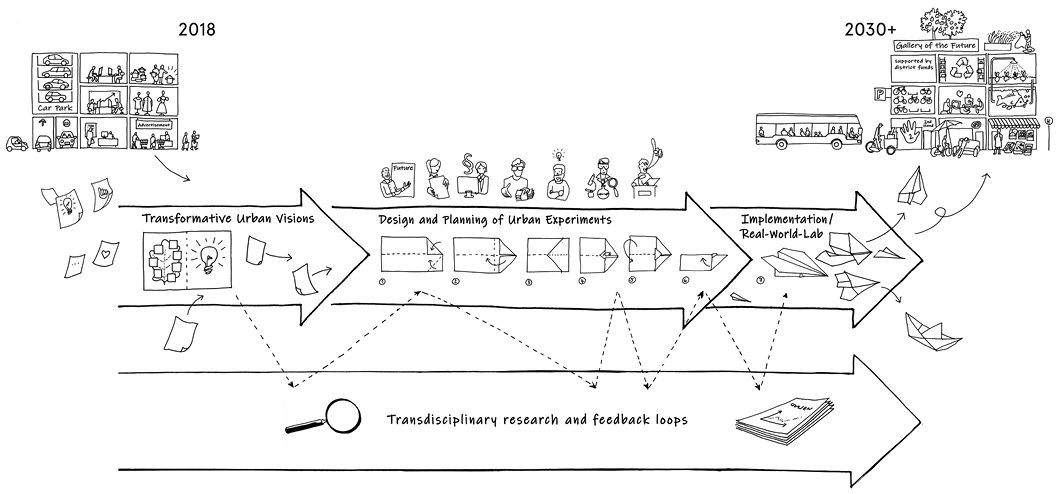
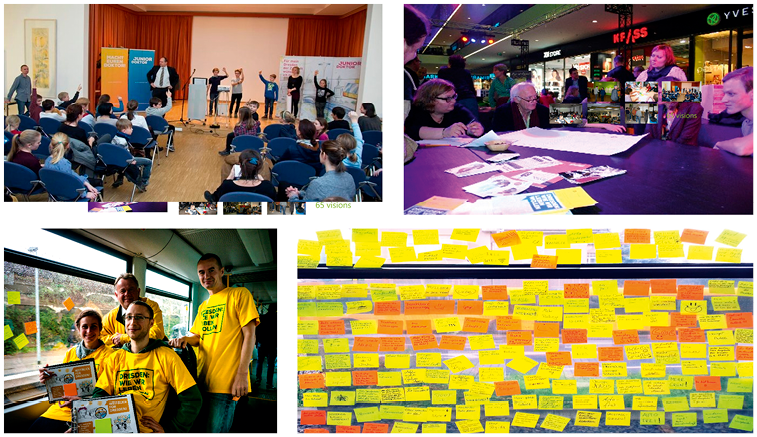
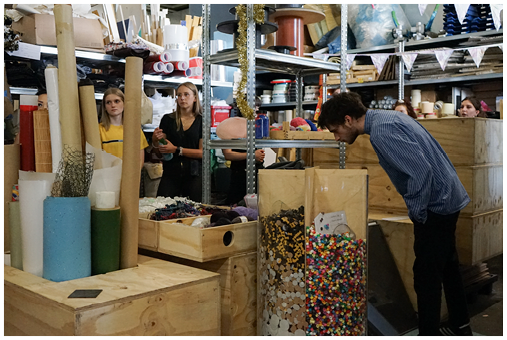



 Open access