Book contents
- Relief in Greek, Roman, and Late Antique Art
- Relief in Greek, Roman, and Late Antique Art
- Copyright page
- Dedication
- Contents
- Figures
- Contributors
- Acknowledgments
- Abbreviations
- Introduction
- 1 Ancient Relief
- 2 Thinking through Marble
- 3 The Body in Relief in Archaic Funerary Sculpture
- 4 Relief in Athenian Vase Painting
- 5 Sculpture, Relief, and the Surrounding Space
- 6 Seeing the Past
- 7 Remedial Relief
- 8 Foregrounding the Background in Roman Relief Sculpture
- 9 Encrusted in Ancestors
- 10 Relief on and for the Body in Late Antique Numismatic Jewelry
- Index
- References
Introduction
Published online by Cambridge University Press: 11 October 2025

Book contents
- Relief in Greek, Roman, and Late Antique Art
- Relief in Greek, Roman, and Late Antique Art
- Copyright page
- Dedication
- Contents
- Figures
- Contributors
- Acknowledgments
- Abbreviations
- Introduction
- 1 Ancient Relief
- 2 Thinking through Marble
- 3 The Body in Relief in Archaic Funerary Sculpture
- 4 Relief in Athenian Vase Painting
- 5 Sculpture, Relief, and the Surrounding Space
- 6 Seeing the Past
- 7 Remedial Relief
- 8 Foregrounding the Background in Roman Relief Sculpture
- 9 Encrusted in Ancestors
- 10 Relief on and for the Body in Late Antique Numismatic Jewelry
- Index
- References
Summary
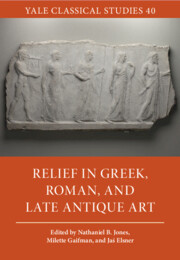
This introduction opens the volume by considering the inherent multiplicity of the idea of relief, which even in the limited purview of the visual arts crosses boundaries of material, form, technique, genre, scale, and style. As a technical term referring to art, moreover, relief is not an ancient idea but a modern one, which first emerged from specific discourses surrounding Italian Renaissance art. The introduction briefly surveys the significance of the historiography of relief in discussions of ancient art before turning to three case studies of ancient vessels decorated in relief – an Archaic Greek pithos from Mykonos, the Derveni krater, and the Townley Vase – which concretely articulate the complexity and variety of ancient relief practices. It then concludes by introducing and offering a synopsis of the ten chapters that follow.
Information
- Type
- Chapter
- Information
- Relief in Greek, Roman, and Late Antique Art , pp. 1 - 27Publisher: Cambridge University PressPrint publication year: 2025
References
Barasch, M. (1998). Theories of Modern Art. Vol. 2: From Impressionism to Kandinsky. New York: New York University Press.Google Scholar
Barr-Sharrar, B. (2008). The Derveni Krater: Masterpiece of Classical Greek Metalwork. Princeton, NJ: American School of Classical Studies at Athens.Google Scholar
Bousquet, J. (1966). “L’inscription du cratère de Derveni.” Bulletin de Correspondance Hellénique 90.1: 281–2.CrossRefGoogle Scholar
Brendel, O. J. (1953). “Prolegomena to a Book on Roman Art.” Memoirs of the American Academy in Rome 21: 7–73.CrossRefGoogle Scholar
Brittenham, C., ed. (2019). Vessels: The Object as Container. Oxford: Oxford University Press.Google Scholar
Brunn, H. (1884). “Über die kunstgeschichtliche Stellung der Pergamenischen Gigantomachie.” Jahrbuch der königlichen preussischen Kunstsammlungen 5: 231–92.Google Scholar
Conze, A. (1882). “Uber das Relief bei den Griechen.” Sitzungsberichte der koniglichen preussischen Akademie der Wissenschaften zu Berlin 26: 563–77.Google Scholar
Courbaud, E. (1899). Le bas-relief Romain à représentations historiques: Étude archéologique, historique et littéraire. Bibliothèque des Écoles françaises d’Athènes et de Rome 81. Paris: Fontemoing.Google Scholar
Dewey, J. (1894). “The Theory of Emotion: (1) Emotional Attitudes.” Psychological Review 1.6: 553–69.Google Scholar
Ebbinghaus, S. (2005). “The Protector of the City, or Art of Storage in Early Greece.” Journal of Hellenic Studies 125: 51–72.Google Scholar
Elsner, J. (2006) “From Empirical Evidence to the Big Picture: Some Reflections on Riegl’s Concept of Kunstwollen.” Critical Inquiry 32.4: 741–66.CrossRefGoogle Scholar
Ervin Caskey, M. (1976). “Notes on the Relief Pithoi of the Tenian-Boiotian Group.” American Journal of Archaeology 80.1: 19–41.CrossRefGoogle Scholar
Freedman, L. (1989). “Rilievo as an Artistic Term in Renaissance Italy.” Rinascimento 29: 217–47.Google Scholar
Freud, S. (1974). Jokes and Their Relation to the Unconscious. Trans. J. Strachey. New York: Penguin.Google Scholar
Ghiberti, L. (1998). I commentarii: Biblioteca nazionale centrale di Firenze, II, I, 333. Ed. Bartoli, L.. Florence: Giunti.Google Scholar
Giuliani, L. (2013). Image and Myth: A History of Pictorial Narration in Greek Art. Trans. J. O’Donnell. Chicago, IL: University of Chicago Press.Google Scholar
Gossman, L. (2006). “Imperial Icon: The Pergamon Altar in Willhelminian Germany.” Journal of Modern History 78.3: 551–87.CrossRefGoogle Scholar
Hildebrand, A. (1893). Das Problem der Form in den bildenden Künst. Strasbourg: Heitz.Google Scholar
Hildebrand, A. (1994). “The Problem of Form in the Fine Arts.” In Mallgrave, F. and Ikonomou, E., trans., Empathy, Form, and Space: Problems in German Aesthetics, 1873–1893. Santa Monica, CA: Getty Center for the History of Art and the Humanities, 227–80.Google Scholar
Holliday, P. J. (2002). The Origins of Roman Historical Commemoration in the Visual Arts. Cambridge: Cambridge University Press.Google Scholar
Hölscher, T. (2004). The Language of Images in Roman Art. Trans. A. Snodgrass and A. M. Künzl-Snodgrass. Cambridge: Cambridge University Press.Google Scholar
Jones, C. P. (2005). Philostratus: Apollonius of Tyana. Vol. 1: Life of Apollonius of Tyana, Books 1–4. Loeb Classical Library 16. Cambridge, MA: Harvard University Press.Google Scholar
Koeppel, G. (1982). “The Grand Pictorial Tradition of Roman Historical Representation during the Early Empire.” Aufstieg und Niedergang der römischen Welt 2.12.1: 507–35.Google Scholar
Koortbojian, M. (2023). The Representation of Space in Graeco-Roman Art: Relief Sculpture, Problems of Form, and Modern Historiography. Berlin: De Gruyter.CrossRefGoogle Scholar
Lakey, C. R. (2018). Sculptural Seeing: Relief, Optics, and the Rise of Perspective in Medieval Italy. New Haven, CT: Yale University Press.Google Scholar
Lange, H. C. (2020a). “Cimabue’s True Crosses in Arezzo and Florence.” In Elm, S. and Ocker, C., eds., Material Christianity: Western Religion and the Agency of Things. Cham: Springer, 29–67.CrossRefGoogle Scholar
Lange, H. C. (2020b). “Relief Effects in Donatello and Mantegna.” In Bloch, A. R. and Zolli, D. M., eds., The Art of Sculpture in Fifteenth Century Italy. Cambridge: Cambridge University Press, 327–43.Google Scholar
Lange, H. C. (2023). Giotto’s Arena Chapel and the Triumph of Humility. Cambridge: Cambridge University Press.CrossRefGoogle Scholar
Marchand, S. L. (1996). Down from Olympus: Archaeology and Philhellenism in Germany, 1750–1970. Princeton, NJ: Princeton University Press.CrossRefGoogle Scholar
Marvin, M. (2008). The Language of the Muses: The Dialogue between Roman and Greek Sculpture. Los Angeles: J. Paul Getty Museum.Google Scholar
Mattusch, C. C. (1988). Greek Bronze Statuary: From the Beginnings through the Fifth Century B.C. Ithaca, NY: Cornell University Press.Google Scholar
Mattusch, C. C. (1996). Classical Bronzes: The Art and Craft of Greek and Roman Statuary. Ithaca, NY: Cornell University Press.CrossRefGoogle Scholar
Matz, F. (1968–75). Die dionysischen Sarkophage. 4 vols. Antiken Sarkophagreliefs 4.2.1–4. Berlin: Mann.Google Scholar
Morreall, J. (2009). Comic Relief: A Comprehensive Philosophy of Humor. Malden, MA: Blackwell.CrossRefGoogle Scholar
Musgrave, J. (1990). “The Cremated Remains from Tombs II and III at Nea Mihaniona and Tomb Beta at Derveni.” Annual of the British School at Athens 85: 301–25.Google Scholar
Neudecker, R. (1988). Die Skulpturenausstattung römischer Villen in Italien. Mainz: von Zabern.Google Scholar
Olin, M. (1992). Forms of Representation in Alois Riegl’s Theory of Art. University Park: Pennsylvania State University Press.Google Scholar
Ostrow, S. F. (2004). “Playing with the Paragone: The Reliefs of Pietro Bernini; For Rudolf Preimesberger.” Zeitschrift für Kunsgeschichte 67.3: 329–64.Google Scholar
Panofsky, E. (2020). Michelangelo’s Principles of Design, Particularly in Relation to Those of Raphael. Ed. Panofsky-Soergel, G. and trans. J. Spooner. Princeton, NJ: Princeton University Press.Google Scholar
Payne, A. (2008). “Portable Ruins: The Pergamon Altar, Heinrich Wölfflin, and German Art History at the Fin de siècle.” RES: Anthropology and Aesthetics 53–4: 168–89.Google Scholar
Payne, A. (2011). “On Sculptural Relief, Malerisch, the Autonomy of Artistic Media and the Beginnings of Baroque Studies.” In Hills, H., ed., Rethinking the Baroque. London: Ashgate, 39–64.Google Scholar
Philippi, A. (1872). “Über die römischen Triumphalreliefe und ihre Stellung in der Kunstgeschichte.” Abhandlungen der philosophisch-historischen Klasse der Königlichen Sachsischen Gesellschaft der Wissenschaften 6: 247–305.Google Scholar
Rankin, E., and Schneider, R. M. (2020). From Memory to Marble: The Historical Frieze of the Vortrekker Monument. Vol. 1. The Frieze. Berlin: De Gruyter.Google Scholar
Riegl, A. (1901). Die spätrömische Kunstindustrie nach den Funden in Österreich-Ungarn: Im Zusammenhange mit der Gesammtentwicklung der bildenden Künste bei den Mittelmeervölkern. Vol. 1. Vienna: Österreichische Staatsdruckerei.Google Scholar
Riegl, A. (1923). Die spätrömische Kunstindustrie nach den Funden in Österreich-Ungarn: Im Zusammenhange mit der Gesammtentwicklung der bildenden Künste bei den Mittelmeervölkern. Vol. 2, Kunstgewerbe des frühen Mittelalters. Vienna: Österreichische Staatsdruckerei.Google Scholar
Schäfer, J. (1957). Studien zu den griechischen Reliefpithoi des 8–6 Jahrhunderts v. Chr aus Kreta, Rhodos, Tenos und Boioten. Kallmunz: Lassleben.Google Scholar
Smith, A. H. (1904). A Catalogue of Sculpture in the Department of Greek and Roman Antiquities, British Museum. Vol. 3. London: British Museum.Google Scholar
Spencer, H. (1860). “The Physiology of Laughter.” Macmillan’s Magazine 1 (March): 395–402.Google Scholar
St. Clair, W. (1998). Lord Elgin and the Marbles. Oxford: Oxford University Press.CrossRefGoogle Scholar
Stansbury-O’Donnell, M. (1999). Pictorial Narrative in Ancient Greek Art. Cambridge: Cambridge University Press.Google Scholar
Summers, D. (2003). Real Spaces: World Art History and the Rise of Western Modernism. New York: Phaidon.Google Scholar
Touchette, L.-A. (1995). The Dancing Maenad Reliefs: Continuity and Change in Roman Copies. London: University of London, Institute of Classical Studies.Google Scholar
Wickhoff, F., and von Hartel, W. (1895). Die Wiener Genesis. Vol. 2. Jahrbuch des kunsthistorischen Sammlungen des allerhöchsten Kaiserhauses 16. Vienna: Tempsky.Google Scholar
Wolf, G. (2016). “Image, Object, Art: Talking to a Chinese Jar on Two Human Feet.” Representations 133 (2016): 152–9.Google Scholar
Wolf, G. (2019). Der Vase und der Schemel: Ding, Bild oder eine Kunstgeschichte der Gefäße. Dortmund: Kettler.Google Scholar
Wölfflin, H. (1888). Renaissance und Barock: Eine Untersuchung über Wesen und Entstehung des Barockstils in Italien. Munich: Bruckmann.Google Scholar
Wölfflin, H. (1915). Kunstgeschichtliche Grundbegriffe: Das Problem der Stilentwicklung in der neueren Kunst. Munich: Bruckmann.Google Scholar
Accessibility standard: WCAG 2.1 AA
Why this information is here
This section outlines the accessibility features of this content - including support for screen readers, full keyboard navigation and high-contrast display options. This may not be relevant for you.Accessibility Information
The HTML of this chapter
complies with version 2.1 of the
Web Content Accessibility Guidelines
(WCAG), covering newer accessibility requirements and improved
user experiences and achieves the intermediate
(AA)
level of WCAG compliance, covering a wider range of accessibility requirements.
Content Navigation
Table of contents navigation
Allows you to navigate directly to chapters, sections, or non‐text items through a linked table of contents, reducing the need for extensive scrolling.
Allows you to navigate directly to chapters, sections, or non‐text items through a linked table of contents, reducing the need for extensive scrolling.
Index navigation
Provides an interactive index, letting you go straight to where a term or subject appears in the text without manual searching.
Provides an interactive index, letting you go straight to where a term or subject appears in the text without manual searching.
Reading Order & Textual Equivalents
Single logical reading order
You will encounter all content (including footnotes, captions, etc.) in a clear, sequential flow, making it easier to follow with assistive tools like screen readers.
You will encounter all content (including footnotes, captions, etc.) in a clear, sequential flow, making it easier to follow with assistive tools like screen readers.
Short alternative textual descriptions
You get concise descriptions (for images, charts, or media clips), ensuring you do not miss crucial information when visual or audio elements are not accessible.
You get concise descriptions (for images, charts, or media clips), ensuring you do not miss crucial information when visual or audio elements are not accessible.
Visual Accessibility
Use of colour is not sole means of conveying information
You will still understand key ideas or prompts without relying solely on colour, which is especially helpful if you have colour vision deficiencies.
You will still understand key ideas or prompts without relying solely on colour, which is especially helpful if you have colour vision deficiencies.
Structural and Technical Features
ARIA roles provided
You gain clarity from ARIA (Accessible Rich Internet Applications) roles and attributes, as they help assistive technologies interpret how each part of the content functions.
You gain clarity from ARIA (Accessible Rich Internet Applications) roles and attributes, as they help assistive technologies interpret how each part of the content functions.