Book contents
- Palmyra, the Mediterranean and Beyond
- Mediterranean Studies in Antiquity
- Palmyra, the Mediterranean and Beyond
- Copyright page
- Contents
- Figures
- Maps and Tables
- Contributors
- 1 Palmyra in the Mediterranean World
- 2 The Western Networks of Palmyra
- 3 You Can’t Get There from Here
- 4 Palmyrene Iconographic Traditions and Their Mediterranean Connections
- 5 Palmyra and Emesa or ‘Palmyre sans Émèse’
- 6 Organizing Networks to Supply Mediterranean Markets
- 7 Language, Law and Religion
- 8 Channels of Communication and Connections of Style
- 9 Identity and Mobility of Palmyrene Jews
- 10 Palmyrene Military Expatriation and Its Religious Transfer at Roman Dura-Europos, Dacia and Numidia
- Index
- References
4 - Palmyrene Iconographic Traditions and Their Mediterranean Connections
A Note on Some Signet Seal Impressions on the Palmyrene Tesserae
Published online by Cambridge University Press: 21 October 2025
By
Edited by

Book contents
- Palmyra, the Mediterranean and Beyond
- Mediterranean Studies in Antiquity
- Palmyra, the Mediterranean and Beyond
- Copyright page
- Contents
- Figures
- Maps and Tables
- Contributors
- 1 Palmyra in the Mediterranean World
- 2 The Western Networks of Palmyra
- 3 You Can’t Get There from Here
- 4 Palmyrene Iconographic Traditions and Their Mediterranean Connections
- 5 Palmyra and Emesa or ‘Palmyre sans Émèse’
- 6 Organizing Networks to Supply Mediterranean Markets
- 7 Language, Law and Religion
- 8 Channels of Communication and Connections of Style
- 9 Identity and Mobility of Palmyrene Jews
- 10 Palmyrene Military Expatriation and Its Religious Transfer at Roman Dura-Europos, Dacia and Numidia
- Index
- References
Summary
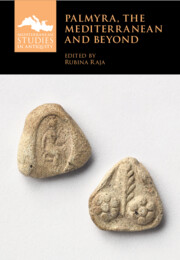
The Palmyrene banqueting tesserae, clay entrance tickets to religious banquets, have been revisited over and over again since the publication of the RTP in 1955. These small but often elaborate objects have been used as lenses into Palmyra’s religious life and the general organization of social, cultural and religious life in the city. However, only in recent years have they become the object of new detailed studies, which aim to systematically examine this unique group of objects within their local context. In this contribution, the focus is on disentangling the tesserae as physical objects to be used, touched and looked at; in particular it seeks to understand a facet of their rich iconographic repertoire, which in so many ways stands in contrast to the otherwise allegedly streamlined visual art repertoire found at Palmyra, namely that of the signet seal impressions. These signet seal impressions were impressed on many of the tesserae, most likely by the sponsor of the banquet, who left his personal mark on the tickets. The seal impressions give us insight into the images circulating in Palmyra in the Roman period in a material group, which today is almost lost to us, namely the glyptic art.
Information
- Type
- Chapter
- Information
- Palmyra, the Mediterranean and Beyond , pp. 49 - 109Publisher: Cambridge University PressPrint publication year: 2025
References
al-Asʿad, K., Briquel-Chatonnet, F. and Yon, J.-B. 2005, The Sacred Banquets at Palmyra and the Functions of the Tesserae: Reflections on the Tokens Found in the Arṣu Temple, in Cussini, E. (ed.), A Journey to Palmyra: Collected Essays to Remember Delbert R. Hillers, Leiden, 1–10.Google Scholar
Delaporte, L. 1920, Musée du Louvre: catalogue des cylindres, cachets et pierres gravées de style oriental, vol. II, Paris.Google Scholar
Delaporte, L. 1923, Catalogue des cylindres, cachets et pierres gravées de style oriental. 2: Acquisitions, Paris.Google Scholar
Dentzer-Feydy, J., Pic, M. and Teixidor, J. 1993, Les antiquités de Palmyre au Musée du Louvre, Paris.Google Scholar
Eristov, H. and Vibert-Guigue, C. 2019, Le tombeau des Trois Frères à Palmyre, Eidola 16, 87–106.Google Scholar
Gawlikowski, M. 1983a, Le sanctuaire d’Allat à Palmyre: aperçu préliminaire, Annales archéologiques arabes syriennes 33, 179–98.Google Scholar
Gawlikowski, M. 1983b, Réflexions sur la chronologie du sanctuaire d’Allat à Palmyre, Damaszener Mitteilungen 1, 59–67.Google Scholar
Gawlikowski, M. 1990, Le premier temple d’Allat, in van Loon, M. and Weiss, H. (eds.), Resurrecting the Past: A Joint Tribute to Adnan Bounni, Leiden, 101–8.Google Scholar
Gawlikowski, M. 2006, Palmyra: Excavations in the Allat Sanctuary, 2005–2006, Polish Archaeology in the Mediterranean 18, 531–1.Google Scholar
Gawlikowski, M. 2008, The Statues of the Sanctuary of Allat in Palmyra, in Eliav, Y. Z., Friedland, E. A. and Herbert, S. C. (eds.), The Sculptural Environment of the Roman Near East: Reflections on Culture, Ideology, and Power, Leuven, 397–411.Google Scholar
Henning, A. 2013, Die Turmgräber von Palmyra: Eine lokale Bauform im kaiserzeitlichen Syrien als Ausdruck kultureller Identität, Orient-Archäologie 29, Rahden.Google Scholar
Heyn, M. K. and Raja, R. 2019, Male Dress Habits in Roman Period Palmyra, in Cifarelli, M. (ed.), Fashioned Selves: Dress and Identity in Antiquity, Oxford, 41–54.CrossRefGoogle Scholar
Ingholt, H., Seyrig, H., Starcky, J. and Caquot, A. 1955, Recueil des tessères de Palmyre, Paris.Google Scholar
Kaizer, T. 2002, The Religious Life of Palmyra: A Study of the Social Patterns of Worship in the Roman Period, Stuttgart.Google Scholar
Kaizer, T. and Raja, R. 2019, Divine Symbolism on the Tesserae from Palmyra: Considerations about the So-Called ‘Symbol of Bel’ or ‘Signe de la pluie’, Syria 95, 297–315.Google Scholar
Kubiak-Schneider, A., Raja, R., Steding, J. and Yon, J.-B. (eds.) in press, The Palmyrene Tesserae: An Update to the RTP, Turnhout.Google Scholar
Lans, B. van der, Seland, E. H. and Teigen, H. F. 2017, Journeys to Tadmor: History and Cultural Heritage in Palmyra and the Middle East, Bergen.Google Scholar
Mesnil du Buisson, R. du 1944, Cabinet des médailles: tessères et monnaies de Palmyre, Paris.Google Scholar
Meyer, M. 2006, Die Personifikation der Stadt Antiocheia: Ein neues Bild für eine neue Gottheit, Berlin.Google Scholar
Milik, J. T. 1972, Dedicaces faites par des Dieux (Palmyre, Hatra, Tyr) et des thiases sémitiques à l’époque romaine, Paris.Google Scholar
Mordtmann, A. D. 1875, Neue Beiträge zur Kunde Palmyra’s, Sitzungsberichte der philosophisch-philologischen und historischen Classe der Akademie der Wissenschaften zu München 2, 48–72.Google Scholar
Oppen, B. E. van and Wallenfels, R. (eds.) 2021, Hellenistic Sealings and Archives: Proceedings of the Edfu Connection, an International Conference, 23–24 January 2018, Allard Pierson Museum, Amsterdam, Turnhout.Google Scholar
Raja, R. 2015a, Cultic Dining and Religious Patterns in Palmyra: The Case of the Palmyrene Banqueting Tesserae, in Faust, S., Seifert, M. and Ziemer, L. (eds.), Antike. Architektur. Geschichte: Festschrift für Inge Nielsen zum 65. Geburtstag, Aachen, 181–200.Google Scholar
Raja, R. 2015b, Palmyrene Funerary Portraits in Context: Portrait Habit between Local Traditions and Imperial Trends, in Fejfer, J., Moltesen, M. and Rathje, A. (eds.), Tradition: Transmission of Culture in the Ancient World, Acta Hyperborea 14, Copenhagen, 329–62.Google Scholar
Raja, R. 2015c, Staging ‘Private’ Religion in Roman ‘Public’ Palmyra: The Role of the Religious Dining Tickets (Banqueting Tesserae), in Rüpke, J. and Ando, C. (eds.), Public and Private in Ancient Mediterranean Law and Religion: Historical and Comparative Studies, Berlin, 165–86.Google Scholar
Raja, R. 2016, In and Out of Contexts: Explaining Religious Complexity through the Banqueting Tesserae from Palmyra, Religion in the Roman Empire 2, 340–71.CrossRefGoogle Scholar
Raja, R. 2019a, Catalogue: The Palmyra Collection. Ny Carlsberg Glyptotek, Copenhagen.Google Scholar
Raja, R. 2019b, Funerary Portraiture in Palmyra: Portrait Habit at a Crossroads or a Signifier of Local Identity?, in Blömer, M. and Raja, R. (eds.), Funerary Portraiture in Greater Roman Syria, Turnhout, 95–110.Google Scholar
Raja, R. 2019c, Religious Banquets in Palmyra and the Palmyrene Banqueting Tesserae, in Nielsen, A. M. and Raja, R. (eds.), The Road to Palmyra, Copenhagen, 221–34.Google Scholar
Raja, R. 2019d, Stacking Aesthetics in the Syrian Desert: Displaying Palmyrene Sculpture in the Public and Funerary Sphere, in Draycott, C. M., Raja, R., Welch, K. and Wootton, W. T. (eds.), Visual Histories of the Classical World: Essays in Honour of R. R. R. Smith, Turnhout, 281–98.Google Scholar
Raja, R. 2022a, Revisiting the Palmyrene Banqueting Tesserae: Conceptualization, Production, Usage, and Meaning of the Palmyrene, in Raja, R. (ed.), The Small Stuff of the Palmyrenes: Coins and Tesserae from Palmyra, Turnhout, 5–67.Google Scholar
Raja, R. (ed.) 2022b, The Small Stuff of the Palmyrenes: Coins and Tesserae from Palmyra, in Raja, R. (ed.), The Small Stuff of the Palmyrenes: Coins and Tesserae from Palmyra, Turnhout, 1–3.Google Scholar
Rostovtzeff, M. I. 1933, Hadad and Atargatis at Palmyra, American Journal of Archaeology 37, 58–63.CrossRefGoogle Scholar
Seyrig, H. 1940, Les tessères palmyréniennes et le banquet rituel, in Vincent, H. (ed.), Mémorial LaGrange, Paris, 51–8.Google Scholar
Smith, A. M. I. 2013, Roman Palmyra: Identity, Community, and State Formation, Oxford.CrossRefGoogle Scholar
Spoer, H. H. 1905, Palmyrene Tesserae, Journal of the American Oriental Society 26, 113–16.CrossRefGoogle Scholar
Spoer, H. H. 1906, Notes on Some Palmyrene Tesserae, Journal of the American Oriental Society 27, 397–9.Google Scholar
Accessibility standard: WCAG 2.1 AA
Why this information is here
This section outlines the accessibility features of this content - including support for screen readers, full keyboard navigation and high-contrast display options. This may not be relevant for you.Accessibility Information
The HTML of this chapter
complies with version 2.1 of the
Web Content Accessibility Guidelines
(WCAG), covering newer accessibility requirements and improved
user experiences and achieves the intermediate
(AA)
level of WCAG compliance, covering a wider range of accessibility requirements.
Content Navigation
Table of contents navigation
Allows you to navigate directly to chapters, sections, or non‐text items through a linked table of contents, reducing the need for extensive scrolling.
Allows you to navigate directly to chapters, sections, or non‐text items through a linked table of contents, reducing the need for extensive scrolling.
Index navigation
Provides an interactive index, letting you go straight to where a term or subject appears in the text without manual searching.
Provides an interactive index, letting you go straight to where a term or subject appears in the text without manual searching.
Reading Order & Textual Equivalents
Single logical reading order
You will encounter all content (including footnotes, captions, etc.) in a clear, sequential flow, making it easier to follow with assistive tools like screen readers.
You will encounter all content (including footnotes, captions, etc.) in a clear, sequential flow, making it easier to follow with assistive tools like screen readers.
Short alternative textual descriptions
You get concise descriptions (for images, charts, or media clips), ensuring you do not miss crucial information when visual or audio elements are not accessible.
You get concise descriptions (for images, charts, or media clips), ensuring you do not miss crucial information when visual or audio elements are not accessible.
Full alternative textual descriptions
You get more than just short alt text: you have comprehensive text equivalents, transcripts, captions, or audio descriptions for substantial non‐text content, which is especially helpful for complex visuals or multimedia.
You get more than just short alt text: you have comprehensive text equivalents, transcripts, captions, or audio descriptions for substantial non‐text content, which is especially helpful for complex visuals or multimedia.
Visual Accessibility
Use of colour is not sole means of conveying information
You will still understand key ideas or prompts without relying solely on colour, which is especially helpful if you have colour vision deficiencies.
You will still understand key ideas or prompts without relying solely on colour, which is especially helpful if you have colour vision deficiencies.
Structural and Technical Features
ARIA roles provided
You gain clarity from ARIA (Accessible Rich Internet Applications) roles and attributes, as they help assistive technologies interpret how each part of the content functions.
You gain clarity from ARIA (Accessible Rich Internet Applications) roles and attributes, as they help assistive technologies interpret how each part of the content functions.