Book contents
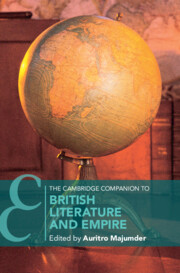
- The Cambridge Companion to British Literature and Empire
- The Cambridge Companion to British Literature and Empire
- Copyright page
- Contents
- Figures
- Contributors
- Acknowledgments
- Chronology
- Introduction
- Part I Early Intimations and Literary Genres: 1500–1800
- 1 Early Modern Utopia
- 2 Trade, Race, and Class in Early Modern England
- 3 Peripheral Heroics on the Renaissance Stage
- 4 Travel Narratives and the Early Novel
- 5 Anglophone Epics and Ruin Poetry in Eighteenth-Century India
- 6 The Black Atlantic, Slave Narratives, and Empire
- Part II Entanglements of Prose, Poetry, and Empire: 1800–1900
- Part III Figures, Movements, and Histories: 1900–1945
- Part IV Pathways and Legacies: 1945–2020
- Further Reading
- Index
- Cambridge Companions to Literature
- References
2 - Trade, Race, and Class in Early Modern England
from Part I - Early Intimations and Literary Genres: 1500–1800
Published online by Cambridge University Press: 20 November 2025
By
Edited by

Book contents
- The Cambridge Companion to British Literature and Empire
- The Cambridge Companion to British Literature and Empire
- Copyright page
- Contents
- Figures
- Contributors
- Acknowledgments
- Chronology
- Introduction
- Part I Early Intimations and Literary Genres: 1500–1800
- 1 Early Modern Utopia
- 2 Trade, Race, and Class in Early Modern England
- 3 Peripheral Heroics on the Renaissance Stage
- 4 Travel Narratives and the Early Novel
- 5 Anglophone Epics and Ruin Poetry in Eighteenth-Century India
- 6 The Black Atlantic, Slave Narratives, and Empire
- Part II Entanglements of Prose, Poetry, and Empire: 1800–1900
- Part III Figures, Movements, and Histories: 1900–1945
- Part IV Pathways and Legacies: 1945–2020
- Further Reading
- Index
- Cambridge Companions to Literature
- References
Summary
This chapter traces the roots of racial capitalism in early modern England. It shows how ideologies of class and race were grounded in the logic of both nationalism and overseas trade and colonialism. It does so by tracing the evolution of the story of Dick Whittington, a fantasy about a poor boy that acquired the status of a fairy tale in English culture. This evolution illustrates how dreams of class mobility at home were shaped by the promises of international wealth; how these promises in turn molded the ideology of nationalism whereby the nobility and the mercantile classes came together despite the tensions between them; how existing geographic differences were rewritten to present European superiority; and finally, how peoples from different parts of the world were represented as both necessary and dangerous to the advancement of the European self.
Information
- Type
- Chapter
- Information
- The Cambridge Companion to British Literature and Empire , pp. 36 - 49Publisher: Cambridge University PressPrint publication year: 2025
References
Works Cited
Anon. “London’s Glory, and Whittington’s Renown Or, a Looking-Glass for Citizens of London.” G. Eld for Iohn Wright, 1612.Google Scholar
Anon. The Libelle of Englyshe Polycye, a Poem on the Use of Sea-power 1436. Edited by Warner, George, Clarendon P, 1926.Google Scholar
Bartlett, Robert. The Making of Europe: Conquest, Colonization, and Cultural Change, 950–1350. Princeton UP, 1993.Google Scholar
Blackburn, Robin. “The Old World Background to European Colonial Slavery.” William and Mary Quarterly, vol. 54, no. 1, Jan. 1997, pp. 65–102.10.2307/2953313CrossRefGoogle Scholar
Bonahue, Edward T. “Heywood, the Citizen Hero, and the History of Dick Whittington.” English Language Notes, vol. 36, Mar. 1999, pp. 33–41.Google Scholar
Deloney, Thomas. The Gentle Craft. Edited by Lange, Alexis F., Mayer and Müller, 1903.Google Scholar
Eltis, David, and Richardson, David. Atlas of the Transatlantic Slave Trade. Yale UP, 2010.Google Scholar
Guasco, Michael. “Labor.” A Cultural History of the Western Empires in the Renaissance. Edited by Loomba, Ania, Bloomsbury Academic, 2019, pp. 101–26.Google Scholar
Heywood, Thomas. The Famous and Remarkable History of Sir Richard Whittington. W. Wilson, 1656.Google Scholar
Hulme, Peter. Colonial Encounters, Europe and the Native Caribbean, 1492–1797. Methuen, 1986.Google Scholar
Johnson, Richard. “A Crowne Garland of Roses Gathered Out of Englands Royall Garden.” G. Eld for Iohn Wright, 1612.Google Scholar
Ladd, Roger A. “From ‘Sonne of Marchaundy’ to ‘Obsurely Bred’: The Nine Lives of Richard Whittington.” English Language Notes, vol. 43, no. 1, Jan. 2005, pp. 12–33.10.1215/00138282-43.1.12CrossRefGoogle Scholar
Manning, Roger B. Village Revolts, Social Protests and Popular Disturbances in England, 1509–1640. Oxford UP, 1988.Google Scholar
Parrinder, Patrick. “‘Turn Again, Dick Whittington!’: Dickens, Wordsworth, and the Boundaries of the City.” Victorian Literature and Culture, vol. 32, no. 2, 2004, pp. 407–19.CrossRefGoogle Scholar
Robinson, Cedric J. Black Marxism: The Making of a Black Radical Tradition. U of North Carolina P, 1983.Google Scholar
Accessibility standard: WCAG 2.0 A
Why this information is here
This section outlines the accessibility features of this content - including support for screen readers, full keyboard navigation and high-contrast display options. This may not be relevant for you.Accessibility Information
The HTML of this chapter
conforms to version 2.0 of the
Web Content Accessibility Guidelines
(WCAG), ensuring core accessibility principles are addressed and meets the basic
(A)
level of WCAG compliance, addressing essential accessibility barriers.
Content Navigation
Table of contents navigation
Allows you to navigate directly to chapters, sections, or non‐text items through a linked table of contents, reducing the need for extensive scrolling.
Allows you to navigate directly to chapters, sections, or non‐text items through a linked table of contents, reducing the need for extensive scrolling.
Index navigation
Provides an interactive index, letting you go straight to where a term or subject appears in the text without manual searching.
Provides an interactive index, letting you go straight to where a term or subject appears in the text without manual searching.
Reading Order & Textual Equivalents
Single logical reading order
You will encounter all content (including footnotes, captions, etc.) in a clear, sequential flow, making it easier to follow with assistive tools like screen readers.
You will encounter all content (including footnotes, captions, etc.) in a clear, sequential flow, making it easier to follow with assistive tools like screen readers.
Short alternative textual descriptions
You get concise descriptions (for images, charts, or media clips), ensuring you do not miss crucial information when visual or audio elements are not accessible.
You get concise descriptions (for images, charts, or media clips), ensuring you do not miss crucial information when visual or audio elements are not accessible.
Full alternative textual descriptions
You get more than just short alt text: you have comprehensive text equivalents, transcripts, captions, or audio descriptions for substantial non‐text content, which is especially helpful for complex visuals or multimedia.
You get more than just short alt text: you have comprehensive text equivalents, transcripts, captions, or audio descriptions for substantial non‐text content, which is especially helpful for complex visuals or multimedia.
Structural and Technical Features
ARIA roles provided
You gain clarity from ARIA (Accessible Rich Internet Applications) roles and attributes, as they help assistive technologies interpret how each part of the content functions.
You gain clarity from ARIA (Accessible Rich Internet Applications) roles and attributes, as they help assistive technologies interpret how each part of the content functions.