


The theoretical framework presented in Chapter 2 highlights formal independence as a key factor shaping deference. It argues that formal independence, alongside political fragmentation, structures an international court’s strategic space and consequently deference. In particular, formal independence shapes the perceived legitimacy of a court. The more a court has robust safeguards to independence, the more its subjects and constituents will see it as independent and by extension legitimate. A court’s perceived legitimacy affects the costs to states for resisting that court. Defiance and resistance of a legitimate court are politically costly and risky because constituents are likely to view such actions as disregard for rightful law and authority. Second, formal independence also affects the extent to which states can credibly resist or curb a court through collective formal means. Greater formal independence translates into fewer opportunities or higher barriers for collective resistance. Thus, greater formal independence is likely to reduce political constraints faced by courts and thereby expand their strategic space to enable less deference.
This begets the question: Are international courts formally independent? This chapter addresses this question. To do so, it conceptualizes and measures the formal independence of international courts. I conceptualize formal independence as the formal rules that aim to safeguard autonomous judicial decision-making. This understanding of formal independence contrasts with informal independence. Based on this definition, the chapter develops an original measure of formal independence, which is used to estimate the formal independence of twenty-six ICs from 1945 to 2015. The chapter then maps and compares formal independence across these ICs. The mapping reveals significant variation in the formal independence of ICs. Rules pertaining to the appointment and terms of office for international judges as well as the managerial autonomy of ICs are the sources of most of the observed variation.
International Courts and Judicial Independence
Judicial independence is the ability of courts to deliberate and reach legal judgments based on legal considerations and without undue pressure or influence from external sources, governmental or otherwise. It relates to a court’s ability to act autonomously, how it is held accountable, and whether nonlegal pressures unduly impact judicial deliberation and decision-making.Footnote 1 Even though the independence of a court is linked to the independence and impartiality of its judges, the focus here is on independence as an institutional attribute of a court.
Policymakers and scholars alike view independence as a desirable feature for courts. For example, the United Nations (UN) calls upon all states to secure, promote, and respect judicial independence.Footnote 2 While independence is valued for normative or moral reasons, it is also desirable for judicial effectiveness. The link between independence and effectiveness is increasingly recognized for international courts, and not only domestic courts. Guillaume argues, “[t]he international judiciary, like national judiciaries, cannot effectively perform its functions unless it enjoys the requisite independence.”Footnote 3 Scholars have argued that independence shapes compliance with ICs,Footnote 4 and it has an impact on the role of ICs in dispute settlement and legal clarification.Footnote 5 Moreover, the independence of an international court improves its ability to ensure the rule of law.Footnote 6
Independence is also a desirable attribute for international courts because it improves their legitimacy, or how they are perceived by other actors.Footnote 7 As Benvenisti and Downs argue,
the perceived independence of a given international tribunal from the handful of powerful states that have tended to dominate the institutional design process continues to be the most significant factor in shaping the extent to which judge made law is regarded as legitimate in the eyes of less powerful states. Such political independence on the part of the international tribunals continues to be a necessary, if not sufficient, condition for the perceived legitimacy of their lawmaking.Footnote 8
Independence confers legitimacy on international courts because it implies ICs are fair and unbiased.Footnote 9 Interview research substantiates the link between independence and perceptions. In one study, for instance, the ECtHR’s independence shaped interviewee’s views of the Court.Footnote 10 Another study found that independence improves the perceived legitimacy of the ECtHR by way of advancing procedural justice.Footnote 11
While there is wide-scale agreement that independence is a desirable attribute, whether international courts are in fact independent is debated. On the one hand, there are those who contend that international courts are politically constrained and lack independence.Footnote 12 In this camp is literature that builds on principal-agent theory. It treats international courts as agents of states who are the principals responsible for delegating authority to courts. Courts are understood to have their own interests that may diverge from those of states. Consequently, states will seek to curtail or curb “agency slack.” Court-curbing mechanisms include ex ante controls, which aim to prevent “adverse selection.” States, for example, rely on appointment procedures to identify judges whose ideological preferences closely align with their own. Other court-curbing mechanisms are ex post means of sanctioning a court, such as declining to reappoint a judge or altering the jurisdiction or powers of the court following a controversial decision.Footnote 13 This perspective suggests that court-curbing mechanisms, typically governed by formal rules, constrain judicial independence. Another strand of literature draws less from principal-agent theory, but nonetheless arrives at the conclusion that international courts have “bounded discretion,”Footnote 14 “constrained independence,”Footnote 15 and operate within a “strategic space.”Footnote 16 Both strands recognize that international judicial independence is limited because they operate with states in the background and political constraints that limit judicial autonomy.
On the other hand, several scholars argue that international courts are independent and exercise their authority without concern for the preferences of states.Footnote 17 A prominent argument from this perspective approaches international courts as “trustees” of states. Unlike delegation to an agent, trusteeship has the foremost objective of making states’ commitments credible, for which independence is essential.Footnote 18 Judges and courts can act as trustees because they have moral authority, serving higher values or “the law,” and expert authority based on respect for their competence and relevant knowledge.Footnote 19 Put differently, the independence of an IC is the result of its expert and moral authority. A slightly different take suggests that states have limited means of controlling ICs because disunity among principals reduces the political feasibility of curbing and therefore ICs operate “in an unusually permissive zone of discretion.”Footnote 20 Moreover, the risks of court-curbing are narrow because states’ preferences are often changed by courts.Footnote 21
Empirical studies have informed this debate. Most of these studies examine the CJEU and/or the WTO dispute settlement mechanism. The wider population of international courts has received limited attention. Additionally, these empirical studies do not measure the independence of these courts. This chapter addresses these limitations by conceptualizing and measuring formal judicial independence of twenty-six ICs. The section “Conceptualizing and Measuring Formal Independence” describes how I conceive of and measure formal independence.
Conceptualizing and Measuring Formal Independence
Judicial independence is a complex concept, consisting of two dimensions. First, independence has a behavioral dimension, which describes whether in practice behavior is independent. This can be called informal independence (also referred to as de facto independence).Footnote 22 Second, formal independence (sometimes called de jure independence) concerns the institutional design of a court and whether judicial independence is formally safeguarded through codified rules. Drawing the distinction between these two dimensions of independence is essential as one connotes rules and the other behavior or practice. It also has significant implications for measurement. Yet, those who study judicial independence at the international level rarely make a point of drawing the conceptual difference between formal and informal independence.
Literature on domestic courts illustrates the benefits of the conceptual distinction. It facilitates examination of whether rules that safeguard independence enable courts to behave independently.Footnote 23 Similarly, distinguishing between formal and informal independence sheds light on independence as a key design feature of international institutions more broadly.Footnote 24 Finally, it can be useful for identifying how independence affects the outcomes, such as compliance, or impacts of international courts.
While there are various measures of formal independence of domestic courts, no such measure exists for ICs.Footnote 25 I develop an original dataset that measures the formal independence of international courts. The ICs included in the dataset comprise the full universe of permanent ICs that were operational at any point between 1945 until 2015.Footnote 26 Excluded are quasi-judicial bodies (such as the UN human rights committees), tribunals with ad hoc appointments (such as investor–state arbitration tribunals), hybrid criminal courts (such as the Special Court for Sierra Leone), or ICs that were “nipped in the bud.”Footnote 27 This selection of ICs closely matches other prominent comparative research on ICs.Footnote 28 Table 3.1 lists the included ICs, along with their abbreviations and the year they became operational.
| International court | Year in operation |
|---|---|
| African Court on Human and Peoples’ Rights (ACtHPR) | 2006 |
| Andean Tribunal of Justice (ATJ) | 1984 |
| Arab Investment Court (AIC) | 2003 |
| Benelux Court of Justice (BCJ) | 1974 |
| Central American Court of Justice (CACJ) | 1992 |
| Caribbean Court of Justice (CCJ) | 2005 |
| Central African Economic and Monetary Community Court of Justice (CEMAC CJ) | 2000 |
| Common Market for Eastern and Southern Africa Court of Justice (COMESA CJ) | 1998 |
| Court of Justice of the European Union (CJEU) | 1952 |
| East African Court of Justice (EACJ) | 2001 |
| Economic Court of the Commonwealth of Independent States (ECCIS) | 1993 |
| Economic Community of West African States Court of Justice (ECOWAS CJ) | 2002 |
| Eurasian Economic Union Court (EAEU CT) | 2015 |
| European Court of Human Rights (ECtHR) | 1959 |
| European Free Trade Agreement Court of Justice (EFTA CJ) | 1994 |
| Inter-American Court of Human Rights (IACtHR) | 1979 |
| International Criminal Court (ICC) | 2002 |
| International Court of Justice (ICJ) | 1947 |
| International Criminal Tribunal of Rwanda (ICTR) | 1994 |
| International Criminal Tribunal of the former Yugoslavia (ICTY) | 1993 |
| International Tribunal for the Law of the Sea (ITLOS) | 1996 |
| Mercosur Permanent Review Tribunal (Mercosur PRT) | 2002 |
| Organization for the Harmonization of Business Law in Africa Common Court of Justice and Arbitration (OHADA CCJA) | 1996 |
| Tribunal of the Southern African Development Community (SADCT) | 2005–2010 |
| Western African Economic and Monetary Union Court of Justice (WAEMU CJ) | 1995 |
| World Trade Organization Appellate Body (WTO AB) | 1994 |
Formal independence is operationalized as the codified rules governing each court, as regulated by their founding treaties, regulations, and rules of procedure (or similar). I construct a composite measure based on eleven codified rules that provide institutional safeguards of judicial independence. The rules of interest are those that define the ex ante and ex post mechanisms of control that states might have over a court. These rules address: (a) the appointment of judges and their terms of office, (b) the managerial autonomy of courts, and (c) additional safeguards that insulate and protect judges from inappropriate external pressures. This selection of rules is guided by theoretical literature, which I refer to when discussing each rule below. Also, this selection closely parallels those that are included in measures of domestic de jure independence or proposed measures for international courts.Footnote 29 I exclude other rules that might be associated with independence, such as the permanence of a court, admissibility, or access because they have no direct ability to safeguard independence on their own, even though they may, in conjunction with other factors, have an impact on informal independence. For similar reasons, I exclude rules more clearly related to impartiality. The following discussion elaborates on how each rule can safeguard independence and relates to the idea of ex ante or ex post mechanisms of state control.
Selection and Terms of Judicial Office
While appointment of judges is likely to be politically charged for all ICs, appointment procedures and the terms of judicial office vary.Footnote 30 Some appointment procedures provide better safeguards to independence than others. Five rules concerning appointment and the terms of judicial office relate to independence:
Selection: The procedure for appointing judges varies across ICs, including: the direct appointment by a single state; by a unanimous vote or consensus of all member states; by a supermajority vote of states; by a majority vote; or by selection of an independent body.Footnote 31 Direct appointments by a single state occur in some “full representation” courts, meaning that the number of seats on the court equals the number of member states so that each state is “represented” by one judge. The ECtHR is an example of a full representation court. “Selective representation” courts, where there are fewer seats than states (e.g., WTO AB), or courts which have more seats than there are member states (e.g., EACJ), do not have direct appointments for obvious reasons. Generally speaking, the independence of international institutions increases as the size of the veto group (or the blocking coalition) becomes larger.Footnote 32 Thus, as Keohane, Moravcsik, and Slaughter explain, judges appointed either directly by an individual state or by unanimity (or consensus) – thereby providing any one state with a veto – have low independence because one state on its own can influence the composition of a court.Footnote 33 For example, when a state can directly appoint a judge, it can select judges who have ideological leanings that align with its preferences. Similarly, if appointment is by unanimity (or consensus), any one state can prevent the selection of a judge whose preferences diverge from its own. Supermajority rules make it more difficult for a state to block the selection of a judge because it would need the support of a portion of other states to join in blocking the appointment. Majority voting rules enable even more independence because it requires at least half of all member states to block a selection of judges.
Reappointment: Rules on reappointment are also believed to influence independence.Footnote 34 If judges can be reappointed, they have more incentives to maintain the good will of states. In other words, states might rely on reappointment as a carrot to nudge judges toward favorable decisions. Thus, the possibility of reappointment reduces independence.
Tenure: Tenure can also affect judicial independence, such that longer terms bolster independence.Footnote 35 When judges are appointed for short terms, they might have more insecurities about their career prospects once their term expires. Moreover, states can influence a judge’s career options once she completes her term of office. For example, the state may later nominate her for a judgeship to another court. Judges, especially if they are younger, may therefore seek to protect their long-term career by remaining in the high esteem of states. Voeten finds that there is some indication that career insecurities make judges more likely to favor their national governments in disputes.Footnote 36 All else equal, longer terms help to insulate judges from political retribution for unpopular decisions and reduce concerns for their career.
Removal from office: Rules governing the dismissal of judges also affect judicial independence.Footnote 37 When states control the removal of judges from office, judges have greater incentive to maintain the good esteem of states, negatively affecting independence. Independence is better safeguarded by rules that ensure removal from office is determined by a judge’s peers or the court itself.
Oath of office: Another means of safeguarding independence is a sworn oath of office.Footnote 38 An oath of office, or disclosure statement, safeguards independence because it binds a judge to remain independent. Moreover, an oath is a public commitment to remain independent, which is likely to be important for perceived legitimacy.
Managerial Autonomy
The extent to which a court has control over its material and human resources is likely to affect judicial independence. Resources and leadership affect the ability of ICs to process their caseloads and how they do so. For example, autonomy over resources “may permit a court or tribunal to develop a factual record independent of that of state litigants before them.”Footnote 39 Moreover, research suggests that those working within the registries and secretariats of international courts, while often unseen and unheard, are instrumental to the administrative and legal operations of ICs.Footnote 40 I consider four rules that relate to managerial autonomy.
Budget: A court’s ability to determine its budget provides it with discretion to determine how its resources are allocated. If states control the budget, they determine the amount of funding a court has as well as how resources are allocated, such as whether funding can go to fact-finding, expert testimony, support staff, or public relations. Thus, the more influence a court has over its budget, the greater its independence.Footnote 41
Registrar: Also critical for a court’s independence is its ability to decide who works in its registry or secretariat. As staffing and managerial decisions are made by a registrar or secretary, whoever appoints the registrar or secretary indirectly shapes many aspects of a court’s operation, including staffing choices and case processing. The more influence a court has over the appointment of its registrar, the higher its independence.
President: A court’s leader influences how it operates and processes cases. The president (or chairperson) of the court, for example, can determine how cases are allocated or who writes decisions.Footnote 42 Courts that appoint their own president therefore have more independence than when they are selected by states.
Rules of Procedure: The control over a court’s rules of procedure can also affect its independence. When courts can determine these rules of procedure on their own, they have some autonomy over the internal administration of the court, the functioning of its registrar, as well as some aspects of judicial proceedings. Thus, courts that can determine their rules of procedure are likely to have more discretion over their management and internal operation, and thus functionally have greater independence.
Insulation of Judges from Undue External Pressure
Other rules can help to safeguard the judges on the bench from being subject to inappropriate pressure from external actors. Two rules provide such safeguards.
Secret deliberations: Rules governing the secrecy or confidentiality of judicial deliberation may foster independence. When courts have confidential deliberations, we can assume that secrecy enables judges to freely deliberate without concern for how their statements may be perceived, interpreted, or used against them by external actors. Thus, secret deliberation may go a long way toward enhancing judicial independence.Footnote 43
Immunities and Privileges: Provisions that grant diplomatic privileges and immunities to judges also safeguard independence. Protections for judges from politically motivated prosecutions may be essential to their ability to act free from the pressure of states. “If the individual judges cannot feel safe from sanctions for the decisions he makes on the bench, if he has to fear negative consequences that affect other aspects of his life, then the most competent individual will either decline to serve as a judge or be disposed to surrender to the pressure.”Footnote 44 Privileges and immunities that benefit judicial independence include protections for judges from prosecution for actions taken in fulfilling the obligations of office.
Before a discussion of how these rules are coded for the purpose of constructing a composite measure, it is worth noting that some might question the inclusion of any given rule that I incorporate. For example, a rule concerning an oath of office may have minimal impact on the overall protection of a court. I, however, contend that the hypothesized impact of formal independence is not purely about whether any one given rule guarantees noninterference, but whether the rules in combination safeguard independence by making interference difficult for states. The degree of difficulty states face in resisting a court is affected by whether a court appears to be independent. Thus, my purpose of including such rules is to not discount the symbolic significance of something like a sworn oath, as it shapes the appearance of independence and thereby makes state resistance more costly and difficult than if there were no oath.
An Index of IC Formal Independence
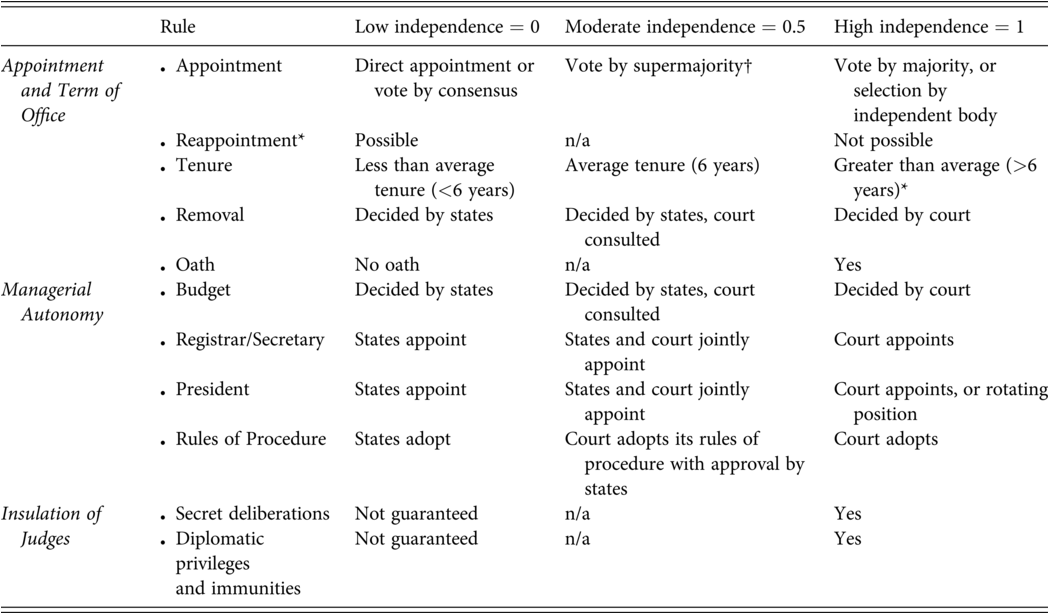
To construct a composite measure of formal independence, each international court is coded along these eleven rules. Each rule is coded on a scale of 0 to 1, where 0 represents low independence and 1 is high independence. The coding for each rule is summarized in Table 3.2.
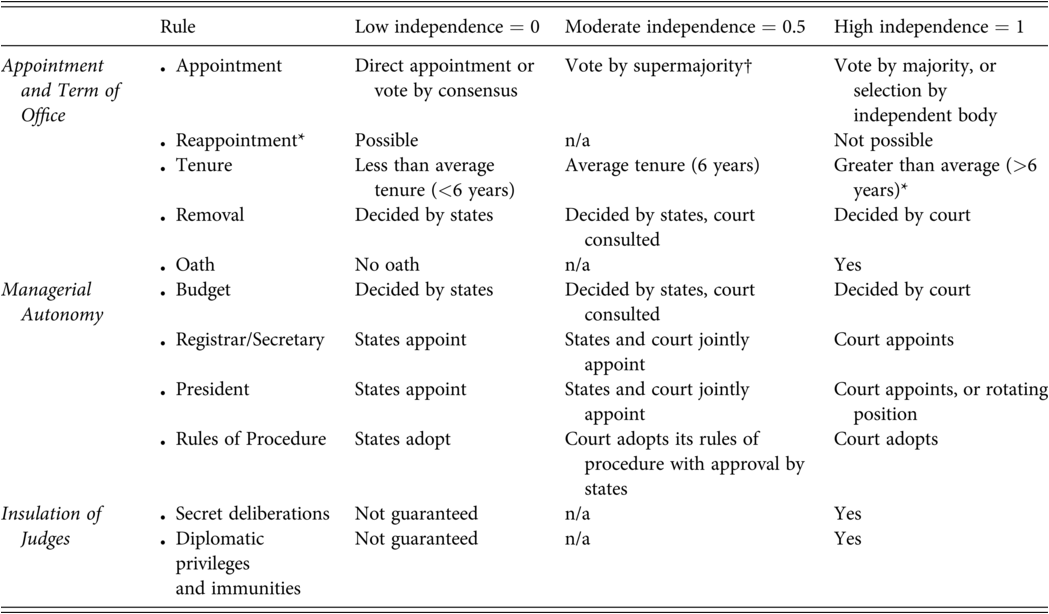
Table 3.2 Long description
The table measures the formal independence of international courts by categorizing various rules under three levels of independence: low, moderate, and high. The rules are divided into two main sections, namely the appointment and term of office, and managerial autonomy. The following details the characteristics of each rule across the three levels of independence.
1. Appointment and Term of Office
Appointment
Low independence means judges are appointed directly or by a unanimity decision rule.
Moderate independence means judges are appointed by a vote of supermajority vote.
High independence means judges are appointed by majority vote or selected by an independent body.
Reappointment
Low independence allows for possible reappointment.
Moderate independence is not applicable.
High independence does not allow reappointment.
Tenure
Low independence means judges serve less than the average tenure, which is less than six years.
Moderate independence means judges serve an average tenure of six years.
High independence means judges serve longer than the average tenure, which is more than six years.
Removal
Low independence means states decide on the removal of judges.
Moderate independence means states decide on removal, but the court is consulted.
High independence means the court decides on the removal of judges.
Oath
Low independence means no oath is required.
Moderate independence is not applicable.
High independence means judges are required to take an oath.
2. Managerial Autonomy
Budget
Low independence means states control the budget.
Moderate independence means states control the budget upon consultation with the court.
High independence means the court governs its budget.
Registrar or Secretary
Low independence means states appoint the registrar or secretary.
Moderate independence means states and courts jointly appoint the registrar or secretary.
High independence means the court appoints the registrar or secretary.
President
Low independence means states appoint the president.
Moderate independence means states and the court jointly appoint the president.
High independence means the court appoints the president, or the position rotates.
3. Insulation of Judges
Rules of Procedure
Low independence means states adopt the rules of procedure.
Moderate independence means the court adopts its rules of procedure with approval from the states.
High independence means the court adopts the rules of procedure independently.
Secret Deliberations
Low independence means secret deliberations are not guaranteed.
Moderate independence is not applicable.
High independence means secret deliberations are guaranteed.
Diplomatic Privileges and Immunities
Low independence means diplomatic privileges and immunities are not guaranteed.
Moderate independence is not applicable.
High independence means diplomatic privileges and immunities are guaranteed.
* CCJ judges hold their tenure until the age of seventy-two and therefore can have terms that exceed six years. See Chapter 5 for further details.
† The CJEU’s new procedure for appointment under the Lisbon Treaty, requiring an independent panel to consult on appoints, is unique. It is coded as 0.5 as it increases independence.
Based on this coding scheme, I develop an additive measure, which equally weights all eleven rules on independence and then normalizes the sum on a 0 (low independence) to 1 (high independence) scale.Footnote 45 The Formal Independence Index is based on this composite measure for all twenty-six ICs from 1945 to 2015. I also consider alternative methods for constructing a composite measure. One alternative is to weigh rules differently. I elect to use equal weighting for three reasons. First, weighting requires additional theoretical insights into what rules are most crucial to independence. Second, the rules that are arguably less critical for independence, such as oath or secret deliberations, are similar across most, if not all, courts. In other words, most of the variation is explained by a fewer set of variables. Third, several measures of de jure independence of domestic judiciaries use a similar additive approach.Footnote 46
Another possibility for measuring formal independence is to exclude those rules that are arguably less important to ensuring independence. I calculate another index (Index2), which includes only the rules concerning appointment and terms of office and managerial autonomy. Index2 and the Formal Independence Index are highly correlated (r = .99).Footnote 47 Another view is that there is a clear distinction between judicial independence and judicial accountability.Footnote 48 Excluding the rules most associated with accountability, or the ability to sanction the court or its judges (reappointment, removal of judges, and budget), I calculate a third version of the index (Index3). It is also highly correlated with the Formal Independence Index (r = .89). Finally, I considered using factor analysis to create an index. This reveals four factors with Eigen values above 1.Footnote 49 The factor with the highest Eigen value explains only 28 percent of the variation. In all, the benefit of using these alternatives indices is limited, and without further theoretical justification for excluding certain rules, I proceed with the full Formal Independence Index.
Mapping Formal Judicial Independence of ICs
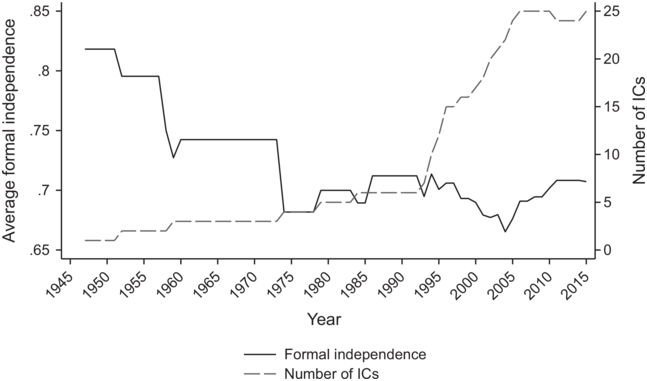
Do international courts differ in their formal independence? A comparison of formal independence of all twenty-six ICs sheds light on this question. Figure 3.1 illustrates that on average judicial independence has declined over time. This development coincides with the increase in the number of ICs.
Formal independence from 1945 to 2015.
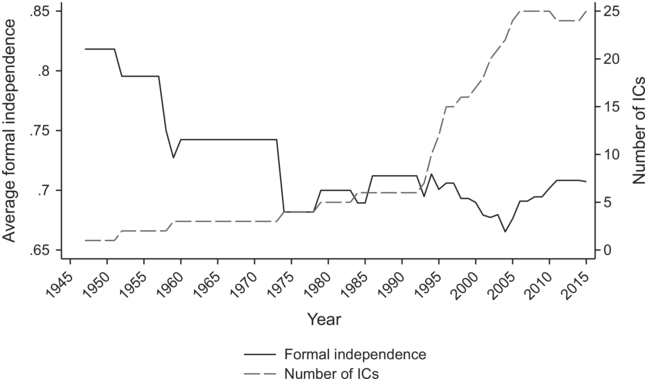
Figure 3.1 Long description
A line graph with the left vertical axis labeled average formal independence ranging from 0.65 to 0.85 in increments of 0.05, and the right vertical axis labeled number of I Cs ranging from 0 to 25 in increments of 5. The horizontal axis spans from 1945 to 2015 in increments of 5. Formal independence begins above 0.8 around 1950, declines through the 1950s and 1970s, drops below 0.7 by 1975, and then fluctuates with a dip near 2005 before slightly rising. The number of I Cs starts at 0 in 1945, gradually increases through the 1980s and early 1990s, then climbs steeply from 1995, reaching 25 by 2005, and remains mostly stable afterward.
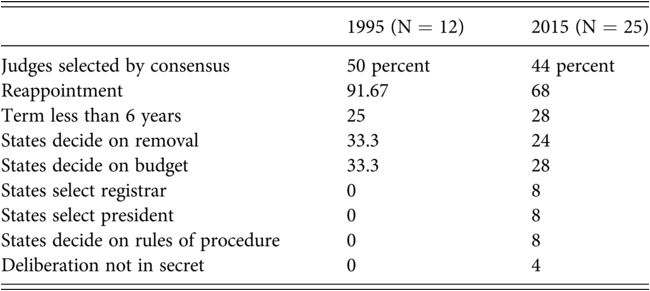
What rules are used typically to limit judicial independence, and has this changed over time? Table 3.3 shows what percentage of ICs in 1995 and 2015 featured rules that hamper judicial independence. By comparing 1995 to 2015, we can see that some provisions have become less common over time, including rules that allow for reappointment and appointment by consensus. However, state control over the selection of court presidents, registrars, and rules of procedure has increased. While most of these differences do not on their own affect a large percentage of ICs, they contribute to a decline in the average level of judicial independence. Additionally, it suggests that the decline in formal independence of the international judiciary is driven by the proliferation of new courts. That is, new courts are created with less robust measures to safeguard judicial independence when compared to older courts.
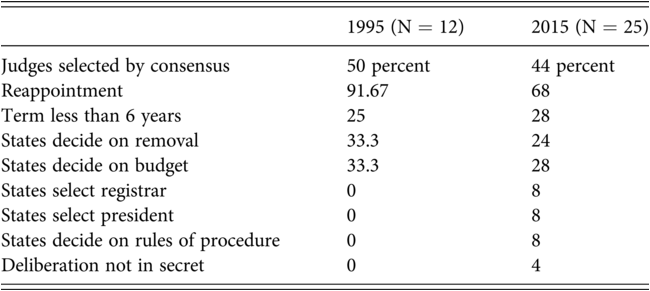
Table 3.3 Long description
The table features the prevalence of rules that hamper independence over time, comparing data from 1995 and 2015 across various international courts. The values represent percentages or counts out of the total courts observed in each year.
Judges selected by consensus decreased from 50% in 1995 to 44% in 2015.
Reappointment prevalence decreased from 91.67% in 1995 to 68% in 2015.
Terms less than six years increased slightly from 25% in 1995 to 28% in 2015.
States deciding on removal decreased from 33.3% in 1995 to 24% in 2015.
States deciding on budget decreased from 33.3% in 1995 to 28% in 2015.
States selecting the registrar increased from 0% in 1995 to 8% in 2015.
States selecting the president increased from 0% in 1995 to 8% in 2015.
States deciding on rules of procedure increased from 0% in 1995 to 8% in 2015.
Deliberation not in secret increased from 0% in 1995 to 4% in 2015.
Note: Immunities and oath are not included because they are present in both years for all courts.
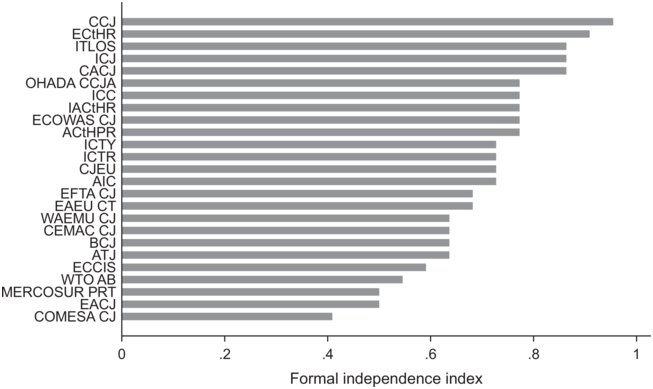
Figure 3.2 compares the formal independence of twenty-five ICs in 2015.Footnote 50 It shows that the Court of Justice of the Common Market for Eastern and Southern Africa (COMESA CJ), Mercosur Permanent Review Tribunal (PRT), and the East African Court of Justice have the lowest levels of formal independence. All three of these courts’ judges are appointed by consensus. COMESA’s court also scores low because, among other things, its judges hold renewable five-year terms, and states control the removal of judges and the selection of the Court’s president.Footnote 51 The Mercosur PRT’s arbitrators hold renewable two-year terms and states control the removal of judges.Footnote 52 For the EACJ, states control the removal of judges, the appointment of the registrar, and the Court’s budget.Footnote 53
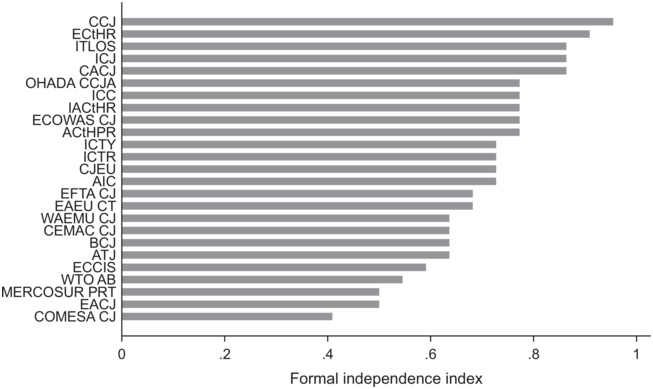
Figure 3.2 Long description
A horizontal bar chart with the vertical axis listing courts from C C J to C O M E S A C J. The horizontal axis represents the formal independence index, ranging from 0 to 1 in increments of 0.2. The C C J scores the highest, near 1, followed closely by E C t H R, I T L O S, I C J, and C A C J. Courts such as C O M E S A C J, E A C J, and M E R C O S U R P R T score below 0.5. The rest fall between 0.5 and 0.8, creating a descending pattern from top to bottom.
The international court with the highest level of formal independence is the Caribbean Court of Justice. The CCJ’s independence is provided by its rules on judicial appointments and managerial autonomy. Judges, as well as the registrar, are elected by the CCJ’s Regional Judicial and Legal Services Commission (RJLSC), which is an independent commission.Footnote 54 Also, its budget is governed by a tripartite relationship between the Court, the RJLSC, and the Board of Trustees of the CCJ’s Trust Fund.Footnote 55
The ECtHR, ITLOS, ICJ, and Central American Court of Justice (CACJ) also score comparatively high in terms of judicial independence. For example, the CACJ’s institutional safeguards to independence include judicial appointments that are for a ten-year, nonrenewable term. Judicial appointments to the ECtHR are also nonrenewable and last for nine years.Footnote 56 The ICJ also scores high because of its rules pertaining to judicial appointments. Judges are elected by a majority vote of the UN Security Council and the General Assembly to serve a nine-year, renewable term.Footnote 57 Also, all four of these courts decide on their rules of procedure and select their registrars and presidents.Footnote 58
Appointment and Terms of Office
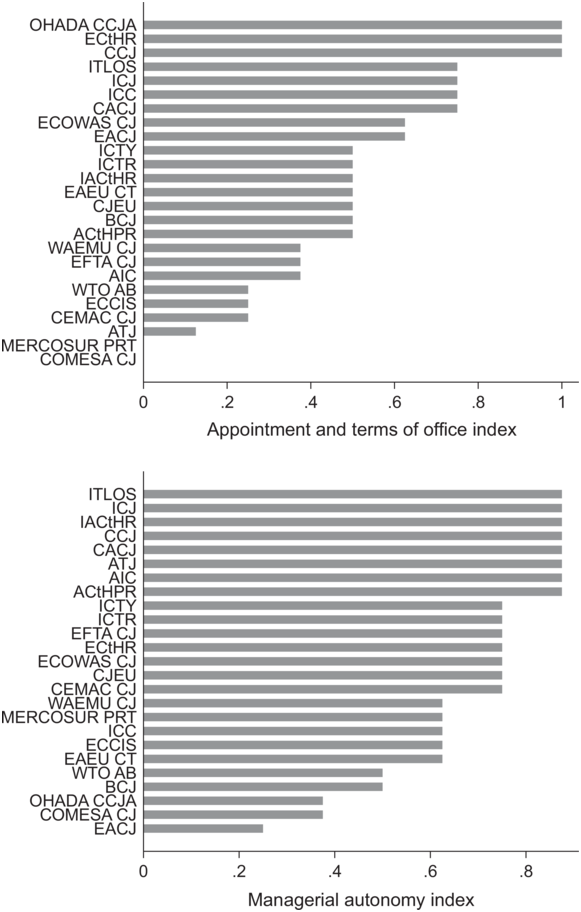
The rules concerning judicial appointment and the terms of office are often designed to limit independence. In 2015, 68 percent of ICs featured the possibility of re-appointment (Table 3.3), which can hinder judicial independence.Footnote 59 We also know that judges are appointed by a consensus of member states or by direct appointments in nearly half of all ICs. Do ICs systematically differ in the extent to which their rules on appointment and terms of office are weak or strong safeguards to independence? To address this question, I create a subindex on the appointment and terms of office that includes the following rules: appointment, reappointment, length of tenure, removal from office, and oath of independence. The subindex is a cumulative score of these five rules, equally weighted and normalized on a scale of 0 (low independence) to 1 (high independence). Figure 3.3 compares ICs on the basis of the appointment and terms of office subindex in 2015.
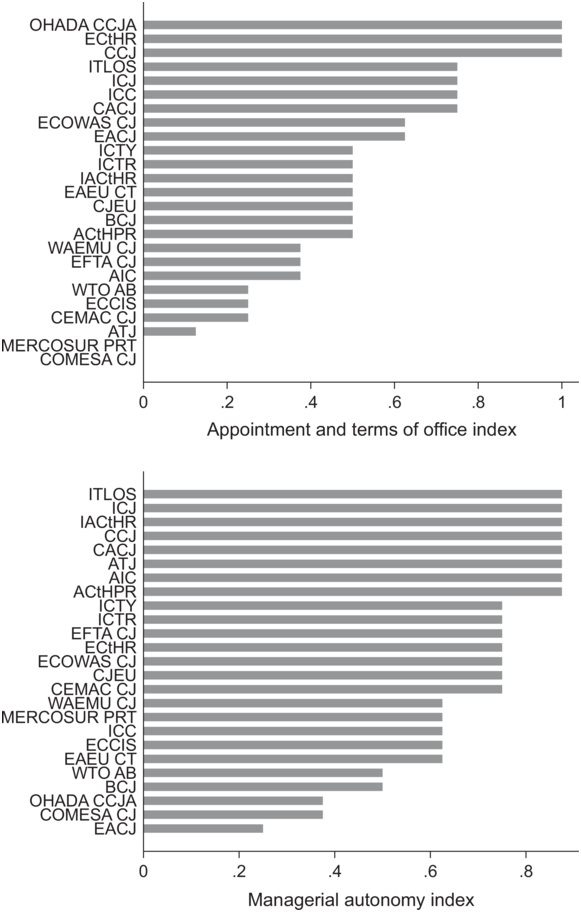
Figure 3.3 Long description
Two horizontal bar charts. The top chart's vertical axis lists courts from O H A D A C C J A to C O M E S A C J. The horizontal axis represents the appointment and terms of office index, ranging from 0 to 1 in increments of 0.2. O H A D A C C J A ranks highest at 1, followed by E C t H R and C C J. C O M E S A C J ranks lowest, followed by M E R C O S U R P R T and A T J. The bottom chart’s vertical axis lists the courts from I T L O S to E A C J. The horizontal axis represents the managerial autonomy index, ranging from 0 to 1 in increments of 0.2. I T L O S, I C J, I A C t H R, and C C J score highest at 1. E A C J and C O M E S A C J score lowest, followed by O H A D A C C J A and B C J.
Figure 3.3 shows that appointment and terms of office rules of the CCJ and the Common Court of Justice and Arbitration for the Organization for the Harmonization of Business Law in Africa (OHADA CCJA) are among the most robust in furnishing formal judicial independence. As mentioned before, the CCJ stands out because the RJLSC, not the member states, appoint its judges.Footnote 60 Apart from the President of the Court, the removal of judges on the CCJ is also determined by RJLSC.Footnote 61 In addition, judges hold office until the age of seventy-two, and thus reappointment does not apply.Footnote 62 The judges of the OHADA CCJA are elected by an absolute majority by the Council of Ministers, which is an intergovernmental decision-making body, for a seven year, nonrenewable term.Footnote 63 On the other end of the spectrum, there are a number of ICs that lack strong protections to independence through appointment procedures and the terms of judicial office. The Court of Justice of COMESA (COMESA CJ) and Mercosur’s PRT score the lowest, followed by Andean’s Tribunal and Court of Justice for the Economic Community of West African States (ECOWAS). Except for the WTO AB, only regional courts have below average (0.58) formal independence in terms of appointment and terms of office.
Managerial Autonomy
Rules concerning the management of ICs also appear to have varying impact on the degree of formal independence of international courts. How do ICs compare in their autonomy over their management? To address this question, I use a subindex on managerial autonomy to summarize the rules determining control over a court’s budget and rules of procedure, as well as the selection of the registrar and president. The subindex is a cumulative score of these four rules, equally weighted and normalized on a scale of 0 (low independence) to 1 (high independence). A comparison of IC in 2015 in terms of managerial autonomy is depicted in Figure 3.3.
From this figure we can see that several ICs that have relatively little managerial autonomy also scored low in terms of appointment and terms of office (e.g., EACJ, COMESA CJ, WTO AB, and Mercosur PRT). The OHADA CCJA is quite interesting in that while it has high independence in terms of the appointment of judges and their terms of office, it has limited managerial autonomy. Several courts (both regional and global) have relatively high levels of managerial autonomy, including the ITLOS, ICJ, IACtHR, CCJ, CACJ, ATJ, and the ACtHPR. Also, as Table 3.3 reveals, states rarely retain control over courts’ rules of procedure or the selection of registrars and presidents. The lack of managerial autonomy that exists for many ICs is driven largely by their limited control over their budgets. In other words, states seem to be especially wary about turning the purse strings over to courts which could affect the administration of justice in significant ways.
Case Selection
Mapping formal independence across a wide selection of ICs reveals that they are designed with different arrangements of formal rules to safeguard judicial independence. Whether these arrangements have an impact on judicial decision-making, and deference in particular, requires a more focused examination of ICs and their decisions. To trace the impact of formal independence, alongside the other explanatory factors specified in Chapter 2, I rely on comparison. Namely, I examine variation within each court’s decisions (i.e., within-case comparison) and compare across courts (i.e., cross-case comparison). For this purpose, I draw heavily on this mapping of formal independence when selecting the EACJ, CCJ, and ACtHPR to study in-depth. Here I briefly detail the logic behind the selection of these courts.
First, an overarching aim of the research is to examine the deference of newer international courts in the Global South for which we have less knowledge, to see how deference is structured in the infancy of a court’s life. Early years for institutions can be formative, and path dependency and organizational culture can take root from the beginning. Observing courts in their nascent stage is therefore important. My goal was also to contribute empirically, which led me to focus on courts that have received less scholarly attention. Also, previous research suggests that states’ economic development or wealth can have bearing on the rule of law, even though this is minimally documented with regard to the international rule of law.
The second motivation for the case selection was to ensure variation on the key explanatory variables, especially formal independence, knowing that this was a factor for which variation would be primarily cross-sectional: Temporal changes to institutional design are much rarer than changes in political fragmentation. In addition, I aimed to identify a selection of cases that would feature some control over alternative explanatory factors. Specifically, I considered rules on access and relative strength of civil society, legal culture and political norms, and legal issues within the courts’ jurisprudence.Footnote 64
Reflecting on the cross-sectional differences in formal independence, as depicted in Figures 3.2 and 3.3, I noted that the CCJ is consistently high in formal independence, while the ACtHPR features a mid-to-high level of independence. The EACJ, on the other hand, stands out for its low level of formal independence. All three courts were established and became operational roughly around the same time. When I began this project in 2014, it was clear that they had a growing body of case law that related to similar issues of human rights, rule of law, and domestic governance. The member states of these courts also have shared histories of colonialism that have had significant impacts on their legal cultures and political norms and most are considered by the World Bank to be low- and middle-income countries.
Conclusion
This chapter has introduced and explored original data estimating the formal independence of twenty-six international courts. In doing so, it makes three main points which are revealed by the data. First, ICs are designed with varying degrees of formal independence. Differences in the rules concerning the appointment and terms of judicial office, as well as those addressing the managerial autonomy of ICs, are responsible for most of the overall variation. ICs do, however, have a few safeguards to independence in common. Nearly all ICs require judges to take an oath of office, guarantee judges diplomatic privileges and immunities, and require secret deliberations. Second, the data reveals that the average level of formal independence has declined as new courts have been created over time.
With the variation in formal independence having been identified, the next question becomes: does it matter? I have posited that formal independence is consequential for judicial decision-making. The remaining chapters examine the link between formal independence and deference, alongside other factors, in the cases of the East African Court of Justice, the Caribbean Court of Justice, and the African Court on Human and Peoples’ Rights.

 Open access