
Skip to main content Accessibility help
×
  • Cited by 16
    • Show more authors
    • You may already have access via personal or institutional login
    • Select format
    • Publisher:
      Cambridge University Press
      Publication date:
      16 February 2017
      07 February 2017
      ISBN:
      9781107110106
      9781107046368
      9781107658288
      Dimensions:
      (228 x 152 mm)
      Weight & Pages:
      0.56kg, 310 Pages
      Dimensions:
      (228 x 152 mm)
      Weight & Pages:
      0.45kg, 310 Pages
    You may already have access via personal or institutional login
  • Selected: Digital
    Add to cart View cart Buy from Cambridge.org

    Book description

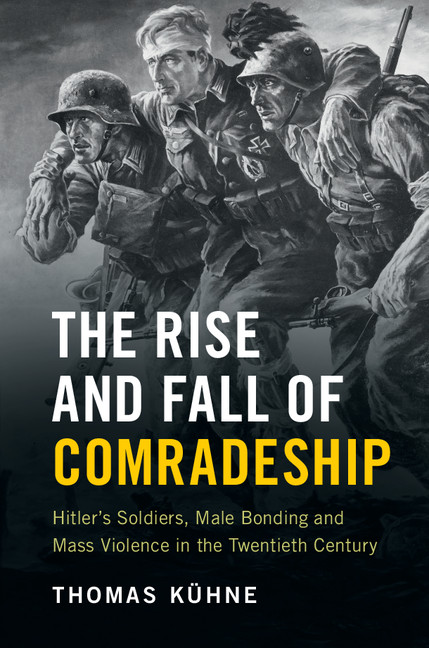
    This is an innovative account of how the concept of comradeship shaped the actions, emotions and ideas of ordinary German soldiers across the two world wars and during the Holocaust. Using individual soldiers' diaries, personal letters and memoirs, Kühne reveals the ways in which soldiers' longing for community, and the practice of male bonding and togetherness, sustained the Third Reich's pursuit of war and genocide. Comradeship fuelled the soldiers' fighting morale. It also propelled these soldiers forward into war crimes and acts of mass murders. Yet, by practising comradeship, the soldiers could maintain the myth that they were morally sacrosanct. Post-1945, the notion of kameradschaft as the epitome of humane and egalitarian solidarity allowed Hitler's soldiers to join the euphoria for peace and democracy in the Federal Republic, finally shaping popular memories of the war through the end of the twentieth century.

    Reviews

    'Probing into the Janus-faced quality of comradeship, Thomas Kühne illuminates the moral world of Nazi Germany on its own terms, a world in which most German soldiers acted as they did, not because they were forced to do so, but because they thought it was right. Obsessed with the ‘virtue’ of being held in high esteem by their ‘masculine’ comrades, they had scant concern for their victims. This book makes an essential contribution to understanding the capacity to commit terrible atrocities without remorse in Nazi Germany.'

    Christopher Browning - University of North Carolina

    'War is a powerful generator of solidarity. Thomas Kühne explores the rise and decline of the German version of this phenomenon, Kameradschaft. It was a myth that was lived in World War II and came to shape male identity into the late twentieth century. How, why and with what consequences this happened is the subject of this powerful exploration.'

    Michael Geyer - University of Chicago

    'An original, comprehensive, and incisive analysis of the concept, myth, reality, and ultimate disintegration of soldiers’ comradeship in modern Germany and its profound implications for the manner in which German men imagined war, perpetrated violence, and for long managed to avoid coming to terms with their complicity in the crimes of the Nazi regime. Set within the larger context of European and American ideas and practices of military cohesion, this is an important book that should be read by all students of modern and military history.'

    Omer Bartov - Brown University, Rhode Island

    Refine List

    Actions for selected content:

    Select all | Deselect all
    • View selected items
    • Export citations
    • Download PDF (zip)
    • Save to Kindle
    • Save to Dropbox
    • Save to Google Drive

    Save Search

    You can save your searches here and later view and run them again in "My saved searches".

    Please provide a title, maximum of 40 characters.
    ×

    Contents

    Metrics

    Altmetric attention score

    Full text views

    Total number of HTML views: 0
    Total number of PDF views: 0 *
    Loading metrics...

    Book summary page views

    Total views: 0 *
    Loading metrics...

    * Views captured on Cambridge Core between #date#. This data will be updated every 24 hours.

    Usage data cannot currently be displayed.

    Accessibility standard: Unknown

    Why this information is here

    This section outlines the accessibility features of this content - including support for screen readers, full keyboard navigation and high-contrast display options. This may not be relevant for you.

    Accessibility Information

    Accessibility compliance for the HTML of this book is currently unknown and may be updated in the future.
