

3 The ‘Van Gend en Loos moment’
The transformation of Europe has its particular ‘moment’, one in which a constitutional integration programme coalesced and brought into a coherent whole the so far dispersed constitutional doctrines of Europe's nature and future. This foundational moment is quite easy to identify. Suffice it to read the established narrative of European law that dates its creation back to one particular case, Van Gend en Loos (6 February 1963) whose fiftieth anniversary was celebrated in 2013.1 However, just like the Marbury v. Madison case in the United States, Europe's foundational case is primarily remembered for what it is purported to have inaugurated, rather than for what it actually was.2 It stands as a unique moment of revelation of Europe's nature (a unified legal order where EC norms have direct effect and prevail over national norms) and future (an incremental process of Europeanization through case law). As with any foundational myth, the principles ‘uncovered’ in 1963–4 have been ‘vindicated and validated again and again’3 at each of the critical steps of the story of Europe, from the 1973 enlargement to the various projects of a Constitution for Europe from 1984 onwards, and from the Maastricht Treaty to the Lisbon Reform Treaty. The decision appears as the constitutional platform of Europe encapsulating all the successive developments of the EU polity to which they are purported to have paved the way, if not directly to have called for. The consequences of this judicial ‘discovery’ seem so far-reaching that it has become almost impossible to imagine ‘what EU law would have been without the decisions of 1963 and 1964’4 and, consequently, ‘what Europe would be without the European Court of Justice’.5 As a consequence of this dense set of interrelated narratives where Van Gend en Loos stands as the cornerstones, it is virtually impossible to reflect upon it without referring to its ‘logical’ outcomes, be they legal (the formation of a highly integrated legal order), economic (the intense development of intra-EC exchanges) or political (the succession of Treaties reinforcing European integration).6 Until very recently, this teleological reading has impeded one from engaging in a fine-grained historical analysis of its genesis. Contrary to the ex post vision of the Court's decision as a judicial fiat, it is not just a thunderstorm in a quiet sky but rather takes place in a very specific moment of European integration, that between 1962 and 1966, during which the legal interpretation of the Rome Treaties became a focal point for a variety of academic, political, economic and bureaucratic controversies. While it was becoming clearer and clearer that the prospects for further political integration were less and less plausible, the fate of EC institutions became even more dependent upon the recognition of a constitutional status to the EC Treaties as a whole. While they were not aiming directly at creating a new body of law, the institutional strategies of the European Commission, the European Parliament and the main proponents of the Common Market had a direct stake in securing that an extensive interpretation of the legal reach and scope of the Rome Treaties prevailed as it directly impinged upon their own competences and powers. In other words, the ‘Van Gend en Loos moment’, is not just important for the legal principles it contributed to establish: it relates more broadly to the various controversies around the parliamentarization of the European Parliament, the judicialization of the European Court of Justice, the ‘governmentalization’ of the European Commission and, last but not least, the emergence of the Common Market as a credible level of governance for national and international economic actors. This chapter shows how the ‘Van Gend en Loos moment’ has been the temporal locus for the transformation of the EC Treaties from a diverse and heterogeneous set of communities, institutions and policies into one common institutional terrain endowed with specific properties and qualities. In other words, it is through the law and, more specifically, through the shaping of a constitutional reading of European Treaties that Europe has built its relative autonomy and its political capacity.
Between predictions and hindsight: the making of a landmark decision
If one wishes to study this moment for what it is, and not for what it is supposed to have produced, there is no other way than suspending temporarily taken-for-granted exegesis of Van Gend en Loos. More often than not, the decision is indeed considered as a self-explanatory and self-evident decision taken by a compact and solitary Court bringing a full-fledged theory to the external world. Yet, just like any other legal text, Van Gend en Loos does not mean anything in itself, unless we consider the lengthy, continuous and multilayered process of interpretation that takes place on both sides of the ‘event’. In other words, jurisprudence is not just a natural and ahistorical outcome: it is rather the product of collective and concurrent attempts to define their true meaning and extent.7 This chapter therefore charts the whole ‘hermeneutic space’8 of this decision, that is, the various social arenas – national as well as European, legal but also bureaucratic, economic and political, etc. – in which its meaning, scope and implications have been commented before, during and after its occurrence. In particular, it shows how the decision has been inserted into a dense web of pre-dictions (structuring the expectations and strategies of the actors vis-à-vis the ECJ) and of retro-dictions (granting it with specific meaning and implications). Through this complex interpretative process, Van Gend en Loos has been prophesied, associated, contested, stylized and eventually polished and codified into one judicial theory of Europe, solidly grounded on a group of stable legal and political principles – the ‘Van Gend en Loos–Costa theory of EC law’.9
Mobilizing for judicial fiat
Far from being a thunderbolt in a calm judicial sky, Van Gend en Loos had been awaited for a couple of years within the then still-restricted circles of Euro-lawyers. As a matter of fact, the Court's interpretation of the juridical value and effect of the new European Treaties remained uncertain. As early as 1961, the Rome Treaties had started being implemented in national – including judicial – settings. This opened the way for a flow of judicial decisions dealing with the interpretation of the new Treaties.10 While evidence shows that the issue raised little interest within the national bureaucracies,11 two groups of actors felt particularly concerned: the Legal Service of the three Executives of the European Communities (hereinafter the ‘Legal Service’) and the pan-European association of lawyers' association, the Fédération internationale pour le droit européen (FIDE). Both groups were closely intertwined: the Legal Service had actually called for, subsidized and co-defined the agenda of FIDE's foundational congress of 1961. On that occasion, 300 legal professionals of all kinds (ECJ and national judges, clerks, professors, jurisconsults, corporate lawyers, etc.) coming from different political, administrative, academic, judicial and – to a lesser extent – economic segments of the EC polity had gathered in Brussels. After carefully scrutinizing the first decisions of national courts on the legal effects of EC Treaties,12 the Legal Service asked the FIDE Board to devote part of its next congress (October 1963) to that specific issue. One of its roundtables accordingly was devoted to ‘Le problème des provisions directement applicables (self-executing) des traités internationaux, et son application aux traités instituant les Communautés’.13
The initiative concurred with that of the Dutch section of FIDE. Possibly because there was already a tradition of international lawyering in the Dutch bar, possibly because the 1956 constitutional reform had rendered its legal system compatible with the direct effect of international treaties, the Dutch section of FIDE launched a working group tasked with identifying ‘which provisions of the Treaty establishing the EC are self-executing’ as early as November 1961. While other national sections of FIDE were more keen on drafting proposals for a European statute for companies, the Dutch section of FIDE was putting together legal practitioners from various backgrounds (legal advisers of public and private bodies, lawyers and law professors) to consider the juridical potentialities of the EEC Treaty article by article in terms of litigation.
These multifaceted doctrinal efforts were soon offered a chance to get tested in real judicial life. It must be said that the Rome Treaties famously provide a new ‘judicial gadget’,14 that of the preliminary ruling, which allowed for national courts, and in particular lower courts, to solicit directly the ECJ's opinion on matters of treaty interpretation thereby circumventing the traditional diplomatic channels. As a matter of fact, the Dutch FIDE's working group had barely started when the ECJ received its first preliminary ruling and gave a wide interpretation to the range of national jurisdictions allowed to refer cases to it under this procedure (Bosch, 6 April 1962). This new legal venue did not go unnoticed by the members of the working group; in fact, the recourse to this new procedure soon became a distinctively Dutch phenomenon, spearheaded by FIDE members.15 Amongst them was L. F. D. Ter Kuile, an international lawyer of the Rotterdam bar since 1955 and legal adviser to an important international bank (the Bank voor Handel en Scheepvaart, the Bank of Commerce and Navigation). Ter Kuile managed to engage in two test-cases on the legal effect (direct or indirect) of article 12 of the EEC Treaty. On 21 May 1962, together with another well-established international lawyer and former head of Amsterdam's bar, Hans Stibbe,16 he defended two firms before the Dutch tax court (Tariefcommissie) – the transport company Algemenende Van Gend en Loos and the electro-technical equipment company Da Costa en Schaake NV. He obtained a preliminary ruling before the ECJ in August 1962.
Michel Gaudet, the head of the Legal Service of the Commission, immediately seized the opportunity opened by his fellow members of FIDE. The brief he submitted in the case was arguably the most far-reaching and ambitious account of the relationship between Law and Europe at the time. A very influential figure in the early years of the EEC, as we saw in Chapter 1, Michel Gaudet was able to have the Collège des commissaires fully endorse his daring legal theory of European integration in its 204th meeting on 31 October 1962 on the matter.17 Described as a ‘vast’ and ‘very impressive analysis of the structure of the EC’ by ECJ advocate general in the case, Karl Roemer, the twenty-one-page memo presented by Michel Gaudet before the Court on 29 November 1962 proposed in fact a unique legal doctrine for the three European Treaties, only mentioning the specific facts of the Van Gend en Loos case at the very end. Trying to make the case for the irreducible specificity of the ‘legal structures established by these Treaties’ with regard to international law, he indicated very explicitly that EC law ‘ha[d] to be’ of direct effect and ‘ha[d] to prevail over contrary national law, and even over subsequent rules’.18
The fact that many actors of the Court itself caught this multifaceted call for a ‘judicial fiat’ coming from both the FIDE lawyers and the Commission's Legal Service is confirmed by the comment of Roger-Michel Chevallier, Robert Lecourt's young référendaire and active FIDE member, made a few days before the actual decision: ‘When you know that a preliminary reference has recently been made to the Court (the case is under deliberation) concerning a possible direct “applicability” of article 12 … you understand the huge interest … not only for the Member States but for any individual if the Court is to give a positive answer to this question’.19 A landmark judgment was predicted; and expectations were great.
A polysemous decision
However, when the Van Gend en Loos decision was eventually delivered, it disappointed many of these expectations of a legal clarification of the EC Treaties' scope. Evidence now shows that the case actually gave way to an open conflict of interpretation within the Court itself between the more classical thesis heralded by the advocate general Otto Riese and the juge-rapporteur Charles-Léon Hammes on the one hand and the more ambitious position of Alberto Trabucchi on the other.20 Testimonies indicate that the majority that eventually ruled on direct effect was very narrow (four to three).21 As a result, the final decision lay somewhere between Gaudet's grand design and the more circumspect analysis of the German advocate general Karl Roemer. Of course, the Court clearly rejected the allegations of the three Member States (Belgium, the Netherlands and Germany) who had presented memos rejecting on principle any direct applicability of the Treaties.22 Nonetheless, the judgment only recognized direct effect on the restrictive ground that article 12 entailed a ‘negative’ obligation for Member States (namely, an obligation not to act). In other words, large parts of the Treaties according to which States had ‘positive’ obligations were potentially excluded from the scope of ‘direct application’ as defined in Van Gend en Loos. Furthermore, the decision did not consecrate the intrinsic specificity of the European legal order, merely described as a ‘new legal order in international law’.23 If read together with the former Confédération nationale des producteurs de fruits et légumes v. Council of the EEC, the decision that had just restricted individual legal standing before the ECJ (December 1962), the judgment could well have been taken to be yet another version of the well-established rules laid out in 1928 by the Permanent Court of International Justice in its Opinion on the access of [certain] individuals to the Danzig courts.24 Last and not least, Van Gend en Loos did not express any opinion on the question of the supremacy of EC law over national laws – contrary to what the Legal Service of the Commission had hoped for.
Thereby, in itself, Van Gend en Loos cannot be said to have called for what nowadays is said to be its ‘logical’ consequence: the affirmation of the principle of supremacy of European law as a whole. Quite to the contrary, and because of its thorough nature and its argumentative richness that have been pointed out by many authors, the judgment actually left open a wide margin of interpretation. The very wavering of the decision's terminology is quite telling in this regard: while the English-language version referred to the ‘direct effects’, the French version used the words ‘effets immédiats’,25 while the unofficial translation made by the Common Market Law Reports mentioned the ‘direct effect’ (with no plural).26 To these not irrelevant variations, one may add the wide range of expressions that legal scholars used in their commentaries (‘self-executing articles’, ‘direct applicability’, ‘direct insertion’, etc.). This ambiguity of the decision as well as the fluidity in the lexicon not only indicate that no legal commonsense had yet imposed itself erga omnes, it also confirms that a range of possible legal futures were still open for Europe. Only this sense of uncertainty that prevailed among Euro-lawyers can actually explain how an acute and alert lawyer such as Pierre Pescatore could neglect to even quote the case in a long paper on ECJ case law presented at a conference held in April 1963. Commenting on his text forty-five years after, he acknowledged that ‘it is quite obvious that I had not at the time grasped the fundamental importance of this decision’.27
Judicial ventriloquism: Van Gend en Loos and its legal entrepreneurs
These uncertainties may actually be the reason why Van Gend en Loos was immediately taken up in an interpretative tide sparked by some of those who had been directly implicated in the case: within two months, a number of members or former members of the Court, joined by their référendaires, the Commission's Legal Service as well as the lawyer in the case, Ter Kuile. Their activism profoundly transformed the case. Their efforts converged in drawing the attention of a variety of audiences and publics (lawyers, academics, public opinion, etc.) on the historical importance of the decision for European integration, a matter of weeks after the judgment was delivered.
The transnational fabric of a landmark case
The interpretative tide started the very day after the decision had been delivered. On 6 February 1963, at a ceremony held at the Court for his departure, Otto Riese (ECJ judge) indicated that, ‘in these days, the Court has delivered an important decision’.28 On 21 February 1963, Michel Gaudet, head of the Commission's Legal Service, notified the Conférence du libre barreau de Liège that ‘a decision of the Court of the highest interest’ had just been taken.29 Two days later, Maurice Lagrange, ECJ advocate general, speaking before the French section of FIDE, ‘called immediately [their] attention to a recent Court decision, 26/62 of 5 February 1963 … of the highest importance’.30 The very same day, in a column in the most authoritative French newspaper, Le Monde, Robert Lecourt stressed that, ‘in the core of the Brussels crisis, the judicial world has just brought an important stone to the building of the European entity’.31 A month later, on 6 April 1963, ECJ judge Alberto Trabucchi, in a lecture at the University of Ferrara, evoked a ‘decision [that] will have a great echo’.32 In issues published just after Van Gend en Loos, various legal journals included comments on the case. Nicola Catalano, a former ECJ judge, referred to ‘a rightful, well-founded and cautious decision’ in one of the major Italian legal journals, Foro padano.33 He was followed by judge Trabucchi's référendaire, Paolo Gori, who considered the decision as ‘one of the most important contributions [which] will be remembered as a landmark in the affirmation of EC law’.34 In the first issue of the Dutch–British EC law journal, the Common Market Law Review, the president of the Court, Andreas Donner, referred to the decision as one of ‘cardinal importance for the entire operation of the EEC Treaty’.35 Two months later, in October 1963, the lawyer who had brought the Van Gend en Loos case before the Court, L. F. D. Ter Kuile, commented on the decision's extreme relevance in a report to the 1963 FIDE congress on direct effect.36
Even though there are no signs of a premeditated collective strategy, four judges and one advocate general, together with their référendaires, former judge Nicola Catalano, as well as the director of the Commission's Legal Service Michel Gaudet and the lawyer in the case L. F. D. Ter Kuile swiftly converged in giving Van Gend en Loos legal and political salience. Through this process of drawing the attention of various audiences to the case, there came into being a sort of judicial ventriloquism (‘the Court said that …’) through which the judgment was put into common parlance in legal circles, by which the actors in the case managed to turn the ambiguous Van Gend en Loos judgment into a clear-cut and far-reaching judicial fiat. On the whole, it all occurred as if a kind of second judicial deliberation had been initiated – one that would fabricate the overall reach of Van Gend en Loos by extending in manifold ways the sense and the validity of its message well above and beyond the relatively prudent and balanced considerations of the decision itself.
Various elements were crucial in such a pre-empting of the Van Gend en Loos hermeneutic space. The first relates to the very position of these Euro-lawyers. As each of them had taken part in the case (as judge, law clerk or litigant in the case of Michel Gaudet and Ter Kuile), they could claim direct access to the ‘authentic’ sense of the decision. As (almost37) no dissenting opinion was expressed publicly in the following weeks,38 their authority with regard to asserting what Van Gend en Loos ‘really’ meant remained virtually unchallenged. Protected by the secrecy of the judicial deliberations, they were in a privileged position when it came to persuasively stating what ‘the decision recognized implicitly’.39 A second element is the sort of activism by proxy, in which judges could engage with the help and participation of their référendaires. The latter were indeed in a very favourable position since not only had they been associated (albeit indirectly) with the judicial deliberations, but they had also more statutory freedom to openly speak about the case. This is particularly important as they played a crucial role at the time in the legal commentary of ECJ case law,40 thereby assuming a position both in the drafting and in the commenting of the Court's decisions. The third element of explanation lies in the position these Euro-lawyers had in the nascent transnational academic circles of EC law. Most of them were key members of that emerging community of scholars, if only because of the critical role both the Court and the Legal Service had played in framing (and subsidizing) the nascent milieu through FIDE. It is quite natural then that référendaires and judges engaged in a sort of academic tour, spreading the Van Gend en Loos word. Two months after the decision, in late April 1963, no fewer than thirteen members of the Court (five judges out of nine, and eight référendaires out of nine) took part in the important conference held at the Institut fur das Recht der Europäische Gemeinschaften in Cologne on ‘Ten Years of ECJ Jurisprudence’. And, at the second FIDE congress in October 1963, three judges and five référendaires participated, together with Michel Gaudet and L. F. D. Ter Kuile,41 all of them actively promoting the relevance of the Van Gend en Loos case for interpreting the whole architecture of the Treaties. Last but not least, judges could rely on the variegated sets of national social networks in which they participated. Quite characteristically, these activists of the pan-European legal cause primarily took action in their own national political, legal and academic circles. It comes as no surprise that former minister and member of parliament Robert Lecourt published an enthusiastic Op-Ed in Le Monde, and did the same several times during his years in Luxembourg. Similarly, judges Antonio Trabucchi and Andreas Donner, who were both academics, commented the Van Gend en Loos judgment in various law journals and conferences in their respective countries. The diversity in the channels of mobilization mirrors the various sorts of social capital that the first ECJ judges could rely on.42 The range of national but also transnational resources they could collectively count on allowed for a quick enlargement of the social fora implicated in the debate over the relationship between Europe and law.
Manufacturing content: Van Gend en Loos and its ‘implications’
Through this interpretative activism, Van Gend en Loos was soon divested of its litigation identity and turned into a constitutive principle of an overall doctrine. It ceased to be the mere resolution of a dispute between the transport company NV Algemene-Van Gend en Loos and the Dutch tax authorities, or just an interpretation of article 12 of the EEC Treaty on customs duties. Rather, it came to represent a trail-blazing judgment founding EC law's social and political functions with European integration. Two elements were particularly crucial in such a multi-faceted exegesis.
First of all, Van Gend en Loos became considered as the cornerstone of an altogether new body of law. Because it related to the judicial capacity for ‘individuals’, Euro-lawyers viewed the decision as paving the way for ‘un nuovo diritto’ (in the words of judge Trabucchi). The decision was read as ‘the first arch of a bridge meant to entirely overcome the barrier between the sovereignties of the different Member States’.43 For this transnational group of exegetes, this was just the first step. As they commented on the ground-breaking importance of the decision, they simultaneously set the Court's future challenges, namely, the ‘supremacy of EC law’. As indicated by former judge Catalano, ‘a decision of the ECJ [in this matter] could well be necessary’44 to solve the next obstacle – ‘the serious problem concerning the coexistence of national and EC law’.45 Their analysis was at one and the same time descriptive (what Van Gend en Loos was or said), prescriptive (what European case law should be now) and performative (making Costa happen before it actually did). While Trabucchi's référendaire stated that ‘the rule will be that of general prevalence of EC law and jurisdiction over the law and jurisdiction’ of the Member States,46 the president of the Court himself boldly explained that the issue was almost solved already since the Court ‘would presumably have ruled that the EEC Treaty has precedence [supremacy] over national law’47 in Van Gend en Loos had it been questioned on the matter. Caught up in this net of descriptions, predictions, and anticipations, Van Gend en Loos thus became not only a foretaste of EC law's future but also a far-reaching manifesto calling for a number of further steps.
A second cognitive salience made its way through this thick pile of interpretative strata: the political relevance of the decision in the context of the crisis in the EC institutions. While there is no direct evidence that this heated political context – the French government had adjourned the British membership negotiations only a couple of days earlier on 28 January 1963 – had influenced the Court in its decision, it clearly weighed on its interpretation. Actually, the day immediately after the Van Gend en Loos decision was delivered, first references were made to the intergovernmental crisis in the presidential address welcoming a newly elected ECJ judge: ‘[S]ince the political impetus [for European integration] will possibly slacken for some time to come, it is incumbent upon the organs [of the Communities] to be all the more conscious of their role as the institutionalized carriers of the European idea’.48 Such transgressions of the separation of political and judicial branches would then repeatedly occur, to the obvious advantage of the judicial realm: ‘[W]hile the statesmen discuss the political future of Europe, without sparing the weight of their authority and the passion of their convictions, the lawyers of our six countries dedicate themselves to the birth of a European law which is discreet, yet full of promises’49 – said Michel Gaudet, the director of the Commission's Legal Service, a couple of weeks after Van Gend en Loos. ECJ judge and former political leader Robert Lecourt went even further when indicating that the ECJ's case law was one of the possible fuels for a lasting European integration: ‘[I]n times where the establishment of a political construction is at a standstill, the field is clear to accomplish other, certainly more modest, progresses but … which might be determinant … The practical Europe, which evolves under the influence of mere facts, could soon make political Europe inevitable’.50 On the whole, therefore, Van Gend en Loos was given very extensive legal and political potentialities that made it a salient point in the nascent EC polity.
Debating the ‘logic’ of the European Treaties
Had it not been heralded within the various social fields that made up the European Communities at the time, the emerging legal doctrine of Europe drawn from Van Gend en Loos exegeses would have stayed in the realm of abstraction. In a context where the perspectives for political integration appeared less and less plausible, the salience of this emerging doctrine of Van Gend en Loos gave a variety of (political, bureaucratic, corporate, etc.) entrepreneurs of Europe an opportunity to ground their pan-European ambitions in new legal terms. In this progressive rallying of differently situated actors, a new common sense of the European Communities was consolidated as each of these mobilizations enriched this nascent paradigm with new dimensions and scopes at the core of the EC polity.
Dramatizing the stakes
While extensive interpretations of the Van Gend en Loos scope and consequences were emerging and consolidating, a dramatic turn of events suddenly put in question the very possibility of such daring pan-European jurisprudence. In a decision of 7 March 1964, the Italian Constitutional Court explicitly denied the supremacy of EC law over posterior national legislation, thereby putting in doubt the then emerging Van Gend en Loos doctrine. Interestingly, the case had emerged from the very hopes and expectations that Van Gend en Loos had triggered within specific Euro-lawyers. The very vagueness of the decision left open a variety of possible future paths. Brussels' first business lawyers saw Van Gend en Loos as a form of ex post confirmation of their correctness in choosing the EC institutions as a new centre for economic regulation; as early as May 1963, a former chairman of the international section of the American Bar Association who had set up his legal office in Brussels two years earlier, Homer Angelo, welcomed Van Gend en Loos: ‘on February 5, 1963, the Court of Justice handed down an interlocutory ruling which may prove for the European communities to be a landmark equivalent to Marbury v. Madison or McCulloch v. Maryland in American constitutional history’.51 The paragraph in Van Gend en Loos on the contribution of ‘individuals’ to the implementation of the Treaties52 had been read by others as setting the stage for legal actions against all sorts of violations of the spirit or letter of the Treaties by the Member States or the Commission (including the more political aspects concerning the functioning of the EC institutions and their internal politics). Both lawyers who had initiated the Costa v. ENEL case that led to the decision of the Constitutional Court were part of the first rank of national lawyers who read Van Gend en Loos as a new starting point.
European cause-lawyers and the Costa v. ENEL case
Far from being a rather irrational dispute over a contested 1,925 Italian lire bill issued by the Italian electricity company, ENEL, led by a litigious, if not foolish, individual, Flaminio Costa (as many of the accounts seem to indicate nowadays), the Costa v. ENEL case originated in a consistently activist conception of a European rule of law. Giangaleazzo Stendardi, a forty-three-year-old constitutional law professor, and Flaminio Costa, a sixty-two-year-old criminal lawyer53 were both committed liberals (in the European sense of criticism of State intrusion in the area of both individual freedoms and economic markets). On previous occasions, they had argued that individual standing before the two European courts was a critical element for bringing about a Stato di diritto in Italy. Costa was among those calling for his government to accept ‘with no more delays the individual petition right before the European Court of Human Rights’.54 Stendardi had theorized the role of individual legal activism before courts as a quasi-substitute for political accountability, particularly at the European level. In various writings before and after the Costa case, he indicated that ‘it is not necessary to have a Parliament directly elected by the people for the citizen to be protected; it only requires the existence of a procedure capable of protecting the individual vis-à-vis the [European] organization’.55 The test-case was a familiar strategy to him. An early analyst of the Italian Constitutional Court (he published one of the very first books on the newly founded Court), he had immediately seized (however unsuccessfully) the opportunity opened by its creation in 1956 to defend freedom of speech through a preliminary ruling, thus resulting in the court's third decision (23 June 1956). Similarly, when claiming as early as 1958 that ignorance of EC law supremacy was ‘a substantial violation of the Treaties’, he prophetically stated that ‘it will be necessary to plead judicially such an issue, in order to provoke a decision, for example of the European Court of Justice’.56
This strong belief in Law as the paramount tool for citizens (more important even than the vote)57 was then naturally mobilized in this context against the December 1962 Italian nationalization law. As a matter of fact, Stendardi, who had been adjunct professor at the private Milanese business school, La Bocconi, in the 1950s and was at the time an active member of the Italian liberal party in Milan,58 was highly critical of the ongoing process of nationalization of a number of private companies in Italy. In an article published in late 1962, Stendardi argued that nationalization was both unconstitutional and contrary to the EC Treaties and that the most likely ‘legal consequences of these violations [would be] a preliminary ruling before the European Court of Justice’.59 It was therefore as a natural continuation of both their professional litigation know-how and their political commitments that the two of them tried a test case (Costa was both the plaintiff and his own lawyer in this case) asking a Milanese lower court for a preliminary ruling before the ECJ (and the Constitutional Court) on the legality of ENEL's nationalization. In a nutshell, the two cause lawyers argued two issues: first, the prevalence of EC law over the posterior Italian nationalization bill; second, the fact that individuals could solicit the Court on the grounds that the obligation of consulting the European Commission before engaging in the nationalization process (articles 93 and 102 of the EEC Treaty), an obligation breached by the Italian government, was not just ‘politically’ but also ‘legally’ binding and justiciable. Hence, they tested an extensive interpretation of the scope of direct effect that would have enabled individuals to ask for the legal implementation of the most ‘political’ part of the Treaties (the inter-institutional dynamics).
In this context, where Van Gend en Loos had given rise to high expectations and many prophecies regarding the future of EC law, the decision of the Italian Constitutional Court in Costa v. ENEL came as a blow. All the more so as other supreme courts had at the same time delivered judgments which refused to acknowledge the specific nature of the Rome Treaties vis-à-vis other international treaties. In France, three judicial decisions from the Cour de cassation (19 February and 22 October 1964) and the Conseil d'État (19 June 1964) defined the EC Treaties as ordinary international public law instruments. The annual meeting of the German law professors' association, where the proponents of a ‘constitutional reading’ of European Treaties turned out to be a minority,60 confirmed that the emerging legal doctrine was hardly capable of convincing national judicial and academic elites. The case had not come to a close, however. Both Milanese lawyers had lodged simultaneously a preliminary ruling before the ECJ and therefore the perspective of a new decision of the same case before the summer triggered an unprecedented transnational legal mobilization. A memo presented by the Legal Service of the Commission in the Costa v. ENEL case indicated its ‘vivid apprehensions’ after the Italian and German adverse judicial decisions.61 The Opinion presented a couple of days later, on 24 June 1964, by ECJ advocate general Maurice Lagrange – the very last Opinion of his more than twelve years at the Court – pointed at the ‘disastrous – the word is not too strong – consequences of such a jurisprudence [would have] on the functioning of the institutional system established by the treaty and therefore, on the very future of the Common Market’.62 Last but not least, only three days before the decision of the Court, the German section of FIDE met in Bensheim for a small seminar with ECJ judges and référendaires to talk about the options open to the Court in matters of supremacy of EC law, Hans-Peter Ipsen, at the time one of the leading German academic authorities in the field, presented possible pathways for the relationship between EC law and domestic laws.63
Politicizing the issue of the legal logic of the European Treaties
This dramatization of the stakes of ECJ decision could not leave the many EC law-implicated political and bureaucratic entrepreneurs unconcerned, all the more so that pan-European leaders were simultaneously facing a closing down of the perspectives of European political integration. The many disagreements and crises that developed between Member States ever since 1962 prevented the rapid development of EC supranational institutions in which federalist political entrepreneurs had put many of their hopes. The failure of the various initiatives to revive European integration (for example, the Fouchet plan of 1961–2 and, most of all, the Hallstein proposals of March 1965), as well as the rejection of the British application for membership (January 1963) illustrated the hardening of the Member States' diplomatic positions and marked a sudden inflexion in the rise of the Commission within the EC institutional system.64 Similarly, the central cause of the European Parliament, namely, the institution of direct election, was quickly put aside. The Parliamentary Assembly criticized such evolution in a resolution to the Council on 27 June 1963, without, however, any effect. In the meantime, the agreement on the merging of the European Communities (February 1964) was carried out à institutions constantes.65 This progressive closure of the political horizon of European integration, which would progressively become more and more clear, came over the months leading up to the 1965 ‘empty chair’ crisis, and came along with a serious crisis of the pan-European movement itself. While, in the immediate aftermath of the Second World War, the European Movement had been the crossroads for all European (political, economic and academic) undertakings, it was now weakened by a series of internal conflicts regarding the best ways to achieve unity of the polity. Ever since the failure of the European Defence Community in August 1954, at least two different streams emerged, one led by Altiero Spinelli which heavily criticized the Rome Treaties and pushed for the establishment of a Constituant Assembly of the European people, and the other promoted by leaders such as Paul-Henri Spaak who defended a more pragmatic point of view on the political potential of the Common Market.66 As a consequence of these divisions, the pan-European nebula lost much of the political momentum that had marked its early congresses in the immediate post-Second World War period.
This progressive dismantling of both the transnational pan-European milieu and the concrete institutional opportunities for further political integration would not be of direct interest for our present research if many of the pan-European political leaders had not also been jurists often maintaining close relationships with legal academia. Fernand Dehousse, Arved Deringer, Walter Hallstein, Carl Friedrich Ophüls, Jean Rey, Marinus van der Goes van Naters, Ivo Samkalden, Paul-Henri Spaak and Pierre-Henri Teitgen whom we have met earlier in this book as they were engaged in institution-building at the Council, the Commission, the Court or the European Parliament, were at the same time law professors, judges or corporate lawyers related to the legal realm through a number of professional associations, teaching positions, learned societies and law journals. This blurriness of the borders between law and politics in early EC settings is essential to understand how these ‘politicians of the law’ were able to redirect their own pan-European investments towards the promotion of a new project of Europeanization where the ECJ would play a central political role. In a context where the blockage of the political pathway was becoming more and more flagrant, the judicial terrain appeared like a new land of opportunities.
Thus, the signal coming from Italy in February and the perspective of a decision by the ECJ in July did not remain unnoticed. Walter Hallstein was first among our lawyers to engage publicly with the debate in a speech before the European Parliament in June 1964. That he was critical in converting the judicial issue of supremacy of EC law into a political stake of European integration as a whole is probably not surprising. As indicated in Chapter 1, Hallstein had retained strong links with German legal academia. Evidence shows that he was closely following the ongoing heated debates over EC law principles.67 In a context where the political development of EC institutions was experiencing its first blockages, the decision of the Italian Constitutional Court indicated that the fate of European integration was also at stake on the judicial scene. Taking advantage of the debate before the European Parliament over the EEC Commission's annual report on 18 June 1964 (that is to say one month before the Costa decision by the ECJ), Walter Hallstein presented no less than his own legal doctrine of Europe. His ‘theses’ were all grounded on the fact that ‘the regulation of EC law prevails, regardless of the level of the two orders where the conflict appears’, thus including prevalence of all EC regulation over national constitutions.68
In this context, it comes as no surprise that the Costa v. ENEL decision delivered by the ECJ was immediately seen as a landmark raising interest and concern beyond the restricted circles of EC law specialists. Even if it is still impossible to speculate on the internal balance within the Court itself,69 its decision taken on 15 July 1964 resolutely sided with pan-European advocates. Admittedly, Costa was assertive and defended most of the arguments that had been expressed by the Commission in its Van Gend en Loos brief. Not only did it set out the prevalence of EC law, but this time it did so in a particularly clear, almost provocative manner, with EC law being defined as an ‘integral part of the legal systems of the Member States’ enshrining a ‘permanent limitation [by the latter] of their sovereign rights’.70 Since the post-Van Gend en Loos prophecies had determined anticipations and strategies vis-à-vis the Court, the recognition of the principle of supremacy confirmed that Costa was read as ‘undoubtedly a continuation and development of the [Van Gend en Loos dccision]’.71 One decision being seen as the mere endorsement of the other's ‘logical consequences’, the commentators of the Costa case, fulfilling the predictions they themselves had made in the wake of Van Gend en Loos, the two cases became firmly linked together into one unique and coherent doctrine.
However, given the still fragile authority of the ECJ, it is not surprising that its decision in Costa was far from being the last word on the now widely debated issue of the legal nature of the Rome Treaties. At the European Parliament, a number of politicians of the law started drawing attention to the political relevance of the subject-matter. The first of them was Marinus van der Goes van Naters, a Belgian Socialist member of parliament, lawyer and former vice-president of the Consultative Assembly of the Council of Europe between 1949 and 1959. On 11 August 1964, he expressed his deep concerns about the Italian Constitutional Court's Costa decision in a question addressed to the Commission. The question initiated an exchange between the Parliament and the Commission that ended with Fernand Dehousse writing a report on the matter in the name of the Legal Committee of the Parliament he was presiding over at the time. Dehousse's report on the ‘supremacy of EC law’ (15 March 1965) was largely based on Van Gend en Loos and Costa v. ENEL of which he quoted and paraphrased many extracts. Prepared in close collaboration with the Legal Service of the Commission,72 the report was meant to be ‘a cry of alarm’. Forging close links between the highly doctrinal questions (for example, dualist v. monist reading of the relationship between national and international law) and the very survival of European integration, it foresaw that ‘legal chaos’73 would ensue if the dualist perspective heralded by the Italian Constitutional Court prevailed.
A couple of weeks later, on 8–10 April 1965, the locus of mobilization moved to an academic setting. The conference on the relationship between EC law and national law organized by the College of Europe in Bruges in April 1965 brought together a very diverse set of people. Among the two hundred participants, one can find a member of the European Commission (Jean Rey), two directors of the Legal Service (Michel Gaudet and Theodor Vogelaar), four members or former members of the ECJ (Nicola Catalano, Maurice Lagrange, Riccardo Monaco and Joseph Gand), a number of jurisconsults of national diplomacies (Ulrich Everling and Pierre Pescatore), young professor-lawyers (Walter van Gerven and Michel Waelbroeck), etc. To put it in the terms of a participant, there was a diverse ‘group of EC law specialists, some being actual “Founding fathers” of the EC, others being former or current members of the Court of Justice, high civil servants of the EC or university professors … [embodying] the wheeling flank of the army of European jurists’.74 However, beyond the diversity of the professional positions of the participants, one could see a striking convergence that another observer, the young Jean-Victor Louis, described in the following terms: ‘[W]hereas the Court of Justice's decision of 5 February 1963 in the case Van Gend & Loos has been at the heart of the debates in The Hague in October 1963, this time the decision of 15 July 1964 in the case Costa v. ENEL, where the Court clearly affirmed the primacy of EC law in a well-founded manner, served as a background to the debates [in Bruges]. Nobody in The Hague challenged the liberal orientation of the decision Van Gend & Loos, everybody in Bruges recognized the necessary primacy of EC law’.75
Two months later, the debate was brought to the European Parliament through the discussion over the Dehousse report. In the meantime, however, the political context had changed dramatically. The disagreements over the reform of EC institutions had now turned into an overt intergovernmental crisis that would lead to the begining of the ‘empty chair’ period starting with the 28–30 June 1965 Council of Ministers. In this context, the fact that the parliamentary discussion displayed a large consensus between MEPs and the presidents of the three Executives, all of them ‘fully agreeing with the 15 July 1964 ECJ decision’76 and stressing the importance of judicial integration, is of importance. Walter Hallstein had made things even clearer in a booklet published in 1964 by the Office for Official Publications of the European Communities as a follow-up to his June speech to the European Parliament on this subject. The president of the EEC Commission defined Europe as a ‘European Community of law’77 – an expression he had already used in 1962 but in rather vague terms.78 By that, he meant to describe (on the basis of the two judicial decisions) the quasi-constitutional structure of the European Communities in which individuals and EC institutions have a direct relationship through law and beyond State control. Quite strikingly, in packaging altogether the direct effect (‘the individual is a legal subject … [who] as a citizen and a subject of the EC is subjected to legal orders in the same way as in the constitutional system of states of federal nature’) and the supremacy (if there were no supremacy, the very ‘functioning of the EC would be put into question’), he connected them to article 177 as ‘the preliminary rulings of the Court of Justice guarantees a uniform interpretation of EC law which is faithful to the finality of the Treaty’.79 Quoting Van Gend en Loos and Costa v. ENEL no less than six times (he actually only referred to these two decisions), literally paraphrasing some of their formulae in several occasions,80 he turned this ‘direct effect/supremacy’ into the very bedrock of the European Communities. What emerges here is a sort of ‘magic triangle’ connecting direct effect, supremacy and preliminary ruling: taken individually, any of these notions is merely a legal principle or procedure utterly incapable of founding a political order on its own. Taken together, their effects now appear to bring into being a dynamic of circular reinforcement: no effective European Treaties without the supremacy of EC law over the law of Member States; no direct effect without preliminary ruling ensuring the uniform implementation of EC law throughout the Community; and, to the loop, no preliminary references to the ECJ without the recognition of the possibility for individuals to claim justiciability in EC law through the direct effect/supremacy doctrine. It seems now that the whole Community would fall apart, were one of these pillars to be compromised or put in question. Structured as a unique legal matrix, this ‘magic triangle’ provides a unique cognitive framework for all European Treaties regardless of their different institutional and political setups, elevating law as the unifying glue of Europe.
In turn, probably comforted by the strong endorsement it had received on a variety of academic and political fronts, the ECJ itself became more and more assertive in promoting and diffusing the emerging ‘Van Gend en Loos doctrine’. Among these far-reaching and bold affirmations of the former is the report of ECJ president Andreas Donner in the Poudres de lait decision on 13 November 1964 that Pierre Pescatore considers to have ‘sealed the finally established unanimity’81 among ECJ judges, less than three years after the Court had split four against three on Van Gend en Loos.82 The accession of Robert Lecourt, one of the strongest advocates of an extensive reading of Van Gend en Loos, appointed to the Court's presidency in 1967 further consolidated the ‘holistic’ reading of the European Treaties, Communities, institutions and policies as constitutive of one coherent, unified, and hierarchized legal order.
Europe's integration programme
It is probably not necessary to push further this fine-grained analysis of the debates over the legal interpretation of the EC Treaties. Within three years, and in a context of great political turmoil in Brussels, a genuine corpus of legal–political doctrine had emerged and become consolidated that was now considered as the very foundation of the European Communities themselves. As the Brussels' crisis affected many of the initial political hopes that had been put in the EC, this doctrine offered an opportunity for jurists of various sorts (politicians of the law, legal advisers to EC institutions, business lawyers, ECJ judges, law professors, etc.) to reformulate their variegated pan-European ambitions into one integration programme, thereby defining a common institutional terrain for EC institutions.
A new common sense
What is most striking in this progressive coalescence of Europe's integration programme is indeed how convergent it has been across fields and institutions. This is not to say there were no dissenting opinions in Europe. It is well known that, at the national level, many Courts, academics, politicians and other groups did not support a ‘Van Gend en Loos doctrine’.83 However, at the EC level, a consensus quickly emerged. From Lecourt to Hallstein and Gaudet to Dehousse, from legal academia to political institutions, from the Court to the Commission or the Parliament, the frames of understanding EC Treaties aligned swiftly. Such a redefinition of Europe as a ‘Community of law’ was so consensual that there was confusion as to which institution was to be recognized as the actual ‘author’ of such a doctrine. Those who had a more predominantly political role, such as the European commissioner Emmanuel Sassen, started referring to ‘the Court's support [in the Costa decision of July 1964] to the Commission's position [expressed in June 1964 by Hallstein before the European Parliament]’. Others, mostly legal academics, would rather draw attention to the creative role of the Court's jurisprudence and the successive rallying of political institutions to it. The similarity of the arguments of the three European institutions was actually striking enough for the president of the EEC Commission to feel the need to underline that ‘there is no conspiracy, but common agreement of freely convinced institutions which are conscious of their responsibility in European affairs’.84 Equally, commissioner Sassen had to emphasize that ‘this concordance is absolutely no conspiracy whatever’.85
The synchronization of timelines around the judicial saga of Costa and the alignment of the EC institutions' agenda hints again at the position of the transnational field of European law as an interstitial field standing at the crossroads of Europe's many integration paths. Key figures of the EC polity such as Fernand Dehousse (head of the Parliament's Legal Committee and EC law professor), Robert Lecourt (president of the ECJ and a member of the Nouvelles equipes internationales, the Christian-democrats' European association), Walter Hallstein (head of the Commission and former international law professor) or Michel Gaudet (conseiller d'État and director of the Commission's legal service) were all multi-positioned actors moving across the various social universes that made up Europe at the time. Their multifaceted activities in the various legal, academic, political or administrative sites of the EC polity were integral in producing common cognitive and normative frameworks of European legal integration. As a matter of fact, in managing their personal ‘holdings’ of memberships and networks, they generated diffuse and almost unnoticed forms of coordination of their various points of view. While one would call for academics to take political imperatives into account, another would simultaneously call for political leaders to draw on the lessons of academic work. As they moved from one position to another, they acted as the ‘special functionaries coordinating the game’86 Norbert Elias referred to in his sociology of complex social settings. Progressively, this convergence of the timing and agendas of EC-implicated actors was authenticated and codified under various forms, such as the jurisprudence of the Court, FIDE proceedings, the Commission's policies or the Parliament's resolutions, etc. On the whole then, this doctrine had no specific author but can be said to have been designed concurrently and collectively through the interplay of reciprocal references and quotations in judicial decisions, hearings and memos as well as in academic conferences and parliamentary debates. Although there was no particular conductor, each of these actors contributed in its own way to further this new definition of Europe and the law.
The emerging theory of Europe took account of the fact that, in the context of intergovernmental rivalries in Brussels, ECJ case law was the most tangible and lasting form of European integration, for it departed from the shaky foundations provided by inter-State agreements. Notably, because it relied on a legal procedure (preliminary rulings) that depended neither on the goodwill of the Member States, nor on that of the Commission, the ECJ appeared to be available to all Euro-concerned interests (be they expressed by individuals, interest groups, companies, etc.). Everyone could take part in the construction of European law through recourse to the ECJ. The fact that the ‘empty chair’ crisis had not altered the dynamics of intra-European exchanges, which continued to expand swiftly, was considered as a confirmation that the really relevant avenue for integration needed to be a-political.87 Rapporteur of the Costa case within the ECJ, the judge and former prominent French political leader Robert Lecourt, who would be president of the Court from 1967 to 1976, was one of the most committed choirmasters of this renewed understanding of the Court's social and political functions in the integration process. Although there are no accounts of his encounters with the functionalist literature,88 his 1964 conference before the French section of FIDE, entitled ‘The Role of Law in Unifying Europe’, is arguably the first systematic conceptualization of the Court's contribution to the dynamics of what would today be referred to as ‘integration-through-law’. In this sense, the ‘Van Gend en Loos doctrine’ is not just a legal doctrine of Europe. More widely, it is the key to the process of social and economic integration between six countries – a process that, eventually, political leaders will have to endorse:
The legal method to unify Europe lies in the fact that EC law has the effect of multiplying relations, associations, transactions beyond borders, as well as of triggering narrow interrelations of activities, interests, and human relationships. The resulting interpenetration of populations cements in concreto a lively Europe thereby irreversible. Thereby, this process will necessarily call for a political coronation required by the very needs of the population ruled by this unique body of law’.89
Potentially mobilized by Europe's civil society, the ECJ was soon pictured as the new cornerstone of economic, social and eventually political integration. As the natural receptacle of this ‘real’ Europe, the ECJ therefore appeared to be in a privileged position when it came to engaging in the highly political task of regulating interests and groups. In this vein, functionalism was no longer related to economics but to law – essentially private law that was endowed with a particular ability to build Europe. Judicial functionalism therefore emerged as a new way of conceiving the articulation between Europe and the law,90 thereby marginalizing two other possible paths for legal integration that would be left off, or at least played down in the course of history: the ‘international harmonization’ one for which the Member States–Commission duet would monitor an overall programme of harmonization of national legislations through political decision-making, and the ‘European citizenship’, heralded by Stendardi and Costa, which gave individuals (and civil society in general) the lead through extensive direct petitioning before the ECJ. Instead, it is the ECJ which is elevated to the role of mediator and moderator between the claims of individuals (considered to be potentially ‘excessive’ and thereby disruptive of the fragile diplomatic agreement) and inter-States politics (deemed incapable of providing Europe with a lasting integrative momentum). As a result, the ECJ and ‘its interlocutors’ have the role of a channel, if not the engine, of Europeanization itself. Table 2 sets out these contending doctrines in Europe and law in the early 1960s.
Table 2 Contending doctrines in Europe and law in the early 1960s
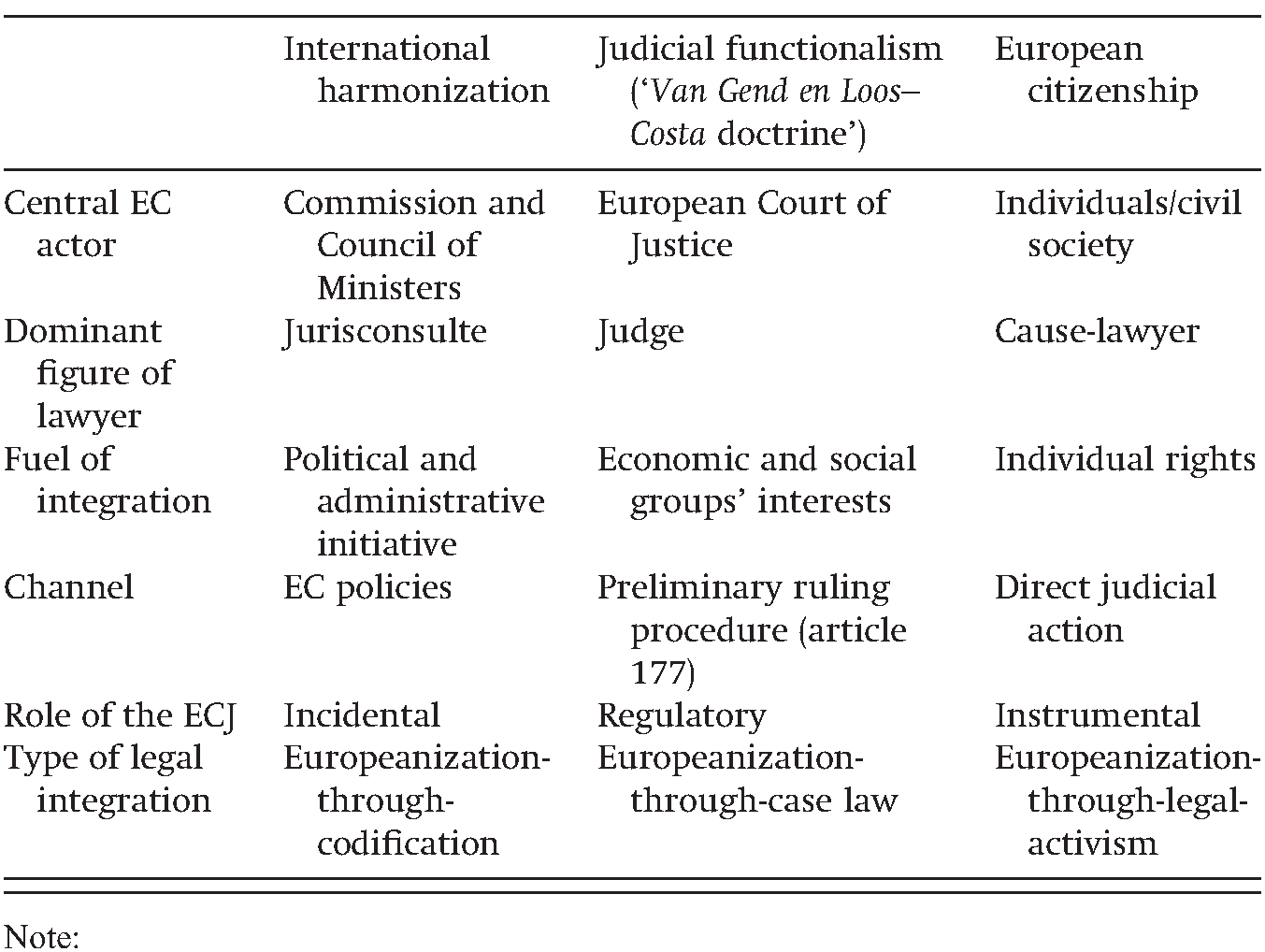
Note: These models are ideal-types. Thereby, they do not intend to mirror reality and they cannot be observed as such in social life. Rather, this table aims at providing a stylization of specific cleavages over the possible political functions given to law and lawyers in the integration process in the early years of European integration. The relevance and respective weight of these three models then have to be measured empirically.
A Community of law
In that it ties together law and politics, the ECJ and European integration, this judicial theory of European integration is more than just an abstract reflection on the future of Europe. The variegated set of its promoters intended it to be performative, thus to effectively redesign the allocation of authority and legitimacy within the EC polity. More particularly, they contributed to elevate legal competence as a necessary precondition for anyone to fully and persuasively participate in EC debates. The fact that Europeanization became seen as a matter of law implied that anyone willing to hold a position of responsibility within the European Communities (be it political, economic, bureaucratic and of course judicial) had to be able to engage in legal discussions. By acknowledging each other as crucial interlocutors beyond the ordinary divisions that still structured the emerging EC polity (national/European; public/private; legal/political), as well as by quoting each other regardless of their different responsibilities, Euro-lawyers of the different breeds (politicians of the law, corporate lawyers, law professors, ECJ judges, the Commission's legal advisers) jointly redefined what it meant and what it required to access and hold various institutional roles within European Communities (commissioners, members of parliament, ECJ Judges, high-ranking officials, but also consultants, etc.), thereby redefining a new ‘integration programme’ for Europe.
In that respect, it might not be coincidental that it is precisely when the ‘Van Gend en Loos–Costa doctrine’ was first discussed in the Parliament (15–16 June 1965) that the requirement for EC elites to possess strong legal credentials became most explicit. Although the Parliament at the time was still weakly institutionalized, the debates generated by the above-mentioned Dehousse report on the issue of supremacy quietly grew into academic exchanges – and accordingly, the Parliament itself turned into an academy of law. The national and political diversity of the thirteen participants in the discussion could not hide the fact that all of them (except one) were, or had been, legal professionals. Written by a renowned academic, the report itself had set the stage for such a ‘legal-only’ debate. It outlined that ‘the science of law and, in particular legal scholarship, play[ed] a decisive role in this framework because it contributes to define and clarify a political situation’.91 Speaking ‘as a lawyer and in the name of the Commission’, Hallstein did not go off message either – quite to the contrary. Right from the start, he praised the report for being a ‘document of scientific quality’. He also insisted that this ‘big political issue’ could only ‘be answered along legal criteria with the help of a legal methodology and only a solution validated by this method can be the right one’.92
Certainly, such a legalistic formulation of the parliamentary debate raised some criticisms. Emmanuel Sassen, a member of the Euratom Commission and himself a doctor of law, expressed some irony about ‘the professor's [Hallstein] real law course’, and more seriously then remarked that ‘neither the Euratom Commission, nor its sister institutions are academies of law’. Similarly, Italian MEP Edoardo Battaglia, himself a former judge and trial lawyer, tried to restore a political order by recalling that ‘this Assembly is not a scientific academy of public law specialists. We are in a Parliamentary assembly and we are politicians’.93 However, he also ended up referring to the various law professors and legal doctrines at stake. And, in fact, the metamorphosis of the Parliament into an academy of law seemed to have been conspicuous enough during that particular session that the chairman felt obliged to adjourn it when it occurred to him that there were not enough lawyers present in order to keep a good debate going: ‘[L]ook around you, it will convince you that, in order to be able to discuss a matter of such importance, there should be more lawyers present’.94 In other words, while stressing the political stakes of the judicial branch, the theory of European integration was at once promoting a specific representation of the EC polity in which legal competence was deemed essential to anyone wishing to exert leadership within that nascent political system.
Simultaneously, but equally importantly, this integration programme was offering the dispersed and variegated set of Euro-jurists that promoted it (judges of the Court, law professors, lawyers, but also many of the MEPs, commissioners, EC civil servants coming from the legal professions) a common place through which they could think and conceive of themselves as one group – that of ‘Euro-lawyers’ – endowed with specific functions (social, economic and, in fine, political integration). Thereby, reframing the role of the ECJ in Europeanization processes also meant for lawyers reframing their own role within the EC polity. While building a legal theory of Europe, the otherwise segmented and often antagonistic ensemble of Euro-lawyers was therefore constituting itself as a specific EC elite. To quote Lecourt, addressing members of FIDE:
If Law possesses such an ability to approximate – to the point of integrating in one unique body – separate and sometimes adversary nations, if it has the power to mould and fuse them, to animate them with one unique soul, if it is endowed with a unificatory power, then let's rejoice, Gentlemen, that this power has been in great part delegated to you.95
In a very characteristic effet de théorie, the emergence of the integration-through-law narrative therefore offered Euro-lawyers a unitary understanding of their variegated, and often conflicting, set of experiences and practices as one unique contribution to the grand project of leading European integration. This does not imply that from then onwards Euro-lawyers would tend to agree on issues and would form one collective profession acting in a rational and unitary way. Rather, it means that, as policy instruments, professional identities and institutional functionalities were now defined in line with and on the basis of that ‘Van Gend en Loos–Costa theory of EC law’, the latter served as a blueprint for action, orienting actors' perceptions, anticipations and (competing) strategies vis-à-vis the European Communities.
From this perspective, Europe's new integration programme is far from being just an abstract set of principles strategically mobilized by self-interested actors (companies, States, EU institutions, interest groups, associations, etc.), as it is too often conceived of in political science. It is the bearer of specific representations of the European Union, of its specific professional canons and political models. In other words, what is usually considered as the mere surface of the social processes that shape EU government is in fact one of the very terrains on which it is built.
1 , 50th Anniversary of the Judgment in Van Gend en Loos (1963–2013). Conference Proceedings, Luxembourg, Office des publications officielles de l'Union européenne, 2013.
2 On this, see also a stimulating paper by Damian Chalmers and Luis Barroso, What Van Gend en Loos Stands For, Jean Monnet Working Paper 03/14.
3 , ‘Rewriting Van Gend en Loos: Towards a Normative Theory of ECJ Hermeneutics’, in (ed.), Judicial Discretion in European Perspective, Kluwer Law International, 2003, p. 151.
4 , ‘Qu'eut été le droit des Communautés sans les arrêts de 1963 et 1964?’, in L'Europe et le droit, Mélanges Boulouis, Paris, Dalloz, 1991, p. 350.
5 , ‘Retour du mythe du gouvernement des juges?’, JurisClasseur-Europe, February 2006, p. 1. Quotes from this article have been translated by the present author.
6 As with any foundational myth, the ex post exegesis of Van Gend en Loos and Costa offers a selective reading of history. Quite emblematically, the ECJ's selection of its most important decisions presented in the languages of the new Member States that joined the EU in 2004 starts with Van Gend en Loos. See http://curia.europa.eu/cs/content/juris/data57/liste.htm (accessed 4 April 2014). Highlighting those decisions that establish the purported emancipation of the ECJ from classic intergovernmental politics, it neglects other ECJ decisions that could well be considered as equally important in defining the Court's jurisprudence. For example, Confédération nationale des producteurs de fruits et légumes v. Council of the EEC, 14 December 1962 could also qualify as a ‘landmark decision’, as it gave a very restrictive reading of individual standing, therefore granting Member States with specific privileges and rights within this new legal order.
7 In this, I disagree with Alec Stone's reading of Van Gend en Loos as a juridical coup not so much for the objective he is aiming at – questioning transformations of law's legitimacy of a given political system (my general goal too) – but rather for the conception of social change the idea of ‘coup’ conveys. It is hardly possible to conceive of Courts – and of international Courts in particular – as unified and rational actors endowed with one clear and common idea of their objectives. A product of heterogeneous if not opposed conceptions of Law and particularly of EC law, Van Gend en Loos is less the sort of inaugural and far-reaching judgment than a still ambiguous text which leaves open a variety of possible interpretations and futures (particularly as far as supremacy is concerned). We argue here that the decision's far-reaching ‘content’ has been produced throughout the history of the European integration. See , ‘The Juridical Coup d'État and the Problem of Authority’, German Law Review, 8, 2007, pp. 935–40.
8 , Glory of Van Gogh: An Anthropology of Admiration, Princeton, NJ, Princeton University Press, 1996.
9 , ‘The Making of a Transnational Constitution’, American Journal of International Law, 75(1), 1981, p. 12.
10 See , Establishing the Supremacy of European Law: The Making of an International Rule of Law in Europe, Oxford, Oxford University Press, 2001.
11 , ‘Meek Acceptance? The West German Ministries’ Reaction to the Van Gend en Loos and Costa Decisions', Journal of European Integration History, 2, 2008, pp. 57–76.
12 As of 1961, the Legal Service had a Centre de Documentation scrutinizing the evolution of national jurisprudence on EC law: ‘Document de travail interne. Analyse des décisions nationales rendues par les juridictions et les autorités administratives sur le droit des Communautés européennes’, 1962, HAEU/COM/BAC.
13 , ‘Nouvelles diverses sur les travaux de l'Association’, Bulletin de l'Association des juristes européens, 10, 1962, p. 29.
14 , ‘Les travaux du groupe juridique dans la négociation du Traité de Rome’, Studia diplomatica, 34(1–4), 1981, pp. 159–78.
15 Out of the first eighteen preliminary rulings notified to the Court during the first six years of the Rome Treaties, fifteen came from Dutch tribunals, one from Luxembourg, one from Germany and one from Italy.
16 Hans Stibbe's Amsterdam law firm, which he inherited from his father, would become, after several mergers, one of Europe's largest law firms in the field.
17 On this, see , ‘The Origins of a Legal Revolution: The Early History of the European Court of Justice’, Journal of European Integration History, 4, 2008, pp. 77–99.
18 Michel Gaudet, ‘Note à MM. les membres de la Commission. Objets. Observations de la Commission devant la Cour de justice au sujet des demandes préjudicielles de la “Tariefcommissie” néerlandaise’, ronéo, 1963, 21p. I would like to thank Bruno de Witte who was so kind as to lend me his own copy of this precious albeit still unpublished document.
19 , ‘Commentaire d'arrêt 2 et 3/62 de la CJCE’, Gazette du palais, 19–22 January 1963, p. 1.
20 The position of Alberto Trabucchi is known thanks to the recent publication of the internal memo he circulated among the judges which went against the position taken by the juge-rapporteur in the case: G. Perini, ‘Note à MM. les juges. Affaire 26/62 Tariefcommissie’, in , ‘Alberto Trabucchi, giurista europeo. Alle radici del diritto in Europa: una testimonianza inedita’, Quaderni della rivista di diritto civile, 2008, pp. 174–6.
21 Interview (conducted together with Morten Rasmussen) with Paolo Gori, former référendaire of Alberto Trabucchi, Prato, Italy, 20 March 2008. See also , ‘The Origins of a Legal Revolution: The Early History of the European Court of Justice’, Journal of European Integration History, 4, 2008, pp. 77–99.
22 See , ‘The Making of a Transnational Constitution’, American Journal of International Law, 75(1), 1981, p. 12.
23 The citations herein all come from the judgment as published in Common Market Law Reports, 1963, pp. 127–32.
24 See , ‘Rewriting Van Gend en Loos: Towards a Normative Theory of ECJ Hermeneutics’, in (ed.), Judicial Discretion in European Perspective, The Hague, Kluwer Law International, 2003, pp. 151–63.
25 Cour de justice des Communautés européennes, Recueil de la jurisprudence de la Cour, Luxembourg, Publications officielles des CE, 1963, p. 21.
26 Common Market Law Reports, 1963, p. 13.
27 , ‘Note’, in Études de droit communautaire européen (1962–2007), Brussels, Bruylant, 2008, p. 61.
28 Otto Riese, ‘Ansprache von Herrn Professor O. Riese anlasslich seiner Verabschiedung am 6 February 1963’ in /CEAB 2/1137 HAEU.
29 , ‘Incidences des Communautés européennes sur le droit interne des États membres’, Annales de la Faculté de droit de Liège, 1963, p. 24.
30 , ‘L'organisation, le fonctionnement et le rôle de la Cour de justice des Communautés européennes’, Bulletin de l'Association des juristes européens, 1963, p. 13.
31 , ‘L'Europe dans le prétoire’, Le Monde, 23 February 1963, p. 1.
32 , ‘Un nuovo diritto’, Rivista di diritto civile, 9, 1963, p. 259.
33 , ‘L'inserimento diretto delle disposizioni contenute nel Trattato istitutivo della Comunità economica europea negli ordinamenti giuridici degli Stati membri’, Foro padano, 1963, p. 32.
34 , ‘Una pietra miliare nell'affermazione del diritto europeo’, Foro italiano, 1963, p. 10.
35 , ‘National Law and the Case-Law of the Court of Justice of the European Community’, Common Market Law Review, 1(1), 1963, p. 13.
36 , ‘Le problème des dispositions directement applicables des traités internationaux et son application aux traités instituant les communautés’, in Deuxième colloque international de droit européen: La Haye 1963, The Hague, NV Uitgeversmij, 1966.
37 I have identified only one differing opinion to this interpretative activism, namely, that of ECJ référendaire Sergio Neri, presumably echoing the viewpoint of his judge, Rino Rossi, who denied the view, held by many Euro-lawyers, that there is any element in the decision enabling to see supremacy of EC law as a logical consequence of Van Gend en Loos: ‘While the Court has endorsed the Dutch theory of self-executing of specific international norms, it is not possible to affirm that it has accepted supremacy’: see , ‘Sulla natura giuridica delle Comunità europee’, Rivista di diritto internazionale, 1964, p. 235.
38 To our knowledge, three out of the seven ECJ judges (Louis Delvaux, Rino Rossi and Charles Léon Hammes) and one of the two Advocates General (Karl Roemer) did not take part in this ex post interpretative activism and remained silent.
39 , ‘Un nuovo diritto’, Rivista di diritto civile, 9, 1963, p. 259.
40 While finishing a PhD at the University of Paris, precisely on ECJ preliminary rulings, Roger-Michel Chevallier, Robert Lecourt's référendaire, was writing a regular legal commentary on EC law in the French Gazette du palais, and, together with the Belgian Gérard Rasquin (Hammes's référendaire), they wrote numerous doctrinal articles on the Court's procedures and case law. Paolo Gori, Alberto Trabucchi's référendaire, a PhD in international law from the University of Florence and Harvard Law School, and Sergio Neri, another Italian référendaire who also held a PhD in international law, were respectively commenting ECJ decisions for the Foro italiano and the Foro padano. One could add former ECJ judge Nicola Catalano to this group, for he had just left the Court and had become one of the most active commentators of the Court's decisions in major Italian, French and Belgium law journals.
41 Presumably as a tribute to his achievement in his Van Gend en Loos test-case, L. F. D. Ter Kuile was representing the Dutch section of FIDE in that debate.
42 Antonin Cohen, Scarlet Robes, Dark Suits: The Social Recruitment of the European Court of Justice, European University Institute, Working Paper RSCAS 2008/35.
43 , ‘Una pietra miliare nell'affermazione del diritto europeo’, Foro italiano, 1963, p. 10, p. 17.
44 , ‘L'inserimento diretto delle disposizioni contenute nel Trattato istitutivo della Comunità economica europea negli ordinamenti giuridici degli Stati membri’, Foro padano, 1963, p. 32, p. 36.
45 , ‘Un nuovo diritto’, Rivista di diritto civile, 9, 1963, p. 259.
46 , ‘Una pietra miliare nell'affermazione del diritto europeo’, Foro italiano, 1963, p. 10, p. 18 (emphasis added).
47 , ‘National Law and the Case-Law of the Court of Justice of the European Community’, Common Market Law Review, 1(1), 1963, p. 13.
48 Speech by Andreas Donner on 6 February 1963, quoted in , The Court of the European Communities: New Dimensions in International Adjudication, Dordrecht, Martinus Nijhoff, 1964, p. 116.
49 , ‘Incidences des Communautés européennes sur le droit interne des États membres’, Annales de la Faculté de droit de Liège, 1963, p. 24 (emphasis in the original).
50 , ‘L'unification du droit européen est aussi un moyen de construire l'Europe’, France-Forum, 1963, p. 31.
51 , ‘Developments in the European Common Market’, International and Comparative Law Bulletin, 7(2), 1963, p. 12.
52 As stated in the Van Gend en Loos decision: ‘The vigilance of individuals concerned to protect their rights amounts to an effective supervision in addition to the supervision entrusted by articles 169 and 170 to the diligence of the Commission and Member States’.
53 Giangaleazzo Stendardi took part in the case only when it was before the Italian Constitutional Court, but suggested the recourse to the ECJ. See , ‘Problemi in materia di legittimità di espropriazione d'impresa’, Foro padano, 5, 1962, pp. 52–60.
54 , ‘Riforme legislative urgenti per una più efficace tutela giurisdizionale del cittadino nella procedura penale’ in Congresso nazionale giuridico forense: Milan 13–18 settembre 1965, Milan, Giuffrè, 1966, p. 735.
55 , I rapporti tra gli ordinamenti giuridici italiani e le Comunità europee, Milan, Giuffrè, 1958, p. 18.
57 He urged each European citizen to ‘ask himself: what have I done, what am I doing for the European norms to be implemented?’ Reference StendardiIbid., p. 17.
58 The Partito liberale italiano, a small right-wing party closed to corporate interests, had gained an unprecedented momentum at the time in Milan (around 20 per cent in 1963–4 elections), actively campaigning against the politics of the centre-left government and, particularly, its nationalization policies. Giangaleazzo Stendardi was on the party's list at the municipal elections in Milan in 1963 and eventually entered the municipal council in 1969. See , Accade a Milano 1945–2002, Milan, Greco e Greco, 2002.
59 , ‘Problemi in materia di legittimità di espropriazione d'impresa’, Foro padano, 5, 1962, p. 60.
60 , Resisting the European Court of Justice: West Germany's Confrontation with European Law (1949–1979), Cambridge, Cambridge University Press, 2012, pp. 44–88.
61 Opinion of the Advocate General Maurice Lagrange on Costa v. ENEL, 25 June 1964, in Recueil de la jurisprudence de la Cour, Luxembourg, Curia, 1964, p. 1179.
62 Ibid.
63 Wissenschaftliche Gesellschaft für Europarecht, Aktuelle fragen des europäische gemeinschaftsrechts, Bensheim, 10–14 Juli 1964, Stuttgart, Enke Verlag, 1965. On the importance of this meeting and the influential role of German law professor Hans Peter Ipsen in shaping the set of possible alternatives for the ECJ judges, see , ‘Europe a Großraum? Shifting Legal Conceptualisations of the Integration Project’, in and (eds.), Darker Legacies of Law in Europe: The Shadow of National Socialism and Fascism over Europe and Its Legal Traditions, Oxford, Hart Publishing, 2003, pp. 167–91, p. 183, n. 92.
64 Cf. et al. (eds.), Visions, Votes and Vetoes: The Empty Chair Crisis and the Luxembourg Compromise Forty Years On, Brussels, Peter Lang, 2006.
65 See , ‘A Supranational Icarus: The Early Commission and the Search for an Independent Role’, in (ed.), Inside the European Community: Actors and Policies in the European Integration 1957–1972, Baden-Baden, Nomos, 2006.
66 On these divisions, see , ‘The Movements for European Unity (1958–1972)’, in (ed.), Inside the European Community: Actors and Policies in the European Integration 1957–1972, Baden-Baden, Nomos, 2006, pp. 177–93; and (ed.), Crises and Compromises: The European Project 1963–1969, Baden-Baden, Nomos, 2001.
67 See , Resisting the European Court of Justice: West Germany's Confrontation with European Law (1949–1979), Cambridge, Cambridge University Press, 2012, pp. 44–88.
68 , ‘La Communauté européenne, nouvel ordre juridique’, in Les documents de la Communauté européenne, 27, 1964, p. 5.
69 In between the two decisions, the composition of the Court had undergone only one change with the – to our knowledge, still unexplained – resignation of the German judge Otto Riese, Adenauer's nephew, only one day after the publication of the decision in Van Gend en Loos (but after he had taken part in the judicial deliberations). He was replaced by Walter Strauss, former minister of Justice in Adenauer's government.
70 Decision Costa v. ENEL, Recueil de la Cour de justice des Communautés européennes, Luxembourg, Curia, 1964, p. 1141.
71 , ‘La preminenza del diritto delle Comunità europee sul diritto interno degli Stati membri’, Giurisprudenza italiana, 1964, pp. 1071–86.
72 Its director Michel Gaudet was heard on 18 February 1965 by the Legal Committee, and a member of its staff was ‘lent’ for the purpose of the report to the European Parliament.
73 Fernand Dehousse, Rapport fait au nom de la commission juridique sur la primauté du droit communautaire, Parlement européen, documents de séances, 1965, p. 14.
74 , in Symposium ‘Droit communautaire et droit national’, Cahiers de Bruges, 14, 1965, pp. 399–400.
75 , ‘Compte-rendu’, Cahiers du droit européen, 1, 1965, pp. 74–5.
76 Débats du Parlement européen, Séance des 16–17 juin 1965, 1965, pp. 221–3. See also the resolution: ‘Résolution du 22 octobre 1965’, Assemblée parlementaire commune, 1966.
77 , ‘La Communauté européenne, nouvel ordre juridique’, in Les documents de la Communauté européenne, 27, 1964, p. 5.
78 , ‘Walter Hallstein et les institutions des Communautés européennes’, in (ed.), Le couple franco-allemand et les institutions européennes, Brussels, Bruylant, 2001, pp. 151–68.
79 , ‘La Communauté européenne, nouvel ordre juridique’, in Les documents de la Communauté européenne, 27, 1964, pp. 8–10.
80 Reference HallsteinIbid., pp. 10–11.
81 , ‘Robert Lecourt (1908–2004)’, Revue trimestrielle de droit européen, 3, July September 2005, p. 990, p. 995.
82 William Phelan, ‘Supremacy, Direct Effect and Dairy Products in the Early History of European Law’, EUI Working Paper, 2014/11.
83 Some cases are thoroughly documented in , Establishing the Supremacy of European Law: The Making of an International Rule of Law in Europe, Oxford, Oxford University Press, 2001.
84 Walter Hallstein, in ‘Débats. Compte rendu in extenso des séances’, Session 1964–5, 17 June 1965, European Parliament, 1965, p. 218.
85 Walter Sassen, in ibid., p. 223.
86 , What Is Sociology?, London, Hutchinson, 1978, p. 86.
87 , ‘Das Europarecht in der Krise der Gemeinschaften’, Europarecht, 1, 1966, pp. 4–24.
88 It must be noted that the first book engaging in a reflection on the role of the European Court in a functionalist perspective came later: , The Rule of Law in European Integration, New Haven, CT, Yale University Press, 1965.
89 , ‘Le rôle du droit dans l'unification européenne’, Bulletin de l'Association des juristes européens, 17–18, 1964, pp. 5–23, p. 22.
90 On this, see also the interesting developments by , Power and Legitimacy: Reconciling Europe and the Nation-State, Oxford, Oxford University Press, 2011.
91 , Rapport fait au nom de la commission juridique sur la primauté du droit communautaire, Parlement européen, documents de séances, 1965, p. 2.
92 Walter Hallstein, in Reference Dehousseibid., pp. 218 and 220.
93 Reference DehousseIbid., p. 231.
94 Reference DehousseIbid., p. 243.
95 , ‘Le rôle du droit dans l'unification européenne’, Bulletin de l'Association des juristes européens, 17–18, 1964, pp. 5–23, p. 22.

