

The genesis of language is not to be sought in the prosaic but in the poetic side of life: the source of speech is not gloomy seriousness, but merry play and youthful hilarity
The artificial part of poetry, perhaps we shall be right to say of all art, reduces itself to the principle of parallelism
It was as if they made them for the sheer pleasure of it. They were completely useless as tools.
The pleasure principle precedes the reality principle
Beauty is truth
Ideophones may be our smoking guns for at least one conjectured development: the relatively small-scale transition from spontaneous pantomimic gestures (accompanied perhaps by equally spontaneous and nearly inarticulate speech) to speech as we know it (and the atrophied remnants of gestures). At any rate, there they (the ideophones) are, whether we accept this conjecture or not. If we wanted to design a missing link from scratch, from such gestures to conventional spoken language, ideophones are a priori what such a link would look like, and I believe that ‘civilizing’ processes such as those sketched out in Chapter 6, may provide the beginnings of a plausible account of some of the changes that followed such a transition.
Repetition has played many a crucial part in this narrative so far. Now, as Henri Frei said in a memorable essay, there is repetition, and there is repetition: so much that we have no established taxonomy for all of its variants. Aristotle’s two wellsprings of art were mimesis and rhythm or harmony, both of which, for all the contrast between them, are recognizable as kinds of repetition. From the plethora of available terms and subcategories from ordinary language and classical rhetoric, three types we can distinguish at this point are what I will call reproduction, recycling, and doubling.
Reproduction or creative artistic mimesis was essentially our topic in Chapter 5. It is the same as pretense, as in language and play. Outside of play, often we can often recognize pretense as imitation in another medium: It includes representational art, including drama, most language, most narrative literature (Auerbach Reference Auerbach1946), and iconic signs, including gestures and onomatopes. It is possible to classify some accompaniment (as where a gesture accompanies a word, or vice versa) as a kind of reproduction also, to the extent that a sign in the visual medium imitates another sign in the auditory medium. Reproduction has a variety of functions: both the segmental structure and the histrionics of ideophones (Chapters 2, 3, and 4 ) reproduce aspects of reality in mimetic performance, and the reproduction of such performances in one medium with an accompanying expression in another may account for sign genesis.
Recycling or passive copycat mimesis is imitation (typically by another signer) of a sign in the same medium. It includes what I once called ritualization, routinization, and grammaticalization. It is exemplified by the reuse, with or without attribution, of bits and pieces of one speaker’s text by another, or by the same speaker on a different occasion. It constitutes a large part of language learning, and underlies standardization, hence – most likely – digitization, and all the various frequency effects noted by linguists from Horne Tooke onward, through Bopp (Reference Bopp1816), Schuchardt (Reference Schuchardt1885), Meillet (Reference Meillet1912), Givon (1971, Reference Givon1979), Lehmann (Reference Lehmann1982), Heine and Reh (Reference Heine and Reh1984), Hopper (Reference Hopper and Aske1987), Haiman (Reference Haiman and Pagliuca1994), Bybee and Hopper (Reference Bybee and Hopper2001), Heine and Kuteva (Reference Heine and Kuteva2002, Reference Heine and Kuteva2007), and Bybee (Reference Bybee2007, Reference Bybee2010) to the present: some frequency effects are chunking, constituency, grammaticalization, possibly even the duality of patterning. Many of Hockett’s design features of language can be directly derived from recycling. I have distinguished recycling from direct quotation in Chapter 1, and dealt with it in a very cursory fashion in Chapter 6.
So pervasive is the role of recycling that some usage-based grammatical theoreticians, notably Joan Bybee, have recently identified it as the fundamental generative principle of language, and have gone so far as to say that a language at any stage should be likened not to an agglomeration of buildings (as in a city), but rather to a sand dune, whose only sculptor/architect is the wind of common usage (Bybee Reference Bybee2010:1). While I am sympathetic to usage-based grammarians, I am reluctant to go quite that far: For children learning a language, it is not quite enough to learn that the winds will eventually wear down all the buildings of their city into sand. They also have to learn about the shape and relative positions of those buildings in the meantime.
Moreover, recycling, as well as repetition of any other kind, has to have something to work on. (Where did all the sand come from?) For language, that something, I believe, may be the ideophones that have been the subject of this book.
Doubling or gemination is the immediate repetition of a string, within the same utterance, by the same speaker. One of its functions is the representation of plurality, intensivity, and symmetry via both repetition and reduplication (a familiar topic). Any grammarian will point out the existence of reduplication, because it is both formally and conceptually language-specific. Repetition, as in
He climbed and he climbed and he climbed
is a different matter. So natural is repetition in this iconic function that it is the rare grammarian (see Aikhenvald Reference Aikhenvald2010 :passim) who bothers to point out its existence in the grammar of a specific language. Doubling is probably what leads (by grammaticalization) to grammatical or rule-governed reduplication, which can have a variety of functions, not all of them iconic. Doubling is virtually a definitional property of ideophones (Chapter 2), and many authorities have attributed reduplication in ideophones to precisely this motivation, but I have given reasons for my skepticism about this. There are many clear cases where ideophones reduplicate, but not for the expression of plurality or repetition. Instead, one of the functions of doubling, as I have argued in the last chapter, may be to serve not only as the expression of histrionic exaggeration, but as an alternative expression, or a conventionalization of such exaggeration. If my speculation is correct, then one function of repetition, like histrionics, would be ludic. Moreover, in this ludic representative function, conventionalization could not be seen as a frequency effect. A stereotyped intonation may be seen as the result of a conventionalized originally histrionic pronunciation, and thus be characterized as a frequency effect: but no matter how often a histrionic pronunciation of an utterance is repeated, that pronunciation itself cannot be shaped or molded into a repetition of the utterance. The transition from staginess to repetition can only occur when speakers decide that the second may serve as a possibly cut-rate moral equivalent of the first. And that transition is akin to the transition from showing to telling. Once hamming it up is replaceable by repetition, communication is no longer restricted to mimes and other able actors.
This chapter will focus on another aesthetic function of doubling, which I have already alluded to in Chapter 3: Words may be doubled for purely decorative purposes, out of a love of symmetry for its own sake. In proposing this specifically, I will distinguish between the distinct ludic and aesthetic functions that repetition within a single word may have. Both formally and conceptually, it seems hard to assign primacy to any kind of repetition. Formally, because before one repeats something, there has to be something there to be repeated: You can’t repeat (or even adorn) when you haven’t got. Conceptually, prose precedes poetry, for reasons that recall pragmatic objections to the primitive nature of ideophones.
In the folklore on expressives and ideophones, one metaphor comes up repeatedly: as aesthetic productions, they are the very spice of life:
..[binomial expressives in Lao] are to the language what spice is to food, what polishing or cutting is to a gem. Without them, the speaker or writer will make himself understood, but prove to be rather dull or pedestrian.
These syllables [of binomial expressions] are sometimes incomprehensible to the Chinese comrades who study Miao [Hmong]. Without such syllables, the language would be much less colorful. On the one hand, the speaker would be unable to express his specific thoughts and feelings. And the hearer, on the other hand, would consider the conversation dull.
But if variety is the spice of life, it is monotony that definitely provides the groceries. In the history of writing, at least, we believe we know that script “originally served workaday economic and administrative purposes, and that imaginative creations came quite late” (Ong Reference Ong1982:86). Or: If monotony provides the themes, and variety provides the variations, every stylist from Haydn, through Karl Marx, to Raymond Queneau knows that fundamental themes precede variations and other frills. Erst kommt das Fressen. Claiming that ideophones and/or expressives may have played a fundamental and primal role in the origin of language seems like trying to put an aesthetic cart several miles ahead of a material horse.
In this sense, expressives seem to stand to prosaic language in the same relationship that play languages like Pig Latin do. They may exhibit a lot of difficult and purposeless frills (cf. Gil 2003, on play languages in general). But nobody has ever claimed that play languages came before prosaic language. They are always deformations of ordinary language. We are back, with this observation, to the common sense skepticism expressed by Diffloth about the antiquity of ideophones.
A preliminary version of Diffloth’s objection was addressed in Chapter 2: Ideophones are similar to another apparently secondary adornment on language, what Fónagy called the ‘distorter’ of paralanguage. Although from the standpoint of synchronic grammar, paralanguage can be viewed as a ‘later’ perturbation of a fundamental grammatical structure, there is diachronic evidence that the analog effects of paralanguage really do predate the conventional forms of digitized grammar – but is such an analogy between paralanguage and artistic effect really a valid one? Surely there is no denying the common sense adage that ‘you can’t adorn what you haven’t got’. Surely in the course of learning to play any piece on a musical instrument like the piano, one has to learn to hit the right notes first, as the admission price one has to pay before being able to engage in the self-indulgent pleasures of playing around with frills like touch, pedals, and dynamics. Or so declares every piano teacher.
But here common experience suggests a divergence between the history of writing and the history of learning a musical instrument. Long before s/he learns about technicalities like reading notes, fingering, and scales, a kid can and joyfully does, engage with considerable gusto in touching or banging the keys, doing glissandi, and depressing the pedals. Any reader skeptical of this claim is welcome to borrow my grandson for a few moments. In this admittedly highly artificial medium, the capacity to engage in playful ‘adornment’ and self-expression seems to precede the sober and disciplined capacity to ‘play what is set before one’. It is so much easier, after all.
But what about the natural medium of the voice? From the standpoint of both structure and function, what can we say about the relative antiquity of the referential and aesthetic functions of language? Certainly, in terms of the modern history of their scholarly recognition, Karl Bühler’s referential, conative, and expressive functions, 1933, preceded Jakobson’s aesthetic function (Reference Jakobson1959). But is it not easier, in language as in music, to engage in the frills first? And what about the motivation for doing the easy stuff and producing aesthetic or ludic purely vocal performances? In the history of humankind, is the aesthetic function of language really an afterthought compared to Buhler’s Big Three?
It would seem that some writers (e.g. the psychologist N. Humphrey, [Reference Humphrey1973], and the linguist Walter Ong [1982]), while acknowledging the aesthetic function of language, have implicitly answered this question in the affirmative, by suggesting that aesthetics may only justify its existence by having a truly cognitive function. Humphrey argued that a sense of symmetry pays its way only inasmuch as it aids in category recognition, which has survival value. Ong, in a far more widely read work, argued that in preliterate cultures, the purely mnemonic imperative to “think memorable thoughts” demanded expression in the “heavily rhythmic, balanced patterns, repetitions, or antitheses, alliterations and assonances” that characterized oral epic poetry (Ong Reference Ong1982:34, following the classic studies of Parry and Lord) – and which as we have seen characterize ideophones as well.
Perhaps, however, this concession to a cognitive motivation is unnecessary. Other writers, like Darwin, suggest that the beautiful may claim as much antiquity as the merely referential if its function is to enhance the mating prospects of its producers (cf. Kohn and Mithen Reference Kohn and Mithen1999). If the aesthetic function of language is like the peacock’s tail, as Jespersen proposed (Reference Jespersen1922:434), then it may be the referential function that is truly the later arrival, and it may be unnecessary to confine the aesthetic motive as a mating aid exclusively to ludlings like Pig Latin. I hope in the following pages first to justify a purely formal contrast between aesthetic and ludic repetition, both of which are attested in a number of languages, and then to propose a deeper kinship between them. Finally, I will propose that both the ludic and the aesthetic are characterized by repetition, as are the first signs, because repetition is how anything can draw attention to itself.
Some of the ‘expressives’ (as Diffloth and others have called them) of Southeast Asia offer a minimally contrasting pair of structures that are so distinguished. Ideophones are ludic reproductions: They perform a depictive, hence an essentially referential, function in that they show things, and do so in a playful way, much like exclamatives. On the other hand, at least some of the ‘expressives’ of Southeast Asia, as I will try to show, perform a purely decorative function: That is, they have no purpose other than to draw attention to themselves as aesthetic objects, and they do so through their formal symmetry. In this way, as I will also try to show, they share properties with apparently rather distant phenomena like grammatical agreement. The most striking reason, I will maintain, that ideophones and all SE Asian expressives are so readily lumped together is because they share one crucial formal property, that of doubling or reduplication. A priori, such an overlap may be coincidental, a case of structural homonymy, but I will argue otherwise in the conclusion to this chapter.
Ever since Smithers (Reference Smithers1954), twin forms like jibber jabber in Western languages have been recurrently identified with ideophones, and ever since Diffloth (Reference Diffloth1972), expressives in Asian languages from Korean to Semai have been also identified as ideophones (cf. Lee Reference Lee1992 on Korean, Kita Reference Kita1997 on Japanese, Ratliff Reference Ratliff and Williams2014 on Hmong). Yet there are recurrent formal differences between two different kinds of reduplication and their associated functions in a number of these languages. In Khmer and Vietnamese (Austroasiatic), Hmong (Hmong-Mien), Lao (Tai-Kadai), and Sui (Tai-Kadai), there are two formally distinct kinds of symmetrical reduplication. One serves a manner-adverb function – typical of ideophones, as we have seen. The other – at least in some SE Asian languages – does something different.
7.1 Hmong
In Hmong, expressive reduplications come very close to being ideophones as defined here. Ratliff reports that in White Hmong there are two kinds of reduplication, which she calls ‘regular’ and ‘expressive’. Both kinds of reduplication have the base preceded by a reduplicating copy, but there both formal and semantic similarities end (Reference Ratliff and Williams2014:181).
Regular reduplication takes a prosaic word as a base, and the reduplicating copy has one of the familiar purely iconic functions of indicating augmentation, iteration, or intensification. The resulting compound is the same part of speech as the base, which may appear by itself.
| ʒoƞ ➔ ʒoƞ ʒoƞ | ‘good’ ➔ ‘very good’ |
| khĭa ➔ khĭa khĭa | ‘run’ ➔ ‘run and run’ |
The reduplicating copy must be a total reduplication of the base, but some reduction of the initial reduplicant is possible, as we saw was true in Wa, and is often the case with iconic reduplication in general: The copy loses stress, its vowel may be reduced (nasality, e.g., is always lost), and its tone may become indiscernible (cf. Whitelock Reference Whitelock1982). Bisyllabic words thus become iambs:
| Nkees | nkees ➔ | [ŋə’ŋẽ22] | ‘very lethargic’ |
| /ŋẽ22/ | /ŋẽ22/ | ||
| lethargic | lethargic |
Expressive reduplication on the other hand takes a (usually: In a minority of cases, the base morpheme has an independent existence) meaningless and hence non-occurring syllable as its base. The reduplicating syllable must then alliterate, but cannot rhyme, and cannot be identical, with the base (Ratliff 182). The nature of its vowel is related to whether or not it shares the same tone as the base. If the tone is the same, the vowel must be [i] or [aƜ]; if the tone is different, it must be high falling, and the vowel must be [u]. Furthermore, there are strict constraints on the possible tones of the two components (Ratliff Reference Ratliff1992:141). The resulting compound does not then “intensify, in the sense of giving more of some aspect of meaning that is already in the utterance without the expressive” (Ratliff Reference Ratliff1992:140). Rather, it exhibits almost all the familiar properties that characterize ideophones in the African literature. Rather than intensifying, it “particularizes: [it provides an] eye-witness account of the passing scene” (Ratliff Reference Ratliff1992:140). Like ideophones in general, it offers an imitative impression, which can be either very specific or very general: “for example txij txej is an impression of ‘a rat crying out in a snake’s mouth’ while nkhiis nkoos is an impression of ‘the sound of hollow things’” (Ratliff Reference Ratliff1992:139). It often exhibits onomatopoeia (most typically the case for compounds of same tone) or sound symbolism (Reference Ratliff and Williams2014:183–6) or an appropriate mouth gesture. For example, as in other languages closer to home, where the sound [f] through mimicry denotes ‘blowing or the wind’, the Hmong expressive fij fwj denotes the blowing of gusts of wind (Ratliff Reference Ratliff1992:222); again as in other languages mentioned in Chapter 4, the sound [l] denotes duration or iteration: All (five) examples in Ratliff’s data of initial [l] + low level tone vowel in the base syllable connote prolonged sound or activity:
| lû làƜ | ‘big continuous humming sound’ |
| lû lè | ‘sound of vacuum cleaner, bees, airplane’ |
Moreover, like ideophones, the Hmong expressive compound is ‘not embedded in the sentence, but acts as an adjunct to the sentence as a whole’ and is frequently introduced by a word that indicates the senses that are being engaged, such as ‘sounds’, ‘cries’, ‘falls’, ‘drips’, or ‘moves, or a word that introduces a performance, such as ‘makes’:
| hlawv | xyoob | xyoob | tawg | nrov | plib plob | ||
| burn | bamboo | bamboo | explode | sound | ID |
‘when bamboo burns, it makes the sound “plib plob”’
| kiv | kiv | kuv | qhov | muag | kuv | ua | yus | yees |
| spin | spin | I | eyes | I | make | ID |
‘when my head turns I get dizzy’
Thus syntactically, the resulting compound can be identified as either a mimetic direct quote or as a manner adverb, although Ratliff states that it is “closer to an elaborated expressive [interjection] than to any other type of word” (Reference Ratliff and Williams2014:180, 182). In fact, there is evidence that it is not exactly the same as a manner adverb: As in at least one other language we have examined (Wolaitta), the manner adverb precedes, while the ideophone follows, the verb it particularizes, suggesting that the ideophone is less incorporated into the grammar:
| majmam | mus | chuj | chiab |
| slowly | go | ID |
‘absent-mindedly or unconsciously walk very slowly’
Ratliff also observes (pc) that expressive reduplications are often accompanied by gestures.
The ones I remember clearly (and I feel safe to report) are (1) the expressive for “butterfly”, which involves the flapping of both elbows while saying npuj npaim [npu52 npai21], and the expressive for a cow’s bilabial trill before a charge, which involves the lowering of head as though to butt someone while saying plig pleg [pli̤ ple̤] (breathy voice).
The Hmong parallels with conventional African ideophones go further. Expressives can be neither questioned nor negated (Ratliff Reference Ratliff1992:138). They may violate canonical constraints on syllable structure (Ratliff Reference Ratliff1992:223). They exhibit a fair amount of free variation: for example, mlis mlas ~ (mluj) mlas ~ mlos for growl of a cat’ (Ratliff Reference Ratliff1992:227), tuj tauv ~ (tuj) teev for ‘dripping sound’ (Ratliff Reference Ratliff1992:243).
At times, this free variation seems to approach sound symbolism, or the beginnings of minimally contrasting forms that correspond to minimally contrasting meanings. Thus, there may be an incipient difference in meaning between the doublets nplhib nplhob and nplhij nplhawj, both of which convey an impression of wriggling:
| nplhib nplhob is found in | ||
| ntses | nti | |
| fish | writhe | ––– |
| ‘fish wriggles (on hook)’; and | ||
| nplhij nplhawj is found in the minimally contrasting | ||
| ntses | nti | ––– |
| fish | writhe | |
| ‘fish are frisky (in water)’ (Ratliff Reference Ratliff1992:218, 224) | ||
If there is a difference in meaning between these two sentences, it must reside entirely in the different meanings of the two expressives.
Or consider the pair nrhuj nrhawv and nrhuj nrheev, both of which convey an impression of clumsy slowness.
| nrhuj nrhawv is found in | |||
| hais | lus | nrho | –––––– |
| speak | word | all | |
| ‘slow of speech’; and | |||
| nrhuj nrheev is found in | |||
| sawv –––– | |||
‘stand slowly (as of an infant just learning to walk)’
Or consider the porcine (very) minimally contrasting tonal quadruplet:
| zib zeb | ‘big pig fighting’ |
| zij zej | ‘sound a pig makes when you pick it up’ |
| ziv zej | ‘cry of pigs squealing’ |
| zuj zeb | ‘of a pig squealing’ (Ratliff Reference Ratliff1992:218, 226, 230, 234) |
Most telling is the fact that in the (as yet) very sparse literature on Hmong linguistics, they are systematically disparaged and denigrated as extra-systemic nonce creations:
Délibérément, nous avons omis les onomatopées,très nombreuses, mais aussi très fantaisistes et variables d’un individu à l’autre.
It is clear on the basis of everything said here that what Ratliff calls ‘expressive’ reduplication in Hmong contrasts formally and conceptually with the iconically motivated total reduplication that signals intensity or repetition, and it is expressive reduplication that creates words recognizable on the basis of our criteria as ideophones.
A similar formal contrast between formally different kinds of reduplication exists in four other Southeast Asian languages of different superstocks: Lao, spoken in Laos; Sui, spoken in Guizhou Province of Southern China, a Tai-Kadai language related to Lao and Thai; and Khmer and Vietnamese, both Austro-Asiatic. And in these languages, as in Hmong, the different kinds of reduplications serve distinct functions, although both are called expressive.
7.2 Lao
Enfield (Reference Enfield2007) identifies two minimally contrasting expressives, both of which manifest symmetrical reduplication. Ideophones consist of two rhyming syllables, equally stressed, usually on the same tone, which conform with the general features of ideophones that we recognize as such: They are felt as vivid recreation of sensory impressions, apparently they can be produced ‘on the fly’, they manifest sound symbolism, they occur at the end of sentences in which they are ‘embedded’, or as complements of a verb hêt ‘do, make, say’, and they generally cannot be negated or occur with aspectual particles (Enfield Reference Enfield2007:299–303). Typically, base and copy rhyme or chime but do not alliterate. An example is
| laaw2 | vaw2 | siang3 | khùù | khon2 | laaw … qòò4 – tooj4 | |
| ID | ||||||
| 3sg.fam. | speak | voice | like | person | Lao | exactly |
“S/he sounds exactly like a Lao person.”
Another kind of reduplication is called by Enfield ‘alliterative’. Typically, alliterative reduplication occurs in symmetrical four-word A+x A+X sequences where the base X and the copy x both occur in construction with an identical nominal A. This type of alliterative reduplication often seems to signal (pejorative?) plurality, much as in Turkish m- reduplication or colloquial English Schmo-reduplication, and can be translated as ‘… and stuff’. One subcategory within this is productive, inasmuch as the rhyme of the base is regularly replaced by –òòk in the preceding copy:
| laang4 | th-òòk5 | laang4 | th-uaj5 |
| wash | ECHO | wash | dishes |
‘wash dishes and stuff.’
Finally, however, there is another kind of alliterative reduplication that is apparently meaningless. It produces two-word rhyming, chiming, and alliterating forms, and the aesthetic and/or referential contribution made by the reduplication seems to be unworthy of comment (Enfield Reference Enfield2007:309–10). Thus
| khuq1 ~ khuq-khiq1 | bucket |
| loong1 ~ loong1-lêêng1 | coffin |
| kùa3 ~ kùa3-kia3 | salt |
| piik5 ~ piik5-peek5 | wing |
My impression from reading Enfield is that there are not too many of these forms, but if the reduplication is indeed as meaningless as his (lack of) discussion seems to indicate, they would be the congeners of the Cambodian bo’ri’va: sap and the emphatics of Vietnamese.
7.3 Sui
Stanford (Reference Stanford2007) reports that in Sui, onomatopoeics (which seem to me to merit the label ideophones) are characterized by full identical reduplication, signaled here by (…)2. (Other superscripts denote tones.) Like ideophones in many other languages, they function exclusively as manner adverbs and are attached to verbs;
| tiw4 ‘stomp, dance’ | ➔ | tiw4 (vɑm6)2 | ‘stomp one’s feet noisily’ |
| ku1 ‘laugh, smile | ➔ | ku1 (çi5)2 | ‘laugh quietly’ |
| kiw1 ‘whistle’ | ➔ | kiw1 (kwhit7)2 | ‘sound of whistling’ |
Rhyming/alliterative intensifiers, on the other hand, look much more like jibber jabber words, inasmuch as the reduplicated form is copied but not repeated. Stanford (on what is only a first approximation, p.c.) consistently translates them as intensifiers, that is, as ‘very __’. These forms apparently cannot be used as adverbs, but only as adjectives:
| khiƞ ‘brown’ | ➔ | khiƞ tiƞ | ‘very brown’ (the imperfect copy rhymes with the base) |
| çu ‘green’ | ➔ | çu çiƞ | ‘very green’ (the imperfect copy alliterates) |
The function of reduplication here may be iconic or decorative, but it is not the same as the function of total faithful reduplication.
7.4 Khmer
The formal contrast in Sui is partially similar to what I found in Khmer, where three kinds of reduplication can be formally distinguished: iconically motivated intensives, ludically motivated ideophones, and aesthetically motivated twin forms, which are recognized in grammatical descriptions as bo’ri’va: sap ‘retinue words’.
In (Haiman Reference Haiman2011), I reported on ideophones in chapter 11, section 5.2, and characterized them in some of the same ways that I am characterizing ideophones now – with a much deeper and broader cross-linguistic acquaintance now than I then had. They function as manner adverbs, and do so invariably, that is, they seem largely aloof from the game of ‘musical parts of speech’ that almost all other words participate in; and they are formally identifiable almost always through being perfect total reduplications. Examples include
| daeu | (lo:p)2 |
| walk | slowly-and-stealthily |
| ID |
‘walk slowly and stealthily; sneak up on’
| tateah msaw | (tu:h)2 |
| slap-on make-up | softly with a slap slap sound |
| ID |
‘slap on make-up piff paff’
In addition to ideophones, which do not seem to be exceptionally numerous, Khmer also invests enormous lexical resources in words of the jibber jabber type. Unlike intensive adverbs, these symmetrical compounds occur as nouns, verbs, adjectives, and even auxiliary verbs, demonstratives, conjunctions, and prepositions, and are judged by native authorities – not just my consultants, but by professional grammarians working in the native tradition of grammatical analysis – to be semantically identical to non-reduplicated words, but carrying some ineffable extra color. Some examples:
| don | da:p |
| (meaningless) | deteriorate |
| ‘deteriorate’ | |
| kni: | knia |
| (meaningless) | companion |
| ‘companion’ | |
| sngiam | sngat |
| quiet | (meaningless) |
| ‘quiet’ | |
| mdec | mda: |
| how | (meaningless) |
| ‘how?’ | |
Bo’ri’va: sap ‘retinue words’ of this sort, where one or both components are meaningless, shade into synonym compounds such as betwixt and between, last and final, hack and hew, of which Khmer also has a vast number, except that one or both members of the symmetrical compound are meaningless. This phenomenon is quite widespread among Southeast Asian languages, and has few parallels in Western languages, where reduplication, even in ‘twin forms’ like jibber jabber, is always invested with some meaning. The closest parallels I have found in English are pairs like true-blue, even Steven, loosy goosy, and lovy-dovy, where an elsewhere meaningful word has apparently been conscripted to accompany a base word primarily on the basis of its purely formal properties.
Why should such meaningless symmetrical compounds exist in general? For their meanings, a commonly accepted opinion is that the reduplication is iconically motivated, and performs the same functions that such reduplication does in general. (You may recall that this is what is very often the meaning attributed to ideophonic reduplication.) Thus Stanford (Reference Stanford2007) holds that these compounds in Sui (Tai-Kadai, Southern China) are without exception ‘intensives’. Svantesson (Reference Svantesson1983:93) also claimed that all of the nearly four hundred reduplicatives that he recorded in Kammu (Mon-Khmer, Vietnam) had an “intensifying function,” but it is hard to see how words like ‘yee ‘one-eyed’ are intensified by being repeated, as ‘yee ‘yang: ‘extremely one-eyed’ makes no sense, while nouns such as ‘k’aar ~ ‘k’aar k’ir ‘mountainside’ or pntrap ~ pntrap pntreeng ‘gift’ make, if possible, even less. Rischel (Reference Rischel1995:93) wrestled with the same issue in his description of Minor Mlabri (Mon-Khmer, spoken in the war-zone between Thailand and Laos):
The doubling phenomenon is not restricted to specifically expressive words. It even occurs on nouns referring to ordinary physical objects.
Examples (Rischel Reference Rischel1995:94) include:
| klɯh kleh | ‘shallow’ (derivable from kleh ‘loud’?) |
| micmɛɛc | ‘ant’ |
| kukɔ’ | ‘neck’ (for which the unreduplicated root *kɔɔ’ can be reconstructed in Monic) |
| klkiil | ‘knee’ |
| mujmuj | ‘hair’ (another dialect of Mlabri has the unreduplicated form) |
And threw up his hands: “something very interesting may be going on here, but what is it?” (Rischel (Reference Rischel1995:94). It follows that iconic motivation for reduplication in these forms is problematic.
Another opinion, of course, is that these are in fact ideophones: impressions or performances. This is clearly the case in Hmong. That it is not the case in Khmer is patently obvious from the fact that they never occur as manner-adverb-like complements of action verbs, nor as the direct object complements of verbs such as ‘do’; less blatantly, from the fact that they invite or co-occur with no paralinguistic or non-linguistic gestures or facial expressions.
It may also be that this is not the case in what Ts’ao called ‘Miao’, a language that is either totally identical with, or at least a member of the same (Hmong-Mien) family as, what Ratliff calls (White) Hmong. Although not too much should be concluded from the rather casual observation of Ts’ao (Reference Parnell, Yü-hung and Kwo-ray1961) that “Chinese comrades” find expressive compounds in Miao “incomprehensible,” it may be that this is because Chinese has nothing similar: This is then an intriguing observation because different dialects of Chinese do have some (usually onomatopoeic) ideophones ( Lau Reference Lau1999 for Mandarin; Bodomo Reference Bodomo and Mugane2006, 2000–Reference Bodomo2008 for Cantonese; Wu Reference Wu2014 for Rui Hong; the literature turns up only onomatopes for Mandarin) and reduplicated adjectives, a category to which they have become largely assimilated (Birkholtz Reference Birkholtz2015). Ergo, to take this unwarranted conclusion to its final destination, the ‘Chinese comrades’ were perplexed by the alliterating ‘expressive’ compounds in Miao most likely because they simply were not ideophones, a part of speech that they were presumably familiar with. In that case, the facts in Miao may be somewhat different from what Ratliff and others have solidly identified in White Hmong, and closer, possibly, to the facts in Vietnamese, to which we now turn.
7.5 Vietnamese
What I am calling decorative compounds in Vietnamese are dealt with in Nguyen (Reference Nguyen1965) and in much greater detail by Thompson (Reference Thompson1987:154–78). The latter explicitly contrasts decorative compounds (which he calls “emphatics”) with ideophones (which he calls “dramatics”).
Thompson’s ‘emphatics’, or most of them, are clearly the same phenomenon as Khmer bo’ri’va: sap. A base root is coupled with a non-identical, almost always alliterating, almost always following, and usually meaningless copy. Aside from a small number of cases (about twenty listed by Thompson) where the compound has an iconically motivated meaning (usually intensive, rarely plurality marking), and a comparable number of cases where reduplication signals attenuation, the vast majority of cases are either semantically identical with the bare root (about 170 of the cases Thompson lists), or have a closely but unsystematically related meaning (about 120 cases). I suspect that the smaller of these two groups may have arisen from what were originally purely decorative compounds via repartition, along the lines of vermin/varmint and the like. To give some indication of Thompson’s standards for what constitutes purely synonymous or decorative compounding, I provide a few cases of pairs that he judges to be semantically minimally distinct.
| Root | Meaning | Minimally distinct compound | Meaning |
| thiếu | lack | thiếu thốn | lack money |
| gặp | meet | gặp gỡ | meet by chance |
And here are a few of the cases of purely decorative reduplication, the largest single class:
| Root form | ~ | Decorative compound | Meaning |
| hốn | hốn hít | kiss | |
| bặn | bặn bít ~ bặn bịu | busy | |
| hay | hay ho ~ hay hón | well done | |
| ghét | ghét gỏng | hate | |
| thớm | thớm tho | small sweet | |
| méo | méo mó | out of shape | |
| vẹo | vẹo vọ | twisted, crooked | |
As in Khmer, there is no certainty about the etymological source of any of these decorative compound-forming twins, which may number in the hundreds (Thompson’s list of approximately 170 examples is by no means exhaustive, according to his account). Thompson hazards the reasonable guess that many of them may have originated as (near) synonyms of the words they are conjoined with, much like our kith and kin, betwixt and between. But really, he speculates that it is just as possible that many currently free-standing words may have originated as once-meaningless twins (Thompson Reference Thompson1987:171).
There is a sharp morphological and semantic contrast between these forms and Thompson’s ‘dramatics’, which are typically formed as reduplications of decorative compounds themselves acting as bases. There are apparently two types of these. In dramatics of the first type, the copies, which may either precede or follow the bases, differ from them only in tone.
| Base | Dramatic reduplication | Meaning |
| lôi thôi | ____ lổi thổi | complicated |
| lổi thổi ____ | ||
| ____lồi thồi | ||
| lồi thồi ____ | ||
| còm ròm | ____ cỏm rỏm | emaciated |
| cỏm rỏm ____ | ||
| ____com rom | ||
| Com rom ____ | ||
In dramatics of the second type (by far the more common), the base is preceded by a copy that differs from it only in that the rhyme of the second syllable is regularly replaced by /a/.
| Base | Dramatic reduplication | Meaning |
| khóc lóc | khóc la khóc lóc | weep |
| ky cóp | ky ca ky cóp | collect bit by bit |
| nhí nhảnh | nhí nha nhí nhảh | sprightly |
Thompson says of these forms only that they “add to the meanings of their bases strong dramatic overtones” (Thompson Reference Thompson1987:174), but the temptation is irresistible to identify them as ideophonic, in view of everything that has been said of the ‘dramatic’ nature of ideophones.
A very cursory examination of other languages suggests that purely decorative reduplication as distinct from iconically or histrionically motivated reduplication is an areal feature shared as a productive feature among mainland Southeast Asian languages from different stocks. Khasi (Mon-Khmer, but spoken in Assam) seems to lack it with the possible exception of a handful of almost entirely undiscussed examples such as duk (suk) ‘poor’ ‘imat ~’ imut ‘visible’ (Rabel Reference Rabel1961:120–1), although it has a fair number of ideophone-like manner adverbs with symmetrical reduplication that manifest (both vocalic and consonantal) sound symbolism, thus
| [kren ] | hum hum ham ham | |||
| speak | noisily | |||
| [knja’] | jikjik jakjak | |||
| sit | lonely | |||
| [mare’] | knteep | ~ knteer | (the second connotes laziness as well as cowardice) | |
| flee | with tail drooping | |||
| [yaaj] | Kankan ~ kenken | |||
| walk | waddling | |||
| [sdent] | ldet | ~ ldat ~ ldit ~ lday ~ ldoy ~ lduy | (the vowels connote different sizes and shapes) | |
| hang | dangling (ibid. 112–4) | |||
Assuming that there is no obvious semantic motivation for ‘expressive’ reduplication in Khmer and Vietnamese, two prosaic hypotheses are possible for their peculiar form, which must be dealt with before we are reduced to calling them purely decorative: These hypotheses, both functionalist, are the semantic erosion theory and the phonetic bulking theory.
7.6 The Semantic Erosion Theory
The first is that the currently meaningless reduplications originated as near-synonyms, which happened to alliterate. They survive as apparently meaningless forms after their original meaning has been lost. Call this sensible hypothesis the ‘semantic erosion theory’. This is the position taken by Hock and Joseph (Reference Hock and Joseph1996:169), Wälchli (Reference Wälchli2005:126–7), Thompson ([1965]/Reference Thompson1987:171), and adopted without discussion by Ourn and Haiman (Reference Ourn and Haiman2000: abstract). It can even be buttressed by the ‘aggressive reduplication theory’ of Wälchli Reference Wälchli2005 and Zuraw Reference Zuraw2002 “coordinate compounds have a tendency to develop phonological similarities between the parts” (Wälchli Reference Wälchli2005:126–7). It accounts nicely for English examples like kith and kin, and even, surprisingly, even Steven, and German examples like Kind und Kegel (semantic erosion) and kit, cat, and ca-boodle (aggressive reduplication).
7.7 The Morphologization Theory
In his grammar of Khmer, Gorgoniev (Reference Gorgoniev1966:73), on the other hand, takes the opposite tack and claims that these forms were created out of whole cloth. He calls words analogous to jibber jabber examples of “true repetitions” and cases of alliterating (near) synonyms like sduec sdaeung ‘thin out, grow rare’ “fake repetitions,” and he even speculates that many such “fakes” (that is, honest-to-God alliterating synonyms, and a significant portion of the Khmer lexicon, to boot (Gorgoniev Reference Gorgoniev1966:93), originated as purely meaningless “true repetitions” that were later sloughed off via phonetic splitting (repartition à la Bréal or secretion à la Jespersen) and a concomitant gain in meaning, like statues coming to life. Call this, for obvious reasons, the morphologization theory. The sensible majority of Western scholarship assumes the semantic erosion theory must be true. Thompson admits this as a possibility:
Possibly, many monosyllabic morphemes which are free in the modern language, and thus appear now as elements in compounds or phrases, may have originally been bound elements in earlier derivatives.
Otherwise, Gorgoniev stands virtually alone.
7.8 The Phonetic Bulking Theory
Another recurrent, if not quite common, functionalist answer to this kind of question (although I do not think it is ventured by the Southeast Asian specialists working with Khmer and Vietnamese) is that a compound pairing may be but one way in which a language provides some kind of phonological bulk to a word that needs it, because it might otherwise be unheeded or disappear. Bloomfield (Reference Bloomfield1933:395–6) speculates that
… some verb forms in the older stages of the Indo-European languages fell into disuse because they were shorter than ordinary forms of the same kind.
Bolinger (Reference Bolinger1975:438) goes further:
Speakers may feel that a word that is all right otherwise […] is unacceptable because it leaves too little meat in the word … [and approvingly cites Malkiel (Reference Malkiel and Sebeok1970:325–6) who accounted for the irregular development of Spanish /feo/ from Latin foedu by speculating that] speakers shied away from the total stripping of an already meager sound structure].
Matisoff (Reference Matisoff1982:74–6) notes that in Lahu
… a good number of compounds may optionally contain a syllable whose function is not so much to amplify meaning as to provide some additional phonological weight or give stylistic dignity to the word … the shorter the base form ,the more likely it is that a fuller variant will supplant it as the stylistically unmarked form.
An example that he cites is the classificatory suffix –shi ‘round object’, which may be added to roots that in fact denote round objects. If the root is monosyllabic, the addition of the suffix is “not particularly elegant,” thus me-shi ‘eye’. If the root is bisyllabic, the addition of the same suffix counts as ‘elegant’, this oqo-shi ‘head’.
McGregor (Reference McGregor, Voeltz and Kilian-Hatz2001:206) notes that in three Australian languages (Warrwa, Gooniyandi, and Gunin) verb roots are almost exclusively bisyllabic. However, in these languages, a large number of verb stems are formed by affixing a ‘light verb’ meaning something like ‘do’ to the verb root – and for these compounds, the requirement of bisyllabicity for the root is relaxed.
Hua, a Papuan language, provides us an example of the same phenomenon. The erstwhile definite article, now a ‘potential topic’ suffix –mo, is like another suffix, the citation suffix –a: both are more or less obligatory on all monosyllabic stems that satisfy the structural conditions for their appearance, but they both become increasingly optional as the stem becomes longer: otherwise unsuffixed de ‘man’ a’ ‘woman’ never occur without one or the other, but hamu’ ‘namesake’, kosita ‘old man’ and aitene ‘old woman’ easily can, as can either monosyllable if it bears a non-zero case affix .
Comparable phenomena are sporadically recurrent in familiar Western languages. In French, the reflex of hoc die ‘today’ is hui, which is now obligatorily reinforced by a preceding au jour d’ ‘on the day of..’; the reflex of august is août /u/ so that instead of saying en août ‘in August’, as for the other months, one says au mois d’août ‘in the month of August’. In colloquial French, the expression je sais ‘I know’ is reduced – but only before /pa/ ‘not’ – to the monosyllable [ ʃɛ]. Otherwise, as when the phrase stands alone, both syllables are maintained. In bookish German, the masculine/neuter dative singular ending –e alternates with zero: the former occurs exclusively after monosyllabic roots: thus dem Mann-e ‘to the man’, but dem König ‘to the king’.
It is conceivable that the ‘peg syllable’ enlargement of Na-Dene languages may once have been motivated by this avoidance of phonological slightness (although ‘systematicity’ may be an alternative characterization for this and other cases of purely ‘place-holding’ functions). In most of these languages, verbs are preceded by a variety of inflectional and derivational prefixes signaling tense, aspect, mood, and subject and object persons. An unmarked verb with no prefixes is semantically possible, but formally no verb is allowed to appear without some prefix (Rice Reference Rice1989:133; Faltz Reference Faltz1998:524; Cook Reference Cook2004:14; Weisser Reference Weisser2008). If no other prefix is available to occupy this position, a ‘peg’ syllable is created. Weisser sums up the facts in Navajo as follows:
These morphemes are completely meaningless, and serve only to satisfy morphophonological rules. One such rule states that no Navajo word may begin with a vowel. When a verb’s structure is such that it would begin with a vowel, a peg consonant is inserted at the very beginning of the form in order not to violate the rule. When the initial vowel is or <ii>, the peg consonant is y; when the initial vowel is <o> o <oo>, the peg consonant is w-. Another rule states that all verb forms must contain at least one syllable before the stem. When the verb form would be complete with out a syllable before the stem, the peg syllable yi- is inserted at the beginning of the form.
Whatever the origins of this peg syllable may be, it seems to be of tremendous antiquity. Vajda Reference Vajda, Kari and potter2010:35) has reconstructed exactly such a place-holding function in Yeniseic languages of Siberia as well, and argues on this basis for a common genetic origin for both language stocks:
In both families, peg (semantically empty) prefixes are used to supply the minimum requirement of two syllables and two morphemes in cases where a finite verb form would be monosyllabic.
The most radical proposal along these lines is that of Heath (Reference Heath1998a). In a number of languages, he maintains that when “a preexisting category is threatened with elimination due to phonetic erosion” or “has undergone phonetic attrition to the point of being inadequately perceptible or risking complete disappearance,” then this ailing category may get a new lease on life by “seizing” on an often (but not always) semantically related independent sign of greater phonetic bulk.
Phonetic bulking may lie at the root of synonym compounding in some Asian languages. In Chinese, Karlgren ([1923]/Reference Karlgren1962) is known for having suggested that synonym compounds in Chinese ‘dialects’/languages occur at a rate that is inversely proportional to the degree of phonetic erosion of stems in those languages. Those ‘dialects’ of Chinese, like Mandarin, or those Tibeto-Burman languages, like Lahu, that have undergone the most phonetic erosion, are those that have compensated for their phonetic losses by developing compounds the most (cf. Li and Thompson Reference Li and Thompson1981:44; Matisoff Reference Matisoff1982:13; 2001:295). These functionalists have proposed a number of terms for phonetic “bulking” (Matisoff): “thickening” (Hagège Reference Hagège1993), “extravagance” (Keller Reference Keller1994), and “complexity” (Dahl Reference Dahl2005). Conversely, other linguists have named constraints on erosion: in Austroasiatic, where sesquisyllabic words are the norm, Anderson and Zide (Reference Anderson, Zide and Macken2002) have proposed a deep “bimoraic constraint,” which maintains this (sesquisyllabic) structure against erosion to monosyllabicity.
7.9 The Decorative Motivation Hypothesis
Against these functionalists, a small number of Southeast Asian scholars like Gorgoniev, Weidert (Reference Weidert1973), and Nacaskul (Reference Nacaskul and Jenner1976:874–6) forthrightly claim that in Southeast Asian languages like Khasi, Khmer, Thai, Malay, and Burmese, synonym concatenation and jibber jabber pairs are neither semantically nor structurally motivated. Weidert, reporting on this phenomenon in Khasi, categorically rejects the plausible idea that reduplication is iconically motivated: considering minimally contrasting synonymous forms like mdan ~ mdan mdia ‘meadow’, tlawt ~ tlawt tlar weak’, and prhut ~ prhut prham ‘wind’, he concludes that
The meaning of a redundant compound, apart from a small number of exceptions, is identical with that of the (usually free-standing) lexeme that forms its core.
Nacaskul Reference Nacaskul and Jenner1976, specifically noting that base forms in Thai “can be inflated without altering their lexical meaning,” forthrightly insists that reduplication
Is a simple aesthetic datum which it behooves us to analyze and which does not have to be [referentially or structurally] justified. […] It is not too much to say that casual speech […] purged of these elaborations, although unambiguous and grammatically correct, sounds unpleasantly harsh and alien.
Karlgren and Nacaskul are talking about the same phenomenon. Karlgren sides with Bloomfield, Bolinger, and Matisoff, in arguing for a purely prosaic referential motivation for bulking, while Gorgoniev, Weidert, Matisoff, and Nacaskul (the ‘poets’) claim that the only motivation is a drive to ‘confer dignity’ or to decorate. How can we decide between them?
In my grammar of Khmer, I was driven to side with ‘the poets’ (preeminently Weidert, Nacaskul, and Gorgoniev) against the functionalists: All symmetrical compounds – including the synonym pairs – deserve to be called decorative, first of all because they seem to have none of the semantic or pragmatic functions of reduplication that are familiar in the literature. In particular, they seem neither to be iconically nor histrionically motivated. But neither are they similar to the cases of referentially unmotivated phonetic bulking just listed above. And most, if not all, symmetrical compounds that are partially meaningless (and perhaps some fraction of those that are presently construed as synonym compounds) are created out of whole cloth. The evidence in Khmer argued conclusively that what brought them about and what maintains them was (and is) an aesthetic drive for symmetry as an end in itself.
I attempted an exhaustive description and catalogue of the various types of these decorative compounds in the entirety of chapter 4 of the grammar (NB: nowhere near chapter 11, devoted as that chapter was to ideophones!), the segregation of these two chapters from each other bearing circumstantial witness to the fact that it never occurred to me that these reduplicative compounds were remotely like ideophones as I understood or currently understand them to be. It also did not occur to me that neither phonetic bulking nor semantic erosion was what they were all about.
There is in fact compelling reason to believe that bo’ri’va: sap compounds – unlike iconically motivated reduplications and performatively motivated ideophones – are motivated simply by a love of symmetry for its own sake. This separates them from both the histrionic motivation for reduplication in ideophones and from iconic motivation for reduplication in plurals and intensives, which Khmer also has in abundance, on the one hand, and from the phonetically motivated bulking via synonym compounding that Karlgren found in Mandarin, on the other. The evidence for a purely decorative drive for their form comes from all directions.
First, there is the matter of where they come from. There are in fact four major strategies for the production of a retinue word in Khmer, of which I will discuss three right away. They could be called the conscription strategy, the procrustean strategy, and the Adam’s rib strategy.
7.9.1 The Conscription Strategy in Khmer
The fact is that words are frequently recruited to act as members of a retinue purely on the basis of their pronunciation: They alliterate with the base word. It is this formal symmetry, rather than any meaning they may have as independent words, which is the reason for their recruitment (compare the handful of comparable rhyming English compounds like loose-y goose-y, artsy-fartsy, true-blue, oopsy-daisy). The examples of this phenomenon are far more numerous in Khmer. Among them are the following mainly alliterative compounds (Note that in the following list, words that have been conscripted into service for their sound rather than their meaning are flagged with (???)):
| psah | psa: |
| heal | market (???) |
| ‘heal’ | |
| tnak | tnaw:m |
| level (???) | handle gently |
| ‘handle gently’ | |
| ponma:n | pontae |
| how much (???) | but |
| ‘but’ | |
| ruac | roal |
| finish | every (???) |
| ‘finish; as an perfective aspect marking serial verb’ | |
7.9.2 The Procrustean Strategy
Second, where the retinue word is a synonym, but one which doesn’t satisfy the formal symmetry requirement, it is frequently tricked out with a meaningless extra affix or (far less frequently) truncated to make it match the base word (the lone comparable English example that comes to mind is kit, cat, and ca-boodle.) In the examples below, the etymologically unwarranted affix is again signaled with (???):
| pra-hak | prahael | |
| (???)like | like | |
| ‘like, approximately’ | ||
| mho:p | m- | ha: |
| food | (???) | food |
| sangkawt | sang-keun | |
| oppress | (???) grind | |
| ‘grind down, oppress’ | ||
7.9.3 The Adam’s Rib Strategy
A word may be accompanied not by an alliterating meaningless pair, nor by a modified meaningful synonym, but by a kind of figura etymologica consisting of a light verb and a derived nominalization of the base word (as if one could say in English walk + take a walk, dream + have a dream). The retinue word (which, curiously, in contravention of Behaghel’s second law, almost always precedes the base word) does not alliterate with the base word, but is similar to it without being identical:
| awh | samnaeuc | saeuc |
| exhaust | laughter | laugh |
| ‘laugh’ | ||
| tveu: | damnaeu | daeu |
| make | trip | walk |
| ‘walk’ |
There are cases where the meaning of the resulting compound is not totally the same as the base alone – thus the first example above can be glossed as ‘ridiculous’, a kind of intensification. But mostly they are total synonyms of the base word, and thus function in the same way as synonym compounds like ciah viang ‘avoid’.
The Adam’s rib strategy is the only one that could possibly be accounted for by some version of the ‘phonetic bulking hypothesis’, since all that seems to be accomplished is just that: The added word is totally synonymous with the base word, but does not alliterate with it, nor provide any other kind of color. And of course, none of these strategies are compatible with a semantic erosion hypothesis.
So, at least two of the three strategies in the creation of bo’ri’va: sap compounds bear witness to a decorative, rather than a referential, drive, and all three of them support a whole cloth hypothesis over an erosion hypothesis. Finally, and most wonderful of all, is what happens to such symmetrical compounds in casual speech: Their symmetry is maintained and we actually see the rise of something like grammatical agreement in an eminently isolating language like Khmer.
7.9.4 Retinue Words and the Inception of ‘Grammatical Agreement’ in Khmer
The most far-reaching sociophonetic process in Khmer is the reduction of bisyllabic words to monosyllables via different degrees of reduction of the unaccented initial (anacrusic) syllable in casual speech. As it happens, there are different degrees of reduction that this anacrusic syllable can undergo, from total retention (in the most formal styles) to different kinds of partial reduction, to complete elimination. Now, symmetrical compounds, if both components are mono-syllabic, are themselves bisyllabic words. One might therefore expect that the initial syllable in such compounds is subject to some degree of reduction. This is, in fact, exactly what happens to the initial syllable of iconically motivated cases of reduplication. A number of intensive forms, among them words like tateuk ‘sopping wet, soaked’, derive from original total reduplications like *teuk+teuk ‘water water’.
When a decorative symmetrical compound is casually reduced, however, then each conjunct must be reduced to exactly the same degree: not at all, or partially, or entirely. If the base word is monosyllabic, then reduction of the initial syllable is simply blocked, whether that syllable is meaningful or not: mho:p mha: ‘food’ (first syllable meaningful) remains unaffected, as does cwan lwan ‘make swift progress’ (only the second syllable meaningful), or haeuj nwng ‘and’ (both of whose syllables are meaningful), in even the most casual style.
If, however, the base word is iambic, then either both component words are maintained, or they are both reduced to exactly the same degree. Thus
damnae damneung ➔ tamnae tamneung ➔ tanae taneung ‘information’
Moreover, symmetry is maintained irrespective of the nature of the reduction process. In most cases, the anacrusic syllable simply loses nuclear vowels, devoices initial stops, or possibly disappears entirely. But there are some anacrusic syllables that change in other ways, for example /r/ may be ‘elided’ to /l/. Again, both conjuncts must agree in the nature of the reduction.
rakhee:k rakha:k ➔ lakhee:k lakha:k ➔ akhee:k akha:k ‘ramshackle’
It is not only demotic reduction but also decorative augmentation that is constrained in this way. Decorative compounds may be (decoratively, that is to say meaninglessly) prefixed with an ‘intensifying’ prefix C1a-. Either both conjuncts in such a compound are so prefixed, or neither of them is:
khepkhop ➔ kakhep kakhop ‘very happy’
This phenomenon does not seem reminiscent of ideophonic reduplication at all. On the other hand, it is reminiscent of the syntactic coordinate structure constraint (Ross Reference Ross1967), which allows question words to be removed out of all coordinate conjuncts, or none of them, but never just one of them. It is also eerily like a sublexical agreement system in statu nascendi in this totally isolating language. It is furthermore a behavior that is not shared by iconically motivated reduplication, which reduces the reduplicant form while leaving the base it copies intact.
I suspect that a decorative drive may be at least as much in evidence in the Sui case as in Khmer (how or why does one ‘intensify’ words like ‘brown’ and ‘green’?)
It seems, then, that in addition to marking intensity and iteration, repetition has at least two more distinct functions: histrionic performance (already much discussed with respect to ideophones) and decoration (which I am introducing here). The functions (or ‘behavioremes’) of histrionic performance and decoration are distinct but they partially overlap in that both are expressed by repetition.
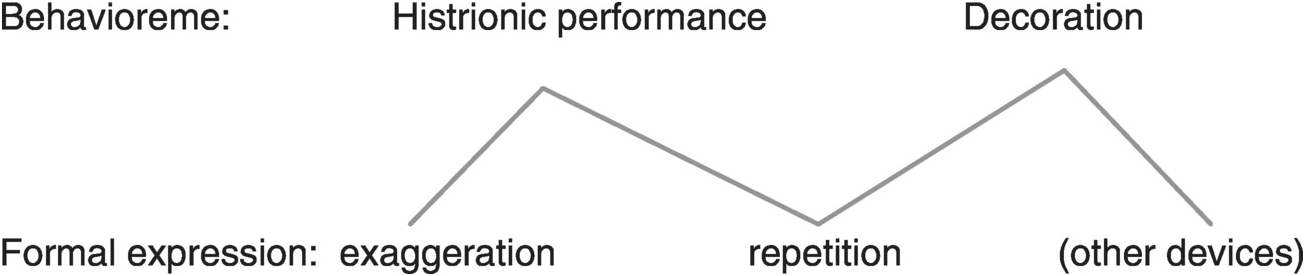
This overlap goes to the point that in some languages, by a familiar conditional perfection operation, the two commingle entirely.
Writing about something like the symmetrical compounds just reviewed here, Nacaskul (Reference Nacaskul and Jenner1976:874–5) writes as if this were a phenomenon confined to languages like Khmer:
To non-native speakers of Southeast Asian languages, the use of successive words of the same or similar meaning in the same grammatical position may seem not only redundant, but excessive.
Before acknowledging a purely decorative motivation for twin forms in Khmer and possibly other languages, we should consider the possibility that such formal symmetry as they exhibit is iconically motivated. Formal parallelism, or balance, as a matter of personal style, is largely semantically motivated: fondly do we hope, fervently do we pray, and so on. There are, in addition, purely grammatical syntactic constructions that express conceptual symmetry: coordinate conjunction (Ross Reference Ross1967), counterfactual conditionals (Haiman and Kuteva Reference Haiman, Kuteva, Bybee and Noonan2003), distributive expressions (Haiman Reference Haiman, MacWhinney, Mal’chukov and Moravcsik2014), and possibly comparatives. It is not surprising to see that these constructions also manifest formal symmetry.
Khmer, like many other languages, provides an example of formal expression for distributives like a dollar apiece. Where English lexicalizes distributivity with words like each, apiece, Khmer expresses the concept by symmetrical repetition. Here are some examples:
| m-kha:ng | pi: | neak | pi: | neak |
| one-side | two | person | two | person |
‘two people on each side’
| kmee:ng | voat | m-neak | m-neak | |
| youth | temple | one-person | one-person |
‘each temple boy’
For a spectacular, if parochial, example of the same phenomenon, consider comparisons, which are a kind of coordination between a standard and something that is measured against it. I therefore view
(more) X (rather) than Y
as a balanced, coordinate construction. It happens to be a presumably marginal fact of English that the comparative degree can be expressed either periphrastically or inflectionally: more intelligent versus smart-er. Usually, the periphrastic form is required for multi-syllabic bases, hence * intelligent-er, and the inflectional form is required for monosyllables, hence *more tall.
Consider now the case where two contrasting features of the same subject are compared. English offers us the possibility of saying either
She is smarter than she is pretty
She is more smart than pretty
Oddly, it is impossible to say
*She is smarter than pretty
One possible explanation of this marginal but not entirely isolated fact (comparable facts are attested in Ukrainian and Swedish) is that the two grammatical sentences maintain some formal parallelism between the two conjuncts linked by than. In the first, the morphology of the comparanda is asymmetrical, but at least two clauses with parallel syntactic structures are contrasted; in the second, the ‘standard’ clause has been reduced to a single word – but here the comparanda are given in the same form as single adjectives: smart and pretty. In the deviant sentence, all parallelism has been abandoned: not only is a clause she is smarter juxtaposed with a single word pretty, but that word is in a different form than the corresponding word in the comparative clause: smarter is not morphologically parallel to pretty.
Other explanations are, of course, possible: a common one is to posit a minimal distinction in meaning between the two acceptable examples. To say more smart than pretty is not to compare degrees to which different properties are realized, but rather to compare the properties themselves. It is to say something absolute like ‘she is smart, rather than pretty’. Without going beyond English, the candidate explanation proposed above may seem far-fetched. However, the commonsense explanation fails totally to predict what classical languages like Latin, Greek, and Sanskrit have independently done with this sentence (cf. Kühner-Stegmann Reference Kühner and Gerth1904:312; Schwyzer-Debrunner Reference Schwyzer and Debrunner1950:185). Using Latin examples, we encounter the spectacular structures
| Aciēs | erat | longior | quam | latior |
| battle-line | was | longer | than | wider |
‘the battle line was longer than it was wide’
(Literally: ‘the battle line was longer than wider’)
| Haec | diligent-ius | quam | apert-ius | dicta | arbitror | |
| this | passionater | than | opener | said | I think |
‘I think these words were said with more passion than honesty’
(Literally: ‘I think these words were said more passionately than more honestly’)
Where differing degrees of contrasting properties are being compared, the blatant drive for the symmetric formal expression of a kind of conceptual symmetry alone is responsible for an incoherent sentence in the classical languages, as it is for the acceptability pattern of the English sentences.
So it is clear that conceptual symmetry may be iconically reflected in formal symmetry. It should be immediately apparent, however, that the twin forms that look so much like ideophones in Khmer are also not referentially motivated: rather than reflecting a state of affairs, and painting the thing as they see it, speakers who use them are conjuring up out of thin air a symmetry that corresponds to nothing in the external world. It seems to be a case of art for art’s sake.
A purely decorative drive for symmetry is certainly not as familiar as either the iconically motivated drive for repetition to reflect conceptual symmetry, or the equally iconically motivated drive for repetition or reduplication to express intensification or repetition. It is possibly less familiar even than the histrionically motivated reduplication of ideophones, and so it may be useful to establish a stronger claim for its existence with some further examples. Non-referential repetition is marginally attested in Western languages, and has been noted in discussions of baby talk (Paul Reference Paul1880:187) and ‘aggressive reduplication’ (Zuraw Reference Zuraw2002:395; Wälchli Reference Wälchli2005: in both cases “a purely phonological drive to impose a reduplication-like structure on words … [so that] already similar syllables are made more similar.” (Zuraw Reference Zuraw2002). But it is unlikely that a two-year-old is aesthetically motivated in substituting tato for [gato] ‘cake’, and it is not at all clear what drives people to improve on orangutan to convert it into orangutang.
I would like to show with some examples that at least some cases of conventional and familiar phenomena such as grammatical agreement may be so motivated. We have noted that most things may be easier said than done, but agreement is certainly easier not said than said, so it certainly is incompatible with a principle of least effort. That there is certainly no functional need for it in any language is evidenced by the languages in which it is entirely lacking (Paul Reference Paul1880:304). In fact, it is expensive, and denigrated by Jespersen as superfluous, cumbersome, and primitive (Jespersen Reference Jespersen1894:45; Reference Jespersen1924:207). Dahl (Reference Dahl2005:201) calculates that eliminating gender and agreement based on gender in a language like Spanish “could save millions of hours of conversation every day. In the same way, and average Spanish novel could be twenty to thirty pages shorter if gender markers were deleted.” Indeed, “if we ask … why it occurs at all, we find that our understanding is limited” (Corbett Reference Corbett2006:1).
There seems to be agreement that two kinds of common agreement can be distinguished: agreement between arguments and predicates on the one hand and agreement between a head and its modifiers on the other (Heine and Reh Reference Heine and Reh1984:230; Lehmann [Reference Lehmann1982]/1995:56–60; Chung Reference Chung1988:3). That the two are distinct is confirmed by the fact that there are languages, like Hua, Turkish, and Hungarian, which have only argument/predicate agreement. This kind of agreement arises very often as the reduction of pronouns to affixes, and is plainly the result of grammatical erosion, as investigators since Bopp (Reference Bopp1816) have recognized. Agreement between a head and its modifiers, on the other hand, cannot be explained in this way, and it is this that I want to consider here. The idea that such agreement may be aesthetically motivated is voiced by Ferguson and Barlow (Reference Barlow, Ferguson, Barlow and Ferguson1988:17–18):
It is interesting to note that all the functionalist explanations of agreement are in terms of efficiency in the referential use of language: no one seems to have considered the playful poetic aesthetic use of language, which is probably of considerable importance in the evolution and acquisition of language, as well as contributing to the creative system-building side of language. It might be worth exploring the possibility that agreement persists and even spreads in response to the same kinds of factors at work in the conventionalization and persistence of rhymed word-pairs, prose rhythms, patterned repetitions, and the like.
It could be that the initial basis for such agreement may lie in the collocability of independently inflecting parts of speech such as demonstratives and nouns in a single noun phrase like this house (Paul Reference Paul1880:304; Greenberg Reference Greenberg and Greenberg1978:75–8). So Greenberg notes that “demonstratives are constantly producing concord phenomena” as exemplified by phrases like these houses even in English, a language with limited inflectional morphology, or in Hungarian, where nominals are inflected for both case and number. In Hungarian, demonstratives are arguably in apposition to full noun phrases, and mark case and number independently of the noun phrase that they precede:
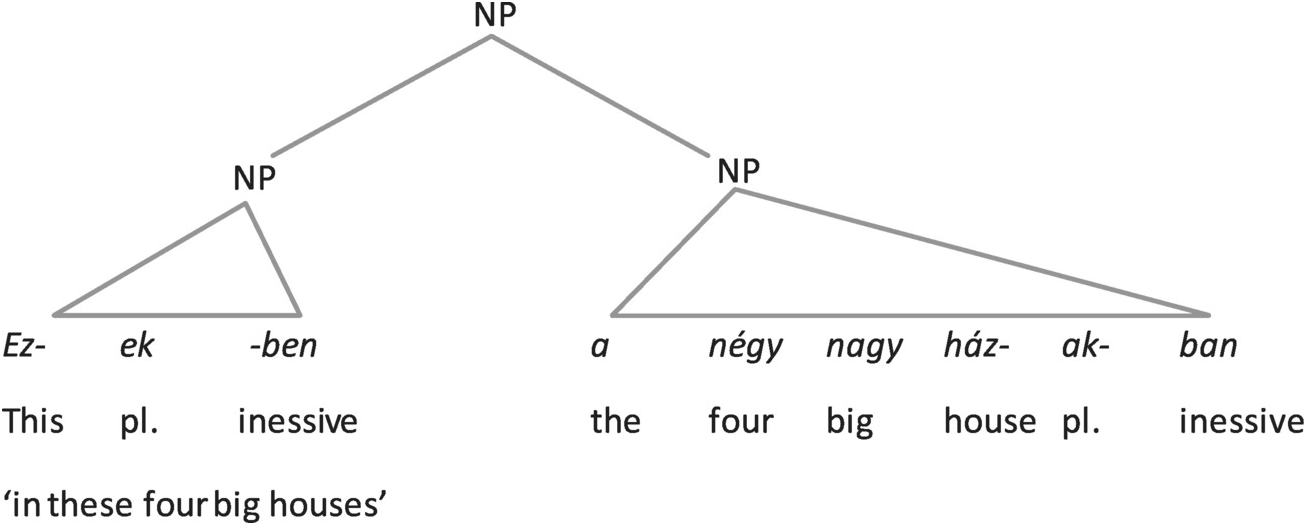
Note that within the noun phrases themselves, only the head nouns ez and ház are marked for case and number, while the modifiers in the second noun phrase, the definite article, the quantifier, and the prenominal adjective, are not.
Now, apposition, like coordinate conjunction, is used to express a conceptually symmetrical idea. In this case, the symmetry is that of referential identity – in a phrase like I, Claudius both noun phrases are referring to the same entity playing the same role in the clause. So it is not surprising, given iconic motivation, that they should be marked in the same way.
The fundamental question, however, is how in languages with more elaborate agreement such a pattern gets spread out to other non-nominal parts of speech within the noun phrase, such as articles, numerals, and adjectives. There may in fact be a parallelism between spread on the one hand, and loss on the other. Marchese (Reference Marchese, Barlow and Ferguson1988:335–40) points out in her discussion of agreement in Godie, a Kwa language, that while agreement between nouns and demonstratives is fairly stable, adjective agreement is subject to different degrees of erosion in all Kwa languages, although she acknowledges that the reasons for this asymmetry remain problematic. Perhaps last hired is first fired.
Two agencies whereby spread occurred now suggest themselves. The first (proposed by Heine) to appear is of analogical extension. It is often the case that the head noun may be zeroed in anaphoric expressions like the good, the true, and the beautiful. In some languages where inflectional categories such as case and number occur only on the head noun, noun phrases with zeroed heads may allow the case and number affixes to appear on the remaining final member of the noun phrase, which may be the prenominal adjective. Hungarian is such a language:
| a | jó | ember- | ek- | töl |
| the | good | person | pl. | from |
‘from the good people’
Corresponds to a headless noun phrase:
| a | jó- | k- | tol |
| the | good | pl. | from |
‘from the good ones’
Something like this, Heine proposes, may have been the source for the inflectional endings on adjectives that are common in both headed and headless noun phrases in German. These inflectional endings, he points out, are still identical with personal pronouns that may have stood as the functional equivalent of zero.
| ein | gut- | es |
| a | good | n.sg. |
‘a good one’ (NB: es is also the 3sg. neuter pronoun ‘it’)
| ein | gut- | er |
| a | good | m.sg. |
‘a good one’ (NB: er is also the 3sg. masculine pronoun ‘he’)
In other languages, such as those of the Slavic and Baltic subfamilies of Indo-European, the so-called definite adjective form is in fact transparently a compound of a basic adjective form and a following third person pronoun ‘them’ *jo, exactly along the lines proposed by Heine for German. But it is not only the definite adjective form that manifests inflectional agreement with the head noun in German – so does the basic adjective. Where did agreement come from in those cases, where no pronoun them can be identified?
Here I am proposing that an entirely different spreading mechanism may exist. Given that within a noun phrase consisting of Demonstrative + Adjective + Noun there is already agreement between the first and last members of that syntagm, there may be an aesthetic generalizing tendency to ‘even things out’ by making all three members rhyme, resulting in what Sapir called the ‘relentless rhyme’ of phrases like the Latin ill-orum bon-orum vir-orum ‘of those good men’.
Some rather weak evidence in favor of the rhyme idea is this: Where agreement has a history, there is evidence that it originally rhymed, and that this original rhyme has been eroded. In Slavic the short or predicate (that is, the basic) form of the adjective rhymes almost perfectly with the head noun (Vaillant Reference Vaillant1958:496; Mirchev Reference Mirchev1978:175; Leskien-Rottmann Reference Leskien and Rottmann2002:69), and it is only the definite form, which is now required in attributive position in all but a few relic forms, which does not. Some relic forms illustrating this rhyme in Russian are
| sred | bel- | a | dnj- | a |
| among | white | gen.sg.masc. | day | gen.sg. masc. |
| ‘in broad daylight’ | (still current) | |||
| na | dobr- | a | konj- | a |
| on | good | acc..sg.masc. | horse | acc.sg.masc. |
| ‘on the good horse’ | (Pushkin) | |||
| po | bel- | u | svet- | u |
| over | white | prep.sg.masc. | world | prep.sg.masc. |
| ‘over the wide world’ | (Pushkin) | |||
In *Proto-Indo-European, there was apparently no clear distinction between adjectives and nouns. All of them counted as nominal, which could be independently marked for number, case, and gender, so there was no ‘spreading’ to be accounted for (Brugmann-Delbrück Reference Brugmann and Delbrück1911:652). But in the modern languages, agreement was something that had to be reinvented, not something that was maintained. Phonetic rhyme argues (as I admit, weakly) for the form of agreement systems in Slavic and Baltic. Much stronger evidence would be available if we could have seen this agreement system in statu nascendi.
And we do see what may be such cases in modern languages – comparable, it may be, to the agreement patterns that seem to be coming into existence in decorative compounds in Khmer.
Plank (Reference Plank and Plank2003) describes the optional multiple marking of (in)definiteness within the noun phrase in his Bavarian dialect of German. Currently substandard structures like
| was | ganz | was | neues |
| something | quite | something | new |
‘something quite new’ (instead of standard (et)was ganz neues)
may arise as blends of two grammatical possibilities, one of them with the indefinite pronoun before, the other with the pronoun after, ganz. This explanation, he admits, is implausible for those cases where no variants exist that could be blended. Substandard
| zwei | ganz | zwei | alte | Brezn |
| two | quite | two | old | pretzels |
‘two quite old pretzels’
can correspond to only one grammatical form: zwei ganz alte Brezn.
Plank suggests that the force of this double marking is “to impart a characteristically emotional flavor to one’s words” (375), and that it is “only natural that peoples ruled by passions and given to laissez-faire should have gone on record as being the most prolific double articulators” (386). But if ‘spirited emphasis’ is what is being expressed, for example in phonetic expressive doubling (e.g. [ImmƏr] instead of [ImƏr] ‘always’, cf. Martinet Reference Martinet1955), what exactly is being ‘emphasized’ in expressions of this sort? The number ‘two’? We can only agree on one thing; whatever the motives for doublings of this sort, neither the drive for clarity nor the principle of least effort can account for them.
Poplack (Reference Poplack1980a, b, Reference Poplack, Sankoff and Cedergren1981) provides evidence of something very similar to Plank’s noun phrases, except that the repeated morphemes are exactly inflectional ones, in Puerto Rican Spanish. Standard Spanish marks agreement within the noun phrase for both number and gender:
| l- | as | chic- | as | bonit- | as |
| the | f.pl. | girl | f.pl. | pretty | f.pl. |
‘the pretty girls’
As a given, there is nothing we can say about this familiar pattern: It is an eroded (e.g. no cases are marked) version of what the language inherited from Latin. But in PR Spanish, even this pattern begins to break down. Final –s is a sociolinguistic variable in PR Spanish, and schematically, the syntagm above can appear in eight different forms, with the final –s either present or absent on each and every word. In one acceptable variant, motivated by the principle of least effort, one might suppose, the plural is totally identical with the singular la chica bonita. In another, motivated perhaps by the drive for maximum clarity of expression, the plural is as distinct as possible from the singular, and is pronounced ‘by the book’, as in the standard language. What Poplack found was that in 73 percent of her corpus, deletion was maintained throughout. If, however, the first two words in the syntagm had retained the suffix, then with 56 percent of her tokens, the final –s was also retained in the final word. So the preferred versions of the syntagm above are
las chicas bonitas
la chica bonita
What Poplack announced on the basis of her data was “a tendency toward concord at the string level” (Reference Poplack1980a:377), exemplified by the preference for
las chicas bonitas over
las chicas bonita
This result, as she correctly noted, ran “counter to any functionalist claim,” whether of clarity or of laziness, since “one plural marker leads to more, but zeroes lead to zeroes” (378). Marker deletion in the final word occurred “precisely in those environments where most information was lost” (381) – a finding apparently similar to those of other researchers working on Brazilian Portuguese. In his approving review of Poplack’s work, Labov restates her findings as the “tendency of the speaker to continue the pattern at the beginning of the noun phrase” (Labov Reference Labov1994:559). A perfectly good name for this tendency, of course, is the creation of semantically unmotivated, or decorative, agreement patterns.
As for what could motivate such a tendency, Labov invoked “a principle of least effort at the grammatical level” (Labov Reference Labov1994:559), but it seems to me that this may be an unwarranted overworking of the concept of least effort. It is true that the tendency to repeat whatever one is doing, including pronouncing a string that we are primed for, is real: It underlies the tongue twister status of phrases like toy boat (to be repeated three times, quickly: Most people wind up stumbling by repeating the initial diphthong). But least effort consistently maintained as a principle means to do less, period. It is no more inherently plausible to claim that speakers will say las chicas bonitas rather than some lazier output, than it would be for a Khmer speaker to claim that symmetrical compounds are somehow easier to pronounce than the single words with which they are synonymous. We know, from fairly extensive studies of casual speech, and even drunken speech, that exercising less effort can result in underarticulation: assimilation, neutralization, consonant cluster simplification, and the loss of unaccented syllables and perhaps even vowel harmony (Stampe Reference Stampe1969; Bailey Reference Bailey1974:13; Lester and Skousen Reference Lester and Skousen1974; Donegan Reference Donegan1985:1). It has not been observed to result in the spontaneous generation of canonically unsanctioned agreement.
As far as I know, it has not been claimed by anyone that the exuberant parallelism of synonym and other symmetrical compounds in Khmer and of phenomena like the coordinate structure constraint are the outcome of the same drive as that which Barlow and Ferguson suggested may produce grammatical agreement. As a phenomenon that may, however, suggest a link between the two, I want to present some examples uncovered by Wälchli (Reference Wälchli2005:2.5.8) of ‘inflectional harmony’ precisely between the members of symmetrical coordinate compounds in some Uralic languages. (Since coordinate structures are conceptually symmetrical, the cases below are iconically motivated, but only in part.) In Mordvin (and in some Finnish dialects), symmetrical pairs like ‘Igor and Natasha’, ‘an old man and an old woman’, where each of the conjuncts is singular, appear with a semantically unmotivated plural suffix:
| ata | -t | baba- | t | |
| old.man | pl. | old.woman | pl. |
‘an old man and an old woman’
| Igor- | t | Natasha- | t | |
| Pl. | pl. |
‘Igor and Natasha’
These forms are now systematically ambiguous: The first could also mean ‘old men and old woman’, the second (less plausibly) ‘the Igors and the Natashas’. The gain in expressing symmetry overtly, with a semantically unmotivated number affix, presumably outweighs the cognitive cost. In Mansi, the phrase ‘Marx and Engels’ becomes
| Marks- | yg | Engels- | yg |
| dl. | dl. |
In Khanti, ‘here and there’ becomes:
| togos- | ngeun | tiis- | ngeun |
| there | dl. | here | dl. |
All of the above should establish the plausibility of decoratively motivated repetition as a structure that is formally similar to but distinct from iconically motivated symmetry, iconically motivated reduplication, and histrionically motivated repetition. I therefore believe that the case for twin forms in Khmer as ideophones has not been made.
The fact remains that in other languages like Hmong decorative jibber jabber words are ideophones by all or most of the criteria that serve to identify them. Why should there be any conflation of the two? Perhaps it is because the two motivations – ludic and decorative – are both at some degree of abstraction the same one. In art, we recognize that representation and decoration are distinct motivations, but we recognize both of them as aesthetic. Perhaps that identity is responsible for both ideophones and twin forms having the same or similar forms. McGloin and Toghbaksh have observed that proverbs such as
‘Birds of a feather flock together’(Ong’s ‘memorable thoughts’) not only tend to have symmetrical forms: People are more likely to believe them because they do. Perhaps, at the deepest level, we believe that beauty is truth.
7.10 The Game Hypothesis
But there may be a still closer connection between the ludic and the decorative impulses. We turn now to a fourth strategy for the creation of retinue words in Khmer. Once we have disposed of synonym compounds, including alliterating synonym compounds, and compounds whose junior member is conscripted for reasons of alliteration, or made to alliterate, we are left with a still sizable residue of meaningless junior forms that are not and were not synonyms, nor other independent words that happened to sound right. In the absence of productive rules of reduplication, the question remains, where did all these other forms come from?
As it happens, they may have arisen as the result of a game. Mention has been made of portmanteau words like smog and brunch. These may have been far more frequent, even in the history of English, than a few random examples may suggest (cf. Bergstrom Reference Bergstrom1906; Pound Reference Pound1914). In Khmer, the practice of making up Spoonerisms of this sort is institutionalized in a word game of rhyme swapping called piak kat kunloah ‘word slice and dice’ (Farmer Reference Farmer2008), which involves doing exactly what speakers of English do when making up words like smog. They take the onset of one word and splice it together with the rhyme of another, but keep both pairs. Given an ‘input’ like smoke+fog, they produce an ‘output’ like smog +foke. The new pair is then a joke-y version of the input pair. Khmer grammarians in particular (cf. Sisowat Reference Sisovat1972; Chun-Leuh Reference Chun-Leuh2007) are enthusiastic in tracing many retinue words to this game. Here is how it works.
Originally, a word may appear in a compound with a near synonym. Thus
| thom | tuliej |
| big | roomy |
| ‘big and roomy’ | |
By rhyme swapping, this compound is transformed into two nonsense words:
| th-iej | tul-om |
| (nonsense) | (nonsense) |
Both of these nonsense words are now ‘available material’, which can be conscripted to serve as retinue words. The nonsense word tulom may thus appear in a new compound with the meaningful word tuliej:
tulom tuliej
‘roomy’
What is the source of the junior word in this existing retinue compound? Native speakers unhesitatingly say it is the result of the playful deformation of the synonymous thom and tuliej. Other examples (cf. Farmer Reference Farmer2008; Haiman Reference Haiman2011) include psa: psao ‘market’ (whose second word psao derives from psa: ‘market’ via a rhyme swap of the expression psa: mian cao ‘there are thieves in the market’), jom jaek ‘weep’ (from the synonym compound jom sraek ‘weep cry’ via the nonsense pair jaek srom).
Authorities like Sisovat most likely go too far in their enthusiasm, and some of the etymologies that they propose are reminiscent, in their naiveté, of the folk etymologies of the Cratylus. But it speaks in favor of the ‘slice-and-dice’ hypothesis that it accounts at once (and possibly redundantly) for the fact that the overwhelming majority of junior words in Khmer retinue words alliterate with the base word: given the mechanics of the game, it will ‘spit out’ alliterating, and not rhyming, forms.
So here in Khmer, the decorative is traced back directly to the ludic. The formal device of doubling repetition is pressed into service both to signal a depictive ideophone, whose metamessage is:
‘Pay attention: I am doing this to show you something’,
and also to make an artwork
‘Pay attention: I am doing this to make you admire it’.
But we recall that the same formal device of reproductive repetition may have been used when practical acts were first transformed into signs, whose metamessage was almost exactly the same
‘Pay attention! (I am doing this so you can see it’).
Viewed in this way, the ludic and the aesthetic are not only closely related to each other, they are related to all signs. The motivation for the genesis of language is then the same as motivation for the genesis of play and art. All of them originate when actions are stylized in some way to draw attention to themselves.
In a final plea for the recognition of the aesthetic as a motivation in human language, I would like to very briefly recall two universals of language change that are the bread-and-butter of historical linguistics: the putative exceptionlessness of sound change and the existence of analogy. The existence of both and the conflict between them have been standard topics in historical linguistics for nearly 150 years. While the last word has not yet been said on whether sound laws truly do ‘operate without exceptions’ (cf. Labov Reference Labov1981), nobody disputes that the statement is at least a plausible contender, with a good chance of being true. It is thereby distinguished from any other universal maxim that has ever been proposed for any other kind of change in human behavior. Not even Parkinson’s Law or Lord Acton’s ‘power corrupts’ comes close. Nobody, however, has expressed any opinion as to where and how this regularity, or the very fact of analogy, may have come into being.
A crucial observation, and the only novel one I offer, may be this: Neither of these, as far as I can tell, have any congeners in biological evolution. A priori, there is no reason that they should, but given the extensive parallels between linguistic and biological evolution, sketchily outlined in Chapter 5, this fact alone is worthy of note. It is tempting to think that specifically human agency and volition may have something to do with both sound change and analogy, and with what they have in common. Consciously or not, both the regularity of sound change, and the fact of analogy, may be motivated by the same essentially aesthetic drive for orderliness. I end on this note.
I believe it was Voltaire who once derided the chutzpah of some unfortunate German metaphysical philosopher, who, “living in the North of Germany, declared that God could make only this one world.” All non-eye-witness-based speculations, including those from persons living in the south of Minnesota, are emphatically vulnerable to Voltaire’s gibe. We are all parochial. Pending time travel, and so on., the best we can expect of any speculative account is that it be compatible with present-day observations. Other things being equal, however, we will favor an evolutionary account over one that pre-emptively throws up its hands at the unknowability of it all. And here the biologists and students of human affairs in general may finally have an advantage over the physicists.
For physicists, explanations consist of laws of maximum generality. Where these laws may have originated, or from what, is not entertained as a meaningful question. We, as biologists in general and as students of human language in particular, have the enormous advantage of having reason to believe, and hoping to show, that ‘everything is the way it is because it got to be that way’, and most likely rather gradually. I have tried here simply to capitalize on this advantage, and contribute some actual data that have not yet been given due consideration in speculative accounts of the evolution of human language.
That the data are skimpy goes without saying. Many more than the few dozen languages that I have examined here, of the ‘7102’ languages spoken in the world today, exhibit the atavisms knowns as ideophones. It remains for others who know, or who even know of, these other languages to see whether the patterns described here are adequately representative of what may be a far more widespread phenomenon.
But perhaps this is how it all happened.
