Translation
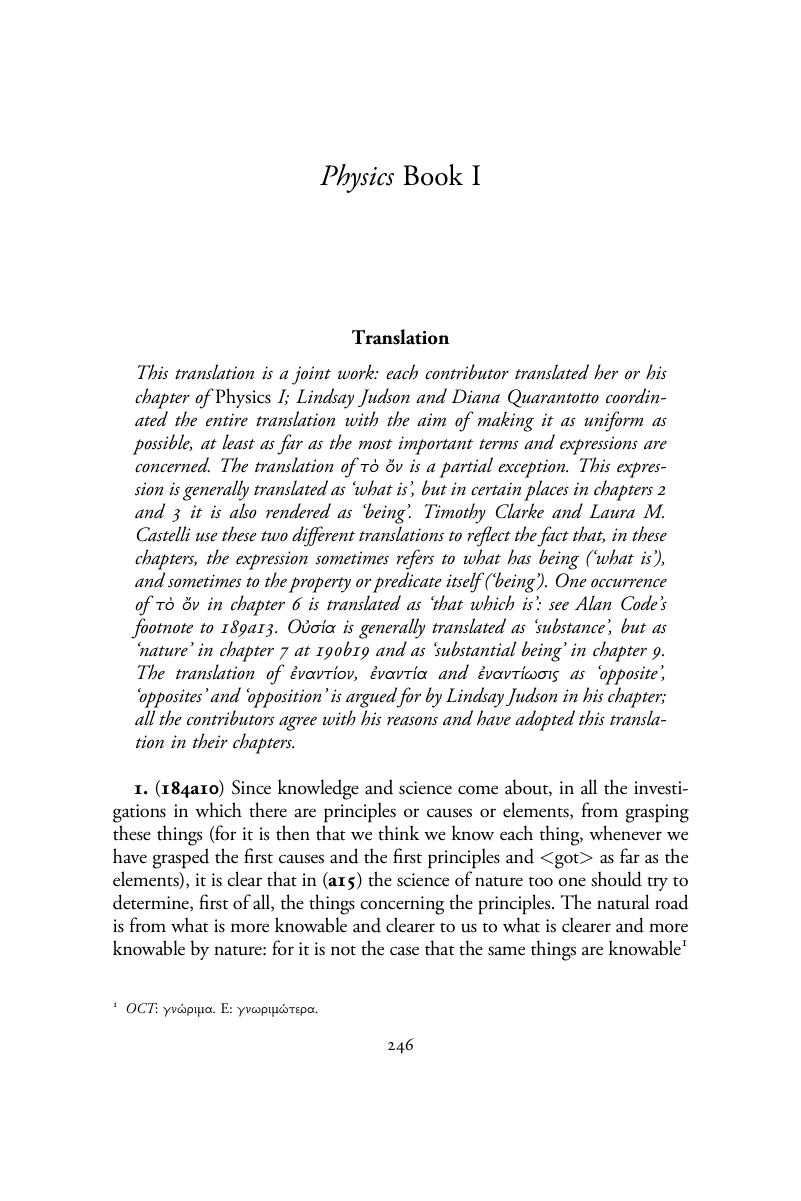
This translation is a joint work: each contributor translated her or his chapter of Physics I; Lindsay Judson and Diana Quarantotto coordinated the entire translation with the aim of making it as uniform as possible, at least as far as the most important terms and expressions are concerned. The translation of τὸ ὄν is a partial exception. This expression is generally translated as ‘what is’, but in certain places in chapters 2 and 3 it is also rendered as ‘being’. Timothy Clarke and Laura M. Castelli use these two different translations to reflect the fact that, in these chapters, the expression sometimes refers to what has being (‘what is’), and sometimes to the property or predicate itself (‘being’). One occurrence of τὸ ὄν in chapter 6 is translated as ‘that which is’: see Alan Code’s footnote to 189a13. Oὐσία is generally translated as ‘substance’, but as ‘nature’ in chapter 7 at 190b19 and as ‘substantial being’ in chapter 9. The translation of ἐναντίον, ἐναντία and ἐναντίωσις as ‘opposite’, ‘opposites’ and ‘opposition’ is argued for by Lindsay Judson in his chapter; all the contributors agree with his reasons and have adopted this translation in their chapters.
1. (184a10) Since knowledge and science come about, in all the investigations in which there are principles or causes or elements, from grasping these things (for it is then that we think we know each thing, whenever we have grasped the first causes and the first principles and <got> as far as the elements), it is clear that in (a15) the science of nature too one should try to determine, first of all, the things concerning the principles. The natural road is from what is more knowable and clearer to us to what is clearer and more knowable by nature: for it is not the case that the same things are knowableFootnote 1 to us and also <knowable> without qualification. For this very reason, it is necessary to proceed in this way from what is unclearer (a20) by nature but clearer to us to what is clearer by nature and more knowable. What is initially evident and clear to us are the things that are confounded to a degree: it is only later, starting from these [confounded] things, that the elements and the principles come to be known to those who divide them. For this reason, one must advance from the universals toFootnote 2 the particulars: for the whole (a25) is more knowable in relation to perception, and the universal is a sort of whole, for the universal comprises many things asFootnote 3 its parts. (184b1) The same thing happens in a way to names in relation to their definition: <a name> signifies some whole in an indefinite way, e.g. ‘circle’, whereas its definition divides it into the particulars. Children too at first callFootnote 4 all men fathers and all women mothers, and later distinguish each of the two.
2. (b15) There must either be one principle or more than one. If there is one, it must either be unchanging, as Parmenides and Melissus say, or changing, as the natural philosophers say, some saying that the first principle is air, others that it is water. And if there is more than one, there must either be a limited or an unlimited number. If a limited number greater than one, there must either be two or three or four (b20) or some other number. And if there are an unlimited number, then either, as Democritus says, the genus is one and they are distinguished by shape or by species, or they are also opposites.Footnote 5 And those who inquire into the number of the things that are are also inquiring in a similar way. For they inquire primarilyFootnote 6 into what the things that are are from, asking whether these things are one or many, and if they are many, whether there are a limited or unlimited number, so that (b25) they are inquiring into whether the principles and the elements are one or many.
Now, to investigate whether what is is one and unchanging is not to investigate into nature. (185a1) For, just as for the geometer too there is no longer any argument to give against an opponent who destroys the principles, but this is instead something either for another science or for one common to all, so too for the person investigating principles. For there is no longer any principle if it is only one, and one in this way; for a principle is a principle of some thing or things. (a5) So, to investigate whether it is one in this way is like arguing dialectically against any other thesis put forward for the sake of argument (like the Heraclitean thesis, or if someone should say that what is is one human being), or like solving an eristic argument, which is just what both arguments contain, both Melissus’ and Parmenides’. For they assume falsehoods, (a10) and are not deductive. Or rather, the argument of Melissus is crude and contains no difficulty – grant him one absurdity and the others follow: this is not very hard. But, for our part, let it be assumed that natural things, either all or some of them, undergo change. This is clear from induction. And at the same time nor does it belong <to us> to solve everything; (a15) only those which someone falsely proves from the principles, but not others, just as it is the task of the geometer to solve the quadrature by way of segments, but not the quadrature of Antiphon. However, although <the Eleatics do> not <speak> about nature, they nonetheless happen to state physical difficulties.Footnote 7 So it is presumably a good idea to have a little dialectical discussion (a20) about them. For the investigation does contain some philosophy.
Since being is said in many ways, the most appropriate starting-point of all is to ask in what way those who say that ‘all things are one’ speak <of being> – whether all things are substance, or quantities, or qualities, and again whether all things are one substance, like one human being, or one horse, or one soul, (a25) or whether all things are quality, and this is one, like pale or hot or one of the other things of this sort. For all these differ a great deal, and all are impossible to maintain. For if, on the one hand, there is substance and quality and quantity, then whether these things are detached from one another or not, the things that are will be many. But if, on the other hand, all things are quality or quantity, then whether substance is (a30) or is not, this is absurd, if one should call the impossible absurd. For none of the others is separate apart from substance. For all <the others> are said of substance as an underlying thing. And Melissus says that what is is unlimited. Therefore what is is a quantity. For the unlimited is in the <category of> quantity, and it is not possible for a substance or a quality or an affection to be unlimited, (185b1) except incidentally, if they are at the same time also certain quantities. For the account of the unlimited employs quantity, but not substance or quality. If, therefore, it is both a substance and a quantity, what is is two and not one. But if it is substance alone, (b5) then it is not unlimited, nor will it even have any magnitude at all. For then it will be a quantity.
Further, since the one itself is also said in many ways, just as being is, it is necessary to investigate in what way they say that the universe is one. And we call one either the continuous, or the indivisible, or those things of which the account of their essence is one and the same, such as μέθυ and οἶνος.Footnote 8 Now, if it is (b10) continuous, the one is many. For the continuous is divisible to infinity. (And there is a difficulty concerning the part and the whole, although presumably it is not <a difficulty> for the argument, but <a difficulty> in its own right. That is, whether the part and the whole are one or more than one, and how they are one or more than one, and if they are more, how they are more. This also applies with regard to non-continuous parts. (b15) And if each part is one with the whole by being indivisible <with respect to the whole>, then <there is the difficulty> that they [sc. the parts] also bear this relation to one another.) But if it is one by being indivisible, then nothing will be a quantity or a quality, nor then will what is be unlimited, as Melissus says, nor limited, as Parmenides says. For the limit is indivisible, but not the limited thing. But if everything that is is one in account, (b20) as are mantle and cloak, then it follows that they are affirming the account of Heraclitus. For being good and being bad will be the same, and being good and being not-good, so that the same thing will be good and not-good, and a human and a horse, and their account will not be about the fact that the things that are are one, but about the fact that they are (b25) nothing.Footnote 9 And being this quality and being this quantity will be the same. And the more recent of the early thinkers were also troubled lest the same thing should turn out for them to be at the same time both one and many. This is why some people took away the ‘is’, like Lycophron, while others refashioned their speech, saying not that the human ‘is pale’, but that he ‘has-paled’, and not that he ‘is walking’, (b30) but that he ‘walks’, so that they would never make the one be many by adding the ‘is’, supposing that the one or being is said in only one way. But the things that are are many either in account (for example, being pale and being educated are different, yet the same thing is both; therefore the one is many), or by division (as with the whole and the parts). But here (186a1) they were already in difficulty, and they conceded that the one is many, as though it were not possible for the same thing to be both one and many – although not those that are opposed. For the one is both potentially and actually.
3. So, if one proceeds in this way, it becomes apparent that it is impossible that (a5) things that are be one, and it is not difficult to solve the arguments from which they argue for their claims. For both of them, i.e. Melissus and Parmenides, argue eristically (for their arguments assume falsehoods and are not deductive; or rather, the argument of Melissus is crude and contains no difficulty – grant him one absurdity (a10) and the others follow: this is not very hard). That Melissus draws fallacious inferences is clear: for he believes that, if everything that comes to be has a principle, then it is also assumed that everything that does not come to be does not have a principle. And this is absurd, too, that there is a principle of everything <that comes to be> – in the sense of a principle of the thing, not <just in the sense of a beginning> of the time <in which it comes to be> – and of generation, not of generation (a15) without qualification, but also of alteration, as if there were no change taking place at once. Furthermore, why should anything be unchanging if it is one? For as the part, too, being one, e.g. this water, moves in itself, why should the all not do the same? Furthermore, why should there not be alteration? Yet truly it is not possible that <what is altered> is one in form, unless this is meant with respect to that from which <alteration takes place> (a20) (and some of the philosophers of nature claim that <what comes to be> is one in this way, but not in that other way): for a human being is different in form from a horse and the opposites from each other.
Against Parmenides, too, one can use the same kind of arguments, even if there are some other arguments proper <to him>; and the solution is in one way that it is false, in another way that it does not entail the conclusion. It is false in as much as it assumes that being is said without qualification, (a25) when it is said in several ways; it does not entail the conclusion because, even if one assumed <the existence of> pale things only, given that the pale signifies one thing, pale things would nonetheless be many and not one. For the pale will be one neither by continuity nor in account: for being pale and what receives it will be different. And there will not be (a30) anything separate beyond the pale: for the pale and that to which it belongs are different not in as much as they are separate, but rather in being. However, Parmenides was not yet able to see this. In truth it is necessary to assume not only that being signifies one thing with reference to that of which it is predicated, but also that <it signifies> what is precisely being and what is precisely one. For the accident is said of some underlying thing, (a35) so that that, to which being belongs as an accident, will not be (for it is other than (186b1) being); therefore, there will be something which is not. So, what is precisely being will not belong to anything else. For it will not be possible to be it while being something determinate, unless being signifies several things in such a way that each of them is something. But it is assumed that being signifies one thing. If, then, what is precisely being does not belong as an accident to anything, (b5) but other things belong to it, why should it be the case that what is precisely being signifies what is rather than what is not? For if what is precisely being is also pale, but being pale is not being precisely being (it is not possible that being belong to it as an accident: for nothing which is not precisely being is being), it follows that the pale is not being: and not in the sense that it is not something determinate, but in the sense that it is not (b10) being at all. What is precisely being, then, is not: for it is true to say that it is pale, and the latter signifies what is not. So that the pale signifies what is precisely being, too: therefore, being signifies several things. Nor will what is have magnitude, if what is is what is precisely being: for to be is different for each of the parts.
It is also evident through this argument that what is precisely being divides into something else which is in turn precisely some being: (b15) for instance, if the human being is something which is precisely some being, it is necessary that also the animal and the biped be something which is precisely some being. For, if they are not something which is precisely some being, they will be accidents. Therefore either they will belong as accidents to the human being or to some other underlying thing. But this is impossible: what is said to be an accident is this, i.e. either what can belong or not belong, (b20) or that in whose account there belongs that to which it belongs (for instance, sitting is an accident that can be separated, while the account of the nose, to which we say that the snub belongs as an accident, belongs in <the account of> the snub). Furthermore <there are things> which are present in the definitional account or from which <the definitional account> is constituted, while (b25) the account of the whole does not belong in their account – for instance, the account of the human being does not belong in the biped or the account of the pale human being does not belong in the pale. If, then, these things are in this way and the biped belongs as an accident to the human being, it is necessary that either it is separable, so that it would be possible for the human being not to be biped, or (b30) the account of the human being will belong in the account of the biped. But this is impossible: for the latter belongs in the account of the former. But if the biped and the animal belong as accidents to something else and are not each precisely some being, then also the human being will be an accident of something else. But let it be established that what is precisely being is not an accident of anything, and that the composite of both is said of that of which both are said. (b35) Will it follow that the all is therefore made of indivisibles? (187a1) Some gave in to both arguments, namely to the argument according to which all things are one, if being signifies one thing, by conceding that what is not is, and to the argument from dichotomy, by introducing atomic magnitudes. But it is also evident that it is not true that, if being signifies one thing and it is not possible that (a5) contradictories be the case at the same time, there will be nothing which is not: for nothing prevents what is not from being some determinate thing which is not, without being without qualification. And truly it is absurd to say that, if there is nothing else beyond what is itself, all things will be one. For who understands what is itself if it is not as something that is precisely being? But, if so, then nothing prevents things that are from being many, (a10) as it has been said.
It is therefore clear that it is impossible that what is is one in this way;Footnote 10
4. as for the physicists, on the other hand, there are two main ways in which they explain things. Accordingly, making what is a single body, i.e. what underlies – either one of the three, or something else which is more solid than fire but less solid than air – some (a15) produce everything else by means of density and rarity, and make [in this way] a plurality of thingsFootnote 11 (these are opposites, and, to put it in general terms, are excess and defect, as are, according to Plato, the great and the small, even though the one [i.e. Plato] makes the great and the small matter, and the one the form, while the others [i.e. the physicists] make the one, i.e. the underlying thing, matter, and make the opposites differences (a20) and forms). As for the others, <they argued that> the pairs of opposites are separated out from the one, in which they already were, just like Anaximander says, and also those who say that the things that are are both one and many,Footnote 12 just like Empedocles and Anaxagoras. For they too separate out everything else from the mixture. They differ, however, in that the former <argues that this process of separation> happens cyclically, while the latter (a25) <argues that> it happens once, and also in that the latter posits an unlimited number both of homeomerous bodies and of opposites, while the former posits only the so-called elements. It seems that Anaxagoras made <homeomerous bodies and opposites> unlimited in this way because he accepted as true the general opinion of the physicists that nothing comes to be out of what is not (this is the reason why they claim ‘things were all together’ (a30), and why he makes coming to be a certain sort of thing alteration, while they talk about aggregation and separation). Moreover, <he made homeomerous bodies and opposites unlimited> also because opposites come to be out of one another; therefore, they must already have been present as constituents. For if everything which comes to be must do so either out of things that are or of things that are not, and since of these coming to be out of things that are not is impossible (all those who study nature (a35) agree on that opinion), they believe that the other possibility necessarily follows: everything comes to be out of things that are and that are present as constituents, but cannot be perceived by us in view of the smallness of their bulk. (187b1) This is the reason why they claim that everything is mixed in everything, because they saw everything coming to be from everything; <they claim that> things only appear different, and are said to be different from each other on the basis of what is most predominant, quantitatively, in the mixture of the unlimited things; as a matter of fact (b5), nothing is purely a whole pale, dark, sweet, flesh, or bone, but whichever each thing has most of seems to be its nature.
Now if the unlimited as unlimited is unknowable, then that which is unlimited in number or size will be a certain unknowable quantity, while that which is unlimited in form will be a certain unknowable quality. (b10) If, then, the principles are unlimited both in number and in form, there can be no knowledge of the things they make up. For we think we have knowledge of what is composite, when we know what things and how many it is from. Moreover, if it is necessary that if the part of a thing can be as large or small as you please, so can the whole thing (b15) (I mean one of the parts into which as constituents the whole is divided), and if it is impossible for an animal or a plant to be as large or small as you please, it is evident that neither can any of its parts be; for the whole would be in the same way. Now flesh and bone and such things are parts of animals, and fruits are parts of plants. (b20) It is, then, clearly impossible that flesh or bone or anything of that sort could proceed as far as you like in largeness or smallness. Further, if all such things are already present in one another, and do not come to be, but are merely separated out, being already there and are called according to what predominates in them, and if anything comes to be out of anything (for instance water is separated out of flesh, (b25) and flesh out of water), and if any limited body is exhausted by a limited body, it is evidently not possible that everything should be present in everything. For suppose that flesh has been removed from some water, and then more flesh came to be by separation from what remains: even if what is separated is lower each time, (b30) yet <the separated flesh> never goes below a certain quantity. Hence if separation comes to an end, it will not be the case that everything is in everything (there will be no more flesh in the remaining water); if, on the other hand, it does not come to an end, so that the extracting keeps going for ever, there will be an unlimited number of equal limited parts in a limited magnitude; but that is impossible. (b35) Besides, if every body must become smaller when something is removed from it, and if the quantity of flesh is defined both in magnitude and in smallness, it is evident that from the least possible quantity of flesh (188a1) no body can be separated. For there would be a quantity of flesh smaller than the least possible. Furthermore, an unlimited amount of flesh, blood and brain would be present in the unlimited bodies, separated from one another but nonetheless being things that are, and each unlimited; (a5) but that is nonsense. Although he [i.e. Anaxagoras] speaks in ignorance, he is right to say that the separating out will never be completed; for affections are not separable. If colours and states are mixed together, then if they are separated out, there will be a pale or healthy which is nothing else, not even <an attribute> of an underlying thing. Thus, in seeking impossible things, his Mind is absurd, if it wants (a10) to separate things, while it is impossible to do this either according to quantity or according to quality; according to quantity, since there is no smallest magnitude, according to quality, since affections are not separable. He does not get right even the coming to be of the things of the same form. For in one way clay breaks down into clay (a15) but in another it does not. And it is not in the same way that bricks are and come to be out of a house and a house out of bricks, and that water and air are and come to be out of each other. It is better to assume fewer and limited things <as principles>, as Empedocles does.
5. Now everyone makes the opposites principles – those who say that the universe is (a20) one and unchanging (for even Parmenides makes hot and cold principles, and these he calls fire and earth), or that the principles are rare and dense, or Democritus <who says that they are> the full and empty, of which he says that the one is as what is and the other is as what is not. Further <he says that things differ> by position, shape, arrangement: these are genera of opposites – of position they are above and (a25) below, in front and behind; of shape angled and unangular, straight and curved. That everyone in a way makes the principles opposites is, therefore, clear. And this is reasonable: for the principles must be neither from each other nor from other things, and all things must be from them. These things belong to the primary opposites – on the one hand because primary things are (a30) not from other things, and on the other because opposites are not from each other.
We must, however, investigate how this turns out on the basis of general considerations. It must, then, be grasped first that of all the things that are, nothing is of a nature to do or to undergo just anything under the agency of just anything; nor does anything whatever come to be from anything whatever – unless one takes things incidentally. (a35) For how could pale come to be from educated, unless the educated were an incidental to the not pale or the dark? But pale comes to be from not pale, and not from all of this, but (188b1) from dark or the things which are intermediate; and educated from not educated, only not from all but from uneducated or from something intermediate if there is such a thing. Nor, then, does anything cease to be into just anything first – for example, the pale does not cease to be into the educated – unless sometimes incidentally – (b5) but into the not pale, and not into just anything but into the dark or what is intermediate. And in the same way also the educated into the not educated, and this not into just anything, but into the uneducated or into something intermediate if there is such a thing. And this holds in the same way in the other cases, since (b10) the same account holds also for those of the things that are which are not simple but composite; but this is overlooked because the opposed conditions have not been named. For it is necessary for everything structured to come to be from unstructured, and the unstructured from structured, and for the structured to cease to be into unstructuredness – and this is not just any unstructuredness but the (b15) opposed one. It makes no difference whether we are speaking of structure or arrangement or composition; for it is clear that the same account applies. Indeed, house and statue and anything else whatever come to be in the same way: for the house comes to be from these things not being put together but being separated in this way, and the statue and any of the things which have been shaped <come to be> (b20) from shapelessness. And each of these is either an arrangement or some kind of composition. If this is true, therefore, everything which comes to be or which ceases to be would come to be or cease to be either from opposites or into opposites and the things which are intermediate between these; and the intermediate things are from the opposites – e.g. colours from pale and dark. Consequently (b25) all the things which come to be by nature would be opposites or from opposites.
Up to this point most other thinkers have been more or less in complete agreement, as we have said earlier. For even if they suppose things without giving an account, nevertheless everyone says that the elements and the things they call principles are the opposites – as if (b30) compelled by the truth itself. They differ from each other in that some take things that are prior and some things that are posterior, and some take things that are more knowable in account, as has been said, and some things that are more knowable by perception: for some suppose hot and cold to be causes of coming to be, some moist and dry, and others odd and even or strife and love, (b35) and these things differ in the way I have mentioned. Consequently in a way they say the same things and in a way different things from each other – they are different, as indeed they seem to most people to be, yet they are the same (189a1) by analogy. For they take them from the same column; for some of the opposites include others, and some are included by others. In this way, then, they speak in the same way and differently, and worse and better, and some take the things that are more knowable in account, as was said (a5) earlier, and others the things that are more knowable by perception (for the universal is knowable in account and the particular by perception; for the account is of the universal, while perception is of the individual) – for example the great and the small in account, and the rare and the dense by perception.
That the principles (a10) must be opposites is evident;Footnote 13
6. what follows next is that we should say whether they are two or three or more. Well, they cannot be one, because the opposites are not one, and they cannot be unlimited, both because that which isFootnote 14 would not be knowable, and there is a single opposition in any single genus, and substance is some one genus, and because it is possible [to explain] on the basis of (a15) a limited number, and it is better [to explain] on the basis of a limited number – for instance as Empedocles does – rather than on the basis of an unlimited number; for he thinks that he explains just as much as Anaxagoras does on the basis of an unlimited number. Furthermore, some opposites are prior to others, and some come to be from others; for instance, sweet and bitter and pale and dark, but the principles must always (a20) remain.
Well, while it is clear from these points that they are neither one nor an unlimited number, given that they are limited in number, there is some reason for not making them only two; for one might raise a difficulty about how either density is of such a nature as to make rarity something, or rarity make density something; likewise too for any other opposition, for Love does not gather Strife (a25) and make something from it, nor does Strife make something from it, but both <make> some other third thing <into something>. And some assume even more things from which they construct the nature of the things that are. In addition to these points, one might raise a further difficulty over this, should one not posit another nature for the opposites: we do not see the opposites to be the substance of any of the things that are, (a30) and the principle ought not be said of some underlying thing. For <if so> there will be a principle of a principle, for what underlies is a principle, and is thought to be prior to what is predicated. Further, we say that a substance is not opposite to a substance. Well then, how could a substance be <constituted> from non-substances?; or how could what is not a substance be prior to a substance? Consequently, should one (a35) hold that both the earlier account and this account are true, it is necessary, (189b1) if one intends to preserve them both, to posit some third thing, just as those saying that the universe is some single nature affirm; <saying that it is>, for example, water or fire or what is intermediate between them; but it is thought that what is intermediate is more so, for fire and earth and air and water are already (b5) entangled with oppositions. Consequently, both those who make the underlying thing different from these [four], and of the others, those who make <it> air, do so not without reason; for of the others, air too has the least perceptible differentiae; and what follows next is water. But at any rate all of them shape this one [underlying thing] by means of the opposites, by density and rarity, and by the (b10) more and less; and these are clearly in general excess and deficiency, just as was said earlier. Also, this opinion, that the one and excess and deficiency are principles of the things that are, seems to be old, though not in the same way, but rather the earliest thinkers say the two act and the one is acted upon, whereas some of the (b15) later thinkers say rather the opposite, that the one acts and the two are acted upon.
Well, there would seem to be some reason to assert that the elements are three for those who are looking closely on the basis of these and other such considerations, just as we said, but that they are more than three no longer <would there be>. For the one [underlying thing] is sufficient to be acted upon, and if being four <opposites> (b20) there will be two oppositions, some other intermediate nature will need to belong separately to each; but if they are able to generate from one another, being two <oppositions>, one of the oppositions would be superfluous. At the same time, it is also impossible for there to be many primary oppositions. For substance is some single genus of what is, so that the principles will differ (b25) from one another only in being prior and posterior, but not in genus; for in every case there is a single opposition in the case of a single genus, and all oppositions are thought to be led up to a single <opposition>. Well, then, that there is neither one element, nor more than two or three is clear; but whether there are two or three, just as we have said, is very difficult.
7. (b30) This then is what we ourselves say, beginning with a discussion of coming to be in its entirety. It is natural first to speak of the common features and on this basis to examine what is distinctive about particular cases. We say that one thing comes to be from another and that something comes to be from something different, when speaking of simples or compounds. What I mean is this: it is possible for a human being to come to be (b35) educated, for that which is not educated to come to be educated or for (190a1) a non-educated human to come to be an educated human. By a simple I mean when the human and what is not educated is what is coming to be, and when the not educated is what comes to be. What comes to be and what is coming to be are compounded when we say that the not educated human (a5) comes to be an educated human. In some of these cases we say not only that this is coming to be but also that it is coming to be from this (as when we say that the educated comes from what is not educated) but this is not said in all cases. For it is not from a human that something educated came to be but a human came to be educated. Of the things that come to be, in cases we describe as involving simples, in one case something (a10) comes to be by remaining, in the other by not remaining. For the human remains when coming to be an educated human and is an educated human but that which is not educated and the uneducated remains neither without qualification nor in a composite form.
In the light of these distinctions, one can grasp in all cases of things that come to be, if one looks closely at the phenomena in the manner in which we speak of them, that something must (a15) always underlie (i.e. that which is in the process of coming to be) and that this [i.e. that which is in the process of coming to be], even if it is one in number, is not one in form (by ‘in form’ I mean ‘in account’). For being a human is not the same as being uneducated. And the one remains, the other does not. That which is not opposed remains (the human remains), the not educated and the (a20) uneducated does not, nor that which is put together out of these (e.g. the uneducated human). The expression ‘this comes to be from that’ (as opposed to the expression ‘this comes to be that’) is more used in the case of what does not remain, as when we say that what is educated comes to be from what is uneducated but not that it [i.e. the educated] comes to be from human. Nonetheless we do also sometimes speak in a similar way [i.e. using the ‘this comes to be from that …’ way] about what remains, (a25) saying that from bronze a statue comes to be, not the bronze comes to be a statue. However, we do speak in both ways in the case of something opposed that does not remain: we say both that this comes to be from that and this comes to be that. And so we talk of something educated coming from something which is not educated and of something which is not educated coming to be something which is educated. This is why we speak in a similar way about what is put together. For we say that both: from an uneducated (a30) human and the uneducated human comes to be educated. ‘Coming to be’ is said in many ways, and some things are said not to come to be but to come to be something or other, but substances alone are said to come to be without qualification. In all cases other than <the coming to be of substance>, it is evident that there must be something underlying, that which comes to be. For when a thing comes to be of such and such quantity or quality or (a35) in a given relation, at a given time or place, something is always present underlying (since substance alone is not said of another underlying thing, (190b1) while everything else is said of substance). But that even substances, and whatever things simply are, come to be from something underlying will be evident to one who looks closely. For always there is something that underlies, from which the thing generated comes to be: as in the case of plants and animals coming to be from (b5) a seed. Some of the things that come to be in the unqualified way come to be some by change of shape (as a statue), others by addition (as things that grow bigger), others by subtraction (as Hermes from the stone), others by composition (as a house), others by alteration (as things changed in accordance with their matter). It is evident that all things that come to be in this way (b10) come to be from what underlies. From what has been said it is clear that everything that comes to be is always a composite: there is something that comes to be and something that comes to be that <thing which comes to be>. There are two types of the latter: either that which underlies or what is opposed <to that which comes to be>. I say that the uneducated is opposed and human underlies; and (b15) shapelessness and formlessness and lack of order are opposed and bronze or stone or gold is what underlies.
It is evident that if there are indeed causes and principles of things which are by nature – from which first causes and principles these things are and come to be non-incidentally what it is said to be in describing its nature [ousia], then (b20) everything comes to be both from what underlies and its shape. For an educated human is, in some way, composed of a human and educated, in that it is decomposable into the accounts of these. It is clear, therefore, that things that come to be do so from these. What underlies is one in number but two in form. The (b25) human, the gold and in general the matter which is countable <is one in number>. It is more a this such [i.e. a determinate particular] and the thing that comes to be does not come to be from it incidentally. The privation and the opposition is incidentally. The form is one: for example, the arrangement or being educated, or any of the things predicated in this way. This is why it is the case that we should say, on the one hand, that the principles are two, (b30) on the other that they are three. For there are two as opposites (as when one speaks of the educated and the uneducated or the hot and the cold or the harmonized and the disharmonized), but in a way this is not so. For the opposites cannot be acted upon by each other. The problem is solved because what underlies is different from these: it is not (b35) an opposite. So in one way there are no more principles than the opposites, but they are so to say two in number; but they are not entirely two, (191a1) but three since something else is present which is essentially different from them. For being a human and being uneducated differ as do being shapeless and being bronze.
We have said how many principles there are for the coming to be of natural things and in what way there are that many. It is clear that there must be something which underlies (a5) the opposites and that the opposites are two <in number>. But, in another way, it is not necessary <to have three principles>: for one or other of the opposites will be enough to make the change by its absence or presence. The underlying nature is knowable by analogy. For as bronze stands to a statue or wood to a bed or (a10) the matter – that is, what is shapeless before it takes on shape – stands to what is shaped, so the underlying nature stands to the substance, which is a this such [i.e. an informed object] and what is. This then is one principle, although it is not one in the way a this such is one nor does it exist in the way a this such exists; there is also one other principle: that of which there is the account, and furthermore another: what is opposite to it, the privation. We have stated above in what way these are two principles, in what way (a15) there are more. For – to resume – it was said first that the opposites alone are the principles but later that there must be something that underlies and so that there are three principles. From these considerations it is now evident what distinguishes the opposites, how the principles are related to each other, and what type of thing that which underlies is. Whether the form or (a20) that which underlies is substance is not yet clear. But it is clear that there are three principles, in what way there are three, and what kind of principle each is. This completes our examination of how many the principles are and what they are.
8. After these things let us say that the difficulty faced by the earliest thinkers, too, is solved only in this way. For those who were the first to inquire (a25) philosophically into truth and the nature of the things that are were led astray by their inexperience,Footnote 15 which as it were thrust them onto another road. So they say that none of the things that are either comes to be or ceases to be, because it is necessary that what comes to be does so either from what is or from what is not; but from both of these it is impossible. (a30) For what is cannot come to be (because it already is), and from what is not nothing could come to be (because something has to underlie). And so, overplaying the immediate consequence [of the difficulty about coming to be], they say that the many things do not exist, but only what is itself exists.
They acquired this opinion for the reasons which have been stated. We, however, say that, in one way, to come to be from what is, (a35) or from what is not, or for what is not or what is to do something, or to be acted upon, or come to be a this, of any sort, is no different (191b1) from the physician’s doing something, or being acted upon, or something’s being from the physician, or <something’s> coming to be <from the physician>, and so as this <latter> is said in two ways, it is clear that also <being or coming to be> from what is, and what is doing something, or being acted upon, too <are said in two ways>. A physician builds a house, not in so far as he is a physician, but in so far as (b5) he is a housebuilder, and he comes to be pale, not in so far as he is a physician, but in so far as he is dark. On the other hand, he heals or fails to be a physician in so far as he is a physician. Since we say most properly that the physician does something, or is acted upon, or <something> comes to be from a physician, when these are acted upon him, or he does <these>, or comes to be <these> in so far as he is a physician, it is clear that also ‘to come to be from what is not’ signifies ‘<to come to be from what is not> (b10) in so far as it is what is not’. They did not make this distinction and gave up on this issue; and it is through this error that they went so much further astray as to suppose that none of the other things comes to be or is, but did away with all coming to be. We too, on our part, say that nothing comes to be without qualification from what is not. But nevertheless <something> comes to be in some way from what is not – that is, (b15) incidentally. (For from the privation, which is in itself what is not – an item that is not present as a constituent in <what comes to be>, something comes to be. Yet this is a cause of surprise, and it seems impossible that something should come to be this way, from what is not.) In the same way <we maintain> that <something> does not come to be from what is, and what is does not come to be <something>, except incidentally. This, too, comes to be this way – the same way as if, e.g. from animal animal (b20) might come to be, and from some animal some animal <might come to be>. Thus, suppose a dog to come to be from a horse.Footnote 16 The dog would not only come to be from some animal, but also from animal, but not in so far as it is an animal, for that is already present. But if something is going to come to be an animal, not incidentally, it will not be from animal: and if <something is going to come to be> what is, <not incidentally, it will> not <be> from (b25) what is. Not from what is not either, for we have said what ‘from what is not’ signifies, namely that <from what is not > in so far as it is what is not. Furthermore we do not do away with the principle that everything either is or is not.
This then is one way [of solving the difficulty]. Another is that the same things can be said according to the potentiality and according to the actuality. This has been explained with greater precision elsewhere. (b30) So, just as we said, the difficulties which forced people to do away with some of the things we mentioned are now solved. For it was through this that the earliest thinkers also were thrust away so much from the road that leads to coming to be and ceasing to be, and, in general, change. For this very nature, had they come to see it, would have solved all their errors.
9. (b35) There are certain others who have touched on this, though not sufficiently. For first, they agree that there is coming to be without qualification from what is not,Footnote 17 (192a1) in which respect <they agree that> Parmenides spoke correctly. Second, it is apparent to them that if <what underlies> is one in number, it is also only one potentially – but this is a very different thing. For we ourselves say that matter and privation are different, and that of these one, the matter, is what is not incidentally, (a5) while privation is in itself what is not; and that the one, the matter, is near substantial being and is substantial being in a way, while the other is in no way at all substantial being; but these other people <say that> the great and the small are alike what is not, either the two taken together or each one separately.Footnote 18 So this type of triad and the previous one <of ours> are completely different. They advanced to the point <of recognizing> that (a10) there needs to be a certain nature to underlie, yet they make this one. For even if someone makes it a dyad, calling it great and small, nonetheless it comes to the same, for he overlooks the other nature. The nature which remains is a joint cause with the shape of things that come to be, as a mother; the other part of the opposition might often (a15) be imagined not to exist at all, if one directed one’s thought to its maleficence. For, supposing there is a certain thing that is divine, good and desirable, we say there to be one thing that is its opposite, and another which by nature desires it and reaches out for it in accordance with its nature. For them, on the other hand, it results that the opposite reaches out for (a20) its own ceasing to be. And yet neither is the form able to desire itself, on account of not being in need, nor is the opposite (for opposites destroy each other), but this is the matter, just as if the female reached out for the male and the ugly for the beautiful – except that in itself it is neither ugly nor female, but only (a25) incidentally so.
In a way it is possible that what underlies ceases to be and comes to be, and in a way not. Considered as that in which, it ceases to be in its own right (for that which ceases to be, the privation, is in this); but considered as potential, it does not cease to be in its own right, but it is necessary that it be incapable of ceasing to be or coming to be. For if it came to be, there would need to be something prior to underlie from which, (a30) as a constituent, <it came to be>; but this is its nature,Footnote 19 so it will be before it comes to be (for by matter I mean the primary underlying subject for each thing, from which, as a constituent, something comes to be non-incidentally). And if it ceased to be it would finally come to this, so it will have ceased to be before it had ceased to be. Concerning the principle according to the form, whether it is (a35) one or <they are> many and what it is or what they are, it is the work of first philosophy to determine with precision – so let us put <such questions> aside until that occasion. (192b1) In the following discussions we will be speaking about the forms of natural and perishable things.Footnote 20 So, then, let us take it as determined in this manner that there are principles and which and how many in number they are; but let us carry on the discussion, beginning from another starting point.