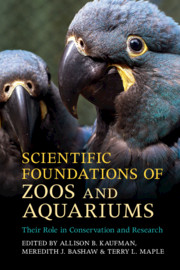
Book contents
- Scientific Foundations of Zoos and Aquariums
- Scientific Foundations of Zoos and Aquariums
- Copyright page
- In Memoriam
- Epigraph
- Contents
- Contributors
- Acknowledgments
- Introduction
- Part I Programs and Initiatives
- Part II Captive Care and Management
- Part III Saving Species
- Part IV Basic Research
- Conclusion
- Appendix
- Index
- References
Introduction
Research in Zoos and Aquariums: Purpose, Justification, Utility, and Welfare
Published online by Cambridge University Press: 21 December 2018

Book contents
- Scientific Foundations of Zoos and Aquariums
- Scientific Foundations of Zoos and Aquariums
- Copyright page
- In Memoriam
- Epigraph
- Contents
- Contributors
- Acknowledgments
- Introduction
- Part I Programs and Initiatives
- Part II Captive Care and Management
- Part III Saving Species
- Part IV Basic Research
- Conclusion
- Appendix
- Index
- References
Information
- Type
- Chapter
- Information
- Scientific Foundations of Zoos and AquariumsTheir Role in Conservation and Research, pp. 1 - 42Publisher: Cambridge University PressPrint publication year: 2019
References
Abbondanza, F. N., Power, M. L., Dickson, M. A., Brown, J., & Oftedal, O. (2013). Variation in the composition of milk of Asian elephants (Elephas maximus) throughout lactation. Zoo Biology, 32, 291–298.10.1002/zoo.21022CrossRefGoogle ScholarPubMed
Andersen, L. L. (2003). Zoo education: From formal school programmes to exhibit design and interpretation. International Zoo Yearbook, 38, 75–81.10.1111/j.1748-1090.2003.tb02066.xCrossRefGoogle Scholar
Anderson, M. J., & Williams, S. A. (2010). Why do flamingos stand on one leg? Zoo Biology, 29, 365–374.10.1002/zoo.20266CrossRefGoogle ScholarPubMed
Anderson, U. S., Keiling, A. S., & Maple, T. L. (2008). Twenty-five years of zoo biology: A publication analysis. Zoo Biology, 27(6), 444–457.10.1002/zoo.20177CrossRefGoogle ScholarPubMed
Anderson, U. S., Maple, T. L., & Bloomsmith, M. A. (2010). Factors facilitating research: A survey of zoo and aquarium professionals. Zoo Biology, 29(6), 663–675.10.1002/zoo.20306CrossRefGoogle Scholar
Ange-van Heugten, K. D., Verstegen, M., Ferket, P. R., Stoskopf, M., & van Heugten, E. (2008). Serum chemistry concentrations of captive woolly monkeys (Lagothrix lagotricha). Zoo Biology, 27, 188–199.10.1002/zoo.20176CrossRefGoogle ScholarPubMed
Asa, C. (2010). Reproductive physiology. In Kleiman, D. G., Thompson, K. V., & Kirk Baer, C. (Eds.) Wild Mammals in Captivity: Principles and Techniques for Zoo Management (2nd ed.) (pp. 411–228). Chicago and London: The University of Chicago Press.Google Scholar
Asa, C. (2016). Weighing the options for limiting surplus animals. Zoo Biology, 35(3), 183–186.10.1002/zoo.21293CrossRefGoogle ScholarPubMed
Asa, C., & Porton, I. J. (Eds.) (2005). Wildlife Contraception: Issues, Methods and Applications. Baltimore: Johns Hopkins University Press.10.56021/9780801883040CrossRefGoogle Scholar
Asa, C., & Porton, I. J. (2010). Contraception as a management tool for controlling surplus animals. In Kleiman, D. G., Thompson, K. V., & Kirk Baer, C. (Eds.) Wild Mammals in Captivity: Principles and Techniques for Zoo Management (2nd ed.) (pp. 469–482). Chicago and London: The University of Chicago Press.Google Scholar
Atkinson, C. T., Woods, K. L., Dusek, R. J., & Sileo, L. S. (1995). Wildlife disease and conservation in Hawaii: Pathogenicity of avian malaria (Plasmodium relictum) in experimentally infected iiwi (Vestia coccinea). Parasitology 111, S59–S69.10.1017/S003118200007582XCrossRefGoogle Scholar
AZA (2018). The Accreditation Standards and Related Policies. Silver Spring: AZA Executive Office.Google Scholar
Barongi, R., Fisken, F. A., Parker, M., & Gusset, M. (Eds.) (2015). Committing to Conservation: The World Zoo and Aquarium Conservation Strategy. Gland: WAZA Executive Office.Google Scholar
Ballou, J. D., Lees, C., Faust, L. J., Long, S., Lynch, C., Bingaman-Lackey, L., & Foose, T. J. (2010). Demographic and genetic management of captive populations. In Kleiman, D. G., Thompson, K. V., & Kirk Baer, C. (Eds.), Wild Mammals in Captivity: Principles and Techniques for Zoo Management (2nd ed.) (pp. 219–252). Chicago and London: The University of Chicago Press.Google Scholar
Balmford, A., Leader-Williams, N., Mace, G. M., Manica, A., Walter, O., West, C., & Zimmerman, A. (2011). Message received? Quantifying the impact of informal conservation education on adults visiting UK zoos. In Zimmerman, A., Hatchwell, M., Dickie, L. A., & West, C. (Eds.), Zoos in the 21st Century: Catalysts for Conservation? (pp. 126–136). Cambridge: Cambridge University Press.Google Scholar
Barber, J. C. E. (2009). Programmatic approaches to assessing and improving animal welfare in zoos and aquariums. Zoo Biology, 28(3), 519–530.10.1002/zoo.20260CrossRefGoogle ScholarPubMed
Barbosa, A. (2009). The role of zoos and aquariums in research into the effects of climate change on animal health. International Zoo Yearbook, 43, 131–135.CrossRefGoogle Scholar
Beck, B. B. (1974). Student behavioral research in zoos. In Research in Zoos and Aquariums (pp. 91–102). Washington, DC: National Academy of Sciences.Google Scholar
Beck, B. B., Rapaport, L. G., Stanley Price, M. R., & Wilson, A. C. (1994). Reintroduction of captive-born animals. In Olney, P. J. S., Mace, G. M., & Feistner, A. T. C. (Eds.), Creative Conservation: Interactive Management of Wild and Captive Animals (pp. 265–286). London: Chapman & Hall.10.1007/978-94-011-0721-1_13CrossRefGoogle Scholar
Benirshke, K. (1975). Bioedical research. In Research in Zoos and Aquariums (pp. 3–11). Washington, DC: National Academy of Sciences.Google Scholar
Benirshke, K. (1996). The need for multidisciplinary research units in the zoo. In Kleiman, D. G., Thompson, K. V., & Kirk Baer, C. (Eds.), Wild Mammals in Captivity: Principles and Techniques for Zoo Management (2nd ed.) (pp. 537–544). Chicago and London: The University of Chicago Press.Google Scholar
Bennett, C. L., Booth-Binczik, S. D., & Steele, S. R. E. (2010). Nutritional composition and digestibility by ocelots (Leopardus pardalis) of whole animals and a commercial diet. Zoo Biology, 29, 753–759.10.1002/zoo.20294CrossRefGoogle Scholar
Bercovitch, F. B., & Andrews, J. (2010). Developmental milestones among African elephant calves on their first day of life. Zoo Biology, 29, 120–126.10.1002/zoo.20179CrossRefGoogle ScholarPubMed
Bielitzki, J. T. (1996). The institutional animal care and use committee within the zoological park: Selecting and training members. In Burghardt, G. M. (Ed.), The Well-Being of Animals in Zoo and Aquarium Sponsored Research (pp. 107–110). Greenbelt, MD: Scientists Center for Animal Welfare.Google Scholar
Blowers, T. E., Waterman, J. M., Kuhar, C. W., & Bettinger, T. L. (2012). Female Nile hippopotamus (Hippopotamus amphibious) space use in a naturalistic environment. Zoo Biology, 31, 129–136.10.1002/zoo.20366CrossRefGoogle Scholar
Borrell, B. (2008). How zoos kill elephants: Animal welfare experts say zoos cut short an elephant’s life span, but can their evidence be trusted? Scientific American. Retrieved from www.scientificamerican.com/article/how-zoos-kill-elephants.Google Scholar
Challender, D. W. S., Thai, N. V., Jones, M., & May, L. (2012). Time-budgets and activity patterns of captive Sunda pangolins (Manis javanica). Zoo Biology, 31, 206–218.10.1002/zoo.20381CrossRefGoogle ScholarPubMed
Chiszar, D., Murphy, B. B., & Smith, H. M. (1993). In search of zoo–academic collaborations: A research agenda for the 1990s. Herpetologica, 49, 388–500.Google Scholar
Clark, A., Silva-Fletcher, A., Fox, M., Kreuzer, M., & Clauss, M. (2016). Survey of feeding practices, body condition and faeces consistency in captive ant-eating mammals in the UK. Journal of Zoo and Aquarium Research, 4, 183–195.Google Scholar
Clark, F. E. (2013). Marine mammal cognition and captive care: A proposal for cognitive enrichment in zoos and aquariums. Journal of Zoo and Aquarium Research, 1(1), 1–6.Google Scholar
Clark, F. E., Davies, S. L., Madigan, A. W.,Warner, A. J., & Kuczaj II, S. A. (2013). Cognitive enrichment for bottlenose dolphins (Tursiops truncatus): Evaluation of a novel underwater maze device. Zoo Biology, 32(6), 608–619.10.1002/zoo.21096CrossRefGoogle ScholarPubMed
Clark, F. E., & Melfi, V. A. (2012). Environmental enrichment for a mixed‐species nocturnal mammal exhibit. Zoo Biology, 31, 397–413.10.1002/zoo.20380CrossRefGoogle ScholarPubMed
Clauss, M., Kleffner, H., & Kienzle, E. (2010). Carnivorous mammals: Nutrient digestibility and energy evaluation. Zoo Biology, 29(6), 687–704.10.1002/zoo.20302CrossRefGoogle ScholarPubMed
Coe, J., & Dykstra, G. (2010). New and sustainable directions in zoo exhibit design. In Kleiman, D. G., Thompson, K. V., & Kirk Baer, C. (Eds.), Wild Mammals in Captivity: Principles and Techniques for Zoo Management (2nd ed.) (pp. 202–215). Chicago and London: The University of Chicago Press.Google Scholar
Conde, D. A., Flesness, N., Colchero, F., Jones, O. R., & Scheuerlein, A. (2011). An emerging role of zoos to conserve biodiversity. Science, 331, 1390–1391.10.1126/science.1200674CrossRefGoogle ScholarPubMed
Conway, W. (2003). The role of zoos in the 21st century. International Zoo Yearbook, 38, 7–13.10.1111/j.1748-1090.2003.tb02059.xCrossRefGoogle Scholar
Conway, W. G. (1969). Zoos: Their changing roles. Science, 163, 48–52.10.1126/science.163.3862.48CrossRefGoogle ScholarPubMed
Crockett, C. C. (1977). Behavioral studies of zoo animals: Undergraduate research and education. In Crockett, C. & Hutchins, M. (Eds.), Applied Behavioral Research at the Woodland Park Zoological Gardens (pp. 14–24). Seattle, WA: Pika Press.Google Scholar
Crockett, C. M., & Ha, R. R. (2010). Data collection in the zoo setting, emphasizing behavior. In Kleiman, D. G., Thompson, K. V., & Kirk Baer, C. (Eds.), Wild Mammals in Captivity: Principles and Techniques for Zoo Management (2nd ed.) (pp. 386–406). Chicago and London: The University of Chicago Press.Google Scholar
Crissy, S. (2005). The complexity of formulating diets for zoo animals: A matrix. International Zoo Yearbook, 39, 36–43.10.1111/j.1748-1090.2005.tb00003.xCrossRefGoogle Scholar
Croke, V. (1997). The Modern Ark: The Story of Zoos: Past, Present and Future. New York: Scribner.Google Scholar
Daly, J. W., Secunda, S. I., Garraffo, H. M., Spande, T. F., Wisneiski, A., & Cover, J. F. (1994). An uptake system for dietary alkaloids in poison frogs (Dendrobatidae). Toxicon, 32(6), 657–663.10.1016/0041-0101(94)90335-2CrossRefGoogle ScholarPubMed
Drews, B., Harmann, J. M., Beehler, L. L., Bell, B., Drews, R. F., & Hildebrandt, T. B. (2011). Ultrasonographic monitoring of fetal development in unrestrained bonobos (Pan Paniscus) at the Milwaukee County Zoo. Zoo Biology, 30, 241–253.10.1002/zoo.20304CrossRefGoogle ScholarPubMed
Dudzinski, K. M. (2010). Overlap between information gained from complementary and comparative studies of captive and wild dolphins. International Journal of Comparative Psychology, 23, 566–586.10.46867/IJCP.2010.23.04.13CrossRefGoogle Scholar
Earnhardt, J. M. (2010). The role of captive populations in reintroduction programs. In Kleiman, D. G., Thompson, K. V., & Kirk Baer, C. (Eds.), Wild Mammals in Captivity: Principles and Techniques for Zoo Management (2nd ed.) (pp. 268–280). Chicago and London: The University of Chicago Press.Google Scholar
Eisenberg, J. F. (1975). Design and administration of zoological research programs. In Research in Zoos and Aquariums (pp. 12–18). Washington, DC: National Academy of Sciences.Google Scholar
Eisenberg, J. F., & Kleiman, D. G. (1977). The usefulness of behavior studies in developing captive breeding programmes for mammals. International Zoo Yearbook, 17, 81–88.10.1111/j.1748-1090.1977.tb00871.xCrossRefGoogle Scholar
Ellis, D. H., Gee, G. F., & Mirande, C. M. (1996). Cranes: Their Biology, Husbandry, and Conservation. Blain, WA: Hancock House Publishers.Google Scholar
Falk, J. H., Reinhard, E. M., Vernon, C. L., Bronnenkant, K., Deans, N. L., & Heimlich, J. E. (2007). Why Zoos and Aquariums Matter: Assessing the Impact of a Visit. Silver Spring, MD, Association of Zoos and Aquariums.Google Scholar
Farnsworth, E. J., & Rosovsky, J. (1993). The ethics of ecological field experimentation. Conservation Biology, 7(3), 463–472.10.1046/j.1523-1739.1993.07030463.xCrossRefGoogle Scholar
Feistner, A. T. C., & Price, E. D. C. (2002). Zoos and universities: Collaborating for primate conservation. Evolutionary Anthropology, 11, 7–11.10.1002/evan.10042CrossRefGoogle Scholar
Fernandez, E. J., & Timberlake, W. (2008). Mutual benefits of research collaborations between zoos and academic institutions. Zoo Biology, 27, 470–487.10.1002/zoo.20215CrossRefGoogle ScholarPubMed
Ferrie, G. M., Schutz, P., Leighty, K. A., Plasse, C., Bettinger, T. L., & Hoffman, E. A. (2013). Identifying parentage using molecular markers: Improving accuracy of studbook records for a captive flock of marabou storks (Leptoptilus crumeniferus). Zoo Biology, 32, 556–564.10.1002/zoo.21090CrossRefGoogle Scholar
Field, D. A., & Dickie, L. A. (2007). Zoo coalitions for conservation. In Zimmerman, A., Hatchwell, M., Dickie, L. A., & West, C. (Eds.), Zoos in the 21st Century: Catalysts for Conservation? (pp. 287–302). Cambridge: Cambridge University Press.Google Scholar
Finlay, T., James, L. R., & Maple, T. L. (1986). A survey of research in American zoos and aquariums. Zoo Biology, 17, 167–180.Google Scholar
Finke, M. D. (2015). Complete nutrient content of four species of commercially available feeder insects fed enhanced diets during growth. Zoo Biology, 34(6), 554–564.10.1002/zoo.21246CrossRefGoogle ScholarPubMed
Forthman, D. L., & Ogden, J. J. (1992). The role of applied behavioral analysis in zoo management: today and tomorrow. Journal of Applied Behavior Analysis, 25, 647–652.10.1901/jaba.1992.25-647CrossRefGoogle ScholarPubMed
Fouts, R. (1995). Arrogance of knowledge versus humility of ignorance. In Norton, B., Hutchins, M., Stevens, E. F., & Maple, T. L. (Eds.), Ethics on the Ark: Zoos, Animal Welfare and Wildlife Conservation (pp. 277–285). Washington, DC: Smithsonian Institution Press.Google Scholar
Fraser, D. (2009). Assessing animal welfare: Different philosophies, different scientific approaches. Zoo Biology, 28(6), 507–528.10.1002/zoo.20253CrossRefGoogle ScholarPubMed
Freeman, E. W., Schulte, B. A., & Brown, J. L. (2010). Investigating the impact of rank and ovarian activity on the social behavior of captive African elephants. Zoo Biology, 29, 154–167.10.1002/zoo.20235CrossRefGoogle Scholar
Gilbert, T., & Soore, P. S. (2017). Editorial: The role of zoos and aquariums in reintroduction and other conservation translocations. International Zoo Yearbook, 51, 9–14.10.1111/izy.12164CrossRefGoogle Scholar
Gillespie, K. L., & Melber, L. M. (2015). Walking the tightrope in educational research and evaluation: Maintaining a strong research agenda while upholding research ethics via and on-site institutional review board. International Zoo Yearbook, 50, 16–22.10.1111/izy.12105CrossRefGoogle Scholar
Gusset, M., & Dick, G. (2010). ‘Building a future for wildlife’? Evaluating the contribution of the world zoo and aquarium community to in situ conservation. International Zoo Yearbook, 44, 183–191.10.1111/j.1748-1090.2009.00101.xCrossRefGoogle Scholar
Gusset, M., & Dick, G. (2011). The global reach of zoos and aquariums in visitor numbers and conservation expenditures. Zoo Biology, 30, 566–569.10.1002/zoo.20369CrossRefGoogle ScholarPubMed
Hardy, D. F. (1996a). Current research activities in zoos. In Kleiman, D. G., Allen, M. E., Thompson, K. V., & Lumpkin, S. (Eds.), Wild Mammals in Captivity: Principles and Techniques (pp. 531–536). Chicago, IL: University of Chicago Press.Google Scholar
Hardy, D. F. (1996b). The diversity of research: Summary of recent applied and informal research in zoos and aquariums. In Burghardt, G. M. (Ed.), The Well-Being of Animals in Zoo and Aquarium Sponsored Research (pp. 5–14). Greenbelt, MD: Scientists Center for Animal Welfare.Google Scholar
Hediger, H. (1968). The Psychology and Behavior of Animals in Circuses and Zoos. New York: Dover Publications, Inc.Google Scholar
Hill, S. P., & Broom, D. M. (2009). Measuring zoo animal welfare: Theory and practice. Zoo Biology, 28(6), 531–544.10.1002/zoo.20276CrossRefGoogle ScholarPubMed
Hosey, G. R. (1997). Behavioral research in zoos: Academic perspectives. Applied Animal Behaviour Science, 51: 199–207.10.1016/S0168-1591(96)01104-5CrossRefGoogle Scholar
Hosey, G., Hill, S. P., & Lherbier, M. L. (2012). Can zoo records help answer behavioral research questions? The case of the left-handed lemurs (Lemur catta). Zoo Biology, 31(2), 189–196.10.1002/zoo.20402CrossRefGoogle ScholarPubMed
Hoy, J. M., Murray, P. J., & Tribe, A. (2010). Thirty years later: Enrichment practices for captive mammals. Zoo Biology, 29, 303–316.10.1002/zoo.20254CrossRefGoogle ScholarPubMed
Hudson, R. (2001). The Jamaican iguana conservation story: Rediscovery to recovery. In Conway, W. G., Hutchins, M., Souza, M., & Kapetanakos, Y. (Eds.), American Zoo and Aquarium Association Field Conservation Resource Guide (pp. 42–48). Atlanta: Zoo Atlanta.Google Scholar
Hundgen, K., Hutchins, M., Sheppard, C., Bruning, D., & Worth, W. (1991). Management and breeding of the red bird of paradise: Paradesia rubra at the New York Zoological Park. International Zoo Yearbook, 30(1), 192–199.10.1111/j.1748-1090.1991.tb03485.xCrossRefGoogle Scholar
Hutchins, M. (1984). The mother–offspring relationship in mountain goats Oreamnos americanus. PhD Dissertation, Seattle, WA: University of Washington.Google Scholar
Hutchins, M. (1988). On the design of zoo research programmes. International Zoo Yearbook, 27, 9–19.10.1111/j.1748-1090.1988.tb03192.xCrossRefGoogle Scholar
Hutchins, M. (1990). Serving science and conservation: The biological materials request protocol of the New York Zoological Society. Zoo Biology, 9, 447–460.CrossRefGoogle Scholar
Hutchins, M. (2003). Zoo and aquarium animal management and conservation: Current trends and future challenges. International Zoo Yearbook, 38, 14–28.10.1111/j.1748-1090.2003.tb02060.xCrossRefGoogle Scholar
Hutchins, M. (2006a). Variation in nature: Its implications for zoo elephant management. Zoo Biology, 25(3), 161–171.10.1002/zoo.20087CrossRefGoogle Scholar
Hutchins, M. (2006b). Death at the zoo: The media, science and reality. Zoo Biology, 25(2), 101–115.10.1002/zoo.20085CrossRefGoogle Scholar
Hutchins, M. (2010). Research: Overview. In Bell, C. E. (Ed.), Encyclopedia of the World’s Zoos (pp. 1076–1080). Chicago and London: Fitzroy Dearborn Publishers.Google Scholar
Hutchins, M., & Ballentine, J. (2001). Fueling the conservation engine: Fund-raising and public relations. In Conway, W. G., Hutchins, M., Souza, M., & Kapetanakos, Y. (Eds.), American Zoo and Aquarium Association Field Conservation Resource Guide (pp. 268–270). Atlanta: Zoo Atlanta.Google Scholar
Hutchins, M., & Conway, W. G. (1995). Beyond Noah’s Ark: The evolving role of modern zoos and aquariums in field conservation. International Zoo Yearbook, 34, 117–130.10.1111/j.1748-1090.1995.tb00669.xCrossRefGoogle Scholar
Hutchins, M., Dresser, B., & Wemmer, C. (1995). Ethical considerations in zoo and aquarium research. In Norton, B., Hutchins, M., Stevens, E. F., & Maple, T. L. (Eds.), Ethics on the Ark: Zoos, Animal Welfare and Wildlife Conservation (pp. 253–276). Washington, DC: Smithsonian Institution Press.Google Scholar
Hutchins, M., & Kreger, M. D. (2006). Rhinoceros behaviour: Implications for captive management and conservation. International Zoo Yearbook, 40, 144–149.10.1111/j.1748-1090.2006.00150.xCrossRefGoogle Scholar
Hutchins, M., & Maple, T. L. (2015). Zoos and zoological parks. In Jennings, B. (Ed.), Biothics (4th ed.) (pp. 271–275). Farmington Hills, MI: Gale.Google Scholar
Hutchins, M., Paul, E., & Bowdoin, J. M. (1996). Contributions of zoo and aquarium research to wildlife conservation and science. In Burghardt, G. M. (Ed.), The Well-Being of Animals in Zoo and Aquarium Sponsored Research (pp. 24–39). Greenbelt, MD: Scientists Center for Animal Welfare.Google Scholar
Hutchins, M., & Smith, B. (2003). Characteristics of a world class zoo or aquarium in the 21st century. Internationl Zoo Yearbook, 28, 130–141.10.1111/j.1748-1090.2003.tb02073.xCrossRefGoogle Scholar
Hutchins, M., Smith, B., & Allard, R. (2003). In defense of zoos and aquariums: The ethical basis for keeping wild animals in captivity. Journal of the American Veterinary Medican Association, 223(7), 958–966.10.2460/javma.2003.223.958-2CrossRefGoogle ScholarPubMed
Hutchins, M., Smith, B., Fulk, R., Perkins, L., Reinartz, G., & Wharton, D. (1991). Rights or welfare: A response to the Great Ape Project. In Beck, B. B., Stoinski, T. S., Hutchins, M., Maple, T. L., Norton, B., Rowan, A., … Arluke, A. (Eds.), Great Apes and Humans: The Ethics of Coexistence (pp. 329–366). Washington, DC: Smithsonian Institution Press.Google Scholar
Hutchins, M., Smith, B., & Keele, M. (2008). Zoos as responsible stewards of elephants. In Wemmer, C. & Christen, C. A. (Eds.), Elephants and Ethics: Toward a Morality of Coexistence (pp. 285–305). Baltimore, MD: Johns Hopkins University Press.Google Scholar
Hutchin, S. M., & Souza, M. (2001). The AZA Conservation Endowment Fund: Zoos and aquairums supporting conservation action. In Conway, W. G., Hutchins, M., Souza, M., & Kapetanakos, Y. (Eds.), American Zoo and Aquairum Association Field Conservation Resource Guide (pp. 291–297). Atlanta: Zoo Atlanta.Google Scholar
Hutchins, M., & Thompson, S. (2008). Zoo and aquarium research: Priority setting for the coming decades. Zoo Biology, 27(6), 488–497.CrossRefGoogle ScholarPubMed
Hutchins, M., Thompson, G., Sleeper, B., & Foster, J. W. (1987). Management and breeding of the Rocky Mountain goat Oreamnos americanus at Woodland Park Zoo. International Zoo Yearbook, 26, 297–308.10.1111/j.1748-1090.1987.tb03176.xCrossRefGoogle Scholar
Jamieson, D. (1985). Against zoos. In Singer, P. (Ed.), In Defense of Animals (pp. 108–117). New York: Harper & Row.Google Scholar
Jamieson, D. (1995). Zoos revisited. In Norton, B., Hutchins, M., Stevens, E. F., & Maple, T. L. (Eds.), Ethics on the Ark: Zoos, Animal Welfare and Wildlife Conservation (pp. 52–66). Washington, DC: Smithsonian Institution Press.Google Scholar
Jarvis, C. (1967). The value of zoos for science and conservation. Oryx, 9(2), 127–136.10.1017/S0030605300006153CrossRefGoogle Scholar
Jensen, E. A., Moss, A., & Gusset, M. (2017). Quantifying long-term impact of zoo and aquarium visits on biodiversity-related learning outcomes. Zoo Biology, 35(4), 294–297.10.1002/zoo.21372CrossRefGoogle Scholar
Kaufman, L., & Zaremba, F. (1995). Conservation research at aquariums: The social contract. In Wemmer, C. M. (Ed.), The Ark Evolving: Zoos and Aquariums in Transition (pp. 129–157). Front Royal, VA: Smithsonian Conservation and Research Center.Google Scholar
Kitkpatrick, J. F. (1996). Ethical considerations for conservation research: Zoo animal reproduction and overpopulation of zoo animals. In Burghardt, G. M. (Ed.), The Well-Being of Animals in Zoo and Aquarium Sponsored Research (pp. 41–47). Greenbelt, MD: Scientists Center for Animal Welfare.Google Scholar
Kleiman, D. G. (1980). Using volunteers in behavioral research and animal management studies. In Proceedings of the 58th Annual AAZPA Conference, September 14–18, 1980 (pp. 147–152). Wheeling, WV: American Association of Zoological Parks and Aquariums.Google Scholar
Kleiman, D. G. (1985). Criteria for the evaluation of zoo research projects. Zoo Biology, 4, 93–98.10.1002/zoo.1430040202CrossRefGoogle Scholar
Kleiman, D. G. (1992). Behavioral research in zoos: Past, present and future. Zoo Biology, 11, 301–312.10.1002/zoo.1430110502CrossRefGoogle Scholar
Keiman, D. G. (1994). Mammalian sociobiology and zoo breeding programs. Zoo Biology, 13(5), 423–432.10.1002/zoo.1430130505CrossRefGoogle Scholar
Kleiman, D. G. (1996). Special research strategies for zoos and aquariums and design of zoo research programs. In Burghardt, G. M. (Ed.), The Well-Being of Animals in Zoo and Aquarium Sponsored Research (pp. 15–22). Greenbelt, MD: Scientists Center for Animal Welfare.Google Scholar
Kleiman, D. G., & Rylands, A. B. (2002). Lion Tamarins: Biology and Conservation. Washington, DC: Smithsonian Institution Press.Google Scholar
Kohn, B. (1996). IACUCs: How do they relate to zoos and aquariums? In Burghardt, G. M. (Ed.), The Well-Being of Animals in Zoo and Aquarium Sponsored Research (pp. 103–106). Greenbelt, MD: Scientists Center for Animal Welfare.Google Scholar
Konstant, W. (1995). Launching the Ark and not missing the boat: Building local capacity for wildlife conservation. In Wemmer, C. M. (Ed.), The Ark Evolving: Zoos and Aquariums in Transition (pp. 192–205). Front Royal, VA: Smithsonian Conservation and Research Center.Google Scholar
Kowalski, N. L., Dale, R. H. I., & Mazur, C. L. H. (2010). A survey of the management and development of captive african elephant (Loxodonta africana) calves: Birth to three months of age. Zoo Biology, 29, 104–119.10.1002/zoo.20195CrossRefGoogle ScholarPubMed
Krupenye, C., Kano, F., Hirata, S., Call, J., & Tomasello, M. (2016). Great apes anticipate that other individuals will act according to false beliefs. Science, 354, 110–114.10.1126/science.aaf8110CrossRefGoogle ScholarPubMed
Kuhar, C. W. (2006). In the deep end: Pooling data and other statistical challenges of zoo and aquarium research. Zoo Biology, 25, 339–352.10.1002/zoo.20089CrossRefGoogle Scholar
La Grange, M. (Ed.) (2006). The Capture, Care, and Management of Wildlife: Comprehensive Studies on the Management, Capture, and Translocation of Wildlife from Source to Final Release. Pretoria: Van Schaik.Google Scholar
Lanciotti, R. S., Roehrig, J. T., Deubel, V., Smith, J., Parker, M., Steele, K., … Gubler, D. J. (1999). Origin of West Nile virus responsible for an outbreak of encephalitis in the northeastern United States. Science, 286, 2333–2337.10.1126/science.286.5448.2333CrossRefGoogle ScholarPubMed
Lawson, D. P., Ogden, J., & Snyder, R. J. (2008). Maximizing the contribution of science in zoos and aquariums: Organizational models and perceptions. Zoo Biology, 27(6), 458–469.10.1002/zoo.20216CrossRefGoogle ScholarPubMed
Lindburg, D. G. (1998). Enrichment of captive animals through provisioning. In Shepherdson, D. J., Mellen, J. D., & Hutchins, M. (Eds.), Second Nature: Environmental Enrichment for Captive Animals (pp. 262–276). Washington, DC: Smithsonian Institution Press.Google Scholar
Lindburg, D. G. (2010). Research: behavioral. In Bell, C. E. (Ed.), Encyclopedia of the World’s Zoos (pp. 1080–1083). Chicago and London: Fitzroy Dearborn Publishers.Google Scholar
Lindburg, D. G. (2008). Reflections on the science of zoo biology. Zoo Biology, 27(6), 436–443.10.1002/zoo.20217CrossRefGoogle ScholarPubMed
Lindburg, D. G., & Baragona, K. (Eds.) (2010). Giant Pandas: Biology and Conservation. Oakland, CA: University of California Press.Google Scholar
Lindburg, D. G., & Fitch-Snyder, H. (1994). Use of behavior to evaluate reproductive problems in captive animals. Zoo Biology, 13, 433–445.10.1002/zoo.1430130506CrossRefGoogle Scholar
Lindburg, D. G., & Lindburg, L. (1995). Success breeding a quandary: To cull or not to cull. In Norton, B., Hutchins, M., Stevens, E. F., & Maple, T. L. (Eds.), Ethics on the Ark: Zoos, Animal Welfare and Wildlife Conservation (pp. 195–208). Washington, DC: Smithsonian Institution Press.Google Scholar
Luebke, J. F., & Matiasek, J. (2013). An exploratory study of zoo visitors' exhibit experiences and reactions: Exhibit reactions. Zoo Biology, 32, 407–416.10.1002/zoo.21071CrossRefGoogle ScholarPubMed
Lukas, K. E., Marr, M. J., & Maple, T. L. (1998). Teaching operant conditioning at the zoo. Teaching Psychology, 25(2), 112–116.10.1207/s15328023top2502_7CrossRefGoogle Scholar
Lukas, K. E., & Maple, T. L. (1997). Comparative psychology and primate conservation: The synergistic relationship between the zoo and university. Proceedings of the American Zoo and Aquarium Association Regional Conference Proceedings, 537–543.Google Scholar
MacDonald, S., & Rivito, S. (2016). Comparative cognition outside the laboratory. Comparative Cognition and Behavior Review, 11, 49–61.10.3819/ccbr.2016.110003CrossRefGoogle Scholar
Macek, M. (2014). Introduction to avian challenges. International Zoo Yearbook, 48, 1–6.10.1111/izy.12058CrossRefGoogle Scholar
Mallinson, J. (2003). A sustainable future for zoos and their role in wildlife conservation. Human Dimensions of Wildlife, 8, 59–63.10.1080/10871200390180154CrossRefGoogle Scholar
Maple, T. L. (1982). Towards a unified zoo biology. Zoo Biology, 1, 1–3.10.1002/zoo.1430010102CrossRefGoogle Scholar
Maple, T. L. (2008). The empirical zoo. Zoo Biology, 27(6), 431–435.10.1002/zoo.20214CrossRefGoogle ScholarPubMed
Maple, T. L. (2016). Professor in the Zoo: Designing the Future for Wildlife in Human Care. Fernandina Beach, FL: Red Leaf Press.Google Scholar
Maple, T. L., & Bashaw, M. J. (2010). Research trends in zoos. In Kleiman, D. G., Thompson, K. V., & Kirk Baer, C. (Eds.), Wild Mammals in Captivity: Principles and Techniques for Zoo Management (2nd ed.) (pp. 288–300). Chicago and London: The University of Chicago Press.Google Scholar
Maple, T. L., & Finlay, T. W. (1989). Applied primatology in the modern zoo. Zoo Biology Supllement, 1, 101–118.10.1002/zoo.1430080511CrossRefGoogle Scholar
Maple, T. L., McManamon, R., & Stevens, E. F. (1995). Defining the good zoo: Animal care, maintenance and welfare. In Norton, B., Hutchins, M., Stevens, E. F., & Maple, T. L. (Eds.), Ethics on the Ark: Zoos, Animal Welfare and Wildlife Conservation (pp. 219–234). Washington, DC: Smithsonian Institution Press.Google Scholar
Marlieve, J. B., & Martell, J. D. (2001). Rehabilitation of spawning habitat for intertidal marine fish along rocky shoreline of Stanley Park, Vancouver, British Columbia. In Conway, W. G., Hutchins, M., Souza, M., & Kapetanakos, Y. (Eds.), American Zoo and Aquarium Association Field Conservation Resource Guide (pp. 62–67). Atlanta, GA: Zoo Atlanta.Google Scholar
Marlieve, J. B., & Newman, M. A. (1995). The role of aquariums in promoting scientific research. In Wemmer, C. M. (Ed.), The Ark Evolving: Zoos and Aquariums in Transition (pp. 61–69). Front Royal, VA: Smithsonian Conservation and Research Center.Google Scholar
McCormick-Ray, M. G. (1993). Aquarium science: The substance behind an image. Zoo Biology, 12, 413–42410.1002/zoo.1430120504CrossRefGoogle Scholar
McPhee, M. E., & Carlstead, K. (2010). The importance of maintaining natural behaviors in captive mammals. In Kleiman, D. G., Thompson, K. V., & Kirk Baer, C. (Eds.), Wild Mammals in Captivity: Principles and Techniques for Zoo Management (2nd ed.) (pp. 303–313). Chicago and London: The University of Chicago Press.Google Scholar
Melfi, V. (2005). The appliance of science to zoo-housed primates. Applied Animal Behaviour Science, 90(2), 97–106.10.1016/j.applanim.2004.08.017CrossRefGoogle Scholar
Melfi, V. A. (2007). Diversity of zoo primate research: A sampler. International Journal of Primatology, 28(6), 1413–1415.10.1007/s10764-007-9209-6CrossRefGoogle Scholar
Melfi, V. A. (2009). There are big gaps in our knowledge, and thus approach, to zoo animal welfare: A case for evidence-based zoo animal management. Zoo Biology, 28, 274–588.10.1002/zoo.20288CrossRefGoogle ScholarPubMed
Mellen, J., & MacPhee, M. (2010). Animal learning and husbandry training for management. In Kleiman, D. G., Thompson, K. V., & Kirk Baer, C. (Eds.), Wild Mammals in Captivity: Principles and Techniques for Zoo Management (2nd ed.) (pp. 288–328). Chicago and London: The University of Chicago Press.Google Scholar
Mellen, J. D., Shepherdson, D. J., & Hutchins, M. (1999). Epilogue: The future of environmental enrichment. In Shepherdson, D. J., Mellen, J. D., & Hutchins, M. (Eds.), Second Nature: Environmental Enrichment for Captive Animals (pp. 329–336). Washington, DC: Smithsonian Institution Press.Google Scholar
Meller, C. L., Croney, C. C., & Shepherdson, D. (2007). Effects of rubberized flooring on Asian elephant behavior in captivity. Zoo Biology, 26, 51–61.10.1002/zoo.20119CrossRefGoogle ScholarPubMed
Mendyk, R. W., Newton, A. L., & Baumer, M. (2012). A retrospective study of mortality in varanid lizards (Reptilia: Squamata: Varanidae) at the Bronx Zoo: Implications for husbandry and reproductive management in zoos. Zoo Biology, 32, 152–162.CrossRefGoogle ScholarPubMed
Meyer-Holzapfel, M. (1968). Abnormal behavior in zoo animals. In Fox, M. F. (Ed.), Abnormal Behavior in Animals (pp. 276–503). Philadelphia, PA: Saunders Company.Google Scholar
Michaels, C. J., Antwis, R. E., & Preziosi, R. F. (2015). Manipulation of the calcium content of insectivore diets through supplementary dusting. Journal of Zoo and Aquarium Research, 2(3), 77–81.Google Scholar
Miller, B., Reading, R. P., & Forrest, S. (1996). Prairie Night: Black-Footed Ferrets and the Recovery of Endangered Species. Washington, DC: Smithsonian Institution Press.Google Scholar
Miller, B., Biggins, D., Vargas, A., Hutchins, M., Hanebury, L., Godbey, J., … Oldemeier, J. (1998). The captive environment and reintroduction. In Shepherdson, D. J., Mellen, J. D., & Hutchins, M. (Eds.), Second Nature: Environmental Enrichment for Captive Animals (pp. 97–112). Washington, DC: Smithsonian Institution Press.Google Scholar
Miller, L. J. (2012). Visitor reaction to pacing behavior: Influence on the perception of animal care and interest in supporting zoological institutions. Zoo Biology, 31, 242–248.CrossRefGoogle ScholarPubMed
Moran, G., & Sorensen, L. (1984). The behavioural researcher and the zoological park. Applied Animal Behaviour Science, 13, 143–155.10.1016/0168-1591(84)90059-5CrossRefGoogle Scholar
Morris, D. (1964). The response of animals to a restricted environment. Symposia of the Zoological Society of London, 13, 99–118.Google Scholar
Moss, A. & Esson, M. (2013). The educational claims of zoos: Where do we go from here? Zoo Biology, 32, 13–18.10.1002/zoo.21025CrossRefGoogle Scholar
Moss, A. (2015). Can conservation education learn anything from “big data”? International Zoo Yearbook, 50, 23–33.CrossRefGoogle Scholar
Murphy, J. B., Ciofi, C., de la Panouse, C., & Walsh, T. (Eds.) (2002). Komodo Dragons: Biology and Conservation. Washington, DC: Smithsonian Institution Press.Google Scholar
Nemeth, N. M., & Oesterle, P. T. (2014). West Nile virus from an avian conservation perspective. International Zoo Yearbook, 48, 101–115.CrossRefGoogle Scholar
Norton, B. G., Hutchins, M., Stevens, E. F., & Maple, T. L. (Eds.) (1995). Ethics on the Ark: Zoos, Animal Welfare and Wildlife Conservation. Washington, DC: Smithsonian Institution Press.Google Scholar
O’Connor, M. R. (2015). Resurrection Science: Conservation, De-Extinction and the Precarious Future of Wild Things. New York: St. Martin’s press.Google Scholar
Odum, R. A. (2001). Aruba Island rattlesnake species survival plan – in situ conservation. In Conway, W. G., Hutchins, M., Souza, M., & Kapetanakos, Y. (Eds.), American Zoo and Aquarium Association Field Conservation Resource Guide (pp. 68–73). Atlanta, GA: Zoo Atlanta.Google Scholar
Ogden, J., & Heimlich, J. F. (2009). Why focus on zoo and aquarium education? Zoo Biology, 28, 357–360.10.1002/zoo.20271CrossRefGoogle ScholarPubMed
Ogden, J. J., Olson, T. L., & Miner, V. (1991). Declines in sociosexual behavior in golden monkeys (Rhinopithecus roxellena): Associated environmental and social variables. Zoo Biology, 10, 491–498.CrossRefGoogle Scholar
Odum, R. A., & Reinert, H. K. (2015). The Aruba Island eattlesnake Crotalus unicolor species survival plan: A case history in ex situ and in situ conservation. International Zoo Yearbook, 49, 104–112.10.1111/izy.12091CrossRefGoogle Scholar
Olney, P. J. S. (1980). London zoo. In Zukerman, S. (Ed.), Great Zoos of the World: Their Origins and Significance (pp. 35–48). London: Weidenfeld and Nicholson.Google Scholar
O’Regan, H., & Kitchener, A. C. (2005). The effects of captivity on the morphology of captive, domesticated and feral mammals. Mammal Review, 35(3–4), 215–230.10.1111/j.1365-2907.2005.00070.xCrossRefGoogle Scholar
Pack, A. A. (2010). The synergy of laboratory and field studies of dolphin behavior and cognition. International Journal of Comparative Psychology, 23, 538–565.10.46867/IJCP.2010.23.04.14CrossRefGoogle Scholar
Plair, B. L., Reinhart, P. R., & Roth, T. L. (2012). Neonatal milestones, behavior and growth rate of Sumatran rhinoceros (Dicerorhinus sumatrensis) calves born and bred in captivity. Zoo Biology, 31, 546–560.CrossRefGoogle ScholarPubMed
Plotnik, J. M., de Waal, F. B. M., Moore, D., & Reiss, D. (2010). Self-recognition in the Asian elephants and future directions for cognitive research with elephants in zoological settings. Zoo Biology, 29(2), 179–191.10.1002/zoo.20257CrossRefGoogle ScholarPubMed
Plowman, A. B. (2008). BIAZA statistics guidelines: Towards a common application of statistical tests for zoo research. Zoo Biology, 27, 226–233.10.1002/zoo.20184CrossRefGoogle Scholar
Poole, J. H., & Moss, C. J. (2008). Elephant sociality and complexity: The scientific evidence. In Wemmer, C. & Christen, C. A. (Eds.), Elephants and Ethics: Toward a Morality of Coexistence (pp. 69–98). Baltimore, MD: Johns Hopkins University Press.Google Scholar
Poyton, S. L., & Whitaker, B. R. (1994). Protozoa in poison dart frogs (Dendrobatidae) clinical assessment and identification. Journal of Zoo and Wildlife Medicine, 25(1), 29–39.Google Scholar
Rabb, G. B., & Saunders, C. D. (2005). The future of zoos and aquariums: Conservation and caring. International Zoo Yearbook, 39, 1–256.10.1111/j.1748-1090.2005.tb00001.xCrossRefGoogle Scholar
Regan, T. (1995). Are zoos morally defensible? In Norton, B., Hutchins, M., Stevens, E. F., & Maple, T. L. (Eds.), Ethics on the Ark: Zoos, Animal Welfare and Wildlife Conservation (p. 330). Washington, DC: Smithsonian Institution Press.Google Scholar
Robeck, T. R., Schneyer, A. L., McBain, J. F., Dalton, M. T., Walsh, M. T., Czekala, N. M., & Kraemer, C. C. (1993). Analysis of urinary immunoreactive steroid metabolites and gonadotropins for characterization of the estrous cycle, breeding period, and seasonal estrus activity of captive killer whales (Orcinus orca). Zoo Biology, 12, 173–187.10.1002/zoo.1430120204CrossRefGoogle Scholar
Robeck, T. R., Willis, K., Scarpuzzi, M. R., & O’Brien, J. K. (2015). Comparisons of life-history parameters between free-ranging and captive killer whale (Orcinus orca) populations for application toward species management. Journal of Mammalogy, 96(5), 1055–1070.10.1093/jmammal/gyv113CrossRefGoogle ScholarPubMed
Rudacille, D. (2000). The Scalpel and the Butterfly: The Conflict between Animal Research and Animal Protection. Berkeley, CA: University of California Press.Google Scholar
Rumbaugh, D. M. (1971). Zoos: Valuable adjuncts for the instruction of animal behaviours. Bioscience, 21, 806–809.10.2307/1295653CrossRefGoogle Scholar
Samuels, A. (1996). Contributions of zoo and aquarium research to understanding the social behavior of difficult-to-study marine mammals. In Burghardt, G. M., (Ed.), The Well-Being of Animals in Zoo and Aquarium Sponsored Research (pp. 73–78). Greenbelt, MD: Scientists Center for Animal Welfare.Google Scholar
Savage, A. (1988). Collaboration between research institutions and zoos for primate conservation. International Zoo Yearbook, 27, 140–148.10.1111/j.1748-1090.1988.tb03207.xCrossRefGoogle Scholar
Saragusty, S., Diecke, S., Drukker, M., Durrant, B., Ben-Nun, I.F., Galli, C., … Hildebrandt, T. B. (2016). Rewinding the process of mammalian Extinction. Zoo Biology, 35, 280–292.10.1002/zoo.21284CrossRefGoogle ScholarPubMed
Schaeffer, D. O. (1996). Designing a research protocol form for zoos and aquariums. In Burghardt, G. M. (Ed.), The Well-Being of Animals in Zoo and Aquarium Sponsored Research (pp. 111–120). Greenbelt, MD: Scientists Center for Animal Welfare.Google Scholar
Schuele, A. (2016). Animal training in zoos: A chance for research. Mammalian Biology, 81, 15.CrossRefGoogle Scholar
Schwartz, K. R. (2017). Integrating in situ and ex situ data management processes for biodiversity conservation. Frontiers in Ecology and Evolution, 5, 120.10.3389/fevo.2017.00120CrossRefGoogle Scholar
Shepherdson, D. J. (1999). Introduction: Tracting the path of environmental enrichment in zoos. . In Shepherdson, D. J., Mellen, J. D., & Hutchins, M. (Eds.), Second Nature: Environmental Enrichment for Captive Animals (pp. 1–12). Washington, DC: Smithsonian Institution Press.Google Scholar
Shepherdson, D. J., Mellen, J. D., & Hutchins, M. (Eds.) (1999). Second Nature: Environmental Enrichment for Captive Animals. Washington, DC: Smithsonian Institution Press.Google Scholar
Spindler, R. E., & Wildt, D. E. (2010). Male reproduction: Assessment, management, assisted breeding and fertility control. In Kleiman, D. G., Thompson, K. V., & Kirk Baer, C. (Eds.), Wild Mammals in Captivity: Principles and Techniques for Zoo Management (2nd ed.) (pp. 429–468). Chicago and London: The University of Chicago Press.Google Scholar
Stanley-Price, M. R., & Soore, P. S. (2003). Reintroductions: Whence and whither? International Zoo Yearbook, 38, 61–75.10.1111/j.1748-1090.2003.tb02065.xCrossRefGoogle Scholar
Stanley-Price, M., & Fa, J. (2007). Reintroductions from zoos: A conservation guiding light or a shooting star. In Zimmerman, A., Hatchwell, M., Dickie, L., & West, C. (Eds.), Zoos in the 21st Century: Catalysts for Conservation? (pp. 155–177). Cambridge, UK: Cambridge University Press.Google Scholar
Sterling, E., Lee, J., & Wood, T. (2007). Conservation education in zoos: An emphasis on behavior change. In Zimmerman, A., Hatchwell, M., Dickie, L., & West, C. (Eds.), Zoos in the 21st Century: Catalysts for Conservation? (pp. 37–50). Cambridge, UK: Cambridge University Press.Google Scholar
Stoinski, T. S., Lukas, K. E., & Maple, T. L. (1998). Research in American zoos and aquariums. Zoo Biology, 17, 167–180.10.1002/(SICI)1098-2361(1998)17:3<167::AID-ZOO2>3.0.CO;2-73.0.CO;2-7>CrossRefGoogle Scholar
Swaisgood, R. R., & Schultz, B. A. (2010). Applying knowledge of mammalian social organization, mating systems, and communication to management. In Kleiman, D. G., Thompson, K. V., & Kirk Baer, C. (Eds.), Wild Mammals in Captivity: Principles and Techniques for Zoo Management (2nd ed.) (pp. 329–343). Chicago and London: The University of Chicago Press.Google Scholar
Swanagan, J. S. (2000). Factors influencing zoo visitors' conservation attitudes and behavior. Journal of Environmental Education, 31, 26.10.1080/00958960009598648CrossRefGoogle Scholar
Tardie, S. D., Santos, C. V., Baker, A., Van Elsaker, L., Feistner, A. T. C., Kleiman, D. G., … Vleeschouwer, K. D. (2002). Parental care in lion tamarins. In Kleiman, D. G. & Rylands, A. B. (Eds.), Lion Tamarins: Biology and Conservation (pp. 213–232). Washington, DC: Smithsonian Institution Press.Google Scholar
Thomas, S. (2015). Editorial: Future perspectives in conservation education. International Zoo Yearbook, 50, 9–15.10.1111/izy.12134CrossRefGoogle Scholar
Thompson, S. (1993). Zoo research and conservation: Beyond sperm and eggs toward the science of animal management. Zoo Biology, 12, 155–159.10.1002/zoo.1430120202CrossRefGoogle Scholar
Tilson, R., & Nyhus, P. (Eds.) (2010). Tigers of the World (2nd ed.). New York: Academic Press.Google Scholar
Veasey, J. S. (2017). In pursuit of peak animal welfare; the need to prioritize the meaningful over the measurable. Zoo Biology, 36(6), 413–435.10.1002/zoo.21390CrossRefGoogle ScholarPubMed
Vitali, S., Reiss, A., & Eden, P. (2011). Conservation medicine in and through zoos. International Zoo Yearbook, 45, 160–167.10.1111/j.1748-1090.2010.00127.xCrossRefGoogle Scholar
Vucicevic, M., Stevanov-Pavlovic, M., Stevanovic, J., Bosnjak, J., Gajic, B., Aleksic, N., & Stanimirovic, Z. (2013). Sex determination in 58 bird species and evaluation of CHD gene as a universal molecular marker in bird sexing. Zoo Biology, 32, 269–276.10.1002/zoo.21010CrossRefGoogle ScholarPubMed
Wells, R. S. (2009). Learning from nature: Bottlenose dolphin care and husbandry. Zoo Biology, 28(4), 635–652.10.1002/zoo.20252CrossRefGoogle ScholarPubMed
Wemmer, C., Rodden, M., & Pickett, C. (1997). Publications trends in Zoo Biology: A brief analysis of the first fifteen years. Zoo Bioligy, 16(1), 3–8.10.1002/(SICI)1098-2361(1997)16:1<3::AID-ZOO2>3.0.CO;2-E3.0.CO;2-E>CrossRefGoogle Scholar
Wemmer, C., & Thompson, S. D. (1995). A short history of scientific research in zoological gardens. In Wemmer, C. M. (Ed.), The Ark Evolving: Zoos and Aquariums in Transition (pp. 70–90). Front Royal, VA: Smithsonian Conservation and Research Center.Google Scholar
Wharton, D. (2007). Research by zoos. In Zimmerman, A., Hatchwell, M., Dickie, L., & West, C. (Eds.), Zoos in the 21st Century: Catalysts for Conservation? (pp. 178–191). Cambridge, UK: Cambridge University Press.Google Scholar
Wharton, D. (2008). The future of Zoo Biology. Zoo Biology, 27(6), 498–504.10.1002/zoo.20204CrossRefGoogle ScholarPubMed
Whitham, J. C., & Wielebnowski, N. (2009). Animal-based welfare monitoring: Using keeper ratings as an assessment tool. Zoo Biology, 28(6), 545–560.10.1002/zoo.20281CrossRefGoogle Scholar
Wiese, R. J., & Willis, K. (2004). Calculation of longevity and life expectancy in captive elephants. Zoo Biology, 23, 365–373.10.1002/zoo.20011CrossRefGoogle Scholar
Zimmerman, A. (2010). The role of zoos and aquairums in contributing to in situ conservation. In Kleiman, D. G., Thompson, K. V., & Kirk Baer, C. (Eds.), Wild Mammals in Captivity: Principles and Techniques for Zoo Management (2nd ed.) (pp. 281–287). Chicago and London: The University of Chicago Press.Google Scholar
Zimmerman, A., & Wilkinson, R. (2007). The conservation mission in the wild: Zoos as conservation NGOs? In Zimmerman, A., Hatchwell, M., Dickie, L., & West, C. (Eds.), Zoos in the 21st Century: Catalysts for Conservation? (pp. 303–321). Cambridge, UK: Cambridge University Press.Google Scholar
Zhang, G., Swaisgood, R. R., & Zhang, H. (2004). Evaluation of behavioral factors influencing reproductive success and failure in captive giant pandas. Zoo Biology, 23, 15–31.10.1002/zoo.10118CrossRefGoogle Scholar
Accessibility standard: Unknown
Why this information is here
This section outlines the accessibility features of this content - including support for screen readers, full keyboard navigation and high-contrast display options. This may not be relevant for you.Accessibility Information
Accessibility compliance for the HTML of this chapter is currently unknown
and may be updated in the future.
- 3
- Cited by