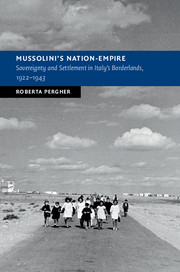
Book contents
- Mussolini’s Nation-Empire
- New Studies in European History
- Mussolini’s Nation-Empire
- Copyright page
- Dedication
- Contents
- Maps
- Acknowledgments
- Introduction
- Chapter 1 The Boundaries of Sovereignty: Italian Rule in Contested Territories
- Chapter 2 Settlement and Sovereignty from the Alps to Africa
- Chapter 3 Divided by a Common Language: The Regime and the Settlers
- Chapter 4 Other Subjects, Other Citizens: The Regime and the Native Populations
- Chapter 5 “Inviolable” Borders: Land, People, and the Option Agreement between Nazi Germany and Fascist Italy
- Conclusion: Mussolini’s Nation-Empire
- Bibliography
- Index
- References
Bibliography
Published online by Cambridge University Press: 27 October 2017

Book contents
- Mussolini’s Nation-Empire
- New Studies in European History
- Mussolini’s Nation-Empire
- Copyright page
- Dedication
- Contents
- Maps
- Acknowledgments
- Introduction
- Chapter 1 The Boundaries of Sovereignty: Italian Rule in Contested Territories
- Chapter 2 Settlement and Sovereignty from the Alps to Africa
- Chapter 3 Divided by a Common Language: The Regime and the Settlers
- Chapter 4 Other Subjects, Other Citizens: The Regime and the Native Populations
- Chapter 5 “Inviolable” Borders: Land, People, and the Option Agreement between Nazi Germany and Fascist Italy
- Conclusion: Mussolini’s Nation-Empire
- Bibliography
- Index
- References
Summary
A summary is not available for this content so a preview has been provided. Please use the Get access link above for information on how to access this content.
Information
- Type
- Chapter
- Information
- Mussolini's Nation-EmpireSovereignty and Settlement in Italy's Borderlands, 1922–1943, pp. 254 - 278Publisher: Cambridge University PressPrint publication year: 2017
References
Primary Sources
Secondary Sources
Balbo, Italo. La politica sociale fascista verso gli arabi della Libia. Rome: Stab. Tip. Europa, 1938.Google Scholar
Battisti, Carlo. “Appunti sui dialetti delle Valli Dolomitiche Atesine.” Archivio per l’Alto Adige 23, no. 1 (1938): 177–194.Google Scholar
Battisti, Carlo. “Rassegna critica degli studi linguistici sull’Alto Adige nel quinquennio 1931–36.” Archivio per l’Alto Adige 21, no. 2 (1936): 561–612.Google Scholar
Bombig, Giorgio. “Le condizioni demografiche della Venezia Giulia e gli allogeni.” Gerarchia 7, no. 9 (1927): 807–819.Google Scholar
Carnaroli, Emiliano. Le funzioni del capitale in agricoltura e l’organizzazione del credito agrario: considerazioni economico-agricole. Padua: Prem. Società Coop. Tip., 1908.Google Scholar
Cavazza, Filippo. “Il problema della colonizzazione in Tripolitania.” In Per le nostre colonie. Edited by Istituto agricolo coloniale italiano di Firenze, 73–100. Florence: Vallecchi, 1927.Google Scholar
Čermelj, Lavo. The Census in Trieste in 1910. Belgrade: Yugoslav Institut for International Affairs, 1946.Google Scholar
Čermelj, Lavo. Life-and-Death Struggle of a National Minority: The Jugoslavs in Italy. Ljubljana: Delniška tiskarna, 1936.Google Scholar
Ciano, Galeazzo. Ciano’s Diary 1937–1938. Translated by Mayor, Andreas. London: Methuen, 1952.Google Scholar
Colocci-Vespucci, Adriano. Diario del Commissariato “Lingua e Coltura” (1918–19). Rome: Stamperia moderna, 1935.Google Scholar
D’Agostino Orsini di Camerota. “Il centennario dell’Algeria.” Gerarchia 10, no. 1 (1930): 481–482.Google Scholar
D’Annunzio, Gabriele. “Canzoni della gesta d’oltremare.” In Merope, Vol. 4 of Laudi del cielo del mare della terra e degli eroi. Milan: Fratelli Treves, 1912.Google Scholar
De Bono, Emilio. “Le mie idee sulla colonizzazione,” L’Oltremare 2, no. 8 (1928): 293–295.Google Scholar
Fassetta, Luigi. “L’Ente di Rinascita Agraria delle Tre Venezie.” Bonifica e Colonizzazione 2, no. 11 (November 1938).Google Scholar
Ferrari, Francesco Luigi. Il regime fascista italiano. Rome: Ed. di Storia e Letteratura, 1983.Google Scholar
Gabelli, Ottone. La Tripolitania dalla fine della guerra mondiale all’avvento del fascism. Tripoli: Airoldi editore, 1937.Google Scholar
Gramsci, Antonio. Selections from the Prison Notebooks. Edited and translated by Hoare, Quintin and Nowell Smith, Geoffrey. New York: International Publishers, 1971.Google Scholar
Gramsci, Antonio. The Southern Question. Translated and introduced by Verdicchio, Pasquale. West Lafayette, IN: Bordighera, 1995.Google Scholar
Holmboe, Knud. Desert Encounter: An Adventurous Journey through Italian Africa. New York: G. P. Putnam, 1937.Google Scholar
INFPS. Colonizzazione demografica in Libia. Venti consigli al nuovo colono. Rome: 1939.Google Scholar
Lessona, Alessandro. “La Cirenaica ad un anno dall’occupazione di Cufra,” Gerarchia 12, no. 4 (April 1932): 265–270.Google Scholar
Lessona, Alessandro. “Le colonie italiane nel quadro europeo.” Gerarchia 12, nos. 7–8 (July/August 1932): 543–553.Google Scholar
Lessona, Alessandro. “La colonizzazione demografica in Libia.” In Scritti e discorsi coloniali, 61–68. Milan: Editoriale Arte e Storia, 1935.Google Scholar
Lessona, Alessandro. “Il popolamento della Libia.” In Scritti e discorsi coloniali, 69–80. Milan: Editoriale Arte e Storia, 1935.Google Scholar
Maugini, Armando. “La colonizzazione della Cirenaica.” In Per le nostre colonie. Edited by Istituto agricolo coloniale italiano di Firenze, 133–155. Florence: Vallecchi, 1927.Google Scholar
Maugini, Armando. “Prefazione.” In I contratti agrari degli enti di colonizzazione in Libia. Edited by Palloni, Giuseppe, 5–14. Florence: G.C. Sansoni, 1945.Google Scholar
Moore, Martin. Fourth Shore: Italy’s Mass Colonization of Libya. London: George Routledge & Sons, 1940.Google Scholar
Mussolini, Benito. “The Doctrine of Fascism” (1932). In Fascism: Doctrine and Institutions. Edited by Mussolini, Benito, 7–31. New York: Howard Fertig, 1969.Google Scholar
Mussolini, Benito. Opera Omnia. Edited by Edoardo, and Susmel, Duilio. 36 vols. Florence: La Fenice, 1951–1963.Google Scholar
Mussolini, Benito. “Prefazione.” In Cirenaica Verde. Edited by Teruzzi, Attilio, 11–13. Milan: Mondadori, 1931.Google Scholar
Opera Nazionale Combattenti. L’Opera Nazionale per i Combattenti. Rome: Castaldi, 1926.Google Scholar
Opera Nazionale Combattenti. Bonifiche e colonizzazione, Alto Adige. Rome: Castaldi, 1927.Google Scholar
Palloni, Giuseppe. I contratti agrari degli enti di colonizzazione in Libia. Florence: G.C. Sansoni, 1945.Google Scholar
Parver, . “Le leggi organiche fasciste per la Tripolitania e la Cirenaica.” L’Oltremare 2, no. 1 (1927–28): 28–30.Google Scholar
Pascoli, Giovanni. “La grande proletaria si è mossa.” In Limpido rivo, prose e poesie presentate da Maria ai figli giovinetti d’Italia, 218–229. Bologna: Zanichelli, 1912.Google Scholar
Pironti di Campagna, Giuseppe. La Difesa dell’Impero. Orientazione Programmatica Italiana. Rome: Liberia Editrice Cattolica Internazionale, 1937–1938.Google Scholar
Ragusin Righi, Livio. Politica di Confine. Trieste: Società Editr. Mutilati e Combattenti, 1929.Google Scholar
Rava, Maurizio. “Demografia e colonizzazione. Esperienze e verità.” L’Oltremare 2, no. 6 (1928): 213–216.Google Scholar
Rivera, Vincenzo. Prospettive di colonizzazione dell’Africa Orientale Italiana. Rome: Libreria di Scienze e Lettere, 1939.Google Scholar
Serpieri, Arrigo. L’agricoltura nell’economia della nazione. Florence: Barbèra Editore, 1940.Google Scholar
Tolomei, Ettore. Integrazione della provincia di Bolzano. Conquista del suolo. Bolzano: Istituto di Studi per l’Alto Adige, 1933.Google Scholar
Tolomei, Ettore, and Preziosi, Giovanni. Provvedimenti per l’Alto Adige intesi ad un’azione ordinata pronta efficace d’assimilazione italiana. Rome: S.A.I. Industrie grafiche, 1923.Google Scholar
Abi-Mershed, Osama W. Apostles of Modernity: Saint-Simonians and the Civilizing Mission in Algeria. Stanford: Stanford University Press, 2010.Google Scholar
Abraham, David. The Collapse of the Weimar Republic: Political Economy and Crisis. New York: Holmes & Meier, 1986.Google Scholar
Absalom, Robert. “The Peasant Experience under Italian Fascism.” In The Oxford Handbook of Fascism. Edited by Bosworth, R. J. B., 127–149. Oxford: Oxford University Press, 2009.Google Scholar
Adas, Michael. “Contested Hegemony: The Great War and the Afro-Asian Assault on the Civilizing Mission Ideology.” Journal of World History 15, no. 1 (March 2004): 31–63.10.1353/jwh.2004.0002CrossRefGoogle Scholar
Adler-Nissen, Rebecca, and Gammeltoft-Hansen, Thomas, eds. Sovereignty Games: Instrumentalizing State Sovereignty in Europe and Beyond. New York: Palgrave Macmillan, 2008.10.1057/9780230616936CrossRefGoogle Scholar
Ahmida, Ali Abdullatif. Forgotten Voices: Power and Agency in Colonial and Postcolonial Libya. New York: Routledge, 2005.CrossRefGoogle Scholar
Ahonen, Pertti et al. People on the Move: Forced Population Movements in Europe in the Second World War and Its Aftermath. New York: Berg, 2008.Google Scholar
Albanese, Giulia. “Versailles/Versaglia: la ‘vittoria mutilata.’” In Gli Italiani in guerra: conflitti, identita, memorie dal Risorgimento ai nostri giorni. Vol. 3, La Grande Guerra. Dall’intervento alla “vittoria mutilata.” Edited by Isnenghi, Mario and Ceschin, Daniele, 735–742. Turin: Utet, 2009.Google Scholar
Alcock, Antony Evelyn. The History of the South Tyrol Question. London: Michael Joseph, 1970.Google Scholar
Aldrich, Robert. Greater France: A History of French Overseas Expansion. New York: St. Martin’s Press, 1996.CrossRefGoogle Scholar
Altekamp, Stefan. Rückkehr nach Afrika. Italienische Kolonialarchäologie in Libyen, 1911–1943. Cologne: Böhlau Verlag, 2000.Google Scholar
Anderson, Lisa. The State and Social Transformation in Tunisia and Libya, 1830–1980. Princeton: Princeton University Press, 1986.Google Scholar
Anghie, Antony. “Finding the Peripheries: Sovereignty and Colonialism in Nineteenth-Century International Law.” Harvard International Law Journal 40, no. 1 (Winter 1999): 1–80.Google Scholar
Anghie, Antony. Imperialism, Sovereignty and the Making of International Law. New York: Cambridge University Press, 2005.10.1017/CBO9780511614262CrossRefGoogle Scholar
Anghie, Antony. “Western Discourses of Sovereignty.” In Sovereignty: Frontiers of Possibility. Edited by Evans, Julie, Genovese, Ann, and Reilly, Alexander, 19–36. Honolulu: University of Hawaii Press, 2012.10.21313/hawaii/9780824835637.003.0002CrossRefGoogle Scholar
Appleton, Leonard. “The Question of Nationalism and Education in Libya under Italian Rule.” Libyan Studies 10 (1979): 29–33.10.1017/S0263718900000960CrossRefGoogle Scholar
Ara, Angelo. “Scuola e minoranze nazionali in Italia, 1861–1940.” Studi Trentini di Scienze Storiche 4 (1990): 457–488.Google Scholar
Arendt, Hannah. The Origins of Totalitarianism. New Edition with Added Prefaces. New York: Harcourt Brace & Company, 1979.Google Scholar
Arielli, Nir. “Beyond Mare Nostrum: Ambitions and Limitations in Fascist Italy’s Middle Eastern Policy.” Geschichte und Gesellschaft 37 (2011): 385–407.10.13109/gege.2011.37.3.385CrossRefGoogle Scholar
Arielli, Nir. Fascist Italy and the Middle East, 1933–40. New York: Palgrave Macmillan, 2010.10.1057/9780230281684CrossRefGoogle Scholar
Arthurs, Joshua. Excavating Modernity: The Roman Past in Fascist Italy. Ithaca, NY: Cornell University Press, 2012.10.7591/cornell/9780801449987.001.0001CrossRefGoogle Scholar
Arthurs, Joshua, Ebner, Michael, and Ferris, Kate, eds. The Politics of Everyday Life in Fascist Italy: Outside the State? New York: Palgrave Macmillan, 2017.10.1057/978-1-137-58654-4CrossRefGoogle Scholar
Baily, Samuel L. Immigrants in the Lands of Promise: Italians in Buenos Aires and New York City, 1870–1914. Ithaca, NY: Cornell University Press, 1999.Google Scholar
Baldinetti, Anna. The Origins of the Libyan Nation: Colonial Legacy, Exile and the Emergence of a New Nation-State. New York: Routledge, 2010.Google Scholar
Ballinger, Pamela. History in Exile: Memory and Identity at the Borders of the Balkans. Princeton: Princeton University Press, 2003.10.1515/9780691187273CrossRefGoogle Scholar
Bandelli, Gino. “Per una storia del mito di Roma al confine orientale. Archeologia e urbanistica nella Trieste del ventennio.” In Il teatro romano di Trieste. Monumento, storia, funzione. Edited by Verzár-Bass, Monika, 252–262. Rome: Istituto svizzero, 1991.Google Scholar
Baranowski, Shelley. Nazi Empire: German Colonialism and Imperialism from Bismarck to Hitler. Cambridge: Cambridge University Press, 2011.Google Scholar
Barrera, Giulia. “Mussolini’s Colonial Race Laws and State-Settlers Relations in AOI (1935–41).” Journal of Modern Italian Studies 8, no. 3 (2003): 425–443.10.1080/09585170320000113770CrossRefGoogle Scholar
Barrera, Giulia. “Patrilinearità, razza e identità. L’educazione degli italo-eritrei durante il colonialismo italiano (1885–1934).” Quaderni Storici 109 (2002): 21–53.Google Scholar
Bartelson, Jens. A Genealogy of Sovereignty. Cambridge: Cambridge University Press, 1995.10.1017/CBO9780511586385CrossRefGoogle Scholar
Bashford, Alison. “Nation, Empire, Globe: The Spaces of Population Debate in the Interwar Years.” Comparative Studies in Society and History 49, no. 1 (2007): 170–201.10.1017/S0010417507000448CrossRefGoogle Scholar
Battaglia, Salvatore. Grande Dizionario della Lingua Italiana I. Turin: Unione Tipografico-Editrice Torinese, 1961.Google Scholar
Beauman, Katharine Bentley. Women and the Settlement Movement. London: Radcliffe Press, 1996.Google Scholar
Ben-Ghiat, Ruth. Fascist Modernities: Italy, 1922–1945. Berkeley: University of California Press, 2001.Google Scholar
Ben-Ghiat, Ruth. Italian Fascism’s Empire Cinema. Bloomington: Indiana University Press, 2015.10.2979/4749.0CrossRefGoogle Scholar
Ben-Ghiat, Ruth, and Fuller, Mia, eds. Italian Colonialism. New York: Palgrave Macmillan, 2005.10.1007/978-1-4039-8158-5CrossRefGoogle Scholar
Benvenuti, Sergio, and von Hartungen, Cristoph, eds. Ettore Tolomei (1865–1952). Un nazionalista di confine = die Grenzen des Nationalismus. Trento: Museo Storico Trento, 1998.Google Scholar
Bergerson, Andrew Stuart. “Introduction: New Manners.” In Ordinary Germans in Extraordinary Times: The Nazi Revolution in Hildesheim, 1–11. Bloomington: Indiana University Press, 2004.10.2979/2540.0CrossRefGoogle Scholar
Berman, Nathaniel. “Chapter Six: Beyond Colonialism and Nationalism? Ethiopia, Czechoslovakia, and ‘Peaceful Change.’” In Passion and Ambivalence: Colonialism, Nationalism, and International Law, 319–383. Leiden, NLD: Brill Academic Publishers, 2011.Google Scholar
Bernhard, Patrick. “Hitler’s Africa in the East: Italian Colonialism as a Model for German Planning in Eastern Europe.” Journal of Contemporary History 51, no. 1 (2016): 61–90.10.1177/0022009414561825CrossRefGoogle Scholar
Betts, Raymond F. Uncertain Dimensions: Western Overseas Empires in the Twentieth Century. Minneapolis: University of Minnesota Press, 1985.Google Scholar
Bevilacqua, Piero, De Clementi, Adreina, and Franzina, Emilio, eds. Storia dell’Emigrazione Italiana. Rome: Donzelli editore, 2002.Google Scholar
Biasutti, Giambattista. “La politica indigena italiana in Libia dall’occupazione al termine del governatorato di Italo Balbo (1911–1940).” PhD diss., University of Siena, 2004.Google Scholar
Bickers, Robert, ed. Settlers and Expatriates: Britons over the Seas. Oxford: Oxford University Press, 2010.10.1093/acprof:oso/9780199297672.001.0001CrossRefGoogle Scholar
Bloxham, Donald. “The Great Unweaving: The Removal of Peoples in Europe, 1875–1949.” In Removing Peoples: Forced Removal in the Modern World. Edited by Bessel, Richard and Haake, Claudia B., 167–207. Oxford: Oxford University Press, 2009.Google Scholar
Boccini, Floriano, and Ciccozzi, Erminia, eds. Opera nazionale per i Combattenti. Progetti. Inventario. Rome: Ministero per i beni e le attività culturali, Direzione generale per gli archivi, 2007.Google Scholar
Bolton, Herbert Eugene. The Spanish Borderlands: A Chronicle of Old Florida and the Southwest. New Haven: Yale University Press, 1921.Google Scholar
Bonifizierungskonsortium Gsies/Taisten. Das Gsieser Tal. Ein Südtiroler Hochtal im Spannungsfeld zwischen Tradition und Zukunft. Bozen: Pluristamp, 1997.Google Scholar
Bono, Salvatore. Tripoli bel suol d’amore. Testimonianze sulla guerra italo-libica. Rome: Istituto italiano per l’Africa e l’Oriente, 2005.Google Scholar
Bosworth, R. J. B. Mussolini’s Italy: Life under the Dictatorship 1915–1945. New York: Allen Lane, 2005.Google Scholar
Bosworth, Richard, and Finaldi, Giuseppe. “The Italian Empire.” In Empires at War: 1911–1923. Edited by Gerwarth, Robert and Manela, Erez, 34–51. New York: Oxford University Press, 2014.10.1093/acprof:oso/9780198702511.003.0003CrossRefGoogle Scholar
Brancatisano, Ilaria. “La colonizzazione demografica in Etiopia.” Clio 30, no. 3 (1990): 455–495.Google Scholar
Brogini Künzi, Giulia. Italien und der Abessinienkrieg 1935/36. Kolonialkrieg oder Totaler Krieg? Paderborn: Schöningh, 2006.Google Scholar
Burbank, Jane, and Cooper, Frederick. Empires in World History: Power and the Politics of Difference. Princeton: Princeton University Press, 2010.Google Scholar
Burke, Edmund III. “The Terror and Religion: Brittany and Algeria.” In Colonialism and the Modern World. Edited by Blue, Gregory, Bunton, Martin, and Croizier, Ralph, 40–50. Armonk, NY: Sharpe, 2002.Google Scholar
Burton, Antoinette. “Who Needs the Nation? Interrogating ‘British’ History.” Journal of Historical Sociology 10 (1997): 227–248.CrossRefGoogle Scholar
Burton, Paul J. Friendship and Empire: Roman Diplomacy and Imperialism in the Middle Republic. Cambridge: Cambridge University Press, 2011.10.1017/CBO9781139035590CrossRefGoogle Scholar
Cannistraro, Philip V. La fabbrica del consenso. Fascismo e mass media. Rome: Laterza, 1975.Google Scholar
Caprotti, Federico. Mussolini’s Cities: Internal Colonialism in Italy, 1930–1939. Youngstown, NY: Cambria Press, 2007.Google Scholar
Capuzzo, Ester. Dall’Austria all’Italia. Aspetti istituzioni e problemi normativi nella storia di una frontiera. Rome: La Fenice edizioni, 1996.Google Scholar
Capuzzo, Ester. “Dalla pertinenza austriaca alla cittadinanza italiana.” In Seminario di studi. Rovereto, 16 ottobre 2009. In tema di cittadinanza: origine, ragioni e applicazione della legge 379/2000. Edited by Capuzzo, Ester, 65–79. Rovereto: Accademia Roveretana degli Agiati, 2010.Google Scholar
Capuzzo, Ester. “Sudditanza e cittadinanza nell’esperienza coloniale italiana dell’età liberale.” Clio 31, no. 1 (1995): 65–95.Google Scholar
Carocci, Giampiero. Storia degli ebrei in Italia. Dall’emancipazione a oggi. Rome: Newton & Compton Editori, 2005.Google Scholar
Cattaruzza, Marina. L’Italia e il confine orientale 1866–2006. Bologna: Il Mulino, 2008.Google Scholar
Cavanagh, Edward, and Veracini, Lorenzo, eds. The Routledge Handbook of the History of Settler Colonialism. New York: Routledge, 2017.Google Scholar
Cavazza, Stefano. Piccole patrie. Feste popolari tra regione e nazione durante il fascismo. Bologna: Il Mulino, 1997.Google Scholar
Chávez, John. “Aliens in Their Native Lands: The Persistence of Internal Colonial Theory.” Journal of World History 22, no. 4 (December 2011): 785–809.CrossRefGoogle Scholar
Choate, Mark. “Identity Politics and Political Perception in the European Settlement of Tunisia: The French Colony versus the Italian Colony.” French Colonial History 8, no. 1 (2007): 97–109.10.1353/fch.2007.0003CrossRefGoogle Scholar
Choate, Mark. “Tunisia, Contested: Italian Nationalism, French Imperial Rule, and Migration in the Mediterranean Basin,” California Italian Studies 1, no. 1 (2010): 1–20.10.5070/C311008861CrossRefGoogle Scholar
Clark, Bruce. Twice a Stranger: The Mass Expulsion That Forged Modern Greece and Turkey. London: Granta, 2006.Google Scholar
Collotti, Enzo. “Il razzismo antislavo.” In Nel nome della razza: Il razzismo nella storia d’Italia 1870–1945. Edited by Burgio, Alberto, 33–61. Bologna: Il Mulino, 1999.Google Scholar
Conklin, Alice. A Mission to Civilize: The Republican Idea of Empire in France and West Africa, 1895–1930. Stanford: Stanford University Press, 1997.Google Scholar
Conte, Carmelo. Struttura e funzioni dell’Opera Nazionale Combattenti. Milan: A. Giuffre, 1965.Google Scholar
Cooper, Frederick. Citizenship between Empire and Nation: Remaking France and French Africa, 1945–1960. Princeton: Princeton University Press, 2014.Google Scholar
Cooper, Frederick. Colonialism in Question. Theory, Knowledge, History. Berkeley: University of California Press, 2005.10.1525/9780520938618CrossRefGoogle Scholar
Cooper, Frederick. Decolonization and African Society: The Labor Question in British and French Africa. Cambridge: Cambridge University Press, 1996.10.1017/CBO9780511584091CrossRefGoogle Scholar
Corner, Paul. The Fascist Party and Popular Opinion in Mussolini’s Italy. Oxford: Oxford University Press, 2012.10.1093/acprof:oso/9780198730699.001.0001CrossRefGoogle Scholar
Corner, Paul. “Italian Fascism: Organization, Enthusiasm, Opinion.” Journal of Modern Italian Studies 15, no. 3 (2010): 378–389.10.1080/13545711003768584CrossRefGoogle Scholar
Corner, Paul, and Galimi, Valeria, eds. Il fascimo in provincia. Articolazioni e gestione del potere tra centro e periferia. Rome: Viella, 2015.Google Scholar
Corni, Gustavo. “La politica agraria del fascismo. Un confronto fra Italia e Germania.” Studi Storici 28, no. 2 (1987): 385–421.Google Scholar
Corni, Gustavo. “Die Utopien des Faschismus: Ruralisierung und ‘neue Städte.’” In Utopie und politische Herrschaft im Europa der Zwischenkriegszeit. Edited by Hardtwig, Wolfgang, 97–118. Berlin: Oldenbourg, 2003.10.1524/9783486594508-008CrossRefGoogle Scholar
Crainz, Guido. Padania. Il mondo dei braccianti dall’Ottocento alla fuga dalle campagne. Rome: Donzelli, 1994.Google Scholar
Cresti, Federico. “The Early Years of the Agency for the Colonization of Cyrenaica (1932–1941).” In Italian Colonialism. Edited by Ben-Ghiat, and Fuller, , 73–82. New York: Palgrave Macmillan, 2005.10.1007/978-1-4039-8158-5_7CrossRefGoogle Scholar
Cresti, Federico. “Land Settlements.” In A Historical Companion to Postcolonial Literatures – Continental Europe and Its Empires. Edited by Poddar, Prem, Patke, Rajeev S. and Jensen, Lars, 298–299. Edinburgh: Edinburgh University Press, 2008.Google Scholar
Cresti, Frederico. Non desiderare la terra d’altri. La colonizzazione italiana in Libia. Rome: Carocci, 2011.Google Scholar
Cresti, Frederico. Oasi di Italianità. La Libia della colonizzazione agraria tra fascismo, guerra e indipendenza (1935–1956). Turin: Società editrice internazionale, 1996.Google Scholar
Cresti, Frederico. “Per uno studio delle ‘elites’ politiche nella Libia indipendente: la formazione scolastica (1912–1942).” Studi Storici 41, no. 1 (2000): 121–158.Google Scholar
Culver, Annika. “Japanese Mothers and Rural Settlement in Wartime Manchukuo: Gendered Reflections of Labor and Productivity in Manshû gurafu [Manchuria Graph], 1936–1943.” In Motherhood and War. Edited by Cooper, Dana and Phelan, Claire, 95–114. New York: Palgrave Macmillan, 2014.10.1057/9781137437945_6CrossRefGoogle Scholar
Darwin, John. The Empire Project: The Rise and Fall of the British World-System 1830–1970. Cambridge: Cambridge University Press, 2009.10.1017/CBO9780511635526CrossRefGoogle Scholar
Davis, Natalie Zemon. Fiction in the Archives: Pardon Tales and Their Tellers in Sixteenth-Century France. Stanford: Stanford University Press, 1990.10.1515/9781503620957CrossRefGoogle Scholar
De Donno, Fabrizio. “La Razza Ario-Mediterranea: Ideas of Race and Citizenship in Colonial and Fascist Italy, 1885–1941.” Interventions 8, no. 3 (2006): 394–412.10.1080/13698010600955958CrossRefGoogle Scholar
De Felice, Renzo. Mussolini il duce. Gli anni del consenso 1929–1936. Turin: Einaudi, 1974.Google Scholar
De Felice, Renzo. Il problema dell’Alto Adige nei rapporti italo-tedeschi dall’ “Anschluss” alla fine della seconda guerra mondiale. Bologna: Il Mulino, 1973.Google Scholar
De Grazia, Victoria. The Culture of Consent: Mass Organization and Leisure in Fascist Italy. Cambridge: Cambridge University Press, 1981.10.1017/CBO9780511528972CrossRefGoogle Scholar
De Grazia, Victoria. “Die Radikalisierung der Bevölkerungspolitik im faschistischen Italien: Mussolini’s ‘Rassenstaat.’” Geschichte und Gesellschaft 26 (2000): 219–254.Google Scholar
De Grazia, Victoria. How Fascism Ruled Women. Berkeley: University of California Press, 1992.10.1525/9780520911383CrossRefGoogle Scholar
De Napoli, Olindo. La prova della razza. Cultura giuridica e razzismo in Italia negli anni Trenta. Florence: Le Monnier, 2009.Google Scholar
Deak, John. “The Great War and the Forgotten Realm: The Habsburg Monarchy and the First World War,” Journal of Modern History 86, no. 2 (June 2014): 336–380.10.1086/675880CrossRefGoogle Scholar
Del Boca, Angelo. Gli italiani in Libia. Vol. 1, Tripoli bel suol d’amore, 1860–1922. Rome: Laterza, 1986.Google Scholar
Del Boca, Angelo. Gli italiani in Libia. Vol. 2, Dal fascismo a Gheddafi. Rome: Laterza, 1988.Google Scholar
Del Boca, Angelo. Italiani, brava gente? Un mito duro a morire. Vicenza: Neri Pozza, 2005.Google Scholar
Del Boca, Angelo, Mohamed Fekini and the Fight to Free Libya. Basingstoke: Palgrave Macmillan, 2011.10.1057/9780230116337CrossRefGoogle Scholar
Dewhurst Lewis, Mary. Divided Rule: Sovereignty and Empire in French Tunisia, 1881–1938. Berkeley: University of California Press, 2014.Google Scholar
Di Michele, Andrea. L’italianizzazione imperfetta. L’amministrazione pubblica dell’Alto Adige tra Italia liberale e fascismo. Alessandria: Edizioni dell’Orso, 2003.Google Scholar
Di Pasquale, Francesca. “‘Sentinelle avanzate della patria lontana’. Gli insegnanti in Libia in epoca coloniale (1911–1943).” In Governare l’Oltremare. Istituzioni, funzionari e società nel colonialismo italiano. Edited by Dore, Gianni, Giorgi, Chiara, Morone, Antonio, and Zaccaria, Massimo, 117–130. Rome: Carocci, 2013.Google Scholar
Dickinson, Edward Ross. “The German Empire: An Empire?” History Workshop Journal 66 (2008): 129–162.10.1093/hwj/dbn028CrossRefGoogle Scholar
Djokić, Dejan. Nikola Pašić and Ante Trumbić: The Kingdom of Serbs, Croats and Slovenes. London: Haus Histories, 2010.Google Scholar
Dominioni, Matteo. Lo sfascio dell’impero. Gli italiani in Etiopia (1936–1941). Rome: Laterza, 2008.Google Scholar
Donati, Sabrina. A Political History of National Citizenship and Identity in Italy, 1861–1950. Stanford: Stanford University Press, 2013.Google Scholar
Duara, Prasenjit. “The Imperialism of ‘Free Nations.’ Japan, Manchukuo, and the History of the Present.” In Imperial Formations. Edited by Stoler, Ann Laura, McGranahan, Carole, and Perdue, Peter C., 211–239. Santa Fe: School for Advanced Research Press, 2007.Google Scholar
Duara, Prasenjit. Sovereignty and Authority: Manchukuo and the East Asian Modern. Lanham: Rowman & Littelfield, 2003.Google Scholar
Dubois, Laurent. Avengers of the New World: The Story of the Haitian Revolution. Cambridge, MA: Belknap Press of Harvard University Press, 2004.CrossRefGoogle Scholar
Ebner, Michael R. Ordinary Violence in Mussolini’s Italy. New York: Cambridge University Press, 2011.Google Scholar
Edward, Catharine, ed. Roman Presences: Receptions of Rome in European Culture, 1789–1945. Cambridge: Cambridge University Press, 1999.Google Scholar
Eisterer, Klaus, and Steininger, Rolf, eds. Die Option. Südtirol zwischen Faschismus und Nationalsozialismus. Innsbruck: Innsbrucker Forschungen zur Zeitgeschichte 5, 1989.Google Scholar
El-Bah, Khalifah. “Fascist Colonial Schooling of Libyan Muslim Arab Children (1922–1942): A Political System Analysis.” PhD diss., University of California, Los Angeles, 1985.Google Scholar
Elkins, Caroline, and Pedersen, Susan, eds. Settler Colonialism in the Twentieth Century: Projects, Practices, Legacies. New York: Routledge, 2005.Google Scholar
Ellis, Matthew H. “Over the Borderline? Rethinking Territoriality at the Margins of Empire and Nation in the Modern Middle East (Part I and II). History Compass 13, no. 8 (2015): 411–422 and 423–434.10.1111/hic3.12251CrossRefGoogle Scholar
Etkind, Alexander. Internal Colonization: Russia’s Imperial Experience. Cambridge: Polity, 2011.Google Scholar
Faloppa, Federico. Parole contro. La rappresentazione del “diverso” nella lingua italiana e nei dialetti. Milan: Garzanti, 2004.Google Scholar
Farrell, Brian P. “The Wide-Angle Lens? The Centrality of Russia in the Histories of Eurasia, Empires, and Borderlands.” Kritika: Explorations in Russian and Eurasian History 16, no. 4 (Fall 2015): 917–924.Google Scholar
Fedorowich, Kent, and Thompson, Andrew S., eds. Empire, Migration and Identity in the British World. Manchester: Manchester University Press, 2013.Google Scholar
Ferrandi, Maurizio. Ettore Tolomei. L’uomo che inventò l’Alto Adige. Trento: Publilux, 1986.Google Scholar
Ferris, Kate. Everyday Life in Fascist Venice, 1929–40. New York: Palgrave Macmillan, 2012.10.1057/9781137265081CrossRefGoogle Scholar
Fink, Carole. Defending the Rights of Others: The Great Powers, the Jews, and International Minority Protection, 1878–1938. Cambridge: Cambridge University Press, 2006.Google Scholar
Fiore, Massimiliano. Anglo-Italian Relations in the Middle East, 1922–1940. New York: Routledge, 2016.10.4324/9781315567136CrossRefGoogle Scholar
Fitzpatrick, Sheila. Everyday Stalinism: Ordinary Life in Extraordinary Times – Soviet Russia in the 1930s. New York: Oxford University Press, 1999.10.1093/oso/9780195050004.001.0001CrossRefGoogle Scholar
Flynn, Kathryn A., and Polese, Richard. The New Deal: A 75th Anniversary Celebration. Layton, UT: Gibbs Smith, 2008.Google Scholar
Focardi, Filippo. Il cattivo tedesco e il bravo italiano. La rimozione delle colpe della seconda guerra mondiale. Rome: Laterza, 2013.Google Scholar
Fogarty, Richard S. Race and War in France: Colonial Subjects in the French Army, 1914–1918. Baltimore: Johns Hopkins University Press, 2008.Google Scholar
Folchi, Annibale. I contadini del Duce. Agro Pontino, 1932–1941. Rome: Pieraldo, 2000.Google Scholar
Foresti, Fabio. “Il problema linguistico nella ‘politica indigena’ del colonialismo fascista.” Movimento Operaio e Socialista 7, no. 1 (1984): 133–155.Google Scholar
Forsyth, James. A History of the Peoples of Siberia: Russia’s North Asian Colony, 1581–1990. New York: Cambridge University Press, 1992.Google Scholar
Framke, Gisela. Im Kampf um Südtirol: Ettore Tolomei (1865–1952) und das “Archivo per l’Alto Adige.” Tübingen: M. Niemeyer, 1987.Google Scholar
Frank, Susi K. “‘Internal Colonization’ and the Frontier Myth: Constructions of Space in Russia and the USA.” Osteuropa 53, no. 11 (2003): 1658–1675.Google Scholar
Franzina, Emilio. Gli italiani al nuovo mondo. L’emigrazione italiana in America 1492–1942. Milan: Mondadori, 1995.Google Scholar
Franzina, Emilio. La storia altrove. Casi nazionali e casi regionali nelle moderne migrazioni di massa. Verona: Cierre, 1998.Google Scholar
Franzinelli, Mimmo, and Cavassini, Paolo. Fiume. L’ultima impresa di D’Annunzio. Milan: Mondadori, 2009.Google Scholar
Fuller, Mia. Moderns Abroad: Architecture, Cities and Italian Imperialism. New York: Routledge, 2007.10.4324/9780203968864CrossRefGoogle Scholar
Fuller, Mia. “Oases of Ambiguity: On How Italians Did Not Practice Planned Urban Segregation in Tripoli.” In La Libia tra Mediterraneo e mondo islamico. Atti del convegno di Catania. Edited by Cresti, Federico, 163–181. Milan: Giuffrè, 2006.Google Scholar
Gabaccia, Donna. Italy’s Many Diasporas. Seattle: University of Washington Press, 2000.Google Scholar
Gabaccia, Donna R., and Ottanelli, Fraser M.. Italian Workers of the World: Labor Migration and the Formation of Multiethnic States. Urbana: University of Illinois Press, 2001.Google Scholar
Gallo, Stefano. Senza attraversare le frontiere. Le migrazioni interne dall’Unità a oggi. Rome: Laterza, 2012.Google Scholar
Gatterer, Claus. Schöne Welt – Böse Leut. Kindheit in Südtirol. Vienna: Verlag Fritz Molden, 1969.Google Scholar
Gentile, Emilio. Il culto del littorio. La sacralizzazione della politica nell’Italia fascista. Rome: Laterza, 1993.Google Scholar
Gentile, Emilio. La Grande Italia. The Myth of the Nation in the 20th Century. Madison: University of Wisconsin Press, 2009.Google Scholar
Gentile, Emilio. La via italiana al totalitarismo. Il partito e lo Stato nel regime fascista. Rome: Nis, 1995.Google Scholar
Ghirardo, Diane. Building New Communities: New Deal America and Fascist Italy. Princeton: Princeton University Press, 1989.Google Scholar
Gillette, Aaron. Racial Theories in Fascist Italy. New York: Routledge, 2002.10.4324/9780203279212CrossRefGoogle Scholar
Giorgi, Chiara. L’Africa come carriera. Funzioni e funzionari del colonialismo italiano. Rome: Carocci, 2012.Google Scholar
Glass, David Victor. Population Policies and Movements in Europe. Oxford: The Clarendon Press, 1940.Google Scholar
Goebel, Michael. Anti-Imperial Metropolis: Interwar Paris and the Seeds of Third World Nationalism. Cambridge: Cambridge University Press, 2015.10.1017/CBO9781139681001CrossRefGoogle Scholar
Gordon, Robert S. C. “Race.” In The Oxford Handbook of Fascism. Edited by Bosworth, R. J. B., 296–316. Oxford: Oxford University Press, 2009.Google Scholar
Gott, Richard. “Latin America as a White Settler Society.” Bulletin of Latin American Research 26, no. 2 (2007): 269–289.10.1111/j.1470-9856.2007.00224.xCrossRefGoogle Scholar
Hagen, William W. Germans, Poles, and Jews: The Nationality Conflict in the Prussian East, 1772–1914. Chicago University Press, 1980.Google Scholar
Haklai, Oded, and Loizides, Neophytos, eds. Settlers in Contested Lands. Territorial Disputes and Ethnic Conflicts. Stanford: Stanford University Press, 2015.10.1515/9780804796521CrossRefGoogle Scholar
Hämäläinen, Pekka, and Truett, Samuel. “On Borderlands.” Journal of American History 98, no. 2 (September 2011): 338–361.10.1093/jahist/jar259CrossRefGoogle Scholar
Hametz, Maura. “Foreigners in their Own City: Italian Fascism and the Dispersal of Trieste’s Port Jews.” Jewish Culture and History 9, nos. 2–3 (2007): 16–32.10.1080/1462169X.2007.10512074CrossRefGoogle Scholar
Hametz, Maura E. In the Name of Italy: Nation, Family, and Patriotism in a Fascist Court. New York: Fordham University Press, 2012.10.5422/fordham/9780823243396.001.0001CrossRefGoogle Scholar
Hametz, Maura E. Making Trieste Italian, 1918–1954. Woodbridge, UK: Boydell Press, 2005.Google Scholar
Hametz, Maura. “Zionism, Emigration, and Antisemitism in Trieste: Central Europe’s ‘Gateway to Zion,’ 1896–1943.” Jewish Social Studies 13, no. 3 (2007): 103–134.Google Scholar
Harvey, Elizabeth. Women and the Nazi East: Agents and Witnesses of Germanization. New Haven: Yale University Press, 2003.Google Scholar
Hechter, Michael. Internal Colonialism: The Celtic Fringe in Britain’s National Development. New Brunswick, NJ: Transaction Publishers, 1999.Google Scholar
Heinemann, Isabel. “Rasse, Siedlung, deutsches Blut”: Das Rasse- & Siedlungshauptamt der SS und die rassenpolitische Neuordnung Europas. Göttingen: Wallstein-Verlag, 2003.Google Scholar
Heinemann, Isabel, and Wagner, Patrick, eds. Wissenschaft, Planung, Vertreibung: Neuordnungskonzepte und Umsiedlungspolitik im 20. Jahrhundert. Stuttgart: F. Steiner, 2006.Google Scholar
Heiss, Hans. “‘Man pflegt Südtirol zu sagen und meint, damit wäre alles gesagt.’ (C. Gatterer) Beiträge zur einer Geschichte des Begriffes “Südtirol,” Geschichte und Region/Storia e regione 9 (2000):85–109.Google Scholar
Hine, Robert V., and Mack Faragher, John. The American West: A New Interpretive History. New Haven: Yale University Press, 2000.Google Scholar
Holquist, Peter. “‘In Accord with State Interests and the People’s Wishes’: The Technocratic Ideology of Imperial Russia’s Resettlement Administration.” Slavic Review 69, no. 1 (Spring 2010): 151–179.10.1017/S0037677900016739CrossRefGoogle Scholar
Horn, David G. Social Bodies: Science, Reproduction, and Italian Modernity. Princeton: Princeton University Press, 1994.Google Scholar
Howe, Glenford. Race, War and Nationalism: A Social History of West Indians in the First World War. Kingston: Ian Randle, 2002.Google Scholar
Huntford, Roland. Fridtjof Nansen and the Unmixing of Greeks and Turks in 1924. Oslo: Det Norske Videnskaps-Akademi, 1999.Google Scholar
Hyam, Ronald. Britain’s Declining Empire: The Road to Decolonisation, 1918–1968. Cambridge: Cambridge University Press, 2007.10.1017/CBO9780511802898CrossRefGoogle Scholar
Il tempo delle fabbriche: Alumix: archeologia industriale a Bolzano. Bolzano: La Fabbrica del Tempo, 2000.Google Scholar
Ipsen, Carl. Dictating Demography: The Problem of Population in Fascist Italy. Cambridge: Cambridge University Press, 1996.10.1017/CBO9780511581953CrossRefGoogle Scholar
Ivašič, Marta. “‘In Libia va male, se andrà sempre così mi pare che perderemo. Evviva il Duce!’ La scuola come strumento di propaganda e snazionalizzazione.” Bollettino dell’Istituto regionale per la storia del movimento di liberazione nel Friuli-Venezia Giulia 3, nos. 1–2 (1975): 33–36.Google Scholar
Jones, Elizabeth B. “The Rural ‘Social Ladder’: Internal Colonization, Germanization and Civilizing Missions in the German Empire.” Geschichte und Gesellschaft 40, no. 4 (October–December 2014): 457–492.10.13109/gege.2014.40.4.457CrossRefGoogle Scholar
Kakel, Carroll P. The American West and the Nazi East: A Comparative and Interpretive Perspective. New York: Palgrave Macmillan, 2011.10.1057/9780230307063CrossRefGoogle Scholar
Kalmo, Hent, and Skinner, Quentin, eds. Sovereignty in Fragments. The Past, Present, and Future of a Contested Concept. Cambridge: Cambridge University Press, 2010.10.1017/CBO9780511675928CrossRefGoogle Scholar
Karch, Brendan. “Nationalism on the Margins: Silesians between Germany and Poland, 1848–1945.” PhD diss., Harvard University, 2010.Google Scholar
Kenny, Kevin, ed. Ireland and the British Empire. Oxford: Oxford University Press, 2004.Google Scholar
Koehl, Robert. RKFDV, German Resettlement and Population Policy, 1939–1945: A History of the Reich Commission for the Strengthening of Germandom. Cambridge: Harvard University Press, 1957.Google Scholar
Kopp, Kristin. Germany’s Wild East: Constructing Poland as Colonial Space. Ann Arbor: University of Michigan Press, 2012.10.3998/mpub.3245954CrossRefGoogle Scholar
Krautwurst, Udo. “What Is Settler Colonialism? An Anthropological Meditation on Frantz Fanon’s ‘Concerning Violence.’” History and Anthropology 14, no. 1 (2003): 55–72.10.1080/10275720032000069601CrossRefGoogle Scholar
Kumar, Krishan. “Nation-States as Empires, Empires as Nation-States: Two Principles, One Practice?” Theory and Society 39, no. 2 (2010): 119–143.10.1007/s11186-009-9102-8CrossRefGoogle Scholar
Labanca, Nicola. “Impero.” In Dizionario del fascismo. Vol. 1 A–K. Edited by De Grazia, Victoria and Luzzatto, Sergio, 659–662. Turin: Einaudi, 2005.Google Scholar
Labanca, Nicola. Oltremare. Storia dell’espansione colonial italiana. Bologna: Il Mulino, 2002.Google Scholar
Labanca, Nicola. Posti al sole. Diari e memorie di vita e di lavoro dalle colonie d’Africa. Rovereto: Edizioni Osiride, 2001.Google Scholar
Labanca, Nicola, ed. Un nodo. Immagini e documenti sulla repressione coloniale italiana in Libia. Rome: Piero Lacaita Editore, 2002.Google Scholar
Larebo, Haile M. The Building of an Empire: Italian Land Policy and Practice in Ethiopia, 1935–1941. Oxford: Clarendon Press, 1994.Google Scholar
Latour, Conrad F. Südtirol and die Achse Berlin-Rom 1938–1945. Stuttgart: Deutsche Verlags-Anstalt, 1962.10.1524/9783486703795CrossRefGoogle Scholar
Lechner, Stefan. Die Eroberung der Fremdstämmigen. Provinzfaschismus in Südtirol 1921–1926. Innsbruck: Universitätsverlag Wagner, 2005.Google Scholar
Lechner, Stefan. “Nel nuovo Stato. L’Alto Adige e il problema dell’acquisizione della cittadinanza italiana.” Italia Contemporanea, nos. 256–257 (September–December 2009): 419–430.Google Scholar
Lederer, Ivo. Yugoslavia at the Paris Peace Conference. A Study in Frontiermaking. New Haven: Yale University Press, 1963.Google Scholar
Lehmann, Karin Ruth. “Städtebau und Architektur als Mittel der Kolonisation am Beispiel der Provinz Bozen: Städtebau und Siedlungsbau in Südtirol und insbesondere in Bozen unter dem Faschismus.” PhD diss., Technische Hochschule Aachen, 2000.Google Scholar
Lerp, Dörte. “Beyond the Prairie: Adopting, Adapting and Transforming Settlement Policies within the German Empire.” Journal of Modern European History 14, no. 2 (2016): 225–244.10.17104/1611-8944-2016-2-225CrossRefGoogle Scholar
Lerp, Dörte. Imperiale Grenzräume. Bevölkerungspolitiken in Deutsch-Südwestafrika und den östlichen Provinzen Preußens 1884–1914. Frankfurt: Campus, 2016.Google Scholar
Lieberman, Benjamin. Terrible Fate: Ethnic Cleansing in the Making of Modern Europe. Chicago: Ivan R. Dee, 2006.Google Scholar
Lill, Rudolf. Die Option der Südtiroler 1939. Beiträge eines Neustifter Symposions. Bozen: Athesia, 1991.Google Scholar
Lustick, Ian. Unsettled States, Disputed Lands: Britain and Ireland, France and Algeria, Israel and the West Bank. Ithaca, NY: Cornell University Press, 1993.Google Scholar
Lüdtke, Alf. Eigen-Sinn. Fabrikalltag, Arbeitererfahrungen und Politik vom Kaiserreich bis in den Faschismus. Hamburg: Ergebnisse Verlag, 1993.Google Scholar
MacMillan, Margaret. Paris 1919: Six Months That Changed the World. New York: Random House, 2007.Google Scholar
Maggi, Paola, Merlatti, Renata, and Petrucci, Gabriella. Sotto Trieste. Percorsi nella città tra storia e archeologia. Trieste: Università degli Studi di Trieste, 2009.Google Scholar
Maier, Charles. Among Empires: American Ascendancy and Its Predecessors. Cambridge: Harvard University Press, 2006.10.4159/9780674040458CrossRefGoogle Scholar
Maier, Charles. “Consigning the Twentieth Century to History: Alternative Narratives for the Modern Era.” American Historical Review 105, no. 3 (2000): 807–831.10.1086/ahr/105.3.807CrossRefGoogle Scholar
Maier, Charles. “Empire without End: Imperial Achievements and Ideologies.” Foreign Affairs 89, no. 4 (2010): 153–59.Google Scholar
Maione, Giuseppe. L’imperialismo straccione. Classi sociali e finanza di guerra dall’impresa etiopica al conflitto mondiale (1935–1943). Bologna: Il Mulino, 1979.Google Scholar
Manela, Erez. The Wilsonian Movement: Self-Determination and the International Origins of Anticolonial Nationalism. New York: Oxford University Press, 2007.10.1093/oso/9780195176155.001.0001CrossRefGoogle Scholar
Mann, Michael. The Dark Side of Democracy: Explaining Ethnic Cleansing. New York: Cambridge University Press, 2004.10.1017/CBO9780511817274CrossRefGoogle Scholar
Martone, Luciano. Giustizia coloniale. Modelli e prassi penale per i sudditi d’Africa dall’età giolittiana al fascismo. Naples: Jovene, 2002.Google Scholar
Matthäus, Jürgen, Shaw, Martin, Bartov, Omer, Doris Bergen, and Donald Bloxham. “Review Forum: Donald Bloxham, The Final Solution: A Genocide (Oxford: Oxford University Press, 2009).” Journal of Genocide Research 13, nos. 1–2 (2011): 107–152.CrossRefGoogle Scholar
Mattioli, Aram. Experimentierfeld der Gewalt. Der Abessinienkrieg und seine internationale Bedeutung 1935–1941. Zurich: Orell Füssli Verlag, 2005.Google Scholar
Mattossi, Andrea, and Krasna, Francesca. “Il ‘censimento riservato’ del 1939 sulla popolazione alloglotta nella Venezia Giulia.” Quaderni del Centro Studi “Ezio Vanoni,” nos. 3–4 (1998): 1–69.Google Scholar
Mayer, Arno. Political Origins of the New Diplomacy 1917–1918. New York: Vintage Books, 1970.Google Scholar
Mazower, Mark. Hitler’s Empire: How the Nazis Ruled Europe. New York: Penguin Press, 2008.Google Scholar
McGuire, Valerie. “Fascism’s Mediterranean Empire: Italian Occupation and Governance in the Dodecanese Islands (1912–43).” PhD diss., New York University, 2013.Google Scholar
McLaren, Brian L. Architecture and Tourism in Italian Colonial Libya: An Ambivalent Modernism. Seattle: University of Washington Press, 2006.Google Scholar
Messner, Reinhold, ed. Die Option. 1939 stimmten 86% der Südtiroler für das Aufgeben ihrer Heimat. Warum? Ein Lehrstück in Zeitgeschichte. Munich: Piper, 1989.Google Scholar
Mezzalira, Giorgio, and Obermair, Hannes, eds. Faschismus an den Grenzen. Il Fascismo di Confine. Geschichte und Region 20, no. 1 (2011).Google Scholar
Micheletta, Luca, and Ungari, Andrea, eds. The Libyan War, 1911–1912. Newcastle upon Tyne, UK: Cambridge Scholars Pub. 2013.Google Scholar
Miller, Alexei, and Berger, Stefan, eds. Nationalizing Empires. Budapest: Central European University Press, 2014.Google Scholar
Monzali, Luciano. Il sogno dell’egemonia. L’Italia, la questione jugoslava e l’Europa centrale (1918–1941). Florence: Le Lettere, 2010.Google Scholar
Munzi, Massimiliano. L’epica del ritorno. Archeologia e politica nella Tripolitania italiana. Rome: “L’Erma” di Bretschneider, 2001.Google Scholar
Naimark, Norman M. Fires of Hatred: Ethnic Cleansing in Twentieth-Century Europe. Cambridge: Harvard University Press, 2001.Google Scholar
Nelson, Robert L. “From Manitoba to the Memel: Max Sering, Inner Colonization, and the German East.” Social History 35, no. 4 (2010): 439–457.10.1080/03071022.2010.513476CrossRefGoogle Scholar
Nelson, Robert L., ed. Germans, Poland, and Colonial Expansion to the East. 1850 Through the Present. New York: Palgrave 2009.10.1057/9780230618541CrossRefGoogle Scholar
Niedermair, Richard. Eine Marktgemeinde und ihre Schule. 100 Jahre Schulhaus Vinzenz Goller. Bruneck: Dipdruck, 2003.Google Scholar
Novello, Elisabetta. La bonifica in Italia. Legislazione, credito e lotta alla malaria dall’Unità al fascismo. Milan: Franco Angeli, 2003.Google Scholar
Nützenadel, Alexander. Landwirtschaft, Staat und Autarkie. Agrarpolitik im faschistischen Italien (1922–1943). Tübingen: Max Niemeyer, 1997.Google Scholar
O’Dwyer, Emer. Significant Soil: Settler Colonialism and Japan’s Urban Empire in Manchuria. Cambridge: Harvard University Asia Center, distributed by Harvard University Press, 2015.10.2307/j.ctv47wdp2CrossRefGoogle Scholar
O’Leary, Brendan. “The Elements of Right‐Sizing and Right‐Peopling the State.” In Rightsizing the State: The Politics of Moving Borders. Edited by O’Leary, Brendan, Lustick, Ian, and Callaghy, Thomas, 15–73. New York: Oxford University Press, 2001.10.1093/0199244901.003.0002CrossRefGoogle Scholar
O’Leary, Brendan, Lustick, Ian, and Callaghy, Thomas, eds. Rightsizing the State: The Politics of Moving Borders. New York: Oxford University Press, 2001.10.1093/0199244901.001.0001CrossRefGoogle Scholar
Orsi, Jared. “Construction and Contestation: Toward a Unifying Methodology for Borderlands History.” History Compass 12, no. 5 (2014): 433–443.10.1111/hic3.12158CrossRefGoogle Scholar
Ottolenghi, Gustavo. Gli italiani e il colonialismo. I campi di detenzione italiani in Africa. Milan: SugarCo, 1997.Google Scholar
Özsu, Umut. Formalizing Displacement: International Law and Population Transfers. Oxford: Oxford University Press, 2015.Google Scholar
Pagden, Anthony. Lords of All the World: Ideologies of Empire in Spain, Britain and France c. 1500–c. 1800. New Haven: Yale University Press, 1995.Google Scholar
Pallaver, Günther. “Die Option im Jahre 1939.” In Deutsche! Hitler verkauft euch! Das Erbe von Option und Weltkrieg in Südtirol. Edited by Pallaver, Günther and Steurer, Leopold, 13–34. Bozen: Rætia, 2011.Google Scholar
Pallaver, Günther, and Steurer, Leopold, eds. Deutsche! Hitler verkauft euch! Das Erbe von Option und Weltkrieg in Südtirol. Bozen: Raetia, 2011.Google Scholar
Pasetti, Matteo. Tra classe e nazione. Rappresentazioni e organizzazione del movimento nazional-sindacalista (1918–1922). Rome: Carocci, 2008.Google Scholar
Pasquill, Jr., Robert, G. Planting Hope on Worn-Out Land: The History of the Tuskegee Land Utilization Project: Macon County, Alabama, 1935–1959. Montgomery, AL: NewSouth Books, 2008.Google Scholar
Pedersen, Jens. “Deutschland, Italien und Südtirol 1938–1940.” In Die Option. Südtirol zwischen Faschismus und Nationalsozialismus. Edited by Eisterer, Klaus and Steininger, Rolf, 127–150. Innsbruck: Haymon Verlag, 1989.Google Scholar
Pederson, Susan. The Guardians: The League of Nations and the Crisis of Empire. New York: Oxford University Press, 2015.10.1093/acprof:oso/9780199570485.001.0001CrossRefGoogle Scholar
Pentzopolous, Dimitri. The Balkan Exchange of Minorities and Its Impact upon Greece. Paris: Mouton, 1962.10.1515/9783112415863CrossRefGoogle Scholar
Pergher, Roberta. “Between Colony and Nation on Italy’s ‘Fourth Shore.’” In National Belongings: Hybridity in Italian Colonial and Postcolonial Cultures. Edited by Andall, Jacqueline and Duncan, Derek, 89–106. Oxford: Peter Lang 2010.Google Scholar
Pergher, Roberta. “Italy’s Colonial Past.” In Routledge Handbook of Contemporary Italy: History, Politics, and Society. Edited by Mammone, A., Parini, E. G. and Veltri, G. A., 327–337. New York: Routledge, 2015.Google Scholar
Pergher, Roberta. “Settlement, Sovereignty, and Social Engineering: Fascist Setlement Policy between Nation and Empire.” In Settlers in Contested Lands. Territorial Disputes and Ethnic Conflicts. Edited by Haklai, Oded and Loizides, Neophytos, 75–96. Stanford: Stanford University Press, 2015.Google Scholar
Pergher, Roberta. “Zwischen Monumentalbauten und Kleinsiedlungen: Faschistische Siedlungspolitik in Libyen und Südtirol.” In Für den Faschismus bauen. Architektur und Städtebau im Italien Mussolinis. Edited by Mattioli, Aram and Steinacher, Gerald, 287–308. Zurich: Orell Füssli, 2009.Google Scholar
Pergher, Roberta, and Albanese, Giulia, “Historians, Fascism, and Italian Society: Mapping the Limits of Consent.” In In the Society of Fascists: Acclamation, Acquiescence and Agency. Edited by Albanese, Giulia and Pergher, Roberta, 1–28. New York: Palgrave Macmillan, 2012.Google Scholar
Pergher, Roberta, and Roseman, Mark. “The Holocaust—An Imperial Genocide?” Dapim—Studies on the Holocaust 27, no. 1 (2013): 42–49.Google Scholar
Pes, Alessandro. “Un impero di parole: L’Africa orientale italiana nei discorsi di Benito Mussolini.” In L’Africa orientale italiana nel dibattito storico contemporaneo. Edited by Maria Carcangiu, Bianca and Negash, Tekeste, 287–299. Rome: Carocci, 2008.Google Scholar
Peterlini, Oskar. Autonomia e Tutela delle Minoranze nel Trentino-Alto Adige. Trento: Centro stampa e duplicazioni della Regione Autonoma Trentino-Alto Adige, 1996.Google Scholar
Petricioli, Marta. Archeologia e Mare Nostrum. Le missioni archeologiche nella politica mediterranea dell’Italia 1898/1943. Rome: Valerio Levi, 1990.Google Scholar
Piras, Mauro. “La terza via al colonialismo. Ideologia e prassi della politica indigena fascista nella Libia pacificata (1932–1940).” In Mare Nostrum. Il colonialismo fascista tra realtà e rappresentazione. Edited by Pes, Alessandro, 121–204. Cagliari: Aipsa, 2012.Google Scholar
Pfanzelter, Eva. Option und Gedächtnis. Erinnerungsorte der Südtiroler Umsiedlung 1939. Bozen: Raetia, 2014.Google Scholar
Protasi, Maria Rosa, and Sonnino, Eugenio. “Politiche di popolamento: colonizzazione interna e colonizzazione demografica nell’Italia liberale e fascista,” Popolazione e storia, no. 1 (2003): 91–138.Google Scholar
Pula, Besnik, “Becoming Citizens of Empire: Albanian Nationalism and Fascist Empire, 1939–1943,” Theory and Society 37, no. 6 (2008): 567–596.10.1007/s11186-008-9063-3CrossRefGoogle Scholar
Quine, Maria Sophia. Italy’s Social Revolution: Charity and Welfare from Liberalism to Fascism. New York: Palgrave, 2002.10.1057/9781403919793CrossRefGoogle Scholar
Quine, Maria Sophia. Population Politics in Twentieth-Century Europe: Fascist Dictatorships and Liberal Democracies. New York: Routledge, 1996.Google Scholar
Renucci, Florence. “La strumentalizzazione del concetto di cittadinanza in Libia negli anni Trenta.” Quaderni Fiorentini per la storia del pensiero giuridico moderno, no. 33/34 (2004/2005): 319–342.Google Scholar
Rieber, Alfred J., ed. Forced Migration in Central and Eastern Europe, 1939–1950. Portland, OR: Frank Cass, 2000.Google Scholar
Rifkin, Mark. “The Frontier as (Movable) Space of Exception.” Settler Colonial Studies 4, no. 2 (2014): 176–180.CrossRefGoogle Scholar
Rifkin, Mark. “Settler Common Sense.” Settler Colonial Studies 3, nos. 3–4 (2013): 322–340.10.1080/2201473X.2013.810702CrossRefGoogle Scholar
Rochat, Giorgio. “Il genocidio cirenaico e la storiografia coloniale.” Belfagor 35, no. 4 (1980): 449–454.Google Scholar
Rochat, Giorgio. Guerre italiane in Libia e in Etiopia. Studi militari 1921–1939. Treviso: Pagus Edizioni, 1991.Google Scholar
Rochat, Giorgio. Italo Balbo. Lo squadrista, l’aviatore, il gerarca. Turin: UTET, 2003.Google Scholar
Rochat, Giorgio. “La repressione della resistenza araba in Cirenaica nel 1930–31.” Il movimento di liberazione in Italia 25, no. 110 (1973): 3–39.Google Scholar
Rodogno, Davide. Fascism’s European Empire: Italian Occupation during the Second World War. New York: Cambridge University Press, 2006.Google Scholar
Romano, Sergio. La quarta sponda. La guerra di Libia 1911–1912. Milan: Bompiani, 1977.Google Scholar
Romeo, Carlo. “Il fiume all’ombra del castello. Il concetto di ‘Alto Adige.’” Geschichte und Region/Storia e regione 9, (2000): 135–170.Google Scholar
Rosario, Tiziano, ed. C’era una volta un villaggio … Frammenti e immagini di storia operaia a Bolzano. Bolzano: Ugaf-La Fabbrica del tempo, 1999.Google Scholar
Roselli, Alessandro. Italy and Albania: Financial Relations in the Fascist Period. London: I.B. Tauris, 2006.10.5040/9780755622085CrossRefGoogle Scholar
Rosoli, Gianfausto, ed. Un secolo di emigrazione italiana, 1876–1976. Rome: Centro Studi Emigrazione, 1976.Google Scholar
Rossi, Andrea. Borgo Vittoria. Die Entstehung eines italienischen Dorfes bei Meran. Meran: alpha beta verlag, 2014.Google Scholar
Rossini, Daniela. Woodrow Wilson and the American Myth in Italy: Culture, Diplomacy, and War Propaganda. Cambridge: Harvard University Press, 2008.Google Scholar
Roumani, Maurice M. The Jews of Libya: Coexistence, Persecution, Resettlement. Brighton: Sussex Academic Press, 2009.Google Scholar
Rubatscher, Maria Veronika. Die Option 1939 in Südtirol. Ein Zeugnis zur Geschichte. Calliano, Trento: Manfrini, 1986.Google Scholar
Ruedy, John. Modern Algeria: The Origins and Development of a Nation. Bloomington: Indiana University Press, 2005.Google Scholar
Rusinow, Dennnison. Italy’s Austrian Heritage, 1919–1946. Oxford: Clarendon Press, 1969.Google Scholar
Ryan, Eileen. “Italy and the Sanusiyya: Negotiating Authority in Colonial Libya, 1911–1931.” PhD diss., Columbia University, 2012.Google Scholar
Sabol, Steven. “Comparing American and Russian Internal Colonization: The ‘Touch of Civilisation’ on the Sioux and Kazakhs.” Western Historical Quarterly 43, no. 1 (2012): 29–51.Google Scholar
Salerno, Eric. Genocidio in Libia. Le atrocità nascoste dell’avventura coloniale italiana (1911–1931). Milan: SugarCo, 1979.Google Scholar
Santarelli, Enzo et al., eds. Omar al-Muktar and the Italian Reconquest of Libya. London: Darf Publishers, 1986.Google Scholar
Santomassimo, Gianpasquale. La terza via fascista. Il mito del corporativismo. Rome: Carocci, 2006.Google Scholar
Saraiva, Tiago, Fascist Pigs: Technoscientific Organisms and the History of Fascism. Cambridge: MIT Press, 2016.10.7551/mitpress/9780262035033.001.0001CrossRefGoogle Scholar
Sarfatti, Michele. Gli ebrei nell’Italia fascista. Vicende, identità, persecuzione. Turin: Einaudi, 2000.Google Scholar
Sbacchi, Alberto. Ethiopia under Mussolini: Fascism and the Colonial Experience. London: Zed, 1985.Google Scholar
Schayegh, Cyrus, and Arsan, Andrew, eds. The Routledge Handbook of the History of the Middle East Mandates. New York: Routledge, 2015.10.4324/9781315713120CrossRefGoogle Scholar
Schiffrer, Carlo. Sguardo storico sui rapporti fra italiani e slavi nella Venezia Giulia. Trieste: Stabilimento Tipografico Nazionale, 1946.Google Scholar
Schneider, Gabriele. Mussolini in Afrika. Die faschistische Rassenpolitik in den italienischen Kolonien, 1936–41. Cologne: SH-Verlag, 2000.Google Scholar
Schober, Richard. Die Tiroler Frage auf der Friedenskonferenz von Saint Germain. Innsbruck: Universitätsverlag Wagner, 1982.Google Scholar
Scott, James C. Seeing Like a State. How Certain Schemes to Improve the Human Condition Have Failed. New Haven: Yale University Press, 1998.Google Scholar
Scroccaro, Mauro. Dall’aquila bicipite alla croce uncinata. L’Italia e le opzioni nelle nuove provincie Trentino, Sudtirolo, Val Canale, 1919–1939. Trento: Museo storico in Trento, 2000.Google Scholar
Segrè, Claudio. “Colonization in the French Maghreb: Model of Italy’s Fourth Shore?” Maghreb Review 12, nos. 1–2 (1987): 34–37.Google Scholar
Segrè, Claudio. Fourth Shore: The Italian Colonization of Libya. Chicago: University of Chicago Press, 1974.Google Scholar
Segrè, Claudio. Italo Balbo: A Fascist Life. Berkeley: University of California Press, 1987.10.1525/9780520910690CrossRefGoogle Scholar
Sessions, Jennifer E. By Sword and Plow: France and the Conquest of Algeria. Ithaca, NY: Cornell University Press, 2011.10.7591/cornell/9780801449758.001.0001CrossRefGoogle Scholar
Settler Colonial Studies Blog. “Definition.” Accessed 5 March 2017. http://settlercolonialstudies.org/about-this-blog/.Google Scholar
Sheehan, James. “The Problem of Sovereignty in European History.” American Historical Review 111, no. 1 (2006): 1–15.10.1086/ahr.111.1.1CrossRefGoogle Scholar
Siegelbaum, Lewis, and Page Moch, Leslie. Broad Is My Native Land: Repertoires and Regimes of Migration in Russia’s Twentieth Century. Ithaca, NY: Cornell University Press, 2014.Google Scholar
Sluga, Glenda. “Identità nazionale italiana e fascismo. Alieni, allogeni e assimilazione sul confine nord-orientale italiano.” In Nazionalismi di frontiera. Identità contrapposte sull’Adriatico nord-orientale: 1850–1950. Edited by Cattaruzza, Marina, 171–202. Catanzaro: Rubbettino, 2003.Google Scholar
Sluga, Glenda. The Problem of Trieste and the Italo-Yugoslav Border: Difference, Identity, and Sovereignty in Twentieth-Century Europe. Albany: State University of New York Press, 2001.Google Scholar
Snowden, Frank M. The Conquest of Malaria: Italy, 1900–1962. New Haven: Yale University Press, 2006.CrossRefGoogle Scholar
Snowden, Frank M. The Fascist Revolution in Tuscany, 1919–1922. New York: Cambridge University Press, 1989.10.1017/CBO9780511599590CrossRefGoogle Scholar
Snowden, Frank M. Violence and Great Estates in the South of Italy: Apulia, 1900–1922. New York: Cambridge University Press, 1986.Google Scholar
Sòrgoni, Barbara. Parole e corpi. Antropologia, discorso giuridico e politiche sessuali interraziali nella colonia Eritrea: 1890–1941. Naples: Liguori, 1998.Google Scholar
Spiegel, Daniela. “I contadini del Duce – Die Kolonisierung der pontinischen Sümpfe 1932–39.” Architectura 40 (2010): 71–98.Google Scholar
Stampacchia, Mauro. Ruralizzare l’Italia! Agricoltura e bonifiche tra Mussolini e Serpieri, 1928–1943. Milan: F. Angeli, 2000.Google Scholar
Steininger, Rolf. South Tyrol: A Minority Conflict of the Twentieth Century. New Brunswick, NJ: Transaction Publishers, 2003.Google Scholar
Steuer, Leopold. “‘Auflösung und Abruf’: Das frühe Interesse des Dritten Reichs an der Um- und Rücksiedlung der ‘Auslandsdeutschen.’” In Deutsche! Hitler verkauft euch! Das Erbe von Option und Weltkrieg in Südtirol. Edited by Pallaver, Günther and Steurer, Leopold, 35–49. Bozen: Rætia, 2011.Google Scholar
Steurer, Leopold. Südtirol zwischen Rom und Berlin, 1919–1939. Vienna: Europaverlag, 1980.Google Scholar
Stoler, Ann Laura. Carnal Knowledge and Imperial Power: Race and the Intimate in Colonial Rule. Berkeley: California University Press, 2002.Google Scholar
Stoler, Ann Laura. “Epistemic Politics: Ontologies of Colonial Common Sense.” Philosophical Forum 39, no. 3 (2008): 349–361.10.1111/j.1467-9191.2008.00303.xCrossRefGoogle Scholar
Stoler, Ann Laura. “On Degrees of Imperial Sovereignty.” Public Culture 18, no. 1 (2006): 125–146.10.1215/08992363-18-1-125CrossRefGoogle Scholar
Stoler, Ann Laura. Race and the Education of Desire: Foucault’s History of Sexuality and the Colonial Order of Things. Durham, NC: Duke University Press, 1995.Google Scholar
Stoler, Ann Laura, and Cooper, Frederick, “Between Metropole and Colony: Rethinking a Research Agenda.” In Tensions of Empire: Colonial Cultures in a Bourgeois World. Edited by Cooper, Frederick and Laura Stoler, Ann, 1–56. Berkeley: University of California Press, 1997.Google Scholar
Stoler, Ann Laura, and McGranahan, Carole. “Introduction: Refiguring Imperial Terrains.” In Imperial Formations. Edited by Stoler, Ann Laura, McGranahan, Carole, and Perdue, Peter C., 3–42. Santa Fe: School for Advanced Research Press, 2007.Google Scholar
Stone, Marla. “A Flexible Rome: Fascism and the Cult of Romanità.” In Roman Presences: Receptions of Rome in European Culture, 1789–1945. Edited by Edwards, Catharine, 205–220. New York: Cambridge University Press, 1999.Google Scholar
Stone, Marla. The Patron State: Culture & Politics in Fascist Italy. Princeton: Princeton University Press, 1998.Google Scholar
Strang, G. Bruce, ed. Collision of Empires: Italy’s Invasion of Ethiopia and Its International Impact. Burlington, VT: Ashgate, 2013.Google Scholar
Strang, G. Bruce. “‘Places in the African Sun:’ Social Darwinism, Demographics, and the Italian Invasion of Ethiopia.” In Collision of Empires: Italy’s Invasion of Ethiopia and Its International Impact. Edited by Strang, G. Bruce, 11–31. Burlington, VT: Ashgate, 2013.Google Scholar
Sunderland, Willard. Taming the Wild Field: Colonization and Empire on the Russian Steppe. Ithaca, NY: Cornell University Press, 2004.Google Scholar
Taddia, Irma. La memoria dell’Impero. Autobiografie d’Africa Orientale. Rome: Piero Lacaita editore, 1988.Google Scholar
Ther, Philipp. The Dark Side of Nation-States: Ethnic Cleansing in Modern Europe. New York: Berghahn, 2014.Google Scholar
Thomas, Martin, Moore, Bob, and Butler, L. J., eds. Crises of Empire: Decolonization and Europe’s Imperial States, 1918–1975. London: Hodder Education, 2008.Google Scholar
Treves, Anna. Le migrazioni interne nell’Italia fascista. Politica e realtà demografica. Turin: G. Einaudi, 1976.Google Scholar
Tyrrell, Ian. Crisis of the Wasteful Nation: Empire and Conservation in Theodore Roosevelt’s America. Chicago: University of Chicago Press, 2015.Google Scholar
Uchida, Jun. Brokers of Empire: Japanese Settler Colonialism in Korea, 1876–1945. Cambridge: Harvard University Asia Center, distributed by Harvard University Press, 2011.Google Scholar
Valente, Paolo. Sinigo. Con i piedi nell’acqua. Storia di un insediamento nell’Alto Adige degli anni Venti. Merano: Edizioni alpha beta, 2010.Google Scholar
Valente, Paolo. “‘Sobald die Deutschen abgezogen sind’ Die ‚italienische Sprachgruppe’ in Südtirol und die Option.” In Deutsche! Hitler verkauft euch! Das Erbe von Option und Weltkrieg in Südtirol. Edited by Pallaver, Günther and Steurer, Leopold, 185–198. Bozen: Rætia, 2011.Google Scholar
Van der Vyver, Johan D. “Sovereignty.” In The Oxford Handbook of International Human Rights Law. Edited by Shelton, Dinah, 1–29, doi: 10.1093/law/9780199640133.003.0017. Oxford: 2015.Google Scholar
Vanello, Lorena. “Colonizzazione e snazionalizzazione nelle campagne della Venezia Giulia tra le due guerra.” In L’imperialismo italiano e la Jugoslavia. Atti del convegno italo-jugoslavo Ancona 14–16 ottobre 1977. Edited by Pacetti, Massimo, 489–510. Urbino: Argalìa editore, 1981.Google Scholar
Várdy, Steven Béla, and Hunt Tooley, T., eds. Ethnic Cleansing in Twentieth-Century Europe. Boulder: Social Science Monographs; New York: dist. by Columbia University Press, 2003.Google Scholar
Veracini, Lorenzo. “Introduction: Settler Colonialism as a Distinct Mode of Domination.” In The Routledge Handbook of the History of Settler Colonialism. Edited by Cavanagh, Edward and Veracini, Lorenzo, 1–8. New York: Routledge, 2016.Google Scholar
Veracini, Lorenzo. Settler Colonialism: A Theoretical Overview. Hampshire, UK: Palgrave Macmillan, 2010.10.1057/9780230299191CrossRefGoogle Scholar
Verdorfer, Martha. Zweierlei Faschismus. Alltagserfahrungen in Südtirol 1918–1945. Vienna: Verlag für Gesellschaftskritik, 1990.Google Scholar
Verginella, Marta. Il confine degli altri. La questione giuliana e la memoria slovena. Rome: Donzelli, 2008.Google Scholar
Villari, Giovanni. “A Failed Experiment: The Exportation of Fascism to Albania.” Modern Italy 12, no. 2 (2007): 157–171.10.1080/13532940701362698CrossRefGoogle Scholar
Vinci, Annamaria. Sentinelle della patria. Il fascismo al confine orientale 1918–1941. Rome: Laterza, 2011.Google Scholar
Visintin, Maurizio. La grande industria in Alto Adige tra le due guerre mondiali. Trento: Museo Storico, 2004.Google Scholar
Visser, Romke. “Fascist Doctrine and the Cult of the Romanità.” Journal of Contemporary History 27, no. 1 (1992): 5–22.10.1177/002200949202700101CrossRefGoogle Scholar
Von Henneberg, Krystyna. “Imperial Uncertainties: Architectural Syncretism and Improvisation in Fascist Colonial Libya.” Journal of Contemporary History 31, no. 2, Special Issue: The Aesthetics of Fascism (April 1996): 373–395.10.1177/002200949603100208CrossRefGoogle Scholar
Wallerstein, Immanuel. World-Systems Analysis: An Introduction. Durham. NC: Duke University Press, 2004.Google Scholar
Weber, Eugen. Peasants into Frenchmen: The Modernization of Rural France, 1870–1914. Stanford: Stanford University Press, 1976.CrossRefGoogle Scholar
Weinberg, Gerhard, ed. Hitler’s Second Book: The Unpublished Sequel to Mein Kampf by Adolf Hitler. New York: Enigma Books, 2003.Google Scholar
Weitz, Eric D. “From Vienna to the Paris System: International Politics and the Entangled Histories of Human Rights, Forced Deportations, and Civilizing Missions.” American Historical Review 113, no. 5 (2008): 1313–1343.10.1086/ahr.113.5.1313CrossRefGoogle Scholar
Weitz, Eric D. “Self-Determination: How a German Enlightenment Idea Became the Slogan of National Liberation and a Human Right.” American Historical Review 120, no. 2 (2015): 462–496.10.1093/ahr/120.2.462CrossRefGoogle Scholar
Wilder, Gary. The French Imperial Nation-State: Negritude and Colonial Humanism between the Two World Wars. Chicago: University Of Chicago Press, 2005.10.7208/chicago/9780226773858.001.0001CrossRefGoogle Scholar
Williams, Manuela A. Mussolini’s Propaganda Abroad: Subversion in the Mediterranean and the Middle East, 1935–1940. New York: Routledge, 2006.10.4324/9780203004777CrossRefGoogle Scholar
Wolf, Gerhard. Ideologie und Herrschafsrationalität. Nationalsozialistische Germanisierungspolitik in Polen. Hamburg: Hamburger Edition, 2012.Google Scholar
Wolfe, Patrick. “Settler Colonialism and the Elimination of the Native.” Journal of Genocide Research 8, no. 4 (2006): 387–409.10.1080/14623520601056240CrossRefGoogle Scholar
Wörsdörfer, Rolf. Krisenherd Adria 1915–1955. Konstruktion und Artikulation des Nationalen im italienisch-jugoslawischen Grenzraum. Paderborn: Schöningh. 2004.Google Scholar
Young, Louise. Japan’s Total Empire: Manchuria and the Culture of Wartime Imperialism. Berkeley: University of California Press, 1999.Google Scholar
Young, Louise. “Rethinking Race for Manchukuo. Self and Other in the Colonial Context.” In The Construction of Racial Identities in China and Japan. Edited by Dikötter, Frank, 158–176. Honolulu: Hawaii University Press, 1997.Google Scholar
Zahra, Tara. “Imagined Non-Communities: National Indifference as a Category of Analysis.” Slavic Review 69, no. 1 (Spring 2010): 93–119.10.1017/S0037677900016715CrossRefGoogle Scholar
Zahra, Tara. “Looking East; East Central European ‘Borderlands’ in German History and Historiography.” History Compass 3, no. 1 (2005): 1–23.10.1111/j.1478-0542.2005.00175.xCrossRefGoogle Scholar
Zendron, Alessandra. “Die Option aus italienischer Sicht.” In Die Option. 1939 stimmten 86% der Südtiroler für das Aufgeben ihrer Heimat. Warum? Ein Lehrstück in Zeitgeschichte. Edited by Messner, Reinhold, 173–191. Munich: Piper, 1989.Google Scholar
Accessibility standard: Unknown
Why this information is here
This section outlines the accessibility features of this content - including support for screen readers, full keyboard navigation and high-contrast display options. This may not be relevant for you.Accessibility Information
Accessibility compliance for the HTML of this chapter is currently unknown
and may be updated in the future.