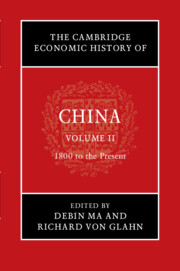
Book contents
- The Cambridge Economic History of China
- The Cambridge Economic History of China
- The Cambridge Economic History of China
- Copyright page
- Contents
- Figures
- Maps
- Tables
- Contributors to Volume II
- Acknowledgments
- Note on Citations
- Introduction to Volume II
- Part I 1800–1950
- Part II 1950 to the Present
- 15 The Origin of China’s Communist Institutions
- 16 China’s Struggle with the Soviet Growth Model, 1949–1978
- 17 Living Standards in Maoist China
- 18 The Political Economy of China’s Great Leap Famine
- 19 China’s External Economic Relations during the Mao Era
- 20 The Chinese Economy in the Reform Era
- 21 China’s Great Boom as a Historical Process
- Index
- References
15 - The Origin of China’s Communist Institutions
from Part II - 1950 to the Present
Published online by Cambridge University Press: 07 February 2022
By

Book contents
- The Cambridge Economic History of China
- The Cambridge Economic History of China
- The Cambridge Economic History of China
- Copyright page
- Contents
- Figures
- Maps
- Tables
- Contributors to Volume II
- Acknowledgments
- Note on Citations
- Introduction to Volume II
- Part I 1800–1950
- Part II 1950 to the Present
- 15 The Origin of China’s Communist Institutions
- 16 China’s Struggle with the Soviet Growth Model, 1949–1978
- 17 Living Standards in Maoist China
- 18 The Political Economy of China’s Great Leap Famine
- 19 China’s External Economic Relations during the Mao Era
- 20 The Chinese Economy in the Reform Era
- 21 China’s Great Boom as a Historical Process
- Index
- References
Summary
In the nineteenth century, the Chinese Empire – the longest-lasting empire in human history – was the largest economy on earth with a decent per capita GDP level. But it shrank rapidly after its collapse. Since the founding of the PRC in 1949, China had been one of the poorest economies in the world until the post-Mao reform, which has enjoyed high growth for three decades. But a sustained slowing down since 2009 reminds us of the trend of the Soviet economy since the mid-1970s.
Keywords
Information
- Type
- Chapter
- Information
- The Cambridge Economic History of China , pp. 531 - 564Publisher: Cambridge University PressPrint publication year: 2022
References
Further Reading
Brandt, L., D., Ma, and Rawski, T., “From Divergence to Convergence: Re-evaluating the History behind China’s Economic Boom,” Journal of Economic Literature 52.1 (March 2014), 45–123.Google Scholar
Courtois, S., Werth, N., Panne, J.-L., Paczkowski, A., Bartosek, K., and Margolin, J.-L., The Black Book of Communism: Crimes, Terror, Repression (Cambridge, MA, Harvard University Press, 2015).Google Scholar
Friedrich, C.J., and Brzezinski, Z.K., Totalitarian Dictatorship and Autocracy (Cambridge, MA, Harvard University Press, 1956).Google Scholar
Gao, H., 1930–1945 How the Red Sun Rose: The Origins and Development of the Yan’an Rectification Movement (Hong Kong, Chinese University Press, 2018).Google Scholar
Li, H., and Zhou, L.-A., “Political Turnover and Economic Performance: The Incentive Role of Personnel Control in China,” Journal of Public Economics 89.9–10 (September 2005), 1743–62.Google Scholar
MacFarquhar, R., The Origins of the Cultural Revolution: The Coming of the Cataclysm 1961–1966 (New York, Columbia University Press, 1997).Google Scholar
MacFarquhar, R., and Fairbank, J.K. (eds.), The People’s Republic, part 1, Emergence of Revolutionary China, 1949–1965 (Cambridge, Cambridge University Press, 1987).Google Scholar
Maskin, E., Qian, Y., and Xu, C., “Incentives, Information, and Organizational Forms,” Review of Economic Studies 67.2 (2000), 359–78.CrossRefGoogle Scholar
Qian, Y., and Xu, C., “Why China’s Economic Reforms Differ: The M-Form Hierarchy and the Entry/Expansion of the Non-state Sector,” Economics of Transition 1.2 (June 1993), 135–70.Google Scholar
Wang, Nianyi 王年一, 大动乱的年代 (A Time of Great Upheaval) (Beijing, Henan People’s Press, 1988).Google Scholar
Xin, Ziling 辛子陵, 紅太陽的隕落: 千秋功罪毛澤東 (The Fall of the Red Sun: The Sins of Mao Zedong) (Hong Kong, Shu zuo fang, 2007).Google Scholar
Xu, C., “The Fundamental Institutions of China’s Reform and Development,” Journal of Economic Literature 49.4 (2011), 1076–1151.CrossRefGoogle Scholar
Xu, C., Institutional Genes: A Comparative Analysis of the Origin of Chinese Institutions (forthcoming from Cambridge University Press).Google Scholar
Xu, Liangying 许良英 and Laidi, Wang 王来棣, 民主的历史 (History of Democracy) (Beijing, Law Press, 2015).Google Scholar
Yang, Jisheng 杨继绳, 墓碑中国六十年代大饥荒纪实 (Tombstone: A Record of China’s Great Famine in the 1960s) (Hong Kong, Tiandi tushu youxian gongsi, 2008).Google Scholar
Zhao, Ziyang, Prisoner of the State: The Secret Journal of Premier Zhao Ziyang (New York, Simon & Schuster, 2009).Google Scholar
Accessibility standard: Unknown
Why this information is here
This section outlines the accessibility features of this content - including support for screen readers, full keyboard navigation and high-contrast display options. This may not be relevant for you.Accessibility Information
Accessibility compliance for the HTML of this chapter is currently unknown
and may be updated in the future.
- 2
- Cited by