
Skip to main content Accessibility help
×

Maintenance update

Due to planned maintenance, between 07:00 - 16:00 (UTC) purchasing will not be available. We apologise for any inconvenience.

  • Cited by 2
    • Show more authors
    • You may already have access via personal or institutional login
    • Select format
    • Publisher:
      Cambridge University Press
      Publication date:
      06 November 2020
      12 November 2020
      ISBN:
      9781108539463
      9781108424004
      9781108439268
      Dimensions:
      (229 x 152 mm)
      Weight & Pages:
      0.6kg, 256 Pages
      Dimensions:
      (229 x 152 mm)
      Weight & Pages:
      0.38kg, 256 Pages
    You may already have access via personal or institutional login
  • Selected: Digital
    Add to cart View cart Buy from Cambridge.org

    Book description

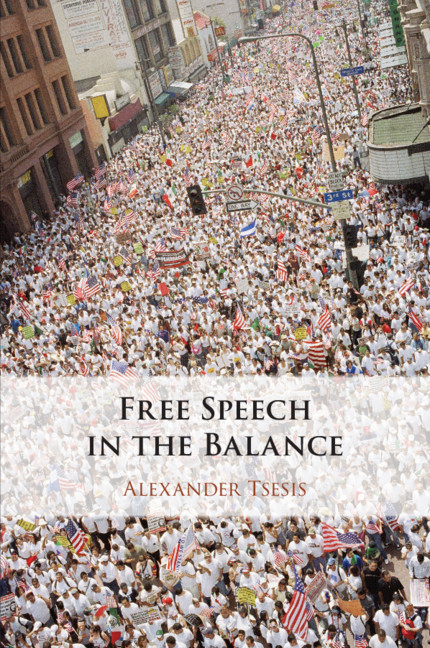
    Free Speech in the Balance is the first comprehensive study of proportional analysis in free speech theory. This book challenges the US Supreme Court's categorical approach and explains the importance of understanding the breadth of concerns arising from regulations directly and indirectly impacting expression. The author provides in-depth analysis of some of the important social and political principles governing topics of vital concern, including campaign financing, university speech codes, secondary school rules, incitement, and threats. This book should be read by students and scholars of free speech theory and anyone interested in learning more about the history of existing law, the issues of current importance, and trends in expressive significance.

    Reviews

    'Meiklejohn, Kalven, Fiss, Schauer, Post - and now Tsesis. This path-breaking study combines high theoretical inquiry with careful doctrinal problem-solving and rich comparative analysis to advance a new contextual approach for the most intricate questions of free speech confronting American judges today. The result is a 21st-century theory offering rules of reasoning fit for a contemporary representative democracy.'

    Richard Albert - William Stamps Farish Professor in Law and Professor of Government, The University of Texas at Austin

    'A powerful attack on American free speech absolutism in favor of European proportionality. Professor Alexander Tsesis reminds us that free speech controversies do not exist in sealed First Amendment containers, but require nuanced understandings of their broader contexts and the values that undergird the entire Constitution.'

    Mark Graber - University System of Maryland Regents Professor, University of Maryland Francis King Carey School of Law

    'Tsesis has written an important book whose central thesis can be summarized by one of his own sentences: 'Context matters.' He attacks so-called 'categorical' approaches to freedom of speech, adopted by the ACLU and the current conservative majority of the Supreme Court alike, that tend to ignore the concrete realities of the cases before them. One need not agree with all of his arguments in order to recognize them as a valuable intervention in a significant public debate about when, if at all, the 'market' of speech should be subject to regulation.'

    Sanford Levinson - University of Texas Law School, and co-author, with Cynthia Levinson, of Fault Lines in the Constitution

    Refine List

    Actions for selected content:

    Select all | Deselect all
    • View selected items
    • Export citations
    • Download PDF (zip)
    • Save to Kindle
    • Save to Dropbox
    • Save to Google Drive

    Save Search

    You can save your searches here and later view and run them again in "My saved searches".

    Please provide a title, maximum of 40 characters.
    ×

    Contents

    Metrics

    Altmetric attention score

    Full text views

    Total number of HTML views: 0
    Total number of PDF views: 0 *
    Loading metrics...

    Book summary page views

    Total views: 0 *
    Loading metrics...

    * Views captured on Cambridge Core between #date#. This data will be updated every 24 hours.

    Usage data cannot currently be displayed.

    Accessibility standard: Unknown

    Why this information is here

    This section outlines the accessibility features of this content - including support for screen readers, full keyboard navigation and high-contrast display options. This may not be relevant for you.

    Accessibility Information

    Accessibility compliance for the HTML of this book is currently unknown and may be updated in the future.
