
Skip to main content Accessibility help
×
  • Cited by 13
    • Show more authors
    • You may already have access via personal or institutional login
    • Select format
    • Publisher:
      Cambridge University Press
      Publication date:
      16 August 2018
      23 August 2018
      ISBN:
      9781108554237
      9781108429160
      9781108453196
      Dimensions:
      (228 x 152 mm)
      Weight & Pages:
      0.58kg, 326 Pages
      Dimensions:
      (228 x 152 mm)
      Weight & Pages:
      0.47kg, 324 Pages
    You may already have access via personal or institutional login
  • Selected: Digital
    Add to cart View cart Buy from Cambridge.org

    Book description

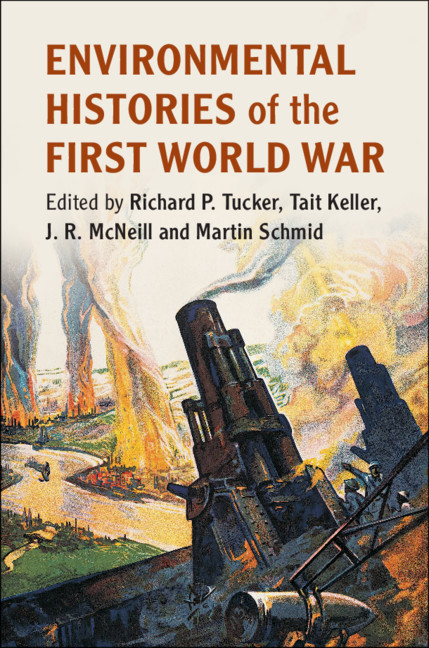
    This anthology surveys the ecological impacts of the First World War. Editors Richard P. Tucker, Tait Keller, J. R. McNeill, and Martin Schmidt bring together a list of experienced authors who explore the global interactions of states, armies, civilians, and the environment during the war. They show how the First World War ushered in enormous environmental changes, including the devastation of rural and urban environments, the consumption of strategic natural resources such as metals and petroleum, the impact of war on urban industry, and the disruption of agricultural landscapes leading to widespread famine. Taking a global perspective, Environmental Histories of the First World War presents the ecological consequences of the vast destructive power of the new weaponry and the close collaboration between militaries and civilian governments taking place during this time, showing how this war set trends for the rest of the century.

    Reviews

    ‘Anyone who wants to learn about the global ecological catastrophe that the First World War precipitated must read this book. It is an eye-opener and a disturbing reminder that those who set the Great War in motion had no idea as to what they had let loose on the world.'

    Jay Winter - author of War beyond Words: Languages of Remembrances from the Great War to the Present

    ‘This exciting collection represents the best of the innovative new field of environmental history of war. Looking at the ways that the First World War impacted land, food, and animals it will give us new insights and fresh ways of thinking. This book will be a must read for those wishing to understand the war.'

    Michael S. Neiberg - author of The Path to War: How the First World War Created Modern America

    ‘The truly global coverage of this pioneering environmental perspective on the Great War breathes new life into the notion of ‘total war' by venturing far beyond the battlefield and the hellish mud of the Western Front's trenches to investigate the feeding and fuelling of military support systems, and wider environmental transformations, from Austria-Hungary to Africa and Japan. This ambitious study of nature's mobilization stands out amidst the onslaught of new books accompanying the centenary.'

    Peter Coates - co-editor of Militarized Landscapes: From Gettysburg to Salisbury Plain

    ‘This collection of essays deserves a broad audience. The innovative studies not only enrich the literature on the First World War as a ‘total' global conflict; they also present powerful evidence of the interpretive insights that await historians in the broader field in which environmental history and military history intersect.'

    Roger Chickering - author of Imperial Germany and the Great War, 1914–1918

    ‘This engaging collection represents a welcome addition to the previously neglected environmental history of World War I. Sharply written chapters focus on the mobilizing of food, oil, and other resources for war, while offering much needed coverage of the environmental consequences of World War I in Africa, the Middle East, and Asia. This book represents a vital contribution to the burgeoning literature on war and the environment.'

    Charles E. Closmann - author of War and the Environment: Military Destruction in the Modern Age

    ‘This is something truly new - a wonderful, global collection on one of the most important yet neglected topics in history: the legacy and impact of war on the environment. It brings together some of the best scholars in the field of World War I and environmental history and covers a dazzling array of topics.'

    Christof Mauch - Director, Rachel Carson Center for Environment and Society, Ludwig-Maximilians-Universität München, Germany

    '… [a] thoughtful and thought-provoking collection, highly recommended especially for public and college library World History or Environmental Studies collections.'

    Source: Library Bookwatch

    '… delivers a comprehensive and much-needed analysis of the conquest of Central Asia and its place in the history of nineteenth-century global expansions.'

    Alex Souchen Source: War in History Book Reviews

    Refine List

    Actions for selected content:

    Select all | Deselect all
    • View selected items
    • Export citations
    • Download PDF (zip)
    • Save to Kindle
    • Save to Dropbox
    • Save to Google Drive

    Save Search

    You can save your searches here and later view and run them again in "My saved searches".

    Please provide a title, maximum of 40 characters.
    ×

    Contents

    • 1 - Mobilizing Nature for the First World War
      pp 1-16
    • An Introduction

    Metrics

    Altmetric attention score

    Full text views

    Total number of HTML views: 0
    Total number of PDF views: 0 *
    Loading metrics...

    Book summary page views

    Total views: 0 *
    Loading metrics...

    * Views captured on Cambridge Core between #date#. This data will be updated every 24 hours.

    Usage data cannot currently be displayed.

    Accessibility standard: Unknown

    Why this information is here

    This section outlines the accessibility features of this content - including support for screen readers, full keyboard navigation and high-contrast display options. This may not be relevant for you.

    Accessibility Information

    Accessibility compliance for the HTML of this book is currently unknown and may be updated in the future.
