


3.1 Introduction
This chapter focuses on the beginning of sentences. In Chapter 2, we discussed how a non-canonical clause can be derived from a more basic pattern for reasons that often lie within discourse. We also saw that, against the background of rigid English word order, the position of the verb’s arguments is generally fixed. When, for example, in a given utterance, an object occurs before the subject, this violates the basic Subject–Verb–Object order of English grammar and the pattern is considered non-canonical. We will also turn to adjuncts in this chapter, which do not have a single, canonical position. However, since adjuncts also occur at sentence beginnings, they are included in the discussion that follows.
Some elements that also typically occur sentence-initially are excluded for the time being. These are elements that are added to the clause to bracket or structure the discourse, usually in interactive, spoken discourse. They function, for instance, as so-called “prefaces” (like well) or “comment clauses” (like I mean or you know) and occur outside the core clause. Following the structure of our book, they belong to the grammar of discourse and will be discussed in Part III in Chapter 8 (on discourse markers).
The clausal patterns we turn to now all have an element of the core clause, which is not the grammatical subject, in their left periphery. This means the element is positioned in front of the subject. Let us illustrate the range of possible constructions by variation on a single example.
(1) Most of what I found belonged to my father: chipped cuff link, an empty pack of cigarettes, black sock, toenail clippings. These things I gathered in a pile by the door, to be thrown away later. (COCA, Fiction, 2015) (fronting)
(2) These things I gathered them in a pile by the door. (left-dislocation)
(3) Among the things I gathered in a pile by the door were an empty pack of cigarettes, black sock, and toenail clippings. (inversion)
(4) In a pile by the door there were an empty pack of cigarettes, black sock, and toenail clippings. (sentence-initial adjunct)
In example (1), the grammatical object (these things) is in initial position, displaced from its canonical position behind the verb. This construction contrasts with examples (2) to (4) as follows: Example (2) shows the same position for the object, but differs from (1) in that the object is resumed later by an anaphoric pronoun (them). In example (3), the fronted constituent is not the grammatical object, but a verbal complement of the copula verb be (among the things I gathered in a pile by the door …). Since be is a so-considered “light” verb, which means it usually does not stand alone, the subject must move to the position behind the verb. Finally, example (4) also has a constituent other than the subject in initial position, but this time the constituent is an adjunct (in a pile by the door). Strictly speaking, this pattern is not non-canonical since adjuncts are not verbal arguments. However, an adjunct in front-position is also a starting-point for the sentence other than the grammatical subject.
You may have discussed these constructions in grammar classes, and perhaps you have been told different names for them. One name that is often used to refer to (1) through (3) is “topicalization,” a term which emphasizes that matters of discourse, notably the topic under discussion, supersede the placement of the subject as the first element in the clause. However, the classification we will use in the following is form-based. We distinguish the mere fronting of a clausal element, as in (1), from left-dislocation, as in (2), where the fronted element does not leave a gap in the remaining clause but is resumed by a pronoun. (3) is an example of inversion, resulting from the fronting of a verbal complement, followed by the reversal of the position of the main verb and the subject. Finally, (4) is a sentence with a sentence-initial adjunct, to which we will turn first in order to take a general look at the role of sentence beginnings in discourse.
After reading this chapter, you will be able to:
identify different types of non-canonical beginnings;
describe the reasons why they are used with reference to the surrounding discourse;
gather attested sentences with a non-canonical beginning from a text or corpus;
develop a research method and choose a format for your results in line with the research question you want to pursue.
Concepts, Constructions, and Keywords
adjuncts in initial position, VP-/clause-oriented adjuncts, NP-fronting, left-dislocation, full inversion, locative and non-locative inversion, topic/topicality, topic persistence, information-packaging
 Before continuing your reading, turn to Exercise 1 in order to practice distinguishing the four constructions introduced above.
3.2 Adjuncts in Front-Position
The beginning of a sentence has an important role in discourse. But what exactly does that mean? On the one hand, sentence beginnings serve our processing needs, in that it is easier to understand something beginning with, and thus connecting to, what we already know. As discussed in Chapter 2, this preference leads to a characteristic packaging of information within the sentence. Sentences tend to sequence given information before new information, whereby the end of the sentence becomes its main area of interest, its normal (or ”unmarked”) focus of attention (a more detailed definition of focus is given in Chapter 4). On the other hand, speakers or writers can also highlight an element by moving it to the initial position. Resulting from this movement, such an element gets some extra attention, becoming a marked focus.
The category of adjuncts is by definition more flexible with regard to their position. An adjunct can occur in initial position as well as in mid- and end-position of the clause and therefore does not cause any non-canonical pattern and special attention when occurring in front-position. Which position is common for an adjunct depends to some extent on its semantics. Types of adjuncts that are characteristically sentence-initial are those referring to the speaker’s attitude (unfortunately) or certainty (surely, certainly), or to the speech event as a whole (honestly); another obvious group are connective adjuncts, such as next or moreover. These adjuncts, which contribute a meaning that is more external to the core clause (they don’t really tell us why or how something happened), are commonly referred to as “clause-oriented adjuncts” (Reference Huddleston and PullumHuddleston & Pullum 2002: 576). Other adjuncts, such as adjuncts of time or place, also occur in front-position, but they are characteristically VP-oriented, meaning they relate more closely to what is in fact asserted by the clause. A test showing this distinction is the so-called “lie test” (Reference Erteschik and LappinErteschik & Lappin 1979): To test whether the information of the adjunct belongs to what is asserted by the clause, you deny the truth of the adjunct. For example, in response to the clause Unfortunately, in 2018 we had a very hot summer, you could answer That’s not true – that wasn’t in 2018, but not *That’s not true, it wasn’t unfortunate. This test shows that unfortunately is more loosely related to the predication of the core clause than the temporal adjunct in 2018.
Grammars of English typically observe that the front-position is the one favored for a clause-oriented adjunct, while a VP-oriented adjunct is said to be favored in end-position. However, this is only a first generalization, because there is a lot of variation possible. For example, in (5) the temporal adjunct one day is placed at the end of the verb phrase (stood before Merabor), while in (6) it comes first.
(5) The admiral stood before Merabor one day as the dragon sat and ate. (COCA, Fiction, 2009)
(6) One day, she’d stop saying sure when she meant no. (COCA, Fiction, 2017)
Still, it makes a difference where a temporal adjunct ends up being placed. We can note that, due to the association of the front-position with clause-oriented adjuncts, the temporal adjunct in (6) has a wider range of meaning, setting the time frame for the entire clause, than in (5). This more general scope is often also expressed by a signal of detachment, such as a pause in spoken discourse or, as in Example (6), by a comma. A corresponding contrast can be found in two possible interpretations of adverbs like hopefully or practically, which may be verb phrase modifiers (to work hopefully, meaning, for example, full of energy) or clausal modifiers (meaning it is to be hoped that).
 Good to Know: Hopefully as a Sentence Adverb
While the use of hopefully as sentence adverb (Hopefully, your watch will turn up again) has become “thoroughly established” (according to the Cambridge Grammar) since the 1960s, some style guides still find fault with using hopefully in this way. They think that hopefully should mean “filled with hope” and should only be used as a manner or VP-adverb placed at the end of a verb phrase (He entered the room hopefully). This criticism goes back to a slim volume from the 1950s that is still highly popular in the US: The Elements of Style, written by English Professor William Strunk in 1918 and expanded on by author E. B. White in the 1950s, advises its readers that the meaning of hopefully “has been distorted,” and that using the adverb in a modal way “is not merely wrong, it is silly.” They continue that “[a]lthough the word in its new, free-floating capacity may be pleasurable and even useful to many, it offends the ears of many others, who do not like to see words dulled or eroded, particularly when the erosion leads to ambiguity, softness, or nonsense” (Strunk & White 2000: 48). Those are harsh words, for which there is no empirical basis. What Strunk and White mean when they say that hopefully can make sentences sound silly is that the manner reading of hopefully – which, according to Strunk and White, is the only legitimate one – does not make sense in sentences in which hopefully can really only have the meaning of “I hope,” not “in a hopeful manner.” For example, in the example sentence above (Hopefully, your watch will turn up again), the reading that the watch shows up in a hopeful manner is indeed not particularly salient, but it is very doubtful that anyone would be tempted to interpret the sentence in this way, considering the placement of hopefully at the beginning of the sentence and the easy availability of the modal meaning. Strunk and White neglect to point out that different meanings of a word may correlate with different positions in a sentence and that word order can actually be a very efficient way of avoiding ambiguity. There is nothing nonsensical about the modal meaning of hopefully per se. If you do a simple lexical search in a corpus like COCA and scroll through the results, you will see that the great majority of tokens belongs in the sentence adverb class (especially sentence-initial hopefully) and that, thanks to its expanded meaning, the adverb is becoming more and more popular – not exactly an indicator of “erosion, softness, or nonsense.”
In case you are wondering why hopefully, of all adverbs that have more than one meaning, is the one that gets picked on, you are in good company. The American Heritage Dictionary remarks in a usage note that it is not easy “to explain why people selected this word for disparagement” and concedes that “its widespread use reflects popular recognition of its usefulness.” Merriam-Webster’s Dictionary points out in another usage note that hopefully behaves like other adverbs in this regard (thankfully, naturally, ideally) and advises solomonically, “[y]ou can use it if you need it, or avoid it if you do not like it.” More conservative style guides have also come around. In 2012, the editors of the Associated Press Stylebook, a reference publication for many journalists and newspapers, announced on Twitter that the Associated Press now supports “the modern usage.” The tweet continues, “[h]opefully, you will appreciate this style update.”
With their clause-orientation and wider scope reading, initially placed adjuncts commonly provide the frame for a longer stretch discourse, since they constitute the point of departure for everything that follows. Take, for example, the title of Leonard Cohen’s song “First we take Manhattan, then we take Berlin,” in which the adverbs first and then provide the temporal frame for the sequence of events as a whole. For this reason, you can’t repeat first in the second sentence (*First we take Manhattan, first we take Berlin). By contrast, in the excerpt in (7), which is taken from Barack Obama’s speech following Donald Trump’s election in 2016, the adverb first modifies several VPs in successive sentences. In this excerpt, each occurrence of first pertains to only one VP, not to the clause as a whole, which is why several statements can all be claimed to hold true first. The repeated use of the adjunct in (7) is acceptable because first does not express a succession in discourse. It modifies, after a pair of negated predicates, two positive statements without causing a contradiction.
(7) Now, everybody is sad when their side loses an election, but the day after we have to remember that we’re actually all on one team. This is an intramural scrimmage. We’re not Democrats first. We’re not Republicans first. We are Americans first. We’re patriots first. (Reference GarunayGarunay 2016)
In contrast to the use of first, note that now in Example (7), being sentence-initial, is an adjunct with a clause-oriented, wider scope function. Now does not add temporal information to the proposition here, but initiates a new discourse segment.
This discussion has highlighted that initially placed adjuncts, especially those with a locative or temporal meaning, provide something like a “signpost” for situating what comes next in the discourse (Reference VirtanenVirtanen 2004). Due to its discourse function, an initially placed temporal adjunct can initiate a new episode or set the temporal frame for an entire story. Take the excerpt in (8), in which Richard Maduku, a novelist and blogger for The Guardian, structures his life story by using different sentence-initial temporal adjuncts to mark the chronology. What you can see in the excerpt is that a more significant turn within the discourse is signaled by more material (on my return …), while a more local turn, here the beginning of just an episode, is initiated by a shorter, less informative adjunct (one day).
(8) On my return to my hometown a couple of years later after the collapse of my restaurant venture in the North, I designed a signpost for my residence to differentiate it from the others. Apart from my birth name that I decided to use on it, I also drew what I regarded as a house in the centre of the miniature signpost. It had a tailless arrow pointing to my house on each side. I became very proud of it whenever I heard neighbours using it to describe their houses to their would-be visitors on phone. But one day a boyhood friend who always faulted almost everything I did, visited me. He told me that the arrow of my signpost was pointing skyward and went on to ask mockingly if my house was in the sky! My explanation that what he called an arrow was in fact a stylistic representation of a house did not impress him! He dismissed my tailless arrows with a wave of his hand. Fearing that other visitors or even passers-by might have mistaken the house of my signpost for an arrow as my friend had done, I grudgingly removed it. (Reference MadukuMaduku 2018)
Narrative and descriptive types of discourse, in particular, show a systematic correlation between the amount of information in the adjunct and major as opposed to minor turns in a text (Reference Virtanen, Dorgeloh and WannerVirtanen 2010, Reference Virtanen, Sarda, Carter-Thomas, Fagard and Charolles2014). However, depending on the type of discourse or genre, an initial position for an adjunct does not always mean that its scope is beyond the single sentence (Reference VerstraeteVerstraete 2004, Reference CromptonCrompton 2006). For example, in recipes or other instructive texts, adjuncts function again more locally, typically supporting the chain of actions that is presented.

Figure 3.1 Initial adjuncts as global vs. local signposts in Example (8)
Let us conclude that initially placed adjuncts are quite symptomatic of the role the sentence-initial position has for the discourse. An initial adjunct provides the point of departure for the upcoming text, which is why it can support the structuring and processing of information. However, initial adjuncts are not in a non-canonical position, which is why the actual effect that is achieved is quite varied. In the remainder of this chapter, we will focus on the fronting of verbal arguments, which leads to a non-canonical construction.
In order to find out if a particular adverb or phrase is characteristically a VP-modifier or a clausal modifier, or whether it can in fact be both, we have to look at how it is attested in English usage. For gathering data on this, we could again work with a corpus of English, as described in Chapter 2. Type in an individual adverb (for instance, recently) or an adverb phrase (e.g., just recently) or use the word class tagging. In COCA, the string for retrieving adverbs, which is also listed in the POS (part of speech) menu, is <_r*>. Note that many other realizations for an adjunct (noun phrases, prepositional phrases, subordinate clauses) will be difficult to retrieve automatically, which is why it can be preferable to work with a given lexeme or phrase (we describe this as a general strategy of a “lexical shortcut” in Section 3.3). For example, we worked with the lexeme first and the phrase one day for retrieving the examples discussed in Section 3.2. For a small-scale project on the positioning of these two adjuncts, you could work with a random list of 100 hits, coding each occurrence for the property of having the adjunct being used clause-initially or -internally. This analysis enables you to calculate the proportion with which the adjunct is used in the left periphery, i.e., whether it serves as a point of departure in discourse. See Exercises 6 and 7 (Level 2) for more ideas about a project on adjunct placement and more on the corpus-based retrieval of constructions with non-canonical beginnings in sections 3.3 and 3.4 below.
3.3 NP-Fronting and Left-Dislocation
We now turn to the two non-canonical constructions in which a noun phrase as verbal argument precedes the subject at the beginning of the sentence. Such an NP can either just be fronted, or occur as a left-dislocation, in which case an anaphoric pronoun fills the gap resulting from the movement of the NP. The difference between the two constructions is illustrated here again by (9) and (10), repeated from above:
(9) These things I gathered in a pile by the door, to be thrown away later.
(10) These things I gathered them in a pile by the door, to be thrown away later.
While the two constructions are similar in their syntactic form, we will now investigate them more closely for the discourse conditions in which they occur. Left-dislocation is described in the literature as a syntactic mechanism for negotiating or clarifying a new topic for the discourse (Reference GeluykensGeluykens 1992), like in Example (11). We will therefore have to explore, not only the information status of the fronted NP and its relation to the preceding discourse, but also its relation to the subsequent discourse.
(11)
a: These things … b: Yes … a: They are awful …
We will first deal with each construction separately before contrasting them as syntactic variants.
Good to Know: Spoken Language DataNote that spoken language data as contained in a corpus comes from transcripts, suggesting a fluency that in real life of course these utterances haven’t had. Natural conversation is full of disfluencies like pauses, intonation, or repair. In linguistics, research on these phenomena is done much more thoroughly within Conversational Analysis, with its own system of notation and categories for phenomena of disfluency. However, you should be aware of these characteristics when referring to spoken data in research on discourse syntax.
3.3.1 The Discourse Function of Fronting
How can a fixed word order and SVO language such as English allow for the fronting of a non-subject NP? Fronting such an element is an obvious case where discourse needs supersede the rules of canonical grammar. More precisely speaking, fronting is acceptable when the fronted constituent is properly “linked” to the preceding discourse (Reference Birner and WardBirner & Ward 1998: 32).
Look at the nature of this relation between a fronted NP and the discourse preceding it. Examples (12) and (13) are acceptable, while Example (14) appears not to be:
(12)
a: He’s gone because he was a coward? b: A coward I can tolerate. But he said he loved you, and it proved he didn’t understand love at all. (COCA, Fiction, 2015)
(13)
a: He’s gone because he was a liar? b: A coward I can tolerate. But he said he loved you, and it proved he didn’t understand love at all.
(14)
a: He’s gone because he wants to run his own business? b: ?A coward I can tolerate. But he said he loved you, and it proved he didn’t understand love at all.
In (12) and (13), we find that the fronted constituent contains information that is given, or at least inferable, from the previous discourse. In (12), the NP a coward is mentioned in the previous sentence while, in (13), its discourse familiarity is due to a potential set of roles or subtypes (liar, coward, cheater, …), which – in this context – is dealt with as belonging to the superordinate category of a loving person. This set membership creates a sufficient familiarity for the fronting to be acceptable. By contrast, in (14), the concept of being a coward comes completely out of context, which is why the fronting is not acceptable.
There are two effects which such a close link to a prior discourse, expressed by way of fronting, can produce. The first occurs with sentences that place an element which contains given information in front-position. In that case, the main focus of the utterance remains in its usual, sentence-final position. As a result, the sentence highlights two elements: the fronted constituent as well as what remains of the information in end-position. In speech, this type of NP-fronting will receive two sentence accents, like in Example (15), where the speaker discusses the works of a painter:
(15) Whistler thought of it, characterized it in very different terms. This we have to refine […]. (COCA, Spoken, 1995)
The other possible effect of fronting is that it can signal that the element in front-position is the most informative element. The link to the previous discourse then exists via an “open proposition” (Reference Huddleston and PullumHuddleston & Pullum 2002: 35), which means everything in the clause, except for the fronted element, is given or inferable. For example, in (16), the proposition “it costs some amount of money” is given information, because the act of ordering something implies that this costs money.
(16) She orders an elevator seat for the stairs. Almost ten thousand dollars it costs, installed. (COCA, Fiction, 2016)
If the link to the previous discourse exists via an open proposition, the discourse function of fronting is to highlight the initial information in the first place. In speech, a clause like (16) would be likely to carry only one main accent.
Let’s summarize: NP-fronting either moves the main focus of attention to the sentence beginning, or it keeps it in the usual end-position but adds the fronted NP as a secondary focus, expressing some kind of connection. We have seen that in both cases the fronting of a verbal argument depends on a close link to the preceding discourse.
3.3.2 Left-Dislocation as a Discourse Strategy
We have already described how left-dislocation formally differs from the mere fronting of a verbal argument. We now turn to the function of left-dislocation in discourse. Let’s start with Example (17), which is from spoken discourse:
(17) One of the guys you know on another network told me that we are lower in the last poll he had seen than pol – politicians. And that’s not fair to you, but it’s – but some of the people in that business are intrusive. They’ll ha – they feel they have to get a story if there’s a rumor out there. And so it makes it – it makes it – a lot of good people say, “Well, I’m not going to run,” and that’s one reason I’m so proud of our boys. And, yes, this guy he’s running against has gone negative on him, but – but his record is out there. (COCA, Spoken, 1998)
Example (17) shows the fronting of the NP this guy, which is resumed by the pronoun he. One might wonder why the pronoun is used here at all since the information status of this guy does not appear to be new in this context. However, what we find is that, with the left-dislocation, it is re-activated. The reason for this re-activation lies in the preceding discourse, where this guy has come to compete with other grammatical subjects, such as they and I. This temporary discussion of what other people think has turned the guy into a topic that can be less expected as a subject. The left-dislocation thus identifies a referent that is still new to the discourse in some way.
The discourse function of left-dislocation exemplified by (17) helps us to understand why the contextual requirements are different from those that we noted about fronting. In a left-dislocation construction, the givenness of the initially placed constituent can stem from a more distant part of the text, or it may even be due to knowledge from outside the discourse. You find this situational givenness in an example like (18), in which the referent of the NP this guy is not mentioned in the prior discourse at all. Speaker b in this dialog can nonetheless expect a FedEx agent to be part of the narrative, which means its givenness is to some extent inferable.
(18)
a: By the way, FedEx – here’s what happened. b: They found – a: The tree had been delivered. It was delivered to the wrong address. b: Right. c: Okay. a: Treetopia did deliver it. b: And FedEx saved the day. a: FedEx tracked it down. b: So here I am walking around my neighborhood with this little wanted poster with my tree on it asking anyone, had they seen my tree. Out of nowhere like a vision, this guy, he starts floats towards me. (COCA, Spoken, 2016)
In sum, the discourse function of a dislocated NP is to remind the reader or listener of a referent which is simply not given or expected enough at a given point of discourse to be talked about without previous (re-)identification. In contrast to fronting, which requires a referent to be given or inferable in the immediately preceding discourse (see Figure 3.2), left-dislocation arises out of more variable connections to the previous discourse.

Figure 3.2 Information status of fronted NP without resumptive pronoun
As the discussion in this section has shown, left-dislocation is a discourse strategy that simplifies referent identification. Considering the variable connections which the dislocated constituent has in relation to the previous discourse, we have also seen that there is a clear difference between left-dislocation and NP-fronting in their relation to the previous discourse. As our next step, we turn to the relation of both constructions to the subsequent discourse.
To check whether you are now in the position to tell the two constructions and their requirements of discourse apart, go to Exercise 4.
3.3.3 Topicality in Discourse: Fronting vs. Left-Dislocation
So far, we have focused on the roles of fronting and left-dislocation in relation to the preceding discourse. We have seen that, with the mere fronting of a verbal argument, the connection between prior discourse and the clause is relatively local and more restricted, while the discourse function of left-dislocation is a more general one of identifying referents from a ground of shared knowledge. Rather than depending on discourse familiarity, left-dislocation is used when the dislocated NP deserves referential reinforcement. But do we know when and why a referent truly deserves this?
This question is related to the concept of topicality. In the linguistic literature, attempts for a definition of “topic” typically center on the idea of “aboutness” (Reference Dalrymple and NikolaevaDalrymple & Nikolaeva 2011: 48, Reference LeuckertLeuckert 2019). Being the topic means, broadly speaking, being the focus of interest at a given point in discourse. For example, in (18) above, FedEx is the discourse topic, that is, the company and its services is what the discourse is about. Fedex is also the topic of several utterances in the sense that it is what these utterances are about (FedEx saved the day, FedEx tracked it down). The NP FedEx thus possesses topicality because it is for a while the focus of interest in the discourse. Based on this definition, we will see now whether there is a difference between NP-fronting and left-dislocation with respect to how they deal with topics in discourse. More concretely, we want to find out in which case the initially placed NP is more topical in the corresponding context of discourse. However, to answer this question empirically, one first needs to find a precise way of operationalizing topicality.
One way in which topicality shows itself in a text is topic persistence, or topic continuity. In practice, this means you count the number of times the referent of an NP (including a pronoun or a synonym) recurs in subsequent clauses. This method has been applied to the study of fronting and left-dislocation (Reference Gregory and MichaelisGregory & Michaelis 2001). The researchers gathered all instances of NP-fronting and left-dislocation from a corpus of telephone speech (44 cases of fronting and 187 instances of left-dislocation) and coded these occurrences for their topic persistence. Following their methodological decisions, a persistent topic meant that the referent of the pre-clausal NP recurred within five subsequent sentences. Their analysis further took note of whether the recurrence had the form of a fully repeated NP or a pronoun. The results are the counts as shown in Table 3.1.
Table 3.1 Rates of occurrence* for topic persistence of pre-clausal NPs
| No persistence | Repeated NP | At least one pronominal use | |
|---|---|---|---|
| NP-fronting | 32 | 2 | 10 |
| left-dislocation | 66 | 11 | 110 |
* Absolute frequencies. There were 44 attestations of fronting and 187 of left-dislocation.
The results can also be presented in a bar chart like Figure 3.3. The graph shows the three discourse conditions both for NP-fronting and left-dislocation on the x-axis and their frequency as the dependent variable on the y-axis.

Figure 3.3 Topic persistence of pre-clausal NPs in fronting and left-dislocation
Rates of occurrence (absolute frequencies) for topic persistence of pre-clausal NPs in 44 attestations of fronting and 187 of left-dislocation.
Figure 3.3 highlights that there are indeed differences between the two constructions and that left-dislocation is higher in topic persistence than NP-fronting. However, an obvious problem with interpreting this chart is that the overall frequencies of NP-fronting and left-dislocation differ considerably. For example, the chart shows a higher frequency of pre-clausal NPs with no persistence for left-dislocation, but does not make it obvious that this is still low, compared to the persistence of pronominal recurrence for left-dislocation. By contrast, for NP-fronting the graph has a comparatively low column for NPs without persistence, although 32 hits is in fact the highest score in that category. It is therefore more advisable to transform Figure 3.3 into a diagram based on percentages, as shown by Figure 3.4.

Figure 3.4 Topic persistence of fronting and left-dislocation (proportions)
Figure 3.4 is apt to illustrate that, in our data set, in the majority of cases of NP-fronting (73 percent), the NP did not persist as a topic in the subsequent discourse. By contrast, in the majority of cases of left-dislocation, the dislocated NP re-occurred as a topic. We learn from this outcome that left-dislocation and fronting, despite resulting from non-canonical sentence beginnings that are formally similar, have different functions relating to the topic structure in discourse.
As the case study in Section 3.3.3 highlights, any kind of research design process involves multiple steps and decisions. The point of departure is usually a theoretical assumption that has led you to your research question. The first step toward answering this question is to come up with a hypothesis, which is basically a statement that could be true or false. The second step is to find a way of testing your hypothesis by operationalizing it, which requires you to think about choosing your method. The method consists, first, of the category of analysis that you are going to investigate and, second, of the choice of the source of data. In line with the hypothesis, you then come up with a prediction about the way your category will behave in the given source of data. When evaluating your results, you check whether the data matches this prediction (this is commonly done by falsifying the null hypothesis, which means you check whether you can exclude that there is no effect).
The results discussed in Section 3.3.3 were based on the hypothesis that left-dislocation differs from NP-fronting in the function it has for the subsequent discourse, notably in its topic persistence. The prediction was that the topic persistence for left-dislocation would be higher. As categories, three degrees of topic persistence were defined. The finding was that the majority of NPs in left-dislocation (more than 50 percent) persisted as topic in the data, whereas more than 50 percent of the fronted NPs did not. This finding was in line with the initial prediction. To substantiate this outcome, you could now continue by applying statistical analyses (which are not dealt with in this book, but see our suggestions for further reading at the end of this chapter) before interpreting and evaluating your results in the context of existing research.
It is important that your research question can be transformed into a testable prediction. For example, the assumption that left-dislocation is used when the NP requires clarification could not be directly addressed in a meaningful way. It is equally important that the format in which you present your results fits your prediction. The results about topic persistence in Table 3.1 could not confirm the assumption that when an NP has no topic persistence it commonly undergoes fronting. Despite the fact that the category of “no persistence” is the largest proportion within the category of NP-fronting, this reverse assumption is certainly not true.
Exercises 8 and 9 (Level 2) deal with the interpretation of data and collecting data for a research project on the difference between fronting and left-dislocation.
3.3.4 Text-Linguistic Variation of Fronting and Left-Dislocation
We now turn to the occurrence of fronting and left-dislocation in different types of discourse, that is, we will look at them using the text-linguistic approach (see Chapter 2). Due to the limited possibilities of corpus methodology in this area (see the toolbox below), this kind of evidence will be based on relatively small amounts of text.
In line with what we said above about left-dislocation as an interactive strategy, most research on this construction is limited to conversation, that is, to unplanned and informal speech. However, when looking at data from both spoken and written English, it turns out to be not entirely true that left-dislocation occurs exclusively in speech. There is some research that also attests occurrences in written English, like the data shown in Table 3.2. These results were collected manually and are based on a small, historical corpus (Reference Tizón-CoutoTizón-Couto 2012). Since the size of the texts in the corpus sections varied, the frequencies in parentheses had to be normalized to a rate of occurrence per 10,000 words (see Chapter 2 on how normalized rates are calculated).
Table 3.2 Frequency of left-dislocation in some discourse types
| Drama | Fiction | Journals | Sermons | Letters | Science | News |
|---|---|---|---|---|---|---|
| 177 | 55 | 13 | 13 | 10 | 8 | 9 |
| (2.05) | (0.63) | (0.15) | (0.15) | (0.11) | (0.09) | (0.1) |
The figures show absolute numbers and normalized frequency per 10,000 words.
You will note that all the frequencies in Table 3.2 are really low, which is also why these results cannot reasonably be turned into a chart. In a bar chart, fiction, for example, would have a bar four to five times as high as the categories of journals and letters, but emphasizing this as a difference would hide the fact that all numbers are very low. Still, the numbers in Table 3.2 inform us that left-dislocation is relatively more frequent in discourse that simulates or contains speech (drama and fiction), or in discourse that is written to be spoken (sermons). A study of fronting showed similar results. Based on the British component of the International Corpus of English, the rates of occurrence of fronting in speech – notably in conversation, phone calls, and classroom speech – ranged from 1.92 to 2.96 per 10,000 words (Reference LeuckertLeuckert 2019). We are thus safe to conclude that, from the point of view of text-linguistic variation, both constructions are a grammatical characteristic of unplanned spoken rather than planned written discourse.
Keep in mind that corpus results like these have other limitations. They will not tell you whether or not the use of fronting or left-dislocation is overshadowed by other non-canonical syntactic patterns (for instance, agentless passives, to be discussed in Chapter 4, or inversion, to be discussed in Section 3.4 below). Nor do the rates of occurrence per discourse type relate to the contrast between a sentence with and one without left-dislocation, nor to the choice between left-dislocation and fronting. Remember that, when dealing with text-linguistic variation, discourse types or individual texts are the object of investigation, not the syntactic variants as such (see Chapter 2). In addition, there is the general problem of retrieval, which overall limits the data that is available. For projects on the use of left-dislocation or fronting, we therefore suggest a methodological shortcut; follow the instructions in the toolbox below and in Exercise 9.
 Lexical Shortcut for Retrieving Constructions in a Corpus
It is almost impossible to search reliably for left-dislocation and NP-fronting in an unparsed corpus. There are two reasons for this problem.
First, a possible search string for an initially placed non-subject NP is generally identical to the one for an NP with a relative clause and an omitted relative pronoun. For example, the sequence of words in the sentence This is a coward I can’t tolerate is the same as in Example (12) above. Second, it is not possible to predict the range of intervening material between the fronted NP and the resuming pronoun. As Example (19) illustrates, a dislocated NP (this woman) may occur in close proximity to the pronoun (she), or, as in the case of (20), the syntactic distance can be more substantial. Since this distance is altogether variable, there is no obvious single search string available for safely extracting all instances of left-dislocation or fronting from a corpus.
(19) Yes, I’ve played so many mothers in my career, but this woman she kind of turns the idea of motherhood on its head. (COCA, Magazine, 2018)
(20) This guy, which we have talked about on this show, unlike all the other insane dictators globally, he is an extra brand of crazy. (COCA, Spoken, 2017)
In cases like these, as a methodological shortcut, you can extract a set of occurrences based on a lemma search, that is, on a fixed lexeme or phrase. With the set of attestations that you thereby receive, you can then carry out a limited quantitative data analysis, or a qualitative analysis, that is, you analyze the discourse function of individual occurrences. For example, similar to the data analysis in Section 3.3.3, you could look at proportions of topic persistence or givenness values within the data set, or carry out an in-depth analysis of the surrounding discourse, making detailed observations about NP-fronting or left-dislocation as a communicative strategy.
3.4 Reversed Argument Order: Inversion of Subject and Verb
3.4.1 Basic Form and Function
We will now turn to inversion, which is another construction that is marked by the initial placement of a non-subject argument. We start with its formal characteristics; for these, take a look at Example (21) from a piece of fiction:
(21) “Who comes?” the questioner repeated, and into the room came a studious-looking man who was five feet six inches tall in Space and thirty-nine years long in Time. (COCA, Fiction, 2001)
What you find in this example and what we refer to as inversion here is the positioning of the entire verb phrase in front of the subject. This is what defines, more precisely speaking, a “full” inversion, which contrasts with subject–auxiliary inversion, such as in interrogatives or after a clause-initial negative element (Where did the studious-looking man come from? Never had I seen such a man before). In full inversion, the grammatical subject is placed behind the entire verb phrase and thus in clause-final position.
Let us next look at inversion from the point of view of the elements that occur at the sentence beginning. These elements typically function as predicative complement within the verb phrase, while inversion is not possible with other verbal arguments. For example, in (22a), some ice cream is the direct object of the verb offer, whereas in (23a) among his favorite flavors is a predicative complement. You probably know that verbs taking an object are classified as transitive verbs, while those with a predicative complement (like be) are called copular verbs. (We will look in greater detail at the notion of transitivity when we discuss the passive in Chapter 4.) What characterizes the distinction between the object of a transitive verb and a predicative complement on the level of meaning is that the former refers to a participant (animate or inanimate) in an event, while a predicative complement expresses a property (usually of the subject). Some verbs also take complements which are neither participant nor property but, as illustrated by (24a), instead refer to local or temporal circumstances (into his life):
a. George offers Harold some ice cream.
a. Lemon and vanilla are among his favorite flavors.
a. Then a new taste came into his life, the love for chocolate chip.
This distinction of verb classes is relevant because inversion only occurs with intransitive and copular verbs but cannot follow the object of a transitive verb. If we take the examples from above, you see that only be and come are grammatical with inversion, while (22b), which includes the verb offer, is ungrammatical. This is because with a transitive verb one automatically parses the sentence as Subject–Verb–Object, which means that ice cream would be constructed as subject rather than a fronted constituent and offer as the verb in its regular position. The reading would be that it is the ice cream that is doing the offering (which is hard to imagine outside a cartoon world).
b. *Some ice cream offers George to Harold.
b. Among his favorite flavors are lemon and vanilla.
b. Into his life came a new taste, the love for chocolate chip.
Sometimes, but quite rarely, the fronted element followed by an inversion is a verbal modifier, that is, an adjunct, occurring with an intransitive verb. In such a case, as in (25a) and (25b), the initial placement of the adjunct is grammatical both with and without inversion, that is, the inversion is optional.
a. […] it was a mystery how Iranians would react to Khomeini’s sermons. Neither the ayatollah nor the shah could know it, so the CIA couldn’t know it either. A decade later came the startling collapse of the Soviet Union. (COCA, Spoken, 2002)
b. A decade later the startling collapse of the Soviet Union came …
Apart from the verb type and the corresponding restrictions on the fronted element, there are several subtypes of inversion depending on the phrase type occurring in initial position. This sub-classification establishes inversion with fronted PP, NP, AdjP, VP, or AdvP. The typology correlates, to a certain extent, with two larger semantic classes of inversion, which also play a role in its function in discourse: If the phrase expresses a spatial or temporal location or direction, the inversion is a locative type of inversion. This type is typically associated with the formal types of AdvP- and PP-inversion and is illustrated by examples (26) and (27):
(26) So, now is the time for the international community, in all its dimensions, to come together. (COCA, Spoken, 2017) (AdvP-inversion, locative)
(27) Near the front door is a collection of the couple’s cowboy hats. (COCA, News, 1999) (PP-inversion, locative)
By contrast, the class of non-locative inversion types is typically realized by a fronted AdjP or a predicative NP, as in (28) and (29):
(28) Most disturbing is the 50% increase in the risk of death for women with depression between 1992 and 2011. (COCA, Magazine, 2017) (AdjP-inversion, non-locative)
(29) An exception to this is the Test of Narrative Language. (COCA, Academic, 2017) (NP-inversion, non-locative)
The correlation of semantic type and phrasal realization is not a perfect one, which is what Figure 3.5 illustrates. On the one hand, inversion following a fronted participle, which is a VP-type of inversion, is commonly also a locative inversion, because the fronted participle is more often than not combined with a locative prepositional phrase. As a result, the initial constituent contains locative and non-locative meaning, as in (30):
(30) Peering over the fence was the new boy who had just moved with his family into the house behind ours (COCA, Fiction, 2009) (VP-inversion, locative and non-locative type combined)
On the other hand, there are also prepositional phrases followed by inversion which do not express locative meaning, as can be seen in (31):
(31) Of greater concern is the loss to the nation of the enormous leadership potential that this returning cohort represents. (COCA, Academic, 2007) (PP-inversion, non-locative type)
Having distinguished the formal and semantic types of inversion, let us finally turn to its function in the discourse. One aspect of this function is very basic. As you have seen, all types of inversion have in common the fact that they use a property of the subject as the point of departure for the clause. The subject is in this way located within the discourse, which is why the locative type is often also considered as something like a “prototype” of inversion. Resulting from a property of the subject as the point of departure for the clause, followed only by the verb be, the focus of the clause is on the subject, and the predication is mainly one of “appearance” into the discourse. This is why the basic function of inversion is presentative, meaning that the subject is introduced into the discourse by locating it via a locative or non-locative property. Examples (32)–(36) illustrate this function, which applies to all types of inversion, including those that use a property, rather than a proper location, as their point of departure:
(32) Here is an interesting book. (AdvP-inversion)
(33) Next to the candle was an interesting book. (PP-inversion)
(34) Lying next to the candle was a book that raised our interest. (VP-inversion)
(35) More important than the book was the picture next to it. (AdjP-inversion)
(36) Another interesting object on the table was a strange-looking picture. (NP-inversion)
The presentative function results from placing the subject, which would be in preverbal position in a canonical sentence, in the position of end-focus. A second important function of inversion is information packaging, to which we turn now.

Figure 3.5 Phrasal and semantic types of inversion
3.4.2 The Information-Packaging Function of Inversion
We have already pointed out that, in discourse, known information tends to precede new information and that this is the main cause for changing the word order in a sentence. Accordingly, it can reasonably be hypothesized with respect to inversion that the initially placed constituent contains information that is more given than the information expressed by the subject.
Evidence from work on inversion confirms this assumption. For example, a study of about 700 attestations of inversion found that by far the most common distribution of information in inversion is the one where the fronted constituent represents information that is recoverable from the previous discourse, while the postposed subject contains information that is new (Reference BirnerBirner 1994). An example of this pattern of information packaging is given in Example (37).
(37) Hefty and expensive, Abraham Lincoln: A History sold only 7,000 copies, but for every person who bought the collection, 50 others read extensive excerpts in its serial run. More important than sales was the book’s intellectual reach. (COCA, Magazine, 2014)
In (37), the NP sales is evoked by the verb sell, which was a predicate in the sentence previous to the inversion. By contrast, the grammatical subject the book’s intellectual reach has the status of new information in the discourse.
Apart from this highly typical information structure in inversion, it is also possible that both the fronted constituent and the postposed subject contain elements that are given from the previous discourse. This may be the case when the postposed subject contains some information that has already been mentioned. An example is (38a), in which the coordinate NP, referring to two characters from fantasy fiction, contains one element that is given and one that is new:
a. “No, we will not break it, Bone! We will fulfill it too well.” A storm frothed against King Rainjoy’s palace, and the hall of mists felt like a ship deck at foggy dawn. Salt, Mist, and Scald stepped toward the ivory throne, knelt beside the swan pool. Behind the Pale Council stood Persimmon Gaunt and Imago Bone. (COCA, Fiction, 2002)
We do not have to understand an example like (38a) as counterevidence against the general information-packaging assumption about inversion. But we should modify the exact wording of the hypothesis. Perhaps it is not always the case that new information follows given information in an inversion. But one hypothesis, which does not seem to have been falsified to date, is that there is no inversion in which the information of the fronted complement is less familiar than the information of the postposed subject. Working with examples like (38a) shows how tricky it can get to investigate the conditions of information structure empirically. We return to the question of investigating information structure and the corresponding methodological decisions in the next toolbox and in the exercises below.
There is an interesting difference between locative and non-locative inversion in their information-packaging function. In comparison to the locative type, non-locative inversion does not only underlie the pragmatic constraint of relative givenness, as just described, but it requires that the entire sentence contains an open proposition. In Section 3.3.1, we already defined an open proposition as having the full clausal content derivable from the preceding text except for one component of the clause. In the case of inversion, this component is the postposed subject. This means that, in the non-locative type of inversion, the entire proposition, except for the postposed subject, must be given information. For instance, (39a) presents (39b) as contextually derivable, and only the NP the promise to give up altogether is signaled to be new:
a. […] whiskey advertisements also are to be discouraged. More significant is the promise to give up altogether […]. (COHA Corpus, Magazine, 1910)
b. That whiskey advertisements are to be discouraged is significant.
In sum, we can conclude that inversion is a construction whose primary function is clearly in line with the principle of placing given before new information in the clause. For distinguishing the formal types and for a closer look at how inversion is used in different texts, turn to Exercise 5. We will also turn to the use of inversion in different types of discourse in the next section.
Based on what you learned in Chapter 2, you will have noted that we did not deal with inversion here as a case of syntactic variation. Remember that, in order to do so, one would need to contrast its occurrence with all the clausal patterns that could potentially be inverted. This is an almost impossible task since the word order constraints of Modern English are strong and favor various other options. Rather than choosing between inversion and its canonical variant, speakers or writers of English resort to other sentence patterns, for instance, using an existential there-construction or choosing a different kind of verb. For example, an order of constituents similar to the one in Example (38a) is easily achieved by the sentences in (38b) and (38c):
b. Behind the Pale Council there stood Persimmon Gaunt and Imago Bone.
c. Behind the Pale Council one could see Persimmon Gaunt and Imago Bone.
Studying inversion as a real syntactic variant, with discourse being the predictor, is therefore not an option, at least not when using corpus-based data (you could more easily set up an experiment on this). This limitation is why most studies of inversion work with a fixed set of attestations and are not based on the entire usage in a corpus.
For the challenge of retrieving a set of attestations automatically, you can again use a shortcut based on selected lexemes. This means you first limit your study to one particular type of inversion, such as PP-inversion. You then search by individual lexemes: for example, you search for occurrences of inversion following the preposition among. Using the POS information and the tagging within the corpus, you set up, for example, the search string starting with among, followed by a determiner, possibly an adjective, and a noun, followed by a verb. If you further limit this search to sentence beginnings (by adding punctuation and capitalizing the preposition), this search string with a common, locative preposition like among is likely to provide you with a considerable set of attestations (of the type Among the numerous examples are some nice ones). From the overall number of hits for this string, you select a randomized set of items, which you can use in your analysis. For example, based on a set of attested inversions together with their expanded contexts, you can investigate the information structure of inversion. See Exercise 10 (Level 2) for a related project.
3.4.3 Text-Linguistic Variation of Inversion
In this section, we explore the text-linguistic variation of inversion, despite the limits of its automatic retrieval. The evidence we discuss covers both the occurrence of the construction as a whole and the usage of the different subtypes, following the form-based classification that we introduced in Section 3.4.1.
Let us first take a look at the occurrence of inversion in general. Table 3.3 contains the rates of occurrence of inversion in three different kinds of non-fiction texts. Note that these results do not include NP-inversion since, with its NP-be-NP sequence, the decision over whether a clause is an inversion or not is usually difficult to make.
Table 3.3 Frequency of inversion in three types of non-fiction discourse
| Text category (number of text samples) | Biography (68) | Reportage (68) | Editorial (54) | Total Texts (190) |
|---|---|---|---|---|
| mean frequency | 1.3 | 1.0 | 0.8 | 1.1 |
| (absolute frequency) | (91) | (71) | (42) | (204) |
As you can see, the average rates of occurrence of inversion vary only slightly across the three discourse types. The frequency is a bit higher in biographical texts and lower in newspaper editorials, with reportages being somewhat in the middle. The presentative function of inversion that we noted above gives us a plausible explanation for this pattern of variation: Since a presentative function means something like “appearance on the scene,” it makes sense that texts dealing with life accounts or news stories are likely to contain more settings or scenes to describe. Even though non-locative inversion can have a related function of appearance into the discourse (see text C in Exercise 5, Adding to the problem is …), such shifts of attention are likely to be less numerous in an editorial.
Our next step in dealing with the text-linguistic variation of inversion is to look at its different subtypes. Table 3.4 presents results from a corpus study of inversion (based on the British National Corpus), which took into account two types of texts: fiction and academic discourse. Given that the numbers of attestations per text category varied, the chart in Figure 3.6 is an appropriate visualization, showing us the proportional shares of the different subtypes of inversion as the dependent variable on the y-axis.
| Inversion type | Fiction | Academic writing |
|---|---|---|
| AdjP-inversion | 8 | 156 |
| AdvP-inversion | 21 | 16 |
| PP-inversion | 194 | 160 |
| Part-/VP-inversion | 41 | 60 |

Figure 3.6 shows a clear discourse-related difference. We see that PP-inversion, though in absolute numbers the most frequent realization of inversion in both types of texts, is dominant only in fiction, whereas in academic texts there is an almost equal proportion of inversion following a fronted PP or AdjP. This pattern of variation suggests that there are two different contexts for the usage of inversion. On the one hand, there are texts which mainly make use of the locative types of inversion, often because they aim at producing the illusion of the visual perception of a scene (in Ex. (33), for instance, you first imagine the candle and then the book). This effect can be described as an “eyewitness perspective” or “immediate-observer effect” (Reference DorgelohDorgeloh 1997; Reference KreyerKreyer 2006), and it is achieved mainly by PP-inversion and AdvP-inversion. The results in Figure 3.6 plausibly show that this function of inversion applies, in particular, to fictional discourse. By contrast, inversion in academic writing is not predominantly locative since academic texts are less likely to evoke scenes from real or fictional worlds. Instead, we find a considerably larger proportion of non-locative inversion, notably AdjP-inversion, in this discourse, which, as you see in Example (40), often combines an evaluative and a connective element in the fronted element. Such non-locative constituents followed by inversion are typically associated with academic argumentation. Their purpose is to build connections and to structure the discourse (Reference Dorgeloh, Kunter and Sanchez-StockhammerDorgeloh & Kunter 2015).
(40) No doubt, there is something vaguely troubling about routinely aestheticizing one’s feeling. But even more troubling is the habit of aestheticizing feelings that play a central role in our moral lives. (Example from Reference Prado-Alonso and Acuña-FariñaPrado-Alonso & Acuña-Fariña 2010: 539)
In conclusion, we can note that the pattern of variation observed for the usage of inversion matches its semantic and formal types as discussed above (Figure 3.5). Even though the correspondences are not perfect, there is a higher likelihood of locative inversion, that is, of PP-, AdvP- and VP-inversion, to be used in texts that often contain descriptions of real-life or fictional scenes. In discourse dealing with more abstract topics, both locative and non-locative inversion types are more likely to serve the discourse structure. In sum, we have seen that both the information status of the preposed and postposed constituent in inversion as well as its text-linguistic variation are triggered by the discourse.
3.5 Summary
In this chapter, we have discussed sentence beginnings and, in particular, the non-canonical positioning of a core element to the left of the grammatical subject of the clause. We have seen that the filling of this position has the general purpose that the information contained in the clause is packaged differently. We also discussed more specific effects achieved by the different constructions, such as choosing a specific point of departure, serving topicality in discourse, and creating the illusion of a more immediate perception.
We looked at the positioning of adjuncts, fronting, left-dislocation, and inversion and discussed both their syntactic form and their text-linguistic variation. We saw that adjuncts as sentence beginnings are signposts for what is to follow. For fronting and left-dislocation, we showed that, even though the two constructions are formally similar, they occur under different conditions of discourse regarding information status and topic persistence. Finally, we split the phenomenon of inversion into a presentative locative type and a more abstract, non-locative type, which enabled us to explain how the use of inversion is associated with different discourse types.
We also highlighted in this chapter how, and to what extent, evidence on the use of these constructions can be produced when using a corpus, and we discussed the development of a research design and different formats for presenting corpus-based results. The research outcomes we discussed relate to the concepts of information status, topicality, and information packaging in discourse.
3.6 Exercises
Level 1: Classification and Application
1. Imagine a text that opens as follows: There are plenty of dishes that satisfy every member of the family. Here are several versions of how the discourse could continue:
Only, pea soup, no one can stand it.
Only, on Saturdays, when there is always pea soup for lunch, no one is happy.
But among the dishes that no one can stand is pea soup.
Only, pea soup no one can stand.
Underline the fronted non-subject constituent in each sentence and name the type of construction (adjunct in initial position, fronting, left-dislocation, inversion).
2. Underline all adjuncts in the following excerpt from the fairy tale The Frog Prince. Which ones are sentence-initial, clause-oriented adjuncts, and which ones are VP-oriented adjuncts? Why do you think the information in the adjuncts used at sentence beginnings is a suitable point of departure for the subsequent discourse?
A. One fine evening a young princess put on her bonnet and clogs, and went out to take a walk by herself in a wood; and when she came to a cool spring of water, that rose in the midst of it, she sat herself down to rest a while. Now she had a golden ball in her hand, which was her favourite plaything; and she was always tossing it up into the air, and catching it again as it fell. After a time she threw it up so high that she missed catching it as it fell; and the ball bounded away, and rolled along upon the ground, till at last it fell down into the spring. The princess looked into the spring after her ball, but it was very deep, so deep that she could not see the bottom of it. Then she began to bewail her loss, and said, “Alas! if I could only get my ball again, I would give all my fine clothes and jewels, and everything that I have in the world.” (“The Frog Prince” from Reference Grimm and GrimmGrimms’ Fairy Tales, 2001)
3. Some (manner) adverbs that often occur sentence-initially are suddenly, happily, quickly, stupidly, slowly, skil(l)fully, and gradually. Choose two (or a set) of these adverbs and carry out a search for them in a corpus like COCA or COHA. Based on a set of 50 attestations for each adverb, calculate the proportional frequency of its usage as clausal modifier. Which one(s) is/are particularly likely to occur as the point of departure for a sentence?
4. As explained in Section 3.3, there is no single search string that yields a reliable set of attestations for NP-fronting or left-dislocation. The following occurrences were found using the search string these things I (as in These things I enjoy and look forward to). As expected, they require subsequent manual cleaning of the data set. Decide which attestations are instances of NP-fronting and which ones have to be discarded as false positives.
| 1. I was trying to call because I’ve – I’ve got all these things I have to do before moving. (COCA, Spoken, 2016) |
| 2. My best baby shower present was a complete basket of all these things I didn’t know I was going to need. (COCA, Spoken, 2016) |
| 3. I got to the point where I was trying all these things I read online, and it never really worked. (COCA, Spoken, 2015) |
| 4. All these things I’ve talked about doing, my opponent is against those. (COCA, Spoken, 2010) |
| 5. But each one of these things I’ve risen, I’ve risen from. I’ve grown better. (COCA, Spoken, 2007) |
| 6. You know, some of these things I’ve dug. I’ve dug being the baddest guy in the party. (COCA, Spoken, 2004) |
| 7. Beyond these things I’ve missed you most when late at night I dream of you, the little things, your face, your eyes and walking in the market, too, but even in my dreams you rise. (COCA, Spoken, 2002) |
| 8. But here – you know, some of these things I’d have in my restaurant, […] (COCA, Spoken, 1999) |
| 9. […] but some of these things I would have at home or I’d send them to people for gifts. (COCA, Spoken, 1999) |
5. For the cases of inversion marked in the passages below, identify the type of inversion, referring to the formal category of the fronted constituent (AdvP, PP, VP, or AdjP) as well as to the difference between locative and non-locative inversion. Describe the function of inversion as presenting given and new information and as either presenting a scene or structuring the discourse. Do you think these functions can apply simultaneously?
B. Built by Empress Maria Theresa, who wanted it to dwarf Venice’s famous plaza, the piazza faces the sea and is the only main square in Italy without a cathedral. It was renovated in 1999 and is marred only by Fontana dei Quattro, called “the ugliest fountain in Europe,” a rock pile with a group of statues. At the back of the piazza is the Town Hall topped by a clock tower with two bronze figures – Mikeze and Jakeze – which clang the hours. Behind the central square is a warren of narrow streets winding through rows of centuries-old buildings. These lanes become alive at night with Triestinos enjoying apertivos after work and hearty dinners after 9 p.m. (COCA, News, 2014)
C. But all those pieces will need to fit together.” Adding to the problem is size of the overall product and the sheer number of players involved. (COCA, Academic, 2007)
6. In her section “Evidence from Corpora” concerning sentence adverbs, Reference VirtanenVirtanen (2008) presents some of her results as follows:
a. In the BNC carefully shows frequencies above the average for imaginative prose and, secondly, informative writing labelled “leisure”, […]. (p. 288)
b. Carefully occurs at the beginning of a clause or sentence in 7% of the hits (443 out of 6476), […] but above the average also in informative writing. (p. 289)
Which of these statements is an observation made from the point of view of syntactic variation, and which one is about the textual variation of carefully as an adjunct?
Level 2: Interpretation and Research Design
7. In Section 3.2 we saw that some temporal and locative adverbs in sentence-initial position are typical signposts for the upcoming discourse. In a study on manner adverbs (such as quickly, carefully, or gradually), Reference VirtanenVirtanen (2008) notes that sentence-initial adverbials of manner are quite characteristic of instructive discourse. One of her findings is about the use of adverbials in recipes (for example, gradually add the sugar …) and instructions for bodily exercise (such as in slowly bend your right knee …). She observes that uses like the sequence “adverbial of manner” + “imperative form of a dynamic verb” are a highly characteristic sentence pattern. In the light of what you have learned in this chapter about the discourse function of sentence beginnings, can you explain the close association of this sentence pattern and instructive discourse?
8. Take the results shown in the chart below. Which of the statements below are supported by the chart?
a. The majority of NPs in NP-fronting are either previously mentioned or members of a previously mentioned set.
b. NPs belonging to a previously mentioned set are more frequently used with NP-fronting.
c. The proportion of NPs that are either previously mentioned or members of a previously mentioned set is higher in the category of NP-fronting than in left-dislocation.
d. In left-dislocation, the majority of NPs have no prior mention.
e. The results confirm the hypothesis that the conditions of givenness for NP-fronting differ from those for left-dislocation.
9. We saw that the majority of NPs in left-dislocation, but not in fronting, persist as a topic in discourse. For a project on fronting and left-dislocation, you could test this assumption based on your own set of attestations. To create a corresponding data set, combine the lexical shortcut described in Exercise 4 (Level 1), i.e., using the lexical string for a fronted NP these things, with part-of-speech (POS) information available in a corpus. Use the POS tag for pronouns in COCA, which will give you hits for more sentences, i.e., with you, we, he, they, it, and she as subject pronoun (sentences starting with yourself, himself, herself and his have to be discarded). After cleaning the data, choose a fixed number of instances for NP-fronting and left-dislocation and decide for each sentence: Which degree of topic persistence (no persistence, repeated as NP, at least one pronominal use) does the NP in initial position have? (You will have to add a certain stretch of the subsequent discourse to each attestation.) Do your results confirm the difference between the two constructions as described in the chapter?
(a) In Section 3.4, we presented the general assumption about the information structure of sentences with inversion, namely that the initially placed constituent contains information that is more recoverable from the previous discourse than the information expressed by the subject. You should now test this hypothesis by retrieving your own set of inversions from a corpus. Retrieve attestations based on a selected lexeme, say, a single preposition. For example, using the lexical tagging of your corpus and the lexeme among, you set up the search string among + determiner + adjective + noun + verb at sentence beginnings (i.e., preceded by a full stop or colon). Working on a set of only ten attestations – which is enough since you also have to look at their expanded contexts – decide for each sentence whether the information in the fronted PP and in the postposed subject NP is given (explicitly mentioned within previous discourse), is inferable (known from the context, though not mentioned before), or constitutes altogether new information. Does your result support the information-packaging hypothesis concerning inversion?
(b) Now let’s say that, in addition to the information-packaging function of inversion, you want to come up with a research project relating to topicality (the discourse function discussed in the chapter as applying to left-dislocation). Which of the two constituents re-ordered by the inversion do you expect to be the more topical? Formulate a testable hypothesis on this and come up with a reasonable prediction about the structure of the data set that would confirm it. Test this hypothesis using the corpus of sentences with inversion as gained for (a) above. Similar to the method described in Section 3.3.3 for the difference between left-dislocation and fronting, adopt the topic persistence values of “no persistence,” “repeated NP,” and “at least one pronominal use” to an analysis of your ten cases of inversion and their subsequent discourse. Do the results match your prediction?

Figure 3.7 NP-fronting/left-dislocation and givenness
Further Reading
For an overview of non-canonical word order focusing on information structure, see Reference Ward, Birner, Horn and WardWard & Birner (2006) and the chapter on information packaging in the Cambridge Grammar (Reference Huddleston and PullumHuddleston & Pullum 2002: Ch. 16).
On the different motivations that contribute to the position of an adjunct in the sentence, namely, complexity, semantic type and type of discourse, see Reference DiesselDiessel (2005). On the scope of adjuncts over subsequent discourse, see Reference CromptonCrompton (2006). For more work on the discourse functions of adjuncts/adverbials, see Reference Sarda, Carter-Thomas, Fagard and CharollesSarda et al. (2014) and Reference KeizerKeizer (2018).
Classic work about fronting and inversion is Reference Prince and ColePrince (1981), Reference BirnerBirner (1994), Reference Birner and WardBirner & Ward (1998), and Reference Ward, Birner, Horn and WardWard & Birner (2006). For the method of gathering and analyzing data on fronting and left-dislocation, see Reference Gregory and MichaelisGregory and Michaelis (2001: 1680–90). See Reference KreyerKreyer (2006: 105–19) for the automatic retrieval of inversion in a corpus. See Reference LeuckertLeuckert (2019) on fronting in spoken genres from different varieties of English.
A detailed description of the development of a research design and dealing with quantitative data can be found, for example, in Reference RasingerRasinger (2013). A comprehensive and state-of-the-art introduction to dealing with corpus data statistically is Reference BrezinaBrezina (2018).
4.1 Introduction
Chapter 3 dealt with variation patterns at the left periphery of the sentence, that is, constructions that target the area preceding the subject position. We saw that adjuncts (PPs, AdvPs) in the sentence-initial position give structure to the discourse by setting the stage for what is to come, while fronted complements (NPs), for example, in a left-dislocation construction, reintroduce a previously mentioned referent. In this chapter, we will discuss “variation in the middle,” which we take to mean syntactic processes that involve the core clause and, in particular, syntactic choices regarding the subject and object position. These positions are usually filled with the verb’s arguments – syntactic phrases, often NPs, that are needed to fully express a verb’s meaning in syntax. For example, a verb like drink usually takes two arguments: the entity that drinks (often referred to as “agent”), realized as the subject, and the liquid that is ingested (often referred to as “theme”), realized as the object.
There are different theories discussing the mapping of semantic arguments to syntactic positions and they all have to account for the fact that, unlike with adjuncts, there isn’t really all that much flexibility when it comes to the realization of subject and object arguments. The number of arguments a verb takes is driven by the verb’s meaning. In order for an event to qualify as “drinking,” somebody (the agent) has to ingest something liquid (the theme), which, syntactically, translates to drink being a transitive verb. Intransitive verbs (like sleep or jump) take only one argument (typically realized as subject), and ditransitive verbs (like give) take three (one subject and two objects). That is as high as the number of arguments goes. There are also verbs with no arguments at all: the so-called “weather verbs” (like rain or snow), which only occur with a non-referential dummy subject (It is raining), due to the requirement in English that the subject position be filled (see Chapter 1).
In this chapter, we will discuss two syntactic constructions that allow for the non-canonical realization of arguments. In English, as outlined in Chapter 1, in a canonical sentence, the agent argument typically precedes the verb and corresponds to the subject of the sentence and the theme argument follows the verb and corresponds to the direct object. Unlike in languages that mark the function of subject and object with morphological case, such as Latin or Polish, one cannot simply switch the verb’s arguments around in Modern English. A sentence like The horse kicked the cow can only mean that the horse is doing the kicking and that the cow is at the receiving end of the kicks.

However, there are processes that allow for a different pattern of argument realization in the core clause as well as processes that change the number of arguments of a verb (They opened the door/The door opened), raising the question of whether the verb under observation is still the same verb. In this chapter, we will discuss two of these patterns in detail: the passive construction (The cow was kicked by the horse), in which the semantic object of the verb ends up in the subject position, and the verb-particle construction (He looked the information up), in which the direct object can be realized in a verb-adjacent position or in a position after the particle. As a reminder, we use the term “construction” to indicate that the verb is only one structural piece in these sentences and that other factors, including discourse-related ones, are in play.
Psycholinguistic studies have shown that using a non-canonical argument realization pattern is costly in terms of sentence processing. If it is harder to process a sentence in which the verb’s arguments are not realized in their canonical positions (agent as subject, patient as object), there must be a benefit associated with this pattern. We will show that the non-canonical realization of the verb’s arguments within the core sentence is often motivated, and sometimes fully determined, by factors beyond the structure of the sentence, such as the choice of discourse topic or the focus of attention, but also by genre conventions.
After reading this chapter, you will be able to:
detect marked and unmarked patterns of argument realization;
identify discourse motivations for choosing non-canonical argument positions, especially in passive and particle verb constructions;
understand limitations that exist for retrieving argument alternation patterns from electronic corpora;
interpret research findings presented in different types of charts;
formulate research questions that test hypotheses for discourse-based research questions on argument alternation patterns.
Concepts, Constructions, and Keywords
agent, animacy, argument realization, get-passive, information status, particle shift, passive construction, preposition stranding, Principle of End-Weight, syntactic complexity, theme/patient, Theory of Minimizing Domains, topic position, transitivity, verb-particle construction
4.2 Canonical and Non-canonical Argument Realization
Let us return to the rigidity of English word order (Chapter 1) and the mapping of the agent role to the subject position. As outlined above, in a passive-voice sentence, the arguments of the verb are not realized in the canonical way. Crucially, the subject of the sentence is not an agent. Most often, it is the “theme” (sometimes also referred to as the “patient”) of the action described by the verb: an entity that participates in or undergoes the action expressed by the verb and that may or may not be animate. If the agent is realized at all – in most passive construction it isn’t, as in (1) below – it shows up as part of a postverbal by-phrase, as in (2). Passives with a by-phrase are usually referred to as long passives. The verb itself occurs as a past participle, which means that, in a finite clause, an auxiliary (usually a form of be) is needed to support tense and agreement.
(1) Owen said the pipeline was shut down immediately after the leak was discovered. (COCA, Magazine, 2016)
(2) Last December, a Maryland couple was investigated by Montgomery County officials for child neglect. (COCA, Magazine, 2015)
The “against the grain,” or non-canonical, realization pattern of arguments, which is typical of passive constructions, is “marked” in two senses of the word: It is associated with a particular morpho-syntactic environment (typically through the combination of a participle and a form of be) and it is less frequent than the active-voice construction. The GSWE (Reference Biber, Johansson, Leech, Conrad and FineganBiber et al. 2021: 475) reports that only 2 percent of all finite verbs in conversations occur in the passive voice: a number that is higher in other registers (up to 25 percent in academic writing), but still considerably under 50 percent.
Good to Know: A Note on Passives and Preposition StrandingThe subject of a passive construction does not always correspond to the direct object of the passivized verb. It can be an underlying indirect object (My sister was given a merit scholarship), a dummy subject (It is known that exercising regularly has many benefits), or the subject of a lower clause (My sister is expected to get into Harvard).
In a sentence like Precision was called for the subject originates as the object of the preposition for. Such a construction – a sentence in which the object of a preposition is shifted to a position in which it doesn’t follow the preposition anymore – is referred to as “preposition stranding.” Preposition stranding is a classic topic in prescriptive accounts of English. Some people feel that a preposition should not be separated from its object at all (because, after all, the morphology of the word preposition itself indicates that a preposition should be placed “pre,” i.e. before, their object), others think preposition stranding is just not elegant and should be restricted to informal speech. Seventeenth-century writer and editor John Dryden even went so far as to edit out instances of preposition stranding found in Shakespeare’s plays. From a linguistic viewpoint, however, there is nothing wrong with moving an object to another position in the sentence and, if anything, preposition stranding is simply one of many constructions in English that allow the displacement of a syntactic phrase. In fact, preposition stranding has a long history in English, in spoken as well as written language. Ingrid Reference Tieken-Boon van OstadeTieken-Boon van Ostade (2014) has shown that Jane Austen, a writer celebrated for her precision and clarity, used preposition stranding freely in both her letters and novels. If you are interested in learning more about the origins of the myth that preposition stranding is somehow ungrammatical or unnatural, see Reference Yáñez-BouzaYáñez-Bouza (2015).
The markedness of argument realization in the passive is also illustrated through the way in which children interpret passive constructions. Studies of the acquisition of the passive voice by young children have shown that children tend to interpret the subject of a sentence as the agent, especially in so-called “reversible” passives as in (3). Parsed correctly, that is, as a passive construction, sentence (3) means that the horse is the kicker and the cow is at the receiving end of the kicks (Figure 4.2), but young children, when asked to select a picture that matches the meaning of the sentence, tend to pick a picture in which the cow kicks the horse, as in Figure 4.1, thereby showing that they link the subject position to an agent interpretation (Reference Turner and RommetveitTurner & Rommetveit 1967, Reference Borer, Wexler, Roeper and WilliamsBorer & Wexler 1987) when this interpretation seems possible.
(3) The cow was kicked by the horse.
(4) The apple was eaten by the boy.

Figure 4.1 Horse kicked by cow

Figure 4.2 Cow kicked by horse
By contrast, for non-reversible passives, like sentence (4), children may select the correct picture (Figure 4.3) – but not necessarily because they parse the sentence as a passive construction and compute its meaning as “A boy ate the apple,” but because the “subject = agent” interpretation does not match their experience of the world (boys eat apples, but apples don’t eat boys), so only Figure 4.3 matches their experience of the world.

Figure 4.3 Apple eaten by boy

Figure 4.4 Boy eaten by apple
Some linguists (Reference Borer and WexlerBorer & Wexler 1992) have taken this behavior to mean that children under five have not mastered the syntax of the passive yet, while others (Reference Pinker, Lebeaux and FrostPinker et al. 1987, Reference O’GradyO’Grady 1997) have pointed out that young children are very well able to understand passive constructions, even those produced on the basis of novel verbs, that is, verbs that they have never encountered before. To test if children would understand and correctly produce passives placed in a proper discourse environment, researchers carried out an experiment in which they introduced four-year-olds to one-syllable nonce-verbs like to pell or to kale with meanings like “jump on top of and then over” and then asked children to act out a scene with two toys (“Can you make it so that the doggy is being kaled by the elephant?”). They found that the comprehension rate was close to 100 percent (Reference Pinker, Lebeaux and FrostPinker et al. 1987).
Overall, it seems safe to generalize that young children have a preference for interpreting subjects as agents, but that they are able to parse sentences as passives when the use of the passive is discourse-appropriate: for example, when an animate patient is the topic of the discourse. The researchers were also interested in seeing if children would produce, rather than just understand, passive constructions. To elicit such passives, they created a specific discourse environment that would be conducive to using a passive construction. The children were presented with a situation where the object of a transitive verb (the theme or patient) was also the topic of the discourse or prior focus of attention. For example, the researchers might first talk about cats and their habits and then introduce a context in which a specific cat was present as the target of another animal’s actions, say, a dog chasing the cat. They then asked the child to describe what happened to the cat, thereby making the cat (the non-agent) the topic of the discourse. And indeed, young children did use the passive voice to answer such questions. In other words, when the discourse conditions favor the use of a passive construction, young children will not only understand the passive, they will also produce it, even with nonce-verbs that they have only just learned. This shows that young children understand that under appropriate discourse conditions the marked pattern of argument realization can be the preferred one.
Let us now shift to a construction with a more subtle way of rearranging the verb’s arguments: the verb-particle construction. Particle verbs, also known as phrasal verbs, are verbs that are followed by – and often form a semantic unit with – a particle (give up, put off, look up, switch on). The semantics of the verb-particle combination can be more or less transparent. If you know the meaning of switch and off, it’s not too hard to figure out the meaning of switch off, but knowing the meaning of run and up will not really set you up for figuring out the meaning of run up as in running up a tab at a restaurant. Some particle verbs are also part of idiomatic expressions, that is, they can only be followed by one particular noun phrase, as in giving up the ghost (said of a machine that stops working).
Particle verbs also come in different syntactic varieties: Intransitive particle verbs like sleep in don’t take any kind of object, transitive particle verbs require a direct object (look up the information, put off a meeting), and prepositional particle verbs are followed by a prepositional phrase (put up with the situation, give up on something). We will focus on transitive particle verbs here, for reasons outlined below.
So how are particle verbs special? Syntactically, at first glance, the particle looks just like a preposition, but it can be demonstrated quite easily that particles have syntactic properties that set them apart from prepositions. Unlike transitive prepositions (up in up the hill, as in (6)), particles (like up in looking up the recruiting page, see (5)) do not seem to form a constituent with the NP that follows them: The particle and the NP cannot be fronted together (see the contrast between (6) and (7)), nor can they be coordinated with another phrase, as shown in (8), or foregrounded as a constituent in a cleft sentence, as shown in (9). The particle seems to go with the verb that precedes it rather than with the NP that follows it.
(5) He looked up the US Army recruiting page. (COCA, Fiction, 2016)
(6) Back at the stable, Red turned Jake around, and up the hill they went. (COCA, Magazine, 1995)
(7) *Up the US Army recruiting page he looked online.
(8) *He looked up the US Army recruiting page and up the requirements for serving in the Army Reserve.
(9) *It was up the US Army recruiting page that he looked online.
What the particle can do is shift from its position between verb and NP and into the position after the NP, a phenomenon often referred to as “particle shift.” (We will use the term “particle shift” here even though some syntacticians have suggested that the element that changes its position is actually the NP.) In the example below, the particle up is separated from the verb look by a rather long noun phrase, the US Army recruiting page.
(10) He looked the US Army recruiting page up online.
We will focus on transitive particle verbs here because they are the ones that allow for these two patterns of argument realization: the continuous form (V-Prt-NP) and the discontinuous form, in which the particle has shifted to the position following the direct object (V-NP-Prt), as illustrated in (10). The whole construction – a transitive verb followed by a particle that can shift, followed by a noun phrase – is commonly referred to as “verb-particle construction” (Reference DehéDehé 2002, Reference GriesGries 2003, Reference Diessel and TomaselloDiessel & Tomasello 2005). Alas, not all linguists use the label “particle” as a part-of-speech category. For example, the Cambridge Grammar refers to particles as “intransitive prepositions.” We will stick with the term “particle” here.
Which of the two patterns – V-Prt-NP or V-NP-Prt – should be considered the unmarked argument realization pattern? Generally, the consensus is that on some level the particle forms a unit with the verb that precedes it (known as the “single verb hypothesis”) and that the discontinuous word order (the one in which the particle is not adjacent to the verb) is marked and has to be motivated and derived somehow. This approach aligns with the non-compositional semantics of many particle verbs: up in look up or give up does not really indicate movement from a lower to a higher point, nor does give in give up have a lot to do with the core meaning of give, which may be paraphrased as passing an object from A to B. Semantically, the verb give and the particle up seem to form a unit, much like a compound. On the other hand, with regard to inflection, particle verbs like look up do not really behave like a compound verb. If they did, we would expect that the past tense affix would attach at the end of the compound verb, but the past tense of look up is looked up, not look upped. Still, even if the verb and the particle do not form a single word, they seem to form some kind of unit and we would expect that this unit stays together in the sentence and precedes the direct object, as in (11). It is not immediately clear why one would break up that unit and place the direct object between verb and particle, but that’s exactly what happens in sentences (10), (12), and (13).
(11) Verizon customer service looked up the number on my receipt and told me to ignore the Bill. (COCA, Magazine, 2009)
(12) She … went to the telephone and looked the number up and called the school. (COCA, Magazine, 1992)
(13) I said, look, you know, I need a franchise document. He goes, I know nothing about that. So, you know, he looked it up. (COCA, Spoken, 2017)
While at first sight it looks as if the continuous (or “joined”) and the discontinuous (or “split”) word order are merely stylistic variations of the particle-verb construction, the behavior of pronouns indicates that something else is at play. If a transitive particle verb is followed by an unstressed pronoun, the discontinuous word order becomes obligatory, as illustrated by the contrast between (13) – looked it up – and (14) – *looked up it.
(14) *The customer service agent looked up it on my receipt.
There’s something about the pronoun that makes the discontinuous word order necessary, and it is not just the fact that the pronoun is short. Example (15) below illustrates that particle shift is not required if the particle verb is followed by a one-syllable object that is not a pronoun (Tom). The crucial difference between a pronoun (it, him, them) and a short NP (Tom) is that the pronoun typically expresses known information, while a noun phrase can introduce new information.
(15) If you’re going to call up Tom, you better do it now. (COCA, Fiction, 2006)
Evidence from psycholinguistic studies confirms that speakers don’t treat the two placement patterns as equivalent to each other and that under specific discourse conditions the discontinuous pattern, which would normally be perceived as the marked pattern, becomes the preferred pattern (Reference DehéDehé 2002), just as under specific discourse conditions the passive construction is preferred to the active construction. We will discuss insights from such studies below.
Before you move on, you should look at Exercise 1 to make sure that you can detect and correctly classify the target constructions that we will discuss.
4.3 Argument Realization in the Passive
Let us return to the passive construction. Before we examine reasons for choosing the passive over the active, we will briefly explore the various syntactic forms the passive can take. While the passive in itself is a non-canonical sentence structure in that the agent argument is not mapped onto the subject position of the sentence, there are also canonical and non-canonical passives. The Cambridge Grammar gives the following sentences as a representative pair of the canonical passive (Reference Huddleston and PullumHuddleston & Pullum 2002: 1427):
(16) Pat stole my surfboard.
(17) My surfboard was stolen by Pat.
The subject of the active, an agent (the NP Pat), appears in a non-obligatory by-phrase, the object of the active (the NP my surfboard) appears as the subject, the verb (steal) appears in its past participle form (stolen) and is preceded by a finite form of the auxiliary verb be (was). The passive can easily be mixed up with sentences in which be is actually a copular verb followed by an adjective that is homophonous with a participle, such as disappointed in (18).
(18) The woman shook her head. She looked at me as if she was disappointed, and I looked away. (COCA, Fiction, 2013)
How do we know if a word that ends in -ed, such as disappointed or surprised, is an adjective or a participle? There are sentences that are simply ambiguous, but one way to make the decision is to imagine the degree adverb very in front of the word ending in -ed or to ask yourself if the -ed word can be replaced by a word that is clearly an adjective (such as happy or sad). If that switch sounds acceptable, you are most likely dealing with an adjective and the verb phrase it is part of expresses a state rather than an event. For example, in (18), we could easily replace disappointed with sad and we could also insert a degree adverb like very in front of disappointed without changing the meaning of the sentence too much. Therefore, the example should not be counted as a passive construction. Obviously, such ambiguities present problems when working with a large corpus.
You should now be able to take on Exercise 2, which asks you to distinguish between passive and adjectival readings.
Pairing an active and a passive sentence like those in (16) and (17) may suggest that passive sentences typically include a by-phrase, but that is not the case. One of the hallmarks of the passive construction is that the agent need not be overtly realized, and, indeed, in most occurrences of the passive, it is not. Corpus-based findings (e.g., Reference Biber, Johansson, Leech, Conrad and FineganBiber et al. 2021) show that, in all registers, so-called “short passives” (passives without a by-phrase) by far exceed “long passives” (passives that include a by-phrase). Reference Biber, Johansson, Leech, Conrad and FineganBiber et al. (2021: 934) therefore conclude that the short passive is “basic” and that the choice of a long passive has to be motivated in a particular way. We will address this issue below.
In addition to the canonical be-passive, there are also non-canonical passives, that is, passives that are not formed like the one in (17). One candidate in English is the get-passive, illustrated in (19).
(19) Yeah, he got fired, because you’re not allowed to put up a nanny cam in the office. (COCA, Spoken, 2016)
On the surface, the get-passive seems to be just like the be-passive, with the only difference being that the construction is formed with get instead of be. However, the differences between the two constructions run deeper. While got in (19) could easily be replaced with was, the syntax of the get-passive and the be-passive is not the same. Unlike be, get does not behave like an auxiliary verb, as shown below in (20) and (21). In question and negation contexts, it requires do-support just like a lexical verb. A syntactic analysis of a get-passive construction will therefore have to be biclausal (see Reference HaegemanHaegeman 1985 for an example).
(20) No, he was not/*got not/did not get fired for putting up a nanny cam in the office.
(21) Was he/*Got he/Did he get fired for putting up a nanny cam in the office?
The differences between the be-passive and the get-passive go beyond the syntax of the construction. While the be-passive is a marker of formal writing, accounting for about 25 percent of all finite verb phrases in academic prose, the get-passive occurs mostly in conversation and even there accounts for only 0.1 percent of all verbs (Reference Biber, Johansson, Leech, Conrad and FineganBiber et al. 2021: 476). This distribution has consequences for the kind of verbs that occur in both constructions. Verbs typically found in the be-passive include verbs often used in academic writing, such as be applied, be calculated, or be suggested, while verbs that occur with some frequency in the get-passive (at least five times per one million words) do not include verbs that express mental activities. There is also a peculiar layering of agency in the get-passive. Unlike the subject of the be-passive, the subject of the get-passive is often constructed as somehow responsible for the event (“secondary agent reading”). In (22), for example, the person who got fired is not portrayed as an innocent victim, but rather as someone who brought the event upon themselves, similar to the subject in (21). This secondary agent reading may explain why the subject in the get-passive is typically animate, which is not the case in the be-passive.
(22) Combat, that’s what they called him, got fired for stealing two cases of bags. (COCA, Fiction, 2015)
Another non-canonical passive, referred to by the Cambridge Grammar as “bare passive,” is a passive that occurs in participial constructions. Participial clauses only occur in subordinate positions and crucially do not require an auxiliary to support tense and agreement features. In other words, they do not require the presence of be. The example in (23) below includes a participial passive-voice relative clause that modifies the noun items. With this being a subordinate clause, no finite verb or auxiliary is needed. If we expand the relative clause to a finite clause, as in (24), a form of be needs to be inserted.
(23) I ordered two items suggested by my waitress. (COCA, News, 2017)
(24) I ordered two items that were suggested by my waitress.
Good to Know: A Note on Passives in CorporaIn corpus studies of the passive, non-canonical passives, particularly bare passives, are often omitted for practical reasons. They are even harder to search for in an electronic corpus than the be-passive because they occur without a form of be or get. It has been estimated (Reference WannerWanner 2009) that in scientific writing around 20 percent of all passives fall into the category of bare passives, a factor to consider when you extract passives for your own research project.
In the remainder of this chapter, we will focus on the canonical be-passive and discuss why speakers pick this marked argument realization pattern over the unmarked agent-becomes-subject pattern.
4.3.1 Short vs. Long Passives
One might be tempted to think that short and long passives are essentially the same construction. Syntactically, they mostly are – the by-phrase is an optional constituent, very much like adjunct PPs, such as in the morning or with great difficulty. However, unlike those PPs, the by-phrase in the passive corresponds to an argument of the verb. Not expressing the agent overtly does not completely remove it from the meaning of the sentence. We will not be concerned with the syntactic representation of the invisible agent in short passives here, suffice it to say that even in short passives, the existence of an agent is linguistically implied, as illustrated by the contrast in (25) vs. (26) below. In the passive construction in (25), the agent-oriented adverb deliberately can be added, indicating that the sentence includes an implicit agent (the person who kept someone else out of the loop deliberately). However, in the intransitive use of the normally transitive verb open in (26), there is no implication that somebody opened the door, which is why the agent-oriented adverb deliberately cannot be added. While a short passive may imply the existence of an agent, the identity of the agent is not expressed, and this turns out to be one of the main motivations for using a short passive construction.
(25) I was kept deliberately out of the loop. (COCA, Spoken, 1992)
(26) The door opened *deliberately.
Most passive constructions make use of the option of not expressing the agent. As indicated above, corpus-based analyses of the passive, for example Reference Biber, Johansson, Leech, Conrad and FineganBiber et al. (2021), report that short passives by far exceed the number of long passives. Let us look at their findings in more detail. In calculating the frequency of the passive construction, it is common to count the number of passives per a certain number of words, i.e. as rates of occurrence (see Chapter 2). In Figure 4.5, adapted from Reference Biber, Johansson, Leech, Conrad and FineganBiber et al. (2021), the frequency of the passive across genres is represented through black squares that themselves correspond to 500 occurrences of the passive per one million words. (The GSWE does not provide exact numbers.) Unfilled squares correspond to fewer than 250 occurrences per one million words. The table only covers passives in finite sentences; the numbers for non-finite passives are lower across the board and we will neglect them here.

Figure 4.5 Distribution of long and short passives in different registers
As we can see in Figure 4.5, long passives are almost non-existent in spoken language and make up about one eighth of all passives in academic writing, a register that is comparatively rich in passives overall. Obviously, the function of a long passive cannot be to suppress an agent. In Section 4.3.2, we will therefore examine more closely the second main function of the passive: aligning a non-agent with the subject position, typically the position associated with the informational status of the topic.
Before we move on, let us return to the two different linguistic perspectives one might take when looking at the impact of usage-related factors on syntactic form, introduced in Chapter 2: The syntactic variationist view is focused on the linguistic variable (here: voice) and on the factors that lead to choosing one variant over another. The text-linguistic perspective is focused on a specific text type, or genre, and on which syntactic variants can be considered characteristic of which genres. Figure 4.5 is clearly concerned mostly with the text-linguistic perspective. The table tells us that there are, comparatively speaking, more passives in academic writing than in conversation, but that does not necessarily mean that most verbs in academic discourse occur in the passive voice. In fact, measuring the number of passives per a set number of words (here: per one million words) may not be the best way of giving a sense of how pervasive the passive is in a given register. Compare the following two excerpts, one from a (scripted) conversation (taken from the show Gilmore Girls, which is praised for its lively dialog and its rapid turn-taking, a hallmark of naturally occurring conversation) and the other from an article in the academic journal Political Research Quarterly.
(27) Lorelei (looking at a picture): Who’s that? Rory: That’s me with April. Lorelei: When did you meet April? Rory: When I went to Philadelphia for Jess’ open house. Lorelei: Jess? Philadelphia? What am I missing here? Rory: Nothing. Jess’ work had an open house, I was invited and I went. And Luke showed up there with April. It was a total fluke. (52 words) (The TV Corpus, Gilmore Girls, 2006)
(28) His conception of coordination challenges incorporates such post-positivist sensitivity, while, it is argued here, offering a suitable focus for engaging with evaluative questions about contemporary governance. This focus concerns the epistemological challenges for policy makers of discovering and acquiring knowledge about potential decision impacts in the context of complexity (49 words) (COCA, Academic Prose, 2016)
Both texts are roughly of the same length (52 and 49 words), both include exactly one passive construction (marked in italics). However, the syntactic make-up of these passages is actually very different. In particular, if we look at how many verbs are used in these passages and how many of those occur in the passive, the two texts are not similar at all. The first text has eleven (finite) verb phrases (all finite verbs are underlined), that is, eleven theoretical opportunities for the passive, but only one of those verb phrases actually occurs in passive voice (<10 percent). The second text has only three (finite) verb phrases (there are fewer verbs because the text has longer, more complex NPs, a point we will address in greater detail in Chapter 9) and one of them is a passive (33 percent). We could therefore say that, from the viewpoint of syntactic variation, in the second text the passive is chosen more often, relatively speaking.
Two studies that look at the passive construction from a variationist viewpoint are Reference Seoane, Dalton-Puffer, Kastovsky, Ritt and SchendelSeoane (2006), discussed below (Exercise 8), and Reference Hundt, Röthlisberger and SeoaneHundt et al. (2018). The latter is concerned with predicting voice alternation based on factors like animacy of subject, givenness of subject, complexity of VP, and length of by-phrase in different international varieties of academic English. Some of these factors will also be addressed in this chapter, albeit not from a comparative perspective.
You should now be able to attempt Exercise 3, which deals with long and short passives.
4.3.2 The Role of Previous Discourse: Topic and Weight
We briefly discussed above that the verb’s arguments are mapped onto syntactic positions in a systematic way. The exact nature of these mapping principles has been the subject of many different proposals, suffice it to say here that the argument that is semantically interpreted as “agent” is usually mapped onto the subject position of a clause. Due to this realization principle, the functional role of topic (the entity the utterance is about) and the semantic role of agent (if the verb has such an argument) typically align in the structural position of the subject in a canonical clause. The passive construction is a way of breaking up that alignment. Short passives are used to demote the agent of the verb (from explicit specification to implicit realization) and to promote another argument of the verb, usually the direct object (semantically a theme), to the position of the subject, that is, the position normally associated with the topic of the sentence (the entity the utterance is about). Therefore, the short passive is most fortuitous when both detachment from a specific agent and topic-status for a non-agent are sought.
Let us illustrate how these two functions come together by expanding the context for sentence (25), see (29). The given sentence is excerpted from a TV interview with Caspar Weinberger, who served as US Secretary of Defense under President Reagan from 1981 to 1987. Five years after he resigned from his position, he was indicted on charges of perjury and obstruction of justice in connection with what has come to be known as the Iran-Contra Affair. The Reagan administration had used proceeds from illegal weapon sales to Iran to fund a rebel group, the Contras, in Nicaragua, allegedly to facilitate the rescue of American hostages. In the interview with ABC journalist Sam Donaldson, Weinberger talks about his experience as advisor to President Reagan and about whether or not Vice President Bush knew of the arms-selling scheme.
(29) President Reagan ultimately accepted the proposal against my strong recommendation and George Shultz’s strong recommendation. But I don’t think that the details of the operation were necessarily disclosed to Vice President Bush, because they certainly weren’t to me. You know, I had to get a great deal of my information about this whole affair from foreign sources, not from our own government, because I was kept deliberately out of the loop. (COCA, Spoken, 1992, from ABC interview on Dec. 27, 1992)
If we look at the underlined arguments in subject position, we see a gradual topic shift from President Reagan’s decision-making to Weinberger’s role in the process. Weinberger is the agent and topic in the sentence preceding the excerpted sentence (I had to get a great deal of my information […] from foreign sources) and then Weinberger is still the topic, but, crucially, not the agent, in the italicized passive construction (I was kept deliberately out of the loop.). Essentially, he portrays himself as victim. Using the short passive here serves two functions: topic continuance (I) and the suppression of a specific agent. The presence of the adverb deliberately makes it abundantly clear that Weinberger thinks someone kept him out of the loop, but the identity of that person is not elaborated on, because the sentence is about Weinberger, not about the people who did not keep him informed. An active-voice sentence would have to realize the agent – the people who kept him out of the loop – as subject and the sentence would then not be about Weinberger and his (perceived) role as victim. The passive construction with its non-canonical mapping of arguments is needed to put a non-agent (Weinberger) in the position canonically associated with topic status. In the discourse situation of the interview, it is not advisable for Weinberger to name names, so the agent is left implicit, that is, a short passive is chosen. (Weinberger was pardoned by President George H. W. Bush before it came to a trial.)
Other reasons for not expressing the agent explicitly are illustrated by the examples below. The identity of the agent may simply not be known, as in (30), it may be common knowledge, as in (31), or it can be constructed from the text, as in (32). The subject of the passive in (32), they, refers back to the NP participants, which is introduced in the preceding adverbial clause. This being an excerpt from a scholarly article that reports experimental work, the identity of the agent of the passivized verb (asked) is clear from the context: The agent here is the group of researchers that carried out the study.
(30) A Chick-fil-A manager in Chino Hills, Calif., was robbed of some cash – and maybe a little dignity – on Thursday of last week. (COCA, Magazine, 2017)
(31) After 12 long years of Ronald Reagan and George H. W. Bush, Bill Clinton was elected president with Democrats in charge of both houses of Congress. (COCA, Magazine, 2016)
(32) To keep participants reading with attention, they were asked to respond yes/no to comprehension questions after 25% of sentences. (COCA, Academic Prose, 2013)
We have just seen that the short passive usually combines two effects: promoting a non-agent to subject/topic and demoting an agent to adjunct status. However, these two functions of the passive do not always align. In (33), the passivized verb, argue, is followed by an object clause and the subject position is filled with it, a non-referential “dummy subject.” As a non-referential element, it cannot serve as a topic. One might ask why one would choose a passive in such instances. We will take up this question in Chapter 9, when we discuss the role of genre conventions (for example, the tradition of minimizing the visibility of the researcher in scientific writing) in choosing non-canonical sentences.
(33) Nevertheless, in this article it will be argued that by creating an appropriate framework for the inclusion of causal responsibility into the equity principle, it may be possible to integrate proportionality, equality and need into a single principle. (COCA, Academic Prose, 1994)
The reverse scenario, topic promotion but no agent suppression, is exemplified by the long passive, that is, passives that include a by-phrase. Obviously, the long passive does not leave the agent of the event implicit. What, then, is the motivation for using a long passive, that is, a construction that puts the agent in a non-canonical position, namely the end of the clause? In many cases two motivations come together. The first factor is topic status of the non-agent, just as in the short passive. Corpus-based studies of the long passive confirm that, in the majority of long passives, the subject has a higher level of givenness than the agent. Reference Biber, Johansson, Leech, Conrad and FineganBiber et al. (2021: 932) report that about 90 percent of agent phrases in long passives express new information, and that in the majority of these cases the subject expresses given information, as seen in Figure 4.6. By contrast, the combination of a subject expressing new information and a by-phrase expressing given information is exceedingly rare (it is represented by one hollow square in the second row of the table).

In Example (34) we see that the topic shifts from the federal probe in the first sentence to the person who started that probe in the second sentence. White is the subject of the sentence-initial adverbial clause (note that the sentence refers to her by just her last name because her full name, Mary Jo White, has already been established), and the pronoun she continues this topic as the non-agent subject of the main clause. The by-phrase introduces a new entity (James Comey), which is elaborated on in a long and complex apposition.
(34) The federal probe started under then-U.S. Attorney Mary Jo White, who now heads the Security and Exchange Commission for the Obama administration. When White left office in 2003, she was replaced by James Comey, the FBI director now under fire for notifying Congress last week about his agency’s decision to review emails to and from Clinton aide Huma Abedin. (COCA, News, 2016)
The Cambridge Grammar generalizes that the “felicity of a long passive requires that the subject not represent information that is newer in the discourse than the NP governed by the word by” (Reference Huddleston and PullumHuddleston & Pullum 2002: 1444). The second, not completely unrelated, factor has to do with phrase length. Syntactically, higher topical status is often reflected in shorter length: A previously introduced subject can be realized as a one-syllable pronoun, while a newly introduced agent is typically longer. Another syntactic marker of givenness is the choice of a definite article or the use of a proper name. Since givenness is not a syntactic category per se, one needs some kind of workaround to classify corpus data automatically. Linguists typically work with syntactic correspondences, which can be quantified automatically. For example, Reference Hundt, Röthlisberger and SeoaneHundt et al. (2018), while recognizing that givenness is a complex concept with no simple 1:1 syntactic correspondence, decide to code subjects as “given” when they are pronominal or definite and as “not given” when they are indefinite noun phrases.
In the sentence we just discussed, the subject NP consists of one word (she), while the by-phrase includes a lengthy modifier in the form of a relative clause (the modifier alone comprises more than twenty words). There is a tendency to place shorter phrases before longer phrases, not only with regard to the choice of argument realization patterns, but also in other situations where two different word order patterns express the same meaning, for example in the realization of possessor and possessed in the genitive construction. The longer a possessor, the more likely it is that the of-genitive will be chosen over the ’s-genitive. If a possessor is short (the teacher), it is typically realized before the noun that is possessed, but if the possessor is long (say, the new substitute teacher from Germany), the preference shifts to realizing the possessor after the noun that is possessed. Hence, chances are that one would say the teacher’s car (instead of the car of the teacher), but one would prefer the car of the new substitute teacher from Germany over the new substitute teacher from Germany’s car (see Reference RosenbachRosenbach 2014). This preference for presenting short phrases before long phrases is commonly referred to as the “Principle of End-Weight.”

Figure 4.7 The Principle of End-Weight
In recent years, there has been a strong tendency to explain these weight effects in terms of syntactic parsing and processing (following Reference HawkinsHawkins 1994 and Reference Hawkins2004). Hawkins and others have argued that the reason behind the Principle of End-Weight is that longer, more complex phrases are more taxing on our short-term memory and take longer to process and integrate into the existing discourse.
Good to Know: The Principle of End-Weight in Linguistic TheoryWhile the exploration into the psycholinguistic foundation of the Principle of End-Weight is a fairly recent focus of linguistic research, the principle itself – the observation that, where possible, shorter constituents tend to precede longer constituents – has a long tradition in linguistic theory. Historical German linguist Otto Behaghel referred to it as the “Law of Growing Constituents” (Reference Behaghel and Streitberg1909). Another name, “Panini’s Law,” links it to the work of the ancient Sanskrit philologist Panini (Reference Cooper, Ross, Grossman, San and VanceCooper & Ross 1975). In English grammar this Principle of End-Weight can be observed in many different constructions not discussed in detail here, including the double object construction and word order choices in the genitive (my sister’s house/the house of my sister).
You may wonder how exactly one calculates the “weight” of a phrase. There are different factors to consider, including length (measured by number of words or number of stressed syllables), syntactic density (measured by number of syntactic nodes in a tree diagram), and information status (new information has more weight than old information). While there is no simple overall formula, it is important to point out that all factors that are typically considered align in the case of the long passive: The by-phrase at the end of the clause is usually “weightier” (longer, newer, syntactically more complex) than the non-agent in subject position.
How to Measure Syntactic ComplexityThere are different ways to measure syntactic complexity
. Factors that matter include the length and depth of a phrase. A simple way to measure length would be just to count the number of words per phrase. A simple way to measure depth would be to count the number of “non-terminal branching nodes” inside the syntactic representation of a phrase. In the diagrams below, terminal nodes are marked as such. They are the nodes that dominate a word. All other nodes are non-terminal nodes. We see that the diagram on the left has only one non-terminal node, the NP node at the top. The diagram on the left has no intermediate levels at all, while the diagram on the right has at least one intermediate level in the noun phrase (in generative grammar
, this intermediate level is typically referred to as X′ pronounced “X-bar,” in this case N′ or “N-bar”). Therefore, the diagram on the right has greater depth (the NP is also longer).

There are many studies on the concept of syntactic complexity and its role in language variation and change, as well as in first- and second-language acquisition. A lot of the recent work on syntactic complexity and constituent order was inspired by John Hawkins’s work on order and constituency (Reference HawkinsHawkins 1994). We will touch on his theory in our discussion of particle verbs below (Section 4.4.2) and will return to the concept of syntactic complexity, including a different approach to measuring it, in Chapter 9.
The following two examples illustrate this pattern: In (35), the choice of the passive allows for topic continuity (note), and the by-phrase (by a Georgia family) is clearly longer and syntactically more complex than the two-word subject. The topic of a note is first established as an indefinite noun phrase in the object position. The second sentence picks up on that topic, now no longer a new topic, realizing it as a definite noun phrase (the note) in the subject position of a passive construction. The agent of the passivized verb is realized as a by-phrase (by a Georgia family). The by-phrase is longer and more complex than the subject (The note) and it is also informationally weightier because it introduces new information. We can see that both reasons for using a long passive come together: Realizing the topic as subject and realizing a weighty agent argument at the end of the sentence, in line with the Principle of End-Weight.
(35) This undated photo shows a note written by a young boy to his deceased father. The note was found by a Georgia family in their backyard. (COCA, News, 2016)
The next excerpt illustrates the same pattern: The first-person pronoun, I, in the passive construction in the second sentence (was asked) is the topic of the previous discourse. The passive construction here achieves topic continuity from the first to the second sentence. The agent of the verb is realized inside a by-phrase (by a good friend), which is weightier (longer, more complex, and informationally new, indicated by the indefinite article) than the subject (the pronoun I).
(36) I’m nonreligious but very tolerant of other people’s beliefs (i.e. I don’t go around expounding on my atheism and mostly keep it to myself). Recently, I was asked by a good friend to serve as a godparent to his child. (COCA, Magazine, 2017)
The realization of arguments in these sentences may be non-canonical from a semantics/syntax-mapping viewpoint, but it is perfectly in line with linking syntactic positions to the ongoing discourse. As with other constructions, we find confirmed that “[i]n general, semantic role is the determining factor in the choice of subject in canonical clauses, while presentational status determines the choice between canonical and non-canonical constructions” (Reference Huddleston and PullumHuddleston & Pullum 2002: 235).
This would be a good time to check out Exercises 4 and 5, which deal with the interpretation of short and long passives.
4.4 Argument Realization in the Verb-Particle Construction
Like the passive construction, the verb-particle construction allows for two different argument realization patterns. We will refer to the pattern in (37) as V-Prt-NP or as the continuous pattern and the one in (38) as V-NP-Prt or the discontinuous (or “split”) pattern.
(37) Until that moment, we had not known that Flint himself was a writer. The next morning, I looked up his name in the periodicals index at the library. (COCA, Fiction, 2000)
(38) Marshall has a rare ability, Norris says, to connect one on one. “You could be one of 100,000 people and feel he’s speaking to you,” she says. “He’s very genuine. Very humble. You know, I looked his name up once. Joseph. It means to be a giver.” (COCA, News, 1992)
In the particle-verb construction we are dealing with two realization patterns completely inside the verb phrase – the subject position is not affected, which indicates that, unlike with the passive, the notion of topic is not going to be an important factor here. Another difference between the verb-particle construction and the passive construction is that in the verb-particle construction, both realization patterns have the same number and types of arguments. This means that the other main function of the passive – backgrounding of an agent – is also not an issue. However, we will see that some of the concepts we introduced in the discussion of the passive are relevant in understanding the verb-particle construction as well. Before we discuss the role of the surrounding discourse in selecting a non-canonical pattern of argument realization, let us briefly reflect on which of the two realization patterns should be considered basic and which should be considered marked. Since none of the two orders is associated with a specific verb form, the answer to this question is not as obvious as in the case of the passive.
4.4.1 Which Pattern is Basic?
With the passive construction, it was fairly easy to say that the word order that gives us a non-agent subject and an optional agent in a by-phrase is a marked way to realize the arguments of the verb. Things are different in the verb-particle construction. Unless one assumes that the verb-particle combination is essentially one lexical item (a proposition that is challenged by the discontinuous pattern), it is not immediately obvious which word order should be considered unmarked, and, indeed, the literature on the subject includes proposals for either pattern as the basic one. Should the canonical argument realization be the one that occurs more often? The one that is easier to process? The one that is acquired earlier? Ideally, different criteria align, but what if they don’t?
With the passive we saw that children acquire the passive – that is, the non-canonical realization of arguments – later than the active construction. Can we use a similar argument for the verb-particle construction? Unlike with the passive, we cannot rely on formal markedness – there is no particular affix or auxiliary associated with either word order in the verb-particle construction. So perhaps a look at acquisitional data will help us determine which word order should be considered basic and which should be marked.
Based on observational data from the CHILDES corpus (a database of spontaneous utterances by children), researchers found that children as young as two years old freely produce verb-particle constructions (Reference Diessel and TomaselloDiessel & Tomasello 2005). The vast majority of these (93.5 percent of 572 tokens) shows the discontinuous order. Looking at these numbers, one might be tempted to think that the discontinuous word order must be basic, but a more in-depth look at the data shows that almost all of the attested examples included short noun phrases (up to two words: a pronoun, a bare noun, or a noun with a determiner) as the direct object that splits the particle from the verb. What we see, then, might be that when children acquire particle verbs they also acquire adult-like sensitivity to the length of the object. Corpus studies confirm that the longer the object, the less likely it is that the discontinuous word order will be chosen. Reference GriesGries (2003) found that for NPs consisting of one to three words, the continuous word order is preferred, a result replicated in a study by Reference Wasow, Arnold, Rohdenburg and MondorfWasow & Arnold (2003). We will return to these findings below.
To control for factors like object length and idiomaticity of V-Prt meaning, Reference DehéDehé (2002) constructed an experiment in which adult native speakers (n = 28) could choose the word order they preferred for completing a sentence. For a sentence that began with she, participants could select verb phrases, like showed off her car, showed her car off, as well as ungrammatical completions, such as off showed her car, as the continuation of the sentence. Dehé found that, for all particle verbs, whether semantically compositional or opaque, the continuous pattern (V-Prt) was the preferred one. Corpus data aligns with this finding, especially in idiomatic expressions, in which the NP that follows the particle is completely predictable. It has been argued that the more idiomatic the verb-particle combination is, as measured through criteria like the degree of semantic compositionality, the less likely it is that the discontinuous pattern will be chosen. For example, when doing a lemma search (as explained in the toolbox on lexical shortcuts in Chapter 3) of the idiomatic expression “[give] up the ghost” (said about a machine that has stopped working), COCA only gives results in the continuous word order, including the one in (39). By contrast, if give up means “yield control or possession,” the choice of object is not predictable (one can give up a lot – a hobby, a privilege, an object) and one can find instances of both word orders, as illustrated in (40) and (41). In (40), the direct object is a noun phrase that is informationally new and the continuous word order is chosen, while in (41), the object has been introduced before and, just as with pronouns, the discontinuous word order is chosen.
(39) These ironworks were long-lived. They only gave up the ghost in the 1970s (COCA, News, 1999)
(40) After Daddy died, even when all the old neighbors had moved away, Mother wouldn’t give up the house on 41st Street. (COCA, Fiction, 1994)
(41) “William Jennings Bryan stayed in this house! … The interior moldings and the woodwork are mahogany, the library pands – “You’re real attached, I know.” I was too attached to give the house up – it was true. (COCA, Fiction, 2006)
In the following, we will assume that the continuous word order (V-Prt-NP) is basic and that the choice of the non-continuous word order has to be motivated. As indicated above, factors that come into play include the length of the direct object (the longer the object, measured in words or syllables, the less likely it is that the discontinuous word order will be chosen), the degree of idiomaticity (the less predictable the meaning of the verb phrase is, the less likely it is that the discontinuous pattern will be chosen), and the semantics of the NP (abstract NPs occur more often in the V-Prt-NP order than in the V-NP-Prt order). In the next section, we will therefore focus on discourse-related factors. How does the surrounding discourse contribute to making the decision to choose a non-canonical over a canonical realization of arguments?
4.4.2 The Role of Previous Discourse: Information Status and Weight
We have already seen that unstressed pronouns typically only occur in the discontinuous pattern (V-Pronoun-Prt) and that this restriction is not simply a function of the pronoun being short, as illustrated by Example (15), now modified as (42).
(42) If you’re going to call up Tom/*him, you better do it now. (COCA, Fiction, 2006)
The main difference between the two noun phrases Tom and him is not one of length, but one of information status. Tom is a referential expression and introduces new information; him is a pronoun and as such referentially dependent, which means that it expresses previously introduced information (more on this in Chapter 6). Similarly, in idiomatic expressions the V-NP-Prt order is more common because the NP does not introduce information that is referentially new. Note that in idiomatic expressions the placement of the particle is not so much a matter of preference, it may actually be quite fixed. One can cry one’s eyes out, but one can’t cry out one’s eyes. A machine can give up the ghost, but it doesn’t give the ghost up. This pattern confirms that the discontinuous word order is associated with the direct object not introducing new information. Note that in (41) above, but not in (40), the direct object NP (the house) refers to an object previously introduced in the discourse.
If the object of a transitive particle verb is long, there is a preference for the continuous word order (V-Prt-NP), which is to be expected, because a noun phrase that is long is typically a noun phrase that contains modifiers, and modifiers bring in new information. This preference also aligns with the Principle of End-Weight (discussed in Section 4.3.2), which states that, given a choice, speakers tend to place long constituents after short constituents. In the example below, the head of the direct object (chair) is modified by a relative clause (that he knocked over …), which itself includes an adverbial clause (as he strode …), resulting in a long and complex postverbal NP. This is also the first and only mentioning of a chair in the discourse, which means that both weight (a long noun phrase) and information status (new information) align. A noun phrase that is both complex and new is typically placed in the postverbal position.
(43) Greg Bennet did not bother to pick up the chair that he knocked over as he strode from the cafeteria. (COCA, Fiction, 1992)
Returning to the examples given above, we see that in (40) the NP that follows the verb-particle combination, despite not being completely new to the discourse (there has been talk about a neighborhood and people moving away), contains new and specific information in the form of a modifier. The object is not just the house, but the house on 41st street. By contrast, in (41), the object contains no new information, resulting in the choice of the discontinuous word order.
Let us look at a chart from a corpus-based study that illustrates the relationship between weight and information status on a larger scale. Figure 4.8 is adapted from an article by Reference Lohse, Hawkins and WasowLohse et al. (2004). The authors extracted 1,684 examples of verb-particle constructions from four different corpora, including data from American and British English, both written and spoken. They looked at the length of the direct object and counted how often each pattern (V-NP-Prt and V-Prt-NP) occurred. (They only included VPs that did indeed allow both patterns, so no VPs in which the NP was a pronoun or part of a fixed idiom.) The graph in Figure 4.8 shows the percentage of examples in the discontinuous word order (V-NP-Prt) – referred to as “split” in this paper – as the dependent variable on the y-axis.

Figure 4.8 Relationship between length of object and word order choice
We see in Figure 4.8 that the discontinuous word order is not the dominant word order in any scenario. (Bear in mind that sentences in which the NP is a pronoun are excluded from the corpus, as they do not typically allow both word order patterns.) It is chosen most often in the case of a one-word NP (such as proper nouns or mass nouns), at a rate of 47 percent, and still quite often in the case of two-word NPs. As the NP becomes longer, the discontinuous pattern becomes less frequent, with a steep decline between the two-word and the three-word NPs, a result that mirrors the findings by Reference GriesGries (2003), a study based on a different corpus. What makes two-word NPs so different from three-word NPs? The difference is not just one of length, but also of information richness. Two-word NPs are often NPs that consist of a noun and a determiner. If the determiner is a definite article, the NP does not really bring in new information (look the number up). By contrast, three-word NPs are more likely to include a modifier, for example an adjective (look up someone’s new address).
Exercise 7 introduces another chart from the same study and asks you to consider the findings in the light of the idea that processing cost is a factor in choosing one syntactic pattern over the other.
It is often assumed that the reason behind the pattern just described (the longer the NP, the less likely the V-NP-Prt order) lies in the way in which sentences are processed. Hawkins’s theory of “minimizing domains” for syntactic processing claims that “[t]he human processor prefers to minimize the connected sequences of linguistic forms […] in which relations of combination and dependency are processed” (2004: 31). Put simply, if we assume that in the particle-verb construction a VP branches into three immediate constituents (V, NP, Prt), we would ask how much lexical material has to be processed by the listener or reader before this structure – and thus the meaning of the phrase – can be figured out.
a. They looked up the deadline for the registration.
b. They looked the deadline for the registration up.
In (44a), the verb look up is immediately followed by an NP that begins with a determiner (the), which means that the structure of the VP can be determined after the first three words in that VP (looked up the), while in (44b) the sequence looked the deadline for the registration (six words) has to be processed before we get to the particle up, which means that processing the syntactic structure of (44b) requires a longer hold on cognitive resources than processing (44a). From this perspective, then, (44a) is a more efficient arrangement of the verb phrase than (44b). The diagrams below illustrate that in the V-Prt-NP word order, the three-branch structure is determined after the third word, the. In the V-NP-Prt word order, the overall structure of the VP (three components, the verb look, the NP, and the particle up) is not determined until the third branch is introduced, which, in the given example (with the NP taking up words #2–5), would not be until we get to word #6:
(44a)

(44b)


However, we have seen that efficiency can be trumped by information status: If the NP is an unstressed pronoun, the V-Prt-NP word order is not an option, even though, from a “minimal domain” viewpoint, both word orders would be equally efficient. Therefore, we will take a deeper dive into the role of the surrounding discourse next.
a. They looked it up.
b. *They looked up it.
The role of the surrounding discourse is not only important to determine if the direct object is new or given information. Work based on spoken data has shown that the two alternative patterns differ with regard to the placement of stress and that one needs to consider which phrase the speaker wants to emphasize or, to use a more technical term, focus. The focused part of an utterance is the part that is highlighted by the speaker, usually through a combination of phonological (stress), syntactic (word order), and lexical choices (a discussion of the expression of focus through sentence-final positioning or it-clefting will follow in Chapter 5). For example, in the famous line from Shakespeare’s Romeo and Juliet in (46), the it-cleft construction would be accompanied by stressing the focused phrase the nightingale. (The context here is that Juliet, who is secretly spending the night with Romeo, wants to assure him that the night is not over yet. He thinks he has heard a lark announce the morning, but she asserts that what he heard was the song of a nightingale instead.)
(46) It was the nightingale, and not the lark, that pierced the fearful hollow of thine ear. (Reference ShakespeareShakespeare, Romeo and Juliet, 2003 [1597]: III.v.2)
The focused part of an utterance cannot be taken for granted or inferred from the discourse, which is not quite the same as saying that a focused phrase cannot be a phrase previously mentioned. The role of focus becomes clearest in situations in which the NP is stressed to emphasize a contrast or unexpectedness, as in the example above. Reference Wulff and GriesWulff & Gries (2019: 878) point out that “contrastive stress is the only variable that can overrule the otherwise very strong preference of pronominal objects preceding the particle.” They provide the sentence in (47) (not taken from a corpus and not contextualized further), where capitalization indicates contrastive stress.
(47) He picked up HIM, not her.
All NPs in (47) are pronouns and presumably refer back to persons previously introduced. In that sense, they all constitute known or given information. However, the addition of not her makes it clear that the sentence is produced in response to an expectation that the object of the verb would be the referent of the object pronoun (her). With regard to this expectation, the choice of the object him is informationally new. It is marked with contrastive stress and is placed after the verb-particle combination, the position generally associated with new information. We see that contrastive stress on him syntactically aligns with the continuous pattern, which is not normally found with pronouns. And indeed, unstressed pronouns do not occur in the continuous pattern.
In an empirical study, Reference DehéDehé (2002) asked ten native speakers of English to read out brief prepared discourse passages that included sentences with verb-particle constructions in neutral (non-contrastive) focus situations. She recorded these readings and analyzed them for pitch and accent placement. She found that “the placement of the accent depends on the speaker’s intention and on the focus structure of the sentence” (Reference Dehé2002: 175). Interestingly, there was no statistical difference between semantically compositional and non-compositional verb-particle constructions. Accent placement was on the noun in the continuous pattern and on the particle in the discontinuous pattern, regardless of whether or not the particle carried independent meaning.
4.5 Summary
In this chapter, we have discussed word order variation patterns “in the middle” (i.e., inside the core sentence) that affect the realization of the arguments of the verb. Drawing on arguments from linguistic theory, corpus findings, language acquisition, and language processing, we have introduced ways of determining which pattern is the basic pattern and discussed motivations for choosing an alternative argument realization pattern, focusing on motivations that are tied to the surrounding discourse.
For the passive construction, we saw that one of the main motivations for using the passive construction is to align a non-agent topic (which is normally realized as an object) with the canonical topic position, that is, the subject position. For the particle-verb construction, we showed that the position after the verb-particle combination is associated with new or relevant information.
On the way, we touched on general principles of word order organization, such as the Principle of End-Weight and the Theory of Minimizing Domains. Throughout this chapter, we have highlighted insights from corpus- and experiment-based research and presented data in context.
Now, it is time for you to engage with the Level 2 exercises and/or turn to the original research articles cited in this chapter to learn more about how linguists operationalize their research questions before you design your own research project.
You should now be able to take on Exercises 7–10 and be prepared to design your own corpus-based research project. What is a concept that you would like to get a deeper understanding of? What is a question that you would like to delve into? The list of further readings at the end of this chapter will help you explore selected topics further.
4.6 Exercises
Level 1: Classification and Application
1. Classify the sentences below as (a) passives, (b) particle-verb constructions, (c) both, or (d) neither. Which criteria do you use to make your decision?
a. An icy shiver ran up her spine. (COCA, Fiction, 2017)
b. Adherence was sampled across classrooms. (COCA, Academic Prose, 2015)
c. The first thing she did was run down to the family room. (COCA, Fiction, 2002)
d. Agnes ran up the plastic stairs. In an instant, she was at the window. (COCA, Fiction, 2017)
e. This is not a small thing: to have a place where the bartender lets you run up a tab that you will never pay. (COCA, Fiction, 2013)
f. While you were busy Snapchatting with your girlfriend just now, you nearly got run down. (COCA, Fiction, 2017)
2. We saw that be-sentences may be ambiguous between a copular (stative) and a passive (event) reading. A sentence like The shop was closed could mean that somebody is talking about a shop that is not open (stative reading with be functioning as copula or linking verb) or about an event in which someone closed the shop (eventive reading with be functioning as auxiliary). Often, however, there will be clues in the sentence or the surrounding discourse as to which reading is intended. In the screenshot on the next page, for the sequence was closed in COCA, determine which of the tokens
a. In the passage below, taken from an article published in 2000 in the biochemistry journal Cell, go over all verb phrases, highlight the passive constructions, and classify them as long or short passives. If some verb phrases are hard to classify, note which ones, and why.
b. Because the subject of the passive is never an agent, it is often not animate. By contrast, the subject in an active-voice sentence is an agent more often than not and therefore an animate entity. Is this true for the text sample below? If not, why not?

A. Typical of DNA bacteriophages and herpesviruses, HK97 assembles in two stages: polymerization and maturation. First, capsid protein polymerizes into closed shells; then, these precursors mature into larger, stabler particles. Maturation is initiated by proteolysis, producing a metastable particle primed for expansion – the major structural transition. We induced expansion in vitro by acidic pH and monitored the resulting changes by time-resolved X-ray diffraction and cryo-electron microscopy. The transition, which is not synchronized over the population, proceeds in a series of stochastically triggered subtransitions. Three distinct intermediates were identified, which are comparable to transitional states in protein folding. The intermediates’ structures reveal the molecular events occurring during expansion. Integrated into a movie (see Dynamic Visualization below), they show capsid maturation as a dynamic process. (Reference Lata and ConwayLata et al. 2000)
4. Compare Figure 4.9 to Figure 4.6 above. Both are adapted from the GSWE (Reference Biber, Johansson, Leech, Conrad and FineganBiber et al. 2021). Each full square represents 5% of the corpus data, a hollow square represents less than 2.5%. How are the two charts related, how are they different? Is there anything unexpected in this chart?
5. In the passage B. below, an excerpt from the online news website Huffington Post, identify the short and long passives. For both, check whether or not the subject of the passive has topic status. What are your criteria for determining topic status? For the long passive, additionally check if the by-phrase is “weightier” than the subject. Again, what are your criteria? Lastly, discuss the choice of short passive over long passive (and vice versa).

B. Ever since the release of the first iPhone, the iPhone Photography Awards have honored the true masters of mobile photography. Now in its 11th year, we’re seeing just what some photographers can do with a camera they probably carry around all the time. While this competition is limited to those who use iPhones, there is a competition for mobile phone users as well, if you’re interested. This year’s winners were selected from thousands of entries and from photographers in 140 countries. The winning image, taken by Jashish Salam of Bangladesh and titled “Displaced,” shows a crowded refugee camp with Rohingya children watching a film about sanitation. Other awards included prizes for photographer of the year and 18 other categories like Nature, Children and Travel.
6. In the sentences below, identify those that include a particle verb. Note whether the sentence makes use of the continuous or the discontinuous word order. Also take note of the discourse status of the object of the particle verb. Is it known or new information? Which criteria do you apply to make that decision? If the discontinuous order is chosen, how many words separate the particle from the verb? Are the results in line with the findings presented in Figure 4.8 above?
a. Mr. Comey, however, was not in Washington to receive it. He was speaking to F.B.I. employees in Los Angeles when he looked up at a television screen in the back of the room and saw a breaking news alert that he had been fired. (COCA, News, 2017)
b. Before, when everyone had to review the necessary drawings and product samples for a project (that means windows, light fixtures, and the like), each individual would look the materials over and then mail them to the next person. With the new system, people just had to look the information up in the knowledge base and make their comments. (COCA, Magazine, 1996)
c. As officers rushed to break up three fights among the crowd, a woman dropped to the ground and used a detective’s car as a shield. Officers put up more crime tape to keep the crowd farther away. An officer yelled she was arresting the next person who started a fight. (COCA, News, 2017)
d. Miners who work in the mine carry individual air purifying systems that would give them up to seven hours of clean air, said Tim McGee (COCA, News, 2006).
e. The Maryland State Police had called off their hunt for Jay when it became clear his disappearance was voluntary. Unwilling to give up the search, Nancy hired a private detective. (COCA, News, 1999)
f. Myers sat in the sun in a lawn chair out back and looked up the valley toward the peaks. Once he saw an eagle soaring down the valley, and on another occasion he saw a deer picking its way along the riverbank. (COCA, Fiction, 1999)
a. We saw that to some extent the placement of particles may be motivated by the need to minimize processing costs. If that is the case, would you expect to see differences in the placement of particles in spoken vs. written language?
b. Figure 4.10 is from the Reference Lohse, Hawkins and WasowLohse et al. (2004) study we discussed in Section 4.4.2. In this chart the authors present data from written samples and from spoken samples. What are the main differences in the graphs? Is the distribution what you thought it would be? Additionally, comment on the use of the line diagram vs. a bar chart, as in Figure 4.8. Which type of chart do you consider more appropriate, and why?
Level 2: Interpretation and Research Design
8. We saw above that Reference Biber, Johansson, Leech, Conrad and FineganBiber et al. (2021) represent their frequency data from a text-linguistic perspective. A different method to measure the frequency of the passive construction is employed by Reference Seoane, Dalton-Puffer, Kastovsky, Ritt and SchendelSeoane (2006) in her comparison of the use of the passive voice in British and American scientific writing (her data comes from two parallelly structured corpora). Unlike Biber et al., she measures the frequency of the passive as the percentage of transitive verbs that occur in passive voice in the corpus (100 percent would mean that all transitive verbs in the corpus occur in passive voice). The results, which are based on corpus data from the 1990s, can be seen below. What kind of insight do you gain from the chart in Figure 4.11? What is something that these charts do not tell you? What are the pros and cons of Seoane’s and Biber’s methodologies? Think of a research scenario in which you would employ the method applied by Biber et al. and one for which you would use Seoane’s method of representing the number of passives.
9. Convert the chart in Figure 4.5 into (approximate) numbers and compare the numbers for the short passive to the distribution of the passive in the same registers in American English (based on COCA). In order to do this, you will have to retrieve passive constructions in COCA. By now, you are familiar with ways of combining part-of-speech searches in COCA in order to find syntactic constructions. What search will you enter in order to identify passive constructions? (Note of caution: You will not find all passive constructions using this method, but a considerable subset.) Explain your decision and present your findings in a chart. You will have to make sure that the numbers you compare are on the same scale as the ones in Figure 4.5. How do you do that? What are your main findings?
10. In Chapter 2, we stressed the difference between a syntactic and a text-linguistic perspective on word order variation. The same distinction can be made at the lexical level. If we look at the passive from a lexical variationist perspective, we are interested in verbs that mostly occur in passive voice, even though they may not occur very often overall or in a particular register. At the other end of the lexical spectrum are verbs that, regardless of register, topic distribution, and length of agent phrase, mostly occur in active voice. According to Reference Biber, Johansson, Leech, Conrad and FineganBiber et al. (2021: 480) the list of these mostly active verbs includes watch, hate, try, thank, and want, all verbs that typically have human subjects. From a text-linguistic viewpoint, we know that passive constructions with high frequency in academic prose include be expressed, be measured, and be performed (Reference Biber, Johansson, Leech, Conrad and FineganBiber et al. 2021: 476). That does not automatically mean, however, that the verbs express, measure, and perform typically occur in passive voice. They could be associated with academic prose as a register. Use corpus data from COCA to find out if these are mostly verbs that are register-specific or mostly verbs that are passive-specific.
a. It is now your turn to retrieve verb-particle constructions from a corpus. One thing to note is that COCA does not provide a “particle” tag, which means that you cannot just search for particles in the same manner you would search for nouns or verbs. Why do you think that is and how would you bypass this problem? Do a couple of searches and check if they bring up any false positives.
b. We saw that unstressed pronouns and definite NPs, especially short ones, tend to occur in the V-NP-Prt pattern, while stressed pronouns and indefinite NPs, as well as longer NPs, tend to occur in the V-Prt-NP pattern. Let’s see if you can replicate these generalizations with data from COCA for particular verb-particle combinations. Now that you have figured out a way of finding verb-particle constructions, select ten continuous and discontinuous orders each for three different verb-particle combinations and check the informational status and the weight of the NP that functions as the direct object. Do you see the generalizations that we discussed confirmed? (Note that if you need to see more context, you can expand your search results. Check out the Toolbox in Chapter 8 for instructions on how to do this.)

Figure 4.10 Length of intervening NP in V-NP-Part constructions in spoken and written English

Further Reading
The GSWE (Reference Biber, Johansson, Leech, Conrad and FineganBiber et al. 2021: ch. 11) provides a good descriptive overview of quantitative facts about the English passive, based on data from four major registers (conversation, fiction, news, and academic writing).
For a book that focuses on the role of the agent in the passive construction, including an analysis of the role of the passive in academic writing, see Reference WannerWanner (2009).
For an article that discusses various hypotheses for the decrease of passives in scientific writing in American English (as opposed to British English), see Seoane (2006).
For a corpus-based article that contrasts the form and function of the get- and the be-passive in English, see Reference Xiao, McEnery and QianXiao et al. (2006). (The second half of the article discusses the form and function of different types of passives in Chinese.)
For an overview of factors that have been considered in particle verb variation, see the corpus-based study by Reference GriesGries (2003). Gries proposes that all factors that are statistically significant can be subsumed under the “Processing Hypothesis,” essentially the assumption that minimizing processing cost is the main factor behind the placement of particles.
For a corpus-linguistic study of the acquisition of particle placement in second-language acquisition, see Reference Wulff and GriesWulff & Gries (2019). One of their main findings is that L2 learners use the continuous word order (verb-particle-NP) more often than native speakers, regardless of context. The continuous word order has a lower cognitive load for the speakers because they do not have to keep the particle in mind while processing a potentially long noun. In a context where speakers have more time (such as in written language), L2 speakers’ placement of particles is more native-like.
5.1 Introduction
So far, we have dealt with patterns of the use of syntax at the beginning and in the middle of the sentence. In Chapters 3 and 4 we discussed how clausal organization tends to follow a general information-packaging principle, whereby given information typically comes first and new information appears later in the sentence. We saw that the reason for this principle is intuitively straightforward, namely that new information is usually more noteworthy and drives the discourse forward. Placing an element in sentence-final position is one way of highlighting this newsworthiness and importance. Coming back to a term we introduced in Chapter 4, the final position in the clause is a way of signaling its focus, which is why it can also be described as the end-focus position.
We have also seen in previous chapters that English has little word-order flexibility and that the subject is usually the first constituent in a canonical clause. However, the information that goes into a grammatical subject is not necessarily less noteworthy than the rest of the clause. One possibility of placing a subject later in the clause is to use there as a so-considered “dummy” subject, allowing us to re-position the original subject. This is the case, for example, in the sentence in (1), illustrated in Figure 5.1.
(1) There once was a woman who was very fond of a wild dog. She would go every day and feed the dog until it finally became tame. She was very close to that dog. (COCA, Academic, 2016)

Figure 5.1 The existential construction
The sentence in (1) illustrates the so-called existential construction, which allows the information in the clause to be packaged differently. In (1) the identity of the woman is not known to the addressee, as signaled by the indefinite determiner (a woman), and the NP referring to the woman is therefore more naturally placed behind the verb. With the subject in preverbal position (?A woman was very fond of a wild dog), the sentence is not, strictly speaking, ungrammatical but sounds a bit odd (as indicated by the question mark in front of it). Sometimes stories or fairy tales begin like that, as in Example (2), but more often their beginnings look like the sentence in (3), that is, they begin with an existential construction.
(2) Once upon a time, a beautiful young woman married a handsome young man. (COCA, Fiction, 2012)
(3) Once upon a time, there lived a handsome prince, who was about to marry a beautiful maiden. (COCA, TV, 2001)
The existential construction expresses the existence or occurrence of the person or thing referred to by the subject (technically called the “referent;” see Chapter 7). This function of the construction is reflected, on the one hand, by its limitation to the verb be and some other verbs that express existence or appearance (such as live in Ex. (3)) and, on the other hand, by the fact that the subject noun phrase tends to be indefinite (a handsome prince). An indefinite noun phrase indicates that its referent is not yet identifiable to the reader or listener. The correlation of existential clauses and indefinite NPs as subjects is not absolute, as Example (4) illustrates, but studies have shown that by far the majority (around 90 percent) of existential clauses contain an indefinite rather than definite subject NP (Reference Johansson, Nevalainen, Rissanen and Kahlas-TarkkaJohansson 1997). If the NP is not identifiable, this also means that the information it carries is new to the reader or listener, which is why the correlation also reflects the principle of placing given before new information in the clause.
(4) In the eighth century, there was the first synodal decree that marriages between nobles and lay commoners were to be contracted publicly. (COCA, Academic, 2009)
The existential construction is one type of construction resulting from the function of clausal endings to carry the sentence focus. Other constructions with a focus-related function are it-extraposition and it-clefting, which we will explore more closely in this chapter. You will learn to:
describe the syntactic characteristics of it-extraposition and it-clefting;
detect and distinguish extraposition and clefting occurring in texts;
apply syntactic and discourse-related predictors to the study of their occurrence in discourse;
discuss and visualize corresponding outcomes.
Concepts, Constructions, and Keywords
clefting, contrastive focus, end-focus, existential construction, extraposed subject clause, focus, focus-marking, foregrounding, it-extraposition, it-clefting, non-extraposition, presupposition
5.2 It-Extraposition
It-extraposition is a construction that moves a clause, not just a phrase, to the sentence-final position. As you probably know, a subordinate clause can also function as the grammatical subject, as you see in Example (5). Since such a subject clause tends to be more complex than just an NP subject, it often makes sense for the speaker or writer to shift this clause to the end of the sentence, as in Example (6).
(5) That you won’t be able to come to my party is too bad.
(6) It is too bad that you won’t be able to come to my party.
As you can see in (6), the placement of the subject clause at the end of the sentence is made possible because the position of the subject is filled by the pronoun it. The original subject clause becomes a so-called extraposed subject, which is, technically speaking, no longer a proper subject, but an element foreshadowed by the “dummy subject” it (Reference Huddleston and PullumHuddleston & Pullum 2002: 1403). Let us look at a few corpus-based attestations of this type of construction, shown as examples (7a)–(9a). Examples (7b)–(9b) give the non-extraposed variants. The examples also illustrate that an extraposed subject clause can be either finite (is, welcomes) or non-finite (to have).
a. It is bad enough that L.A. is almost 4 million with continued high density, intolerable traffic and parking problems, unaffordable housing and all while undergoing a continued drought. (COCA, News, 2016)
a. It is bad to have such sharply diverging classes. (COCA, News, 2012)
a. It is apparent how evil welcomes evil. (COCA, Fiction, 1991)
b. That L.A. is almost 4 million with continued high density, intolerable traffic and parking problems, unaffordable housing and all while undergoing a continued drought is bad enough.
b. To have such sharply diverging classes is bad.
b. How evil welcomes evil is apparent.
As you see in (7a) through (9a), the extraposed clauses are relatively long and informative compared to the main clause. We have already seen that speakers tend to place long constituents after short constituents when we discussed the verb-particle construction in Chapter 4. This correspondence of the end-focus position and complexity or length was discussed in Section 4.3.2 as the end-weight principle. This principle now also explains why speakers and writers often prefer to position a subject clause in clause-final position. According to one corpus-based study, the occurrence of extraposition outnumbered non-extraposition (where the subject clause remains in its original position, like in Ex. (5)) by a ratio of 8:1 in favor of the extraposed variant (Reference Kaltenböck, Mair and HundtKaltenböck 2000). Note, however, that there are also lexical constraints strengthening this preference, as, with some verbs, there is no canonical equivalent. For instance, with the verb appear, which is semantically similar to be apparent, occurring with and without extraposition in examples (9a) and (9b), extraposition becomes mandatory (It appears that evil welcomes evil is grammatical, but *That evil welcomes evil appears is not).
Despite weight being a strong motivating factor for extraposing a subject clause, non-extraposition is sometimes equally acceptable. For a better understanding of the actual choice between extraposition and non-extraposition, to which we will turn in more detail in Section 5.2.2, let’s first look at one more aspect of the extraposition construction. A crucial syntactic property is the realization of the subject clause. As we could see in the examples in (7a) – (9a) above, extraposition is possible with different types of subject clauses: finite that- or wh-clauses, as in (7a) and (9a), to-infinitives, like in (8a), as well as ing-participial clauses (It’s great seeing you again). Sometimes, the predicate in the main clause requires a specific type of subject clause, while others allow for more syntactic variation. For example, the matrix clause predicate be fun in COCA only occurs with the to-infinitive and the ing-participle, as shown by examples (10) and (11), while the predicate be possible occurs both with non-finite and finite sub-clauses, as you can see in (12) and (13):
(10) It is fun to watch this kind of crime. (COCA, Spoken, 2017)
(11) It is fun watching the different trends and things that come full circle throughout the lives of the first ladies. (COCA, Spoken, 2015)
(12) Ikeda is certain it is possible to be fat and fit. (COCA, News, 2003)
(13) It is possible that I am a freak of nature. (COCA, Fiction, 1998)
In view of this range of syntactic variation, we could ask if all of these subtypes in fact show the same preference for an extraposition of the subject clause. To answer this question, let us look at some corpus-based results. Figure 5.2 is based on the occurrence of extraposition and non-extraposition in the ICE-GB corpus, which is the British part of the International Corpus of English (Reference Kaltenböck, Aijmer and StenströmKaltenböck 2004). The findings, given here in absolute frequencies as the dependent variable on the y-axis, include all of the syntactic categories we have just mentioned: the to-infinitive, the ing-participle, finite that-clauses (and, in addition, the category of “other” finite clauses, which included if- and wh-clauses).
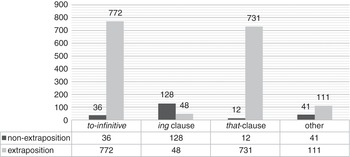
Figure 5.2 Non-extraposition vs. it-extraposition with different subject clauses
The results in Figure 5.2 show that there is an effect of the formal realization of the subject clause: ing-clauses as subjects occur more often without than with extraposition. By contrast, the other types clearly favor extraposition over non-extraposition. This outcome informs us that the syntactic realization of the subject clause is indeed a relevant factor for the choice of it-extraposition or non-extraposition. In the next two sections, we will see that the choice of construction also varies by discourse-related factors, notably by its information structure (5.2.1) and the type of discourse in which it occurs (5.2.2).
5.2.1 The Information-Packaging Function of It-Extraposition
Following the general principle of information-packaging (as described in Chapters 2 and 3) as well as what we have just discussed as the role of end-focus and end-weight, a subject clause in clause-final position is likely to be associated with new information. By implication, it is equally plausible to assume that non-extraposition is more likely to occur if the content of the subject clause constitutes information that is not new, that is, when the information is given or inferable from the discourse context.
Let us substantiate this claim by a quick ad hoc corpus search. We can search in a corpus, for example, for all sentences containing the string to do so in subject position, a clausal subject that almost certainly contains given information (due to the pro-form do so). Carried out in COCA, the search for do so followed by a verb provided us with more than 1,000 hits (note that a corpus like COCA is continuously growing), which all contained a subject clause like that in Example (14). We thus easily find instances of subject clauses with given information, showing us that non-extraposition is not altogether uncommon.
However, subject clauses with given information also occur in sentence-final, that is, extraposed position. For instance, there is nothing weird about the extraposed version of (14) (It would be hypocritical to do so). Since both variants are, grammatically speaking, acceptable, the claim about the information-packaging function of it-extraposition raises an empirical question: Is it true that it-extraposition as a construction favors new information over given information in the subject clause?
To test this claim as a hypothesis, let us look at data which is available from the same corpus as the data we discussed above (Reference KaltenböckKaltenböck 2005). For interpreting the results, we first need to know how given and new information was exactly defined when dealing with the data. Kaltenböck (2005: 127) operationalized givenness by making use of the concept of retrievability in discourse. Information in the subject clause is understood as retrievable if it is either mentioned in the preceding discourse or inferable from the discourse situation. Examples of subject clauses with retrievable information are given in (15) and (16), while the extraposed subject clause in (17) is new information.
(15) He became a lawyer and is now mayor of our hometown. If Mr. Murray is right, however, the next generation of educated professionals will consist almost entirely of the sons and daughters of other educated professionals. Members of the upper class send their children to better schools, coach them in ways of success, and know how to game college admissions. Members of the lower class have little access to such advantages. Although critics have faulted details of Murray’s argument, it is hard to deny his larger point: It is bad to have such sharply diverging classes. (COCA, News, 2012)
(16) It was my first day of class, and I was 21, and the students came in saying, “Where is the instructor?” I said I was the instructor and they said, “You. It is not bad enough that they gave us a lady but you have on heels.” (COCA, Academic, 2008)
(17) We’re back with our panel. Juan Williams, during the break, passed on a useful health tip. He noted that authorities are now informing us that it is bad to use drugs […]. (COCA, Spoken, 2001)
In (15), the information contained in the subject clause is present from the preceding text (upper class, lower class), while in (16) they gave us a lady can be understood from the previous discourse (the speaker presenting as female), that is, the information is inferable. By contrast, a sentence like the one in italics in (17) is new information because to use drugs is not retrievable information. Note that, for the data we discuss below, being retrievable from the preceding text was limited to a stretch of discourse comprising nine preceding clauses (or similar units, if there happened to be no complete sentences).
Let us now look at the corresponding outcome concerning the information status of extraposed subject clauses. Table 5.1 is based on a collection of 1,701 instances of it-extraposition from the ICE-GB corpus and shows the absolute frequency as well as the percentage of subject clauses with irretrievable (i.e., new) and retrievable (i.e., given) information.
Table 5.1 Information status of subject clause in it-extraposition
| Total number (in %) | |
|---|---|
| Irretrievable (new) information | 1,217 (71.5 %) |
| Retrievable (given) information | 484 (28.5 %) |
| Total | 1,701 (100 %) |
In line with a prediction that follows the principle of information packaging, the majority of the occurrences of extraposition in Table 5.1 contain a subject clause with irretrievable information. This finding confirms our hypothesis, and it supports the end-focus function of the construction. In other words, the non-canonical placement of a subject clause clearly has to do with the subject containing new, and hence, more important, information.
Having verified the discourse function of it-extraposition empirically, we may also ask if and how the information structure interacts with the syntactic variable we discussed above. Does the syntactic form of the subject clause affect the likelihood of given or new information being contained in the subject clause? The corpus study we are using here also has an answer to this question, which is what is seen in Table 5.2.
Table 5.2 Information status of different types of subject clauses in it-extraposition
| Given information | New information | Total | |
|---|---|---|---|
| to-infinitive | 286 | 486 | 772 |
| ing-clause | 21 | 27 | 48 |
| that-clause | 104 | 627 | 731 |
| other | 34 | 77 | 111 |
| Total | 445 | 1,217 | 1,662 |
As you can see in Table 5.2, there is a considerable difference between finite (that-) clauses and non-finite (to- and ing-) clauses in the extent to which they contain given or new information when in extraposed, that is, sentence-final, position. Finite that-clauses have the clearest preference for shifting new information into the end-focus position whereas, for the infinitival and participial subject clauses, the difference between extraposed subject clauses with given information and those containing new information is less pronounced.
For visualizing this outcome in a graph, we again need to ensure that the choice of the diagram matches our research aim (see our discussion on charts in Chapter 3). Figure 5.3 thus derives from two decisions: First, it emphasizes that we are interested in the differences among syntactic forms of extraposed subject clauses concerning their information structure; hence, the different syntactic realizations are chosen as the parameter of variation on the x-axis. Second, the results are presented as percentages on the y-axis, because we must take note of the fact that the overall number of hits per syntactic category varies considerably in the corpus data.
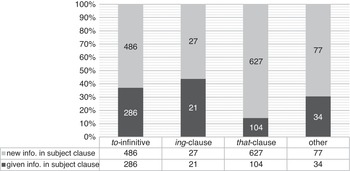
Figure 5.3 Frequency of given and new information in extraposed subject clauses
Figure 5.3 illustrates the proportions of given and new information with different syntactic types of an extraposed subject clause. It thus shows the different strengths of the association of the subject clause types with the dependent variable, given or new information. In particular, it highlights that finite that-clauses differ from the rest. Note, however, that presenting results only in the form of percentages can be misleading, since the chart would hide how much the absolute numbers within each category are different (for example, that there are considerably fewer ing-clauses than that-clauses in the data set). When presenting your own work, you should therefore add absolute numbers, in the form of a table (as we have done in Figure 5.3), for the sake of transparency.
In sum, the findings on the syntactic realization of extraposed subject clauses have confirmed the assumption that the syntactic type of an extraposed clause is a formal variable that interferes with the characteristic distribution of information in it-extraposition. An obvious reason for this interference is the length of the subject clause: Since non-finite clauses tend to be shorter, they are also more likely to be chosen as a syntactic realization when encoding given information. The pattern of variation that we have seen thus also confirms the validity of the Principle of End-Weight..
Based on the section, it is now possible for you to analyze a collection of attestations for it-extraposition. Go to Exercise 1 to retrieve instances of the construction from a text and to Exercise 2 for analyzing extraposed subject clauses as containing retrievable or irretrievable information. See Exercise 5 of the Level 2 exercises for an alternative visualization and interpretation of the data discussed in this section.
In order to find out more about the construction in discourse, we will now apply the text-linguistic perspective.
5.2.2 The Role of Discourse: Extraposition or Non-extraposition?
So far, we have looked at the internal properties of it-extraposition, that is, its syntactic realizations and information structure. In this analysis, the role of discourse resulted from the influence of the co-text, which determines what is given and what is new information. We now turn to the textual context, that is, to the types of discourse in which the construction is likely to occur.
The role of the discourse context, in the form of the surrounding register and genre (for more on this, see Chapter 9), raises at least two questions here. First, we are interested in the use of extraposition and non-extraposition in different types of discourse. This question can be answered by looking at the rates of occurrence of the construction in different registers. More specifically, however, we also want to find out if the discourse context affects the extent to which the information-packaging principle applies to the construction, as discussed in Section 5.2.1. In other words, one might plausibly assume that the discourse context in which extraposition is used is a relevant predictor for the distribution of information within the construction. As you will see, corpus results again enable us to investigate this assumption.
Table 5.3 Extraposition and non-extraposition in two registers
| Non-extraposition | Extraposition | |
|---|---|---|
| Speech | 79 | 730 |
| Writing | 138 | 971 |
Let us first look at the occurrence of extraposition and non-extraposition in the two registers of speech and writing in Table 5.3. What the frequencies recorded in Table 5.3 (based on an equal amount of spoken and written words in a text corpus) tell us is that extraposition seems overall to be more common in writing. However, the numbers in Table 5.3 also indicate that sentences with a non-extraposed subject clause occur to a different extent in the two registers. The reason is that sentences with a subject clause that could be extraposed, that is, contain a matrix and a subordinate clause, are also more common in writing. The results given in Table 5.3, which are absolute rates of occurrence of the construction, do thus not prove a proper effect of the discourse type on the choice of the construction. Rather, they reflect the frequency of occurrence of that type of complex sentence as a whole.
Transforming the results from Table 5.3 into the graph in Figure 5.4, based now on percentages, illustrates that the choice of non-extraposition amounts to about ten percent of all complex sentences of that kind, regardless of register. Contrary to our initial assumption, we therefore have to note that speech and writing as different registers do not have a significant effect on whether speakers prefer a non-extraposed over an extraposed variant of these sentences.
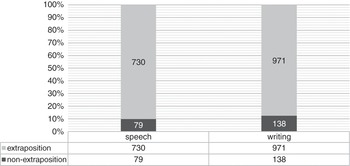
Now let us return to the information-packaging function of it-extraposition in discourse. Is the information structure within it-extraposition dependent on the type of discourse in which the construction is used? Table 5.4, an expanded version of Table 5.2, which you saw in Section 5.2.1, contains the absolute frequencies of it-extraposition with given versus new subject clauses in speech as opposed to writing. Percentages are given in brackets. In this case, Table 5.4 enables us to detect a register difference: The information-packaging function of the construction, that is, its preference for the subject clause to contain new information, is only obvious in the context of writing, whereas the register of speech does not show a strong preference in that respect.
Table 5.4 Information status of subject clause in it-extraposition
| Information status | in speech | in writing | Total number (in %) |
|---|---|---|---|
| New information | 410 (56.1 %) | 807 (83.2 %) | 1,217 (71.5 %) |
| Given information | 321 (43.9 %) | 163 (16.8 %) | 484 (28.5 %) |
| Total | 731 (100 %) | 970 (100 %) | 1,701 (100 %) |
Table 5.4 has told us an interesting difference, which we again want to visualize. Turning the numbers from Table 5.4 into the bar chart in Figure 5.5 illustrates the different proportions. Using percentages is unproblematic here since both corpora were of equal size and all frequencies, given again in the table together with the chart, are sufficiently high.

Figure 5.5 Subject clauses with given and new information in two registers
The graph in Figure 5.5 to some extent modifies the outcome of our discussion of Table 5.1 above. Although it-extraposition with new information in the subject clause is the more common pattern in both contexts, there is a clear effect of the discourse type on the function of the construction: in this case, this is an effect of the register resulting from the medium. The assumption that the main function of it-extraposition is information-packaging in fact only applies to the written medium. Note that the effect is not exclusively a matter of text-linguistic variation, since the overall frequencies of the construction in both contexts, as given by Table 5.3 (731 as opposed to 970), are not strikingly different (the average rates of occurrence per text being 1.5 in speech and 1.9 in writing). Instead, the text type influences the discourse function of the construction, in that the assumed preference for an extraposed clause to contain new information only holds true for writing.
There is not much evidence on the occurrence of extraposition in more specific types of discourse, due to the fact that searching for the construction in a corpus is a challenge. We have seen before that lexical shortcuts can be a solution, so one possibility for retrieving instances of it-extraposition from a corpus is to search for specific lexical subtypes. For example, you could investigate the construction with specific semantic predicates, using lemmas in the matrix clause such as (be) good, bad, true, apparent, likely, or the like.
You could now turn to Exercise 6, where a corresponding project is proposed.
5.3 It-Clefting
The term clefting is used to describe a syntactic process that divides a single clause into two constituent parts. One of the two parts becomes foregrounded, while the other one is backgrounded (Reference Huddleston and PullumHuddleston & Pullum 2002: 1414). There are two main constructions that are referred to as clefting: it-clefting (it’s the cake there that I like) and wh-clefting (what I like there is the cake). In an it-cleft construction, it becomes the subject of the matrix clause, with a relative clause
appearing as a modifier within an NP structure. At first sight, the construction therefore resembles extraposition, as you can see in (18) and (19). However, in contrast to the extraposed subject clause in (19), the embedded clause in an it-cleft, like (18), is a relative clause ([whom] we met there).
(18) It was Lucky we met there. (it-clefting)
(19) It was lucky that we saw four rhinos. (it-extraposition)

You may be familiar with the construction in (18) from constituency tests in syntax since the matrix clause in an it-cleft predicates, and thereby highlights, the existence of one clausal constituent. By contrast, in it-extraposition, the matrix clause is a comment or judgment. Turning sentences (18) and (19) back into more basic, canonical clauses makes this difference become apparent: for (18), the canonical clause would be We met Lucky there, and for (19), That we saw four rhinos was lucky.
Note that there are cases of it-clefting which turn out to be ambiguous. The ambiguity can be due to the fact that it-clefts can be used to highlight elements with different syntactic functions. While, in (18) above, the highlighted element is the grammatical object, there are also matrix clauses that introduce other clausal elements. In (20) and (21), for example, the highlighted element is an adjunct:
(20) It’s about six weeks ago I last took my bike to get to work.
(21) It’s only on rare occasions that I bike to work.
The examples in (20) and (21) not only have a non-clefted, but also a non-extraposed counterpart (That I last took my bike to get to work is about six weeks ago; That I bike to work is only on rare occasions). The ambiguity results from the ellipsis of the subordinator (that or when), which is what we have in (20) and (21). More complete versions of each sentence are given in (22) through (25), illustrating which of the two constructions is present:
(22) It’s about six weeks ago when I last took my bike to get to work. (it-clefting) corresponding non-cleft: About six weeks ago I last took my bike to get to work.
(23) It is about six weeks ago that I last took my bike to get to work. (it-extraposition) corresponding non-extraposition: That I took my bike … is about six weeks ago.
(24) It’s only on rare occasions when I bike to work. (it-clefting) corresponding non-cleft: Only on rare occasions I bike to work.
(25) It’s only on rare occasions that I bike or walk to work. (it-extraposition) corresponding non-extraposition: That I bike to work is only on rare occasions.
It is not always easy to tell what speakers have in mind at the moment of uttering a sentence like (20) or (21); most likely, the speaker will not be able to tell you either. But, as we have seen, the cases where we encounter problems distinguishing it-clefting from it-extraposition result from the possibility of dropping the relative pronoun or the complementizer in these constructions.
In the following, we turn to the discourse function of it-clefting as a syntactic variant in Section 5.3.1 and to its text-linguistic variation in 5.3.2. As you will see, there is not a lot of quantitative evidence to report in this area, since retrieving the construction based on a limited number of search strings is more than a challenge, and lexical shortcuts for the construction are not easily available. We will therefore explore the discourse function of it-clefting mainly by way of contextualized examples.
5.3.1 Functions of It-Clefting: Foregrounding, Focus, and Presupposition
As we have seen so far, while the discourse function of it-extraposition has to do with presenting new information as the end-focus, it-clefting is a construction that syntactically highlights a particular sentence element. For example, in (18), the noun phrase Lucky is highlighted, while the rest of the predication becomes a syntactically subordinate relative clause.
This function of highlighting can also be described as foregrounding an element by way of the cleft construction. If you utter (18), rather than simply We met Lucky there, you turn the element Lucky into the complement in a new matrix clause. As a result, Lucky becomes a constituent of the new main clause and, with that, the new focus of the entire construction. The remainder of the original predication is placed within a subordinate clause ([whom] we met there), so that it appears to provide only background information. This division into foregrounded and backgrounded material is, in principle, independent of the information status of the two components. In the example in (26), a corpus attestation that is similar to Example (18), we see from the context that Bill is given information; nonetheless, Bill is foregrounded and syntactically marked as the focus.
(26) Imitating the old man’s adventure never entered my mind, but Bill Langland’s taste for adventure required more actual participation than mine. It was Bill who first suggested that we try to catch a big fish – any big fish – on a handline. (COCA, Academic, 1997)
In contrast to extraposition, which attributes end-focus to a subject clause by placing the clause sentence-finally, it-clefting marks its focus syntactically and, as a result, makes the material in clause-final position appear less important. The syntax of the it-cleft also prevents an unintended, end-focus interpretation (Reference LambrechtLambrecht 1994).
This focus-marking function of it-clefting is independent of the different conditions of given and new information in the foregrounded and backgrounded part of an it-cleft. We could see in (26) that the foregrounded element can easily be given information: Bill is highlighted but the information is not new. By foregrounding it, the sentence expresses the focus is on Bill and, with that, it creates a meaning of contrast: it was Bill, and not somebody else, who was able to do this. This effect of expressing a syntactically “stressed,” contrastive focus is one of the two discourse functions of it-clefting (Reference PrincePrince 1978). The contrastive focus function is typically present when the focused element contains given information (see Figure 5.6).
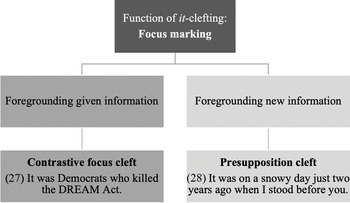
Figure 5.6 Focus marking and information structure in two types of it-clefting
As for the backgrounded part of the cleft-construction, this part may contain new information, as in (26), or old information, as in (27). However, in contrast to the foregrounded element, the backgrounded part in an it-cleft is always presented as if it were somehow already known. This effect is due to the background part being, syntactically, a subordinate clause. For example, in (27), due to the complex sentence structure of the it-cleft, the fact that somebody killed the DREAM Act (the name of a legislative proposal that grants conditional residency to certain undocumented immigrants in the US) is not presented as an issue in itself. What is highlighted is that the information (that somebody killed the DREAM Act) is already known from the previous discourse. The idea is strengthened, or sometimes properly created, that the backgrounded part of the cleft-construction contains information that was to be presupposed.
(27) This wasn’t Republicans who killed the DREAM Act. It was Democrats who killed the DREAM Act. (COCA, Spoken, 2011)
Not all instances of the it-cleft truly background given information, like in (27), and consequently receive a contrastive focus interpretation. In (28), for example, both the focused element and the backgrounded part of the sentence constitute new information.
(28) It was on a snowy day just two years ago when I stood before you on this very spot in this beautiful and historic chamber to take the oath of office as Maryland’s new governor. (COCA, News, 2017)
The element highlighted by the it-cleft in (28), originally an adjunct (on a snowy day), would have been a plausible point of departure for the clause, since adjuncts providing a temporal orientation tend to be placed sentence-initially (as discussed in Chapter 3). Why is this element additionally foregrounded? The function of the it-cleft in (28) is not so much about the element that is syntactically highlighted, but relates to the backgrounded component. The it-cleft does not affect the order in which the two parts appear in the discourse (it was on a snowy day just two years ago when I stood before …). So, the difference that is created only results from the syntactic subordination of the remainder of the clause (when I stood before you …). This subordinated part of the it-cleft is again presented as if already known. The second type of it-cleft, in which new information is expressed as the focus, thus presents the subordinate clause as if it were “known to some people although not yet known to the intended hearer” (Reference PrincePrince 1978: 899). Its function is to evoke a presupposition, which comes about through foregrounding one part of the predication as the sentence focus and presenting the rest as if it could already be presupposed (see Figure 5.6).
Summing up the discussion in this section, Figure 5.6 highlights that the focus-marking and foregrounding function of it-clefts are independent of the distribution of information in the construction. The foregrounded element contains given or new information in comparison to the rest of the clause; this element always ends up being marked as focus. Depending on the information status of the foregrounded constituent, the function of the it-cleft is either to express a stressed and contrastive focus (the Democrats, nobody else), or to signal the presupposition that the backgrounded part (what happened just two years ago) is not entirely new, but something that is possibly already known. In Section 5.3.2, we will turn to the question of how these two discourse functions of it-clefting are associated with different types of discourse.
5.3.2 It-Clefting in Different Types of Discourse
Much like it-extraposition, it-clefting can be found in almost all types of discourse. For example, the GSWE (Reference Biber, Conrad, Finegan, Johansson and LeechBiber et al. 2021) notes that it-clefts, although especially frequent in academic texts, also commonly occur in conversation or in fiction. The use of it-clefting in discourse is therefore not register-specific. However, as we will see, there is some variation regarding the element that the construction is meant to highlight. As illustrated in Figure 5.6, following the information status of that element, there are two types of it-clefting that we distinguish: the contrastive focus it-cleft and the presupposition it-cleft. Is either of these more characteristic in certain kinds of discourse?
Let us look at the foregrounded part of it-clefting again, this time at the information status as possibly varying by the type of text in which the it-cleft occurs. Figure 5.7 is based on 701 it-clefts from four spoken and written registers (Reference HedbergHedberg 1990): conversational speech, fiction, commentaries, and historical narratives.

Figure 5.7 Information status of foregrounded element in it-clefts.
We can see in Figure 5.7 that the it-cleft with given information, that is, the contrastive focus cleft, is the more common type in three out of the four types of discourse. However, we also see that new information in the foregrounded element is not uncommon in any of these registers. Figure 5.7 further highlights that this presupposition cleft, that is, the one that foregrounds new information, is the more common type of an it-cleft only in fiction (53.3 percent).
This outcome brings us to a final, interesting pattern of the use of it-clefting in actual discourse, a pattern that we also saw when dealing with (28). The example showed an it-cleft foregrounding new information, but we also noted that the backgrounded part (I stood before you on this very spot …), although syntactically subordinate, contains new information as well. It might strike us in Example (28) that the subordinate clause is comparatively long and drives the discourse forward, rather than adding just some background information. This use of the it-cleft is a pattern that occurs especially in narration. Although the construction highlights information by making it the sentence focus (on a snowy day just two years ago), this element is truly only an opener for the story or episode to follow. In the end, the backgrounded part turns out to be even more noteworthy. Similar occurrences are the examples in (29) and (30), which are, like (28), from story beginnings.
(29) It was on a summer day in 2012 that I had to practically chase my 58-year-old spouse out of the house for a long-overdue physical exam I’d booked for him. (COCA, Magazine, 2014)
(30) It was on a snowy night, after you’d bitten me again, that you rose up in a way, a levitating way, and your head was not yours but belonged to a pharaoh or a prince, and I caught a glimpse of what was behind the coral curtain in your village, and it was so exactly as you’d said, bowls and bowls and your mother’s cup, your lips to your mother’s cup, and then I saw the bus, and […]. (COCA, Fiction, 2015)
This use of it-clefting, as illustrated by (28) through (30), is an interplay of syntactic foregrounding, the information in the foregrounded and the backgrounded components, both being new, and of the position in the text where the it-cleft occurs. As we saw, foregrounding one element by way of an it-cleft makes the rest of the sentence appear like known information, that is, presupposed. Using this mechanism for an upcoming narration helps to present a story as if some knowledge of it were shared by the reader, an effect that reduces the distance between writer and reader. The pattern tends to be used in fiction, which is what we saw in the higher proportion of the presupposition it-cleft in Figure 5.7 and in Example (30). However, as our discussion of examples (28) and (29) has shown, the pattern also occurs in non-fictional discourse, for example, in news texts or magazines.
You should now be able to detect and analyze the function of it-clefts in different kinds of texts and to distinguish it-clefting from it-extraposition. Go to Exercises 3 and 4 to test your analysis skills and to Exercises 7 and 8 (Level 2) for dealing with the discourse function of it-clefting. Also find out more about a possible common origin of the two constructions in our Good to Know box.
Good to Know: Extraposition as Possible Origin of Both ConstructionsIn this chapter, we have looked at the functions of it-extraposition and it-clefting in discourse, and we have seen that both share the function of marking an element as the focus of the sentence. We have also noted that the two constructions are formally similar, due to the pronoun it being used as a dummy subject. These similarities might raise the question of whether there is perhaps a common historical origin of the use of it in the two constructions.
You know it to be a personal pronoun, and there are sentences that look like an it-cleft, but in which it is in fact a personal pronoun, referring to something or someone. Note, for example, the sentence in (31):
(31)
a: What a strange object you have over there! b: It is the vase I received for Christmas
In contrast to it in an it-cleft, it in (31) is a referential pronoun, referring back to the strange object speaker a has been pointing to. The relative clause I received for Christmas modifies the NP headed by the noun vase, that is, together they form a single constituent (the vase I received for Christmas). By contrast, in the it-cleft in (27), the sequence Democrats who killed the DREAM Act is not a single constituent NP. By the analysis we presented when discussing this example, the it-cleft in (27) highlights the noun phrase Democrats, which is a predicative complement of the main clause. This clausal structure makes the relative clause not a modifier of Democrats, but of the subject pronoun it (it/the ones who killed the DREAM Act was/were the Democrats). Only, for reasons of end-focus and end-weight, this modifier is moved to the end of the sentence.
This analysis can explain the similarity of clefting and extraposition. If the subordinate clause in the it-cleft is a relative clause belonging to the subject NP, and not to the antecedent noun, both constructions can be said to result from the extraposition of a subordinate clause. We also saw in this chapter that there are cases in which it is difficult to keep clefting apart from extraposition: In particular, this is the case when the clefted element is an adjunct, as in the examples in (32) below (based on the it-cleft in (20) above):
(32) It’s about six weeks ago they did the job. (it-clefting)
a. It’s about six weeks ago when they did the job. (it-clefting)
b. Six weeks ago they did the job. (non-clefted version)
c. It’s about six weeks ago that they did the job. (it-extraposition)
d. That they did the job is about six weeks ago. (non-extraposition)
In view of these parallels, historical syntacticians have wondered if the two constructions are ultimately related. Do they have a common historical origin, or did one develop based on the other? There is some evidence discussed by historical linguists in favor of the position that it-clefting originates in extraposition, rather than the other way round (Reference Patten, Gisborne and HollmannPatten 2014). For example, historical corpus data has shown that the earliest attested form of an it-cleft is the one with a focused NP. By contrast, those instances that foreground an adjunct, such as a PP or a clause, seem to be a later phenomenon. Also, from the point of view of the two types of it-clefting we discussed in Section 5.3.1, the it-cleft that highlights given information (the contrastive focus cleft) is attested earlier than the type of clefting where the backgrounded part is presented as if it could be presupposed. Taken together, these historical findings suggest a more likely origin of the cleft-construction in extraposition. Furthermore, in Old English, it was easily possible for a pronoun to be modified by a relative clause. And it was not uncommon for such relative clauses to occur sentence-finally, that is, to be extraposed (it/the ones who killed the DREAM Act was the Democrats becoming it was the Democrats who killed the DREAM Act). In that sense, the extraposition of a subordinate clause, which could be a proper subject clause or a relative clause modifying the subject NP, is possibly the common origin of both constructions.
5.4 Summary
In this chapter we have dealt with two constructions that serve the expression of the sentence focus, that is, of the most important part of the message in a sentence. We first explored sentences resulting from the extraposition of their subject clause and the characteristic distribution of given and new information within these sentences. We saw that discourse types and registers also play a role here and that only the written medium truly favors new information that is extraposed.
We then turned to the use of it-clefting in discourse: a construction which places the focus on one sentence element by turning the clause into a complex sentence. Depending on whether this element carries given or new information, the function of an it-cleft in discourse is either to create a meaning of contrast, or to present new information as if it were already known to the listener or reader. We looked at evidence for these functions in discourse and noted a characteristic pattern of use for narrative types of text.
On the way, we also discussed alternative formats for visualizing quantitative evidence from corpora and highlighted the importance, as well as the limits, of presenting proportional frequencies when dealing with data sets of a different size.
5.5 Exercises
Level 1: Classification and Application
1. Find the occurrences of it-extraposition in the following text excerpt from Monica Macaulay’s book Surviving Linguistics: A Guide for Graduate Students (Reference MacaulayMacaulay 2011). For each occurrence, give the corresponding, non-extraposed version.
A. Most graduate advisors do their best to train their students, but often they forget just how explicit they need to be. It’s easy to forget, for example, that it’s not obvious how submission of abstracts works or how examples should be laid out. It’s also easy to overlook the fact that many linguistics graduate students don’t come into the field with a background in science, […]. (Reference MacaulayMacaulay 2011: xi.)
2. The instances of it-extraposition given below were collected from COCA, using the matrix predicate be bad or be great. Have a look at each attestation and its co-text provided and decide for each case whether the extraposed subject clause constitutes given or new information. What kind of evidence can you use to come to a decision?
a: I’ll ask Betty to order some takeout. You still a vegetarian? b: Yes, but not vegan anymore. a: Just tell me what you eat. b: Vegetables. Cheese. Beans. No meat. a: What about one of those Greek salads from Dino’s? b: Fine. Dressing on the side. a: Now you have had a colored career, you’re one of the more successful restaurateurs in the world. You could have gone anywhere. You stuck with New York. b: First of all, it is my city, I grew up here, and second of all, the integrity of downtown especiallyPreceding text it-extraposition Given or new? 1. a: It’s great that you’re still a vegetarian. (COCA, Fiction, 2015) Regardless of the project, assessment, or unit we are working on with students, the important element is not only the assessment, but the Big Think that occurs for students afterward. It is too easy for teacher-librarians to be content when they finally get that elusive teacher to collaborate with them. 2. It is great to finally work with that teacher. (COCA, Academic, 2010) With Boone in Los Angeles with me while I work on those safe houses for abused women and families, I’ve discovered just how amazing living together can be. I had no idea I’d adapt so quickly to having someone in my life 24/7. Add in B. J. and instant motherhood, and it’s been the most incredible few months ever. 3. “It really is wonderful to see you so ecstatically happy,” Gabi told her. (COCA, Fiction, 2013) 4. b (continues): It is great to see the way the people responded. (COCA, Spoken, 2002) 5. a (continues): it’s bad that we work so hard. (COCA, Spoken, 2007) It is inconceivable to me that the city fathers want to emulate Beijing and Shanghai with their populations in the millions. 6. It is bad enough that L.A. is almost 4 million with continued high density, intolerable traffic and parking problems, unaffordable housing and all while undergoing a continued drought. (COCA, News, 2016)
3. Is the sentence marked in this excerpt from P. D. James’s Devices and Desires an instance of it-extraposition or of it-clefting? Find the answer by trying to produce the corresponding canonical version for each option.
B. There were after all a dozen appropriate texts he could have quoted. “Darkness and light are both alike to Thee.” But they were not alike to a sensitive ten-year-old boy. It was on those lonely walks that he had first had intimations of an essentially adult truth, that it is those who most love us who cause us the most pain. (James, Devices and Desires, 2004)
4. For each of the following instances of it-clefting, produce the corresponding non-cleft version and name the syntactic function of the sentence element that is highlighted.
a. It was you who introduced me to the track chair guys, right? (COCA, Spoken, 2015)
b. It is because the State has recognized this fact that the law has insisted that, for a legal life and personality, these groups and societies must get the authority of the State, and submit to its conditions. (BNC, Academic, 1991)
c. The anonymity of doctors who provide these details will be guaranteed. If these practices are not stamped out it is the public who will be the ultimate victims. (BNC, Academic, 1980)
d. He looked up. On the pavement opposite a small boy watched him. The shouting grew fiercer, and the gates opposite were thrown open. It was the woman who had put the flowers on the place where Harry Lawrence had died, […]. (BNC, Fiction, 1991)
Level 2: Interpretation and Research Design
5. Figure 5.8 shows an alternative visualization of the results given as Table 5.2 and the graph shown as Figure 5.2. Figure 5.8 visualizes the absolute frequencies of different types of subject clause and their information status. Compare Figure 5.8 to 5.2 and discuss how the two diagrams highlight different research outcomes. Figure 5.2 already highlighted the relevance of syntactic form for the occurrence of extraposition. Which finding on different syntactic types of extraposed clauses does Figure 5.8 emphasize?
6. Replicate the analysis described in Exercise 2 with matrix predicates that express some kind of belief (e.g., being true, apparent, or likely). Find a search string for a related lemma search, combining the pronoun it, any form of the verb be and an adjective such as true, apparent, likely, or other. Based on an analysis of a randomized set of twenty attestations and their previous co-text, what is the proportion of given and new subject clauses? Do the findings confirm the hypothesis that extraposition occurs more often with new information in the subject clause?
7. Recall the function of an it-cleft, as discussed in Section 5.3.1, focusing either given or new information, and look at this example of it-clefting from the novel Frankenstein. Discuss the occurrence of an it-cleft in its relation to what you see (and possibly know) about the co-text and the context and a possible association with the genre of a suspense novel.
C. It was eight o’clock when we landed; we walked for a short time on the shore enjoying the transitory light, and then retired to the inn and contemplated the lovely scene of waters, woods, and mountains, obscured in darkness, yet still displaying their black outlines. (Reference ShelleyShelley, Frankenstein, 1993 [1818]: ch. 23)
8. In Section 5.3.2 we pointed out that the type of cleft focusing given information, adding a meaning of contrast, is overall the more common type and that it-clefts with long and noteworthy information in the subordinate component, creating a presupposition, are a characteristic of narrative discourse. Find three it-clefts from a fictional and from an academic text of your choice. Classify them as belonging to the contrastive focus or the presupposition type. What do you observe? Which function seems to be more common in which type of discourse?
Data is from Reference KaltenböckKaltenböck 2005: 131.

Figure 5.8 Information structure within different syntactic types of extraposed clauses (absolute frequencies)
Further Reading
On the function of it-extraposition in discourse, notably academic discourse, see, for example, Reference ZhangZhang (2015). On information structure in it-clefts and their relation to wh-clefts, see Reference Hedberg, Fadden, Hedberg and ZacharskiHedberg & Fadden (2007).
On the use of it-clefting in child language development, see Reference Aravind, Hackl and WexlerAravind et al. (2018) or Reference Thornton, Kiguchi and D’OnofrioThornton et al. (2018). For a more theoretical discussion of the relationship between extraposition and it-clefting, also contrasting their treatment within the conceptually very different frameworks of Generative Grammar and Construction Grammar, see Reference Patten, Gisborne and HollmannPatten (2014).


