

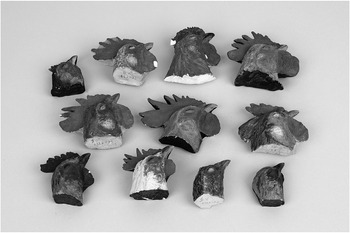
One might not expect to find eleven immaculately painted plaster chicken heads (Figure 13.1) in a museum of the history of science such as the Whipple. The heads are cast from individual birds: they each share with their originals the same lifelike heft, the same scarlet comb and wattle with the same stippled reptilian feel, the same plumage colouring – even a few of the same feathers, transferred during the moulding process. A slice from the right side of each head has been removed to form a flat surface, with the back edges bevelled and painted in black to bring the head’s profile into relief when displayed on a table. The heads were made in the early 1930s and have been attributed to Reginald Punnett, Alfred Balfour Professor of Genetics at the University of Cambridge from 1912 to 1940. His experimental notebooks, held by the Cambridge University Library, reveal that during each of these twenty-nine years he conducted detailed breeding experiments with chickens – his commitment to poultry was such that in 1923 he admitted that ‘the hen has seldom been out of my thoughts.’Footnote 1 Punnett’s chicken-breeding experiments are bound up with the invention for which he is known today, a form of visualisation quite different from the Whipple’s chicken heads: the Punnett square, a tabular array still used in genetics to represent the outcome of a cross between two organisms.
While interest in three-dimensional scientific models has grown among historians over the past two decades, scholars also acknowledge that such models remain an ‘understudied historical resource’.Footnote 2 In investigating the various roles that models and visualisations can play in science, Punnett’s case is a particularly fruitful one, because his scarcely studied career spans a period in which Mendelian genetics in Britain was an emerging science that operated at the geographical and academic fringes of the University. Funding and academic reputation were at stake in debates over the practical benefits of this recently rediscovered way of understanding heredity; new research techniques were being developed to prove and extend Mendel’s laws; and new students had to be attracted to the discipline and trained in its theory and praxis. In this chapter, I am interested in how both Punnett’s square and his chicken-head models, qua visualisations, played different but related roles in all three of these areas during this crucial period in the development of genetics in Britain. Historians of three-dimensional models have often understood their work as addressing a conspicuous void in broader studies of representational media in science, with the result that there is a dearth of scholarship that treats three-dimensional models together with other visual media. I follow Nick Hopwood in endeavouring to show that models and their uses in science are most clearly illuminated when their relations to and differences from other forms of visual media, including flat material such as the Punnett square, are made clear.Footnote 3
I begin by describing Punnett’s partnership with the geneticist William Bateson, and with the help of their famous comb experiment I explain the function of the Punnett square, which was developed around the same time. Scholarship on the Punnett square has tended to focus on its genesis and its use in research; I build on these accounts by exploring how the square, along with the chicken-head models, were used in Punnett’s teaching.Footnote 4 While the practice of constructing a Punnett square imparted knowledge of Mendel’s laws and the theoretical basis of genetics to students, the chicken heads served as in-class teaching aids, their lifelike detail helping students gain the phenotypic literacy so essential to the practice of breeding experiments in early genetics. I describe how these functions, along with the use of the Punnett square as a conceptual tool in research, dovetailed with the efforts of Bateson, Punnett, and others, in fundraising campaigns, to pitch genetics as a science with important practical yields. I then explore the differing afterlives of the square and the heads, explaining these differences in reproduction and dissemination not only as a function of their materiality but also in terms of their uses in the theory and practice of a rapidly changing science. This leads me to conclude with a brief philosophical discussion of how my account of Punnett’s chicken-head models aligns with and informs practice-centric accounts of the structure of knowledge in genetics.
The Comb Experiment and the Punnett Square
On Christmas Day, 1903, Punnett received a letter from his older colleague William Bateson, with an exciting request. Bateson, a fellow of St John’s College, had already been studying variation and heredity for over a decade when he was made aware of Gregor Mendel’s hybridisation experiments in 1900;Footnote 5 he quickly became an ardent defender of Mendelism, and sought to demonstrate and extend Mendel’s laws by conducting carefully controlled breeding experiments with chickens and other organisms, largely at his home in Grantchester.Footnote 6 By 1903, Bateson needed help: his wife and assistant Beatrice would be ‘incapacitated’ (i.e., pregnant) for the next season, and the breeding experiments – the menial and technical tasks involved in raising hundreds of chicks and carefully recording their characteristics – were ‘not a one-man job’.Footnote 7 The sole Fellow at a Cambridge college engaged in genetics, Bateson’s academic position was lonely and precarious. He had to cobble together an income and financial support for his research from different studentships, bequests, and individual donors, and would not secure a professorship until 1908, and then only in biology.Footnote 8 Luckily for him, Punnett’s response to his request came less than a week later, and was enthusiastic: ‘There is nothing I should like better.’Footnote 9
Thus began a six-year partnership that introduced Punnett to chicken breeding and cemented his interest in Mendelism. One of Mendel’s key insights was that factors (roughly equivalent to today’s genes) were separate from but responsible for certain observable traits; by following patterns in the inheritance of observable traits, Mendel was able to define several laws that governed the inheritance and expression of factors. Early geneticists such as Bateson and Punnett experimentally confirmed many of Mendel’s findings, but also encountered traits with inheritance patterns that weren’t easily explained by his laws. One of their most famous experiments from this period was a demonstration of epistasis, or interaction between different genes, in four comb types in chickens: the rose, the pea, the walnut, and the single.Footnote 10 These observable characteristics, now collectively referred to as an organism’s phenotype, were known to Punnett as unit-characters, and like Mendel he termed factors the ‘somethings’ which corresponded to these unit-characters and were contained in and inherited through parental gametes.Footnote 11 When Punnett and Bateson crossed a rose-comb chicken and a pea-comb chicken, they might have expected that the first generation produced (F1) would be comprised of roses and peas in a ratio of 3 : 1, suggesting that the more common form of comb was dominant over the other. This would have aligned with Mendel’s laws of independent assortment and of dominance. Instead, F1 consisted entirely of chickens with a third form of comb, the walnut. Furthermore, a walnut × walnut cross produced a second generation (F2) in which chickens with four types of comb – the walnut, the rose, the pea, and the single – appeared in a ratio of 9 : 3 : 3 : 1. Mendel had observed this same ratio with two independent pairs of dominant–recessive unit-characters, such as seed colour and seed shape in pea plants, but never with the same unit-character. This suggested that comb type, as a unit-character, was determined by two interacting factors – an example of epistasis.
The design of the experiment is not complicated, but it can be difficult to grasp the inheritance pattern with only a verbal description. When Punnett explained this experiment in the 1911 edition of his short but popular book Mendelism, he illustrated the inheritance pattern in F2 using a method he had invented in 1906, now called the Punnett square (Table 13.1).Footnote 12 I summarise his description here. Both parents of F2 are walnut-combed, with the factors RrPp: the capital letters represent dominant factors, and the lower-case recessive. Each gamete from each parent contains only one factor from each dominant–recessive pair, so the egg cell and sperm cell that form the zygote will each randomly contain RP, Rp, rP, or rp. Chicks end up with varying combinations of these factors. Any chick with at least one dominant R factor and one dominant P factor will go on to exhibit a walnut comb, like its parents; any chick with R as its only dominant will develop a rose comb, and likewise with P for the pea comb; and the rarest chick with no dominant factors will have a single comb. There are sixteen possible combinations of factors, which Punnett represented in a 4 × 4 square tabular array. To construct the square, one begins by filling the cells in the top row with RP, the second row with Rp; the third with rP; and the fourth with rp. These represent the factors that each zygote receives from the egg cell. Then one follows the same pattern in the columns, representing the factors from the sperm cell. Each square in the completed table represents a chick, and the four letters that appear in each square represent that chick’s combination of factors, from which one can infer its comb type. The genius of the Punnett square is that it reveals all of the possible combinations of factors and resulting unit-characters for any given cross; it demonstrates how one arrives at the ratio of 9 : 3 : 3 : 1 for those unit-characters from the combination of factors; and it does both of these elegantly and economically.
The biochemist Dorothy Needham attended Punnett’s undergraduate course in genetics in 1917–18, when she was a student at Girton College. Her lecture notes reveal that Punnett used the square to illustrate basic breeding experiments and illuminate Mendel’s laws: there are three Punnett squares in her notes for the first lecture of the course, including a square identical to the one in Table 13.1, used to illustrate epistasis.Footnote 13 He gave these lectures, which were intended for students reading Zoology for Part I of the Natural Sciences Tripos, on Tuesdays and Thursdays for the duration of his professorship.
Needham was a meticulous note-taker and may have recorded more information than the average student, but it is likely that Punnett encouraged all students in his classes to construct Punnett squares themselves. In his book Heredity in Poultry, a ‘handy guide’ to Mendelian inheritance in chickens, he not only includes several Punnett squares, but actually takes the reader through every step of creating one, ordering her to ‘draw’ the lines, ‘write’ the letters to fill in each cell, and ‘examine’ the finished product to draw conclusions from the information thus represented.Footnote 14 Punnett understood that the student of genetics needed to learn by making and doing: by constructing the square herself repeatedly, she would be led through the logic of genetics – indeed, through a demonstration of Mendel’s laws.
Since each parent contributes two of four possible ‘letters’ to each row or column, and there are four rows or columns, each with an equal number of squares, it is evident that one of each pair of factors is inherited from each parent, and that the likelihood of getting either is random, resulting in equal distribution. This is Mendel’s first law, the law of segregation. Once the whole square has been filled with letters, the reader then fills in the observable traits according to the capital letters in each square: in doing so she demonstrates Mendel’s third law, the law of dominance, which states that dominant alleles (capital letters) override the expression of recessive alleles (lower-case letters). Finally, the reader tallies up the occurrences of each trait to arrive at the ratio of 9 : 3 : 3 : 1, which is a demonstration of Mendel’s second law, the law of independent assortment.Footnote 15 Amazingly, with a single visualisation, Punnett is able to guide a student through the demonstration of all three of Mendel’s laws of heredity. It is the teacher’s hope that the completion of a Punnett square entails a kind of ‘a-ha!’ moment of pattern recognition and understanding; the didactic power of the square lies in its ability to allow the reader to see and understand for herself how the laws of genetics are borne out in particular experiments.
‘How to See’ a Chicken Head
In 1910 Bateson departed Cambridge for the John Innes Horticultural Institute, but he remained a mentor and correspondent of Punnett, who stayed at Cambridge and continued working with chickens for the rest of his life, as Alfred Balfour Professor of Genetics. In the late 1920s, with the financial support of the National Poultry Institute, Punnett and his assistant Michael Pease developed the Cambar: the first autosexing poultry breed whose chicks could be sexed at birth by their plumage, allowing egg producers to immediately rid themselves of cockerels and reduce costs.Footnote 16
The Whipple’s accession catalogue states that Punnett’s plaster chicken heads may have been a part or a product of his research surrounding the Cambar, but this seems unlikely for several reasons. Punnett and Pease acknowledged the creation of the Cambar in a paper published in 1930, the year their partnership ended and two years before the earliest date inscribed on the chicken heads; at least one of the chicken heads clearly exhibits a rose comb, which is not a trait associated with any of the breeds involved in Punnett and Pease’s research into autosexing; and finally, it is unclear what such models would have added to Punnett’s research, since he and Bateson had already developed a consistent system of notation for breeding experiments, in use and virtually unchanged by Punnett since 1903.Footnote 17
If Punnett had wanted to record the chickens’ traits for his research, he would only have had to note them down; if he had wanted a representation of those traits, he could have taken photographs, which he had done in his research for the Cambar.Footnote 18 Instead, he went to the trouble of creating painted, textured three-dimensional models, suggesting that the chicken heads were meant not only to be viewed but also to be interacted with: to be touched, to be compared with each other, and perhaps to be brought into the classroom and used as a teaching aid. The use of models and physical specimens as teaching aids had a precedent in Punnett’s own life: he was at an early, formative period in his career when he spent three years as a demonstrator at the University of St Andrews, where specimens from the departmental museum were fundamental to the curriculum. Professors used the specimens in lectures to illustrate key points, and students were also questioned on the specimens for their examination.Footnote 19 Professors at Scottish universities were known for making use of models in their lectures because, Margaret Maria Olszewski argues, their salary depended on lecture attendance, and the engaging models often succeeded in attracting students.Footnote 20 While Punnett’s professorship guaranteed a salary, his genetics course was not covered by the Zoology composition fee, and cost £1 1s per term to attend.Footnote 21 It is not clear whether Punnett received the fee himself, but in any case to students the charge constituted an obstacle, which it was in Punnett’s interest to overcome by making his lectures engaging and hands-on.
The chicken heads are an ideal size for handling, and the level of detail both in the painting and in texture (Figure 13.1) suggests that they were meant to be observed from up close. No other medium, short of real live chickens – highly impractical in the lecture room – would be able to convey this sensory information with such vividness and specificity. I have described the heads as sharing many of the same characteristics, and even some of the same matter, as their originals. In her 2004 study of natural history displays in early-twentieth-century German museums, Lynn Nyhart argues that such models, with their lifelike detail, were intended to teach the lay public ‘how to see – how to look thoughtfully at objects … [and] to take in their meaning’.Footnote 22 Similarly, Hopwood observes that the use of Ziegler’s wax embryo models in the classroom was meant to teach students how to see microscopically.Footnote 23 But did Punnett’s students really need to be taught how to see a chicken?
In order to answer this, we need to understand the skills involved in the practice of genetics in this period. Bateson asserted that there was no other way to learn the laws of heredity and variation than by ‘the direct examination of the phenomena … [which] can only be provided by actual experiments in breeding’.Footnote 24 For Bateson and for Punnett, research in Mendelian genetics took place not in the laboratory, but outdoors: Punnett kept poultry pens and a shed with incubators on the University Farm, two miles northeast of the city centre but quite close to Whittingehame Lodge, where Punnett lived and kept chickens in the adjoining rooms and yard; he also carried out sweet-pea experiments at the Botanic Gardens.Footnote 25
Punnett’s experimental notebooks provide a glimpse into how these experiments proceeded. The essential goal was to track patterns in the inheritance of particular traits, and to do this one needed very large sample sizes. On average, Punnett bred about 500 chicks per year – though sometimes as many as 1,000 – and each had its own page in that year’s notebooks. At the top of this page Punnett noted the chick’s lay date and hatch date, a code for its parentage, and an identifying number that corresponded to a brass label clipped around the chick’s leg. A list of dated observations followed as the chicken developed, with the death date concluding the entry. However, many of the chick’s relevant traits could be recorded straight after hatching: the comb type, plumage colour, number of toes, presence of feathers on the legs, and so on.Footnote 26 With so many chicks to assess and so many traits to record, Punnett and Bateson initially developed a series of abbreviations that Punnett continued to use in the notebooks for the rest of his life: for example, ‘lt., nts., r.c., n.e., f.l.’ meant ‘light down, no coloured ticks seen, rose comb, no extra toe, feathering on leg’.Footnote 27 Speed was valuable, but so was precision: traits could be ambiguous and require further description, and it was also important to note similarities between birds of different lineages as they matured.
For the geneticist, then, seeing a chicken did have to be taught. One needed a practised eye for detail and the ability to isolate and identify traits, which explains why having lifelike models was so important for Punnett. Drawn in by the heads’ detail and novelty, the student would notice the subtle differences in specific characteristics: how one comb type might be distinguished from another, how to identify ambiguous traits within a type, how traits such as wattle size and plumage might differ between otherwise similar males and females (the sex of most models is noted on the rear), and so on. For Punnett, the careful observation and comparison of specific traits was the very foundation of studies in genetics, and the chicken-head models would have been indispensable in teaching students ‘how to see’ in the mode that was necessary for early genetics research at Cambridge.
Genetics: A New and Changing Discipline
While the Punnett square taught Mendelian theory through the practice of constructing a combinatorial diagram, the chicken heads imparted the visual skills necessary for the practice of early experimental genetics at Cambridge. In tandem, the two visualisations made pursuing genetics accessible and appealing to students. Attracting and training new talent would have been of great importance to Punnett, since genetics in this period was far from an established discipline in Britain. During Punnett and Bateson’s collaborative period, leading journals such as Nature had refused to publish their research, which led them to jointly establish the Journal of Genetics in 1911.Footnote 28 They also helped form the Genetical Society of Great Britain in 1919, but academic enthusiasm for the discipline remained limited. By 1924, the society comprised mostly private individuals and plant and animal breeders; fewer than a quarter of the 108 members were affiliated with universities, and this was not to increase significantly until after the Second World War.Footnote 29
Difficulties were also encountered on the path to the endowment of Punnett’s 1912 Alfred Balfour Professorship, and published fundraising pleas from supporters of the protracted campaign for a genetics chair offer insight into the self-understanding and self-fashioning of an emerging discipline. Bateson, along with Punnett, Adam Sedgwick, Arthur Balfour, and other well-connected friends of his, petitioned individual donors, the Evolution Committee of the Royal Society, the University of Cambridge Council of the Senate, and the Cambridge community for almost ten years, insisting that research into Mendelian genetics had a ‘sure prospect of future success’.Footnote 30 Generally, this group adopted a strategy that focused on the practical benefits that a deeper understanding of Mendelian heredity might yield. Their ‘Plea for Cambridge’, published in the Quarterly Review in 1906, takes such an approach:
The extreme importance of these studies [in genetics], which, if they prove a key to heredity, will place in man’s hands an instrument as powerful as Watt’s application of steam, is shown by the fact that Mr [Rowland] Biffen has already discovered that susceptibility to rust in wheat is Mendelian, and is thus a property which may be eliminated by breeding.Footnote 31
According to this projection, the success of genetics research could be measured in part by the number of different isolated traits that could be shown to fall under Mendel’s laws of inheritance, so that they could be bred out (or, in the case of the Cambar, bred in) for practical purposes. Punnett took a similar tack in Mendelism, where he argued that the Mendelian laws had been ‘found to hold good’ for everything from coat colour to the waltzing habit of Japanese mice, and that it would be reasonable to expect that, over time, more traits would be ‘brought into line in the light of fuller knowledge’.Footnote 32
Attracting and retaining new students helped recruit the manpower needed to conduct the labour-intensive breeding experiments that would uncover Mendelian patterns in the heredity of more and more traits. But Punnett’s visualisations also served the research programme of early genetics in a more direct sense. As William Wimsatt observes, the Punnett square was not only a didactic aid, but in fact constituted a conceptual tool that could be used to make inferences from observed phenotypic patterns to possible genetic explanations of them.Footnote 33 The square’s way of integrating and ordering information permitted the extension of Mendel’s laws to new hereditary patterns, by working backwards from observed characteristics to the genetic factors at play. To the extent that geneticists, aided by the Punnett square, could bring an ever-wider scope of observable traits within the regular order of hereditary laws, they justified the existence of their discipline in the university and promoted the endowment of their science.Footnote 34
Having discussed the various functions of the square and the chicken heads in the particular context of early genetics at Cambridge, further and broader insight into the nature of models in science may be gleaned by elucidating the afterlives of these visualisations. The Punnett square was rapidly disseminated in articles, letters, books, and textbooks; it became so useful and ubiquitous that no biologist educated after 1920 could have avoided encountering it.Footnote 35 Meanwhile, Punnett’s chicken heads seem to have fallen into obscurity, with (apparently) no one after Punnett taking much notice of them at all until the Whipple Museum acquired them in 2013. Why might this be so?
At least some of the credit for the spread of the Punnett square should be given to Punnett himself, who included eight examples in the 1911 edition of Mendelism (which went through seven editions and several translations) and about as many in the less popular Heredity in Poultry.Footnote 36 Reviewers noted that Mendelism was ‘richly illustrated with figures and coloured plates’.Footnote 37 Plates were attractive and clearly an asset, but they were also expensive to reproduce, while simple tables such as the Punnett square could be easily and cheaply typeset, which contributed to their propagation.Footnote 38 The square’s simplicity also meant that it was somewhat flexible, and subsequent copiers of Punnett’s square made important additions that became canonical: Herbert Walter added gamete types in the margins in 1913, and Edmund Sinnott and Leslie Clarence Dunn added visual representations of characters in the individual cells in 1925.Footnote 39 Wimsatt notes that the square’s open-ended structure permitted ‘enormous adaptive radiation into a variety of new contexts where [the square has] played a role in conceptualizing and solving a number of diverse problems’.Footnote 40 Punnett first used the square to represent a dihybrid pea-plant cross, but the square was never bound to the particular content for which it was initially conceived: it was not only simple, but also easily adaptable.
In contrast, the chicken-head models are by nature irreproducible in a strict sense, because they are plaster casts of individual, short-lived birds. Plaster hardens over time and becomes fragile, which would have restricted the models’ movement. For the uses I have described, the choice of particular bird is unimportant so long as variety exists amongst the models, so in theory one could have made similar models from different individuals without any loss in utility. However, this is certainly much more difficult, time-consuming, and expensive than typesetting and printing a black-and-white table.
This cannot be the only reason why the heads were never reproduced – after all, three-dimensional models such as Ziegler’s wax embryos and Auzoux’s papier-mâché anatomical and botanical models achieved a fairly wide circulation, even though they were expensive and difficult to make compared with books or other flat media.Footnote 41 Rather, the chicken-head models were rooted in the particular practice of genetics in the service of which they were created and used – that is, a science based on the tracking of directly observable phenomena in ‘backyard’ breeding experiments. The practice of genetics changed rapidly over the course of the following decades.Footnote 42 T. H. Morgan’s experiments with fruit flies precipitated that organism’s dominance in genetics experimentation, and shifted the locus of research away from the chicken pen and botanical garden into the laboratory. Teaching geneticists ‘how to see’ no longer meant telling a rose comb from a walnut but, for example, learning to see through a microscope.Footnote 43 As the practical knowledge involved in doing genetics changed, Punnett’s highly specific chicken-head models quickly became obsolete, while his square lived on, kept alive thanks to its simplicity and theoretical adaptability, as well as the continued relevance of Mendelian laws to the study of genetics.
Still, in the context of the particular kind of genetics research being carried out in Cambridge in the early twentieth century, the practical knowledge imparted by the use of the chicken heads in teaching was fundamental. This insight both aligns with and illuminates philosophical accounts of early genetics in the United States by scholars such as Kenneth Waters, who have similarly attempted to supplant theory-centric accounts by emphasising the complementary role of practice.Footnote 44 According to Waters, ‘philosophers typically assume that scientific knowledge is ultimately structured by explanatory reasoning and that research programs in well-established sciences are organized around efforts to fill out a central theory and extend its explanatory range.’Footnote 45 This account is by no means incorrect: indeed, the extension of the explanatory range of a theory is precisely the kind of process at play in the use of the Punnett square in research as a conceptual tool to extend Mendelian laws, as described above.
However, the chicken heads testify to the deficiency of such an account. The heads and the practical know-how they impart are not intended to explain anything about heredity – rather, they make possible the transmission of certain investigative strategies, namely the observation of chickens in breeding experiments.Footnote 46 Waters’s larger point is that these investigative strategies, underpinned by practical knowledge, are central to research programmes, but are often overlooked in philosophical accounts of the structuring of scientific knowledge. We have seen that the square and the heads, particularly their use in teaching, made possible the dissemination of experimental expertise and theoretical understanding, processes that were crucial to research programmes in early genetics.
Not only does my analysis of Punnett’s chicken heads support Waters’s argument that practical know-how was as important as theoretical explanation in early genetics, but it also helps explain why the former is frequently overlooked: it can be difficult to recover. In the case of early genetics at Cambridge, practical knowledge was most clearly embodied by fragile plaster models whose reproduction would have been difficult and time-consuming, if it were even possible. Luck, institutional resources, and curatorial diligence were all fundamental in allowing the uncovering of this knowledge and the reconstruction of a highly specific research method – and such a combination of resources is seldom guaranteed.
Punnett’s visualisations – the square and the heads – played important but different roles in the classroom: while the square helped students understand Mendelian laws, the heads trained them to isolate, identify, and differentiate particular traits. To the extent that the Punnett square served as a conceptual tool used to infer the underlying factors at play in inheritance patterns, it also contributed to the narrative, advanced by Bateson, Punnett, and others, that genetics could yield practical benefits by enabling greater control over particular traits in domesticated animals and plants. I have shown that visualisations played a crucial role in establishing genetics as an academic discipline at Cambridge by disseminating theoretical and practical knowledge through educational channels and by helping to justify the endowment of a professorial Chair in 1912. I have also described how the differing afterlives of the square and the heads are the result of important material and scientific conditions, including the differing rates of change in the theory and practice of genetics in the first half of the twentieth century. If the roles of visualisations in science are both as fundamental and as varied as I have described, then further study of such visualisations and of the nuanced differences in their use and reproduction has the potential to illuminate the didactic strategies, self-fashioning, and research practices of additional scientific disciplines.

 Open access