

It is a curious fact that the first doctoral project in the history of science at Cambridge ended up with its student, Derek J. Price, announcing that a number of his sources were in fact forgeries. And it is a telling detail that in 1956, when Price presented this finding in a paper entitled ‘Fake Antique Scientific Instruments’, he compared his discovery to the recent unmasking of the Piltdown Skull as a fraud.Footnote 1 To be sure, the Piltdown controversy – which concerned supposedly ancient human remains unearthed in Sussex circa 1912 – caused more of a stir than the fake astronomical instruments that Price had found. But there are also strong parallels between the two cases, and both for Price and for his successors in the world of scientific instruments the 1956 paper remains a landmark. Underlying both exposés were changes in the nature of collections, the organisation and representation of specimens, and the ways in which scholars approached their material sources: objects that had previously been scrutinised one by one were, in the years after the Second World War, considered en masse, and this provided novel conditions for the detection of forgery.
Since Price’s work, a number of studies and an international working group have uncovered more fakes in collections of scientific instruments, in particular those with a provenance going back to the collector/dealer Anton Mensing.Footnote 2 Recent investigations have suggested that the problem of forgery was and is far greater than has been supposed.Footnote 3 But Price’s own research and its context remain obscure.Footnote 4 He had begun work at the Whipple Museum in 1951 under its first director, Rupert Hall, on a project entitled ‘The History of Scientific Instrument Making’.Footnote 5 Very early on, and apparently at Hall’s prompting, he began to question the authenticity of certain instruments, beginning with a fine and apparently early astrolabe signed ‘Johannes Bos’. Eventually even the identity and existence of Bos would come into question, and doubt would be thrown on a large number of instruments held in collections around the world.
In this chapter I present an account of Price’s methods and motivations, and the context in which he was working.Footnote 6 Price was able to uncover forgeries, I argue, owing to new kinds of information that had become available as collections of antique instruments moved from the hands of individuals to institutions. He was working in a post-war age of international cooperation, new techniques of analysis, and a renewed positivism exemplified in the ‘science of science’ movement. Price’s discovery of a group of fakes at the Whipple can be directly related to these developments via his international surveys of scientific instruments and his concept of ‘scientometrics’. The general trend is illustrated by contemporary findings in other fields that yielded astonishing findings, specifically regarding deception and fraud – the most famous of these being the unmasking of the Piltdown forgery over the period 1953–5 – just prior to Price’s announcement.
Over the course of the twentieth century many disciplines saw a transition of their working collections from private to public hands, and after the Second World War international cataloguing projects produced a new kind of relationship between individual objects and an aggregated way of knowing. Clues to authenticity, which had once been sought out by connoisseurs, were now the possession of the cataloguer, who could marshal and arrange large amounts of information. Material transformations in the collation of data brought about new understandings of material relics, and, in this brave new world, prized specimens became dubious antiques.
‘Hall Says a fake!’
A first point to make about collections of early scientific instruments is that, unlike coins, statues, paintings, furniture etc., they are a relatively recent phenomenon – dating back only as far as the late nineteenth century.Footnote 7 In Britain, the first sustained attempt to form a collection was undertaken by Augustus Wollaston Franks at the British Museum.Footnote 8 Franks purchased from private individuals, took donations, and acquired instruments at the Bernal sale in 1855, building up a small but significant holding, mainly of sundials and astrolabes. By the end of the century a number of museums and private collectors were acquiring scientific instruments – mainly continental – in large numbers. First amongst the private collectors was the paper magnate Lewis Evans, whose collection formed the basis of the Museum of the History of Science, Oxford. Although Price was the first to announce the presence of fake instruments publicly, Lewis Evans had in fact privately expressed suspicions about instruments he had seen at auction more than half a century earlier.Footnote 9
The distinction between Evans’s detective work in the 1890s and Price’s in the 1950s is instructive. Evans’s suspicions operated at the level of the clue (or trace) of forgery: false signatures, not fake instruments. There is a direct parallel between Lewis Evans’s minute observations and the clues found by Sherlock Holmes, Sigmund Freud, and the art historian Giovanni Morelli as described in Carlo Ginzburg’s classic analysis of the late-nineteenth-century ‘semiotic paradigm’.Footnote 10 Evans used his connoisseurial eye to discern problems with instruments that he could eliminate from his list of potential purchases, but there was no scholarly context for his work – it is unlikely that he considered publishing his findings, which were recorded only in the margins of auction catalogues. He was working with his own notes on instruments he had seen, and these were limited to sales and collections that he could personally visit.
Price operated in entirely different conditions. His (re)discovery that antique instruments had been faked was based on his work at the Whipple Museum of the History of Science, founded in 1951 – the year Price joined the staff. The Whipple was at that point home to 1,000 or so historical instruments that had been donated to the University of Cambridge in 1944 by the collector and businessman Robert Stewart Whipple, augmented by pieces from donations, a few purchases, and acquisitions from the Cavendish Laboratory of experimental physics.Footnote 11
It appears that it was Hall who put Price on to the question of authenticity: in the Whipple’s Accession Ledger, alongside the entry for object Wh.0305 – an astrolabe by the little-known maker Johannes Bos – there is a note in Price’s hand that reads ‘Hall says a fake!’ But it was Price who ran with the idea, eventually discovering that amongst Whipple’s founding collection five instruments were fake, and moreover that these were of a piece with similar forgeries in collections across Europe and in the United States. Most striking of all was that these could all be traced back to a single source, the dealership Frederik Muller & Co. (under the direction of the collector and dealer Anton Mensing), two of whose sales, in 1911 and 1924, seemed to be linked to all of the forgeries Price found.Footnote 12
Although Price was tentative in his conclusions, he was effectively opening up all collections and sales of historical scientific instruments to a scrutiny entirely unknown before. It seems that for scientific instruments barely anyone – with Lewis Evans a notable exception – had even suspected forgery. As Price pointed out, his revelations could be hugely damaging, not just for the pride of the various collectors of early instruments, but for historians working in the relatively young field of history of science.
For Price and others, the exact role of scientific instruments in the development of science was an important and open question: in a field still dominated by the ‘Great Man’ style of history – which dealt mainly with ideas and discoveries rather than practices and tools – to work on scientific instruments was unfashionable.Footnote 13 For a young scholar like Price, seeking to legitimise his interest in instruments and distance himself from antiquarianism, forgeries had the potential at least to upset the relationship between research and collections, and potentially to alter the historical record itself.
Price had begun his career during the Second World War, working as a lab assistant at South West Essex Technical College, where he subsequently enrolled as a student (in metallurgy) before moving to the University of Cambridge. There, in Easter 1951, he began his researches into ‘The History of Scientific Instrument Making’, working under Rupert Hall, the first director of the Whipple Museum.Footnote 14 From the very beginning of his historical research, Price was interested in the manufacture of instruments. And at this point in the development of history of science as a discipline, he was working almost entirely without precedent. Hall recalled the situation that confronted the two scholars as they attempted to make sense of Whipple’s collection:
How to proceed? Like the whole population of Britain, save a few score of individuals, I began with a total ignorance concerning the scientific instruments of the period from the sixteenth to the early nineteenth centuries. […] Among other aids, at first, I had a copy of Mr Whipple’s own Guide to the 1944 exhibition at Cambridge, as well as his numbered acquisitions list (in chronological order). […] Later, I also studied Disney’s catalogue of the Royal Microscopical Society collection and a very different, more scholarly work by Alfred Rohde, Die Geschichte der wissenschaftlichen Instrumente[.]Footnote 15
This murky state of affairs was reflected in the circumstances of the Whipple Museum’s founding. The 1944 exhibition mentioned by Hall was in fact a rare outing for Robert Stewart Whipple’s collection: after he had donated his collection to the University of Cambridge in that year, it was moved a number of times and the Museum did not open until May 1951.Footnote 16 Housing a large collection of scientific instruments in the straitened conditions of the late 1940s had simply not been a priority for the University – so, although in 1951 a display was mounted, much of the collection remained packed up in cases. And the practical difficulty of building up a museum was matched by scholarly uncertainty. As Hall himself put it, ‘instruments follow lines that may diverge considerably from those pursued by historians of science’.Footnote 17 In the context of a relatively new discipline it was unclear how to use the collection in terms of both research and display.
For Hall, who had responsibility for the development of the Museum, this was all becoming daunting. But his understudy Price seems to have found the situation merely enticing: here was a fine collection of early instruments, more or less unstudied and providing the basic material for a subject almost entirely absent from the secondary literature. To judge from his later work, in particular an essay on the ‘philosophy of scientific instruments’, what motived Price was the search for a lost history of craft know-how, a ‘continuous thread’ of ‘understanding the world through tangible devices’.Footnote 18 In line with Hall’s comment about the relative independence of the history of science and the history of scientific instruments, Price’s project required first and foremost the establishment of sound data, i.e. an accurate record of the material culture of science. This, in combination with Price’s background in metallurgy, the links he was forging with the Department of Physics under Lawrence Bragg,Footnote 19 and his more general predilection for applying scientific techniques to historical problems, partially explains his early decision to submit instruments from the Whipple Museum to metallurgical analysis. Using spark spectroscopy Price found that several Whipple instruments were made of modern electrolytically manufactured copper sheet instead of ancient open-hearth metal, and that all five ‘Mensing’ fakes lacked the tell-tale signatures that indicated appreciable levels of zinc, silicon, aluminium, and silver impurities. This marks the beginning of a line of inquiry that has cast doubt over hundreds of objects in collections around the world, and which continues to this day.Footnote 20
From Connoisseurship to Catalogues
There is, however, another way of thinking about what Price had done: rather than look at his motivations and methods, we can take a step back to look instead at how collections are organised, displayed, and represented – through images, catalogues and checklists – and the ways in which these have changed over time. During the twentieth century collections of antique instruments had shifted from being objects of the connoisseurial gaze to being the subjects of systematic ordering and analysis, and it was in this move, I argue, that the possibilities of detecting forgeries emerged. Another way to put this is that instruments had shifted from being visible to being legible: earlier they were inspected, coveted, displayed, and traded, but they were not systematically classified and analysed; by the middle of the century this was becoming possible owing to new kinds of institution, as well as to international cataloguing projects.
As I have said, Price began work with the Whipple collection at Easter 1951, and we know from a letter to a colleague at the Cavendish Laboratory that he was already conducting metallurgical analysis – in order to authenticate instruments – by August of that year.Footnote 21 The instrument that Hall had fingered as a fake and that Price was now pursuing was a small astrolabe, signed ‘Ioannes Bos I / 1597 / Die 24 Martii’ (Figure 9.1).Footnote 22
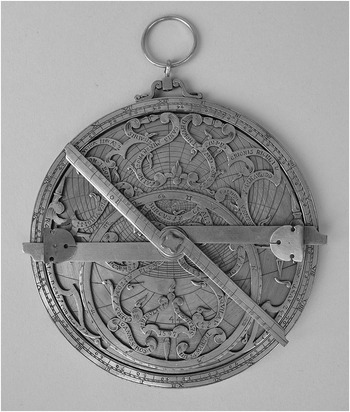
This instrument, noted Price, was listed as item 33a in the 1924 auction catalogue Collection Ant. W. M. Mensing, sold by Frederik Muller & Co. But note the very specific date it carries: 24 March 1597. In addition to the 1924 astrolabe and the Whipple astrolabe – which may or may not be the same – Price was able to identify two more Bos astrolabes with the very same date. Hence there were three or possibly four astrolabes made by Joannes Bos on the very same day (the uncertainty over the total number stemmed from the fact that Price couldn’t be sure whether the astrolabe pictured in the catalogue was one of the ones he had identified).Footnote 23 This was the first clue, and from here on Price was hot on the trail (Figure 9.2):
We started with a very few suspect instruments, found where these had been purchased, and investigated instruments which had been bought from the same source at the same time. We then sought the cooperation of the dealers concerned and traced the collections back, all the time discovering that associated instruments fell into the same category of Strozzi–Mensing copies.Footnote 24
There is no reason to doubt Price’s account – but it is not complete. In addition to tracing provenances, from the very beginning Price’s method was comparative: while for Whipple, purchasing the astrolabe from a Paris-based dealer in 1928,Footnote 25 the existence of other copies could not possibly have been known, by the middle of the century Price was able to consult listings of instruments in numerous institutional collections. Indeed, one of his main preoccupations in this period was the compilation of a large ‘International Checklist of Astrolabes’, which was eventually published in two parts in 1955.Footnote 26

Figure 9.2 Letter from Henry Nyburg to Derek Price, 16 February 1955, answering questions about the origins of certain instruments. This shows Price’s method: from initial suspicions he worked back via provenance to find other instruments that could be examined. Antique Art Galleries sold over eighty instruments to Whipple, between the mid 1920s and the early 1950s. Amongst these about twenty are suspicious, are composites or heavy restorations, or are known forgeries (see Jardine, Nall and Hyslop, ‘More Than Mensing?’).
When Hall and Price began their work on the Whipple collection, they were faced with a worrisome lack of scholarship on scientific instruments. For Whipple himself, of course, the problem had been quite different: he had no more scholarly expertise in the history of scientific instruments, but he did have a large network of fellow collectors, dealers, and intermediaries to call on. In addition, his concept of the history of instrumentation was less burdened by scholarly niceties than Hall’s and Price’s would be, though that is not to say that it lacked intellectual motivation. For Whipple there were a number of factors that dictated his collecting habits.Footnote 27 First, there was enthusiasm. Whipple’s collection began, as he tells it, with an eighteenth-century telescope; this set a pattern for collecting optical instruments, mainly microscopes, telescopes, and spectacles.Footnote 28 Second, there was the market. By far the most common early instruments to come up for sale were sundials; these had been in circulation as antiques longer than any other kind of scientific instrument, and there were well-established private collections on which Whipple could model his own. Third, there was cost. Whipple was wealthy, but by no means a top-tier collector, as is shown by the prices he paid for instruments from dealers who also sold to more wealthy clients.Footnote 29 Fourth, there was aesthetics. Whipple, as Hall put it, ‘had mainly chosen pieces that could be placed in cabinets in his home’ (Figure 9.3).Footnote 30 He was, in short, a connoisseur, with just as much interest in the visual appeal of an instrument as in its historical significance. Fifth and finally, there was Whipple’s historicist agenda, in which instruments were to serve as examples – arranged in evolutionary sequence – of the progress of manufacture, leading in the end to a modern instrument firm like Cambridge Scientific Instruments, of which he was Chairman.Footnote 31

To Whipple, an instrument was interesting insofar as it satisfied his demands in each of these areas. The fourth and fifth, aesthetics and historicism, are of particular relevance to the question of forgery, and also the much broader question of authenticity as it affects questions of display. We have no evidence of whether Whipple was able to detect forgeries, although the low prices he paid for some of the more obvious imitation instruments in the collection strongly suggest that he was aware of (while still being interested in) such instruments. Yet, akin to the completism of stamp collecting, the compilation of an evolutionary series requires that gaps be filled, and the need for attractive instruments that can be displayed in drawing-room cabinets places demands on the aesthetic appearance of an instrument that would not be imposed by the scholarly historian. In meeting these demands without necessarily knowing the full provenance or authenticity of objects Whipple was by no means alone, as the collections of, for instance, Henry Wellcome and Lt-General Augustus Pitt Rivers attest.Footnote 32
Just as the criteria for a collection like Whipple’s made space for forgery, so the inability to cross-reference collections made detecting forgery all but impossible. While instruments were largely in private hands, knowledge of their scarcity and distribution was unobtainable. Price could confidently assert that Joannes Bos was the maker of only one authentic instrument – the astrolabe shown in the Mensing catalogue,Footnote 33 but for Whipple such an assertion would be meaningless: for him the astrolabe was a beautiful object, showing the development of astronomical instrumentation on the Continent in the sixteenth century.Footnote 34 Whipple’s choices were based on his historicism and on aesthetic critera, and were dictated by the market and his wallet.
Price, meanwhile, without even necessarily studying the object,Footnote 35 could draw on a wholly different set of resources and was working with a different set of assumptions. Gone were aesthetics, finance, and historicism in the earlier evolutionary mould, and in their place came card catalogues, an international network of scholars and curators, and an interest in the instrument-making trade as an end of historical research in itself. Although Price was no less progressivist in his attitude than Whipple, his method was to amass data first and make inferences about the nature of craftsmanship and handing-on of techniques on this basis. As Price put it in his 1956 paper on fakes, the instruments with which he was dealing were ‘of such exceptional workmanship that they could not be detected as spurious except by comparison with the rest of the series’.Footnote 36 This, moreover, was also Price’s general historical method, as he explained in the introductory notes to the ‘International Checklist of Astrolabes’, where he states that ‘the full significance of any one instrument cannot properly be realised except by comparison with the corpus of all such instruments extant’.Footnote 37 The ‘Checklist’ boasts a huge volume of data – some 700 instruments in around 200 collections. At the end of the ‘Checklist’ a graph reveals the chronology of astrolabe production in the East and West, with peaks around 1700 and 1600, respectively. Historical conclusions were to be drawn from aggregating information about instruments in collections around the world, and individual instruments acquired meaning only through this process. In the case of Bos this was a particularly pertinent point, as there existed no biographical information beyond the instruments, and no Bos instruments beyond the group of identical astrolabes Price identified. As Price put it, Joannes Bos ‘becomes incomprehensible as an historic person’ unless the fakes are identified and discounted from the record.Footnote 38
It was this groundwork on which Price based his short 1956 paper on fake scientific instruments. Gone was the connoisseurship of a collector journeying to an antique shop or sale-room, gone too the visual arrangement of instruments in a private display case. Although some of Whipple’s collection was, by the early 1950s, on display in the new Museum, much of it remained in packing cases, a situation both typical and unavoidable in museums then and since. Yet in spite of its relative invisibility, through Price’s tireless data-gathering the collection took on a new legibility, even as the instruments themselves were transformed from personally appraised objects to lines in a printed table. It was precisely this move that permitted Price to make his claim that there existed numerous forgeries, not only in the Whipple, but in collections by then already dispersed around the world.
Post-war Internationalism and the Changing Nature of Collections
Collections arranged in a developmental series created gaps – gaps that could be filled by unscrupulous dealers and eager collectors. And where anomalies arose, the collector’s imperative – to have something no one else did – could play its part. Collections systematically catalogued, on the other hand, created anomalies – objects that didn’t fit and suddenly looked suspicious. Price’s ‘big data’ approach to the history of science was not favourable to highly anomalous instruments – for him, comparison was key. The exception that proves this rule was, of course, the Antikythera mechanism, on which Price spent a large portion of his career, and about which he crafted elaborate arguments.Footnote 39 For historians of instruments and technology of Price’s generation, the progressivist model of the development of instruments still held, but the pressure it placed on outliers was all the greater because of the new historiographic (rather than dilettante) criteria. The attitude of ‘filling the gaps’ was replaced by attempts to amass data, sort out anomalies, and place historical arguments on a sure footing.
But this was not merely the historical pursuit of an enthusiast: in fact Price was participating in a range of post-Second World War developments that affected a number of fields. One way to illustrate this is to consider the ideology of Price’s method. Statistical techniques could be used, he argued, to shed light on technical aspects of history, such as the development of the astrolabe, and could be applied to the growth of science itself. This involved the development of what Price called ‘scientometrics’ – the ‘scientific’ use of statistics to represent and assess the development of scientific training, publishing, and institutional support.Footnote 40 This had historiographic and technocratic implications: scientometrics used the analysis of large numbers of papers and citation indices to establish the ways in which scientific networks developed, thus downplaying the role of individual papers and scientists. For Price, ‘great men’ were outliers – far less significant than the scientific structures that supported them. This had political implications, and implications for the role of sociologists in crafting policy. It is clear from Price’s increasingly active contribution to science policy in the late 1960s and 1970s that he saw his role as both analytic and normative.Footnote 41 For example, only careful management, he contended, would overcome the tendency to overproduction in the sciences – itself a result of the rapid transformation of scientific education after the Second World War.
Price’s work on instruments, then, was not merely an intriguing side-line, but a central part of an ambitious project that applied large quantities of data to historical problems. Instruments were the materials of history in a strong sense, because science was a matter of experimental tinkering, invention, and craft know-how. For instruments as well as people, large numbers showed smooth trends and steady development that could be shifted by government policy. Nor were these concerns limited to historiography and the politics of science. If we look elsewhere in the sciences in this period we can see a similar pattern, of large quantities of data, the interpenetration of different disciplines and experimental techniques, and the commitment to modernist technocracy and internationalism.
As mentioned at the outset, Price gave a direct comparison for his uncovering of fake antique scientific instruments: the Piltdown forgery. This was no mere passing allusion. As Price knew, the Piltdown story very closely mirrored that of fake instruments, both in the specifics of the argument and in its political context. The so-called ‘Piltdown skull’ in fact consists of only a few fragments of bone, discovered in the years prior to 1912 by the amateur archaeologist and antiquarian Charles Dawson, in Pleistocene gravel beds in Sussex. Dawson’s collaborator Arthur Smith Woodward christened it Eoanthropus: ‘The Dawn Man’, and to many it came to be known as the ‘missing link’ between humans and their primate ancestors.Footnote 42 Initial doubts about the legitimacy of the skull never quite disappeared, however, and in the mid 1950s it was conclusively shown to be a composite, though the identity of the forger has never been absolutely settled.Footnote 43 In one sense, the story is quite straightforward: a controversial scientific breakthrough came to be increasingly doubted and was eventually discredited. Of greater relevance for Price and fake instruments is the complex way in which the visibility of the skull was bound up with its authenticity: at first an internationally important find was made into a piece of scientific theatre – in the end it was undone by someone who boasted that he hadn’t even needed to see it in person.
Owing to the fragmentary nature of the skull, the very first Piltdown controversy hinged on its correct reconstruction. At the first presentation of the remains, anatomist-anthropologists Grafton Elliot Smith and Arthur Keith began a short-lived but fierce confrontation over the cranial capacity of the reconstructed skull, with Keith’s estimate giving a larger and therefore more human brain-case than Elliot Smith’s.Footnote 44 Keith’s finding, and his estimate of an age of about 500,000 years, were the reasons the skull was considered so important.Footnote 45
Just as remarkable as the Piltdown skull’s antiquity, however, was the method by which the scientific community was convinced of the fact. So confident was Keith in his ability to reconstruct a skull – any skull – from the merest fragments, he performed a demonstration to the Royal Anthropological Institute in 1914. Keith had two colleagues select a modern skull, prepare a cast and isolate fragments of similar scale to those of the Piltdown specimen. Keith’s reconstruction, done in complete ignorance of the nature of the skull from which these new fragments came, was then unveiled alongside the cast of the original skull.Footnote 46 Showmanship and the anatomist’s expert way of knowing established the authenticity of the artefact: the nature of Piltdown Man was demonstrated primarily by close examination of, and direct working with, the fragments themselves (Figure 9.4).

Figure 9.4 The examination of the Piltdown skull, by John Cooke, 1915. Arthur Keith, whose interpretative reconstruction of the skull carried the day, is seated and wearing a white coat. Note the portrait of Charles Darwin hanging behind the gathered scientists, conferring not just authority but also an evolutionary justification for the existence of ‘Piltdown Man’.
In stark contrast, the revelation of forgery some forty years later was not a continuation of close visual analysis. Rather it was the product of distant appraisal. J. S. Weiner, the physical anthropologist at the University of Oxford who is credited with exposing the Piltdown forgery, first became interested in the topic after attending a talk by the palaeontologist Kenneth Oakley, at which Oakley announced that fluorine-absorption tests had shown a possible discrepancy between the Piltdown mandible and skull cap.Footnote 47 Weiner was less impressed by the discrepancy (fluorine tests having a large margin of error) than by Oakley’s relatively recent date for all of the fragments. Since 1912 many more early hominids had been discovered and the Piltdown skull was looking increasingly – and concerningly – like an outlier.Footnote 48 As the high status of the Piltdown skull had caused Oakley’s fluorine tests to be called into question, the immediate issue was whether another means of accurately dating the specimen could be found. Weiner’s first idea was that X-ray crystallography might reveal differences in fossil bones from different geological eras, but this did not prove immediately feasible. His next approach was to study the published images of the Piltdown teeth, which remained the strongest evidence that the skull combined ape and human features – the very fact that had become especially incongruous in the light of Oakley’s tests. Weiner found that he was able to fabricate similar teeth artificially by filing and staining ape teeth, and from here it was only a short leap to calling the authenticity of Piltdown into question, a move that negated the need for accurate dating. But note that, even as Weiner was attempting to convince others that the Piltdown skull was a fake, he had not yet examined the skull in person. As Wiener’s research assistant put it later, only after revealing the forgery did Wiener ‘need access to the original fossils, which [he] had never seen’.Footnote 49 It was only once Weiner had convinced himself and others that there was a high likelihood of forgery that he considered it necessary to look at the fragments themselves. While the original validity of Keith’s interpretation of the skull was bound up with the performance of his own expertise in reconstruction, the ultimate unmasking of the Piltdown forgery was based on Weiner’s distance from the artefact itself.
In addition to this move – from visibility to legibility – there are two other features of the Piltdown story that are common to most exposés: changes in the techniques used to analyse the suspicious artefact, and close links between the unmasking and an attempted disciplinary reform. In this case, in addition to Wiener’s replication of the teeth, the new techniques were the fluorine test and X-ray crystallography (which was eventually used by Wiener, who published the results in his 1955 book on the Piltdown forgery); the discipline was the ‘New Physical Anthropology’ – whose main advocate in Britain was J. S. Weiner, and which emphasised large-scale survey work, international collaboration, and the study of populations over individual specimens.Footnote 50
Over the course of the first half of the twentieth century the Piltdown skull went from being an object appraised in its own right, in particular by Keith, to being just one part – and a highly anomalous one at that – of an international catalogue of early human remains. Keith had only a handful of remains to refer to and to fit within his theory of human evolution; Weiner, with more material to examine in collections around the world, was primarily concerned with establishing the exact ages of the specimens themselves, in order to provide a solid foundation for a reformed physical anthropology. It is this move, from consideration of the particular artefact to its relocation in a catalogued collection, that provides a direct parallel to Price’s work. This is as much about disciplinary reform as it is about the nature of collections as they move between private display and museum accession. Forgery is typically seen as an accusation levelled by connoisseurs, able to determine authenticity by the ‘eyeball test’ – but sometimes the pattern is reversed, and it is not proximity but distance that enables detective work.
Conclusion
In his classic essay ‘Clues’, Carlo Ginzburg suggests that in the years around 1900 a ‘semiotic paradigm’ took hold of a range of disciplines: psychoanalysis (via Freud), art history (via Giovanni Morelli), and criminal detection (via Conan Doyle). The last of these shows that the search for clues stretched into the realm of human imagination. But Ginzburg also found concrete links between his protagonists: this was the microhistory technique applied to an ambitious thesis about the relationship between parts and wholes, seeing and knowing, deception and truth. My intention has been to provide a ‘version 2.0’ for Ginzburg’s argument, by documenting changes brought about by large quantities of data in the middle of the twentieth century.
In this chapter I have argued that the question of forgery eventually became a question of data: where earlier detection had rested on close appreciation of individual objects, by the middle of the twentieth century large collections of instruments could be compared internationally and appraised en masse. As antique instruments moved from the collector’s cabinet to the museum catalogue, they entered into new kinds of relationships with each other, with systems of classification and recording, and with historians and curators. In the 1950s the first international databases of scientific instruments were being put together, in the context of UNESCO’s scheme for systematic international cultural cooperation. In these conditions and precisely as a result of the new kinds of data being generated, the question of forgery became acute. The Whipple Museum in its early years was host to the discovery of fake antique scientific instruments, and therefore played a special role in the history of instrument studies.
The irony of this situation is that earlier in the century instruments were subject to the classic scrutiny of the connoisseur: precisely the conditions in which the detection of forgery is traditionally thought to occur, as it had done in the art world for centuries. In those earlier circumstances, instruments were highly (if selectively) visible – but they were not legible. Later, in the age of the card catalogue and the international survey, instruments achieved a legibility that made unusual individual instruments into anomalies that had to be dealt with using special techniques: metallurgical analysis, examination with precision tools of measurement, and complex historical reconstruction. The general trend was towards a history of the diffusion and role of craft techniques and expert manufacture tending towards standardisation: outliers could be significant, but they were also more suspicious, didn’t necessarily add to the historical narrative, and might be fake. Ideas of the public record and the public interest were invoked in an age very different from that of the private drawing-room museum.
Forgeries, as many others have pointed out, are peculiarly revealing sources for the history of scholarship, the history of aesthetics, and the history of commerce.Footnote 51 One reason for this is obvious, though not often stated: forgers can respond to the market in a much more systematic and coherent way than the historical record itself. In extreme cases, scholars themselves have fabricated their material: here the historical record appears to become identical with scholarly interest, at least until the deception is uncovered. Possibilities and failures of detection can also provide clues to the ways in which attitudes towards authenticity, connoisseurship, commodification, and tradition have shifted. In cases when apparently obvious forgery goes undetected or objects are mistakenly attributed, we get a glimpse of how recent and selective our positivist mentality really is.Footnote 52 Authenticity and its opposite are not conditions of objects out there waiting to be discovered: they are processes involving networks of objects, scholars, publics, spaces, and techniques, and as such they are subject to the forces of historical change. As we move into an age of greater reflexivity within museums concerning all aspects of provenance, curatorial voice, participation, and representation, the question of authenticity can be raised again – not as a means to get the historical record straight, but as a means of understanding the relationship between the kinds of structures that have governed ownership and interpretation of objects and the conclusions that are drawn from and about them.


 Open access
.jpg)