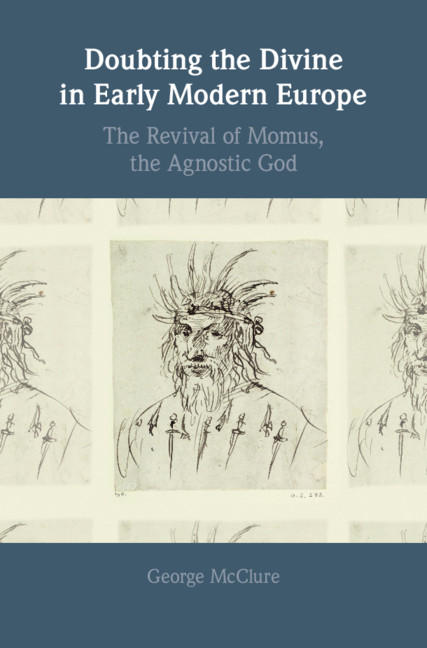

In this book, George McClure examines the intellectual tradition of challenges to religious and literary authority in the early modern era. He explores the hidden history of unbelief through the lens of Momus, the Greek god of criticism and mockery. Surveying his revival in Italy, France, Spain, Germany, the Netherlands, and England, McClure shows how Momus became a code for religious doubt in an age when such writings remained dangerous for authors. Momus ('Blame') emerged as a persistent and subversive critic of divine governance and, at times, divinity itself. As an emblem or as an epithet for agnosticism or atheism, he was invoked by writers such as Leon Battista Alberti, Anton Francesco Doni, Giordano Bruno, Luther, and possibly, in veiled form, by Milton in his depiction of Lucifer. The critic of gods also acted, in sometimes related fashion, as a critic of texts, leading the army of Moderns in Swift's Battle of the Books, and offering a heretical archetype for the literary critic.
‘This study is most valuable in its masterful interpretations of ancient and early modern texts, and it concludes by showing how Momus 'became a useful trope in the emergence of a self-conscious art of literary criticism'. McClure skillfully captures the subtleties of complex works and draws engaging connections between diverse authors.’
Anton M. Matytsin Source: Renaissance Quarterly
Loading metrics...
* Views captured on Cambridge Core between #date#. This data will be updated every 24 hours.
Usage data cannot currently be displayed.
This section outlines the accessibility features of this content - including support for screen readers, full keyboard navigation and high-contrast display options. This may not be relevant for you.
Accessibility compliance for the HTML of this book is currently unknown and may be updated in the future.
