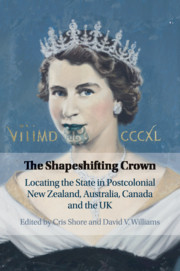
 The Shapeshifting Crown
 Locating the State in Postcolonial New Zealand, Australia, Canada and the UK
Book contents
- The Shapeshifting Crown
- The Shapeshifting Crown
- Copyright page
- Contents
- Figures
- Acknowledgements
- Table of Statutes and Cases
- 1 Introduction
- Part I The Nature and Development of the Crown
- Part II The Crown as an Embodied Entity
- Part III The Crown and Constitutional Reform
- 8 The Republican Move
- 9 Constitutional Reform and the Politics of Public Engagement
- 10 Crown Prerogative
- 11 The Queen Is Dead! Long Live the King?
- 12 Conclusion
- Index
- References
9 - Constitutional Reform and the Politics of Public Engagement
from Part III - The Crown and Constitutional Reform
Published online by Cambridge University Press: 13 January 2019

Book contents
- The Shapeshifting Crown
- The Shapeshifting Crown
- Copyright page
- Contents
- Figures
- Acknowledgements
- Table of Statutes and Cases
- 1 Introduction
- Part I The Nature and Development of the Crown
- Part II The Crown as an Embodied Entity
- Part III The Crown and Constitutional Reform
- 8 The Republican Move
- 9 Constitutional Reform and the Politics of Public Engagement
- 10 Crown Prerogative
- 11 The Queen Is Dead! Long Live the King?
- 12 Conclusion
- Index
- References
Summary
Advocates of constitutional reform often argue that a key obstacle to political change is lack of public understanding about constitutional order and the absence of conditions necessary for promoting measured, dispassionate and rational reflection on existing constitutional arrangements, or what political theorists term ‘deliberative democracy’. These problems are even more pronounced in political systems based on the Westminster model of constitutional monarchy, where neither the constitution nor the Crown are concepts easy to grasp. In this chapter we critique the simplistic and rationalistic assumptions behind arguments for deliberative democracy. As we show, what constitutes public engagement in matters of constitutional importance is sometimes a matter of debate and often turns out, on closer analysis, to be more theatrical and performative than deliberative. In making our argument, we draw on examples from New Zealand, a country that has had three major constitutional deliberations since 2005, including an unsuccessful referendum on whether to change its national flag. These examples illustrate wider problems of how to engage the public in meaningful constitutional debates when the constitution itself is so opaque.
Information
- Type
- Chapter
- Information
- The Shapeshifting CrownLocating the State in Postcolonial New Zealand, Australia, Canada and the UK, pp. 184 - 202Publisher: Cambridge University PressPrint publication year: 2019
References
Abélès, Marc. 1988. ‘Modern Political Ritual: Ethnography of an Inauguration and a Pilgrimage by President Mitterrand.’ Current Anthropology 29(3): 391–404.CrossRefGoogle Scholar
Austin, J. L. 1962. How to Do Things with Words: The William James Lectures Delivered in Harvard University in 1955. Edited by Urmson, J. O.. Oxford: Clarendon Press.Google Scholar
BBC News. 2014. ‘New Zealand to Hold Referendum on National Flag.’ 11 March. Accessed 16 May 2016 at www.bbc.co.uk/news/world-asia-26524132.Google Scholar
Bohman, James. 1998. ‘Survey Article: The Coming of Age of Deliberative Democracy.’ Journal of Political Philosophy 6(4): 400–25.Google Scholar
Butler, Judith. 1997. Excitable Speech: A Politics of the Performative. New York and London: Routledge.Google Scholar
CAP (Constitutional Advisory Panel). 2013. New Zealand’s Constitution: A Report on a Conversation. Wellington: New Zealand Government.Google Scholar
CAP (Constitutional Advisory Panel). N.d. ‘Our Role – Tō mātau kaupapa.’ Website. Accessed 11 May 2018 at ndhadeliver.natlib.govt.nz/ArcAggregator/arcView/frameView/IE28514444/http://www.ourconstitution.org.nz/.Google Scholar
Chappell, Zsuzsanna. 2012. The Palgrave Macmillan Deliberative Democracy: A Critical Introduction. London: Palgrave Macmillan.CrossRefGoogle Scholar
Cox, Noel. 2008. A Constitutional History of the New Zealand Monarchy: The Evolution of the New Zealand Monarchy and the Recognition of an Autochthonous Polity. Saarbrücken, Germany: VDM Verlag Dr. Müller.Google Scholar
Dryzek, John S. 2000. Deliberative Democracy and Beyond: Liberals, Critics, Contestations. Oxford: Oxford University Press.Google Scholar
Dryzek, John S. 2007. ‘Theory, Evidence, and the Tasks of Deliberation.’ In Deliberation, Participation and Democracy: Can the People Govern?, edited by Rosenberg, Shawn W., 237–50. Basingstoke and New York: Palgrave Macmillan.Google Scholar
Dryzek, John S. 2012. Foundations and Frontiers of Deliberative Governance. Oxford: Oxford University Press.Google Scholar
English, Bill and Sharples, Pita. 2010. ‘Consideration of Constitutional Issues.’ Office of the Deputy Prime Minister and Office of the Minister of Māori Affairs. Wellington. Accessed 16 January 2017 at www.beehive.govt.nz/sites/default/files/CR_Cab_paper_8.12.10.pdf.Google Scholar
Ercan, Selen A. and Dryzek, John S.. 2015. ‘The Reach of Deliberative Democracy.’ Policy Studies 36(3): 241–48.Google Scholar
Garner, Duncan. 2015. ‘Opinion: Flag This Irrelevant Debate and Spend $26m on Hungry Kids.’ The Dominion Post. 9 May. Accessed 10 May 2018 at www.stuff.co.nz/dominion-post/comment/columnists/68392405/duncan-garner-flag-this-irrelevant-debate-and-spend-26m-on-hungry-kids.Google Scholar
Goffman, Erving. 1969. The Presentation of the Self in Everyday Life. London: Allen Lane.Google Scholar
De Greiff, P. 2000. ‘Deliberative Democracy and Group Representation.’ Social Theory and Practice 26(3): 397–415.Google Scholar
Gutmann, Amy and Thompson, Dennis. 2004. Why Deliberative Democracy? Princeton, NJ: Princeton University Press.CrossRefGoogle Scholar
Habermas, Jürgen. 1984. The Theory of Communicative Action, Vol. 1: Reason and the Rationalization of Society. Translated by McCarthy, Thomas. Boston: Beacon Press.Google Scholar
Habermas, Jürgen. 1992. ‘Citizenship and National Identity: Some Reflections on the Future of Europe.’ Praxis International 12(1): 1–19.Google Scholar
Hargreaves, Lynley. 2015. ‘Is Our Flag a Brand?’ Science Media Centre Sciblogs. Blog post, 29 June. Accessed 16 May 2016 at sciblogs.co.nz/infrequently-asked-questions/2015/06/29/is-our-flag-a-brand/.Google Scholar
Joseph, Philip A. 2008. ‘The Māori Seats in Parliament. Te Oranga o te Iwi Māori: A Study of Māori Economic and Social Progress.’ Working Paper 2. Wellington: New Zealand Business Roundtable. Available at www.nzcpr.com/wp-content/uploads/2014/08/TheMaoriSeatsInParliament.pdf.Google Scholar
Kelsey, Jane. 2015. ‘The TPPA: Treaty Making, Parliamentary Democracy, Regulatory Sovereignty and the Rule of Law.’ Trans-Pacific Partnership Agreement: New Zealand Expert Paper Series, No. 1. Accessed 19 May 2018 at tpplegal.files.wordpress.com/2015/12/tpp-treaty-process.pdf.Google Scholar
Kertzer, David I. 1988. Ritual, Politics & Power. New Haven, CT: Yale University Press.Google Scholar
Key, John. 2012. ‘Merry Christmas!’ YouTube video. Published 20 December 2002 by user ‘NZNats’. Accessed 25 January 2012 at www.youtube.com/watch?v=x48TNjVbSHk.Google Scholar
Key, John. 2013. ‘Prime Minister’s Statement to Parliament.’ January 29. Accessed 23 February 2013 at www.parliament.nz/en/pb/papers-presented/current-papers/document/50DBHOH_PAP24173_1/statement-to-parliament-rt-hon-john-key-prime-minister.Google Scholar
Kong, Hoi and Levy, Ron. 2017. ‘Deliberative Constitutionalism.’ In Oxford Handbook of Deliberative Democracy, edited by Bächtiger, André, Dryzek, John, Mansbridge, Jane and Warren, Mark, 625–39, Oxford: Oxford University Press.Google Scholar
LeDuc, Lawrence. 2015. ‘Referendums and Deliberative Democracy.’ Electoral Studies 38 (2015): 139–48.Google Scholar
Leicester, Graham. 1996. ‘A Pragmatic Approach to the Construction of Europe.’ In Europe: A Time for Pragmatism, edited by de Miñón, Miguel Herrero and Leicester, Graham, 6–19. London: European Policy Forum.Google Scholar
Levy, Ron. 2013. ‘The Law of Deliberative Democracy: Seeding the Field.’ Election Law Journal 12(4): 355–71.Google Scholar
Markell, Patchen. 2000. ‘Making Affect Safe for Democracy? On “Constitutional Patriotism”.’ Political Theory 28(1): 38–63.Google Scholar
Mitchell, Timothy. 1999. ‘Society, Economy, and the State Effect.’ In State/Culture: State-Formation after the Cultural Turn, edited by Steinmetz, George, 76–97. Ithaca, NY: Cornell University Press.Google Scholar
National Party and Māori Party. 2008. ‘Relationship and Confidence and Supply Agreement between the National Party and the Māori Party.’ Accessed 19 May 2018 at img.scoop.co.nz/media/pdfs/0811/NationalMaori_Party_agreement.pdf.Google Scholar
Scoop News. 2010. ‘Sharples and English Announce Constitutional Review.’ Scoop News Audio. 8 December. Accessed 19 May 2018 at www.scoop.co.nz/stories/HL1012/S00066/audio-sharples-and-english-announce-constitutional-review.htm.Google Scholar
Sedley, Stephen. 2011. Ashes and Sparks: Essays on Law and Justice. Cambridge: Cambridge University Press.Google Scholar
Shore, Cris. 2000. Building Europe: The Cultural Politics of European Integration. London: Routledge.Google Scholar
Taonui, Rawiri. 2012. ‘Ngā māngai – Māori representation: Controversy over Māori Seats.’ Te Ara: The Encyclopedia of New Zealand. Published 20 June 2012; reviewed and revised 15 July 2016. Wellington: Manatū Taonga Ministry for Culture and Heritage. Accessed 19 May 2018 at www.TeAra.govt.nz/en/interactive/33915/john-key-on-the-maori-seats-2008.Google Scholar
Trouillot, Michel-Rolph. 2001. ‘The Anthropology of the State in the Age of Globalization: Close Encounters of the Deceptive Kind.’ Current Anthropology 42(1): 125–38.Google Scholar
Turner, Victor. 1967. The Forest of Symbols: Aspects of Ndembu Ritual. Ithaca, NY: Cornell University Press.Google Scholar
Werhan, Keith. 2012. ‘Popular Constitutionalism, Ancient and Modern.’ UC Davis Law Review 46(1): 65–131.Google Scholar
Accessibility standard: Unknown
Why this information is here
This section outlines the accessibility features of this content - including support for screen readers, full keyboard navigation and high-contrast display options. This may not be relevant for you.Accessibility Information
Accessibility compliance for the HTML of this chapter is currently unknown
and may be updated in the future.