Book contents
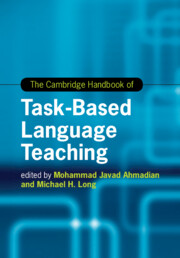
- The Cambridge Handbook of Task-Based Language Teaching
- Cambridge Handbooks In Language And Linguistics
- The Cambridge Handbook of Task-Based Language Teaching
- Copyright page
- Dedication
- Contents
- Figures
- Tables
- Contributors
- Preface The Origins and Growth of Task-Based Language Teaching
- Part I The Rationale for Task-Based Language Teaching
- Part II Tasks and Needs Analysis
- 3 Why Task? Task as a Unit of Analysis for Language Education
- 4 Adapting and Advancing Task-Based Needs Analysis Methodology across Diverse Language Learning Contexts
- 4A Developing a Task-Based Approach
- 4B A Task-Based Language Needs Analysis of Syrian Refugee Parents in Turkey
- 4C Task-Based Language Teaching in a Japanese University
- 4D The Implementation of a Task-Based Spanish-Language Program in Qingdao, China
- 5 The L in TBLT
- 5A Blustery with an Occasional Downpour
- 5B “I Have a Question”
- Part III The Task Syllabus and Materials
- Part IV Methodology and Pedagogy
- Part V Task-Based Language Teaching with School-Age Children
- Part VI The Teacher in Task-Based Language Teaching
- Part VII Task-Based Assessment and Program Evaluation
- Part VIII Research Needs and Future Prospects
- Index
- References
4D - The Implementation of a Task-Based Spanish-Language Program in Qingdao, China
A Case Study
from Part II - Tasks and Needs Analysis
Published online by Cambridge University Press: 19 November 2021

Book contents
- The Cambridge Handbook of Task-Based Language Teaching
- Cambridge Handbooks In Language And Linguistics
- The Cambridge Handbook of Task-Based Language Teaching
- Copyright page
- Dedication
- Contents
- Figures
- Tables
- Contributors
- Preface The Origins and Growth of Task-Based Language Teaching
- Part I The Rationale for Task-Based Language Teaching
- Part II Tasks and Needs Analysis
- 3 Why Task? Task as a Unit of Analysis for Language Education
- 4 Adapting and Advancing Task-Based Needs Analysis Methodology across Diverse Language Learning Contexts
- 4A Developing a Task-Based Approach
- 4B A Task-Based Language Needs Analysis of Syrian Refugee Parents in Turkey
- 4C Task-Based Language Teaching in a Japanese University
- 4D The Implementation of a Task-Based Spanish-Language Program in Qingdao, China
- 5 The L in TBLT
- 5A Blustery with an Occasional Downpour
- 5B “I Have a Question”
- Part III The Task Syllabus and Materials
- Part IV Methodology and Pedagogy
- Part V Task-Based Language Teaching with School-Age Children
- Part VI The Teacher in Task-Based Language Teaching
- Part VII Task-Based Assessment and Program Evaluation
- Part VIII Research Needs and Future Prospects
- Index
- References
Summary
While a significant amount of literature has been published on the theoretical and empirical basis of task-based language teaching (TBLT) as an educational framework for teaching second and foreign languages, few studies have described entire task-based programs. This chapter reports on a case study in which we describe the inception, design, implementation and evaluation of a task-based, Spanish foreign language program at Qingdao University in China. The program is the result of an international partnership between an American university and a Chinese university, whereby Chinese students receive a dual degree in Spanish as a foreign language. A detailed needs analysis was conducted and informed the design of the program, which includes the application process, tasks, and several community-based initiatives. We also report on how we do teacher-training and professional development collaboration, our challenges, and how we have worked to overcome those challenges. All in all, teacher and student satisfaction, student job placement, and community engagement indicate that the program is meeting students’ real-world needs for Spanish and is serving the Qingdao community. We conclude by discussing implications for implementing a fully task-based program in China, the nation’s first university-level TBLT program for Spanish foreign language learning and teaching.
Information
- Type
- Chapter
- Information
- The Cambridge Handbook of Task-Based Language Teaching , pp. 135 - 150Publisher: Cambridge University PressPrint publication year: 2021
References
Further reading
Baralt, M. and López-Bravo, M. (2016). Teaching Chinese as a foreign language: A classroom study on the timing of grammar around a task. Chinese as a Second Language Research, 5, 27–61.Google Scholar
East, M. (2012). Task-based learning from the teachers’ perspective. Amsterdam: John Benjamins.CrossRefGoogle Scholar
McDonough, K. and Chaitmongkol, W. (2007). Teachers’ and learners’ reactions to a task-based EFL course in Thailand. TESOL Quarterly, 41(1), 107–32.CrossRefGoogle Scholar
Orton, J. (2011). Educating Chinese language teachers: Some fundamentals. In Tsung, L. and Cruickshank, K., eds. Teaching and learning Chinese in global contexts. London: Continuum, 151–64.Google Scholar
Zheng, X. and Borg, S. (2014). Task-based learning and teaching in China: Secondary school teachers’ beliefs and practices. Language Teaching Research, 18, 205–21.Google Scholar
Zhang, E. Y. (2007). TBLT-innovation in primary school English language teaching in mainland China. In Van den Branden, K., Van Gorp, K., and Verhelst, M., eds. Tasks in action: Education from a classroom-based perspective. Newcastle: Cambridge University Press, pp. 68–91.Google Scholar
References
Baralt, M. (2018). Becoming a task-based teacher educator. TBLT as a researched pedagogy. Samuda, V. Van den Branden, K., and Bygate, M., eds. TBLT as a Researched Pedagogy. Abingdon: Routledge.Google Scholar
Baralt, M., Gilabert, R., and Robinson, P. (2014). Task sequencing and instructed second language learning. London: Bloomsbury.Google Scholar
Baralt, M. and López-Bravo, M. (2016). Teaching Chinese as a foreign language: A classroom study on the timing of grammar around a task. Chinese as a Second Language Research, 5, 27–61.CrossRefGoogle Scholar
Bygate, M., Samuda, V., and Van den Branden, K., (2018), eds. Task-based Language Teaching as a researched pedagogy. Amsterdam: John Benjamins.Google Scholar
Carless, D. (2004). Issues in teachers’ reinterpretation of a task-based innovation in primary schools. TESOL Quarterly, 38(4), 639–62.CrossRefGoogle Scholar
East, M. (2012). Task-based learning from the teachers’ perspective. Amsterdam: John Benjamins.CrossRefGoogle Scholar
Ellis, R. (2003). Task-based language teaching and learning. Oxford: Oxford University Press.Google Scholar
Esteban, M. (2016). Spain’s relations with China: Friends but not partners. Chinese Political Science Review, 1, 373–86.CrossRefGoogle Scholar
González Puy, I. (2012). El español en China. In VV. AA., El español en el mundo. Anuario del Instituto Cervantes, capítulo dos. Madrid: Instituto Cervantes.Google Scholar
Gurzynski-Weiss, L. (2017). Expanding individual difference research in the interaction approach: Investigating learners, instructors, and other interlocutors. Amsterdam: John Benjamins.Google Scholar
Long, M. (2005). Second language needs analysis. Cambridge: Cambridge University Press.Google Scholar
Long, M. (2015). Second language acquisition and task-based language teaching. Malden, MA: Wiley Blackwell.Google Scholar
Markee, N. (2007). Managing curricular innovation. Cambridge: Cambridge University Press.Google Scholar
Mazzaferro, G. (2018). Translanguaging as everyday practice. Cham, Switzerland: Springer.Google Scholar
McDonough, K. and Chaitmongkol, W. (2007). Teachers’ and learners’ reactions to a task-based EFL course in Thailand. TESOL Quarterly, 41(1), 107–32.Google Scholar
Phillips, T. (2018). Study of Portuguese and Spanish explodes as China expands role in Latin America. The Guardian. Retrieved on October 10, 2019 from: https://www.theguardian.com/world/2018/sep/02/study-of-portuguese-and-spanish-explodes-as-china-expands-role-in-latin-americaGoogle Scholar
Phipps, S. and Borg, S. (2009). Exploring tensions between teachers’ grammar teaching beliefs and practices. System, 37, 380–90.CrossRefGoogle Scholar
Sachs, G. T. (2007). The challenges of adopting and adapting task-based cooperative teaching and learning in an EFL context. In Van den Branden, K., Van Gorp, K., and Verhelst, M., eds. Tasks in action: Education from a classroom-based perspective. Newcastle: Cambridge University Press, pp. 235–64.Google Scholar
Samuda, V. (2015). Tasks, design, and the architecture of pedagogical spaces. In Bygate, M., ed. Domains and directions in the development of TBLT: A decade of plenaries from the international conference. Amsterdam: John Benjamins, pp. 271–301.CrossRefGoogle Scholar
Scrimgeour, A. (2010). The yin-yang of Chinese language teaching in Australia: The challenges native speaker trainee teachers face in the Chinese classroom. In Liddicoat, A. J., ed. Languages in Australian education: Problems, prospects and future directions. Newcastle upon Tyne: Cambridge Scholars, pp. 127–44.Google Scholar
Wang, F. (2019). The status of Spanish language teachers in China. Paper presented at Qingdao University, June, 2019.Google Scholar
Willis, D. and Willis, J. (2007). Doing task-based teaching. Oxford: Oxford University Press.Google Scholar
Van den Branden, K. (2006), ed. Task-based language education: From theory to practice. Cambridge: Cambridge University Press.Google Scholar
Van den Branden, K. (2016). The role of teachers in task-based language education. Annual Review of Applied Linguistics, 36, 164–81.Google Scholar
Van den Branden, K., Bygate, M., and Norris, J. (2009), eds, Task-based language teaching: A reader. Amsterdam: John Benjamins.Google Scholar
Zheng, X. and Borg, S. (2014). Task-based learning and teaching in China:Secondary school teachers’ beliefs and practices. Language Teaching Research, 18, 205–21.CrossRefGoogle Scholar
Zhang, E. Y. (2007). TBLT-innovation in primary school English language teaching in mainland China. In Van den Branden, K., Van Gorp, K., and Verhelst, M., eds. Tasks in action: Education from a classroom-based perspective. Newcastle: Cambridge University Press, pp. 68–91.Google Scholar
Zhou, W. and Li, G. (2015). Chinese language teachers’ expectations and perceptions of American students’ behavior: Exploring the nexus of cultural differences and classroom management. System, 49, 17–27.Google Scholar
Accessibility standard: Unknown
Why this information is here
This section outlines the accessibility features of this content - including support for screen readers, full keyboard navigation and high-contrast display options. This may not be relevant for you.Accessibility Information
Accessibility compliance for the HTML of this chapter is currently unknown
and may be updated in the future.