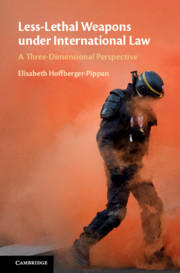
Book contents
- Less-Lethal Weapons under International Law
- Less-Lethal Weapons under International Law
- Copyright page
- Dedication
- Contents
- Foreword
- Acknowledgments
- Table of Cases
- Table of Legal Instruments
- Abbreviations
- Introduction
- 1 Definition and Categorization of Less-Lethal Weapons
- 2 Less-Lethal Weapons and International Law
- 3 Guidelines on Less-Lethal Weapons
- Conclusion
- Bibliography
- Index
Introduction
Published online by Cambridge University Press: 13 August 2021

Book contents
- Less-Lethal Weapons under International Law
- Less-Lethal Weapons under International Law
- Copyright page
- Dedication
- Contents
- Foreword
- Acknowledgments
- Table of Cases
- Table of Legal Instruments
- Abbreviations
- Introduction
- 1 Definition and Categorization of Less-Lethal Weapons
- 2 Less-Lethal Weapons and International Law
- 3 Guidelines on Less-Lethal Weapons
- Conclusion
- Bibliography
- Index
Summary
Hitherto international law has almost exclusively concerned itself with lethal and highly destructive weapons. Rockets, missiles, and bombs are just a few of many other examples of technology leaving behind trails of unfathomable destruction. So far, less-lethal weapons, such as tear gas, rubber bullets, water cannons, and the highly contested Taser have literally slipped under the radar. Indeed, authors have dealt with less-lethal weapons primarily between 2000 and 2009 but the legal discussion has almost entirely grinded to a halt. The frequent occurrence of protests over the past few years reaching from Hong Kong to Paris and Venezuela, which were often defeated with brute violence and the excessive use of inter alia tear gas, has again sparked the discussion of how international law responds to the use of less-lethal weapons. Aware of the fact that more action was needed, the United Nations High Commissioner for Human Rights issued the “Guidance on Less-Lethal Weapons in Law Enforcement”1 in 2019 in order to better address legal aspects of less-lethal weapons in policing scenarios. It is the first UN document solely addressing this category of weapons aiming to fill the regulatory gaps that have existed thus far. This development clearly shows that the international community is anything but ignorant toward the fact that so far legal (human rights) documents have primarily addressed lethal technology.
Information
- Type
- Chapter
- Information
- Less-Lethal Weapons under International LawA Three-Dimensional Perspective, pp. 1 - 5Publisher: Cambridge University PressPrint publication year: 2021
Accessibility standard: Unknown
Why this information is here
This section outlines the accessibility features of this content - including support for screen readers, full keyboard navigation and high-contrast display options. This may not be relevant for you.Accessibility Information
Accessibility compliance for the HTML of this chapter is currently unknown
and may be updated in the future.