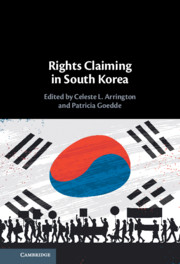
Book contents
- Rights Claiming in South Korea
- Rights Claiming in South Korea
- Copyright page
- Dedication
- Contents
- Contributors
- Acknowledgments
- Abbreviations
- Introduction Rights in Action
- Part I Rights in Historical Perspective
- 1 Legal Disputes, Women’s Legal Voice, and Petitioning Rights in Late Joseon Korea
- 2 Defying Claims of Incompetence
- 3 “Equal” Second-Class Citizens
- Part II Institutional Mechanisms for Rights Claiming
- Part III Mobilizing Rights for the Marginalized
- Part IV Shaping Rights for New Citizens and Noncitizens
- Conclusion Findings and Future Directions
- Index
- References
1 - Legal Disputes, Women’s Legal Voice, and Petitioning Rights in Late Joseon Korea
from Part I - Rights in Historical Perspective
Published online by Cambridge University Press: 17 April 2021
By

Book contents
- Rights Claiming in South Korea
- Rights Claiming in South Korea
- Copyright page
- Dedication
- Contents
- Contributors
- Acknowledgments
- Abbreviations
- Introduction Rights in Action
- Part I Rights in Historical Perspective
- 1 Legal Disputes, Women’s Legal Voice, and Petitioning Rights in Late Joseon Korea
- 2 Defying Claims of Incompetence
- 3 “Equal” Second-Class Citizens
- Part II Institutional Mechanisms for Rights Claiming
- Part III Mobilizing Rights for the Marginalized
- Part IV Shaping Rights for New Citizens and Noncitizens
- Conclusion Findings and Future Directions
- Index
- References
Summary
Based on a neo-Confucian vision that the monarch’s mandate relied on listening to his people’s grievances, the Joseon state (1392–1910) empowered subjects regardless of gender or status to petition the sovereign regarding grievances not rectified in lower courts. While Joseon-era women are usually considered to have been silent subjects outside the home, their petitioning activity shows that women, irrespective of their status, had the same legal rights as men to appeal grievances to the state. This chapter parses women’s linguistic practices in claims-making to show how their petitioning rights complicated gender dynamics of Confucian society. The gender hierarchy was reinforced through women’s narrative strategy as they appropriated discourses of domesticity. At the same time, I posit that women as legal agents were re-gendering legal identity by constructing a sense of personhood via their petitioning. Through gendered claims, women struggled to defend not only themselves and their sense of morality but also their entire family.
Keywords
Information
- Type
- Chapter
- Information
- Rights Claiming in South Korea , pp. 21 - 42Publisher: Cambridge University PressPrint publication year: 2021
References
Primary Sources
Gojong sillok [Veritable records of King Gojong]. http://sillok.history.go.kr/id/wza_12006022_004.Google Scholar
Gomunseo [Old documents]. Compiled by Kyujanggak Institute of Seoul National University. Vols. 16–26.Google Scholar
Gomunseo jipseong [Compilation volume of Old documents]. Compiled by Academy of Korean Studies. 80 vols.Google Scholar
Gwanghaegun-ilgi [Daily records of King Gwanghae-gun]. In Joseon wangjo sillok [Veritable records of the kings of the Joseon dynasty]. 48 vols. Reprint, Seoul: Guksa pyeonchan wiwonhoe, 1970.Google Scholar
Gyeongguk daejeon [Administrative Great Code]. 1978. Translated by Beopjecheo. Seoul: Iljisa.Google Scholar
Ilseongnok [Records of daily reflections]. 1992. Edited by Kyujanggak Institute of Seoul National University. Seoul: Kyujanggak Institute of Seoul National University.Google Scholar
Jungjong sillok [Veritable records of King Jungjong]. In Joseon wangjo sillok [Veritable records of the kings of the Joseon dynasty]. 48 vols. Reprint, Seoul: Guksa pyeonchan wiwonhoe, 1970.Google Scholar
Seungjeongwon ilgi [Daily record of the Royal Secretariat]. 1961–. Seoul: Guksa pyeonchan wiwonhoe.Google Scholar
Simnirok [Records of simni (hearings)]. 1998–. Translated by Minjok munhwa chujinhoe. 6 vols. Seoul: Minjok munhwa chujinhoe.Google Scholar
Sok daejeon [Continuation of the Great Code]. 1965. Seoul: Beopjecheo.Google Scholar
Secondary Sources
Allee, Mark. 1994. Law and Local Society in Late Imperial China: Northern Taiwan in the Nineteenth Century. Stanford: Stanford University Press.Google Scholar
Blaine, Marcia Schmidt. 2002. “Women and the New Hampshire Provincial Government.” In Petitions in Social History, edited by van Voss, Lex Heerma, 57–77. Cambridge: Cambridge University Press.Google Scholar
Bourdieu, Pierre. 1994. Language and Symbolic Power. Cambridge: Harvard University Press.Google Scholar
Butler, Judith. 1999. Gender Trouble: Feminism and the Subversion of Identity. New York: Routledge.Google Scholar
Butler, Judith 2007. “Performative Acts and Gender Constitution: An Essay in Phenomenology and Feminist Theory.” In The Performance Studies Reader, edited by Bial, Henry, 187–99. New York: Routledge.Google Scholar
Choe, Jae-seok. 1966. Hanguk gajok yeongu [A study of the Korean family]. Seoul: Minjung seogwan.Google Scholar
Davis, Natalie Zemon. 1987. Fiction in the Archives: Pardon Tales and Their Tellers in Sixteenth-Century France. Stanford: Stanford University Press.Google Scholar
Deuchler, Martina. 1988/1989. “Heaven Does Not Discriminate: A Study of Secondary Sons in Joseon Korea.” Journal of Korean Studies 6: 121–64.CrossRefGoogle Scholar
Deuchler, Martina 1992. The Confucian Transformation of Korea: A Study of Society and Ideology. Cambridge, MA: Council on East Asian Studies, Harvard University, distributed by Harvard University Press.Google Scholar
Duncan, John. 2000. The Origins of the Joseon Dynasty. Seattle: University of Washington Press.Google Scholar
Feldman, Eric A. 2000. The Ritual of Rights in Japan: Law, Society, and Health Policy. New York: Cambridge University Press.Google Scholar
Haboush, JaHyun Kim. 1991. “The Confucianization of Korean Society.” In The East Asian Region: Confucian Heritage and Its Modern Adaptation, edited by Rozman, Gilbert, 84–110. Princeton: Princeton University Press.Google Scholar
Haboush, JaHyun Kim 2002. “Gender and Politics of Language in Joseon Korea.” In Rethinking Confucianism: Past and Present in China, Japan, Korea, and Vietnam, edited by Elman, Benjamin A., Duncan, John B., and Ooms, Herman, 220–57. UCLA Asia Pacific Monograph Series. Los Angeles: UCLA Asia Institute.Google Scholar
Han, Sang-gwon. 1996. Joseon hugi sahoewa sowon jedo: sangeon/gyeokjaeng yeongu [Late Joseon society and the petition system: A study of written and verbal petitions to the king]. Seoul: Iljogak.Google Scholar
Han, Sang-gwon 2008. “Joseon sidae sosonggwa oejibu: 1560 nyeon gyeongjubu gyeolsong iban bunseok” [Litigation and scriveners during the Joseon: An analysis of Gyeongju County’s legal case in 1560]. Yeoksawa hyeonsil 69: 255–92.Google Scholar
Han, U-geun. 1956. “Sinmungo eui seolchi wa geu silchejeok hyoneung e daehayeo” [The establishment of the petition drum and its effectiveness]. In the Publication Committee of Dugye Yi Byeongdo baksa hwangap ginyeom nonchong, [Festschrift in commemoration of the sixtieth birthday of Dr. Dugye Yi Byeongdo], 357–408. Seoul: Iljogak.Google Scholar
Hirsch, Susan. 1998. Pronouncing and Persevering: Gender and the Discourses of Disputing in an African Islamic Court. Chicago: University of Chicago Press.Google Scholar
Hong, Eun-jin. 1998. “Gurye munhwa Yussigaui hangeul soji e daehayeo” [Vernacular Korean petition of Gurye Yu clan]. Gomunseo yeongu 13: 111–43.Google Scholar
Jeon, Gyeong-mok. 1996. “Joseon hugi sansong yeongu: 18, 19 segi gomunseo jungsimeuro” [A study of gravesite lawsuits in the late Joseon based on old eighteenth- and nineteenth-century documents]. Ph.D. diss., University of North Jeolla.Google Scholar
Jeon, Gyeong-mok 1998. “Joseon hugi sansongui han sarye” [A case study of late Joseon gravesite disputes]. Gomunseo yeongu 14: 69–98.Google Scholar
Jeong, Ji-yeong. 2001. “Joseon hugiui yeoseong hoju yeongu” [A study of women householders in the late Joseon]. Ph.D. diss., Sogang University.Google Scholar
Karasawa, Yasuhiko. 2007. “Between Oral and Written Cultures: Buddhist Monks in Qing Legal Plaints.” In Writing and Law in Late Imperial China: Crime, Conflict, and Judgment, edited by Hegel, Robert E. and Carlitz, Katherine, 64−80. Seattle: University of Washington Press.Google Scholar
Kim, Gyeong-suk. 2002. “Joseon hugi sansonggwa sahoe galdeung yeongu” [A study of gravesite lawsuits in the late Joseon and social conflicts]. Ph.D. diss., Seoul National University.Google Scholar
Kim, Gyeong-suk 2005. “Joseon hugi yoseong-ui jeongso hwaldong” [Women’s petitioning activity in the Late Joseon]. Hanguk munhwa 36 (December):89–123.Google Scholar
Kim, Jisoo M. 2009. “Individual Petitions: Petitions by Women in the Joseon.” In Epistolary Korea: Letters in the Communicative Space of the Joseon, 1392–1910, edited by Haboush, JaHyun Kim, 68–76. New York: Columbia University Press.Google Scholar
Kim, Jisoo M. 2010a. “Crossing the Boundary of Inner Quarters: Elite Women’s Petitioning Activity in Late Joseon Korea.” In Korean Studies Forum, edited by Kim, Hyuk-Rae, 4: 221–43. Seoul: Yonsei University Press.Google Scholar
Kim, Jisoo M. 2010b. “Voices Heard: Women’s Right to Petition in Late Joseon Korea.” Ph.D. diss., Columbia University.Google Scholar
Kim, Jisoo M. 2013. “Law and Emotion: Tension between Filiality and Fidelity in a Property Dispute of Early Joseon Korea.” Dongbang hakji 162: 203–39.Google Scholar
Kim, Jisoo M. 2015. The Emotions of Justice: Gender, Status, and Legal Performance in Joseon Korea. Seattle: University of Washington Press.Google Scholar
Kim, Jungwon. 2007. “Negotiating Virtue and the Lives of Women in Late Joseon Korea.” Ph.D. diss., Harvard University.Google Scholar
Kim, Jungwon 2014. “‘You Must Avenge on My Behalf’: Widow Chastity and Honour in Nineteenth-Century Korea.” Gender and History 26(1):128−46.Google Scholar
Kim, Seon-gyeong. 1993. “Joseon hugi sansonggwa sanrim soyugwon-ui siltae” [Gravesite lawsuits in the late Joseon and the ownership of mountains and forests]. Dongbang hakji 77–79: 497–535.Google Scholar
Kim, Yeong-min, and Pettid, Michael J., eds. 2011. Women and Confucianism in Joseon Korea: New Perspectives. Albany: SUNY Press.Google Scholar
Kim, Yong-gyeong. 2001. “Byeonghae Hwangssiga Wansan Yi ssiui yueon mit soji” [Will and petition of Madam Yi from the Byeonghae Hwang]. Munheon-gwa haeseok 14: 76–77.Google Scholar
Kuehn, Thomas. 1991. Law, Family, and Women: Toward a Legal Anthropology of Renaissance Italy. Chicago: University of Chicago Press.Google Scholar
Macauley, Melissa. 1998. Social Power and Legal Culture: Litigation Masters in Late Imperial China. Stanford: Stanford University Press.CrossRefGoogle Scholar
Orchard, Christopher. 2002. “The Rhetoric of Corporeality and the Political Subject: Containing the Dissenting Female Body in Civil War England.” In Women as Sites of Culture: Women’s Roles in Cultural Formation from the Renaissance to the Twentieth Century, edited by Shifrin, Susan, 9–24. Burlington: Ashgate.Google Scholar
Pak, Byeong-ho. 1974. Hanguk beopjesa go [Thoughts on Korean legal history]. Seoul: Beommunsa.Google Scholar
Pak, Byeong-ho 1996. Geunse-ui beopgwa beopsasang [Early modern law and legal thought]. Seoul: Jinwon.Google Scholar
Peterson, Mark A. 1996. Korean Adoption and Inheritance: Case Studies in the Creation of a Classic Confucian Society. Ithaca: Cornell University Press.Google Scholar
Tucker, Judith E. 2008. Women, Family, and Gender in Islamic Law. New York: Cambridge University Press.Google Scholar
Yi, Jeong-ok. 1982. “Wansan Yi ssi yueon go” [A study of Wansan Madam Yi’s will]. Munhak gwa eoneo 3: 165–67.Google Scholar
Zarinfraf-Shahr, Fariba. 1997. “Ottoman Women and the Tradition of Seeking Justice in the Eighteenth Century.” In Women in the Ottoman Empire, edited by Zilfi, Madeline C., 253–63. New York: Brill.Google Scholar
Accessibility standard: Unknown
Why this information is here
This section outlines the accessibility features of this content - including support for screen readers, full keyboard navigation and high-contrast display options. This may not be relevant for you.Accessibility Information
Accessibility compliance for the HTML of this chapter is currently unknown
and may be updated in the future.