


It’s not about facts, it’s about feelings.
In the space between chaos and shape there was another chance.
The first part of this volume dealt with language. I have argued that language can work as a physical, inner, and social tool and have described studies on evolving language in interaction. Part II of this volume focuses on abstractness. In this chapter, I define abstract concepts, examine their subtypes, and sketch a theory on abstractness, namely the Words As social Tools (WAT) view. In Chapters 6, 7, and 8, I illustrate how language, thanks to its ability to work as a physical, inner/cognitive, and social tool, is crucial to acquiring, representing, and using more abstract concepts and words.
While abstract concepts have been considered a unitary whole for years, recent studies have shown that different kinds of abstract concepts exist, have at least partially different brain representations, and generate different behavioral outcomes. In this chapter, I review studies of the last five to ten years, highlighting the importance of capturing even the fine-grained differences within abstract concepts. I contend that the interoceptive, social, and linguistic experience might play a different role in different kinds of abstract concepts, and I highlight the importance of studying these different kinds of concepts in different contexts and situations.
5.1 Abstractness and Concreteness
Concepts are essential for our survival. Both humans and other animals form categories, for example, to distinguish between prey and predator, objects and living beings, animals and plants. Creating concepts, that is, associating information to categories, is crucial for our species and strongly contributes to our ability to adapt to the physical and social environment. Concepts are critical to forming predictions, making inferences, and orienting our actions and interactions with what surrounds us. According to the influential Big Book of Concepts (Murphy, Reference Murphy2002), concepts are what keep together our past, present, and future experiences. While the literature on concepts has a long tradition, and some debates date back to the time of Greek philosophy, some problems are still unsolved and are at the center of the current discussion, one of these being the issue of abstraction and abstractness.
All concepts are, even if to a different extent, the product of an abstraction process. When we form the category of dogs, we abstract from the peculiarities of single dogs – for example, we also include in our category dogs that are not puppies, black, and with shiny fur, like ours. This abstraction process is even more prominent when forming superordinate categories, such as animals and vehicles. In this case, we assemble exemplars that might share hardly any perceptual similarity, such as fishes and lions or bicycles and airplanes. Hence, abstraction characterizes each kind of concept, abstracting is intrinsic in forming concepts, and the cognitive economy is one of the reasons for their existence. How about abstractness?
We call abstractness (Borghi et al., Reference Borghi, Barca, Binkofski, Castelfranchi, Pezzulo and Tummolini2019a, Reference Borghi, Barca, Binkofski, Castelfranchi, Pezzulo and Tummolini2019b; Borghi, Reference Borghi2022) the process that leads to the formation of concepts like “love,” “logic,” and “thinking,” as differing from concepts like “dog,” “hammer,” and “food.” Most people would consider the first three words more abstract than the three latter ones. Is there anything specific that qualifies abstract concepts, expressed in this case by abstract words, distinguishing them from concrete ones?
Until some years ago, people believed that concrete and abstract concepts were opposed in a dichotomous way. In this view, a concept was either concrete or abstract. This view is not the one I adopt here for an evident reason – the distinction is not clear-cut, as plenty of examples can highlight. The concept of “dog” can be considered a concrete one, but we associate dogs with affection and love; hence, the concrete concept of “dog” is charged with abstract emotional connotations. No concept is either entirely abstract or completely concrete, and the activation of more concrete and more abstract components might vary depending on the context. Based on considerations similar to the ones I have just advanced, some years ago, scholars proposed considering concrete and abstract words as two extremes of a continuum (e.g., Barsalou & Wiemer-Hastings, Reference Barsalou, Wiemer-Hastings, Pecher and Zwaan2005; Wiemer-Hastings et al., Reference Wiemer-Hastings, Krug and Xu2001). The idea of a continuum is certainly more adequate than the idea that they represent a dichotomy. However, I do not believe that the notion of a continuum is sufficiently compelling and it does not account for the current results, which show that different dimensions characterize different kinds of abstract concepts. Hence, my colleagues and I, together with other authors, propose that concrete and abstract concepts can be represented as points in a multidimensional space, defined by various features and dimensions (Crutch et al., Reference Crutch, Troche, Reilly and Ridgway2013; Troche et al., Reference Troche, Crutch and Reilly2017; Harpaintner et al., Reference Harpaintner, Trumpp and Kiefer2018; Villani et al., Reference Villani, Lugli, Liuzza and Borghi2019b; Kiefer & Harpaintner, Reference Kiefer and Harpaintner2020; Villani, Lugli et al., Reference Villani, D’Ascenzo, Borghi, Roversi, Benassi and Lugli2021; Borghi, Reference Borghi2022; Mazzuca et al., Reference Mazzuca, Falcinelli, Michalland, Tummolini and Borghi2022).
Which dimensions would differ between more abstract and more concrete concepts? Let us start with the classical way of defining concepts.
Classically, people said abstract concepts do not typically have a single object as a referent and are more detached from sensory modalities than concrete concepts. Such a definition seems limited for at least two reasons. First, there is evidence showing that abstract concepts are also grounded in the sensorimotor system and activate the effectors such as hands, mouth, and head (Ghio et al., Reference Ghio, Vaghi and Tettamanti2013; Dreyer & Pulvermüller, Reference Dreyer and Pulvermüller2018; Villani et al., Reference Villani, Lugli, Liuzza and Borghi2019a; Reference Villani, Lugli, Liuzza and Borghi2019b; Banks & Connell, Reference Banks and Connell2022a, Reference Banks and Connell2022b). Second, it emphasizes what abstract concepts – or, better, more abstract concepts –are not, rather than what they are; hence, it is a negative definition.
Instead, several aspects characterize abstract concepts distinguishing them from concrete ones. The dimensions I list are not always mutually exclusive; sometimes, they overlap and are orthogonal. Furthermore, the relevance of these dimensions can be highly variable depending on the kind of concept and the context. Due to the contextual dependence of these dimensions, we cannot say that they always distinguish abstractness from concreteness. I now briefly outline and describe them.
First, abstract concepts are grounded in sensory dimensions, even if this is to a lesser extent than concrete ones (Banks & Connell, 2021b). For example, the abstract concept “freedom” might evoke various sensorimotor experiences associated with actions, events, and situations like running, freeing from boundaries, and breaking bars.
Second, and more importantly, they evoke more interoceptive experiences (signals from our inner body) (Connell et al., Reference Connell, Lynott and Banks2018; Villani, Lugli et al., Reference Villani, D’Ascenzo, Borghi, Roversi, Benassi and Lugli2021; Barca et al., Reference Barca, Candidi, Lancia, Maglianella and Pezzulo2023) and are more characterized by valence (Kousta et al., Reference Kousta, Vigliocco, Vinson, Andrews and Del Campo2011) than concrete concepts. Hence, they are anchored to the body but more to inner interoceptive and emotional dimensions than to the five senses. According to an influential proposal, abstract concepts will be grounded in emotions more than other concepts (e.g., Vigliocco et al., Reference Vigliocco, Kousta, Della Rosa, Vinson, Tettamanti, Devlin and Cappa2014). Recent analyses (Winter, Reference Winter2023) confirm that the finding that abstract concepts are rated either as more positive or negative than concrete concepts generalizes across many languages – Cantonese, Mandarin Chinese, Croatian, Dutch, French, German, Indonesian, Italian, Polish, and Spanish. However, these analyses also reveal that the effects are mainly limited to a specific kind of abstract concepts, the emotional ones, and not generalizable across concept types. Furthermore, there is also some counterevidence showing that concrete concepts are more emotionally charged than abstract ones (Yao et al., Reference Yao, Keitel, Bruce, Scott, O’Donnell and Sereno2018).
A third aspect that characterizes abstract concepts – in this case, in a negative way – is the low degree of iconicity of the correspondent words (Lupyan & Winter, Reference Lupyan and Winter2018). Iconicity refers to the resemblance between the word form and meaning. It concerns onomatopoeia – think of words like “bang,” “ouch,” etc. (e.g., kikki-bouba (see Chapter 4.3); Flumini et al., Reference Flumini, Ranzini and Borghi2014) but extends to other words – for example, vowels like “I” generally refer to small objects, as in the word “tiny,” open vowels to larger ones, as in the adjective “large.” Iconic words are typically acquired earlier and engage sensory brain areas more than arbitrary words. Lupyan and Winter (Reference Lupyan and Winter2018) propose that iconicity is not widespread in languages because it prevents generalization and abstractness, linking words to particular contexts. Consistent with the idea that abstract words are less iconic than concrete ones, more iconic abstract words are easier to confound with concrete words in an abstract/concrete speed categorization task, even if the abstractness level is controlled (Pexman et al., Reference Pexman, Heard, Lloyd and Yap2017).
Fourth, abstract concepts are low-dimensional categories – their exemplars are heterogeneous and have only a few common elements (Lupyan & Mirman, Reference Lupyan and Mirman2013; Langland-Hassan et al., Reference Langland-Hassan, Faries, Gatyas, Dietz and Richardson2021). For example, the experiences that we assemble to form the concepts of “freedom,” “truth,” and “justice” are quite heterogeneous and do not have many common features compared to the experiences related to “tables” or “hammers.” This heterogeneity is one of the reasons why language is important for abstract concepts because it works as a sort of glue, helping assemble different experiences (Borghi & Binkofski, Reference Borghi and Binkofski2014) and link the key neurons, activated in the various contexts where concepts are used (Pulvermüller, Reference Pulvermüller2018).
Fifth and related to fourth, abstract concepts are more independent from and less strongly associated with a single context and evoke various possible contexts (i.e., they have lower “contextual availability”; Schwanenflugel et al., Reference Schwanenflugel, Akin and Luh1992).
Sixth, and related to fourth and fifth, abstract concepts refer to relations rather than to single entities (Barsalou, Reference Barsalou2003; Borghi & Binkofski, Reference Borghi and Binkofski2014); think of a concept like “causation,” but also of a spatial concept like “above.” Abstract concepts are more relational than concrete ones; thus, they help to bridge across domains. According to the definition of Dedre Gentner (e.g., Gentner & Asmuth, Reference Gentner and Asmuth2019), relational categories include members having a common relational structure rather than intrinsic properties. Prepositions and verbs are typically more relational than nouns – they are more mutable, depending on the context, and more polysemous. However, not all verbs are relational, and also nouns can be relational – relational nouns differ from entity nouns. Think of concepts expressed by words like “causation,” “agreement,” or “power,” or even terms referring to spatial relations like “above,” in contrast with entity categories like “carnation” or “camel.” Importantly, Asmuth and Gentner (Reference Asmuth and Gentner2017) found that it was easier to find abstract relational concepts than concrete ones; in contrast, it was easier to find concrete entity concepts than abstract ones. In addition, some abstract relational concepts derive from concrete ones – such is the case of the abstract meaning of the concept “anchor.” Hence, most abstract concepts are relational. Their relational character can help explain the increase of abstract concepts in adulthood, and the increased amount of abstract concepts in an increasingly complex society, where reasoning can be facilitated by establishing cross-domain mappings. We find insightful solutions referring to previous situations, and reactivating previous experiences might be more difficult with relational terms, which are less stable in memory than entity nouns. Hence, the use of relational language can be beneficial to retrieve “knowledge that would otherwise remain inert” (Jamrozik & Gentner, Reference Jamrozik and Gentner2020); for relational concepts that are typically abstract, language plays a crucial support and scaffolding role.
Seventh, because of their exemplars’ sparse nature, the heterogeneous nature of the context associated with them, and their relational character, abstract concepts are acquired differently than more concrete concepts. Learning the concept of “ball” or “tree” can benefit from linguistic input, but the correlational structure of the environment (Malt & Wolff, Reference Malt and Wolff2010) and the similarity between the category members also help us to form the first category independent of the word. Instead, when we acquire a low-dimensional category, what becomes essential is the language and the help coming from others, for example, through explanations, demonstrations, etc.. Hence, the seventh point is that for the acquisition of abstract concepts, language and social interaction are more crucial than for the acquisition of concrete ones (Borghi et al., Reference Borghi, Barca, Binkofski, Castelfranchi, Pezzulo and Tummolini2019a, Reference Villani, Lugli, Liuzza and Borghi2019b). In other words, abstract words’ modality of acquisition is linguistic rather than perceptual (Wauters et al., Reference Wauters, Tellings, Van Bon and Van Haaften2003; Della Rosa et al., Reference Della Rosa, Catricalà, Vigliocco and Cappa2010; Villani et al., Reference Villani, Lugli, Liuzza and Borghi2019b). The greater difficulty that children have with learning abstract concepts is accounted for by a biologically realistic unsupervised learning model; this operationalized concrete concepts as having many overlapping features. Abstract concepts, in contrast, were operationalized as having feature neurons common to only pairs of category instances. In other words, abstract concepts were similar, but their features differed (Henningsen-Schomers & Pulvermüller, Reference Henningsen-Schomers and Pulvermüller2021). In this model, the late age of acquisition is explained by the low dimensionality of abstract concepts.
Eighth, words expressing abstract concepts are acquired later than concrete words (age of acquisition; Gilhooly & Logie, Reference Gilhooly and Logie1980).
Ninth, the importance of language and social interaction for abstract concepts is not limited to their acquisition: together with other scientists (e.g., Dove, Reference Dove2018; Reference Dove2020; Reference Dove2022; Dove et al., Reference Dove2020) and collaborators, I believe that language represents a powerful instrument with which to represent abstract concepts. The reasons are many. Linguistic labels help us collect heterogeneous exemplars; they enhance the similarity of the disparate exemplars belonging to low-dimensional categories. Furthermore, language, and particularly inner speech, can scaffold us during the inner monitoring of our knowledge (Borghi et al., Reference Borghi, Fini, Tummolini, Robinson and Thomas2021). I agree with Dove (Reference Dove2020) that language is even more than a scaffold; it is a neuroenhancement.
This statement connects us to the tenth point: abstract concepts are more connected to internal states and evoke metacognition (see Borghi et al., Reference Borghi, Barca, Binkofski and Tummolini2018a; Shea, Reference Shea2018). My colleagues and I have recently proposed that we need to monitor our knowledge more extensively when we comprehend and use abstract words, searching for their meaning. This metacognitive monitoring process might occur through inner speech. In addition, metacognition can contribute to ground them, regulating internal stages of the perception-action loop (Barsalou, Reference Barsalou1999; Tummolini & Mannella, Reference Tummolini and Mannella2023).
This claim leads us to an eleventh possible difference: with abstract concepts, we might use inner speech more extensively (Borghi, Reference Borghi2020; Dove et al., Reference Dove2020). Inner speech helps us search for meaning in ourselves, contributing to inner monitoring (Borghi & Fernyhough, Reference Borghi and Fernyhough2023) and preparing ourselves to revert to others to ask for information. My colleagues and I proposed that, with abstract concepts, we use a mechanism called social metacognition: being aware of the deficiencies of our knowledge, we will prepare ourselves to revert to others (Borghi et al., Reference Borghi, Barca, Binkofski and Tummolini2018a; see also Shea, Reference Shea2018). This mechanism might activate our mouth motor system to prepare us to ask for information from experts. And indeed, we have provided evidence that people feel less confident in their own knowledge and have a greater need for others to understand the meaning of abstract than concrete concepts and guess which kind of concept an image refers to when the image represents an abstract concept (Villani et al., Reference Villani, Lugli, Liuzza and Borghi2019b; Fini et al., Reference Fini, Era, Da Rold, Candidi and Borghi2021; Mazzuca et al., Reference Mazzuca, Falcinelli, Michalland, Tummolini and Borghi2022). Notably, with Charles Fernyhough (Borghi & Fernyhough, Reference Borghi and Fernyhough2023), we have also coined the term “inner social metacognition.” The term suggests that, once we realize that our knowledge is not adequate, before reverting to others, we might first try to find solutions in ourselves through inner speech, for example, through dialogic inner speech (Alderson-Day et al., Reference Alderson-Day, Mitrenga, Wilkinson, McCarthy-Jones and Fernyhough2018).
This claim leads to a twelfth difference: since, with abstract concepts, we have a greater need of others, these concepts will promote social cohesion. In a recent paper, I proposed that abstract concepts are concepts for which we need others more (Borghi, Reference Borghi2022). Social interaction will be more crucial for their acquisition but also their use. Indeed, in infancy, we start to comprehend and acquire them when our social abilities are more structured (Bergelson & Swingley, Reference Bergelson and Swingley2013), and the social dimension of language is pivotal for these concepts. How can we characterize this social dimension? It can involve an asymmetric or symmetrical contribution of the social actors. In the first case (asymmetric contribution), we will need others to help us understand word meaning. This asymmetric relationship typically occurs when we acquire a novel concept, relying on parents, experts, and authoritative written sources (e.g., books, encyclopedias, internet). Yet, it can also occur when we comprehend and use an abstract word, the meaning of which we have not entirely mastered. In the case of an asymmetric contribution, we will need others not to teach us but to co-construct meanings. The meaning of abstract concepts is more debatable than that of concrete concepts (Borghi, Reference Borghi2022; Mazzuca & Santarelli, Reference Mazzuca and Santarelli2022; Chiara Fini, personal communication); hence each user can participate in its definition. This can happen with new concepts – for example, related to discoveries – or the reframing of existing concepts. Think of the definition of the concept of “representation”: different scientists might have different views on what it means. This implies that they might make inferences to understand what the others intend and then eventually discuss the concept in order to arrive at a possible common definition. Furthermore, because the meaning of abstract concepts is more debatable, we might need to revert to others to understand which of the possible meanings they have in mind in order to create a common ground for interaction. Also, the concept continues to change with different instances as it comes up in discussions. So, abstractness involves going beyond what we observe and the information we receive, and building a mental life in which inferential thinking, fantasy, imagination, curiosity and multiple mental activities play a major role.
Finally, abstract concepts differ from concrete ones in their use in conversation, in which they are conveyed by words. In a recent study (Villani et al., Reference Villani, Orsoni, Lugli, Benassi and Borghi2022; see Chapter 8.2 for a more detailed description), we asked participants to write a simulated conversation. We found that abstract concepts elicit more expressions conveying uncertainty (e.g., “mmm …,” “I am not sure,” and “Can you explain better?”). Due to their difficulty and the uncertainty they generate, abstract concepts lead to more interactive exchanges (more extensive use of the second person, more frequent use of turns). Consistently, they evoke more “why” and “who” questions and fewer questions related to the current situation (“what,” “where,” and “what” questions). Finally, they evoke more general statements, likely due to their weaker anchoring to a specific situation.
Do any of these dimensions exhaust the meaning of abstract concepts? No. Are they all essential to define abstract concepts? No. As anticipated, we can think of abstract concepts as a collection of kinds of concepts, which can be represented as points in a space defined by various dimensions.
5.2 Varieties of Abstract Concepts
If we can think of abstract concepts as a collection of kinds of concepts, then it is essential to investigate the similarities and differences between these concept kinds. One of the main novelties of the last few years in the literature in this area is the acknowledgment that abstract concepts are not a unitary whole. They encompass various kinds, including, among others, concepts of emotions, numbers, and mental states. They also include institutional, religious, spiritual, philosophical, aesthetic and evaluative, and social concepts (for overviews, see Borghi et al., Reference Borghi, Barca, Binkofski and Tummolini2018b; Villani et al., Reference Villani, Lugli, Liuzza and Borghi2019b; for a meta-analysis and a systematic review on concept kinds and their brain representation, see Desai et al., Reference Desai, Reilly and van Dam2018; Conca, Borsa et al., Reference Conca, Borsa, Cappa and Catricalà2021).
In a recent review paper, Conca, Borsa et al. (Reference Conca, Borsa, Cappa and Catricalà2021) analyzed 40 studies on kinds of abstract concepts published until 2020. They selected only studies focusing on single nouns, not on sentences. The three main methods used to investigate the differences between kinds of concepts are feature generation tasks, rating tasks, and databases, such as WordNet, that group words based on their meaning (Miller, Reference Miller1998). While feature production tasks have the advantage of mirroring online how people represent concepts, they have some limitations, particularly relevant in the case of abstract concepts. First, they generally do not elicit many features and evoke unspecific properties; moreover, the features produced are often ambiguous and difficult to interpret. In addition, abstract concepts typically do not have a hierarchical organization, making it difficult to produce taxonomic relations. Finally, the selected categories are often slightly different across the studies, and this creates many comparability problems. Aside from feature listing, many studies have used ratings, identifying various dimensions along which concepts might differ. While ratings have some advantages compared to feature listing, they have other problems. For one thing, they rely on explicit evaluations; thus, biases might affect them. A possible problem in comparing rating studies is that sometimes they make use of different dimensions, reducing the comparability. A third method for accessing conceptual organization consists of using databases such as WordNet; however, their use is limited because they do not offer information on conceptual concreteness/abstractness.
5.2.1 Specific Kinds of Abstract Concepts
This section overviews the specificities of the various types of concept. According to Conca, Borsa et al. (Reference Conca, Borsa, Cappa and Catricalà2021), the four concepts that recur across studies are emotional, mental states, social, and numerical concepts. The most often studied are emotional concepts, while researchers often investigate numerical concepts per se rather than comparing them to other concepts.
Emotional words. Whether emotional concepts are abstract concepts or a third, independent category is currently debated (Altarriba et al., Reference Altarriba, Bauer and Benvenuto1999; Altarriba & Bauer, Reference Altarriba and Bauer2004; Kazanas & Altarriba, Reference Kazanas and Altarriba2015; Mazzuca et al., Reference Mazzuca, Barca and Borghi2017). Independently from the effector, in lexical decision – a task in which words must be distinguished from nonwords – emotionally valenced words are processed faster than other words, including other abstract ones, in adults (Siakaluk et al., Reference Siakaluk, Newcombe, Duffels, Li, Sidhu, Yap and Pexman2016; Mazzuca et al., Reference Mazzuca, Lugli, Nicoletti and Borghi2018 ) and children (Ponari et al., Reference Ponari, Norbury and Vigliocco2018; Lund et al., Reference Lund, Sidhu and Pexman2019). The advantage of emotional concepts over other abstract and concrete concepts holds across tasks – associations, ratings, recognition, categorization, and learning tasks – and studies (e.g., Altarriba & Bauer, Reference Altarriba and Bauer2004; Kousta et al., Reference Kousta, Vigliocco, Vinson, Andrews and Del Campo2011; Newcombe et al., Reference Newcombe, Campbell, Siakaluk and Pexman2012; Moffat et al., Reference Moffat, Siakaluk, Sidhu and Pexman2015; Siakaluk et al., Reference Siakaluk, Newcombe, Duffels, Li, Sidhu, Yap and Pexman2016; Mazzuca et al., Reference Mazzuca, Lugli, Nicoletti and Borghi2018; Ponari et al., Reference Ponari, Norbury and Vigliocco2020). Furthermore, with emotional concepts, typically more associated words are produced (e.g., Altarriba et al., Reference Altarriba, Bauer and Benvenuto1999), confirming the richness of their representation.
Social concepts. Feature listing tasks show that social concepts differ from institutional ones (Roversi et al., Reference Roversi, Borghi and Tummolini2013). Results of functional magnetic resonance imaging (fMRI), transcranial magnetic stimulation (TMS), and, more generally, brain imaging studies indicate that social concepts engage different regions, particularly the anterior temporal lobe (ATL), traditionally considered dedicated to social concepts (Mellem et al., Reference Mellem, Jasmin, Peng and Martin2016). They also engage other temporal, occipital, and frontotemporal regions (Conca, Borsa, et al., Reference Conca, Borsa, Cappa and Catricalà2021).
Numerical concepts. I discuss numerical concepts extensively in Chapter 7.2.
Institutional concepts. Institutional concepts, like “norm,” “contract,” and “parliament,” typically refer to institutions or institutional elements, that is, human-made entities that acquire their function through the collective acceptance of some rules (Searle, Reference Searle2010). In a feature production task, my colleagues and I (Roversi et al., Reference Roversi, Borghi and Tummolini2013) contrasted different kinds of concrete and abstract concepts: standard artifacts (e.g., “hammer”), social concepts (e.g., “friendship”), and institutional concepts (e.g., “ownership”). Interestingly, we found that institutional artifacts cannot be assimilated into social entities; differently from the latter, they elicited more normative relations and exemplifications and less contextual considerations (situations, spatiotemporal features). The results support the view that institutional concepts are artifacts, even if they are more symbolic than standard artifacts like hammers and screwdrivers. In a second study (Villani, D’Ascenzo, et al., Reference Villani, D’Ascenzo, Borghi, Roversi, Benassi and Lugli2021), experts and nonexperts in law rated two kinds of abstract concepts (institutional and theoretical, e.g., “acceleration,” “subtraction,” “temperature,” “sum”) and two kinds of concrete ones (natural food, e.g., “banana,” “chestnut,” “potato”; and artifact, e.g., “hammer,” “wheel,” “painting”). Institutional concepts were distinguished into pure-institutional (e.g., “contract,” “state,” “property”) and meta-institutional (e.g., “norm,” “duty,” “justice”), which appeared more abstract. Ratings concerned various dimensions: abstractness-concreteness; imageability; contextual availability; familiarity; age of acquisition; modality of acquisition; social valence; social metacognition; arousal; valence; interoception; metacognition; perceptual modality strength; body-object interaction; and mouth and hand involvement. Compared to theoretical concepts and concrete concepts, institutional concepts evoke more social experiences, and more inner emotional and cognitive states, are more associated with mouth and hearing and less with tact, are low in body object interaction, and are more positive in valence than theoretical concepts but more negative than food ones. Finally, they evoke a specific context (high contextual availability). Interestingly, law experts but not novices associate institutional concepts with interoceptive and emotional experiences; this association highlights that expertise can involve emotional factors.
Overall, ratings showed that Institutional concepts were more related to mouth, hearing, and sociality, likely due to language activation in a social context. My colleagues Caterina Villani, Stefania D’Ascenzo, Corrado Roversi and Luisa Lugli and I tested the hypothesis of a major role of linguistic and social situations for institutional concepts in a priming study. We compared institutional concepts (e.g., “marriage,” contract,”) with abstract theoretical concepts (e.g., “energy,” “multiplication”) and with two kinds of concrete concepts, i.e., food and tools. The names referring to the four kinds of concepts were primed by photos displaying a social-action (dance together), linguistic-social (dialogue), linguistic-textual (reading a book) situations, and a control condition (landscape). The linguistic-social prime selectively interfered with institutional concepts, confirming the relevance of language in social interaction for these concepts and showing they differed from concrete concepts and abstract theoretical concepts. The different priming effects found in experts in law and nonexperts revealed that these concepts have a flexible and variable representation. Intriguingly, the interference effect of linguistic-social primes was more marked for nonexperts, suggesting they conceptualized institutional concepts in terms of negotiation and conflict.
Evaluative concepts. As we have seen, one of the characteristics of abstract concepts is that their meaning is not fully determined, which leaves space for possible negotiations on the word meaning. In this respect, evaluative concepts represent an interesting case. In a recent paper, Fingerhut and Prinz (Reference Fingerhut and Prinz2018) argue that both moral and aesthetic concepts, like “beauty,” are abstract (on the concept of “beauty,” see also Borghi, Reference Borghi2022). The reason why they are abstract might lie in their debatable character (Mazzuca & Santarelli, Reference Mazzuca and Santarelli2022): something can be seen as beautiful by someone, as ugly by somebody else. According to the authors, this debatable character characterizes both morality and aesthetic concepts. What is beautiful and morally acceptable for one individual does not correspond to what is attractive and morally acceptable for another one. What distinguishes the two kinds of concepts are the emotions they evoke. According to Fingerhut and Prinz (Reference Fingerhut and Prinz2018), aesthetic objects are highly emotional, and the emotion of wonder is pivotal. For example, we are thrilled because we see something unexpected and unpredictable. Alternatively, we feel small in front of something big. Finally, in front of art, we tend to contemplate. Consistently, anhedonic individuals (people who are unable to feel pleasure) and alexithymic ones (people who have difficulties expressing emotions) tend to evaluate less valuable artistic products.
Not only aesthetic but also moral concepts have an embodied and emotional character. Many studies that I do not address here in detail show that, for example, the concept of guilt is strongly linked to the notion of purity and to the idea of washing our bodies. Evidence supports the so-called Macbeth effect, that is, the relationship we perceive between physical and moral cleanliness. People who have committed an immoral act, feel a greater need to wash their hands and to choose cleansing products; however, when they find themselves in a clean environment, people evaluate immoral acts as being less immoral. Being in clean versus dirty environments exerts a different influence on moral evaluations. Participants primed with unethical events prefer cleaning products to others (Zhong & Liljenquist, Reference Zhong and Liljenquist2006; Schnall et al., Reference Schnall, Benton and Harvey2008). Although a recent meta-analysis questions the ubiquity of the Macbeth effect, evidence suggests that the relationship between physical and moral cleanliness is present in some conditions (Siev et al., Reference Siev, Zuckerman and Siev2018; Falcinelli et al., Reference Falcinelli, Fini and Borghi2021).
Ecological concepts. In recent years, researchers have investigated concepts belonging to new domains; ecology is a fascinating one. Surprisingly, the literature is scarce regarding how people represent and use ecological concepts, like “climate change,” which can be more concrete and abstract. In recent work, my colleagues Ilenia Falcinelli, Claudia Mazzuca, Chiara Fini, and I found significant differences between ecological and nonecological concepts of close domains, including natural kinds, geopolitical concepts, and technological concepts. Participants rated ecological concepts as being as abstract as the technological ones but at the same time as less familiar. Compared to nonecological concepts, participants were less confident in their meaning and reported needing others more to understand them, even if they did not trust field experts. Also, they rated ecological concepts as more emotionally loaded than technological ones and more likely to generate public debates, even if they evoked fewer social situations. Ecological concepts, particularly abstract ones, are also intriguing because of their indeterminate and ideological character, which can lead to possible conflicts and negotiations.
5.2.2 Comparisons between Kinds of Abstract Concepts
In Section 5.2.1, we saw the particularities characterizing specific concept kinds. Here I briefly review some studies that compared different kinds of concept, aiming to find their similarities and fine-grained differences. Notably, while some studies focused on single concepts, like the emotional, numerical, or institutional ones, some recent works have sought to identify clusters of abstract concepts and their representational structure. Distinctions between different kinds of abstract concepts might emerge through different methods. In some studies, researchers defined a priori the concept kinds (e.g., Setti & Caramelli, Reference Setti and Caramelli2005; Roversi et al., Reference Roversi, Borghi and Tummolini2013; Desai et al., Reference Desai, Reilly and van Dam2018; Villani et al., Reference Villani, Lugli, Liuzza and Borghi2019a). In other cases, concept kinds emerged bottom-up, for example, through cluster analyses, from the ratings or the features produced (e.g., Crutch et al., Reference Crutch, Troche, Reilly and Ridgway2013; Harpaintner et al., Reference Harpaintner, Trumpp and Kiefer2018; Villani et al., Reference Villani, Lugli, Liuzza and Borghi2019b).
A propriety generation task by Harpaintner et al. (Reference Harpaintner, Trumpp and Kiefer2018) revealed that we can distinguish abstract concepts based on their specific semantic features: some are characterized by verbal associations; some by a high proportion of internal/emotional features; while others by a large proportion of sensorimotor features. Abstract concepts also differ as to the bodily parts or effectors they engage. For example, mental state concepts engage the mouth motor system more than other abstract concepts, as shown in a rating and an fMRI study (Ghio et al., Reference Ghio, Vaghi and Tettamanti2013; Dreyer & Pulvermüller, Reference Dreyer and Pulvermüller2018). Numbers – at least low numbers - activate the hand motor system, likely because of finger counting habits (Fischer, Reference Fischer2008; Fischer & Brugger, Reference Fischer and Brugger2011; Fischer et al., Reference Fischer, Kaufmann and Domahs2012)(see Chapter 7.2 for an extended discussion). Emotional concepts have an intermediate status: some evidence indicates that they activate the face and bodily regions through which emotions are expressed (Moseley et al., Reference Moseley, Carota, Hauk, Mohr and Pulvermüller2011; Ghio et al., Reference Ghio, Vaghi and Tettamanti2013). However, there is also contrasting evidence. For example, in two experiments with a lexical decision followed by a recognition task in which either the hand or the mouth were engaged or used to respond, my colleagues and I found that emotional words were processed slower in the mouth than in the hand condition, differently from other abstract words (Mazzuca et al., Reference Mazzuca, Lugli, Nicoletti and Borghi2018). In addition, this activation is less when compared with that of other concepts, such as mental state ones (Ghio et al., Reference Ghio, Vaghi and Tettamanti2013; Dreyer & Pulvermüller, Reference Dreyer and Pulvermüller2018). The involvement of the mouth/face with emotional terms, present but less pronounced than other abstract words, is confirmed by the studies my colleagues and I performed on pacifier use. Prolonged use of the pacifier in infancy interferes less with processing emotional words than other abstract words (Barca et al., Reference Barca, Mazzuca and Borghi2020).
Recently, numerous studies have also focused on the different brain representations of different kinds of abstract concepts. These studies typically compare two or more kinds of concepts. A recent fMRI study focused on abstract concepts that are strongly associated with motor and visual features (e.g., “beauty,” “fight”) and showed that their processing activates brain regions that overlap with modal areas typically engaged during visual and motor tasks (Harpaintner et al., Reference Harpaintner, Sim, Trumpp, Ulrich and Kiefer2020). Catricalà et al. (Reference Catricalà, Conca, Fertonani, Miniussi and Cappa2020) compared abstract social concepts (e.g., “sociability”) and quantity ones (e.g., “immensity”) and investigated through TMS the causal role of right sATL and the right intraparietal sulcus (IPS) in their processing. Participants received a word prime belonging to one of the two categories and had to categorize the target word, which consisted of an exemplar of one of the two categories. When TMS was delivered after the priming, they found a reduction of the response times to unprimed targets, suggesting an involvement of the correspondent cortical area. The reduction of the priming effect was present after ATLs and IPS stimulation for social concepts and only after IPS for quantity ones. In another recent paper, Conca, Catricalà et al. (Reference Conca, Borsa, Cappa and Catricalà2021) used an fMRI-adaptation paradigm with a passive reading task, employing different concrete (living and artifact categories) and abstract categories – emotions (e.g., “fear”), cognitions (e.g., “logic”), attitudes (e.g., “tolerance”), and human actions (e.g., “punishment”). Concrete and abstract concepts activated different areas of the left temporal lobe, with emotions and attitudes adapting to the left middle temporal gyrus and concrete concepts adapting to the left fusiform gyrus. Within abstract concepts, emotions and attitudes (which correspond approximately to the emotional and self-sociality concepts identified by Villani et al., Reference Villani, Lugli, Liuzza and Borghi2019b, and collapsed in Villani, Lugli, et al., Reference Villani, D’Ascenzo, Borghi, Roversi, Benassi and Lugli2021) did not differ from each other. Still, they differed from human actions and cognition, which did not adapt to the left anterior middle temporal gyrus. Further evidence with sentences reveals that the anterior superior temporal gyrus, insula, and supplementary motor area were activated, while the superior temporal gyrus / superior temporal sulcus and left inferior frontal gyrus neural areas are biased towards processing social-emotional concepts over nonsocial concepts (Mellem et al., Reference Mellem, Jasmin, Peng and Martin2016). A recent meta-analysis reveals that concept kinds related to numerical, emotional, moral, and theory of mind (ToM) processing engage both overlapping and different brain areas (Desai et al., Reference Desai, Reilly and van Dam2018). Emotional concepts activate the core regions of the emotional network, with the amygdala and orbitofrontal cortex uniquely activated for them. Numerical concepts recruit areas related to the processing of spatial information and hand movement, i.e., the IPS, superior parietal lobule, and inferior parietal lobule bilaterally. Instead, morality concepts activate various regions, including medial frontal and temporoparietal brain regions, that overlap with areas associated with general semantics, social and episodic memories, and emotion regulation. Similarly, areas recruited by ToM concepts overlap substantially with those engaged by morality and emotional domains.
Notably, new studies comparing concept kinds do not focus only on nouns but also on other syntactic categories. For example, in two studies, Muraki, Sidhu, et al. (Reference Muraki, Cortese, Protzner and Pexman2020) and Muraki et al. (Reference Muraki, Cortese, Protzner and Pexman2020) asked participants to perform a syntactic classification and a memory task of four kinds of verbs: (i) abstract mental (e.g., “assert”), (ii) abstract emotional (e.g., “accuse”), (iii) abstract nonbodily (e.g., “broaden”), and (iv) concrete (e.g., “exercise”). They found differences between verb kinds, showing that non-embodied verbs were processed slower than embodied ones, but results also revealed that the differences between verb kinds might vary across tasks. Event-related potentials analysis confirmed that the nonembodied abstract verbs were the ones that more markedly differed from concrete verbs. Therefore, it is possible that, in the case of verbs, the differences among concept kinds are less marked than with names, while the distinction between more abstract and more concrete verbs remains relevant.
So far, we have seen that feature listing, ratings, and other tasks indicate that different dimensions characterize abstract concepts, which have a different brain representation; we have also noticed that these differences are more pronounced with concept nouns than with verbs. However, it remains to be determined to what extent these dimensions are central for conceptual representation. In a recent preregistered study, my colleagues and I used an interference paradigm to determine which dimension was more relevant for a given kind of concept (Villani, Lugli, et al., Reference Villani, D’Ascenzo, Borghi, Roversi, Benassi and Lugli2021). We used three kinds of concrete concepts, the ones more frequently investigated in the literature – artifacts, natural objects, and food – and three kinds of abstract ones derived from the study by Villani et al. (Reference Villani, Lugli, Liuzza and Borghi2019b). We took the most representative concepts from each of the four clusters and collapsed two clusters – emotional and mental states concepts and social concepts – because of their similarity and partial overlap in the dimensions they captured. The three concept kinds thus consisted of philosophical and spiritual concepts (PS) (e.g., “fate,” “moral”), physical, space, time and quantity concepts (PSTQ) (e.g., “acceleration,” “effort”), and emotional, mental state, and social concepts (EMSS) (e.g., “anxiety,” “friendship”). The task was quite simple: we asked participants to rate word difficulty on a five-point scale and, at the same time to perform a concurrent task – to estimate their heartbeat, squeeze a softball, chew gum, or pronounce a syllable (articulatory suppression). We designed the four conditions based on the study hypotheses and added a baseline in which participants rated the word difficulty without performing any additional task. In the heart-beating condition, participants had to evaluate their heartbeat pace, a method often used in studies on interoception. With the ball-squeezing condition, we intended to test the involvement of the sensorimotor system, particularly of the hand effector. We selected the gum-chewing condition (Topolinski & Strack, Reference Topolinski and Strack2009; Topolinski et al., Reference Topolinski, Lindner and Freudenberg2014) to determine the involvement of language and the mouth motor system. Finally, we designed the articulatory suppression condition to check for the involvement of articulated inner speech. We reasoned that the higher the interference of the concurrent task was, the higher would be the perceived difficulty. To test our hypotheses, we performed Bayesian analyses. Results confirmed that different kinds of concepts tapped into different dimensions.
In keeping with our hypotheses, we found that EMSS activated interoception more than the more concrete PSTQ concepts. The ball-squeezing condition, in which participants manipulated a softball in the rhythm of a metronome, increased the difficulty scores of PSTQ concepts more than the heart and gum condition, even if no difference with the control condition was found. Consistent with this, within concrete concepts, it increased the tools’ difficulty scores. In keeping with our predictions, the gum-chewing condition interfered more with abstract concepts than with the subkinds of concrete concepts. Contrary to our expectations, articulatory suppression did not differentially affect PS concepts and did not have a differential effect on abstract compared to concrete concepts. The absence of the effect of articulatory suppression might be due to the explicit nature of the task or the involvement of nonarticulated inner speech.
Overall, the results allow us to conclude that different kinds of abstract concepts tap into different dimensions (see Figure 5.1). They confirm the role of interoception and mouth motor system involvement for abstract concepts and sensorimotor experience and hand motor system for concrete ones. More specifically, they show that EMSS concepts are grounded in interoceptive experience and confirm that PSTQ concepts are more concrete than other abstract concepts, being less characterized by the interoceptive dimension and more by the sensorimotor one (ball squeezing).
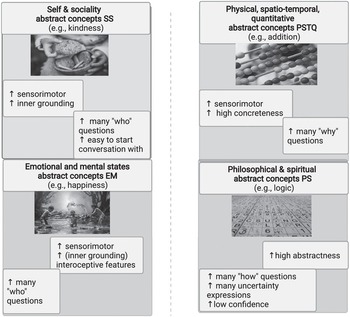
Figure 5.1. Four kinds of abstract concepts identified through cluster analysis (Villani et al., Reference Villani, Lugli, Liuzza and Borghi2019b). For each kind, the upper box reports the content dimensions (concreteness/abstractness, inner grounding, and sensorimotor) identified through principal component analysis (PCA) on various ratings. The lower box reports the pragmatic dimensions that emerged from a rating task and a simulated conversation (Villani, Lugli, et al., Reference Villani, D’Ascenzo, Borghi, Roversi, Benassi and Lugli2021; Villani, Orsoni, et al., Reference Villani, Orsoni, Lugli, Benassi and Borghi2022; Fini et al., Reference Fini, Falcinelli, Cuomo, Era, Candidi, Tummolini and Borghi2023).
Notably, the dimensions that characterize concepts are not stable and fixed but flexible and context-dependent. For example, evidence suggests that the context can modulate the differences and similarities between the various kinds of concept. In a recent study, my colleagues and I collected ratings for more than 100 Italian words in the time period of the first Italian lockdown after the spread of Covid-19 (Mazzuca et al., Reference Mazzuca, Falcinelli, Michalland, Tummolini and Borghi2022). We selected words based on the fact that the pandemic could have influenced their representation; hence, our sample included, among others, words related to family, institutions, diseases, social professions, transportation, and body parts. We also had words derived from two of the clusters found in Villani et al. (Reference Villani, Lugli, Liuzza and Borghi2019b) – emotions and mental states words (EMMS, e.g., “love,” “optimism,” “hope,” “fear,” “anxiety,”) and philosophical and religious words (PS, e.g., “life,” “religion,” “faith,” “destiny,” “death”). Interestingly, the two clusters were not as separate as in the analysis by Villani and colleagues, suggesting that the pandemic might have at least partially modified their representation. Concepts, and particularly abstract ones, are highly variable and flexible.
So far, we have argued that different kinds of abstract – and concrete – concepts tap into different dimensions. But do these different dimensions emerge online when we use concepts conveyed by words in everyday conversations? In a recent online preregistered study (Villani, Orsoni, et al., Reference Villani, Orsoni, Lugli, Benassi and Borghi2022), we presented participants with written sentences related to the abstract concepts PS (e.g., “moral,” “fate,” “salvation”), PSQT (e.g., “energy,” “number”), and EMSS (e.g., “shame,” “joy,” “conflict”), and to concrete concepts related to artifacts, natural objects, and food. An example of two sentences, one related to concrete and one to abstract concepts is: “I made a cake;” “I thought about fate.” Participants were invited to provide a written response simulating a conversation with a familiar person. At the end, they completed the Interpersonal Reactivity Index (IRI; Keaton, Reference Keaton, Worthington and Bodie2017; Italian version adapted by Albiero et al., Reference Albiero, Ingoglia and Lo Coco2006) – we were interested in the relationships between the concepts’ empathic concern and the perspective taking subscale. Later, we coded the produced responses in terms of various dimensions: sensorimotor grounding (properties related to the five senses, materials); thematic relations (spatial, temporal, events, concrete actions, abstract actions); inner grounding (emotions, interoceptions, proprioceptions, beliefs, metacognition); and other (associations, subspecifications, nonperceptual evaluations). The results confirm that PS concepts are the more abstract among abstract concepts, and PSQT the more concrete, while EMSS concepts have a different status. PS concepts evoke more beliefs and introspections (inner grounding) and more abstract actions, while PSQT concepts elicit more visual properties, concrete actions, and temporal relations (sensorimotor grounding, thematic relations). EMSS evoke more abstract actions than PSQT, but less than PS concepts; notably, they yield more interoception features than the other abstract concepts. So far, the results of this study confirm previous ones, extending them because we did not use isolated words but sentences and simulated conversations. Crucially, however, this study allows us to distinguish concept kinds in terms of the conversational dynamics they elicit. The most abstract, – PS concepts – lead to higher uncertainty (more uncertainty expressions like “Mmm …, Explain it to me better,” more questions, and repetitions) and promote more interactive behaviors (more turns) than other abstract concepts. Their higher abstractness level is testified by the fact that they evoke more general statements and elicit more points of view than PSQT concepts. PSQT concepts elicit more “why” questions than other abstract concepts, likely because many of them are scientific terms, and participants might want to understand the underlying mechanisms. Finally, EMSS concepts yield more “who” questions than other concepts, suggesting participants’ interest in the person who experiences emotions.
The last study is critical because it investigates and compares various concept kinds in terms of their conversational dynamics, not only their associated features. Recently Barsalou et al. (Reference Barsalou, Dutriaux and Scheepers2018) stated that we need to study concepts in situated action. This study represents a step in a series of studies that go even further as they investigate concepts in situated interactions (Banks et al., Reference Banks, Borghi, Fargier, Fini, Jonauskaite, Mazzuca and … Woodlinin press; Fini et al., Reference Fini, Falcinelli, Cuomo, Era, Candidi, Tummolini and Borghi2023; see Chapter 8 for more details).
5.3 A Theory on Abstract Concepts and Their Varieties: The WAT Proposal
My colleagues and I have recently proposed a theory on abstract concepts and their varieties (see Figure 5.2).
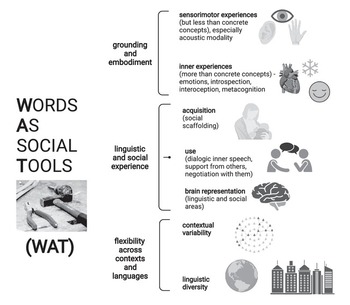
Figure 5.2 The WAT proposal and its main tenets.
The Words As social Tools (WAT) proposal is characterized by three main tenets, with various subtenets and one assumption (Borghi & Cimatti, Reference Borghi and Cimatti2009; Borghi & Binkofski, Reference Borghi and Binkofski2014; Borghi et al., Reference Borghi, Barca, Binkofski, Castelfranchi, Pezzulo and Tummolini2019a, Reference Borghi, Barca, Binkofski, Castelfranchi, Pezzulo and Tummolini2019b). The assumption is that abstract concepts come in different varieties, as seen in Section 5.2, and their differences should be investigated and highlighted. However, we think that it also makes sense to explore the macroscopic differences between abstract and concrete ones, although possibly examining differences within subcategories (Villani et al., Reference Villani, Lugli, Liuzza and Borghi2019b; Villani, Lugli, et al., Reference Villani, D’Ascenzo, Borghi, Roversi, Benassi and Lugli2021). Indeed, across several studies, my colleagues and I found that the dimension of abstractness/concreteness is pivotal (Mazzuca et al., Reference Mazzuca, Falcinelli, Michalland, Tummolini and Borghi2022).
5.3.1 Tenet 1: Grounding and Embodiment
The first and basic tenet of the WAT proposal is that abstract concepts and their varieties, like all other concepts, are grounded in situated experiences and simulations, and are embodied. Different dimensions might be more crucial for the various subkinds.
Subtenet 1: Sensorimotor experiences. Sensorimotor and exteroceptive experiences play a role for abstract concepts, even if it is a less prominent role than for concrete concepts. Compared to concrete concepts, abstract ones activate the acoustic more and the tactile fewer modalities, but they still evoke the senses (Banks & Connell, 2021b) (see Section 5.1).
Subtenet 1.2: Inner experiences. In contrast, inner experiences are particularly relevant for abstract concepts. Studies indicate that abstract concepts, and primarily emotional ones, evoke affections and interoception to a larger extent than concrete concepts (see Section 5.1 for discussion); evidence also shows that they evoke introspection and metacognition (Barsalou & Wiemer-Hastings, Reference Barsalou, Wiemer-Hastings, Pecher and Zwaan2005; Borghi et al., Reference Borghi, Fini, Tummolini, Robinson and Thomas2021).
5.3.2 Tenet 2: Linguistic and Social Experience
Linguistic and social experiences are more crucial for the acquisition, use, and brain representation of abstract concepts than concrete ones.
Subtenet 2.1: Acquisition. Because of the heterogeneous nature of the categorical exemplars, the sole sensorimotor experiences with objects and entities might make it difficult to form categories. An example can clarify. Children experience cups that, although different, share similarities in shape, material, and function – hence, they can form the category of “cup” and then refine and make it more compact thanks to language and the support of others. Others can help them refer to cups – for example, indicating the category exemplars. Things are not so easy with abstract concepts. Take the notion of justice. Children might hear the word “justice” in various situations. Benefiting less from the environmental support – forms of justice are not objects and are not similar in color, shape, and consistency - it is unlikely that they can form a category without strongly relying on linguistic labels, explanations, and the support of others. According to WAT, children – but also adult learners – need the support of caregivers or other people to learn the content of abstract concepts. Notably, my colleagues and I do intend language as a holistic experience, strongly intertwined with the social interaction it promotes, and not as the simple learning of new word-to-referent and word-to-word associations.
Subtenet 2.2: Use. As abstract concepts are more complex, their members are more sparse and perceptually different, and their meaning more undetermined and open to negotiation, they should engage people more in social interaction. Others can provide support in acquiring and helping refine the concept and negotiating its meaning when, for example, two interlocutors intend a concept differently. Hence, abstract concepts would promote interaction. This interaction might occur first with oneself and is aimed at monitoring the knowledge level and finding an interpretation of the word’s meaning through inner speech. We have called this process “inner social metacognition”(Borghi & Fernyhough, Reference Borghi and Fernyhough2023). Then, the need to refer to others to search for support or mutual exchange might promote social interaction and possibly social cohesion. We have called this process “social metacognition” (Borghi et al., Reference Borghi, Barca, Binkofski and Tummolini2018b; Borghi, Reference Borghi2022). I will illustrate these two processes in Chapters 7 and 8 (see Figure 7.1).
Subtenet 2.3: Brain representation. If linguistic experience is crucial for acquiring and using abstract concepts, then their brain representation should reflect this. Compared to concrete concepts, abstract ones should recruit more linguistic and social brain areas and also areas related to inner speech (see Chapters 7 and 8 for discussion). In addition, abstract concepts should engage the mouth motor system more because of its role in articulating words during inner speech. This inner speech recruitment might occur both during self-talk to search for the concept meaning and while preparing to interact with others to ask for the concept meaning. I discuss evidence supporting this claim in Chapters 7 and 8.
5.3.3 Tenet 3: Flexibility across Contexts and Languages
Because of their undetermined character, abstract concepts should be more flexible and variable across participants and contexts (Falandays & Spivey, Reference Falandays and Spivey2019).
Subtenet 3.1: Contextual variability. The meaning of abstract concepts should be more variable across contexts (Davis et al., Reference Davis, Altmann and Yee2020).
Subtenet 3.2: Linguistic diversity. If language is so crucial for their acquisition and use, abstract concepts should be more influenced than concrete concepts by linguistic diversity (Borghi, Reference Borghi2019). I discuss evidence consistent with this claim in Chapter 6.
5.4 Different Varieties of Abstract Concepts: Conclusion
In this chapter, I have defined what we mean by abstract concepts by comparing them with concrete ones. I have shown, however, that “abstract concept” is an umbrella term and that different varieties of abstract concepts exist, which can be conceived of as points in a multidimensional space. I have overviewed the central studies that focus on specific kinds of abstract concepts, such as emotions or numbers, and studies that compare them, highlighting their similarities and differences. This overview reveals that concepts and their distinctions are flexible and markedly influenced by the context and the expertise. Finally, I have sketched the WAT proposal, aiming to account for abstract concepts and their diversity. Notably, this theory stresses the importance of word acquisition and use and puts the accent on the linguistic experience, intending it as a bodily, social, holistic experience.
You, old woman, blessed with blindness, can speak the language that tells us what only language can: how to see without pictures.
Chapter 5 aimed at defining abstract concepts and illustrated the particularities of their subkinds. I also outlined a theory of abstractness, the Words As social Tools (WAT) theory. This chapter focuses on the relationship between abstract concepts and perception – of the external world and the body. It moves from the idea that language can be considered as a tool that enhances human interoceptive and perceptual abilities and that different spoken and signed languages offer ways to develop these.
6.1 Abstract Concepts, Language, and Interoception
While abstract concepts are more detached than concrete ones from sensorimotor modalities, recent evidence suggests that interoception is more relevant for them. I illustrate recent studies, some of which were performed in our lab, on this privileged relation, discuss the reasons why it exists, and explain that it characterizes primarily emotional abstract concepts.
Interoception has been defined as “the forgotten modality”(Connell et al., Reference Connell, Lynott and Banks2018). In fact, studies have mostly investigated whether concepts activated sensory modalities and motor aspects, but until recently, they have never focused on interoception. Some authors have underlined the importance of internal elements, such as introspection, for abstract concepts (e.g., Barsalou & Wiemer-Hastings, Reference Barsalou, Wiemer-Hastings, Pecher and Zwaan2005; Barsalou et al., Reference Barsalou, Dutriaux and Scheepers2018). Conversely, other authors have highlighted the role of affective and emotional experiences. However, opposing views exist, and the role of affections, while certainly characterizing abstract emotional concepts, is not always prominent across all kinds of abstract concepts (see Chapter 5.2.1; Yao et al., Reference Yao, Keitel, Bruce, Scott, O’Donnell and Sereno2018; Winter, Reference Winter2023). But how about inner bodily signals? In Chapter 1.1, I proposed that language might help humans detect their inner bodily signals and processes. Here, I shortly review the few studies showing that abstract concepts evoke interoception. In the influential study by Connell et al. (Reference Connell, Lynott and Banks2018), the authors asked participants to rate to what extent they experienced more than 32,000 English words through six sensory modalities (hearing, tasting, feeling through touch, sensations inside the body, smelling, and seeing). Interoception was the dominant modality for 8.6 percent of the total concepts. Concepts more associated with interoception were part of domains typically associated with interoception (e.g., cardiovascular, gastrointestinal, and pain) and domains like fatigue, pregnancy, illness, drugs, and emotions. Interoception was dominant over other properties more often than taste, smell, and touch together, even if less prevalent than hearing or vision. It was negatively correlated with abstractness, that is, the more concepts evoked internal bodily sensations, the more people regarded them as abstract rather than concrete. Finally, interoception was the dominant modality for 13.6 percent of abstract concepts and 3 percent of concrete ones.
In a second study, the authors examined the role of interoceptive experience for emotional compared to nonemotional abstract concepts and for six core emotional concepts, three positive and three negative – anger, disgust, happiness, love, sadness, and surprise – and their associated words, plus two nonemotion words as control. Interoception was the dominant modality for more emotional than other abstract concepts and was particularly relevant in characterizing negative emotions, such as anger and sadness. Finally, a lexical decision task revealed that interoceptive strength was not simply an artifact related to ratings but predicted the concreteness effect, that is, the facilitation of abstract over concrete categories. Hence, interoceptive experience is automatically activated when processing abstract words.
Having determined that the role of interoception is not an artifact of ratings, it is important to verify whether it impacts their processing. To demonstrate this, my colleagues and I tested the role of interoception for concrete and abstract concepts using an interference paradigm (Villani et al., Reference Villani, Lugli, Liuzza, Nicoletti and Borghi2021). We hypothesized that if the interoceptive experience is crucial for abstract concept processing, then their perceived difficulty would increase. We included three subkinds of concrete concepts: artifacts (e.g., “broom”); food (e.g., “eggplant”); and natural objects (e.g., “camel”). We also included three subkinds of abstract ones: emotional, mental states and social concepts (EMMS, e.g., “shame”); physical, spatiotemporal, and quantitative (PSTQ, e.g., “number”); and philosophical and spiritual abstract concepts (PS, e.g., “destiny”). Participants performed two concurrent tasks: they had to rate the difficulty of words and perform another task, depending on the condition to which they were assigned. In the interoception condition, they estimated their heartbeat pace and reported if they had noticed any change at the end of the task. We compared the interoceptive condition with a control condition and three other conditions aimed to test the role of inner speech and the involvement of the hand and mouth actions. In these conditions, participants had to pronounce a syllable (articulatory suppression), squeeze a ball, and chew gum. Bayesian analyses confirmed our prediction that the heart-beating condition would interfere more with abstract concepts than with concrete ones, increasing the difficulty of the first and reducing that of the second. Significantly, the effect was particularly prominent with emotional concepts.
Accepting that interoception counts for abstract concepts, especially emotional ones, does it count more for certain individuals and specific life periods? In a study in preparation that I am conducting with Giusi Porciello, Laura Barca, Giada Bisti, Anna Chiara D’Andrea, Chiara Fini, Cristiano Violani, and Cristina Trentini, we wanted to investigate whether pregnancy might enhance interoceptive awareness and impact how pregnant women rate abstract and concrete words. Eighty women, half of them pregnant, rated twenty concrete and twenty abstract words in abstractness/concreteness, body object interaction, emotionality, interoception, and valence. Participants also filled out a Multidimensional Assessment of Interoceptive Awareness (MAIA) questionnaire, which measures interoceptive sensitivity (Mehling et al., Reference Mehling, Acree, Stewart, Silas and Jones2018). While, surprisingly, we did not find any difference between pregnant and nonpregnant women in MAIA responses, the results on ratings were pretty interesting. Preliminary analyses revealed that body object interaction ratings were higher in pregnant women, likely due to changes in bodily perception. More interestingly, pregnant women evaluated abstract words as higher in interoception and emotional character than nonpregnant women, while no difference was present for concrete terms. Hence, inner bodily changes selectively modulated the evaluations of abstract concepts. Support for this also comes from another recent study (De Livio et al., 2022). My colleagues and I investigated whether gender-nonconforming participants would have a different interoceptive experience of their voice and another way to conceptualize gender-related words compared to a cisgender control sample. Participants had to read neutral and stereotyped texts, either aloud or silently. After reading the texts aloud, they listened to their recorded voice and had to evaluate on a scale the congruency of their voice with the voice they felt represented themselves (Crow et al., Reference Crow, van Mersbergen and Payne2021). Preliminary results indicate that gender-nonconforming participants in the reading aloud condition judged their voice less congruent; they had a different bodily and emotional regulation experience (Mehling et al., Reference Mehling, Acree, Stewart, Silas and Jones2018). Finally, compared with the cisgender group, they rated gender-related words higher in emotionality, interoception, and social metacognition (the need to rely on others to understand word meaning).
Preliminary results suggest that long-term expertise might also influence interoceptive sensitivity and abstract concepts’ representation. Together with Chiara Fini and Lorenza Silvestri, we recruited sixty participants, divided them into two groups, depending on their years of sports practice, and had them rate the interoceptive strength of concrete and abstract words of different categories. Preliminary results indicated that interoception ratings scored higher for abstract than concrete concepts; with increased sports expertise, the difference in interoception ratings between concrete and abstract concepts decreased. These results confirm the strong associations between abstract concepts and interoception and suggest that it can be changed and modulated with age and experience.
In conclusion, some recent studies have contributed to highlighting the role of the “forgotten modality,” with interoception, for abstract concepts, particularly for emotional ones, showing its influence across different tasks. Preliminary results indicate that various kinds of life experiences, such as pregnancy, might modulate the relationships between interoception and abstract concepts. Overall, this evidence is consistent with the view that abstract concepts focus on inner processes more than sensorimotor ones. Further research is needed in this area to grasp better the mechanisms subtending this relationship and investigate whether it differs depending on participants, their cognitive style and life experience, and their inner experiences, including pathological ones.
6.2 Abstract Concepts and Metaphors
In this section, I review studies on the role of metaphors in language comprehension and production and in shaping our thought. I then outline the main claims and the evidence favoring the influential conceptual metaphor theory (Lakoff & Johnson, Reference Lakoff and Johnson1980;Reference Lakoff and Johnson2008; Gibbs et al., Reference Gibbs, Lima and Francozo2004), according to which we understand abstract domains by mapping them to concrete ones through metaphors. I refer extensively to crosslinguistic studies. I argue that conceptual metaphor theory explains abstract representations thanks to a powerful mechanism, discuss to what extent this mechanism holds across different kinds of abstract concepts, and contend that it could be complemented and integrated with other mechanisms ascribing a more crucial role to sociality.
Metaphors (e.g., “life is a journey”) represent a possible way to link abstract concepts with perceptual experience. The conceptual metaphor view holds that abstract meanings can be understood by recycling concrete experiences. In this view, people metaphorically represent abstract concepts by mapping them with a concrete correspondent concept. For example, the abstract concept “similarity” would be represented by referring to physical contiguity and the term “category” to a container (for reviews, see Pecher et al., Reference Pecher, Boot, Van Dantzig and Ross2011). In the social domain, ideologies are mapped using the horizontal left-right dimension (Farias et al., Reference Farias, Garrido and Semin2013) and concepts like power using the vertical dimension: we think of the most influential people as located higher than less powerful ones (Lakens et al., Reference Lakens, Semin and Foroni2011). In the original, stronger version of this view, abstract concepts are represented in terms of concrete ones. According to more moderate versions, which focus on aspects that characterize the metaphorical base (e.g., “container,” in the case of “categories are containers”), to build an abstract concept, people will highlight the abstract, relational properties of the base. Thanks to repeated use, this knowledge can then be abstracted without always relying on its concrete source (for an overview, see Boroditsky & Ramscar, Reference Boroditsky and Ramscar2002; Wolff & Gentner, Reference Wolff and Gentner2011; Jamrozik et al., Reference Jamrozik, McQuire, Cardillo and Chatterjee2016). Much evidence supports the conceptual metaphor theory on abstract concepts. Reviewing it in detail is out of the scope of this volume (for reviews, see, e.g., Borghi et al., Reference Borghi, Binkofski, Castelfranchi, Cimatti, Scorolli and Tummolini2017; Dove, Reference Dove2022). In the next section, I review how conceptual metaphor theory has addressed the concept of time. Here I intend only to address the ability of the mechanism of metaphorical mapping to account for abstract concepts’ representation fully. I use as an example an analysis of signs from the Italian Sign Language that my colleagues and I performed (Borghi et al., Reference Borghi, Capirci, Gianfreda and Volterra2014). The idea behind the study was that the way signs of different abstractness were conveyed could inform us of the mechanism underlying the representation of the corresponding concepts. We found that many signs conveying abstract meaning relied on metaphors – for example, knowing as seeing, chest as a container of emotions, head as a container of mental activities. However, analyzing other signs led to favoring other theories of abstract concepts. For example, they supported the theory that abstract concepts are grounded in situations, and their social aspects (Barsalou & Wiemer-Hastings, Reference Barsalou, Wiemer-Hastings, Pecher and Zwaan2005) or the affective embodied account theory, according to which abstract concepts will evoke more affective experiences than concrete concepts (e.g., Vigliocco et al., Reference Vigliocco, Kousta, Della Rosa, Vinson, Tettamanti, Devlin and Cappa2013). Finally, most abstract concepts, such as “truth” and “linguistics,” were conveyed by signs that exploited linguistic information, derived either from the same sign language or the correspondent spoken language, Italian. Thus, they were in line with theories underlining the role of linguistic experience for abstract concepts, such as the WAT and the “language is an embodied neuroenhancement and scaffold”( LENS) (Dove et al., Reference Dove2020). Hence, the analysis that was performed, while confirming some of the current theories on abstract concepts, at the same time pointed to their limitations, suggesting that these theories are not sufficiently general to account for the various kinds of abstract concepts. In my view, only theories that posit reliance on different mechanisms, such as multiple representation ones, can provide a thorough account of abstract concepts and their flexibility (e.g., Vigliocco et al., Reference Vigliocco, Kousta, Della Rosa, Vinson, Tettamanti, Devlin and Cappa2014; Borghi et al., Reference Borghi, Barca, Binkofski and Tummolini2018; Gallese & Cuccio, Reference Gallese and Cuccio2018; Lund et al., Reference Lund, Sidhu and Pexman2019; Dove, Reference Dove2020; Dove et al., Reference Dove2020; Conca et al., Reference Conca, Borsa, Cappa and Catricalà2021). They can highlight the role of various dimensions – sensorimotor, interoceptive, emotional, linguistic, and social – and show that their weight might differ depending on the concept kind. Overall, I believe that the conceptual metaphor theory captures an embodied mechanism that is certainly at work. However, this theory has a series of limitations (for thorough analysis, see Borghi et al., Reference Borghi, Binkofski, Castelfranchi, Cimatti, Scorolli and Tummolini2017) and needs integration.
First, although there is much evidence, it is unclear whether and how conceptual metaphor theory can be generalized to all abstract concepts. Take, for example, concepts like “linguistics” or “philosophy.” Which metaphors should they rely on? Recently, authors endorsing metaphorical embodiment have admitted that we do not necessarily use metaphors, arguing that metaphors unfold in probabilistic, partial, and context-dependent ways (Gibbs, Reference Gibbs, Robinson and Thomas2021). Second, metaphors guide people in selecting a specific way to interpret abstract concepts but are unlikely to exhaust their meaning (for a development of this critique, see Pecher, Reference Pecher2018). For example, does the metaphor “love is a journey” capture the rich meaning people associate with “love”? Third, it is unclear how we select what to map from concrete and abstract domains. For example, a “sea of stars” is not liquid. Fourth, developmental evidence indicates that abstract concepts, or at least a subset of them, emerge in children earlier than metaphors (Dove, Reference Dove2009). Fourth, the fact that primary and more basic metaphors, like “difficult is heavy,” might underlie many different concepts limits the explanatory breadth of the theory (Dove, Reference Dove, Robinson and Thomas2021). These considerations create problems for a theory exclusively based on the metaphorical mapping mechanism.
In sum, I believe the metaphorical mapping mechanism is powerful but cannot be advocated as the only mechanism accounting for abstractness. At the same time, as clearly highlighted by Dove (Reference Dove2022), metaphors are interesting for multiple representation views. They are flexible and variable cross-culturally. Both linguistic and embodied elements concur in representing them. Like the abstract concepts that they are sometimes composed of, they are examples of the “malleable” aspects of human knowledge (Dove, Reference Dove2022).
6.3 Abstract Concepts, Language, and Languages
Because abstract concepts are highly related to language, they are more likely to be influenced by linguistic variability than concrete concepts. I discuss this claim, which is subtenet 3.2 of the WAT theory (see Figure 5.2), in light of recent evidence on Whorfian effects of language – the hypothesis that the language we speak affects thinking – in shaping the mind (see Chapter 1.5). As recently argued by Kemmerer (Reference Kemmerer2022), Whorfian effects raise important theoretical challenges. For example, grounded cognition has to cope with the fact that concepts are not only grounded in sensorimotor systems, but are represented there in language-specific ways. Here I discuss how these language-specific effects differ depending on word abstractness. I illustrate evidence of the impact of languages on the representation of concepts that differ in abstractness, such as those of odor, gender, and time.
Relatively recent views contend that linguistic variation concerns all domains (Malt & Wolff, Reference Malt and Wolff2010). In light of a review of the literature, I argue here that linguistic variation occurs cross-domain but might have more effect on the domains typically considered abstract than on the concrete ones. Consistent views claim that abstract concepts have low situational systematicity, that is to say that, compared to concrete concepts, the elements that constitute abstract concepts are more sparse across time and space (Davis et al., Reference Davis, Altmann and Yee2020; Langland-Hassan & Davis, Reference Langland-Hassan and Davis2022). Their indeterminate character makes them flexible and dynamic (Falandays & Spivey, Reference Falandays and Spivey2019). Here, I propose something more specific: their meaning varies more depending on the spoken (and signed) language than the meaning of concrete words.
In order to address whether abstract concepts are more variable across languages than concrete ones, it is important to understand whether possible variations might depend on other factors, such as the grammatical class. Some authors suggested that closed-class items, like prepositions, conjunctions, and articles, are less variable than open-class ones (nouns, verbs, adjectives) (Slobin, Reference Slobin1985; Talmy, Reference Talmy1988). Other authors have argued that verbs and prepositions, which have a relational character, might be more variable across languages than nouns, more constrained by their reference to the objects and entities in the environment (Gentner & Boroditsky, Reference Gentner and Boroditsky2001). Interestingly, verbs are generally more abstract than nouns, as my colleagues and I (Pezzuti et al., Reference Pezzuti, Dawe and Borghi2021) recently showed in an analysis of more than 400 participants based on the Italian version Wechsler Adult Intelligence Scale – Fourth Edition (WAIS-IV) (Orsini & Pezzuti, Reference Orsini and Pezzuti2015). However, evidence shows that people perceive some verbs referring to nouns as more concrete than more abstract nouns (Gillette et al., Reference Gillette, Gleitman, Gleitman and Lederer1999). Hence, I think grammatical category per se cannot account for the universality of a word across languages. The word abstractness and concreteness might instead play a role in explaining linguistic variability. In the following, I substantiate my claim in light of recent evidence.
In this context, the distinction advanced by Slobin (Reference Slobin, Gumperz and Levinson1996) between “thinking for speaking” and “thinking for thinking” is crucial. This distinction can guide us in understanding whether different naming practices influence our linguistic production exclusively or also our conceptualization. Notice that, for proponents of languaging views, the distinction between language and thought that linguistic relativity studies involve (e.g., Casasanto & Gordon, Reference Casasanto and Gordon2005; Athanasopoulos et al., Reference Athanasopoulos, Bylund and Casasanto2016; Casasanto, Reference Casasanto2016) does not make sense because in their view, language and thought cannot be separated. In a very lucid and compelling analysis of the relationship between languaging and linguistic relativity, Batisti (Reference Batisti2021) poses the causality problem: if one fully endorses the languaging perspective, one cannot hypothesize that language influences thought. However, even Cowley (Reference Cowley2019) admits that “linguistically-informed perception can influence human doing, sayings, and feelings.” (p. 488). A different, radical view, closer to the one adopted in this book, is proposed by Sidnell and Enfield (Reference Sidnell and Enfield2012). They argue that “differences in language structure are not associated only with differences in patterns of thought or cultural context. Differences in language structure lead to linguistically relative collateral effects, which lead in turn to differences in our very possibilities for social agency” (Sidnell & Enfield, Reference Sidnell and Enfield2012, p. 329). I now turn to review studies on various kinds of concepts, led by the hypothesis that the effects of languages are stronger, the weaker the strength of the environmental constraints. I deal first with concrete nouns and verbs, and then with abstract concepts.
6.3.1 Concrete Nouns and Concrete Verbs
In an influential study, Malt et al. (Reference Malt, Sloman, Gennari, Shi and Wang1999) demonstrated divergences between knowing, operationalized as the ability to categorize, and naming. When faced with containers of different shapes, the naming pattern of Spanish, English, and Chinese speakers strongly differed. When participants had to sort the containers into categories, the response pattern did not vary across speakers. Hence, with concrete objects, participants seemed to be influenced by the language when thinking for speaking but not when thinking for thinking. This is likely because the environmental constraints strongly affect concepts referring to objects. Many influential studies focus on how different languages classify animals and plants or how they encode tools. Given the various species in different environments, authors have often compared Western and small-scale cultures. Research in folk-biology has investigated how people reason about plants and animals (Medin & Atran, Reference Medin and Atran1999). Despite differences, there are also striking similarities in how these categories are organized. For example, Lopez et al. (Reference Lopez, Atran, Coley, Medin and Smith1997) had American people and people of the traditional Itza-Maya society sort cards with the names of mammals and perform induction tasks, generalizing a property from one mammal to another (e.g., “[Mammal 1] has a disease. [Mammal 2] has another disease. Do you think [Mammal 3] has the disease of [Mammal 1] or the disease of [Mammal 2]?”). In both Western and traditional societies, people used taxonomies of local species of mammals, the members of which were perceptually similar, which differed from scientific taxonomies, and organized them taxonomically in different hierarchical levels. Notably, beyond the commonalities, there were many differences, for example in detecting similarities – foxes, for instance, were sorted together with dogs by Americans, but with cats by Itzai – and in the stronger ecological attention in the Itza population, who took the animals’ environment and way of chasing more into consideration. In an influential research program, Berlin (2002/Reference Berlin2014) analyzed folk classification systems for plants among the Tzeltal Maya of Mexico and the Aguaruna Jivaro of Peru. Remarkably, about 60 percent of labeled classes corresponded to species identified by botanists. These studies suggest that, despite variations, there are striking similarities among languages and cultures in classifying animals, plants, and even artifacts. Can we account for a phenomenon like this by relying on nativist accounts? I do not believe we can. Rather, it is plausible to argue that the biomechanics of our body and the correlational structure of the environment can create some constraints that influence variations across cultures.
Is this phenomenon confined to concrete nouns referring to spatially bounded entities? Although it might be more pronounced with nouns, it does not seem limited to them. Narasimhan et al. (Reference Narasimhan, Kopecka, Bowerman, Gullberg and Majid2012) had speakers of nineteen different languages describe what they saw while watching videos representing everyday verbs like taking and putting (e.g., “putting a cup on the table,” “taking an apple from a bowl”). All languages expressed the agent with the noun and the motion with the verb. However, they disagreed on the path of displacement motion (to a goal vs. from a source) and the spatial relationship between figure and ground (containment, support, etc.). For example, in Yélî Dnye, an isolated language spoken on Rossell Island, a small island offshore in Papua New Guinea, no locative marker comparable to “to” or “from” exists, and it is the verb that encodes whether the action refers to a goal or a source. Also, some languages, like Hungarian, have verbs with general meanings like “putting” while others, like German, do not. With a similar procedure, Majid et al. (Reference Majid, Boster and Bowerman2008) had speakers from twenty-eight languages belonging to thirteen language families and different cultures, from rural to urban, watch videos of cutting and breaking events and describe what the agent did. Even if there were differences across languages, different languages had many commonalities. The main distinction between cutting and breaking events holds across languages, differentiating events where the locus of separation is highly predictable versus unpredictable. For example, in the case of slicing bread but not smashing a plate, it is possible to predict the location of separation from where the knife is placed. Intriguingly, this distinction occurs even in languages and cultures where knives were introduced only recently and cutting tools are hardly used, such as in the Yélî Dnye language. Besides some commonalities, there were also many variations across languages: for example, the number of verbs used varied from fifty in Tzeltal to three in Yélî Dnye; some languages, like Dutch, Swedish, and Mandarin, have a particular verb to refer to cutting with one or more blades; finally, chopping events are either ascribed to cutting or to breaking events depending on the language.
Studies on concrete motion verbs are interesting to verify whether differences in the naming pattern also correspond to conceptual differences. Consider, for example, motion verbs. Malt et al. (Reference Malt, Gennari, Imai, Ameel, Tsuda and Majid2008) had English, Dutch, Spanish, and Japanese speakers observe video clips of a girl locomoting on a treadmill that varied in speed and slope. They had to name what they saw and evaluate the typicality of each clip for some gait terms. Notably, two languages, English and Dutch, encoded manner in the verb, while the other two did not. Despite being high- or low-manner languages, the four languages reflected the discontinuity in the manner of motion between walking and running. Other differences existed, though. For example, languages differed in encoding fine-grained distinctions between actions such as “skipping” and “jumping.” Another study by Gennari et al. (Reference Gennari, Sloman, Malt and Fitch2002) compared English and Spanish motion verbs. Notably, English verbs encode manner (e.g., “stroll”) and use particles to express the path; Spanish verbs encode the path (e.g., “entrar” [enter], “bajar” [descend]), while adverbs or other particles express manner. Participants observed video clips of motion events; in one condition, they had to name the action, in the other, they only watched the video. Then they performed a recognition task, in which they had to decide whether they had previously seen a specific action, and a similarity judgment task. The verbal coding influenced the explicit similarity judgment task but not the recognition task. Hence, “thinking for speaking” did not impact recognition. The results suggest that, although the language has an impact, this impact might be confined and might not strongly affect mental representations of motion events.
Another domain where convergences and divergences across languages can be noted is that of body parts. Universal elements are less than one might predict. For example, some languages do not possess the term “body.” The Jahai language does not possess a term for “face” and “mouth” but has many terms related to small parts of the face (e.g., eyes, upper lip, lower lip, teeth, wrinkles on the side of the eyebrows, etc.). “Soul” and “life force” are considered parts of the body in some languages but not in others (Enfield et al., Reference Enfield, Majid and Van Staden2006). Despite these differences, compared to other domains, body parts seem to be more consistent across languages. Majid et al. (Reference Majid, Jordan and Dunn2015) asked speakers of twenty Germanic languages (e.g., Danish, German, English, Dutch, Frisian, etc.) to name elements of four domains: color (e.g., “blue”), body parts (e.g., “forearm”), containers (e.g., “bowl”), and spatial relations (e.g., “on”). Spatial relations showed the most variation in meaning. The authors interpret the results by contending that grammaticized meanings are more variable than the meanings of open-class lexical items, like nouns. I think this result is also informative for the concreteness/abstractness distinction. More concrete items – containers, body parts, and even object properties – are less variable across languages because they are more subject to constraints given by their referents. Interestingly, in a recent study with Japanese languages, Huisman et al., (Reference Huisman, Hout and Majid2021) found the highest similarity in the face region for bounded parts (i.e., nose, mouth, ear, and eye). This happened when participants both named and colored acoustically presented body parts in a silhouette. In contrast, unbounded parts varied more, especially in the cheek area. Notably, referring to spatially bounded objects is typical of concrete items.
The pattern I have reviewed is quite complex and nuanced. Variations are ubiquitous. However, the results suggest that reliance on objects leads to strong convergence among speakers, in the case of both natural objects and artifacts. Concrete verbs of everyday actions, like “putting/taking” and “cutting/breaking,” have many differences but striking similarities in naming. When there are stronger constraints in the structure of the physical world and biological constraints linked to the specificity of the human perceptual system (Malt & Majid, Reference Levinson and Majid2013), then we are more likely to find cross-linguistic commonalities. These conceptual commonalities might also exist independent of the naming similarities, as the dissociations between the naming and sorting tasks reveal.
6.3.2 Abstract Nouns and Abstract Verbs
If we consider abstract nouns, the variations in meaning become more substantial. Evidence on the abstract concepts of time represents an exciting example. Many studies have investigated the notion of time, based on the conceptual metaphor view (Lakoff & Johnson, Reference Lakoff and Johnson1980; Reference Lakoff and Johnson2008). Hence, the concept of time will refer metaphorically to the concrete concept of space (for an overview of time, space, and number, see Winter et al., Reference Winter, Marghetis and Matlock2015). Overall, many studies demonstrate the cross-linguistic variability of the concept of time and its relationship with the more concrete concept of space (for a review, see Boroditsky, Reference Boroditsky2018).
Languages differ in the metaphors used to refer to the concept of time. For example, different languages use the metaphors of length and quantity. In some languages, such as English and Indonesian, people speak of “long meetings” and a “long time”; in others, such as Greek and Spanish, people say “large time” (largo tiempo). In a study reported by Casasanto (Reference Casasanto2008), English, Indonesian, Greek, and Spanish participants estimated how much the length of a line or the quantity of water in a container would grow and remain on the screen. Results showed, in line with a Whorfian view, that participants performed this nonlinguistic task relying on the metaphors of time in their languages. This representation is not stable. For example, while Swedish and Spanish people relied respectively on the length and quantity metaphors, bilingual people flexibly shifted between the two representations depending on the used language (Bylund & Athanasopoulos, Reference Bylund and Athanasopoulos2017).
How do people represent the relationship between future, present, and past? It depends on the spoken language. Some languages, such as English, use horizontal metaphors to think about time. People associate the past with the left and the future with the right. When Spanish participants judged whether written words refer to the past or the future, they responded faster to future terms by pressing a right key and to past words by pressing a left key (Santiago et al., Reference Santiago, Lupáñez, Pérez and Funes2007). Other languages use multiple mappings, with a dominant one. For example, Chinese Mandarin speakers arrange pictures vertically and gesture along the vertical axes to indicate the progression in time. A study by Boroditsky (Reference Boroditsky2001) was the first to reveal with an implicit priming task that the vertical metaphor to refer to time is more frequent in Chinese Mandarin speakers, while for English speakers, time flows horizontally from left to right. Interestingly, the effect can shift in bilingual people, who use either the vertical or the horizontal mapping depending on the language they are using (Boroditsky et al., Reference Boroditsky, Fuhrman and McCormick2011).
Writing direction also impacts how people think of time. In cultures that adopt the left–right mapping preferentially, the writing direction influences the direction of the mapping. Hebrew and English speakers had to make temporal order judgments after seeing two pictures representing an earlier and a later phase of an event by pressing a left or a right key; for example, they saw the picture of an intact banana and a peeled banana. Hebrew participants responded faster when the right key represented “earlier” responses, whereas English speakers did the opposite, consistent with the opposite writing directions, right-to-left, and left-to-right (Fuhrman & Boroditsky, Reference Fuhrman and Boroditsky2010). When deciding whether words were related to time, Spanish and German participants responded faster by pressing the right key for words about the future and the left about the past, while Yiddish participants did the opposite (Santiago et al., Reference Santiago, Lupáñez, Pérez and Funes2007; Ulrich & Maienborn, Reference Ulrich and Maienborn2010). Interestingly, even the reading direction of blind people (who read with their hands) influences how they conceive time (Hendricks & Boroditsky, Reference Hendricks and Boroditsky2015).
Many languages use the front–back axis to describe the relationship between past and future. In most cases, people see the past as behind the ego, as conveyed by the English expression “Let’s put the past behind us.” However, this mapping is not universal. For example, the Aymara language speakers represent the past in front of them and the future behind them. Thus, Aymara speakers point the index finger on the forehead to refer to old generations (Núñez & Sweetser, Reference Núñez and Sweetser2006). Similar to Aymara, in Vietnamese (Sullivan & Bui, Reference Sullivan and Bui2016), time also flows from the front (past) to the back (future) because events of the past events can be “seen,” but future events are still uncertain. In other languages, people represent time along cardinal directions. For example, Pormpuraaw, an Australian Aboriginal community, represents time as flowing from East to West (Boroditsky & Gaby, Reference Boroditsky and Gaby2010), while for speakers of Yupno, in Papua New Guinea, the past is construed as downhill, and the future as uphill (Núñez et al., Reference Núñez, Cooperrider, Doan and Wassmann2012).
An intriguing proposal to account for divergences in conceiving the relationship between past and future is the temporal focus hypothesis (de la Fuente et al., Reference De la Fuente, Santiago, Román, Dumitrache and Casasanto2014). Cultures vary in whether they are past-oriented or future-oriented, depending on the value they place on tradition and progress. According to the temporal focus hypothesis, this should impact people’s representation of time: the future is ahead in future-oriented cultures, behind in past-oriented societies. In keeping with this hypothesis, a study showed that Spanish people saw the future ahead differently from Moroccans who saw the past ahead; interestingly, the Spanish elderly had a time representation that was intermediate between the Spanish and Moroccan ones. A recent study showed that, despite one exception (South Africa), the distinction between past- and future-oriented societies could explain data taken from ten Western (sub)cultural groups, ten subcultural groups from China and Vietnam, and Great Britain (Callizo-Romero et al., Reference Callizo-Romero, Tutnjević, Pandza, Ouellet, Kranjec, Ilić and Casasanto2020).
We have seen that different space-time mappings exist and that languages greatly vary in the mappings they adopt. Intriguingly, there are languages where no clear space-time mapping is present. In Yélî Dnye language, no calendar time is present – no names of the days, months, or years. People refer to time through gestures, indicating the sun. When comparing Yélî Dnye speakers with Dutch speakers in locating verbal (e.g., yesterday, today, tomorrow) and nonverbal sequences (e.g., maturation of an organism) in space, Dutch people used a left-to-right mapping. In contrast, no stable space-time mapping characterized Yélî Dnye speakers’ responses – they used left-to-right, east-to-west, and forward–away axes. Not casually, Levinson and Majid (Reference Levinson and Majid2013) called Rossell “the island of time.” These results cast doubts on the universality of space-time mapping and suggest that space is used when the complexity of time organization and structuring requires it. Other languages that do not seem to use linear representations of time are the Yucatec Maya (Le Guen & Pool Balam, Reference Le Guen and Pool Balam2012), who conceive time as a succession of events not spatially organized, or the Amondawa in Amazonia (Sinha et al., Reference Sinha, Sinha, Zinken and Sampaio2011).
This short overview reveals that the abstract concept of time is highly variable across cultures and languages and that even the mapping with time, which occurs across many languages, is likely not universal. Linguistic and nonlinguistic tasks consistently show that many different mappings are present and might concur. Furthermore, the reading direction has a significant impact. Being the representation of time flexible, it might shift in bilingual people. In addition, evidence shows that people can also be trained and can learn new linguistic relations between space-time concepts, and that these new relations can impact their thought (Hendricks & Boroditsky, Reference Hendricks and Boroditsky2017).
I briefly consider a further example of concepts that people typically rate as abstract (albeit less abstract than concepts such as time), namely, emotional terms. In a recent study, Jackson et al. (Reference Jackson, Watts, Henry, List, Forkel, Mucha and Lindquist2019) examined the semantics of twenty-four emotion terms across 2,474 spoken languages of twenty language families. Notably, when compared with other abstract concepts, emotional ones are more embodied, that is, they are generally evaluated as being more concrete and imageable, being acquired earlier, and evoking interoception and sensory modalities like vision and touch to a larger extent (Villani et al., Reference Villani, Lugli, Liuzza and Borghi2019a). The domain of emotions is fascinating because of the debate revolving around their representation. Even though this is outside the scope of the present volume, it might be worth remembering the contrast between influential views, according to which more basic emotions will be universal (e.g., Ekman, Reference Ekman1992), and constructivist approaches, which put the accent on the process of building emotions (e.g., Barrett, Reference Barrett2017). Here we focus on emotional concepts expressed by language, that is, how people speak about emotions, which does not necessarily reflect how they perceive emotions (Majid, Reference Majid2019). The authors analyze the cases of colexification, when multiple concepts use the same form within a language – for example, the Persian word “ænduh” expresses both “grief” and “regret.” Across languages, valence and neurophysiological activation are good predictors allowing the differentiation of emotion from neutral words. Despite these universal aspects, the data reveal a striking cross-linguistic variability. Even if often equated in dictionary translation, emotional words vary consistently and significantly across languages. Emotions vary more than the semantics of color, known for its variability. For example, the word “anger” is associated with “envy” among Nakh-Daghestanian languages, but it is more associated with “hate,” “bad,” and “proud” among languages. Language spoken in contiguous geographical communities has more similar colexification patterns.
So far, we have seen that, although there are many differences across languages, linguistic variations affect less concrete than abstract concepts. As examples of concrete concepts, I chose spatially bounded objects and entities, such as artifacts (containers), plants, and animals. As an example of an abstract concept, I used the notion of time and have briefly addressed the concept of emotion (I discussed the abstract concept of number in Chapter 7.2). How about concepts that lie in between abstract and concrete ones? I briefly discuss the examples of odor and gender concepts. Odor is intriguing because it does refer to a sensory modality but an ineffable one and does not have a physical object as a referent. Odors cannot be seen, heard, or touched, but the source they originate from can be seen and touched. In a recent study on twenty different languages, Majid et al. (Reference Majid, Burenhult, Stensmyr, De Valk and Hansson2018) examined the codability (agreement of speakers, length of the produced speech, and specificity of the response) of words referring to the five senses. They found marked cross-cultural differences; intriguingly, the order of sensory modalities generally did not correspond to the Aristotelian hierarchy of senses – sight, hearing, touch, taste, and smell – but different cultures emphasized different senses. Across languages, however, the odor has a lower codability score. Is odor “the muted sense”(Olofsson & Gottfried, Reference Olofsson and Gottfried2015) weakly related to language across all cultures? It is less verbally expressed than other senses, but there are exceptions. Comparative analyses of a free naming of smell and color showed that, while English speakers had few words referring to odors, Jahai speakers from a hunter-gatherer population from the Malay Peninsula named odors easily, with the same level of interspeaker agreement as color (Majid & Burenhult, Reference Majid and Burenhult2014). Do these differences depend on different ways of perceiving color, or are they due to different naming patterns? Perception of color pleasantness does not vary across cultures, as revealed by a rating study on nine non-Western cultures (Arshamian et al., Reference Arshamian, Gerkin, Kruspe, Wnuk, Floyd, O’Meara and Majid2022). Consistent with this, analyses of Dutch and Jahai speakers’ facial expressions showed that emotional reactions to odor did not differ (Majid, Burenhult, et al., Reference Majid, Burenhult, Stensmyr, De Valk and Hansson2018). However, the naming pattern did: Jahai speakers used more abstract words to refer to odors (e.g., “musty”), and Dutch participants more concrete words referring to the source of the aroma (e.g., “smells like lemon”)(Majid, Burenhult, et al., Reference Majid, Burenhult, Stensmyr, De Valk and Hansson2018). Hence, across cultures, odor pleasantness is perceived similarly, and, with some exceptions, such as the Jahai culture, it is also less variable because, across languages, it is less encoded in language. How can we reconcile this finding with the fact that, among the senses, the smell is the most ineffable and thus apparently more abstract one? One possible way to account for these differences is to rely on the abstractness of the words used. Across most cultures and languages, people mainly name odors using concrete words that refer to their sources (e.g., “smells of liquorice”). This reliance on the concrete source of smell might explain the lower cross-linguistic variability of odors across languages.
Another example of a concept the abstractness of which might vary across cultures and languages is gender, an interesting concept since it includes both embodied, biological components and cultural ones. Mazzuca et al. (Reference Mazzuca, Majid, Lugli, Nicoletti and Borghi2020; Mazzuca, Borghi et al. Reference Mazzuca, Borghi, van Putten, Lugli, Nicoletti and Majid2022) asked Italians, Dutch, and English speakers to perform a free listing task and a typicality rating task. Across tasks, a major difference emerged between Italians, who focused more on sociocultural factors (e.g., “identity”), and Dutch participants, who focused more on biological elements (e.g., “genitals”) and adopted a more essentialist stance. The difference might occur because gender in Italy is at the center of political debates, rendering sociocultural features more salient. Consistent with this, Italians rated abstract features as more related to gender, while Dutch and English participants, especially Dutch, associated gender with more concrete aspects (see Figure 6.1).
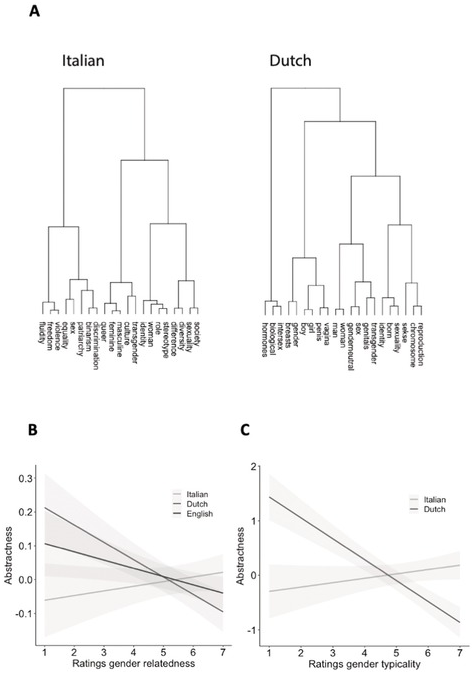
Figure 6.1 Conceptualization of gender by Dutch, English, and Italian participants (Mazzuca, Borghi et al., Reference Mazzuca, Borghi, van Putten, Lugli, Nicoletti and Majid2022). Panel A gives cluster analysis results for Italian and Dutch clusters, showing that Italian clusters were more focused on sociocultural factors, and Dutch clusters on biological aspects. Panels B and C report the ratings of the produced words. Panel B shows that the more words are related to gender, the more they are abstract, but only for Italians. The effect is reversed for Dutch participants, while English participants are in the middle. Panel C shows the opposition only between Italians and Dutch participants: for the former, gender typicality is positively correlated with abstractness; for the latter, the pattern is the opposite.
So far, I have contended, in light of examples of concrete, abstract, and intermediate concepts, that the meaning of abstract words varies more across languages than that of concrete terms. In the literature, there is some evidence contrasting with the hypothesis. Analyzing semantic neighborhoods of 1,010 meanings in 41 languages, Thomson et al. (2022) showed that words that aligned most were not the most concrete ones but those that belonged to highly structured domains, such as number, time, and kinship. Some of these concepts are abstract. However, they belong to the most concrete among abstract concepts, i.e., PSTQ ones, and importantly they are concepts the meaning of which is conventional and less debatable. Furthermore, this study does not investigate people’s mental representation of time but whether they use similar words (e.g., “day” and “month”) across languages. However, this evidence is important and challenging. It also induces reflections on whether concreteness-abstractness ratings should be combined with other information (e.g., age and modality of acquisition, negotiable character of the meaning, etc.). My colleagues and I directly tested the hypothesis that abstract concepts are more variable across cultures and languages in two studies. In the first, Italian and Iranian participants performed “sensibility” judgments of sentences referring literally or metaphorically to motor actions (e.g., “s/he grasps the cup/a concept”). Concurrently they observed a video displaying a movement congruent or incongruent with the one mentioned in the sentence. For example, in the incongruent condition they saw a video of someone pouring tea, while the sentence referred to grasping a cup. Compared to the other conditions (congruent abstract, incongruent concrete, and abstract sentences), congruent concrete sentences were facilitated in Italian and interfered with Persian (Ghandhari et al., Reference Ghandhari, Fini, Da Rold and Borghi2020). The results suggest a stronger integration between gestures and language in Italians. We interpreted the result on Iranians referring to the tendency to avoid movement when talking, which is common in the Persian culture. In this task, we found stronger variations in concrete than in abstract verbs; however, we ascribe the result to the specific paradigm and the privileged relations of concrete concepts with actions. More intriguingly, in a study we are performing together with Federico Da Rold, Claudia Mazzuca, Chiara Fini, and Mina Ghandhari, we used a sorting task to test the hypothesis that abstract concepts might differ more by comparing participants of three different cultures, both Western and Eastern, namely, Italian, Iranian, and Israeli. Participants used an appositely created app and had to sort forty names of concrete and abstract concepts into two, four, six, and an indeterminate number of groups by dragging words on a tablet. Concrete words included the most frequently studied categories in the literature, that is, tools, animals, and food (Warrington & Shallice, Reference Warrington and Shallice1984; Rumiati & Foroni, Reference Rumiati and Foroni2016). Abstract words included members of the three groups identified by Villani et al. (Reference Villani, Lugli, Liuzza and Borghi2019b): philosophical and spiritual (PS); emotional, mental state, and social concepts (EMSS); and physical, space, time, and quantity concepts (PSTQ). As shown in Figure 6.2, within each language, concrete concepts cluster more easily into three categories, while abstract concepts are sparser and heterogeneous. More crucially, the variability of sorting across cultures is higher for abstract than concrete words, both when we consider abstract and concrete concepts as unitary categories and when we divide them into subclusters each, as Figure 6.2 shows.
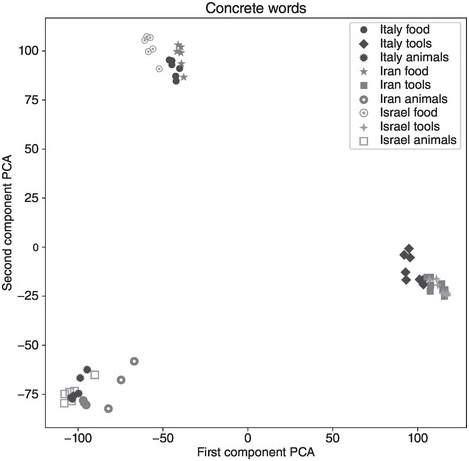
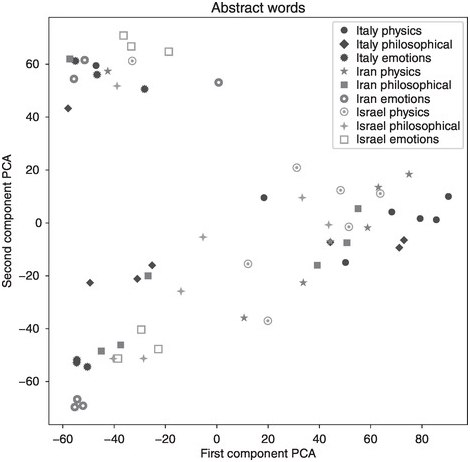
Figure 6.2 Results of a principal component analysis performed on a sorting task. Iranian, Israeli, and Italian participants had to divide twenty concrete (Figure 6.2a) and twenty abstract (Figure 6.2b) words into two, four, six, or a free number of categories.
6.4 Abstractness and Language as a Physical Tool: Conclusion
In this chapter, I have contended that abstract words can work as a physical tool. First, I have proposed that they might enhance interoception, the ability to detect inner bodily signals. Second, we have seen that they recruit sensorimotor experiences. I have briefly described how this can happen thanks to metaphors. Even if abstract concepts recruit perceptual and bodily experiences and might even enhance human sensitivity to them, the ability to strengthen perception – to work as physical tools - is mainly a privilege of concrete concepts. For example, hearing the word “dog” helps us identify the foggy entity we see far away from us as a dog (see Chapter 1). Although interoceptive and sensorimotor experiences are fundamental, I think that language and social experience play a primary role in the acquisition, representation, and use of abstract concepts. Metaphorical mapping is a powerful mechanism. However, I believe that only positing the reliance of abstract concepts on various mechanisms – embodied, linguistic, and social – can capture the richness of their meaning. Multiple representation theories, like the WAT theory, described in Chapter 5.3, can catch this richness. In the last section, I described evidence showing how different spoken languages and cultures help build abstract concepts, in some cases also relying on the metaphorical mapping mechanism. In contrast, concrete concepts are less variable and more anchored to and constrained by the correlational structure of the physical environment.
Nell’attesa ho avuto lo spazio per costruire enormi impalcature di significato, e dieci minuti dopo farle crollare, per mia stessa mano. Poi riprendere da un punto qualunque, correggere il tiro di qualche centimetro per rendere la costruzione immaginata più solida. Vederla crollare di nuovo.Footnote *
Self-consciousness is not knowledge but a story one tells about oneself.
Practice listening to your intuition, your inner voice; ask questions; be curious…
So far, we have seen that language can work as an inner tool that enhances human cognition (see Chapter 2). This chapter substantiates the claim that inner speech and overt language as inner tools become particularly prominent at increasing conceptual abstractness. To support this proposal, I review behavioral studies showing that the mouth motor system is more activated for abstract concepts, suggesting that we might use an articulated form of inner speech during their processing. Then I synthetically overview brain imaging studies and research, addressing conditions with impairments in social interaction and inner and overt speech abilities, such as autism, schizophrenia, and aphasia.
7.1 Abstract Concepts, Language, and Inner Speech
One way to ascertain that linguistic experience impacts the representation of abstract concepts is to investigate whether their processing involves the mouth motor system. I overview behavioral and neural evidence consistent with this claim. Then I propose that inner speech is activated during abstract concept acquisition, processing, and use. Finally, I describe the mechanisms of social metacognition and inner social metacognition. I propose a model according to which individuals first address the limits of their knowledge through metacognition. Then they search for possible word meanings and try to elaborate on and reexplain to themselves the meaning of the word, possibly through dialogic inner speech (inner social metacognition). Finally, they use inner speech to prepare themselves to ask others for information that might complement their knowledge gaps or negotiate the word meaning (social metacognition).
7.1.1 Abstract Concepts, Language, and Mouth Motor System Activation
Moving the mouth during conceptual processing might signal the presence of inner language. Across different studies, my colleagues and I consistently found that, while concrete concepts activated the hand motor system more, the mouth and face motor systems are more engaged when processing abstract concepts. We started with studies mimicking the acquisition of concepts. We performed four experiments asking participants either to manipulate or to observe new objects on a computer screen (Borghi et al., Reference Borghi, Flumini, Cimatti, Marocco and Scorolli2011). Concrete elements were three-dimensional (3D) objects varying in shape and color and rich in perceptual features; participants had to move them around by dragging the mouse and then inserting them into a hole. Abstract concepts did not have a single object as a referent but multiple ones; these objects interacted in different ways. For example, after two or more objects collided, one moved in a straight line while the other spiraled away at a different speed. The interacting objects were all cylinders and sky-blue, and participants had to observe them interacting but could not move them using the mouse. First, they had to decide whether or not two elements belonged to the same category. As expected, abstract concepts yielded more errors than abstract ones. Then participants learned the category name. Invented names (e.g., “CALONA,” “NOROLO”) had the same number of letters; half of them finished with A, half with O (feminine vs. masculine in Italian). Labeling facilitated the categorization of both concrete and abstract concepts. Hence, when participants had to match words to images, abstract concepts remained more difficult than concrete ones. This result replicates the well-known concreteness effect, that is, the processing advantage of concrete concepts compared to abstract ones with artificial categories. A further property generation task testified that our operationalization was correct: participants produced more perceptual properties for concrete items and more abstract and relational properties for abstract ones, similar to what happens with natural categories. In further experiments, to investigate the role linguistic support plays in facilitating conceptual acquisition, we added to half of the invented names an explanation of their meaning. Explanations for concrete items mentioned perceptual elements (e.g., “CALONA: “a figure having a concavity”); for abstract concepts, the explanations pointed to the interaction between the elements (e.g., “PANIFA: two 3D moving figures. After the contact, one of them moves in a straight line; the other one executes a turning movement with a different velocity”).
Interestingly, in a subsequent words-to-images matching task, the presence of explanations reduced the difference between responses to concrete and abstract concepts. Explanations seemed to support the acquisition of abstract concepts but did not impact concrete ones, likely because perceptual information, together with the label, was sufficient to form the category.
To address whether language activation with abstract concepts has a motor counterpart, we introduced a property verification task manipulating the response effector (mouth vs. hand). Participants had to decide whether a property, like the color, was true of a given category (e.g., “Is the FUSAPO red?”). For half of the experiment, they responded “yes” using the microphone (mouth); for the other half, they pressed a “yes” key on the keyboard. In a previous study, we had found faster response times with the microphone than key-pressing responses with sentences related to mouth-related actions (e.g., sucking a candy) (Scorolli & Borghi, Reference Scorolli and Borghi2007). Across two experiments, responses to concrete words were faster with the keyboard, responses to abstract words faster with the microphone. This finding indicates that acquiring novel abstract concepts involves language, thus engaging the mouth effector.
A possible limitation of the study is that the referents of concrete and abstract categories were perceptually different. In everyday life, what really differs is how we assemble what we perceive to form concrete and abstract concepts. Hence, in a further study (Granito et al., Reference Granito, Scorolli and Borghi2015), we presented participants with categories created with Lego bricks. Through a sorting task, we assessed which categories participants had formed. As predicted, sorting was faster for concrete than for abstract concepts. Then the experimenter taught the participants a label and explained each category’s criterion. The same component could be part of a concrete or abstract category, but concrete labels pointed to single objects, and abstract ones referred to relations (Gentner & Boroditsky, Reference Gentner and Boroditsky2001). The explanations of concrete concepts contained information on the item’s color and shape; the explanations of abstract concepts included spatial relations. Here are two examples, the first of a concrete and the second of an abstract category: “A jagged stack-shaped object with a yellow protrusion”; “The two objects have one contact point and form a concavity.” Accuracy in a subsequent categorical recognition task was higher with concrete than abstract concepts, confirming the concreteness effect. However, linguistic training (label and linguistic explanation) improved the performance, especially with abstract stimuli. Linguistic training also sped up the mouth responses in an image-word match experiment. Indeed, participants who had received the linguistic training responded faster with the mouth (microphone) than those who hadn’t. Analyzing the strategies adopted, we found that linguistic training was particularly crucial for participants whose initial categories were quite distant from the ones they later adopted; it enhanced convergence.
This work extends the previous one, highlighting the importance of linguistic support (labels and explanations) in abstract concept acquisition. It also supports its results, showing the relationship between linguistic activation and mouth motor system engagement.
Studies with artificial categories have many disadvantages and some advantages. One of the main advantages of these two studies is that they allowed us to separate concepts from words; participants first formed the category, then received its name. Overall, results revealed that abstract concepts are harder to create and abstract words harder to learn than concrete ones, requiring more linguistic support.
The disadvantages of studies with artificial categories are notoriously many. How can we be sure that the way we operationalize concrete and abstract concepts is correct? Do the results obtained with artificial categories extend to everyday ones?
As to the first question, it is certainly possible that our operationalization did not capture all aspects that abstract concepts typically involve. In the study by Borghi et al. (Reference Borghi, Flumini, Cimatti, Marocco and Scorolli2011), we considered two distinctive aspects of concrete versus abstract concepts: richness versus poverty in perceptual aspects; and the presence of one versus many referents. In the study by Granito et al. (Reference Granito, Scorolli and Borghi2015), we considered the distinction between objects and relations. I do not think that the operationalizations we made were incorrect. For example, in the first study, the feature production task revealed that concrete concepts elicited more perceptual features, while abstract concepts yielded more relational ones, as in real life. As to the second study, relations are certainly more abstract than objects. Hence, these operationalizations are not wrong, but they certainly do not capture all aspects of abstractness.
Now consider the second question: Do the results obtained with artificial categories extend to everyday ones? Can we demonstrate that abstract concepts involve language more than concrete ones and that this engages the mouth more than the hand motor system?
The first response comes from an experiment in which my colleagues and I controlled whether the higher involvement of the mouth with abstract concepts was simply due to their heterogeneous character and low-dimensional character (Granito et al., Reference Granito, Scorolli and Borghi2015). To this aim, we selected real Italian abstract words, together with concrete words whose members were either heterogeneous (e.g., “tools”) or not (e.g., “penguin”). We asked participants to evaluate how much the hand and mouth effectors were involved in possible actions with the target items. We found that participants associated concrete concepts, be they compact or heterogeneous, with the hands and abstract ones with the mouth.
Other responses come from various further experiments performed with real words in our and other labs. I first review the ones conducted by me and my colleagues. Borghi and Zarcone (Reference Borghi and Zarcone2016) had participants read abstract and concrete definitions on the computer screen. Concrete definitions described the object’s color and shape and included thematic relations; abstract definitions included taxonomic relations (for example, definitions for “hen” included “Its verse is “cackle,” it has two legs and is located in farms,” and “Pet birds, it belongs to the family of chickens”; definitions for “logics” included “You use it when, from a clue, you make correct reasoning,” and “Philosophical discipline that investigates the laws of reasoning”). An abstract or concrete word followed each definition. The task consisted of determining whether the definition was appropriate for the word. If appropriate, participants had to press either a keyboard button with the dominant hand’s index or a device with the teeth, depending on the block. If it was not appropriate, they had to refrain from responding. We found an overall advantage of concrete over abstract stimuli, thus confirming and extending the concreteness effect. However, the most important result was the predicted interaction between the target words and the response effectors. Responses with the mouth were overall slower due to the device, but the mouth’s disadvantage over the hand decreased with abstract compared to concrete concepts. Hence, responses were facilitated when participants responded by pressing the device with the mouth to abstract words. Computing the differences in response time between hand and mouth responses, we can see that, for example, words like “logic,” “reason,” and “motive” scored very high in abstractness ratings, and the mouth–hand difference in response time was very high.
In contrast, words like “sand,” “statue,” “boot,” and “ice” scored low in abstractness, and the mouth–hand difference was minimal. Further ratings in which participants had to determine to what extent each word was associated with a hand or a mouth action confirmed the result.
Having demonstrated facilitation of mouth responses with real abstract words, the question arose as to whether this mouth facilitation with abstract concepts extended to other tasks, including tasks that implied a lower level of processing, like the lexical decision. The lexical decision is a task in which participants have to decide whether or not a word belongs to a given language – in this case, Italian. According to a lexical decision study by Mazzuca et al. (Reference Mazzuca, Lugli, Nicoletti and Borghi2018), mouth responses with abstract concepts have no facilitation. But this facilitation occurs with other tasks, such as recognition. My colleagues and I conducted two experiments in which participants performed first a lexical decision, then a recognition task. In one experiment, they responded by pressing a key with their hand or a device with their teeth, as in Borghi and Zarcone’s (Reference Borghi and Zarcone2016) study; in the other, they responded with their foot to the critical trials (Italian words) while they had to press the button with the hand or teeth only to catch-trials (Italian words with a bold letter). Processing abstract concepts required more time (concreteness effect) across the experiments and tasks. More crucially, we did not find the expected interaction between the kind of concept and response effectors in the lexical decision task. Still, we found it in the recognition tasks in which abstract concepts were facilitated more in the mouth than in the hand condition. In this study, together with concrete and abstract concepts, we also included emotional concepts. Their fluctuation pattern suggests that we can neither assimilate them into concrete nor abstract concepts.
Overall, the present results prove that facilitation occurs when participants respond to abstract concepts using the mouth effector and concrete ones using the hand effector. However, the task flexibly modulated this facilitation. Hence, facilitation is present in tasks requiring deep processing, like the definition-matching and recognition tasks, but not in tasks involving shallow processing, such as the lexical decision. However, some issues remain unsolved. First, one could argue that the activation of different effectors is simply a nonconstitutive byproduct of conceptual activation (Mahon & Caramazza, Reference Mahon and Caramazza2008). Second, it is unclear whether the kind of considered concepts influences the involvement of effectors.
To address the first issue, we designed some interference paradigms. The underlying reasoning is simple: interfering with hand/mouth actions should create processing problems if the motor system’s involvement is pivotal. In recent work (Fini et al., Reference Fini, Zannino, Orsoni, Carlesimo, Benassi and Borghi2021), my colleagues and I had participants decide whether words were concrete or abstract while squeezing a softball or pronouncing a syllable (articulatory suppression). In a first experiment run with participants, squeezing a ball slowed response times with concrete concepts, while pronouncing a syllable slowed response times with abstract concepts. In a second experiment run with participants, we found that articulatory suppression interfered with processing with both concepts but more markedly with abstract ones; no interference from ball squeezing was present. Hence, the results suggest that the mouth motor system’s involvement is crucial for abstract concepts, at least for this task. In another study (Villani et al., Reference Villani, Lugli, Liuzza, Nicoletti and Borghi2021), we asked participants to rate the difficulty of different kinds of concrete and abstract concepts while performing a concurrent dual-task. Two concurrent tasks involved the mouth, i.e., a gum-chewing task and an articulatory suppression task. Two further tasks required participants to manipulate a softball (hand motor system involvement) and estimate their heartbeat pace – a task typically used to determine interoceptive awareness. We reasoned that the perceived difficulty should increase if the second task interfered with the first. As predicted, gum-chewing made processing concrete concepts easier compared to all the other conditions. Specifically, the gum-chewing condition interfered more with abstract than concrete concepts of animals, tools, and food. The result confirms that holding something in the mouth can interfere more the higher the word abstractness is. Surprisingly, however, we did not find any selective effect with articulatory suppression, which interfered similarly with concrete and abstract concepts. The discrepancy with Fini et al. (Reference Fini, Zannino, Orsoni, Carlesimo, Benassi and Borghi2021) results could be due to the explicit character of the rating task. Results of the online interference paradigms suggest that mouth involvement might be crucial for comprehending word meaning. Recently, my colleagues Johannes Nedergaard, Marta Kapielska, and I tried to prevent participants from using language while categorizing images related to concrete and abstract concepts. Participants observed three images, two representing the same abstract concept (e.g., “calm”), and had to choose the odd one (odd-one-out paradigm). We contrasted a baseline with two interference conditions: visuospatial and verbal. Contrary to our predictions, visual interference had a stronger effect on abstract than on concrete concepts, likely because the relationships between concepts and visual images is not very tight, and it is more difficult to find a match between the image and the concept. Intriguingly, responses were not slower under verbal than visuospatial interference with abstract concepts overall, but they were with the more abstract philosophical-spiritual (PS) ones (e.g., “religion,” “logic,” “salvation,” “enigma”), compared to the other categories of abstract concepts identified by Villani et al., (Reference Villani, Lugli, Liuzza and Borghi2019) i.e., emotional, mental state, and social concepts (EMMS), physical, space, time, and quantity (PSTQ), and self and sociality (SS) abstract concepts. In sum, impeding participants from using language seems to especially affect the processing of very abstract concepts.
On a parallel thread of research, we asked ourselves whether the interference due to the mouth’s involvement might interfere with the acquisition of abstract concepts. We reasoned that many children used the pacifier in the phase of language acquisition, and we asked ourselves whether this might have impacted the acquisition of abstract concepts selectively. We started investigating the long-term effect of the pacifier’s use. In the first study, my colleagues and I asked first-grade children to define abstract, concrete, and emotional concepts (Barca et al., Reference Barca, Mazzuca and Borghi2017). Children were divided into groups depending on whether and how long they had used the pacifier – we assessed this information by asking their parents. First, two judges evaluated the definitions produced, determining whether they were correct, wrong, or partially correct. Pacifier use did not influence the correctness of the definitions. Then we analyzed the conceptual relations produced by children; two judges coded them, and a third one intervened in case of disagreements. The most common were perceptual, including perceptual properties and parts (e.g., “helicopter: something that has a propeller”), emotional (e.g., “heart: something that is inside us and makes us kind”), experiential (e.g., “brush: when the teacher tells me to paint something, and I paint with the brush”), taxonomic (e.g., “banana: it’s a fruit”), thematic (spatial: “library: where the books are”; action-function: e.g., “box: you put something inside”), and free association relations (e.g., “culture: when in the morning you have to go to school and have to wear an apron”). Results showed that children who had used the pacifier for longer than three years produced fewer experiential relations. More crucially, if you considered the conceptual relations used, their distinction between concrete and abstract concepts and concrete and emotional concepts was less marked than those of the other children. The longer pacifier use might have interfered with the acquisition of abstract concepts at an age characterized by a consistent increase in vocabulary, especially of abstract terms.
Which mechanism might underlie the differences in abstract concept representation, as reflected by the produced definitions, following the pacifier use? We hypothesize that mouth involvement plays a significant role. Still, other explanations are possible: for example, the pacifier partially hides facial expressions, and this might render adults less responsive to children due to the reduction in empathy. If this was the case, we should find a similar pattern of results with emotional and abstract concepts. But this was not the case. In the following experiment, we had 8-year-olds perform a categorization task. They read words and had to decide whether the words referred to animals or not. If they didn’t, they had to press a button. The nonanimal words were concrete, abstract, or emotional. Children who had used the pacifier for more than three years had slower responses to abstract concepts than to emotional and concrete concepts; furthermore, the longer they had used the pacifier, the slower their response times with abstract words were. This result suggests that abstract and emotional words cannot be assimilated but that their processing subtends different underlying mechanisms. Hence, we hypothesize that the empathy-based explanation works more for emotional concepts. In this vein, Niedenthal et al. (Reference Niedenthal, Augustinova, Rychlowska, Droit-Volet, Zinner, Knafo and Brauer2012) showed that prolonged pacifier use could impact emotional development, especially in male children. However, we believe that the selective slowing down in the processing of abstract concepts depends on the involvement of the mouth while using the pacifier. So far, I have addressed long-term effects of pacifier use. In a recent study performed by Laura Barca, Claudia Mazzuca and me, we investigated whether the pacifier effect is present when children learn their first words. We tested 24–36-month-old children and asked parents to complete the MacArthur-Bates Communicative Development Inventory (the Italian version) (Caselli et al., Reference Caselli, Bello, Rinaldi, Stefanini and Pasqualetti2015). We found that the months of pacifier use did not affect the total number of words produced by children or the different abstractness of words. This null result leads us to hypothesize a possible developmental course of the pacifier’s hindering effects: these effects likely occur after three years of age, when children learn most abstract words.
So far, I have illustrated various results with adults and children, showing an association between the involvement of the mouth and abstract concepts. Responses with the mouth are facilitated, while the active hindering of mouth movement determines abstract concepts processing costs. The results of other laboratories are in line with ours. For example, Ghio et al.(Reference Ghio, Vaghi and Tettamanti2013) demonstrated that participants associate mental state abstract concepts with mouth actions, emotional concepts with mouth and hand actions, and math concepts with hand actions, likely owing to finger-counting habits. Dreyer and Pulvermüller (Reference Dreyer and Pulvermüller2018) showed that mental state concepts, but not emotional ones, activate the face/mouth area with functional magnetic resonance imaging (fMRI).
A question now arises: Why would the mouth be involved during abstract concept acquisition and use? Over the years, my colleagues and I have thought of some possible responses. Multiple mechanisms, which are not necessarily mutually exclusive, might explain the mouth motor system engagement. In both the phases of concept acquisition and use, a unique role might be played by inner speech.
7.1.2 Abstract Concepts and Inner Speech
Inner speech might be crucial during both the acquisition and the processing of abstract concepts. During the learning of novel concepts, inner speech can help internal rehearsal of the linguistic labels to support memory consolidation (Borghi & Fernyhough, Reference Borghi and Fernyhough2023). This process, which characterizes the acquisition of all kinds of words, might be particularly relevant for abstract ones because of the critical role that labels assume in keeping together and soldering the connection between their heterogeneous and different category exemplars.
Inner speech might also be crucial during the processing and use of abstract words. Here, various mechanisms might be at play. First, because the acquisition of abstract concepts mainly occurs linguistically, people might reenact this acquisition process during their comprehension and use. Second, people might need to search for a possible word meaning by rehearsing associated words. This search would explain why participants process abstract concepts slower than concrete concepts (concreteness effect). This search might occur through inner speech, and would be compatible with the engagement of the inferior frontal gyrus, linked to phonological search in working memory (Binder et al., Reference Binder, Frost, Hammeke, Bellgowan, Springer, Kaufman and Possing2000). Aside from inner searching for words, during this monitoring phase, Charles Fernyhough and I have proposed that people might even have a dialogue with themselves to find the word’s possible meaning; we called this process “inner social metacognition” (Borghi & Fernyhough, Reference Borghi and Fernyhough2023). Intriguingly, through this inner dialogue, people might even be able to find inner solutions that they were not aware of possessing (Alderson-Day et al., Reference Alderson-Day, Weis, McCarthy-Jones, Moseley, Smailes and Fernyhough2016). Suppose, however, people cannot find an answer or are not satisfied with the solution found. Their uncertainty and low confidence in their knowledge of abstract words will induce people to resort to others who can help them understand the meaning. My colleagues and I have called this mechanism “social metacognition” (Borghi et al., Reference Borghi, Barca, Binkofski and Tummolini2018, Reference Borghi, Barca, Binkofski, Castelfranchi, Pezzulo and Tummolini2019). The term “metacognition” refers to the fact that people might assess their knowledge and determine its limits (Shea, Reference Shea2018); the term “social” is used to indicate that people might revert to others, particularly authoritative others (Prinz, Reference Prinz2012), for support. Hence, we will activate the mouth to prepare ourselves to ask for information from more competent others. However, we might also revert to others to discuss and negotiate the word meaning (Mazzuca & Santarelli, Reference Mazzuca and Santarelli2022; hence, the interaction might not be asymmetric. Finally, because the abstract concept meaning is indeterminate, we might revert to others to understand what they have in mind in order to maximize our exchange with them. Our view of social metacognition is in keeping with one influential proposal focusing more generally on metacognition (Frith, Reference Frith2012b; Shea et al., Reference Shea, Boldt, Bang, Yeung, Heyes and Frith2014). According to this proposal, humans make use of “system two metacognition.” System two metacognition occurs when two or more individuals have to coordinate sensorimotor systems, enabling them to share the metacognitive representations they had previously developed individually (Shea et al., Reference Shea, Boldt, Bang, Yeung, Heyes and Frith2014). This form of metacognition enables individuals to understand the mental states of others but also to share their evaluations on their current task, for example, exchanging their confidence judgments. It allows individuals to solve problems more easily thanks to cooperation with others; consistent evidence indicates that sharing confidence judgments increases performance in joint action (Fusaroli et al., Reference Fusaroli, Bahrami, Olsen, Roepstorff, Rees, Frith and Tylén2012).
Section 7.4 will deal more extensively with the relationship between abstract concepts and social interaction. Here it is essential to mention that the processes of inner social metacognition and social metacognition might involve inner speech. Furthermore, as argued in Chapter 2, different kinds of inner speech might be at work (Alderson-Day et al., Reference Alderson-Day, Mitrenga, Wilkinson, McCarthy-Jones and Fernyhough2018). Forms of inner speech related to working memory might help us search for associated words; evaluative inner speech might contribute to monitoring self-knowledge; dialogic inner speech might help us find an explanation of a word’s meaning (Borghi & Fernyhough, Reference Borghi and Fernyhough2023). Furthermore, inner speech can help individuals in phase two metacognition, that is, in inner prepariations and articulation of questions and observations to submit to others (see Figure 7.1).
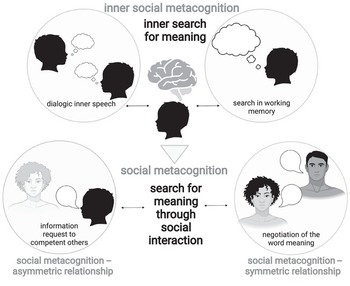
Figure 7.1 Abstract words as tools: how the processes of inner social metacognition and social metacognition might work. People might feel uncertain about a word’s meaning and, in phase 1, either inner search for words or engage in a dialogic inner speech to find a solution internally. In phase two, people might revert to others, either asking for information, in case of asymmetric expertise level, or trying to understand what the other intends with a given concept and negotiating with the other the word meaning. Inner speech can assist in phase 1 and phase 2, for example, inner articulating the questions and observations to present to others. The two phases/processes might not necessarily be in sequence but co-occur.
7.2 Language and Numbers
We can think of numbers as special kinds of abstract concepts: they have a perceptually bounded object referent, but this referent is not always the same. Numbers also differ from other abstract concepts because at least small numbers can be acquired through sensorimotor experience, especially manual interaction, as shown by literature on finger counting. In this section, I deepen the role played by linguistic experience for numerical acquisition and representation. I contend that small and large numbers differ in abstractness, and that language, and the mouth motor system, are more important for representing the more abstract higher numbers. I review neural, behavioral, and cross-cultural studies that support this claim.
Our species has a sophisticated and complex ability, that of using numbers. Can numbers be considered abstract concepts (Fischer & Shaki, Reference Fischer and Shaki2018)? One could say: “No because they have an object as a referent.” I would respond: “Yes, but a special kind of abstract concept.” Their referent can be an object, but it continuously changes: for example, the number “three” may refer to three boxes, three people, three houses, and three wounds. Hence, numbers are low-dimensional categories: elements of the category “three” might have in common only that they collectively are three and nothing else.
On the other hand, compared to concepts like “truth” and “freedom,” numbers are less detached from sensorimotor experience because they might have objects as a referent. Thus, their grounding in the sensorimotor system might be less debatable than other abstract concepts. Recently Villani et al. (Reference Villani, Lugli, Liuzza and Borghi2019) found that concepts that refer to numbers or computing (e.g., “addition,” “subtraction”) cluster together with spatial and temporal concepts and elicit more sensorimotor properties than other abstract concepts like emotions, mental states, philosophical-religious, and self-other concepts.
Numbers are interesting for the present book for at least two reasons. First, many empirical demonstrations show that numbers are grounded in perception and action. Various evidence has shown that finger counting is crucial for number acquisition and fundamental also for adults’ numerical representation (Andres et al., Reference Andres, Di Luca and Pesenti2008; Di Luca & Pesenti, Reference Di Luca and Pesenti2008; Fischer & Brugger, Reference Fischer and Brugger2011; Tschentscher et al., Reference Tschentscher, Hauk, Fischer and Pulvermüller2012). Our conception of space influences our representation of numbers (for a review, see Winter et al., Reference Winter, Marghetis and Matlock2015). Studies have shown that we represent numbers along a mental line and that the direction of this line depends on our culture, particularly on the hand on which we start to count (Fischer, Reference Fischer2008; Lindemann et al., Reference Lindemann, Alipour and Fischer2011) and the writing direction. For example, Western people represent low numbers on the left and high numbers on the right (the spatial-numerical association of response codes (SNARC) effect) (e.g., Fischer, Reference Fischer2001; Loetscher et al., Reference Loetscher, Schwarz, Schubiger and Brugger2008; Stoianov et al., Reference Stoianov, Kramer, Umiltà and Zorzi2008; Anelli et al., Reference Anelli, Lugli, Baroni, Borghi and Nicoletti2014). Numbers and calculations are also associated with the upward and downward direction, in line with the metaphor “more is up, less is down”(Winter & Matlock, Reference Winter, Matlock and Hampe2017; Woodin & Winter, Reference Woodin and Winter2018). For example, when people are in an elevator, they perform more additions while moving upward and more subtraction when the elevator moves downward (Lugli et al., Reference Lugli, Baroni, Anelli, Borghi and Nicoletti2013).
The second reason why numbers are interesting is that language influences their representation. Scholars debate whether speaking a language that does not possess names for high numbers might affect numerical abilities. According to an influential view, two separate systems exist. One concerns exact numbers, the other approximate quantities (e.g., Lemer et al., Reference Lemer, Dehaene, Spelke and Cohen2003); the first involves neural areas associated with linguistic processing (Dehaene et al., Reference Dehaene, Spelke, Pinel, Stanescu and Tsivkin1999). Evidence from different populations supports the view that language is pivotal for forming and using exact numbers. For example, Pica et al. (Reference Pica, Lemer, Izard and Dehaene2004) investigated the population of Munduruku, Brazil, which possesses exact numbers until the number five. Compared to French controls, they did not differ in approximate quantities, but their performance markedly decreased with higher numbers. Studies with the Piranha people in Brazil, who possess numerals only to designate “one” and “two” (Gordon, Reference Gordon2004), and with home-signers of Nicaragua, who do not have signs to indicate numbers (Spaepen et al., Reference Spaepen, Coppola, Spelke, Carey and Goldin-Meadow2011), reached similar results.
Do numbers and words referring to computing and calculating activate effectors? Much evidence shows that they engage the hand and associate numbers with manual actions (e.g., Gianelli et al., Reference Gianelli, Ranzini, Marzocchi, Rettore Micheli and Borghi2012; Ghio et al., Reference Ghio, Vaghi and Tettamanti2013). FMRI evidence shows that, when presented with digits and words referring to numbers from one to nine, the hemisphere contralateral to the hand used to start counting was activated; this activation differs in left and right starters (Tschentscher et al., Reference Tschentscher, Hauk, Fischer and Pulvermüller2012). Transcranial magnetic stimulation (TMS) studies revealed an increase in corticospinal excitability for the hand muscles during numerical judgments (Rusconi et al., Reference Rusconi, Walsh and Butterworth2005; Andres et al., Reference Andres, Seron and Olivier2007; Sato et al., Reference Sato, Cattaneo, Rizzolatti and Gallese2007). Other evidence shows that small numbers activate the precision grip, higher numbers the power grip (Lindemann et al., Reference Lindemann, Abolafia, Girardi and Bekkering2007; Moretto & Di Pellegrino, Reference Moretto and Di Pellegrino2008), and that observing either grasping hands or manipulable objects influenced numerical processing (Badets & Pesenti, Reference Badets and Pesenti2010; Ranzini et al., Reference Ranzini, Lugli, Anelli, Carbone, Nicoletti and Borghi2011). Large-scale evidence obtained observing gestures in TV news archives reveals that with larger numbers speakers use open hand configuration, outward movements, and a broader distance between the hands (Woodin et al., Reference Woodin, Winter, Perlman, Littlemore and Matlock2020). In a smart experiment, Domahs et al. (Reference Domahs, Moeller, Huber, Willmes and Nuerk2010) compared German deaf signers, German adults, and Chinese adults and asked them to decide which number was smaller or larger. Significantly, in the Chinese finger-counting system, numbers above five are represented with one hand, while for the other two groups, it involved two hands. They found that using two hands slowed down the responses.
To summarize: many studies indicate that the representation of numbers involves the hand effector. However, the evidence found pertains only to small numbers, until ten. After ten, language comes into play. Therefore, it is possible that, while the hand effector plays a role for small numbers, the mouth effector plays a significant role for higher numbers, for which the linguistic system is more crucial (in preparation with colleagues including Angelo Cangelosi, Martin Fischer, Caterina Villani, and Bodo Winter). This proposal, which should be tested, is compatible with the idea that numerical abilities involve different brain systems. Small numbers will rely on the subitizing system. Humans have this system in common with animals like pigeons, rats, fishes, and other primates; it allows us to evaluate approximate numerical magnitudes and count up to four without relying on language. We will then represent numbers up to ten by relying on the hand motor system. Then, language will come into play, together with the increase in the number of referents and the degree of abstractness of the numbers. We might need to keep high numbers longer in phonological working memory and even use inner speech to retrieve them. Such language engagement might have a motor counterpart, that is, the mouth motor system’s activation. Consistent with this claim, recent evidence from a two-digit number magnitude comparison shows that compatibility effects disappear under articulatory suppression in English and German (Bahnmueller et al., Reference Bahnmueller, Maier, Göbel and Moeller2019). Such involvement may be less pronounced for languages endowed with image-like characters. For example, Tang et al. (Reference Tang, Zhang, Chen, Feng, Ji, Shen and Liu2006) showed that while processing numbers, the left hemisphere’s phonological processing system is more engaged in English speakers than in Chinese speakers. Note that I do not intend to imply that language plays a role only for large numbers. Studies with children show that language is also pivotal for learning small numbers. Longitudinal studies reveal that numerical word knowledge in kindergarten children predicts later good math competencies (Slusser et al., Reference Slusser, Ribner and Shusterman2019). For example, Negen and Sarnecka (Reference Negen and Sarnecka2009) had 2-year-olds copy the experimenter who gave a puppet a given number of elements; children also had to recall the elements. Children mastering more number words outperformed the others (see also Negen & Sarnecka, Reference Negen and Sarnecka2012). Even though the task was not linguistic, knowing the names of numbers facilitated the performance. Hence, language might always be important, but I propose that it might assume a more critical role with the increase in number size.
7.3 Neural Underpinning of Abstract Concepts
Not only the acquisition of abstract concepts is influenced by language, but also their neural representation. This section illustrates the results of brain imaging studies on the neural underpinnings of abstract concepts. I discuss the role played by areas related to language production and comprehension, in particular frontal and temporal areas. I especially focus on the inferior frontal gyrus’s function in representing abstract concepts and words.
The neural representation of abstract concepts is clearly influenced by language. Meta-analyses on fMRI and positron emission tomography (PET) studies (Binder et al., Reference Binder, Desai, Graves and Conant2009; Wang et al., Reference Wang, Conder, Blitzer and Shinkareva2010; Wang et al., Reference Wang, Wu, Ling, Xu, Fang, Wang and Bi2017) show that the areas most typically involved during abstract concept processing belong to the left hemisphere. They are the left inferior frontal gyrus (LIFG) (mostly pars orbitalis, Broca’s area) (see also Della Rosa et al., Reference Della Rosa, Catricalà, Canini, Vigliocco and Cappa2018), the left middle temporal gyrus (LMTG), and the anterior superior temporal sulcus (STS).
I now consider these areas in turn. LIFG has been associated with verbal working memory, phonological processes, and subvocalizations. Its lesioning impacts phonology and syntax, while TMS on LIFG reduces the accuracy of the lexical decision. Within LIFG, the pars orbitalis is connoted for emotional and social aspects. The anterior temporal lobe (ATL) is crucial for conceptual representation.
Why would LIFG be engaged during abstract concept processing? Scientists have advanced different hypotheses. An influential one, very relevant for us, ascribed its engagement to the fact that, because they have low imageability (Paivio, Reference Paivio1990), we will need to keep them longer in working memory (Binder et al., Reference Binder, Frost, Hammeke, Bellgowan, Springer, Kaufman and Possing2000; Wang et al., Reference Wang, Conder, Blitzer and Shinkareva2010). This interpretation is entirely in line with the Words As social Tools (WAT) proposal (see Chapter 5.2). Since abstract concepts are complex, they generate uncertainty; hence they would be processed longer. Similarly, Shallice and Cooper (Reference Shallice and Cooper2013) propose that this area provides the complex logical functions they deem necessary to process abstract concepts. Other authors ascribe LIFG activation to semantic control and executive system regulation. Abstract concepts have low scores of contextual availability (Schwanenflugel & Stowe, Reference Schwanenflugel and Stowe1989), that is, they are less strongly associated with a single context, likely because they evoke a wider variety of contexts. This variability will require stronger executive control (Fiebach & Friederici, Reference Fiebach and Friederici2004; Noppeney & Price, Reference Noppeney and Price2004; Hoffman et al., Reference Hoffman, Binney and Lambon Ralph2015). Della Rosa et al. (Reference Della Rosa, Catricalà, Canini, Vigliocco and Cappa2018) recently employed a lexical decision task and found through a conjunction analysis that the only area where words with low imageability and low contextual availability converge is the LIFG. The regions associated only with low imageability are left-lateralized; those associated only with low contextual availability are more bilateral. Hence, LIFG might represent a crucial crossroads sensitive to both intrinsic and content information, such as imageability and relational, contextual information (semantic control), engaging different neural areas depending on the tasks. In this perspective, abstract concepts’ relational and combinatorial role counts more than their concrete/abstract character per se (Binder et al., Reference Binder, Conant, Humphries, Fernandino, Simons, Aguilar and Desai2016). Overall, this evidence shows that abstract concepts, because of their lower imageability and greater difficulty, are generally kept longer in short-term memory and require more top-down semantic control due to their variability across contexts. The more robust activation of LIFG when abstract words are presented without context, thus eliciting various possible contexts, confirms this interpretation (Hoffman et al., Reference Hoffman, Binney and Lambon Ralph2015). This role of LIFG is perfectly in line with the WAT account. Abstract concepts might generate higher uncertainty, and the process of searching for meaning might last longer compared to concrete concepts, as the solid concreteness effect reveals. Similarly, fMRI evidence showing that LIFG (orbitalis and triangularis areas) is engaged when reading sentences with emotion-social and social content (Mellem et al., Reference Mellem, Jasmin, Peng and Martin2016) over sentences without social aspects is clearly compatible with the WAT proposal of a link between linguistic and social experience in abstract concepts.
There is an important caveat about results on activation of the LIFG. Most of the conducted studies employ single words and tasks that involve shallow processing, such as the lexical decision task (Barsalou et al., Reference Barsalou, Dutriaux and Scheepers2018). The use of such stimuli and tasks might have rendered the role of language particularly crucial. However, the activation of LIFG is selective for abstract concepts and does not involve concrete ones. Notably, more abstract concepts are more often relational (Gentner & Asmuth, Reference Gentner and Asmuth2019), that is, concepts with less intrinsic properties. Furthermore, their meaning is typically more contextually and situationally dependent (Falandays & Spivey, Reference Falandays and Spivey2019). Hence, when words are presented in isolation and without a context, language can become more prominent than it usually is, especially for abstract concepts. These considerations might invite some caution and should lead scientists to adopt more varied and ecologically valid methods.
Other areas typically recruited, according to meta-analyses, are the LMTG usually engaged during text comprehension and understanding of lies, irony, and non-literal language (Ferstl et al., Reference Ferstl, Neumann, Bogler and von Cramon2008), and the left STS. LSTS is involved in various social processes, ranging from phonological processing and language perception to social processing (theory of mind (TOM)) (Beauchamp, Reference Beauchamp2015). A recent meta-analysis of fMRI and PET studies (Liebenthal et al., Reference Liebenthal, Desai, Humphries, Sabri and Desai2014) suggests that we can identify at least three functionally different areas. Its middle portion is specialized for speech perception and recognition, specially tuned to perceive native speech sounds; it is part of a pathway for speech recognition, connecting the auditory cortex to semantic regions of the left middle and inferior temporal cortex. It thus encodes mostly auditory rather than visual aspects of language. STS posterior part responds to multiple sources of information and is dedicated to comprehension, irrespective of the stimuli modality. It is more sensitive to nonlinguistic stimuli (sensory features, biological motion, emotional valence) than linguistic stimuli and is involved in associative thinking and semantic memory. Finally, anterior-dorsal STS (atSTS) is engaged during executive function and is sensitive to linguistic stimuli; thus, it can be dedicated to maintaining auditory sequences in short-term memory, while the STS posterior-ventral branches (ptSTS) might extend the functions of STS posterior part, being more involved in the semantics of nonlinguistic stimuli. The activation of this area, related both to speech processing and semantics, is consistent with our view that with abstract words, we might need to keep information in short-term memory longer to grasp their meaning fully. Consistent with this, another meta-analysis (Hein & Knight, Reference Hein and Knight2008) indicates that the anterior STS regions are mainly dedicated to speech processing, posterior regions for motion processing, audiovisual integration, and face processing. Crucially, the functionality of this area varies depending on the coactivation of other brain areas. When coactivated with the inferior frontal cortex, as during the processing of single abstract words, STS is involved in speech processing; when coactivated with medial prefrontal regions it is involved in mentalizing.
Atrophy of ATL gives rise to semantic dementia, a severe impairment of verbal and nonverbal semantic knowledge across different categories – abstract and concrete concepts, living and nonliving concepts, and people concepts. According to the influential hub-and-spoke model, ATL represents all categories, integrating and abstracting information from different modality-specific association cortices and forming a transmodal hub (e.g., Ralph et al., Reference Ralph, Jefferies, Patterson and Rogers2017). However, due to the different connectivity across the regions, ATL portions are specialized for specific concepts. Notably, particular ATL areas are differently sensitive to visual versus verbal information, hence to concrete versus abstract stimuli (e.g., Hoffman et al., Reference Hoffman, Binney and Lambon Ralph2015; Binney et al., Reference Binney, Hoffman, Ralph and Matthew2016; Rice et al., Reference Rice, Hoffman, Binney and Lambon Ralph2018). Superior ATL is specialized for processing auditory and verbal stimuli, relative to pictures, consistently with its connection with primary auditory processing areas in posterior superior temporal gyrus (STG). Indeed, the STG responds more strongly to abstract than concrete words (Hoffman et al., Reference Hoffman, Binney and Lambon Ralph2015), and anterior STG responds more to socially relevant abstract words than to socially relevant concrete ones (Rice et al., Reference Rice, Hoffman, Binney and Lambon Ralph2018; see also Pobric et al., Reference Pobric, Lambon Ralph and Zahn2016). In contrast, the ventromedial portion of ATL is more activated with pictures than words, likely due to its connections with visual processing regions in the ventral posterior temporal cortex. Consistently, superior ATL is more active during the processing of abstract concepts and ventromedial ATL of concrete concepts.
Different authors considered ATL a crucial area for social cognition, specifically, a central hub for storing and retrieving personal knowledge, including names of people, their biographies, and social concepts (e.g., Olson et al., Reference Olson, McCoy, Klobusicky and Ross2013; Wang et al., Reference Wang, Wu, Ling, Xu, Fang, Wang and Bi2017). Consistent with this, patients with semantic dementia often show social impairments. Recent evidence shows that the two visions might not be in contrast: anterior ventral ATL (vATL) regions will respond both to images and names of people, while the core ATL will be activated in a transmodal way (Rice et al., Reference Rice, Hoffman, Binney and Lambon Ralph2018). Hence, all or part of the ATLs represents social concepts, including knowledge of people (face recognition), emotional concepts, and ToM concepts.
While many views converge in showing engagement of the linguistic system for abstract concepts, the role played by linguistic rehearsal, and semantic information is debated. Sabsevitz et al. (Reference Sabsevitz, Medler, Seidenberg and Binder2005) propose that posterior areas of frontal regions and anterior areas of temporal regions primarily concern phonological working memory; they are more active with abstract concepts and nonwords. More anterior and ventral regions of IFG, particularly the pars orbitalis and posterior areas of STS, pertain to semantics. Proponents of the hub-and-spoke model (e.g., Ralph et al., Reference Ralph, Jefferies, Patterson and Rogers2017) consider ATL the hub for semantic information and delegate to the IFG a control function. My colleagues and I do not see such opposition and think that phonological retrieval – possibly through inner speech – can be a way to access semantic knowledge (Borghi et al., Reference Borghi, Binkofski, Castelfranchi, Cimatti, Scorolli and Tummolini2017) (see Chapter 3.1.1).
Notably, activating linguistic areas does not necessarily involve recruiting only these areas. All concepts are grounded and situated, and evoke situations and contexts. Hence, typically, areas related to conceptual content are also engaged. For example, reading social-emotional sentences – describing people in emotional situations (e.g., in which they felt happy, sad, angry, fearful, surprised, disgusted, etc.) – activates regions across the social brain. They are, in particular, aSTG/STS, but also other regions linked to aspects of social processing (Frith & Frith, Reference Frith and Frith2012), such as the orbital region of inferior frontal gyrus (IFG orbitalis), the ventromedial prefrontal cortex (vmPFC), and the amygdala, left lateral region of the fusiform gyrus and the posterior portion of the STS (Simmons et al., Reference Simmons, Reddish, Bellgowan and Martin2010; Mellem et al., Reference Mellem, Jasmin, Peng and Martin2016). Similarly, in an fMRI study, Wilson-Mendenhall et al. (Reference Wilson-Mendenhall, Barrett and Barsalou2013) demonstrated that abstract concepts activate in a distributed fashion areas related to their nonlinguistic content: for example, the concept “convince” activates brain regions related to mentalization and social cognition (e.g., medial prefrontal cortex, STS), while “arithmetic” engages regions related to numerical processing (e.g., bilateral intraparietal sulcus). Similarly, regions of ATL are engaged when processing social information. However, data about the activation of content are scattered. In recent fMRI work, Berkovich-Ohana et al. (Reference Berkovich-Ohana, Noy, Harel, Furman-Haran, Arieli and Malach2020) performed four different tasks: a classical linguistic task, such as verbal fluency or sentence conjugation; a visual imaging task (imagine tools/navigation); another visual task; and a task in which participants had to respond to the questions “Is man’s nature good or evil?”/Is there free will?” Thus, the authors did not use decontextualized stimuli but asked people to reason on some abstract issues. Abstract thinking activated mostly left lateralized frontal areas, including supplementary motor area (SMA) and premotor dorsal (PMD) in middle and medial frontal gyrus, the LIFG, including Broca’s area, and middle temporal gyrus (MTG) including Wernicke areas. Importantly, all these regions are part of a language processing circuit, and their activation did not overlap with that produced during visual processing. Despite the difference between the two concepts, the activation was remarkably consistent across items and across individuals.
To summarize, the activated area’s circuit is consistent with proposals according to which linguistic networks are crucial for abstract concepts’ processing. Does this pattern of results confirm the traditional view, according to which amodal linguistic information characterizes abstract concepts? No, for two reasons. The first is that sensorimotor areas are also engaged, for example, right hemisphere regions such as the superior frontal gyrus, precuneus (D’Esposito et al., Reference D’Esposito, Detre, Aguirre, Stallcup, Alsop, Tippet and Farah1997), anterior cingulate gyrus, amygdala, parietooccipital junction (Perani et al., Reference Perani, Cappa, Schnur, Tettamanti, Collina, Rosa and Fazio1999), and occipital gyrus (Jessen et al., Reference Jessen, Heun, Erb, Granath, Klose, Papassotiropoulos and Grodd2000); or left hemisphere areas like the left lateral (precentral gyrus) and medial (supplementary motor area) premotor cortex (Sakreida et al., Reference Sakreida, Scorolli, Menz, Heim, Borghi and Binkofski2013). The second reason is that careful reading shows that not only linguistic but also emotional (e.g., Vigliocco et al., Reference Vigliocco, Kousta, Della Rosa, Vinson, Tettamanti, Devlin and Cappa2013) and social (e.g., Mellem et al., Reference Mellem, Jasmin, Peng and Martin2016) areas are engaged. So, on one side, language is used as a means to retrieve information; on the other side, language does not seem to be independent of the social dimension.
Let us consider the possible predictions that distributional views of language would advance. According to distributional semantics theories, we can capture meaning through word associations linked to word content. Hence, these theories will predict the activation of linguistic areas and the conceptual content during abstract concepts’ processing. Instead, the pattern of data reveals that sensorimotor areas are activated, supporting the idea that concepts might be grounded in sensorimotor cortices. Furthermore, social areas are recruited independently of the conceptual content. Purely grounded views will instead primarily predict activations based on conceptual content. The pattern of data confirms hybrid views. Specifically, it supports the WAT view, according to which the language role does not only consist in maintaining semantic relations; rather, we should consider language as a whole, taking into account its interactive and social aspects (Borghi et al., Reference Borghi, Binkofski, Castelfranchi, Cimatti, Scorolli and Tummolini2017, Reference Borghi, Barca, Binkofski, Castelfranchi, Pezzulo and Tummolini2019; Borghi, Reference Borghi2020).
7.4 Abstract Concepts, Neuropsychological and Psychiatric Data
Neuropsychological and psychiatric data help to constrain theories of abstractness. My colleagues and I have proposed the WAT view, which assigns a central role to inner and outer language and social interaction for abstract concepts’ acquisition, representation, and use (Borghi et al., Reference Borghi, Barca, Binkofski, Castelfranchi, Pezzulo and Tummolini2019). This view can be improved in light of the evidence of populations with linguistic and social impairments (Borghi et al., Reference Borghi, Mazzuca, Da Rold, Falcinelli, Fini, Michalland and Tummolini2021). Here I address the use of abstract concepts in conditions characterized by reduced social abilities and limited or peculiar inner speech use, such as autism and schizophrenia. Then I briefly overview studies on abstractness and abstraction in a condition characterized by linguistic difficulties such as aphasia.
7.4.1 Abstractness and Autism Spectrum Condition
Autistic spectrum condition (ASC) is a neurodevelopmental condition characterized by impairments in social interaction and repetitive patterns of behavior (Roehr, Reference Roehr2013) (for a recent special issue, see Narzisi, 2020). I prefer the term ASC to the more common autism spectrum disorder (ASD) because it is broader and less connoted in a clinical sense. Studies on ASC can widely contribute to building and validating a theory on abstract concepts. Impairments in social interaction, in particular, characterize ASC. Furthermore, even if results are sometimes scattered and not always consistent, ASC individuals might have difficulties with abstraction and abstractness. To date, it has been impossible to establish a causal connection between the abstraction and abstractness ability and social ability. Still, there are various reasons why investigating ASC is critical for a grounded theory of abstract concepts that ascribes a crucial relevance to social interaction.
I first briefly review studies pointing to ASC characteristics that are indirectly relevant for the formation and use of abstract concepts, such as work on visualization, ToM, conversation and narratives, and inner speech. I focus on the literature on categorization.
7.4.1.1 Visualization in autism
An autistic scientist famously wrote, “All abstract thought needs to be converted to picture in order for me to understand” (Grandin, Reference Grandin2006; pp. 145). Various evidence is consistent with this claim and has shown the necessity for autistic individuals to visualize. Now think of the consequences this might have on the processing and use of abstract concepts. Abstract concepts are not easy to imagine. Classical work has shown that they evoke fewer images than concrete concepts, leading to slower processing and worse recognition of abstract words (the concreteness effect, Paivio, Reference Paivio1990). For years, scholars have used imageability ratings instead of concreteness/abstractness ratings to select abstract concepts. Recent work (Kousta et al., Reference Kousta, Vigliocco, Vinson, Andrews and Del Campo2011) has shown that imageability and abstractness are strongly correlated but not equivalent. Furthermore, being a strong visualizer can lead to more substantial difficulties with abstract concepts than with concrete concepts – and ASC individuals are strong visualizers. In autistic individuals, pictures have an advantage over words in providing access to semantics. To demonstrate this, Kamio and Toichi (Reference Kamio and Toichi2000) used a semantic priming paradigm with a within-modality (word-word) or cross-modality (picture-word) word complexion task. Unlike typical development participants, who performed equally in the two tasks, high-functioning autistic adolescents and adults performed better in the task involving pictures. Overviewing the results of different tasks (n-back, serial recall, dual-task, Raven’s progressive matrices, semantic processing, false belief, visual search, spatial recall, and visual recall), Kunda and Goel (Reference Kunda and Goel2011) conclude that ASC individuals think using pictures, even in tasks typically solved through verbal mediation. In line with this, ASC rehabilitation programs often use visual instruments, such as graphical organizers (Knight et al., Reference Knight, McKissick and Saunders2013) or virtual reality (Herrera et al., Reference Herrera, Jordan and Vera2006).
7.4.1.2 ToM in autism
ASC individuals have social interaction impairments. An influential, debated view has suggested that a dysfunctional mirror system might be the basis of social impairment in autism (e.g., Fabbri-Destro et al., Reference Fabbri-Destro, Gizzonio and Avanzini2013; Rizzolatti & Fabbri-Destro, Reference Rizzolatti and Fabbri-Destro2010; Fabbri-Destro et al., Reference Fabbri-Destro, Gizzonio, Bazzini, Cevallos, Cheron and Avanzini2019). For example, Dapretto et al. (Reference Dapretto, Davies, Pfeifer, Scott, Sigman, Bookheimer and Iacoboni2006) showed that high-functioning autistic children showed no mirror neuron system activity in the Broca’s area, inferior frontal gyrus –note that the left IFG is the neural area typically engaged during abstract concepts processing (for a meta-analysis, see Wang et al., Reference Wang, Conder, Blitzer and Shinkareva2010).
Do these difficulties influence the ability of ASC individuals to form and use mental states and emotional and social concepts? Again, we cannot demonstrate a causal influence between these capabilities. However, difficulties of ASC individuals with emotional, mental states, (EMSS) and social concepts are documented. Since the seminal work by Baron-Cohen et al. (Reference Baron-Cohen, Leslie and Frith1985), many studies have shown that ASC children have difficulties in adopting others’ perspective (ToM). Whether ASC implies a deficit or a delay in ToM (see the meta-analysis by Happé, Reference Happé1995) is debated. Consistent with these difficulties, evidence shows that autistic children have problems processing a specific kind of abstract concepts, namely, mental state concepts, like “believe” (Leslie & Thaiss, Reference Leslie and Thaiss1992; Dove, Reference Dove2019), and cognitive terms, like “thinking” (Tager-Flusberg, Reference Tager-Flusberg1992). Very relevant in this context are also studies on emotional concepts – indeed, ASC individuals often experience deficits in comprehension and expression of emotions (alexithymia). For example, Moseley et al. (Reference Moseley, Shtyrov, Mohr, Lombardo, Baron-Cohen and Pulvermüller2015) performed fMRI comparing the passive processing of emotion words, abstract verbs, and animal names in typical development and ASC individuals. They found reduced activity of motor areas and the cingulate cortex for emotional words and modulation of such activation related to autistic traits. Results of an unpublished study by Norbury et al. with ASC children(reported by Vigliocco et al., Reference Vigliocco, Ponari and Norbury2018) are inconsistent with earlier ones. The authors did not find differences between valenced and nonvalenced concrete and abstract concepts in a definition and lexical decision task between ASC children without language impairments and typical development controls. However, the details of the study and the materials are not reported, and participants were not controlled for alexithymia. Overall, while evidence showing ASC difficulties with mental states and cognitive terms is quite reliable, findings on emotional words suggest that ASC individuals might have impairments, but the results are more scattered. Discrepancies in the findings might also be due to sampling differences because ASC is a highly heterogeneous disorder. Although it is sometimes difficult to disentangle the social and emotional dimensions, the findings seem to favor more a view highlighting the difficulties of ASC individuals with social interaction than one emphasizing their emotional impairments.
7.4.1.3 Conversation and Narratives in autism
The ASC population consistently shows impairments with pragmatics; this occurs across the spectrum and independently of language capabilities. These impairments include difficulties in conversations, where ASC individuals rarely show an interest in others and do not report vivid personal details. The stories ASC people tell are less causally coherent, include a minor variety of words, and use fewer internal state language (ISL) terms (verbs and adjectives referring to internal and cognitive states like happy, to know) (for a meta-analysis, see Baixauli et al., Reference Baixauli, Colomer, Roselló and Miranda2016). ASC individuals also produce fewer spontaneous personal narratives with fewer mental state terms (Bang et al., Reference Bang, Burns and Nadig2013). A recent study applied sentiment analysis and abstraction analysis, two natural processing techniques, in two narrative tasks, telling a story from a book and describing a picture. ASC children’s narratives differed from those controls: they used less positive terms (and slightly less negative ones) and less abstract state verbs; no difference appeared in the picture description task (Chojnicka & Wawer, Reference Chojnicka and Wawer2020).
7.4.1.4 Inner Speech in autism
In our view, inner speech represents an essential inner monitoring tool crucial to processing abstract concepts (see Section 7.1.2) (Borghi & Fernyhough, Reference Borghi and Fernyhough2023). Inner speech can contribute to the inner search for abstract concepts meaning, to clarify their content by reexplaining it to us, or, finally, to prepare us to ask for information from more competent others (Borghi et al., Reference Borghi, Barca, Binkofski and Tummolini2018; Shea, Reference Shea2018; Borghi, Reference Borghi2020; Dove et al., Reference Dove, Barca, Tummolini and Borghi2020; Borghi & Fernyhough, Reference Borghi and Fernyhough2023). Studies on ASC and inner speech have mostly focused on planning, task-switching, set-shifting, short-term/working memory, and motor control. Across these domains, results suggest that the ASC population uses inner speech and verbally mediated thought less than the neurotypical population. Consistently, treatments typically aim to improve self-talk and verbal labeling for ASC individuals. However, a careful analysis of the literature shows that the empirical findings’ quality is not very high. Furthermore, the limited use of inner speech does not necessarily lead ASC individuals to perform worse in executive tasks and cognitive flexibility; hence, we should view the results with caution (for a review, see Williams et al., Reference Williams, Peng and Wallace2016). More crucially, I am not aware of studies directly investigating the relationship between abstractness and inner speech in ASC, which would be paramount to understanding whether the reduced use of inner speech contributes to limitations in abstractness capability. The reduced use of inner speech can also render inner monitoring more difficult. In some studies on memory, adults listened to sentences referring to actions, enacted them, and later recalled them. Findings on ASC individuals revealed altered monitoring for self-performed actions, showing a modified enactment effect (Zalla et al., Reference Zalla, Daprati, Sav, Chaste, Nico and Leboyer2010; Daprati et al., Reference Daprati, Nico, Delorme, Leboyer and Zalla2013).
Notably, part of the difficulties during outer and inner language use might also be partially due to hearing impairments. There is evidence that low verbal IQ and lack of communication typical of autism might be due to a deficit in auditory processing. Abnormalities in hearing can reduce the ability for ASC individuals to engage in joint attention with speakers and joint action with others (for a review, see Siegal & Blades, Reference Siegal and Blades2003). What are the relationships between these difficulties with abstract concepts? As my colleagues and I have proposed, with abstract concepts, we might need to rely more on other people and benefit particularly from their linguistic input. Pragmatics and hearing difficulties might thus contribute to the problems ASC individuals experience with abstractness.
7.4.1.5 Categorization in autism
Forming abstract categories implies the ability to categorize and put together different category members; this process might be harder with more abstract than with more concrete concepts because of the sparse and heterogeneous character of category members. Can ASC individuals easily cope with such difficulties? I first address the literature focusing on categorization and ASC and then illustrate the few studies directly focusing on abstract concepts.
The literature on ASC and categorization is scarce and nonsystematic and has often led to controversial results. An interesting study relates categorization to perception (Plaisted, Reference Plaisted, Burack, Charman, Yirmiya and Zelazo2001). Because for autistic children, perceptual stimuli are more discriminable, categorical boundaries will be sharper. This feature can explain two characteristics typically associated with ASC: the restricted interests in objects (e.g., their focus on a specific brand of cars), and the difficulties encoding new emotional expressions.
More interesting is evidence on abstraction, that is, the classification of items at different hierarchical levels (basic and superordinate). Some early studies did not find differences between ASC and typical development populations. For example, Tager-Flusberg (Reference Tager-Flusberg1985) found no difference in the categorization of either words or pictures at the basic and superordinate levels. Contrasting evidence showed that ASC children perform poorly in assigning objects to superordinate categories (e.g., trees, beds, humans, animals, tools, and vehicles), even if they do not have difficulties in categorizing perceptual information, such as differences in shape (Shulman et al., Reference Shulman, Yirmiya and Greenbaum1995).
Prototype extraction, which implies generalization processes, also presents difficulties in ASC children and adults (Minshew et al., Reference Minshew, Meyer and Goldstein2002). Some studies indicated that high-functioning autistic children are slower than controls in prototype extraction (Molesworth et al., Reference Molesworth, Bowler and Hampton2008) and prototype use (Church et al., Reference Church, Rice, Dovgopoly, Lopata, Thomeer, Nelson and Mercado2015) – they have difficulties with prototypes, for example, of natural faces (Gastgeb et al., Reference Gastgeb, Rump, Best, Minshew and Strauss2009) and dot patterns (Gastgeb et al., Reference Gastgeb, Dundas, Minshew and Strauss2012). However, there is also some counterevidence (Vladusich et al., Reference Vladusich, Olu-Lafe, Kim, Tager-Flusberg and Grossberg2010).
One of the difficulties for ASC children in categorizing can be their excessive focus on details. The influential weak central coherence theory (Happé & Frith, Reference Happé and Frith2006) argues that, because ASC people focus on details, they have difficulties finding abstract, general similarities useful to form categories. In keeping with this view, Johnson and Rakison (Reference Johnson and Rakison2006) report the results of a habituation and induction/generalization task on moving objects with ASC preschoolers. They found that ASC children attend to the relationship between specific object parts and motion trajectory but, in contrast to 18-month-old infants, ignore the whole object and significant correlations, such as the fact that entities with legs also possess eyes and desires and are alive.
People with ASC can overcome their difficulty with generalizations when instructed to focus on global aspects. A study with pictures using semantic distance as a measure of abstractness (the more distant the elements, the higher the distance) reveals this. When instructed, 8–17-year-olds with autism could use effortful analogical reasoning, even if they did not use it spontaneously. However, this ability, which correlates with understanding social situations, likely develops later than in typical development (Green et al., Reference Green, Kenworthy, Mosner, Gallagher, Fearon, Balhana and Yerys2014).
7.4.1.6 Abstract Concepts in autism
There are a few studies that directly address the distinction between concrete and abstract concepts in ASC. Eskes et al. (Reference Eskes, Bryson and McCormick1990) performed a Stroop task directly comparing concrete (e.g., ship) and abstract concepts (e.g., life). They found a similar performance in high-functioning autistic children and controls: abstract concepts interfered less than concrete and color-related ones for both groups. However, children were matched for reading ability but not for age; the ASC sample was small and with high age variations (8–19 years), differently from TD children (7–9 years). Finally, this work is related to a concrete, sensorial dimension – the color of the word. In another study, participants had to match a word with one of four pictures (Hobson & Lee, Reference Hobson and Lee1989). Autistic individuals performed worse than TD ones on emotion-related items but not on social and abstract items. However, the abstract concepts they used are not well distinguished from concrete superordinate concepts: they included concepts referring to emotions (e.g., “horror,” “surprise,” “delighted”) and the social dimension (e.g., “disagreement,” “sharing,” “greeting”), but their stimuli also encompassed some superordinate concepts (e.g., “coniferous”). Hence, caution is needed in making a generalization from these results. Furthermore, there is some contrasting evidence. I illustrated in Section 7.4.1.2 a study that failed to find differences between valenced and nonvalenced concrete and abstract concepts in definition and lexical decision (Norbury et al., reported in Vigliocco et al., Reference Vigliocco, Ponari and Norbury2018). In contrast, an fMRI study showed that autistic traits modulated the different activation of the motor cortex for abstract emotional concepts compared to animal names and abstract verbs (Moseley et al., Reference Moseley, Shtyrov, Mohr, Lombardo, Baron-Cohen and Pulvermüller2015).
Overall, despite some conflicting results, there is evidence of difficulties or delays of ASC individuals in categorization: with superordinates, but not in perceptual categorization; in prototypes extraction; and in finding general similarities among category members because of the focus on details. Finally, some scattered evidence suggests that they perform worse with abstract concepts, especially emotional ones. At the same time, there is evidence that they are visualizers rather than verbalizers. Their use of inner speech is reduced (Granato et al., Reference Granato, Borghi, Mattera and Baldassarre2022), and they might have difficulties reporting self-related experiences. The coexistence of abstraction and abstractness difficulties with problems in interacting with others suggests a relation between the two, even though further research is needed to deepen this issue.
7.4.2 Abstractness and Schizophrenia
In this section, I concentrate on schizophrenia. I discuss only a small fraction of studies, considering only the aspects of schizophrenia that might be relevant for a theory of abstract concepts that ascribes a crucial role to language and social interaction.
Schizophrenia is a heterogeneous psychiatric disorder. According to DSM 5, positive symptoms (e.g., delusions and hallucinations) and negative symptoms (e.g., reduced emotional expression) characterize schizophrenia. Notably, schizophrenic patients have overall language impairment in both discourse production and comprehension (Rochester, Reference Rochester2013; Swaab et al., Reference Swaab, Boudewyn, Long, Luck, Kring, Ragland and Solomon2013), communicative and pragmatics problems (Bambini et al., Reference Bambini, Arcara, Bechi, Buonocore, Cavallaro and Bosia2016), and difficulties in Theory of Mind (Parola et al., Reference Parola, Berardinelli and Bosco2018) and the social sphere. I shortly describe the problems of schizophrenic patients with pragmatics, ToM, and inner speech and illustrate one of the core features of schizophrenia, concretism.
7.4.2.1 Pragmatics, ToM, and Inner Speech in Schizophrenia
Let us first focus on pragmatics, that is, on the communicative use of language (Levinson, Reference Levinson1983), which includes both verbal and nonverbal communication modalities, such as gestures and facial expressions. Schizophrenic individuals typically experience pragmatic difficulties, as testified, for example, by the Assessment of Pragmatic Abilities and Cognitive Substrates (APACS) test (Arcara & Bambini, Reference Arcara and Bambini2016). Such severe pragmatic difficulties extend from comprehension to production and affect both linguistic and nonverbal abilities (e.g., production and understanding of gestures and facial expressions), as measured through the linguistic and extralinguistic scales of the Assessment Battery for Communication (ABaCo; Angeleri et al., Reference Angeleri, Bosco, Gabbatore, Bara and Sacco2012; Parola et al., Reference Parola, Berardinelli and Bosco2018). A recent debate focuses on whether these pragmatic difficulties depend on cognitive measures of general intelligence or ToM difficulties. According to the original proposal by Frith (Reference Frith2012a)(see also Champagne-Lavau and Stip, Reference Champagne-Lavau and Stip2010), difficulties with ToM account for pragmatic impairments. Other studies lead to mixed results. For example, Parola et al. (Reference Parola, Berardinelli and Bosco2018) suggest that pragmatic impairments of schizophrenic patients are not due to a decline in general intelligence and cognitive functions. The capability to use ToM, inferring other mental states, has a substantial impact on pragmatic disorders, particularly on the linguistic scale of ABaCo. However, it does not entirely account for them; specifically, it does not explain the extralinguistic scale results.
The debate on whether ToM entirely explains pragmatics difficulties or whether pragmatics and ToM difficulties typically co-occur in schizophrenic patients is outside the scope of this book. However, the fact that schizophrenic patients have pragmatics and ToM deficits and, at the same time, are affected by concretism (the tendency to interpret words literally, see Section 7.4.2.2) is crucial for an approach highlighting the critical role of language and social interaction for acquiring and using abstract concepts.
Not only do schizophrenic individuals experience difficulties with language and pragmatics, but they also have impairments in inner speech. In Section 7.1.2, I clarified that inner speech might be critical for processing and using abstract concepts. Crucially for the perspective that I am delineating, a recent study highlights how the inner speech of schizophrenic individuals with auditory verbal hallucinations has an “uncontrolled/uncontrollable character” (Petrolini et al., Reference Petrolini, Jorba and Vicente2020). Notably, auditory verbal hallucinations are among the hallmarks of schizophrenia since 70–80 percent of the population experience them. Schizophrenic individuals experience a deficit in self-monitoring (Pacherie, Reference Pacherie2008) and agency (Daprati et al., Reference Daprati, Franck, Georgieff, Proust, Pacherie, Dalery and Jeannerod1997); as some authors have underlined, auditory-verbal illusions might result from deficiencies in monitoring applied to inner speech production (Vicente, Reference Vicente2014).
These limitations in inner speech can be related to the limitations of schizophrenic individuals with executive functions. As revealed by a recent meta-analysis, the most critical areas are shifting, inhibition, visuospatial working memory, verbal manipulation, and, to a lesser extent, verbal working memory maintenance (Snyder et al., Reference Snyder, Kaiser, Warren and Heller2015). Petrolini et al. (Reference Petrolini, Jorba and Vicente2020) propose that, together with a reduced self-monitoring ability, difficulties in executive functions cause the uncontrolled character of inner speech. At the same time, the uncontrolled character of inner speech can also impact executive function. For example, compared to the inner speech of controls, schizophrenic individuals’ inner speech might be characterized by more intrusions (Alderson-Day et al., Reference Alderson-Day, McCarthy-Jones, Bedford, Collins, Dunne, Rooke and Fernyhough2014), have a more negative valence, and be more fragmented, being distributed across multiple voices that are perceived as externally generated rather than self-generated.
7.4.2.2 Concretism in Schizophrenia
Concretism, that is, the tendency to interpret language literally, is associated with classical work on schizophrenia (Bleuler, Reference Bleuler1911) and is now considered one of its core symptoms. For example, when required to explain what “That lawyer is a shark” means, schizophrenic individuals answer, “He swims very fast” (Bambini et al., Reference Bambini, Arcara, Bosinelli, Buonocore, Bechi, Cavallaro and Bosia2020). Researchers have investigated concretism using proverbs, irony, idioms, and metaphors. Recent evidence shows that the impairment of schizophrenic individuals is diffuse across the figurative types, even if they find verbal explanations of proverbs particularly challenging. According to Bambini et al. (Reference Bambini, Arcara, Bosinelli, Buonocore, Bechi, Cavallaro and Bosia2020), these results may suggest that concretism in schizophrenia becomes stronger as abstraction increases – proverbs, due to their moral content, are particularly abstract. Concretism is also modulated by individual and clinical variables, such as IQ. More importantly, it is influenced by “conceptual disorganization,” testifying formal thought disorders, and “difficulties in abstract thinking,” as measured by the Positive and Negative Syndrome Scale (PANSS; Kay et al., Reference Kay, Fiszbein and Opler1987). The difficulties of schizophrenic patients with figurative language in schizophrenia have also been associated with limitations in social abilities, such as impairments in ToM (Bambini et al., Reference Bambini, Arcara, Bechi, Buonocore, Cavallaro and Bosia2016; Parola et al., Reference Parola, Berardinelli and Bosco2018).
Studies on concretism are very important for our perspective because they suggest that, together with social, pragmatics, and ToM difficulties, schizophrenic patients have problems with abstraction and possibly abstractness. However, research has mostly focused on metaphors, idioms, proverbs, and irony, whereas to the best of our knowledge, studies focusing directly on the use of abstract concepts are lacking.
One of the few exceptions is a study by Minor et al. (Reference Minor, Bonfils, Luther, Firmin, Kukla, MacLain and Salyers2015). The authors analyzed the words produced during a semistructured interview to verify which categories of words were better predictors of symptoms. They found that negative symptoms were associated with fewer social concepts and that emotional words, particularly anger ones, were positively associated with reality distortion symptoms. Hence, schizophrenic symptoms are mostly related to the increase of negative emotional words (e.g., “hate,” “frustration,” “tantrum”) and the decrease of social words (e.g., “talking,” “celebrating,” “organizing”). Significantly, the use of social words was related to metacognition abilities, as measured through the Metacognition Assessment Scale (MAS-A; Lysaker et al., Reference Lysaker, Carcione, Dimaggio, Johannesen, Nicolò, Procacci and Semerari2005). This scale tests individuals’ ability to integrate information from different psychological sources, such as memories, emotions, and thoughts, to create a coherent story of their life. Another exception is the recent study by Nagels et al. (Reference Nagels, Kircher, Grosvald, Steines and Straube2019), who compared controls with schizophrenic patients with severe versus mild or no formal thought disorders. They saw videos of an actor pronouncing a concrete versus a metaphorical sentence, performing a gesture. They had to press a button to decide whether the gesture was related or unrelated to the sentence. Controls outperformed schizophrenic patients across all conditions. Notably, patients with severe formal thought disorders had the worst performance with abstract sentences, independent of IQ and years of education, while no difference was present with concrete ones. However, the study could not discriminate between linguistic utterances and gestures since it addressed matches/mismatches between the two. It thus revealed dysfunctions in gesture-language matching, particularly in an abstract context.
To sum up, research shows schizophrenic individuals’ linguistic, pragmatic, and inner speech difficulties and problems in ToM coexist with concretism, the tendency to interpret language literally. The few studies on abstractness reveal a decrease in emotional and social concepts at increased schizophrenic symptoms and difficulties with abstract gesture-sentence stimuli in patients with severe formal thought disorders. Overall, evidence collected so far can suggest a link between problems with abstract concepts and linguistic and social difficulties. However, more studies are needed that focus directly on abstract and not only on metaphorical concepts and idioms to reach a more reliable conclusion (Borghi et al., Reference Borghi, Mazzuca, Da Rold, Falcinelli, Fini, Michalland and Tummolini2021).
7.4.3 Abstractness and Aphasia
I believe that we need to be able to form flexible categories in order to learn abstract categories. Take, for example, extremely flexible categories such as ad hoc and goal-derived ones (Barsalou, Reference Barsalou1983; Reference Barsalou and Bower1991). An example of an ad hoc category is “ways to escape from the mafia” (Barsalou, Reference Barsalou1983). Goal-derived categories are more stable in memory than ad hoc ones, but their members are generally collected uniquely based on a common goal. Consider the goal-derived category “birthday presents”: it can include members of different taxonomic categories, such as animals, plants, and different kinds of artifacts (books, clothes, toys, records). Members of ad hoc and goal-derived categories generally aren’t perceptually similar; these categories are low dimensional (Lupyan & Mirman, Reference Lupyan and Mirman2013; Henningsen-Schomers & Pulvermüller, Reference Henningsen-Schomers and Pulvermüller2021), that is, they cohere only on a single or a few dimensions – in this case, the common goal. Low-dimensional categories can also share perceptual dimensions – for example, when we put together all red objects. Forming low-dimensional categories implies abstracting from many perceptual and nonperceptual features and isolating a single dimension, focusing on it. Low-dimensional categories might also have thematic similarities, generally co-occuring in the same theme or situation, although not visual similarities (Kalénine et al., Reference Kalénine, Mirman and Buxbaum2012a; Kalénine et al., Reference Kalénine, Mirman, Middleton and Buxbaum2012b). This is the case, for example, of “birthday presents” and “things to take from one’s home during a fire” (Langland-Hassan et al., Reference Langland-Hassan, Faries, Gatyas, Dietz and Richardson2021).
Abstract concepts are typically low-dimensional categories (Borghi, Reference Borghi2022a; see also the distinction between sparse and dense categories in Sloutsky, Reference Sloutsky2010). They do not have many perceptual common traits and share only a few elements. In a recent paper, I have addressed the differences between concrete concepts, goal-derived categories, and abstract concepts (Borghi, Reference Borghi and Djebbara2022b). Concrete concepts (e.g., “table”) typically assemble perceptually similar exemplars with common affordances. Ad hoc and goal-derived categories (e.g., “things to take to the seaside”) collect perceptually dissimilar exemplars, endowed with different affordances but referring to common sociocultural practices. Finally, abstract concepts (e.g., “truth”) collect dissimilar exemplars, the affordances of which might be based on common sociocultural practices. For example, being sincere and telling the truth are encouraged in various cultures. It is possible to hypothesize that learning ad hoc and goal-derived categories, which do not refer to similar elements and are low-dimensional categories, might bootstrap the later acquisition of abstract concepts (see Chapter 8.1.2, Figure 8.1).
Because low-dimensional categories have only a few common features, individuals might need more online linguistic support to form them. A way to test this hypothesis is to investigate categorization in aphasic people. Aphasia is a condition that impairs the ability to comprehend and produce language, typically due to a stroke, head injury, or neurodegenerative disease.
Lupyan and Mirman (Reference Lupyan and Mirman2013) found that individuals with aphasia performed worse than matched controls when they had to categorize objects that shared only one dimension but not objects that shared multiple dimensions. Importantly, the adopted task did not require verbal responses: they had to press a button to select, within a given array, pictures that respected a certain criterion, for example, all the blue things versus all the pictured fruit. The performance of aphasic participants was selectively correlated with their difficulties in naming, not by severity of their aphasia, the size and localization of the lesion leading to aphasia, and their overall semantic performance. This result supports the idea that language contributes to reifying categories – labels can make categories more compact and cohesive. More crucial is the recent work by Langland-Hassan et al. (Reference Langland-Hassan, Faries, Gatyas, Dietz and Richardson2021) on aphasia. The authors had aphasic people and age-, gender- and age-matched controls perform on a trial concreteness task. Items consisted of one target image and four possible matching ones and were normed for visual similarity and common setting (which of the four images goes best with the top image?) to obtain a measure of trial concreteness. Trial concreteness does not correlate with conceptual concreteness, as assessed through imageability and concreteness/abstractness ratings: it represents an independent measure of abstract thought obtained using nonverbal stimuli. During the experiment, participants had to decide which of the four presented images matched better with the target; measures were accuracy and response times. Confidence ratings and response times were also collected. Lower trial concreteness resulted in lower accuracy, lower confidence, and longer response times. Aphasic individuals scored lower than controls in both accuracy and response times. More crucially, aphasic individuals scored lower than controls in response times, at the decrease of the trial concreteness level. However, the effect did not extend to confidence scores and response times, suggesting that aphasic patients might have metacognitive impairments. Notably, however, their confidence response time negatively correlated with their linguistic ability, meaning that people might feel less confident when unable to find an appropriate label. Overall, the results support the hypothesis that language provides vital support for abstract thought and metacognition about abstract thought.
7.4.4 Summary: Autism, Schizophrenia, Aphasia
Linguistic and social experiences are crucial for all concepts, but they become more critical at increasing conceptual abstractness. Research on autistic and schizophrenic individuals suggests a pivotal role for social interaction, and inner speech, in acquiring and developing the capability to use abstract concepts. Research on aphasia highlights the importance of language in supporting our ability to use abstract thought. New data are necessary to come to definite conclusions. However, the neuropsychological and psychiatric studies I have overviewed indicate that both language and social interaction play a paramount role in developing abstract concepts.
7.5 Abstractness and Language as an Inner Tool: Conclusion
This chapter contains the proposal that language, both in its inner speech and overt version, represents a critical instrument to potentiate cognition and a crucial means for acquiring and using abstract concepts. In line with a Vygotskian perspective, an instrument initially developed for social interaction can be used both for self-regulation and as a public communication means. I have overviewed various findings indicating a more substantial mouth motor system involvement for words with more abstract components. I have then considered a special kind of abstract concept, namely, numbers; evidence so far reveals that they activate the hand motor system, likely because of the finger-counting ability we develop during childhood. I hypothesized that the case might differ for high numbers, where the linguistic system’s involvement might be critical for memorization and processing. The involvement of language – and the mouth motor system – can be due to different mechanisms. I have outlined them, proposing that, in most cases, inner speech will be critical for their displacement. A review of the neural bases of abstract concepts processing and linguistic pathologies, such as aphasia, completes the chapter. Overall what I have reviewed supports the idea of a determinant role of language as an inner tool supporting the acquisition and use of abstract concepts – to enhance motivation, sustain memories, find solutions in ourselves, and prepare to revert to others.
If you don’t understand, ask questions. If you’re uncomfortable about asking questions, say you are uncomfortable about asking questions and then ask anyway. It’s easy to tell when a question is coming from a good place. Then listen some more. Sometimes people just want to feel heard. Here’s to possibilities of friendship and connection and understanding.
Alone, we can do so little. Together, we can do so much.
In earlier chapters, we have seen that abstract concepts (e.g., “truth”) typically do not have single objects as their referent and are more detached from sensorimotor modalities than concrete concepts. And yet, they also activate sensorimotor, interoceptive, and emotional experiences (e.g., Villani et al., Reference Villani, Lugli, Liuzza, Nicoletti and Borghi2021; Banks & Connell, Reference Banks and Connell2023). In Chapter 7, we saw that abstract words can work as tools enhancing our perception and interoceptive abilities. More crucially, they evoke social and linguistic experiences more than concrete concepts. As I have argued, words are vital as they are the “glue” that can keep together heterogeneous and varied experiences. In this chapter, I aim to demonstrate that the idea that words are social tools is particularly crucial for abstract concepts. I start by reviewing studies on abstract concepts’ social acquisition in infants and children. Then I focus on new methods for addressing the online use of abstract concepts in interactive situations. Finally, I deal with the social function that abstract concepts might cover, speculating about the possible reasons for why they evolved.
8.1 Language and Abstract Concepts Acquisition
In this section, I contend that social and linguistic experiences contribute to forming and learning concrete concepts and are essential to acquiring abstract concepts. This section views the current developmental literature that supports this claim. It focuses on infants and children and has no pretense of exhaustivity.
An essential part of the Words As social Tools (WAT) proposal (Borghi & Cimatti, Reference Borghi and Cimatti2009; Borghi & Binkofski, Reference Borghi and Binkofski2014; Borghi et al., Reference Borghi, Barca, Binkofski, Castelfranchi, Pezzulo and Tummolini2019) deals with conceptual development. My colleagues and I propose that to acquire abstract concepts, the input of others is essential. Because abstract concepts are collections of very heterogeneous exemplars, the contribution of other people and linguistic labels in helping us form them is pivotal. This statement clearly does not imply that social interaction and language do not play a role in all kinds of concepts, both concrete and abstract ones. Simply put, the point is that when the correlational structure of the environment assists learners less, other people have to take over, offering social and linguistic scaffolding.
My colleagues and I have explained elsewhere how we think that statistical associations between words and that perceptual experiences with their referents and social aspects both concur in early word learning (Tomasello & Carpenter, Reference Tomasello and Carpenter2007; Smith et al., 2018; Tomasello, Reference Tomasello2018). The social aspects might assume progressively more relevance in the course of development, especially with more abstract words (Borghi & Binkofski, Reference Borghi and Binkofski2014; Borghi et al., Reference Borghi, Barca, Binkofski, Castelfranchi, Pezzulo and Tummolini2019). I now illustrate some studies on conceptual development, showing that language and social interaction are crucial for acquiring abstract concepts.
8.1.1 First Abstract Concepts, Language, and Social Interaction in Infants
Abstract words are typically acquired later than concrete ones, as the date of age of acquisition reveals. Analyses have revealed that concrete words represent 75 percent of the most frequent words of children (from first to eighth grade) and only 28 percent of the most used words of adults (Brown, Reference Brown1957, reported in Schwanenflugel, Reference Schwanenflugel1991). During childhood, the number of abstract words increases dramatically: age of acquisition ratings suggest that at the age of four, less than 10 percent of known words are abstract, while they amount to more than 40 percent of all words at age twelve (Ponari et al., Reference Ponari, Norbury and Vigliocco2018).
Studies on infants specifically focusing on abstract concepts are few. An important one investigates the comprehension of abstract and concrete words in 6–16-month-old infants (Bergelson & Swingley, Reference Bergelson and Swingley2013). Parents said the name of one of two videos shown to the infants. Results revealed that 10-month-olds, but not younger infants, looked at the video effectively named by their parents; thus, already at ten months, infants showed understanding of simple abstract words like “uh-oh” and “all present.” Children’s success with abstract words significantly increased around fourteen months. Notably, infants demonstrate comprehension of concrete words at around six months of age. The greater difficulty of abstract concepts might be due to their referential uncertainty, enhanced by the fact that parents pronounce the concept nouns in the presence of their referents less often than with concrete concepts. Hence, abstract words are harder to learn because it is more difficult for children to establish referents. What changes at ten and fourteen months allow the acquisition of abstract concepts? Notably, two crucial modifications in social cognition occur at around ten and fourteen months. The ability to follow the gaze of others at ten months might be particularly decisive in selecting and forming categories based on elements that do not have common perceptual features. Even more crucial might be the emergence of a developed form of joint attention at fourteen months, in which the infant understands what both she and the adult know together. Interestingly, there was no correspondence between parental reports and naturalistic data. While parental reporting underlined continuity in word acquisition, in line with an accumulator model, naturalistic data on comprehension obtained in the lab revealed a boosting effect between 10–12 and 14 months old (Bergelson, Reference Bergelson2020), corresponding to the development of critical social abilities and the emergence of the first produced words. Hence, parents do not seem to notice the boosting effect on their children’s language acquisition; they also use abstract words less consistently with their referents than they do with concrete words. Similar findings are reported by Katharina Rohlfing and collaborators (Grimminger et al., Reference Grimminger, Rohlfing, Lüke, Liszkowski and Ritterfeld2020), who showed that parents already used decontextualized talk when speaking to infants in their first year of life. We can consider this decontextualized talk more abstract. For example, observing parent–child interactions, the authors found that when children were 12 months old, almost 16 percent of all parental utterances were decontextualized, with an individual variation from 3 to 33 percent. Most of these decontextualized utterances focused on nonpersonal stories, past events, and comparisons of something present to something known by the child. Notably, whether or not decontextualized, that is, more abstract speech, was used, had no differential impact on later language development, as assessed at twenty-four months.
Studies on pacifier use (see Chapter 7.1.1) have shown that language widely contributes to the acquisition of abstract concepts. These studies have indicated that pacifier use, influencing the mouth movements, impacts both the conceptual relations produced in a definition task and the response times in a categorization task, leading to longer response times with abstract compared to concrete and emotional words (Barca et al., Reference Barca, Mazzuca and Borghi2017; Reference Barca, Mazzuca and Borghi2020; Barca, Reference Barca2021). However, these studies investigated the long-term effect of pacifier use in first- and third-grade children. As I saw with Laura Barca and Claudia Mazzuca in a recent study with 24–36-month-old children, instead, that pacifier use does not impact the pattern of acquired words in infants. Many possible reasons underlie this result. First, parental reports might be less reliable than direct observation. Second, and more crucially, the investigated words differ consistently in the studies my colleagues and I performed on school-age children and this study on infants. To access conceptual knowledge in infants, we used a questionnaire compiled by parents, the Primo Vocabolario del Bambino (Caselli et al., Reference Caselli, Bello, Rinaldi, Stefanini and Pasqualetti2015); adapted from MacArthur-Bates Communicative Development Inventories (CDIs). Hence, for example, we asssessed whether infants use, among others, words related to sounds of nature, vehicles, food, body parts, people, routines, and verbs. Six independent researchers evaluated the concreteness/abstractness of all the words on the questionnaire. Results showed that the number of produced words did not vary as a function of pacifier use. In addition, there was no clear pattern, indicating that prolonged pacifier use might influence more abstract than concrete concepts. Aside from the fact that parental reports might not be entirely reliable and that we used ratings obtained by adults and not by infants, the terms defined as abstract were not particularly complex. For example, we classified objects (e.g., “box,” “toothbrush,” “pillow”) as more concrete than temporal expressions (e.g., “tomorrow,” “morning,” “late”). Yet, even these temporal expressions might not be “hard words” (Schwanenflugel, Reference Schwanenflugel1991; Gleitman et al., Reference Gleitman, Cassidy, Nappa, Papafragou and Trueswell2005) to learn, that is, words in order to understand the meaning of which, people need to use inner speech or revert to others to ask for information. Therefore, children might recruit the mouth motor system later, when they have to learn harder and more complex concepts like “justice.” Inner reexplaining of the meaning, talking to oneself, and reverting to others because of the low confidence and uncertainty on the word meaning might occur more plausibly for words like “freedom” than for words like “to carry,” even though “to carry” is more abstract than “table.”
So, children learn abstract concepts later than concrete ones. But why do people learn abstract categories, and what is their function? A recent study by Lewis et al. (Reference Lewis, Colunga and Lupyan2021) based on parentally completed checklists of children’s vocabulary suggests that children who learn earlier superordinate categories later experience a more robust vocabulary growth; the study focuses on the period between 19 and 26 months old. To be precise, children who have acquired more general nouns and verbs (e.g., “animal” instead of “fox”; “move” instead of “run”) learn more words associated with the previously acquired superordinate term. The authors rule out the result being due to general intelligence. However, they cannot exclude the effect being due to the children’s exposition to a culturally richer milieu, where a greater number of different words are used.
One potential problem of work on infants is that most studies make use of parental reports and parental ratings of children’s production (e.g., Frank et al., Reference Frank, Braginsky, Yurovsky and Marchman2017); while this has the advantage of reaching many children and parents, it might also limit the reliability of the results (Lewis et al., Reference Lewis, Colunga and Lupyan2021). Ecological methods, in which children freely interact with their parents, are crucial to understanding how learning the first abstract concepts occurs. Specifically, these paradigms allow researchers to consider the role of memory and investigate how learning happens in time. Wonderful examples concern analyses of learning new words in children, in which the children wear a head-mounted camera, allowing online checking of their interactions with the surrounding objects and people (e.g., Yu et al., Reference Yu, Suanda and Smith2019, Reference Yu, Zhang, Slone and Smith2021; Slone et al., Reference Slone, Smith and Yu2019). Recent evidence on a toy session in which dyads composed of toddlers (mean age: 21 months) and parents interacted suggests that toddlers and parents represent a system endowed with memory. Hence, they do not simply perform curiosity-driven actions but engage in interactions characterized by a story-like structure (Karmazyn-raz & Smith, Reference Karmazyn-Raz and Smith2023). For example, toddlers interact with toys, followed by parents who interact with the same toys and talk. Toddlers return to their preferred toy and explore new toys and situations, and parents and toddlers always maintain tight time coordination of manual actions with objects and talk. Their actions derive from the previous ones and influence the next, making optimal conditions for learning, passing from working memory to stable memories. Increasing the knowledge of the relations between toys, their predictive errors on the action that objects afford decreases. Notably, this study focuses on a section of free play with toys, where parents and toddlers coordinate in interacting with objects. Nevertheless, one could predict that the role of memory and time can be even more critical in learning abstract concepts, where the social tuning between the actors might be particularly crucial (see Section 8.1.2).
Ecological studies investigating children’s interaction with their parents or peers have a further advantage: they allow the direct tracking of children’s vocabulary in use, even if the samples are not large. In a recent study (Bellagamba et al., Reference Bellagamba, Borghi, Mazzuca, Pecora, Ferrara and Fogel2022), my colleagues and I analyzed the emergence of abstract concepts in interactive mother–child situations. We used a longitudinal database on infant–mother interactions made available by our colleague Alan Fogel. The transcription of children’s vocabulary production was based on a previous study by Camaioni et al. (Reference Camaioni, Aureli, Bellagamba and Fogel2003). We coded the words produced by eight children, four boys, and four girls, at ten months and then at twenty-four months. We distinguished the words in three degrees of abstractness: low, intermediate, and high. For example, words with a low level of abstractness included, among others, objects that children could manipulate, visible parts of the bodies, and words referring to their mother, who was present. Words of intermediate level included names of relatives and body parts that were not present or visible (e.g., “grandma,” “eyes”), questions, descriptive words (e.g., “nice”), locations, and internal physiological states (e.g., “hot”). Finally, words of high abstractness level encompassed pronouns, quantifiers (“more,” ”some”), abstract routings (e.g., “all done!”), and internal states referring to emotions, volition, cognition, and morality (e.g., “love,” “need,” “pretend,” and “bad”). Results clearly showed that the abstract concepts increased with age, with a significant shift between 12 and 15 months old and between 22 and 24 months old. While there was a general increase in abstract concepts, a fine-grained analysis of the various age groups allowed us to record the emergence of their different kinds. Within abstract concepts, abstract routines were already present from the first age group (12–15 months); negations, personal pronouns, and numbers emerged around 16–18 months; while abstract assertions and quantities emerged around 19–21 months. Our results also suggest why creating and using abstract concepts might be important. Indeed, we found that the larger the vocabulary size, the higher the number of abstract concepts produced. This result can have two different interpretations. First, it might suggest that children must master language proficiently to use abstract concepts (Gleitman et al., Reference Gleitman, Cassidy, Nappa, Papafragou and Trueswell2005) since language is essential to learning new abstract concepts. Alternatively, this finding shows that both superordinate and abstract concepts promote language learning, extending the results of Lewis et al. (Reference Lewis, Colunga and Lupyan2021). Whatever the correct interpretation, in both cases, these results highlight a tight relationship between language learning, social interaction, and abstract concept learning.
To summarize: studies on infants, realized both with questionnaires and naturalistic observations, show that abstract concepts, even the simplest ones, emerge later than concrete ones. Evidence suggests that such emergence might be motivated by significant social changes, such as the ability to follow the gaze of others and to engage with them in complex forms of joint attention and joint action. While they talk to infants, parents use words that often do not coexist with their referents; this contributes to making the social abilities to follow their gaze and understand what they know crucial. Besides pointing out the importance of social interaction for acquiring abstract concepts, I have addressed why people learn to master abstraction and abstractness. Some studies suggest that learning superordinate and abstract concepts is strictly linked with the richness of linguistic vocabulary. Further research should determine whether learning superordinate and abstract concepts plays a causal role in facilitating linguistic acquisition in infants or whether they are simply correlated to the broadness of the productive vocabulary. I will now review some studies on social interaction in children at an age at which they master more abstract concepts.
8.1.2 Abstract Concepts, Language, and Social Interaction in Children
As I have mentioned, abstract concepts grow from 10 percent of a child’s production at 4 years old to 40 percent at 12 years old. Why such a marked increase? What happens at age 12? The school context undoubtedly has an influence, but there might be maturational factors that allow children to develop their capability for abstractness. I hypothesize that children learn to rely more on other people and become more sophisticated in their ability to choose their informants.
In a recent study, my colleagues and I tested the hypothesis that 5–7-year-old children will rely more on others when comprehending abstract rather than concrete concepts (Paoletti, Fini et al., Reference Paoletti, Fini, Filippini, Massari, D’Abundo, Merla and Borghi2022). We designed a very simple task similar to a lexical decision: children listened to names and were required to decide whether they existed; if the word existed, they had to press a button. We presented concrete and abstract words and nonwords. We thus recorded response times and accuracy and, through thermal imaging, the nasal tip’s temperature. Analysis of response times and errors revealed that children performed better with concrete than with abstract concepts – for the first time, we demonstrated the concreteness effect with response times in very young children (see also Lund et al., Reference Lund, Sidhu and Pexman2019). Notably, we found a higher increase in the nasal tip’s temperature with abstract concepts. This increase in temperature in specific facial regions correlates with the emotional state and the signals of the sympathetic and parasympathetic systems. The parasynthetic system activation leads to vascular relaxation and an increase in temperature (Aureli et al., Reference Aureli, Grazia, Cardone and Merla2015) and indicates prosocial behavior. This finding suggests that, with abstract concepts, children might have been more uncertain, as the pattern of response times and errors suggests. This uncertainty leads to a more substantial reliance on others. Whether these others are the people in the experimental room or hypothetical others that might support the children, even if not directly present in the lab, cannot be determined based on current data. The mechanism of relying on others may be activated, as one of the possible outcomes of an internal monitoring process, when one experiences uncertainty and little confidence (see Borghi et al., Reference Borghi, Fini, Tummolini, Robinson and Thomas2021; Fini & Borghi, Reference Fini and Borghi2019).
Provided that, with abstract concepts, individuals rely more on others, it is important to achieve the ability to select the “right” others, that is, the others who are competent and can provide rich information. What must children develop to be able to choose the right experts? According to Kominsky et al. (Reference Kominsky, Zamm and Keil2018), people need to have some notion of causal mechanisms to ask for help from others. Kominsky et al. (Reference Kominsky, Zamm and Keil2018) performed experiments with 7–10-year-olds and adults and demonstrated that the more causally complex an object is, the more likely individuals are to ask for help. For example, children are more likely to revert to others when interacting with objects as complex as a microscope, which has various diverse components. Even 5-year-olds have a sense of causal complexity and use it in asking for help. For example, 5- and 6-year-olds, but not 4-year-olds, expect complex artifacts to be internally complex and are sensitive to the number of internal parts. Yet, only older children are sensitive to the differences and interconnections between these parts (Ahl et al., Reference Ahl, Amir and Keil2020). In fact, the ability to detect when something is complex develops more clearly around 7–9 years of age. Children of 7–9-years-old and adults, but not 5–6-year-olds, were able to determine the complexity of an object and decide whether they needed help to fix it. To do this, they were able to select relevant information (e.g., the difficulty in building an object or in fixing it) over irrelevant information (e.g., the difficulty in spelling its name or in seeing it at night) (Ahl et al., Reference Ahl, DeAngelis, Stephenson, Joo, Keil and Keil2018). The difficulty of younger children thus consists in not being able to filter and select the right pieces of information. Hence, the humans’ ability to judge whether they need help and select the right informants develops gradually, with a major change after age six. In another study on numerical competence (Kominsky et al., Reference Kominsky, Langthorne and Keil2016), the authors investigated whether children distinguish between ostentatious confidence and real competence. Kindergarten and first-graders did not choose informants who told them that they did not know, for example, the number of all the leaves of all the trees in the world, and preferred informants who pretended to know. After fourth grade, children were able to identify competent people on whom to rely, that is, people who told them it was possible to know the number of windows of the White House but not to foresee the most popular boy name on October 2224 (see Chapter 3.2.2). Despite these age differences, even younger children could distinguish what information could be knowable and what could not. However, they were either not able to integrate this knowledge with that about the informants, or they tended to believe what other people told them anyway.
Some studies show that the acquisition of emotional concepts precedes that of purely abstract concepts (see Chapter 5). Researchers have proposed that emotional terms can provide a bootstrapping mechanism – being the first words children learn without an object as a referent, emotional terms can help children learn more abstract concepts. Ponari et al. (Reference Ponari, Norbury and Vigliocco2018) offer evidence consistent with this. They performed an auditory lexical decision task with children from age 6 to 12 and found the facilitation of positive words over negative ones in 8- and 9-year-olds. Valence did not affect children of the other age groups, likely because younger children did not know many words and older children had already acquired neutral abstract words. Lund et al. (Reference Lund, Sidhu and Pexman2019) employed an auditory lexical decision to test 5-, 6-, and 7-year-olds; overall, they found a response times facilitation of positive over negative words; they also found an interaction showing that 6-year-olds processed faster positive abstract words than neutral abstract words. Kim et al. (Reference Kim, Sidhu and Pexman2020) also found effects of valence in a recognition task with 7–8-year-old children: accuracy was higher for negative than for neutral words, but only for abstract words, while no effect of valence was present in concrete words.
My colleagues and I propose that goal-derived categories might also contribute to learning more abstract concepts (Borghi et al., Reference Borghi, Barca, Binkofski, Castelfranchi, Pezzulo and Tummolini2019; Borghi, Reference Borghi and Djebbara2022b). The members of goal-derived categories are generally assembled based on common goals and do not have many common properties (Barsalou, Reference Barsalou1983; Reference Barsalou1985). For example, the goal-derived category “birthday presents” can include records, books, animals, and plants – elements that belong to disparate taxonomic categories. Hence, they violate the correlational structure of the environment. Unlike other low-dimensional categories (Lupyan & Mirman, Reference Lupyan and Mirman2013), such as “red objects,” the feature they have in common is not a perceptual one. In this respect, they strongly resemble abstract concepts. Differently from the exemplars of abstract categories, the members of goal-derived categories can be objects (e.g., “birthday presents”), and goal-derived categories based on shared goals. However, goal-derived categories, like abstract concepts, can also refer to activities (e.g., “things to do during the weekend”). According to an influential view (Lucariello & Nelson, Reference Lucariello and Nelson1985; Nelson, Reference Nelson1988;), slot-filler categories, based on a shared function, are the basis of the formation of superordinate categories. Hence, preschoolers will not possess taxonomic categories but event-based categories, where each slot can be filled by various elements. For example, the event “sleeping” includes a slot related to possible sleep locations and another to sleeping time. Initially, each slot can be filled by only one value (e.g., “bed”), but with further experience, other values might fill it (e.g., “armchair,” “train”). Slot-filler categories posit the foundations for the development of taxonomic categories; for example, the superordinate category “food” is composed of the slot-filler categories “food for breakfast,” “food for lunch,” etc. As I have explained, the creation of superordinate concepts pertains to the process I called abstraction, which is related to but different from abstractness (for a similar distinction, see Bolognesi, Reference Bolognesi2020; Bolognesi & Caselli, Reference Bolognesi and Caselli2022). Even if no evidence has been collected so far, one can hypothesize that children become able to form abstract concepts only if they can apply the slot-filling mechanism and create low-dimensional categories, especially if the feature(s) the various members share is not a perceptual one (Figure 8.1). Across development, the timeline of word acquisition reflects this pattern: abstract concepts are acquired later than concrete ones and later than superordinate ones.
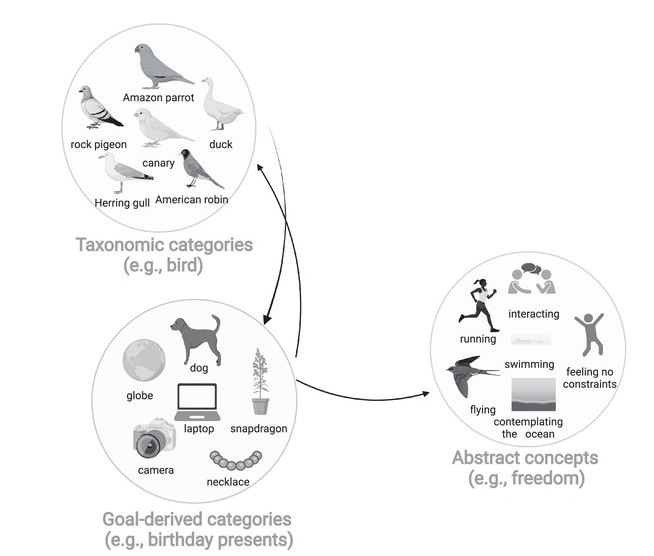
Figure 8.1 The mechanism that might lead from taxonomic categories to goal-derived categories to abstract concepts. While the members of taxonomic categories are perceptually similar, those of goal-derived ones may belong to different taxonomic categories and are flexibly assembled based on common goals. Similarly, the members of abstract categories are heterogeneous, and this partly explains why linguistic explanations facilitate their acquisition.
In sum, in this section, I have outlined some mechanisms that might lead children to learn abstract concepts. A precondition to learning abstract concepts like those used by adults is, in my view, the development of the ability to appropriately interact with others, understanding if they are competent or are pretending to know what they do not know. Notably, sociality is fundamental both to acquiring concrete concepts, either basic or superordinate ones, and to learning abstract concepts. However, social support is needed for different reasons. When infants learn the word “bottle,” parental support is needed to establish reference. Social support might be even more necessary when children learn superordinate words, like “animal,” which are more general, and goal-derived categories, like “things to take on holiday” (Bellagamba et al., Reference Bellagamba, Borghi, Mazzuca, Pecora, Ferrara and Fogel2022). However, I hope to have clarified that abstractness, although related, is different from abstraction. Superordinate words often refer to bounded referents, whereas abstract concepts do not; they instead refer to a heterogeneous set of situations, events, and states. When children acquire the abstract concept of “freedom,” other people might help them think of the different and sparse referents to which the category points. But this might not be the whole story. To form and use abstract concepts, children have to become able to go above what they perceive through the senses. For example, they should see a scene in which someone runs on the grass not only as an exemplar of the event “running” but also as an exemplar of the category “freedom.” Here, the others might not only be needed to establish reference (Dove, Reference Dove2016) but also to scaffold children to engage in abstract thought, a special kind of thought that involves fantasy, imagination, emotions, etc. Others might thus become “intellectual reference points”(Fini & Borghi, Reference Fini and Borghi2019). Hence, for future research, it will be paramount to investigate the acquisition and use of concrete concepts of different hierarchical levels, goal-derived concepts, and abstract concepts in different social contexts. In this framework, the role played by social competencies becomes fundamental for the learning and use of abstract concepts. I propose that children start to acquire and use many abstract concepts when they can rely on other people and select the right informants. Among possible mechanisms that bootstrap the acquisition of abstract concepts, an important role is played by the acquisition of emotional concept (the first concepts that do not have an object as referent) and goal-derived categories (the first concepts whose exemplars are not assembled on the basis of perceptual similarity). Acquiring these categories can give them a sense of the possible flexibility of concepts and acquire the awareness that concepts do not necessarily have a stable referent, which is crucial to using abstract concepts and words. The acquisition of emotional and goal-derived concepts can pave the way for more sophisticated abstract concepts, for which they have to engage in a novel form of thinking, a thinking that “goes beyond.”
Once abstract concepts have been acquired, what happens over the lifespan? Due to space limitations, I will not address this topic in-depth but just give some glimpses into it. In the literature, there is controversial evidence (for a review, see Borghi & Setti, Reference Borghi and Setti2017). Studies on recall indicate that the advantage of concrete over abstract words (concreteness effect) declines with age due to the lower ability of older adults to rely on sensorimotor properties and their preserved linguistic capabilities, especially comprehension ones. Results on lexical decision seem to contradict this finding, showing that the concreteness effect is maintained in the elderly. However, careful analysis suggests that this capability relies on the compensatory role of linguistic, and especially phonological, neural networks. These results are consistent with a recent proposal that my colleagues Matthew Costello, Jennifer MacCormack, Paek Eun Jin, Uma Jallow, and I advanced to account for the fact that, with age, people experience reduced sensorimotor, interoceptive, and emotional abilities but no strong decline of language capabilities (Costello & Bloesch, Reference Costello and Bloesch2017). We propose that even if language is never fully detached from its sensorimotor basis, with age, it allows a more detached mode of engagement, compensating for the reduced embodied experiences. This is consistent with the role the elderly play in our societies, in which they are appreciated for their wisdom and their ability to evaluate with detachment from the here and now. Hence, abstractness capability emerges slowly in children, is preserved in the elderly, and can cover an essential social role.
8.2 Abstract Concepts in Conversation
Most studies on abstract concepts make use of single words or simple sentences. However, the meaning of concepts, particularly abstract ones, is flexible and context-dependent, and more variable than that of concrete concepts. In this section, I defend the importance of adopting new methods to study concepts, especially abstract concepts, that reflect the dynamics of real interactions, taking into account context and focusing on natural and virtual conversations. In proposing this, my view is very close to the one proposed by enactivist views (Di Paolo et al., Reference Di Paolo, Cuffari and De Jaegher2018). In these views, language cannot be separated by the sociocultural practices in which it is embedded; it is a form of participatory sense-making in which many possible “enactions” are possible, from cooperation to conflict. I will first overview some new studies that investigate abstract concepts in particular contexts, especially social contexts, then focus on interactive methods for addressing their use. These ecological and dynamic methods allow the investigation of the role language as a social tool plays in abstract concepts.
8.2.1 Abstract Words and Social Contexts
Concepts are not stable, and people update them continuously in light of the current situations and new experiences. In the 1980s and 1990s, the early work of Larry Barsalou highlighted this flexibility, viewing concepts as flexible and variable constructions in working memory (e.g., Barsalou, Reference Barsalou1993). And yet, a version of concepts as stable entities has prevailed, motivating the choice of experimental paradigms in which the context is hardly considered (for a critique, see Yee & Thompson-Schill, Reference Yee and Thompson-Schill2016). Studies on abstract concepts are no exception.
Most studies on abstract concepts are performed using linguistic stimuli, consisting of the words that express the concepts. Typical studies employ single words, nouns or verbs, or simple sentences, often without subordinates. The most common tasks are ratings, feature listing, lexical decisions, and property verification. These methods have led the researchers to capture some of the most critical characteristics of concepts and identify possible abstractness hallmarks. However, investigating concepts by examining words in isolation might lead to distortions. As convincingly argued by Barsalou et al. (Reference Barsalou, Dutriaux and Scheepers2018), statistical regularities:
are associated with concepts that can be viewed as Bayesian priors. Nevertheless, it can be argued that priors are never fully context-independent or fixed, instead reflecting the evolving contexts in which they are continually updated. Furthermore, priors are typically accompanied by significant amounts of potentially dominating, contextually relevant information. For these reasons, researchers argue increasingly that studying priors in isolation and reifying them into “gold standard” conceptual cores is a misleading practice. To develop more complete and powerful accounts of concepts, examining their use in situated action is necessary.
An example of a method that investigates concepts in action is the visual word paradigm: participants’ eye movements are recorded as they hear or produce sentences while looking at real objects or pictures in a display (Tanenhaus et al., Reference Tanenhaus, Spivey-Knowlton, Eberhard and Sedivy1995; Huettig et al., Reference Huettig, Rommers and Meyer2011).
Curiously, however, the role of context for abstract concept processing has been recognized for a long time. Classic context availability scores revealed that, typically, people evaluate abstract concepts as associated with more contexts but linked less to a specific context (Schwanenflugel & Stowe, Reference Schwanenflugel and Stowe1989). Along similar lines, Davis et al. (Reference Davis, Altmann and Yee2020) propose the notion of situational systematicity, defined as “the extent to which the same objects and relations constitute the concept (i.e., schema) regardless of the situation” (p. 2). The authors contend that abstract concepts have lower situational systematicity, that is, members and relations composing abstract concepts are more dispersed in space and time. For example, people can instantiate the concept of “justice” by referring to a process that might occur over the years. Due to their low situational systematicity, abstract concepts are not processed bottom-up, starting from sensory experiences, but top-down, starting from previous knowledge.
Despite this long-standing interest in the associations between abstract words and contexts, there are few studies in which abstract words are embedded within contexts. This evidence indicates that the context facilitates conceptual processing. For example, McRae et al. (Reference McRae, Nedjadrasul, Pau, Lo and King2018) had participants perform a lexical decision task with abstract words preceded by pictures of situations. The pictures could be related to the word (e.g., two girls who eat the same cob of corn primed the concept “share”) or unrelated. The related prime speeded up response times, provided that participants had sufficient time to process the picture (one second) efficiently. There was also facilitation of related over unrelated primes when participants had to focus on the picture to decide whether it depicted a normal situation. This evidence suggests that abstract concepts are related to real events and situations in more complex ways than concrete concepts.
Investigating concepts in isolation has many limitations, but these limitations are particularly noteworthy when considering abstract concepts. As argued in Chapter 5, concepts are not entirely abstract or concrete, and both their meaning and abstractness level can consistently shift depending on the context. Crucially, abstract concepts are primarily associated with specific contexts related to interaction with others and oneself (for a broad overview, see Troyer and McRae, Reference Troyer and McRae2021). In Section 8.1, we saw how studies on conceptual acquisition reveal the importance of the social context for abstract concepts’ acquisition. In Chapter 7, I introduced the notions of “inner social metacognition” and “social metacognition,” arguing that people need more scaffolding support from others to process abstract than concrete concepts. In two phases, which are not necessarily sequentially organized, people will search for the meaning of abstract concepts through inner dialogue; in a second phase, they will ask for support or seek a confrontation with others. Thus, the social context is determinant for the acquisition and for the processing of abstract concepts, both in asymmetric situations, when we learn from others, and in symmetric ones, when we have to discuss and negotiate meaning with others. Notably, in neither case, is the support of others guaranteed. We might search for others’ help and receive a refusal. Various social dynamics might be at play, from cooperation to conflict (Di Paolo et al., Reference Di Paolo, Cuffari and De Jaegher2018). And yet, we might cooperate in maintaining a dialogue, an interaction (Pickering & Garrod, Reference Pickering and Garrod2021). In this sense, words, particularly abstract words, can be considered social tools.
To my knowledge, only a few studies investigate the relationship between abstract concepts and social context. In a recent study submitted for publication, my colleagues Daniele Nico, Elena Daprati, Luca Tummolini, and I intended to test whether different social contexts, favorable and unfavorable, modulate abstract concepts’ processing. Participants’ task was to decide whether an abstract or concrete definition matched an abstract or concrete target word. Correct responses gained them points. The instructions told half the participants that they were playing against an opponent (who did not exist) and the other half that they were playing alone. In the condition where a competitor was present, participants were told that the experimenter could decide how many trials to assign to them. The socially favorable condition was created by the experimenter allowing participants to play in two-thirds of the trials, and hence to gain many points; in the socially unfavorable condition, participants could play in only one-third of the trials. There was also an intermediate condition, in which participants could play in half the trials. Dependent variables were the time spent reading the definition and the time required to decide whether it matched the word. The most exciting result showed a selective slowing of responses to abstract words in the socially favorable competitive condition compared to when the participants believed themselves to be playing alone. Different interpretations are possible. One is that participants responded more slowly when their effort was greater and felt more under pressure due to the competition; yet, this does not explain that no difference exists between socially favorable condition and the intermediate and unfavorable conditions. It is also possible that, because people especially need the support of others with abstract concepts, lacking such support might explain the longer response times found with abstract concepts when an opponent was present. However, this explanation does not clarify why this would happen in a favorable social context. A further possibility is that, in this situation, participants tended to feel more pressure because they were favored; hence their performance decreased. There is an additional, intriguing interpretation that I prefer. We have seen that, because of the higher complexity of abstract than concrete concepts and the higher uncertainty they generate, people will turn to others more in order to grasp abstract concepts than to grasp concrete concepts (Borghi, Reference Borghi2022a). Consequently, the presence of others should enhance abstract conceptual processing under the condition that people perceive others as potentially well disposed towards them. Following this reasoning, participants should have performed better when the experimenter assigned them more possibilities (two-thirds of the trials). This was not the finding; rather, the results showed that participants performed worse in the competitive situation precisely in this condition. The competitive situations impaired performance with abstract concepts, especially when the participants had more to accomplish. A final intriguing explanation is that the favorable social situation and the processing of abstract concepts recruit similar mechanisms and resources, resulting in an interference effect, thus leading to longer response times. Whatever the explanation, the results clearly show that manipulating the social context has a selective effect on the processing of abstract concepts.
In another recent preregistered study, my colleagues Caterina Villani, Stefania D’Ascenzo, Michele Ubertone, Mariagrazia Benassi, Corrado Roversi, Luisa Lugli, and I intended to investigate whether social context might prime the processing of concrete and abstract concepts. Legal experts and nonexperts performed a go-no-go task. When they read a word referring to a planet or atmospheric and astronomical phenomenon, they had to refrain from responding; otherwise, they had to press a button. Target words referred to institutional and theoretical abstract concepts (e.g., “contract,” “energy”) and food and tool concrete concepts (e.g., “bread,” “knife”). Before seeing the words, participants saw an image prime. Primes belonged to four different types: social-action (e.g., dancing), linguistic-action (e.g., talking), linguistic-textual (e.g., reading), and control (e.g., the image of a landscape). Importantly, the social and linguistic primes but not the control prime impaired the processing of abstract but not concrete concepts, likely because of a conflict between the linguistic and social situations evoked by the prime and those elicited by the target words. Interestingly, the effect was more marked with primes evoking interpersonal communication (linguistic-social) than purely social-action and linguistic-textual situations. Hence, this priming study confirms that social and linguistic contexts modulate abstract concepts’ processing.
The short review in this section shows that context facilitates the processing of abstract concepts. More specifically, it reveals that contexts that refer to social interactions are a more effective prime for abstract than concrete concepts and that the social dynamics present in the experimental setting – favorable, competitive, etc. – selectively influence their processing.
8.2.2 Abstract Words and Real-time Contexts
We have seen that a significant step forward in research on concepts involves investigating them in situated contexts. However, conceiving words as social tools requires rethinking the methods for addressing abstract concepts even further. Due to the extreme variability of abstract concepts (Falandays & Spivey, Reference Falandays and Spivey2019; Glenberg, Reference Glenberg2019), I believe that research should investigate them online, in real-time interactions during their use (Villani, Orsoni, et al., Reference Villani, Orsoni, Lugli, Benassi and Borghi2022). At the same time, it is essential to have experimentally controlled situations. One should find a combination of ecological methods and experimental control.
To my knowledge, there are only a few studies investigating concepts in real-time situations. Zdrazilova et al. (Reference Zdrazilova, Sidhu and Pexman2018) had participants play the taboo task: participants had to explain the meaning of a concrete or abstract word to a partner, avoiding using the word itself. Zdrazilova and colleagues recorded and coded the descriptions and the produced gestures. They found that, with abstract words, participants more often produced person (agent) and introspective utterances; with concrete words, they more often produced object/entity utterances; taxonomic relations pervaded across both categories. Interestingly, the results on the linguistic production were very similar to those obtained by Barsalou and Wiemer-Hastings (Reference Barsalou, Wiemer-Hastings, Pecher and Zwaan2005) in a feature listing task: abstract concepts elicited more social and introspective features. Importantly, participants rarely used synonyms, but, especially with abstract concepts, they produced complex descriptions that made use of different modalities. As to gestures, concrete and abstract concepts evoked distinctive gestures. With abstract concepts, participants used more metaphoric and beat gestures. Metaphoric gestures represent abstract ideas, like moving the hands forward to talk about the future, while beat gestures don’t have a specific semantic meaning but emphasize the speech’s prosody. With concrete concepts, participants used more iconic gestures, representing physical objects or events. The presence of iconic gestures with concrete concepts and metaphoric gestures with abstract ones is compatible with the conceptual metaphor theory (Lakoff, Reference Lakoff2006; Lakoff & Johnson, Reference Lakoff and Johnson2008; Winter et al., Reference Winter, Marghetis and Matlock2015; see also Chapter 6.2 of this volume). However, it is possible that the meaning of concepts cannot be exhausted through metaphoric and iconic gestures. Beat gestures can contribute to filling this gap; the presence of beat gestures can also attest to the critical role of verbal information, which they highlight and underline, for abstract concepts. Crucially, communicative gestures, for example, moving toward partners to invite them to complete a sentence or clapping hands at the end of the other’s turn, although very frequent, did not differ between concrete and abstract concepts. According to the social metacognition hypothesis, the authors should have found more communicative gestures with abstract concepts, but this was not the case. One possible explanation is that because both members had to reach an explicit common aim, they could take for granted that the other would collaborate; thus, the cooperation didn’t have to be enhanced with abstract concepts. To understand better what was going on, one could analyze whether there were differences between the gestures of the two partners, the one who had to explain and the partner who had to guess the word meaning. I would predict more communicative gestures performed by the second partner because the other would be more necessary as support to accomplish the task, especially to guess abstract concepts.
Imagine being in front of a photograph; your task consists of guessing the concrete/abstract concept to which it refers, e.g., “fleet” or “friendship.” You are first asked to guess abstract concepts (block 1), then concrete concepts (block 2); the order of the two blocks is counterbalanced. If you are not able to guess, you are allowed to ask for suggestions from two experimenters, a different one for the block of concrete and abstract concepts. After each block, you are invited to perform a joint action task, grasping a bottle with two avatars, each guided by a different experimenter. Importantly, you are informed that another guessing session will follow after the joint action session. My colleagues and I adopted this procedure in a recently published study (Fini et al., 2020). Kinematics analyses revealed that the movement synchrony between the participant and the avatar, that is, the time delay between the contact times of their index and thumb with the bottle, was higher when the avatar was guided by the experimenter offering hints on abstract concepts.
In other words, abstract concepts enhanced synchrony, promoting collaborative behavior. What is the possible cause? Likely the greater difficulty of abstract concepts rendered the experimenter’s help being more necessary in order to guess them. In line with this interpretation, both an objective index, namely, the number of required suggestions, and participants’ subjective perception revealed that others were more crucial to guessing abstract concepts. My colleagues and I interpret this result in the framework of the WAT theory as support of the notion of social metacognition. With abstract concepts, people are aware of the limitations of their knowledge – in this case, of their difficulties in matching images and words – and think of other people as possible sources of guidance and advice.
This study suggests a possible link between processing abstract concepts and prosocial behavior. However, lots of questions remain open. Does this result apply only to this task, or can it be generalized? Does it apply primarily to specific kinds of abstract concepts? Understanding whether abstract concepts’ processing impacts joint action represents a new line of research, rich in theoretical and possibly societal implications.
A different way to investigate concepts in interaction is by studying concepts mediated by words during a particular form of joint action, namely, dialogue. How do people use concepts in conversation? What differences between concrete and abstract concepts emerge? These questions motivate a recent study my colleagues and I performed (Villani, Orsoni, et al., Reference Villani, Orsoni, Lugli, Benassi and Borghi2022). Imagine you read a sentence including a concrete word or an abstract one, for example, “I made a cake,” or “I thought about destiny.” Your task involves reacting to this sentence as if you were chatting to an acquaintance. The study was performed online, and participants received written sentences and replied with written responses. The responses were then coded in terms of the content of the produced sentences (e.g., reference to the five senses, parts, thematic relations, taxonomic ones, emotions, and inner bodily aspects) and their pragmatic characteristics. Results showed interesting differences in content between concrete and abstract concepts and their subkinds, reflecting and expanding results in the literature (see Chapter 5.2). For example, concrete concepts evoked more sensorimotor properties, abstract concepts more inner ones (e.g., emotions, beliefs, etc.). More crucially, concrete and abstract concepts differed in the dynamic and interactive aspects induced by the simulation of a conversation. Compared to concrete concepts, with abstract concepts, participants produced more expressions revealing uncertainty (e.g., “mmm,” “what do you mean?”) and engaged in more interactive exchanges – they asked more questions, particularly “why” and “how” questions, and replied asking the other for more specifications. Even if they had only one sentence to respond to, they relaunched the conversation, asking for more turns. Significantly, not only do abstract concepts differ from concrete ones, but also the different kinds of abstract concepts present differences in the way they promote interactive exchanges. Specifically, philosophical-spiritual (PS) concepts (e.g., “salvation,” “religion”) differed from the other abstract concepts: consistent with their higher degree of abstractness (Villani et al., Reference Villani, Lugli, Liuzza and Borghi2019), they were characterized by more frequent signs of uncertainty (more frequent repetitions, uncertainty expressions, and questions) and the tendency to engage the interlocutor more (more turns) and to produce general statements. Physical, space, time and quantity concepts (PSTQ) concepts (e.g., “reflex”), which are more “concrete” and linked to sensorimotor properties than the other abstract concepts, elicited more “why” questions, likely because many of them are scientific terms. Finally, emotional mental state and social concepts (EMSS) (e.g., “love”), which yield more interoceptive and inner properties than the other concepts, elicited more “who” questions, attesting to the interest in the agent who experiences or is an object of the emotion. Hence, these results support the hypothesis that abstract concepts generate more uncertainty and likely involve the interlocutor more in the dialogue. Yet, this study focused on a simulated and written conversation, while it would be essential to focus on real-time conversations. It is also important to understand possible differences in conversations with a single person, chatting in front of the other or online, or public discourse, as transmitted, for example, through social media. In an ongoing study, my colleagues Claudia Mazzuca, Caterina Villani, Daniele Nico, Elena Daprati, and I asked participants to write a post on Facebook or Twitter. They had to write the post starting from different kinds of concepts: concrete tool concepts (e.g., “lamp,” “knife,” and “pencil”), PS abstract concepts (e.g., “moral,” “destiny,” and “logics”), and EMMS (e.g., “calm,” “revenge,” and “shame”). Results so far confirm that with PS people produce more questions, at least on Facebook. They also reveal that tools activate more interaction with the public, probably because speaking about them involves fewer personal matters. Does this mean that people engage more often in conversation with abstract concepts than concrete ones and find it easier? Not necessarily. My colleagues and I recently asked Italian and English people to rate how easy it is to start a conversation on different kinds of abstract concepts and concrete ones (Fini et al., in press). We found that people prefer to start a conversation with abstract rather than with concrete concepts, especially with self-sociality ones (e.g., “kindness”). When familiarity and pleasantness were controlled, the difference between concrete and abstract concepts was less marked. Basically, people prefer to start conversing about abstract concepts, that is, with concepts whose meaning is more debatable. However, they prefer to start with self-sociality abstract concepts – familiar, pleasant, and light topics – not with the more complex ones. At the same time, people want to continue conversing about abstract concepts, PS ones, which require more intellectual support or intellectual exchanges and score higher in social metacognition (Figure 8.2).
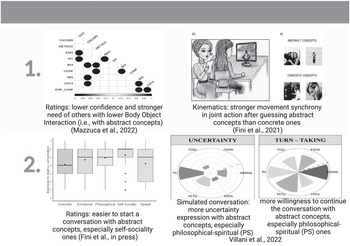
Figure 8.2 Abstract concepts and social interaction.
Panel 1: Results on social metacognition. A rating study on 124 Covid-related words showed that, with words that scored lower in Body Object Interaction, hence are more abstract, participants’ perceived confidence in their own knowledge was lower, and the need for others’ help stronger (social metacognition) (Mazzuca et al., Reference Mazzuca, Falcinelli, Michalland, Tummolini and Borghi2022); a kinematics study showed that participants were more synchronous in performing a joint action task with the experimenter helping them guess to which images abstract (rather than concrete) concepts referred, because of the stronger perceived need for her help (Fini et al., Reference Fini, Era, da Rold, Candidi and Borghi2021).
Panel 2: Results on abstract concepts in conversation. A rating study showed that participants perceived it easier to start a conversation with abstract concepts than with concrete concepts, particularly with self-sociality ones (e.g., kindness) (Fini et al., in press); A study in which participants responded to sentences revealed that they used more expression signaling uncertainty, more “why” and “how” questions, and were more frequently willing to continue the conversation with sentences involving abstract than concrete concepts. The effect was stronger with the more complex abstract concepts, i.e., philosophical-spiritual ones (e.g., “logic,” “religion”) (Villani, Orsoni, et al., Reference Villani, Orsoni, Lugli, Benassi and Borghi2022).
In current times, interaction within dyads often occurs virtually, for example, through online chatting. In a recent study with my colleagues Chiara Fini, Giovanna Cuomo, Vanessa Era, Ilenia Falcinelli, Mattia Gervasi, Claudia Mazzuca, Matteo Candidi, and Bodo Winter, we created an online interactive situation in which participants wrote sentences starting from either a concrete or an abstract word. We randomly assigned participants to two conditions: social and individual. In the social condition, they chatted in dyads starting from the cue words; in the individual condition, they wrote on the chat, knowing that another person was doing the same at the same time and that later they could read what the other had written. Subsequent measures of psychological distance through the Inclusion of Other in the Self (IOS) scale (Aron et al., Reference Aron, Aron and Smollan1992) revealed that, after chatting, participants felt closer to the other than if they had performed the task individually. Analyzing the social condition, we found that participants evaluated as more demanding conversations starting from abstract concepts, and felt they contributed more than when they chatted on concrete concepts. Crucially, with abstract concepts, but not concrete ones, their psychological closeness to the other was higher the more they felt the other contributed to the conversation. The effect did not depend on the valence and pleasantness of concrete and abstract words, which were balanced (see also Reitsma-van Rooijen et al., Reference Reitsma-van Rooijen, Semin and Van Leeuwen2007, who showed that physical closeness increased after reading a positive abstract sentence and decreased after reading a negative abstract sentence; see also Lahnakoski et al., Reference Lahnakoski, Forbes, McCall and Schilbach2020).
Overall, these studies with interactive methods reveal that when people have to chat or discuss an abstract concept, they engage more in the relationship; they feel closer to the other and are more synchronous in movement – hence, they are keener to collaborate. I think this phenomenon occurs because individuals need others who might become their intellectual referents (Fini & Borghi, Reference Fini and Borghi2019). Notice that this does not necessarily imply an asymmetric relationship between individuals. In the kinematics study I described (Fini et al., 2020), the experimenter was the holder of expertise and delivered suggestions; hence she was more expert than the participant. In contrast, in the online chatting study (Fini et al., in press), the other was not qualified as an expert. Yet, the more they contributed to the conversation, the closer they were perceived. Thus, even if expertise is not crucial, it appears that individuals consider the level of engagement of another person in the interaction. Think of scientists who discuss the novel definition of a concept: each of them will feel obligated to the others because all contribute to the final outcome. Abstract concepts offer this space to negotiate and contextualize more than concrete concepts because they have fewer physical constraints.
Mazzuca and Santarelli (Reference Mazzuca and Santarelli2022) have recently provided an example of this contestability of abstract concepts, examining the concept of gender. The authors overview the characteristics of political concepts. First, political concepts are partially indeterminate (Koselleck, Reference Koselleck2004), that is, they are open to a possible future, general, ambiguous, since they might have multiple referents, and conflictual, a potential source of disagreements. Strategies to politicize a concept are to stress its abstractness and more contestable aspects. A recent study by Mazzuca et al. (Reference Mazzuca, Majid, Lugli, Nicoletti and Borghi2020) exemplified this process. Normative (monosexual, cisgender) and non-normative individuals (e.g., queer, gender diverse, and plurisexual) produced free associations to the word “gender.” While normative individuals produced more frequently perceptual, biological, and binary features (e.g., female–male), non-normative ones focused more on experiential, social, and political aspects (e.g., “queer,” “discrimination,” “construct”). Highlighting the abstract characteristics of the concept of gender, non-normative individuals enhance its debatability and its indeterminacy without anchoring it to stable, solid, and universal perceptual grounds.
In sum, most studies on abstract concepts focus on single words and simple sentences. Instead, I have argued the importance of using interactive methods to investigate concepts during their use. I have also described some examples of studies that attempt to incorporate an interactive dimension. To my knowledge, no study has investigated the emergence and use of abstract concepts employing a dual brain neuroscience approach that allows capturing the dynamics of real-time interactions (see Chapter 3.1). Interactive methods are particularly important because of the tight relationship between abstract concepts and the social dimension. Implementing both interactive behavioral methods like the ones I have illustrated, together with studies like the hyper scanning ones, which address forms of synchronization among participants, will allow researchers to capture the complex dynamics of acquisition and negotiation that abstract concepts elicit. Because of the openness of abstract concepts, people might either learn their meaning from others or negotiate their meaning with others. Hence, the presence and contribution of others can be paramount for abstract concepts’ representation. In Section 8.3, I will discuss some possible causes for why abstract concepts are so widespread.
8.3 Social Functions of Abstractness
In this section, I will contend that abstract concepts have an important social function: enhancing social cohesion. This might be one of the reasons that they are so widespread. I will overview the literature on the social functions of abstraction and abstractness and explore the possible social implications of using abstract concepts, focusing on the notion of social metacognition.
Why are abstract concepts so ubiquitous? They are difficult to acquire and process; yet, people use them extensively (Lupyan & Winter, Reference Lupyan and Winter2018). One of the possible reasons is that abstractness might have critical social functions. According to Gilead et al. (Reference Gilead, Trope and Liberman2020), “social groups that define their beliefs in terms of intangible ideas should become more cohesive.” While I agree with their claim, I do not agree with their analysis. In their view, a speaker saying, “I am a Republican because I believe in liberty,” is socially more accepted and likely to receive more group solidarity than one who says: “I am a Republican because I don’t want the government to take away my guns.” Notably, the second speaker uses expressions that convey a similar concept in terms of concrete action preferences. In my view, the example is interesting, but the effect might be influenced by the word valence. It is easy to think of counterexamples differing in valence. For example, if you contrasted sentences like “He has no fantasy” with “He’s not good in drawing imaginary characters,” the second one, which is composed of more concrete words, will be more socially accommodating than the first.
The claim that more abstract words might have a less negative and profound social impact has also been proposed by other scholars. For example, the social consequences of using words at a different level of abstraction have been clearly analyzed in the framework of the linguistic intergroup bias (LIB; Maass et al., Reference Maass, Salvi, Arcuri and Semin1989; Maass, Reference Maass1999). LIB refers to the fact that, when you speak or write of your ingroup, your description of positive behaviors tends to be more abstract than that of negative behaviors. In other words, for positive behaviors of people of your ingroup you tend to generalize more, saying for example that someone is “helpful” rather than the more specific someone “helps.” The opposite is true when you speak or write about members of your outgroup (e.g., “X is aggressive” vs. “X hurts”). Hence, using more abstract terms is dynamically valuable for creating cohesion within specific groups. A similar phenomenon occurs in interpersonal relationships. A positive abstract message leads to feeling closer to the sender than a positive concrete message. In contrast, a negative abstract message led to feeling more distant than a negative concrete message (Reitsma-van Rooijen et al., Reference Reitsma-van Rooijen, Semin and Van Leeuwen2007). As to the whole society, abstraction (more than abstractness) can certainly be used to implement cohesion, in line with what Gilead said, by avoiding conflicts on specific issues. However, the examples used by Gilead et al. (Reference Gilead, Trope and Liberman2020) are limited, as previously shown. In contrast, I think the evidence on LIB is compelling and highlights the possible social consequences of the use of abstract terms: however, this evidence, too, pertains to abstractness, not per se but in relation to the emotions and valence that words evoke.
A different and plausible interpretation of the relationship between abstract concepts and group dynamics is proposed by Mazzuca and Santarelli (Reference Mazzuca and Santarelli2022). The authors argue that possessing some abstract concepts – values – in which to believe can cement group cohesion, even if there might be local disagreements related to implementing that value. For example, members of a given society might believe in the general value of justice, even if some criticize how justice is implemented in tribunals. I believe these considerations lead to new questions and might open new potential research avenues. First, do these considerations concern specific kinds of abstract concepts, like values, or can they be extended and generalized to other concepts? For example, it is possible that the simple knowledge that we as a species possess general, common notions enhances our sense of community. Would this hold both for concepts such as “respect for others” and notions like “logic”? Second, is it the possession of these general values or rather the awareness that individuals have these general and shared values that increases social cohesion? Third, how much does this enhancement of group cohesion concern only general, abstract concepts and not specific concepts? For example, would knowing that everybody knows the Pythagorean theorem render people’s community sense stronger?
Even if the studies I have overviewed addressing the possible social impact of abstraction and abstractness are interesting, I think the mechanism of social metacognition my colleagues and I have identified is powerful in accounting for the relationship between abstract concepts and social cohesion. The reason is straightforward: the abstract concepts people form are a social product. This consideration might be trivial and undoubtedly also true for concrete concepts, but social interaction is constitutive to a larger extent of abstract concepts formation, representation, and use. An example from our studies concerns the concept of gender; gender-nonconforming people think, more than cisgender, that they need others to define gender-related concepts (De Livio et al., 2022).
Notably, language tends to maintain social cohesion, that is, to create a common ground between speakers. I think abstractness renders this characteristic of language more extreme because abstract concepts induce people to reflect more and engage more in social exchanges, such as conversations. Thus, one important reason abstract concepts enhance social cohesion has to be searched for in the social metacognition mechanism I have spoken about (Borghi & Tummolini, Reference Borghi and Tummolini2020). As I have mentioned, the meaning of abstract words is less determined, thus more open to negotiations. One could argue that it is also more open to conflict, at least as to the word meaning. Independent of whether abstract concepts are the fruit of convergent opinions or conflictual ones, social interaction is an intrinsic part of their meaning. Thus, I think abstract concepts can increase cohesion because they reveal to us and remind us that others are part of the process of using them.
As an example, think of the reviewing process. Scientists write papers, and reviewers criticize them and induce them to change them. Science is also a collaborative effort in this respect. Do researchers love their reviewers? Sometimes yes, sometimes no. And yet, the final product is different if researchers have received reviews than if they haven’t. Their original paper is still their paper, but other people are also part of the process. One could argue that all word meanings are defined collectively. Sure, but with some concepts, like concrete ones, people are more anchored to external referents; for others, they are not. Abstract concepts can thus be reframed as concepts for which people need others more (Borghi, Reference Borghi2022a). This mechanism can create and foster social bonds and contribute to building social hierarchies (Borghi & Tummolini, Reference Borghi and Tummolini2020). People might be differently competent in questions relevant to their social group; they can thus recognize a different authority and allow experts to contribute to creating new concepts.
The notion of shared realities is strongly related to the ideas I am discussing here. People might build abstract concepts “not only to summarize information but also (and above all) in the service of creating a common representation – a shared reality” (Rossignac-Milon et al., Reference Rossignac-Milon, Pinelli and Higgins2020). Shared realities will combine two kinds of motivations: relational and epistemic, that is, the need to connect with other people and the need to understand the world (Higgins et al., Reference Higgins, Rossignac-Milon and Echterhoff2021). Take a conversation. People align with others: they change their style and the content of what they say depending on the partner with whom they are talking. For example, if they know someone likes a colleague, they will describe her more positively than if they know that their conversational partner does not like her. This process biases subsequent memories of the described content, that is, of the colleague. Similarly, when people communicate, they typically adjust their tone and the concreteness of the terms they use to the needs of their partners. The mechanism underlying this phenomenon is the so-called sharing-is-believing one. Hence, one could hypothesize that the development of abstractness is due to our strong motivation to interact with others and create and share the world with them. While, for concrete concepts, there is less space open to debate, in the case of abstract concepts, there is space for redefinition, discussion, convergence, and conflict.
8.4 Abstractness and Language as a Social Tool: Conclusion
This chapter has presented the idea that abstract words are social tools. In the first part, I reviewed studies highlighting the importance of social interaction for acquiring abstract concepts in infants and children. I then argued that intending words as social tools requires profound methodological changes. Thus, I reviewed studies on adults, highlighting the social context’s influence on abstract concepts’ processing, and analyzing studies that aspire to reflect real-time interactions to glimpse conceptual use. Finally, I explored the reasons underlying the associations between social interaction and abstract concepts, contending that they can have the social function of enhancing social cohesion or at least promoting the awareness that we live in a social world.
This book is neither a book on language nor a book of abstract concepts. I have attempted to describe what I think of language and its relationship with abstractness. I treat language in its relationship with abstractness and abstract concepts in relation to language. The reason that compelled me to write this book is that in recent years I came to realize that language has been neglected. It has been neglected by embodied and grounded views, which consider words mainly as pointers or shortcuts to meaning, focusing more on simulation. Neglecting language to highlight the importance of simulation has been a necessary step to contrast Fodorian views (Fodor, Reference Fodor1998), but now it is high time to restore language’s prominence. Neither has its role been fully recognized and highlighted by the distributional semantics view, which considers language largely in terms of associations between words varying in frequency. Hybrid views partially integrate these two positions but do not consider the pragmatic aspects of language and the social and interactive experiences it involves. In this book I defend a holistic view of language, emphasizing its social and interactive elements. Using language is a form of experience that involves our body in interaction with other bodies, and that affects our body and mind.
In Part I of the book, I describe language as a tool. It is a tool that enhances our perceptual and interoceptive abilities (Chapter 1) and our thinking (Chapter 2). It is a tool that we use with ourselves (Chapter 2) and with others (Chapter 3), and has evolved into interacting with other people (Chapter 4). In Part II, I focus on abstract words and the abstract concepts they express. Abstract words are fascinating since they are one of the maximal expressions of the power and potentialities of language. Because of their complexity and heterogeneous character, abstract words enhance our talking with ourselves and promote our interaction with others. Hence, we can consider them inner and social tools more than other words. Because they are less constrained than concrete words by the characteristics of the physical environment, their meaning is more indeterminate, flexible, subject to contextual, sociocultural, and linguistic variations, and negotiable.
When using them, people go beyond reference; abstract concepts leave space for fantasy, imagination, new associations, and unconstrained thinking. Thinking of “running on the grass” as an example of “running” is profoundly different from thinking of “running on the grass” as an example of “freedom.” Considering running on the grass as an example of freedom is subjective and disputable. When speaking of “bottles,” one can assume that people of the same culture share similar notions, but when speaking of “freedom,” this is not the case, since subjective experience plays a more significant role. In addition, we can consider running on the grass as an example of freedom today, but tomorrow we might tend to include flying in the sky or exiting prison as examples of “freedom.”
Abstract concepts and the words that express them are intriguing because, among all words, they are more subjective, variable, and open. They exemplify well the freedom language grants us. They are also fascinating for a further reason: because, more than other words, they illustrate that language is a social construction. During acquisition, linguistic and social interaction is more crucial to learn and develop them than are concepts, the meaning of which is more constrained by the presence of a specific and bounded referent, an object or entity. During use, the openness and indeterminacy of their meaning make social interaction essential. Abstract words are social tools (Borghi et al., Reference Borghi, Barca, Binkofski, Castelfranchi, Pezzulo and Tummolini2019); they are concepts for which we have a greater need for others (Borghi, Reference Borghi2022). In Chapter 5, I outlined the central tenets of the Words As social Tools (WAT) theory (see Figure 5.2), while in Chapter 7 I illustrated how, during the use of abstract concepts, we might benefit from inner speech and search for the contribution of others to complement our knowledge (see Figure 7.1). Consider possible social situations that might occur when using the abstract concept of “justice.” Other people might disagree with us on the meaning of justice and have opinions which conflict with ours. Alternatively, people might have different experiences and have developed a notion of “justice” different from ours, and we might need to struggle to understand it. Finally, people might be experts on “justice,” and our knowledge might benefit from interacting with them. These situations occur more frequently with abstract words than concrete words because of the former’s indeterminate meaning, high flexibility, and contextual dependency. There is a constant element across all these situations: the presence of others (actual or simulated) and possible linguistic interaction. In some cases, materials and technological means, such as books, tablets, and computers, might mediate this interaction. Language always supports conceptual acquisition: possessing a name renders categories more compact and clear-cut. But the role of language is of paramount relevance for abstract concepts, where the constraints of the physical environment are less powerful and tight. Language’s power has its maximal expression in endowing us with abstractness capabilities.
In Chapter 7, I delineated a model of the possible processes occurring during abstract words’ acquisition, processing, and use. In particular, I described the processes of inner social metacognition, in which people might talk to themselves in search of word meaning, and social metacognition – when people prepare themselves to interact with others to obtain information, negotiate word meaning, and align with what others intend.
In this book, I hope to have underlined how words, particularly abstract words, enrich both our inner life and our interaction with others. They promote curiosity and desire for knowledge and enhance various forms of interaction. People tend to be more synchronous with others because they need them, but they can also conflict with others because they have divergent views. Abstract words are the maximum example of the “malleable” (Dove Reference Dove2022) and sophisticated nature of human cognition: more than with other kinds of words, with abstract ones, we are free to build their meaning, going beyond what is predetermined and given. Crucially, this building process does not occur on our own. We can create new worlds but need others to support us, share meanings, insert constraints, and contrast and conflict with us. More than other words, abstract words highlight how meaning is socially constructed. More than other words, they show that words can make us free and that we become free together with others.


