Skip to main content Accessibility help
×
  • Cited by 1
    • Show more authors
    • Open Access
      You have digital access to this book
    • Select format
    • Publisher:
      Cambridge University Press
      Publication date:
      17 October 2024
      31 October 2024
      ISBN:
      9781108935463
      9781108832212
      Creative Commons:
      Creative Common License - CC Creative Common License - BY Creative Common License - NC Creative Common License - ND
      This content is Open Access and distributed under the terms of the Creative Commons Attribution licence CC-BY-NC-ND 4.0.
      https://creativecommons.org/creativelicenses
      Dimensions:
      (229 x 152 mm)
      Weight & Pages:
      0.5kg, 252 Pages
      Dimensions:
      Weight & Pages:
    Open Access
    You have digital access to this book
    Selected: Digital
    View content
    Add to cart View cart Buy from Cambridge.org

    Book description

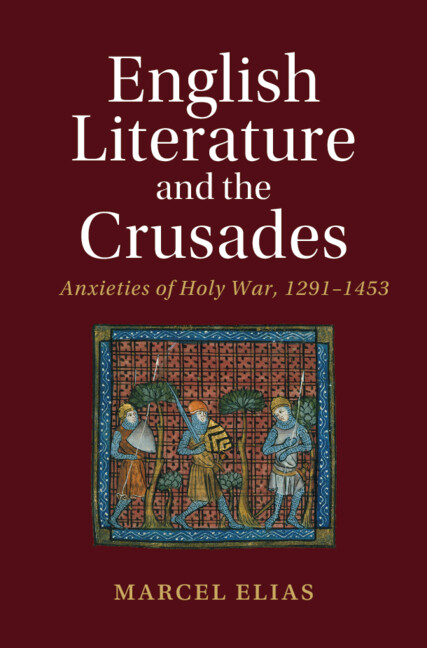
    The period from the Mamlūk reconquest of Acre (1291) to the Ottoman siege of Constantinople (1453) witnessed the production of a substantial corpus of Middle English crusade romances. Marcel Elias places these romances in dialogue with multifarious European writings to offer a novel account of late medieval crusade culture: as ambivalent and self-critical, animated by tensions and debates, and fraught with anxiety. These romances uphold ideals of holy war while expressing anxieties about issues as diverse as God's endorsement of the crusading enterprise, the conversion of Christians to Islam, the sinfulness of crusaders, and the morality of violence. Reinvigorating debates in medieval postcolonialism, drawing on emotion studies, and excavating a rich multilingual archive, this book is a major contribution to the cultural history of the crusades. This title is part of the Flip it Open programme and may also be available open access. Check our website Cambridge Core for details.

    Reviews

    ‘A powerful intervention … English Literature and the Crusades clearly positions Elias as one of the leading voices in the current second wave of crusade literature scholarship’

    Robert Rouse Source: Studies in the Age of Chaucer

    ‘There is much to praise here. Elias demonstrates a close and thoughtful sensitivity to [his] sources, centred on a clear intent to listen to what these authors are saying … Most importantly, Elias’ overall thesis is plausible. He is very persuasive in his contention that during the period 1291–1453 the culture of crusading in the kingdom of England can be characterised by ‘anxiety’, albeit expressed in various different forms and played out along a range of vectors … In short, this is a very important contribution to a rich topic’

    Nicholas Morton Source: Journal of Religious History, Literature and Culture

    ‘Meticulously researched and convincingly written … An important intervention in debates on crusading literature’

    Emily Dolmans Source: Modern Language Review

    ‘… offers a rich, innovative analysis of European crusade discourse … will be of interest to both literary scholars and historians’

    Siobhain Bly Calkin Source: Journal of Religious History

    ‘[A] perceptive, nuanced book [that] establishes Elias as one of the foremost scholars on the subject’

    Lee Manion Source: Journal of English and Germanic Philology

    ‘Elegant [and] packed with insights’

    Andrew Jotischky Source: Medium Aevum

    ‘Based on a secure understanding of wider events in the world of crusading …, making good use of the wider debates about crusading strategy that were being stirred across Europe [and] firmly rooted in the evidence from the texts …[this book] pays welcome attention to the anxieties … expressed about the legitimacy of violence at a time when crusaders were rarely achieving their objectives’

    David Abulafia Source: Times Literary Supplement

    ‘Scholars working on crusade history would do well to thoughtfully ponder the arguments presented in this book’

    Thomas A. Fudge Source: Parergon

    ‘… will interest medievalists working on race, affect, and English crusade literature, and its capacious linguistic range of meticulously researched manuscripts and texts will also appeal more broadly to European historians of cultural encounter. It also dialogues with scholars working on postcolonial literature, decoloniality, and the longer histories of emotions, and will open up new avenues for nuanced transdisciplinary conversation’

    Christine Chism Source: Modern Philology

    ‘Recommended.’

    A. L. Kaufman Source: Source: Choice

    Elias’s book advances existing arguments about crusading literature’s topicality, longevity, and engagement while offering fresh interpretations of key texts through a focus on emotions. English Literature and the Crusades merits special praise for its location of crusade texts in a truly ‘international’ milieu and for its rejection of oversimplified binaries.’

    Renée R. Trilling Source: Journal of English and Germanic Philology
    Refine List

    Actions for selected content:

    Select all | Deselect all
    • View selected items
    • Export citations
    • Download PDF (zip)
    • Save to Kindle
    • Save to Dropbox
    • Save to Google Drive

    Save Search

    You can save your searches here and later view and run them again in "My saved searches".

    Please provide a title, maximum of 40 characters.
    ×

    Contents

    • English Literature and the Crusades
      pp i-i
    • Cambridge Studies in Medieval Literature - Series page
      pp ii-ii
    • English Literature and the Crusades - Title page
      pp iii-iii
    • Anxieties of Holy War, 1291–1453
    • Copyright page
      pp iv-iv
    • Dedication
      pp v-vi
    • Contents
      pp vii-vii
    • Acknowledgments
      pp viii-x
    • Introduction
      pp 1-17
    • Chapter 1 - Royal Emotions, Blasphemy, and (Dis)unity in The Siege of Milan and The Sultan of Babylon
      pp 18-49
    • Chapter 2 - Hopes and Anxieties of Conversion in the Otuel Romances
      pp 50-69
    • Chapter 3 - Women, God, and Other Crusading Motives in Guy of Warwick
      pp 70-98
    • Conclusion
      pp 131-134
    • Notes
      pp 135-198
    • Bibliography
      pp 199-230
    • Index
      pp 231-237
    • Cambridge Studies in Medieval Literature - Series page
      pp 238-242

    Metrics

    Altmetric attention score

    Full text views

    Total number of HTML views: 0
    Total number of PDF views: 0 *
    Loading metrics...

    Book summary page views

    Total views: 0 *
    Loading metrics...

    * Views captured on Cambridge Core between #date#. This data will be updated every 24 hours.

    Usage data cannot currently be displayed.

    Accessibility standard: Unknown

    Why this information is here

    This section outlines the accessibility features of this content - including support for screen readers, full keyboard navigation and high-contrast display options. This may not be relevant for you.

    Accessibility Information

    Accessibility compliance for the HTML of this book is currently unknown and may be updated in the future.

