


11.1 Introduction
Speaking three languages is becoming increasingly common. For example, according to the Special Eurobarometer 386 (Council of Europe, 1992), a quarter of all Europeans can hold a conversation in two languages besides their native language. Are they trilingual? Traditionally, the term trilingualism had not been defined in its own right; instead, for many researchers the term “bilingualism” did not exclude cases in which three or four languages have been acquired. Reference HaugenHaugen (1956), for instance, used “bilingualism” as “a cover term for people with a number of different language skills, having in common that they are not monolingual” (9). “Strictly speaking, a bilingual … is one who knows two languages, but will here (as commonly) be used to include also the one who knows more than two, variously known as a plurilingual, a multilingual, or a polyglot” (9). In Reference GrosjeanGrosjean’s (1982) and Romaine’s (1989) classic monographs on bilingualism, trilingualism is not explicitly discussed, although there are some examples throughout both books. In Romaine’s typology of bilinguals, trilinguals figure as Type VI “double non-dominant home language without community support” (185, 197–198). More recently, Reference Stavans and HoffmannStavans and Hoffman (2015: 3) have distinguished bilingualism, multilingualism/ plurilingualism, and trilingualism, reserving the latter term for the discussion of individuals with three languages. Thus, the term trilingualism is often used to make explicit that there are three languages (rather than two, four, five, and so on).
In language acquisition studies, the term trilingualism has come to cover various areas of research that are quite different from each other and can roughly be divided into late multilingualism and (multilingual) first language acquisition. In what follows I will refer to the former as L3 acquisition and to the latter as 3L1 acquisition or TFLA (trilingual first language acquisition).Footnote 1 Table 11.1 summarizes the different scenarios within the two areas. This contribution focuses on 3L1 acquisition. I will exclude trilingualism through schooling, immigration, or L2 instruction after primary school entry, because it introduces the formal context as another variable. Most of the studies I have summarized fall under the category in (4); (5–7) are still under-researched.
Table 11.1 Typology of trilingualism
| L3 acquisition | 1 | Speakers who grew up in a monolingual environment, who have acquired two (or more) foreign languages later, and for whom the L3 is the chronologically third language or any foreign language acquired after the L2. |
| 2 | Early bilinguals (speakers with two L1s) who learn a foreign language in the school context. | |
| 3 | Early bilinguals (with two L1s) who move during childhood (e.g., after having completed primary school) and acquire the community language as an L3 after puberty. | |
| 3L1 acquisition | 4 | Children brought up with two home languages, both different from the language of the wider community. |
| 5 | Children brought up with two home languages that stand in a diglossic relationship to each other (e.g., Sicilian and Standard Italian), both different from the community language. | |
| 6 | Children in a bilingual community whose (only) home language is different from both community languages. | |
| 7 | Children in trilingual communities. |
Just like research on L3 acquisition, research on 3L1 acquisition has only gained momentum within the past two decades, although it is likely that previous studies in bilingualism have included trilinguals or multilinguals.Footnote 2 In 2008, Susanne Quay organized a symposium on this topic for the 11th International Congress for the Study of Child Language (IASCL) in Edinburgh, which resulted in the first special issue on 3L1 acquisition, published in the International Journal of Multilingualism (Reference QuayQuay, 2011a). Nevertheless, still today systematic studies in which all three languages are taken into account are scarce. As frequently mentioned in the L3 and 3L1 acquisition literature, trilingualism involves a higher degree of complexity than bilingualism (Reference HoffmannHoffmann, 2001; Reference QuayQuay, 2008): while bilinguals have three possible language modes: A, B, and AB, trilinguals have A, B, C, AB, AC, BC, ABC – a total of seven choices, although they rarely make use of all seven modes. This complexity is not only challenging for those acquiring and maintaining the languages, but it also makes the research more taxing and time-consuming (Reference Stavans and HoffmannStavans & Hoffmann, 2015: 147). 3L1 acquisition has been studied both from a qualitative angle, as well as in quantitative approaches. Although both are needed to fully understand the processes in 3L1 acquisition, herein I will mostly focus on the latter – surveys, interviews, and naturalistic studies in which quantitative analyses have been carried out (see Reference HoffmannHoffmann [2001: 4–6] for an overview of earlier qualitative studies).
Generally speaking, trilinguals utilize the same kinds of mechanisms and processes as bilinguals, but the additional language complicates these processes (Reference ClyneClyne, 1997). While bilinguals are rarely ever balanced or use their languages equally, balance and equal use of languages become even less frequent in trilinguals. Many researchers have observed a tendency for trilinguals (children and adults) to behave more like bilinguals such that there is interaction and code-switching between two languages, but rarely between all three (Reference ClyneClyne, 1997: 108; Reference DewaeleDewaele, 2000; Reference HoffmannHoffmann, 2001: 12; Reference Stavans and SwisherStavans & Swisher, 2006: 216; Reference MontanariMontanari, 2010b: 42). Typological factors and the role of the languages (e.g., minority vs. majority language) will affect the relative influence of the languages on one another. For example, if two of the languages of a trilingual share some feature (e.g., due to typological proximity), this might not only lead to accelerated acquisition in these languages (compared to monolinguals), but also to transfer into the third one Moreover, trilinguals rarely use their languages equally, because one is needed in a wider variety of domains and functions. There is often an additional difference in relative use between the two lesser-used languages.
In this chapter I will focus on the core areas of language – phonology, lexicon, syntax, and pragmatics – in discussing (1) whether and how trilingualism differs from bilingualism, (2) what evidence there is for separate developments and interaction between the three languages, and (3) what the roles are for quantity of use (and, relatedly, dominance/ proficiency) and/or typological distance. Since these questions also hinge on the children’s ability to use each language according to the context, I will start by presenting data on language choice by context. I will conclude by discussing factors that may impede or foster trilingual language maintenance, and point to some future directions.
11.2 Language Choice by Context
How do young trilingual children learn to adjust their speech to their interlocutors? What are their language choices and mixing patterns? At the core of most trilingual case studies is an analysis of the child’s language choice with different interlocutors. Establishing whether the child separates the languages in “pragmatic terms” means knowing which language to speak in which context (i.e., to whom and in which situation). From a methodological point of view, addressing this question requires quantification of the child’s production (by language) in different contexts, where “context” often refers to the language spoken by the interlocutor(s). Sometimes a single interlocutor may represent the only context in which a specific language is spoken, but data collection need not be restricted to a (monolingual) context where only one language is spoken. Instead, “context” may represent a monolingual situation with one or several interlocutors speaking one and the same language, or a multilingual situation where speakers with different languages are present. Reference Paradis and NicoladisParadis and Nicoladis (2007) used the term “interlocutor sensitivity” to describe the situation when bilingual children use more of the language spoken by their interlocutor than of the other language(s) that they speak. In the following, we will see that trilingual children tend to show interlocutor sensitivity from early on.
11.2.1 Interlocutor Sensitivity
Reference Quay, Cenoz and GeneseeQuay (2001) studied the child Freddy, born and raised in Japan, with a German-speaking father and an English-speaking mother. Regular exposure to Japanese started at 0;11 when Freddy began attending a Japanese childcare center. The parents spoke German to each other and were proficient in Japanese. Freddy’s perception and production skills in English were better than in the other languages. He did not differentiate languages in either the German or English context, using Japanese freely instead. However, the parents also accepted Japanese language mixing and mixed Japanese elements into their own language, which might have affected the child’s behavior. Freddy’s case is quite different from that of Xiaoxiao (Reference QuayQuay, 2008), who also grew up in Japan with two minority languages at home: English from her father, Mandarin Chinese from her mother. She was exposed to Japanese at day care from five months of age onward. Quay analyzed thirty-minute video recordings during dinner table conversations, covering the ages between 1;10 and 2;4, and focusing on the two minority languages spoken in the home. Xiaoxiao selected her language not only based on the languages spoken to her but also based on her interlocutor’s proficiencies, thus showing interlocutor sensitivity. She used more Chinese than other languages with her mother, more English than other languages with her father, and mostly Japanese when both parents were present, because Japanese was the language (other than English) that both parents shared.
Reference MontanariMontanari (2009a) investigated language choice in a Tagalog–Spanish–English trilingual child, Kathryn, longitudinally between 1;10 and 2;4. The author wanted to know whether there is evidence for interlocutor sensitivity when users of different languages are present, and whether the choice of the non-target language can be explained by lexical gaps or the interlocutors’ bilingual strategies (e.g., whether they encouraged mixing). Kathryn was born in Los Angeles to a Filipino-American mother and a Chilean-American father who spoke to her in Tagalog and Spanish, respectively. Input in English was provided through Kathryn’s older sister and outside the home. Until 2;2 Kathryn was exposed mostly to Tagalog (48%), and to a lesser extent to Spanish (29%) and English (23%). From 2;3 she started attending an English day care and, as a consequence, relative exposure to English increased to 50%. Her total number of words in each language matched relative exposure. At 1;9, 40.3% of Kathryn’s words were Tagalog, 36.1% were Spanish, and 23.6% English. The relative share of English vocabulary increased over time, as did exposure to this language. According to MLU measures, too, Tagalog was initially her dominant language. Measuring which language the girl selected when confronted with different language users showed that she differentiated the languages from the earliest sessions: she used more Tagalog with her mother, she increased her English use with the English-speaking interlocutor, and used more Spanish in the Spanish context. Kathryn did not strictly adhere to the interlocutor’s language, however, and this was related to her relative proficiency in the three languages. For instance, during the earlier stages, when Tagalog was very strong, there was more mixing in the non-Tagalog contexts. Toward the later recordings, mixing in English decreased as her English proficiency increased. While the interlocutors mixed rarely (the Tagalog-speaking mother slightly more than the English and Spanish interlocutors), the child showed mixing in all three languages but less in Tagalog, indicating that proficiency was a stronger determinant of her mixing behavior than parental mixing behavior. Overall, the study shows early language differentiation, but also the ability to do so in a context where speakers with three different languages are present at the same time.
Reference Nibun and WigglesworthNibun and Wigglesworth (2014) looked at language choice from as early as between 1;4 and 1;9. The study follows Michael, who grew up in Australia with a German-speaking father and a Japanese-speaking mother. Michael’s estimated exposure to Japanese (61%) was higher than to German (33%). Exposure to English started at 1;7 twice weekly but was estimated to be minimal (and was not investigated explicitly). The analysis, based on audio and video recordings, showed that at 1;4 Michael already differentiated language contexts, predominantly using the language of the interlocutor. He abided by the context language 60–75% of the time, despite an obvious dominance in Japanese due to more exposure to this language. Over time, mixing increased in the German context, consisting mostly in lexical borrowings, while decreasing in the Japanese context.
Reference EinfeldtEinfeldt (2022) investigated the acquisition of a trilingual child, Tommaso, growing up in South Germany with Italian (language of the mother), Swiss German (language of the father), and German (language of the community). The child has been observed on a regular basis between 1;4 and 2;8 in each of the three languages. The Italian recordings were done with the mother, the Swiss German ones with the father, and the Standard German ones with the researcher. Figure 11.1 shows the number of utterances in each recording by language context (dots represent German utterances; dark grey, Italian; medium grey, Swiss German; light grey, utterances containing elements from more than one language). This study shows an impressive case of trilingual language separation from an early age. Most mixing occurred from both home languages into the community language (CL), which was the language developing most slowly during the second year.
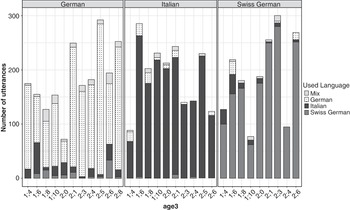
Figure 11.1 Language choice in the trilingual child Tommaso (German, Italian, Swiss German).
Overall, all case studies reviewed in this section demonstrate that trilingual children show interlocutor sensitivity from early on, just like bilingual children do. However, the degree to which trilinguals use their interlocutor’s language may be compromised by their proficiency in each language (Reference Quay, Cenoz and GeneseeQuay, 2001; Reference MontanariMontanari 2009a; Reference EinfeldtEinfeldt, 2022), the interlocutor’s behavior (Reference Quay, Cenoz and GeneseeQuay, 2001; Reference ChevalierChevalier, 2013), and possibly even the interlocutors’ proficiency (Reference QuayQuay, 2008).
11.2.2 Code-Mixing
Analyses of language choice, as illustrated in Figure 11.1, typically include quantifications of mixed utterances, and a distinction is drawn between inter-utterance (intersentential) mixing and intra-utterance (intrasentential) mixing. The former means that entire utterances (including one-word utterances) are produced in a language that is not the one spoken in the context or by the interlocutor. Intra-utterance mixing, by contrast, refers to utterances containing elements from more than one language (represented in light grey in Figure 11.1). Percentages of intra-utterance mixing vary across children, language contexts, and age range (as mixing tend to decrease with growing age).Footnote 3 Examples are provided in Table 11.2.
Table 11.2 Intra-utterance mixing in trilingual children
| Child (Source) | Age (Range) | Language and Mixing Rate (%) | ||
|---|---|---|---|---|
| Mother’s L | Father’s L | Community L | ||
| Xiaoxiao (Reference QuayQuay, 2008) | 1;10–2;4 |
|
|
|
| Kathryn (Reference MontanariMontanari, 2009a) | 1;9/2;4 |
|
|
|
| Tommaso (Reference EinfeldtEinfeldt, 2022) | 1;4–2;8 |
|
|
|
Some studies on trilingual children were exclusively dedicated to the analysis of language mixing. Reference Stavans and SwisherStavans and Swisher (2006) investigated mixing in two trilingual children, M and E, who acquired Spanish (father), Hebrew (mother), and English (CL) simultaneously from birth. English was the children’s dominant language. Data were collected over twenty months from age 2;6 to 4;2 (M) and 5;5 (E), and mixed utterances were drawn from thirty-two hours of spontaneous conversation. The children mostly responded in English when being addressed in their home languages, possible because English was the children’s dominant language and because both parents were fluent in English. Most intrasentential mixes occurred between two languages only, but some cases also involved three languages and even violation of the morphosyntactic boundaries; for example, the arones (the closets) with an English determiner, a Hebrew stem (aron), and a Spanish plural suffix (-es). According to the authors, these are indications of a “unique trilingual competence development that capitalizes on multiple languages” (217). The children exploit the formal properties of language, and thereby achieve “economic efficiency” in communication.
Reference Poeste, Müller and GilPoeste, Müller, and Arnaus Gil (2019) wanted to know whether code-switching is related to language dominance. The authors investigated data from 122 children with more than one language from birth, including fifty-one bilinguals (mean age 4;9), sixty-two trilinguals (mean age 4;7), and nine quadrilinguals (mean age 4;5). The data were originally collected to elicit properties unrelated to code-switching (e.g., adjective placement, subject placement, finite verb placement in German). It seems that not all children were tested in all of their (minority) languages, but dominance was assessed for as many as 107 children based on vocabulary and accordingly children were classified as balanced, unbalanced, or unknown. Mixing rates were low overall (7% total); trilinguals (8.8% mixing) and multilinguals (9.3% mixing) showed higher rates than bilinguals (4.3% mixing). Interestingly, only 45% of all children showed mixing at all, and among these, half were balanced and half unbalanced. This led the authors to the conclusion that language dominance does not determine mixing, contrary to earlier observations by Reference Quay, Cenoz and GeneseeQuay (2001) and Reference MontanariMontanari (2009a). Intersentential mixing was more frequent between typologically close languages and decreased noticeably once Catalan–Spanish speaking children were excluded. Overall, the study shows comparatively low mixing rates for trilinguals (as for bilinguals). However, the authors’ conclusion that dominance and mixing are unrelated might have been compromised by the fact that not all trilingual children were examined in all of their minority languages. Moreover, while the study makes a strong case for the role of typological proximity, it will be interesting to investigate in future studies whether this finding is generalizable to typologically close languages that are not spoken within the same community, unlike Catalan and Spanish. An example would be trilinguals, who speak two related dialects as home languages and a typologically different CL (Profile 5, Table 11.1) − a so far understudied scenario in 3L1 acquisition. Another case in point is the following study by Reference Sivakumar-Thiyagarajah, Müller, Arnaus Gil, Suárez-Gómez and Guijarro FuentesSivakumar, Müller, and Arnaus Gil (2020).
Reference Sivakumar-Thiyagarajah, Müller, Arnaus Gil, Suárez-Gómez and Guijarro FuentesSivakumar and colleagues (2020) examined language mixing in a trilingual boy (Diego), who grew up speaking Italian and Spanish as minority languages in France. The child spoke French and Italian as his stronger languages (measured based on vocabulary) and Spanish as his weaker language. Like all previous studies, Reference Sivakumar-Thiyagarajah, Müller, Arnaus Gil, Suárez-Gómez and Guijarro FuentesSivakumar and colleagues (2020) found evidence for language separation according to context. Mixing was most frequent in the child’s weaker language (Spanish) and happened primarily between Italian and Spanish. At first brush, the results seem to underline the role of typological proximity in language mixing. However, since French was the CL, an alternative explanation is that the child rarely heard mixing into French.
In summary, studies of language choice and code-switching in children acquiring two minority languages in a country where a third language is spoken show that (1) children differentiate their languages by discourse even before the age of two years, (2) children vary in terms of interlocutor sensitivity and are more likely to use their parents’ minority languages if the parents refrain from using the community language in the home, and (3) the amount of exposure to each language (and, by implication, dominance and relative proficiency), the caregiver’s abilities and language strategies, and typological distance additionally determine the amount and directionality of mixing.
11.3 3L1 Studies on Core Linguistic Areas
11.3.1 Phonology
Reference Yang and HuaYang and Hua (2010) studied the inventory of phonemes in child D, who grew up in Paraguay with Paraguayan Spanish, Mandarin, and Taiwanese. His mother addressed D mostly in Mandarin (and sometimes in Taiwanese), Spanish was D’s father’s language and the family language, while the Taiwanese input was provided by the grandmother. Audio and video data were collected during playtime, covering the ages between 1;3 and 2;0. This resulted in 184 Spanish words, 163 Mandarin words, and 72 Taiwanese words. The authors were interested in language interaction, potential effects of relatedness between the languages, and differential input. Although D’s language production was predominantly in Spanish (54% of his utterances), by 2;0 D was able to produce all sounds but /r/ in Spanish and all sounds but /ph/ and /g/ in Taiwanese. Given the child’s divided input space, this is impressive, even if five sounds were still missing from Mandarin and not all sounds in all languages were produced regularly yet (113). There were similar error patterns across the three languages. For instance, final consonant deletion and deaspiration, or replacement of /f/ by /x/, were found in more than one language, but the attested patterns were comparable to those of monolinguals reported in the literature. These similarities to monolingual children suggest that limited amounts of input in each language do not impede phonological development. However, more input does not necessarily lead to faster acquisition, because the Taiwanese sound inventory developed faster than the Mandarin sound inventory although D had the least input in Taiwanese. The authors speculated that the development of Taiwanese may have been helped by the typological similarity between Mandarin and Taiwanese. The study shows that the child differentiated the phonologies of three languages from early on, while there was also interaction between the languages.
Reference MontanariMontanari (2011) studied the phonological systems of Kathryn at the age of 1;10. Kathryn grew up with a Chilean Spanish-speaking father and a Tagalog-speaking mother in an American English-speaking environment. Kathryn heard English regularly from her older sister and from family conversations. At 1;10 her estimated relative exposure to Spanish was 29%, to Tagalog 48%, and to English 23%, which roughly matched her word types at that age (see Section 11.2.1). Data were collected in a setting where all languages were present. The produced consonants were coded for whether they matched the target sounds in terms of organ (oral articulator involved in producing the segment), location (place of articulation), degree (manner of articulation), and glottis gesture (voicing). The data show different developments across languages. In Tagalog and English (compared to Spanish), words were produced more faithfully with regard to the organ and location involved in the production of the target sounds. In Spanish and English (compared to Tagalog), the target sounds were produced more faithfully with regard to manner of articulation. In terms of voicing, Kathryn performed better in English than in the other two languages. Finally, the type of organ errors differed across languages. In English and Spanish, they concerned exclusively coronal targets, while in Tagalog, they involved velar targets (although coronal and velar sounds are present in all three languages). Thus, the types of errors and the phonetic inventories suggested that the child was at distinct stages of phonological development in each language. Kathryn further produced some language-specific phonemes that went beyond the average monolingual inventory, suggesting heightened attention to phonological properties.
Reference Mayr and MontanariMayr and Montanari (2015) studied two sisters, aged 6;8 and 8;1, who grew up in California with an English-speaking father, an Italian-speaking mother, and a Mexican Spanish-speaking nanny (who did not learn any English or Italian). The estimated input distribution was 24% of English, 33% of Spanish, and 43% of Italian during the girls’ first four years. From age 6;0 onward, as the girls attended an Italian-English dual language program, estimated exposure shifted to 46%, 16%, and 38% respectively. The study focused on word-initial voiceless and voiced stops. The stop systems of Italian and Spanish overlap, as both are voicing languages with prevoiced /b d g/ and short lag voice onset time (VOT) for /p t k/. However, in Mexican Spanish, word-initial /d/ can be lenited, yielding an approximant [ð̞]. English, by contrast, is an aspiration language, with /p t k/ produced in the long-lag VOT range (with aspiration) and /b d g/ in the short-lag VOT range (although prevoicing may occur). Stop sounds were elicited in three recordings per language over a period of two months. The child’s English stops were target-like, but in the girls’ two minority languages they differed in spite of the overlapping properties. While Italian stops were subject to crosslinguistic influence (CLI) from English, Spanish stops were unaffected by English: voiceless stops were generally produced with short-lag VOT and voiced stops were lenited. Thus, the children developed different stop systems for Italian and Spanish despite the similarities between these two languages. The authors speculated that these differences between Italian and Spanish can be explained based on the contexts in which the languages were acquired. The children heard a lot of Italian in an English context and they had a lot of contact with Italian speakers who also spoke English, while their only input source for Spanish was the nanny, who did not speak any English.
Reference EinfeldtEinfeldt (2022) has provided the most detailed case study of trilingual phonological development, covering the ages between 1;4 and 2;6 in Tommaso, who is growing up with Standard German, Swiss German, and Italian (see Section 11.2.1). One part of the study focused on consonant inventories, which differ substantially between the three languages. Here, the child showed mostly monolingual-like developments with some evidence for acceleration and transfer. Another focus was VOT. While all three languages have binary stop systems, they are based on different parameters: German distinguishes long-lag VOT (fortis stops) from short-lag VOT (lenis stops), Italian distinguishes short-lag VOT (fortis stops) from prevoicing (lenis stops), while the Swiss German stop system is based on closure duration (CD) (all stops have short-lag VOT but fortis stops have a longer CD). At 2;4 Tommaso made monolingual-like distinctions in German and Italian. In Swiss German, all stops were produced within the short-lag range, although the CD contrast had not been acquired. This is typical for Swiss German children, who do not acquire this contrast before age 4;0. The third focus were geminate consonants in Italian. The contrast between short consonants (singletons) and long consonants (geminates) is absent in German, which makes this phenomenon potentially susceptible to CLI from German to Italian. However, Tommaso distinguished geminates from singletons already at 1;4. Overall, all analyses showed evidence for language separation from early on. The development was largely monolingual-like, with some evidence for acceleration and transfer, but no delays.
Overall, the studies on trilingual phonology conform to the idea of early differentiation (Reference Yang and HuaYang & Hua, 2010; Reference MontanariMontanari, 2011), albeit with some interaction (Reference Yang and HuaYang & Hua, 2010; Reference Mayr and MontanariMayr & Montanari, 2015; Reference EinfeldtEinfeldt, 2022). There seem to be no delays compared to monolingual children, suggesting that acquiring three languages is not necessarily more costly than acquiring two. Cases of interaction may be triggered by typological proximity (Yang & Hua, 2019), and cases of separation may be triggered by different contexts of use (Reference Mayr and MontanariMayr & Montanari, 2015).
11.3.2 Vocabulary
Multilingual children have to acquire two or more labels for the same referent. This goes against Reference Clark and Mac WhinneyClark’s (1987) Principle of Contrast, which says that any difference in form goes along with a difference in meaning. Linked to this principle, research in the 1970s (e.g., Reference 294Volterra and TaeschnerVolterra & Taechner, 1978) proposed that bilingual children initially have a fused lexicon, which includes words from both languages but no translation equivalents (TEs). Contrary to this idea, however, research on bilingual children has convincingly shown that children do learn translation equivalents from early on. Trilingual children face the additional challenge that they have to acquire three labels for the same referent.
Reference MontanariMontanari (2010b) studied lexical differentiation in Kathryn, who has grown up with Spanish, Tagalog, and American English. The author reconstructed the child’s vocabulary between 1;4 and 2;0 by means of diary data and audio recordings of spontaneous speech, collected in a setting where all three languages were spoken. She analysed the cumulative appearance of words (all words in all languages that Kathryn knew at each monthly interval) and conceptual vocabulary (TEs counted only once, as the conceptual representation for a TEs is assumed to be the same across languages). Moreover, she distinguished doublets (concepts for which the child has TEs in two languages; e.g., Ta. susi−Sp. llaves “keys”), triplets (concepts for which the child has TEs in three languages; e.g., Ta. aso−Sp. perro−En. dog), and neutral terms (words like okay, existent in all three languages). Results showed that the child’s cumulative vocabulary in each language grew more or less at the same rate and neutral terms grew somewhat faster, suggesting that words that are identical or similar in a multilingual child’s languages are acquired earlier. The conceptual vocabulary, which is best suited to compare lexical knowledge in multilinguals and monolinguals, showed that Kathryn’s overall lexical development was a bit slower in the beginning but otherwise comparable to that of bilinguals and monolinguals in other studies. TEs were produced from early on and the percentage increased with the gradual increase of new words. The number and types of TEs seemed to depend on the amount of input heard, as doublets with Tagalog, to which the child had more exposure, were most frequent. Triplets were less frequent than doublets, possibly due to a higher number of cognates between English and Spanish. Kathryn could also use equivalents with different language users from 1;6 on, providing robust evidence for lexical differentiation.
In summary, there is evidence for language separation from vocabulary acquisition, and the number of doublets grows faster than that of triplets. With that said, the number of systematic studies comparable to that of Reference MontanariMontanari (2010b) are still scarce.
11.3.3 Syntax
There is evidence from bilingual children for differentiated syntactic development from the moment that children start to produce their first two-word utterances (see Reference De Houwer, Fletcher and MacWhinneyDe Houwer, 1995; and Reference Meisel, Hyltenstam and OblerMeisel, 1989, Reference Meisel2011 for overviews). Comparable studies of 3L1 children are rare.
Reference MontanariMontanari (2009b) studied Kathryn’s early word combinations between 1;7 and 2;1 (MLU less than 1.5). Kathryn is the aforementioned child who acquired Spanish and Tagalog in the home and English outside the home. The frequencies of particular word order sequences in her speech were calculated in terms of whether Arguments (Arg) precede or follow Predicates (Pred). English is an SVO language (i.e., Arg+Pred). In Tagalog, word order is relatively free, but in the unmarked case, the verb comes first, resulting in either VSO or VOS (i.e., Pred+Arg). In Spanish, word order is determined by both grammatical functions and information structure, resulting in SVO Arg+Pred or VOS (Pred+Arg). Thus, all languages differ from each other in their word order patterns, which is an ideal scenario to investigate language differentiation. Kathryn’s earliest constituent combinations indeed mirror the language-specific patterns described. In Tagalog, Pred+Arg prevails over Arg+Pred (73% Pred+Arg/27% Arg+Pred). In English, the reverse pattern was found (20% Pred+Arg/80% Arg+Pred). In Spanish, the ratio of the two orders is more balanced (40% Pred+Arg/60%Pred+Arg). These ordering preferences are also mirrored in the interlocutors’ speech (Pred+Arg order: Tagalog 76%, English 5%, Spanish 41%). Thus, not only did the child show language differentiated patterns, but also the exact patters of the adult language.
Reference Devlin, Folli, Henry and SevdaliDevlin, Folli, Henry, and Sevdali (2015) studied a trilingual child, S, acquiring English, Italian, and Scottish Gaelic from birth. The mother interacted with S in Italian and the father in Scottish Gaelic. English was the language of the family, of the community, and at the nursery (attended by S from the age of 0;5). English was also S’s dominant language according to MLU measures.Footnote 4 Data from between 2;3 and 3;7 showed that the child “doubled” the pronoun it by a full DP object, as in I like it, the carrot, and she dislocated subjects to the right and left periphery of the clause, as in He’s cross, daddy (he and daddy being co-referent). These constructions are ungrammatical in English, but the corresponding equivalents in Italian are grammatical. The authors argued in favour of CLI from Italian, where dislocations are frequent (e.g., L’ho letto, il libro [literally: It I have read, the book]). Data from the other languages were not presented, so it remains unclear whether the child produced the corresponding structures in Italian. Reference Devlin, Folli, Sevdali, De Angelis, Jessner and KresicDevlin and colleagues (2017) studied the same child aged 5;4–5;7 with respect to the unaccusative/unergative distinction in Italian and in English. Italian differs from English as the unaccusative/unergative distinction is marked by means of auxiliary selection. In English, the distinction is not marked on auxiliaries, but it is visible in past participle and resultative constructions. Results show that S had acquired the distinction in both English and Italian. However, her Italian developed rather slowly and the ability to select auxiliaries according to the aforementioned distinction lagged behind monolinguals. Some miscategorization occurred and there was some overlap between the lexical verbs that S miscategorised in English and in Italian. The authors argued for CLI from Italian, the child’s weaker language, into English. The role of Scottish Gaelic was not discussed.
Reference KazzaziKazzazi (2011) provided a qualitative analysis from two trilingual children (Anunsheh and Irman) who grew up in Germany with Farsi and English as their home languages. German was the children’s dominant language and English the weakest. Data for this study are based on written notes (covering about four years for one child and ten years for the other). One of the structural properties the author investigated were modified NPs, including determiner-noun sequences and compounds. English and German are premodifying languages, while Farsi is postmodifying. The data showed occasional influence from German to Farsi resulting in premodification in Farsi, but cases where the Farsi structure “won out” over the German structure were far more common. This resulted in compounds, such as Ge. Schuhehaus (Hausschuhe “slippers”), Ge. Keksebutter (Butterkekse “shortbread”), Ge. Feuerlager (Lagerfeuer “campfire”) or En. mix-caugh (“cough-mixture”). The author argued that the Farsi structures “cater in a particular way to certain general cognitive tendencies such as iconicity and transparency,” which is why they are transferred more easily, not only to the weaker language (English) but also to the stronger language (German).
Reference Arnaus Gil and MüllerArnaus Gil and Müller (2018b) ran a cross-sectional study with sixty-three children who acquired French as one of their L1s. There were nineteen bilingual children (aged 3;11–6;4) and 44 trilingual and multilingual children (aged 2;4–9;3). While monolingual French children go through a stage (before age 2;7) during which they produce postverbal subjects (e.g., est tombé Philippe “is fallen Philippe” instead of Philippe est tombé), the multilingual children in this study seemed to skip this stage, which the authors interpreted as acceleration.Footnote 5 In another cross-sectional study, Reference Arnaus Gil and MüllerArnaus Gil and Müller (2018a) studied verb placement in German main clauses in bilingual and trilingual children (ages 2;0–9;3). German is a V2 language, which requires that the verb is in second position, no matter whether the sentence starts with a subject or whether −for stylistic purposes− a prepositional phrase (PP) or object is fronted. Monolingual German children pass through a stage (roughly between 1;8 and 3;6) during which they produce target-deviant verb-final structures. By contrast, the trilingual children in this study (German + a Romance language + another language) seemed to skip the verb-final stage that is typical for monolingual German children. The authors argued for positive CLI from the Romance language.
In summary, the outcomes of studies on the syntactic development of trilingual children parallel those from bilingual studies, showing early separation of languages (Reference MontanariMontanari, 2009b) and crosslinguistic influence regardless of language dominance (Reference KazzaziKazzazi, 2011; Reference Devlin, Folli, Henry and SevdaliDevlin et al., 2015, Reference Devlin, Folli, Sevdali, De Angelis, Jessner and Kresic2017; Reference Arnaus Gil and MüllerArnaus Gil & Müller, 2018a, b). Compared to the acquisition of phonology, it is perhaps less obvious that children follow the same patterns as monolingual children. Studies that provide quantified data from all three languages and that capture the emergence of syntax are the exception (Reference MontanariMontanari, 2009b being the only one).
11.3.4 Pragmatics
Trilingual pragmatics is understudied. Reference Safont-JordàSafont-Jordà (2011, Reference Safont-Jordà2013) investigated data from a consecutive trilingual boy, Pau, who grew up in Valencia, Spain, where Spanish is spoken as the majority language. Pau acquired Catalan as his L1; exposure to Spanish started at the age of 2;0 and to English at 2;11. The mother used Catalan and Spanish with Pau, the father Catalan only, while English was restricted to playtime, TV, and instruction at school. The study focused on the pragma-linguistic routines of requesting in the three languages, examining direct and indirect request strategies. Data involved audio and video recordings during play at home with the mother-researcher. Indirect request strategies are vague, opaque expressions that do not show the speakers intention explicitly (e.g., It’s hot in here, isn’t it? – as a request to open the window). Direct requests are realized (e.g., by imperative verbs, such as Look!). There are cross-linguistic differences in politeness orientations, Spanish and Catalan being positive politeness-oriented languages where direct requests are not considered as offensive or rude, unlike in English. The first study (Reference Safont-JordàSafont-Jordà, 2011) covered the age between 2;6 and 3;6. It showed an increase in indirect forms and a decrease in direct requests in Spanish and Catalan, coinciding with the introduction of the third language English. Thus, since indirectness in English requests affected Catalan and Spanish request forms, the pragmatic systems were closely linked. Pau’s production therefore involved a wider variety of forms than found with monolingual Catalan and Spanish children at comparable ages, suggesting qualitative differences vis-à-vis monolinguals. Reference Safont-JordàSafont-Jordà (2013) showed a decrease of indirect request forms in Catalan and Spanish starting at 3;7, along with a steady increase in English during the same age. This means that the amount and type of request forms varied for each language and developed in line with appropriateness criteria of language use. Direct requesting was closely linked in Catalan and Spanish but completely different in English. Thus, the pragmatic systems of trilingual children interact too, and the influencing language can even be one that is neither the home language nor the CL.
11.3.5 Summary
While there is fairly good coverage of studies on interlocutor sensitivity, studies on core linguistic areas are still scarce, especially quantitative longitudinal studies that capture the onset of speech production in all three languages. Table 11.3 lists studies that more or less meet these criteria.
| Reference | Child | Age span | LanguagesFootnote 6 | |
|---|---|---|---|---|
| Lexicon | Reference MontanariMontanari, 2010b | Kathryn | 1;4–2;0 |
|
| Phonology | Reference Yang and HuaYang & Hua, 2010 | D | 1;3–2;0 |
|
| Tommaso | 1;4–2;6 |
| ||
| Syntax | Reference MontanariMontanari, 2009b | Kathryn | 1;7–2;1 |
|
| Pragmatics | Reference Safont-JordàSafont-Jordà, 2011, Reference Safont-Jordà2013 | Pau |
|
|
11.4 Factors Supporting and Jeopardizing Trilingual Language Development and Maintenance
Most of the reviewed studies thus far have documented the development of children who use all their three languages to a greater or lesser degree. However, Reference Quay, Cenoz and GeneseeQuay’s (2001) study of Freddy, a Japanese–English–German boy growing up in Japan, shows that not all children raised trilingually start out or end up as active trilinguals (i.e., speaking all three languages actively). Reference Barron-Hauwaert and Tokuhama-EspinosaBarron Hauwaert (2003: 131) also suggested that balanced trilingualism is hard to achieve because one of the languages is always at risk of being underused. Maintenance is indeed a struggle, because the CL becomes stronger over time, as witnessed by some of the studies reviewed. For instance, in Montanari’s (2009) study of language choice, one can observe already at the age of 2;4 that mixing in the CL English decreases systematically. Reference DewaeleDewaele (2000) describes the language skills of Livia in Dutch, French, and English when she was four years old, and reports in Reference DewaeleDewaele (2007) that Livia is “still trilingual at ten,” pointing out though that maintenance might become a struggle:
In sum, now that Livia is ten, we realize that becoming trilingual from birth is not that hard, but that the difficulty lies in the maintenance and development of the three languages. It requires a constant investment on the part of the child and the parents to make sure that all languages are actively used and needed. Nothing linguistic is ever completely secured.
In the remainder of this chapter, I discuss which factors may support or hinder active bilingualism.
Use of the Community Language at Home.
Two independent studies have provided evidence that using the CL at home might jeopardize the development of minority languages. Reference De Houwer, Hoffmann and YtsmaDe Houwer (2004) collected survey data in Flanders, the Dutch-speaking region of Belgium, asking for language use in bilingual and trilingual families with at least one child aged six to nine. All children in the sample heard Dutch at school but differed in terms of home language use. Among the 18,049 questionnaires, De Houwer identified 308 trilingual families (1.7% of the families surveyed). Families were considered trilingual if, within the family, at least two languages X and Y were spoken in addition to or instead of Dutch. She found that in less than half of these families the children actually spoke three languages. There were two main conditions that favored active trilingualism: (1) neither one of the parents spoke Dutch at home, and (2) both parents did not speak the same two languages X and Y. This means that, if parents used Dutch at home, it became a strong competitor for the other home languages. Reference Braun and ClineBraun and Clyne (2010) conducted semi-structured interviews with seventy trilingual families in Germany and England to see whether parents used their native languages with their children. They distinguished three types of families: In Type I families, each parent speaks one different language but neither parent speaks the CL; in Type II families, each parent speaks two native languages; in Type III families, each parent speaks three NLs. In Type II and III families, one of the languages spoken by the parents is the CL. For the parents in Type I families, it was easiest to implement the one person–one language strategy, and these parents were also more successful in raising their children trilingually than parents who spoke two or three native languages. Additionally, Type I children often had grandparents who did not speak the CL, which was a factor that motivated the parents to pass on their native languages to their children (see also Reference BraunBraun [2012] for a more detailed account of the grandparents’ role). Type II and III families encountered problems in maintaining their second or third language once children started nursery or primary school, and the grandparents typically did not provide native language support, as they were often bilingual or multilingual with the CL themselves. In summary, the studies strongly indicated that parental use of the majority language at home is likely to jeopardize active trilingualism.
Language at Day Care.
Reference QuayQuay (2011b) studied language use at the day care of the two trilingual children Freddy and Xiaoxiao. Both children acquired two minority languages at home that were different from the CL, German/English (Freddy) and Mandarin/English (Xiaxiao) (Reference Quay, Cenoz and GeneseeQuay, 2001, Reference Quay2008; see Section 11.2.1 for details). Both children spent 6–8.5 hours per day at day care where they were exposed to Japanese starting at the age of 0;11 (Freddy) and 0;5 (Xiaoxiao). A quantitative analysis of language choice showed that both Freddy and Xiaoxiao produced predominantly Japanese utterances: 95% in the case of Freddy and 98.7% in the case of Xiaoxiao. The data are very robust, based on thirty recorded sessions for Freddy (age 1;1–1;10) and fourteen for Xiaoxiao (2;0–2,4). Neither child ever produced German (Freddy) or Mandarin (Xiaxiao), and they produced only a very small amount of English or Japanese–English mixed utterances. The study showed clear separation of home languages and day care language. Furthermore, in a qualitative analysis, Quay (2011) showed particular recurring discourse patterns, namely gesture and onomatopoetic expressions, especially in the case of Freddy, which – so the author argues – make input more transparent for language-learning children. Both children acquired Japanese effortlessly and even became dominant in Japanese.
Caregivers’ Discourse Styles.
Reference ChevalierChevalier (2013) investigated the influence of caregiver discourse styles, specifically the way in which parents react when their children mix, based on a case study of Lina, who was growing up in the German-speaking part of Switzerland. Lina’s mother is Swiss German, she has a French-speaking father from Belgium, and her English input source is her aunt, who came to visit twice a week; English is also the language used between the parents. Overall, Lina spent considerably more time with her mother and less time with her aunt. Monthly recordings were done between two and three years in all three languages. The data showed that the parents used their languages consistently when addressing the child (mother 98%, father 89%, aunt 99.7%), but Lina’s speech with each of her conversation partners showed different amounts of mixing: with her mother, 97% of her utterances are in Swiss German, with her aunt, 54% are in English, but with her father, only 13% are in French. The analysis of caregiver speech was restricted to Lina’s father and her aunt (i.e., the main interlocutors in the two non-CLs), and how they responded if the child did not use their respective languages. Responses were classified on a continuum of five categories with responses constraining a monolingual mode at one extreme (e.g., expressing incomprehension) and responses allowing or encouraging multilingualism at the other extreme (e.g., switching to the child’s language). The responses by Lisa’s aunt clustered on the monolingual end of the scale, while those of Lisa’s father clustered on the multilingual end. Based on these data, Chevalier argued that the explanation of the differential amount of mixing in the child’s speech lied in the caregiver’s different conversational styles.
Metalinguistic Awareness and the Role of Translanguaging.
Reference ChoiChoi (2019) describes language practises from a translanguaging perspective, asking what language practices a trilingual child engages in to communicate meaning in a multilingual household. This is an ethnographical case study of the child Gyuan based on 300 audio and 300 video recordings covering the period between birth and age 6. Gyuan grew up in the US. His main caregiver was his grandmother, who was living with them and spoke Farsi to the child. The father also used Farsi, while his mother spoke to him in Korean. Thus, Farsi and Korean were provided almost equally on a daily basis at home. At 4;6 Gyuan started English at pre-kindergarten. The study nicely illustrates the child’s heightened awareness of the interlocutors’ languages and needs as well as his own metalinguistic knowledge as he engaged in complex, nuanced translation (requesting and offering translation as well as paraphrasing).Footnote 7 Code-switching happened flexibly and purposefully regardless of proficiency. However, the child refrained from code-switching in English contexts and, over time, increasingly code-switched English into the two HLs. While the author emphasized the translanguaging theories’ intent to prevent monolingual ideology in schools and the strategic inclusion of students’ HLs in instruction, she also warned that if translanguaging practices are introduced in minority language settings, they might have the effect that the CL will eventually take over and jeopardize the maintenance of the HLs, as indicated by the increasing tendency to use English (the CL) in HL contexts.
In summary, many studies have emphasized that introducing the CL at home will have implications for the home languages (Reference De Houwer, Hoffmann and YtsmaDe Houwer, 2004; Reference Braun and ClineBraun & Clyne, 2010; Reference BraunBraun, 2012; Reference ChoiChoi, 2019), while the CL is acquired without efforts, regardless of whether it is used at home or not (Reference QuayQuay, 2011b). Discourse styles may play an additional role (Reference Quay, Cenoz and GeneseeQuay, 2001; Reference ChevalierChevalier, 2013). Given that domains of language use are divided by three rather than two, the impact of the CL may be stronger in trilinguals than in bilinguals.
11.5 Conclusions
This overview has provided evidence for language separation in trilingual children from early childhood, which parallels findings in bilingual studies. The few studies that have systematically investigated all three languages show language-specific patterns in each of them, despite some interaction. This is particularly impressive because the domains of language use are divided by three. It suggests that children at a very young age can acquire complex lexical, phonological, and syntactic systems with a substantially reduced amount of input. However, maintenance of all three languages is an issue, especially if the CL takes over. Again, this parallels what we know from the research on bilingual (heritage) speakers.
What is left for future research? As told, studies that systematically track the development from the onset of speech in all three languages are still an exception. Moreover, little is known about early trilingual development in Type 5–7 trilinguals: children who speak two closely related dialects at home (Type 5), children in bilingual communities (Type 6), and children in trilingual communities (Type 7). This is a missed opportunity for several reasons. First, these trilingual types are comparatively frequent. Second, the language combinations often represent a good mix of typologically close and distant languages/varieties and are thus ideal scenarios to further explore the role of typological proximity for CLI. Third, data from children in bilingual or trilingual countries are ideal to further explore the role of the CL, and specifically the question whether CLs (on the local or national level) still have a strong impact when there are several CLs.
12.1 Introduction
Multilingualism in education usually encompasses the teaching and learning of the local majority or dominant language, another language of international status, and other languages that are present in the sociolinguistic environment. The latter may be minority languages that have been revitalized or the languages of immigrant children. Multilingualism, like bilingualism, has very long-standing historical roots (Reference CenozCenoz, 2009). Just within our own lifetime we have witnessed migration to Western Europe, the US, Australia, New Zealand, and thriving cities in Asia, Singapore, Hong Kong, and Dubai, where newcomers arrive with their own languages (Reference Bonnet, Siemund, Bonnet and SieumundBonnet & Siemund, 2018). In Africa, many territories have encouraged the revitalization of Indigenous languages in education at the primary and secondary level (Reference OkalOkal, 2014). Meanwhile, English has established itself as the main international language in non-English speaking countries, following the colonial period, and more recently as a result of globalization (Reference Cenoz and GorterCenoz & Gorter, 2010, Reference Cenoz and Gorter2017). The expansion of European languages such as English, French, Portuguese, Dutch, or Spanish during the colonial and postcolonial era explains their current presence in a number of countries worldwide, where they may be used in the administration and political institutions, as second languages (Reference Jenkins, Cogo and DeweyJenkins et al., 2011).
Indeed, multilingualism in education clearly reflects societal multilingualism, an ancient, widespread and still-increasing phenomenon. As Reference Bonnet, Siemund, Bonnet and SieumundBonnet and Siemund (2018: 8) remark:
Levels of multilingualism are still on the increase in Europe, while they are actually coming down in other parts of the world, such as Singapore, Hong Kong, China in general, India, or Malaysia, largely due to official language policies: A frequently pursued goal is bilingualism involving a national language in combination with English.
With regard to the nature of multilingualism we may note that ideology underpins multilingualism, just as it does bilingualism (Reference BakerBaker, 2006). Ideology conditions ideas on what languages should be taught, based on the status of the languages. Ideologies also condition key pedagogical decisions such as what language and language competence involves, and how languages should be taught. However, the debate in public institutions dealing with multilingual policies, for example in Europe, centers on its goals and objectives. It addresses whether multilingual education contributes adequately to the balance between globalization and regionalization. It considers the revitalization or integration of minority languages in the actual communities. In particular, it asks whether educational policies contribute adequately and satisfactorily to their citizens becoming balanced plurilingual speakers, “plurilingual” being the term used for individuals, while “multilingual” is used for society (Mercator, 2011). Indeed, any discussion about multilingualism in education is in part a discussion about our younger generations and how we may help them to build their present and their future.
This chapter focuses on multilingualism in education, with a special focus on Europe, as an example of a continent where an overt policy was engineered – from within its very central institutions and agreed upon by its twenty-seven member states. We begin with an overview of trends in multilingualism (Section 12.2). Next, we review key descriptive paradigms (Section 12.3), before presenting a selection of programs (Section 12.4). After that, we summarize the main findings of second language acquisition research in the programs described (Section 12.5). We finish with some concluding remarks around tensions, frictions, and ways ahead (Section 12.6).
12.2 A Bird’s Eye View of Multilingualism
In this section we present an overview of educational language policies, including consideration of the new role taken by English. For decades, educational policies worldwide were mostly legally endorsed with a focus on either monolingualism, or, toward the end of the twentieth century, bilingualism. This was the case, for example, of the US’s Bilingual Education Act (1968) with dual or two-way education language pro-grams, the subsequent “No Child Left Behind” Act (NCLB, passed in 2002), which no longer promoted bilingualism, and was then followed by the “Every Student Succeeds” Act (ESSA 2015) (Reference BakerBaker, 2006). Canada is another well-known case: With two official languages, French and English, it heralded the implementation of immersion programs (Reference Genesee, Abello–Contessse, Chandler, López–Jiménez and Chacón–BeltranGenesee, 2013). While French was the main language in Quebec, “it was the Anglophone majority who clamoured for educational programmes in which their children could become bilingual, after the Quebécois party won political power” (Reference García, Flores, Martin–Jones, Blackledge and CreeseGarcía & Flores, 2012: 234). However, four decades later, the context for language learning changed drastically in three ways, to make the lives of the young, urban, and educated generations not only unyieldingly multilingual but also additionally multiliterate. First, globalization in Western nation states placed languages, and in particular English, at the center of education as “capital” for career opportunities (Reference BourdieuBourdieu, 1991). Second, computer-mediated communication had a dual impact: Texts in most spoken languages became accessible through the Internet, as did free language courses.Footnote 1 Third, societal linguistic hetero-geneity was enhanced by migration and widely available low-cost travel-ling (Reference VöglVögl, 2018).
Change was stirred by top-down policies, such as those issued in the European Union (EU)Footnote 2 in the mid-1990s. They placed languages at the crossroads between linguistics, sociolinguistics, politics, and education, in an unprecedented manner. The European institutions, formerly exclusively concerned with the protection of national languages, developed a growing interest in multilingualism and linguistic diversity (Commission of the European Communities, 1995). As a result, the twenty-four official languages and a long list of minority languages were fostered and promoted both as an asset in themselves, and as a response to what was manifestly becoming the ever-growing presence of English worldwide (Reference Pérez–Vidal, Juan–Garau and Salazar–NogueraPérez-Vidal, 2015). The formula “1 + 2,” or “mother-tongue + 2” was presented to the member states as a recommendation. It meant that European citizens were entitled to be educated in their L1(s), plus two other languages, one of them being a language of wider communication and another one a language of their choice – which was called their personally adopted language (PAL) (Reference MahloufMahlouf, 2008). For immigrants this was the local language, and, for local citizens, that of neighboring countries. Schools were seen as language friendly, and were encouraged to “adopt a holistic approach to the teaching of language, which [should] make appropriate connections between the teaching of the ‘mother tongue,’ foreign languages, the language of instruction, and the languages of migrant communities; such policies will help children to develop the full range of their communicative abilities” (Commission of the European Communities, 2003: 9).
To strengthen these policies, multiple institutional initiatives were launched. These included:
the study abroad mobility schemes within SchengenFootnote 3 (i.e., Comenius, Leonardo, Socrates, and ERASMUS, now “ERASMUS +” with a new emphasis on languagesFootnote 4) aimed at the secondary, technical, and tertiary level, respectively
a content and language integrated learning (CLIL) approach for primary and secondary education (Reference Nikula and MarshNikula & Marsh, 1997; Reference Pérez–Vidal, Dafouz and GuerriniPérez-Vidal, 2009; Reference Lyster, Loewen and SatoLyster, 2017)
an early start for foreign language instruction (Reference García–Mayo and García–LecumberriGarcía-Mayo & García-Lecumberri, 2003; Reference MuñozMuñoz, 2006)
the Common European Framework of Reference (CEFR), a tool for setting standards of language levels allowing for international comparison (Council of Europe, 2001)
the European Language Portfolio (PEL), to record personal language experiences at school (Reference Cassany, Esteve, Martin Peris and Pérez–VidalCassany et al., 2004)
the European Higher Education Area, an agreement signed in the city of Bologna, Italy, in 1999 by twenty-nine European countries, which placed special emphasis on languages, to homogenize tertiary education through the European Credit Transfer System (ECTS) and the establishment of two cycle degrees (three years for an undergraduate degree with 240 ECTS + two years for a Master’s with 60 ECTS), except for regulated professions, such as medicine or engineering.
These policies have been hailed as successful and certainly resulted in higher mobility figures, which were set at 20 percent of new graduates accessing mobility, starting with figures between 5 and 10 percent for most institutions, and an international ethos for young Europeans (European Commission, 2012).
However, the multilingualism agenda has been rather side-lined, something attributed to the difficulty of truly tackling literacy in a third or additional language, except in bilingual territories with two local languages, such as Catalonia (Spain) or Belgium, or in elitist institutions such as the European schools described in Section 12.4 (Mercator, 2011; Reference Bonnet, Siemund, Bonnet and SieumundBonnet & Siemund, 2018). Blame has also been placed on the ever-growing influence of English in the world.
The truth is that English, and specifically Standard English, has entirely captured the interest and funding of most educational systems. Other varieties have never achieved acceptance as alternatives to the two major strands of World English, UK and US English, and for the last thirty years, the UK and US varieties have predominated (Reference McArthurMcArthur, 2003). This situation privileges the figure of the native English teacher, both in the classroom and in the publishing industry, and the native-speaker monolingual model for language learning, hence acting as gatekeepers for education as well as professional and social upward mobility (Reference RicentoRicento, 2000). Reference Phillipson and RicentoPhillipson (2000) coined the term linguistic imperialism referring to a set of unchallenged dogmas. He disputed that the native speaker was the best teacher, questioning the use of English only in the classroom, the maximum exposure, the Early-Start, and the Communicative Approach “fallacies.” Since the 1990s, an academic struggle for an inclusive view of multilingualism, both cognitive and social, has gained ground in research in second language acquisition, defying the monolingual, inequal, even allegedly racist “native-speakerism” bias, discussed further in Sections 12.3 and 12.4 (Reference CookCook, 1993, Reference Cook and Robinson2013; Reference OrtegaOrtega, 2019; Dewaele et al., 2021).
12.3 A Selection of Paradigms
In this section we review three current seminal paradigms seeking to describe multilingualism in education, related respectively to program typology issues, ideological and pedagogical approaches, and linguistic approaches.
Multilingual models aim to capture the changing nature of educational systems, as opposed to typologies more typical in bilingual research (Reference BakerBaker, 2006). With regard to program features, Reference CenozCenoz (2009) put for-ward the Continua of Multilingual Education model for use when describing the multiplicity of multilingual schools. It highlights the fluent dynamics of diversity within multilingual education as a consequence of the interplay of the three key dimensions already mentioned: language, sociolinguistics, and education. Of particular interest is the potential source of learning difficulty coming from prior languages we know when learning additional languages. Reference Puig-Mayenco, González Alonso and RothmanPuig-Mayenco and colleagues’ (2020) review of transfer studies – in relation to existing representative models – from the past fifteen years reminds us that previous languages that we know influence the representation and process of the subsequent L3/Ln acquired, and that “third language acquisition (L3/Ln) presents differently from second language (L2 acquisition).” The point is which prior language has a larger impact on the L3/Ln and what “the variables that ultimately explain such transfer are at different stages of the developmental sequence.” The main well-established existing models coincide in not overtly denying that such variables simultaneously affect L3/Ln acquisition, albeit with a different weight, be it linguistic experience, age of acquisition, or similarity between the languages (overall or at the level of specific properties) (Reference Puig-Mayenco, González Alonso and RothmanPuig-Mayenco et al., 2020: 33). No formalized model supports that there is no transfer or that it comes exclusively from the L1, although some empirical evidence has been claimed for the latter, namely 14.1 percent of studies reviewed. The L2 transfer model is compatible with 28.2 percent of studies reviewed; the model claiming both L1 and L2 influence with 5.9 percent, while the one claiming typological similarity influence with 60.5 percent (see Chapters 8 and 9 of this volume).
Ideologies and pedagogical practices are evolving. A second continuum model has been gaining ground, regarding what languages should be taught. It takes the notion of linguistic imperialism presented in Section 12.2 into the domain of pedagogy (Reference De KorneDe Korne, 2012) and draws on the contrast between heteroglossic, or diversifying ideology and monoglossic, or monolingual-like ideology. At one end is standard language ideology (SLI) (Reference WeberWeber, 2009, cited in Reference VöglVögl, 2018: 189): the common way of thinking about languages, whereby the standard language is seen as an equivalent to “language.” At the other end, non-SLI values all language varieties, not only the standard ones. It must be noted that SLI is not at odds with multilingualism. This can be seen, for example, in the EU policies discussed in Section 12.1, where only language varieties at the top of the hierarchy (i.e., in the case of English, the UK and US varieties; in the case of Spanish, the Castilian variety), adhering to prescriptive norms, are accepted.
As for what language and language competence involves, non-SLI draws on Reference GrosjeanGrosjean’s (2008: 23–36) complementarity principle of bilingual language abilities, and underscores the idea of repertoires including all the languages a speaker has, at whatever level of proficiency, as multicompetence (Reference Cook and RobinsonCook, 2013). Moreover, it shifts away from deficit models, which emphasize symmetrical competence in all the languages a speaker has, an idea already existing in bilingual research (Reference GrosjeanGrosjean, 2008) further developed for multilingualism (Reference LüdiLüdi, 2004). Lastly, as regards how languages should be taught, Reference García, Flores, Martin–Jones, Blackledge and CreeseGarcía and Flores (2012: 238) claim there are three key constructs in the dynamic language pedagogies that derive from non-SLI. First, “languaging,” which considers what students do with language in multilingual spaces. Second, “translanguaging,” which is a planned strategy in “flexible” classrooms, involving the concurrent use of two languages, either for different functions (e.g., one for reception and the other for production purposes), or for comparison, a practice also advocated by Reference CumminsCummins (2007). Third, there are “flexible, multiple models of biliteracy” in which multiple language practices and media are used.
The claim made within the views based on dynamic language pedagogies is that it makes it easier for learners to navigate and develop their linguistic resources as a way to multi-literacies, through multimodality, hybrid or fluid forms, language mixing, and nonverbal varieties of expression. In addition, “not only is the hierarchy of languages torn down, but the walls between languages are shown to be more connection than barrier” (Reference De KorneDe Korne, 2012: 483). Moreover, on the basis of such views, frontal criticism has been leveled at the type of bilingual programs typical in the United States in which “children are taught English as a second language, while being educated in the language they know, Spanish.” It is argued that such transitional programs are not valid in highly heterogeneous classrooms in our globalized society, or in the complexity existing in Africa and Asia (Reference García, Flores, Martin–Jones, Blackledge and CreeseGarcía & Flores, 2012). Such a statement resonates with the views of the well-known tripartite distinction: language can be considered as a problem, cognitively, personality wise, and sociopolitically, as a right, resisting the discrimination of minority languages, or as a personal, communal, and regional resource (Reference RuizRuiz, 1984).
The third paradigm of interest is of a linguistic nature and puts the role of English in the spotlight. Academics have noted that “English is [was] changing” and English as a Global Language and English as a Lingua Franca (ELF) have appeared as new constructs at the turn of the millennium yet again against the SLI, particularly in the United Kingdom (Reference Graddol and MeinhoffGraddol & Meinhoff, 1999). The ELF paradigm does not mirror the native-speaker model. ELF research reveals a “non-centrist understanding of English as an international language,” which moves away from central English or nationally defined new Englishes, and accounts for the ever-changing negotiated spaces of current language use (Reference Jenkins, Cogo and DeweyJenkins et al., 2011). ELF is simultaneously the consequence and the principal medium of globalizing processes and interconnectivity in today’s world, “it is at once globalised and globalising” (cif. 303). There are three well-known corpuses of ELF that aim to describe its features and regularities and codify it at all linguistic levels. The Vienna-Oxford International corpus of English (VOICE) (Reference SeidlhoferSeidlhofer, 2011), the ELFA, and the Asian Corpus of English (ACE) in Hong Kong. The VOICE corpus defines ELF as “an additionally acquired language system which serves as a common means of communication for speakers of different languages. ELF and English as a foreign language (EFL) are two entirely different things” (Reference Jenkins, Cogo and DeweyJenkins et al., 2011: 283). ELF is the language used amid non-native speakers of English aiming at communicating among themselves; EFL is the standard variety native speakers use, which is considered suited as the foreign language in education all around the world. Native speakers are not excluded from ELF. The particular role of ELF has gained prominence in research, for example, on the linguistic effects of study abroad, finding that speaking and listening abilities appear to make significant progress, as do grammar and vocabulary through ELF (Reference Pérez–VidalPérez-Vidal, 2014; Reference Mitchell, Tracy–Ventura and McManusMitchell et al., 2017). This occurs through interaction with target-language speakers, often in groups of international students using ELF in countries such as Poland or Germany (Reference KöylüKöylü, 2016; Reference Llanes, Arnó and Mancho–BarésLlanes et al., 2016).
12.4 A Selection of Cases of Multilingualism in Education
Four examples of European multilingual policies are described in this section, covering all educational levels. The first is early language learning education (ELLe) (Reference EneverEnever, 2011), which has been introduced in almost all twenty-seven European countries. The idea is enshrined in the truism “the earlier, the better,” which, however, needs a substantial number of hours and intensity of exposure to yield the expected results (Reference García–Mayo and García–LecumberriGarcía Mayo & García Lecumberri, 2003; Reference MuñozMuñoz, 2012). Reference EneverEnever (2011) summarizes a transnational longitudinal European survey, to give “the bigger picture” of ELLe in the following terms. Both top-down processes in combination with supportive bottom-up school and home environments are generally present in ELLe. It also calls for teachers with age-appropriate teaching skills, including technology-based pedagogy and a good command of the language, at the CEFR C2 (i.e., advanced level), a profile not easily found. With regard to language choice, some countries specify one or two options, others a whole list, and others leave the decision to local authorities or schools. However, as the Eurydice report reveals, by 2006, more than 60 per cent of primary school pupils were learning English, whereas only 4 percent were learning German, and 6 percent French (in Belgium and Luxembourg). Some countries have a compulsory second language; in others, it is optional.
Next, we focus on the so-called European Schools (ES), which are multilingual and multicultural in their organization, ethos, and goals. The ES are a conglomerate of officially appointed schools, which cater to EU officials’ children of different L1 backgrounds, between four to eighteen years of age, although local and immigrant children are also accepted (Reference Housen and MuñozHousen, 2012). The highly reputed ES system has been in place for nearly sixty years and comprises fifteen centers located in Belgium, Luxemburg, Germany, the United Kingdom, Spain, Italy, and the Netherlands. ES students are expected to reach high levels of functional proficiency and literacy (i.e., near-native), in at least two languages at the end of primary school: the child’s mother tongue (L1), plus a second language (L2), out of the three working languages of the EU: French, English, and German.Footnote 5 A third language (L3) is introduced in secondary school, with the possibility of a fourth (L4). The classes are taught by native speakers of the language who additionally know one of the L2s. Teaching is grafted onto functional-notional communicative approaches with some features of audiolingualism and the direct method. Most importantly, there is “social-linguistic engineering” involving mixing learners with different L1s in the same classroom to promote crosslinguistic interaction through a common foreign language (Reference Baetens Beadsmore and Skutnabb–KangasBaetens-Beadsmore, 1995).
Thirdly, Luxembourg is the multilingual European country par excellence, with three official languages taught at school in addition to English: Luxemburgish, German, and French (Reference De KorneDe Korne, 2012). Luxemburgish is taught in pre-primary education only as an oral language, switching to German when learners reach primary school. French is gradually introduced as a subject and only in the later primary school years as the teaching medium, alongside German. English is introduced as a compulsory subject at fourteen with other languages being optional (Spanish, Latin, and Italian). There is a division in the system between classical and technical schools, which affects which subjects are taught in which languages. French is more common in the former and German in the latter. Interestingly, the country voluntarily went through a systematic screening process provided by the Council of Europe, and several problems were identified and solutions provided (Council of Europe and Ministère de l’Education Nationale et de l’Education professionelle Luxembourg, 2005).Footnote 6 Most notably, languages had been taught to native-like monolingual standards, with course books designed in the target-language countries (France and Germany) emphasizing grammatical correctness and literacy at the expense of communicative abilities. The European report underscored the need to foster communicative competence, self-confidence, and higher equality standards.
Lastly, Catalonia is an autonomous region in Spain with two official languages, Spanish and Catalan. The latter is the minority language, although it is more important nowadays following an intense process of revitalization that started in 1983 thanks to the Catalan Immersion Program in Education in Catalonia.Footnote 7 In terms of tertiary education, European policies established in the Bologna declaration in 1999, mentioned in Section 12.2, were adopted. Linguistic policies were designed for the first time, following the examples of the Freie Universität in Berlin, l’Université de Fribourg in Switzerland, the Kolodanyi Janos in Hungary, among others, which have three or more languages. The Universitat Pompeu Fabra (UPF) in Barcelona took the lead in Spain and designed the Plan of Action for Multilingualism (2007–2011). This involved the introduction of English-Medium Instruction (EMI) programs by including at least two EMI subjects in the last two years of all degrees offered – 3.5 percent of the total number of creditsFootnote 8 – in order to accommodate incoming mobility students and making mobility accessible to 25 percent of its own student population by 2020. Notably, students might have experienced CLIL in English in compulsory education. A number of other measures were taken such as the concept of “three working languages” (i.e., Catalan–Spanish–English) in teaching, research, and administration, while being specifically committed to strengthening and increasing the presence of Catalan by raising its international profile. Following the principle of “linguistic security,” once a teacher publicizes the teaching language of instruction at the start of an academic year, it cannot be changed. Students, on the other hand, are allowed to use the language of their choice for oral communication, striking a balance between the linguistic rights and obligations of all parties involved. The UPF university community is required to have sufficient knowledge of the three working languages, one active and the other two passive (Reference Pérez–Vidal, Martí i Castell and Mestres i SerraPérez-Vidal, 2008, Reference Pérez–Vidal, Juan–Garau and Salazar–Noguera2015). This links with a new interesting field of research and pedagogy, intercomprehension, which entails understanding languages without speaking them as a strategy for communication and eventual learning (Reference Blanche-Benveniste, Conti and GrinBlanche-Benveniste, 2008; Reference Grin, Conti and GrinGrin, 2008; Reference Pinho and AndradePinho & Andrade, 2009; Reference Dolci and TamburriDolcci & Tamburri, 2015). The emphasis on Catalan at UPF reflects its general position as a minority language, something which generates apprehension in particular among those who see the new arrival of EMI programs, geared to attract international students, as yet another threat, as has also been reported in the Basque country (Reference Doiz, Lasagabaster and SierraDoiz et al., 2014).
12.5 Empirical Findings
Multiple studies on the effect of multilingual education assert the benefits of multilingualism on language learning with no detriment to content learning or L1 development during compulsory education (Reference Bonnet, Siemund, Bonnet and SieumundBonnet & Siemund, 2018). Others also seek to identify the factors accounting for such outcomes, as, indeed, further empirical research is required to confirm such alleged benefits. Socioeconomic background seems to impact strongly on the acquisition of additional languages (Reference Keßler, Paulick and AhrenholtzKeßler & Paulick, 2010). Likewise, the skills practiced in the first two languages also have an impact on L3 progress. In their study of bilingual Spanish–Catalan students learning English, Reference Roquet, Pérez-Vidal, Van Daele, Housen, Kuiken, Pierrard and VedderRoquet and Pérez-Vidal (2007) replicated Reference SanzSanz (2000) and confirmed that learners who read regularly in both Catalan and Spanish obtained significantly better results in written English, in terms of complexity, fluency, and accuracy.
Turning to the cases presented above, the ELLiE (Early Language Learning in Europe) exemplar study empirically examined how the interaction of specific variables might result in different learning outcomes in primary classrooms with children aged between 7 and 11 (Reference EneverEnever, 2011). Multilingual data were collected in seven countries, one of them Spain, more specifically Catalonia, where, having Spanish and Catalan as L1s, the school foreign language is learnt as an L3.Footnote 9 English is the first foreign language in school; an optional additional language may be offered from age twelves or thirteen. The study revealed that speaking, listening and reading in the foreign language develop individually as well as in conjunction with one another. It also revealed that learners’ vocabulary and foreign language complexity show significant improvement during the first years. Generally, by the fourth year, learners’ competencies are similar in the three skills, and most learners reach approximately an A1 level (as described by the CEFR) by the age of ten to eleven. Children’s daily exposure to a foreign language is, naturally, a great ally in the acquisition of that language, and provides a strong foundation for further learning. However, more limited exposure can also result in the steady development of communicative skills, especially if it is accompanied by a supportive and friendly atmosphere (Reference EneverEnever, 2011).
Concerning the European schools, Reference Baetens Beardsmore and BoeyBaetens Beardsmore and colleagues (1980) compared the L2 and L3 levels of proficiency of thirteen-year-old pupils in the ES of Brussels and Luxembourg with those of students in Canadian French immersion programs. The ES students’ level was found to be equal or higher, despite less classroom contact with the target language, allegedly due to self-initiated use of French by the ES pupils inside and outside school and the presence of the language in the environment. More recently, Reference Housen and MuñozHousen (2012) further confirmed that extracurricular activities provided more contact with the target language and that it is the additional input that significantly improved students’ fluency, grammar, and lexicon. Housen draws several general observations about the factors contributing to multilingual education (2012):
The amount and intensity of exposure to a language is key to foreign language learning, both in school and the wider environment (Reference MuñozMuñoz, 2012).
Language learning is typically characterized as a gradual, lengthy, and relatively slow process, and one in which the more and longer the contact with the target language, the more learning will be fostered.
L2/3 learning benefits from more intense or compactly distributed forms of teaching (Reference Collins and BlommaertCollins, 1999; Reference SerranoSerrano, 2011).
Using the target language as a medium for teaching general content gives it more meaning and significance and thus proves to be beneficial.
There is a clear need for (formal) L2-subject teaching alongside the content course, in order to develop a high level of proficiency (Reference HammerlyHammerly, 1991; Reference Dixon, Zhao and ShinDixon et al., 2012).
In sum, the ES experience sheds light on the influence of the linguistic environment in foreign-language learning.
Third, schools in Luxembourg have traditionally treated languages as a separate subject area, as explained in Section 12.3, with the focus on grammatical correctness, and largely excluding prevalent immigrant languages (Reference WeberWeber 2009, Reference Weber and HornerWeber & Horner, 2010). The goals for education since the screening process mentioned have broadened with a shift toward more heteroglossic, flexible, and inclusive approaches to language education. The new model integrates language education and other subject areas through project work in a variety of communicative tasks, giving more attention to creative expression and communicative competence. The more flexible approach reflects both better students’ differing language backgrounds, as indeed migration figures are high, and the reality of multilingual settings, and greater attention is given to the need for students to acquire communicative competence and gain confidence in using their languages (Reference De KorneDe Korne, 2012). The Copenhagen secondary school project exemplifies this shift away from traditional, formal models of language education to a flexible approach based on heteroglossic ideology of language education that reflects the reality of multilingual settings. Arising from a collaboration between a Luxembourg lycée (an upper-level secondary school) and a professional theatre, the project involved a play written and produced in English but developed, in different stages, in Luxembourgish, German, English, and French, and encompassing the teaching of physics, English literature, art, and history subjects (Reference De KorneDe Korne, 2012: 479–500).
Moving on to tertiary education, several studies followed up developments tapping the linguistic progress made in degrees with different amounts of EMI, such as those at the UPF described in Section 12.4. Ament and colleagues (2020) studied the distribution of pragmatic markers (PM) in undergraduates’ oral production with data from the EMI students with 100 percent of English exposure finding that EMI may aid the acquisition of some PMs’ functions (i.e., causal, contrast, sequential, and topic shift/digression markers) whereas others, such as elaboration markers, may be less easily picked up, suggesting that participation in a variety of contexts and explicit instruction could be a way forward to achieve a more balanced acquisition of textual PMs. Reference Roquet, Vraciu, Nicolás and Pérez-VidalRoquet and colleagues (2022) measured the longitudinal impact of an adjunct instruction (AI) course on students’ grammatical and lexical knowledge, and on their receptive skills (i.e., reading and listening). The AI course was a language course taught alongside a content class involving L2 content-based teaching with a systematic focus on form to successfully follow the content instruction. They found that AI led to improvement in L2 grammar and receptive skills in courses with minimal English foreign language exposure.
As mentioned, within the European strategy toward multilingualism, most tertiary education learners in Europe these days would have experienced CLIL in primary and secondary (Reference Alonso, Grisaleña and CampoAlonso et al., 2008; Reference Dalton-Puffer, Delanoy and VolkmannDalton-Puffer, 2008, Reference Dalton-Puffer, Ruiz De Zarobe and Jiménez Catalán2009; Reference Pérez CañadoPérez-Cañado, 2012), an initiative also criticized by some (e.g., Reference ParanParan, 2013). On the whole, no differences are generally found between CLIL and non-CLIL students in content learning, although Reference Fernández–Sanjurjo, Fernández–Costales and Arias BlancoFernández-Sanjurjo and colleagues (2017) found non-CLIL students performed slightly better in science than the CLIL cohorts, and CLIL has not been found to have a detrimental effect on L1 (Reference Admiraal, Westhoff and De BotAdmiraal et al., 2006; Reference SerraSerra, 2007; Reference SylvénSylvén, 2010). Concerning language learning, of greatest relevance for multilingualism are the CLIL settings within Europe. Findings in the Basque country reveal that CLIL students, who are Spanish/Euskera bilinguals, outperform their non-CLIL counterparts in English as their L3 in general proficiency, in the four language skills, and in positive attitudes toward trilingualism (Reference LasagabasterLasagabaster, 2008, Reference Lasagabaster2009; Reference Villarreal Olaizola, Garcia-Mayo, Ruiz De Zarobe and Jiménez CatalanVillarreal Olaizola & García Mayo, 2009; Reference Ruiz de Zarobe, Lasagabaster, Lasagabaster and Ruiz de ZarobeRuiz de Zarobe & Lasagabaster, 2010). Reference LasagabasterLasagabaster (2017) and Reference San Isidro and LasagabasterSan Isidro and Lasagabaster (2019) advocate that, for CLIL to achieve an optimum outcome in Galicia, its three educational languages, Galician, Spanish, and English, must be treated as dynamically interrelated and interdependent, following earlier models put forward by Reference Cummins, Street and HornbergerCummins (2008) for bilingualism. In Catalonia, empirical studies reflect a similar pattern (Reference Navés, Victori, Ruiz de Zarobe and LasagabasterNavés & Victori, 2010; Reference Roquet and Pérez–VidalRoquet & Pérez-Vidal, 2017).
In turn, research results on the effects of mobility or study abroad reveal that, across the majority of language skills, and particularly oral communication, study abroad students show significant improvement during, and often after, their time abroad, that they develop personally with an international ethos, and that positive experiences often have a long-lasting effect (Reference Mitchell, Tracy–Ventura and McManusMitchell et al., 2017). Recent research programs (LANGSNAP; BARCELONA; SALA) have shown that learner characteristics mediate sociocultural experiences which, in turn, mediate learning experiences while abroad. Interestingly, study abroad research on the effects of immersive contexts has been slowly moving away from a monolingual, Western-centered view to include multilingual learners of Asian and Middle-Eastern origin (Reference Plews and JacksonPlews & Jackson, 2017); heritage speakers are finally acknowledged and have captured the field’s attention (Reference George and Hoffman-GonzalezGeorge & Hoffman-Gonzalez, 2019; Reference Sanz, Pozzi, Quan and EscalanteSanz, 2021).
12.6 Tensions, Friction, and Ways Ahead
We would like to end this chapter by briefly touching on one last, but key, point: the controversy surrounding the term “multilingualism” itself, as contrasted with “plurilingualism.” Several authors have used both terms, as in the revised version of the CEFR (Council of Europe, 2018), as a starting point, in order to clarify two different views of the three main issues identified in the introduction: which language should be taught, what language competence is, and how languages should be taught in education. As mentioned, the prefix “multi” underscores the multiplication of singularities, whereas “pluri” values plurality within a holistic integrative view. Thus, the former is reserved for the language practices of individuals, classrooms, and geographical areas or countries seen as separate entities, which is what Reference CumminsCummins (2007) has criticized about the “two solitudes” of French and English in the Canadian immersion programs. We could describe Switzerland as a multilingual country with four official languages, German (north, east, and center), French (west), Italian (south), and Romansch (east), spoken in different territories, with only one canton being trilingual (Graubünden). Likewise, educational policies that view languages through the monoglossic lens as merely juxtaposed emphasize boundaries, do not allow language mixing, and do not promote any reciprocal interest. In contrast, “plurilingualism” serves the purpose of flagging up the dynamic, unbalanced nature of an individual’s abilities in multiple languages and interest in their respective cultures. The plurilingual speaker is seen as a complex and composite set of resources used dynamically (Reference Herdina and JessnerHerdina & Jessner, 2002; Reference Beacco and ByramBeacco & Byram, 2007). It is claimed that, even with only one language, individuals should be regarded as plurilingual; they have idiolects, know different varieties, registers, and so on. Therefore, both plurilingualism and pluri-culturalism should be a major educational aim, whereby curiosity and links about/between and across languages and cultures should be stimulated (Reference Piccardo, Trifonas and AravossitasPiccardo, 2018). Finally, multilingual competence should lead to a holistic view of one’s own linguistic repertoires and allow learners to develop agency, capacity to perceive affordances, and awareness of the “in-between-spaces” across languages. Self-awareness of one’s own language abilities grants them “symbolic competence” with which learners build new identities (Reference KramschKramsch, 2009).
To conclude, with regard to the different policies, paradigms, examples of multilingual education, and terminological distinctions we have reviewed, we realize that the main three factors discussed encapsulate a number of tensions and problems that languages have in education and that affect the future of our young generations. What languages should be taught at school and university impinges on the linguistic rights of individuals and the vitality of minority languages, as these and their speakers tend to be gate-kept from the higher levels of education. There is a danger that what language competence involves may result in pedagogical practices that promote boundaries rather than mixing and “native-speakerism” as the norm. How languages should be taught may unfortunately result in the educational exclusion of newly arrived or poorly equipped learners, and of current practices of informal learning. To counter such inequities, a more optimistic view would include the driving force of the internet, which allows access to knowledge for the youth, the strength of the ELF movement, and society’s unyielding multilingualism to help us educate the new generations as balanced plurilingual speakers (Mercator, 2011).
Indeed, for a number of years now, young people of all socioeconomic levels have been involved in leisure activities that involve informal language learning practices. To give some examples, they have accessed the web via Blogger, Facebook Messenger, Instagram, or Tiktok; they have been seduced by K-Pop – that is, contemporary Korean music – and have joined its fan clubs; they have followed their favorite video games through gameplay channels (Candy Crush Saga, World of Warcraft); and participated in all sorts of forums to discuss their favorite film series (The Ministry of Time, The Paper House, Hell Bound). They have also produced fanfics – that is, written commentaries on their favorite sagas (Harry Potter, Crepuscule) – just as some may have become otakus (fans) in the manga or anime universe, and even collaborated in ambitious manga translation and dubbing projects (such as fansubbing, from fandom and subtitling; or scanlation, from scan and translation) or strived to understand Russian cartoons or TV series (Reference CassanyCassany, 2022). In sum, they consume information and knowledge, through text, images, and sound, hence through multimodality; in parallel they communicate and produce texts in their various languages, and are emotionally involved while doing so, because it is fun! In short, there is an unprecedented off-school tight network among young people who share the same leisure interests, use their languages, and seek to learn new ones, in communities of practice, either with local peers or worldwide. Within those circles, who meet virtually, and sometimes in person, opinions, knowledge, resources, and technical know-how are exchanged. Often exchanges occur in the two main lingua franca, ELF and Spanish as a lingua franca. All of that involves personal, cultural, and identity development as well as considerable amounts of multilingual practice, in what in psycholinguistics is called incidental learning (Reference Julstijn and ChapelleJulstjin, 2013). There is no doubt that it all represents a fascinating phenomenon that is bound to keep growing, and will keep changing the new generations approach to languages, to a similar degree that not so young learners are turning to Duolingo as an autonomous learning device (Reference Jiang, Rollingson, Plonsky, Gustafson and PajakJiang, et al., 2021). As Reference CassanyCassany (2022) emphasizes, the main message for educators should be to take all of it on board in instructed second language learning, so that this instructed learning is not perceived as alien or even contrary to what is learnt naturally in such authentic leisure activities.
13.1 Introduction
The continued growth of the field of cognitive approaches to third language (L3) acquisition has been in part due to an empirical and theoretical focus of the role of a learner’s first language (L1) and second language (L2) in L3 acquisition and use. Using the findings yielded thus far to inform predictions for later stages of L3 acquisition, we have begun to examine developmental questions that can novelly inform ongoing debates related to L1 and L2 differences and language acquisition more generally. One set of these developmental questions addresses how the acquisition of an L3 affects existing linguistic systems. Thanks to a thriving line of inquiry dedicated to the study of the L1 over the lifespan of L2 acquisition in sequential bilinguals, it is widely accepted that an L1 is not a static linguistic system and that L2 acquisition is a bidirectional process that can yield L1 effects at the lexical, morphosyntactic, and phonological levels from even the earliest stages of L2 development (see, e.g., Reference Schmid and KöpkeSchmid & Köpke, 2017a, Reference Schmid, Köpke, Schmid and Köpke2019). Following Reference Schmid and KöpkeSchmid and Köpke (2017a), all L1 phenomena that stem from “the co-activation of languages, crosslinguistic transfer, or disuse, at any stage of [L2] development and use” (637–638) fall under the umbrella term of L1 attrition. Attrition is posited to be a universal phenomenon among bilinguals (Reference Schmid and KöpkeSchmid & Köpke, 2017a) with attrition and acquisition viewed as parallel processes governed by similar mechanisms (e.g., Sharwood Smith, 2001; Reference OpitzOpitz, 2011; Reference Schmid and KöpkeSchmid & Köpke, 2017a, Reference Schmid, Köpke, Schmid and Köpke2019; Reference KubotaKubota, 2019). While the scope of attrition has been defined more narrowly elsewhere (see Reference Schmid and KöpkeSchmid & Köpke, 2017a), herein I use the term to refer to any change in an existing language after exposure to a novel language.
Taking the notion of L1 plasticity as a point of departure, it is reasonable to predict that any system can affect a previously acquired system, just as it has been established in the L2 and L3 acquisition literature that existing systems can (and do) affect subsequently acquired systems. In this case, the prediction is that an L3 will influence an L1 and an L2, and the small body of research that is reported on in this chapter supports this prediction. Herein, I begin with an overview of the relevant L1 attrition research, including the scope of attested effects, primary findings in lexical, morphosyntactic, and phonetic/phonological attrition,Footnote 1 including the (extra)linguistic factors that modulate L1 effects, and the predictions that this body of research makes for L3 influence on existing systems. I then pivot to two primary research questions that I consider central to L3 regressive effects (i.e., L3 → L2 or L3 → L1; here, I use “regressive transfer” or “regressive influence” synonymously with “attrition”):
1. Does an L3 affect an L2 (quantitatively and qualitatively) differently than it affects an L1?
2. Can an L3 have facilitative effects on an L2? That is, can acquisition of a structure in the L3 that has not yet been acquired in the L2, lead to L2 convergence?
I review the research that has established the groundwork for these lines of inquiry, the majority of which has centered on linguistic factors among sequential L3 learners in a formal learning context. I continue with an overview of the outstanding questions stemming from this research and discussion of how we might model attrition in multilingualism. I conclude with key considerations for the development of a methodological framework, highlighting the need to draw further from experimental approaches used in L1 attrition as a complement to L3-specific methods.
13.2 L1 Attrition
L1 attrition is a logical outcome of bilingualism given that the addition of an L2 to a monolingual’s linguistic repertoire entails a decrease in L1 use and shared processing resources between the L1 and L2. Attrition processes are thought to be set in motion at the very initial stages of L2 acquisition (i.e., at the onset of L1-L2 co-activation) in all sequential bilinguals. Reference Schmid and KöpkeSchmid and Köpke’s (2017a) definition of L1 attrition encompasses effects on linguistic knowledge that stem from co-activation of the L1 and L2, crosslinguistic influence, or L1 disuse. Effects across modules of grammar are related to both representation and accessibility and span production, processing, and comprehension alike (p. 638). Unlike earlier definitions of attrition that limit the scope to changes at the level of linguistic representation and consider processing effects separately (e.g., Reference Seliger, Vago, Seliger and VagoSeliger & Vago, 1991), Reference Schmid and KöpkeSchmid and Köpke (2017a) propose that L1 processing and representation effects occupy a single developmental continuum. Where processing and structural effects lie in relation to one another on the attrition continuum, however, remains what Reference Schmid, De Leeuw, Schmid and KöpkeSchmid and De Leeuw (2019) refer to as the “black box” of attrition research. The research reviewed in the following sections indicates that attrition effects observed in adult attritersFootnote 2 primarily reflect decreased L1 processing efficiency and co-activation (see Reference Kasparian and SteinhauerKasparian & Steinhauer, 2017) as opposed to structural change. However, it remains unclear whether online attrition eventually yields structural change, whether online effects must precede structural effects, and even whether grammatical restructuring is possible.
13.2.1 L1 Lexical Attrition
Lexical attrition has been the most widely researched aspect of attrition thus far. The lexicon has been posited to be the first domain of grammar to attrite (Reference EckeEcke, 2004; Reference Paradis and KöpkeParadis, 2007; Reference Schmid, Köpke, Schmid, Keijzer and DostertSchmid, 2007). Observed changes are thought to be due to changes in L1 lexical access as a result of co-activation with the L2 and resulting competition, and changes can present in the form of increased disfluency in production (e.g., reduced speech rate, self-correction, repetitions) and comprehension (in the form of longer reaction times), reduced lexical accuracy, and reduced lexical diversity (repetition, variety, and dispersion of tokens across word types), including sophistication (i.e., usage rate of rare/infrequent words) (for a comprehensive review of these phenomena, see Reference Jarvis, Schmid and KöpkeJarvis, 2019).
Reference Paradis and KöpkeParadis (2007) reports that the linguistic variables most commonly associated with lexical attrition are frequency of lexical items in the L1 and L2 and similarity between L1 items and their L2 counterparts. Reference Schmid and JarvisSchmid and Jarvis (2014) found heavy reliance on frequent items in L1 speech production and Reference Schmid, Köpke and PavlenkoSchmid and Köpke (2009) have found that these items incur lower processing costs. Frequency aside, L1 items with true cognate L2 counterparts are more resilient to attrition; the opposite is true of “false” cognates. As we will see throughout this review of the literature, the degree of these effects can be modulated by extralinguistic factors, including L1 and L2 usage and proficiency. For example, the use of the L1 for professional purposes (Reference Schmid and JarvisSchmid & Jarvis, 2014) at the onset of reduced L1 input can mitigate L2 lexical interference, although mitigation can also depend on L2 proficiency and experience (Reference Schmid and JarvisSchmid & Jarvis, 2014). Most recently, neuroimaging data have shown L2 effects (1) modulated by recency of L2 use on neural activation and connectivity associated with L1 lexical processing (Reference Brice, Frost and BickBrice et al., 2021) and (2) modulated by L1 proficiency on ERP responses to lexico-semantic anomalies associated with word retrieval and conflict monitoring (Reference Kasparian and SteinhauerKasparian & Steinhauer, 2016).
In addition to being the most widely studied aspect of attrition (and perhaps multilingualism, more generally), the lexical domain is inextricably linked to the other domains of grammar discussed herein, affecting “underlying syntactic knowledge as well as syntactic processing, and any lexical … aspects of phonology” (Reference Bardovi-Harlig, Stringer, Schmid and KöpkeBardovi-Harlig & Stringer, 2019: 376). Specifically, it is thought that lexical attrition can trigger a domino effect, yielding potential changes in syntactic complexity and variety as well as phonological information stored in lexical representations (for examples, see Reference Bardovi-Harlig, Stringer, Schmid and KöpkeBardovi-Harlig & Stringer, 2019). The following sections address attrition in each of these two domains.
13.2.2 L1 (Morpho)Syntactic Attrition
While lexical attrition is largely accepted as a natural consequence of bilingualism, the vulnerability of L1 morphosyntactic properties has been (and continues to be) widely debated. As illustrated in recent keynote articles on attrition by Reference Schmid and KöpkeSchmid and Köpke (2017a) and Reference Hicks and DomínguezHicks and Domínguez (2020b) and subsequent commentaries, there seems to be general agreement that language-internal L1 syntactic properties that interface with language-external domains (such as discourse) are vulnerable to L2 influence (e.g., overt subject pronoun use conditioned by discourse constraints; Tsimpli et al., 2004; Iverson, 2012; Reference DomínguezDomínguez, 2013). Sorace’s Interface Hypothesis (IH; applied to L1 attrition in Sorace, 2000; Reference Tsimpli, Sorace, Heycock and FiliaciTsimpli et al., 2004) posits that these interface properties’ vulnerabilities result from limited processing resources that are needed for online integration across internal and external domains. However, there is less consensus on the status of language-internal syntactic knowledge,Footnote 3 and specifically whether L2 influence can yield L1 representations that take on L2 feature specifications, or optionality between L1 and L2 representations. Some authors have maintained that language-internal morphosyntactic properties are not vulnerable to L2 influence (e.g., Reference SchmidSchmid, 2002; Reference Tsimpli, Sorace, Heycock and FiliaciTsimpli et al., 2004; Reference PerpiñánPerpiñán, 2011)Footnote 4 with Sorace (2020) citing the L1 reversibility attested upon re-exposure in Reference Chamorro, Sorace and SturtChamorro and colleagues’ (2016) study as an indication that any observed instability is behavioral. These behavioral examples are supported by eye-tracking data indicative of stable L1 syntactic processing (Reference Grüter and HoppGrüter & Hopp, 2021). In contrast, several behavioral studies have pointed to instability of language-internal syntactic properties, including properties of binding (e.g., Reference Gurel and YilmazGurel & Yilmaz, 2011; Domínguez & Hicks, 2016), infinitival constructions (e.g., Reference Ribbert and KuikenRibbert & Kuiken, 2010), and subject-verb inversion phenomena (Reference IversonIverson, 2012). Reference Kasparian, Vespignani and SteinhauerKasparian and colleagues (2017) have also reported evidence from Event Related Potentials (ERPs) of L1 vulnerability to change in number disagreement processing strategies associated with reduced L1 use. Regardless of any disagreement over whether these data sets constitute true language-internal attrition, several researchers (e.g., Reference LohndalLohndal, 2020; Reference PutnamPutnam, 2020; Reference WestergaardWestergaard, 2020) back Reference Hicks and DomínguezHicks and Domínguez’s (2020a) notion that syntactic attrition is plausible and should thus be incorporated in any complete model of bilingualism.
If language-internal syntactic attrition is possible, why is it so rare? Reference Hicks and DomínguezHicks and Domínguez (2020a) and Reference Schmid and KöpkeSchmid and Köpke (2017a, Reference Schmid and Köpke2017b) have both addressed this paradox; the takeaways are that this highly constrained type of attrition is potentially limited to contexts in which (1) the L1 and L2 are structurally similar languages, (2) an L1 property has an L2 analogue with shared (but not identical) feature configurations, and (3) there is consistent co-activation of the L1 and L2. Finally, there is the question of why syntactic attrition is realized differently than lexical attrition or, as we will see in the following section, phonetic/phonological attrition. Following Reference Schmid and KöpkeSchmid and Köpke (2017a), this difference likely boils down to the discrete nature of morphosyntactic phenomena, contrasted with lexical and phonetic/phonological variance that can often occur without incurring “an outright violation of the target norm” (654).
13.2.3 L1 Phonetic and Phonological Attrition
Similarly to the case of morphosyntactic attrition, the primary questions related to phonetic and phonological attrition underline what is affected and to which extent. These questions are reflected in the differential consideration of phonetic drift, phonetic attrition, and phonetic drift and phonetic attrition. Herein, I follow Reference ChangChang’s (2019a) definition of phonetic drift and phonetic attrition as subphonemic changes that are short term due to recent L2 experience or long term, respectively. Phonological attrition, on the other hand, is a long-term change that “crosses a phonemic boundary” (Reference ChangChang, 2019a: 203) or yields a difference in the realization of allophonic alternations (e.g., Reference Celata, Schmid and KöpkeCelata, 2019). This area of research has come to encompass production, perception, and processing of segmental and suprasegmental phenomena. In what follows, I will first review the research on phonetic drift and attrition, followed by phonological attrition. Despite reports of L1 phonological resilience (e.g., Reference Guion, Flege and LoftinGuion et al., 2000; Reference Oh, Guion-Anderson and AoyamaOh et al., 2011), all three phenomena have been documented at the segmental and suprasegmental level in both production and perception.
13.2.3.1 Phonetic Drift and Phonetic Attrition
While phonetic drift is distinguished from phonetic attritionFootnote 5 by its short-term nature and direct relationship to recent L2 experience (Reference ChangChang, 2019a), the field’s (often necessary) primary reliance on cross-sectional data prevents the identification of an L1 modification as fleeting or lasting; only longitudinal research can reliably inform the nature of such a modification. With this in mind, I conflate phonetic drift and phonetic attrition here and subsume them under the label of phonetic attrition, save for the limited cases in which longitudinal data are available to tease them apart.
Unlike other domains such as morphosyntax, L1 phonetic attrition is commonly reported and has shown to be greater earlier in L2 development, possibly due to a novelty effect or L2 inhibition challenges (Reference ChangChang, 2013; but cf. Reference Herd, Walden, Knight and AlexanderHerd et al., 2015) or relative L1 and L2 dominance (Reference Jacobs, Fricke and KrollJacobs et al., 2016). This type of attrition is posited to reduce over time, as illustrated in a comparison of the degree of the effect in novice versus experienced learners (e.g., Reference ChangChang, 2012). As Reference Chang, Schmid and KöpkeChang (2019b) notes, this is a logical outcome following several assumptions that underpin theoretical accounts of phonetics/phonology and bilingualism such as the Speech Learning Model (Reference Flege and StrangeFlege, 1995; Reference Flege, Schirru and MacKayFlege et al., 2003) and revised Speech Learning Model (Reference Flege, Bohn and WaylandFlege & Bohn, 2021): (1) L1 and L2 sounds coexist in a single phonetic space, (2) sound categories are not static or fixed, and (3) perceptually similar sounds often merge,Footnote 6 particularly in the inventories of late L2 learners. Category merger is thought to be optimized specifically in cases where two similar sounds occupy a space wherein they are distant enough to be perceptually distinct to a listener but not so distinct that the listener does not associate the sounds (Reference KartushinaKartushina, 2015; Reference Kartushina, Hervais-Adelman, Frauenfelder and GolestaniKartushina et al., 2016; but for a counterexample, cf. Reference KartushinaKartushina, 2015; Reference Kartushina, Hervais-Adelman, Frauenfelder and GolestaniKartushina et al., 2016). This perceptual relation can occur at the level of an individual sound or systemically across a class of sounds, including a grammar’s vocalic inventory (Reference GuionGuion, 2003; Reference Chang, Lee and ZeeChang, 2011), and even at the level of an acoustic feature such as overall F0 (Reference ChangChang, 2012, Reference Chang2013).
The largest body of evidence of phonetic attrition comes from the study of the production of stop consonants, whose realization is most often measured acoustically via voice onset time (VOT); that is, the duration between the release of a stop closure and the onset of voicing. VOT has been documented as shifting toward L2 values via shortening (e.g., L1 English/L2 Spanish; Reference Lord, Bruhn De Garavito and ValenzuelaLord, 2008) and lengthening (e.g., L1 Korean/L2 English; Reference Kang and GuionKang & Guion, 2008). Shifts in VOT production are shown to occur across proficiencies and in immersion as well as foreign language settings in which reduced L1 input is not a factor (e.g., Reference Dmitrieva, Jongman and SerenoDmitrieva et al., 2020; see also Reference Osborne and SimonetOsborne & Simonet, 2021 for a rare case of dissimilation). As for L2 input and use, Reference ChangChang (2019a) reports conflicting results that indicate the need for further exploration: He found that “frequent active use” of the L2 (here, Korean) predicted the persistence of L1 VOT effects (but the resistance of changes to vowel formants) while passive L2 immersion was sufficient for sustained influence on another acoustic correlate of Korean stops, F0 of the following vowel.
Evidence of L1 phonetic attrition has been found for other classes of sounds including fricatives (Reference PengPeng, 1993), approximants (Reference De Leeuw, Mennen and ScobbieDe Leeuw et al., 2013; Reference Ulbrich and OrdinUlbrich & Ordin, 2014; Reference De LeeuwDe Leeuw, 2019a), and vowels. Shifts in the L1 vocalic space have been documented in a range of learners, from naïve monolinguals (e.g., Reference KartushinaKartushina, 2015) to novice learners (Reference ChangChang, 2012; but cf. Reference Lang and DavidsonLang & Davidson, 2019) to advanced learners (e.g., Reference Chang, Schmid and KöpkeChang, 2019b; Reference Lang and DavidsonLang & Davidson, 2019), and in case studies of long-term US residents Arnold Schwarzenegger (Reference 348Kornder and MennenKornder & Mennen, 2021) and Steffi Graf (Reference De LeeuwDe Leeuw, 2019a). These shifts can be assimilatory (e.g., Reference Lang and DavidsonLang & Davidson, 2019), dissimilatory (Reference Chang, Schmid and KöpkeChang, 2019b), or even a combination thereof (Reference Chang, Schmid and KöpkeChang, 2019b). While it is noted in the previous section that L1 effects are thought to be greater between L1/L2 sounds that are phonetically similar but perceptibly different (Kartushina), L2 influence is also posited to depend on the size and distribution of the L1 and L2 vocalic inventories (see Reference ChangChang, 2019a), as well as perceptual bias due to gender differences and salience of F1 versus F2 frequencies (Reference ChangChang, 2010).
As is typical for phonology more generally, there is less suprasegmental research than segmental. Most available data come from global accent evaluations of the L1 speech of long-term residents in an L2 context, with the exception of two studies of F0 peak alignment that revealed assimilatory (Reference De Leeuw, Mennen and ScobbieDe Leeuw et al., 2012) and dissimilatory (Reference MennenMennen, 2004) patterns of change in the L1. Data from L1 accent ratings vary; while a pair of studies point to L1 Korean resilience independent of L1 use in an L2 English context (Reference Guion, Flege and LoftinGuion et al., 2000; Reference Yeni-Komshian, Flege and LiuYeni-Komshian et al., 2000), the remainder suggest that L1 accent remains plastic in adulthood and that plasticity can be predicted by L1 use (Reference De Leeuw, Schmid and MennenDe Leeuw et al., 2010; Reference Bergmann, Nota, Sprenger and SchmidBergmann et al., 2016), frequent use of code-switching (Reference De Leeuw, Schmid and MennenDe Leeuw et al., 2010), length of residence (Reference Bergmann, Nota, Sprenger and SchmidBergmann et al., 2016), and L1 professional use, specifically in language teaching (Reference Mayr, Sánchez and MennenMayr et al., 2020). In this last case, the authors considered possible effects of increased co-activation of the L1 and L2 and exposure to non-native input in the teachers’ L1.
13.2.3.2 Phonological Attrition
When it comes to changes to phonological knowledge, I refer the reader to Reference Celata, Schmid and KöpkeCelata (2019), who conceives of such changes in two forms: (1) mutual exclusion, or replacement of one phonological unit with another, and (2) change to the realization of an allophonic alternation. Some authors have posited that phonological knowledge is resistant to change with very specific exceptions, such as the case in which sounds are encoded only at the lexical level (Reference Darcy, Ramus, Christophe, Kinzler and DupouxDarcy et al., 2009) and not part of the phonological system, in which case L1 pronunciation will change as a result of lexical attrition (Reference Bardovi-Harlig, Stringer, Schmid and KöpkeBardovi-Harlig & Stringer, 2019: 375). However, while there is evidence of L1 phonological stability at the segmental (e.g., Reference Bullock, Toribio, González, Dalola, Grantham O’Brien, Shea and ArchibaldBullock et al., 2006) and suprasegmental (e.g., Reference Nodari, Celata and NagyNodari et al., 2016; Reference Cabrelli AmaroCabrelli Amaro, 2017b) levels, a number of studies indicate that changes to phonological knowledge are possible. These attrition phenomena range from phoneme replacement or neutralization of phonemic contrasts, to changes in spatial distribution and phonotactic structure. The selectivity of phonological attrition, in addition to the extralinguistic factors discussed throughout this section, has been attributed to psychoacoustic salience, frequency, functional load, and crosslinguistic differences in inventory distribution.
Shifts in L1 representation have been documented across the board for vowels, consonants, phonological alternations, and phonotactics. Changes in the L1 vowel inventory have been documented in the form of vowel phoneme replacement driven by relative frequency and salience (Reference Bullock and GerfenBullock & Gerfen, 2004), the merging of vowel categories (Reference Oh, Guion-Anderson and AoyamaOh et al., 2011), and systemic changes in vowel height to approximate an L2 spatial distribution (Reference ChangChang, 2012; Reference Mayr, Price and MennenMayr et al., 2012) or to maximize the (vertical) distance between two inventories (Reference GuionGuion, 2003). L1 consonant contrasts can undergo neutralization, as shown in Reference Celata and CancilaCelata and Cancila’s (2010) data from an explicit identification task of Italian singleton versus geminate consonants (cf. data from an implicit task completed by the same participants). Phonemic contrasts can transform into allophonic alternations, as seen in the production data for clear and dark laterals in Reference De Leeuw, Tusha and SchmidDe Leeuw and colleagues’ (2018) study and in the perception data of stops versus approximants in Reference ChapinChapin’s (2018) study. The inverse is also true; Reference Dmitrieva, Jongman and SerenoDmitrieva and colleagues (2010) found that L2 acquisition strengthened a voicing contrast that is part of the L2 but that is (incompletely) neutralized in the L1. There is also evidence of phoneme merger (Reference Kang and GuionKang & Guion, 2008), where a stop contrast was maintained in the L1, but the L1 members of the contrast each merged with an L2 counterpart.
Looking to suprasegmental data, a number of studies have demonstrated changes in the perception of syllable structure and word boundaries. Reference CarlsonCarlson (2019), Reference Cabrelli, Luque and Finestrat-MartínezCabrelli and colleagues (2019), and Reference Alcorn and SmiljanicAlcorn and Smiljanic (2017) all examined the effects of a phonotactically more permissive L2 on L1 perception of illicit onsets or codas and revealed a weakened L1 illusory vowel effect modulated by immersion context (Reference CarlsonCarlson, 2019) and L2 proficiency (Reference Alcorn and SmiljanicAlcorn & Smiljanic, 2017). In the case of an L1 and L2 with similar phonotactic constraints, the quality of the illusory vowel can shift toward the L2, at least when engaging in a metalinguistic identification task (Reference Parlato, Christophe, Hirose and DupouxParlato-Oliveira et al, 2010). Finally, Reference Namjoshi, Tremblay and SpinelliNamjoshi and colleagues (2015) reported a shift in L1 perception of word boundaries due to crosslinguistic differences in the use of F0 as an acoustic cue.
13.2.4 Summary: L1 Attrition
To summarize, the occurrence and degree of attrition appear to vary depending on (1) the module of grammar, (2) linguistic variables that are common across modules as well as module-specific, (3) extralinguistic variables related to language experience and usage, and (4) whether data are elicited via measures of production or comprehension. Moreover, there are conflicting data when it comes to variables such as L1 usage, whereby some researchers posit that greater usage is associated with L1 stability and others posit that greater usage leads to increased vulnerability due to a high degree of L1/L2 co-activation.
Starting with a comparison across lexical, morphosyntactic, and phonetic/phonological attrition (1), morphosyntactic attrition is the least commonly attested, with evidence largely limited to phenomena that require online integration of language-external elements. Phonetic drift and phonetic attrition have been commonly observed, with comparably fewer accounts of lesser-studied phonological attrition as measured in production and perception alike. Finally, there is ample evidence of lexical attrition, and, in particular, lexical access. When it comes to linguistic variables (2), frequency and crosslinguistic similarity (including cognate status) are commonly reported to predict attrition across modules of grammar, while variables such as functional load, acoustic distance, and psychoacoustic salience have been linked specifically to phonetic/phonological attrition. Extralinguistic variables associated with attrition (3) – beyond age of L2 acquisition, given that this chapter focuses on attrition in sequential bilinguals – encompass attitudinal/affective, socioeconomic/educational, and sociolinguistic factors, as well as quantity, timing, and context of L1 and L2 input and usage, L2 proficiency, and cognitive factors (including inhibitory and biological/aging factors). To complicate matters, these factors do not always predict outcomes in isolation; rather, they act in tandem with other variables and can be analyzed as “cluster” factors (see, e.g., Reference Köpke, Köpke, Schmid, Keijzer and DostertKöpke, 2007). Further, it is not clear whether these variables affect all modules to a similar degree. Finally, if we consider the whole of the body of research available, there is a noticeable connection between evidence of attrition and whether data are based on speech production patterns. That is, there is a need for additional comprehension/perception data to better understand the nature of attested L1 effects and ultimately glean whether and how attrition affects representation.
13.2.5 Predictions for L1 and L2 Attrition in L3 Acquisition
There are a number of critical questions that are left to answer when it comes to attrition and its selective nature. While attrition research has “reached adulthood” (Reference De Bot, Schmid and Köpkede Bot, 2019: 502), we are in the early stages of understanding several critical questions, including those related to the reversibility of attrition, how L1 modules of grammar might be differentially affected within a single learner (Reference Schmid, De Leeuw, Schmid and KöpkeSchmid & De Leeuw, 2019: 187), whether degree of attrition depends on directionality and/or L1/L2 structural similarity (Reference Schmid and KöpkeSchmid & Köpke, 2017a), and whether epiphenomenal effects precede structural/representational changes. What we do know at this juncture, however, is that a sequential bilingual’s L1 is not impervious to L2 influence. Thus, the logical prediction that follows is that an L3 learner’s L1 and L2 will not be impervious to an L3, either. In fact, there is ample evidence of L2 change as a result of reduced L2 input and usage, exclusive of influence from a subsequently acquired language (for an overview of the L2 attrition literature, see Mehotcheva & Köpke, 2019). Within this scenario of L1 and L2 attrition, we can also predict that many of the variables that modulate L1 attrition will also be at play, and likely at an increased level of complexity given the additional system in the mix. As we will see in Section 13.3, L3 researchers have begun to test these predictions with the aim of further informing L1 versus L2 maturational differences as well as the benefits that L3 acquisition can afford L2 development.
13.3 L3 Influence on Existing Systems
13.3.1 Introduction
While the observation of L3 effects on existing linguistic systems has occupied a much smaller space in L3 acquisition research than that of initial transfer and acquisition, a growing body of work has established the epistemological value of this type of research. Two primary questions have driven this work: The first is effectively the mirror-image of the most researched question in the field, which asks which variables drive the reliance on one existing system or another at the initial stages of L3 acquisition. The inverse question asks: when a learner has two existing systems, which variables determine any differential regressive effects of an L3 on these systems? In addition to informing the cognitive organization of the multilingual mind, this question has important implications for our understanding of the constitution of an (early-acquired) L1 versus a (late-acquired) L2 system. The primary debate in L1–L2 differences has centered on maturational constraints, specifically the relationship between reduced brain plasticity and the ability to acquire a target-like representation in adulthood. Applying this notion of maturational constraints to the maintenance of a linguistic system, comparing L3 effects on an L1 versus L2 can uniquely reveal constitutional differences in terms of a critical period for stability.Footnote 7
In addition to AoA-related differences, we can home in on other factors that predict differential attrition outcomes. The second question focuses on the interaction between an L3 and late-acquired L2 and considers trickle-down effects in L3 acquisition. Specifically, if a learner acquires a phenomenon in the L3 that presents similarly in the L2 but had not been acquired prior to L3 acquisition, is this knowledge transferred to the L2? This question has important implications in a classroom setting and can further inform the benefits of multilingualism. I address each of these questions in turn, followed by relevant theoretical and methodological considerations.
13.3.2 Research Question 1: L3 Effects on L1 versus L2
The question of how an L3 might affect an L2 differently than an L1 has been examined primarily via phonological effects. Reference Cabrelli Amaro and RothmanCabrelli Amaro and Rothman (2010) first formalized a hypothesis that favored a relationship between age of acquisition and stability in the form of the Phonological Permeability Hypothesis (PPH), which states that a late-acquired phonological system is more vulnerable to L3 effects than an early-acquired system. In studies by Reference Cabrelli AmaroCabrelli Amaro (2013, Reference Cabrelli Amaro2017b), the strong version of the hypothesis operationalized these effects as changes to representation, while the weak version operationalized them as epiphenomenal (i.e., effects due to differences in L1 versus L2 processing routines and inhibitory ability). Spanish data from advanced mirror-image English/Spanish learners of L3 Brazilian Portuguese (Reference Cabrelli AmaroCabrelli Amaro, 2017b) were compatible with the weak version, such that L2 Spanish production of word-final mid vowels pointed to greater L3 influence than L1 Spanish production while no effects were found in Spanish perception regardless of AoA (i.e., whether Spanish was the L1 or L2). Longitudinal case study data in Reference Cabrelli AmaroCabrelli Amaro’s (2013) study was collected at the same time as the group data and tracked an L2 Spanish speaker’s Spanish from the onset of L3 acquisition. In line with the group data, after twelve weeks of instruction, production of Spanish word-final mid vowels had shifted toward L3 Brazilian Portuguese and accent ratings of his Spanish speech dropped significantly, with Spanish perception remaining stable (for additional evidence of L2 perceptual stability, see Reference 353Wrembel, Gut, Kopečková and BalasWrembel et al., 2020).
Of the studies that have followed, a clear pattern has yet to emerge, although none has replicated the effect found by Reference Cabrelli AmaroCabrelli Amaro (2017b). In a study of L1 Polish/L2 Danish/L3 English, Reference SypiańskaSypiańska (2013) found L3 VOT effects on both L1 Polish and L2 Danish but L3 vowel formant measures in Reference SypiańskaSypiańska (2016) signaled effects only on L1 Polish. Without mirror-image data, it is difficult to gauge whether the L1 Polish data are a consequence of AoA, particularly when we consider the robust evidence of L2 influence on L1 phonology (Section 13.2), L3 influence on L1 phonology (Reference SypiańskaSypiańska, 2013; Tordini et al., 2018; Reference LiuLiu, 2019; Tordini, 2019), or another variable (or variables) such as global structural similarity. In a recent pilot study, Reference Brown and ChangBrown and Chang (2022) examined this role of similarity in L3 Spanish effects on speech rhythm in the L1 and L2 of two groups of mirror-image English/German bilinguals and found L3 effects on English speech rhythm independent of its status as an L1 or L2. Based on the assumption that English is more similar to Spanish than German is, Brown and Chang concluded that typology is positively associated with instability and proposed the Similarity Convergence Hypothesis (SCH), whereby
proficient trilinguals are most likely to experience [regressive crosslinguistic influence] rCLI in a previously knowledge language which is most similar to the more recently acquired source language. Additionally, this rCLI will occur in a direction which makes the previously known language more similar to (or “converge with”) the newly acquired language. (14)
While AoA was not a significant predictor of attrition as measured by the learners’ production, the data indicated a trend toward greater effects on the L1, whether it was German or English. This finding led to the acknowledgement that there might be a role for an interaction of more than one variable, and underlines the importance of further research to understand the relationships of AoA and typology (what I refer to as global structural similarity).
Differential L3 effects have been the focus of just a few lexical and morphosyntactic studies. To my knowledge, the only morphosyntactic study is based on judgment data in Reference Cabrelli Amaro, Angelovska and HahnCabrelli Amaro’s (2017a) study from the mirror-image sample from Reference Cabrelli AmaroCabrelli Amaro (2013, Reference Cabrelli Amaro, Angelovska and Hahn2017a) and Reference Cabrelli Amaro, Amaro, Rothman and PeukertCabrelli Amaro and colleagues (2015). The study replicated the finding that, among advanced learners with target-like L3 knowledge of subject-to-subject raising across a dative experiencer, L2 Spanish was more susceptible to L3 Portuguese influence than L1 Spanish. Specifically, L2 Spanish speakers rated ungrammatical sentences significantly higher than L1 Spanish speakers, in contrast to L3 initial stages data showing rejection of these sentences by L1 and L2 Spanish speakers alike. As with the phonological production data from Cabrelli Amaro (2013, 2017a), the participant from the case study reported by Reference Cabrelli AmaroCabrelli Amaro (2013) patterned with his peer group of L1 English/L2 Spanish speakers (Reference Cabrelli Amaro, Amaro, Rothman and PeukertCabrelli Amaro, 2015). In contrast to the phonological data, which are compatible with the weak version of the PPH, these morphosyntactic data suggest that differential stability might indeed extend to representation. While judgment tasks, typically intended to tap representation, have been posited to reflect metalinguistic performance (see, e.g., Reference Schütze, Schindler, Drożdżowicz and BrøckerSchütze, 2020), the author contended that the results were indicative of a representational change because the structure examined is one (1) that is not explicitly taught in an L1 or Ln classroom and (2) for which negative input is not available. Taking the phonology and morphosyntax data together, Reference Cabrelli Amaro, Angelovska and HahnCabrelli Amaro (2017a) amended the scope of the PPH to include other modules of grammar and presented the Differential Stability Hypothesis (DSH) to reflect this change.
While the DSH has not yet been tested for lexical attrition, the results of a ten-year case study detailed by Reference Ecke and HallEcke and Hall (2013) are compatible with its tenets. The authors analyzed lexical retrieval failures in the first author’s L1 German, L3 English, and L4 Spanish (the speaker’s L2 Russian and L5 Portuguese were not in regular use). In contrast with the DSH’s predictions, Ecke and Hall predicted that L1 lexical retrieval would be more vulnerable to attrition than L3 English or L4 Spanish due to less frequent L1 use while in the L3 or L4 environment. However, data showed that regardless of decreased use, L1 German stabilized after an initial period of adjustment spurred by a temporary increase in maintenance costs, in line with research that shows phonetic drift. German was also the overall greatest source of crosslinguistic influence regardless of the relative typological relationship with English and Spanish.Footnote 8 Unlike the L1, although L3 English and L4 Spanish were maintained at a level of near-native proficiency, their stability fluctuated as a result of lessened usage. These data bolster the idea that degree of stability is negatively associated with age of acquisition.Footnote 9
Two more recent studies have also compared lexical attrition in early- versus late-acquired languages.
Reference LarsonLarson (2018) reported error analyses from elicited production tasks in the L1, L2, and L3 from four L1 English/L2 Spanish learners of L3 Brazilian Portuguese. The data recorded after thirteen weeks of instruction revealed that 6 percent of lexical items produced in L2 Spanish were instances of form-based transfer (as opposed to meaning-based transfer such as the use of semantic extensions and calques) from Portuguese, while no Portuguese items were observed in L1 English. While these data are compatible with the DSH, additional data would be needed to support the hypothesis: First, a mirror-image comparison group is necessary to determine whether the observed effects are a result of crosslinguistic structural similarity or AoA. Second, to adequately isolate AoA, learners must have target-like representations in the L1 and L2 prior to L3 acquisition and, ideally, global native-like proficiency. In this case, while proficiency was not measured, high proportions of form-based lexical transfer have been associated with lower levels of proficiency (e.g., Reference LindqvistLindqvist, 2010) and the participants had completed Spanish coursework at a third-year undergraduate level, which typically correlates with intermediate to high-intermediate proficiency.
The third study, from Reference SuhonenSuhonen (2020), carried out three L3 translation ambiguity experiments with L2 English speakers of either L1 German or L1 Swedish. The experiments spanned (1) initial L3 learning of an artificial language by L1 Swedish/L2 English speakers measured after one hour of exposure (masked priming), (2) longitudinal development of intensive L3 Swedish (L1 German/L2 English) over ten months in Sweden (word-pair similarity ratings), and (3) a cross-section of L3 Swedish (L1 German/L2 English) learners that resided in either Sweden or Germany (word-pair similarity ratings). In the artificial language study, a nonsignificant effect of translation ambiguity was found in L1 and L2 reaction times, with cognitive control as a significant predictor of L1 reaction times. In the longitudinal and cross-sectional studies, L3 effects were reported for time on task in the L1 and the L2 and for similarity ratings (modulated by time on task) in the L2 data, although these effects were significant only in the longitudinal study. In this case, decreased time on task in L1 German was modulated by cognitive control and perceived similarity.
However, time on task increased in L2 English when perceived L2–L3 similarity was high. Suhonen posited that the L2 outcome was due to hypercorrection or avoidance (Reference SchachterSchacter, 1974) and further suggested that the distinct outcomes in the longitudinal (significant L3 effects) and cross-sectional (no significant L3 effects) data sets were due to language experience. That is, the longitudinal sample was in an intensive immersion learning context for which there is documentation of temporarily increased L1 inhibition (e.g., Reference Linck, Kroll and SundermanLinck et al., 2009; see also Section 13.2.3.1) that is “separate from attrition” (167). On the other hand, the effects found in the cross-sectional sample tested in Sweden, whose duration of exposure was longer and whose learning context was less intensive, were proposed to be representative of lexical attrition. Interestingly, L3 effects on the L1 and L2 were global rather than item-based, which contrasted with item-based L1 and L2 effects on the L3. This finding led the author to posit that this difference reflects the lower processing burden that comes with wholesale inhibition of a less proficient language compared to an L1 or advanced L2.
Whether an L1 or L2 differ in degree of susceptibility to L3 influence, we know that neither system is impervious to change. Is it possible that the durability and reversibility of L3 effects, particularly those that are posited to reflect changes in representation, are qualitatively or quantitatively different in an L1 versus an L2? For example, take the data from Reference Hyltenstam, Bylund, Abrahamsson and ParkHyltenstam and colleagues (2009), who tested phonemic discrimination of Korean stops by Korean adoptees that arrived in Sweden at the age of three months. Despite a lack of a full L1 stabilization period, these adoptees were able to re-activate their L1 perceptual grammar in a re-exposure scenario an average of twenty-two years after the onset of L1 input loss. Could we predict the same outcome for L1 Swedish speakers that had had three months’ exposure to L2 Korean as adults?
Thus far, the only data available that tracks reversibility comes from the L1 English/L2 Spanish/L3 Portuguese case study participant introduced by Reference Cabrelli AmaroCabrelli Amaro (2013), whose initial testing session in Brazil showed attrition of L2 Spanish phonological production and morphosyntactic representation after twelve weeks of L3 Portuguese exposure. Shortly after this testing session, the participant returned to the United States, where he was working as a Spanish instructor with minimal Portuguese input and use. Reference CabrelliCabrelli (2020) collected data from the participant nine months (phonology) and two-and-a-half years (morphosyntax) after the participant’s return to the United States. The morphosyntax judgments in both Spanish and Portuguese had shifted from Portuguese-like to Spanish-like and his Spanish vowel production data had returned to baseline (Portuguese production data were not collected). While generalizations should not be made based on a single case study, these data suggest that, similar to an L1, changes to a near-native L2 are reversible. This is true even at the level of representation and at least under optimal conditions in which the L2–L3 input ratio is reversed (i.e., the learner is re-immersed in the L2 and experiences reduced input in the L3). The findings line up with the assertion that “attrition effects … decrease as a result of … re-exposure” (Reference Chamorro, Sorace, Schmid and KöpkeChamorro & Sorace, 2019: 35), which is also supported in an L1 attrition case study by Reference Sancier and FowlerSancier and Fowler (1997). To determine whether reversibility differs in an L1 versus L2, we need to compare the L2 of learners such as Cabrelli Amaro’s case study participant with the L1 of mirror-image participants in an L3-dominant environment, followed by re-immersion in the environment of the L1/L2. If an early-acquired system is in fact more stable than a late-acquired system, one could then predict that an L2 representation will undergo reversal more easily than an L1. We can also expand this question of reversibility by comparing closely related language pairs such as Portuguese and Spanish with dissimilar pairs to determine how crosslinguistic structural similarity modulates any AoA effects.
With just a handful of studies that vary broadly along a number of dimensions, L3 effects on early versus late-acquired systems is still an exploratory question. To move this question forward, we will need to develop research that examines all of the variables that have been identified as critical in L1 and L2 attrition research, including – but not limited to – those discussed in the studies just mentioned. Consider the data sets that indicate a greater degree of L2 attrition versus L1 attrition: What variables are responsible for these differential outcomes? Are they linguistic (e.g., crosslinguistic proximity, the specific phonological units measured), experimental (e.g., elicitation of production versus perception data, instrument choice), extralinguistic (e.g., AoA, proficiency, context of acquisition as well as testing, usage, affective factors), cognitive (e.g., inhibitory ability, relative activation), metacognitive (e.g., crosslinguistic awareness), or a combination of several of these? For example, take the L3 Portuguese effects on L2 Spanish documented by Reference Cabrelli AmaroCabrelli Amaro (2013, Reference Cabrelli Amaro, Angelovska and Hahn2017a, Reference Cabrelli Amaro2017b): Could they be attributed to an interaction of crosslinguistic structural similarity and AoA, whereby an L2 effect is dependent on a high degree of crosslinguistic similarity between the L3 and L2? And, are similarity effects driven by a grammar’s parser, metacognitive factors, or both? Reference Jessner, Oberhofer and MegensJessner and colleagues (2021) discuss the notion that acquisition of an L3 that shares a cognate-rich relationship with a learner’s existing system enhances crosslinguistic awareness, particularly in experienced learners (Reference MegensMegens, 2020). What might happen in a scenario absent of such a relationship, such as English/Spanish bilinguals learning L3 Mandarin?
Additional factors may be at play that have been shown in L1 attrition and L2 attrition research to affect the degree of change. These include between-group differences in Spanish usage (e.g., Reference Mayr, Sánchez and MennenMayr et al., 2020) and other variables often associated with the construct of dominance, the age of reduced Spanish contact (e.g., Reference BylundBylund, 2009), attained proficiency in the L2 (e.g., Reference MehotchevaMehotcheva, 2010), affective factors such as attitude and motivation (e.g., Reference XuXu, 2010 for L2 attrition), or, most likely, a combination thereof (Reference De Bot, Lowie and Verspoorde Bot et al., 2007; Reference Schmid and DusseldorpSchmid & Dusseldorp, 2010). We will need to consider each of the variables mentioned and their interaction to fully understand whether and under which conditions an L2 is more vulnerable than an L1 to L3 influence.
13.3.3 Research Question 2: L3 Facilitative Effects on the L2
Knowing what we do about variability in L2 outcomes, most L2 learners will not have fully acquired a target-like system prior to the L3 onset of acquisition for reasons related to individual differences, learning conditions, and/or linguistic features including complexity, frequency, and salience (see, e.g., Reference Housen and SimoensHousen & Simoens, 2016 for a discussion). In this section, I explore the question of whether (and under which conditions) L3 acquisition can facilitate L2 development. The research in Section 13.3.2 demonstrates that an L3 can affect an L2 in a nonfacilitative manner; it is therefore plausible to hypothesize that an L3 can have facilitative effects on a non-target-like L2. If this hypothesis is supported, such an outcome has practical implications adjacent to our understanding of multilingual crosslinguistic influence. Most importantly, it would bolster the promotion of the study of multiple languages, lending support to multilingual initiatives and objectives such as the one set forth at the European Commission Social Summit in 2017 for all citizens to speak their mother tongue and two other languages by 2025 (COM(2017)0673),
While most L3 development studies have been designed primarily to observe nonfacilitative transfer, a number of studies have set out to examine potential facilitative L3 effects on the L2 at linguistic and cognitive levels. Starting with lexical facilitation, two studies have examined L2/L3 language pairs with substantial cognate relationships, each with distinct outcomes. Reference GriesslerGriessler (2001) documented L2 English lexical development in L1 German speakers learning French as an L3. This same development was not attested in a comparison group without L3 French, leading Griessler to attribute development to what she called a “French add-on effect” (58). The author considered the effect to be potentially due to English–French cognate relationships, while also citing possible “mnemonic advantages.” Such metacognitive advantages include enhanced “experienced-based indicators of future recall, including memory of previous recall attempts, accessibility of target information, and cue familiarity” (Reference KelemenKelemen, 2000: 800). These and other metacognitive advantages such as enhanced metalinguistic and crosslinguistic awareness have been documented in L3 learners (e.g., Reference MegensMegens, 2019) and could serve to supplement gaps in linguistic knowledge in the L2. With that said, the only other study to examine L3 lexical effects specifically on an L2 (Reference Forecelini and SundermanForcelini & Sunderman, 2020) reported a nonfacilitative effect of L3 (Portuguese) on L2 (Spanish) lexical similarity and suggested that decreased lexical processing speed in L2 Spanish was the result of increased demands on cognitive control due to lexical crosslinguistic similarity. Further research is therefore needed to determine the level(s) (linguistic, (meta)cognitive) at which a lexically similar L3 can fill L2 gaps, and whether any observed effects are limited to language pairs with substantial lexical overlap.
As with lexical knowledge, Reference GriesslerGriessler’s (2001) study was the first to show facilitative regressive transfer of the L3 in the morphosyntactic domain (specifically, verbal morphology). Beyond Griessler’s findings, most L3–L2 regressive transfer research on morphosyntax has originated in East Asia. Several studies in Hong Kong have tested L1 Cantonese speakers of advanced L2 English learning French or German. These studies have demonstrated L3 French effects on L2 English plural morphology (in free writing but not in a grammaticality judgment-correction task; Reference TsangTsang, 2016) and subject relative clauses (Reference HuiHui, 2010), as well as L3 German effects on L2 English tense/aspect (Reference Cheung, Matthews, Tsang, De Angelis and DewaeleCheung et al., 2011; Reference 349Matthews, Cheung and TsangMatthews et al., 2014). Reference Ahn and JangAhn and Jang (2019) also reported facilitative effects specific to generic NPs in the L2 English of L1 Korean speakers learning French as an L3 with low-intermediate proficiency. Similarly, Reference Ahn and MaoAhn and Mao (2019) found that L2 English interpretation of reflexive binding was (descriptively) more target-like in a group of L1 Korean/L2 English/L3 Chinese participants compared to an L1 Korean/L2 English control group, and attributed the between-group difference to L3 Chinese influence. Finally, in the only study to my knowledge to examine L4 regressive transfer, data from Reference Llinàs-Grau, Mayenco, Ibarrola-Armendariz and Ortiz De Urbina ArruabarrenaLlinàs-Grau and Puig-Mayenco (2016) revealed a positive effect of L4 German on that-deletion in L3 English in simultaneous Catalan/Spanish bilinguals. In contrast to these studies, the only null effect reported has come from L1 Chinese speakers in Taiwan (Reference ChuangChuang, 2002) whose L2 English did not evidence facilitative effects of L3 German relative clause acquisition.Footnote 10
Moving on to phonology, two recent studies have investigated L3 enhancement of L2 representations. A study of L1 Mandarin/L2 English/L3 Cantonese speakers by Reference Luo, Li and MokLuo and colleagues (2020) examined L3 effects on L2 perception and processing speed. Two groups of L3 Cantonese participants with (1) less than a year of immersion or (2) more than five years’ immersion in a Cantonese-dominant environment evidenced faster L2 English reaction times than a comparison L1 Mandarin/L2 English group. Processing speed was modulated by proficiency, whereby the strength of the positive L2–L3 correlation was greatest in the experienced group. In contrast to Luo and colleagues’ findings, Lewandowska and Wrembel (2019) did not find a facilitative effect of L3 German or French on the upper-intermediate L2 English vowel perception of L1 Polish speakers after approximately six weeks of classroom-based L3 exposure. Since the German vowel inventory patterns more similarly with English than French does, the authors predicted that L3 German would have a greater facilitative effect on L2 English perceptual acuity than L3 French. Contrary to the prediction, the groups did not differ in L2 accuracy, and the L3 French learners, whose L3 categorizations were more accurate than those of the L3 German learners, categorized L2 vowels faster than the L3 German learners. While it is of course possible that the data reflect a true null effect, it is equally possible that the L3 had not yet reached a point in development in which influence on the L2 could obtain. In fact, L3 German accuracy averaged only 66 percent, which indicates that the target vowel representations had not been fully established. Another point to consider is the role of explicit instruction, which is unclear based on the studies cited in this section, since none state whether the phenomena under investigation were part of the curriculum.
Taken together, these studies suggest that faciliative regressive effects might be more robust for morphosyntax and lexical knowledge than phonology but can occur across modules of grammar. This is true even when (1) the L3 is as different from the L2 as Chinese and English (Reference Ahn and MaoAhn & Mao, 2019) and (2) L3 proficiency is low-intermediate (Reference Ahn and JangAhn & Jang, 2019; cf. Lewandowska & Wrembel, 2019; as well as Reference TsangTsang, 2016, who found that exertion of L3 influence was limited to high-proficiency learners). At the same time, while L2 representations might benefit, crosslinguistic similarities might lead L2 processing to operate at a deficit (Reference Forecelini and SundermanForcelini & Sunderman, 2020). To dig deeper into the question of which factor(s) constrain facilitative L3 influence on an L2, first steps will be to replicate existing research across levels of proficiency with language triads that vary in similarity and to determine how facilitative outcomes differ depending on explicit instruction and context more generally (classroom versus naturalistic).
13.4 Furthering Research on Attrition in L3 Acquisition
As with any nascent line of study, we are currently faced with more questions than answers, each of which has theoretical and practical implications. Unsurprisingly, the questions that have most frequently emerged from the data reviewed in Sections 13.3.2 and 13.3.3 (and thus should be a priority in the expansion of this research agenda) largely reflect those that are central to L1 attrition research; this nonexhaustive list includes the following:
1. What is the role of global structural similarity between the L3 and the L1 versus L2?
2. At what point(s) in development and at what level(s) of proficiency does an L3 influence an existing system?
3. Are all modules of grammar affected similarly?
4. Does L3 influence occur at the level of representation?
5. Can L3 effects be reversed?
6. What are the roles of cognitive and affective individual differences?
As we pursue these questions, we will need to address relevant theoretical and empirical considerations, namely the modeling of these dynamic developmental processes and the establishment of a methodological framework. Sections 13.4.1 and 13.4.2 address each of these in turn.
13.4.1 Modeling Attrition in Multilingualism
Building this line of investigation requires not just a description of what happens, but also how and why. The optimal starting point is, once again, existing models that have provided accounts of (or that can account for) L1 attrition, which vary widely in their theoretical orientation and coverage. These models, some of which were developed for specific modules of grammar, all address the interaction of representation and processing at some level, while varying in their conceptualization of the primacy of the role of processing, the mechanisms that underlie attrition processes, and their specification of a formal component. Those with a more explicit formal specification tend to center on morphosyntactic structures and include Attrition via acquisition (Reference Hicks and DomínguezHicks & Domínguez, 2020b), Multiple Grammars (Reference Amaral and RoeperAmaral & Roeper, 2014; see Slabakova for its direct application to L1 attrition), the Feature Reassembly Hypothesis (Reference Putnam, Perez-Cortes, Sánchez, Schmid and KöpkePutnam et al., 2019), Modular Online Growth and Use of Language (MOGUL; Reference Sharwood Smith, Schmid and KöpkeSharwood Smith, 2019), the Interface Hypothesis (Reference Chamorro, Sorace, Schmid and KöpkeChamorro & Sorace, 2019), and, specific to phonetics and phonology, the revised Speech Learning Model (Reference Flege, Bohn and WaylandFlege & Bohn, 2021). Other models such as the Activation Threshold Hypothesis (Reference ParadisParadis, 2004) and the Savings paradigm (e.g., Reference De Bot, Martens and Stoesselde Bot et al., 2004), as well as connectionist models of the bilingual lexicon, are more explicit in their definition of the processing mechanisms involved. Several accounts, including MOGUL, the Competition Model (Reference MacWhinney, Schmid and KöpkeMacWhinney, 2019), and Complex Dynamic Systems Theory (CDST; Reference Opitz, Schmid and KöpkeOpitz, 2019; see also Chapter 4 of this volume, for its application to L3/Ln acquisition) also specify a role for individual differences related to social and affective factors and/or metacognitive factors. This last set of models in particular aligns with the notion that Reference MacWhinney, Schmid and KöpkeMacWhinney (2019) puts forth in his extension of the Competition Model to L1 attrition, which assumes that
no single-process model [e.g., entrenchment, transfer] will be sufficient to account for the observed phenomena in language attrition … a full account … will require still further detail regarding social and motivational inputs, contextual changes, internal processing mechanisms for consolidation, and neurological foundations of plasticity and reorganization. (11)
Looking to existing L1 attrition accounts, while a range of factors undoubtedly extend to L2 attrition and are sufficient to explain the L3 facilitation data in Section 13.3.3, we still need to stipulate the factors that contribute to any observed differences in an L1 versus L2 and the mechanisms that yield these differences. The accounts of L3 regressive influence mentioned thus far (PPH/DSH, TCH) are essentially formal accounts, with the former distinguishing between representational versus processing effects. Both require further elaboration; they explain why a particular outcome will obtain, but do not fully explain how it will obtain and need to specify the mechanisms that underlie the outcomes. Additionally, if we follow MacWhinney’s position – and it is reasonable to assume, that, regardless of one’s theoretical assumptions, we all acknowledge a role for neuro-cognitive and social-affective factors – the end goal will be to broaden the scope of these accounts of L3 regressive influence. Currently, the Dynamic Model of Multilingualism (DMM; Reference Herdina and JessnerHerdina & Jessner, 2002) is the only proposal that accounts for attrition in multilingualism and encompasses linguistic, cognitive (here, (meta)linguistic awareness), and social-affective factors. The DMM applies CDST (see Chapter 4 of this volume) to multilingualism and assumes that a multilingual’s systems are interconnected and consistently fluctuating, with interactions that are unpredictable but systematic. Attrition and acquisition processes are driven by a multilingual’s current communicative needs. As an example, if a multilingual is acquiring an L3 in an immersion setting, language maintenance effort (LME) will be reduced in the L1 and L2 as a result of the effort dedicated to the L3, which will lead to L1 and L2 attrition.Footnote 11 In addition to elaboration of the mechanisms that underpin these changes, what remains to be stipulated is how and why changes to an L1 may be qualitatively and quantitatively different than changes to an L2 (Research Question 1). That is, while the DMM describes the context in which L1 and L2 attrition will be likely to occur and can cover L3 facilitative effects on an L2 (Research Question 2), it “does not make any prediction with respect to the relative strengths of language attrition in L1 and L2 and how these might fluctuate over time, instead treating L1 and L2 similarly” (Reference Ecke and HallEcke & Hall, 2013).
To advance theoretically informed modelling of attrition in L3 acquisition, it is important to follow Reference Schmid, Köpke, Schmid and KöpkeSchmid and Köpke’s (2019) call for theoretically motivated research that includes linguistic, psycholinguistic, and sociolinguistic approaches. With the need to consider a multitude of factors, the question then becomes whether to do so by (1) opting for so-called “simple” models that generate falsifiable predictions, which CDST proponents have traditionally viewed as reductionist and oversimplified (e.g., Reference De Bot, Larsen-Freeman, Verspoor, De Bot and LowieDe Bot & Larsen-Freeman, 2011), or (2) prioritizing the elaboration of fine-grained descriptions (often of single cases) of the complexities of attrition phenomena. In the absence of falsifiable predictions, generalizations are typically limited to post hoc evaluations of outcomes against existing theoretical proposals (e.g., Reference Chan, Dörnyei, Henry, Henry, MacIntyre and DörnyeiChan et al., 2014). In his evaluation of this difference in approaches, Reference PallottiPallotti (2021) considers alternatives to post hoc evaluations, which he does not consider to be a viable resolution due to their lack of falsifiability. His proposed solution to describe as well as explain language development (including attrition) is essentially a compromise between CDST and traditional approaches (and methodologies) that presupposes that complexity and testable hypotheses are not incompatible. CDST approaches and their associated methods of visualization and computational modeling can be optimal for zooming in on variability at a fine-grained level, together with traditional methods that necessarily simplify reality, zooming out in an effort to work practically toward explaining parts of the whole. I continue the discussion of methodological considerations in multilingual attrition research in the following section.
13.4.2 Methodological Considerations
While a one-size-fits-all methodological framework is implausible given that design decisions will often vary depending on elements ranging from the theoretical framework to the participant sample, there are a number of best practices that are broadly applicable.
13.4.2.1 Samples, Baseline Measures, and Background Measures
When it comes to sampling, once the language triad has been decided upon (see Section 13.4.2.2), the most important determination is that participants meet the minimum criteria for inclusion. For Research Question 1, researchers will want to employ mirror-image bilingual groups learning the same L3 and for which input quantity, usage, and context are controlled. To isolate age of acquisition from proficiency, learners should have native-like L2 proficiency, although proficiency effects can potentially be accounted for by including it as a covariate in analyses. Researchers will ideally document each learners’ L1 and L2 baseline prior to L3 onset and confirm whether they have acquired the relevant phenomenon in the L2. Existing studies (Reference Cabrelli AmaroCabrelli Amaro, 2013, Reference Cabrelli Amaro, Angelovska and Hahn2017a, Reference Cabrelli Amaro2017b; Reference SypiańskaSypianska, 2013; Reference Brown and ChangBrown & Chang, 2022) have all used bilingual comparison groups in lieu of longitudinal data. Doing so is logistically less complex since data can be collected at a single time point once learners have reached a certain L3 proficiency threshold, rather than following learners over time from the onset of L3 acquisition. However, this method is suboptimal, as illustrated by the case study in Reference Cabrelli AmaroCabrelli Amaro (2013): at the onset of L3 acquisition, the participant’s L2 Spanish vowel production, despite near-native Spanish proficiency, differed statistically from that of the L1 Spanish/L2 English comparison group. This L2 target deviation shows the potential consequence of using a comparison group rather than a learner’s own baseline data, particularly if the L3 and L1 pattern similarly: it is possible that what could look like L3 influence actually reflects persistent L1 influence on the L2. That is, the learner’s representation might have had residual L1-like (and thus L3-like) quality at the L3 onset. Without baseline data, a researcher might interpret the learner’s data as a reflection of L3 influence, when in fact the data reflects the L3 onset. When using a comparison group, this confound can be minimized by selecting a language triad that patterns differently in each of the three languages, or for which the L1 and L2 pattern together and differently from the L3.
For Research Question 2, as with Research Question 1, it will be ideal to test the L3 learners first at the L3 onset to confirm that they have not acquired the L2 representation, and then over time to determine (1) the point at which the L3 representation is acquired and (2) when (and if) L3 acquisition influences the L2 representation. As with the studies in Section 13.3.2, all of the studies in Section 13.3.3 used bilingual comparison groups. In doing so, the assumption is that the L2 learners tested are homogenous in their L2 representations, although the robust variability attested in L2 data might indicate otherwise. It is quite possible that at least a subset of L3 learners had acquired the L2 prior to L3 onset, which would then skew the results.
The heterogeneity of L3 learner samples means that it is crucial that we commit to longitudinal studies that document the learners’ L1 and L2 baseline wherever possible. This is no doubt a tall logistic order that requires very specific timing; however, if we continue to rely on data from bilingual comparison groups, we will never be certain whether differences between an L3 learner’s L1 and L2 and the L1 and L2 of a comparison group reflect L3 influence or simply individual variation. Longitudinal data will also allow us to track effects that result from changes in speakers’ communicative needs (Reference Herdina and JessnerHerdina & Jessner, 2002), such as reimmersion effects on attrition reversal (Reference Cabrelli AmaroCabrelli Amaro, 2013). When it comes to density of data collected, ideally, more time points mean we will be more likely to capture changes in progress rather than limiting ourselves to more of a “before and after” scenario, such as the case of the syntactic judgment changes in Reference Cabrelli Amaro, Amaro, Rothman and PeukertCabrelli’s (2015) study. Of course, the procurement of dense data will come with trade-offs such as paradigm familiarization effects, not to mention time and expense.
In addition to measuring linguistic factors across time points, data from extralinguistic measures of proficiency and dominance, social-affective factors, and cognitive factors such as relative L3-L1 and L3-L2 co-activation taken at each time point will be critical for us to examine the relationship between these fluctuating factors and L1/L2/L3 representation and processing. For maximum comparability of (extra)linguistic factors across studies, a principal goal will be to determine common operationalizations of relevant constructs, especially for dominance, proficiency, and language distance, for which there are myriad conceptualizations. From there, we need to work to establish reliable and valid measures of these constructs that are openly accessible.
13.4.2.2 Language Triad, Linguistic Phenomena, and Instrument Selection
As we are still very much in the early stages of determining the conditions under which an L3 influences an L1 and/or L2, we need designs that maximize the likelihood that attrition will obtain. This can be done by looking to existing L1 (and, to a lesser extent, L2 attrition) research to identify language triads and linguistic contexts in which attrition has been observed, well-studied linguistic phenomena shown to be vulnerable to attrition (e.g., for phonology, vowel formants and VOT; for morphosyntax, interface phenomena), as well as instruments and modalities that have demonstrated reliability in their detection of attrition. Compare, for example, instruments used in phonology research such as explicit perception tasks that tap (meta)linguistic awareness (Reference Celata, Schmid and KöpkeCelata, 2019, referring to Reference Celata and CancilaCelata & Cancila, 2010 and Reference Parlato, Christophe, Hirose and DupouxParlato-Oliveira et al., 2010), versus neurocognitive measures of sensitivity to gender agreement violations for which we lack evidence of L1 attrition (Reference Bergmann, Meulman, Stowe, Sprenger and SchmidBergmann et al., 2015). Relying on these phenomena, modalities, and instruments will be especially important in the case that the data collected do not reflect attrition. Consider the following example. In Section 13.2.2 we saw that there is inconclusive evidence of attrition when examining language-internal morphosyntactic phenomena. Knowing this, if we were to design a study to test Research Question 1 and isolate age of acquisition, we would avoid these phenomena and instead start with syntax-discourse interface phenomena, which have been shown to be vulnerable to attrition. To further increase the chance of observing attrition, we could select structurally similar language triads, test them in a context in which the L3 is highly activated, and/or incorporate measures of production, among other elements. What is the risk of starting out with designs that do not take what we know about L1 attrition into account? To put it simply, if attrition does not obtain, we cannot answer Research Question 1 and are met with a confound when it comes to Research Question 2. Specifically, how do we know whether data that do not show any change to the L2 truly reflect persistent fossilization of the L2, or whether the null result is due to a methodological choice? As we know, L3 developmental research is complex and time consuming, so the last thing we want to do is have all that work go to waste, especially when we have a substantial body of attrition research from which we can draw.
13.4.2.3 Analysis
Considering the perennial sample size issue in L3 research (often a result of strict inclusion criteria; see, e.g., Reference Cabrelli AmaroCabrelli Amaro, 2017b, who had to exclude twenty-five of forty-eight participants based on L2 and/or L3 proficiency minima) and the large number of predictor variables to be considered in L3 regressive influence, identifying the most appropriate analysis can be a significant stumbling block. In the interest of space and because this question is addressed in detail in a treatment of L3 statistical modeling (Chapter 29), I limit my focus here to the most prominent challenge, which is when and how to evaluate group- versus individual-level data. Assuming power is sufficient for slope estimation, I would contend that an analysis should always include individual-level data, particularly when we have access to longitudinal data and can treat each participant as her own control. While control and comparison groups have historically been used in lieu of longitudinal data, treating a data set as a series of case studies can relieve us from having to rely solely on a potentially incomparable control group (or even an incomparable peer group, in the case of robust inter-individual variability). Instead, we can consider a mixed-methods approach, plotting individual trajectories and engaging in qualitative analysis of the full range of variables under consideration to glean patterns in the data. This focus on individual data, while informative on its own, does not mean that group-level analyses are not of value as long as all variables are consistent across groups except for the variable(s) of interest and a study is sufficiently powered. In an ideal scenario, we would have access to participant numbers that would meet the sampling requirements for appropriate methods of exploratory analysis such as Principal Components Analysis, which can be used to identify the relationships between the linguistic, cognitive, and social-affective factors discussed throughout in a single analysis, reducing “the dimensionality of the original space and giving an interpretation to the new space, spanned by a reduced number of new dimensions which are supposed to underlie the old ones” (Reference Rietveld and Van HoutRietveld & Van Hout, 2011: 254; see, e.g., Reference Schmid and DusseldorpSchmid & Dusseldorp, 2010 for an illustration of this process in L1 attrition research). These new dimensions (factors) can subsequently be used in confirmatory hypothesis testing by fitting data to models that can account for inter- and intra-individual variance. The reality, however, is that such sampling requirements will most often be prohibitive in L3 developmental research. For example, simulations carried out by Carter and Wojton (2018) indicated that, for a mixed model to be appropriate for a sample size of ten or fewer participants (a common sample size in L3 research), there can only be a single fixed effect, which is a rarity (or even impossibility) in an L3 design. Furthermore, detection of an effect is limited to an effect size of >1, which is considered large in between-subjects SLA research and medium for within-subjects research (Reference Plonsky and OswaldPlonsky & Oswald, 2014), and would preclude detection of smaller – yet potentially meaningful – effects. With smaller samples, then, we can either rely on descriptive statistics coupled with effective data visualization (see, e.g., Reference Plonsky and PlonskyPlonsky, 2015), or on more nuanced methods of parameter estimation that do not necessarily require large samples to generate effect sizes of interest, such as Bayesian models (see Chapter 29).
13.5 Conclusion
The substantial body of L1 attrition research reviewed in this chapter takes us to the conclusion that a linguistic system remains plastic across the lifespan, and the comparably smaller body of L3 regressive influence research indicates that this plasticity is inherent to systems acquired in childhood as well as adulthood. Although there is still much to uncover when it comes to our understanding of the variables that condition attrition, the underlying mechanisms that are involved, and the extent and permanence of these effects, we are fortunate to have a strong foundation of L1 attrition research to work from as we endeavor to understand (1) how an L3 might differentially affect existing systems and how these outcomes might inform outstanding debates in the field of multilingualism, and (2) what cumulative effects L3 acquisition might have on adult L2 acquisition. Despite typical methodological growing pains, the studies reviewed herein serve as a “proof of concept” that we can build upon by capitalizing on what we know about L1 attrition theory and methodology in tandem with the relevant best practices that have been adopted in L3 research thus far. Ultimately, determination of the factors that constrain L3 influence and L1/L2 plasticity will extend beyond theoretical implications and will be an important tool for language instructors. Information about the expected timing and degree of L3 influence, the contexts in which it is most likely to occur, and the conditions under which the L1 and L2 can recover from L3 influence can all inform curricular planning and pedagogical interventions to promote L1/L2 maintenance in an L3 classroom context.
14.1 Introduction
A population of third language (L3) learners that has received little attention to date is that of heritage speakers (HSs) – individuals who grow up speaking two languages in early childhood. We refer to them as early bilingual L3ers or HS L3ers. The particular situation of these speakers is that they have two native languages that were primarily acquired in a naturalistic setting before starting to acquire additional languages later in life. We refer to their later-acquired language/s as “L3s” because, like other L3 learners, HSs have two languages to draw from. So far, L3 research has mainly been concerned with L3 learners for whom the L3 is the second foreign language (henceforth: late sequential L3ers).Footnote 1
From a theoretical perspective, understanding how L3 acquisition works in early bilingual L3ers can help to shed light on the applicability of existing L3 models to more diverse learner settings, as called for in recent discussions (Reference González Alonso and RothmanGonzález Alonso & Rothman, 2017; Reference Rothman, González Alonso and Puig-MayencoRothman et al., 2019). For example, some L3 acquisition models distinguish between naturalistically acquired vs. instructed languages, assuming that transfer is more likely between two instructed languages (also referred to as L2 Status; Reference Bardel and FalkBardel & Falk, 2007, Reference Bardel, Falk, Cabrelli Amaro, Flynn and Rothman2012). Following the procedural/declarative distinction, which proposes that L1 knowledge is primarily procedural, while L2 knowledge is primarily declarative in its nature (Reference ParadisParadis, 2009), HS L3ers should not have explicit knowledge of their background languages in the same way that late sequential L3ers are assumed to have of their second language (L2). This suggests that language status effects are less likely for this population, arguably enabling us to better identify the relative weight of other explanatory variables, both individual (e.g., language use and dominance) and linguistic (e.g., structural similarity, complexity, and salience).Footnote 2
Insights from studies using HS L3ers would also be helpful from a practical perspective, considering that HSs make up a growing proportion of school classes worldwide. In Germany, for example, 39 percent of children aged between five and ten have a “migration background” (Statistisches Bundesamt, 2019).Footnote 3 Though not all of these children grow up multilingually, for those who do, the first foreign language taught at school is their third language (L3). It was proposed relatively early on by Reference Cenoz and JessnerCenoz and Jessner (2000) that early bilingual foreign language learners are indeed L3 learners of that language (vii–viii), despite generally being considered under the umbrella of second language acquisition research. Much of the early work on early bilinguals acquiring L3s was from an educational perspective, and aimed at identifying potential advantages in L3 as compared to L2 learners of the same language. For example, Reference RingbomRingbom (1987) studied the results from college English exams in bilingual Swedish-speaking Finns and found that the bilinguals achieved higher scores than monolingual Finns on several measures of English proficiency (87–88). Similar advantages were shown in the US context for early bilinguals (English–Spanish) learning L3 French (Reference ThomasThomas, 1988), for Basque–Spanish bilinguals acquiring English in the Basque country (Reference Muñoz, Cenoz and JessnerMuñoz, 2000; Reference Sagasta ErrastiSagasta, 2003), as well as for HSs learning English at school in Germany (Reference Hesse, Göbel, Gogolin and NeumannHesse & Göbel, 2009). Further factors investigated included metalinguistic awareness (Reference JessnerJessner, 2006; Reference CenozCenoz, 2013), age of L3 introduction at school (Reference Muñoz, Cenoz and JessnerMuñoz, 2000), type of language program (Reference Lasagabaster, Cenoz and JessnerLasagabaster, 2000), (academic) proficiency in the heritage languages (e.g., Reference Cummins, Cenoz and JessnerCummins, 2000; Reference Siemund, Lechner and PeukertSiemund & Lechner, 2015; Reference Lorenz, Toprak and SiemundLorenz et al., 2021, Reference Lorenz, Toprak-Yildiz and Siemund2022), and socioeconomic status (Reference Hopp, Vogelbacher, Kieseier and ThomaHopp et al., 2019). Such findings are in sharp contrast to the generally claimed disadvantages for migrant children in scholarly success (e.g., Reference Diehl, Hunkler and KristenDiehl et al., 2016).
Unlike educationally driven research, linguistically motivated research with early bilinguals aiming to identify the effects of previously learned linguistic properties on the acquisition of the properties of the L3 is still in its infancy, despite the potential that this field holds. This is especially surprising when considering the fact that three of the well-known L3 morphosyntax models base their predictions on data from studies with early bilingual L3ers: the Cumulative Enhancement Model (CEM; Reference Flynn, Foley and VinnitskayaFlynn et al., 2004), the Linguistic Proximity Model (LPM; Reference Westergaard, Mitrofanova, Mykhaylyk and RodinaWestergaard et al., 2017; Reference WestergaardWestergaard, 2021), and the Scalpel Model (Reference SlabakovaSlabakova, 2017).
Notwithstanding, quite some work in the field of HS L3ers does exist. Our observation is that these studies seem to straddle two central domains of the grammar: (1) morphosyntax (some early examples being Reference Iverson, Pires and RothmanIverson, 2009; Reference Kupisch, Snape, Stangen, Duarte and GogolinKupisch et al., 2013; Reference Giancaspro, Halloran and IversonGiancaspro et al., 2015) and (2) phonetics-phonology (the earliest example arguably the studies by Reference Llama and López-MorelosLlama and López-Morelos [2016, Reference Llama, López-Morelos, Babatsouli and Ball2020]). For this reason, the current chapter stands to showcase the existing studies using HS L3ers, while examining which potential differences (if any) have been found across the domains of (morpho)syntax versus phonetics-phonology. We consider the following questions:
1. How does L3 acquisition in early bilinguals differ from L3 acquisition in late bilinguals (late sequential L3ers)?
2. How does the existing morphosyntax research differ from research in phonology?
3. What are the major methodological challenges?
We begin with a definition of HS L3 learners, and then move on to exemplify the empirical research carried out in the field of L3 morphosyntax (the majority of studies) and phonology. The chapter ends with a discussion of these questions, and suggests areas for further research.
14.2 Who Are Heritage Speaker L3 Acquirers?
Heritage speakers are a subtype of early bilingual who grow up with an additional language at home that is not spoken by wider society (Reference MontrulMontrul, 2008, Reference Montrul2016; Reference RothmanRothman, 2009; Reference Putnam and SánchezPutnam & Sánchez, 2013; Reference Scontras, Fuchs and PolinskyScontras et al., 2015; Reference Kupisch and RothmanKupisch & Rothman, 2018). This definition encompasses simultaneous bilinguals (i.e., speakers who acquire the heritage language [HL] and majority language from birth) and successive bilinguals (i.e., those who acquire the majority language consecutively, often when they start kindergarten or school).
Studies using HS L3ers differ among themselves in what they regard as the “L3.” In the majority of studies to date, “L3” refers to the chronologically third language, often learned as the first foreign language at school. These studies generally address adult-aged HSs (e.g., Reference Iverson, Pires and RothmanIverson, 2009, Reference Iverson2010; Reference Kupisch, Snape, Stangen, Duarte and GogolinKupisch et al., 2013; Reference Lloyd-Smith, Gyllstad, Kupisch and QuagliaLloyd-Smith et al., 2021), while only few studies on school-aged HSs exist (Reference Westergaard, Mitrofanova, Mykhaylyk and RodinaWestergaard et al., 2017; Reference HoppHopp, 2019; Reference Jensen, Mitrofanova and AnderssenJensen et al., 2021). For others, in contrast, the language under investigation is not the chronologically third language, but instead the L4 or Ln (such as the HSs studied in Reference Gabriel, Krause and DittmersGabriel et al., 2018).Footnote 4 An alternative scenario, pointed to by Reference PolinskyPolinsky (2015), is that of HSs relearning their HL in a formal setting. In some cases, the classroom variety of the HL being learned in adulthood may differ greatly from the HL as it was acquired in childhood, and may in some ways be parallel to L3 acquisition. This is an interesting approach to be explored further in future research, especially because both the line between HL and L3 acquisition, and the line between naturalistic and instructed learning seems to become somewhat blurred. In fact, much of the research on HL acquisition recruits participants from university classes (including HSs who are studying their HL as a subject at university), so we would need clear criteria for determining when a HS counts as an L3 learner.
Crucially, HS L3ers differ from late sequential L3ers in having comparatively more experience dealing with two linguistic systems from early on. For this reason, Reference Iverson, Pires and RothmanIverson (2009, Reference Iverson2010) and Reference RothmanRothman (2011: 108–109) proposed early bilinguals to be of particular interest to L3 research, being the only type of bilingual to have two early acquired mental grammars for both languages. Adding to these theoretical considerations is the observation that HSs continue to make up an increasing number of foreign language learners in classrooms worldwide, making research on this population important for practical reasons.
14.3 Morphosyntactic Studies
As is the case for late sequential L3ers, the majority of studies with HS L3ers have been conducted within the domain of morphosyntax. In the discussion of the studies that follows, we group studies into those that exemplify patterns of transfer from the typologically closer source (Reference Iverson, Pires and RothmanIverson, 2009; Reference Kupisch, Snape, Stangen, Duarte and GogolinKupisch et al., 2013; Reference Giancaspro, Halloran and IversonGiancaspro et al., 2015; Reference HoppHopp, 2019), those which identify patterns of selective transfer (Reference García Mayo and SlabakovaGarcía-Mayo & Slabakova, 2015; Reference Slabakova and Garcia MayoSlabakova & García-Mayo, 2015), and those that have focused on the role of individual variables, such as language use (Reference Fallah, Jabbari and FazilatfarFallah et al., 2016, Reference Fallah and Jabbari2018) and dominance (Reference González Alonso, Puig-Mayenco, Fábregas, Chaouch-Orozco and RothmanGonzález Alonso et al., 2021; Reference Lloyd-Smith, Gyllstad, Kupisch and QuagliaLloyd-Smith et al., 2021).
14.3.1 Support for Typological Primacy
The three following studies examined L3 English article realization in Turkish, Vietnamese, and Russian HL populations in Germany, finding evidence for transfer from German (i.e., the typologically closer language). Note, however, that all three studies are also compatible with the idea that transfer comes from the dominant language (i.e., the language a speaker is more proficient in).
The first study by Reference Kupisch, Snape, Stangen, Duarte and GogolinKupisch and colleagues (2013) analyzed article use in the spoken production of fifteen HSs of Turkish, who grew up in Turkish-speaking families (mean age = 24). From a total of 1,528 instances of NPs and DPs, only 5 percent contained target-deviant productions. These were usually due to articles being oversupplied, which points to transfer from German, since transfer from Turkish would have surfaced as article omission. Further, many of the ungrammatical productions translated into grammatical sentences in German.
Further evidence for transfer from German was found in a second study by Reference Siemund, Lechner and PeukertSiemund and Lechner (2015), who exhibited target-like production of English articles in HSs of Vietnamese and Russian despite a lack of comparable article system in the HLs. While the twelve-year-old HSs made fewer article-related errors than their monolingual peers, this effect was no longer apparent for the sixteen-year-old HSs. The authors suggested this to reflect a higher degree of metalinguistic awareness in younger years, which may potentially disappear as early bilingual children grow older.
Third, Reference HoppHopp (2019) studied a group of thirty-one Turkish-German early bilinguals and a group 31 L1 German controls acquiring English. Using sentence repetition and oral production tasks, Hopp investigated article and subject realization and V2 word order. In the production of articles and subjects, both groups performed similarly, close to ceiling level. At a numerical level, the HSs omitted a larger number of subjects and articles, as would be typical for Turkish speakers, though the difference from the L1 German control group was not significant. Both groups had difficulty with verb raising, which seemed to indicate negative transfer from German and an overall role for typological proximity.
Four further studies examined the extent to which transfer patterns differ between early bilingual L3ers and late sequential L3ers, finding unanimous support for the Typological Primacy Model (TPM), which predicts wholesale transfer from the structurally closer language at the initial stages of L3 acquisition (e.g., Reference RothmanRothman, 2011, Reference Rothman2015; Reference Rothman, González Alonso and Puig-MayencoRothman et al., 2019).
The first was a study by Reference Iverson, Pires and RothmanIverson (2009). Iverson’s study, in addition to examining patterns of transfer into the L3, aimed to challenge the proposal that L2 learning relies on a combination of rote learning and L1 transfer rather than on inborn mechanisms of language acquisition (e.g., Reference Bley-Vroman, Gass and SchachterBley-Vroman, 1989). Iverson proposed that any transfer occurring from a late-acquired L2 could be taken as evidence for a mental representation in that language and, in turn, for continued access to Universal Grammar (e.g., Reference Schwartz and SprouseSchwartz & Sprouse, 1996; Reference WhiteWhite, 2003).Footnote 5 To test this hypothesis, Iverson compared early and late English–Spanish bilinguals in L3 Brazilian Portuguese at the initial stages of acquisition. The phenomena of investigation were gender agreement (between nouns, determiners, and adjectives) on the one hand, and noun drop (e.g., “I don’t want the white car, I want the red (*one)”) on the other. These two phenomena are found in Spanish and Brazilian Portuguese, but not in English. The participants included simultaneous bilinguals (N = 13) and advanced L2 Spanish speakers (N = 22; AoO in Spanish > 15 years), who were learning BP in a study abroad program in Brazil. Data was collected using a grammaticality judgment task (GJT) to test gender agreement and noun drop, and a translation task to elicit noun drop. The early bilingual and late sequential L3 participants exhibited target-like knowledge of both phenomena, suggesting facilitative transfer from Spanish, since these properties could not have been transferred from English. Accordingly, Iverson argued that linguistic representations can be acquired beyond childhood; further, transfer stemmed from the typologically closer language, irrespective of whether Spanish was the HL or late-acquired L2.
This finding was confirmed by Reference Giancaspro, Halloran and IversonGiancaspro and colleagues (2015) for the acquisition of Differential Object Marking (DOM) in L3 Brazilian Portuguese. As with Reference Iverson, Pires and RothmanIverson (2009), both HSs of Spanish and late L2 Spanish learners were included in the study. Using a GJT, the authors tested the participants’ acceptance of the preposition a in Brazilian Portuguese, which appears before certain direct objects (with the properties [+human/+specific]) in Spanish, but not in Brazilian Portuguese. Their results indicated that both experimental groups tended to accept DOM in Brazilian Portuguese, suggesting nonfacilitative transfer from Spanish, once again regardless of whether this was the HL or the L2.
Reference Puig-Mayenco and MarsdenPuig-Mayenco and Marsden (2018) also contrasted L3 acquisition in early bilinguals and late sequential L3ers (Catalan–Spanish–English), and showed no effect of form of bilingualism. The phenomenon of investigation was knowledge of the position of the polarity item “anything” in English negation, questions, and conditionals. While “anything” is grammatical after negation and ungrammatical in affirmative contexts in all three languages, English and Catalan additionally allow “anything”/res in questions and conditionals, which is not permitted with the Spanish form nada. Catalan also differs from Spanish and English in that res can appear in pre-verbal position, for example in the sentence Res (no) els fa por “nothing frightens them.” Accordingly, nonfacilitative transfer from Spanish was predicted to lead to difficulties accepting “any” in questions or conditionals, and facilitative transfer from Catalan to a higher acceptance thereof. Nonfacilitative transfer from Catalan was expected to lead to the acceptance of “any” outside the scope of negation. Puig-Mayenco and Marsden's results point to transfer from Catalan in both groups, who were significantly more likely than L1 Spanish controls to accept the use of “any”/ “anything” in conditionals and before negation. The authors proposed that the relative closeness of Catalan and English (as opposed to Spanish and English) at the level of phonology might explain the occurrence of transfer from Catalan (for illustration of the relevant phonetic-phonological properties that overlap, see Reference González Alonso, Puig-Mayenco, Fábregas, Chaouch-Orozco and RothmanGonzález Alonso et al., 2021: 4). This interpretation would be in line with the TPM’s cue hierarchy, posited by Reference RothmanRothman (2015: 185) to guide the parser in its selection of the typologically closer language (see also Reference Rothman, González Alonso and Puig-MayencoRothman et al., 2019: 163). However, the authors point out that this result also aligns with the LPM and Scalpel Models, which predict transfer from the structurally more similar source.
In an attempt to tease apart the predictions of the TPM and the LPM, Reference González Alonso, Puig-Mayenco, Fábregas, Chaouch-Orozco and RothmanGonzález Alonso and colleagues (2021) tested four properties that pattern differently in the three languages of early sequential bilinguals (Catalan/Spanish) acquiring L3 English during eight weeks of initial exposure to English. The phenomena tested included (1) Direct Object Marking (DOM), which is grammatical only in Spanish; (2) Articles before proper nouns (grammatical only in Catalan); (3) VSO word order (grammatical only in Spanish); and (4) causative structures with a lexical DP, such as “John made Mary go out,” which pattern similarly between English and Spanish, but differ in Catalan (the DP appears in dative case after the verb). Unlike in the study by Reference Giancaspro, Halloran and IversonGiancaspro and colleagues (2015), no negative transfer from Spanish was found for DOM. Instead, participants accepted the use of articles before proper nouns in L3 English, suggesting negative transfer from Catalan. Unexpectedly, VSO constructions were given low ratings across all three languages, suggesting that the participants’ Spanish displayed effects of crosslinguistic influence (CLI) from Catalan; the results for the fourth property, causative constructions, were hard to interpret (for discussion, see Reference Giancaspro, Halloran and IversonGiancaspro et al., 2015: 19–20). Overall, the results suggest a predominant role for transfer from Catalan, which, as in the study by Reference Puig-Mayenco and MarsdenPuig-Mayenco and Marsden (2018), is argued to be more similar to English at the level of phonology.
In summary, the studies in this section all point to a strong role for typological primacy. The three Germany-based studies on article realization suggest transfer from the typologically closer and dominant language, German. The four remaining studies, which focused on various aspects of grammar in initial state L3 learners, showed no differences in transfer patterns between HSs and late sequential L3ers with the same L1s (both transferred from the typologically closer language). Since the typologically closer language in most studies coincides with the L2 rather than the L1, these results would seem to suggest that for transfer into the L3, age of onset in the L2 is less deterministic than typological similarity.
14.3.2 Support for Selective Transfer
The following studies have found evidence for property-by-property transfer in early bilingual L3ers.
Reference Westergaard, Mitrofanova, Mykhaylyk and RodinaWestergaard and colleagues (2017) investigated 22 Norwegian-Russian early bilingual school students (aged 11 to 14), and two age-matched groups of L1 Norwegian and L1 Russian controls in L3 English. They tested two phenomena, including subject-auxiliary-inversion in questions (where English patterns with Norwegian), and adverb placement in declaratives (where English resembles Russian). In line with the expectation that transfer of a property occurs if there is structural similarity (independently of overall genealogical/typological proximity), the L1 Russians and the Norwegian–Russian early bilinguals more frequently accepted L3 English stimuli with the correct adverb placement (Adv-V), while L1 Norwegian speakers did so less often. Similarly, L1 Norwegians and Norwegian–Russian bilinguals more frequently accepted residual V2 in English (found in English in wh-questions), while L1 Russians did so significantly less often. These results suggest a cumulative effect of the background languages on the L3, and the equal availability of both background languages for transfer. Based on this result, the authors proposed the Linguistic Proximity Model (LPM; Reference Westergaard, Mitrofanova, Mykhaylyk and RodinaWestergaard et al., 2017), which predicts selective transfer from either background language based on similarities between individual structures (or micro-cues) in the languages.
The Scalpel Model (Reference SlabakovaSlabakova, 2017) expands on the notion of structurally driven transfer, positing that it can be driven by additional variables. In two studies, Reference Slabakova and Garcia MayoSlabakova and García Mayo (2015) and Reference García Mayo and SlabakovaGarcía Mayo and Slabakova (2015) investigated L3 English in Basque–Spanish early bilinguals and L1 Spanish/L2 English learners. The first study (Reference Slabakova and Garcia MayoSlabakova & García Mayo, 2015) examined focus fronting and topicalization. The primary aim was to extend and test the predictions made by the Interface Hypothesis (e.g., Reference SoraceSorace, 2011) to L3 acquisition, according to which syntactic constructions that are dependent on discourse information are particularly difficult for learners due to their high demand on processing abilities. The authors suggested that this difficulty should be even greater for L3 learners, who need to suppress two background languages. Should this expectation be correct, then the trilingual participants in this study were predicted to have difficulty incorporating discourse information in focus-fronted constructions in English. However, this expectation was not borne out, and performance for focus-fronting was target-like. Some difficulties were found in distinguishing between acceptable and unacceptable topicalizations in English, which was interpreted as an effect of the relatively higher construction frequency of clitic left dislocations in Spanish. A second study (Reference García Mayo and SlabakovaGarcía Mayo & Slabakova, 2015) likewise found evidence for nonfacilitative transfer from Spanish in the acquisition of L3 English null objects. These findings led the authors to propose a role for construction frequency in determining patterns of transfer into the L3, in line with the Scalpel Model, which proposes property-by-property transfer modulated variables such as construction frequency, availability of unambiguous input, prevalent use, and structural linguistic complexity.
Reference Jensen, Mitrofanova and AnderssenJensen and colleagues (2021) also found evidence for the LPM and Scalpel Models in thirty-one of school-aged HSs of Russian in Norway acquiring seven different semantic and morphosyntactic properties of L3 English. Their result points to a combination of facilitative (and to a lesser extent nonfacilitative) CLI from both Russian and Norwegian, driven partially by structural similarity, but modulated by the complexity and saliency of the properties being acquired.
14.3.3 Language Dominance and Language Use
Another proposal has been that language dominance might play a role in predicting the source of transfer in early bilingual L3ers. In the relevant literature, language dominance has been operationalized as relative use, and/or as proficiency (see Reference Silva-Corvalán, Treffers-Daller, Treffers-Daller and Silva-CorvalánSilva-Corvalán & Treffers-Daller, 2015). Although the two might coincide, they are often measured differently: language use measures tend to be based on questionnaires and are more subjective in their nature, while proficiency measures generally rely on data from language tasks. As we know from HL research, HSs’ dominance profiles are not clear-cut in themselves, meaning that HSs are not simply dominant in one language over the other. For example, early bilinguals often become dominant in the majority language once they reach adulthood (Reference Benmamoun, Montrul and PolinskyBenmamoun et al., 2013; Reference Montrul, Treffers-Daller and Silva-CorvalánMontrul, 2015, Reference Montrul2016; Reference Stangen, Kupisch, Proietti Erguen, Zielke and PeukertStangen et al., 2015; Reference Kupisch and RothmanKupisch & Rothman, 2018), while they might be balanced bilinguals or dominant in the HL during childhood with a dominance shift often happening during primary school (Reference Kupisch, Montrul and PolinskyKupisch, 2021; Reference Kupisch, Kolb, Rodina and UrekKupisch et al., 2021). Related to this, CLI can be bidirectional during childhood, while being largely unidirectional into the HL during adulthood (for overviews, see Reference Kupisch, Schmid and KöpckeKupisch, 2019, Reference Kupisch, Montrul and Polinsky2021). It seems plausible that such patterns can affect the extent to which transfer occurs from one language or the other. A related proposal has been that language use might determine the source of transfer.
Evidence for a predictive role of language dominance (operationalized as the language of communication) was attested in two studies that examined early bilingual Mazandarani/Persian speakers by Reference Fallah, Jabbari and FazilatfarFallah and colleagues (2016, Reference Fallah and Jabbari2018). The first study investigated prenominal possessives in thirteen- to fourteen-year-olds learning English at school. Participants were divided into three groups based on their language of communication: (1) L1 Mazandarani/early L2 Persian speakers living in a Mazandarani-speaking area (= Mazandarani (dominant) users); (2) Speakers with the same language profile but living in a Persian-speaking area (= Persian (dominant) users), and (3) L1 Persian/early L2 Mazandarani speakers (= Persian (dominant) users). Since the position of possessives is the same in Mazandarani and English (prenominal) but differs in Persian, the authors predicted facilitative transfer in the case of the Mazandarani (dominant) users, and nonfacilitative transfer in the Persian (dominant) users. In line with these predictions, the Mazandarani users judged English possessors mostly correctly (80 percent), while the Persian users tended to prefer postnominal possessors. The second (2018) study tested the same group of speakers for their use of attributive adjectives (prenominal in English and Mazandarani, but postnominal in Persian). As in the 2016 study, Mazandarani users achieved higher scores on all tests, indicative of facilitative transfer from Mazandarani, while the Persian users transferred the Persian word order. These results are taken as evidence for transfer from the most frequently used language, irrespective of whether this was the L1 or early acquired L2.
The role of language dominance was also investigated by Reference Lloyd-Smith, Gyllstad, Kupisch and QuagliaLloyd-Smith and colleagues (2021), who examined the acceptability judgments of English embedded wh-questions following the word order of German and Italian in advanced learners of English. The participants were twenty-one Italian HSs in Germany (mean age = 23) who were dominant in German based on results from a vocabulary measure in German and Italian, and based on their overall language use. At the same time, they differed from one another with regard to how much Italian they used across the lifespan, which was measured with a detailed background questionnaire. The study aimed to ascertain (1) whether transfer would occur holistically from the overall dominant and typologically closer language, German, or (2) whether a higher amount of Italian use would lead to a higher amount of transfer from Italian. Their results showed that, while performance was close to ceiling at a group level, certain wh-items following the Italian word order (e.g., *Mary doesn’t know where is John) were accepted by the majority of HSs and L1 Italians, but not by L1 German controls. This was interpreted as nonfacilitative transfer from Italian. However, no role for overall dominance in German was found, nor for Italian use. The result suggests evidence for structurally driven morphosyntactic transfer, in line with the LPM and SM models, irrespective of dominance patterns.
A somewhat clearer role for dominance has been found in L3 developmental data (i.e., when L3 performance measured across different time-points). Reference Puig-MayencoPuig-Mayenco (2019) examined Catalan–Spanish early bilinguals learning English in a classroom setting (see also Reference Puig-Mayenco, Rothman and TubauPuig-Mayenco et al., 2020). He investigated the interpretation of negative quantifiers at two different time points, namely at the initial state after just a few hours of input, and again after eleven months of classes. Language dominance in Catalan and Spanish was measured as a continuous variable on a scale from “completely Catalan-dominant” to “completely Spanish-dominant” using an adapted version of Birdsong’s BLP (e.g., Reference Birdsong, Gertken and AmengualBirdsong et al., 2012). At Time 1, all learners negatively transferred their interpretations of negative polarity items and negative quantifiers from Catalan, irrespective of their dominance profiles. At Time 2, negative transfer was more likely to be overcome by speakers who were dominant in Spanish, but was still an issue for those who were Catalan dominant. This result suggests that negative transfer is harder to overcome if it occurs from a dominant language. It also led the author to propose that the effects of individual variables, such as dominance, become more visible at the later stages of L3 acquisition (see also Reference González Alonso and RothmanGonzález Alonso & Rothman, 2017: 6 with the claim that processes of linguistically driven transfer become clouded by individual variation beyond the initial state).
A similar result was obtained by Reference Cabrelli, Iverson, Giancaspro, González, Molsing, Becker Lopes Perna and Tramunt IbañosCabrelli and colleagues (2020), who compared L1 Spanish/(early) L2 English with L1 English/(late) L2 Spanish speakers acquiring DOM in L3 Brazilian Portuguese, and found that nonfacilitative transfer from Spanish was overcome faster by the group who acquired Spanish as a late L2, whereas the L1 Spanish group had more difficulties in overcoming nonfacilitative transfer from Spanish. The authors suggested this could be because Spanish was acquired from birth (AoO), and/or because Spanish was dominant. To tease these explanations apart, the authors suggested that a study with early bilinguals would be needed: If Spanish HSs overcame transfer from Spanish faster than L1 Spanish speakers, this could be explained by their dominance in the majority language. In contrast, if both groups performed similarly, this would suggest early exposure to Spanish (i.e., AoO) was the central factor. This hypothesis was put to the test by Reference Cabrelli and IversonCabrelli and Iverson (2023), who examined the called-for group of English-dominant HSs of Spanish that were advanced learners of L3 Brazilian Portuguese. Their results revealed that the HSs patterned with the L1 Spanish speakers: both groups failed to recover from nonfacilitative transfer from Spanish, accepting DOM constructions. This result was interpreted as an effect of having learned Spanish at an early age. Rather than being a function of AoO per se, the authors suggested that it is the lifetime quantity of exposure to Spanish that matters. Based on this assumption, the authors put forward the Cumulative Input Threshold Hypothesis, which postulates that the rate of recovery from nonfacilitative transfer is proportional to the input quantity in the transferred language. In other words, the more exposure a speaker has had to a construction in the transferred language, the longer it will take to overcome nonfacilitative transfer from that language in the L3. However, as the authors point out, a continuous measure of input would be needed to more accurately test the role of cumulative input.
We wish to argue that HS L3 learners are the ideal population to further test Cabrelli and Iverson’s Cumulative Input Threshold Hypothesis, since input quantity in the HL tends to be highly variable between individuals and can also be quantified relatively easily. For example, Reference Kupisch, Lloyd-Smith, Stangen and BayramKupisch and colleagues (2020) presented a questionnaire that can be used with HS adults to measure self-reported exposure to the HL across the lifespan, rendering a continuous score on a scale from high exposure to low exposure. A similar measure of HL use was also shown by Reference Lloyd-SmithLloyd-Smith (2021) to predict phonetic-phonological transfer from the HL into the L3 (see Section 14.4.3). Other, more extensive, questionnaires measuring cumulative input have also been developed for early bilinguals and could be adapted for use with older speakers (Reference Unsworth, Nicoladis and MontanariUnsworth, 2016). Using such a measure, one could test for correlations between a higher HL use/exposure score and a slower recovery from nonfacilitative transfer. Such a correlation, if found, would provide strong evidence for their hypothesis.
14.4 Phonology
Though the number of L3 phonology studies with HSs is smaller than that for morphosyntax, this field has also seen a rise in interest over the past few years. As will be illustrated, some studies provide evidence for similar explanatory factors as the morphosyntax studies, such as typological and/or structural proximity. In addition, there seem to be new elements at play, such as universal difficulty, perceptual salience, and stronger evidence for the role of background language use. We discuss the studies in this order, beginning with support for typological primacy.
14.4.1 Support for Typological Primacy
Transfer from the typologically closer language was attested by two studies that examined voice onset time (VOT) in HS populations in Germany. Reference Gabriel, Kupisch and SeoudyGabriel and colleagues (2016) reported German-like performance in the perception and production of voiceless stops in L3 French in Mandarin HSs, even though they theoretically could have transferred their knowledge of shorter VOT values from Mandarin. Although all three languages belong to different families, German and French are typologically closer to each other than either of the two languages is to Mandarin, which means that typological primacy might have played a role (for typological primacy, family membership is not relevant, since the parser does not know anything about family membership). However, these results could also be explained in terms of dominant language transfer, since all learners were dominant in German. To tease apart dominance and similarity, another HS group that is dominant in Mandarin would have to be tested.
In a further study on VOT, this time in L3 English in the German context, Reference Geiss, Gumbsheimer, Svenja, Lloyd-Smith and KupischGeiss and colleagues (2021) investigated twenty-one HSs of Italian and found evidence for transfer from German. This study used two control groups of L2 English, one with L1 Italian and one with L1 German. Both the HSs and L1 German/L2 English controls were on target in English, in contrast to L1 Italian/L2 English controls, who produced VOTs with shorter-than-target values. Once more, the results would also be compatible with dominant-language transfer besides typological proximity. To tease apart dominance and similarity, another HS group dominant in Italian would have to be tested.
In a study that aimed to tease apart the role of dominance from typological proximity (along with several other variables), Reference Cabrelli and PichanCabrelli and Pichan (2021) tested the production of intervocalic stops in L3 Brazilian Portuguese and L3 Italian at the initial stages. While postvocalic voiced stops /b d g/ surface as [−continuant] in English, Brazilian Portuguese, and Italian, they surface as [+continuant] in Spanish (e.g., todo [toðo] “all”). Therefore, transfer from English into Italian or Brazilian Portuguese would be facilitative, while transfer from Spanish into Italian or Brazilian Portuguese would be nonfacilitative. Cabrelli and Pichan examined three different groups: (1) L1 English/L2 Spanish, (2) L1 Spanish/L2 English, and (3) HSs of Spanish/L1 English. If dominance was predictive, transfer patterns should differ between the L1 Spanish and HS Spanish groups, since only the former were dominant in Spanish. In contrast, transfer from Spanish in all three groups would provide evidence for typological proximity. Cabrelli and Pichan found that most speakers produced stops in Italian and Brazilian Portuguese in a Spanish-like manner. This lines up with predictions made by the TPM and also to some extent with the LPM. However, a number of participants produced target-like [−continuant] stops, or stops with values that lay between English and Spanish, especially the L3 Italian learners, and this was unrelated to their background (i.e., not an effect of dominance). A follow-up questionnaire suggested that, unlike the L3 Brazilian Portuguese learners, the L3 Italian learners had been explicitly taught how to produce stops in Italian, which might be why they acquired this property faster. The authors argue for a prominent role of typological proximity across all three learner groups, irrespective of whether Spanish was the HL, a monolingual L1, or an L2, in line with Reference Iverson, Pires and RothmanIverson (2009) and others for morphosyntax.
14.4.2 Support for Selective Transfer
Transfer from typologically distant HLs has also been found by some studies that investigate multiple sound segments.
For example, two studies on school-aged HSs of Turkish in Germany acquiring L3 English found evidence for transfer from both phonological systems for L3 English speech rhythm and vowel production (Reference Domene MorenoDomene Moreno, 2021). This led Reference Domene MorenoDomene Moreno (2021) to propose that phonological transfer occurs in a cumulative, “bit-by-bit” fashion, based on similarities of individuals pieces in the phonetic-phonological systems, similar to the notion of structural transfer proposed by the LPM and Scalpel Models for morphosyntax. Following a similar logic, Reference ArchibaldArchibald (2021) argued that a detailed analysis of metrical phonology across language pairings would be the most effective basis for explaining and predicting phonetic-phonological CLI.
However, structural comparisons across languages do not account for all findings, since structurally motivated transfer seems to be modulated by other variables. For example, Reference Gabriel, Krause and DittmersGabriel and colleagues (2018) found that HSs of Turkish and Russian in Germany produced shorter, more target-like values for the fortis stops /p, t, k/ in L3 French as compared to German monolingual controls. This was interpreted as facilitative transfer from Turkish and Russian, in which fortis stops are produced with short-lag VOT (closer to French). However, the HSs produced voiced stops in French (i.e., /b d g/) in a German-like fashion (with short lag), and this time did not make use of the target property (i.e., prevoicing) in their HLs. To explain this result, the authors proposed that perceptual salience might play a role, since the (non)aspiration of voiceless stops is more salient than prevoicing is (68). In other words, nonfacilitative transfer from the typologically closer or dominant language can be overridden by facilitative transfer from the more distant language, especially if the feature in question is particularly salient.Footnote 6 This finding could be explained by the LPM and the Scalpel Models, which specify that structurally based transfer is possible, but may not always occur.
Another factor proposed to influence L3 phonetic-phonological development is universal difficulty, at least when it comes to articulating sounds in a new foreign language. Reference KopečkováKopečková (2016) investigated the production of various rhotic sounds in nineteen (2)L1 German/L2 English speakers learning Spanish. Five of the participants also spoke an additional HL, four of which contained a rhotic /r/, and one of which did not. The results showed that the five HSs were more accurate in producing rhotic sounds as compared to the monolingual learners. However, their degree of ability to produce the notoriously difficult Spanish trill /r/ depended on whether or not this sound was present in the HL.
14.4.3 Language Dominance and Language Use
The roles of dominance and language use have also been investigated for L3 phonology in HSs. For example, Reference Llama and López-MorelosLlama and López-Morelos (2016, Reference Llama, López-Morelos, Babatsouli and Ball2020) investigated adolescent Spanish HSs in Canada in their production of VOT in L3 Canadian French. Spanish and French both have short lag VOT for the voiceless stops /p,t,k/, while English has long lag VOT. The authors found that most speakers produced voiceless French stops in line with English, their dominant language, even though they had acquired monolingual-like stops in L1 Spanish, which they arguably could have transferred. This finding was confirmed in their 2020 study. As the authors point out, this result might also be explained by the English-like input received from their peers, since exposure to naturalistic French (or French as it is spoken in France) would have been seldom.
A further area of interest in HS L3ers has been global foreign accent, which has been examined in two different studies on L3 English in Germany. In the first study, Reference Lloyd-Smith, Gyllstad and KupischLloyd-Smith and colleagues (2017) examined “perceived accent strength” (on a Likert-scale) and “origin of accent” in 19 adult-aged HSs of Turkish and in three control groups (L1 speakers of German, Turkish, and English) by means of an accent rating study with twenty English teacher raters. The accents of the HSs were perceived as moderate, in line with the ratings for the L1 German controls, but as significantly weaker than the accents of the L1 Turkish controls. As a group, the HSs were rated as German-sounding in 60 percent and as Turkish-sounding in 20 percent of ratings, indicating more pronounced influence from German, but some influence from Turkish. In regression analyses, the number of “Turkish-like” ratings in English was significantly predicted by “phonological proficiency in Turkish,” measured in a separate rating experiment with Turkish raters (see Reference Kupisch, Lloyd-Smith, Stangen and BayramKupisch et al., 2020). This suggests that phonetic-phonological transfer from a typologically distant language is more likely if phonetic-phonological proficiency in that language is high.
In the second study on global foreign accent, Reference Lloyd-SmithLloyd-Smith (2021) this time investigated Italian HSs (n = 23) in Germany, using a similar design. As with the (2017) study, the HSs were rated as mostly German sounding (66 percent of ratings), and an Italian-like accent was detected in only 11 percent of ratings. In regression analyses, the probability of sounding Italian-like (classified binarily) was predicted by the “Italian Use Score,” measured using a HL questionnaire, suggesting a role of HL use for transfer from that language. When taken together, these accent studies suggest that, while L3 accent is mostly affected by the dominant and typologically closer language, phonetic-phonological influence from the typologically more-distant HL can co-occur in speakers who use their HL regularly, or who have a high phonological proficiency in that language.
14.5 Discussion
In this section, we return to the three driving questions for this chapter, namely (1) the comparison between HS and late sequential bilinguals, (2) potential differences across the domains of morphosyntax and phonology, and (3) methodological challenges.
14.5.1 Do HS L3ers Differ?
As this chapter has illustrated, one central question in research with HS L3ers has been the extent to which they differ from late sequential L3ers, the traditionally studied population of L3 learners. Differences between these populations might be expected, for example, due to the largely declarative nature of L2 knowledge in late L2ers, which is often lacking in HSs, or based on HSs’ increased experienced dealing with two linguistic systems from early on (i.e., prior to (potential) sensitive periods for language acquisition). In fact, it was also proposed by Reference RothmanRothman (2015) that, if the cognitive advantages found for bilinguals as compared to monolinguals in psycholinguistic research (e.g., Reference Bialystok, Gogolin and NeumannBialystok 2009) can be extended to language acquisition, then it is thinkable that early bilinguals might be able to more effectively inhibit their background languages during the early stages of L3 acquisition (as compared to sequential bilinguals), and thereby avoid nonfacilitative transfer.
However, in the few existing studies that explicitly compare HS with late sequential L3ers (i.e., Reference Iverson, Pires and RothmanIverson, 2009; Reference Giancaspro, Halloran and IversonGiancaspro et al., 2015; Reference Puig-Mayenco and MarsdenPuig-Mayenco & Marsden, 2018; Reference Cabrelli and PichanCabrelli & Pichan, 2021; Reference González Alonso, Puig-Mayenco, Fábregas, Chaouch-Orozco and RothmanGonzález Alonso et al., 2021), it seems that transfer patterns are similar across both groups of bilinguals. These studies evidenced transfer from the typologically closer language, in line with the TPM or with other models that accommodate data consistent with transfer driven by similarity. Importantly, it made no difference to the outcome whether the second background language had been acquired as an L1 (heritage and non-heritage alike), or as an L2. If these studies are on the right track, the implication, as far as we understand, would be that there is no single cut-off point that would allow us to divide L3ers into two groups (early vs. late) in terms of how morphosyntactic transfer is expected to pattern.
14.5.2 Morphosyntax versus Phonology
A second point of interest in this chapter has been the extent to which patterns of transfer differ across the domains of morphosyntax and phonology. On the one hand, it was suggested early on that it is “fairly obvious” that phonological transfer is conditioned by different explanatory principles from those guiding syntax (Reference Sharwood Smith and KellermanSharwood Smith & Kellerman, 1986: 7). On the other hand, following the notion of full transfer as proposed by, for example, the TPM, one would not make different predictions for transfer across different modules of grammar. One reason to assume that phonetics-phonology is different from other linguistic domains are the neuro-motor routines of the L1(s) that constrain the acquisition of subsequent languages. Though this may not be (as) relevant to L3 perception studies, it is relevant to L3 production. In the same vein, in research on heritage languages, syntactic representations have been suggested to be more stable in their nature (e.g., Reference Benmamoun, Montrul and PolinskyBenmamoun et al., 2013), whereas pronunciation has been shown to be more susceptible to changes in a leaner’s environment. As pointed out by Reference KupischKupisch (2020) in relation to HL research, though phonology is often claimed to be one of the most robust domains of grammar, accent in fact tends to be one of the least stable. As we will argue, L3 phonetics-phonology (or, at least the produc-tion thereof) seems more likely to be affected by variables such as language use than other areas of the grammar.
With regard to L3 morphosyntax, a strong role for typological primacy (and for the TPM) has been found by many of studies discussed in this chapter (Reference Iverson, Pires and RothmanIverson, 2009; Reference Kupisch, Snape, Stangen, Duarte and GogolinKupisch et al., 2013; Reference Giancaspro, Halloran and IversonGiancaspro et al., 2015; Reference Puig-Mayenco and MarsdenPuig-Mayenco & Marsden, 2018; Reference HoppHopp, 2019; Reference González Alonso, Puig-Mayenco, Fábregas, Chaouch-Orozco and RothmanGonzález Alonso et al., 2021). In contrast, others have found evidence for morphosyntactic transfer from the typologically more-distant language (e.g., Reference García Mayo and SlabakovaGarcía-Mayo & Slabakova, 2015; Reference Slabakova and Garcia MayoSlabakova & García-Mayo, 2015; Reference Westergaard, Mitrofanova, Mykhaylyk and RodinaWestergaard et al., 2017; Reference Lloyd-Smith, Gyllstad, Kupisch and QuagliaLloyd-Smith et al., 2021), often dependent on variables such as construction frequency (Reference SlabakovaSlabakova, 2017), dominance (Reference González Alonso, Puig-Mayenco, Fábregas, Chaouch-Orozco and RothmanGonzález Alonso et al., 2021), and language use (Reference Fallah, Jabbari and FazilatfarFallah et al., 2016, 2017). More work is needed to identify the extent to which these variables are important across different populations; for example, whether they apply in the same manner to late successive L3ers as they do to HS L3ers.
The L3 phonology studies reported herein seem to have found more support for transfer from multiple sources. While evidence for typologically based transfer from a single language does exist (e.g., Reference Gabriel, Kupisch and SeoudyGabriel et al., 2016; Reference Cabrelli and PichanCabrelli & Pichan, 2021; Reference Geiss, Gumbsheimer, Svenja, Lloyd-Smith and KupischGeiss et al., 2021), combined phonetic-phonological transfer seems more common, modulated by factors such as similarity of phonetic-phonological segments (e.g., Reference Domene MorenoDomene Moreno, 2021), perceptual salience (Reference Gabriel, Krause and DittmersGabriel et al., 2018), universal difficulty (Reference KopečkováKopečková, 2016), HL proficiency (Reference Lloyd-Smith, Gyllstad and KupischLloyd-Smith et al., 2017), and HL use (Reference Lloyd-SmithLloyd-Smith, 2021).
The asymmetry between the domains of phonetics-phonology and morphosyntax in L3 acquisition was also discussed in the PhD thesis by Reference Lloyd-SmithLloyd-Smith (2020). While Italian use was a predictor of an Italian-sounding accent in their L3 English accent data, it did not predict morphosyntactic transfer from Italian. Reflecting on this, Lloyd-Smith proposed that “global accent” is simply a more dynamic area of language than the area of morphosyntax they examined and, accordingly, is more likely to be affected by individual variables such as language use. This is interesting considering the fact that syntax and phonology are sometimes assumed to be subserved by the same memory system, procedural memory (Reference ParadisParadis, 2004). At the same time, such differences have only been observed when the phonology data comes from speech production, rather than perception, suggesting that this may also be explained by the difference in modalities.
Phonetics-phonology studies also seem more likely to find advantages for HS L3ers when compared to L2 learners of the same target language (e.g., Reference KopečkováKopečková, 2016; Reference Gabriel, Krause and DittmersGabriel et al., 2018). This is perhaps unsurprising, since HS L3ers have an overall larger pool of phonetic-phonological properties at their disposal than L2 learners (which, of course, applies equally to late sequential L3 learners). However, Reference KopečkováKopečková (2016) points out that, when such advantages occur, they tend to be linked to similar properties already available in the speakers’ repertoire, rather than pointing to any kind of general advantages (see also Reference Geiss, Gumbsheimer, Svenja, Lloyd-Smith and KupischGeiss et al., 2021). For future studies, it would be desirable to further tease apart the often-assumed general language learning advantages from advantages due to facilitative transfer. According to the general advantage explanation, early bilinguals would have advantages in linguistic learning because they have experienced more structural variety during their early childhood, with the effect that they are more flexible and cognitively apt in foreign language learning. The alternative scenario is that early bilinguals – or any L3 learners for that matter – have advantages because they have a larger repertoire of linguistic structures to draw from. This latter scenario would predict no differences between early and late bilinguals. Again, testing typologically distinct languages might provide some clarification: if early bilingualism comes with general language learning advantages, early bilinguals should have advantages over late bilinguals when learning new properties (e.g., sounds or structures that are inexistent in their earlier acquired languages).
14.5.3 Methodological Challenges
One aspect that should be pointed out in relation to working with HS L3ers is the importance of testing the phenomenon of investigation in the background languages, and not only in the L3. This point was made early on for studies with late sequential L3ers (Reference Rothman and Cabrelli AmaroRothman & Cabrelli Amaro, 2010), but it is equally important in the case of HS L3ers. This is because CLI from the ML into the HL is quite common, and certain properties may not be monolingual-like for numerous reasons. Obviously, this can affect the extent to which properties are available for transfer into the L3.
To provide an illustration, Reference Giancaspro, Halloran and IversonGiancaspro and colleagues (2015) tested HSs of Spanish and L2 learners of Spanish in the US in their acceptance of DOM in L3 Brazilian Portuguese, and found more Spanish-like behavior in the Spanish L2ers than in the HSs. However, when examining the HS Spanish data, it was clear that the HSs were not sensitive to certain cues, relying only on animacy as a cue for DOM, but not on specificity, as would usually be the case in monolingual Spanish (Reference Giancaspro, Halloran and IversonGiancaspro et al., 2015: 201). Without the HL data, it would have been impossible to know that the HSs were in fact transferring from their Spanish grammatical system. Similarly, in a study of VOT in German–Italian bilinguals speaking L3 English, Reference Geiss, Gumbsheimer, Svenja, Lloyd-Smith and KupischGeiss and colleagues (2021) measured VOTs in all three languages. They found language-specific patterns for Italian (high rates of prevoicing and short lag VOT) and for German (comparatively lower rates of prevoicing and long lag VOT). Had these speakers merged VOT systems in their early acquired languages, it would have been impossible to distinguish between German and Italian as transfer sources.
A further caveat in some of the relevant studies laid out herein is that the typologically closer language was also the dominant/more proficient language, meaning that the potential effects of typological proximity and dominance cannot be separated. One way of isolating potential effects of language dominance, while excluding typological distance as a factor, to be explored in future studies, is to choose scenarios in which all three languages are typologically similar (e.g., Swedish, German, English; for a study on conceptual lexical transfer in sequential L3ers, see Reference SuhonenSuhonen, 2020) or typologically very distinct (e.g., Sinhala, Tamil, English). Of course even in these scenarios an individual (or her parser) might perceive certain language pairs to be typologically closer than others because the parser does not know anything about genealogical relatedness. Nonetheless, such cases have hardly been explored and might bring fresh evidence.Footnote 7
Finally, a case that we mentioned at the beginning of this paper but have not yet discussed in detail is that proposed by Reference PolinskyPolinsky (2015), namely HSs relearning their HL, which has the potential to be viewed as a subcategory of HS L3 acquisition. In her article, Polinsky examines various pre-existing (and some new) data on HSs in the US context relearning their HL as adults. Polinsky’s line of argumentation is that, when HSs come to re-learn their HL in a formal setting, the variety they encounter is often different from that which they heard at home. This could be because the classroom variety is a standard variety, while exposure in the home was to a dialectal variety. Structured classroom input can also constitute the first exposure to literacy. Despite the typological vicinity between the HL acquired in childhood and the formal variant being acquired in the classroom, morphosyntactic transfer from the HL can still occur.
Thus, Polinsky argues that the relearning of a HL in this context bears much similarity to L3 acquisition. One difficulty with this approach is that it is not immediately clear at which point HSs become “re-learners.” While it seems fairly clear that this definition applies to populations such as those studied by Reference Oh, Jun, Knightly and AuOh and colleagues (2003), who were HSs of Korean with only limited exposure to Korean during childhood, it is less clear whether it applies to any adult-aged HS in a formal learning setting. Early bilinguals who acquire a HL with a lot of dialectal variation are potentially informative in this regard. Italian HSs are a case in point: dialects in Italy are not simply variants of Standard Italian, and some dialects are mutually incomprehensible (e.g., Sicilian and Piemontese). In this setting, one can easily imagine that a HS “re-learns” the Standard variety when she decides to study Italian in a formal setting. However, the details of how exactly this can be studied still need to be worked out in detail. One problem is that even a HS who has only spoken a dialect at home has had some contact with the standard language, for example because their parents might have adopted a more “neutral” way of speaking, or through engagement with Italian language through other sources such as the Internet and media.
14.6 Conclusion
It seems that transfer patterns in early bilinguals mirror those for late bilinguals in many respects, which seems to imply that the background languages of early bilinguals are available as transfer sources in L3 akin to the previously acquired languages of late bilinguals, in spite of differences in AoO. Morphosyntax and phonetics-phonology seem to pattern differently, and the explanation could be that phonetic-phonological transfer (at least in production studies) is more likely to come from the dominant (or most frequently used) language, because neuro-motor routines are more affected by changes in learners’ environments than core representations are. However, more studies that investigate both L3 phonetics-phonology and morphosyntax within the same population are needed to substantiate this idea. One methodological challenge of working with HS L3ers is that it is absolutely necessary to control for CLI between the early acquired languages, for the reasons pointed out here. Some open questions result from the fact that the typologically closest language in previous studies often coincides with the dominant language. Future research could contribute to answering open questions by looking at language triads where all languages are close or distinct. Bilectals may be another potentially insightful group, as they grow up with two varieties that can be structurally extremely close. Also, there is a lack of studies on HSs acquiring L3 vocabulary (though, for an innovative methodological approach in late sequential L3ers, see Reference SuhonenSuhonen, 2020), and still a dearth of studies that examine school-aged HSs acquiring foreign languages from a linguistically driven perspective.
15.1 Introduction
This chapter discusses the development of the language competence of a particular population of bilingual speakers, namely returnee bilingual speakers. Returnees are multilinguals who live for a certain period in a migration setting during childhood, being exposed to their family language(s), the majority language (an early second language/L2), and potentially a third language (L3), for instance, through schooling. After spending their childhood (and in some cases also their adolescence) in the migration environment, they move back to their families’ country of origin, where the family language is now the majority language and exposure to the L2 (and potentially also to the L3) may decrease significantly.
To date, this population has been studied from two perspectives: (1) with a focus on the linguistic changes that affect the previous majority language by becoming a minority language in the new environment, which may lead to language attrition; and (2) with a focus on the development of the family language after the speakers’ immersion in the families’ country of origin, which may lead to possible outcomes of heritage language reversal (for a discussion of both scenarios, see Reference Flores, Schmid and KöpkeFlores, 2019). A third perspective, which is pursued in the present chapter, targets both the development and change of an L3 in this population, a research field that is largely unexplored and thus open to investigation.
This chapter discusses three scenarios in which an environmental shift may affect the status of an L3 and raises theoretical questions that follow from these scenarios. The first scenario involves L3 attrition, a case in which the L3 acquired in a foreign setting undergoes attrition due to reduction in input after returning to the homeland. We discuss what the trajectories of L3 attrition may look like, and what variables may influence or offset the effects of L3 attrition in light of the evidence we have gathered from L2 attrition literature. The second scenario includes theoretical discussions of whether the relearning of an attrited L2 can be considered L3 acquisition. Finally, the third scenario explores the source of crosslinguistic influence (CLI) on the L3 and how studying the returnee population can open an exciting opportunity to tease apart internal and external factors that are otherwise confounded in the traditional bilingual population. Since the literature on all three scenarios is scarce, we will combine the interpretation of the limited existing findings with theoretical considerations and propose research hypotheses that may be tested in future research.
15.2 Who Are Returnees?
Returnees are multi/bilinguals of immigrant families who spend a significant portion of their formative developmental years (school age) in a societal majority language context, a typical heritage language (HL) scenario, yet return to their families’ native environment, often as older children or young adolescents (or even young adults). Returnees can either be simultaneous or sequential bilinguals, whereby some children acquire the two languages simultaneously from birth, while others acquire the L2 after they have started to develop their L1.
Simultaneous (2L1) bilingual returnees are usually born in the host country and are exposed to their heritage language at home and the majority language in the wider society. While residing in the host country, they are indeed also labeled as heritage speakers (HSs), precisely because their native language is primarily spoken within the family unit. Consequently, what makes them “returnees” is the fact that they return to their parents’ country of origin, where the language that the parents used to speak at home in the host country becomes the majority language after return. Let’s take Reference FloresFlores’s (2010, Reference Flores2012, Reference Flores2015, Reference Flores2020) group of returnees for example. Most returnees in her study were born in Germany/Switzerland in a Portuguese household and thus spoke Portuguese at home and German outside of the home. These children then moved back to Portugal at different points in their lives, ranging from ages seven to fourteen. As reported by Reference FloresFlores (2010), the returnee children’s opportunities to engage in German decreases dramatically, and some even completely lost contact with German upon their return to Portugal. As a consequence, Reference FloresFlores (2010) reveals a high level of morphosyntactic attrition in children who moved back to Portugal before puberty, and Reference FloresFlores (2015) even shows an extreme case where a child was no longer able to produce complete utterances in German after eighteen months in Portugal.
Simultaneous bilingual returnee children, as in the case of Flores’s studies, are certainly not rare in the current context of global mobility; in 2017 alone, 4.4 million immigrants moved to or within Europe (Eurostat, 2019). In addition to the over 2 million migrants from non-EU member states who have the right to maintain their native languages and culture, there are around 1 million yearly who return to their native country or that of their parents (Eurostat, 2019). Although a large number of returnees exist within the European context, it is extremely difficult to systematically track these children over time, as immigration in the EU is largely dispersed and there is a lack of organizations that oversee the network of returnee families and communities. Therefore, past studies on simultaneous bilingual returnees are usually qualitative in nature and involve a small number of participants.
Sequential bilingual returnees, on the other hand, are usually born in their parents’ country of origin and acquire their native language before moving to a foreign (host) country. Once relocating to the foreign environment, they acquire the societal majority language as their (early) L2. Recall that in the case of simultaneous bilingual returnees, the language that they speak at home is a HL – they have always been exposed to a situation in which their home language is juxtaposed to the majority language. It is perhaps both a theoretical and an empirical question as to whether sequential bilingual children, who acquired their native language in the home country, are considered heritage speakers when they move to a foreign environment. According to Reference RothmanRothman (2009: 156), “a language qualifies as a HL if it is a language spoken at home or otherwise readily available to young children, and crucially this language is not a dominant language of the larger (national) society.” If we were to adopt this definition, then sequential bilinguals may also be regarded as heritage speakers once they move to a language context in which the home language differs from the societal majority language. However, it is important to note that the language profile and experience of such sequential bilinguals may differ from the simultaneous bilingual heritage speakers, depending on the age of migration. Where migration occurs at school age, the former group would have had more exposure, different quality of input, and higher levels of education and literacy practices in their native HL.
Let us illustrate a typical scenario of sequential bilingual returnees by using examples from Kubota and colleagues’ work (Reference KubotaKubota, 2019; Reference Kubota, Chevalier and SoraceKubota et al., 2020a, Reference Kubota, Chevalier and Sorace2020b, Reference Kubota, Heycock, Sorace and Rothman2020c). The Japanese returnee children in her studies were all born in Japan in a Japanese household. In fact, in Japan the term “returnee” (kikokushijo) is recognized widely among the general public – a testament to the increasing number of returnee children in recent years (more than 12,527 returnees in 2016) due to globalization and expansions of Japanese industries abroad. The children in Kubota and colleagues’ studies moved to an English-dominant environment at various ages (ages one to nine), mostly due to their parent(s)’ job relocation. According to the Japan Institute for Labour Policy and Training (2017), nearly 30 percent of the employees in Japan have experienced relocation both within and outside of Japan. Of those who relocated abroad, 40.7 percent were transferred to Asian countries, followed by 22.6 percent to North America, and 20.2 percent to Europe. In Kubota and colleagues’ studies, half of the participants came from countries where English is not the official language (e.g., Netherlands, France, Poland, Singapore, Thailand, Israel, Malaysia, Vietnam, Indonesia, and China) and the other half from English-speaking countries (e.g., the United States, United Kingdom, and Canada). On average, Japanese employees spend 3.3 years abroad, which aligns with the participants’ average length of residence in the foreign environment of 4.1 years.
The crucial difference between the simultaneous bilingual returnees in Reference FloresFlores (2010, Reference Flores2012, Reference Flores2012, Reference Flores2015, Reference Flores2020) and the sequential bilingual returnees in Kubota and colleagues (Reference KubotaKubota, 2019; Reference Kubota, Chevalier and SoraceKubota et al., 2020a, Reference Kubota, Chevalier and Sorace2020b, Reference Kubota, Heycock, Sorace and Rothman2020c) is the fact that the latter returnee families are fully aware of the fact – even at the time that they leave the home country – that they will eventually return to their home country after living abroad for a certain period of time. This is one of the main reasons why Japanese families choose to enroll their children in weekend/Saturday Japanese schools in the host country, in order to help them maintain their native language and prepare them to enter Japanese schools upon their return to Japan. In the case of simultaneous bilingual families, the return often happens for economic, personal, or health reasons, without being effectively planned for from the beginning, even if it is a lifetime desire of many migrant families to return (Reference Flores, Snape, Montrul and PolinskyFlores & Snape, 2021).
A further variable that distinguishes the different returnee populations studied so far is the language of the host country. Many studies report on bilingual returnee children who return from English-dominant environments (Reference Berman and OlshtainBerman & Olshtain, 1983; Reference Yoshitomi and HansenYoshitomi, 1999; Reference TauraTaura, 2008; Reference TomiyamaTomiyama, 2008; Reference Snape, Matthews, Hirakawa, Hirakawa and HosoiSnape et al., 2014; Reference Kubota, Chevalier and SoraceKubota et al., 2020a) and thus speak English as their L2, while bilingual returnees in the European context often speak other European languages (such as German or French) as their 2L1 (two first languages). Given that English is a high-prestige language and is taught as one of the main subjects in schools worldwide, it is not surprising that the Japanese families make greater effort and are highly motivated in maintaining their children’s English ability. For instance, all returnee families in Kubota and colleagues’ studies who lived abroad where English is not the official language chose to enroll their children in international schools where English is the medium of instruction. Therefore, none of the parents reported that their children could converse in the societal language (e.g., Dutch, French, Mandarin Chinese, Thai), considered here to be the L3, although these children were certainly exposed to the language (and some even had lessons at school) while living abroad. On the contrary, only a residual number of the returnee participants observed by Reference FloresFlores (2010, Reference Flores2012) were enrolled in German classes after moving to Portugal. Such contextual differences may contribute to the various degree of L2 attrition found across the two types of returnees; while Reference FloresFlores (2010, Reference Flores2012, Reference Flores2015, Reference Flores2020) found clear indications of morphosyntactic attrition in her Portuguese–German returnees, Reference Snape, Matthews, Hirakawa, Hirakawa and HosoiSnape and colleagues (2014, Reference Snape, Hirakawa, Hirakawa, Hosoi and Matthews2012), Reference Yoshitomi and HansenYoshitomi (1999), and Reference Kubota, Heycock, Sorace and RothmanKubota and colleagues (2020c) found weak to no signs of morphosyntactic attrition in Japanese–English returnees. This goes to show that returnees are certainly not a homogenous group of bilinguals (although they are a subset of bilinguals), and significant variability at the individual and group levels exists.
The rich language experience that this population offers can help us shed light on both theoretical and empirical questions pertaining to bi/multilingualism. For instance, detachment from a 2L1 or L2-dominant language environment creates a unique setting in which one can test whether a (native) language involves the acquisition of linguistic knowledge, followed by a period of stabilization. This idea originates from memory consolidation in neurocognition, which hypothesizes that memory is consolidated through recurrence and recency of neuronal activity (Reference YoshitomiYoshitomi, 1992; Reference Steinkrauss, Schmid and SchmidSteinkrauss & Schmid, 2016). Disuse of a language before its consolidation causes neural connections responsible for storing linguistic knowledge to weaken and thus results in language attrition. As already indicated, there is indeed a great divergence in terms of how long returnees stay in the host country and are exposed to the majority language before they are detached from that environment and lose contact with the (former) majority language. In other words, the stabilization period of the majority language differs from individual to individual and teasing apart this factor can help us understand whether a language needs to be stabilized in order to be relatively immune to effects of disuse, and if so, how long this consolidation period may be. Based on the analysis of her data, Reference FloresFlores (2020) suggests that at least nine years of exposure to the native language may be necessary to consolidate morphosyntactic knowledge such as nominal inflection (in German). The returnees who lived shorter than nine years in the host country revealed significantly higher degrees of attrition compared to the speakers with a length of residence between ten and thirteen years, independently of the length of their stay back in Portugal. More research involving a greater number of returnee participants and examining different aspects of the language is necessary to conduct a proper individual-level analysis.
Moreover, examining the development of returnees’ native HL from the point of re-exposure to the native environment opens up new directions of research in heritage language bilingualism (HLB). While HL outcomes sit on an individual-level continuum of divergence, precisely what factors predict and characterize these developmental outcomes are almost unknown (Reference MontrulMontrul, 2015; Reference Kupisch and RothmanKupisch & Rothman, 2018; Reference PolinskyPolinsky, 2018). All current hypotheses suggest that divergences are a by-product of some mitigating factors related to the opportunity to acquire language during the developmental process of a HL bilingual. Findings in this field, however, are largely limited to contexts in which children grow up and remain in an environment where the native HL is a minority language. Environment transitions – as in the case of returnees – create opportunities to tease apart the factors that are hypothesized to account for HLB divergence, such as quality and quantity of input and exposure to literacy. If these are reliable factors that predict HL development, then returnee children provide an interesting test-case for examining whether sudden change in increased input and access to literacy through schooling may influence their HL development/competence. Although effects of re-exposure to the HL (i.e., heritage language reversal) have been studied in the returnee literature (Reference Daller and YıldızDaller & Yıldız, 1995; Reference Daller, Treffers-Daller and FurmanDaller et al., 2011; Reference Flores and RatoFlores & Rato, 2016; Reference Treffers-Daller, Daller, Furman and RothmanTreffers-Daller et al., 2016), this area of research is even more scarce than that which is dedicated to L2/2L1 attrition (Reference Flores, Snape, Montrul and PolinskyFlores & Snape, 2021). Thus, more work on this population is essential to address these important questions that transcend boundaries between several disciplines such as theoretical linguistics, psycholinguistics, and cognitive science.
A further contribution of research on bilingual returnees lays in its potential to inform questions related to L3 acquisition. These potential contributions will be discussed in the next sections, based on various scenarios of potential L3 acquisition and loss after return.
15.3 Scenarios of Potential L3 Acquisition and Loss in Returnees
15.3.1 Scenario 1: Return from an L3 Environment (in Childhood) and L3 Attrition
The first scenario where the return to a bilingual speaker’s homeland may affect an L3 emerges in the case of bilingual speakers who lived in an L3 environment and, at a certain moment of their life, moved (back) to the L1 or the L2 environment. This is the case of bilingual couples who move to or meet in a country where neither of their family languages is spoken. Their children grow up with both their parents’ family languages at home and start to acquire the dominant environmental language as an L3, often in the school context. They lose daily contact with this third language if the family moves back to (one of) the home country(ies).Footnote 1 For instance, this situation is frequently experienced by families with academic jobs who get a position at an international research center or university.
If studies on returnees from L2 environments are rare, studying returnees moving back from L3 contexts is even more scarce, or almost nonexistent. We report the results from two exploratory case studies that analyze language development in three children after moving back from an L3 context to one of their native language environments. We will then discuss the main research questions related to L3 development that arise from this type of study.
One of the first studies looking at the development of an L3 in returnee children is Reference CohenCohen’s (1989) investigation of the performance of his own two English–Hebrew bilingual children after a one-year stay in Brazil, where the children acquired Portuguese as their L3 and were able to converse fluently in that language. They learned Portuguese mainly through social interactions outside their private Israeli school, for instance through a twenty-one-day excursion with monolingual Brazilians almost six months after living in São Paulo. The children moved (back) to Israel at the ages of almost ten and fourteen and lost contact with Portuguese. Data collection started one month after leaving Brazil and was repeated three and nine months later. Cohen investigated attrition effects in the productive L3 lexicon of the returnees based on a storytelling task (using the well-known Frog, Where Are You? booklet). The results show a decrease in the total amount of lexical items, but also its diversity to retell the story during the nine-month testing period in which the participants lacked contact with Portuguese. Furthermore, greater attrition effects were observed in the younger than in the older sibling, but attrition appeared to be restricted to productive skills since both children recognized most of the words they did not use, even eleven months after the onset of noncontact. The author argues that a prolonged period of lack of contact with the target L3 leads to forgetting processes, even though not to a complete loss of lexicon. In addition, L3 attrition is modulated by age of loss of input, which in turn is linked to degree of literacy.
The second study, by Reference Yildiz and KoyuncuogluYildiz and Koyuncuoglu (2017), investigates attrition effects in the L3 Turkish of an L1 English–L2 French bilingual child from Canada who lived for eleven months in Turkey when she was about six years old. She acquired a high level of fluency in oral Turkish by attending a Turkish-speaking nursery school. After moving back to Canada, she completely lost contact with her L3. Data collection occurred via Skype once a month during eight months through free conversation. Data collection started one month after the child returned to Canada. The study aimed at identifying attrition in Turkish morphology and vocabulary by analyzing code-switching utterances. According to the authors, the “findings have revealed the subtle yet significant changes” in the child’s Turkish (Reference Yildiz and KoyuncuogluYildiz & Koyuncuoglu, 2017: 298), particularly with respect to structurally assigned morphology. For instance, the child started to use analytical structures instead of bound morphemes in the later stages of data collection. The authors acknowledge that a longer period of observation would have been useful to better understand the attrition patterns in Turkish.
One crucial question that arises from these kinds of studies, which investigate the development of an L3 in bilingual returnees who lived for a certain period in the L3 environment, aims at understanding if processes of L3 attrition in bilingual child returnees follow the same trajectories as in L2 attrition. To shed light on this research inquiry we need to compare the findings from L3 studies with the studies on L2 attrition in returnees, even though both types of research are scarce. Thus, much more studies are needed to gain a more coherent picture of this type of bilingual language development.
Most L2 attrition studies involving child returnees are case studies with a reduced number of participants (see Reference Flores, Schmid and KöpkeFlores, 2019 for an overview; an exception are Kubota’s studies on Japanese returnees). Similarly to the two L3 attrition studies, several L2 attrition studies on child returnees present longitudinal analyses of the attrition trajectory in the L2 from the moment of return until some months (and no longer than two or three years) later (Reference KuhbergKuhberg, 1992; Reference Reetz-Kurashige and HansenReetz-Kurashige, 1999; Reference Tomiyama and HansenTomiyama, 1999, Reference Tomiyama2000; Reference Yoshitomi and HansenYoshitomi, 1999; Reference Snape, Matthews, Hirakawa, Hirakawa and HosoiSnape et al., 2014; Reference FloresFlores, 2015). They focus on lexical knowledge, morphosyntax, semantics or, more recently, processing costs and cognitive function (Reference KubotaKubota, 2019; Reference Kubota, Chevalier and SoraceKubota et al., 2020a, Reference Kubota, Chevalier and Sorace2020b, Reference Kubota, Heycock, Sorace and Rothman2020c). Essentially, the degree of L2 attrition observed in these studies varies significantly, which is due to differences in the age of return, the degree of contact with the L2 after moving back, the linguistic domain under analysis, or even the method used. Still, most studies report a decline of proficiency that starts some months after the change of dominant environment, which is more significant in younger returnees.
Overall, the attrition trajectories reported for the L2 seem to be similar to the processes observed in L3 attrition. After some months lacking regular contact with the target language, attrition effects start in the productive lexicon in the form of more frequent instances of code-switching, and move selectively to other linguistic domains. For instance, Isabella, the participant observed by Reference Yildiz and KoyuncuogluYildiz and Koyuncuoglu (2017), started to produce deviant system morphemes in her L3 Turkish within seven months of incubation (i.e., lacking context with the L3). The same is observed in the case of Ana, the participant analyzed by Reference FloresFlores (2015), who started to show attrition effects in her L2 German five months after her return to Portugal. The degree of attrition will depend in both cases, L2 or L3 returnees, on the same factors: the level of proficiency attained in the target language before the moment of return and the amount of exposure to this language after return, in addition to individual factors which may further impact on the attrition process (e.g., motivation to maintain contact with the target language after moving away from its environment). An interesting question, open to investigation, is whether a potential period of stabilization of linguistic knowledge, in the sense of Reference FloresFlores (2010), would apply in the same fashion to an L3. In other words, does an early acquired L3 need the same amount of input and time as an L2 to be acquired and consolidated in the speaker’s mind? Or does the fact that it is an L3 play a role in early language consolidation, precisely because it is in competition with two other languages? From what we already know about multilingual language acquisition in childhood, we would predict that this stabilization period would be similar in L2 and L3 acquisition as long as the language input conditions are similar.
Despite the logical assumption that L2 and L3 stabilization periods should pattern similarly, the fact that bilingual speakers who return from an L3 environment have two childhood languages instead of only one is indeed a crucial variable that distinguishes L2 from L3 returnees. The central question that arises from this particular language scenario is whether the presence of two native languages will accelerate the attrition process due to the competition of two languages in use against the one non-used language. Several studies on 2L1/ L2 returnees have shown strong effects of crosslinguistic influence in various language domains after the returnee moved back to the country of origin. The HL, which now becomes the dominant language, starts to influence the attrited L2 (or 2L1) in several domains. Reference FloresFlores (2012), for instance, revealed such effects of crosslinguistic influence from Portuguese into the returnees’ eroded German in the domain of object expression. After losing regular exposure to German, the group of Portuguese–German returnees that she investigated started to omit object pronouns in German in contexts that do not allow for object omission. This process is interpreted as crosslinguistic influence from Portuguese, which is a null object language. A relevant question that arises from these observations is whether in L3 returnees the processes of crosslinguistic influence would be even more pronounced, since the speaker has two childhood languages competing with the attrited L3. We will explore this question from a theoretical perspective in Section 15.3.3.
15.3.2 Scenario 2: Reacquiring a Lost Language – A Case of Reactivation or L3 Acquisition?
The second scenario involves situations of return or of double return with a focus on the language that starts to be the dominant language after the change of environment. On the one hand, this is the case of the native language that is acquired as the HL while the bilingual individual lives in the migration context. As soon as s/he moves (back) to the country of origin, this HL becomes the dominant environmental language (for a deeper discussion of these cases, see Reference Flores, Schmid and KöpkeFlores, 2019). On the other hand, in the current global mobile society, many families move back to the country of migration after (failed) attempts to return to the homeland. In these cases of double return, the returnee child experiences attrition of the L2 after moving to the L1 context, followed by re-immersion in the L2 context after going back to the context of migration (a situation discussed by Reference FloresFlores, 2020).
What is the relationship of these scenarios with L3 development? The crucial fact in these scenarios is that a language, acquired through naturalistic exposure in childhood, has gone through a period of reduced use or complete deprivation at a certain moment of the bilingual speaker’s life. When the speaker is (re-)immersed in the context where this language is the majority language, exposure is regained and re-acquisition sets in. This raises a central question, namely: is the reacquisition of a previously acquired and lost L1 or L2 an instance of reactivation of a latent language, or is it relearning? In the latter case, we may argue that the language is relearned in the same fashion as it would be as an L3.
This hypothesis has been discussed by Reference PolinskyPolinsky (2015) with a slightly different population, so called “heritage-speakers-turned-learners” (163), heritage speakers who lose daily contact with their HL due to extensive exposure to the environmental language and decide to formally re-learn the HL as adults in a classroom setting. Polinsky asks whether heritage speakers make better L3 learners of their latent HL than speakers who learn this same language as a late L2. If they show considerable advantages, then we may conclude that a latent, non-used native language is never lost and, in cases of renewed contact, this language is reactivated, not newly learned as an L3. If, on the other hand, this population evidences performance similar to that of “traditional” late L2 learners, we may conclude that a language that has not fully stabilized in childhood must be relearned as an L3. Polinsky concludes that “heritage-speakers-turned-learners” may not reactivate their whole HL in cases of renewed contact; instead, they have to relearn certain areas of language structure, particularly morphosyntax. These speakers may therefore show only “selective advantages in mastering the phonetics and phonology of their L1/L3” (165). Polinsky recognizes, however, that her conclusions are based on limited data, since “the work on re-learning of L1 as L3 is still in its infancy” (165).
A further population that has been a test case for this question of “reactivation-versus-relearning” are internationally adopted children. These are children who are adopted by families that live outside the child’s country of birth and move to their new homeland, where they are completely deprived from their L1 from this moment on. As a result, these speakers are posited to effectively lose their L1 and replace it with their L2 (Reference Pallier, Dehaene and PolinePallier et al., 2003; Reference Ventureyra, Pallier and YooVentureyra et al., 2004). Often, they enroll in language courses to relearn their native language when they are adults. Currently, there is no consensus on the question of whether the L1 is effectively erased from the speakers’ brain (as suggested by, for instance, Reference Pallier, Dehaene and PolinePallier and colleagues [2003]) or if they maintain L1 remnants that are activated when the speakers are re-exposed to this language. Research with international adoptees show that there are indeed remnants at least at the phonetic level, which may boost the reactivation of the attrited L1 (Reference Hyltenstam, Bylund, Abrahansson and ParkHyltenstam et al., 2009; Reference ParkPark, 2015; Reference Choi, Broersma and CutlerChoi et al., 2017). The prediction arising from this observation is that the re-exposure to an apparently lost native language will lead to a learning process that differs from traditional non-native (L2/L3) acquisition.
Moving this discussion to the population of (double) returnee bilinguals, again, the research addressing questions of relearning and reactivation is scarce. We selected two studies on Turkish returnees from Germany in an attempt to discuss this topic, even though indirectly. The first study is by Reference Treffers-Daller, Daller, Furman and RothmanTreffers-Daller and colleagues (2016), who analyzed a property that is challenging in the acquisition of Turkish by non-native speakers, namely collocations and fixed expressions (involving yap- and et- “to do”), and asked if bilingual returnees have difficulties in fully mastering this property after returning to Turkey. The results show that the returnees did not use target-like collocations in their HL Turkish before or right after their return but developed native-like knowledge within seven years of re-immersion in Turkey. Even though they do not compare the target group with L2 learners of Turkish, they conclude that the returnees activated their native language’s grammatical system with increasing input, which is distinct from that of a non-native language. Overall, the finding in this study contradicts the idea that some properties of a native language that are latent or not fully stabilized may be relearned as a non-native language/L3 in a case of increased input. However, there is also evidence that not all linguistic properties of a HL converge toward the monolingual/homeland norm, even several years after the return to the country of origin. This is shown by Reference Kaya-Soykan, Antonova-Unlu and Sagin-SimsekKaya-Soykan and colleagues (2020) in a study involving fifteen Turkish returnees. They analyzed the participants’ production and perception of evidentiality markers in their heritage Turkish eleven years after their return from Germany. The authors concluded that even after “many years of residing in Turkey the language behaviour of the returnee participants still differed from monolingual Turkish speakers” (16). Of course, this conclusion does not imply that the HL is like an L3 in this domain of evidentiality markers, but it hints that there are properties of a native language that have to be fully stabilized during the optimal phase in order for it to be acquired.
In addition to the development of the HL upon return, we may also look at situations of double return. Recall that, in this case, bilingual returnees move to the homeland, typically in childhood, and spend a period of time in the homeland environment, where they lose contact with the L2. After this time in the homeland, the speakers move back to the country of migration and are re-immersed in the dominant L2 environment. This situation was investigated by Reference Flores, Schmid and KöpkeFlores (2019) in a case study on a bilingual Portuguese–German speaker who moved to Portugal at the age of nine and went back to Germany after a four-year stay in Portugal. During her stay in Portugal, considerable effects of attrition were detected at various levels of morphosyntactic knowledge; eleven months after being re-exposed to German, the rate of attrition in case, gender, and plural marking decreased significantly. The author argues that re-stabilization of native linguistic knowledge occurred, which is in line with the idea that a latent language system is reactivated shortly after the speaker is immersed in the target language’s environment.
15.3.3 Scenario 3: L3 Development after Return and the Role of the Dominant Language Environment – A Contribution to the Theoretical Discussion of L3 Acquisition Models
The third and final scenario we would like to consider is how the other languages (L1 or L2 or 2L1) of a returnee may influence L3 development/attrition upon return to the homeland. In Section 15.3.1, we discussed the trajectories of L3 attrition (with the limited evidence available in the literature) and described potential factors that may affect this process in light of findings from L2 attrition literature. What we did not consider, however, is the potential crosslinguistic influence that may occur from the L1/2L1 or L2 to the L3. For example, let us illustrate a hypothetical case of Japanese–English bilingual children who moved to France and acquired French as an L3 in the community. When these children move back to Japan, some may receive the majority of their input in Japanese by entering a Japanese school system, while others may enroll their children in English as a medium (EMI) schools, thereby getting ample English exposure in school. Given that French is not widely spoken in Japan, it is likely that under this scenario, the children’s L3 French will undergo changes, perhaps as a result of influence from the L1 (Japanese) or the L2 (English). In such cases, what factors may drive the potential effects of multilingual crosslinguistic influence? Does dominance or linguistic structure play any role? We would like to review some models and studies from L3 acquisition literature for insight into this line of inquiry.
Several formal models have been proposed in the L3 acquisition literature to explain the source of CLI and/or transfer (for discussion on distinctions between CLI and transfer, see Reference Rothman, González Alonso and Puig-MayencoRothman et al., 2019; Reference Schwartz and SprouseSchwartz & Sprouse, 2021; for a detailed overview of these models, see Chapter 1 of this volume; but we will use the term “influence” to include all instances of effects from one language to the other). These models, however, mainly focus on the initial stages of sequential L3 acquisition. One of the earlier hypothesis established in the field, the L2 Status Factor Hypothesis (L2SF) (Reference Bardel, Falk, Cabrelli Amaro, Flynn and RothmanBardel & Falk, 2012), assumes that the individual properties of the L2 will influence the L3. Following Reference ParadisParadis (2004), the authors assume that this is because the same memory system, namely, declarative memory is used to sustain explicit knowledge of grammar in the L2 and L3, while speakers use procedural memory to sustain implicit or automatized knowledge of their native grammar. Due to the fact that L2SF does not explicitly state when influence can occur and also confers maturational constraints (i.e., focuses on adult L2/L3 learners), it is uncertain whether it can be applied to predict the nature of CLI in the child returnee population. However, if we were to follow this hypothesis, we would expect syntactic properties of their L2 English to influence their L3 French, regardless of whether they are more dominant (both in terms of proficiency and exposure) in their L2 English or L1 Japanese.
While the L2 Status Factor Model focuses on the sequence of acquisition, the Typological Primacy Model (TPM) (Reference RothmanRothman, 2011, Reference Rothman2015; Reference Rothman, González Alonso and Puig-MayencoRothman et al., 2019) predicts that the structural similarity determines the source of (full) transfer to the L3. The idea here is that, in the initial stages of L3 exposure, linguistic information such as lexicon, phonology, morphology, and surface syntactic structures in the L3 is assessed by the parser against both L1 and L2 grammars. The parser determines the grammar that is holistically closest (i.e., structurally similar) to the L3 grammar and thus is chosen as the best candidate to be transferred onto the L3. Although the TPM restricts its prediction to L3 initial stages, Reference González Alonso and RothmanGonzález Alonso and Rothman (2017) call for the need to examine whether models of L3 acquisition can be applied to developmental stages of L3 interlanguage grammar.
An interesting piece of evidence that aligns with the TPM in the developmental trajectories of an L3 comes from Reference HoppHopp (2019), who tested the applicability of L3 acquisition models to developmental stages in a child population by administering L3 English sentence repetition and oral production tasks in Turkish–German heritage speakers. These children were already learning English as a L3 (once a week) from grade 1 and were tested longitudinally over time, at the end of grade 3 and the end of grade 4 (one year in between). The results showed that, for both sentence repetition and oral production tasks, Turkish–German heritage speakers had greater difficulty (compared to the German “monolingual” controls who were also learning English) with linguistic properties that are dissimilar between German and English, while in terms of shared properties, they showed comparable performance to the controls. Crucially, properties that are different between Turkish and German/English showed no signs of influence in L3 English. Hopp’s finding suggests that child heritage speakers holistically transferred the structurally similar language (German) to their L3 (English), which is line with the TPM. One important aspect that Hopp points out, nonetheless, is that it is impossible to tease apart the effect of dominance from typological proximity since the heritage speakers in his study were more dominant in the majority language, German, rather than their HL, Turkish.
In fact, studies that tested the role of dominance in L3 influence are largely inconclusive (Reference Fallah, Jabbari and FazilatfarFallah et al., 2016; Reference Fallah and JabbariFallah & Jabbari, 2018; Reference Lloyd-Smith, Gyllstad, Kupisch and QuagliaLloyd-Smith et al., 2018; Reference Puig-Mayenco, Miller, Rothman, Cho, Iverson, Judy, Leal and ShimanskayaPuig-Mayenco et al., 2018, Reference Puig-Mayenco, Rothman and Tubau2020). For instance, Reference Fallah and JabbariFallah and Jabbari (2018) compared L3 English performance of three groups of bilingual young adolescents in their initial stages of L3 acquisition: (1) Mazandarani–Persian bilinguals who are dominant in their L1 Mazandarani, (2) Mazandarani–Persian bilinguals who are dominant in their L2 Persian, and (3) Persian–Mazandarani bilinguals who are dominant in their L1 Persian. The results from a grammaticality judgment task and elicited production task on attributive adjectives showed that language dominance (measured by quantity of exposure) was the only factor that sufficiently explained the observed differences in performance among the three groups. That is, group (1), who is more dominant in Mazandarani, accepted and produced more attributive adjectives in prenominal position, while groups (2) and (3), who are more dominant in Persian, allowed more attributive adjectives in postnominal position. However, the authors do point out that it is difficult to determine which language of the two (Mazandarani–Persian) are more similar to English, rendering it difficult to make strong predictions about the role of structural proximity on L3 transfer, posited by the TPM (and other models such as the Cumulative Enhancement Model [Reference Flynn, Foley and VinnitskayaFlynn et al., 2004; Reference Berkes and FlynnBerkes & Flynn, 2012]).
As shown in the studies highlighted, it appears to be extremely difficult to tease apart the influence of external or participant-related factors such as dominance or proficiency (for literature on effects of proficiency, see Reference Lloyd-Smith, Gyllstad, Kupisch and QuagliaLloyd-Smith, 2018) from internal structures of the language on L3 acquisition/development. Moreover, to understand the full picture of how CLI is manifested at the initial stages of exposure to L3 and how this may or may not carry over to later stages of learning or acquisition, there is a need “to start data collection at the initial stages and track these same L3 learners over developmentally long periods of time” (Reference González Alonso and RothmanGonzález Alonso & Rothman, 2017: 689). Although limited, there is some work that suggests that factors such as language dominance affect the rate of L3 development past the initial stages of L3 influence (Reference Puig-Mayenco, Rothman and TubauPuig-Mayenco et al., 2020).
We propose that returnees will be an excellent sample to solve these aforementioned issues. First, attrition studies on returnees form one of the few areas of research in which a longitudinal approach is widely adopted, mostly due to the fact that it is crucial to establish a baseline at the onset of their return to pinpoint the changes at the individual level that occur upon linguistic transition. Second, by tracking the development of their L3 from the moment of arrival to the host country to several years after their return to the home country, we will be able to precisely measure how the change in language dominance affects manifestations of L3 CLI. Going back to the Japanese–English–French returnee example, if typological proximity is the driving force of L3 influence at both initial and developmental stages, then it is predicted that English will always influence French, regardless of the changes in language environment. In contrast, if dominance is the sole or overriding factor, then we would expect to see influence from English to French while the returnees are living in the host country (since Japanese would hypothetically be only spoken in the family unit) and, crucially, there should be a gradual shift in the source of influence from L2 English to L1 Japanese (on L3 French) once the returnees move back to Japan. Alternatively, it could be the combination of both of these factors – for instance, Reference Puig-Mayenco, Rothman and TubauPuig-Mayenco and colleagues (2020) found initial L3 influence from a structurally similar language, followed by an effect of dominance in the developmental stages. The major challenge with such an experimental design, however, is to test children immediately after their arrival to the host country and track them longitudinally until they are back for some time in the home country. Such studies would span over a period of at least three to four years, which is largely impractical and costly. However, we believe that longitudinal studies, coupled with such an interesting and unique population, will provide further insights into how an L3 is acquired and how it may interact with L1 and L2. As acknowledged by Reference Bardovi-Harlig and StringerBardovi-Harlig and Stringer (2010), there are several methodological constraints on conducting proper research on L2 attrition in the context of remigration. As has been made clear in this chapter, these constraints are even bigger in research on L3 attrition.
15.4 Hints for Future Work
As discussed in this chapter, returnees are certainly an understudied population and examining their language development can potentially reveal several important questions pertaining to bi/multilingualism. So far, the majority of work on returnees has focused on the process of L2/2L1 attrition, and very few studies have looked into the effects of re-exposure to their native HL, let alone their development/attrition in their L3. Moving forward, we first need to further examine what the L3 acquisition process looks like for children and whether current L3 models can be adapted to the developmental stages of language acquisition. In doing so, returnees can serve as a test-case to tease apart the effects of dominance from others (linguistic structure, language proficiency), precisely because they are a subset of bi/multilinguals whose dominant language of the society changes during their formative developmental years. It is, however, important to carefully choose the language combinations of the returnees – ideally, one of the other languages (L1 or L2) that is structurally similar to the L3 should undergo change in dominance. For instance, Flores’s Portuguese–German–English returnees will be a good population to examine, since German and English are typologically similar languages and these returnees move away from the German-dominant environment.
What will be extremely crucial when investigating L3 attrition/development in the returnee population is to establish what their baseline performances look like prior to their return to the home environment. Therefore, we strongly recommend that such studies be longitudinal in nature. We know much less about what the trajectories of L3 acquisition look like in any given linguistic property, compared to the vast amount of work that has been conducted in the L2 with various linguistic structures. Thus, it will be nearly impossible to differentiate the process of “attrition” from “delayed acquisition” if we were to test the returnee’s L3 performance at one point in time. Only when we can gauge the changes that occur in one’s L3 before and after the linguistic transition, can we be relatively certain about the source and nature of that process.
We also are in need of more studies that examine the interactions among the returnee’s languages – whether it is between L1 and L2, L1 and L3, L2 and L3, or among all languages of a returnee. To date, no prior study has simultaneously examined the process of L2 (or 2L1) attrition as well as effects of re-exposure to the native HL. Exploring these interactions among languages will provide us with an understanding of some of the questions raised in this chapter, such as whether L3 attrition follows the same trajectories as L2 attrition, and whether the same background factors modulate these processes.

