

Chapter 7 Typologies of translation techniques in Greek and Latin Latin elticis : catelticis = Greek ἑλκτική : καθεκτική
1 INTRODUCTION
My remarks here are prompted by some curious Greek words and forms encountered in my current work towards the first complete critical edition of a Late Latin text, and the question where they belong – in other words, what phenomenon or phenomena they exemplify – in typologies of borrowing and translation techniques. The text in question is a medical book, the Latin translation-cum-compilation (made probably in the sixth century ad) of the Therapeutica and On Fevers by Alexander of Tralles (fl. early/mid sixth century). Immediate illustration of the curiosities to which I refer is offered in (1) and (2) below – I am interested particularly in the Latin words underlined. The ‘Latin’ adjectives elticis, catelticis, alioticis, which belong closely together, look like transcriptions of Greek -ικός adjectives in the feminine genitive singular (-ικῆς), but function as feminine nominative singular in the Latin. A rather different phenomenon is seen in the noun cynorodoxeos, but again a Greek genitive singular form (originally in -εως) lies behind the form which in the Latin context can only be nominative. (For details on the forms and their morphology, see section 4.)
(1) Alex. Trall. Therapeuticaii, 397, 10 (Puschmann) εἰ μὲν οὖν ἡ ἑλκτικὴ δύναμίς ἐστιν ἀσθενής,…· εἰ δὲ καὶ ἡ ἀλλοιωτικὴ δύναμις ἀσθενήσει,… ‘If, then, the attractive power (sc. of the liver) is weak,…; if, on the other hand, the transformative power is weak,…’
Alex. Trall. Lat. 2.68 siquidem elticis uirtus fuerit infirmata,…; quodsi alioticis uirtus epatis fuerit infirmata,…1 ‘If the elticis power (sc. of the liver) is weakened,…; but if the alioticis power of the liver is weakened,…’
(2) Alex. Trall. ii, 247, 29–30 πῶς δεῖ θεραπεύειν τὴν κυνώδη ὄρεξιν τὴν γινομένην δι’ ἀσθένειαν τῆς καθεκτικῆς δυνάμεως; ‘How must one treat doglike hunger arising through weakness of the retentive capacity (sc. of the whole body)?’
Alex. Trall. Lat. 2.20 tit.2 curatio si ex imbecilla uirtute catelticis fiat cynorodoxeos ‘Treatment if as a result of a weak catelticis capacity cynorodoxeos occurs.’3
The questions how to describe and account for these forms provide a starting point, and to some extent a recurring focus in this paper, even if I do not as yet have satisfactory answers to them. After some further introductory remarks on general strategies of translation, I review types and partitions of, first, code-switching, interference and borrowing, and, secondly, of the terminological status and the integration (or nativisation) of borrowed medical terms, highlighting new types observed in the Latin Alexander and the phenomenon of the non-Greek use of Greek words. In each section, in the hope that the general and the particular may illustrate each other to mutual benefit, I alternate general remarks on and illustration of wider phenomena with consideration of their applicability to our specific question, how to describe and account for elticis, catelticis, alioticis (and secondarily the type represented by cynorodoxeos).
2 TRANSLATION AND BILINGUALISM
Translating constitutes a particular and very diverse set of forms of bilingual behaviour. The cases I am interested in arise in contexts of translation (the production of written translations), but translation of what type? The context is written, literary in a sense, although apparently not – at least, not always – drawn from the high literary language. Given the generally high degree of consistency in the numerous decisions that had to be taken in the turning of the thousands of Greek sentences into Latin, the translating was probably written in the first instance, rather than translated orally on the spot, and quite possibly supported by the ready availability of written bilingual glossaries giving the translator one or more Latin equivalents to use for a given Greek word. Presumably, the aim of the maker of the translation, who is in some degree bilingual at least to the extent of being able to read Greek and to write some form of Latin, is to convey in language x (the target language, the language of the ‘target text’) ideas proper to users of language y, or normally expressed in language y (the source language, the language of the ‘source text’). I use x and y deliberately here (rather than ‘L1’ and ‘L2’) in order to leave open the possibility that the maker of the translation may be translating into L2 (even if, in both the ancient and the modern world, translations into L1 are much more frequent).
In my title I refer deliberately to the bland ‘translation’, in preference to ‘borrowing’, ‘code-switching’, or ‘interference’, in order to sidestep there at least the difficult and involved terminology associated with aspects of the latter concepts. Nevertheless, we must confront these terms and the various categories and sub-categories of phenomena which they denote. For, by describing and analysing accurately the attested modes of translation and their status in the text and in the language at large, we may be better placed to comment on the implications (of both modes and status) for the nature of the contact languages involved, at least with regard to the currency of expressions, the register(s) represented in the text, and the sociolinguistic standing of the author. This applies both in general and if we have a particular problem, such as that of accounting for our Latin nominative singular feminine adjectives in -icis (elticis, catelticis, alioticis).
3 TYPOLOGIES OF TRANSLATION TECHNIQUES: GENERAL STRATEGIES
Different translation techniques, at the level of text, phrase and word, have been identified and studied with special reference to comparing the target with the source, and in particular to observing, categorising and interpreting features of the source in the target.
In his general strategy, a translator may set out to produce a version that is either broadly sensus de sensu or more or less uerbum e uerbo.4 Still fundamental on this dichotomy is Sebastian Brock (Reference Brock1979). He illustrates both types, characterising (1979: 73) the former, sensus de sensu, as the Graeco-Roman ideal, in which the translator is interested in the form of the translation, and its impact on the reader, and hence in bringing ‘the original to the reader’. The uerbum e uerbo type, in contrast, he characterises as the Judaeo-Christian ideal, as being ‘solely concerned with the content of the original’, and hence as bringing ‘the reader to the original’.
A single translation may appear to illustrate, in different passages, both broad strategies. This seems to be the case for the Latin Alexander, if we compare the following examples, (3) as an instance of sensus de sensu translation:5
(3)


and (4) as an example of a much more uerbum e uerbo approach:
(4)

Brock's examples of the uerbum e uerbo type, however – at least those of sacred and doctrinal texts ― all fall under what Ilya Gershevitch (Reference Gershevitch1979) memorably termed ‘alloglottography’ (in an article published in the same year as that of Brock, who therefore does not use the term) – that is, the written rendering of the source text (the original) in such a way that it can be precisely reconstructed from the target text (the translation). Brock's examples of uerbum e uerbo translation are deliberate, controlled. In some of his instances demonstrably (and perhaps more generally), the use of the uerbum e uerbo strategy yields a ‘double safeguard’ (Reference Brock1979: 78), a safeguard for the reader, who is assured a pure rendering of the original, however unidiomatic, and a safeguard for the translator, who is innocent of any modification or falsification of the original – these are instances of, as it were, deliberate and systematic imitation of the source language by the target language.7
Such control is not so apparent in the uerbum e uerbo parts of the Latin Alexander, which one cannot help suspecting have their (in Latin terms) unhappy form faute de mieux. The makers of the Latin Alexander are not fully in control of the language of the original – and perhaps not of the target language either! Even the ‘higher’ passages – those in more classicising Latin, with stylistic aspirations – contain some bad misunderstandings. To my mind, this makes their work more rather than less interesting as a case of bilingual behaviour.8
While it may be fair to characterise the Latin Alexander as showing a frequent alternation between uerbum e uerbo and sensus de sensu translation strategies, it seems that this opposition throws no immediate light on the genesis of our puzzling forms in -ticis: about half of the instances of elticis, catelticis and alioticis occur in passages which are not slavish uerbum e uerbo renderings of the Greek (cf. already the examples in (1) and (2) above). If their occurrence is not explained by their distribution, let us examine them more closely as complex words in their syntactic contexts, and so return to the question what among the various bilingual phenomena they are examples of.
4 ‘LATIN’ ELTICIS, CATELTICIS, ALIOTICIS
To recapitulate some basic information (summarised in (5) below): the Greek forms are well attested and understood (ἑλκτικός since Plato,9 καθεκτικός and ἀλλοιωτικός since Aristotle10) as well-formed derivatives of respectively ἕλκω ‘drag, draw, attract’, κατέχω ‘hold down, detain, confine’ and ἀλλοιόω ‘alter, transform’, in various philosophical and scientific contexts, and in medicine in particular as terms of physiology and therapeutics.11 We can confidently predict the Latin forms that each would be expected to yield. Outside learned circles, we should expect the Greek initial h- (of ἑλκτικός) not to be written, and the th- of καθεκτικός to be written t-. In probably all Latin-speaking communities from the Republican period on, a cluster -lct- (as in ἑλκτικός) would be naturally simplified to -lt-.12 Quite unexpected, on the other hand, is the apparent assimilation of the stem of *catectic- to *eltic-, yielding cateltic- (cf. 1.6 in (6) below for the two side by side). Insofar as eltic- is the Latinised reflex of (Greek) (h)elctic-, the stem cateltic- represents either the Latinised reflex of (Greek) cat(h)elctic-, or a Latin assimilation.13 However, it seems that the expected Latin declension (-icus, -a, -um for Greek -ικός, -ική, -ικόν) was attained by eltic-, cateltic- and aliotic- only through correction in the course of the manuscript tradition. With regard to the attestation of these adjectives, for elticis, the ThLL [s.v. helcticos] cites only Latin medical translations, those of Oribasius and Philumenus (the latter a Latin version of a lost work by a second-century Greek doctor incorporated into Book 2 of the Latin Alexander); catelticis and all(o)eoticis were apparently missed by the ThLL. As for cynodes orexis, only the Latin Oribasius is cited, s.v. orexis:
(5)
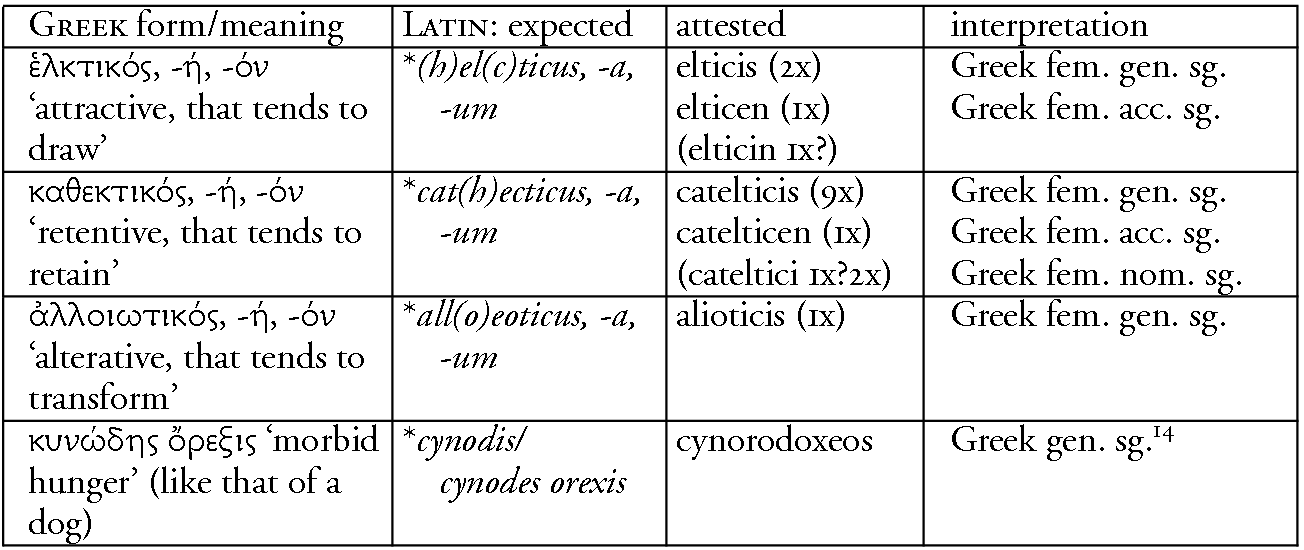
The attested Latin spellings are easily interpreted as writings of Greek inflectional forms, some of which appear to have been lifted straight from their Greek syntactic contexts, as in most of the instances of the forms in -is (for Greek -ῆς; cf. (2) above) and as in the only passage (6) in which the Latin forms are in -en (for Greek -ήν; in (6), notice that eltic- and cateltic- are set in contrast side by side):
(6)


The inflection of the forms is, then, usually fixed by their form in the Greek original, and is not determined by their Latin syntactic context. However, in context, if one disregards their morphology, the forms are for the most part easy to interpret and liable therefore, in many instances, to have their endings ‘corrected’ in due course by learned redactors. Note the first example in (7) (and cf. (1) above).
(7)

The main reason why we are quite reasonably surprised at our translators’ failure to deal straightforwardly with Greek ἑλκτικός, καθεκτικός and ἀλλοιωτικός is that these words are members of the large, important and productive morpho-lexical class of Greek adjectives and nouns in -ικός, -ική, -ικόν, which has been prominent in Latin medical terminology since the first century ad, and which is prominent still, and – with the named exceptions – straightforwardly and reliably dealt with in the Latin Alexander, by means of borrowing, i.e. transcription and integration (or, more rarely, morphological loan-translation16). In (8) and (9) are just a few of many possible examples. That in (8) relates to pathology, those in (9) to one of the contexts relevant to our present concerns, that is, the properties of foods and remedies:
(8) Alex. Trall. Lat. 2.12 facit quoque et ad emoptoicos (masc. acc. pl.; cf. αἱμοπτυϊκός) et dentes reumatizantes et ad omnis reumaticas (fem. acc. pl.; cf. ῥευματικός) passiones, et stranguiria patientibus et uesicam dolentibus et colicis et spleneticis (masc. dat. pl.; cf. κολικός, σπληνητικός). ‘It (the remedy) is effective also for those spitting blood and for a flux in the teeth and all rheumatic affections, and for those suffering strangury and those with pain in the bladder and those afflicted in the colon or the spleen.’
(9) Alex. Trall. Lat. 1.6 et quae uirtute areotica (fem. abl. sg.; cf. ἀραιωτικός) sunt medicamenta ‘and those medicaments which have the power of drying’;
1.89 et magis habent ad reprimendum stipticam uirtutem (fem. acc. sg.; cf. στυπτικός) ‘and they (the remedies) have rather styptic power for repressing’;
1.114 aliquo alio narcoticam habente uirtutem (fem. acc. sg.; cf. ναρκωτικός) ‘some other substance with narcotic power’;
2.139 malactica est uirtute (fem. abl. sg.; cf. μαλακτικός) ‘it (the medicament) has the power of softening’;
2.143 plus esse conuenit diaforeticam et malacticam uirtutem habentia (fem. acc. sg.; cf. διαφορητικός, μαλακτικός) ‘it is more appropriate that they (the remedies) should have diaphoretic and softening power’; cf. 1.41 sic ad ea ueniendum quae amplius diaphoretica sunt uirtute ‘then we must resort to those which have a more marked diaphoretic power’.
The borrowing by Latin of Greek adjectives and nouns in -ικός, -ική, -ικόν is a good example of the borrowing of a morpho-lexical system.17 Clearly, our problem cases, which for some reason fail to penetrate this system, are loanwords of sorts, but of what sort? In the typology of David Magie (Reference Magie1905), they are evidently instances of transcriptio (as opposed to translatio/interpretatio or comparatio).18 Furthermore, they instantiate transcriptio in the stronger, or at least literal, sense that not only the stem but also the inflectional ending has been transcribed. The presence of alien morphology is often a concomitant of what is seen as a type of ‘code-switching’ as opposed to borrowing (at any rate, integrated borrowing). Perhaps, then, our puzzling forms in -ticis are instances of some sort of code-switching. These remarks call for a brief digression on the various species of these phenomena distinguished in the linguistic literature, and the associated terminology.
5 BILINGUALISM AND CODE-SWITCHING VS BORROWING VS INTERFERENCE
Synchronically, at least, a borrowing is quite distinct from a ‘code-switch’.19 Various types of code-switching are distinguished against criteria of different sorts, grammatical and functional or pragmatic,20 and code-switching as a whole is – not only in this volume – generally distinguished not just from borrowing but also from interference. One (non-grammatical) synchronic criterion serving to identify the use of a borrowing is that it need not entail any knowledge of the source language: a switch, on the other hand, like interference, does imply a context involving language contact, and a degree of bilingualism (cf. Adams Reference Adams2003: 27), although with the following important distinction between switching and interference. A switch, whether involving a whole word-form or affecting just a part of a word-form (usually the stem or the inflectional ending), will tend to be deliberate, even skilful, and will be made manifest in performance in the user's L1 (in a translation, the target language), while interference will be unintentional or the result of incompetence and will affect either L1 or L2 (usually L2 – and, in a translation, again of course only the target language comes into question).21
So, to give some brief illustration (using some of the examples discussed by James Adams (Reference Adams2003: 18–28)), (10), (11) and (12) below are all instances of code-switching, clearly deliberate and artful. All three are intra-sentential insertions, operating below the level of the nominal phrase. The switch in (10) is intra-phrasal, affecting only the noun (ληκύθους) within the adjective-noun phrase (illas ληκύθους); it depends on the retention of the L2 (Greek) morphology, and is further signalled by the use of L2 (Greek) script:22
(10) Cicero, Att. 1.14.3 nosti illas ληκύθους ‘you know my palette’.
The switches in (11) and (12) take place within the word. Each manifests the deliberate (artful and jocular) use of L2 (Greek) morphology on an L1 (Latin) stem. This phenomenon is sometimes referred to as ‘morphological borrowing’, but, at least in the context of code-switching, it is better termed ‘morphological switching’:
(11) Cic. Att. 1.16.13 φιλοσοφητέον, id quod tu facis, et istos consulatus non flocci facteon ‘one must take to letters, as you do, and not care a button for their Consulships’ (translation by Shackleton Bailey (Reference Shackleton Bailey1999: 91)).
(12) Quintilian 8.6.33 at ‘οἴνοι’ ἀγαθοῖο’ ferimus in Graecis, Ouidius ioco cludit ‘uinoeo bonoeo’ ‘but while we accept “οἴνοι’ ἀγαθοῖο” in Greek, Ovid in jest ends a verse with “uinoeo bonoeo” (“of good-um wine-um”)’.
The instances in (13a) and (13b) are in certain respects descriptively similar to those in (10)–(12), but are to be regarded as cases of interference rather than of code-switching, chiefly because the mixing of languages that they show is not deliberate but accidental – both are from the same document, a receipt issued by a non-native user of Latin. In (13a), the matrix language (Latin, here L2) shows foreign (Greek, here L1) accusative plural endings on the noun–adjective phrase δηναριους σεσκεντους in a pattern superficially identical to that of Ovid's ‘uinoeo bonoeo’ in (12):
(13a) CPL 193…σκριψι μη ακκηπισσε…δηναριους σεσκεντους…‘…I wrote that I had received…six hundred denarii…’
In (13a), there is no question that the stem σεσκεντ- is Latin and that δηναριους as a masculine noun is also Latin (in contrast to the neuter δηνάρια, the standard form of this loanword in Greek). At first sight, (13b) would seem to contain another instance of exactly the same type, a switch affecting an inflectional ending – the stem of Latin classis with Greek first-declension genitive singular ending -ης. If the ending had been intended to be Latin, it would have been written -ις. In fact, we should note also the alternative possibility (favoured by Adams Reference Adams2003: 25) that what we have in κλασσης is a switch at word level (i.e. of the whole word rather than just the ending) to a perfectly regular Greek word-form, the genitive singular κλάσσης of the integrated loanword κλάσσα (Greek first declension from Latin third-declension classis):
(13b) CPL 193…ακτουμ καστρις κλασσης (κλάσσης?) πραιτωριαι ‘…performed in the camp of the praetorian flotte’.
On the latter interpretation, κλάσσης in (13b) would in formal and structural terms resemble Cicero's ληκύθους in (10) above, the key difference between the two lying in the fact that ληκύθους is manifestly deliberate (and, in part at least in virtue of this fact, is said to be a code-switch), while κλάσσης is at least very probably accidental (and is hence said to be an instance of interference, whether at word level or affecting only the inflectional ending). If κλάσσης is a Greek word-form in its entirety (rather than Latin stem κλασσ- + Greek ending -ης), it is the more striking in that it is part of a Latin noun + adjective phrasal term (classis praetoria ‘the praetorian fleet’), and its modifier (πραιτωριαι = Latin gen. sg. fem. praetoriae) is apparently unaffected and given its ‘correct’ Latin form.23
The two criteria most frequently used for characterising code-switching/interference as distinct from borrowing centre on the use of foreign inflectional material, and the frequency of occurrence or degree of integration in the matrix language of the foreign lexical material. Thus, it is held that interference and code-switching have in common the tendencies (a) to include foreign inflectional material (in the context of translation literature, morphology characteristic of the source), with or without a foreign lexical stem, and (b) to involve rare (even ‘nonce’24) forms with a low degree of integration or standardisation. Borrowings, on the other hand, will tend to recur and, in keeping with their consequently higher degree of integration, to show native inflection (in a translation, that which is characteristic of the target language). This digression began with stress on the importance of a synchronic point of view for a meaningful distinction between borrowing and code-switching/interference. Diachronically, it may be hard to tell them apart, in that borrowings may start life as cases of interference or code-switching. It would seem reasonable to suppose that the arrow of change will always point in the same direction (from code-switching/interference to borrowing, and not the other way around), and that this unidirectionality will hold also of the individual criteria, i.e. that over time a foreign word, if it catches on at all in the matrix language, will become more integrated, gaining in currency and shedding its foreign inflection in favour of matrix-language morphology. Superficially, or in formal terms at least, elticis, catelticis and alioticis might be regarded as lying in a phase of development somewhere between code-switch and borrowing.
In the light of these reflections, it is interesting to observe that one and the same word which may reasonably be regarded – on grounds of frequency, distribution, use and morpho-syntactic adaptation – as a well-integrated lexical borrowing may appear in Latin translation-literature to show behaviour in one context characteristic of a switch, in another of interference. A promising example is, I think, to be seen in the use of the genitive singular form of paralysis in three Late Latin medical texts ((14)–(16) below). The term paralysis is used without apology or awkwardness (of the sort seen in (15) below), and with Latin inflection, by Vitruvius (8.3.4; first century bc), Petronius (129.6; first century ad) and Suetonius (Vitellius 3.1; first to second century ad), and in medical discussions in the first century ad by Scribonius Largus and the Elder Pliny (e.g. 22.105, 27.92).25 Its use, then, and the Latin genitive singular inflection that it bears in Cassius Felix (fifth century ad), as e.g. in (14), is entirely in keeping with the status of integrated borrowing that it would seem to have enjoyed for five centuries:
(14) Cass. Fel. 54.1 (Fraisse) et sunt distantiae paralysis duae ‘and there are two types of paralysis’.
It is therefore striking to find, probably just a few generations before Cassius Felix, the Greek genitive singular form (paralyseos for Greek παραλύσεως) attested in the works of two other highly educated Latin medical writers, working probably in the same province, Africa. Caelius Aurelianus (15) uses this form three times, and no other form of the genitive singular:
(15) Cael. Aur. Chron. 2.2 sed plurimis species duae paralyseos uisae sunt ‘but many have thought that there are two species of paralysis’ (cf. 2.4 haec sunt communes paralyseos significationes ‘these are the signs common to both types of paralysis’; 2.15 Erasistratus memorat paralyseos genus, et ‘paradoxon’ appellauit ‘Erasistratus records a type of paralysis which he has termed paradoxos’).
The Greek genitive form paralyseos is attested also – once only – in the short gynaecological work of Theodorus Priscianus (16), a near-contemporary of Caelius Aurelianus.
(16) Theod. Prisc. Gyn. 7 (p. 229.1 Rose) sub horrore causae ueluti paralyseos mentiuntur imaginem ‘affected by the shuddering of the disease, they (sufferers from suffocation of the womb, praefocatio matricis) give the appearance of having a sort of paralysis’.
Now, admittedly further research is needed on the language – I mean the Latinity – of both Caelius Aurelianus and Theodorus Priscianus. However, as things stand, I think it very probable that Caelius Aurelianus is code-switching, deliberately using the Greek genitive form in order to avoid the morphological ambiguity of the Latin ending -is and/or to enhance his appearance of learning.26 Theodorus’ use of genitive paralyseos, on the other hand, is, I think, much more likely to be another effect of interference on the part of – as I suppose (cf. Langslow Reference Langslow2002: 42–43) – his L1 (Greek) on his L2 (Latin). On the other hand, our problematic forms elticis etc. appear neither learned, nor like cases of interference, since most often the (original) genitive case of the Latin forms in -is (Greek -ῆς) is impossible in the Latin syntactic context.
I suspect that there is fruitful further work to be done on the treatment of Greek inflectional forms in Latin, in particular that of the genitive singular ending -εως. This ending (in paralyseos) was deliberately chosen to bring us back to our starting point. For, if some sense can immediately be made of the Greek genitives as genitives in (15) and (16) above (paralyseos), the same cannot be said of (17) (repeated from (2) above), in which the last word (cynorodoxeos) appears to be used by the maker(s) of the Latin Alexander as a nominative singular.
(17) Alex. Trall. Lat. 2.20 tit. curatio si ex imbecilla uirtute catelticis fiat cynorodoxeos ‘Treatment if as a result of a weak catelticis capacity cynorodoxeos occurs.’
On the face of it, cynorodoxeos might be thought to be a late example of the process supposedly witnessed very much earlier as giving rise to Latin nominatives such as abacus and elephantus (if, that is, they are from the Greek genitives ἄβακος and ἐλέφαντος).27 An important difference, however, lies in the fact that cynorodoxeos does not decline. It belongs rather to a small but growing dossier of Latin indeclinable nouns in -eos (or -eus) which presumably originate as transcriptions of Greek genitive singular forms in -εως, and are subsequently used by the maker(s) of the Latin Alexander in nominative or accusative, as well as genitive, function and occasionally exhibit masculine gender. Two lexical groups are prominent: 1. terms of pathology, originally feminines in -σις, -σεως in Greek: e.g. diabroseos (διάβρωσις, erosion of the coats of a blood-vessel), pitiriaseos (πιτυρίασις, a ‘bran-like’ eruption on the skin), syntixeos (σύντηξις, colliquescence), and of course cynorodoxeos (κυνώδης ὄρεξις); and 2. botanical terms, originally feminines or neuters in -ι(ς), -εως in Greek: e.g. ameos (ἄμ(μ)ι, ajowan), limnisteos (λίμνηστις, greater centaury), orcheos (ὄρχις, the plant salep), and commonest of all ireos (ἴρις, iris). As far as I can see, this curious type has not been noticed before, although a few individual forms are catalogued in recent fascicles of the ThLL.28 It merits, however, further research and report for historical as well as philological and linguistic purposes in that, to the best of my knowledge, examples of the type are documented to date only in texts thought to have been made in northern Italy in the sixth century ad – that is, apart from the Latin Alexander, in Latin translations of Oribasius, Hippocrates and (in Book 2 of the Latin Alexander) Philumenus. It thus promises to provide another stylistic agreement between these texts.29
As for our puzzling forms in -ticis, they seem not to fit easily into any of the categories so far considered. They are clearly transcriptions in origin; they are used as borrowings, but without morphological integration, and showing endings which speak against either code-switching or interference.
6 FURTHER DISCUSSION OF ‘CODE-SWITCHING’ AND ‘BORROWING’
Pieter Muysken, in his influential contributions on code-switching (which he calls ‘code-mixing’) and grammatical theory (Muysken Reference Muysken, Milroy and Muysken1995; Reference Muysken2000), compares the distinction between lexical borrowing and code-switching with that between derivational morphology and syntax. Is there anything in his distinctions and characterisations to help us with the analysis of especially the ending of elticis in elticis uirtus etc.?
Muysken defines (Reference Muysken, Milroy and Muysken1995: 189; cf. Reference Muysken2000: 71) code-switches as ‘words (W) with different language indices [his subscript ‘p’ and ‘q’] inserted into a phrase structure’ (18a), and lexical borrowings as ‘formatives (F) inserted into an alien word-structure’ (18b). He represents them schematically as follows:
(18a) [S…Wp Wq…] (Muysken's code-switching)
(18b) [W…Fp (Fq)…] (Muysken's borrowing).
In the former case (18a), his definition and representation are not affected by whether the matrix language is ‘p’ or ‘q’. In the latter (18b), however, we must assume that the basis, or ‘host’, language is that denoted by subscript ‘q’, since the optional ‘(Fq)’ can stand only for ‘host’ inflectional morphology attached to the foreign lexical stem ‘Fp’ in order to enable it to behave, in Muysken's words, ‘externally like an element from the host language’ (Reference Muysken, Milroy and Muysken1995: 189; cf. Reference Muysken2000: 71).
As it stands, Muysken's scheme for code-switching in (18a) nicely captures Cicero's illas ληκύθους (cf. (10) above), and in the Latin Alexander would capture cateltici uirtus,30 since cateltici can be interpreted as a word in the ‘foreign’, embedded language (Wp) in agreement with another word in the matrix language, uirtus (Wq). However, the scheme does not apply to catelticis uirtus because catelticis cannot be regarded in this context as a word in the embedded language.
Equally, Muysken's scheme for borrowing in (18b) describes the commoner type areotica uirtus (cf. (9) above) or the secondary form, eltica uirtus etc., of our problematic cases, in which the Greek formative eltic-(Muysken's Fp) is inserted into the Latin word-structure [-a uirtus] (the Latin ending -a being Muysken's Fq). If, however, it is right to see alien morphology in the -is ending of elticis, then in order to characterise elticis as a borrowing in elticis uirtus, we should need to supplement his scheme with at least (18b’), below, where [Fp] may (but need not) be morphologically complex and is enabled by host morpho-syntax (signalled by subscript ‘q’ in [Fp]q in (18b’)) to behave externally like an element of the host language (in this instance, to function as [fem. nom. sg.? or endingless?] determiner of uirtus):
(18b’) [W…[Fp]q…].
Muysken's simple formalism lends support to the hypothesis raised above that elticis in elticis uirtus is neither code-switch nor borrowing, but somewhere between the two, and to the extent that it can be more easily accommodated in (18b) than in (18a) perhaps closer to a borrowing than to a code-switch.
Muysken brings loans and switches together as instances of ‘lexical interference’ – another example of terminological variability in this domain, as we shall shortly see – but he rejects the claims of ‘some people’ that ‘it is better to drop the conceptual distinction between borrowing and code-mixing altogether and to speak about “interference” in general’ (Muysken Reference Muysken2000: 71). He defines and distinguishes code-switches and loans, as in the table in (19), with reference to two dimensions, ‘(a) whether a particular case occurs at the supra-lexical or sub-lexical level, in the sense just described; and (b) whether it involves being listed [i.e. lexicalised] or not’:
(19) Types of ‘lexical interference’ (after Muysken Reference Muysken, Milroy and Muysken1995: 190; Reference Muysken2000: 72)

Other work tends to distinguish ‘code-switching’ and ‘borrowing’ at the level of the lexicon with reference to a longer list of other, more particular, criteria, which allow in principle a more nuanced characterisation of problematic instances such as our forms in -ticis. Shana Poplack and David Sankoff (Reference Poplack and Sankoff1984) give a useful review of many earlier studies in the field, which is conveniently schematised by Muysken (Reference Muysken, Milroy and Muysken1995: 190–191; Reference Muysken2000: 73) in the binary feature chart which I reproduce slightly modified in (20):
(20) A binary feature-matrix characterising borrowing and code-switching (after Muysken Reference Muysken, Milroy and Muysken1995: 190–191; Reference Muysken2000: 73)

Poplack and Sankoff themselves highlight the four types of criteria set in bold in (20) in their study of the attainment of ‘this state of complete assimilation’, which ‘obviously does not come about instantaneously’ (Poplack and Sankoff Reference Poplack and Sankoff1984: 103–104).33 They acknowledge that identifying (integrated) loanwords against criteria remains an inexact science,34 but they reach a relatively optimistic conclusion on the plausibility of their criteria at the end of their introduction (Reference Poplack and Sankoff1984: 105). Their ordering of the criteria appears to suggest (though I should stress that this is not expressly their intention) a chronological sequence as in (21), which could, by reversing the arrows, be regarded as an implicational hierarchy:
(21) frequent use → phonological and morphological integration [→ displacement of host synonym(s)35] → acceptability as a host form.
If this holds in the domain investigated by Poplack and Sankoff (i.e. for English loanwords in the Spanish speech of Puerto Ricans in East Harlem, New York), it repeatedly fails in Latin translation literature. In our particular cases, elticis, catelticis and alioticis seem to have attained acceptability with phonological integration, at least in their stems, but without morphological integration in their inflection, although (probably – but cf. n. 13 above) with Latin assimilation of a ‘malapropistic’ kind in the stem cateltic-.
7 TERMINOLOGICAL STATUS AND INTEGRATION OF LOANTERMS
Integration in the language at large can be unevenly reflected in individual texts. The sociolinguistic position of authors writing on one and the same subject can be very different. The morphological foreignness of cynorodoxeos and catelticis goes hand in hand in the Latin Alexander in a most unexpected fashion with their repeated use as apparently familiar and well-integrated loanterms without apology or explanation.36
In some earlier work on a general characterisation of Latin word-formation in the Roman Empire, centring on the language of four Latin medical texts which are not in any straightforward sense translations,37 I proposed a typology (reproduced in (22) in modified form) of the kinds of terminological treatment to which foreign terms and their host-language (Latin) translation-equivalents are subject:38
(22) Partition of the manners of use of foreign terms and their translation-equivalents (adapted from Langslow 2000: Ch. 2)
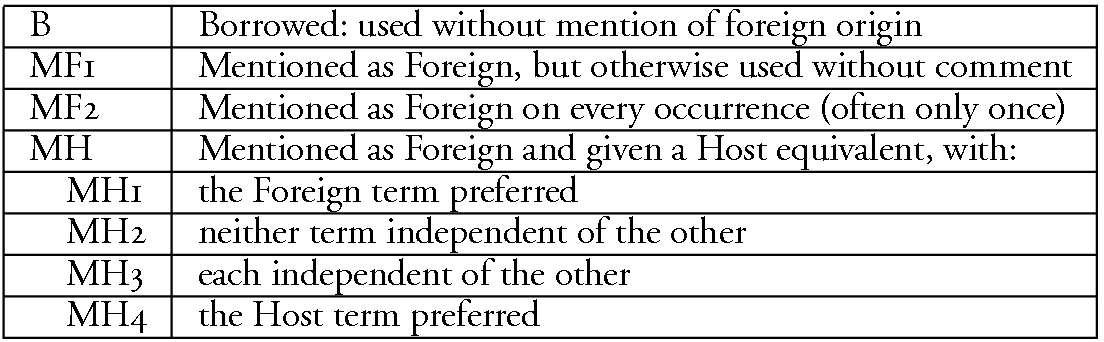
The status-types proposed and discussed there are in a sense points between the two extremes – ‘unlisted’ code-switching and integrated borrowing – set up in the binary feature chart in (20) above. The typology as it stands served the particular purpose of characterising the use of Greek medical terms in four Latin medical texts in such a way that the texts might be compared and contrasted with one another quantitatively, and to some degree and with due caution, qualitatively also. On the qualitative side, I discussed a small number of striking, in a sense ‘extreme’, cases of integration or non-integration of Greek medical terms in the Latin texts under consideration.
Extreme cases recognised hitherto include, on the one hand, the naturalisation, or nativisation, of loanterms to the extent that they appear ‘on the right’, as the explanans, in explanatory equivalences such as those illustrated in (23)–(25). (23) and (24) are deliberately chosen to provide further illustration of the frequency and ready integration of Greek terms in -ικός, -ική, -ικόν (Latin -icus, -ica, -icum). In (23), note that the -ικός/-icus adjective in the adjective–noun phrasal term appears in both the explanandum part of the equivalence (reumatice, for Greek ῥευματική, with Greek ending) and in the explanans (reumatica, with Latin ending). In (24), on the other hand, the Greek dative form, made to fill the slot of a Latin ablative, is glossed with what is clearly a Latin ablative ending on an -ικός/-icus adjective functioning in the masculine plural as a noun denoting sufferers from the disease denoted by the stem (pthisici (φθισικοί) ‘sufferers from pthisis (φθίσις)’):
(23) Cassius Felix, De medicina 23.1 (Fraisse) reumatice diathesis, id est reumatica passio.
(25) Cass. Fel. 42. 14 sin uero paresis fuerit stomachi, id est paralysis.
(25) incidentally exemplifies again the extent of the nativisation of Greek παράλυσις (as Latin paralysis, discussed above). Interestingly, there may be cases in learners’ Latin of what we may call ‘hypercorrection against contact-induced lexical change’, in other words against the assumption that an L1 (Greek) word is an integrated borrowing in L2 (Latin). I think of cases such as (26) and (27). These are in a sense reversing the unidirectional arrow of naturalisation referred to above. Both, however, are drawn from Theodorus Priscianus, whose L1, as I suggested earlier, was probably Greek not Latin. In both, Greek loanterms which we have good reason to suppose had been for centuries widely understood and used in educated Latin-speaking circles (especially podagra ‘gout’ and dysenterici ‘sufferers from dysentery’: compare (26’) and (27’) respectively) are ignored – surely, deliberately avoided – in favour of elaborate paraphrases, reminiscent of the practice of a much earlier age.39
(26) Theod. Prisc. Gyn. 2.118 (p. 221, 20 Rose) quibus uero sub calido tactu pedum dolor obuenerit ‘but for those whom foot-pain (gout) hot to the touch has afflicted’.
(26’) Celsus 5.18.1 ad calidas podagras ‘for cases of hot gout’.
(27) Theod. Prisc. Gyn. 3.31 (p. 247, 3 Rose) in iis qui sanguinem uomuerint40 aut dysenteriae uitio laborarint ‘in the case of those who have vomited blood or suffered with the disease dysentery’.
(27’) Pliny, Nat. 12.32, 20.10 dysenterici ‘those suffering from dysentery’ (cf. Scribonius Largus 85).
A third type of extreme case is seen in some instances of my type MH1 above (that is, cases in which a host-language terminological equivalent is provided but the foreign term is preferred). The point of interest here is the failure of certain loan-translations to achieve any visible currency in the host language. In contrast with early established MH4 examples, such as those in (28), several perfectly well-formed loan-translations, such as those in (29), are attested just once in the Latin record and remain to all intents and purposes nonce-forms:41
(28) Well-integrated loan-translations (type MH4): destillatio = κατασταγμός ‘catarrh, the common cold’, aspera arteria = τραχεῖα ἀρτηρία ‘the trachea’.42
(29) Non-lexicalised (nonce) loan-translations (type MH1): coruus = κόραξ ‘a type of surgical knife’ (Cels. 7.19.7), rotula = τροχίσκος ‘a small, round medicinal tablet’ (Cass. Fel. 32.2 (Fraisse)), fossula = βοθρίον ‘a type of ulcer’ (Cass. Fel. 29.8 (Fraisse)), filificium = παιδοποίησις ‘the bearing of children’ (Cael. Aur. Gyn. 1.291, 1140).
Once again, Theodorus Priscianus offers a superficially comparable instance (30), which, if, as I suppose, Theodorus is translating into his L2 (Latin) from his L1 (Greek) and hence L1 and L2 are reversed, has a rather different flavour:
(30) Theod. Prisc. Gyn. immineo = ἐπιμένω ‘to persist’ especially with treatment.43
However, the case in (30) differs importantly from those in (28) and (29) in that the Greek model of the Latin loan-translation is not mentioned in the text, and in that it is a finite verb (cf. Otta Wenskus’ remark quoted on p. 168 below).
8 NEW TYPES IN THE LATIN ALEXANDER
The above are a few examples of extreme cases of the treatment of Greek loanwords in Latin medical texts, at both ends of the spectrum of naturalisation – integration and non-integration. It seems that the text of the Latin Alexander is likely to throw up not only interesting new examples of existing types, but new types altogether. It is perhaps in their context that elticis, catelticis and alioticis may be accommodated.
The first one that deserves a mention is the use of transcriptio extended not only to foreign morphology (as apparently in the ending of elticis, etc.), but even to items of core vocabulary. This seems the most likely explanation of the word uitia in the curious translation, in (31), of a sentence early in the introduction to the extensive discussion of gout:
(31) Alex. Trall. ii, 501, 19 πολλὰ μὲν οὖν εἰσιν αἴτια τὰ τὴν ἀνιαρὰν τίκτοντα ποδάγραν ‘Well, many are the causes that give rise to accursed gout’:
Alex. Trall. Lat. 2.236.1 multa igitur sunt uitia in his qui insanabiles possident podagras ‘So, many are the afflictions in those who have incurable cases of gout.’
The question arises, what is uitia (‘diseases’) doing here? It is very rare in the Latin Alexander,44 and it is in any case a poor equivalent for αἴτια (‘causes’), which is correctly translated on numerous occasions.45 One possibility is that αἴτια was originally rendered with causae (‘causes’), and that causae was then misunderstood as meaning ‘cases’ or ‘diseases’, and replaced with the ‘higher’ synonym uitia.46 In view of the purely formal resemblance between Greek αἴτια and Latin uitia, I am inclined to raise and favour the possibility that the Greek word was in the first place transcribed (as *aitia) and then either misread (say, in an early uncial script in which <A> with an open top resembles <U>), or ‘corrected’, and so Latinised. It is at least possible that elticis, elticen, etc. are uncorrected transliterations of unrecognised Greek adjectives. This observation fails, however, to address the most puzzling aspects of these forms, the partial Latinisation of their stems alongside the apparent failure to recognise their suffix.
9 NON-GREEK USE OF GREEK WORDS
The second type also may have a questionable connection with real Greek words. In my book on medical Latin (Langslow Reference Langslow2000: 80 n. 9), I observed the presence in the texts I was focusing on – none of them straightforward translations47 – of Greek words unknown in surviving Greek texts. These include those listed in (32) (for details, see Langslow Reference Langslow2000: Index, s.vv.):
(32) Greek medical words unknown in Greek texts but attested in Latin medical texts: elephantia ‘the disease ἐλέφας/ἐλεφαντίασις’; leptospathium ‘a thin spatula’; masomenum ‘a remedy for toothache’; spleniticus ‘for treating a diseased spleen’; sycotice ‘a remedy for anal lesions’; tiltarium ‘a lint dressing’; trichocollema ‘a salve for the eyelashes’; xerolusia ‘a dry bath in hot sand’.
There are certainly more examples of this kind to be found in the Latin Alexander as excavations continue. In the meantime, two very particular – and potentially more interesting – types of apparently non-Greek use of Greek words have already come to light.
First, I note in passing the presence in the Latin text of some items of non-standard Greek vocabulary that may be characteristic of Italian Latin. These include those listed in (33), which have recently been discussed by Adams (Reference Adams2007: 489–491, 498), in his ground-breaking study of the regional differentiation of Latin:
(33) Non-standard Greek apparently characteristic of Italian Latin: e.g. pelagicus ‘of large, ocean-going fish’ (Alex. Trall. Lat. 1.63, 2.130, 135; for Greek πελάγιος, πλανήτης);48tricoscinum ‘hair-sieve’, tricoscinare ‘sieve with a hair-sieve’ (for Latin saetacium, saetaciare; apparently ← Greek *τρι(χο)κόσκινον, but only κόσκινον is attested (Attic; modern Greek dialects of southern Italy; modern southern Italian dialects)).
Adams studies these words and many others (mainly non-Greek) in a long chapter devoted to assessing the linguistic – especially lexical – evidence for attributing to northern Italy the production of the Late Latin translation of the fourth-century Greek doctor Oribasius, together with a group of other Late Latin medical translations including, as it is becoming increasingly clear,49 the Latin Alexander.
Secondly, it frequently happens in the Latin Alexander that Greek words are used rather differently in the Latin version compared with their models or counterparts in the Greek original. Provisionally, I distinguish two types of mismatch, the one lexical, the other syntactic or morpho-syntactic. The lexical type may be illustrated by the use in the Latin Alexander of encathisma (Greek ἐγκάθισμα) ‘a sitz-bath’ even where the Greek original has a different expression, albeit still a straightforward noun phrase, as, for example, in (34):
(34) Alex. Trall. Lat. 2.185 encathismata/incatismata for Alex. Trall. ii, 481, 2 λουτροῖς ἐκθερμαίνουσιν ‘warming (medicated) baths’.
Similarly, the Latin Alexander attests not only the adjectival plethoricus (matching Greek πληθωρικός) but also the substantival base-form pletura corresponding to Greek πληθώρα. The latter noun, however, is not found in the Greek original, which uses instead, as in the examples in (35), either the substantival perfect passive infinitive τὸ πεπληρῶσθαι or the neuter noun πλῆθος:
(35) Alex. Trall. Lat. 1.93 quodsi absque plenitudine corporis id est pletura (Alex. Trall. ii, 29, 7–8 χωρὶς τοῦ πεπληρῶσθαι τὸ σῶμα) flegmon tibi uisus fuerit factus…; optimum autem est in talibus in quibus non est pletura ut diximus primo lauare aegrotantem ‘If, however, the inflammation seems to you to have arisen in the absence of excessive fullness of the body, i.e. pletura…; but it is best in such cases in which there is no excessive fullness as we have said first to wash the patient’;
Alex. Trall. Lat. 1.144 cognosce non in eo esse pleturam (Alex. Trall. ii, 231, 18 πλῆθος; cf. Alex. Trall. Lat. 2.184, 185) ‘recognise that there is no excessive fullness in him (i.e. the patient)’.
In this instance, the possibility suggests itself that the phonological adaptation and sociolinguistic integration of Greek πληθώρα was accelerated by its being falsely identified (by a sort of folk-etymology) as a member of the large class50 of Latin derivatives made to verbs with the suffix -tura (-sura).
A second type of divergence between the Greek in the Latin Alexander and the Greek in the Greek original concerns rather the syntactic incorporation of the foreign lexical stems. For a first example, we may use again the loanword encathisma ‘a sitz-bath’, which, in the passage quoted in (36), is used with a passive ‘quasi-auxiliary’ verb51 to translate the Greek substantival passive infinitive (τὸ ἐγκαθίζεσθαι):
(36) Alex. Trall. Lat. 2.209 (de incatismatibus) post haec autem incatismata sunt adhibenda…‘(On sitz-baths) After this, however, sitz-baths are to be administered’ (Alex. Trall. ii, 347 (περὶ ἐγκαθισμάτων) καὶ τὸ ἐγκαθίζεσθαι…κάλλιστόν ἐστι βοήθημα ‘(On sitz-baths) And using the sitz-bath is an excellent remedy’).
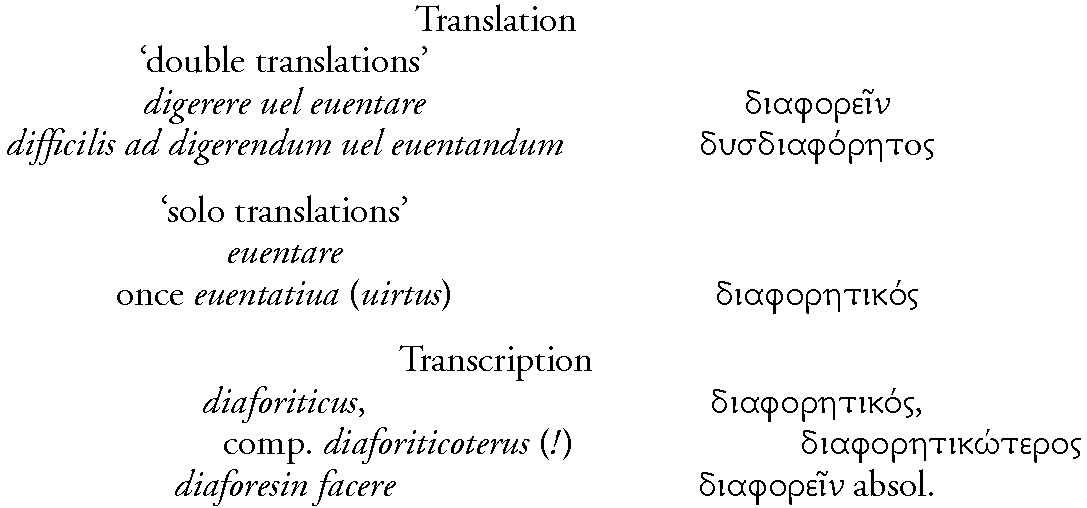
A second case of syntactic divergence is found among the curiously varied set of translation equivalents (summarised in (37) below) of derivational forms based on the Greek verb διαφορεῖν ‘to dispel, carry away’ (especially of the disposal of harmful matter in the body). In outline, the Greek stem διαφορ- is rendered either by translation or by transcription. In the former case, only rarely is a single Latin equivalent used (euentare; euentatiuus for διαφορητικός – cf. n. 16 above): usually, the ‘double translation’ digerere uel euentare is employed for a single form of Greek διαφορεῖν.52 Transcription (with varying degrees of morphological adaptation) is employed for the deverbal adjective διαφορητικός (diaforiticus), even in the comparative grade διαφορητικώτερος (diafor<it>icoterus), and for the absolute use of finite forms of the verb διαφορεῖν. The notable feature in the last case is that the Latin translator avoids the difficulties inherent in borrowing rather than translating a Greek verb in its finite forms by, in effect, rendering the inflectional ending with the corresponding form of facere, and the stem with the borrowed nominalisation diaforesis, even though Greek διαφόρησις is altogether rarer in the Greek original and often not present in contexts where Latin diaforesin facere is used:
(37) Translation and transcription of Greek διαφορ-
Wenskus (Reference Wenskus1996: 251–254) has observed, with regard to her extensive corpus of borrowed forms from Greek into Latin, the rarity of Greek verb-forms, a clear preference for Latin verb-forms, and a tendency to replace Greek verb-forms with Latin nominalisations. She comments in passing (Reference Wenskus1996: 252) ‘hier scheint mir übrigens auch eine der Wurzeln des lateinischen Nominalstils vorzuliegen’ ‘here, incidentally, it seems to me we have also one of the roots of the Latin nominal style’. I take it that this remark refers to only those cases where a Latin translation uses a noun in order to render a verb in the Greek original, rather than to the nominal style in Latin in general,53 which, it seems to me, is well rooted in Latin quite independently of Greek. In either case, this is an important hypothesis, which deserves further attention and testing.54
10 CONCLUSION
The final set of examples (the translation-strategies used for Greek διαφορ-) contains another instance of a Greek adjective in -ικός which is either translated or successfully borrowed and integrated into Latin (cf. (8) and (9) above). This serves only to underline further the anomalous status of elticis, catelticis and alioticis, on which I confess I am as yet unable to draw firm conclusions, although they are perhaps better understood now than at the outset.
With their Greek inflectional endings, elticis and congeners give the appearance of being examples of transcription in the first instance. They would thus take their place alongside other transcriptions in the Latin Alexander (such as 2.23 [odorem] cnisodi for Greek κνισώδη ‘fatty, greasy, like roast meat’, and possibly aitia for Greek αἴτια, if that is what lies behind the puzzling uitia at 2.236.1, (31) above), which I have yet to catalogue or investigate systematically.
The possibility was raised above (p. 164) that the intention of the ‘first translator’ to revisit and Latinise elticis, etc., at least by integrating their morphology, was never realised – although, taken together, the forms seem to have been given on almost every occurrence the standard ending -is regardless of the case-form of the Greek original. This hypothesis has implications for the mechanics of the process of producing a written translation. It would also suggest that Latin rather than Greek was that translator's L1, and hence that translation was proceeding in the usual direction, from L2 to L1.
It was twice suggested above that elticis, etc. are neither straightforward code-switches nor regular borrowings. They show features characteristic of both types, but those typical of borrowings are more prominent and numerous. In order to illustrate this graphically, I take the liberty of reproducing as (38) Muysken's table (20 above) with the addition of a column for elticis, etc.:
(38) Muysken's binary feature-matrix (from (20) above) with an additional column
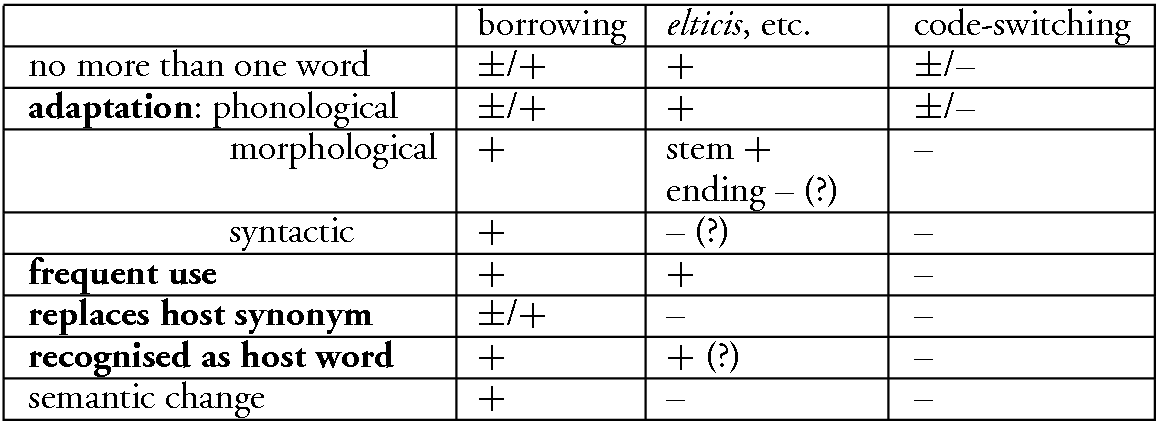
For all their odd appearance and syntactic behaviour, one thing these words are not is nonce-forms. They are well established in at least two important medical translations made probably in the same place (northern Italy) and at about the same time (sixth century ad). Their frequent use without apology or explanation is in line with that of integrated borrowings, ‘real loanwords’, although I hesitate to assert that they are ‘recognised as host words’.
In the terms of the typology of terminological status presented above (22), they belong either straightforwardly to type B or, if we regard as original the explanatory gloss at 2.201 (but cf. n. 36 above), then to type MH1. However, even if we acknowledge the earlier existence in Latin of the forms (at)tractiua (or -toria), retentiua (or -toria), alteratiua (or -toria), which might in principle have competed with elticis, catelticis, alioticis, respectively, it would be a gross exaggeration to say that these Latin adjectives were established host synonyms replaced by the Greek terms.
The Greek terms are clearly subject to phonological adaptation, and morphological adaptation at least of the stem is seen clearly in eltic- and the ‘malapropistic’ cateltic- and possibly in aliotic-, too. The Latinisation of the stems is strongly indicative of borrowings rather than code-switches. Admittedly, the failure to adapt their inflectional morphology to their Latin contexts is a feature more characteristic of code-switching, but if they are morphological switches they are not of a standard type in that their endings – in their Latin syntactic context – usually make no more sense in Greek than in Latin.
What the bizarre inflectional morphology reflects most strikingly is the failure to recognise these words as members of the large and successful morpho-lexical set to which they belong, and I wonder whether this yields an argument in favour of regarding the translator's L1 as Latin. For it is scarcely thinkable that a translator with Greek as his L1, capable of rendering -ικός, -ική, -ικόν with Latin -icus, -ica, -icum on countless occasions for numerous different stems, would have failed to recognise that these adjectives belong to the same class, and so to treat them in the same way. I acknowledge the risk that I am overestimating the linguistic competence of the translator(s) in both Latin and Greek, although we saw much earlier that some successful sensus de sensu translation is achieved in the Latin Alexander alongside, from a Latin point of view, less inspiring uerbum e uerbo passages, and that our puzzling adjectives in -ticis and our indeclinables in -eos occur in both ‘higher’ and ‘lower’ styles of translation, and with sufficient regularity to occasion – and I hope justify – this long discussion. I close by highlighting two further aspects of this regularity.
First, somehow relevant to their genesis may be the fact that elticis, catelticis, alioticis constitute a small but near-complete morpho-lexical set of terms of Galenic physiology (cf. n. 11 above). I am not aware of other such subsets amid the countless Latin borrowings from Greek terms in -ικός, -ική, -ικόν. Imagine, though, that the fourth of the four φυσικαὶ δυνάμεις, ἡ ἀποκριτική, were to be found in a Latin medical translation showing other northern Italian features rendered as abcriticis uirtus!
Secondly, the (plausibly northern Italian) translations which alone attest elticis, catelticis, alioticis have in common also the use, in part at least as indeclinables, of loanwords starting life as Greek genitive singular forms of feminine nouns (the type ireos, cynorodoxeos briefly introduced above). It is striking that the Greek noun-form which the problematic adjectives ἑλκτικῆς, καθεκτικῆς and ἀλλοιωτικῆς are most frequently modifying is δυνάμεως, which, although always correctly rendered with Latin uirtus, is a member of the same class which yields the cynorodoxeos indeclinables, and may somehow be related to the apparent fossilisation of the genitive singular feminine of the adjective in a variety of case functions in the Latin translation. But ireos, cynorodoxeos, etc. call for separate discussion, and I am getting perilously close to obscurum per obscurius!
1 The text of the quotations from the Latin Alexander is provisional at this stage. In a few instances, the text has been reconstructed on the basis of a collation of all the manuscripts, and printed, albeit tentatively, in Langslow (Reference Langslow2006). Generally, however, it is based on just the three oldest manuscripts (my A, M and P1) and the early printing (Lyons 1504) – for details, see Langslow (Reference Langslow2006: Ch. 3). My editorial corrections of the text are signalled by the use of italics. The Latin version in passage (2) is a much freer rendering of the Greek than that in (1). Variability of this kind – which may, as in example (2), extend beyond the basic uerbum e uerbo versus sensus de sensu typology discussed in section 3 – is common in the Latin Alexander. Latin sentences at some remove from the Greek of Puschmann's edition (Reference Puschmann1878–1879) presumably reflect redaction (editorial intervention) either in the Greek tradition (including the manuscript used by the Latin translator) or in the Latin version. Such redaction (both of the Greek and of the Latin Alexander) is well attested; for details, see Langslow (Reference Langslow2006: especially Ch. 2).
2 By tit. I refer to a chapter title, or heading (transmitted as part of the running text of the main body of the work, and plausibly regarded as part of the original translation, as opposed to the derivative list of chapter titles which is prefixed in some manuscripts to the start of the work or to the start of each book, and which is more often subject to variation and modification).
3 On the face of it here, catelticis begs to be taken as modifier of cynorodoxeos, but the context requires the construal that I give in the translation. Cf. 2.22 init. si ex calore nimio imbecilla fiat catelticis uirtus ‘if as a result of excessive heat, the catelticis capacity becomes weak’. This clause is not in the Greek, but here the intended meaning is not in doubt.
4 For the expression uerbum e uerbo, note Cicero, Fin. 3.15 and Horace, Ars 133; for the two strategies contrasted, Jerome, Letter 57.5.2 (ad 395, to Pammachius, on the best type of translation).
5 Notice, for example, the order of the first two words; the use of Latin et…et…for Greek μετά…ἔτι καί…; the generic subjunctives habeant, possint; the Latin relative clause qui solutus est for the Greek participle ἐκλυόμενον.
6 In fact, this example is fully uerbum e uerbo except only the Greek definite article (Latin adiutorium for Greek τὸ βοήθημα). Elsewhere in the Latin Alexander, however, a Latin demonstrative adjective (hic or ipse, say) is apparently made to stand for the Greek definite article.
7 Brock observes the value of such translations, which he compares to diplomatic editions, also for the editor of the original text. In form and effect (lack of idiomaticity), they resemble interference in language-contact situations less formal than translations, but they differ from it in being deliberate and systematic.
8 In fact, I believe that the Latin Alexander is a very valuable witness for improving the Greek original, but for reasons having more to do with the transmission of the respective texts than with the strategy and competence of the translator. Again, for further details, see Langslow (Reference Langslow2006: Ch. 2).
9 Plato, R. 523a2, of the power of a subject to draw its student towards knowledge of reality.
10 Each only three times in Aristotle – καθεκτικός: Top. 125b18, Hist. anim. 635b3, Probl. 963a21; ἀλλοιωτικός: De sensu 441b21, Phys. 257a24, De caelo 310a29.
11 In the system of physiology developed and represented by Galen (although it almost certainly antedates him), four ‘natural powers’ (φυσικαὶ δυνάμεις) were attributed to natural organisms, and to individual organs of animals. These powers were the attractive, the retentive, the alterative (part of digestion, but distinct from the cooking aspect of this process, the πεπτική) and the excretive (in Greek: ἑλκτική, καθεκτική, ἀλλοιωτική, ἀποκριτική). The last-named, the excretive, occurs only once in the Greek Alexander, at ii, 313, 18, in a passage that is not in the Latin version. For surveys of Galen's physiology and further references, see Hankinson Reference Hankinson and Hankinson2007: especially 223–225 and Debru Reference Debru and Hankinson2007: especially 270–271.
12 Compare, for example, ultor ‘avenger’, for *ulctor, agent noun to the root of ulcīscī ‘to be avenged’; or fultus ‘supported, propped’ (for *fulctos), participle to fulcīre ‘to support’ (see e.g. Leumann Reference Leumann1977: 217; Weiss Reference Weiss2009: 180).
13 In Greek manuscripts of Galen, καθεκτικός occasionally appears as καθελκτικός (by assimilation to ἑλκτικός), e.g. In Hippocratis de natura hominis librum comm. 2.5 (p. 64, 22 Mewaldt). Such a variant is never reported by Puschmann (Reference Puschmann1878–1879) for the manuscripts of the Greek Alexander, but it remains possible that the assimilation in Latin catelticis is of Greek rather than Latin origin. On the other hand, Latinisation may be reflected also in the single -l- in the stem of alioticis (contrast Latin ali- and Greek ἀλλοι-). The fourth example in (5), cynodis (or -es) orexis, appears to have undergone univerbation, and possibly some sort of metathesis [–d–r– > –r–d–] of a type (stop–liquid) familiar especially in Late Latin, although no precise parallel is offered by Väänänen (Reference Väänänen1981: §137) or Stotz (Reference Stotz1996–2004: iii.7 §§293–297): the closest, in the latter (§295.1), cinodomel for cydonomeli, cited from the Alphita, an important [Salernitan?] medieval medical–botanical glossary, shows rather [–d–n– > –n–d–]. However, I have yet to collate all the forms of cynodes orexis attested in the manuscripts of the Latin Alexander.
14 Presumably, the development was roughly (gen. sg.) κυνώδους ὀρέξεως → cynodu(s) orexeos → cynod'orexeos → cynorodoxeos/-eus.
15 Presumably, reflecting earlier inuenienda somehow?
16 In which the Latin suffix -tiuus translates the Greek suffix -ικός: so, in the Latin Alexander, for example, confortatiuus (τονωτικός), mitigatiuus (παρηγορικός), operatiuus (δραστικός), recorporatiuus (μετασυγκριτικός), temperatiuus (ἐπικεραστικός). On Latin -tiuus (and -torius) for Greek -ικός, see André Reference André1963: 48–53 and Langslow Reference Langslow2000: 353–361.
17 Morpho-lexical systems are surely not subject to the same constraints on ‘borrowability’ as, on the traditional view going back to Whitney (Reference Whitney1881), grammatical systems are. It is of morpho-syntactic elements and patterns that Lucien Tesnière famously asserted (Reference Tesnière1939: 85) that ‘la miscibilité d'une langue est fonction inverse de sa systematisation’ (quoted by Haugen (Reference Haugen1950: 224 n. 36), who also quotes Whitney (Reference Whitney1881: 14), ‘whatever is more formal or structural in character remains in that degree free from the intrusion of foreign material’). Note, however, the scepticism on the validity of linguistic constraints voiced by Thomason and Kaufman (Reference Thomason and Kaufman1988: especially 14–20), a reference I owe to Alex Mullen. The apparent difficulty experienced by ἑλκτικός, καθεκτικός, ἀλλοιωτικός in intruding where numerous other members of the same system had intruded before remains, to me at least, a puzzle.
18 This typology was taken over by Dubuisson (Reference Dubuisson1985) in his analysis of the Latinisms in the Greek prose of the second-century bc Greek historian Polybius, and is helpfully summarised by Rochette (Reference Rochette and Bakker2010: 291), who illustrates each approach for the rendering of Latin consul and quaestor in Greek: per transcriptionem – κωνσουλ, κ(ο)υαιστωρ; per translationem – σύμβουλος (i.e. with + counsel), ζητητής (i.e. seek + agent suffix); per comparationem – ὕπατος (the ‘highest’ magistrate, which the consul is), ταμίας (the ‘treasurer’, the central office of the quaestor). (NB Rochette has accidentally transposed ζητητής and ταμίας.) On the rendering of Roman institutions in Greek, note also Mason Reference Mason1970 and Reference Mason1974.
19 Cf. Poplack and Sankoff Reference Poplack and Sankoff1984: 99 and Myers-Scotton Reference Myers-Scotton1992, and, more recently, e.g. Muysken Reference Muysken2000: 69–75 and Myers-Scotton Reference Myers-Scotton2006: 253–260. The most important recent discussion of these phenomena and the associated terminology with reference to the ancient world is in the introductory chapter of Adams Reference Adams2003: especially Introduction 1.v, 18–28.
20 The (essentially functional, or pragmatic) distinction between ‘intimate’ and ‘emblematic’ code-switching cuts across the formal, or structural, syntactic dichotomy between inter-sentential (including tag switching, which is often emblematic) and intra-sentential, see Mullen, this volume, for further details. It is the latter type that encompasses lexical loan-phenomena with which we are here concerned, and which may be further subdivided between ‘alternation’, ‘insertion’ and ‘congruent lexicalisation’ (cf. e.g. Muysken Reference Muysken, Milroy and Muysken1995; Reference Muysken2000), and code-switching within the word (or morphological interference? or ‘leaks’? cf. e.g. Adams Reference Adams2003: 25, 27). A multi-purpose illustration (drawn from Adams Reference Adams2003: 23–24, switches marked with double obliques): ILCV 4463 Βηρατιους Νικαγορας | Λαζαρίῃ καὶ Ἰουλίῃ καὶ Ὀνησίμῃ | κον φιλιους βενε μερεντες | ὁ βίος ταῦτα: intra-sentential code-switching (but with a tag-switch (inter-sentential) into Greek at the end), ‘intimate’ (as opposed to ‘emblematic’), ‘alternation’ phrase by phrase (as opposed to ‘insertion’, except with a switch within the word (morphological interference?) in φιλιους, with Greek ending -ους for intended Latin -ως = -ōs).
21 The distinction advanced in this paragraph between code-switching and interference is not hard and fast: code-switching may be sub-conscious (i.e. the code-switching mode is chosen, but not the switch points), and it may be the result of imperfect competence (such as a gap in the lexicon or inflectional morphology); further, in the case of a balanced bilingual, it may be inappropriate or impossible to identify L1 versus L2. I owe these observations to Alex Mullen.
22 In identifying instances of the use of Greek script in Latin literary texts, we are of course at the mercy of the individual manuscript tradition. There are a few clear examples in the manuscripts of the Latin Alexander (e.g. 1.41 et ΗΓΑΡΜΙΧΑ [A et tapauxa M 7 7cixa P2 om. P1: surely reflecting πταρμικά] id est sternutationes ‘and πταρμικά, that is sneezing-agents’), but how many others have been lost through the general tendency to replace Greek with Latin letters, it is impossible to say. In lucky cases, certain forms of corruption in Latin manuscripts may be taken to reflect Greek letters in an earlier exemplar.
23 I owe this observation to Patrick James. I wonder whether it weakens the case for viewing either κλάσσης as a whole or the -ης ending of κλασσης as a Greek morpheme in favour of regarding -ης as an alternative Greek spelling of Latin -is (although eta is not used to represent Latin short i elsewhere in this text).
24 For Poplack's (Reference Poplack1980) term ‘nonce borrowings’ Myers-Scotton (Reference Myers-Scotton2006: 253–260) substitutes the expression ‘singly occurring’ items in her valuable discussion of whether such words and forms are borrowings or code-switches.
25 Scribonius introduces the word paralysis as a Greek term (101, p. 54, 8 Scon.), but subsequently (156, p. 76, 19, al.) uses it as if it were Latin (thereby treating it as an instance of my type MF1 in (22) below). Celsus is the only Latin writer to treat Greek παράλυσις as an instance of my type MH4, that is to say he assigns to it (2.1.12, 6.6.36) a Latin translation equivalent, resolutio neruorum, which he subsequently uses (e.g. 2.8.14, 2.8.40, 3.27.1A, 5.28.2B) consistently in place of the Greek term.
26 Alternatively, conceivably, Caelius is preserving the morphology of his source text in order to distinguish Greek terms from Latin, even among familiar items. I owe this suggestion to Patrick James. Further research is needed on the spelling and morphology of this long and difficult text.
27 On these forms, see André Reference André1956 and Leumann Reference Leumann1964: 97, who rejects the idea that they are in any straightforward way Latin nominatives from Greek genitives.
28 See, for example, the ThLL, s.vv. pityriasis, limnestis; the editor of the former article is uncertain whether to regard pitiriaseos in the Latin Alexander as a genitive (with passio ‘disease’ understood), or as a nominative. On the other hand, orcheos is ignored both by the ThLL, s.vv. orchis and cynorchis, and by André (Reference André1985: s.vv.). The borrowing of Greek genitives in -εως as Latin indeclinables is not noticed, as far as I can see, by Leumann (Reference Leumann1977: 453–460) in his chapter on integration of Greek nouns in the Latin declensions, nor by Biville in her monumental work on the incorporation of Greek forms in Latin (Reference Biville1990–1995). I have looked in vain also in Housman Reference Housman1910; Väänänen Reference Väänänen1938; Frei-Korsunsky Reference Frei-Korsunsky1969; Biville Reference Biville and Brixhe1993.
29 The survival in modern Italian alone among the Romance languages of ireos (masc., no pl.) may allow it to be added to the dossier of Italian, especially northern Italian, features identified by Adams (Reference Adams2007: 472–511) in the Latin of these late medical translations (on this, see further below). I am grateful to Nigel Vincent and Martin Maiden for help with Italian ireos.
30 For which there seems to be adequate manuscript support at 2.21 tit., 2.22 tit., 2.22 init., with cateltici for Greek fem. nom. sg. καθεκτική – although the problem remains of the apparent Latinisation of the stem (see above).
31 In this row, I have substituted tendencies for Muysken's clear-cut values (+ for borrowing, – for code-switching).
32 In this cell, I have changed Muysken's value (+) to reflect the fact that a borrowing may, but need not, replace any of its (near-)synonyms in the host language (see Poplack and Sankoff Reference Poplack and Sankoff1984: 104). Cf. the types labelled ‘MH’ in (22) below.
33 It is worth observing in passing that some of these criteria have an ancient and venerable pedigree. So, for example, frequency of use is explicitly acknowledged as a criterion of assimilation or nativisation by Cicero, N.D. 2.91 (see Wenskus (Reference Wenskus1996: 235–236) on the imagery of worn currency, coins in long circulation; she compares Apuleius, Apol. 38.3). And Seneca the Younger in a memorable passage of the Natural Questions (5.16.4–5) alludes to the criteria of (in the terminology of Poplack and Sankoff Reference Poplack and Sankoff1984) ‘replacement of host synonym’ and ‘acceptability’ or ‘use as a host word’; on this passage, see Wenskus Reference Wenskus1996: 234.
34 ‘Not all of these criteria, however, will be satisfied in all cases which we may want to consider loanwords, and each of them may be satisfied by words which are not’ (Poplack and Sankoff Reference Poplack and Sankoff1984: 104).
35 I have bracketed this stage because it is not clear to me that it is bound to occur in any language-contact situation ancient or modern, and certainly in Graeco-Roman medical contexts, there was often no Latin term to displace. A Latin equivalent may or may not have been created (either before or after nativisation of the Greek term), and the Latin creation may have fared better or worse than the Greek term. Cf. n. 32 above and the discussion in section 7.
36 Admittedly, catelticis uirtus does receive an explanatory note (id est ea quae continet) at 2.201 (quoted in (7) above), but the isolation of this gloss and the fact that it comes so late in the text makes me doubt whether it was part of the original translation.
37 By this, I mean that they are based on Greek sources, dealing with Greek vocabulary and phraseology, perhaps even translating whole Greek sentences, recipes, paragraphs, but that as far as we know they are not rendering directly longer portions of Greek text, let alone a single Greek treatise either word-for-word or sensus de sensu.
38 For other approaches to typologies of borrowings, note (e.g.) Weise Reference Weise1882; Deroy Reference Deroy1956; Gusmani Reference Gusmani1973; Humbley Reference Humbley1974; Biville Reference Biville1990–1995.
39 Cf. Cato, De agricultura 122 si lotium difficilius transibit ‘in dysury’ (lit. ‘if urine is passed with some difficulty’). For the Latin phrasal lexeme pedum dolor ‘gout’, note for example Cicero, Brut. 130, Fam. 6.19.2, Celsus 5.18.34, Pliny, Ep. 1.12.4 (and see further ThLL, s.v. pes, 1896, 53 ff.).
40 Cf. the single-word haemoptyïci ‘those spitting blood’, although this is not attested before Marcellus (e.g. 7.20) and Caelius Aurelianus (e.g. Chron. 3.2.35), near-contemporaries of Theodorus.
41 These are further examples of Coleman's ‘losers’ (cf. Coleman Reference Coleman, Lavency and Longrée1989).
42 Early attestations of destillatio include e.g. Celsus 1.23, Seneca, Ep. 75.12, Pliny, Nat. 20.183; for aspera arteria, cf. e.g. Cicero, N.D. 2.136, Cels. 4.1.3.
43 See, for example, Euporiston faenomenon 53, p. 55, 3 Rose, 85, p. 90, 16; Logicus 15, p. 114, 2, 45, p. 144, 23; of a disease persisting, Eup. faen. 43, p. 44, 13. For discussion and Greek parallels, see Langslow Reference Langslow2002: 42–43.
44 In Books 1 and 2 (together more than 80 per cent of the Latin Alexander), I have found the stem only seven times, at 2.10, (2.35 tit.), 2.214 (in paralisin/paralysim uitium), 2.260, 2.265 (cf. 2.53 tit. and 2.67 uitiosus).
45 To the best of my knowledge, Greek αἴτια is never attested in a medical context in the sense ‘faults’.
46 For causa ‘disease’, note e.g. Tertullian, Nat. 2.7 (and see further ThLL, s.v., 680, 82ff., although some of the earlier examples cited there are, I think, doubtful).
47 Cf. n. 37 above.
48 Admittedly, as Patrick James observes, pelagicus could reflect the effective borrowing of the suffix -icus (← Greek -ικός) and its nativisation to the point where it could be used to ‘amplify’ the less marked suffix -ius (Greek -ιος, in πελάγιος).
49 For details, see Langslow Reference Langslow2006: 181–182; Adams Reference Adams2007: 474–475, 497.
50 There are some twenty-three forms in -tura relating to medicine altogether in the four texts studied in Langslow Reference Langslow2000: 301. Large numbers of first attestations of forms in -tura in Latin generally are reported for all periods from before 100 bc to after ad 400 (for details and references, see Langslow Reference Langslow2000: 300 n. 114).
51 I say ‘quasi-auxiliary’ because the passive adhiberi ‘to be applied’ is in a medical context so banal as to be comparable with ‘to be’ or ‘to have’.
52 Cf. the double translation of the deverbal adjective δυσδιαφόρητoς at Alex. Trall. Lat. 2.214 difficilis ad digerendum uel euentandum.
53 That is, the frequent use of a nominalisation + auxiliary verb (or quasi-auxiliary: see n. 51 above) in preference to a finite verb. On aspects of the nominal style in medical Latin, see Langslow Reference Langslow2000: Ch. 6.
54 Note also Wenskus Reference Wenskus1995.
