

12 Pragmatics in the (English) lexicon
12.1 Introduction
In this chapter I shall discuss only the lexicon of English, but the general principles seem to apply to many, if not all, other languages even though the minutiae do not. By “lexicon” I mean a rational model of the mental lexicon or dictionary. Although the way a lexicon is organized depends on what it is designed to do, it is minimally necessary for it to have formal (phonological and graphological), morphosyntactic (lexical and morphological categorization), and semantic specifications. Relations are networked such that formal specifications are (bi-directionally) directly linked to morphosyntactic specifications that are directly linked to semantic specifications – which, for the moment, subsumes pragmatic specifications. A lexicon must be accessible from three directions: form, morphosyntax, and meaning; none of which is intrinsically prior. Each of these three access points is, additionally, bi-directionally connected with an encyclopaedia. Haiman (1980: 331) claimed “Dictionaries are encyclopaedias” and certainly many desktop dictionaries contain extensive encyclopaedic information (e.g. Hanks Reference Hanks1979; Kernfeld Reference Kernfeld1994; Pearsall Reference Pearsall1998). The position taken here is that a lexicon is a bin for storing listemes,1 language expressions whose meaning is (normally) not determinable from the meanings (if any) of their constituent forms and which, therefore, a language user must memorize as a combination of form, certain morphosyntactic properties, and meaning. An encyclopaedia is a structured database containing exhaustive information on many (perhaps all) branches of knowledge. It therefore seems more logical that the lexicon forms part of an encyclopaedia than vice versa, but the actual relationship does not significantly affect this chapter. I assume that encyclopaedic information is typically, if not uniquely, pragmatic.
A lexicon is a bin for storing listemes for use by language speakers in any and all contexts. This is not to deny that new listemes are occasionally created, but the coining of a new listeme is a rare event and the resources of a lexicon are normally adequate for all contexts that a speaker faces. Consequently the meanings of listemes are expected to be adapted by semantic extension or narrowing both concretely and figuratively by speakers in utilizing them and hearers in interpreting them. Such lexical adjustment can be illustrated by the various meanings of the related listemes cut in (1).
(1) cut grass, cut hair, cut steel, cut the thread, cut the cards, cut your losses, cut out the middle man, cut the ties, to cut and run, cut the cackle, cut a class, cut someone socially, be a cut above, she's all cut up by the breakdown in her marriage, be cut to the quick, cut through the obfuscation, cut my finger, cut the tyres, cut the cake, cut a disk, a railway cutting, cut through the back lane, cut a [fine] figure
Most, if not all, of these seem to derive from a basic notion of severing, interpreted in various ways according to what is severed and/or the manner of severing (this could even apply to cut a figure). Similarly, it is well known that a color term may extend to shades very far from the focal color (Berlin and Kay Reference Berlin and Kay1969; MacLaury Reference MacLaury1997) as selected from, say, the Munsell Color Array; we can attribute this to the elasticity that language needs to have in order that it can usefully be applied to the world around us. In certain domains and in certain formulaic expressions color terms are used of hues vastly distant from the focal color. Take the domain of human appearance: terms like white, black, yellow, and brown have all been used to characterize the skin pigmentation of people of different races, often dysphemistically. These color terms are descriptively appropriate not so much in relation to the focal colors as in relation to each other: a white person is typically paler than the others and a black person darker; a yellow person is typically yellower than the others. The peoples of southeast Asia and Austronesia are often referred to as brown, despite the fact that peoples labeled black are often of similar brown skin color. So brown, too, functions by contrast with white, black, and yellow in this domain. In the domain of oenology, red wine does have a (usually dark) red tinge but white wine is only white by virtue of being paler than red wine; white wine is normally pale yellow or pale green. Clearly what determines the meanings of these particular sets of color terms is their comparative function: by means of very rough approximation to the focal color, they distinguish within a semantic field between different species of the kind of entity denoted by the noun they modify.
Pragmatics within the lexicon is largely an addition to the semantic specifications; for instance, it is useful to identify the default meanings and connotations of listemes. Default meanings are those that are applied more frequently by more people and normally with greater certitude than any alternatives. Bauer (Reference Bauer1983: 196) proposed a category of “stylistic specifications” to distinguish between piss, piddle, and micturate, i.e. to reflect the kind of metalinguistic information found in traditional desk-top dictionary tags like ‘colloquial’, ‘slang’, ‘derogatory’, ‘medicine’, ‘zoology’; such metalinguistic information is more encyclopaedic than lexical. So too is etymological information. Pustejovsky (Reference Pustejovsky1995: 101) specifies book as a “physical object” that “holds” “information” created by someone who “write[s]” it and whose function is to be “read.” Certainly, there is a relation between book, write, and read that needs to be accounted for either in the semantic specification or pragmatically – Pustejovsky represents it in terms of a network and networks are also used in frame semantics (Fillmore Reference Fillmore1982; Reference Fillmore and Brown2006; Fillmore and Atkins Reference Fillmore, Atkins, Lehrer and Kittay1992; FrameNet at http://framenet.icsi.berkeley.edu) and by Vigliocco et al. (2009). Category terms like noun, verb, adjective, and feminine are part of the meta-language, not the object language; but they also appear in the lexicon as expressions in the object language and there needs to be a demonstrable relation from object language to meta-language (and vice versa). It would seem incontrovertible that encyclopaedic data is called upon to interpret non-literal expressions like Ella's being a tiger; likewise, to explain the extension of a proper name like Hoover to denote vacuum cleaners and vacuum cleaning or the formation of the verb bowdlerize from the proper name Bowdler. I assume that, because many proper names are shared by different name-bearers, there must be a stock of proper names located either partially or wholly in the lexicon, even if they are stored differently in the brain (see section 12.9). The production and interpretation of statements like those in (2)–(3) requires pragmatic input.
(2) Caspar Cazzo is no Pavarotti!
(3) Harry's boss is a bloody little Hitler!
(2) implies that Caspar is not a great singer; we infer this because Pavarotti's salient characteristic was that he was a great singer. (3) is abusive because of the encyclopaedic entry for the name Hitler that carries biographical details of a particular infamous name-bearer. Such comparisons draw on biodata that are appropriate in an encyclopaedia entry for the person who is the standard for comparison but not appropriate in a lexicon entry; the latter should identify the characteristics of the typical name-bearer, such as that Aristotle and Jim are normally names for males, but not (contra Frege Reference Frege1892) the biographical details of any particular name-bearer – any more than the dictionary entry for dog should be restricted to a whippet or poodle rather than the genus as a whole.
One of the earliest investigations of lexical pragmatics was McCawley (Reference McCawley and Cole1978); McCawley (correctly) argued that a listeme (such as pink or kill) and a semantically equivalent paraphrase (such as pale red or cause to die) are subject to different pragmatic conditions of appropriateness that give rise to different interpretations, which he thought could be captured by general conditions of cooperative behavior such as Grice's cooperative maxims. He did not tackle the question of whether pragmatics intrudes on lexical entries. Nor does Blutner (Reference Blutner1998; Reference Blutner, Horn and Ward2004; Reference Blutner and Cummings2009). Blutner discusses pragmatic compositionality, blocking (if a listeme already exists to express a meaning, do not construct another one without good reason to do so),2 and pragmatic anomaly (recognized as early as Apollonius Dyscolus in Peri Suntaxeōs III.149; see Uhlig Reference Uhlig1883). The closest Blutner comes to pragmatics within the lexicon is discussing the interpretation of certain adjectives and institute-type nouns (Blutner Reference Blutner1998).
Carston (Reference Carston2002: Ch. 5), then Wilson and Carston (Reference Carston and Frápolli2007) discuss lexical narrowing (e.g. drink used for ‘alcoholic drink’), approximation (e.g. flat meaning ‘relatively flat’), and metaphorical extension (e.g. bulldozer used to mean ‘forceful person’). They argue that the same interpretive processes as are employed for literal utterances are used for narrowing, broadening, through to approximation and figurative usage in hyperbole and metaphor. Interpretation is triggered by the search for “relevance” constrained by the principle of least effort: “An input is relevant to an individual when it connects with available contextual assumptions to yield positive cognitive effects (e.g. true contextual implications, warranted strengthenings or revisions of existing assumptions)” (Wilson and Carston Reference Carston and Frápolli2007: 245). Inferences deriving from “explicature,” “implicature,” and context-based assumptions satisfy the expectation of relevance, which causes the interpretive process to stop at whatever interpretation a hearer judges satisfactory in the context of utterance.
Huang (Reference Huang2009) also deals with lexical narrowing, lexical blocking, and pragmatic anomaly and, in addition, contrastive focus reduplication. But (despite his title “Neo-Gricean pragmatics and the lexicon”) he has very little more to say about pragmatics in the lexicon than is found in Blutner or Wilson and Carston.
Copestake and Lascarides (Reference Copestake and Lascarides1997) identified the importance of noting in the lexicon the frequency of particular word senses, in a manner very similar to that independently proposed for a broader range of data by Allan (Reference Allan and Peeters2000; Reference Allan2001 and again in this chapter). Copestake and Lascarides (Reference Copestake and Lascarides1997: 140) write “For example, in the bnc [British National Corpus] diet has probability of about 0.9 of occurring in the food sense and 0.005 in the legislature sense (the remainder are metaphorical extensions, e.g. diet of crime).” In section 12.2 below I introduce a credibility metric like that of Copestake and Lascarides which applies to (some) nonmonotonic statements within the lexicon. I argue the case for nonmonotonic statements in the lexicon in entries for nouns in section 12.3 and for verbs in section 12.4. In section 12.5 I discuss the pragmatic intrusions into the interpreting of collectives and collectivized nouns. This leads naturally to a consideration in section 12.6 of the entries for animal nouns that may refer to either the animal's meat or its pelt (after Allan Reference Allan1981; Nunberg and Zaenen Reference Nunberg, Zaenen, Tommola, Varantola, Salmi-Tolonen and Schopp1992). Section 12.7 takes up the dictionary entry for and; 12.8 discusses the pragmatic component of lexicon entries for sorites terms; 12.9 looks at the place of “prefabs” or “formulaic expressions” in the lexicon and 12.10 tackles ways in which connotation might be incorporated into entries for listemes. Section 12.11 summarizes the chapter.
12.2 A credibility metric
In some of what follows it will be helpful to use a credibility metric for a proposition. The truth value of a proposition p hinges on whether or not p is, was, or will be the case. What matters to language users is not so much what is in fact true, but what they believe to be true.3 The credibility of p is what is believed with respect to the truth of p, or believed is known, or is in fact known of its truthfulness. Because most so-called “facts” are propositions about phenomena as interpreted by whomever is speaking, we find that so-called “experts” differ as to what the facts are (for instance, with regard to global warming, or what should be done about narcotics, or what is the best linguistic theory). Whether ordinary language users judge a proposition true or false depends partly on its “pragmatic halo” (Lasersohn Reference Lasersohn1999): in any normal situation Sue arrived at three o'clock is treated as true if she arrived close to three o'clock; the slack afforded by the pragmatic halo is restricted by a pragmatic regulator such as precisely or exactly in Sue arrived precisely at three o'clock or Sue arrived at exactly three o'clock.4 Mostly, though, truth or falsity is assigned by the ordinary language user on the basis of how credible the proposition is, and this is reflected in the way that language is produced and understood. There is a credibility metric such as that in Table 12.1, in which complete confidence that a proposition is true rates 1, represented as cred = 1.0, and complete confidence that a proposition is false rates cred = 0.0; indeterminability is midway between these two: cred = 0.5. Other values lie in between. (□ is the necessity operator, ⋄ is the possibility operator,  symbolizes exclusive disjunction,
  p means “not-p.”)
Table 12.1. The credibility metric for a proposition
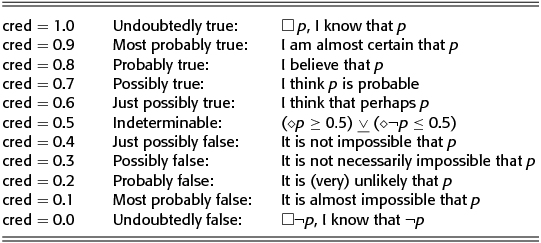
In reality, one level of the metric overlaps an adjacent level so that the cross-over from one level to another is more often than not entirely subjective; levels 0.1, 0.4, 0.6, 0.9 are as much an artifact of the decimal system as they are independently distinct levels in which I have a great deal of confidence. Nonetheless, I am certain that some variant of the credibility metric exists and is justified by the employment of the adverbials (very) probably, (very) possibly, and perhaps in everyday speech. This metric is needed in some lexical entries, as we shall see.
12.3 Semantic specifications for bird and bull
Birds are feathered, beaked, and bipedal. Most birds can fly. Applied to an owl this attribute of flight is true; applied to a penguin it is false. Birds are sexed and a normal adult female bird can lay eggs. It is a defining characteristic that members of the female sex carry ova; I’ll label this function sxF (which can be glossed ‘sexual female’). Where they don't, or the ova are non-viable, the organism can count for our purposes as a gendered female, genF, but not sxF. Mostly, sexual females are gendered females too; see (4) where → indicates semantic entailment.
(4) Most(x)[sxF(x) → genF(x)]
Although we do speak of human eggs, nonetheless the default egg is from an oviparous genus such as a bird, so I’ll assume this characteristic ought to be noted in the lexicon.5 Based on Allan Reference Allan2001: 252, I propose that the semantic part of the lexicon entry for bird be (5), where ∧ symbolizes logical conjunction, +> indicates (defeasible) nonmonotonic inference (NMI), which could perhaps be referred to as an implicature and which is cancelled for species such as emus and penguins.

The lambda-operator is useful to identify an individual as having a number of properties jointly, e.g. being a member of the set of creatures that are at the same time feathered and beaked and bipedal. In (5) the line bird(x) +> ⋄fly(x) identifies that a bird is most probably capable of flight with a credibility rating of 0.7. In the case of a sparrow, the semantic component of the lexicon entry may look like (6); for a penguin, like (7).


For both (6) and (7) the oviparity of sxF sparrows and penguins is an entailment of their being birds. The credibility of a sparrow being able to fly is estimated at cred ≥ 0.99 (it might be injured), whereas the credibility of a penguin flying is 0 (its not-flying has a credibility of 1).
The first entry under bull in the Oxford English Dictionary (1989) is “The male of any bovine animal; most commonly applied to the male of the domestic species (Bos Taurus); also of the buffalo, etc.” Part of this is more formally stated in (8).
(8) ∀x[λy[bull(y) ∧ animal(y)](x) → λz[male(z) ∧ bovine(z)](x)]
I will ignore the facts identified in (9).
(9) male(x) → genM(x) +> sxM(x)
(8) is inaccurate because the noun bull is not restricted in application to bovines; it is also properly used of male elephants, male hippos, male whales, male seals, male alligators, and more. The initial plausibility of (8) is due to the fact that it describes the stereotypical bull. The world in which the English language has developed is such that bull is much more likely to denote a bovine than any other species of animal. Peripheral uses of bull
are examples of semantic extension from bovines to certain other kinds of large animals; consequently they require that the context make it abundantly clear that a bovine is not being referred to. This is often achieved by spelling it out in a construction, such as bull elephant or bull whale, which is of greater complexity than the simple noun bull used of bovines – a difference motivated by the principle of least effort (Zipf Reference Zipf1949). There is no regular term for “the class of large animals whose males are called ‘bulls’, females ‘cows’, and young ‘calves’” so in Allan Reference Allan2001: 273 I coined the term *bozine to label it.6 The semantics of English bull is given in (10) from which the NMI of bovinity will be cancelled where the animal is contextually specified as giraffid, hippopotamid, proboscid, pinniped, cetacean, or crocodilian.

Once again we see a default interpretation being recorded as an NMI in the lexicon because of the salience of this particular characteristic, namely bovinity, of the default reference (i.e. the denotatum) for bull
. (At first sight a salient meaning should be almost the opposite of a default meaning: something that is salient jumps out at you; by contrast a default is the fall-back state when there is no contextual motivation to prefer any other. On a second look, what qualifies a state to become the default is its salience in the absence of any contextual motivation to prefer another.) The credibility of ≥0.9 is based on my intuition. A search of ten corpora totaling about ten million words (the Australian corpus of English; Australian ICE; the Lancaster–Oslo/Bergen corpus of British texts; the London–Lund corpus; the Freiburg corpus of British texts; the Freiburg corpus of American texts; the Brown corpus of American texts; the Wellington corpus of written New Zealand texts; New Zealand ICE; Kenya–East Africa ICE) revealed no applications of bull to animals other than bovines, nor indeed were such searches useful in confirming or disconfirming any of the other credibility ratings in this chapter.
In this section I have shown that a lexicon entry can be constructed to indicate the necessary components of meaning for the entry and also the most probable additional components of meaning that obtain for most occasions of use but which may be canceled as a function of contextual constraints. These can be seen as prototype effects that, for instance, help distinguish cup from mug and bowl (see Labov Reference Labov, Farkas, Jacobsen and Todrys1978). Traditional Arab and Turkish coffee cups are small bowls with no handle, very similar in configuration to Chinese porcelain teacups. The typical Western teacup or coffee cup has a handle and is accompanied by a saucer. All these types of cup are bowl-like in shape though they are smaller, usually have higher sides, and serve a different function than most bowls. Cups are intended to be put to the lips to convey liquid to the mouth whereas liquid in food bowls is spooned into the mouth; otherwise a bowl is used for food preparation. These kinds of conditions (that distinguish cup from mug and bowl) are encyclopaedic and pragmatic rather than purely semantic.
For each lexicon entry the semantic identity of the listeme is presented as a meaning postulate – cf. (10); for instance, the noun bull is semantically represented by the predicate bull ranging over a variable for the entity denoted. Predicates like bull, animal, male, and bovine are not decomposed into semantic primitives but give rise to certain inferences some of which are necessary semantic entailments, others are probabilistic nonmonotonic inferences. Similar conditions apply to the verb climb, as we see in section 12.4.
12.4 Climbing
Jackendoff (Reference Jackendoff1985) identified some interesting characteristics of the verb climb. From (11) we understand that Jim climbed up the mountain – contrast (11) with (12). We also understand that he used his legs and feet – contrast (11) and (12) with (13).
(11) Jim climbed the mountain.
(12) Jim climbed down the mountain.
(13) Jim climbed (down) the mountain on his hands and knees.
Snakes, airplanes, and ambient temperature lack legs and feet they can use when climbing (which is presumably a metaphorical extension with these actors), and they can't climb down, some other verb must be employed.

In (17) the lexicon entry captures the fact that the default interpretation of climb presumes both upward movement, symbolized by ↑7and the use of feet (and therefore legs, too).

NMIs apply not just to nouns and verbs but potentially in any lexicon entry.
12.5 Collectives and collectivizing
Allan Reference Allan1976 and Reference Allan2001 discuss the semantics of collective nouns such as admiralty, aristocracy, army, assembly, association, audience, board, class, clergy, committee, crowd, flock, government, and collectivized nouns such as those italicized in (18)–(19).
(18) These three elephant my great-grandfather shot in 1920 were good tuskers, such as you never see today.
(19) Four silver birch stand sentinel over the driveway entrance.
A definition of collectivizing will be given shortly, but let's begin with familiar collectives.
Collective nouns allow reference to be made to either the set (collection) as a whole or to the set members. In many dialects of English (but not all) the different interpretations are indicated by NP-external number registration
; consider (20).8

Whereas singular NP-external number registration indicates that the set as a holistic unit is being referred to, cf. (21), the plural indicates that the set members are being referred to (22). In these and later examples, X and Y are (possibly null) variables for NP constituents; NPsg is a singular NP, and NPpl is plural; x, y, z are sets, either unit sets (individuals)9 or multi-member sets, so one should understand from (21) and (22) that ∀x[∃y[y⊆x]].
(21) ∀x[NPsg[X Nhead[λy[many(y) ∧ collocated(y)](x)] Y]
→ combined_membership(x)]
(22) ∀x[NPpl[X Nhead[λy[many(y) ∧ collocated(y)](x)] Y]
→ constituent_members(x)]
Thus, (23) identifies the composition of the committee, while (24) identifies dissension among the membership of the committee.


NPs denoting institutions, e.g. the company I work for, the BBC, the university must be singular (NPSG in (27) and (28)) when the institution as a building, location, or single constituent body is referred to, as in (25), but can have plural NP-external registration when referring to the people associated with it (26).

The facts with respect to such collective nouns are represented in (27)–(29), where N0 is the form of the noun unmarked for number.
(27) ∀x∃z[N0[library(x)] → λy[many(y) ∧ book(y) ∧ collocated(y)](z) ∧ x⊇z]
+> ∃x[NPsg[X N0,head[library(x)] Y] ∧ institution(x)]
(28) ∀x[NPsg[X N0,head[institution(x)] Y] → constituent_body(x) ∨ site(x)]
(29) ∀x[NPpl[X N0,head[institution(x)] Y] → staff_members(x)]
There is no evidence in (20)–(29) of probabilistic representation being required in the lexicon. The different interpretations are indicated through morphosyntactic choices.
Allan Reference Allan1976 and Reference Allan2001 identify a principle of N0 usage for English, given in (30).
(30) N0, the form of the noun unmarked for number, is used when the denotation for N is perceived not to consist of a number of significant similar units.
In a plural NP headed by N0, the absence of plural inflexion on the head noun marks “collectivizing.” Collectivizing signals hunting, conservation, or farming jargon because N0 is characteristically used of referents that are NOT perceived to be significant as individuals. Early users of the collectivized form were not interested in the individual animals except as a source for food or trophies. Consider the italicized nouns in (18)–(19) and (31)–(34), to which italics have been added.
(31) A three month shooting trip up the White Nile can offer a very good mixed bag, including, with luck, Elephant, Buffalo, Lion, and two animals not found elsewhere: Nile or Saddle-back (Mrs. Gray's) Lechwe and White-eared Kob. (Maydon Reference Maydon1951: 168)
(32) On the way back to camp we sighted two giraffe on the other side of the river, which were coming down to the water's edge to drink. (Arkell-Hardwicke Reference Arkell-Hardwicke1903: 285)
(33) These cucumber are doing well; it's a good year for them.
(34) The cat-fishes, of which there are about fifty distinct forms arranged in four families, constitute the largest group, with probably the greatest number of individuals per species. In some parts of the country where nets are little used and fishing is mainly done with traps and long lines, at least three-quarters of the annual catch is of cat-fish. (Welman Reference Welman1948: 8)
The plural NP “cat-fishes” at the beginning of (34) refers to species of cat-fish, whereas the N0 at the end refers to individuals caught by fishermen. Collectivizing of trees and other plants is much less common than collectivizing animals – from which, perhaps, it derives. Vermin are never collectivized; though individual language users may differ over what counts as vermin. Early uses of the collectivized form were applied to animals hunted for food or trophies. Today, collectivizing occurs in contexts and jargons of hunting, zoology, ornithology, conservation, and cultivation, where N0 is characteristically used of referents that, as I’ve already said, are not perceived to be significant as individuals. Two possible contributing factors to the establishment of N0 as the mark of collectivizing are (1) the unmarked plural of deer – which once meant ‘wild animal, beast’, and (2) the fact that meat nouns are N0 (discussed in the next section). Despite the fact that there is a good deal of variation in the data (see Allan Reference Allan1976: 100f.), collectivizable nouns should be marked as such in the lexicon. Reference will need to be made to the discourse domain being one of the contexts identified above and vermin will need to be excluded. The kind of entry I envisage is (35), which uses giraffe as an example.
(35) IF Domain = conservation THEN ∀x[NPpl[X N0[giraffe(x)] Y]]; cred ≈ 0.6
Clearly, more work is needed.
12.6 Animals for food and fur
In this section I take up a discussion from Allan Reference Allan1981. Consider the sentences in (36)–(37).
(36) Harry prefers lamb to goat.
(37) Jacqueline prefers leopard to fox.
Most likely you will interpret the animal product nouns in (36) to refer to meat, such that (36) is paraphrasable by (38), whereas the animal product nouns in (37) refer to animal pelts such that (37) is paraphrasable by (39).
(38) Harry prefers eating lamb to eating goat.
(39) Jacqueline prefers leopard skin to fox fur.
The converse interpretations are unlikely, especially Jacqueline prefers eating leopard to eating fox.10 The predicate prefer in (36)–(37) offers a neutral context permitting the default animal product to rise to salience. This suggests that the lexicon entries for lamb and goat, and that for other creatures (such as whale, see (40)) should include a specific application of the formula in (41).
(40) In Tokyo, whale gets ever more expensive!

The lexicon entries for leopard and fox should include a specific application of the formula in (43); so will all of the italicized animal product nouns in (42).
(42)
a. Jacqueline was wearing mink.
b. Elspeth's new handbag is crocodile, I think.
c. This settee's made of buffalo.
d. The tannery has loads of impala right now.

A mass NP headed by an animal noun will refer to the pelt of the animal denoted by that NP when there is in the clause an NP head or clause predicate describing apparel, accessories to apparel, furniture, the creation of an artifact, or any object likely to be made from leather and any place or process that involves pelts, hides, or leather such that these constrain the domain for the interpretation of N0. Thus the nonmonotonic inference in (41) is canceled by the implications of the lining in (44); from (43) the NMI is canceled by the predicate eat in (45).
(44) I prefer the lining to be made of lamb, because it's softer.
(45) All we had to eat was leopard.
More subtle interpretations are required in (46)–(49).
(47) The girl holding the plate was wearing rabbit.
(48) The girl who wore mink was eating rabbit.
(49) Because she decided she preferred the lamb, Hetty put back the pigskin coat.
In (46) “plate of lamb” identifies meat. Although the most likely interpretation of a plate of steel is ‘a plate made of steel’ (cred ≥ 0.99), a plate of lamb is, with similar credibility, interpreted as ‘a plate bearing food’. The predicate “wearing rabbit” in (47) identifies the rabbit pelts as apparel (again, cred ≥ 0.99) and, likewise, “wore mink” in (48) identifies mink as apparel while the predicate in “eating rabbit” coerces the reference to rabbit meat. In (49) “the lamb” is most likely to be interpreted as meat (cred ≥ 0.8) until this is revealed as a “garden-path” misinterpretation, corrected by the preference for a porcine pelt in the second clause, which cancels the original NMI, replacing it with the coerced interpretation “lambskin coat”.
In this section I have claimed that animal nouns in mass NPs which denote a product from the dead animal typically refer to either the animal's flesh or its pelt, but this probabilistic inference can be canceled by certain contextual elements that condition the domain for interpretation. Credibility rankings can be assigned as shown in (50). However, in (50) these rankings are based on my intuition, although they ought to be made on the basis of the frequency of interpretations retrieved from large and diverse corpora.
(50) NPmass [N[λy[lamb(y) ∧ animal(y)](x)]] +> meat_of(x); cred ≥ 0.8
IF NOT meat_of(x) THEN pelt_of(x)
NPmass [N[λy[goat(y) ∧ animal(y)](x)]] +> meat_of(x); cred ≥ 0.7
IF NOT meat_of(x) THEN pelt_of(x)
NPmass [N[λy[rabbit(y) ∧ animal(y)](x)]] +> meat_of(x); cred ≥ 0.7
IF NOT meat_of(x) THEN pelt_of(x)
NPmass [N[λy[leopard(y) ∧ animal(y)](x)]] +> pelt_of(x); cred ≥ 0.9
IF NOT pelt_of(x) THEN meat_of(x)
NPmass [N[λy[fox(y) ∧ animal(y)](x)]] +> pelt_of(x); cred ≥ 0.9
IF NOT pelt_of(x) THEN meat_of(x)
NPmass [N[λy[mink(y) ∧ animal(y)](x)]] +> pelt_of(x); cred ≥ 0.9
IF NOT pelt_of(x) THEN meat_of(x)
NPmass [N[λy[buffalo(y) ∧ animal(y)](x)]] +> pelt_of(x); cred ≥ 0.8
IF NOT pelt_of(x) THEN meat_of(x)
NPmass [N[λy[crocodile(y) ∧ animal(y)](x)]] +> pelt_of(x); cred ≥ 0.8
IF NOT pelt_of(x) THEN meat_of(x)
NPmass [N[λy[impala(y) ∧ animal(y)](x)]] +> pelt_of(x); cred ≥ 0.7
IF NOT pelt_of(x) THEN meat_of(x)
It would seem obvious that there should be some generalization over nouns that can refer to either meat or pelts; one might refer to the degree of choice between these two alternatives being “graded salience” (Giora Reference Giora2003: 10 and this volume), but this notion is yet more relevant in the lexicon entry for and.
12.7 And
And may conjoin all sorts of sentence constituents and whatever is felicitously conjoined is grouped together such that there is always some plausible reason for the grouping. This “plausibility” valuation is a coherence metric and necessarily pragmatic because it relies on knowledge of whatever world is spoken of; later, I shall question whether it is relevant to the lexicon entry for and. With the exception of some conjoined NPs that I will refer to as NP-*com-Conjunction (and briefly exemplify in (61)–(65)), the conjoined constituents are synonymous with a conjunction of sentences, e.g. in (51e) ‘Two is a number ∧ Three is a number’.
(51)
a. Sue is tall and slim.
b. Eric was driving too fast and hit a tree.
c. Elspeth always drove slowly and carefully.
d. Joe and Harriet are tall.
e. Two and three are numbers.
On the assumption that Φ and Ψ are well-formed (combinations of) propositions expressed as well-formed conjunctions in English, the semantics of Φ and Ψ is as presented in (52). There is, in addition, a series of nonmonotonic inferences that exemplify Giora's “graded salience” (Giora Reference Giora2003: 10); they are listed with the strongest contextually possible inference as the first to be considered.
(52) Φ and Ψ ↔ Φ ∧Ψ
a. IF cred(
 Φ → Ψ) ≥ 0.9 ∧ cred(cause(Φ,Ψ)) ≥ 0.8
THEN Φ and Ψ +> Φ causes Ψ (e.g. Flick the switch and the light comes on; cause ≺ effect11) ELSE
b. IF cred(enable ([do(Ø,Φ)],Ψ)) ≥ 0.9 ∧ cred(
Φ → Ψ) ≥ 0.8THEN Φ and Ψ +> Φ enables the consequence Ψ ∨ Φ is a reason for Ψ (e.g. Stop crying and I'll buy you an ice-cream; action ≺ consequence) ELSE
c. IF cred(Φ<Ψ) ≥ 0.8
THEN Φ and Ψ +> Φ and then later Ψ (e.g. Sue got pregnant and married her boyfriend; Φ ≺ Ψ) ELSE
d. IF cred(enable(Φ,[do(S,[say(S,Ψ)])])) ≥ 0.812
THEN Φ and Ψ +> Φ is background for Ψ (e.g. There was once a young prince, and he was very ugly) ELSE
e. Φ and Ψ +> Φ is probably more topical or more familiar to S than Ψ (e.g. On Saturdays my mum cleans the flat and Sue washes the clothes)
Note the conditional relations in (53):
(53) (Φ causes Ψ) → (Φ is a reason for or enables the consequence Ψ) → (Φ temporally precedes Ψ)13
Whether the last two discourse-based implicatures of (52) are part of this sequence remains to be determined. However, it is arguable that if Φ is background for Ψ then Φ is prior to Ψ; and if Φ is more topical or more familiar than Ψ, then again, it is arguable that Φ is prior to Ψ; and should these rather tenuous claims be acceptable, then the fact that Φ precedes Ψ when they are conjoined is normally iconic. However, the choice of sequence is a matter of usage (or pragmatics) and is not obligatory, but it does seem to justify a general statement such as (54):
(54) Φ and Ψ ↔ Φ ∧ Ψ
Φ and Ψ +> Φ is prior to Ψ; cred ≥ 0.9
Consider (from (52c)) Sue got pregnant and married her boyfriend: it is false (cred = 0) that Sue's getting pregnant literally causes her to marry her boyfriend, though it may be her reason for doing so, cred ≈ 0.4; but it is quite probable (cred ≈ 0.75) that her marriage to the boyfriend is a consequence of her being pregnant, whether or not he is the biological father-to-be. It is almost certain (cred ≥ 0.9), even though defeasible, that Sue's pregnancy precedes her marriage. Out of any natural context of use it is not possible to determine whether or not saying Sue got pregnant is a background for going on to say that she married her boyfriend. This aside, it has been possible to propose a (partial) lexicon entry for and which includes its implicatures in grades of salience. There seems to be no good reason to treat and as multiply ambiguous semantically when one core meaning can be identified (logical conjunction) and all other interpretations can be directly related to that as a hierarchy of nonmonotonic inferences processed algorithmically. As Ockham wrote: Numquam ponenda est pluralitas sine necessitate ‘Plurality should never be posited without necessity’ (Ordinatio Distinctio 27, Quaestio 2, Ockham Reference Ockham, Gál and Brown1967–88: I, K)
Is it possible to define a plausibility measure for Φ and Ψ that is semantically based? I suspect not. At first sight the acceptability of (55) as against the unacceptability of (56) seems explicable semantically because only living things eat and if Max is dead he is no longer living and this is a semantic entailment of die.
(55) Max ate a hearty meal and died.
(56) *Max died and ate a hearty meal.
However, the situation seems pragmatically determined in (57)–(60): it is a matter of conventional beliefs about death, going to hospital, and going to heaven.
(57) Max went to hospital and died there.
(58) *Max died and went to hospital.
(60) *Max went to heaven and died there.
In NP-*com-Conjunction, *com is a ≥2-place predicate with a sense ‘is added to, is mixed or combined with, acts jointly or together with, is acted upon jointly or together with’ (Allan Reference Allan and Peeters2000: 196). It is found in (61), which is not semantically equivalent to (62) – contrast the latter with (51e).
(61) Two and three are five.
(62) *Two is five ∧ Three is five
A revealing recipe-like paraphrase of (61) is (63), which accounts for the fact that (64) is a paraphrase of (61).
(63) Take twox and take threey, combine them (*com(x,y)), and you get fivew, cf. Mix flourx and watery to make pastew or just Flour and water make paste.
(64) Two and three make five.
NP-*com-Conjunction is recognized when a conjunction of sentences either cannot apply or is unlikely to apply as in (61) and (65).
(65) Joe and his wife have a couple of kids.
The subject NP of (65) is most likely NP-*com-Conjunction whereas that of (66) is not. That these judgments are pragmatically rather than semantically plausible is seen by comparing them.
(66) Joe and his sister have a couple of kids.
(66) is, given social constraints on incest, most likely an infelicitous manner of expression where the conjunction is intended to be Φ and Ψ with the weakest of nonmonotonic inferences; preferred would be Joe and his sister each have a couple of kids. With respect to (65), although it is true that each of Joe and his wife has two kids, the sentence Joe and his wife each have a couple of kids suggests these derive from former relationships such that the married couple has four children altogether.
12.8 Sorites
Two horses don't constitute a herd nor do ten grains of sand constitute a heap. For collections such as these, denoted by sorites nouns,14 the number of constituents needed to render the description accurate depends on the nature of the constituents; for example, whereas the least lower bound on a herd of horses might be three, that on a heap of sand is probably more than a hundred. There are sorites predicates like be bald, be tall, be many and sorites adverbs like slowly, loudly. These are invariably gradable and contextually determined as may be seen from the contrasts in (67).
(67) tallfor a Pygmyversustallfor a North American basket-ball professional15
manypeople thought George W Bush was a foolversusmany of my students didn'tattend class today
a slug moves slowlyversusthe train went through the station slowly
There is a similar contextual relevance for the nouns: a herd of horses, elephants, or giraffes will typically have fewer members than a herd of wildebeest, though this is not necessarily the case; moreover, it has no bearing on the lexical meaning of herd. The least lower bound on a heap of beans is lower than that on a heap of sand, probably because of the size of the constituent members. Clearly these are facts about the world referred to but are they facts about the meaning of listemes? No, but they are relevant to the propositions in which the listemes occur: for instance, if speakers wish to report the speed at which a slug is moving they need to apply different criteria than when reporting the speed at which a train is moving. It appears from work reported by Hagoort et al. (Reference Hagoort, Hald, Bastiaansen and Petersson2004) that the brain is prepared to do exactly that kind of thing and that contextual information is integrated with semantic information from the start; see also Terkourafi (Reference Terkourafi, Haugh and Bargiela-Chiappini2009b). However, as I’ve said, although this is relevant to the meaning of propositions, we can dispense with such enriched interpretations in the lexicon because they are instances of lexical adjustment: they count as “ad hoc categories” (Barsalou Reference Barsalou1983; Carston Reference Carston2002; Wilson and Carston Reference Carston and Frápolli2007) dependent on a particular domain of discourse. What we see in (67) is a context-induced specification of the meaning for the sorites words. The same holds for bald: various degrees of baldness are characterized in (68)–(70).
(68) His hair is thinning / thin ≈ He is balding / going bald / has a bald patch.
(69) He is bald.
(70) He is completely bald.
The domain of baldness extends from thinning (head) hair to its almost complete absence. It is arguable that (69) is applicable in situations where (68) or else (70) would also hold true, even though the accuracy of (69) might be disputed in favor of either (68) or (70). So, how sorites words should be specified in a lexicon is highly controversial.
Although not directly concerned with the lexicon, there is a large number of proposals discussed in Williamson (Reference Williamson1994), Beall (Reference Beall2003), and N. J. J. Smith (Reference Smith2008). They include supervaluation, subvaluation, and plurivaluation. Smith suggests “talk of the meanings of some terms must always be relative to a group of speakers, whose dispositions regarding the use of those terms play an essential part in fixing those meanings” (Smith Reference Smith2008: 314). This is a recasting of Quine's “There is nothing in linguistic meaning beyond what is to be gleaned from overt behavior in observable circumstances” (Quine Reference Quine1992: 38). To return to (69): what I suggest for the meaning of bald is the minimal semantics of (71).
Two speakers, or the same speaker on different occasions, may differ as to what counts as ‘not a full complement of hair’ such that x is bald has a range of truth values; i.e. there is no single state of hair-loss for which it is invariably true of x that x is bald for all occasions and all speakers. A modification like (68) is appropriate to the least lower bound and (70) to the greatest upper bound; (69) applies to both.
Defining sorites terms often invokes alternative points on the relevant scale. For instance many implies a contrast with other points on a quantity scale; more precisely, less than most and greater than a few. In (72), |f∩g| can be glossed ‘the number of Fs that (are) G’.
(72) [many(x): Fx](Gx) → |f∩g|> [a_few(x): Fx]G(x)
+> |f∩g|< [most(x): Fx]G(x)
(I assume that a few x > few x > one x.) The domain referred to significantly affects the actual numbers, as we saw in (67). It is notable that to establish the truth of (73) we cannot look to a specific number because even if that can ever be known, the precise number that justifies the use of “many” will differ for different speakers and even for the same speaker on different occasions.
(73) Many US citizens live in poverty.
Although the meaning of (73) falls under the definition in (72) there is also an implication, or perhaps connotation, that (according to the speaker) the number of US citizens living in poverty is greater than it ideally ought to be. Similar conditions hold for Many of my students were absent from class today, which does not imply that more than half of them weren't there, but that ‘more than one might have expected to be absent were in fact absent’ – and that could easily be as little as 5 per cent.
For sorites like tall and slowly it will be necessary to invoke, respectively, the height scale tall > average height > short and the speed scale slow < average speed < fast on condition that these apply to a particular domain or set of domains as shown in (67).
Sorites like herd and heap (in the sense of Eubulides’ soros) involve configurational criteria.


Suppose that three is the least lower bound for a herd or heap and often the number of constituents is many more, often vastly many more. There is
no upper bound. A heap of sand will typically have many more constituents than a heap of logs; though if the domain of discourse is an egg-timer on the one hand and a clear-felled forest on the other, there may not be such a discrepancy. There is no unique quantity that defines a heap, not even a heap of some particular substance; that is, there is no exact number that determines when a quantity of sand constitutes a heap; the roughly conical configuration is a necessary part of the requirement but is insufficient in itself – as is the condition on quantity. However, the semantic extension of heap(s) as in I have a heap of things to do and There were heaps of people at the party has lost all notion of a particular configuration and is roughly synonymous with lots of or many and must be defined in a manner similar to (72).
12.9 Formulaic language in the lexicon
“A formulaic sequence is a sequence, continuous or discontinuous, that appears prefabricated and stored as a chunk, rather than being generated afresh” (Wray Reference Wray2008: 94). Just as metaphor is pervasive in language, so are “prefabs” – a useful term succinctly defined by Erman and Warren Reference Erman and Warren2000 as “specific conventionalized multiword strings.” Especially in the spoken language, people use thousands of them (just look, for example, at www.phrases.org.uk/index.html); but they are also markers of oral literature, religious texts, best-seller scripts, and popular radio and TV shows (see Allan Reference Allan2001, Reference Allan2006b; Corrigan et al. Reference Corrigan, Moravcsik, Ouali and Wheatley2009; Donahue Reference Donahue1991; Goldman Reference Goldman1990; Jackendoff Reference Jackendoff1995b; Jensen Reference Jensen1980; Kuipers Reference Kuipers2009; Paraskevaides Reference Paraskevaides1984; Schmitt Reference Schmitt2004; Wray Reference Wray2002, Reference Wray2008). Prefabs can be classed into at least three groups.
Idioms are primarily figurative; they include: a bit of the other; Bob's your uncle; by and large; come a cropper; fuck off; go the whole hog; kick the bucket; put a sock in it; rain cats and dogs; set store by; sleep like a log; spill the beans; sweat blood; the key to.
Clichés are primarily nonfigurative; they include: be heavily compromised; be not very well; believe you me; don't do anything I wouldn't do; Good Lord; Happy Birthday! Hot-dog! [= great!]; ladies and gentlemen; out of sight out of mind; reading, writing, and (a)rithmetic; to make a long story short; un je ne sais quoi; you can say that again; you'd better [do A].
Catchphrases include: Beam me up, Scotty; Computer says ‘No’; Frankly, my dear, I don't give a damn; It doesn't amount to a hill of beans; Not that there's anything wrong with it; One potato, two potato, three potato, four…; Play it again Sam; S/he loves me, s/he loves me not.
Subclassifications of these groups sometimes suggest themselves (e.g. imprecations, proverbs) and a prefab can often be classed into more than one of the three (e.g. be worth one's weight in gold).
Prefabs have similar characteristics to compounds and phrasal verbs in that, although they may have a variable slot, they are largely immutable and function as lexical islands phonologically and syntactically (Underwood et al. Reference Underwood, Schmitt, Galpin and Schmitt2004; Van Lancker et al. Reference Van Lancker, Canter and Terbeek1981; Wray Reference Wray2002, Reference Wray2008). Like proper names and tabooed terms (such as fuck) they seem to be stored in a different manner from the normal lexicon, perhaps in the right brain. The evidence for this is that people with left hemisphere trauma often have access to prefabs, proper names, and tabooed terms when they don't have normal access to ordinary language; furthermore, persons with right hemisphere damage use significantly fewer prefabs than normal subjects (Van Lancker Reference Van Lancker, Corrigan, Moravcsik, Ouali and Wheatley2009: 452). Lexicography has ignored the conclusion that different kinds of vocabulary are stored in different hemispheres of the brain, even though it could be relevant to classifying types of lexical data; I shall maintain this tradition.
A simplified lexicon entry for kick the bucket might be something like (76).
(76) /kɪk ðə bʌkət/ –- [VP[V[kick]] NP[D[the] N[bucket]]] → die(x)

The ellipse in the figure contains encyclopaedic information that is clearly pragmatic yet according to Allan (Reference Allan2001) is outside of the lexicon. Traditionally such information is located in dictionaries, for instance, the Oxford English Dictionary (1989) labels kick the bucket “slang” and the Macquarie Dictionary (2003) describes it as “Colloquial” (it doesn't appear in Webster Reference Webster and Gove2002). Such descriptions, whether assigned to the lexicon or the networked encyclopaedia, are clearly pragmatic. The explanation for the meaning of kick the bucket is metonymic: in former times a bucket was a ‘beam’ and when an animal (such as a pig) was tied to the beam by its hind legs to be slaughtered, it would kick the bucket in the throes of death. But information about this source for the idiom is an encyclopaedic datum that is not generally known, and plays no part in the interpretation today of the idiom kick the bucket.
Unlike the meaning of the typical idiom, the meaning of a typical cliché is computable from its constituent parts. What marks the cliché is that it occurs frequently as the clichéd chunk (Bannard and Lieven Reference Bannard, Lieven, Corrigan, Moravcsik, Ouali and Wheatley2009: 300f., 304), and experimental evidence suggests that it is normally processed as a chunk and not according to its constituent parts (Underwood et al. Reference Underwood, Schmitt, Galpin and Schmitt2004; Wray Reference Wray2002, Reference Wray2008). I suggest that clichés should therefore be noted in full in a lexicon and (pragmatically) marked as clichés. Mutatis mutandis, the same goes for catchphrases: their meaning is almost invariably computable from their parts, but they are recalled and used as chunks – or perhaps as articulated chunks in the case of items of play like one potato, two potato, three potato, four…, or the words of a national anthem or of the full version of Happy Birthday to you. It is a debatable matter whether these can count as lexical entries rather than encyclopaedia entries. They seem to be evoked by a particular kind of event that triggers a speech act, e.g. Happy birthday by the occasion of someone's birthday that the speaker wishes to demonstrably recognize; Beam me up, Scotty is triggered by the thought ‘Get me out of here’. It seems feasible to propose that the listeme birthday is linked to the networked encyclopaedia with a free pragmatic condition like (77):
(77) If it is X's birthday then it is appropriate to tell X Happy birthday.
The situation with respect to Beam me up, Scotty is far more constrained: it can perhaps be tagged to the phrasal verb get NP out in some thesaurus-like way on condition that the constituent NP refers to the speaker (perhaps, along with others); it can only be used as a jocular expression and to an addressee likely to understand the utterance as a catchphrase. This latter condition does not apply to all catchphrases: for instance, it doesn't apply to not that there is anything wrong with it, which functions adequately as a non-prefab; the condition that applies is that “it” refers to a mildly tabooed topic (such as being gay).16 This illustrates the squishiness17 of prefabs.
Prefabs are, by definition, multiword expressions. Traditional dictionaries of phrases list them in alphabetical order but the mental lexicon is surely more akin to a database which is searched in a manner similar to a Google search engine operating on key words and combinations of words. The mental lexicon will also be accessed semantically and pragmatically (i.e. via meanings and encyclopaedic information; see Giora, this volume and Katsos, this volume) and not merely through aspects of the form of language expressions.
12.10 Connotation in the lexicon
The connotations of a language expression are pragmatic effects that arise from encyclopaedic knowledge about its denotation (or reference) and also from experiences, beliefs, and prejudices about the contexts in which the expression is typically used. Terms like surgeon, nurse, secretary/receptionist, and motor mechanic evoke connotations of gender from the fact that the typical job-holder in each case is, even today, a gendered stereotype: most surgeons and motor mechanics are male; most nurses and secretary/receptionists are female. These connotations are all, clearly, the pragmatic effects of normative conceptions of typical job-holders.

The most common denotations of bunny and rabbit or doggie and dog are the same, but the connotations are different: bearing the diminutive, the first member of the two pairs connotes endearment or childish language; see (80).

To avoid blaspheming (for which the Bible sanctions execution: Leviticus 24:16), people use a variety of euphemistic expletives (see Allan and Burridge Reference Allan and Burridge2006: 15ff., 39). For instance, Jesus is end-clipped to Jeeze! and Gee! (which is also the initial of God); Gee whiz! is a remodelling of either jeeze or jesus. More adventurous remodelings are By jingo! Jiminy cricket! [from Jesus Christ] Christmas! Crust! Crumbs! Crikey! Note that the denotation of Gee!, Jeepers!, and Jesus! is identical. All function as exclamations of surprise, dismay, enthusiasm, or emphasis. From a purely rational viewpoint, if one of them is blasphemous, then all of them are. What is different is that the first two have connotations that are markedly different from the last. Connotation – or, more precisely its pragmatic effect, reaction to connotation – is seen to be a vocabulary generator. But the question here is what goes into the lexicon, and I suggest (81)–(82) (in which statements introduced by a simple + are encyclopaedic).


Whether the encyclopaedic statements should be included within the lexicon is a matter of debate. I personally don't believe they should form a part of the lexicon entry but they must certainly be accessible from and networked with the lexicon.
12.11 Conclusion
In this chapter I have looked at ways in which pragmatics intrudes on the lexicon. I count as “pragmatic” encyclopaedic data and nonmonotonic inferences (NMI) – which arguably arise from encyclopaedic data. In section 12.2, I introduced the notion of a credibility metric for a proposition and used it to calibrate NMIs in the lexicon to correspond with the degree of confidence one might have in the truth of the inference: its probability. Sections 12.3 and 12.4 demonstrated that in addition to the lexicon entry specifying the necessary components of meaning in the semantics for an entry, it should also specify the most probable additional components of meaning, which are accepted or canceled as a function of contextual constraints. These same sets of conditions were demonstrated for different kinds of entries throughout the rest of the chapter. Section 12.5 looked at lexicon entries for collective and collectivizable nouns. These differ in that different interpretations for collective nouns arise from their morphosyntactic context and although this needs to be captured in the lexicon it is not a matter of pragmatics; on the other hand, a noun is collectivizable only in some defined set of contexts and these are a pragmatic constraint. Section 12.6 discussed the use of animal nouns in mass NPs to denote either the animal's meat or its pelt. Although there are defined morphosyntactic conditions on such interpretations, the choice of one interpretation or the other is pragmatically determined because it is contextually induced and is open to calibration against a credibility metric. Section 12.7 returned to the much disputed semantics of and. The view taken here is for a monosemic semantics which assumes that English and has the semantics of logical conjunction but there is a graded salience captured in an algorithm that assigns one of a set of nonmonotonic inferences as supplementary meaning on the basis of context. Section 12.8 discussed the vexed question of how to represent the semantics of sorites terms in the lexicon. A minimalist semantics was proposed. Section 12.9 discussed the matter of prefabs or formulaic expressions. It is only recently that their frequency and ubiquity has been recognized. They pose a challenge to the lexicon principally because they are multiword expressions; many are figurative; many are stylistically marked. These pragmatic characteristics are appropriate to encyclopaedic information linked to the entry. Section 12.10 considered the representation of connotation in the lexicon as a matter of pragmatic intrusion.
In this chapter I have shown different motivations for including pragmatics in the lexicon or linking it to the lexicon, and I have demonstrated how that may be accomplished. This is not to deny that other formalizations are possible.
My thanks to Kasia Jaszczolt for making me clarify bits of this chapter. Kasia is not to blame for remaining infelicities; indeed, she heartily disapproves some of my claims.

