

13 Conversational interaction
13.1 Introduction
The study of conversational interaction is now approached in a multitude of different ways in pragmatics, reflecting in part the ever increasing diversity of the field. Approaches range from the study of the structure and management of talk as a form of social order itself in conversation analysis, through to the study of a wide variety of pragmatic phenomena that occur in conversational interaction, including formulaic language, discourse/pragmatic markers, reference and deixis, presupposition, implicature, speech and pragmatic acts, humour, im/politeness and beyond to issues of identity and power, to name just a few. The latter study of pragmatic phenomena in conversational interaction draws from a wide range of approaches, including conversations reconstructed through the introspective methods of philosophical pragmatics, the study of naturally occurring conversations through ethnography of speaking, interactional sociolinguistics, philology, (critical) discourse ana-lysis, interactional pragmatics and more recently corpora, and the study of conversation elicited through devices such as discourse completion tests or role plays.1
Within this complex analytical landscape two key trends can be discerned in relation to the place of conversational interaction in pragmatics. First, the work of the ordinary language philosophers, Austin, Grice and Searle, who were all focused on analysing meaning (and to a lesser extent action) in language from ordinary conversation, has been enormously influential with regard to the ways in which conversation itself, and language data from conversation, are approached by many in pragmatics, particularly those practising cognitive and philosophical forms of pragmatics (so-called Anglo-American pragmatics). In such approaches, the analyst largely abstracts away from the details of conversation itself in order to formalise the rules and principles by which speakers mean (and to a lesser extent do) things in ordinary discourse. For instance, the constitutive rules for different speech acts developed by Searle (Reference Searle1969), and the conversational logic proposed by Grice (Reference Grice1989) to account for meaning that the speaker intended but did not expli-citly express, are both examples of formalised systems of abstract reasoning through which speaker meaning can be analysed. This tradition of drawing from conversational data, albeit often reconstructed through introspection, has been inherited by scholars who focus on the analysis of pragmatic meaning (see Allan, Bach, Carston, de Saussure, Horn, Jaszczolt, Sullivan, this volume), or treat speech acts as a form of speaker meaning (see Kissine, Peregrin, this volume).
The second key trend is the formative influence of the work of sociologists and anthropologists, in particular, that of conversation analysis (Sacks et al. Reference Sacks, Schegloff and Jefferson1974) and interactional sociolinguistics (Gumperz Reference Gumperz1982), which has changed the ways conversation is approached by many scholars in pragmatics, particularly those practising interactional and socio-cultural forms of pragmatics (so-called European-Continental pragmatics). In conversation analysis (CA), however, the main focus is on understanding the organisational and social structure of conversation itself. The analyst thus closely examines the fine details of conversational interaction, teasing out how participants themselves understand and experience action, and manage the mechanisms through which talk is accomplished. While this approach could not be more different to cognitive-philosophical pragmatics in its underlying ontological and epistemological commitments, and thus in its treatment and analysis of conversational data, both approaches have nevertheless formed the bedrock of much of the work in pragmatics on or using conversation, ever since they were brought together by Levinson's (Reference Levinson1983) highly influential textbook.
However, while much of the interest in pragmatics and CA was initially focused on conversation in the folk sense of ordinary or everyday uses of talk between family, friends or acquaintances, conversation has since garnered a more technical definition, encompassing all types of face-to-face or telephone-mediated interaction that use language, including that occurring in institutional settings such as the classroom or workplace. More recently still it has been extended again to include various forms of computer-mediated communication (CMC), particularly those which allow (close to) real-time exchange of messages. The latter more technical notion of conversation is sometimes called talk-in-interaction in CA in order to distinguish this broader, academic notion from the ordinary sense of conversation. In this chapter, however, the term conversational interaction will be retained, in part to emphasise that it is a perspective on mundane and institutional conversation rooted in the analytical concerns of pragmatics, which is the primary focus of discussion here, rather than those of CA proper.
The importance of a pragmatics perspective on conversation is emphasised here because although work in CA has been enormously influential in advancing our understanding that conversational interaction is fundamentally emergent or non-summative in nature, the view that talk is situated not only locally in interaction but also in the sociocognitive worlds of participants does not lie within the purview of CA. In not strictly allowing for ‘inferences about what they [participants] are thinking, or why they do what they do, or assumptions about their roles and the wider social context’ (Myers Reference Myers, Culpeper, Katamba, Kerswill, Wodak and McEnery2009: 502), conversation analysts place evaluations, meanings to some extent, as well as the sociocognitive underpinnings of conversational interaction outside of the direct scope of their analytical interests.2 The point here is not to argue for the superiority of one methodology over another, however, as Jucker (Reference Jucker2009) quite rightly points out in regard to the analysis of pragmatic phenomena:
an assessment of a particular method always depends on the specific research question that the researcher tries to answer because the different methods vary enormously in their suitability for specific research questions. One particular method may provide interesting results for one specific question or set of questions while it is of little value for another set of questions. (Jucker Reference Jucker2009: 1633)
Thus, while it is suggested here that developing an approach informed by research and methods in CA in studying pragmatic phenomena that occur in conversational interaction is likely to be more productive than one which eschews such research, it is important to note that to be informed by such research is one thing, to be unduly constrained by it is another. Consequently, in this chapter, it is proposed that although the emergent nature of pragmatic phenomena in conversational interaction should clearly not be neglected, neither should the way in which such phenomena are inherently situated, not only locally in interaction but also within the sociocognitive worlds of participants. In this respect, it is argued that the properties of both emergence and situatedness should be taken into account in any analysis of pragmatic phenomena in conversational interaction. This entails drawing in a principled manner from a range of other analytical traditions, then, including not only conversation analysis, but those of cognitive, philosophical and socio-cultural pragmatics.
This chapter begins by first briefly outlining the landscape in terms of the different types of conversational interaction that have been studied thus far, including emerging computer-mediated forms of conversational interaction. The interactional engine underpinning these different types of conversational interaction, including the ways in which it is structured and managed, is next briefly described. The two key properties of conversational interaction, namely, emergence and situatedness, are then discussed, with particular emphasis placed on the implications of these properties for the analysis of pragmatic meaning, action and evaluation in conversational interactions. In this section, the sociocognitive engine that underpins conversational interaction is also discussed, based on the specific requirements that conversational interaction places on that system. The chapter concludes by sketching a programme for furthering our understanding of the pragmatics of conversational interaction.
13.2 Types of conversational interaction
Conversational interaction defined in the broad sense of all face-to-face or technology-mediated forms of interaction that use language encompasses a wide range of different types of talk. Building on Hakulinen's (Reference Hakulinen, D’hondt, Östman and Verschueren2009) analysis of conversation types, conversational interactions can be classified relative to four different dimensions: degree of institutionality, activity type/genre, channel and participation framework.
As previously noted, the main focus of analysis in pragmatics and CA was initially everyday conversations between family, friends and acquaintances, although the scope was soon extended to include other institutional forms of talk in workplaces, classrooms and the like. Mundane or ordinary conversation is thus generally defined in contrast to institutional talk. Levinson (Reference Levinson1983), for instance, defines (ordinary) conversation as ‘the predominant kind of talk in which two or more participants freely alternate in speaking, which generally occurs outside specific institutional settings‘ (p. 284). More specifically, such mundane conversation involves ‘organization of talk which is not subject to functionally specific or context-specific restrictions or specialized practices or conventionalized arrangements’ (Schegloff Reference Schegloff1999: 407, original emphasis). Yet despite being defined relative to institutional forms of conversational interaction, ordinary conversation is regarded as primordial. Schegloff (Reference Schegloff1999), for instance, goes on to argue
[w]hat humans grow up with is an ordinary interaction within the family, within peer groups, neighborhoods, communities, etc. In all of these, it appears most likely that the basic medium of ‘interactional exchange’ is ordinary conversation – in whatever practices it is embodied in those settings. (Schegloff Reference Schegloff1999: 413)
In the sense that everyone engages in it from an early age and constantly throughout their lives, then, ordinary conversation is uncontroversially basic.
However, the claim in CA that institutional forms of conversational interaction are restricted variations of the basic system of ordinary conversation is somewhat more controversial. Schegloff (Reference Schegloff1999) argues that ‘other speech-exchange systems themselves appear to be shaped by the adaptation of the practices and organizations of ordinary conversation to their special functional needs, legal constraints, etc.’ (ibid. 415; see also Goodwin and Heritage Reference Goodwin and Heritage1990: 289). Types of institutional conversational interaction examined in this way range from courtroom talk, classrooms and workplace meetings and interactions through to broadcast interviews and debates, police interviews, medical consultations and various forms of counselling, including phone-in help-lines (Heritage Reference Heritage, Fitch and Sanders2005). Key differences between ordinary and institutional forms of conversational interaction include their overall structure and turn allocation. While institutional talk generally has particular phases (e.g. a recognisable beginning and end), ordinary talk has no such recognisable phases or formal procedures. Moreover, turns in institutional talk tend to be pre-allocated, while in everyday talk turns are allocated on a local basis (Heritage Reference Heritage, Fitch and Sanders2005). However, while the claim that institutional talk involves particular adaptations of the turn-taking and sequential structure of ordinary talk is perhaps intuitively appealing, such a claim still requires further exploration across various institutional settings.
A second, related dimension of conversational interaction is that of activity type (Levinson Reference Levinson1979) or communicative genre (Fairclough Reference Fairclough2003). These involve ‘practised patterns of language use’ that are constitutive of different communicative activity types or genres, such as intimate talk, family dinner-table conversation, troubles telling (or troubles talk), small talk, negotiation talk, consultation, advice giving and so on (Hakulinen Reference Hakulinen, D’hondt, Östman and Verschueren2009). However, while activity types or genres are clearly an important dimension of analysis, there is no principled way of classifying conversational interactions in this way, with such categorisations often being based on commonsense or vernacular terms that inevitably overlap in some respects. The analytical focus is thus generally more on how such activity types or genres are accomplished through conversational interaction rather than attempting to enumerate them as such (Auer Reference Auer, Verschueren and Östman2009: 95).
The channel in which conversational interaction takes place was, up until recently, restricted to auditory (e.g. telephone conversations) or audio-visual (e.g. face-to-face conversations) modes of communication. However, in recent years the notion of conversational interaction has been extended to encompass various forms of computer-mediated communication, particularly those that occur in real-time (or near to it). These include instant messaging via various software applications such as Windows Live Messenger or Yahoo Messenger, on-line chat rooms or forums (synchronous conferencing), text messaging (or SMS) via mobile phones, and the use of email in some instances for close to real-time exchange of messages. The increasing use of software such as Skype that supports audio-visual calls over the internet is also an area of interest in that such software often features text messaging and file sharing functions together with the audio(-visual) channel. Early studies of turn-taking systems in various forms of computer-mediated communication (CMC) indicated that the turn-taking system in ordinary face-to-face conversation cannot always be straightforwardly mapped onto that occurring in CMC. A variety of factors relating to the medium of CMC in question can influence how closely it maps onto spoken conversational interaction (Garcia and Jacobs 1999; Georgakopoulou Reference Georgakopoulou, Verschueren, Östman, Blommaert and Bulcaen2005; Herring Reference Herring1999, Reference Herring, Barab, Kling and Gray2004, Reference Herring2007). Key factors include synchronicity, message transmission (i.e. one-way transmission where the receiver cannot see the message until it is sent versus two-way transmission where both the sender and receiver are able to see or hear the message as it is produced), persistence, size of message, channels of communication (including not only text but images, audio and video), degree of anonymity and whether the system enables private or public communication (Herring Reference Herring2007: 14–17).
Generally speaking, synchronous forms of private CMC are structurally the closest in many respects to spoken conversational interaction, as will be discussed in the following section. Yet while on-line interactions can have similarities with spoken conversational interaction, CMC does not constitute one homogeneous variety of discourse, as it also encompasses asynchronous forms such as blogs (= ‘weblogs’), discussion boards and social networks, and also varies in terms of register, style and genre of the forum in question (Georgakopoulou Reference Georgakopoulou, Verschueren, Östman, Blommaert and Bulcaen2005; Herring Reference Herring2007). The question of which forms of CMC can be legitimately treated as forms of conversational interaction thus remains an empirical one, and an evolving one at that, as emerging technologies continue to afford different configurations of channel and other medium-related factors in communicating.
The fourth dimension influencing the type of conversational interaction in question is the participation framework (Goffman 1979). Multiparty interactions tend to have more complex instantiations of turn allocation practices as opposed to dyadic interactions where turn-taking can be more smoothly (albeit not always) accomplished (Sacks, Schegloff and Jefferson Reference Sacks, Schegloff and Jefferson1974). In addition, multiparty interactions afford different discourse roles for participants ranging from straightforward speakers and addressees through to virtual speakers (who invoke what could have been said by someone at some point) and non-addressed participants, who include side-participants, bystanders and overhearers (Levinson 1988; Verschueren Reference Verschueren1999).
13.3 The interactional machinery of conversational interaction
While conversational interaction encompasses a diverse range of forms of talk (and more recently text), one of the key contributions of CA has been in explicating the interactional mechanisms underlying these different types of conversational interaction. These are generally taken to include turn-taking, sequence organisation, repair organisation, recipient design, and structural organisation (Schegloff Reference Schegloff, Enfield and Levinson2006). In this section, the two main features of this interactional machinery relevant to analysing pragmatic phenomena in conversational interaction, namely, turn-taking and sequence organisation, are briefly described in relation to an excerpt from a spoken face-to-face conversation, and then extended to an analysis of a conversation conducted through an on-line messaging service.3
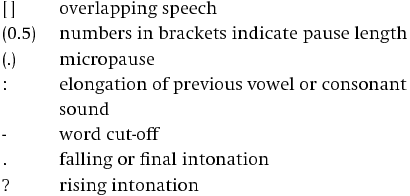
The first excerpt, which is from a casual chat between two male undergraduate students who are also friends, can be used to illustrate some of the most salient interactional features of ordinary conversation.45
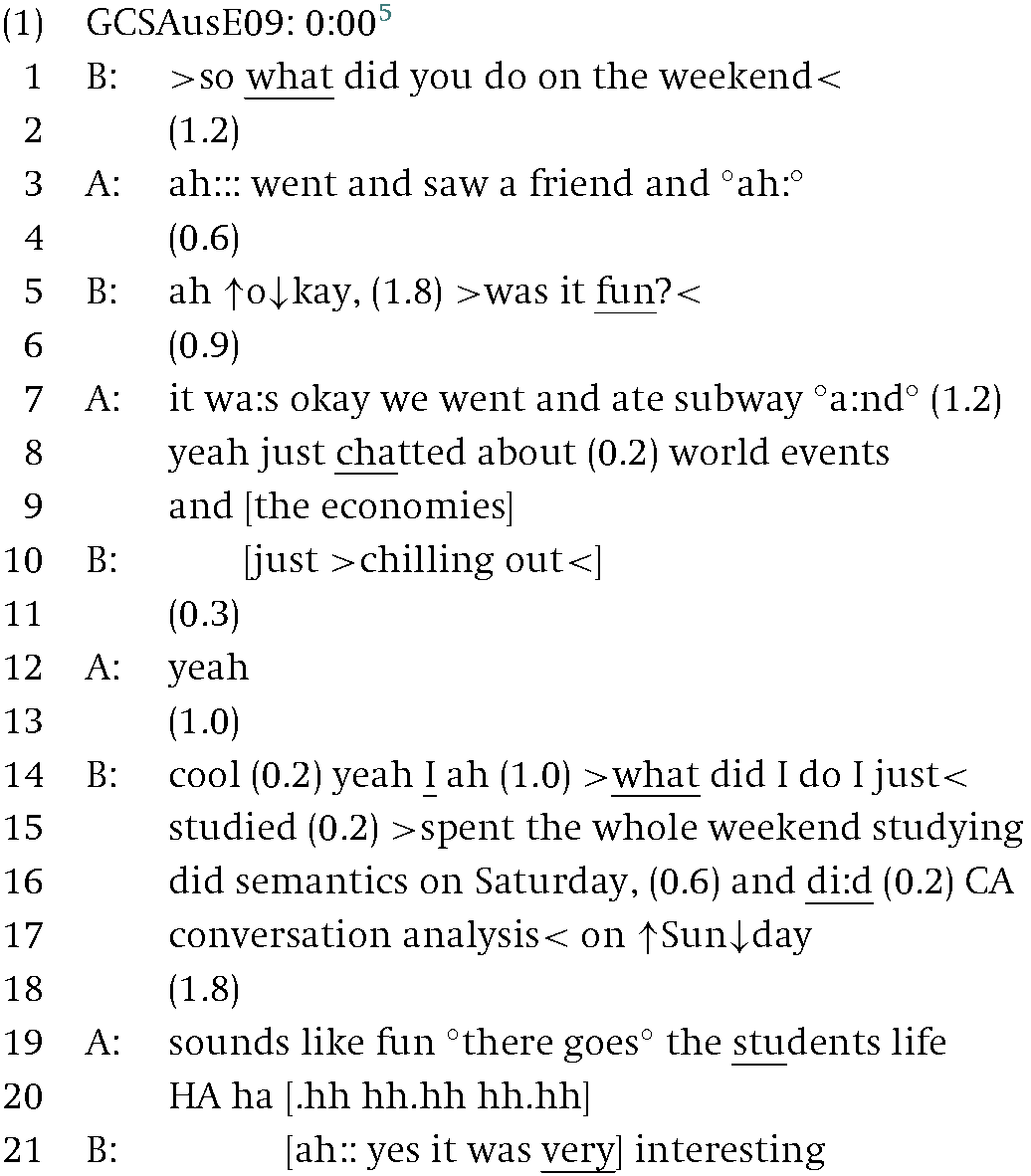
The first thing to note in this conversation is that the two participants take turns in speaking, illustrating the first key principle of the interactional machinery of conversational interaction, namely, composition (Clift et al. Reference Clift, Drew, Hutchby, Verschueren and Östman2006: 11). Although there are no set institutional rules guiding the allocation of turns, the two participants are able to take the speaking floor in a relatively orderly fashion that reflects the principles of turn-taking first outlined by Sacks et al. (Reference Sacks, Schegloff and Jefferson1974: 704). These rules, in turn, rest on the ability of both participants to parse the ongoing speech into what are called turn construction units (TCUs) on the basis of grammar, intonational packaging and where it ‘constitutes a recognizable action in context’ (Schegloff Reference Schegloff2007: 3–4). The span of a TCU-in-progress that projects imminent possible completion is termed a transition relevance place (TRP) (Schegloff Reference Schegloff2007: 4). Such TRPs are not spans where speaker change has to occur, however, but rather are recognisable places where speaker change can occur. Speaker change may, of course, occur at points other than a TRP, but speakers are held interactionally accountable for such changes.
In the excerpt above, we can see Ben selects Alex as next speaker in lines 1 and 5, while he self-selects as next speaker to continue his speaking turn in line 14. The only point at which there is overlap between semantically meaningful TCUs occurs across lines 9–10, when Ben offers a gloss of Alex's weekend (as ‘just >chilling out<’). There are two things to note about this overlapping turn. First, its design closely aligns with the action in the preceding turn, as through it Ben offers a formulation of what it is that Alex is trying to do in the preceding turn, namely, describe his weekend activities (Garfinkel and Sacks Reference Garfinkel, Sacks, McKinney and Tiraykian1970: 342). Second, it occurs at a projectable TRP, thus constituting a form of recognitional onset (Jefferson Reference Jefferson1986). It can also be observed more generally that turns are designed to accomplish actions in a manner that maintains progressivity in moving from one element (e.g. a turn or TCU) to the next with as little intervening as possible (Heritage Reference Heritage and Turner2009: 308; Schegloff Reference Schegloff2007: 14–15) and respects minimisation with regard to reference to or formulations of persons, places, times, actions and so on (Schegloff Reference Schegloff, Enfield and Levinson2006: 80). The second-turn design principle has also been productively applied to the analysis of person reference (or deixis) (Enfield and Stivers Reference Enfield and Stivers2007; Lerner and Kitzinger Reference Lerner and Kitzinger2007).
The second point to note is that the relationship between the turns is orderly, illustrating the second key principle of the interactional machinery, namely, position or sequentiality (Clift et al. Reference Clift, Drew, Hutchby, Verschueren and Östman2006: 11). The observation by Sacks that actions in conversational interaction tend to come in pairs was formalised through the notion of adjacency pairs, such as question-answer or invitation-acceptance/declination. Adjacency pairs are not limited to two turns, however, as they can also be expanded in various ways, the main ones being pre-expansion (e.g. pre-request, pre-invitation, pre-offer), insert expansion (e.g. pre-second insert expansion for request) and post-expansion (Schegloff Reference Schegloff2007). In the excerpt above, question-answer adjacency pairs and minimal post-expansions are evident in lines 1–12, while Ben's telling in lines 14–17 occasions an assessment on the part of Alex of the upshot of this telling (lines 19–20), with which Ben displays agreement (line 21) (Pomerantz Reference Pomerantz, Atkinson and Heritage1984). Notably here, as Alex does not reciprocate Ben's initial question about the weekend's activities (cf. the reciprocal ‘how are you’ routine noted by Schegloff Reference Schegloff1986), Ben occasions this telling through a self-directed question about his own weekend's activities. Ben's telling is treated as a possible complaint by Alex (Schegloff Reference Schegloff2005), who responds with an ironic positive assessment (line 19). The non-serious frame here is marked through laughter (Glenn Reference Glenn2003; Jefferson Reference Jefferson and Psathas1979; Schenkein Reference Schenkein1972), and Ben's subsequent continuation of the ironic frame in upgrading Alex's preceding positive assessment from ‘fun’ to ‘very interesting’ (line 21).
However, it is important to note that while reference has been made to adjacency pairs in explicating the sequential architecture of this particular excerpt, this is not to say that all conversational interaction can be reduced to adjacency pairs or expansions thereof. Instances of extended storytelling (or personal narratives), for instance, involve a different kind of overall sequential structure (Jefferson Reference Jefferson and Schenkein1978; Sacks Reference Sacks1986). One of the key findings in CA, however, is that such sequences, whether with respect to adjacency pairs or the overall structural organisation of the interaction, are for the most part organised around actions rather than topics (Schegloff Reference Schegloff1997, Reference Schegloff2007).
The interactional machinery of turn-taking and sequence organisation
can also be applied to some synchronous forms of private CMC, as seen in the following excerpt from a private conversation between two friends conducted through instant messaging.6
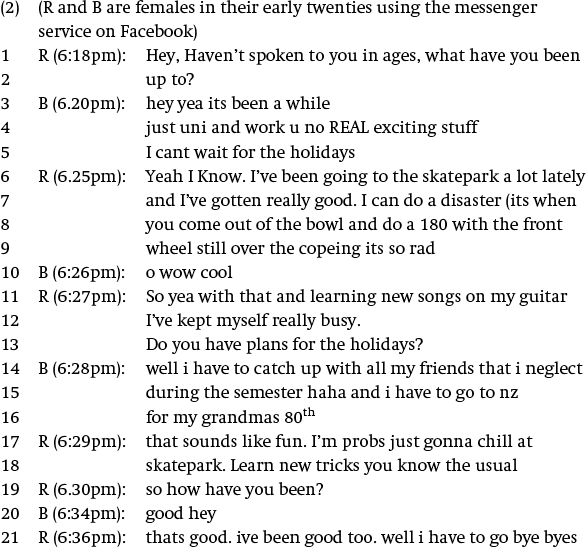
The excerpt above bears a number of striking similarities with the face-to-face conversational interaction discussed in example (1) despite being conducted entirely through a textual channel. Once again there is an orderly taking of turns by the two participants. However, rather than relating to recognition of TRPs, next turns are allocated by the current sender, who holds the floor in three main ways. First, in a manner similar to ordinary spoken conversation, the current sender can select next sender through ‘addressing them with a turn whose action requires a responsive action next’ (Schegloff Reference Schegloff2007: 4). In this interaction these are primarily information-seeking questions (Stivers Reference Stivers2010), as seen in lines 1, 13 and 19. Second, the current sender self-selects by continuing her current turn. For instance, Rachel moves from an expression of solidarity in response to Bronwyn's previous turn (constituting one TCU) to a telling of her recent activities (constituting a second TCU) in the same turn (line 6). Unlike face-to-face conversation, however, interruption or overlap of a current turn is not possible due to limitations of the medium (i.e. the messenger allows only one-way transmission), although a turn can be displaced if another participant sends another message in the meantime. Third, the current sender selects next sender through posting the message, thereby implicitly relinquishing rights to next turn, a practice evident throughout the interaction. However, this implicit relinquishment of next turn can easily be reversed, if that sender goes on to take the next turn. An example of this latter move, which can be seen in lines 17–18, appears to be occasioned by a lack of reciprocation in asking questions on the part of Bronwyn.
There are also similarities with the underlying sequential structure of the face-to-face conversation in example (1), as a clear pattern of adjacency pairs (question-answer-assessment) is apparent. There is, moreover, a striking resemblance with another practice found in example (1), namely, self-talk despite the current speaker's inquiries about the other not being reciprocated. Rachel's inquiries about Bronwyn's recent activities (line 1), her plans for the holidays (line 13) or how Bronwyn has been (line 19), for instance, occasion a telling on Rachel's part about her recent activities (lines 5–8), her plans for the holidays (lines 17–19) and how she has been (line 21). These latter tellings by Rachel occur despite Bronwyn not reciprocating Rachel's questions, which mirrors Ben's telling about his weekend's activities despite his initial inquiry not being reciprocated by Alex in example (1). It appears, then, that the routinely reciprocal nature of such question-answer-assessment sequences can occasion self-initiated tellings in some cases, or what might be glossed as ‘occasioning self-talk through inquiring about others’.
13.4 Characterising conversational interaction
Conversational interaction can arguably be characterised in terms of two key properties. The first is emergence, where the activities of participants in conversational interaction are reciprocally linked and conditional upon those of others (Arundale Reference Arundale1999, Reference Arundale2006a, Reference Arundale2008, Reference Arundale2010a, Reference Arundale2010b; Arundale and Good Reference Arundale, Good, Fetzer and Meierkord2002). The upshot of this reciprocal conditionality, or non-summativity, is that pragmatic phenomena cannot always be straightforwardly reduced to an analysis of the mental states, including a priori intentions, of individuals (see Haugh and Jaszczolt, this volume). The second key property is that of situatedness, where the activities of participants in conversational interaction are not only interpretable in terms of the local, situated context of that particular interaction (that is, what has come before and what comes afterwards in the interactional sequence to which participants themselves are demonstrably orienting) (Schegloff Reference Schegloff, Alexander, Giesen, Munch and Smelser1987, Reference Schegloff, Boden and Zimmerman1991, Reference Schegloff2005), but also beyond the here-and-now, encompassing the layers of historicity and orders of indexicality (Blommaert Reference Blommaert2005, Reference Blommaert2007) that afford pragmatic meanings and actions (Mey Reference Mey2001: 115, 227; Reference Mey and Cummings2010: 445–6). The upshot of the inherent situatedness of conversation is that pragmatic phenomena in conversational interaction cannot always be straightforwardly reduced to emergent interactional phenomena in the here-and-now without a proper consideration of their sociocognitive roots.
13.4.1 Emergence
The term interaction is used in two quite distinct ways in pragmatics. In the ordinary or ‘weak’ sense, interaction refers to ‘a situation in which people converse’ (Arundale Reference Arundale2006a: 196), and thus where talk is ‘directed to another person and has potential for affecting that other person’ (Schiffrin Reference Schiffrin1994: 415). In the folk sense, then, interaction is synonymous with talk or contact. This view of interaction assumes a summative view where the ‘output of one system…serves as an input to a separate, independent system’ (Arundale Reference Arundale2006a: 196). The conceptualisation of interaction as the summative pairing of the behavioural and cognitive states of individuals is dependent on the assumption that no reciprocal conditionality can be identified across the activities of those individuals, and thus ‘explanations of those activities can be reduced without remainder to the simple sum of the independent individual's behaviour and/or cognitive states’ (Arundale Reference Arundale2010a: 2079). The classic view in pragmatics that meaning involves recipients attributing intentions to speakers based on the behaviour, normally an utterance, of that speaker (see Haugh and Jaszczolt, this volume, for further discussion) presupposes a summative conceptualisation of interaction, where speaker meaning is reduced to the speaker's behaviour (output) and the recipient's inferences about intentions underlying the speaker's behaviour (input). It is assumed, therefore, that in cases of successful communication, the recipient's inferences about the speaker's intentions match those of the speaker, while miscommunication is characterised as cases where those inferences do not match the actual intentions of the speaker. While such an approach can account for at least some of what goes on in conversational interaction, especially when language-use data from conversations is abstracted away from its sequential environment, the inadequacy of a summative conceptualisation of interaction for explaining how meanings, actions and evaluations often arise in conversational interaction has been repeatedly emphasised by those examining naturally occurring conversation (see Arundale Reference Arundale, Fitch and Sanders2005 for a good summary).
For example, in the following exchange an understanding that Sirl wanted to use the shower first emerged over a number of turns, and was thus only retrospectively attributed to a previous utterance.

While Sirl's initial inquiry in turn 1 might be interpreted as a pre-request in that it constitutes a preparatory condition for making a request to use the bathroom first, and Michael subsequently leaves open the possibility that Sirl may wish to make such a request in turn 2, Sirl does not go on to make the request in turn 3. Instead, he treats his first utterance as simply a request for information, thereby blocking the interpretation of this utterance as a pre-request. However, the marked pause after Sirl's counter-response indicates that something has been left unsaid, and so Michael makes an offer to Sirl in turn 4 that he use the bathroom first, thereby reinterpreting Sirl's utterance in turn 1 as a pre-request. The subsequent acceptance of this offer by Sirl in turn 5 ratifies Michael's retrospective interpreting. Crucially, this interpreting only emerges in this interaction over the course of a number of turns, and rests on contingent inferences made by Michael that are afforded and constrained by the inferences made by Sirl, and vice versa.
According to a summative view of interaction this short conversation is an instance of miscommunication, as Sirl's utterance in turn 1 (the output) initially failed to elicit the ‘correct’ inference on the part of Michael (the input). Yet characterising this interaction as miscommunication neglects the possibility that it was in fact a matter of the two participants ‘sounding each other out’ before coming to an agreed interpretation of Sirl's initial utterance. Moreover, an analyst taking a summative view of interaction would also have to assume that Sirl really did intend to imply that he wanted to use the shower with his first utterance. Yet it is equally possible that Sirl decided he wanted to use the shower only after Michael made the offer. Sirl himself may not have been able to distinguish his own a priori intention and what eventually emerged as their understanding of his utterance in turn 1 (cf. Haugh Reference Haugh2007c: 94–5)
The contingent inferencing underlying the emergence of a particular understanding of Sirl's first utterance in this interaction goes beyond the traditional monadic account of inference located in the autonomous minds of individuals. Instead, it is arguably more productively understood in terms of anticipatory and retroactive inferencing (Arundale Reference Arundale2008; Arundale and Good Reference Arundale, Good, Fetzer and Meierkord2002; Good Reference Good and Goody1995).
Each participant's processing in using language involves a set of concurrent cognitive operations that are temporally extended, not only forward in time in recipient design of their own utterances and in anticipation of other's talk…but also backwards in time in the retroactive assessing of interpretations of what has already been produced in their own and in other's utterance. (Arundale and Good Reference Arundale, Good, Fetzer and Meierkord2002: 135)
In other words, implicatures and other interpretings are contingent not because the inferences are necessarily always defeasible, as various scholars have pointed out (Carston Reference Carston2002: 138–9; Haugh Reference Haugh2008d: 445–6; Weiner Reference Weiner2006), but because such inferences are both anticipatory and retroactive in nature (Haugh Reference Haugh2009: 97–102).
In another example of the emergent nature of conversational interaction, Chris is asking Emma about her acupuncture business. The utterance-final disjunction here appears to occasion an instance of ‘not saying’, where the speaker partly leaves the interpretation of what is not said up to7 the recipient.

In this excerpt, Chris begins by asking about Emma's customers’ level of satisfaction with her work (lines 1–2). Emma responds in the affirmative (line 4) after a brief pause (line 3), before going on to give a justification for her assertion that her customers are happy, namely that she is getting business through word of mouth (lines 6–8, 10), which presupposes they must be happy. Careful examination of Chris's utterance in lines 1–2, however, indicates that his question could have been legitimately interpreted both as a polar question (‘or not’), or as an alternative question (‘or something’, for example ‘unhappy’, ‘dissatisfied’ etc.). Chris leaves it open to Emma as to which one of these interpretations is meant. In this way, a default implicature of epistemic optionality arises, whereby Chris not only claims a lack of knowledge about the level of satisfaction experience by Emma's customers, a claim standardly associated with questions (Heritage and Raymond forthcoming; Raymond Reference Raymond2003), but increases the epistemic cline between them in implicitly claiming that he is unable or unwilling to even guess by offering a complete candidate answer (Pomerantz Reference Pomerantz1988).8 Emma opts for an interpretation of his question as a polar question in responding with ‘YEAH’ in the next turn (Raymond Reference Raymond2003), which is subsequently accepted by Chris (line 5), who also simultaneously prompts her to give an account of her answer through repeating her affirmative response.
Crucially, then, the interpretation of Chris's question in lines 1–2 as a polar question rather than an alternative question emerges over the course of a number of turns, that is, the initial question from Chris, Emma's response and Chris's subsequent response. This interpretation cannot be reduced to a summative explanation based on Chris's intentions at this point as Chris's intentions were left opaque through his not saying. Thus, while a default implicature of epistemic optionality is interactionally achieved here, this arguably follows from a general presumption of intentionality (Haugh and Jaszczolt, this volume), and an understanding of the practice of not saying through utterance-final disjunctive type questions, rather than from the ascription of specific a priori intentions to Chris (cf. Haugh Reference Haugh, Kecskes and Mey2008c: 59–60). It also draws from inferencing on the part of Chris and Emma which is mutually affording and constraining, or what Arundale and Good (Reference Arundale, Good, Fetzer and Meierkord2002) term more broadly ‘dyadic cognizing’:
Each participant's cognitive processes in using language involve concurrent operations temporally extended both forward in time in anticipation or projection, and backwards in time in hindsight or retroactive assessing of what has already transpired. As participants interact, these concurrent cognitive activities become fully interdependent or dyadic. (Arundale and Good Reference Arundale, Good, Fetzer and Meierkord2002: 122)
Such a view precludes a monadic explanation of the inferencing underpinning this interaction, where each individual participant's inferences arise independently of the other, but instead suggests that these cognitive processes are fully interdependent (Arundale and Good Reference Arundale, Good, Fetzer and Meierkord2002: 127).
In both these examples, then, another sense of interaction appears more apt, namely, a technical conceptualisation of interaction as ‘the conjoint, non-summative outcome of two or more factors’ (Arundale Reference Arundale2006a: 196). In these instances, the factors involved are the inferences made by the two participants about what is being meant, done and evaluated through these conversations. The definition of interaction in the technical sense of emergence assumes conversational interaction is ‘a non-summative phenomenon involving two or more cognitively autonomous persons engaged in affording and constraining one another's designing and interpreting of utterances and/or observable behaviours in sequence’ (Arundale Reference Arundale2010a: 2079; cf. Arundale Reference Arundale1999: 125–6, 129; Kidwell and Zimmerman Reference Kidwell and Zimmerman2006: 7; Krippendorff Reference Krippendorff2009: 43). Treating conversational interaction as emergent assumes that it is a system that can be treated as fundamentally non-summative in nature.
Arundale (Reference Arundale, Locher and Lambert Graham2010b) explains this property of non-summativity by appealing to analogies with statistical inference, systems theory and chemical reactions. In mathematical terms, summativity refers to instances where the effect of one factor depends on the levels of another factor in statistical inference, while non-summativity encompasses instances where there are interaction effects between variables that go beyond that main effect when conducting analysis of variance. In systems theory, a formal system arises when
[t]he state of each unit is constrained by, conditioned by, or dependent on the state of other units. The units are coupled. Moreover, there is at least one measure of the sum of its units which is larger [or less] than the sum of that measure of its units. (Miller Reference Miller1965: 200–201)
In other words, the emergent property is characteristic of the system as a whole, not its individual parts (Georgiou Reference Georgiou2003: 241). In chemistry, non-summativity refers to the properties of a compound (e.g. sodium chloride, NaCl, or common salt) being qualitatively different from the properties of the two elements (sodium and chlorine) that constitute it. More generally, non-summativity refers to cases where ‘the state(s) of one component become reciprocally linked to and conditional upon those of other component(s) in space and/or time’ (Arundale Reference Arundale, Locher and Lambert Graham2010b: 139).
In relation to conversation, then, non-summativity is a property of conversational interaction as a system, which is framed by Arundale as involving ‘two [or more] persons’ evolving, reciprocal co-creating of meanings and actions in on-going address and uptake’ (Arundale Reference Arundale2010a: 2079; see also Arundale and Good Reference Arundale, Good, Fetzer and Meierkord2002; Krippendorff Reference Krippendorff2009: 37–47). This view is developed in considerable detail in Arundale's Co-Constituting Model of Communication (CCM) (Arundale Reference Arundale1999, Reference Arundale, Fitch and Sanders2005, Reference Arundale2006a, Reference Arundale2008, Reference Arundale2010a, Reference Arundale2010b; Arundale and Good Reference Arundale, Good, Fetzer and Meierkord2002),9 and to some extent in other interactional achievement models of communication (Clark H. Reference Clark1996; Sanders Reference Sanders1987). It also underpins the analysis of social actions in CA (Schegloff Reference Schegloff1996, Reference Schegloff2007). The key idea is that participants reciprocally afford and constrain interpretations of meanings, actions and evaluations in interaction through the adjacent placement of subsequent utterances, through which they display their understandings of the interactional import of prior and forthcoming utterances (Arundale Reference Arundale2006a: 196). In examples (1) and (2) above, the response of the recipient helps constrain what is implicated amongst the potential interpretings initially afforded by the speaker's first utterance, an interpretation which is subsequently ratified, qualified or rejected by the first speaker.
While a non-summative model of conversational interaction is necessarily complex, it is arguably essential for the analysis of pragmatic phenomena, as summative models are ‘formally incapable of explaining the non-summative effects or emergent properties observable when individuals are engaged in interaction’ (Arundale Reference Arundale2008: 243; see also Krippendorff Reference Krippendorff1970). The advantage of an approach that accounts for the emergent properties of conversational interaction is that it can also accommodate particular instances of pragmatic phenomena which do not necessarily need to be treated as formally emergent. In other words, a summative explanation of certain pragmatic phenomena is possible within a non-summative approach. The reverse, however, is not true. One implication of treating pragmatic phenomena in conversational interaction as emergent or non-summative phenomena is that while the sociocognitive engine (cf. Levinson Reference Levinson2006a: 86) underlying conversational interaction clearly encompasses monadic (i.e. individual) cognitive processes and states of attention, (individual) intentions, inference and agency, it also needs to go beyond explanations rooted at the level of individual psychological processing into forms of dyadic cognising (Arundale Reference Arundale2008; Arundale and Good Reference Arundale, Good, Fetzer and Meierkord2002; Haugh Reference Haugh2009; see also Haugh and Jaszczolt, this volume).
13.4.2 Situatedness
While CA is primarily concerned with the local situated context, a stance that is understandable given the analytical concerns of conversation analysts, it is commonly argued in pragmatics that we also need to consider the historical, social and cultural circumstances in which conversational interaction occurs (Grundy Reference Grundy2008: 223). Mey (Reference Mey2001), for instance, argues that language, which lies at the heart of conversational interaction, ‘transcends the historical boundaries of the “here and now”, as well as the subjective limitations of the individual's knowledge and experience’ (115), as it ‘functions both as a repository of earlier experience and as a tool-box for future changes’ (227). Such a stance points to a potential issue for the CA approach to analysing actions (and to a lesser extent meanings) in conversational interaction: while it is claimed ‘analysis requires demonstrating that the action in question was understood and experienced as such by the participants’ (Schegloff Reference Schegloff1996: 172, original emphasis), the identification (and labelling) of actions by the analyst itself is treated as unproblematic. For example, recognising a ‘possible complaint’ as an action is argued to be ‘a matter of position and composition – how the talk is constructed and where it is’ and thus ‘it is not a matter of divining intentions’ (Schegloff Reference Schegloff, Enfield and Levinson2006: 88). However, it is never made clear how the analyst (or participants) know this constitutes a (possible) complaint in the first place.
In the previous analysis of example (1), the relevant section of which is reproduced below, for instance, the recognition of a “complainable” (namely, having to spend all weekend studying) was claimed to be evident from Alex's subsequent ironic assessment of Ben's weekend spent studying.

In lines 15–17, Ben describes how he spent the whole weekend studying. This is treated as a complainable by Alex, who responds with an ironic assessment in line 19 (‘sounds like fun °there goes° the students life’). It is interpretable as ironic since evidently Alex does not mean studying all weekend is really a fun thing to be doing, but rather that having to study all weekend can be assessed as being exactly the opposite (that is, not fun), and thus something about which making a complaint is understandable. However, such an analysis begs the question of just how it is we can conclude a possible complaint is at issue here, and how we recognise Alex's assessment as ironic.10 Evidently we are drawing from some kind of interactional competence or intuition that lies outside of this particular interaction.
Mey (Reference Mey and Cummings2010) argues that what makes speech acts possible, including ‘possible complaints’, are particular conditions or what he terms ‘affordances’:
for any activity to be successful, it has to be ‘expected’, not just in the sense that somebody is waiting for the act to be performed, but rather in a general sense: this particular kind of act is apposite in this particular discursive interaction. (Mey Reference Mey and Cummings2010: 445)
In other words, social actions are dependent on the ‘situation being able to “carry” them’ (Mey Reference Mey and Cummings2010: 445). In the case of possible complaints and ironic assessments this involves a general understanding of what students do (i.e. not only study, but also recreation, and sometimes part-time work), how much time they normally spend doing study as opposed to those activities, and thus what would constitute a reasonable, as opposed to unreasonable, balance between less desirable activities (i.e. study) and more desirable activities (i.e. recreation).
It appears, then, that attempts to formalise such conditions in philosophical pragmatics perhaps have a more important role to play than generally acknowledged by those preferring empirical analyses of naturally occurring data, since without some ‘precise reflections on what constitutes the nature’ of the speech act in question (Jucker Reference Jucker2009: 1620), analysts may inadvertently reify their own intuitions to the level of theory. Such a problem is admittedly less likely to arise in CA, where such theorising is normally eschewed. However, in pragmatics, where theorising about pragmatic phenomena is one of its primary goals, the reification of informal intuitions can lead to an endless proliferation of categories, internally contradictory schemas, and ultimately, incoherence in theorising about pragmatic phenomena. The potential for such problems suggests that we need to take not only the local, situated context of a particular interaction into account in our analyses of conversational interactions, but also the sociocognitive world that underpins them.
The notion of situatedness proposed here encompasses both the local, here-and-now of conversational interaction, as well as the ‘layered simultaneity’ and horizontal and vertical distribution of ‘orders of indexicality’ characterising that which lies beyond the here-and-now (Blommaert Reference Blommaert2005, Reference Blommaert2007). As Blommaert (Reference Blommaert2005) argues, various forms of discourse, including conversational interaction, are subject to what he describes as ‘layered simultaneity’.
It occurs in real-time, synchronic event, but it is simultaneously encapsulated in several layers of historicity, some of which are within the grasp of participants while others remain invisible but are nevertheless present. (Blommaert Reference Blommaert2005: 130)
Such a view of interaction goes beyond the locally observable to encompass ‘a polycentric and stratified’ environment where ‘people continuously need to observe “norms” – orders of indexicality – that are attached to a multitude of centres of authority, local as well as translocal, momentary as well as lasting’ (Blommaert Reference Blommaert2007: 2). These orders of indexicality are spread horizontally across social networks, as well as vertically in the sense that they belong to different scales of operation and degrees of validity (Blommaert Reference Blommaert2007: 1).
Norms (see Peregrin, this volume) are often conceptualised as external forces that drive (or cause) particular actions, interpretations or evaluations by individuals, a perspective that is sometimes labelled Parsonian, as it was most famously advanced in the work of Parsons ([Reference Parsons1937]1968). The treatment of norms as external forces was critiqued by Garfinkel (Reference Garfinkel1967) among others,11 and the view has since emerged that norms, or ‘orders of indexicality’, can be understood more productively as distributed and emergent properties that are enabled across networks of speakers, including those broader networks of which conversational interactions constitute an important part. Arundale argues that
we co-constitute anew in each inter-action patterns that we have likely co-constituted in similar form in the past, and it is the continual re-co-constituting or co-maintaining of these patterns that observers attempt to explain using abstractions like ‘ideologies’ or ‘social institutions.’ But from the perspective of the co-constituting model of communication, an ideology or social institution does not exist except as a continual renewing of patterns in inter-action. (Arundale Reference Arundale1999: 141–2, original emphasis)
In other words, the ongoing renewal of inter-action12 patterns across social networks is the mechanism by which orders of indexicality are sustained (and thus evolve). Instances where such inter-action patterns are not renewed thus constitute challenges to orders of indexicality, although the impact of such challenges depends very much on their place of occurrence within the wider social network. A similar view of ‘norms’ is advanced by Eelen (Reference Eelen2001), who suggests they constitute a kind of ‘working consensus’, a set of practices rather than beliefs. Indeed, this view of broader socio-cultural norms reflects a perspective that has long been argued for by ethnomethodologists (Garfinkel Reference Garfinkel1967; Heritage Reference Heritage1984), with Mey (Reference Mey and Brown2006b) succinctly representing this perspective in arguing that the ‘social context not only constrains language use, but is itself constructed through the use of appropriate language: social norms are (re)-instituted through the use of language’ (53). These orders of indexicality, then, form part of a ‘shared memory’ that arises as ‘inter-action within a network across time and space creates a structural form of social memory, independent of the memories of individuals’ (Arundale Reference Arundale1999: 141). Krippendorff (Reference Krippendorff2009) argues that such social memory cannot be reduced, at least not without remainder, to the psychological processes of individuals. Instead, it should be modelled as a system in its own right distributed across social networks. Work on different kinds of knowledge schemata, such as frames and scripts, for instance, represent an attempt to do just that, albeit within a largely structuralist framework.13
Such a perspective clearly has implications for those attempting to characterise the conditions (or affordances) that make particular pragmatic meanings, actions and evaluations possible. It also has implications for the way in which we approach the analysis of various pragmatic phenomena in conversational interaction. In particular, the situatedness of conversational interaction needs to be taken into account, especially in cases where speakers in local, situated interaction also invoke particular schemata and orders of indexicality that are variously distributed across social networks. In the following excerpt, for instance, from a conversation between two friends talking about Chris's recent visit to the dentist, the way in which scripts and orders of indexicality associated with dentists are invoked is14 illustrated.

Up until this point in the conversation, Chris has been telling Mark about his dentist, and how impressed he is with him. Mark responds to this over-extolling by teasing Chris that he is probably charged a lot for the dentist's services (line 1). While Chris initially agrees, he goes on to account for his previous extolling by claiming that his dentist only does work that needs to be done (lines 3–5). This presupposes that dentists sometimes do unnecessary dental work, thereby inflating what they can charge. This presupposition is made explicit in a subsequent turn, when Chris begins talking about what some dentists do, namely, offering a fluoride treatment (apparently perceived by Chris as unnecessary) (lines 7–8), before Mark co-constructs a humorous completion to Chris's utterance, where it is suggested that dentists make money by first deliberately causing damage to their patient's teeth (lines 9–10). While it is not clear what Chris might have said had he finished what he was saying in line 8, Mark was able to anticipate what could have been said.15 In this way, Mark co-constructs a common stance about dentists who do unnecessary work with Chris (cf. Haugh Reference Haugh2009: 101–2). This stance is recognisably humorous not only because of the incongruity between the action attributed to such dentists (i.e., deliberately damaging the patient's teeth), and the assumption that dentists are there to help people, but also because it draws upon stereotypical views of dentists as overcharging their patients. In other words, in order to fully appreciate the humour here, we arguably need to go beyond the local, situated interaction to include a consideration of views of dentists that reside in our shared memories or schemata.
In another example, taken from an interaction occurring in an institutional setting (a television broadcast), the way in which multiple layers of historicity can be invoked becomes even more apparent. The following excerpt is from a debate between Sanna Trad, daughter of a prominent leader in the Australian Muslim community in Sydney, and Bronwyn Bishop, a conservative senator, about Australian Muslims wearing the hijab.
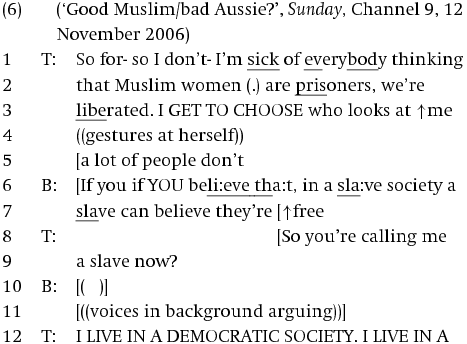

This excerpt begins with Trad expressing her frustration that wearing the hijab is interpreted (by many Australians) as a sign of a lack of freedom on the part of Muslim women, and then going on to claim that she is actually exercising her agency in choosing to wear a hijab (lines 1–4). However, she is interrupted by Bishop, who implies that Trad is unaware of the limits placed on her freedom by her Islamic beliefs, by drawing an analogy with slaves who in never having experienced freedom do not understand its meaning (lines 6–7). Trad's subsequent response is very heated. In particular, she tries to counter the implication that she is not part of Australian society (which is a negative evaluation of Trad displayed by Bishop, which thus constitutes a potential challenge to her identity), by claiming she was ‘born and raised’ in Australia (lines 13–14) and has Australian friends who are, importantly, from Anglo-Christian backgrounds (lines 16–18). The way in which this face threat involves multiple layers of historicity is made evident in Trad's response to Bishop's implied accusation, namely, that Trad (and all those who wear hijabs) are not legitimate members of Australian society. In other words, the discourse of ‘Muslims as un-Australian’ as a broader underlying concern is invoked in this interaction. It also draws from a shared understanding that there are supposedly ‘real’ Australians who are born and raised in the country and are stereotypically from Anglo-Christian backgrounds. The point here is not to endorse such understandings, but simply to point out that such understandings are evidently presupposed by both Bishop and Trad.
While conversation analysts often eschew the need for invoking shared knowledge (see the recent debate in McHoul et al. Reference McHoul, Rapley and Antaki2008), it has been argued here that pragmatic phenomena in conversational interaction cannot always be reduced to emergent interactional phenomena in the here-and-now. More serious consideration of their sociocognitive roots, and consequently acknowledgement of the inherent situatedness of conversation interaction, has thus been advocated here.
13.5 Towards a pragmatics of conversational interaction
Conversational interaction is an important concern for any theory of pragmatics. While there are clearly many forms of language use apart from conversational interaction that are also deserving of analytical attention, conversational interaction remains important due to its enduring ubiquity in social life. In this chapter, it has been argued that pragmatic phenomena in conversational interaction should be recognised as emergent and situated in nature. This has implications for the ways in which we might approach the analysis of pragmatic phenomena that occur in conversational interaction.
A basic framework for analysing pragmatic phenomena in conversational interaction has also been assumed in this discussion. This framework is based on a tripartite distinction between pragmatic meaning, action and evaluation, which, along with investigations of the interactional machinery and sociocognitive engine underlying conversation, arguably forms the basis of a programme for investigating the pragmatics of conversational interaction. In advancing this programme, a wide range of methodologies can legitimately be called upon. It has been argued here, however, that this should occur in a principled manner, bearing in mind the properties of emergence and situatedness that characterise conversational interaction.
It is also apparent that more work on conversational types of computer-mediated communication is necessary. While face-to-face conversation remains at the core of much of our language use, variant forms of conversational interaction are emerging as different types of computer-mediated communication are increasingly becoming a part of our daily lives. These emergent forms of conversational interaction need to be accommodated within dyadic as well as multiparty theories of conversational interaction in pragmatics. The assumption that talk is inherently fleeting also needs revisiting in light of the increasing prevalence of conversational forms of computer-mediated communication where the conversational record remains there for all to inspect. The advantage of such a record is that it engenders greater metalinguistic and metapragmatic awareness amongst interactants themselves, with such awareness offering a rich analytical vein for future research on conversational interaction. It appears, then, that there still remains much to explore in better understanding the pragmatics of conversational interaction.