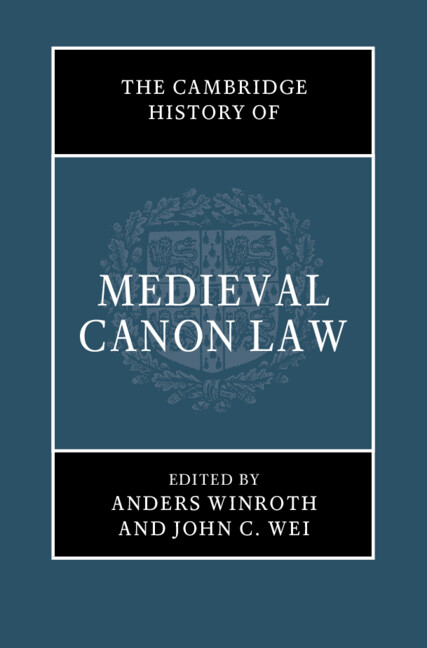

Canon law touched nearly every aspect of medieval society, including many issues we now think of as purely secular. It regulated marriages, oaths, usury, sorcery, heresy, university life, penance, just war, court procedure, and Christian relations with religious minorities. Canon law also regulated the clergy and the Church, one of the most important institutions in the Middle Ages. This Cambridge History offers a comprehensive survey of canon law, both chronologically and thematically. Written by an international team of scholars, it explores, in non-technical language, how it operated in the daily life of people and in the great political events of the time. The volume demonstrates that medieval canon law holds a unique position in the legal history of Europe. Indeed, the influence of medieval canon law, which was at the forefront of introducing and defining concepts such as 'equity,' 'rationality,' 'office,' and 'positive law,' has been enormous, long-lasting, and remarkably diverse.
‘… will do much to orient medieval and legal historians to some of the particularities of the innovative, dynamic, and influential legal system formed over time in the church of the Middle Ages.’
Atria A. Larson Source: Speculum
Loading metrics...
* Views captured on Cambridge Core between #date#. This data will be updated every 24 hours.
Usage data cannot currently be displayed.
This section outlines the accessibility features of this content - including support for screen readers, full keyboard navigation and high-contrast display options. This may not be relevant for you.
Accessibility compliance for the HTML of this book is currently unknown and may be updated in the future.
