

3.1 Comparison between Russian and English
A complete contrastive description of the two languages would require the voluminous work of a large book rather than a chapter. That is why we will restrict our description to two tasks: first, to provide a typological comparison of English and Russian; second, to show different features of the two languages that might have an effect on Russian English.
Both English and Russian are Indo-European languages, that is, using an anthropological metaphor, they are relatives but are related to each other in a rather remote way, like second cousins,Footnote 1 as they belong to different linguistic groups – Germanic and Slavic. It is not only genetically that the languages are related to each other by their remote ancestors, but they are also relatively similar typologically, as both Russian and English are of inflexional morphological type, though they demonstrate opposite features of synthetical and analytical subtypes. English is an analytical inflexional language, with a great number of analytical forms. Russian is characterized as a synthetical inflexional language, with the predominance of affixes, inner flexions, and change of word stress as the main synthetical means of word modification. However, these trends are quite dynamic and neither of the languages maintains a pure morphological type.
The predominance of analytical forms in the paradigms of English part of speech modification – such as verb tenses (is doing, have done, will do, has been doing), passive voice (is done), and mood (should do, would have done, might do), noun plus preposition forms expressing relations between objects (of the boy, to the boy, by the boy), which is typical of noun cases, degrees of comparison (more/most beautiful) – accounts for its analytical morphological type. In Russian, similar grammatical categories can be expressed in a synthetical way combining grammatical and lexical meanings in one form. For example: tense forms – (1) делает (delayet, ‘is doing,’ ‘has been doing’), (2) сделал (sdelal, ‘has done’), (3) сделает (sdelayet, ‘will do’); passive forms – (4) делается (delayetsa, ‘is being done’); noun cases – (5) мальчика (malchika, ‘of the boy’), (6) мальчику (malchiku, ‘to the boy’), (7) мальчиком (malchikom, ‘by the boy’); degrees of comparison – (8) красивее/красивейший (krasiveye/krasiveishiy, ‘more beautiful/most beautiful’).
However, recent linguistic research reveals the evident trend of the Russian language toward analytism (Kostomarov Reference Kostomarov1999). Along with synthetical forms, informal speech can contain parallel analytical variants; for example, (9) более красивый, (10) самый красивый (boleye krasivyi, ‘more beautiful’; samyi krasivyi, ‘most beautiful’), (11) буду просить (budu prosit’, ‘will ask’) instead of (12) попрошу (poproshu, ‘will ask’).
We will make further comparison of English and Russian, keeping in mind the potential difficulties for Russians to use English and the possible areas of the Russian language influence on Russian English (see Chapter 4).
Morphology
The Russian language has a very restricted category of possessiveness, which is usually expressed by an adjective: (1) мамин ключ (mamin klyuch, ‘Mom’s key’), (2) папина рубашка (papina rubashka, ‘Dad’s shirt’), (3) материнская любовь (materinskaya lyubov’, ‘Mother’s love’), (4) отцовское слово (otsovskoye slovo, ‘Father’s word’), (5) дядин дом (dyadin dom, ‘Uncle’s house’), (6) собачья миска (sobachya miska, ‘dog’s bowl’), (7) кошкин дом (koshkin dom, ‘cat’s house’), etc. These Russian forms compete with the postpositional Genitive noun forms: (8) ключ мамы (klyuch mamy, ‘Mom’s key,’ lit. ‘key of (my) Mom’), (9) рубашка папы (rubashka papy, ‘Dad’s shirt,’ lit. ‘shirt of (my) Dad’), (10) любовь матери (lyubov’ materi, lit. ‘love of the mother’), (11) слово отца (slovo otsa, ‘word of Father’), (12) дом дяди (dom dyadi, ‘house of the uncle’), (13) миска собаки (miska sobaki, ‘bowl of the dog’), (14) дом кошки (dom koshki, ‘house of the cat’). Unlike an English possessive case noun, the Russian adjective is used less frequently than postpositional noun. I. Golub (Reference Golub1997), a specialist in Russian stylistics, argues that Russian possessive adjectives have no prospect for expanding and developing.
Both Russian and English have nouns used either in the pluralia tantum or singularia tantum. However, not all of the nouns have similar features with regard to their grammatical number. For example, the Russian (15) волосы (volosy) (plural) corresponds to the English hair (singular), just like (16) деньги (den’gi) (plural) to English money (singular), (17) одежда (odezhda) (singular) – clothes (plural), (18) зелень (zelen’) (singular) – greens (plural), (19) часы (chasy) (plural) – watch/watches, (20) ворота (vorota) (plural) – gate/gates.
Russian nouns have a lexico-grammatical category of gender. This means that all nouns are characterized by one of the gender features: masculine, feminine, or neuter. The gender usually cannot be explained semantically – Russian (21) вилка (vilka, ‘fork’) is of the feminine gender, while (22) нож (nozh, ‘knife’) is masculine; (23) путь (put’, ‘way’) is masculine, while (24) дорога (doroga, ‘road’) is feminine. The gender in Russian, unlike the one in English, does not depend on whether the noun denotes an animate or inanimate thing. The grammatical feature of gender is revealed in the noun agreement with a modifying adjective and/or the verb in the past tense: (25) маленькая вилка упала… (malen’kaya vilka upala, ‘the small fork fell’), (26) острый нож упал… (ostryi nozh upal, ‘the sharp knife fell’). The gender of a noun is also revealed by a pronoun substituting for the noun: (27) вилка/она упала (vilka/ona upala, lit. ‘she’), (28) нож/он упал (nozh/on upal, lit. ‘he’). There is no metaphorical shift of gender in Russian, similar to the feminine gender of the English nouns denoting vehicles (boat, ship, car can be used in the feminine for pragmatic reasons or neuter in neutral contexts). Nor are gender roles mythologically attributed to the elements (the sun – masculine; the moon – feminine, etc.) because all nouns have a fixed gender attribution. The political correctness campaign, which has led to the ‘ostracism’ of nouns denoting human gender, does not seem to be evidenced in Russian. This language has retained nouns denoting masculine and feminine human beings: (29) стюард (st’uard, ‘steward’) – стюардесса (st’uardessa, ‘stewardess’), (31) бортпроводник (bortprovodnik, ‘male flight attendant’) – бортпроводница (bortprovodnitsa, ‘female flight attendant’). Meanwhile, many nouns of the so-called ‘common’ gender are in fact masculine in form: (32) врач (vrach, ‘practitioner’), (33) доктор (doctor), (34) почтальон (pochtal’on, ‘mail carrier’), (35) председатель (predsedatel’, ‘chairperson’). Their feminine counterparts are used only in very informal style and have a certain negative connotation: (36) почтальонша (pochtal’onsha, ‘female mail-carrier’), (37) докторица (doktoritsa, ‘female doctor’), (38) врачиха (vrachikha, ‘female medical practitioner’).
Morphologically, English and Russian differ in existence/non-existence of articles. Though the article does not pertain to the Russian language, the meaning of definiteness or indefiniteness can be expressed in Russian a) with the help of the word order:
(39)
В комнату вошла женщина. V komnatu voshla zhenschina. ‘A woman entered the room.’
Compare:
(40)
Женщина вошла в комнату. Zhenschina voshla v komnatu. ‘The woman entered the room.’
b) with the help of a determining pronoun:
(41)
Иду я и вижу магазин. Захожу я в этот магазин… (Gurevich Reference Gurevich2003: 139) Idu ya i vizhu magazin. Zakhozhu ya v etot magazin… ‘On my way I see a shop. I enter in the shop…’ (42)
Жил-был один старик… Zhil-byl odin starik… ‘Once upon a time there lived an old man…’
or in informal speech c) with the help of the particle -то (-to) (Arakin Reference Arakin1989: 72):
(43)
А сад-то вырубили. A sad-to vyrubili. ‘But the garden has been cut down.’
The category of verb voice exists in both English and Russian. However, it is used more extensively in English, one reason for this being that in Russian only transitive verbs, that is, verbs that take a direct object, are able to form a passive construction (the so-called direct passive), whereas in English the range of verbs and types of passive constructions is much wider: indirect passive (I was given a book), prepositional passive (The book was referred to), and adverbial passive whose subject is transformed from an adverbial modifier of place (The house has not been lived in). The latter three constructions are impossible in Russian and they correlate with an active sentence, either impersonal or negative personal: (44) Мне дали книгу (Mne dali knigu); (45) на эту книгу ссылались (na etu knigu ssylalis’); (46) в доме никто не живет (v dome nikto ne zhivyot). Moreover, transitivity of Russian and English verbs does not coincide – some English transitive verbs correlate with Russian intransitives and, therefore, in Russian they are not used in the passive form (to follow sb – идти за кем-то/idti za kem-to; to join sth – вступить в/vstupit’ v).
One of the most difficult grammatical categories to contrast English and Russian is the category of tense and the attending category of aspect. First, the difference between English and Russian tenses is that English has two sets of tenses – absolute, viewed from the point of the moment of speech (present, past and future), and relative, viewed in relation to some other moment (e.g., from the point of the past); in this case the verb can express priority, simultaneousness, or what follows. In other words, the verb can express a prepast action (He said he had called you), a simultaneous action in the past (She said she was preparing for her test and asked not to bother her) or the future in the past (She said she would be very busy on Monday). Radden and Dirven (Reference Radden and Dirven2007) term these two types of tenses simple deictic (i.e., absolute) and complex (i.e., relative) tenses. The latter express anterior and posterior times (Radden and Dirven Reference Radden and Dirven2007: 201). The Russian language does not differentiate between the absolute and relative tenses and due to this it is termed “non-sequence-of-tense language” (Grønn and Marijanović Reference Grønn and Marijanović2010: 10; Grønn and von Stechow Reference Grønn and von Stechow2010):
(47)
Он сказал, что звонил тебе. On skazal, chto zvonil tebe. ‘He said he had called you.’ Cf. (48)
Он говорит, что звонил тебе. On govorit, chto zvonil tebe. ‘He says that he called you.’ (49)
Она сказала, что готовится к тесту, и просила не беспокоить ее. Ona skazala, chto gotovitsa k testu, i prosila ne bespokoit’ yeyo. ‘She said she was preparing for her test and asked not to bother her.’ Cf. (50)
Она говорит, что готовится к тесту и просит не беспокоить ее. Ona govorit, chto gotovitsa k testu, i prosit ne bespokoit’ yeyo. ‘She says that she is preparing for her test and asks not to bother her.’ (51)
Она сказала, что будет занята в понедельник. Ona skazala, chto budet zanyata v ponedel’nik. ‘She said she would be very busy on Monday.’ Cf. (52)
Она говорит, что будет занята в понедельник. Ona govorit, chto budet zanyata v ponedel’nik. ‘She says she will be busy on Monday.’
The expression of relative time by English verb forms gave a reason for Russian scholars to name this a category of time correlation (Smirnitsky Reference Smirnitsky1959; Ilyish Reference 277Ilyish1971), or retrospective coordination (Blokh Reference Blokh1983: 156), which they oppose to the category of tense. The Russian language lacks the category of time correlation.
Aspect is one more category that exists in both languages under study, but has different forms and meanings. The Russian language has two aspects – perfective and imperfective. The perfective aspect implies a completed action: (53) cделать (sdelat’, ‘to have done’), (54) прочитать (prochitat’, ‘to complete reading’), (55) написать (napisat’, ‘to complete writing’). The imperfective aspect means an incomplete, progressive process or multiple repeated action: (56) делать (delat’, ‘to do’), (57) читать (chitat’, ‘to read’), (58) писать (pisat’, ‘to write’). The perfective aspect is characteristic only of terminative verbs, denoting the beginning or end of a state. The perfective forms emphasize the terminative component of the verb meaning (beginning, end, or result of the action), while the imperfective form focuses on the continuation of the action (Gurevich Reference Gurevich2003: 153).
English verbs are also grouped into terminative (to arrive, to leave, to drop) and durative (non-terminative) verbs (to sit, to work, to love) according to their semantics. The resultative action is usually verbalized by the Perfect form and the duration of the action is emphasized by Continuous forms. However, the Perfect forms are not purely aspective forms – they can express both complete and incomplete actions. The sentence I have slept all day long expresses duration of the action rather than a result because the verb to sleep is not terminative. Or the sentence I have been to Beijing three times focuses on the repetition of the action in the past and its orientation toward the future (I might visit it again). However, the resultative action can also be expressed by a non-Perfect English verb form: cf. He ate an apple (perfective meaning) and He ate apples (imperfective). So the aspective meaning of a perfective action can be expressed in English by either Perfect or Simple forms. This aspective meaning is not presented by the opposition of Perfect–Simple forms. It proves that the major meaning of the Perfect forms is that of time correlation rather than the aspective meaning.
The opposition Continuous–Non-Continuous forms, though considered as a traditional aspectual opposition, does not represent the category of aspect to the full, since the duration of the action can be expressed by Simple Tense forms, not only Progressive Tense forms: A young man sat in the corner of the room. – A young man was sitting in the corner of the room. This kind of neutralization occurs in durative verbs. Unlike Russian imperfective aspect verbs, English Continuous forms focus more on the simultaneity of a continuing process with a certain moment in the present, past, or future, rather than on just the duration and incompleteness of the action (Gurevich Reference Gurevich2003: 156). The Perfect Continuous forms express actions that continued for some time before a certain moment that is clear from the context: We have been learning English for four years. Tom had been studying for two hours before his friend came.
Different verb forms are employed in English and Russian to express the Subjunctive Mood. English forms depend on the type of subordinate clause (conditional, purpose, object, etc.), time correlation with the main verb (simultaneousness or priority), and regional variety (British vs American English as models). For example:
(59)
I suggest he come here (American English, object clause). (60)
I suggest he should come here (British English, object clause). (61)
If he came here, we’d be happy (conditional clause, simultaneous or future unreal action). (62)
If he had come, we’d have been happy (conditional clause; unreal past action).
In Russian, an unreal action is always expressed by the past tense form (there is no relative past or future) with the help of the particle бы, which might merge with the conjunction:
(63)
Предлагаю, чтобы он пришел сюда. (64)
Predlagayu, chtoby on prishol syuda. (65)
Если бы он пришел сюда (сегодня, завтра, вчера), я был бы счастлив. (66)
Yesli by on prishol syuda segodnya/zavtra/vchera, ya byl by schastliv.
Thus English subjunctive forms are much more diverse than Russian.
Besides finite forms of the verb, both English and Russian have non-finite forms, or verbals, unable to serve as a predicate on their own. The common verbals for both languages are the infinitive and participle. The specific non-finite forms are gerund in English (see Chapter 4) and adverbial participle, or ‘converb’ (Grønn and Marijanović Reference Grønn and Marijanović2010: 11; Krave Reference Krave2010) (deyeprichastiye) in Russian. The adverbial participle, as the translated name prompts, performs adverb functions mostly:
(67)
Начиная дело, о конце думай. Nachinaya delo, o kontse dumai. ‘When starting business, think of the end.’ (68)
Уважая человека, уважаешь себя. Uvazhaya cheloveka, uvazhayesh sebya. ‘Respecting a person, you respect yourself.’ (69)
Не зная броду, не суйся в воду. Ne znaya brodu, ne suisya v vodu. ‘Not knowing the ford, do not poke your nose into the water.’
What differentiates English and Russian non-finite forms radically is the ability of English verbals to make semi-predicative constructions when used with a noun or a pronoun denoting the subject of the action: Nothing so much prevents our being natural as the desire of appearing so. Real talent is obvious for all to see. She turned my face toward her, eyes facing eyes. The Russian language does not have similar syntactically compressed structures (see also Chapter 4).
Syntax
In terms of syntactical features, English and Russian oppose each other in the type of word order, with English characterized by a fixed SVO order and Russian having a loose word order. This also results in the difference of the functional sentence perspective. The relatively free linear word order of a Russian sentence is compensated by a more rigid, as compared with English, informational structure of the sentence. In Russian, the rhematic component is always in the final position of a stylistically neutral sentence. A thematic object of the sentence, getting topical features, is not infrequently shifted to the initial position:
(1)
Работу я не выполнил. Rabotu ya ne vypolnil. Lit. ‘Work I haven’t done.’ (2)
Это место мы называем странным. Eto mesto my nazyvayem strannym. Lit. ‘This place we call strange.’
A fixed position of a word in the sentence structure helps to determine a part of speech characteristics of convertible English words: He has no equal (noun); on equal terms (adjective); to equal the rights (verb); dress them equal (adverb) (Levitsky et al. Reference Levitsky, Borisenko, Borisov, Ivanov and Slavova2009: 146). In Russian, conversion is not a productive way of word building, occurring mostly due to the elliptical process (Аrakin Reference Arakin1979: 224): (3) больной (человек) (bol’noy (chelovek), ‘a sick person’), (4) столовая (комната) (stolovaya (komnata), ‘a dining room’).
A predominant type of connecting words in the phrase and sentence is adjoining in English but agreement and government in Russian. The adjoined words have no special formal mark of dependence between them; words are combined by sheer contact (beautiful girl; read quickly). This type of connection occurs between an English attribute and a nominal part of the sentence (subject, object), sometimes between the subject and verb predicate (especially in the past tense: Many people came), predicate and adverbial modifier (He can run quickly), adverbial modifier and attribute (very loud…), etc. Adjoining as a type of syntactic connection of words brings English closer to the isolating type of languages, the most analytical of all language types. A synthetic nature of Russian predetermines agreement between an attribute and the subject or object, between the subject and the verb predicate:
(5)
Пришел симпатичный мальчик. Prishol simpatichnyi mal’chik. ‘A handsome boy came.’ (6)
Пришла симпатичная девочка. Prishla simpatichnaya devochka. ‘A beautiful girl came.’
Adjoining word connection and fixed word order have resulted in the so-called ‘proximity rule’ in English: words that are close semantically tend to be positioned close to each other. In other words, a word modifying another word should be placed next to it. That is why an attributive postpositional phrase with dependent elements is natural in English: Children playing in the yard are my friends. In Russian, with its loose word order, a prepositional phrase is quite normal:
(7)
Играющие во дворе дети – мои друзья. Igrayuschiye vo dvore deti – moi druzya. Lit. ‘Playing in the yard children are my friends.’
The sentence literally translated into English does not sound Standard English because the component in the yard divides the elements that should be adjoined (playing children) and thus breaks the proximity rule.
Agreement as a type of syntactic connection between words is typical for a noun and its attribute in Russian. The attribute that agrees with a noun in gender, number, and case is normally used prepositionally. However, Russians often use attributes without agreement in postposition – the case of these attributes is usually governed by the noun: (8) платье мамы (platye mamy, ‘Mom’s dress’), (9) платье в клетку (platye v kletku, ‘plaid dress’), (10) дом из кирпича (dom iz kirpicha, ‘brick house’). In informal speech, Genitive nouns in the possessive meaning can be used in preposition in order to rhematize the determined noun:
(11)
К нам отца однополчане приехали. (Petrova Reference Petrova2011: 279) K nam otsa odnopolchanye priyekhali. ‘My father’s army buddies came to us.’
The Russian language far less than English features notional agreement between the subject and predicate. The agreement in Russian is mostly formal:
(12)
Комитет проголосовал за это предложение единогласно. Komitet progolosoval za eto predlozheniye yedinoglasno. The committee has/have voted for this proposition unanimously.
where the subject and the verb predicate are in the singular despite the fact that the subject implies several representatives (the discreet plural) of the committee rather than an organization (the indiscreet singular). This is why the so-called notional agreement is sometimes a stumbling block for Russian learners of English.
The English sentence is normally two-membered, that is, it has a subject and a full predicate. The Russian language has a lot of one-membered sentences used both in formal and informal styles:
| (13) Холодно. | (14) Темнеет. |
| Kholodno. | Temneyet. |
| Lit. ‘Cold.’ | Lit. ‘Getting dark.’ |
These sentences correspond to English structures with a dummy (formal) subject:
| It is cold. | It is getting dark. |
The English sentence with a nominal predicate normally has a link verb, while in Russian the link verb is absent if the sentence describes a present-time situation:
(15)
He is a student. Он – студент. On student. (16)
She is beautiful. Она красивая. Ona krasivaya.
Lexis
In the field of lexis, English and Russian are contrasted in their analytical and synthetical derivation. Russian as a synthetic language is apt to make new words by affixational derivation within a word form, whereas analytical English uses various collocations to name the same notions. Thus the derivational potential of the Russian root стар- is about sixty affixational derivatives – for example, (1) cтарость (starost’), (2) старик (starik), (3) старуха (starukha), (4) старец (starets), (5) старина (starina), (6) стареть (staret’), (7) состариться (sostarit’sya), (8) стариковский (starikovskiy), (9) старческий (starcheskiy), (10) старинный (starinny), (11) встарь (vstar’). The English language uses a number of adjectives for nominal collocations: old age, old man, old woman, get old, etc. Russian prefixed verbs are often translated by English phrasal (analytical) verbs: (12) вбежать (vbezhat’, ‘run in’), (13) выбежать (vybezhat’, ‘run out’), (14) добежать (dobezhat’, ‘run up’), (15) обежать (obezhat’, ‘run round’), (16) убежать (ubezhat’, ‘run away’), etc. (Plotkin Reference Plotkin1989: 200).
As was pointed out by Plotkin (Reference Plotkin1989: 205), the development of analytical lexemes in a language leads to the widening of meaning of their components, which is different from polysemy. In speech, a polysemantic word actualizes only one of its meanings, while a word with a wide meaning specifies a certain meaning variant through a transparent invariant. In English, wide meanings pertain to verbs mostly, especially to be, have, do, get. Of nouns, the word thing is wide in meaning.
In comparison with Russian, English has far more polysemantic words, which is often explained by its analytical trend (Zelenetsky Reference Zelenetsky2004: 197).
Phonetics
Phonetically English and Russian also have many similarities and differences. Russian is believed to be a language with the predominance of consonants – it has thirty-five consonant and six vowel phonemes, while English is termed a vocalic type of language, with twenty (or twenty-one) vowels and twenty-four consonants, that is, the number of vowels and consonants in English is almost equal.
The English consonant system has a number of consonants not known in Russian: the interdental [θ/ð] sounds, the labial [w], and the velar nasal consonant [ŋ].
In Russian, there are consonants that sound somewhat similar to English ones; still, they have certain different features. The Russian [щ] is similar to a combination of the English [ʃ] and [tʃ]. A Russian specific consonant is the velar fricative [x] that only approximates the English [h]. Different pronunciation in the standard language is also characteristic of the Russian rolling [p] and English [r] (see Chapter 4).
The consonants [p, t, k] are pronounced with aspiration in English, while this way of pronouncing is not characteristic of Russian.
Palatalization is a phonological feature of Russian consonants: (1) угол (ugol, ‘corner’) – уголь (ugol’, ‘coal’); (2) рад (rad, ‘glad’) – ряд (ryad, ‘row’); (3) да-да (da-da, ‘yes-yes’) – дядя (dyadya, ‘uncle’); (4) нос (nos, ‘nose’) – нёс (nyos, ‘carried’).
When Russian voiced consonant letters appear in the very end of the word, they are pronounced as their voiceless counterparts: (5) луг (lug, ‘meadow’) – лук (luk, ‘onion’ [luk]); (6) код (kod, ‘code’) – кот (kot, ‘cat’ [kot]). In English, final consonants are not devoiced: lap – lab. Devoicing usually takes place in Russian due to the regressive assimilation. When two consonants are adjacent to each other, the second consonant influences the first one and dictates its quality: (7) вкус (vkus, ‘taste’) sounds [fkus] because k devoices the preceding v; (8) абсолютно (absolyutno, ‘absolutely’) is pronounced as [ъpsəl’utnə].
Unlike English sonorants (bottom, bottle), Russian consonants do not form syllables.
Russian and English vowels approximately correlate as shown in Table 3.1.
Table 3.1 Approximate correlation of Russian and English stressed vowels
| Russian | a | о | у | е | и | ы | |
|---|---|---|---|---|---|---|---|
| English | æ (cat) | α: (car) ʌ (bus) | ɔ: (port) ɒ (lot) | u: (tool) ʊ (book) | ə: (girl) e (bed) æ (cat) | i: (tree) ɪ (sit) | |
As can be seen from Table 3.1, the only Russian vowel that has no approximation in English is the back vowel [ы] pronounced in between [ɪ] and [ʊ]. The English [ə:] is also only a rough approximation of the Russian vowel; it is closer to the sound produced by the Russian letter ё.
There is no opposition of tense and lax vowels in Russian as compared with English: [i] – [ɪ]; [e] – [ɛ]; [u] – [ʊ]; [o] – [ɔ]. The Russian vowel system has no long vowels. For the majority of Russians, the words cot, court, and caught would sound as homophones.
Neutralization of unstressed vowel sounds leads to weak, reduced vowels. In English, reduction results in loss of a vowel length and emergence of the shwa primum [ə]. In standard Russian, neutralization leads to the shwa primum and shwa secundum [ъ], depending upon the position of the syllable: (9) корОва (korova) [kəróvə] ‘cow’; (10) садовОд (sadovod [sъdəvót], ‘gardener’). Quantitative reduction is typical of и, ы, у: (11) сЫн (syn, ‘son’) – сынЫ (synY, ‘sons’); (12) сУдно (sUdno, ‘vessel’) – судА (sudA, ‘vessels’); (13) кИт (k’it, ‘whale’) – китОвый (k’itOvyi, ‘referring to whales’).
A great difference between Russian and English phonemic systems is made by English diphthongs, that is, combinations of two vowels constituting one phoneme. Eight English diphthongs are as follows: ei, ai, oi, au, əu, iə, uə, ɛə. English diphthongs are falling, with the first element of higher prominence than the second glide. The Russian vocalic system has no diphthongs.
Both Russian and English are characterized by ‘free stress,’ which is not fixed on one part of a word. However, there are more set rules where the stress can fall in English. Generally, it is the first syllable excluding prefixes. Two-syllabic words usually have the first syllable stressed. If affixes are added to the root, the stress does not shift and falls on the same syllable of the root: sEttle – sEttlement, Interest – Interestingly – unInteresting. In Russian words, it is difficult to explain why stress falls on this or that syllable (Avanesov Reference Avanesov1964). The stress can shift from syllable to syllable in Russian derivatives: (14) спАть – зАспанный (spAt’ – zAspannyi); (15) бЕдный – беднЯк (bEdnyi – bednyAk). Russian and English words of the same origin infrequently have different stresses: (16) cтудЕнт – stUdent; (17) каратЭ – karAte; (18) жокЕй – jOckey. Multisyllabic English words usually have two stresses – primary and secondary: (19) dEmon’strAtion. In Russian, which is believed to lack the secondary stress (Arakin Reference Arakin1989: 42), a new tendency to use two stresses in very long compound words has been observed; for example, (20) ,грАдостро’Ительство (,grAdostro’Itel’stvo).
The English stress functions to differentiate words: (21) to impORt, v – Import, n. Besides a word-differentiating function: (22) мукА (mukA, ‘flour’) – мУка (mUka, ‘torment’), the Russian stress also serves to differentiate forms of the same word as in (23) из дОма – Genitive Case, Singular; домА – Nominative Case, Plural.
Intonation contours in English and Russian are different (Bratus Reference Bratus1972; Wells Reference Wells2006; Marren Reference Marren2011) (see Chapter 4). English sentences are pronounced with a gradual descending stepping scale, while in Russian the first word is usually not the highest in pitch. The range of intonation fall in statements is greater in Russian than in English; emphasis is steeper; and Russian stressed syllables are pronounced with a steeper rise. English statements, unlike Russian, often use the fall–rise intonation.
Knowing these differences between English and Russian at various levels of the language structures, we can predict certain linguistic features of Russian English, which are caused by the transference of the speakers’ native language features (see Chapter 4).
3.2 Englishization of Russian
The impact of World Englishes, as Braj B. Kachru has put it, is:
Janus-like, with two faces. One face is that of ENGLISHIZATION, the process of change that English has initiated in the other languages of the world. The second face is that of NATIVIZATION and ACCULTURATION of the English language itself, the process of change that localized varieties of English have undergone by acquiring new linguistic and cultural identities. That explains the use of terms such as the Africanization or the Indianization of English.
Since modern Russia has established its place in the Expanding Circle of Englishes, two interdependent processes (the Russianization of English and the Englishization of Russian) have been developing at an increased pace. Russianization of English implies various changes caused by the English language nativization (acculturation, domestication, or indigenization) in the Russian environment at all linguistic levels: phonetic, morphological, syntactic, semantic, and pragmatic (see Chapter 4). Englishization of Russian, and vice versa, comprises linguistic changes at various linguistic levels in the Russian language and speech practice induced by its contact with the English language.
While Russianization of English is still a relatively new and heatedly debated topic in Russia, Englishization of Russian is unanimously accepted and widely discussed by both ordinary Russian speakers and professional linguists. Extensive Englishization of Russian is seen as one of the leading trends in a whole range of drastic linguistic changes caused by a complete overhaul of the social, political, and economic life of the country at the end of the twentieth to the beginning of the twenty-first century (Krysin Reference Krysin and Zemskaya2000; Zemskaya Reference Zemskaya2000; Valgina Reference Valgina2003; Semyonova Reference Semyonova2007; Krongauz Reference Krongauz2009; Gudkov and Skorokhodova Reference Gudkov and Skorokhodova2010; Levontina Reference Levontina2010; Yudina Reference Yudina2010; Mustajoki and Protasova Reference Mustajoki, Protassova, Alapuro, Mustajoki and Pesonen2012; Rathmayr Reference Rathmayr2013; Dyakov Reference Dyakov2015). A vast number of articles and book-length research published in the 1990s and 2000s highlighted the major influences of English on Russian. Some of these studies were published outside Russia (Kryuchkova Reference Kryuchkova and Ammon2001; Maximova Reference Maximova and Görlach2002; Proshina Reference Proshina2005b, Reference Proshina2008a, Reference Proshina and Proshina2008b, Reference Proshina and Kirkpatrick2010b; Rivlina Reference Rivlina2005; Ustinova Reference Ustinova2005; Eddy Reference Eddy2007; Yelenevskaya Reference Yelenevskaya, Rosenhouse and Kowner2008; etc.), but the majority of sources for the data on the Englishization of Russian come naturally from inside the country (Kostomarov Reference Kostomarov1999; Krysin Reference Krysin and Zemskaya2000, Reference Krysin2004, Reference Krysin2008; Romanov Reference Romanov2000; Marinova Reference Marinova2008; Krongauz Reference Krongauz2009; Nikolina Reference Nikolina2009; Gudkov and Skorokhodova Reference Gudkov and Skorokhodova2010; Kostomarov and Maximova Reference Kostomarov and Maksimov2010: 219–220; Levontina Reference Levontina2010; Rivlina Reference Rivlina and Rassokha2010a, Reference 292Rivlina and Pavlovskaya2010b, Reference Rivlina2010c; Shaposhnikov Reference Shaposhnikov2010; Zapadnaya Reference Zapadnaya2010; Gritsenko Reference Gritsenko2014; Dyakov Reference Dyakov2015).
Many scholars point to new trends that prove a gradual change in the typological features of Russian, which can be accounted for, to this or that degree, by the impact of global English onto Russian. The major current trends in the development of the Russian language structure noted by linguists are oriented toward analytism, gradual loss of inflections, and increase in informal style features. These are mostly grammatical features, and their enhancement is infrequently accounted for by the influence of the ubiquitous English language. All these types of contact-induced phenomena could be observed to a certain degree in Russian throughout its long history of contact with English (see Chapter 1), but we will provide and analyze only recent examples which illustrate the accelerated Englishization of Russian in the 1990s–2000s.
Among grammatical trends in Russian influenced by English, the following phenomena are mentioned:
The number of unchanged nouns, used undeclined, has increased (Kostomarov Reference Kostomarov1999: 250; Kostomarov and Maksimov Reference Kostomarov and Maksimov2010: 841). Most of them are foreign loans; for example, (1) евро (euro), (2) студио (studio), (3) аудио (audio), (4) видео (video).
The increase in the number of shortened words and abbreviations instead of poly-morphemic typical Russian word patterns. This tendency is interconnected with the increase in the number of words used in non-inflected morphological forms instead of the normally inflected Russian lexical units: (5) би (= бисексульный, ‘bisexual’), (6) тату (= татуировка, ‘tattoo’), (7) Она такая секси (seksi instead of Она такая сексуальная, seksual’naia, meaning ‘She is so sexy’), etc. Certain English borrowings, especially company names, trademarks or other personal nouns, when inserted into Russian are sometimes used in non-inflected forms to preserve their authenticity; for example, the New Year Coca-Cola advertisement includes the sentence (8) Вместе с Кока-Кола встретим Новый год! (Vmeste s Koka-Kola vstretim Novyi god!) ‘Let’s celebrate New Year together with Coca-Cola’ (the normal structure would be with the dative form (9) с Кока-Колой (Koka-Koloi), required by the preposition).
Russian names in apposition seem to be losing declination and are used in the Nominative case without agreement with the precedent noun:
(10)
Флакон туалетной воды De Viris – производство Франции (11)
Flakon tualetnoi vody De Viris – proizvodstvo Frantsii. (12)
A bottle of toilet water De Viris, produce of France.
(13)
Flakon tualetnoi vody De Viris proizvodstva Frantsii.
(14)
…скончался в Кентербери, юго-восток Англии (15)
…skonchalsya v Kenterberi, yugo-vostok Anglii (16)
…passed away in Canterbury, South-East England
(17)
…skonchalsya v Kenterberi, na yugo-vostoke Anglii (18)
…passed away in Canterbury, South-East England.
Nouns previously used only in the singular (singularia tantum nouns) tend to be pluralized by analogy to English counterparts: (19) финансовые риски (finansovye riski) ‘financial risks’; (20) национальные элиты (natsional’nye elity) ‘national elites’; (21) угрозы и вызовы (ugrozy i vyzovy) ‘threats and challenges’; etc.
The last two decades have seen an increase in the use of Noun + Noun phrases in Russian (of the stone wall type). Compound words, similar to the phrases made by this pattern, were encountered in old Russian: (22) краса-девица (krasa-devitsa, lit. ‘beauty-girl’); (23) бой-баба (boi-baba, lit. ‘fight-woman,’ that is, ‘butch; determined, energetic woman’). Nowadays these compounds are considered obsolete and occur mostly in folklore. Nevertheless, a new generation of similar patterns is ousting traditional Adjective + Noun collocations: (24) офис-менеджер (office-manager) instead of офисный менеджер (ofisnyi menedzher); (25) интернет-кафе (Internet-café) instead of интернетное кафе (internetnoe kafe); (26) ракета-носитель (raketa-nositel’, ‘rocket- carrier’) instead of ракетный носитель (raketnyi nositel’). This phenomenon is not devoid of linguists’ attention (Aitmukhamedova Reference Aitmukhamedova2000; Buzadzhi Reference Buzadzhi2008; Rathmayr Reference Rathmayr2013: 77) and has been named binominal usage (Kostromina Reference Kostromina1992) or analytical adjectives (Benigni Reference Benigni, Zemskaya and Kalenchuk2007; Siedina Reference Siedina, Zemskaya and Kalenchuk2007: 376). The important factor for the Russian language is that the first noun is not declined, which can gradually lead to typological changes in the language. Another example provided by Kostomarov (Reference Kostomarov1999) is the combination (27) Горбачев-фонд (Gorbachev-foundation), which has other Russian variants Фонд имени М.С. Горбачева (Fond imeni M. S. Gorbachova) lit. ‘Foundation named for M. Gorbachov’ or Фонд Горбачева (Fond Gorbachova) lit. ‘Foundation of Gorbachov.’ The declination of the phrase concerns only the second element (28) деньги Горбачев-фонда (den’gi Gorbachov-fonda ‘the money of the Gorbachev Foundation’), (29) переданные Горбачев-фонду (peredannye Gorbachov-fondu, ‘transferred to Gorbachev Foundation’), etc. Some linguists see this N + N phrase as contradicting the rules of predominantly synthetical Russian (Leontovich Reference Leontovich2005: 526), while others claim that this influence is supported by the increase in analytical typological features in other areas of Russian grammar (Shaposhnikov Reference Shaposhnikov2010: 72).
Formally unparalleled forms can be used as parallel parts of the sentence, which results in zeugma that used to be employed in Russian mostly for humor or irony but nowadays is neutral:
(30)
Женщина назвать себя и от фотографирования отказалась. (Kostomarov Reference Kostomarov1999: 254) Zhenschina nazvat’ sebya i ot fotografirovaniya otkazalas. lit. ‘The woman to name herself and from photographing refused.’ ‘The woman refused to give her name and have her photo taken.’
In formal style, the Russian language has been characterized by an abundance of nominalizations (the so-called bureaucratese), or verbal-nominative expressions of an action, whereas English tends toward verbalization, that is, verb predicates are prevalent. Recent years have demonstrated the turn of Russian toward verbalization: (31) выполнить instead of осуществить выполнение (vypolnit’ vs osuschestvit’ vypolneniye = ‘to perform’ vs ‘to make performance’) (Kostomarov Reference Kostomarov1999: 261) and this leads to the increase in the informal stylistic tendencies.
The Verb-(and)-Verb pattern of the English cash-and-carry is also introduced into Russian (32) заниматься бизнесом «купи-продай» (zanimat’sya biznesom ‘kupi-prodai’ = to be engaged in ‘buy–sell’ business) (Kostomarov Reference Kostomarov1999: 267–268).
Lexical and lexico-semantic features of Russian Englishization include the following:
‘Cultural borrowings,’ which denote objects and concepts new to the host/Russian culture: (33) брокер (‘broker’); (34) гамбургер (gamburger, ‘hamburger’); (35) дайджест (daidzhest, ‘a digest’); (36) скейтборд (skeitbord, ‘skateboard’), etc. Many of these loans relate to the spheres where English has an elaborated internationally accepted terminology: business and economics, IT technologies, sport, etc.
‘Core borrowings,’ which more or less duplicate and supplement the meaning of their Russian equivalents: (37) мониторинг (‘monitoring,’ to supplement the Russian equivalent наблюдение, nabl’udenie in the sphere of natural sciences, medicine or social sciences); (38) имидж (‘image’ is equivalent to the Russian образ (obraz), but is used to denote image in official and business contexts, especially where the intentional formation of the opinion is implied, while obraz is used in more intimate contexts); (39) саммит (‘summit,’ a laconic equivalent to the Russian встреча в верхах, vstrecha v verkhakh); (40) тинейджер (‘teenager,’ correlating with the Russian подросток, podrostok), etc. Among the most important reasons for such borrowings are the following: the need to provide a specialized term in a certain sphere, for example, (37) мониторинг, ‘monitoring’; the need to differentiate semantically close concepts or semantic variants, for example, (38) имидж ‘image’; language economy, that is, the need to provide a one-word nomination for an equivalent Russian phrase, for example, (39) саммит, ‘встреча в верхах,’ ‘summit’; sociopsychological factors, such as communicative significance of concepts and prestige of English as the language of globalized community (‘teenager’). The latter also accounts for some old loans from other languages (French, German, etc.) being replaced by Anglicisms; for example, (41) макияж (Fr.: maquillage) giving way to мэйкап (‘make-up’).
Calques, or loan translations: (42) утечка мозгов (‘brain drain’); (43) политически корректный (‘politically correct’); (44) Евро двадцать-двенадцать (Euro twenty twelve, Euro-2012, instead of the usual Russian verbal date indication with the ordinal numeral (45) две тысячи двенадцатый год, ‘year two thousand and twelve’), etc.
Semantic calques, that is, Russian vocabulary units acquiring new meanings under the semantic influence of English: (46) челнок, челночный (chelnock, chelnochnyi, used to denote bobbin, acquired the meaning shuttle as in space shuttle, or shuttle diplomacy) (Mechkovskaya Reference Mechkovskaya2009: 227); (47) vyzov (used to denote ‘a dare, provocation’ and later acquired the meaning of challenge as in threats and challenges); (48) деликатный (delikatnyi), used previously only in reference to considerate people or sensitive issues, acquired the meaning of delicate as in delicate fabric, etc. Semantic calquing includes the extension of the meaning of earlier assimilated borrowings, such as (49) деликатный (delikatnyi, ‘delicate’), the process often referred to in Russian linguistics as ‘secondary borrowing’ (Krysin Reference Krysin2008: 106–112; Marinova Reference Marinova2008) or semantic ‘leveling,’ caused by ongoing internalization of lexis (Rivlina Reference Rivlina2010c). Some semantic calques are difficult to establish; for example, some Russian linguists see the semantic development of the adjective (50) крутой (krutoi, meaning ‘steep, abrupt, harsh’) as a typical example of the semantic calquing of the English adjectives tough and cool as in (51) крутой парень (krutoi paren’, ‘tough guy’), (52) крутая музыка (krutaia muzyka, ‘cool music’), while others argue that it is the result of an independent semantic development (Shaposhnikov Reference Shaposhnikov2010: 217–218).
Hybrid words, that is, half-Russian and half-English hybrid compounds and derivatives: (53) медиапространство (mediaprostranstvo, ‘mass media space,’ where the first part медиа-, ‘media’ is borrowed from English and the second is the Russian word denoting ‘space’); (54) пропиарить (propiarit’, a verb derived with the help of a Russian verbal prefix and a suffix from the English noun ‘PR’); etc. A great number of these compounds have a Latin stem accommodated in English and borrowed through English.
Pseudo-borrowings, that is, new locally coined (‘made-in-Russia’) pseudo-English words: (55) профи (profi, ‘a pro, a professional’), (56) шоп-тур (shop tour, a tour of a foreign country with the purpose of shopping there), etc. Sometimes only new meanings are assigned to English word forms (shaping, ‘fitness exercises’); sometimes the words undergo word-building processes either to a Russian model (profi) or to an English one (shop tour).
Rejuvenation of lexemes absorbed by Russian earlier: (57) бизнес and бизнесмен (‘business,’ ‘businessman’). The word (58) атлет (atlet, ‘athlete’), which used to be a rare and stylistically marked word, tends to become stylistically neutral and more frequently used alongside another more assimilated borrowing (59) спортсмен (‘sportsman’), etc.
Collocation calquing: (60) делать бизнес (delat’ biznes, ‘to do business’); (61) взять курс лекций (vziat’ kurs lektsii, ‘to take a course of lectures’).
In total, the number of English borrowings into Russian includes 15,000 words, according to the Dictionary of Anglicisms of the Russian Language (Dyakov Reference Dyakov2010a, Reference Dyakov2010b).
It should be noted that as the Englishizing features make their way into Russian, they are involved in the follow-up process of Russification/Russianization, that is, they are transformed and adapted/assimilated both formally and semantically to conform to the rules, customs, or needs of Russian communication. Formal Russification includes phonetic and accentual assimilation (e.g., word stress is often shifted in borrowings to copy Russian typical accentual patterns, as in (62) мáркетинг → маркéтинг, ‘marketing’), morphological changes (e.g., all borrowed nouns acquire the morphological category of gender and most of them case declension), extensive derivation (e.g., the borrowed word (63) пиар (piar), ‘PR’ has given rise to a whole word family in Russian, including several nouns (64) пиарщик (piarschik), пиар-агентство (piar-agentstvo), пиар-компания (piar-kompaniya), verbs пиарить (piarit’), пропиарить (propiarit’), распиарить (raspiarit’), adjectives распиаренный (raspiarennyi), пиаровский (piarovskiy), and even idiomatic expressions, such as черный пиар (chornyi piar, ‘black PR’); делать пиар на крови/костях/слезах кого-либо (delat’ piar na krovi/kost’iakh/slezakh kogo-libo, ‘to do PR on somebody’s blood/bones/tears’)),Footnote 2 etc. Semantically, many borrowings undergo the process of semantic shift; for example, (65) ‘killer,’ киллер has been narrowed in its meaning to denote ‘a hitman,’ while the meaning of the trademark (66) ‘Pampers,’ памперс, has been extended to denote ‘a diaper.’
In Russian linguistics, there is extensive research on how cultural differences contribute to drastic reconceptualization of many lexical units borrowed from English. As A. Shmelev puts it, “borrowings, when placed in the Russian language environment, often adapt to it and start correlating with the framework of ideas which are non-existent in the source language, but are imposed by the Russian worldview” (Zaliznyak et al. Reference Zaliznyak, Levontina and Shmelev2012: 438). For example, the borrowing пиар (piar), ‘PR’ as well as its numerous derivatives have developed a strong negative connotation in Russian outside the professional sphere of use, which is seen by many Russian linguists as culture-bound: arguably, the idea of the professionally organized formation of a positive public image contradicts the norms of traditional Russian communicative behavior with its value of sincerity, modesty and aversion to public praise and self-praise (Karasik Reference Karasik2004: 217; Rivlina Reference Rivlina2005, Reference Rivlina and Rassokha2010a).
English influence is also evident in phonetic/phonological features:
Some phonetically assimilated borrowings, especially proper names, tend ‘to restore’ their more English-like phonetic make-up and accentual pattern: (67) Вашингтóн → Вáшингтон (Washington), (68) Флорúда →Флóрида (Florida), (69) Давúд → Д΄эйвид (David), etc. (Valgina Reference Valgina2003: 72; Shaposhnikov Reference Shaposhnikov2010: 33).
In certain spheres of public speech (e.g., in TV presenters’ speech), some authors draw attention to ‘anglicized’ intonation patterns, chopped rhythm, etc. (Leontovich Reference Leontovich2005: 526). (See also Chapter 9 of the present volume.)
Graphic arrangement and punctuation features have also been influenced by English, which is evidenced by:
The extensive use of capitalization (in cases where Russian rules require small letters): (70) Генеральный Директор (‘Director General’), (71) Центр Гуманитарной Помощи (Tsentr Gumanitarnoi Pomoschi, ‘Humanitarian Aid Center’), etc.
Reduction in the use of quotation marks (e.g., in company names, text titles, etc.): (72) компьютерная программа Praat (komputernaya programma Praat, ‘computer program Praat’); (73) журнал Тайм (zhurnal Taim, ‘Time magazine’), etc.
Use of Arabic figures to indicate centuries, whereas Russian typically uses Roman figures: (74) 20-й век (dvadsatyi vek, ‘twentieth century’) instead of ХХ век.
Pragmatic and discoursal features can be traced in:
Changes in the forms of personal address: the reduction in the use of patronymics: (75) Михаил Сергеевич Горбачев → Михаил Горбачев (Mikhail Sergeevich Gorbachev → Mikhail Gorbachev). M. Krongauz states that in personal introductions the Russian norm used to require either a full name with a patronymic, or a more intimate short name form, while the use of a full name without a patronymic used to sound pretentious. English-influenced use of the full name without a patronymic is seen as evidence of new public etiquette (Krongauz Reference Krongauz2009: 112–113).
New etiquette formula: (76) Берегите себя! Будьте осторожны! (Take care!) used for saying goodbye. It is often produced by TV anchorpeople.
Increase in the use of euphemisms in general, including borrowings from English used instead of Russian words for amelioration: (77) уборщица → клининг-менеджер (borrowing ‘cleaning manager’ instead of Russian words denoting ‘a janitor’ or ‘a charwoman’).
Greater tolerance toward obscene lexis. Though the increase in the public use of swear and obscene words is accounted for by other important tendencies in modern Russian speech practice, such as the weakening of public restrictions and (auto)censorship in post-perestroika Russia, as well as general democratization of public discourse and penetration of low-colloquial style lexis into it, etc. (Zemskaya Reference Zemskaya2000: 12–13), some linguists argue that English also contributes to this process. For example, they observe that obscene English words are sometimes used instead of Russian ones because they seem to sound less insulting.
English influence is observed even in non-verbal behavior of communicators, in particular in:
Borrowed gestures: e.g., the international ‘ok’ and rude ‘middle finger’ signs; the gesture supplementing or substituting the phrase ‘I’ll be watching you’ (index and middle fingers pointed at one’s own eyes and then the interlocutor’s eyes); the gesture supplementing or substituting the exclamatory ‘Yes!’ (one arm bent at the elbow with a clenched fist and abruptly moved down alongside the body); etc.
There is also a number of other less systemic influences induced by contact with English, which are impossible to enumerate in the present contribution.
3.3 Code-mixing and Code-switching
Besides numerous influences and innovations in the system of the language (langue), as outlined in this chapter, Englishization of Russian is also manifested in speech practice (parole) by English-Russian code-switching (CS) and code-mixing (CM) when English is embedded into Russian-based communication.
Before addressing English-Russian CS and CM, it should be noted that the major problem often commented on in the field of CS and CM research is the absence of uniformly accepted terminology (Mesthrie Reference Mesthrie2001: 443; Isurin et al. Reference Isurin, Winford and de Bot2009: xviii; Rivlina Reference Rivlina and Shchemeleva2012). This is due to the fact that all contact-induced verbal products form a continuum of ‘separate-yet-related’ linguistic phenomena (Pandey Reference Pandey and Thumboo2001: 279) with some ‘grey’ areas where it is difficult to separate them with certainty. In addition, there are different approaches employed to distinguish these phenomena – purely formal/structural, sociolinguistic or psycholinguistic – which do not always agree with each other in their outcomes. Therefore, some of the researchers choose to abandon the term ‘mixing’ altogether and use the term ‘code-switching’ to refer to all the cases of the juxtaposition of two languages (Chen Reference Chen1996; Chirsheva Reference 271Chirsheva2000, Reference Chirsheva and Kashkin2008; Myers-Scotton Reference Myers-Scotton2002: 3), and others, vice versa, prefer the term ‘code-mixing’ to ‘code-switching,’ at least within the clause (Muysken Reference Muysken2004, Reference Muysken, Bhatia and Ritchie2013: 195). In many publications ‘code-switching’ is used as a generic name (Auer Reference Auer1998; Gardner-Chloros Reference Gardner-Chloros2009; Bullock and Toribio Reference Bullock and Toribio2012) overlapping or interchangeable in various contexts with the related narrower terms, such as ‘code-mixing,’ ‘code-shifting,’ ‘code-gliding,’ ‘code-meshing,’ or even ‘insertion’ and ‘nonce borrowing.’ The latter two, for example, are treated by some linguists as ‘insertional code-switching’ (Auer Reference Auer and Mesthrie2001: 445), ‘lexical switching’ (Chen Reference Chen1996: 271) or ‘single-item codeswitching’ (Angermeyer Reference Angermeyer2005: 513) when they are used by bilinguals. In general, CS and CM are considered to be the phenomena of bilingual speech; while borrowings can be used by monolinguals. ‘Classic’ or ‘prototypical’ CS and CM presuppose ability to communicate, though with varying degrees of proficiency, in both of the interchanged codes (Mesthrie Reference Mesthrie2001: 443; Myers-Scotton Reference Myers-Scotton2002: 25). ‘Code-alternation’ is often used as an umbrella term to cover both CS and CM and the term ‘code-alteration’ embraces an even wider range of contact-induced phenomena, including CS, CM, and borrowing (Pandey Reference Pandey and Thumboo2001: 278; Dimova Reference Dimova2012: 15).
When distinguished, CS and CM are most often treated sociolinguistically: CS is considered to take place when components from another language are used intentionally, marking the change in such social variables as interlocutor appropriateness, topic, or context; CM, however, either implies no deliberate intention or pragmatic effect at all, or is seen as a more ‘ragged’ case of switching between codes with less clear boundaries between them (Mesthrie Reference Mesthrie2001: 443). In terms of linguistic description, code-mixing is seen as a point in a continuum of language alternation phenomena between the polar extremes of code-switching and fused (mixed, grammaticalized) lects (Auer Reference Auer1999: 309). Thus, CM is primarily associated with hybridization in bilingual speech, whereas the term CS suggests the movement from one language to another. ‘Language mixing’ is used by some researchers as a linguistic equivalent for the sociolinguistic terms CS and CM (Bhatia Reference Bhatia and Thumboo2001; Bhatia and Ritchie Reference Bhatia and Ritchie2008, Reference Bhatia, Ritchie, Bhatia and Ritchie2013; Martin Reference Martin2008), especially when the distinctions between CS and CM are irrelevant or the boundaries between borrowing and CS or CM are blurred.
In this volume, the terms ‘CS’ and ‘CM’ are treated and distinguished in the linguistic sense mainly, with the terms ‘language mixing’ or just CS/CM used when the issues are addressed jointly or when they cover the areas of dubious status.
Being the phenomena of bilingual speech, English-Russian CS and CM have been investigated primarily in those spheres where bilingual Russian speakers switch regularly between Russian and English or where the domain itself entails extensive interaction with English-language sources and regular English-Russian language mixing. It has been shown that English today is most often code-switched or mixed with Russian in such domains as advertising (Ustinova and Bhatia Reference Ustinova and Bhatia2005; Proshina and Ustinova Reference Proshina and Ustinova2012), modern Russian music industry, including pop- and rock-music (Eddy Reference Eddy and Poshina2008; Zapadnaya Reference Zapadnaya2010), fashion and ‘glossy’ magazine publishing (Isaeva Reference Isaeva2010), some aspects of business discourse (Isakova Reference Isakova2005), graffiti and others (for an in-depth coverage and examples from different domains see Part II of the present volume). Domain-based studies of English-Russian CS and CM also include publications on English-Russian bilingual children in bilingual families (Chirsheva Reference 271Chirsheva2000) and Russian teachers and students of English (Sichyova Reference Sichyova2005; Chirsheva Reference Chirsheva and Kashkin2008).
These studies demonstrate that English embedded into the Russian discourse performs a wide range of functions similar to those in other Outer and Expanding Circle countries. First, this involves all the basic linguistic functions (Jakobson Reference Jakobson and Sebeok1960; Chen Reference Chen1996), namely:
the descriptive, nominative, informative, or referential function: to represent the real world – e.g., when there are no precisely equivalent lingual units in the local/Russian language;
the expressive function: to express the speaker’s feelings – e.g., when English language expressive resources seem to be more emotional, or just the opposite, more subtle than their counterparts in the native/Russian language;
the directive, appellative, or conative function: to appeal to, or to influence the addressee – e.g., to attract attention or to impress the interlocutor;
the phatic function: to establish and maintain the contact between the participants – e.g., when resorting to conversational formulae in English;
the metalingual function: focusing on the language, or the code of the message – e.g., paraphrasing one’s words or quoting in English;
the poetic, creative, or aesthetic function: focusing on the form of the message for various stylistic and rhetorical effects – e.g., creating puns, jokes, irony, metaphors, contrast or special emphasis involving the use of English; the so-called ‘ludic’ or ‘playful’ function is considered to be a subtype of the creative function when English is played on for fun and entertainment in the local language/Russian discourse.
These linguistic functions are further complemented by a whole range of sociolinguistic and pragmatic functions, their nomenclature varying from publication to publication. The functions most often indicated include the following:
language/effort economy – e.g., when the word or expression learnt or acquired in English is embedded into local/Russian discourse in English, sparing the speaker the effort of searching for an appropriate local/Russian equivalent;
(self-)identification – e.g., when English switched with the local/Russian language serves as the marker of bilingual and bicultural identity (actual, assumed or aspired identity) of the speaker and/or of the interlocutor, or when CS/CM is used to show one’s linguistic competence, worldly knowledge and professional experience;
social solidarity and social distancing – e.g., when CS/CM is used to include fellow-bilinguals into the process of communication or to exclude and marginalize people who do not speak English;
a symbolic function, when English is used as a symbol of globalization/Westernization, rendering either additional positive connotations of modernity, technological advance, reliability, business efficiency, sophistication, prestige, high quality of life, and so on, or just the opposite, negative connotations, generated by people’s concerns about the issues of national identity preservation and local/Russian language purity; the so-called ‘decorative’ function is considered to be a subtype of the symbolic function, when English, being a marker of international prestige and modernity, is embedded into the local/Russian verbal product to make it more attractive.
Among other function types some authors identify the following:
when English is employed to obscure or to hide the meaning of the utterance, defined by some authors as an ‘esoteric’ function of CS (Chirsheva Reference Chirsheva and Kashkin2008: 65), close to which is the function of euphemization;
when new concepts are first introduced in English and then translated and commented on in vernacular/Russian, defined as an ‘educational’ function;
when English is embedded into local/Russian discourse to ‘reconcile’ the global with the local, referred to in some publications as the ‘glocal’ function of CS/CM.
Typically, several functions are performed by CS/CM simultaneously, with one of them dominating in each specific context. For example, in an interview with the former head of the Russian Central Bank Gerashchenko, the interviewee himself commented on the reasons for his switching into English:
(1) Nel’zia zolotoval’utnye rezervy TsB nazyvat’ rezervami strany. Inache oni srazu stanov’atsia touchable. – Chto, prostite? – Ya govoryu, na nikh mozhet byt’ obrashcheno vzyskaniye v sluchaye prinyatiya sootvetstvuyushchego sudebnogo resheniya. Inogda odnim inostrannym slovom legche skazat.’ Eto ne ot vypendryozha.
(2) The gold-exchange reserves of the Central Bank cannot be called ‘national reserves.’ Otherwise, they immediately become touchable. – Sorry, what? – I am saying that they could be tapped into as a result of legal action. Sometimes it is much easier to express an idea in one foreign word. This is not just an ego trip.
Using the English word touchable, which causes a communicative breakdown (Sorry, what?), the interviewee then fills in the lingual gap by providing the definition of the term and comments that there is no adequate one-word equivalent for this concept in Russian (sometimes it is much easier to express an idea in one foreign word), trying to dissociate himself from possible accusations of using English because of its prestige or in order to show off his bilingual knowledge (this is not just an ego trip). Thus, the referential function and the function of language economy dominate in this context, accompanied by the functions of self-identification and, to some degree, education, though it could be argued that the purpose of impressing the interviewer and the readers might not be completely irrelevant either.
The scope and functional characteristics of English-Russian CS and CM are directly related to the depth and range of English use in Russia. Since the intranational functioning of English in Russia is limited and English is not an actually spoken intranational variety, fully fledged, balanced, and productive English-knowing bilingualism, in spite of its exponential growth, remains largely an individual or group phenomenon. The overwhelming majority of the population form what can be regarded as a ‘periphery’ of bilingualism: their proficiency in English is limited by the basics of English learnt at school and university, combined with the odds and ends acquired through extensive Internet use, exposure to English-language popular culture products and international advertising, and the code-switched speech of other bilinguals. Their bilingualism can be defined as ‘minimal,’ ‘passive,’ ‘incipient’ (Li Reference Li and Li2000: 6–7) and often ‘truncated’ (Blommaert Reference Blommaert2010: 8–9), that is, organized topically, on the basis of separate activities. Most English embedded into their own predominantly Russian speech is generated by ‘passive familiarity’Footnote 3 rather than by ‘classic’ or ‘prototypical’ CS, requiring regular English speaking. In written speech, English-Russian mixing is promoted by the fact that English is acquired primarily through the formal system of education; therefore, practically all Russian speakers are familiar with the English alphabet represented by the Roman script in addition to the Cyrillic script. In other words, though not many Russians are proficient bilinguals, almost all of them are ‘biscriptals’ (Bassetti Reference Bassetti, Bhatia and Ritchie2013: 652). Mass biscriptalism, as in many other Expanding Circle countries, is also sustained by the need to use the Roman script in computer-mediated and other electronic forms of communication when keyboards with local/Cyrillic script are unavailable (Ivleva Reference Ivleva2005). As a result, many recent borrowings from English are ‘graphically unstable,’ that is, tend to co-exist in two graphic variants, one English and one transliterated into Russian (Marinova Reference Marinova2008: 64–66; Kuz’mina and Abrosimova Reference Kuz’mina and Abrosimova2013: 147–148), for example, such words as (3) оффшор – off-shore, (4) вип/ВИП – VIP, (5) пиар – PR, and others. Besides, a number of long-established borrowings in various Russian-based texts today tend to be ‘graphically restored’ (Rivlina Reference Rivlina2010c), or ‘back-transliterated’ into English (Marinova Reference Marinova2013: 190), for example, such words as (6) шоу – show, (7) банк – bank, (8) клуб – club, (9) бар – bar, and others. In addition, many Russian company names, shop names, or product labels are regularly used both in English and in Russian; for example, a Moscow-based house maintenance company (10) SweetHome uses its name both in English and transcribed into Russian as Свитхоум, or the karaoke-bar (11) Истерика! (‘Hysterics!’) promotes its name both in Russian and transliterated into English as Isterika! (Isterika! Song & Show Club) on the signboard.Footnote 4 Thus, there is an obviously mounting practice of double English and Russian designation and script shifting, which increases the presence of English in Russian communication and habituates ordinary Russian speakers to Englishization through CS and CM.
English-Russian bilingualism, though limited in scope, has become a mass societal phenomenon in Russia (Rivlina Reference Rivlina2013) and has reached the level sufficient for the appearance of numerous mixed English-Russian verbal products, which are aimed not at limited groups of English-Russian competent bilinguals practicing bilingual speech in specific domains, but at the general Russian-speaking public. Representative of this phenomenon are a number of modern Russian popular fiction and non-fiction literature titles published in the last decade, which employ English or English-Russian language mixing with the primary purpose of attracting the attention of the readers; it is important that the majority of these books contain very little English, if at all, except for their titles. Consider the following list (some of these examples will be analyzed in detail further in this section):
(12)
(13)
Khakamada, Irina 2008. Success [успех] в большом городе [Success [uspekh] v bol’shom gorode/Success [success] in the big city]. Moscow: AST, Astrel’, Kharvest. (14)
Minaev, Sergei 2006. Духless: Повесть о ненастоящем человеке [Dukhless: Povest’ o nenastoyaschem cheloveke/Soulless: A novel about a fake man]. Moscow: AST, Tranzitkniga. (15)
Minaev, Sergei 2008. The Тёлки: Повесть о ненастоящей любви [The Tyolki: Povest’ o nenastoyaschei lyubvi/The Bimbos: A novel about a fake love]. Moscow: AST, Astrel’, Kharvest. (16)
Pelevin, Viktor 2003. Generation “П” [Generation “P”]. Moscow: Vagrius. (17)
Pelevin, Viktor 2011. S.N.U.F.F. Moscow: Eksmo. (18)
Pelevin, Viktor 2013. Batman Apollo. Moscow: Eksmo. (19)
Robski, Oksana 2005. Casual. Повседневное [Casual. Povsednevnoe (meaning ‘casual’)]. Moscow: Rosman, R-Pl’us. (20)
Robski, Oksana 2006. Про любoff/on [Pro lyuboff/on/About love]. Moscow: Rosman, R-Pl’us. (21)
Robski, Oksana 2007. Zамуж за миллионера, или Брак высшего сорта [Zamuzh za millionera, ili Brak vysshego sorta/How to marry a millionaire, or Marriage of superior quality]. Moscow: AST, Astrel’.
Similar cases of English-Russian CS and CM permeate Russian-based magazine and newspaper headlines, radio and TV show titles, music groups and individual entertainers’ names, Russian company names, brands and product labels, various components of the Russian ‘linguistic landscape,’ such as shop names and restaurant names, to say nothing of the advertising of Russian products and services, most of which are not intended for international trade (for further examples see Part II of the present volume). The creation of English-Russian mixed linguistic products would be impossible without the assumption that they will be understood and appreciated by the majority of the public and will fulfill their intended functions.
One of the main functions performed by English embedded into Russian discourse today, as the examples demonstrate, is the creative function: due to its relative novelty and ‘otherness,’ English is used as an additional tool of linguistic creativity in Russian discourse, to be more specific, a tool of bilingual creativity.Footnote 5 It should be noted that many researchers register a drastic increase in linguistic creativity and language play in Russian discourse as an aftermath of the democratization of social climate in the 1990s, which is described as a “verbal freedomfest” (Zemskaya 2000: 14). “Playing on foreign-languageness” (Ilyasova and Amiri Reference Ilyasova and Amiri2009: 58), on English especially, is seen as one of the most significant tendencies in linguistic creativity in modern Russian (Ilyasova and Amiri Reference Ilyasova and Amiri2009: 56–62; Kazkenova Reference Kazkenova2013: 172–177).
Formally, English-Russian linguistic creativity is manifested by such bilingual language play techniques as Roman-Cyrillic writing system hybridization, hybridization of English and Russian morphemes, English-Russian punning, and others. For example, in the book title ‘Про любoff/on [Pro lyuboff/on/About love],’ the suffix of the Russian word любовь (lyubov’, ‘love’), being homophonous with the English ‘off,’ is played on in the nonce English-Russian blend lyuboff/on, invoking the idea that love can be switched off or on like an electric appliance.
Semantically, it is important that creative use of language mixing entails various interpretations, which are always “indexical and occasioned,” that is, they can be understood only if “the context at hand is taken into account” (Auer Reference Auer and Auer2007: 8). Therefore, used primarily as the symbol of globalization and Westernization, English can be mixed creatively with Russian to convey different sociopragmatic meanings in different contexts. For example, in the mix of a Russian noun with the English definite article in the book title ‘The Тёлки [The Tyolki/The Bimbos],’ the article performs no informative function at all (the grammatical meaning it has in English is lost in Russian which has no category of article determination); it is used as a “critical creativity” (Carter Reference Carter2004: 47) device to mock young Russian women who are eager to join the Westernized elite. However, the same technique in the mixed English-Russian name of the restaurant The Сад, The Sad, ‘The Garden’ is supposed to invoke positive connotations of prestige and modernity and to render a lighthearted and friendly ambience of the place. Besides, as in many other Outer and Expanding countries, English can be employed just for fun, with the primary motivation of amusing the audience (cf. Kachru Y. Reference Kachru2006a: 224), or for what Bhatia and Ritchie (Reference Bhatia, Ritchie, Bhatia and Ritchie2013: 594) define as its “low-level cosmetic effects,” such as eye-catching, attention-getting, or memory-facilitating. Interestingly, to render these additional meanings, playful throwing of English into Russian can be restricted to as little as just one separate English/Roman grapheme; for example, in the title ‘Zамуж за миллионера… [Zamuzh za millionera…/How to marry a millionaire…]’ the Roman grapheme <z>, which renders the sound /z/ similar to the sound rendered in Russian by the letter <з>, is embedded into the Russian word to substitute its Cyrillic counterpart as the marker or token of English without destroying the phonemic structure of the Russian word, zамуж ⟵ замуж, ‘to marry.’Footnote 6
It should be emphasized that due to the ‘minimal’ character of mass English-Russian bilingualism, as the examples demonstrate, the use of English in Russia in most cases is restricted to the intrasentential level – phrases, words, separate morphemes, and even graphemes. Very rarely are Russian speakers exposed to whole sentences or texts in English,Footnote 7 unless they are used as stable lingual units, such as quotations or advertising slogans. Another important constraint imposed by the ‘minimal’ character of mass English-Russian bilingualism is the limited range of English vocabulary embedded into Russian discourse, such as the basic stock of English typically learnt at school or the vocabulary shared by English and Russian and easily recognizable in both, Cyrillic and Roman, scripts: cognates, international terms, or, as mentioned earlier, ‘graphically unstable’ borrowings/insertions from English. As some researchers point out, English words and expressions frequently used in Expanding Circle linguistic communities need to be “conventionalized” (Stefanowitch Reference Stefanowitch2002: 72); in other words, they should be familiar to the most ‘minimal’ bilinguals. If not widely known, English language components are often accompanied by an explanation or Russian translation, as in the titles ‘Casual. Повседневное’ or ‘Success [успех] в большом городе.’ Numerous cases of such use of English in Russian discourse today, sometimes defined as “duplicating multilingualism” (Backhaus Reference Backhaus2007: 34–35), increase the range of recognizable English lexis, contribute to further conventionalization of English and promote the ongoing expansion of mass English-Russian bilingualism and English-Russian CS/CM.
As for the variant of English used in English-Russian CS/CM, it cannot be referred to as British English, American English, or any other institutionalized regional variety, first of all, because Russian speakers have no problem borrowing from and mixing different Englishes, and second, because the type of English they use, especially if they play on it creatively, is to a large extent shaped and influenced by the Russian context. For example, the book title S.N.U.F.F. by Victor Pelevin is an obvious reference to the novel Snuff by Chuck Palahniuk (though it is not in any way explained in the book itself and needs to be interpreted by knowledgeable readers); however, it is not a quotation, but rather a play on English ‘snuff,’ because in the novel it stands for ‘Special Newsreel/Universal Feature Film,’ English being used symbolically as part of an imaginary anti-utopian world ideology. In the less sophisticated titles of the books written by Irina Khakamada ‘Sex в большой политике: Самоучитель self-made woman [Sex v bol’shoi politike: Samouchitel’ self-made woman/Sex in the big politics: A self-study book for a self-made woman]’ and ‘Success [успех] в большом городе [Success [uspekh] v bol’shom gorode/Success [success] in the big city],’ the reference is made to a book by Candace Bushnell and a popular TV series Sex and the City. However, formally, these mixed titles do not exactly reproduce the original English title, but rather its translation into Russian as ‘Секс в большом городе/Sex in the big city,’,where the word ‘big’ was added because in Russian there is only one word standing for ‘city’ and ‘town’; therefore, an allusion to the English-language source is made via its Russian translation. In general, English in English-Russian CS/CM is often culled and transformed; in other words, Russianized.
To recapitulate, we have shown in this section that the present-day English-Russian contact situation determines the increased use of English in Russian discourse, though in most cases it is still used in juxtaposition with Russian and primarily as an additional tool of linguistic creativity. The processes of Englishization of Russian and Russianization of English, either through various changes and innovations in the system of the Russian language or through English-Russian CS/CM in speech practice, are inextricably interwoven, triggering and counterbalancing each other in the ongoing process of English-Russian interaction.
3.4 English Culture in Russian
The history of Russia in the twentieth century, which started and ended with revolutions, that is to say, two total and diametrically opposed upheavals in the social, political, and cultural structure of society, way of life, ideology, and outlook, represents unique material for scholars studying the dynamic development of language, culture, and society. Undoubtedly, radical changes like these over such a very short time span in such a huge country would make any scholar happy unless the scholar belonged to the society in question, spoke its language, and was a product of its culture and so long as his/her own outlook had not been subjected to the same degree of destruction and aggression.
Russia’s opening up to the world has been marked in the first instance by a massive avalanche of foreign, almost exclusively English, words, which have infiltrated Russian language and society along with the culture-bound phenomena of Western life they denote: business, computers, the Internet, television serials, jazz, rock, rap, videos, and so on. Dictionaries of New Words, Dictionaries of the Perestroika, Dictionaries of Loanwords are being published all the time and the flow of aggrieved and outraged entreaties that the Russian language be preserved from this flood of borrowings is gathering momentum.
This section focuses on the contemporary changes in the Russian mentality and culture caused by this sudden ‘intrusion’ of English into the Russian language, culture, and life. The impact of English culture via the English language on Russian culture can be seen in different spheres.
There is nothing new about this phenomenon. Such things happened in the past. In eighteenth-century Russia, for example, German was very popular with Russian aristocrats (which, in those days, meant the educated circles of society), and in the nineteenth century, the French language ousted – in the same circles – not only German as a foreign language, but even, occasionally, Russian. The influence of a language implies the influence of the culture with which the language is loaded. Consequently, as language and culture are inextricably intertwined, the promotion and dominance of a foreign language (nowadays, undoubtedly, English) inevitably results in promotion of a foreign culture and ideology. In other words, English as a global language imposes English-American (increasingly American) traditions, value systems, mentality, and way of life. Not infrequently the cultural-ideological loading of the language contradicts the local national culture. The impact of the secret forces of culture is gradual, almost unnoticeable and, therefore, much more efficient than any means of open pressure.
The process of changes in Russian culture taking place under the influence of the English language has been going on for about twenty years, and some striking results can be shown.
The very Russian traditional form of address by first name and patronymic is disappearing due to imitation of the Western pattern. Indeed, from time immemorial, a patronymic as a middle name “derived from the name of a father or ancestor” (Oxford Dictionaries 2015) has been used as an official respectful form of addressing older people (Grigoriy Ivanovich, Svetlana Grigorievna).
Nowadays it is hardly ever utilized in business Russian, business cards giving only first names and family names. A businessman, asked directly: ‘What is your patronymic?’, usually answers ‘I don’t need it any longer.’ A colleague from a provincial city signed her letter, offering cooperation between our universities, with her first name and surname. In my reply I apologized for having addressed her only by her first name and asked for her patronymic. We were surprised and even shocked at her reply: ‘I prefer to have no patronymic. I spent a few months as a probationer in an English university and fell out of the habit of using a patronymic.’ A few months of life in a different culture were enough to make her give up her own name. The plan of cooperation between our universities never worked out.
Another cultural borrowing concerning names is the new fashion of giving the initial of a father’s name instead of patronymic (Anna A. Skorik) and of using two or more first names (Anna-Natalia Malakhovskaya; Oleg Roman David Kuznetsov).
The choice between gospodin (Mr.) and tovarishch (comrade) has become more or less irrelevant today: no patronymic but a ‘Westernizer’ (or rather an old, ‘pre-revolutionary’ form of address), that is Mister, while tovarishch is virtually out of use.
Most Russians avoid the first person singular pronoun, with capital letter I, in any context and any position in a sentence. This spelling tradition or rule seems strange to Russians because to their ears it smacks of self-praise, individualism, conceit. In the Russian language the only personal pronoun which is always written with a capital letter is Vy (You), second person plural, addressed to a single person in order to emphasize special respect and politeness. Thus while the Russian language provides its users with a spelling rule to show extra respect and politeness to other people, the English language uses the same means to indicate self-esteem, which seems to illustrate collectivism of Russian culture and individualism of English culture. Nothing has changed yet in this respect but, surprisingly, even shockingly to older generations, young Russians have begun appealing to the public on the Internet that this practice should be changed after the English model. In 2011, on Rutube, a new cartoon appeared entitled Я с большой буквы. Mr. Freeman (I as a Capital letter. Mr. Freeman). The cartoon is a stirring appeal to young people to start spelling Я (I) in Russian with a capital letter. Here are some extracts illustrating the passionate way it is presented:
(1) Children, young people, free yourselves from the tyranny of parents, from the prohibitions of adults. The social system of the past enslaved everybody, therefore all people in Russia were the same, that is, law-abiding. We should not be identical, we must be different!
The first step is to write Я (I) as a capital letter. We must proudly bear our Я like a banner of our individuality and freedom.
This change in spelling appears likely, inevitable even, when the new generation of Russians grows up and comes to power.
Changes in the Russian language and culture, occurring due to the influence of English, are quicker and more evident in the field of business than in any other sphere. In the Russian tradition of letter-writing, it was obligatory that the opening greeting of the addressee be followed by an exclamation mark. I remember very well how shocked I was many years ago in the Soviet Union when I got my first letter from ‘a capitalist country’ where my first ever American friend wrote to me ‘Dear Svetlana,’ with a comma. I was hurt: ‘Why? What had I done to be humiliated with a common comma instead of being greeted with a proud exclamation mark?’ I was even more surprised when in her second letter she asked me why I had put an exclamation mark after her name. Nowadays, a comma after the name of an addressee is regular practice in Russian business letters. In ordinary letters, young people increasingly use the Internet smiley sign:) instead of our dear old exclamation mark. Thus, the Russian language is becoming less emotional than it used to be, and more business-like and reserved, which may lead to a change in the Russian national character in the not so distant future.
One more present-day Russian language and culture novelty which is becoming increasingly widespread under the influence of English is the flood of various kinds of abbreviations which are meant to facilitate communication, but in fact often prevent it. Just one example: A Russian company exporting timber, called by the acronym (2) Экспортлес (Exportles, лес [les] meaning ‘timber’ and/or ‘wood’), used as the English variant of its name Exportless which sounds like ‘no export’ or ‘so bad it can’t be exported.’
Another example of changes in the Russian language and culture comes from the field of translation. The flood of English written and spoken books, films, magazines, newspapers, TV and radio broadcasts demands immediate translation – the sooner the better, the more profitable, especially in the case of books and films. The combination of greedy publishers and film distributors with incompetent and equally greedy translators, who are controlled and edited by no one, results in a lot of harm for both languages, but more so for Russian.
This problem is best illustrated by the translations of proper names in literature, bilingual English-Russian dictionaries and encyclopedias. Proper nouns have been chosen as an example of obvious changes in the Russian language and culture because, more than other words, they are loaded with a cultural component. Indeed, proper nouns – mostly anthroponyms (names of people) and toponyms (geographical names) – compose a significant part of language’s sociocultural context and the language picture of the world, not least because they are proper, that is, they signify “individual objects without reference to their features” (Akhmanova Reference Akhmanova1966: 175). Accordingly, the translation of proper nouns in bilingual dictionaries requires, strange as it may seem, a great deal of caution, effort, and knowledge of the cultural background in general. Proper nouns are a very important national component of both the language and the culture pictures of the world, and for this reason they are a powerful defense weapon for national identity.
The ‘military’ metaphor comes from the title of the recent book War and Peace of Languages and Cultures (Ter-Minasova Reference Ter-Minasova2007), discussing the idea that language is not just a barrier separating peoples but also – and more importantly – a shield defending the national identity of ‘its people,’ that is, the people using it as a means of communication.
The role of proper names in the language and – especially – culture picture of the world cannot be overestimated. One little example illustrates how a proper name reveals both the culture picture and the changes it has undergone. The sociocultural position of women in Old Rus becomes clear from the fact that in those days a woman seems to have been nameless as she was addressed by her patronymic and not by her first name. In the famous Russian epic The Song of Igor’s Campaign (immortalized by Borodin’s opera Prince Igor), Igor’s wife is called Yaroslavna, which is her patronymic, that is, a derivate from Yaroslav, her father’s name. We do not know her first name. Thus, the prince was known as Igor, and his wife as Yaroslav’s daughter.
The careless handling of proper nouns – both anthroponyms and toponyms – can inflict significant damage on meaning, historical truth, pictures of the world, and communication in general. In other words, the non-recognition or inaccurate rendering of proper nouns can cause setbacks in communication and instead of bringing people closer together will divide them. Such examples as Джон Баптист (John the Baptist) instead of Иоанн Креститель (Joann Baptiser) and Мэри дочь короля Генри (Mary, daughter of King Henry) instead of Мария Кровавая/Мария I, дочь Генриха VIII (Mariya Krovavaya – Bloody Mariya or Mariya I, daughter of Henry VIII) in addition to testifying to the ignorance of the translators and authors of dictionaries and encyclopedias, also deform the Russian cultural and linguistic pictures of the world, which seems to be more serious.
The presentation of proper names in bilingual dictionaries implies their translation into some other language. Academician Oleg Nikolaevich Trubachov, the eminent Russian linguist, brilliantly revealed this twofold problem of proper nouns – translational and lexicographical – in his criticism of the Russian edition of Hutchinson’s Pocket Encyclopedia (Trubachov Reference Trubachov1997). The Russian version of the encyclopedia, striking in its incompetence, ignorance, and lack of culture, provides such a large quantity of mistakes, inexactitudes, and absurdities in translation that it can serve as excellent material for academic research on translation under the heading How not to translate or what bad translation leads to. In the opinion of Academician Trubachov (Reference Trubachov1997), the translation of this ‘pocket encyclopedia’ is a glaring example of inadequate knowledge of everything that it is necessary to know: the English language, history, and culture, and European languages, history, and culture, to say nothing of the total ignorance of what is perhaps most important for a Russian publication, namely the Russian language picture of the world. We will cite only some examples of the innumerable mistakes in the reproduction of proper nouns – the names of people and the geographical place names that left their mark on culture and history.
The main problem is a deviation from and distortion of the traditional way of presenting proper names in another language and, consequently, culture (in this case – Russian) to a level where they are generally unrecognizable. The inaccuracies and mistakes can be roughly classified as shown in Table 3.2.
Table 3.2 Inaccuracies and mistakes in translating proper names
| The way proper names borrowed from other languages are traditionally presented in Russian | Their translation in the Russian Edition of Hutchinson’s Pocket Encyclopedia |
|---|---|
| 1. By pronunciation | |
| Жорж Сера (Georges Seurat) | Джордж Сейраm (transliteration; the first name anglicized) |
| Энгр (Ingres) | Ингрес (transliteration) |
| Юджин О’Нил (Eugene O’Neill) | Евгения О’Нил (The first name is russified by adding the ending я – ja which turns Eugene O’Neill into a woman) |
| Нидерланды (the Netherlands) | Лоукантриз (transliteration of pronunciation of low countries), нижние страны (translation) |
| 2. By transliteration | |
| Шварцвальд (Schwarzwald) | Черный лес (translation) |
| Брауншвейг (Braunschweig) | Брюнсвик (unrecognizably distorted pronunciation) |
| 3. By loan translation (of words or parts of a word) | |
| оз. Верхнее (Lake Superior) Lake the Upper | Озеро Sьюпериор (pronunciation and transliteration) |
| Карл Великий (Charlemagne) Karl the Great | Карлеман (corrupted pronunciation of Charlemagne) |
| Иоанн Безземельный (John Lackland) Joann the Landless | Джон Лекленд (pronunciation) |
| 4. By historical tradition | |
| Царица Савская (The Queen of Sheba) Zarina of Sava | Королева Шеба (translation and transliteration) |
| Лотарингия (Lorraine) Lotaringiya | Лоррен (pronunciation) |
This list can be continued, but the examples cited are enough to understand that such mistakes in proper nouns relating to world history and culture are more than chance occurrences or comical absurdities. Most of the following examples would be totally unrecognizable by Russian readers and give a new non-Russian language and culture picture of the world. They deal a serious blow to the general level of culture in Russia.
Encyclopedias of this sort do nothing to raise the cultural level of the readers at whom they are aimed, but rather have an opposite harmful effect, sinking the poor, deceived readers into ignorance. After all, bilingual dictionaries, encyclopedias, and reference books are a highly authoritative and ‘holy’ source of knowledge, which has the last word, and the magic of this word is incomparable to that of any other publication. Therefore, it is not surprising that in the early 1990s, this pocket encyclopedia, ‘translated into the Russian language,’ was republished every year: Russia, which had long sat in isolation behind the Iron Curtain, ‘opened to the world,’ ‘entered the world community’ (the Western community) and Russia’s inhabitants rushed to the lexicographical Source of Knowledge in order to fill their lacunae of ignorance. Everything was attractive: an ‘encyclopedia’ (brief, succinct, giving the most basic things), ‘Oxford’ in the publisher’s address (what could be more prestigious than that?).
To conclude, proper nouns present a difficult lexicographical problem, particularly because they seem, by comparison with common nouns, deceptively easy to translate: monosemantic, denoting individual objects without reference to their features. Hence, due to the careless treatment of proper nouns, the general cultural standard decreases, a blow is dealt to the national language, the language and culture pictures of the world deteriorate, and, accordingly, the prestige of the country and its people suffers. It is vital to recognize, clarify, and follow the traditional denomination and pronunciation of historical figures, geographical names, biblical characters, and so on – that is, the entire culturally significant field of background knowledge covered by proper nouns.
So far in this brief survey of the recent changes, problems and challenges caused by the ever-increasing penetration and influence of English, the concentration has been mostly on the ‘losses’ to the Russian language and culture. However, to be fair, justice must be done to the positive side of this influence. It can be seen, mainly in the very important field of communication style which is becoming more polite and civilized. The habitual orders of the Soviet years, telling people (‘the broad masses of the people’ in the old terminology) what to do, how to behave, how to live, were expressed invariably in very direct (and, actually, rude, as we understand now) imperative forms, that is, verbal infinitives which are used to give orders to dogs and soldiers: (3) стоять! (stoyat’!, ‘to stand!’), (4) бежать! (bezhat’!, ‘to run!’), etc. Soviet public rules and regulations were linguistically expressed in the same way: (5) не курить – ne kurit’ (‘not to smoke’ – don’t smoke), (6) не сорить – ne sorit’ (‘not to litter’ – don’t litter), etc. The new, much more decent and polite manner of administrative talking to people has come to a New Russia as a pleasant surprise. Nowadays, our ‘good old’ order не курить (‘don’t smoke!’) is replaced by a variety of polite appeals: у нас не курят – u nas ne kuryat (‘we do not smoke here’), спасибо, что вы не курите – spasibo, chto vy ne kurite (‘thank you for not smoking here’). Don’t litter is now often expressed in a moralizing way: Clean is not where you sweep, clean is where you do not litter. Another polite novelty in the field of addressing the public is the appearance of apologies for ‘temporary inconvenience’ at building sites etc.
This tendency to be direct and outspoken (or rather just plain rude) in all spheres of life, including especially, for obvious reasons commerce and business, is humorously presented by the Internet ‘Russian-English Dictionary of Business Communication’ (2005) (Table 3.3). This humor – alas! – is pretty true to life. However, laughing at our negative sides is a good and promising thing.
Table 3.3 Russian-English Dictionary of Business Communication
| Russian | English Translation |
|---|---|
| 1. Господи, это опять вы…. (lit.) God damn it, you again!… | 1. Thank you very much for your email. |
| 2. Если до завтра не предоставите документы, пеняйте на себя. Тут вам не детский сад. If you don’t present your documents by tomorrow, you will have only yourself to blame. This is not a kindergarten, you know. | 2. We will do our best to proceed with your request, however, for the best result the documents should reach us not later than tomorrow. |
| 3. Вы читать умеете? Can’t you read? | 3. You can find this information below. |
| 4. Сколько можно напоминать! How many times must you be reminded? | 4. Kind reminder. |
| 5. Неужели так сложно подписать документ там, где нужно? Surely it is not that complicated to sign the documents in the right place? | 5. Please sign in the place marked with yellow sticker. |
Another sphere of communication where the influence of English can be seen very vividly is that of advertising. This whole field has been quite an eye-opener in post-Soviet Russia because in the years of shortages and deficits there was obviously no place for advertising: it would only irritate people by reminding them of things they could not buy. No wonder, therefore, that advertisements like imperatives. ‘Fly Aeroflot’ or ‘Buy oranges from Morocco!’ looked absurd and irritating as they were ordering the use of the one and only airline that existed in the country or to buy the fruit, which was a very rare thing even in Moscow to say nothing of the great country outside the capital. Whenever occasionally they appeared on sale, usually before the New Year, people standing in long lines couldn’t have cared less where the oranges came from.
The New Russia era began with a flood of advertisements distorting the Russian language and culture with poor translations, and the Russian mentality – with alien values of alien cultures. It was a kind of cultural AIDS as we had not been immunized against this new phenomenon in our social life.
The business and art of advertising have been developing at such a fast pace that it will take a separate chapter (see Chapter 12), or preferably a book, to describe the process and its results. Here, on the positive side of the impact of English on the Russian language and culture, the appearance of ‘social ads’ must be mentioned. Social, unlike commercial, advertisements, appeal to feelings of sympathy, love, friendship, to the values of education and upbringing, etc.
The tune of business and commercial ads is also – occasionally! – changing for the better. For example, the advertisement for Slavyanskiy Bank consists of a photograph of a little girl and an extract from a poem by Osip Mandelshtam about the innocence of childhood, plus the address and telephone numbers of the bank. In the underground (the Moscow metro), there appear occasionally poems by Russian and international authors.
One more – last but not least – example of the positive influence of English on Russian is the change in the style of academic writing. Before perestroika in the early 1990s, academic papers were written in a very rigorous, deliberately impersonal style. This was achieved by many stylistic devices: an abundant use of the passive voice, a strict prohibition of the use of I that contradicted the Russian collectivist culture. The so-called ‘modest we’ (Russian ‘мы скромности’) was substituted for I when the paper was done by a single author. Now, under the influence of English the situation is changing, and academic papers, especially those meant for educational purposes, are written in a more free and attractive, easy-to-understand way. I appears more and more frequently, and this section is evidence of this new trend.
This change seems to be quite positive because, first, the pronoun I, establishing closer contact between the author and the reader or listener, ensures greater efficiency of communication and, second, the modest we is a good way to hide one’s personal responsibility for what has been said or written, while using I makes one fully responsible for the content of the paper.
This is a very brief account of the ever-growing present-day influence of English on the Russian language and culture, every example of which requires a chapter of its own. This section is written by a Russian academic, ‘advanced in years.’ The young in Russia, probably, see the process and its results in a somewhat different way.
3.5 Russian Culture in English
The main function of Russian English is intercultural (see Chapter 2), which means that non-English nations use English to promote their cultures on the world scale. They choose English not because it so suits their goal, but because of its status of a means of international and intercultural communication.
Like any other language, English by its nature is best fit to describe the culture intrinsic to it – its ‘own’ (‘internal’) culture. It lacks the verbal means to describe other cultures and has to borrow them. Due to such property of a language as its “functional duality” (Kabakchi Reference Kabakchi, Abiyeva and Belichenko2005; Kabakchi and Beloglazova Reference Kabakchi and Beloglazova2012: 12–14), that is, its being simultaneously a national language serving a particular culture and a means of communication for people of possibly different cultural backgrounds, English (and, in fact, any other language) can be applied to any ‘external’ culture and be adapted to it. This flexibility is exactly the feature differentiating human languages from more primitive semiotic systems employed by other species (bees’ waggle dance language, for example).
Orienting English toward Russian culture, external to it, requires extensive adaptation, resulting in the formation of Russian-Culture-Oriented English. By this term we mean Standard English enriched by additional verbal means. This process of adaptation is best described not as interference, defined by U. Weinreich as “deviation from the norms of either language, which occur in the speech of bilinguals as a result of their familiarity with more than one language, i.e. as a result of language contact” (Weinreich Reference Weinreich1953: 1), but rather as transference or positive transfer, with emphasis on the benefit of the host language, the effect of languages contact valued since Cicero.
Formation of Russian-Culture-Oriented English
The formation of Russian-Culture-Oriented English is a process going deep and far into the history of Russian-English relations, resulting in an extensive corpus of English-language Rossica serving as the basis for the Russian-Culture-Oriented English reconstruction. It includes texts of different genres and types. Here are some exсerpts from English-language description of Russian culture. For instance, an academic article:
(1) The gentry or middle service class (dvoryane) also figure in numerous graveside inscriptions. A 1677 Pskov memorial, for example, recalls the ‘Moscow dvoryanin’ Evsegneii Nikitin syn Neelov, while a 1679 inscription remembers another dvoryanin, Grigorii Grigor’ev syn Chirikov. Numerous memorial plates from the Pskov Caves monastery identify the deceased as “pomeshchik,” confirming the fact that the middle class level of Muscovite servitors became accustomed to adding social rank to grave markers. Soon zhiltsy and others who inhabited the middle levels of the Muscovite social order also had their rank recalled in commemorative tablets. Seventeenth-century ceramic memorials commemorate a musketeer (strelets), artilleryman (pushkar’), and others from the lower reaches of the military service classes.
An extract from the notes of a traveler:
(2) There were three principle sorts of conveyance: the telega, a springless, one-horse cart, which had a leather hood and curtain for bad weather; the kibitka, which was similarly equipped but could also be converted into a horse-drawn sleigh; and the tarantass, a sort of hooded and seatless basket about seven feet long … The tarantass was drawn by a troika, a team of three shaggy Siberian horses … the tarantass was the most popular. Both kibitkas and tarantass could be bought or hired in Perm … All these sorts of vehicles were driven by a yamshchik (driver) who was invariably at least partially drunk.
Modern guides on foreign countries sometimes include most unusual texts:
(3) Word of the month: Vsyo v shokolade
Vsyo v shokolade (everything in chocolate) – that’s the real way to live! If you’re living v shokolade it means that everything in your life is, like the best chocolates, luxurious and tasty. You’ve got the klassnaya mashina (cool car), the shikarny (chic* and stylish) clothes** and the klyovy date on your arm. You eat in glamurny (glamorous) restaurants which are ochen dorogie (very expensive) and drink with VIPs at the most eksklyuzivny (exclusive) bars in the city. Even Russia’s It-girl, the blondinka v shokolade, Kseniya Sobchak could be jealous of you. Ah! The power of dreams.
All the given texts, different as they are in their genre characteristics, have one prominent feature in common – the specific vocabulary resulting from the host language adaptation to an external culture.
Finding adequate names for specific elements of the vernacular culture is the major problem of the external-culture-oriented language, as the lexis of a language includes apart from relatively universal and culturally neutral words also culturally specific words termed culturonyms. The latter can be further divided into polyonyms – words that can be easily reoriented toward an external culture since they name items characteristic of almost all cultures – and idioculturonyms, that is, words specific to a particular culture. So each language makes use of its own idioculturonyms, which are terms serving its internal culture (idionyms), but it lacks xenonyms – culturonyms of other (external) cultures (see Figure 3.1).
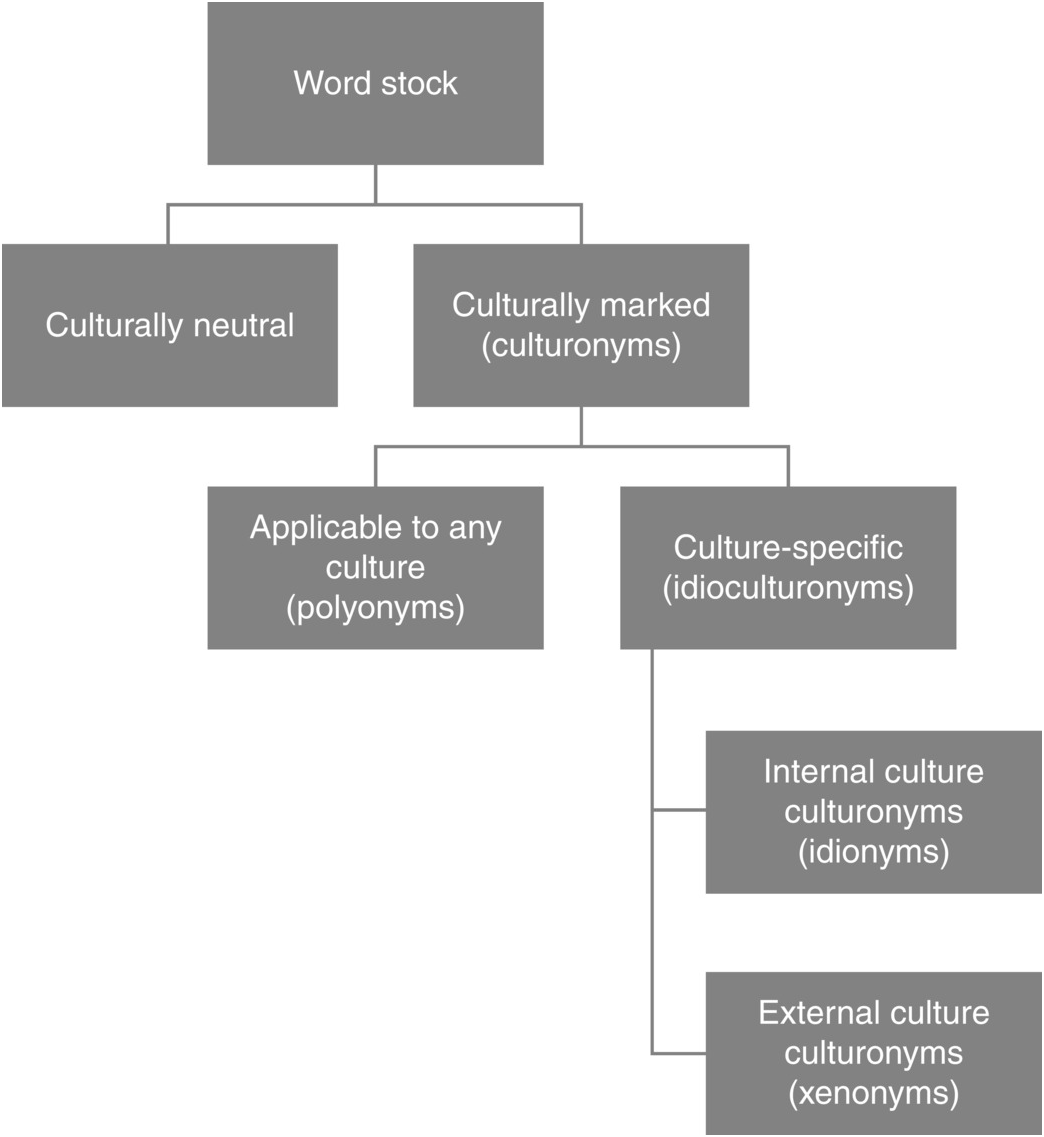
Figure 3.1 Cultural classification of a language lexis
The process of formation of Russian-Culture-Oriented English would be the process of filling out the gaps with Russian xenonyms, for which English has no ready terms.
For centuries first philosophers, then linguists were searching for an “alphabet of human thoughts” (Leibniz 1903, cited through Wierzbicka Reference Wierzbicka1992a), which came to be identified with “semantic primitives” and “lexical universals” (Wierzbicka Reference 301Wierzbicka, Dirven and Pütz1992b). The task of compiling this alphabet is a daunting one, for it requires an extensive cross-linguistic research, but, to our mind, it is also a vain task. The reason is that there is a concept behind each word, not just its meaning. And concepts are culturally specific, of which the ongoing cognitive research yields more and more proofs (Goleva Reference Goleva2006; Kalugina Reference Kalugina2006; Abayeva Reference Abayeva2007).
Thus in the sentence (4) “It is early Sunday morning, and I am looking through my Moscow window at the street below” (Davidow Reference Davidow1980: 7) the words ‘Sunday,’ ‘morning,’ ‘window,’ and ‘street’ are polyonyms. Without polyonyms any attempt to describe an external culture would be either impossible or very difficult. However, it is necessary to remember that most polyonyms are but approximate equivalents. ‘Sunday’ in a Muslim country differs from ‘Sunday’ in a Christian country; the meaning of the polyonyms ‘morning’ and ‘window’ depends on the climate of the country described. Streets in Russia differ from streets in the UK with their left-side movement.
Similar considerations bring Svetlana Ter-Minasova to the idea of ‘language as a mirror of culture’; and the more distant are the cultures, the greater is the discrepancy between the concepts behind the correlated words (Ter-Minasova Reference Ter-Minasova2000: 55).
An interesting case of non-equivalence of thus wrongly equated words was highlighted by Kevin McCaughey, who qualified the situation with such pseudo-equivalents as the ‘kasha syndrome’: “Kasha is translated in virtually every textbook as ‘porridge.’ So porridge is the word used by today’s English speakers when referring to a particular Russian dish that has little to do with the English/Scottish breakfast food” (McCaughey Reference McCaughey2005: 457).
Lesley Chamberlain (Reference Chamberlain1988) is unanimous with McCaughey:
(5) The English word ‘porridge’ is no good for translating kasha. It deters those who do not share my early morning tastes and suggests sticky mush, whereas kasha covers almost all ways of cooking all grains in water, milk, stock and cream to a variety of consistencies ranging from dry (like rice) to set (like Italian polenta) to a thick purée.
The Italian risotto, Spanish paella, and Russian plov might appear very similar in terms of ingredients, yet, they are very different as resulting dishes. Thus when facing the task of describing an external culture one inevitably faces the problem of finding lexical means to do it. And this is a process that could be most efficiently presented in terms of translation, as the notion of translation is very useful whenever one deals with the problem of meaning (Jakobson Reference Jakobson and Jakobson1996: 164).
Internal Translation and Its Techniques
When orienting English toward Russian culture one cannot but employ a strategy akin to translation, that is, supplying the “equivalent of the source language message, first in terms of meaning and secondly in terms of style” (Nida and Taber Reference Nida and Taber1969: 12). The difference is that those are not the ‘closest natural equivalents,’ for there are none, as we have shown earlier. They are either not closest, being more or less culturally bound, or not natural, but rather artificially created by the speaker. This particular kind of translation can be termed ‘internal translation,’ as it takes place within one author, one text, there being no translator as such. The fact that the translator is the author and the translation is an integral part of the process of generating an authentic text results in the major peculiarity of the internal variety of translation – the communicative carte blanche, not being restricted by the pre-existing text and pre-existing author. So the internal translator has greater freedom to choose from basically the same set of possible translation solutions to the problem identified in translation studies as ‘equivalent-lacking words.’ Those solutions are as follows:
1. Transliterated borrowing. This is the most common technique of internal translation of xenonyms, even despite the problem of no single transliteration standard (see Kabakchi and Yuzefovich Reference Kabakchi and Yuzephovich2007): e.g. (6) Kulebyaka is the Tsar of Russian pies (Craig and Novgorodsev Reference Craig and Novgorodsev1990: 42).
2. Calqued borrowing, or loan translation applicable to formally complex elements – words, clichés, idioms: (7) The Russians have a ditty that runs, ‘Without a document, you’re an insect; but with a document, you’re a human being’ (Smith H. Reference Smith1976: 327).
3. Semantic calque, i.e., the modification of the target language word’s meaning under the influence of the meaning of the source language word, (8) the Hermitage serving as an example.
4. Semi-calque or hybrid translation, as in (9) Matryoshka-doll, Bolshoy-theatre.
5. Transplanting the original word in its original graphical form. Until very recently this technique was employed only by slavists in scholarly texts: (10) P. E. Ščeglov develops a different interpretation in Дуэль и смерть Пушкина in his analysis of the famous anonymous пасквильFootnote 8 (Slavic and East European Journal 1993: 481). Very seldom might it be employed for stylistic purposes, but to the degree limited by the few formal correlations between the Latin and Cyrillic alphabets: (11) an enormous illuminated sign reads: MOCKBA (Cusack Reference Cusack1964: 2). Transplanting is restricted in its use as most of the potential English-speaking audience will not be even able to read the Cyrillic script.
6. Explicatory translation implies substitution of a xenonym by its explanatory definition and is mostly fit for reference literature. Yet, even there this technique is almost never used in isolation, but is a part of a complex strategy: (12) The Five, also called The Russian Five, or the Mighty Five, Russian Moguchaya Kuchka (‘Mighty Group’), group of five composers who, in about 1875, united in their efforts to create a truly national school of Russian music: César Cui … (Encyclopaedia Britannica 2001).
7. Lexical substitution by some contextual analogues, which can be either polyonyms (kulebyaka → pie) more general in meaning or closest idioculturonyms (buterbrod → sandwich).
Yet, the freedom of choice of the exact technique in dealing with xenonyms in internal translation is far from absolute and unrestrained. There are certain norms, or factors restricting it.
Norms Determining the Choice of Internal Translation Technique
It can be noticed that the techniques listed above vary in what can be termed naming precision and xenonymic convertibility. Thus transplanted xenonyms will be characterized by absolute convertibility when they allow for no doubts as to the idionym being the prototype of the xenonym in question.
Transliterated xenonyms allow for reliable convertibility, as there might remain some uncertainty as to the exact form of the idionym, yet the variability is usually not too confusing.
Calqued xenonyms can be described as unautonomous in terms of convertibility, as they require additional explication to narrow the scope of potential idionyms. Thus in the following example even an expert might need the hint of ‘Ivan Grozny’ to identify ‘the Chosen Council’ as Izbrannaya Rada: (13) In this task the tsar was assisted by a group of able advisers known as the Chosen Council (Brown et al. Reference Brown, Fennell and Kaser1982: 79).
As to explications and substitutes, they will be quite unreliable in terms of convertibility.
We can presume that the author employing internal translation should strive to provide for at least reliable convertibility. This does not necessarily mean that the freedom of choice turns out to be reduced to transliteration/transplantation, while the other techniques are under a ban. But it does mean that with all other factors equal, precision and convertibility are to be the priority.
Factors Determining the Choice of Internal Translation Technique
First of all when introducing a xenonym into an English text one needs to take into account the xenonym status in the host language and its communicative availability. There are basic xenonyms already part of the English language word-stock, legitimate members registered in general purpose dictionaries; they require no explanation: (14) In the dining-room, where a samovar steamed on the table (Reed Reference Reed1967: 213).
The second category might be called special xenonyms, registered in specialized dictionaries and glossaries and known to specialists in some particular field. Thus if the text is meant for the latter, no additional explication will be needed, while a wider audience may face a difficulty grasping its meaning without further hints. The xenonyms of this type are generally italicized to indicate their peripheral place in the host language and make them more identifiable in the text.
The third category is that of occasional xenonyms, introduced for the needs of a particular communicative situation, unregistered in any dictionaries and known only to those familiar with the culture being described. Here the context is to be very transparent to guide the reader:
(15) Since the place is called Cheburechnaya, I felt obliged to sample their chebureki – thin fried bread with a meat filling as an appetizer. Now, I don’t pretend to be an expert on chebureki, but Cheburechnaya’s chebureki are pretty damn good.
The status of the speaker being the author of the text is also a factor affecting the choice of the internal translation technique. It can be noted that non-native speakers suffering from a kind of linguistic inferiority complex are sometimes subject to hypercorrection in their use of English, that is, they tend to overemphasize the norm. As such speakers do not dare to interfere with the language that is not theirs, they prefer to avoid special and, even more so, occasional xenonyms.
Thus we can compare the different linguistic behavior in respect to xenonyms in the samples shown in Table 3.4.
Table 3.4 Dependence of xynonym use upon the native language of the speaker
| Non-native author | Native author |
|---|---|
| (16) Professor Ludmilla Selezneva graduated with honors from Rostov State University in Rostov-on-Don, Russia, in 1978, where she received her graduate degree in 1979 and her first doctorate in history in 1982. She attained her second doctorate in 1996 from the Rostov State University of the Humanities, in Moscow (Selezneva Reference Selezneva2003: 6). | (17) Postgraduate study can lead to the Candidate of Sciences degree (kandidat nauk), roughly equivalent to a Western Ph.D., or to the higher D.Sc. (doktor nauk) (Brown et al. Reference Brown, Fennell and Kaser1982: 402). |
In the case of the non-native L. Selezneva, we can only guess, guided by our knowledge of the educational system of the time, that the ‘graduate degree’ corresponds to the specialist degree,Footnote 9 the ‘first doctorate’ is the degree of the kandidat nauk, the ‘second doctorate’ being that of doktor nauk. And that the second text is absolutely precise in all xenonymic nominations.
The third criterion is the text genre. Russian-Culture-Oriented English comprises texts of different genres and types: city guides, academic publications, popular travel notes, fiction, etc. Yet, by the communicative goal all texts can be divided into two groups: descriptive and instructive.
The descriptive texts are to be kept transparent and simple, understandability being crucial in the choice of internal translation of xenonyms technique, while instructive texts seek maximal precision in order to be usable for the recipient in an unfamiliar cultural and language environment. The latter case might be illustrated by the following example: (18) You may have a ‘key lady’ (дежурная, diZHURnaya) who sits at a desk on your floor and can provide you with a key (Beyer Reference Beyer2001: 31). The xenonym is introduced in three different modes by means of transplantation, transcription, and contextual analogue. The aim is clearly to make the recipient able to identify the useful vernacular term in both the oral and the written form.
Finally the author of an English-language but Russian-Culture-Oriented text must take care that the text has adequate perception and conceptualization by the addressee. The necessity to take the target audience, or the text recipient, into account is clear from the above classification of xenonyms, which vary in their communicative availability to the reader. Thus most of the special and all occasional xenonyms will require some contextual support to help the reader in their conceptualization, that is, grasping the concept behind the unfamiliar word. Therefore while introducing a xenonym for the first time which is not universally known, it is common to use parallel attachment of various techniques of internal translation. Some of the techniques will function as a convertibility guarantee (the transplanted xenonym in the example above), while some will be there to clarify the meaning (‘key lady’).
The conceptualization of xenonyms might be of little importance though if they are used for the purpose of stylization, they may add ‘couleur locale’: (19) From our table we could see the frosty Prospekt, with Friday night crowds crossing to the new Gastronom food store next door (Morning Star 1968). Or as a means of character building: (20) (of a character of Russian origin) Never earned a kopek in his life (Michener Reference Michener1971: 201).
Thus we can see that cultural differences are a problem to be faced inevitably when using a language in external cultural orientation, as is the case with Russian English. Yet, it is not an unsolvable problem, as used to be presumed by those holding the notion of languages being impenetrable. The very fact of the existence of Russian English is a proof of the opposite. Languages exist in contact and contact is a major factor in their development.

