

The linguistic features described in this chapter are revealed on the mesolectal (and sometimes, though rarely, acrolectal) level of Russian English. Since Russian English is an exonormative variety, the linguistic features manifested here do not imply the standard found in English speech of all Russians. They can be recognized only as performance trends typical of many but not all educated Russian users of English.
4.1 Phonetic Features
The present chapter deals with the accent of English that most Russian speakers are likely to have, that is with pronunciation, which is “the most immediately observable” of all aspects of human language (Thompson Reference Thompson1991: 178). According to Jenkins, “despite the widespread acceptance of the extensive role of English as an international lingua franca and its increasing number of functions in this respect, there is still an almost equally widespread resistance to this lingua franca’s forms” (Jenkins Reference Jenkins, Mauranen and Ranta2009: 10). It is especially true in relation to accents. Received Pronunciation (RP) “is often the only accent presented as a model for production, even if other native speakers’ (NS) accents and occasionally non-native speakers’ (NNS) accents may be presented for receptive training purposes” (Jenkins Reference Jenkins, Mauranen and Ranta2009: 11). Indeed, Inner Circle varieties, namely, British English (RP) and General American English (GA), are both invariably chosen as exonormative standards for teaching the English language sound system at educational institutions of all levels in Russia. However, the phonetic/phonological pattern of the native language cannot but influence the mode in which the sounds of the language being newly acquired by the person are organized in his/her speech and mind. This chapter is concerned with the most likely transformations of the English pronunciation patterns caused by the interaction with the sound system of the Russian language, and observable in Russian-English speech at both segmental and suprasegmental levels. Regardless of the attitudes toward this Expanding Circle NNS variety of English, it is crucial to be aware of its de facto specificity in terms of phonetic organization within the context of mutual intelligibility as a primary consideration in intercultural communication. The cases when misperception of phonetic organization of NNS English speech led to comprehension breakdowns and affected the effectiveness of communication are well described in literature (Baldwin Reference Baldwin1988; Jenkins Reference 278Jenkins2000, etc).
The Russian-English speech pattern is viewed as an accent-retaining speech habit that is developed due to the influence of the native language of its speakers. Linguistic typology method, which makes it possible to study the systems of English and Russian comparatively, is employed to establish differences and similarities between the two languages. The revealed differences as well as the similarities of the languages in contact are seen as the reasons for both positive and negative transfer in the situation of language contact.
The first subsection of section 4.1 covers the most commonly altered consonants and vowel sounds of the English language, the second is concerned with the most frequent transformations of the syllable structure, the third subsection deals with accentual and rhythmic structure of the word and the phrase, and, finally, the last part discusses the melodic contours that are most typical in Russian English speech.
Russian-English Consonants and Vowels
Although English and Russian have many similarFootnote 1 consonants, the consonant sound systems of the two languages do not fully overlap.
Consonants
Table 4.1 shows a matrix of English consonants, which simultaneously indicates the presence (+) or absence (-) of the approximating consonant sounds in Russian.
Table 4.1 Consonants in English and Russian
| English | p | b | t | d | k | g | f | v | s | z | θ | ð | ʃ | ʒ | t∫ | dʒ | m | n | ŋ | l | r | w | h | j |
| Russian | + | + | + | + | + | + | + | + | + | + | - | - | + | + | + | - | + | + | - | + | + | - | + | + |
Because Russian lacks five consonant sounds approximating to those of English, indicated in grey in Table 4.1 (which, otherwise, might have served as starting points in forming the new linguistic oppositions), Russians are very likely not to discriminate between the following phonological contrasts in English:
| 1) θ/sFootnote 2 | in such pairs as | ‘thank’ and ‘sank,’ ‘faith’ and ‘face’ |
| 2) θ/f | ‘thaw’ and ‘four,’ ‘thin’ and ‘fin’ | |
| 3) ð/z | ‘clothe’ and ‘close,’ ‘breathe’ and ‘breeze’ | |
| 4) ð/d | ‘then’ and ‘den,’ ‘there’ and ‘dare’ | |
| 5) dʒ/tʃFootnote 3 | ‘batch’ and ‘badge,’ ‘search’ and ‘surge’ | |
| 6) n/ŋ | ‘sin’ and ‘sing,’ ‘ton’ and ‘tongue’ | |
| 7) v/w | ‘vest’ and ‘west,’ ‘veil’ and ‘whale.’ |
It is quite natural for Russian speakers to replace the sounds of English that do not occur in the Russian speech community with the Russian sounds that are more or less similar in terms of their articulatory and acoustic features to the corresponding English ones. Sometimes, more than one sound of the native language can be used to substitute the new English ones. Consequently, a group of three or more words may sound alike in Russian English and perceived alike by the Russian speakers of English; for example, voiceless th can be replaced either by s or f, leading to such words as thought – fought – sought/thin – fin – sin/thaw – four – saw, etc. not contrasted productively and receptively.
Vowels
English and Russian systems of vowel sounds exhibit more differences than those of consonants. First, the number of vowels in English is about three times as big as in Russian (twenty vs six accordingly). Second, vowels in English are subject to greater variation, as there is an opposition of short (e.g. [e, ʌ, æ, ʊ, ɒ, ɪ]) and longFootnote 4 (e.g. [ɜː, ɑ:, uː, ɔː, iː]) vowels, as well as of monophthongs (e.g. [e, ɪ, ɑ:] and diphthongs (e.g. [eɪ, aɪ, aʊ]), to say nothing of various combinatory and positional modifications of vowels in real speech. Besides, the English vowel system possesses one sound, which is a long open-mid central unrounded vowel [ɜː] that has no counterpart in Russian, and, thus, becomes one of the most significant vowel difficulties for Russians. Table 4.2 shows a matrix of English vowels, which simultaneously indicates the presence (+) or absence (-) of the corresponding vowel sounds in Russian.
Table 4.2 Vowels in English and Russian
| English | əFootnote 5 | e | ɜː | æ | ʌ | ɑ: | ʊ | uː | ɒ | ɔː | ɪ | iː | eɪ | aɪ | aʊ | ɔɪ | əʊ | ɪə | eə | ʊə |
| Russian | + | + | - | - | + | + | - | + | - | + | - | + | - | - | - | - | - | - | - | - |
Due to the absence of the sound /ɜː/, the lack of vowel length and openness contrasts, as well as of the monophthong–diphthong opposition in Russian we can expect a failure to distinguish between the following phonological contrasts in Russian English:
| 1) ə/ɪ-e, etc. | in such pairs as | ‘boxers’ and ‘boxes,’ ‘officers’ and ‘offices’ |
| 2) ɜː/e-æ, etc. | ‘germ’ and ‘gem,’ ‘ferns’ and ‘fans’ | |
| 3) ɜː/ɔː | ‘work’ and ‘walk,’ ‘worm’ and ‘warm’ | |
| 4) ɪ/iː | ‘fit’ and ‘feet,’ ‘sin’ and ‘seen’ | |
| 5) ʊ/u: | ‘full’ and ‘fool,’ ‘pull’ and ‘pool’ | |
| 6) ʌ/ ɑ: | ‘come’ and ‘calm,’ ‘hut’ and ‘heart’ | |
| 7) e/æ | ‘pen’ and ‘pan,’ ‘men’ and ‘man’ | |
| 8) e-æ/eɪ | ‘gets’ and ‘gates,’ ‘madden’ and ‘maiden’ | |
| 9) ʌ-ɑ:/aɪ | ‘luck’ and ‘like,’ ‘hard’ and ‘hide’ | |
| 10) ʌ-ɑ:/aʊ | ‘fund’ and ‘found,’ ‘grand’ and ‘ground’ | |
| 11) ɒ-ɔː/ɔɪ | ‘con’ and ‘coin,’ ‘John’ and ‘join’ | |
| 12) ɒ-ɔː/əʊ | ‘not’ and ‘note,’ ‘bought’ and ‘boat’ | |
| 13) ɪ-iː/ɪə | ‘bid’ and ‘beard,’ ‘he’ and ‘here’ | |
| 14) e-æ/eə | ‘dead’ and ‘dared,’ ‘glad’ and ‘glared’ | |
| 15) ʊ-u:/ʊə | ‘pulley’ and ‘poorly,’ ‘two’ and ‘tour’ |
It should be noted that though no diphthongs occur in the phonetic system of the Russian language, the formation of English diphthongs does not usually pose a difficulty for Russian speakers, because a sequence of two vowels or a vowel and a consonant sound /j/ is quite natural within a Russian word; for example, (1) паук/pʌ′uk/‘a spider,’ (2) клеить/′kleit’/‘to stick,’ (3) май/mɑj/‘May,’ (4) улей/′ul’ej/‘a hive.’ A two-vowel sequence in Russian, however, is a combination of two separate segments belonging to two different syllables, while a diphthong in English is treated as a single phonetic and phonemic unit. Thus, mesolectal Russian-English speakers tend not to differentiate such words as, for example, (5) letter/latter – later/ratter – rater, (6) men/man – mane, (7) phon – phone, born – bone, etc.
Another factor that causes difficulty for the Russian learner of English is the existence of numerous rules of combinatory and positional modifications of sounds in Russian that are transferred into English speech, one of the most troublesome being the voice neutralization rule, that is, devoicing the voiced stop-consonants in the word-final position.Footnote 6 For example, the words (8) гриб (‘mushroom’) and грипп (‘flu’) are both pronounced in Russian Nominative singular and Accusative singular as /grip/ forming a homophonic pair. The same is true with the following pairs of words: (9) код (‘code’)/кот (‘cat’) – /kot/; (10) порог (‘threshold’)/порок (‘flaw’) – /pʌ’rok/; (11) столб (‘post’)/столп (‘pillar’) – /stolp/, etc. Since this sound modification occurs regularly in Russian, a Russian speaker of English tends to change the word-final voiced consonants into their voiceless counterparts, thus producing and perceiving no contrasts between such English words as (12) cub – cup, (13) bad – bat, (14) league – leak, (15) knees – niece, (16) buzz – bus, etc.
It is notable that given the likelihood of non-distinction between English open and close vowels (e.g., e/æ), short and longFootnote 7 vowels (e.g., ɪ/iː, ʊ/u:), monophthongs and diphthongs (e.g., e-æ/eə, ɒ-ɔː/əʊ), and other vocalic contrasts in the production and perception of English speech by Russian speakers, word-final consonant devoicing may add up to the formation of such homophonic chains of words as: (17) dead – dad – dared – debt, (18) lick – leak – lig – league, (19) fit – feet – fid – feed, (20) got – goat – God, etc.
To make the description of the segmental features in Russian English fairly complete, a few more of its features must be mentioned. First, Russian speakers tend to roll the /r/-sound in English words the same way they pronounce the approximating sound in their native language (close to Scottish English). Second, the /h/-sound is not as light as produced by native speakers of English because the productive (and thus acoustic) and perceptive characteristics of its counterpart /x/ in Russian are different: its velar fricative features make it sound much harder. Third, all consonants followed by such close vowels as /e/, /ɪ/, /iː/ are very likely to be palatalized by Russian speakers of English, that is, added the soft quality, as there exist regular phonological contrasts between soft and hard consonants in Russian.Footnote 8 As a result, the following pronunciation patterns appear to be characteristic of Russian English: (21) kettle [k’etl], (22) sick [s’ɪk], (23) peal [p’i:l], etc. Finally, since Russian spelling more or less closely correlates with the corresponding sound form of lexical units, Russian speakers of English are very likely to pronounce silent letters in English words; for example, (24) knife [knaɪf], (25) know [knəʊ], (26) debt [debt], (27) bomb [bɒmb], (28) thing [θɪŋg], etc. Graphical form of English words borrowed from Greek, along with an array of other factors like lack of linguistic experience, equivalent sound form of internationalisms in Russian, alternative pronunciation pattern in English and others may affect oral realization of consonant letter sequences, such as -ph- in philosophy (Mesolectal Russian English – [phɪ′lɒsəphɪ]), -ps- in psychology (Mesolectal Russian English – [psɪ′hɒlədʒɪ]), -ch- in chemistry (Mesolectal Russian English – [′tʃemɪstrɪ]), etc.
Russian-English Syllable Structure
Both English and Russian syllables follow four main patterns, particularly V, CV (open, or unchecked) and CVC, VC (close, or checked), with the nucleus being a vowel sound. English has an additional type of syllable, lacking in Russian, whose nucleus can be formed by a sonorant /l/, /n/, or, rarely /m/: (29) pencil [′(pen)-sl], (30) taken [′(teɪ)-kn], (31) bottom [′(bɒt)-m] (Torsuyev Reference Torsuyev1962: 8–9). While four similar types of syllables are identified in both languages, the dominance of this or that type varies in each language. English exhibits the principal use of close (checked) syllables of a CVC (CCVC, or CVCC) type, while open (unchecked) syllables of a CV structure prevail in Russian. Although a CVC (CCVC, or CCCVC) structure is also quite common in Russian, many Russian words of this type, such as masculine Nominative singular nouns, are regularly reorganized into a CV-CV sequence in case the grammatical category of case, number or, rarely, gender changes, by adding an extra vowel sound.
Examples:
Russ. (32)
зал (‘hall’) – masc., Nom., sing., but ′за-лы (‘halls’) – Nom., pl., в ′за-лe (‘in the hall’) – masc., Prepos., sing., (33)
мир (‘world’) – masc., Nom., sing., but ми-′ры (‘worlds’) – Nom., pl., в ′ми-рe (‘in the world’) – masc., Prepos., sing., (34)
раб (‘slave’) – masc., Nom., sing., but ра-′бы (‘slaves’) – masc., Nom., pl., ра-′ба (‘female slave’) – femin., Nom., sing., etc.
On the contrary, in disyllabic and polysyllabic words, English syllable organization is determined by the type of vowel nucleus in the stressed position as there is a tendency for a strong attraction of the consonant to the preceding checked vowel, resulting in the formation of a close stressed syllable. (Note: this phenomenon is also known as nucleus-vowel-length-dependence.Footnote 9) This is not observed if the nucleus vowel under stress is free; in this case, the following consonant becomes the onset of the next unstressed syllable:
Examples:
| Eng. | Checked vowel nucleus cf. | Free vowel nucleus | ||
| (35) | coffee | [′kɒf.ɪ] | corkey | [′kɔː.ki] |
| (36) | litter | [′lɪt.ə] | liter | [′li:.tə] |
| (37) | mother | [′mʌð.ə] | father | [′fɑ:.ðə] |
| (38) | money | [′mʌn.ɪ] | mooner | [′mu:.nə] |
This syllable organization trend for nucleus vowel quality dependence is naturally preserved in normative English speech. However, Russian speakers of English tend to resyllabify the syllables of the CVC type into the most typical Russian CV syllable structure, thus turning the words of, for example, CVC-V type into a CV-CV structure, CVC-VC into CV-CVC, etc.
Examples:
| English | Russian English | cf. Russian | ||
| (39) | coffee | [′kɒf.ɪ] | [′kɒ.fɪ] | ′ко – фе |
| (40) | coming | [′kʌm.ɪŋ] | [′kʌ.mɪŋ] | ′ка – мень |
| (41) | getting | [′get.ɪŋ] | [′ge.tɪŋ] | ′ге – те – ро- |
| (42) | mother | [′mʌð.ə] | [′mʌFootnote 10.ðə] | ′ма – ма |
| (43) | money | [′mʌn.ɪ] | [′mʌ.nɪ] | ′Ма – ня |
Similarly, in case a close syllable in a disyllabic English word is followed by a syllable formed by a sonorant consonant nucleus (CVC-S), which is a unique English syllable feature, a syllable division peculiar to Russian English leads to the structural transformation of both syllables (CV-CVS).
Examples:
| English | Russian English | cf. Russian | |
| (44) bottle | [′bɒt.l] | [′bɒ.təl] | бу-′тыль |
| (45) medal | [′med.l] | [′me.dəl] | ме – ′даль |
| (46) pedal | [′ped.l] | [′pe.dəl] | пе – ′даль |
Since such resyllabification continually occurs in the Russian-English speech even if the speaker is an acrolect user of English, it can be considered one of the most salient characteristics of the Russian English accent in terms of syllabic organization.
It is also worth mentioning that both English and Russian allow complex syllable onsets containing up to three consonants in English (e.g., spring, straw, scratch), and up to four consonants in Russian (e.g., спрут, строй-ка, скраб, всплеск, вскрик), and codas with up to four consonants in both languages (e.g., Eng. acts /kts/, masked /skt/, sixths /ksθs/; Russ. cредств /tstv/; царств /rstv/). That is why English consonant clusters are not troublesome for Russian speakers of English (as they are for most Asians) with the exception of a few coda sequences which contain consonants that do not occur in Russian; for example, ninth(s) /nθ(s)/, twelfth(s) /lfθ(s)/, clothes /ðz/, springs/ŋz/, etc. In this case, Russians can resort to a number of articulatory simplification methods, including substitution of uncommon sounds into most similar analogues available in their native language (/θ/>/s/, /ð/>/z/, /ŋ/>/n/), addition of an extra vowel sound between the consonants clothes /-ðiz/, or omission of one or more consonants ninths /ns/, twelfth(s) /l(f)s/, clothes /(ð)z/, etc. Following Jenkins,Footnote 11 we can admit that none of the above-described transformations can severely affect intelligibility.
Stress and Rhythm in Russian English
Stress patterns in both Russian and English are considered to be extremely variable and unlikely to be predicted easily. However, the Russian word stress pattern is much more mobile than English, due to multiple modifications of the word structure required to represent such grammatical categories as declension, number, person, etc., which are characteristic of any synthetic type language. Thus, the prediction of stress location in Russian words seems reasonably difficult, with stress placement prognosis in their derivatives being the hardest.Footnote 12 For example: (47) ′стол (‘table’ – n.) – сто′ловый (‘table’ – adj.) – на′стольный (‘table’ – adj.) – столо′ваться (‘to board’ – v.); (48) голо′ва (‘head’ – n.) – подго′ловник (‘headrest’ – n.) – голов′ной (‘leading’ – adj.), etc.
As there are quite a few regulations applicable for stress placement in English, which only adds to the complexity that a Russian speaker of English faces acquiring the accentual variability of the target language, mesolectal Russian English stress pattern turns out to be free, variable, and, thus, irregular (Table 4.3). Russians often shift stress within a word, which results in not following the English stress placement rules.
Table 4.3 Shift of stress in mesolectal Russian English
| English | Russian English | |
|---|---|---|
| Shifting stress from the 1st to the 2nd syllable |
|
|
| Shifting stress from the 2nd to the 1st syllable |
|
|
| Shifting stress from the 1st or 2nd syllable to the final syllable |
|
|
It is notable that despite the fact that the Russian language uses, though quite moderately, the phonological function of stress to contrast homographs,Footnote 13 many Russian speakers of English do not employ prosodic means to distinguish numerous pairs of English words (usually nouns and verbs) that are not contrasted otherwise.
Examples:
| English | Russian English | |
| Preserving stress on the 1st syllable | ′import but to im′port | ′import, to ′import |
| ′object but to ob′ject | ′object, to ′object | |
| ′process but to pro′cess | ′process, to ′process | |
| ′project but to pro′ject | ′project, to ′project |
Similar to the above-mentioned cases of not using the phonological function of stress, we may indicate frequent examples of non-distinction between word combinations and compound words in mesolectal Russian English. English compound nouns pose a difficulty for Russians, as in the Russian language the second component of the noun bears a primary stress while in English it is normally the first one that is stressed with a primary stress, which acoustically distinguishes the compound noun from a free word combination in which the second noun is more prominent.
Examples:
| English | Russian English | |
| Preserving stress on both components of the compound | ′blackbird | ′black’bird |
| ′blackboard | ′black’board | |
| ′greenhouse | ′green’house | |
| ′paperbag | ′paper’bag |
As mentioned earlier in this chapter, Russian derivatives are characterized by variable stress placement patterns, but no such accentual variety can be observed in the pronunciation of English-related words by mesolectal Russian-English speakers.
Examples:
| English | Russian English | |
| Preserving stress on the same syllable | ′analogue | ′analogue |
| a′nalogy | ′analogy | |
| ̩ana′logical | ′analogical | |
| e′conomy | e′conomy | |
| ̩eco′nomical | e′conomical | |
| ̩eco′nomics | e′conomics |
With regard to the phenomenon of accentuation within a phrase, Russian and English exhibit theoretical similarities since both languages are stress-timed and tend to accentuate content words. Nevertheless, the rhythmic models in the two languages are obviously distinctive. English rhythm seems to be more isochronous, which demands placing stresses upon particular syllables within a syntagma (or a phrase) at regular intervals, and, thus, causes both quantitative and qualitative reduction of the sounds in the chain of unstressed syllables between them. Therefore, Russian learners often give excessive prominence to English words (for the most part – auxiliary, or function words) that English native speakers are likely to reduce considerably; for example, his, her, have, will, should, as, is, can.
Examples:
| English | Russian English | |
| (49) | She is as SLY as a FOX. | SHE IS AS SLY AS a FOX. |
| (50) | How is his ENGlish? | HOW IS HIS ENGLish? |
| (51) | Her SISter ALso has a CAR. | HER SISter ALso HAS a CAR. |
| (52) | You should have TOLD me THIS. | YOU SHOULD HAVE TOLD ME THIS. |
Intonation in Russian English
Both English and Russian are considered to be intonation languages,Footnote 14 which implies that intonation plays an important role in conveying the meaning in these languages. Intonation performs the same basic functions in both languages, among which are the functions of unifying words into sentences, distinguishing communicative types of sentences, and serving as the means of expressing emotions. At the same time, there exist a number of differences in Russian and English intonation patterns (Bratus Reference Bratus1972; Wells Reference Wells2006; Vasilyev et al. Reference Vasilyev, Lukina, Vereninova and Katanskaya2009; Marren Reference Marren2011). While English has four basic types of intonation – the falling intonation, the rising intonation, the falling–rising intonation, and the rising–falling intonation – the speakers of Russian employ seven main intonation contours, each of them being either rising, falling, or a combination of rising and falling tones, with the falling–rising intonation pattern being an exception (Vasilyev et al. Reference Vasilyev, Lukina, Vereninova and Katanskaya2009). Although the approximating intonation patterns, some of which perform quite similar functions, can be observed in both languages,Footnote 15 the Russian melodic contours are more varied and sound more dramatic and abrupt. Moreover, the most common gradual descending stepping scale in English requires the first stressed word to be pronounced the highest in pitch, while in Russian sentences there is no such constraint. Finally, the rising tone in English typically starts at the lowest point of the pitch range and is sustained on the unstressed syllables following the nucleus; in Russian, the starting point of the rise is usually much higher and unstressed syllables are never marked higher in pitch. As Visson (Reference Visson2013: 108) observes, the sharply rising pitch of Russian English makes the impression of great surprise, questioning the veracity of an assertion or giving orders.
All these and other differences in the prosodic (suprasegmental) systems of the languages in contact result in Russian learners not observing the standard intonation patterns in English and habitually transforming them into Russian-like contours. Russian speakers of English are very likely to follow the broken (not gradually descending) scale and to ask yes/no questions with falling instead of rising intonation, which may sound impolite to English native speakers. This tendency to change a rising contour into a falling one is generally characteristic of Russian English as a whole, which makes Russian-English speakers sound rude to the English-native speaker’s ear (Figure 4.1).
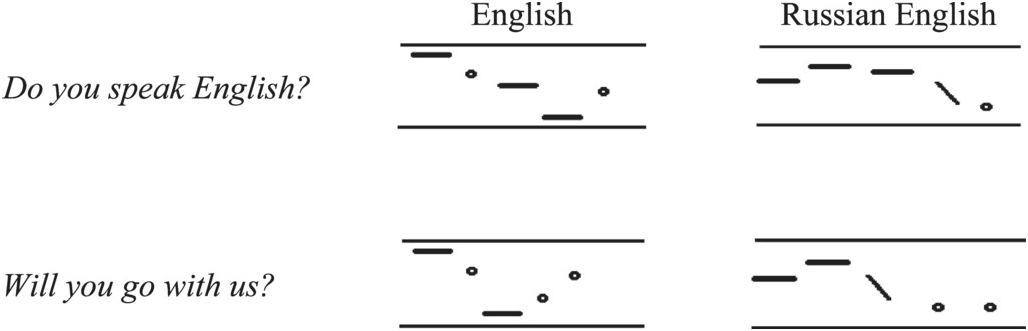
Figure 4.1 Intonation scales in English and Russian English
In conclusion, it might be asserted that although Russian accent in English can be observed at all phonetic levels (i.e., segmental and suprasegemental – syllabic, prosodic, including accentual, rhythmical, and intonational), it is primarily the intonation that gives the Russian speaker of English away because, as Cruz-Ferreira (Reference Cruz-Ferreira1989: 24) puts it, “intonation is still the last ‘stronghold’ of a foreign accent in speaking any L2,” which is true “even of speakers who otherwise have perfect or near-perfect command of the phonetics of the L2.”
4.2 Orthographic and Punctuation Features
Transliteration and Alphabet
Russian and English use different alphabets. Transliteration of Cyrillic words by Roman (Latin) letters can be problematic for several reasons: a) the number of letters in the alphabets is different – twenty-six letters in English and thirty-three in Russian; b) the phonetic correspondences of the letters in English and Russian are different – there are ten vowel letters representing six phonemes, twenty-one consonant letters representing thirty-five phonemes, and two letters which do not designate any sound in Russian while the English alphabet has six vowel letters to represent twenty (twenty-one) vowel phonemes and twenty consonant letters to represent twenty-four consonant phonemes; c) rivalry between transliteration and transcription as translation techniques in rendering Russian names in English (nowadays translators note their evident preference for transcription, that is, they tend to produce a sound form rather than a graphic form of a source text word into a target language – for example, the Russian name Егор is rendered as Yegor rather than Egor, sound by sound rather than letter by letterFootnote 16); d) there is no universal standard for transliteration – different standards are used in Russia and abroad, and even within Russia several standards can be found. The most well-known standards used outside Russia are as follows:
The scientific/scholarly/academic/linguistic transliteration system based on Croatian and earlier Czech alphabets and used in linguistic publications. It was codified in the 1898 Prussian Instructions for libraries. The scientific transliteration system is phonemic and tries to preserve the pronunciation as much as possible. It was later used for the ISO, the International Standard of transliteration. In this system the Russian ё is represented as ё, ж = ž, й = j, x = x, ц = с, ч = č, ш = š, щ = šč, ю = ju, я = ja.
The ISO, the adoption of the scientific transliteration, was developed by the International Organization for Standardization (1947). The current standard of 1995 is based on one-character-for-one-character equivalents (the most difficult Russian-English correspondences are presented in the following way: ё = ё, й = j, х = ch, ц = c, ю = ju, я = ja) and the use of diacritics (ж = ž, ч = č, ш = š, щ = šč).
The United Nations romanization system (1987 latest version) is used for geographical names. It can be found in the Fifth United Nations Conference on the Standardization of Geographical Names, Montreal, 18–31 August 1987, Vol. I. It uses correspondences similar to ISO (ё = ё, ж = ž, й = j, ц = с, ч = č, ш = š, щ = šč, ю = ju, я = ja) but for the special case of х = h.
The American Library Association and Library of Congress (ALA-LC) romanization used since 1975 and updated in 1997. It applies diacritics (ё = ё, й = ĭ) and two-letter combinations (ж = zh, х = kh, ц = ts, ч = ch, ш = sh, щ = shch, ю = iu, я = ia).
The British Standard, the main system of the Oxford University Press and the British Library, which used it for cataloguing publications acquired up to 1975 but later shifted to the Library of Congress system. In this system, the problematic correspondences are as follows: ё = ё, ж = zh, й = ĭ, х = kh, ц = ts, ч = ch, ш = sh, щ = shch, ы = ȳ /ui, ю = yu, я = ya. The endings -й, -ий, -ый may be simplified to -y.
The United States Board of Geographic Name and the Permanent Committee on Geographical Names for British Official Use (BGN/PCGN) romanization system, adopted in 1944 and 1947, requires no diacritics (е = е/ye, ж = zh, й = y, х = kh, ц = ts, ч = ch, ш = sh, щ = shch, ю = yu, я = ya) with one exclusion: ё = ё/уё. This system of romanization of Russian names is employed by the English-language Wikipedia.
Russia has known several National Standards (GOST), the latest one introduced in 2002 (GOST 7.79–2000) System of Standards on Information, Librarianship, and Publishing – Rules for Transliteration of the Cyrillic Characters Using the Latin Alphabet. In this system the Russian ё corresponds to English yo, ж = zh, й = j, x = h/x, ц = c/cz, ч = ch/č, ш = sh/š, щ = shch/š, ю = yu, я = ya.
Until 2010, transliteration in Russian/Soviet international passports was based on French rules (without diacritics). In 1997, a new English-oriented system was established to be followed by GOST 52535.1–2006 in 2006 and adopted as mandatory for transliterating personal names in passports issued after 2010. The difference between the 1997 and the 2006 systems consists in the following: the Russian letters e and ё are now always transliterated as e (there was alternation between ye and e), й = i (earlier y), ю = iu (earlier yu), я = ia (earlier ya). Other problematic letters are rendered the following way: ж = zh, х = kh, ц = ts, ч = ch, ш = sh, щ = shch, ы = y, the so-called soft and hard signs (ь and ъ) are not rendered in transliteration.
These systems of transliteration are based on the regular letter-to-letter equation, which is sometimes inconvenient in intercultural communication because the resultative pronunciation of proper names may be distorted and the names are not reversable in back translation. This is a case with the letter ё, for example. People whose family name contains this unhappy letter (often substituted by the letter e in Russian writing and, therefore, mispronounced) complain that their names become unrecognizable in foreigners’ pronunciation: Sycheva does not sound like Sychova, which is closer to the Russian original, and many other names with the ё/е (yo/e) alteration.
The two mute signs used in the Russian alphabet are usually not rendered in English. However, in the systems used by international authors and institutions (including GOST), the apostrophe is employed to show a palatalized consonant (Архангельск – Arkhangel’sk). In Russian passports this sign is omitted: Мельников – Melnikov. The hard sign ъ is usually marked by two apostrophes (подъём – pod”yom) except in the latest passport system.
The Russian alphabet has four iotated vowels е, ё, ю, я pronounced with [j] in the beginning of a word or after a vowel, or used to palatalize the preceding consonant. Despite the standards, these letters are transliterated in a number of ways: e = e/ye/ie (Dostoyevsky/Dostoevsky, Nikolaiev/Nikolayev/Nikolaev); ё = e/ye/yo/ie/io/o (Khrushchev, Pecherin/Pechorin/Pechyorin/Pechyerin, Metelkin/Metiolkin/Metielkin; Yelkin/Yolkin); ю = yu/iu/u/iou/you (Yurkov/Iurkov, Ushin/Yushin/Youshin/Ioushin).
The transliteration of the letter щ in English also has some variants, the most recommended by all standards being shch but the most popular one appears to be the simplified variant sch: Schelkovo, Scheglov, etc. Thus, along with recommended standard forms of romanization, English users often have to make the so-called ‘homemade’ forms, and many publishers and editorial boards also tend to have their own house style of rendering loans in English.
This quite brief analysis of the transliteration systems for rendering Russian words in English demonstrates an acute problem of exposing Russian culture to the world. The lack of a single unified standard results in a great number of variants and can hinder successful intercultural communication (Kabakchi and Yuzephovich Reference Kabakchi and Yuzephovich2007). Voices become louder for adopting a rigid system of Russian romanization for intercultural communication (Arutyunov Reference Arutyunov2001). And, most probably this should be a system developed by Russian-English-knowing linguists rather than native speakers of English as is sometimes suggested (Kabakchi and Yuzephovich Reference Kabakchi and Yuzephovich2007: 121). That was the way for developing and adopting romanization in China and South Korea.
The problem of transliterating Russian loans has attracted many Russian researchers, including Nikolay F. Yakovlev (Reference Yakovlev1930), Lev V. Scherba (Reference Scherba1940), Alexander A. Reformatskiy (Reference Reformatskiy1960), Roman O. Jakobson (Reference Jakobson1965), and many others. The first attempt is known to have been taken in 1842 when the publisher K. Kodinsky suggested changing the Cyrillic alphabet for the Roman one in order to simplify Russian spelling (Grigoryeva T. Reference Grigoryeva2009). Another proposal was put forward by the great Russian literary critic of the nineteenth century V. Belinskiy (Reference Belinskiy1955). An official transition from Cyrillic to Latin was proposed after the October revolution. The advantages of the Roman script as compared with the Cyrillics were found in the international character of the script (it was regarded as uniting Russia with the West and the East), smaller number of letters, which made it easier to learn, and printing economy. In 1929, an ad hoc committee for Russian romanization, headed by Prof. N. Yakovlev who worked on developing alphabets for minor ethnic groups that had no writing systems, was established with the People’s Commissariat of Education. The project that proposed three variants of romanization was finished in 1930 and enthusiastically supported by A. Lunacharskiy (Reference Lunacharskiy1930), People’s Commissar of Education at the time, who, however, remembered Lenin’s warning not to be in a hurry. Stalin did not approve of the project and the committee was dismissed. When analyzing the history of the romanization attempts in Russia, today’s linguists argue that the attempt failed not because it was too early to carry out the romanization reform but, quite the other way about, because it was late (Ashnin and Alpatov Reference Ashnin and Alpatov2001). In the end of the 1920s, Stalin no longer contemplated the idea of the world revolution, one of the ways to which might have been through romanization of the writing. Some factors were against the project: the rich writing tradition of Russian culture (it is much easier to change the alphabet for ethnicities with new writing), the psychology of millions of educated Russians who would have to learn reading texts in a new script, and – one of the major factors – change of the state policy and ideology.
At the end of the 1930s, with the crash of the Communist International, Latinized alphabets of the Soviet minorities were changed to Cyrillics (by 1936 there had been sixty-eight Roman alphabets developed for ethnic minorities in Russia). The Baltic republics that joined the USSR in 1940 made an exception. They were allowed to retain the Roman alphabet.
The collapse of the USSR pushed a new change of the alphabets – this time some former Soviet republics (Moldavia, Azerbaijan, Uzbekistan, and Turkmenia) selected Latin scripts. There were also attempts in Chechnya to introduce the romanized alphabet as a means to separate from Russia and to get political independence. In 1999, the Republic of Tatarstan passed the law ‘On restoring the Tatar alphabet based on the Latin script,’ which caused a great controversy and dispute in Russia. In Tatarstan, the Latin script was used for teaching the Tatar language in elementary schools. Streets were supplied with Latinized signs (Alpatov Reference Alpatov2005). However, since this law was regarded as a pretext for further destruction of the country, the Russian Federation Constitutional Court suspended the law in 2004.
Though today Russian graphics based on the Cyrillic script is adopted by the law on the state language in the Russian Federation, we can witness an enormous increase in using English letters, names, and even sentences in the Russian linguistic landscape – in advertising, business, mass media, popular culture, and the Internet (see Chapters 3, 6, 8, 9, 10, 11, 12).
Punctuation
English and Russian punctuations are based on different principles in both languages and Russian users of English not infrequently transfer the principles of Russian punctuation onto English writing. In Russian, punctuation is structurally dependent, which means that specific structures (such as parallel parts of the sentence, participial phrases, subordinate clauses) are singled out in the sentence. Russian punctuation is regulated by syntactic rules – for many Russian schoolchildren syntax is associated with punctuation. English punctuation is logically and communicatively bound. It depends much more on semantics and intonation; therefore, Russian-English bilinguals consider it to be more subjective. A comma normally separates optional information segments and rhythmic groups, which may look strange to a Russian user of English: (1) Recently, the most popular approach to the language study is cognitive… (AREC6)Footnote 17 (2) Also, we have used the definition analysis of the words of two varieties of English… (AREC9). Most often Russians do not use a comma after an adverbial phrase in the beginning of a sentence: (3) Before talking about the song the teacher may want his/her students to think about the topic, to express their personal attitude toward it (AREC4).
Russian users of English are apt to put commas to mark a subordinate clause not only in the initial position but also at the end of the sentence: (4) Since the goal of ESP teaching/learning is developing learners’ communicative competence, the communicative approach to teaching/learning English, might work best, if integrated with successful techniques and activities, developed in various teaching methods (AREC1). In Russian-English writings, commas can be encountered even before the conjunction that because it introduces an object clause (in Russian, every clause is to be separated from another one with a comma): (5) Everyone knows, that translators are social beings and depend on their social connections with other human beings (AREC2). Relative (attributive) clauses, either descriptive or restrictive, are not excepted: (6) Other exercises, that might be used, are: gap-filling… (AREC1). (7) Teachers, who apply learner-centered technologies, engage learners in activities, which meet their needs and interests, promote their personal growth (AREC1).
Since marking a clause by a comma is obligatory in Russian punctuation, Russians tend to put a comma in a compound sentence, this way delineating two parallel clauses with or without a conjunction: (8) As for speaking and writing in classic languages, this is perceived as an unessential skill, and correct pronunciation and spelling appear to be optional aspects (AREC5).
It is also quite typical for Russian writers to place a comma between a noun and a participial phrase modifying this noun: (9) I would like to consider some of the teaching technologies, approaches and methods from a rich heritage, accumulated by pedagogy in Russia and overseas (AREC1).
However, Russian users of English do not usually use a comma to mark the last of the parallel parts of the sentence introduced by the conjunction and: (10) The phonetics, lexicon and grammar of classic languages allow to analyse genesis of the modern languages at all levels, to see relationship between these languages (AREC5). However, the comma is quite expected before the conjunction but: (11) The term Ebonics, which is commonly used by a number of scholars as a synonym of the above mentioned labels, was coined by Robert Williams in 1973, but received considerable attention in 1996 during the Oakland case (AREC8).
Syntax of the sentence and usage of conjunctions is another feature that highlights Russian identity of an English writer. In a formal and especially narrative style, Russians tend to use a cluster of asyndetic clauses in one sentence, which becomes very long: (12) L. Vygotsky’s theory of the ‘zone of proximate development’ was implemented in developing strategies of teaching, a learner acquires skills with a teacher’s support, the more successfully a learner acquires skills, the less support a teacher provides (AREC1).
Neither may a conjunction be used before the last of a group of parallel parts of the sentence: (13) Modern science, art, everyday human life reproduce achievements of the corresponding spheres of the ancient culture, such as theatre, philosophy, political system, sports, museums (AREC5).
Among other features specific to Russian English, the abundant usage of the exclamation mark can be noted, especially in informal writing (see Chapter 3). It is not infrequent that Russians use the exclamation mark after addressing a person (Dear Barbara!) and when expressing their emotions (in this case even three marks can be put in line: It was gorgeous!!!). This does not testify to a very emotional type of Russian character – this happens because of the influence of Russian punctuation.
These are the most typical mesolectal features of Russian English. In the field of punctuation, they are primarily based on the influence of the structural principle typical of Russian. In the field of orthography, we can speak of any lectal representation of Russian English. The main issue here is lack of a unified standard for transliterating Cyrillic words of Russian origin into English and as a result of this, a great number of spelling variants for writing Russian culture-loaded common words and proper names in English.
4.3 Grammatical Features
The statement that grammar structure is invariable in the conditions of a language contact has been dominant among linguists for quite a long time. Indeed, it is well known that grammar, unlike lexis is a tight system of meanings and forms with a hierarchy of classes, subclasses, and levels and, therefore, much more resistant to outer influence. Yet, the leading American experts in the field of contact linguistics claim that practically any part of a language system can be borrowed and changed, including grammar (Thomason and Kаufman Reference Thomason and Kaufman1988: 387). Grammar changes are revealed in transfer of morphemes, word order, and grammar meanings though they fully differ from those in lexis and phonology. Grammar deviations become noticeable in a long-lasting process, based on written language and formed under strong cultural pressure.
The idea that English grammar is a set of indestructible rules prevailed in Soviet and then in Russian linguistics for many decades. The only compromise could be made for lexical and few grammatical changes in American English though not infrequently regarded as ‘a spoilt English.’ The Russian educational system has always been very careful about grammar. Therefore, very often Russians’ speech in English is characterized by hypercorrect, that is, very formal grammar, with full forms, lack of elision and assimilation (I am going to do it rather than I gonna do it; I want to go there rather than I wanna go there; He would have done that rather than He’d of done that). In having an option to choose between two codified variants of one and the same form (e.g., the data are and the data is) an educated Russian will choose the more traditional plural variant: (1) These data hint at the existence of some other kinds of gestalts in human consciousness (AREC43).
Russian English grammar, as any non-native variety, is formed under the influence of the following factors: 1) standard native variety (mainly British English or American English); 2) universal (learner) strategies of L2 acquisition; 3) degree of proficiency in the target language; 4) native language transfer (Davydova Reference Davydova2011: 22). However, mesolectal and basilectal English can feature certain characteristics that deviate from the standard and are accounted for by the difference between Russian and English (see Chapter 3), transfer of Russian traces into English, and sometimes asymmetry of English grammar itself. There is one more factor which cannot be passed over or ignored if the object of the research is the Russian variety of English. The deviations on the grammatical level clearly reflect Russian specific mentality and unique (lacuna) aspects of Russian culture (Proshina Reference Proshina2011: 164).
It should be noted here that different sources provide various lists of specific features in learners’ speech, often termed mistakes, which can be encountered in the speech of Russian learners of English, especially at the basilectal level of language competence (Monk and Burak Reference Monk, Burak, Swan and Smith2001; Savitsky and Kurovskaya Reference Savitsky and Kurovskaya2004). Our research and description is based primarily on the mesolectal written speech of Russian teachers of English; therefore, our description does not repeat the work done by our predecessors who mostly took the approach of analyzing typical errors. We are going to discuss typical morphological and syntactical features of mesolectal Russian English.
Verb
–S Inflexion Omission
The third reason mentioned above (i.e., asymmetry of English grammar itself) for Russian-English specifics can be demonstrated in the loss of the suffix –s in the Present Simple verbs. The analytical character of English interferes with the usage of its synthetical verb form of the third person singular (sits, does, goes), which might be one of the reasons for the suffix omission (considered as a “typological oddity” (Trudgill Reference Trudgill2002: 98) or “superfluous” and “communicatively redundant” (Breiteneder Reference Breiteneder2009: 72, 118) form) even by Russians whose native language is synthetical. It might be natural to expect that for Russians, who are accustomed to a great number of endings that make up synthetical forms in their native language, this English form should not be difficult to master. However, it is one of the problems for Russian users of English who sometimes omit –s because this form is so much of a relic for analytical English: (2) May be it was that situation that influence the fact that the word democracy appear only in the inaugurate speech of the sixth president John Q. Adams (AREC27). A similar feature is noted in a number of varieties of the Outer and Expanding Circles and is characterized as “the 3rd person zero” typical of ELF (Cogo and Dewey Reference Cogo and Dewey2012: 82–83). It is accounted for by “regularization processes” (Droschel Reference Droschel2011: 218).
Tense and Aspect Forms
As was mentioned in Chapter 3, Russian and English aspect and tense forms are not parallel and do not coincide in their meanings. As a matter of fact, English Simple (Indefinite) tense forms are able to express all aspective meanings (completeness/incompleteness and duration), which makes it possible for English users to employ this form in a neutral and universal way, substituting it for the Perfect and sometimes Progressive (Continuous) forms.
Russian speakers tend to substitute the Progressive form of the verb for the Simple tense because a present-time verb in Russian does not discriminate between the meanings of “moment of an action in progress/temporary action” and “repeated/permanent action”: (3) The world changes. < The world is changing. Prices become higher. < Prices are rising (Savitsky and Kurovskaya Reference Savitsky and Kurovskaya2004: 35–36).
At the same time, Russian users are apt to substitute the Past Simple forms for the Past Continuous tense to express a completed duration period in the past: (4) I was living in America for two weeks instead of I lived in America for two weeks. The research on indigenized Russian English of English teachers and university students shows that the use of the Continuous tense in Russian English is four times as much as in standard British or American Englishes. The overgeneralization of the progressive aspect to habitual events and situations is also mentioned: (5) And every day I am sitting in the Internet for thirty minutes (Davydova Reference Davydova2011: 28).
The use of the Perfect forms can also deviate from Standard English. In her in-depth analysis of the use of the Present Perfect in non-native varieties of English, Julia Davydova revealed that of the four main meanings of this tense –resultative perfect, experiential perfect, the perfect of recent past, and extended-now perfect – Russians tend to use the Past Simple for the first three meanings:
(6)
I alone ate this pizza – resultative meaning; I was in Moscow twice – experiential meaning; We recently were on sea – meaning of recent past,
and the Present Simple or Continuous for the extended-now perfect:
(7)
I’m studying English for six years (Davydova Reference Davydova2011: 55, 260–263).
Indeed, the absence of the category of perfect in Russian makes it difficult to discriminate between such sentences: I know her – I have known her for long. In the Russian language they are rendered by the same form of the verb in the Present tense. The second sentence in Russian English is most likely to be: I know her for long.
Similar sentences express the extended-now perfect in Russian English: (8) We are friends for two years. (9) They are in Moscow since Friday. (10) I study English for a year.
To transfer their native form, Russian speakers employ such a non-native learner strategy as simplification, using less complex forms that are more natural for them. The “perfect-avoidance” (Trudgill and Hanna Reference Trudgill and Hannah1994: 107) is typical nowadays of many varieties, including American English, and Scottish and Irish Englishes (Hickey Reference Hickey2012). However, its non-usage is usually compensated by the Past Simple whereas in Russian English, as in some European varieties (Droschel Reference Droschel2011: 234), it can be substituted by the Present. Both Past and Present Simple substitutions of the Perfect are believed to be “a tendency to simplify the tense-aspect system” (Droschel Reference Droschel2011: 237) used as a lingua franca.
According to the observations by Daniel Altshuler, the Russian past perfective is a hybrid between the English “simple past” and the English “result perfect” – it is similar to the English “simple past” in that “it triggers a narrative progression” and to the English “result perfect” in requiring an event’s consequence to hold and be “especially significant” at some salient time interval (Altshuler Reference Altshuler, Atle and Marijanović2010: 75–108). This explains the usage of the Past Simple instead of the normative Perfect. Sometimes Russians tend to substitute an adverbial introduced by since, indicating the starting point for the action continuing until now: (11) Beginning from 1976 the magazine was stabilized as 48-page quarterly, and has remained so to the present time (AREC21).
When using the Perfect tense, Russians tend to overuse the adverb already whose equivalent is employed in Russian to emphasize completeness of the action: (12) I have already had lunch. In Russian English, this adverb can be encountered even with a nominal predicate: (13) My son is already five years old (Savitsky and Kurovskaya Reference Savitsky and Kurovskaya2004: 40).
The Sequence of Tenses
Russification of the past tenses in English can be explained by the absence of relative tenses in Russian as was observed in Chapter 3. That is why such relative tenses as the Past Perfect or Future in the Past are so difficult to acquire and to produce, especially in the stream of speech. Copying the native pattern, a Russian speaker produces the following sentences, correlating to those in Standard English.
(14)
SE: He said he went to school. RE: He said he goes to school. (15)
SE: He said he had gone to school. RE: He said he went to school. (16)
SE: He said he would go to school. RE: He said he will go to school.
Similarly, the influence of the native language can be evidently seen in the usage of the Future tense in if/when clauses. Russian learners tend to use the future form in all clauses, just as in the Russian language. They do follow the rule, especially in written speech, but even at a high level of proficiency in oral speech they inevitably switch on to their native pattern.
(17)
SE: He said that if/when he had time he would come. RE: He said that if/when he will have time he will come.
Non-finite Forms of the Verb
Speaking of verbals, we should mention, first and foremost, that gerunds do not exist in Russian. Many Russian bilinguals tend to equate the gerund with the verbal noun (e.g. (18) singing ‘penie,’ (19) jogging ‘beg,’ (20) fishing ‘rybalka’), which in Russian cannot have a direct object. Therefore, when using the gerund, Russians are apt to combine it with a prepositional object rather than with a direct (non-prepositional) object: (21) The main achievement for them was improvement and mastering of target language (AREC29).
Modal and Link Verbs
It is not typical for the Russian variety of English to use all the diversity and richness of English modals to express a speaker’s attitude toward reality. Russian speakers commonly use the verbs can, must, have to, should expressing ability, possibility, duty, advice, which have the same equivalents in Russian. The Russian English data say that the most frequent modal verb expressing the meaning of duty is must in comparison with the verbs have to and should in Standard English (Savitsky and Kurovskaya Reference Savitsky and Kurovskaya2004: 82). This is explained by the factors of national history and mentality. A consideration of Russia’s dramatic history full of wars, revolutions, years of authority, power and repressions, and a society not upholding the individual and with few democratic traditions gives us the answer why Russian speakers so often use must (dolzhen) not only in English but also in their mother language.
(22)
SE: I have to go. RE: I must go. (23)
SE: You should do it. RE: You must do it.
Such meanings as doubt, disbelief, certainty/uncertainty, deduction, reproach are most likely to be rendered lexically, with the help of such words as perhaps, probably, evidently, surely, maybe, by all means. Moreover, complex forms of English infinitives, which are not typical for the Russian language, are very difficult to acquire and produce for a Russian speaker.
(24)
SE: She may come. RE: Perhaps she will come. (25)
SE: He must have done it. RE: Evidently he did it. (26)
SE: Can he have done it? RE: Could he really do it? (27)
SE: You might have told it. RE: You might/could tell it.
One more feature of written Russian English is also accounted for by the asymmetry of Standard English. This is the case of the full (uncontracted) negative form of the modal verb can. Since in written speech all the other modal and auxiliary verbs are divided from the negative particle not by a space, Russian users of English tend to write cannot in two words: (28) In contrast to the objective material world, the subjective realm of archetypes can not be adequately understood through quantitative modes of research (AREC18).
The Noun and Its Determiners
One of the problematic issues concerning the use of nouns is the lack of correlation between singularia and pluralia tantum in both languages (see Chapter 3). However, these are the deviations of the basilectal level rather than those of the mesolectal one. On the mesolectal level, the usage of the noun number sometimes deviates from Standard English, for the nouns ending in –s are taken for the plural inflexion: (29) Politics of transfer from collectivist values to individualist ones are morally approved of and positively appraised in this fragment of discourse (AREC13).
Since the Russian language has no articles, Russian English users are apt to omit articles in speech: (30) Old English period is rich in text records, both poetic and prose (AREC12). They also substitute the definite article with the indefinite and vice versa: (31) The most meaningful aspects of culture common to the Germanic tribes in Britain were clustered around the cultural idea of the warband, a term which is commonly used to describe a small group of barbarian warriors or raiders and a leader to whom the warriors were devoted (AREC12); (32) There is also the antithesis between a dream and reality at the heart of the fairy tale (AREC18); (33) Acquiring the language, the individual acquires conceptualization of the world that is typical of their culture (AREC27).
Deviations in the use of pronouns on the level between basilect and mesolect are well described in the chapter ‘Russian Speakers’ in Learner English by Bruce Monk and Alexander Burak (Reference Monk, Burak, Swan and Smith2001). The most salient feature occurs due to the dummy it which frequently substitutes the demonstrative this generalizing the situation: (34) At first, teachers and students had some difficulties in working on the programme as it was a new system of teaching and studying the English language at technical university (AREC38). Knowing that it is often used as a formal subject of the English sentence, Russian-English speakers and writers sometimes overuse the structure with the dummy it: (35) Generally speaking, it was found 12 conceptual features (AREC27). This structure might emerge due to the difference in the Russian and English functional sentence perspectives: as we have mentioned in Chapter 3, a Russian rhematic component is typically at the end of the sentence, while in English it sometimes can be positioned at the beginning of it.
Syntax
Word Order
Modern English is characterized by a fixed order of words. Due to the inflexional character of the Russian language, its word order is flexible. That is why a Russian speaker of English tends to put the words loosely in an utterance where the word order is supposed to be fixed.
Difference in the syntactic structure and functional sentence perspective between the languages results in the abundant use of structures with the introductory there followed by a more specific verb (rather than be): (36) In each society there exist certain rules that prescribe benevolent attitude to others (AREC41). The construction there + verb proves to be an easy way to focus on the rhematic subject of the sentence.
The difference in the functional sentence perspective of Russian and English sentences often results in the word order typical of Russian, with the subject and predicative being in reverse relations: (37) The most interesting for us appeared to become a magic tale because its history goes back to the agricultural period where traces of mythological worship of the sun, earth and water can be found (AREC18).
A topical thematic object in Russian English is often placed at the beginning of the sentence: (38) Mornings we usually spent at the beach (Vapnyar Reference Vapnyar2003: 52).
The influence of Russian word order is found in the nominal structures of a noun and its modifier, which in Russian usually functions as a postpositional apposition, while in Standard English it is more natural to use a prepositional noun modifier. Russian English results in the N + N structure where the first noun is more generic (appositional) and the second is more specific: (39) As yin, yang are loaned words and yin-yang philosophy is very popular in the world, the usage of mythonyms yin-yang helps the understanding of the novels’ texts (AREC23); (40) The owner used the second name of the island Taiwan (AREC39).
It turns out that when speaking or writing in English, Russians give preference to the use of adverbial attributes placing them immediately after the noun they modify instead of positioning them at the beginning or at the end of the sentence: (41) PR in business have some peculiarities.
Complements
The loss of an object after certain verbs is accounted for by Russian syntax and Russian collocations. For example, the Russian verb рассказать (rasskazat’) can be used without an addressee object. Therefore, the corresponding English verb to tell is sometimes used without an object: (42) These examples tell about the close connection between the two concept spheres – LIGHT and BEAUTY (AREC6); (43) The article tells about the rap-war between the two rap camps (AREC28). This finding goes in line with research carried out in EuroEnglish (Cogo and Dewey Reference Cogo and Dewey2012: 84–89)
It is quite common for Russian users of English to omit the formal object it: (44) I don’t like when somebody disturbs me. Cf. Standard English I don’t like it when somebody disturbs me or I don’t like being disturbed (Savitsky and Kurovskaya Reference Savitsky and Kurovskaya2004: 89).
In a formal style, Russian users of English tend to construct very long sentences (the so called ‘Leo Tolstoy’s style’). Asyndetical coordinate clauses are separated by a comma rather than a semicolon: (45) The students of the English department are future teachers and they should not only be able to know how to communicate effectively, they should also learn how to develop the ability to provide good reasoning working with school students in the nearest future and help them pass the National exam in English (AREC34).
Syntactic Complexes
Complex structures with verbals are very common in modern English, but they don’t have an analogy in the Russian language. Instead of complexes with an infinitive, a gerund or participles, which are in fact compressed, simple sentences with ‘hidden’ predication, Russian speakers use subordinate clauses (Ionina Reference Ionina and Vikulova2009: 55).
(46)
SE: I saw him doing that. RE: I saw how he was doing that. (47)
SE: He was seen to do it. RE: They saw how he did it. (48)
SE: I like Tom’s singing. RE: I like how Tom is singing. (49)
SE: The train leaving, we entered the carriage. RE: We entered the carriage because the train was leaving.
Interrogative Sentences
Tags in English disjunctive questions have always been confusing for Russian users, as they should agree with the form of the predicate. In similar Russian sentences, a tag has a form close to English right?, yes?, isn’t it? which is reproduced in Russian English. The same tendency can be observed in modern spoken British English (Britain Reference Britain and Kirkpatrick2010: 52):
(50)
SE: You didn’t mean to do it, did you? RE: You didn’t mean to do it, yes?
The particular syntactic pattern is transferred to English in such sentences as:
(51)
RE: What do you think, he will come? (SE: Do you think he will come?) (52)
RE: How do you think? (SE: What do you think?) (53)
RE: How do you call it? (SE: What do you call it?)
Negation
It is typical for the Russian language to employ a lot of negative forms and meanings including questions. This fact, which is another expression of a national mental factor, finds its reflection in Russian English.
(54)
RE: Don’t you know what’s the time? (R: Vy ne znaete, kotoryi chas?)
The need to render the following type of sentences into English requires extra mental work from the speaker, as the Russian language is not restricted to one negation in a sentence:
(55)
RE: Nobody knows nothing. R: Nikto nichego ne znaet.
Interestingly, the use of two or more negatives in a clause is a frequent feature of not only Expanding Circle World Englishes, but also of many dialects of Great Britain (Britain Reference Britain and Kirkpatrick2010: 44) and the USA (Tottie Reference Tottie2005: 218–219, 224).
The analysis of the most prominent grammatical features of mesolectal Russian English has demonstrated that they were formed mainly by such factors as native language transfer and national peculiarities of the Russian mentality and culture.
4.4 Lexical Features
Lexical features are the most noticeable linguistic elements, yet in the context of Russian English, they have not received much attention. Some studies mention the use of lexical features produced by native speakers of Russian in the context of Slavic languages and culture (Kabakchi Reference Kabakchi2002; Proshina Reference Proshina and Kirkpatrick2010b), the emergence of Eastern European English (Salakhyan Reference Salakhyan2012), and domains of use of English in Russia (Eddy Reference Eddy2007; Gritsenko Reference Gritsenko2014). The data used in this chapter comes from recorded speech segments, Russian online newspapers, and official sites.
Translation
Translation of concepts, collocations, and idiomatic expressions is a frequent occurrence among speakers of Russian English. The frequency of its use depends on the speaker’s mastery of English, the social situation, and the availability of similar concepts in English. While most of the time the use of translation by the speaker occurs naturally without the speaker’s awareness, many instances of translation are employed intentionally with an explanation (see Kabakchi Reference Kabakchi, Arinshtein, Abijeva and Philimonova2000). In the case of the natural occurrence, speakers translate phrases word by word:
(1) Following the news of a bad buckwheat harvest, panic buying of the traditional foodstuff sent prices soaring in a sign that some analysts say is likely linked to economic anxieties, not harvest yields. (Panin Reference 288Panin2014)
In Standard English, the phrase in a sign is used with the preposition of. In Russian in a sign is used as a collocation in a sign of and as a part of a set expression. In the example above it is a direct translation of the Russian set expression in a sign of what.
It is often the case that the Russian verbs with prefixes are translated into English as phrasal verbs. As the example below indicates, the phrasal verb buy out is a direct translation of the Russian raskupayut, with the prefix ras- corresponding to the particle out: (2) Several large retail chains reported that customers were buying out stocks of buckwheat as soon as they appeared on the shelf (Panin Reference 288Panin2014). In the following sentence the phrasal verb beat up corresponds to the Russian verb pobit’, with the prefix po- indicating a completed action, which is expressed by the particle up in English: (3) During the trial, Dmitrichenko claimed he only wanted to have Filin beaten up (Sitdikov Reference 296Sitdikov2014).
While in referring to a country’s president a speaker of Standard English employs the word leader, the head of the country, president or queen if applicable, in the example below the Russian phrase glava strany is loosely translated as the ruler of the country: (4) If the ruler of the country told them not to pay, why would they pay? (Fedosenko Reference Fedosenko2014).
Translation of idiomatic expressions is mostly noticeable in the spoken language; for example, (5) Created more than 20 years ago by Yelena Nemirovskaya and Yury Senokosov, the MSCA [The Moscow School of Civic Awareness] was pure gold (Sonin Reference Sonin2015); (6) “People had been breaking each other’s bones in lines for Italian shoes in our country,” he said (Nechepurenko Reference Nechepurenko2014). In the latter example, besides using the Russian idiom lomat’ drug drugu ryobra/kosti, the speaker also translates the Russian collocation v nashei strane (in our country), while in British or American English it would be natural to use in this country. The next sentence has the translation of a typical Russian phenomenon – a special hotel is provided at railway stations and airports for mothers with small children where they can have a rest and nurse the child: (7) On their territory there are rooms of mother and child, cafes, restaurants, shops, drugstores, help to invalids and other services (Shuttler Trans 2013a).
In the case of the intentional translation of a Russian idiomatic expression with an interlocutor who is not a Russian speaker, the speaker provides a pretext ‘as we say in Russian’ or ‘There is an expression in Russian,’ ‘in Russian we say that’ in anticipation that the used expression may not be understood by the interlocutor: (8) An air-conditioned apartment was ‘not for our pockets’ as we say in Russian (Lebedev Reference Lebedev1997: 169).
Collocations translated from Russian may sound very unusual and somewhat misleading in English; for example, (9) The passenger trains going a way from the Moscow stations can be fast and passenger, long-distance, local and suburban traffic ones depending on their speed and distance which train passes. Fast trains do along the line less stops, than passenger, besides duration of these stops is insignificant. There are also firm trains, express trains with coaches with higher comfortFootnote 18 (Shuttler Trans 2013b). Fast train corresponds to high-speed train, and firm train means a train with a higher level of comfort.
Loan translation as a pragmatic technique appears to be productive unless it prevents the interlocutor from understanding the meaning.
Loan Words
When a lexical item enters the recipient language from the donor language it becomes a loan word. It does not undergo translation but is transcribed or transliterated in cases when there is a difference in alphabets. In the context of Russian English, the extent of loan words from Russian often depends on the linguistic repertoire of the speaker and the interlocutor as well as the situation. For the most part, speakers of Russian English borrow lexical items directly to express concepts that pertain to Russian reality and may or may not be present in the established varieties of English. For instance, loan words are used to express traditional cultural concepts, food, and social and political realities:
(10)
Poklonnaja mountain is the most significant monument constructed in honour of victory in the Great Patriotic War. (Moscowcity.com 2015a)(11)
But unlike other kremlin fortresses in Russia, the Rostov kremlin was not planned as a defensive structure. (Tretyakova Reference Tretyakova2014)(12)
Dishes on offer include Ukha Rostovskaya (fish soup) with pikeperch from Lake Nero, pelmeny and pancakes with assorted fillings, as well as traditional Russian drinks mead and kvass. (Tretyakova Reference Tretyakova2014)
To prove that Russians are open to other cultures, the local Ded Moroz, or Father Frost, meets his Finnish counterpart, Joulupukki, annually (Kalashnikova Reference Kalashnikova2014).
(13)
Gastronom, the Russian for ‘grocery store,’ is located in the Forest Hills neighborhood of Queens, a borough in New York. (Dolgov Reference Dolgov2014)
While the abovementioned loan words have made their way into established varieties of English, in daily communication, their frequency is much higher in the context of Russian English. However, the number of occurrences for each speaker during an individual speech act is situational and is in direct relation to the speaker’s level of involvement with the Russian realities.
Transfer
Lexical transfer is the use of a word or a phrase from a different linguistic source. This process is often based on the speaker’s assumption that a certain lexical item in the language from which they transfer is analogous to the same word in the target language. In the context of Russian English, four different types of transfer are obvious. First, the transfer occurs when the needed lexical item is not in the speaker’s repertoire or it is not readily available. In this case the speaker inserts a Russian lexical item or a phrase: (14) To St.-Petersburg and further to the Northern Europe trains follow from the Leningrad station (Shuttler Trans 2013b). Most of these transfers represent nonce borrowings (Romaine Reference Romaine1995). They are restricted to individual bilingual speakers and represent one-time occurrences.
The second type of transfer occurs with cognates or perceived cognates in multiple social domains. It appears that speakers base their judgment on the fact that certain lexical items in Russian are actually old loan words and therefore can be safely used in English. Often these words have Latin, Greek or other foreign roots.
(15)
Applicants to the Aspirantura Program of N.A. Dobrolubov Linguistics University of Nizhny Novgorod (LUNN) must hold the equivalent of a five-year RF higher education degree or a master’s degree. (Linguistic University of Nizhny Novgorod 2010)
The use of the word aspirantura is not an isolated event. It is often followed by a metalinguistic commentary PhD program, Graduate Studies or post-graduate degree. This lexical transfer is also mentioned in Salakhyan (Reference Salakhyan2012) as a transfer example in the context of English of the native Ukrainian speaker.
(16)
A dissertation for the academic degree candidate of science should be a scientific qualification work, including a solution of the problem that has an essential significance for the corresponding field of study, or else states the scientifically substantiated technical, economical or technological elaboration of essential significance for economy.
Kandidat nauk (lit. candidate of science) is an approximate Russian equivalent for the international PhD. It is awarded after graduating from aspirantura, a loan word in English related to the PhD program.
A similar instance is found in the following example on the site of the Ministry of Education and Science: (17) Next year, winners of Olympiads in Russian will receive vacation packages in Artek, the international children’s center, which will celebrate its ninetieth anniversary in 2015 (Ministry of Education and Science 2014), where Olympiads is derived from Greek Olympia and means intellectual contest in various subjects.
The third type of transfer is the semantic transfer. Speakers use semantic transfer from Russian with the synonymous lexical items in English.
(18)
After a break in publishing, International scientific journal ‘Philological Sciences (Scientific Essays of Higher Education)’ renewed it’s (sic!) appearance since second half-year of 2013. […] The journal published research results of both Russian and foreign scientists in the field of literary study & linguistics, reflecting topical questions of philological sciences, as well as most significant materials of scientific conferences, bibliographical surveys & reviews. (Filologicheskiye nauki Reference Dzhusupov2013)
The widening of meaning in the words ‘science,’ ‘scientific,’ and ‘scientist’ related in this case to the humanities or liberal arts (see also Visson Reference Visson2003: 167) leads to the unusual collocations: philological sciences, scientific conference in linguistics/history:
(19)
On 10–12 April 2014 the International scientific internet-conference ‘Philology education in the Russia-European education sphere’ was held in Surgut. (EU-Russia Year of Science 2014)(20)
Yesterday, October 9, the Institute of International Relations, History and Oriental Studies hosted the opening ceremony for the International Scientific Conference ‘Russia-China: History and Culture.’ (Kazan Federal University 2014)
English words in the speech of Russian users may change their meanings as is the case with the word salon, which has acquired the meaning of ‘exhibition’ in Russian English:
(21)
Veniamin Kaganov also talked about the results of the Moscow International Education Salon that took place in September. At the Salon, more than 20 Russian universities helped create a joint exhibit on new developments in the study of Russian, and many of the universities presented their own programs. (Ministry of Education and Science 2014)
The words realize and realization are often used in the meaning of ‘implementing.’ For example:
(22)
It is not less convenient to use Moscow airports also for realization of foreign trips – the airports of Moscow have the adjusted transport corridor almost with all of the capitals all over the world. (Shuttler Trans 2013a)(23)
Ministry of construction of Russia intends to realize the program ‘Housing for Russian family.’ (Ministry of Construction 2014)
When using some Russian culture-bound words, Russian speakers or writers are apt to substitute a Russian loan by a better-known English word, even in set collocations typical of Russian. For instance, in the sentence that follows, the traditional Tsar Cannon, a point of tourist interest in the Moscow Kremlin, is rendered by Emperor Cannon to avoid misinterpretation:
(24)
The Emperor Cannon cast by Andrey Shchokhov is the oldest and the largest cannon in the world. (Moscowcity.com 2015b).
The use of semantic transfer is a frequent occurrence and in most cases does not interfere with the intended meaning. It is hard to identify social domains where most of these semantic transfers occur. It is, however, obvious that nouns are the predominant class of words involved in all types of transfers which concurs with the findings by Poplack, Sankoff, and Miller (Reference Poplack, Sankoff and Miller1988).
New Coinages
It has been mentioned that compound nouns are a frequent type of noun in New Englishes (Bauer Reference Bauer1983; Biermeier Reference Biermeier2008). While some studies show a higher rate of compounds in spoken discourse (Schmid Reference 294Schmid2005), others demonstrate that compounds are more often used in written discourse (Biermeier Reference Biermeier2008). In the context of Russian English, the creation of appositional compounds is noticeable in spoken discourse.
An interesting case is the compound home task used by many Russian teachers of English. For example: (25) Their home task was to prepare telling about schools in Russia and Great Britain (1 September 2015); (26) Pupils write down their home task (Openclass 2013). The TESL-EJ, an electronic journal for ELT, anecdotally mentions the discussion of this word at the English Language Teachers’ Forum:
(27)
(Snyder Reference Snyder2001)
Blendings are also employed for new coinages. For example, following the Maidan events of 2014 in the capital of Ukraine, Russians protested with various slogans as reflected in the newspaper: Shudder at the vehemence of the ‘Anti-Maidan’ rallies, where banners proclaiming (29) ‘We are not MaiDOWNS’ are commonplace (Pivovarchuk Reference Pivovarchuk2015).
Although a number of studies on the use of lexical items in New Englishes are based on varieties other than Russian English, they cite similar trends in word use and formation (Platt et al. Reference Platt, Weber and Lian1984; Carls Reference Carls, Carls and Lucko1999; Dako Reference Dako2001). For instance, a corpus-based study compared seven varieties of emerging Englishes where Russian was not included (Biermeier Reference Biermeier2008). Biermeier examined word formation in new Englishes and found that “the systematic lexical differences … are indicative of independent developments in New Englishes” and “structural nativization” (p. 202). Furthermore, the study on Puerto Rican English has also revealed the use of deceptive cognates, false cognates, accidentally similar cognates, and accidentally created cognates (Nash and Fayer Reference Nash and Fayer2007). Similarly, studies on Chinese and Singapore Englishes revealed shifted meaning, acronyms, clippings as well as compounds (Yang Reference Yang2005; Bao and Hong Reference Bao and Hong2006).
In the context of Russian English, some lexemes occur predominantly in certain social domains, but it is not possible to generalize and state that it is in the general use of the speaking community. However, it should be noted that the use of Russian English is situational.
The use of Russian English lexical features by native Russian speakers who reside or had an experience residing in an English-speaking country differs from that of people who have never lived in such environment for an extended period of time. This may often be attributed to how these people acquired English. Many speakers of English who reside in Russia learned it in a formal setting and maintain it by using it in travels or at work. However, many basilectal and mesolectal speakers who live or have lived in an English-speaking country learned English mainly by exposure, self-learning, with some basic instructions. The main difference lies in the strategies on which they rely for selecting or creating new lexical items. For instance, in Russia they often use the English equivalents of Russian sayings, while those who live abroad often translate Russian sayings and proverbs and often rely on compounds and semantic transfers. At the same time, acrolectal speakers of Russian English have a wide lexical range and an ability to accommodate their interlocutors.
4.5 Pragmatic Features
For achieving success in communication, speakers have to consider not only what language items they use in the course of interaction, but also how they use the language. In many interactions involving English, Russian speakers, no matter how proficient they are in this language, express their intents and purposes in the manner that they have adopted learning their native language, Russian. It is one of the ways of turning the English language into Russian English. As is to be expected, like other speakers of English across the Circles, Russians commonly transfer their conventions of Russian language use into their linguistic interaction in English. These conventions include use of imperatives for expressing direct requests, use of the masculine pronouns for the indefinite subject, and the principle of belittling oneself in interpersonal communication. The linguistic characteristics of Russian English have been described in the previous paragraphs. This section discusses the pragmatic features of Russian English. Politeness, imperativeness; masculine orientation; belittling oneself are the focus of this section of the chapter.
Directness and Imposition, Politeness and Impoliteness of Russian English
Braj Kachru argues that “interlocutors from different Circles of English speak and write English to express their meanings to each other using a shared medium with different sociocultural conventions of language use and different cultural messages” (Kachru B. 2002 cited in Kachru Y. Reference Kachru, Kachru, Kachru and Nelson2006b).Footnote 19 Yamuna Kachru further suggests that “the cooperative principle, the politeness principle, rules of politeness, and politeness strategies operate differently across speech communities” (Kachru Y. 2002 cited in Kachru Y. Reference Kachru, Kachru, Kachru and Nelson2006b).Footnote 20 The notions of politeness and impoliteness and, consequently, their perception by speakers of different linguistic and cultural backgrounds vary across cultures and the “same verbal or non-verbal act being polite in one culture may be perceived as inappropriate or even rude in another culture” (Larina Reference Larina2008: 33).
Users of English across cultures utilize different linguistic means for achieving successful communication because their conventions regarding the choice of language for various speech acts differ as well. That is why interpretability related to culture knowledge is the most difficult phase of understanding another variety of English as compared with intelligibility and comprehensibility (Smith L. Reference Smith and Kachru1982; Nelson Reference Nelson2011). Zoya Proshina argues that the collectivist nature of Russians relating them to their Asian neighbors influences the performed speech acts and makes them mostly receptor-oriented, whereas the patterns characteristic of Anglo cultures are speaker-oriented (Proshina Reference Proshina and Proshina2008b: 93). As a result, in Russian speech the first person singular pronoun я/ya is far less frequently used than the corresponding I in English speech: (1) I wouldn’t think about that any more – Бросьте вы думать об этом/Bros’te vy dumat’ ob etom (You stop thinking about that) (Proshina Reference Proshina and Proshina2008b: 93); (2) How do I know this? – А как вы это докажете?/A kak vy eto dokazhete? (How can you prove that?) (Proshina Reference Proshina2008c: 78).
The speech act of requesting has been extensively studied in interlanguage and cross-cultural pragmatics. According to Brown and Levinson (Reference Brown and Levinson1987), requests are regarded as face-threatening acts; by making a request, the speaker behaves as an intruder, threatens the hearer’s freedom of action and freedom from imposition. Plentiful works on cross-cultural pragmatics are written based on the assumption that members of different cultures express requests with more or less directness, that is, the realization of this speech act in context is subject to cross-cultural variability (Blum-Kulka and Olshtain Reference Blum-Kulka and Olshtain1984; Kuzmenkova Reference Kuzmenkova2008; Larina Reference Larina2009, Reference Larina2013).
In her comparison of Russian and English requests Irina Dubinina (Reference Dubinina2010) observes common and different strategies of requesting and their linguistic formulation employed by speakers of the two languages. As a similarity, Dubinina indicates that when a request concerns an act that will benefit the speaker and cause inconvenience to the hearer, a speaker of Russian and a speaker of English both prefer indirect strategies (notably, interrogatives): (3) Ne podbrosish’ do doma? – Can you give me a ride? It should also be noted with regard to the Russian language that the negated conditional of the modal verb moch (can) and the negated perfective present/future are the most important types of conventionalized indirect request in Russian and ‘represent a fairly high degree of politeness’ (Berger et al. Reference Berger, Brehmer and Betsch2001: 5).
According to Searle (Reference Searle, Cole and Morgan1975), conventionalized indirect requests may involve sentences concerning the speaker’s wish that the hearer do the act; the hearer’s ability to do the act; the hearer’s desire or willingness to do the act; the hearer’s doing of the act. Describing the cultural and linguistic differences in performing requests, Dubinina (Reference Dubinina2010) further points out that a speaker of English prefers the hearer’s ability to perform the act, whereas a speaker of Russian prefers either the hearer’s ability or the hearer’s doing of the act (perfective future): (4) Ty ne mozhesh/ne mog by podbrosit’ menya do doma? – Can/could you give me a lift home? – Ty ne podbrosish menya do doma? – Will you give me a lift home? As to the degree of politeness in these speech acts, interrogative constructions, such as ability questions, are perceived as hyper-polite (Mills Reference Mills1992: 68). According to Leech and Larina (Reference Leech and Larina2014), the scale of absolute politeness, where the degree of politeness is measured by the amount of choice the speaker’s utterance offers to the hearer, is longer in English than in Russian, because “Russians in general prefer a shorter, informative, less implicit, less formal and more direct style of communication” (Leech and Larina Reference Leech and Larina2014: 12).
It has been argued that contrary to Brown and Levinson’s politeness theory a Russian hearer does not necessarily see a request as an imposition on her/his personal freedom, and “a potential refusal involves less face-loss for a Russian speaker than it does for somebody with an Anglo-Saxon cultural background” (Rathmayr 1994: 274 cited in Ogiermann Reference Ogiermann2009: 194).Footnote 21 A number of studies on speech acts and politeness in the Russian language show the predominance of direct impositive forms of requests, mainly imperatives (Berger et al. Reference Berger, Brehmer and Betsch2001: 4; Ogiermann Reference Ogiermann2009: 193; Larina Reference Larina2009: 222–238; Dubinina Reference Dubinina2010). Summarizing the research on requests in the Russian language, Eva Ogiermann concludes that linguists agree that the imperative is the most frequent and appropriate strategy for expressing requests in Russian (Reference Ogiermann2009: 194). This sociocultural convention finds its way into Russians’ English language practice, as in the conversation between two American professors and Russian student-organizers of the English Club’s Summer Camp (Vladivostok, Russia) – Student 1 (explaining to Professor X the format of the program he is expected to teach at the Camp): (5) Teach them speaking. Make them think about discussion questions as their home task.
Another example is from the closing ceremony of the Summer Camp when one of the students wanted to ask the participants to come up and receive the Camp awards. Additionally to using the imperative the speaker confused two English words which resulted in her request sounding as a strict command: (6) Go out!
This was commented on by the American professor who emphasized that for a person unfamiliar with Russian culture this request in the form of an order may sound very rude and the speaker will be considered ill-mannered.
Similar negative attitudes to Russian speakers of English based on their direct expression of requests have been illustrated many times in literature and media. Lynn Visson describes a situation in the restaurant when a Russian guest addressed the waiter: (7) Bring me the soup! and an American thought: Boy, is he rude! (2005: 12).
Another example analyzed in Visson’s book involves a Russian wife, an American husband and his son. The woman tried to warn the boy against catching cold and said to him:
(8)
(Visson 2005: 3)
To sum up, Russian speakers’ typical expression of requests in English is direct and imperative, which results from the predominance of direct impositive forms of requests in their native language. Besides, Russian speakers’ higher degree of imposition on the hearers is also revealed in the speech acts of advice, suggestion and invitation (Wierzbicka Reference Wierzbicka2003). Clashing with the English speakers’ desire to avoid such imposition by the use of indirect structures, hints, and preliminary questions (Tsurikova and Evanson Reference Tsurikova and Evanson1995: 16), the Russians’ intentions are not understood by the interlocutors correctly, and in cross-cultural interactions Russian speakers of English may “appear discourteous or domineering” (Thomas Reference Thomas1984: 227). While language mistakes made by non-native speakers are perceived as the learner’s lack of knowledge of the language itself, pragmatic errors are interpreted as communicative intentions and deliberate violations of the norms (Bergelson Reference Bergelson2005: 26). As noted by Tatiana Larina, “Russian speakers of English, when they use conversational strategies based on their native communication system, often sound abrupt, straightforward, imposing and even aggressive to the native English speaker’s ear” (Larina Reference Larina2008: 33). However, Bergelson (Reference Bergelson and Leontovich2003) argues that while to Americans directness can seem rude or imposing, Russians associate it with sincerity, cordiality, and solidarity.
Masculinity of Russian English
Another typical pragmatic feature of Russian English is its so-called male or masculine orientation, also transferred from the native language communicative practice. When reference to an indefinite person is made in Russian, a masculine form of a noun or a pronoun is normally employed. For example: (9) Каждый должен знать правила безопасности/Kazhdy dolzhen znat’ pravila bezopasnosti (Everybody should know the safety rules), with the form of the predicative adjective dolzhen in the masculine form; (10) Если кто-то хочет участвовать, он должен подать заявку/Esli kto-to hochet uchastvovat’, on dolzhen podat’ zayavku (If somebody wants to participate, he should file an application); (11) Студент обязан посещать лекции/Student obyazan poseshchat’ lektsii (A student must attend lectures). Russian neutral indefinite pronouns are normally followed by a masculine singular form of a verb: (12) Тебе кто-то звонил/Tebe kto-to zvonil (Somebody called you). For adjectives, masculine is the base form: красивый, правый, умный/krasivy, pravy, umny (beautiful, right, smart). The word ‘human or person (человек/chelovek)’ is also masculine in Russian, as well as the names of most professions. These grammar and lexical norms of the Russian language transferred into English-language interactions create an impression of ‘masculine orientation’ of Russian English and even ‘language sexism’ which is carefully avoided by native English-speakers through the use of gender-neutral singular they or he/she forms. For example:
(13)
If somebody will be late for meetings, he will be punished. (Vladivostok, English Camp, orientation session)
As research on the Russian language media shows, the avoidance of linguistic forms associated with male dominance is far less prominent in Russian than in English (Panin Reference Panin2004: 17).
However, being more exposed to the English language with its political correctness requirements in their English speech, Russians are starting to follow the sociolinguistic rules of English, not their mother tongue, as in the post on the website for online language learning:
(14)
Hi, I am looking for someone who speaks English and he/she knows a little Russian. I can teach him/her Russian. Regards, Dmitry. 12 October, 2012
Another illustration (one of many) of Russian speakers and writers of English following the Inner Circle Englishes pattern in choosing both a male and a female pronoun to refer to an indefinite person comes from Russia’s English-language newspaper Russia Beyond the Headlines:
(15)
If, however, the participant does not return or does not work in Russia for the agreed period, then he or she will have to repay the loan or a part of the loan with interest. 8 August 2012
Belittling Oneself
One more type of verbalization of Russian conventions through English is what is called ‘belittling oneself,’ that is, the speaker’s undervaluing him or herself or being excessively modest. Rejecting a compliment as a result of following the norms of Russian etiquette, highlighting keeping a low profile and being shy, is described by Zoya Proshina as a normal reaction of Russian women: “On being paid a compliment about a nice dress, a Russian female is sure to say, (16) ‘Oh, thank you. Actually, it is not quite new. I bought it long ago”’ (Reference Proshina2008c: 94). Providing a similar example of denying a compliment by a Russian woman, Tatiana Larina notices that Russians more rarely compliment each other compared to representatives of ‘Anglo’ cultures and, just like Japanese and Chinese, tend to reject a compliment rather than accept and return it (Leech and Larina Reference Leech and Larina2014: 15–16).
However, the findings of a contrastive study of politeness strategies between American English and Russian speakers by Valentyna Matusevych (Reference Matusevich2006) paint a different picture of how Russian speakers respond to compliments. First of all, the data suggest that both Russian men and women like being complimented, they expect compliments and even get upset at not receiving them (Reference Matusevich2006: 10–11). The major differences in using strategies for responding to compliments are that Russian speakers were more eager to accept compliments than speakers of American English and a little less eager to return them. Moreover, deflecting and rejecting strategies were significantly lower (Matusevych Reference Matusevich2006: 11). Besides, when Russian students spoke English, their non-native language, the occurrence of accepting strategy increased, whereas the deflecting strategy approximated that of American students (Matusevych Reference Matusevich2006: 12). The contradiction between Matusevych’s results and Proshina’s observations can probably be explained by the fact that the participants of the 2006 study were Russian students receiving education in the USA and their responses were influenced by their wish “to receive approval in a foreign country” (Matusevych Reference Matusevich2006: 12), that is, win acceptance. The author admits that the research has limitations and the hypothesis that Russian speakers of English would either demonstrate acquisition of American pragmatic norms or a transfer of Russian norms was not proven by the data (Matusevych Reference Matusevich2006: 12).
Supporting Zoya Proshina’s claim that Russians tend to belittle themselves, in the introduction to her book Where Russians Go Wrong in Spoken English cited above, Lynn Visson describes at length how this pragmatic feature can lead to a communicative failure in an interaction with a speaker of American English (2005: 6). She recommended her Russian friend for a job (TESL) at a school for Spanish-speaking children. At the interview the experienced Russian teacher with great skills commented on her resume and spoke about the education and previous work, but said nothing about her experience in organizing numerous English-only extra-curricular activities for children. She explained later to her surprised friend why she could not follow the American principles of presenting a positive self-image and engaging in aggressive self-presentation: she felt “it was not appropriate to boast at the very first meeting” (Visson 2005: 6). However, the Russian teacher was invited for the job after Lynn Visson herself called the school head and explained the woman’s background and the specific attitude of people raised in the Soviet Union, their habitual shyness.
An interesting confirmation of shyness being a part of Russian mentality was observed in a US university class which had only three American students, while others were from Asia including one from the Asian part of Russia. After several classes when the professor was trying to engage everyone into discussions or elicit ideas from the group but mostly received answers from the few Americans, she asked “In your cultures, is ‘shy’ a positive or a negative characteristic of a person?” As she had probably expected, only the students born in the USA said it was negative, while the Asian members of the class admitted it was positive. After the professor brought this striking cultural difference to the students’ attention, the attitudes in the group changed. The professor started calling out the Asian students’ names when she wanted to hear them and the American students were more patiently waiting for their Asian classmates to answer instead of breaking in. The cultural differences were overcome within one small community.
Summing it up, there is not enough information to define whether or not the strategy of the speaker’s undervaluing him or herself and rejecting compliments reveals itself in Russian English and, if it does, how its frequency depends on the speakers’ age and the language learning background and environment. A further study is needed to address these issues specifically.
Pragmatic features of Russian English arise from Russian speakers’ native language communicative practices shaped by the cultural norms generally allowing more directness and imposition than in the speech of British and American users of English. Imperativeness of requests, advice, and other speech acts in Russian English are often perceived by interlocutors from the Inner Circle countries as impoliteness, although it is not intended to be so.
Another prominent characteristic of Russian English is the male orientation of the language, which is, however, gradually giving way to the British and American principle of political correctness in using pronouns.
Finally, the principle of belittling oneself in a conversation as a reflection of Russian modesty or even shyness is debatable and may also be a changing pattern, as the contradictory data and claims of researchers show.
Bergelson points out that the culture of modern Russia is a “rather chaotic conglomerate of significantly contradictory cultural patterns” (Reference Bergelson and Leontovich2003: 4) and differentiates between three types of them: traditional, inherited from the Soviet system, and Westernized. Consequently, all these three layers are interwoven into the fabric of conversations involving Russian English.
There has not been much research conducted to address the issues of pragmatics in Russian speakers’ use of English. This chapter is limited by the few works in cross-cultural pragmatics comparing speech acts in Russian and English and even fewer works on speech acts and politeness in Russian English. To create a fuller and clearer picture, a more thorough investigation is needed.

