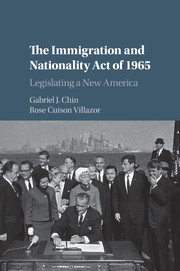


The Immigration and Nationality Act of 1965: Legislating a New America examines and explores the 1965 Immigration Act’s origins and its legal, political, economic, and cultural effects. This book demonstrates the principal consequence of the law – ending formal discrimination in immigration law. At the same time, while the 1965 Immigration Act was in some sense a civil rights law, it was one of its era that perpetuated discrimination in certain ways.
On October 3, 1965, at a ceremony on Liberty Island in New York Harbor, President Lyndon B. Johnson signed into law the Immigration and Nationality Act Amendments of 1965, also referred to as the Hart-Celler Act.Footnote 1 A primary goal of the 1965 Immigration Act was to end the controversial National Origins Quota System that began in the 1920s.Footnote 2 In signing the 1965 Immigration Act, President Johnson famously stated, “This bill ... is not a revolutionary bill. It does not affect the lives of millions. It will not reshape the structure of our daily lives.”Footnote 3 Fifty years later, it is clear that President Johnson was mistaken. The 1965 Immigration Act did precipitate a revolution – a demographic revolution. For nearly a century before 1965, the immigrant stream was overwhelmingly white. That resulted from nearly a century of federal laws designed to guarantee that immigrants to the United States were predominantly from the countries of Northern and Western Europe. Yet, since 1965, a supermajority of immigrants are people of color from Asia and Central and South America. This demographic paradigm shift – the electoral, cultural, and linguistic remaking of America – is a direct consequence of the 1965 Immigration Act’s changes to U.S. immigration policy. In repealing the National Origins Quota System, the 1965 Immigration Act, like the Civil Rights Act of 1964 and the Voting Rights Act of 1965, adopted a norm of nondiscrimination. Section 2 of the Immigration Act provided that “no person shall ... be discriminated against in the issuance of an immigrant visa because of his race, sex, nationality, place of birth, or place of residence.”Footnote 4 Today, California, Hawaii, New Mexico, Texas, and the District of Columbia are majority minority. Indeed, the United States is expected to become a majority minority nation as a whole by 2043.Footnote 5
The 1965 Immigration Act did more than overturn the national origins quota. It also established the framework of our contemporary immigration law system – one that privileges select family members of U.S. citizens and lawful permanent residents as potential immigrants. Promoting a policy of family unification, the 1965 Immigration Act allocated unlimited visas to spouses, children, and parents of U.S. citizens and a limited number of visas to spouses and children of lawful permanent residents and siblings of U.S. citizens. Moreover, the 1965 Immigration Act provided that a limited number of visas would be conferred to skilled and unskilled workers and noncitizens seeking to escape countries because of persecution or fear of persecution on basis of race, religion, or political opinion. Upon arriving in the United States, all of these preferred immigrants – family members, workers, and refugees – acquire lawful permanent residency or “green cards.” Noncitizens outside of these select categories for lawful permanent immigration may lawfully enter the United States, if at all, temporarily under various nonimmigrant visa categories.
This immigration system created half a century ago by the 1965 Immigration Act remains the bedrock of contemporary immigration law and policy. As policy makers consider what comprehensive immigration reform would look like, including addressing the existence of 11 million undocumented immigrants, it is essential to understand the system that we have today. We cannot do that without taking a close look at the 1965 Immigration Act.
Immigration before 1965: American Apartheid
The 1965 Immigration Act ended the controversial National Origins Quota System that began in the 1920s. The National Origins Quota System was explicitly structured to maintain the Caucasian racial makeup of the country. Under the system, Congress granted each country of the world at least 100 immigrant visas (what would now be called “green cards” granting “lawful permanent resident” [LPR] status) annually. Additional visas were allocated to some nations based on a formula that considered the number of Americans who traced their ancestry to that nation. Importantly, as intended, this system effectively privileged natives of some countries over others. People from England, Germany, and Ireland and other Western Europeans were particularly favored, while Southern and Eastern Europeans were disadvantaged.
The law’s preference for white immigrants was also reflected by its treatment of people from Africa and Asia. Although in the 1920s as today many Americans traced their ancestry to Africa, quotas for African nations were the 100-visa minimum. The stated rationale was that it was impossible to determine from which country African Americans originated; the real reason was a racist desire to minimize African immigration.
The system also treated Asians differently. The anti-Asian immigration policy of the United States began in 1882 when Congress passed the Chinese Exclusion Act; other Asians were denied the right to immigrate over time, and they were almost entirely prohibited from immigrating under the quota system. In 1952, Congress finally allowed Asians from all nations to immigrate and naturalize. However, the restriction policy continued; large Asian countries such as China, India, and Japan received the minimum quota of 100, as did Asian countries with close connections to the United States such as South Korea and the Philippines. Notably, immigrants of Asian racial background, regardless of citizenship or place of birth, were charged to the quotas of their nation of racial ancestry. Under the so-called Asia Pacific Triangle provision, there was a worldwide, overall cap of 2,000 Asian immigrants per year.
Even among nominally favored groups, discrimination was embedded in the law. For example, under the quota system, natives of the Western Hemisphere could enter the United States free of the quota; based on a policy originating in the Monroe Doctrine, they were exempt from the numerical limits. This is shocking from a modern perspective given the concern in some quarters about immigration from Mexico; in principle, millions of Mexicans were welcome to immigrate. In practice, however, they could not. The law allowed federal immigration authorities to deny entry to would-be immigrants who were not literate or who were “likely to become a public charge.” Therefore, for example, agricultural workers from Mexico normally had to enter the United States, if at all, as temporary workers, even though immigrant visas were available in theory.
The 1965 Immigration Act: The End of the Race Line, in Principle and Practice
The 1965 Immigration Act ripped out the National Origins Quota System by its roots. It increased the number of visas available only marginally, but it eliminated race as a formal factor in immigration policy. Immigrants were to be judged as individuals, and admitted based on education, achievement, job skills, or family connections to U.S. citizens or LPRs. The refugee and asylum programs admitted people based on humanitarian concerns.
However, the number of visas available to any given country in the Eastern Hemisphere was capped at 20,000 (out of 170,000 total), and for the first time, Western Hemisphere immigration was limited, although by the region as a whole and without per-country limitations. (Per-country limitations were later added to the Western Hemisphere). The 1965 Immigration Act fundamentally altered the racial demography of the immigrant stream, directly leading to the United States heading toward a majority-minority population.
Crucially, the 1965 Immigration Act should be seen as part of a broader movement to protect civil rights and eliminate race as a factor in public policy. Indeed, the 1965 Immigration Act should be understood as a sibling of the other great civil rights laws of those years, the Civil Rights Act of 1964 and the Voting Rights Act of 1965. At the same time, the 1965 Immigration Act was a product of its era. If it ended formal racial discrimination, it also perpetuated discrimination based on sexual orientation and political opinion. It failed to account for the interests of Mexican migrant workers who had traveled to the United States for generations, but were restricted under the new law. It also had the effect of giving Africans few opportunities to come to the United States.
This book considers these various aspects of the 1965 Immigration Act to deepen our understanding of our contemporary immigration law system. It is divided into four parts that focus on various aspects of the law: its purported goal to eviscerate race discrimination and promote equality; the promotion of family unification; providing employment opportunities; and political and economic consequences.
Part I: Nuanced Views of the Intended Consequences of 1965 Immigration Act
Part I examines more closely the 1965 Immigration Act’s purpose to remove discrimination in immigration law. The chapters in this part examine both the intended and unintended effects of the 1965 Immigration Act. Gabriel J. Chin makes the case that the 1965 Immigration Act should be regarded as an important piece of civil rights legislation. Several leading scholars have argued that the contemporary diversification of the United States was an unintended consequence of the 1965 Immigration Act. Chin challenges this conventional argument. Based on close reading of media records, the legislative history, as well as interviews with participants, Chin contends that when Congress passed the 1965 Immigration Act, it intended to end racism as an idea as well as a formal matter. Accordingly, it deserves to be considered a sibling of other celebrated (albeit imperfect) laws such as the Civil Rights Act of 1964 and the Voting Rights Act of 1965.
The next three chapters, by contrast, present more critical views on the 1965 Immigration Act. Contrary to the claim that the 1965 Immigration Act ushered in a new civil rights era, both Bill Ong Hing and Kevin Johnson argue that the 1965 Immigration Act did not remove all racial barriers to immigration. In particular, these two authors argue that the 1965 Immigration Act kept in place discriminatory barriers for African and Latino/a immigrants. Specifically, Hing maintains that when it comes to residents of African descent after the end of slavery, the 1965 Immigration Act played little role in facilitating the entry of African migrants to the United States. A close look at African migrants to the United States reveals that the vast majority entered as refugees or under the diversity visa lottery program that was established in 1990. The 1965 Immigration Act did nothing to make up for or correct decades of discrimination.
Johnson argues that the 1965 Immigration Act affirmatively discriminated against Latinos/as. In particular, Johnson points out that the Immigration Act of 1965 implemented for the first time numerical caps on immigration from Mexico, as well as all of Latin America. Mexican workers in particular had a special relationship with the United States based on migration and employment; abrupt restriction of their ability to immigrate deprived these people of color equal treatment under the law. Importantly, Johnson argues that this anti-Latina/o intent of the 1965 Immigration Act set in stone the modern American immigration enforcement state that has focused primarily on Latino/a immigrants.
Brian Soucek similarly presents a counternarrative to the view that the 1965 Immigration Act ended discrimination by focusing on the extent to which the law’s refugee policy maintained restrictions based on nationality. Specifically, Soucek points out that to qualify for refugee status, those persecuted had to hail from a “Communist or Communist-dominated country,” or “the general area of the Middle East” and thus maintained national origins restrictions. Refugee status was also provided for those “uprooted by catastrophic natural calamity as defined by the President.” The 1965 Immigration Act, Soucek argues, turned refugee policy into another weapon of the Cold War, to be deployed largely as the president chose.
Part II: The 1965 Immigration Act and Impact on Families
Next, Part II conducts a closer look at the 1965 Immigration Act’s stated policy of promoting family unification. In particular, the three chapters in this part examine which sorts of families benefited from the 1965 Immigration Act and the impact of the Act on other families. Rose Cuison Villazor underscores that the 1965 Immigration Act enabled millions of U.S. citizens and LPRs to bring their families to the United States and thus changed the racial and ethnic makeup of our country. Yet, Villazor shows that family unification has not been meaningfully realized by millions of U.S. citizens and LPRs and their families. In particular, many families continue to be separated as a result of the visa backlog. Additionally, others are unable to unify because of the law’s limited definition of who counts as family for purposes of immigration law.
Cerissa Salazar Parreñas and Rhacel Salazar Parreñas’ chapter examines the role the 1965 Immigration Act plays in creating transnational families and households. It focuses on the extent to which limited visa programs for nonimmigrant workers and visa backlogs help form transnational families. As this chapter highlights, the physical distance and long separation in time under our contemporary immigration system have imposed significant emotional consequences and relational challenges to transnational households.
Atticus Lee’s chapter contends that although the 1965 Immigration Act marked a new era of racial inclusivity, it also brought with it the sting of overt discrimination based on sexuality. Lee conducts a historical analysis of immigration law’s exclusion of individuals based on sexual orientation – beginning with the 1965 Immigration act’s definition of homosexuals as “aliens afflicted with ... sexual deviation,” prohibiting them from receiving visas and gaining admission into the United States, to the 2013 Supreme Court invalidation of the 1996 Defense of Marriage Act (DOMA). In so doing, Lee highlights the impact of immigration exclusion of gays on their right to establish families in the United States.
Part III: Employment-Based Immigration and the 1965 Immigration Act
Part III examines the ways in which the 1965 Immigration Act facilitates immigration based on employment. Leticia Saucedo’s chapter conducts a historical analysis of the relationship between the 1965 Immigration Act and the termination of the Bracero Program with Mexico. As she explains, the debates surrounding the guest worker programs that led up to the 1965 Immigration Act centered on the work that citizens will do and what work immigrants will do and thus shaped the view of the types of immigrants that the United States desires. Further, she explains how 1965 Immigration Act failed to provide avenues for Bracero workers to participate in the Act’s guest workers programs. Combined with the new Western Hemisphere quotas, the Act limited lawful entry of migrant workers who had a long tradition of working in the United States. Instead of considering the historical patterns of mobility influenced by the Bracero Program or the motivations and behaviors of immigrants themselves, the 1965 Immigration Act and ensuing laws focused on targeting the workplace and employer behavior. The combination of these factors helped entrench undocumented immigration and continues to shape contemporary discussions on comprehensive immigration reform.
Robyn Magalit Rodriguez and Valerie Francisco’s chapter examines noncitizen and nonimmigrant workers, those who enter the United States on a temporary basis. Specifically, their chapter examines those workers who come on H-1 visas, which are reserved for noncitizens with Bachelor’s degrees and able to work in a specialty occupation. H-1 visa holders are different from most other temporary workers because they have the skills that could enable them to adjust their status to LPR or green card holders. As this chapter highlights, a growing transnational migration industry have led H-1 visa holders to become vulnerable at different points of the labor migration. This includes becoming susceptible to abuse by employers who hold the power to help these workers gain green cards.
Part IV: The 1965 Immigration Act and Political and Economic Implications
Part IV turns to political and economic issues related to the 1965 Immigration Act and the future of U.S. immigration policy. Notably, both chapters provide a closer look at Mexican immigrants. Giovanni Peri’s chapter focuses on the long-term economic impact of the 1965 Immigration Act. The immigration system established by the 1965 Immigration Act did not provide for a large inflow of immigrants as workers, particularly those without college educations. Peri’s chapter analyzes how the 1965 Immigration Act’s privileging of college-educated immigrants shaped economic outcomes for various groups. Peri compares Asian immigrants, who generally had higher education and entered based on employment-related visas, with Mexican immigrants, who generally had more limited educational backgrounds and entered as family-sponsored immigrants. The 1965 Immigration Act, Peri contends, led Mexicans to rely on their preexisting social networks to find work mainly in manual, unskilled occupations. By contrast, Asian immigrants, who were already a selected and highly educated group in 1965, had access to highly remunerated jobs. Overall, Peri argues, the large number of undocumented and the very low number of employer-sponsored immigration for Mexican immigrants suggests that the 1965 Act did not work very well for that group. Accordingly, Peri calls for a more labor-market-based immigration system, which he believes would work better for Mexican immigrants and would also be more beneficial to the United States.
Finally, Jeannette Money and Kristina Victor’s chapter examines the demographic and political transformation of Mexicans and Mexican Americans, particularly in U.S. border communities. In particular, they document the demographic impact of the 1965 law in terms of increased permanence and increased illegality. They contend that political empowerment was gradually enhanced through four channels: second-generation access to citizenship through birth on U.S. soil; legalization via the Immigration Reform and Control Act of 1986; increased naturalization when the Mexican government recognized a form of dual nationality in 1998; and finally, through geographic concentration. Additionally, they explore the political power of the Mexican and Mexican-American community to shape border security policy along the U.S.-Mexican border. Overall, their chapter illustrates the delayed but growing influence of the largest group of immigrants in the United States.
In sum, this book both celebrates and critiques the 1965 Immigration Act. In so doing, it aims to explain why our current immigration system operates the way that it does today, and seeks to offer guiding principles for what immigration law could look like in the future.
