

There is nothing like art – in the oppressor’s sense of art. There is only movement. Force. Creative power. The walk of the Sophiatown tsotsi or my Harlem brother on Lenox avenue. Field hollers. The Blues. A Trane riff. Marvin Gaye or mbaqanga. Anguished happiness. Creative power, in whatever form is released, moves like the dancer’s muscles.
6.1 Introduction
This chapter discusses online mediatizations of a multilingual South African “way of speaking” (Hymes Reference Hymes, Bauman and Sherzer1974) which is commonly known as TsotsitaalFootnote 1. The name is a combination of tsotsi, referring to a (mostly) petty criminal, and taal, Afrikaans for “language.” It translates literally as “thug language” or “language of criminals.” However, the social semiotics of this way of speaking are considerably more complex than the explicit reference to criminality. They also involve notions of urbanity, a politics of resistance to oppression, youth and masculinity, the art of being streetwise (referred to locally as being “clever”), and performative displays of linguistic virtuosity.
Drawing broadly on Stuart Hall’s (Reference Hall1997) work on representation, Asif Agha’s (Reference Agha2007) notion of enregisterment and Richard Bauman’s (Reference Bauman1977; Bauman and Briggs Reference Bauman and Briggs1990) work on performance, I argue that displays of language – whether online or offline – are complex signifying practices which are imbued with ideology (in the sense of Silverstein Reference Silverstein, Clyne, Hanks and Hofbauer1979). Ideologies constitute a reflexive, meta-pragmatic space where speakers and writers articulate beliefs about the shape and structure of the represented linguistic form, its position and meaning in the social world, its typical speakers as well as the multimodal ensemble of which it forms part. Representations can, at times, be reductionist, creating an impoverished, even stale and lifeless, version of the linguistic practices they portray (as discussed in Deumert Reference Deumert2014a; Chapter 4). However, they can also give new meanings to vanishing vernaculars, extending their social symbolism across time and space; that is, beyond the realm of body-to-body encounters. I suggest that Tsotsitaal can be understood as constituting part of South African (urban) folklore; that is, it is an artful tradition of speaking, and a mimetic display of this tradition, just as much as it is creative contemporary practice. Online representations of Tsotsitaal draw on a history of media representations – going back to the 1950s – and recontextualize the familiar in new contexts and for new audiences. Rather than seeing folklore as embedded in the “romantic mist” of the past, I follow Dan Ben-Amos (Reference Ben-Amos1971: 4), who argued that “the materials of folklore are mobile, manipulative and transcultural,” and indeed mediatized and displayed in public contexts (Bauman Reference Bauman1983).
The chapter is structured as follows: 6.2 discusses the history, social meanings and early mediatizations of Tsotsitaal. This is followed by a brief overview of Tsotsitaal and other mixed urban vernaculars in contemporary South Africa (for a broad overview of the sociolinguistic context in South Africa, see Deumert Reference Deumert, Jahr, Trudgill and Vandenbussche2014c). Moving into the data analysis, I outline the broad methodological-theoretical framework in 6.4 and discuss Tsotsitaal representations on social media platforms in 6.5 and 6.6. Tsotsitaal is used to achieve particular communicative goals in these online contexts: to index what is colloquially known as loxion kulca (“location culture,” i.e. the ways of the townshipFootnote 2); to articulate a voice that evokes the past and that is experienced as aesthetically pleasing; and to show-off, that is, to display linguistic knowledge and skill to an audience.
6.2 Locating Tsotsitaal: Sophiatown and Beyond
In the popular imagination, the origins and history of Tsotsitaal are closely linked to Sophiatown, the multiethnic and multilingual neighborhood of Johannesburg which was destroyed in 1955 when the apartheid government forcefully moved its residents to Meadowlands, Soweto. Sophiatown, also known affectionately as Kofifi, was – and is – legendary in South Africa (and beyond, see Hannerz Reference Hannerz1996). It was a hub of music, literature, art and politics in the 1940s and early 1950s, and one of the few places in South Africa were Africans were allowed to own property. However, it was also a slum, overcrowded and impoverished, plagued by high levels of crime. And it was on the streets of Sophiatown – as well as close-by areas such as Marabastad, Alexandra, the Western Native Township and Newclare – that the figure of the tsotsi seems to have taken shape.
The term tsotsi appears in the sociological literature from the mid-1940s onwards. It is used to refer to young, male criminals, who express an assertive masculinity, and display a strong sense of fashion and style; typically, modeling themselves on the gangsters seen in the popular American movies of the time. The etymology of the word is murky and several proposals have been made. It might be a mispronunciation of zoot suit, referring to the fashionable pegged trousers and long overcoats of the time (Glaser Reference Glaser2000). Alternatively, it might originate in the isiXhosa and/or Sesotho verb for ‘to sharpen’ (ukutsolisa and ho tsotso respectively), metaphorically referring to the ‘sharp’ look of the young men as well as their preference for knives. In isiXhosa there is also itsolo, an old term meaning “dandy” (Kropf Reference Kropf1899). And, finally, some have suggested that it might be a word play on Tutsi, an ethnic group in Rwanda, which was known for its vicious and fierce warriors (see Molamu Reference Molamu2003, for a discussion of the different etymologies).
The tsotsi was not only a figure of fear, but also one of desire and fantasy, of politics, poetry and art. This is illustrated in Kgositile’s Poets Credo (Reference Kgositsile1968), given as the epigraph to this chapter. The tsotsi was not only dangerous; heFootnote 3 was also about music and movement, with a walk as free and distinct as the language that accompanied it. It was an identity which was artful and powerful at the same time, expressing resistance to all forms of oppression. The figure of the tsotsi also opened up distant horizons: He linked Sophiatown to Harlem, showed appreciation of American and European fashion, was familiar with jazz and film noir. He represented a life which transcended the parochial world of apartheid South Africa: In the midst of brutal colonial oppression tsotsis challenged not only authority, but simultaneously played “a game of cosmopolitanism” which held the promise of a different, bigger world (Hannerz Reference Hannerz1996: 169; Fenwick Reference Fenwick1996; Morris Reference Morris2010).
Tsotsis were defined by their fashion style, as well as by communicative practice. What kind of a language was/is Tsotsitaal? Taal, as noted above, is Afrikaans for “language,” and the base, or matrix, language of Sophiatown’s Tsotsitaal – both lexically and syntactically – was Afrikaans (Slabbert and Meyers-Scotton Reference Slabbert and Myers-Scotton1996).Footnote 4 In addition to Afrikaans, the lexicon includes material from various African languages and English (especially in its American guise, picked up from movies), some lexis from other languages (such as French, German, Portuguese, Italian or even Latin) as well as a wide range of creative neologisms. The strong influence from Afrikaans requires explanation – why Afrikaans and not isiZulu, Sesotho or even English (which, also then, was a language of prestige and global aspiration)? Local demographics are unlikely to have played a role. Although Sophiatown and neighboring areas had initially been set aside for Colored occupation, and Afrikaans might have been dominant in the early days, this changed rapidly: Already in the 1920s, Africans made up about half of the local population, this increased to about 85 percent in the 1930s, and to over 90 percent in 1950.Footnote 5 A “founder effect” (Mufwene Reference Mufwene1996) can explain limited influence, but it does not explain the fairly persistent Afrikaans base, especially in syntax. The use of Afrikaans is better understood as a form of cultural-linguistic appropriation or even parody: taking “the language of the oppressor” and making it one’s own, turning it upside down in the process. Afrikaans, the language of Whiteness and purity, thus became the language of Blackness and hybridity (see Deumert Reference Deumert2009, for a discussion of similar processes in Namibia; on linguistic appropriation see also Fanon Reference Fanon[1952] 2008).
The use of Tsotsitaal as a voice of resistance against oppression is evident in one of its earliest media representations, Strike Vilakazi’s (1956) protest song “Meadowlands.” The lyrics of the song articulate different voices. There is the voice of White people, trying to lure Sophiatown residents into leaving their homes and moving to Meadowlands, the government-decreed Black township. This is answered by the voice of the tsotsis who speak out, simply, but firmly, against the forced removals. And, finally, there is the coda sithandwa sam, a third voice, which links the two stanzas (Sotho, unmarked; Nguni, underlined; Tsotsitaal, italics).
| Otla utlwa makgowa are | You’ll hear the Whites say |
| Are yeng ko Meadowlands | Let’s move to Meadowlands |
| Meadowlands, Meadowlands | Meadowlands, Meadowlands |
| Meadowlands, sithandwa sam | Meadowlands, my love. |
| Otlwa utlwa botsotsi bare | You’ll hear the tsotsis say |
| Ons dak nie ons phola hier | We won’t leave, we are staying here |
| Phola hier, phola hier | Staying here, Staying here |
| Phola hier, sithandwa sam. | Staying here, my love.Footnote 6 |
Tsotsitaal also featured prominently in the pages of Drum, a South African magazine which was directed at a Black urban audience. Consider, for example, Can Themba’s (1956) “picture story” Baby Come Duze (“Baby come near”). It is the story of a love triangle, told multimodally in image and text, using the township’s “new lingo … made of Afrikaans, Zulu, Sotho, English and brand-new words” (with translations provided for the uninitiated; reprinted in Chapman Reference Chapman1989). Or his story The Urchin (1963) which features Macala, a ten-year old boy:
Macala suddenly felt in the mood for the jargon of the townships. The near-animal, amorphous, quick-shifting lingo that alarms farm boys and drives cops to all branches of suspicion. But it marks the city slicker who can cope with all its vagaries.
The anthropologist Phillip Meyer (Reference Meyer1961: 73–75) suggested that the tsotsi – and his language – became part of urban folklore, an almost mythical figure which was not only “terribly dangerous” and outside of “decent” society, but also an icon of urbanity and style. The figure and language of the tsotsi allowed writers – and their readers – to imagine, and perform an African modernity that was distinct from that of mission-school educated intellectuals. The tsotsi represented a modernity that was streetwise and “sharp” (see above), brash and fast-talking, with a devil-may-care attitude and in opposition to authority. These texts enregistered (Agha Reference Agha2007) not simply a way of speaking – understood as a collection of socially meaningful linguistic forms which are interpreted as belonging to a specific code or variety – but also a unique way of being in the world, reflecting an aesthetic which valued hybridity and play, and a political orientation which resisted oppression and any denial of freedom.
Tsotsitaal as an aesthetic form and social symbolic representing the experience and voice of Black urban resistance, did not disappear with the end of Sophiatown. It remained part of the semiotic repertoire of South African artists well into the 1980s. An example is Matsemela Manaka’s (Reference Manaka1981) essay The Babalaz People (“those who have a hangover,” ibabalaz, “hangover,” is part of the core Tsotsitaal lexicon)Footnote 7. In this essay, Manaka locates Black (political) theater firmly within the segregated and violent towns that were created by apartheid architecture, with urban vernaculars, such as Tsotsitaal, as its expressive force and aesthetic.
The squatters, slums and ghettos should be its [Black theater’s] stage. Mampara [“fake”] bricks, corrugated zinc, the mud and stench in the streets should be its costume. Seqamtho, “tsotsitaal,” sepantsola, not sehippie should be its language.
Manaka’s programmatic statement identifies not only Tsotsitaal as the linguistic form appropriate for struggle theater, but also Iscamtho (spelled here Seqamtho) and Sepantsula (spelled here Sepantsola). The latter two refer to multilingual urban vernaculars which draw more strongly on African languages, and thus recontextualize the hybrid aesthetics and political meanings of Tsotsitaal in a different linguistic form (see below). These ways of speaking are distinguished from seHippie, the language and subculture of the Hippies. The latter extended, according to the historian Clive Glaser (Reference Glaser1992), beyond the township and “linked up to white hippie culture.” Its love-and-peace rhetoric, bellbottom trousers and sandals, stood in contrast to the edgy resistance aesthetic of the township. It is relevant that Manaka puts Tsotsitaal in inverted commas. Tsotsitaal has a unique, or marked, status among the languages listed: It was a language not only of the street, but also – already in 1981 – a language with a history of mediatization.
6.3 What’s in a Name? Of Tsotsitaal and Tsotsitaals
The above cited quote by Manaka points to the multitude of (emic) language names that, by the 1980s, were used to refer to mixed urban vernaculars in South Africa. Linguists typically group these into two broad categories (the name most commonly used in the literature and media discourse is highlighted in bold):
(a) mixed vernaculars, that arose in the historical freehold areas of Sophiatown and tend to show strong Afrikaans-influence. These vernacular practices stabilized in the 1940s, have been represented in print since the 1950s, and have been in decline from the 1970s onwards. Language names include: Flaaitaal, Tsotsitaal, Kofifitaal, Wietie (“to speak”), lingo; and
(b) mixed vernaculars, that emerged in the apartheid townships and use African languages as their matrix language. These varieties rose to prominence from the 1970s onwards, have been mediated especially through music (in the local genre of kwaito as well as in hip hop) and radio, and continue to be widely used (on kwaito and hip hop in South Africa see Livermon Reference Livermon, Falola and Fleming2012, Williams and Stroud Reference Williams and Stroud2014). Language names include: Iscamtho, Sepantsula, Ringas (“speaking slang”), Kasi-Taal (“location language”), lingo.
The idea that we can distinguish two basic types goes back to an early MA thesis, written by Cornelius Vale Bothma in 1951. Bothma distinguishes two forms of what he calls “Tsotsi-taal”: Flaaitaal, the strongly Afrikaans-based “language of the streetwise,” those who are “fly,” clever and quick-witted, and Shalambombo, a Nguni-based prison argot. Bothma uses Tsotsitaal as a hypernym to refer to both types, a move which, at times, is also made by speakers, linguists, and in the media. In Cape Town, for example, Tsotsitaal can be used to refer to slang lexis embedded in an isiXhosa matrix (Mesthrie and Hurst Reference Hurst2013). Similarly, in Durban isiTsotsi describes an isiZulu-based, non-standard variety that stands in a diglossic relationship to standard isiZulu (Rudwick Reference Rudwick2005) (also Slabbert and Meyers-Scotton Reference Slabbert and Myers-Scotton1996: 326).
What unites these different types of speech is a partially shared lexicon, which includes many words that go back to the old Afrikaans-based variety of Sophiatown. This was argued most recently by Rajend Mesthrie (Reference Mesthrie, Meyerhoff and Nagy2008) (also Schuring Reference Schuring1979; Slabbert and Meyers-Scotton Reference Slabbert and Myers-Scotton1996) who proposed “a unified account of tsotsitaal” (with small cap to distinguish it from the Afrikaans-based Tsotsitaal). He describes tsotsitaal in this generalized sense as “a loose set of varieties that flourish in South Africa’s townships” (Mesthrie Reference Mesthrie, Meyerhoff and Nagy2008: 95). These varieties display a distinct and recognizable lexis, which can be inserted in an existing matrix language (Afrikaans, English, or an African language), and is typically accompanied by a multimodal ensemble of dress, movement, gesture, and posture (Hurst Reference Hurst2008; Brookes Reference Brookes, Seyfeddinipur and Gullberg2014). The historical depth of this lexicon became evident when I was looking at online data from the last few years (2009 to 2015): The majority of the words as well as turns of phrase that were used on Twitter and Facebook were known to older Tsotsitaal speakers in their fifties, and only rarely did a formulation elicit the response “I don’t know that one.” This suggests that there is a core lexicon which has shown considerable stability across time.
Tsotsitaals, as conceptualized by Mesthrie, are instantiations of what Roland Kiessling and Marten Mous (Reference Kiessling and Mous2004) (also Childs Reference Childs, Spears and Winford1997) discuss under the heading of “urban youth languages in Africa.” They argue that these vernaculars constitute a typologically unified phenomenon which exists, in various linguistic forms, across the continent (including varieties such as Sheng in Kenya or Nouchi in Côte d’Ivoire), and perhaps even across the world. African urban youth languages are not unlike European multiethnic youth languages such as, for example, straattaal in the Netherlands. The linguistic processes (mixing, relexicalization, neologisms, etc.) and the socio-symbolic meanings appear to be fairly similar (youth, masculinity and urbanity, a symbolic sense of Blackness or ethnic identity; e.g. Cornips et al. Reference Cornips, Jaspers, de Rooij, Nortier and Svendsen2015; see also the other chapters in Nortier and Svendsen Reference Nortier and Svendsen2015).Footnote 8
Mesthrie’s argument that tsotsitaalness resides primarily in the lexicon echoes Arnold van Gennep’s (Reference Gennep1908) early work on special languages which also sees them as lexically and not morphosyntactically defined. Anne Storch (Reference Storch2011; Reference Storch, Lüpke and Storch2013) has argued that the linguistic processes which create such a special, and sometimes secret, lexicon are of interest to linguistic theory because they reflect the metalinguistic knowledge of speakers. The lexicon, in other words, is not something that is given; rather, it is dynamic, generative, and creatively constructed, just like morpho-syntax. Borrowing and semantic shifts (including metaphor, metonymy, hyperbole, etc.) feature prominently in the Tsotsitaal lexicon. Examples include cherry for “darling” (from French chérie; borrowing) and donkie to refer to a slow-witted person (from “donkey”; borrowing plus semantic shift). In addition, there are a number of phonological and morphological processes. Khekheti Makhudu (Reference Makhudu and Mesthrie2002) discusses, for example, syllable inversions (Afrikaans slaan > nals, “to hit”), nasalization (Afrikaans papier > mampier, “paper”), devoicing (pasella, “gift,” from isiXhosa ibhasela), and reduplication (naiza-naiza, “party,” from English “nice”). In Louis Molamu’s (Reference Molamu2003) dictionary we have examples of reanalysis, new ornamental affixes (amper, “almost,” becomes amper-kies, mri, “friend,” becomes mri-tology or mri-toza), word-initial, word-final as well as word-internal truncation, as well as ideophones (such as gwap-gwap, “quick passing of time”). Learning how to use these words – and how to create new words – forms “part of people’s linguistic education” (Storch Reference Storch, Lüpke and Storch2013: 94), and is integral to the successful performance of this particular way of speaking. That is, speaking Tsotsitaal – or its cousin Iscamtho – skillfully is not solely a question of knowing existing words and enacting them within the expected multimodal matrix (dress, posture, and movement), it is also the ability to expand on what is there, to surprise the audience through a display of linguistic virtuosity and creativity. The remainder of this chapter focuses on the digital representations, enactments, and performances of the old Afrikaans-based Tsotsitaal. Given that fluent speakers of this variety are now mostly in their fifties and older, what representations do we see online?Footnote 9
6.4 Virtual Linguistic Landscapes: Representing Language(s) Online
Stuart Hall’s edited volume Representation (Reference Hall1997) is a core text in the study of signifying practices; that is, practices through which we create meaning and constitute the world around us. Hall argues that we create social meaning in three different ways: (a) by interpreting the world for ourselves and others, (b) by doing things, and (c) by re-presenting and displaying the world. He writes:
In part, we give objects, people and events meaning by the frameworks of interpretation which we bring to them. In part, we give things meaning by how we use them, or integrate them in our everyday practices … In part, we give meaning by how we represent them – the words we use about them, the images of them we produce, the emotions we associate with them, the ways we classify and conceptualize them, the values we place on them.
As noted in the introduction, Hall’s work on representation links to Asif Agha’s notion of enregisterment as well as Richard Bauman’s work on performance. Representation and performance are kindred theoretical concepts which aim to understand reflexive communicative practices that put language on display in front of an audience, and, in the process of doing so, create – that is, enregister – recognizable ways of speaking that are available for further displays, and that can, over time, become integrated into routine daily practices. Thus, the repeated use of Tsotsitaal in the pages of Drum created, already in the 1950s, an image of how to speak and write, of how to represent the language of the street corner. This then became the source for further media displays, first in the context of struggle theater and writing, later in movies such as Mapantsula (1988) and soap operas such as Isidingo (which premiered in 1998). These displays created a model of language and associated speaker personae, that was available for further recontexualizations (Bauman and Briggs Reference Bauman and Briggs1990) and resemiotizations (Iedema Reference Iedema2003) in interaction, off-line and online.
The idea that the internet constitutes a vast semiotic landscape was argued by Jane Hill (Reference Hill2005). Jane Hill made use of Google’s search engine to trace the intertextual meanings of mañana (“morning, tomorrow”) in what she calls Mock Spanish, that is, the use of Spanish lexical items by monolingual English speakers to project a “positive colloquial persona.” These practices are offensive to native speakers of Spanish as they inadvertently reproduce racist stereotypes. Mock Spanish occurs in everyday interactions, but is particularly prominent in media representations, ranging from movies (such as the Terminator) to slogans on T-shirts and coffee cups. In her 2005 article, Hill advocates the use of Google searches as a tool for tracing the intertextual linkages and meanings of such heavily mediated forms. She argues that:
This [online, Google-enabled] research technique allowed me to reproduce in a very short span of time the experience that an ordinary English speaker might have over several months or even years, being exposed to multiple contexts of /man’yanə/.
Google searches – of text, images, and videos – provide quick access to a vast range of language-on-display, constituting what we might call a “virtual linguistic landscape” (Ivkovic and Lotherington Reference Ivkovic and Lotherington2009; Androutsopoulos Reference Androutsopoulos, Mallinson, Childs and Van Herk2013a). An image search for Tsotsitaal, for example, provides an interesting and thought-provoking collection (public search, December 22, 2014; browser: Firefox, location: South Africa). Most noticeable is the preponderance of academic representations of this linguistic practice. Two out of the top five images reproduce the first page of an academic paper (Slabbert and Myers-Scotton Reference Slabbert and Myers-Scotton1996; Makhudu Reference Makhudu and Mesthrie2002). Another image – depicting greeting routines in cartoon-like fashion – accompanies a newspaper article written by another linguist (Hurst Reference Hurst2013). The remaining two images reference popular culture: one shows the cover of a recently produced album (by the American indie rapper Ten and Tracer), the other an image from a blog, depicting a young Black man dressed in twenty-first century township fashion (jeans, T-shirt, sneakers and soft hat). Scrolling down further we see more iconic representations of Black male township youth (and style), an advert of the mobile phone company 8ta/heita (whose name is inspired by an old and well-known Tsotsitaal greeting), books about Tsotsitaal, more blogs, as well as images from the Oscar-winning South African movie Tsotsi (2005), which introduced the figure of the Tsotsi to global audiences. In these digital representations Tsotsitaal becomes visible as an object of academic study and point of reference for local, as well as global, popular culture: Its deep local embedding notwithstanding it works as a meaningful term for an American rapper with no identifiable connections to South Africa.
Google searches are particularly helpful when investigating what we might call hegemonically-sanctioned representations. Thus, just like editors, search engine algorithms create regimes of visibility by sorting, ranking, and filtering content that is available online (Bucher Reference Bucher2012; Introna and Nissenbaum Reference Introna and Nissenbaum2000). With the exception of product reviews (such as Tripadvisor) and Wikipedia entries, user-generated content on social media platforms generally receives low rankings on Google, and much remains entirely invisible in broader web-searches (this includes tweets, Facebook, and YouTube comments).
The following analysis focuses on two social media platforms: Facebook and Twitter. YouTube is not included because of the general paucity of user-generated material: Although a search for “Tsotsitaal” returned 61 results, only 23 were about linguistic practice (date of search: December 22, 2014; four years later, in June 2018, this had grown to over 300 videos tagged “Tsotsitaal”). The majority of these (n=18) were professionally or semi-professionally produced music videos, TV programs and documentaries, or trailers/interviews for movies such as iNumberNumber (2014) or Hijack Stories (2000), which make use of Tsotsitaal/Iscamtho in the dialogue. Given the academic interest in Tsotsitaal and related practices, it is perhaps not surprising that two further videos were recordings of academic presentations about Tsotsitaal. Only three videos could be classified as user-generated content. These were unedited amateur recordings of staged multilingual performances. Two were recordings of the same spoken word poet; the third, an impromptu rap performance. Linguistically, although tagged as “Tsotsitaal,” neither of them uses the Afrikaans-based variety which is the focus of this chapter, and all three represent Iscamtho-like practices.
The question of access is relevant here. Online engagement in South Africa is historically mobile-centric, and, as such, has favored text- and image-based practices (see Deumert Reference Deumert2014a, Chapter 3). Thus, while YouTube provides only limited data, online representations of the Afrikaans-based Tsotsitaal are fairly common on Facebook and Twitter, two social media platforms which allow easy access via phones. Writing Tsotsitaal online is not habitual practice. It is experienced self-consciously as marked, as exploring a different and unfamiliar voice.
1. Texting my bf in tsotsi taal, so funny [May 2013; female; Twitter].
2. The way I text in tsotsi taal when chatting with Sanny. Nno maan. Makes me feel like I’m standing @ a urinal : D [September 2013; male; Twitter]Footnote 10
The examples discussed below were taken from the public timeline of Twitter and from public sites on Facebook (data collection took place in 2014, when the chapter was written). Demographic information (race, gender) is based on visual inspection of the avatar: Although avatars do not necessarily reflect the actual gender/race of a user, they can be taken to reflect the projected or desired race/gender.
6.5 The Pleasure of the Past: Afrikaans aka Tsotsitaal
Using Twitter’s search function and looking over a large number of tweets (going back to 2009) which either talk about Tsotsitaal or offer performances of Tsotsitaal, two observations can be made: (a) There are almost no posts by White South Africans on the topic which thus seems to belong to the contested space of what has been referred to as Black Twitter (Brock Reference Brock2012; Florini Reference Florini2014); and (b) many writers express great appreciation for the “old school” Afrikaans-based Tsotsitaal, even though, or perhaps precisely because, it is rarely heard in everyday spoken interactions, except among older people.Footnote 11
3. These o’ladies be speaking tsotsi taal lol…I love it when old people speak tsotsi taal mixed with Afrikaans [October 2014; female; Twitter]
4. My stepdad and I speak in that old school tsotsi taal…he’s 64 this year. Awesome. [February 2014; male; Twitter]
5. I’m really fascinated by old man with their tsotsi taal and kasi swag! They were the pioneers of cool [January 2014; male; Twitter]
6. How kool is these old Tyma Tsotsi taal??? “Ons gat jou Pazamiesa hieso” [“we will chase you away”]#YizoYizo [August 2012; male; Twitter]
The models for this type of speech – which is characterized as “smooth,” “cool,” “dope,” “turn on,” “deep,” “fascinating,” “boss” – are not one’s peers, but one’s elders and, in addition, media representations. Popular characters in South African TV series which are regularly mentioned as models are Bra Gibb (in Yizo Yizo, played by Dominic Tyawa), Bra Tiger (Patrick Shai) from Zone14 and Papa G (Georgie Zamdela) from Isidingo.
At the same time as writers express appreciation and admiration, they also articulate a sense of inadequacy, and a wish to learn and improve their skills:
7. Working on my tsotsi taal [November 2014; female; Twitter]
8. :””D I want to learn how to speak tsotsi taal like the old timers [December 8, 2013; male]
9. I wanna learn how to tweet in tsotsi-taal… That’s gonna be so dope for when I have my kasi [“township”] moments! [June 2012; male]
On Facebook, a number of virtual classrooms have playfully inverted the idea of school or university as the place where one learns to speak “proper.” Instead, they propose to “teach” the language of the streets.
10. Ikasi Ringas [“township talk”] – School of Tsotsitaal [started 2012]
TsotsiTaalLanguageSchool (TTLS) [started 2014]
UniVersity of TsotSi-taal LinGo [started 2013]
School of iRingas aka Tsotsi Taal [started 2012]Footnote 12
The most popular of these is Ikasi Ringas (with over 14,000 likes in 2014; it went up to over 17,000 in 2018)) which emphasizes diversity, authenticity, celebration, sharing, and learning in the about feature:
Ikasi Ringas is a community that aims to celebrate and spread authentic South African township lingo. Expand your township vocabulary and share language unique to various South African townships
The design of the site creates a classroom that is quite unlike the classrooms readers will have experienced at school. The image on the site is of Bonginkosi Dlamini aka Zola, a well-known Kwaito musician who provided the soundtrack to the movie Tsotsi. And instead of a stern teacher, there is a team of administrators which provide status updates with “cool” and “crazy” words, advice on how to engage in appropriate streetwise interactions (“Next time umntu aku buza [‘a person asks you’] ‘Ku hambani?’ meaning what’s popping … tell them ‘ku hamba iinyawo umzimba ubaya iskelem’ [‘the feet are walking, the body has been tricked into following’]”, February 2013); challenges readers to the occasional quiz (“A simple quizz for friday what does the abbreviation ‘MVV’ in tsotsi taal mean?”, August 2013),Footnote 13 and provides ample scope for user contributions (“WHAT DO YOU CALL A ‘BACK YARD ROOM’Footnote 14 IN YOUR HOOD?”, May 2014).
Although English and Iscamtho-like practices dominate on these pages, Afrikaans influence is persistent, and old Tsotsitaal lexis keeps re-appearing. Thus, among the responses to the above question of how to refer to a “backyard room,” we find pozi (already attested in Bothma’s, Reference Bothma1951, wordlist; possibly from posisie, “position”), as well as a range of other Afrikaans-based terms: hoki (from hoek, “corner”), kisti, kist, ekhistini (from kis, “box,” but with the final –t as in Dutch; also used in South African English to refer to a large wooden chest), palamente (vernacular spelling of parlement, “parliament”), huis (“house”) and spookhuis (“ghost house”). Old Tsotsitaal lexis also features in the responses to the question: “how do you say I love you in Tsotsi taal? (June 2014). Particularly favored is the intensifier blind (meaning “very”) and the verb frostana (from Afrikaans verstaan, “to understand”), giving rise to several versions of the phrase: ngiyakufrostana blind blind! (literally, “I understand you totally”). While this example, just as the one provided in the original question, uses isiZulu as the syntactic matrix, other respondents offer a range of phrases which draw on Afrikaans lexicon as well as syntax:
11. ek is lief voor jou [“I love you”]
ill be a lover jou vir wena skat [“I’ll be your lover, for you, dear”]
ek es mal van jou [“I am crazy about you”]
Remembering and acknowledging Afrikaans words in Tsotsitaal is common practice and can even be turned into a competition:
12. Tsotsitaal words that are taken from afrikaans – (my spelling sucks) Kak, bell, Vat se, geen, traap, scooner, verstaan, gister, sister, ekse, fede, bow(build), groont, groet, mooi, plaat, spaan, vaar, bestier, stier, vaslaap, skomel, draai, blom, skierlek, water siek, and many many more. What other words can you think of? (May 2013)
I suggested above (in 6.2) that Tsotsitaal allowed speakers to appropriate Afrikaans, a language which – its complex and multi-racial speaker base notwithstanding – was historically and symbolically associated with Whiteness and oppression. And indeed one of the reasons which has been given for the rise of Iscamtho-like practices, and the decline of the Afrikaans-based Tsotsitaal, are the Soweto protests of 1976, when high school students protested against the introduction of Afrikaans as a compulsory subject, and carried posters with slogans such as “to hell with Afrikaans.” Karen Calteaux (Reference Calteaux1994) comments on the situation of the early 1990s as follows: “the youngsters of today no longer know Afrikaans and dislike it … the youngsters of today tend to prefer Iscamtho … Iscamtho is thriving but Tsotsitaal will die out without a trace.” Similarly, Andrew Molefe (2011) lamented in his “Thinking Aloud” column in The New Age that “tsotsi taal is now a threatened species. There are few people left in the township who can still praat [‘speak’] the language with the flair of its original hip form” (see also Molamu Reference Molamu1995; Childs Reference Childs, Spears and Winford1997; Brookes and Lekgoro Reference Brookes and Lekgoro2014).Footnote 15
Yet, online, on Twitter and Facebook, the tradition of the old-style Tsotsitaal, the language of Sophiatown, continues, symbolically creating “a connection between aspects of the present and an interpretation of the past” (Bauman Reference Bauman and Bauman1992: 32). This link between old and new, past and present, is established also in other media discourses. In 2002, Tokollo Tshabalala aka Magesh released the kwaito hit No.1 Tsotsi, which earned him the affectionate nickname tsotsi van toeka af (“old-style Tsotsi”; on musical representations of Sophiatown in kwaito, see also Livermon Reference Livermon, Falola and Fleming2012). The expression tsotsi van toeka af was then picked up by those writing in digital spaces to express a sense of continuity, a way in which the township experiences under apartheid still resonate today. This is illustrated in (13), where the writer links the tsotsis of Sophiatown to kwaito/hip hop and contemporary loxion kulca:
13. Tsotsi van tuka,tsotsi van kofifi,kwaito all the way [June 2013; male; Twitter]
The style and language of the old-school tsotsi is not only valued and desired, it is also performed. And although knowledge is mostly of a fragmented nature, limited to just a few words and phrases, writers use these fragments to create performances for their online audiences (on linguistic fragments in performance, see Williams and Stroud Reference Williams and Stroud2014). In these written performances the emphasis is not on the invention of novel forms, creative word play and linguistic manipulation – practices which index the fluent and proficient speaker – but rather on articulating a recognizable historical voice.
6.6 The Pleasure of the Knowledge: Performing Tsotsitaal
The affordances of, especially, Twitter are well-suited for cultural-linguistic performances in the absence of full proficiency. The service’s message format is minimalist (with a maximum of 140 characters), and there is no expectation that a tweet would be anything but a “small performance.” The concept of “small performances” draws on Alexandra Georgakopoulou’s (Reference Georgakopoulou2007) discussion of “small stories.” Like “small stories,” “small performances” are embedded into everyday social practice. They are momentary, fleeting, and non-routine displays of linguistic skill for an audience. Perhaps the most pervasive small performance genre in digital spaces are greeting routines (Androutsopoulos Reference Androutsopoulos2013b). Greetings and salutation rituals allow participants to frame their social relationships in particular ways, evoke shared tradition and history, and make it possible for people with minimal linguistic skills to engage successfully in an interaction by relying on fragments of knowledge. The tweet in (14) shows an exchange of greetings between two male writers, including iconic and old-style forms such as fede (“how are you”), ekse (“hello”), and authi (“young man”), as well as the creative spelling /xap/ for “what’s up.” The exchange took place on Twitter around lunchtime in July 2013.
14.
@K_M: Morning tweeps @C_M_D: Woi woi bosso wat se authi? [“hey boss, what are you saying?”] @K_M: Xap broer fede? [“what’s up brother, how are things?”] @C_M_D: Grand bos! [“cool boss!”] @K_M: Hola [“hey”]
Tsotsitaal performances on Twitter are often framed by explicit announcements, in which the writers state their intention that they will now write Tsotsitaal. This establishes a clear performance frame, and invites the audience to enjoy and evaluate the display they are about to see and read.
15. Ok let me try tweeting in tsotsi taal. [August 2013; male; Twitter]
16. I will start tweeting in tsotsi taal … [May 2013; male; Twitter]
These comments draw attention to “the act of expression” itself (Bauman Reference Bauman1977), an interactional move which is central to definitions of performance as artful language. And the responses show that audiences appreciate such displays. In response to, for example, (14), readers reacted with a clear sense of anticipation.
17. *graps a chair* :) [August 2013; female; Twitter]
18. *camps on your TL* ♥♥,) /\ [August 2013; female; Twitter; TL= timeline]
It is not only Tsotsitaal that is displayed in a performative frame online, but any language can become a focus of performance in the digital space of Twitter. Consider the exchange between @LNW (female) and @P_P (male) in (19), which draws on a wide range of linguistic resources – urban isiZulu, Tsotsitaal, English – in a self-conscious and reflexive performance of the genre “expressing affection.” In each post the writer first performs a particular way of speaking, and then provides an explanation of how the linguistic performance should be read, i.e. as isiZulu, Tsotsitaal, or old school.
19. @P_P mara siyathanda nina neh! [“but we love you, hey”] ♥♥ lmfao
how do u like my Zulu?
@ LNW BLIND BLIND vele siyathandana !! [“totally of course we love”]
Lol ♥♥ lmao how do u like my tsotsi taal ?
@ P_P lmao ahhh sweetheart! Wena [“you”] ul always be my baby!!!
Lmfao…how do u like my old school? [January 2013; Twitter]
In addition to linguistic fragments, reflecting a broad appreciation of, and admiration for, words and expressions belonging to the Afrikaans-based Tsotsitaal, we also see more sustained performances on Twitter. In early 2012, @JM (male) tweeted – early in the morning – four short Tsotsitaal performances. The total number of tweets posted by @JM on that day was 52. Thus, these performances were just a small portion of his digital engagement on the day. He self-consciously flagged the tweets as representing not just Tsotsitaal, but Kofifitaal, the original language of Sophiatown.
20. Sy is jou vrou. Let her have some fun. Tlogela go nna iscefe se ndoda. Los daai Delilah [“She is your wife/girlfriend … Stop being a weak man. Leave that unfaithful woman”; February 12, 2012, posted at 6:52am]
21. Ons phola hier [‘We stay here’; posted at 7:01am; retweeted once)
22. Ek nyisa daai moegoe ka my twa en hy di gatas bel. Dom kop. (Kofifi Taal on Twitter) [“I threatened the idiot with my gun, and he called the cops. Stupid person”; posted at 7:07am]
23. Want ek is dik so. Ek vat nie tshandis. Jy gaan tshwerr! [“Because I am fed up like that. I don’t take nonsense. You will go!”; posted at 7:08am]
None of the four tweets given in (20) to (23) is directed at anyone in particular (as indicated by the absence of the @ feature), nor do they comment on events that have happened on @JM’s timeline (such as perhaps a friend having trouble with his girlfriend, or a disagreement with someone). Rather, they are stand-alone performances which not only put linguistic forms on display, but also the social voice of the most prototypical resident of Sophiatown: the tsotsi, with his rough and tough masculinity. In addition to written, verbal performances, images tagged as tsotsi van Kofifi are posted regularly on Twitter: They are mostly, but not exclusively, photographs of well-dressed young men who stand in a culturally recognizable posture that is at once cocky and confident. All these performances – written as well as visual – keep the tradition alive, creatively representing it in a new digital form. They are an example of what Alistair Pennycook (Reference Pennycook2007b: 286) called “creativity as recontextualization”; that is, creativity as mimesis, as the “performance of sameness.”
The small stories paradigm mentioned above considers the role of brief narrative moments in interaction. Similarly, work on performance has emphasized the interactional aspects of language-on-display (Bauman Reference Bauman1977). In the case of @RM’s Tsotsitaal tweet there was Twitter-style audience interaction which further recontextualized the postings: (21) was retweeted; and (23) was retweeted and tagged #GeorgieZamdelaTweet by a reader, thus comparing the linguistic display on Twitter to the virtuoso and much-admired Tsotsitaal performances of George Zamadela, Papa G in the TV series Isidingo.
The Facebook and Twitter data discussed here form part of the virtual linguistic landscape. Although not easily accessible via Google search engines, these performances are part of the digital experience of individuals as they read their timelines or check into Facebook. These performances display and represent language in a visual mode, and contribute to new forms of enregisterment in person-to-person interaction as well as popular culture.
6.7 Conclusion: Don’t be Tjatjarag
Old Afrikaans Tsotsitaal words and expressions, the linguistic world of the 1950s to 1970s, remain in circulation today; they are desired and appreciated, enacted and performed, seen and read. Media discourses have long been part of the history of Tsotsitaal, starting with Drum in the 1950s, struggle theater and writing of the 1960s and 1970s, movies and TV since the 1980s, and, in the twenty-first-century digital media. Today, knowledge of this way of speaking tends to be fragmented. It is often limited to individual words, and the focus is on small, fleeting performances. Yet, it remains popular.
The way in which old words linger and can, through mediatization, be infused with new life can be illustrated with the example of tjatjarag, another Tsotsitaal word meaning “over-eager” or “nosy.” The journalist Lesiba Langa describes how, in his youth, the word was used by school teachers and his grandmother when angry or reprimanding someone. It was a word that belonged to the speech of older people. But then, in 2010, Julius Malema, the youth leader of the ANC used it in an outburst against the BBC journalist Jonah Fisher: “Let me tell you, before you are tjatjarag [audience laughs], this is a building of a revolutionary party and you know nothing about the revolution. So here you behave or else you jump.” Malema’s outburst received considerable local and international media coverage, and suddenly tjatjarag was all over South Africa “being mentioned in hang-out spots” and “on social network sites the word has been thrown around excessively.”Footnote 16 It features on T-shirts, has inspired its own “keep calm and don’t be tjatjarag!!!” series, and gone global with entries in the Urban Dictionary.
Thus, as suggested by Louis Molamu (Reference Molamu1995: 154), we might not yet be seeing the end of Tsotsitaal. Even though it is spoken fluently mostly by “grey-haired” men, it nevertheless continues to “supply a considerable stock of words and phrases” to everyday language. Tjatjarag is one of those Tsotsitaal words that has crossed into general South African slang. In the process it lost some of its tsotsitaalness, its link to the social, political and cultural world of Sophiatown, and the edgy resistance aesthetic that went with it. Other words and expressions, however, retain their link to the world of the past more strongly, and writers and readers take delight in using them. Showing off one’s linguistic virtuosity in online texts does not mean that new words are created and invented, rather it is about displaying one’s knowledge of a historical voice. Being able to perform the old Afrikaans-based Tsotsitaal for an audience is not something everyone can do. It requires work and effort, skill and knowledge.
IntroductionFootnote 1
At a press conference a few months before the U.S. presidential election of 2016, award-winning Mexican-American journalist Jorge Ramos of the U.S. Spanish language television network Univision repeatedly attempted to ask candidate Donald Trump a question about immigration. Trump derisively told him to sit down and refused to address him, saying that Ramos spoke out of turn. As Ramos, a Mexican-born U.S. citizen, was being physically removed by Trump’s security detail, Trump told him to “Go back to Univision” and a Trump supporter shouted, “Get out of my country.” Ramos was eventually allowed back into the press conference, but only after having endured the indignity of exclusion as a representative of the largest U.S. Spanish language news service. Yet, it seemed to be his Spanish language accent that initially led him to be identified as “other” and denied the right to speak.Footnote 2 In other words, phenotype is not the only way in which bodies are singled out for exclusion and policing (Ramos is blue-eyed and of European descent); language, in this case, rather than appearance (phenotype, dress, religion) was the trigger for racialization and exclusion. The incessant challenges that many Spanish-accented individuals face in the U.S.A. are also a theme in various online spaces where Mexican-American and other Latino youth gather to express their feelings and frustrations. The present chapter examines some of the writing practices of young bilingual Mexican-Americans on YouTube, focusing on the discursive and orthographic means through which they contest monolingual and standard language ideologies and engage in counter-hegemonic narratives about Mexicans, Mexican-American history, and identity. The data include a YouTube video by the artist “Jae-P,” who was born in Los Angeles to Mexican immigrant parents, and the comments (N=453) posted by viewers. The analysis looks at how YouTube commenters signal stances through code choice, as well as through discursive, and orthographic means. In addition, it explores how YouTubers draw on their bilingual and multistylistic repertoires to express discursive alignments/distance within and across ethnolinguistic boundaries.
This chapter approaches YouTube as a “potential site of cosmopolitan cultural citizenship – a space in which individuals can represent their identities and perspectives, engage with the self-representations of others, and encounter cultural difference” (Burgess and Green Reference Burgess and Green2009: 77). YouTube offers both content creators and audiences the chance to participate in the “mundane but engaging activities that create spaces for engagement and community-formation” (Uricchio, Reference Uricchio, Bondebjerg and Golding2004: 148, cited in Burgess and Green, Reference Burgess and Green2009: 75). Through audience practices such as quoting, favoriting, commenting, and sharing, viewers can evaluate, discuss, and curate the content in ways that are personally meaningful to them (Burgess and Green, Reference Burgess and Green2009: 76). Moreover, digital spaces such as YouTube offer Diasporic populations such as Mexicans and Mexican-Americans a way to engage politically with the nation of origin (Sharma Reference Sharma2014; Swinehart, this volume). The current chapter examines the practice of commenting on YouTube video content in order to examine how audience members construct narratives about who they are and their relationship to the society in which they live.
Background
The oldest evidence of humankind in the geographical U.S. dating back to 35,000 BC was found in the U.S. state of Texas (Chávez Reference Chávez, Melendez, Young, Moore and Pynes2001: 17). These early inhabitants and their descendants lived in the region continuously until the mid-twelfth century CE when they began migrating south and settled in what is now Mexico and Central America, giving rise to the Aztec culture (Anzaldúa Reference Anzaldúa1999). Aztlán, the Nahuatl word for the home of the Aztec people was the historical name for this region which encompasses what is now the American southwest (Chávez Reference Chávez1984; Gonzalez Reference Gonzalez2001; Muñoz Reference Muñoz1989). Sixteenth-century Spanish colonization brought renewed settlement to the region, this time by Spaniards, Indians (Indigenous people), and Mexicanos (people of mixed Spanish and Indian heritage). In 1821, Mexico achieved independence from Spain whereupon these territories became part of the newly formed Imperio de Mexico. Two centuries later, following the Mexican--American War of 1846–1848, large numbers of Mexican nationals became de facto inhabitants of the U.S.A. when 2.1 million square km of territory (encompassing most modern-day states of Arizona, California, Colorado, New Mexico, Nevada, Texas, and Utah) was transferred from Mexican to U.S. sovereignty upon the signing of the Treaty of Guadalupe-Hidalgo (Moll and Ruiz Reference Moll, Ruiz, Suárez-Orozco and Páez2008: 364). The Mexicano and Indian landowners living on the U.S. side of the new border were massacred, harassed, and lynched by jealous neighbors, causing many to abandon their ranches and flee to Mexico (Chávez Reference Chávez1984). Thus, the ancestors of many Mexican-Americans have ties to the American southwest dating back at least as far back as the Spanish Colonial Period (1519–1821). The border between the U.S.A. and Mexico has been a continually contentious space and tensions have been exacerbated in the twentieth century as Mexico has become increasingly impoverished relative to the U.S.A., leading to mass migrations to El Norte (the North). As of the 2014 U.S. Census, people of Mexican origin constitute the largest single group of Latin Americans with 35 million currently living within U.S. borders. Latinos make up 17 percent of the U.S. population, of whom 64 percent are of Mexican origin.
The growing numbers of Mexican migrants in the U.S.A. have triggered what Chavez (Reference Chavez2008) refers to as the Latino Threat Narrative as – “a set of culturally entrenched discourses that construct U.S. Latinos as linguistically and culturally dangerous” (cited in Carter Reference Carter2014: 210; cf. Mendoza-Denton Reference Mendoza-Denton1999; Rodriguez Reference Rodriguez1983). This narrative frames Spanish-speaking immigrants as unable or unwilling to learn English, reluctant to integrate into larger society, and more insidiously, as conspiring to re-conquer the southwestern U.S.Footnote 3 A similarly prejudiced frame positions Spanish speakers and the Spanish language as disrupting the security of monolingual white public space (Hill Reference Hill2009). Attacks on Spanish through political movements like English First and numerous “official” English campaigns, objections to the public use of Spanish, and the rejection of Spanish as a language that merits proper idiomatic translation in official signage are ubiquitous facts of life in the U.S.A. (Hill Reference Hill2009: 122–123). The psychological effects of internalizing impoverished conceptions about one’s language have been dubbed “linguistic terrorism” (Anzaldúa Reference Anzaldúa1999: 58), causing Spanish speakers to fear using their language in public places and abandonment of Spanish among some immigrants. Adopting some of the same rhetoric and slang as the Chicano Rights Movement of the 1960s (see footnote 6), Mexican-American rap artists’ choice to rap in Spanish can be framed as a counter-narrative, proclaiming the rights of Mexican-Americans to exist and practice their language and culture within the geographical and cultural boundaries of white hegemonic “American” culture.Footnote 4
Mexican-American rap emerged in the 1990s with groups such as Cypress Hill and Kid Frost in what Androutsopoulos and Scholz (Reference Androutsopoulos and Scholz2003) refer to as the transculturation process or the spread of hip hop from African American youth to other groups within national borders and beyond. At the time, most well-known Mexican-American rappers performed in English and tried to conform to the linguistic patterns of African American youth and Hip Hop Nation Language or HHNL (Alim Reference Alim, Finegan and Rickford2004). However, in the early 2000s, in response to their growing popularity, a number of bilingual Mexican-American rappers were signed to the Spanish language music division of the Univision television network. Artists like Kinto Sol, Akwid, and Jae-P rapped in Spanish over beats infused with the sounds of older popular Mexican music styles such as banda, cumbia, and norteño. In 2008, the rapper Jae-P was a finalist in the Latin Music Awards in the Latin rap/hip-hop album category. He has a large following on Facebook and YouTube and has continued to rap and produce video content on social media in the intervening years.Footnote 5 One striking aspect of his work is that he chooses to rap almost exclusively in Spanish despite his own bilingual proficiency and that of many, if not most, of his fans in the U.S.A. His Facebook page and the comments of people responding to his video are in Spanish, as are a majority of the YouTube comments analyzed here.
Jae-P’s song, “Ni de aquí ni de allá” (not from here [the USA], nor from there [Mexico]) references a common experience among Mexican migrants and Mexican-Americans who feel rejected in their parents’ country of origin and in the country where they were born or were brought to as young children (Anzaldúa Reference Anzaldúa1999; Franquiz and Salazar-Jeréz Reference Fránquiz and Salazar-Jerez2013; Carris Reference Carris2011). The title of the song expresses the ambivalence that many such young people have both towards the homeland and the adoptive country, the feeling that they are not entirely at home in either culture, and the struggle they face to define their identities as a result. Writing about Mexican-American youth, Zentella (Reference Zentella, Súarez-Orozco and Páez2009: 332) notes, “In effect, they are neither real Americans nor real members of their ancestral culture.”
Performed entirely in Spanish, the video is set against a backdrop of visual references to Mexican-American life in California – small, one-story dwellings, low-rider cars, backyard parties, and musical references from banda melodies accompanied by traditional instruments like the trumpet and the accordion.Footnote 6 The content of the song hinges on a few common themes: (1) a yearning to belong, (2) Mexican-Americans/Latinos as an up-and-coming social force, and (3) pride in Mexican/Indigenous/Latino identities (“raza” and “brown pride”). The lyrics highlight the struggles of Jae-P and people like him to gain acceptance in the U.S.A., lamenting the fact that despite learning English and working hard, to the gringos, he’ll always be a “wetback” and a “fucking joke” (para el gringo soy un wetback, un pinche chiste). Neither his face nor his skin are acceptable forms of identity in the U.S.A. (ni cara ni mi piel fue la forma aceptada MADE IN THE USA). The rallying cry “brown pride” which appears in numerous comments in the corpus, signifies feelings of otherness and being “out of place” or “ni de allá” (Anzaldúa Reference Anzaldúa1999; Fránquiz and Salazar-Jeréz Reference Fránquiz and Salazar-Jerez2013; Carris Reference Carris2011; Muñoz Reference Muñoz1989). Referencing the instrumental motivations of his parents who brought him to the U.S.A. as a child, Jae-P raps that this is where the money is (aqui esta la lana …) and as his grandmother used to say, first you just have to “suck it up” (primero hay que tragar). Despite his allegiance to Mexico and desire to return there (Mexico yo te quiero y me quiero regresar), he doesn’t feel accepted there either (Pero tu gente no me entiende y jamás me acceptará). Ultimately, there is hope as Jae-P raps that despite his two accents, he will prevail (Con dos acentos en la lengua llegaré a triunfar), proclaiming that the next generation will reap the benefits of his hard work when he says that one day, his child will be the president of the U.S.A. (Mi hijo será presidente de este pinche país).
Language is specifically thematized in the song as Jae-P recounts how he learned English (apprendí hablar inglés), but despite his two accents (dos accentos en la lengua) gets dismissed as linguistically incompetent in Spanish by a dismissive female voice, “this guys doesn’t know how to talk” (este güey no sabe hablar) (cf. Zentella Reference Zentella, Flores and Rosaldo2007 on pochos). He exhorts his listeners to learn English because this land will be “ours” again someday (Porque esta tierra será nuestra otra vez).Footnote 7 The song, its metalinguistic observations about language and its uptake by viewers on YouTube showcase current political debates surrounding the status of Spanish and Latinas/os in the USA. Emergent in the dialog between the song and the comments is a collective assertion of the rights of Spanish speakers to use their language in “white public space” (Hill Reference Hill2009) and the contestation of received histories and discourses about what types of bodies are licensed to be in the U.S.A.
Data
The data for this chapter consist of 453 comments collected on YouTube in 2012 following the “explicit” version of the rap song posted in 2007 by BIGBEARURDADDY. All of the comments were manually copied and pasted in a word document and then the comments, usernames, and date were extracted and entered into an excel spreadsheet and coded for different types of orthographic patterns (e.g. letter repetition, non-standard punctuation, hybrid/non-standard orthography), type of comment (reply to another post, response to video), and theme (ethnic pride, nationalism, etc.).
About two-thirds of the comments appear to be in Spanish, although it was often difficult to assign a language at the sentence or word level. What is the “matrix” language when an English lexeme sits adjacent to a Spanish lexeme, marked as a plural with an orthographic form from hip-hop culture (<z>)? (e.g. <FUK ALL SEROTEz> “fuck all Salvadorians”). In other instances, the interpretation of a Spanish lexeme may rely on the English pronunciation of a grapheme (e.g. syllabic use of the grapheme <s> as in <sto> for esto). Thus, trying to definitively determine the language or code of a given sentence or word forces us to question the boundedness of English and Spanish as distinct languages and adopt a more fluid conception of linguistic repertoires as sets of resources that may come from disparate sources (Agha Reference Agha, Reyes and Adrian2008; García Reference García2009). Agha (Reference Agha, Reyes and Adrian2008) challenges the grammar-centric idea that each code can be identified as having discrete boundaries. Moving away from such a perspective to an interpersonal one, he argues, allows us to observe how the social-indexical values of speech-forms are reevaluated through the reflexive activities of speakers under conditions of linguistic and cultural contact. Specifically, we can see how changes in the “social types” stereotypically indexed by speech are experienced and negotiated by speakers as aspects of their identities (Agha Reference Agha, Reyes and Adrian2008: 254–255).
In addition to a repertoire that blends Spanish and English linguistic resources, the comments also contain elements of Mexican Spanish and Chicano “Caló” slang, other varieties of Spanish (e.g. Salvadorian, Guatemalan, Castilian, and Argentine), Chicano English (Fought Reference Fought2003; Galindo Reference Galindo, Glowka and Lance1995; Santa Ana Reference Santa Ana1993), Hip Hop Nation Language (HHNL) (Alim Reference Alim, Finegan and Rickford2004), and American English (cf. Anzaldúa Reference Anzaldúa1999). Mexican-American hip-hop culture is represented at the lexical level with range of slang expressions such as vato and pura neta which seem to have been recycled from Caló or slang of the Pachuco or Mexican migrant culture (Ramirez Reference Ramirez2006, Castro Reference Castro2000).Footnote 8 Adopting Agha’s perspective allows us to see how language users draw on complex repertoires that contain bits and chunks from more than one language variety and writing system. The choice to use one variant over another can be interpreted as indexing social types, which can tell us about how young people align or disaslign with various possible identities, discourses, and stances (e.g. Mexican, American, Latina/o, indigenous, brown, white/güero, etc.).
The gender identities of participants are difficult to determine conclusively in what Iorio (Reference Iorio, Garley and Slade2009) calls “demographically lean” online sites such as YouTube. However, judging from ubiquity of male-gendered Spanish usernames (e.g. <JAVIER…>) and from morphological and other forms of male gender marking within the comments (e.g. <ESE LOKITO> “crazy gang banger”), the sample appears to be dominated by male users, which aligns more broadly with male-dominated participation in hip hop (Cutler Reference Cutler2014). The age of the contributors is also difficult to verify, since users do not always post personal information on their own pages; however, based on the tiny photos posted by some users and the kinds of activities they reference in the comments (listening to rap music, orienting to “norteño” or “sureño” gangs, playing video games), most appear to be young people in their teenage years or early twenties.
Theoretical Overview
The linguistic and orthographic hybridity of the data point us to analytical tools such as Bakhtinian heteroglossia, polyphony, and more recent concepts such as polylanguaging (Jørgensen et al. Reference Jørgensen, Karrebæk, Madsen and Møller2011). Heteroglossia entails the coexistence of and often tension between different types of speech within an utterance, whereas the polyphony relates to the assignment of multiple values (meanings) to a written sign or the multiplicity of sounds associated with a symbol or character belonging to the writing system of a spoken language (Coe Reference Coe1999). As Deumert (Reference Deumert2014a: 109) writes, adopting a Bakhtinian perspective allows us to get beyond seeing language not only as a “social fact characterized by conventions and norms,” but also as a “source of creativity and art and which produces utterances that are unpredictable and multi-voiced.” In contrast to analyzing the data as simply a form of code switching which relies on an a priori view of languages as discrete, identifiable entities, frameworks like polylanguaging (Jørgensen et al. Reference Jørgensen, Karrebæk, Madsen and Møller2011) and translanguaging (García Reference García2009) assume no such fixed boundaries. Rather, “[l]anguage users employ whatever linguistic features are at their disposal to achieve their communicative aims as best they can, regardless of how well they know the involved languages” (Jørgensen et al. Reference Jørgensen, Karrebæk, Madsen and Møller2011: 34). Some of the data illustrate this kind of unconscious deployment of linguistic resources; yet in other instances users appear to be making deliberate choices in their written utterances that reveal an understanding of how to capitalize on the interplay between two or more systems and associated registers as a way to index “social types” which they use to negotiate aspects of their identities (Agha Reference Agha, Reyes and Adrian2008: 254). Examples of this type also have the potential to be heteroglossic or polyphonous (Bakhtin Reference Bakhtin and Holquist1981; Reference Bakhtin and Emerson1984). Thus, multilingual YouTubers, empowered by the creative freedom afforded to them by the looser strictures of online writing (Garley Reference Garley2014), deploy their repertoires in ways that tell us something about their understanding of how languages are socioculturally associated with values, meanings, and speakers (Jørgensen et al. Reference Jørgensen, Karrebæk, Madsen and Møller2011).
Methodology
Following Androutsopoulos and Tereick (Reference Androutsopoulos, Tereick, Spilioti and Georgakopoulou2016), this chapter examines YouTube comments as a resource for discourse participation and examines the attitudes users express towards the reference video and/or their contribution to the ongoing discourse. It adopts a mixed method research design combining orthographic analysis (Darics Reference Darics2013; Iorio Reference Iorio, Garley and Slade2009; Sebba Reference Sebba2007; Shaw Reference Shaw2008; Soffer Reference Soffer2010) and Computer-Mediated Discourse Analysis (CMDA) (Androutsopoulos and Beißwenger Reference Androutsopoulos and Beißwenger2008) in order to analyze the writing practices and discursive means through which Mexican-American youth resist hegemonic English and white culture and the ways in which they themselves are constructed discursively in the U.S. popular imagination.
For the analysis of orthography, the chapter employs tools from studies of orthographic practices, both in CMC and in other forms of less-regulated writing. Sebba (Reference Sebba2007: 24) describes orthography as a set of socially and ideologically organized practices that are determined by the kinds of literacy practice for which they are designed. Using and controlling standard language is a marker of power and orthographic choices are associated symbolically and metaphorically with “social, cultural and linguistic identities and hierarchies” (Coupland Reference Coupland1985:155 cited in Jaffe and Walton Reference Jaffe and Walton2000: 562). Specifically, standard orthography is ideologically associated with middle-class status and educational attainment, whereas non-standard orthography often marks a speaker as having low linguistic and social capital; moreover, written speech is seen as deviant, non-conformist, and an affront against “everything regular and established in society” (Hinrichs and White-Sustaíta Reference Hinrichs and White-Sustaíta2011: 48).
CMC writing, according to Sebba (Reference Sebba2007) exists somewhere between the highly regulated space of academic writing and the completely unregulated spheres like graffiti (Sebba Reference Sebba2007: 44). However, in CMC, non-standard orthography often serves very specific pragmatic functions, including the expression of creativity, personality, affect, emotional involvement, and informality (Danet et al. Reference Danet, Ruedenberg and Rosenbaum-Tamari1997; Darics Reference Darics2013; Peuronen Reference Peuronen, Thurlow and Mroczek2011). Others point to its role in rendering spoken words (Soffer Reference Soffer2010; Herring Reference Herring and Chapelle2012; Cho Reference Cho2010) and in stereotyping and positioning the language it represents vis-à-vis the standard (Jaffe and Walton Reference Jaffe and Walton2000; Hinrichs and White-Sustaíta Reference Hinrichs and White-Sustaíta2011). Furthermore, because of its associations with non-conformity, non-standard orthography may also mark an utterance or stance as deviant or rebellious. Lastly, it may play a central role in identity construction and creation such as demarcating group boundaries and showing an oppositional stance with respect to the mainstream (Sebba Reference Sebba2007: 56).
Analysis of YouTube Comments: Resisting Hegemonic Language and Culture
The data are divided into two sections. The first consists of examples illustrating how language choice and stance are strategically deployed to convey resistance to hegemonic English and white American culture within the USA. The second section analyzes how writers express this resistance through creative use of orthography, which they also deploy to challenge the way they are portrayed and to assert pride in their identities.
Language Choice and Counter-Hegemonic Stances
Speaker stance is defined as speakers’ positioning with regard to both the content and the form of their utterances (Jaffe Reference Jaffe2007). One powerful way to convey a stance of resistance is through language choice, manifesting not only in the preference for one language – in this case, Spanish – but also in discursive resistance towards English and hegemonic American culture.Footnote 9 This linguistic resistance is echoed in the empowering discursive stances that YouTubers take in their comments regarding the status of Mexican-Americans in the USA.
Responding to the Ni de aquí ni de allá YouTube video, the favored status of Spanish within this space emerges in the conversational turn shown in 1 and 2 below when DellM’s request for an English translation of the song triggers kika’s rebuke that he learn some Spanish instead of expecting bilinguals to bear the entire communicative burden (all names are pseudonyms). The repetition and vari-directional scare quotes around the lexeme <“translate”> marks this kind of labor as something English monolinguals ought to be doing themselves. In effect, yokicamaja’s comment demonstrates a role reversal of the two languages wherein Spanish is the dominant, unmarked language and English is the interloper. By insisting that English monolinguals make the effort to learn the lingua franca, she casts the hegemony of English into doubt. This counter-hegemonic challenge is heightened through non-standard forms such as the clipped form <bout> (about), an emphatic expression of national/ethnic pride, <mexicana para toda la vida>, self-proclaimed gang affiliation, <sur 13>, and the HHNL form <da> (the).Footnote 10 The polyphony of her utterance indexes multiple personal alignments as well as heteroglossic tensions between Spanish and English.
1. DellM Can someone please translate the song for me please.or tell me a website where i can translate the song
2. kika how bout u learn some spanish and then you can “translate” it yourself mexicana para toda la vida sur 13 all da way!
Expressions of ethnic pride as in 2 align with a preference for Spanish and the use of creative orthography in the corpus. Indeed, comments containing expressions of regional, national or ethnic pride were slightly more likely to be written mostly in Spanish compared with the average across the remainder of the corpus; they were also more likely to contain creative orthography compared with the remainder of the corpus, pointing to the symbolic, counter-hegemonic role that language choice and orthography can play in augmenting the illocutionary force of an utterance (Sebba Reference Sebba2007). Comments expressing ethnic pride also show how many young Mexican-Americans feel about themselves, their relationship to the United States and white Americans. Many comments convey a strong sense of self-worth and pride about their origins in Mexico in exclamations such as <pura raza> (pure race), <100% Mexicano>, and <brown pride>, an analog to the “black pride” movement, dating back to the Civil Rights era of the 1960 and 1970s which challenged negative images associated with people of color in the U.S.A.
A frequent theme among these comments is the call to reclaim territories formerly belonging to Mexico that are now part of the U.S.A. The Nahuatl term Aztlán refers to the ancestral home of the Aztec people (Anzaldúa Reference Anzaldúa1999: 33). It came into widespread use during the 1960s among members of the Chicano student movement (Muñoz Reference Muñoz1989: 77) and has since become a rallying cry for people of Mexican descent to reclaim lands seized by the U.S.A. from Mexico in 1848. Currently, invoking the term is part of a practice among young Latinos in the U.S.A. of assigning alternative toponyms to an area as a way to assert personal ownership of an area (cf. Quist Reference Quist, Cornips and de Rooij2018).
Assertions of linguistic and cultural pride in the YouTube comments are often pitted against hegemonic (white) American culture which is framed in oppositional ways. Sinaloa picks up on a line from the song about having more kids to take back what is <nuestro> (ours) which he explicitly states does not include gringos, Germans, and the other blonde people (<otros wueros>). By implication, the speaker indexes his disaffiliation with these groups while asserting his non-European, indigenous heritage. The pragmatic force of his utterance is marked by several orthographic variations such as phonemic <k> in <kitarle> and morphemic <k> in <lo k es nuestro> (what is ours), the non-standard spelling of the curse word <chingen> (from chinguen “fuck”), and by a sureño gang identifier <puro sur 13> (pure south 13).
3. sinaloa semon tengan mas morriyos para kitarle lo k es nuestro chingen a su madre los gringos y alemanes y oros wueros puro sur 13
hell yeah, have more kids in order to take back what’s our fuck the mothers of the gringos and the Germans and other white people pure south 13.
Calling out to an imagined young male audience with the vocative <wey> in 4, DJ makes pragmatic use of quotations to critique the appropriation of the term, <“americanos”>, proclaiming gringos to be the real <wetbacks> (illegal immigrants) because they had to cross an entire ocean to arrive in the U.S.A. The comment is written in a relatively standard register apart from absent diacritics, capitalization, and punctuation and <ke> for que. Gringos are recast as hypocrites, racists and fools whereas Mexicans are framed as the real Americans with a territorial claim based on seniority or right of return. Lexical forms like <wey>, <mamones>, <pinches>, <gringos>, <pendejos>, and <chingar> index the writer’s Mexican identity and locate his complaint within a geohistorical context.
4. DJ mira wey, se les critica por mamones y racistas wey. estos pinches gringos se creen “americanos” cuando ellos son los wetbacks, cruzaron todo el pinche atlantico wey, son bien mamones y pendejos. y si hay ke chingarnos a los gringos y menos critica
look dude, one can criticize them for being dumbasses and racists, dude. these fucking gringos think they’re “americans” when they are the wetbacks, they crossed the whole fucking atlantic, dude, they’re really dumbasses and fools. and yes we have to fuck up the gringos instead of complaining.
These sentiments are echoed in 5 below in vihuela’s hybrid Spanish-Nahuatl expression <HONOR AZTLAN>). Anzaldúa (Reference Anzaldúa1999) calls Aztlán the “other” imagined Mexico, which connects ancient Indigenous people on both sides of the recently established U.S.A.–Mexico border. This is followed by the subjunctive exhortation <VIVA MEXICO> (long live Mexico). Building on these nationalist sentiments, vihuela further constructs a Mexican origin audience with collective first person plural pronouns such as <nuestra> (our) and verb forms such as <recuperamos> (we’ll recover). With plentiful swagger, vihuela represents Mexicans and Mexican-Americans as agentive actors in a historically justified movement to reestablish Aztlán, and to even extend its boundaries beyond the 48th parallel up to the 49th in Canada.
5. vihuela AZTLAN HONOR VIVA MEXICO CABRONES EN TODO CANADA Y E. U. recuparamos nustra tierra que nos quitaron esos putos les hicimos una invasion masiva y no[s] nadamas esos estados todo estados unidos y llegamos hasta canada puro aztlan honor….….….….…...
HONOR TO AZTLAN LONG LIVE MEXICO MOTHERFUCKERS IN ALL OF CANADA AND U.S. we’ll recover the land that these fuckers took from us we made a massive invasion and swim across these states the entire united states and make it all the way to canada. pure aztlan honor.
In sum, the examples in this section illustrate how language choice and discursive assertions of resistance towards hegemonic English, received representations of Mexican-Americans, and interpretations of historical events collude to create an empowered stance (cf. Mendoza-Denton Reference Mendoza-Denton1999). These comments construct a collective sense of solidarity and common purpose with other Mexican-origin youth in the U.S.A. The next section turns to a discussion of orthographic creativity – in particular, the ways in which users deploy their multilingual repertoires in their online writing to add layers of meaning to their utterances. The ubiquity of CMC forms points up the important symbolic role that creative and non-standard forms of writing take on in online spaces like YouTube and their role in adding affect and subtlety to a written utterance.
Orthographic Creativity
Virtually all the comments in the corpus depart from standard written norms in their tendency towards lack of punctuation and capitalization, in line with other electronic forms of so-called “fingered speech” (McWhorter Reference McWhorter2013). Moving beyond these ingrained CMC forms, around half of the comments also contain CMC conventions such as serial vowels, consonants and punctuation as well as mixed use of capitalization, bilingual forms, and rebus spellings. A number of the conventions found in the corpus are used by Spanish speakers across the Spanish-speaking world. These include <k> for the morpheme que (that/which/what) or the phoneme /k/, using the grapheme <d> in place of the homophonous prepositional morpheme de (of) or <t> for the clitic pronoun te (you, direct object). The Spanish conjunction porque (because) and the interrogative por qué (why) are often written <x q>, where <x> stands for por and <q> stands for que (<x k> is another variant). Other, more complex shorthand forms rely on bilingual English-Spanish competence in order to be interpretable, although arguably some may have already become conventions in their own right. One such pattern relies on the English pronunciation of the grapheme <s> (pronounced /ɛs/) substituting it for the syllable es in Spanish words. (The Spanish pronunciation of the grapheme <s> is bisyllabic, i.e. /ese/). In 6, the author is telling off other commentators who say they don’t like Jae-P or the song in an utterance that contains Spanish and English words rendered in a hybrid resistance orthography. Her use of the grapheme <s> in place of the syllable /εs/ lends the utterance a clipped, menacing tone, perhaps analogous to stopped fricatives in English (dese and dose for these and those) (cf. Deumert’s discussion of <da>, Reference Deumert2014a: 108). The author augments this toughness through a collection of non-standard spellings including initial geminate <r> in <rruka> (perhaps a case of prosodic writing for emphasis), morphemic <k> and <c>, phonemic <k>, <b> for /v/, <i> for the conjunction y (and), and colorful curse words (guanga, garrapstrosa). This example also contains a dialectal form in which the grapheme <c> is used for the Spanish clitic pronoun se in the first line (<c skucha>) which works because of the homophony between them in seseo varieties such as Mexican Spanish.
6. Chica1 se ke soy rruka y k c skucha mal… pero como me kaga el puto palo jente mamona ojetes de mierda ke dicen k no les gusta esta musica y k they hate cholos y cuanta mamada…. pero aki tienen ke star los hijos de su puta guanga garrapastrosa madre skuchando sbto! kien putas los manda?? xq no ban i chingan su madre asta k se le ponche una llanta al tren y a su puta madre!!!
I know that I am a gang girl and that it’s hard to hear… . but I can’t stand these dumbass pieces of shit who say that they don’t like this music and that they hate cholos and what bullshit…but they have to come over here, sons of their slutty dirty mother, and listen to this! who the fuck asked them?? Why don’t they go and fuck their mothers until they puncture a tire on the train and fuck off!!!
A similar pattern is found in morphemic uses of <k>. Besides the phonemic use of <k> (e.g. <aki> instead of aqui), the grapheme <k> can also stand in place of the complementizer or prepositional morpheme que (that, which). Unlike the grapheme <k> which is pronounced /ka/ in Spanish, the English pronunciation of <k> is nearly homophonous with the Spanish pronunciation of que (/ke/), thus presupposing a bilingual reader. Perhaps one reason for using <k> in place of que is to save time by shaving down the number of letters from three to one, yet the grapheme <k> has functions beyond simply reducing the number of keystrokes needed to type out a word.
Schieffelin and Doucet (Reference Schieffelin and Doucet1994) and Sebba (Reference Sebba, Androutsopoulos and Georgakopoulou2003) note the cultural symbolism of using <k> in Romance languages such as French and Spanish where it is lacking. Debates in the 1980s about whether to employ <k> in written Haitian Creole centered on its “Anglo Saxon” feel and the rejection of its French linguistic and cultural origins that its adoption would entail. Sebba (Reference Sebba, Androutsopoulos and Georgakopoulou2003) notes that in Spain, <k> has become a marker of anti-establishment groups or of those who sympathize with such activities (cf. the okupas squatter movement in Spain, Michael Newman, personal communication). Thus, in Spanish and other Romance languages, <k> has become enregistered as a marker of subcultural non-conformity through the visible rejection of standard orthography. This is very likely its function in the YouTube commentaries discussed here, even in places where it appears to serve a short-hand function. For example, in 7, <k> co-occurs in an expressed stance of defiance about staying in the U.S.A., lending pragmatic power to the utterance as a rejection of standard orthography and dominant social discourses about the residency rights of immigrants.
7. DD aqui donde me gusta y aqui me voy a kedar!!!!!!!!!!!
Here where I like (it) and here I’m going to stay!!!!!!!!!!!
Like, <k> and <s>, the grapheme <z> is also a vessel for social meaning. Androutsopoulos (Reference Androutsopoulos2000) has noted its subcultural associations for German punk fans, and Garley (this volume) observes its symbolic value for German hip-hop forum participants for signaling a hip-hop affiliation. In 8, the grapheme <z> is a plural marker in the HHNL expression haterz (people who criticize and denigrate others), positioning the author, RP, as an insider who is knowledgeable of HHNL lexis as well as the written norms of HHNL. Other aspects of the author’s identity are signaled in his multilingual polyvocal repertoire (English, Spanish, Caló, HHNL) and self-locating geographical identifiers that point to his first-generation immigrant status with roots in Mexico and California. The renaming of places (e.g. California as <califas>) is a common strategy among young people for signaling and contesting ownership to a place (Paunonen et al. Reference Paunonen, Vuolteenaho and Ainiala2009, cited in Quist Reference Quist, Cornips and de Rooij2018). According to Castro (Reference Castro2000), califas is an affectionate and proprietary in-group term for California that has been in use since at least 1940 among Mexican-American youth.
8. RP born in guanajuato raised in califas fuck yeah cabrones fuck haterz
Serial vowels and consonants function pragmatically and iconically to convey enthusiasm. In 9, the Mexican Spanish expression <chida> (cool) contains 54 <i>’s which mimics a drawn-out exclamation of delight and personal identification the author feels with the content of the song. The author further cements his connection to the lyrics and to other Mexican-Americans by opting to use Chicano slang terms such as chida (cool), la rola (song), and compas (friends).
9. Jason G esta chiiiiiiiiiiiiiiiiiiiiiiiiiiiiiiiiiiiiiiiiiiiiiiiiiiiiiida la rolla compas)
this is a cooooooooooooooooooooooool song dudes
The non-standard use of capitalization also has subcultural significance. For instance, in 10, the mixture of upper and lower case letters seems to index a countercultural subjectivity and a stance of resistance towards normative patterns of writing, and perhaps by extension, conventional received forms of knowledge about the world.
10. B Martinnnes esTA ChIdO la rOLa)
this is a cool song
If orthographic practices were to be ordered on a scale of consciousness, conventional CMC forms like <u> for “you” or the number <4> in place of the preposition “for” would be at the lower end since they eventually become part of unreflexive, unconscious practice. Social meaning is more likely to be located in the conscious, deliberate, and pragmatically complex choices that writers make in their CMC utterances. In 11, PedroG uses Anglicized spelling to phonetically render a Mexican Spanish curse on white Americans, <pinches gringos> (fucking gringos). According to UrbanDictionary.com, the term pinche gringo is used “when arrogant white people piss off a Mexican or Mexican-American person.”
(www.urbandictionary.com/define.php?term=Pinche%20Gringo)
11. PedroG pink chess gring gous
fucking gringos
The polyphonous graphemic representation in the example reflects the author’s knowledge of English spelling, while simultaneously voicing a generalized sentiment about white Americans among many people of Mexican heritage. It illustrates how Spanish speakers monitor white ways of speaking and mock white pronunciation of Spanish as a way to reclaim power and disrupt the dominant sociolinguistic order (Carris Reference Carris2011: 476). Combining the English morphemes <pink> and <chess> for pinches (fucking) signals how we “hear” the vowels by inscribing auditory information into a written utterance, providing an “interpretative framework signaling how the verbal message should be understood by the reader” (Darics Reference Darics2013: 144). The author renders the tense high vowels /i/ and /e/ of Spanish as the lower, lax English vowels, /Ι/ and /ε/ by choosing English lexical items to represent the Spanish syllables. Similarly, the diphthongal <ou> in <gring gous> mimics the diphthongal vowel pattern found in American English, contrasting with the monophthongal /o/ of Spanish.Footnote 11
This example illustrates how the surface level interpretation of an utterance (a curse on gringos) acquires additional layers of meaning through the polyphony of the written utterance which is at once both Spanish and English and a heteroglossic rendition of a Mexican voicing a gringo speaking Spanish (Bakhtin Reference Bakhtin and Holquist1981; Reference Bakhtin and Emerson1984). As Deumert (Reference Deumert2014a: 109) writes, rather than arbitrary mixtures of linguistic forms, such “highly crafted utterances…combine forms for maximum effect” allowing writers to “articulate different voices” and create “artful tensions and semantic conflicts” which draw from the writer’s entire repertoire.
The examples in this section illustrate how YouTube commenters draw on their multilingual and multistylistic repertoires and orthographic competencies to express resistance towards standard written norms, standard language ideologies, and hegemonic American culture. The final section turns to a discussion of the implications of this data in terms of prior and future work on creative orthography and counter-hegemonic discourse in YouTube comments and other CMC spaces.
Discussion/Conclusion
This chapter has focused on some of the hybrid, multi-voiced discursive and orthographic practices that bilingual Mexican-American youth use to signal their alignments, stances, and identities on YouTube. Through language choice and discursive references to Mexico’s pre-1848 borders, young Mexican-Americans stake out stances of resistance towards hegemonic English and express nationalist and anti-colonial sentiments. Posting comments in Spanish is an act of counter-hegemonic resistance and a challenge to the dominance and hegemonic status of English as the language of power, education, and the internet. Commenting in Spanish (or rapping in Spanish) can also be interpreted as a way to “keep it real” in the hip-hop sense by opting to express oneself in a socially marked and stigmatized minority language (in the U.S.A.), but one that for young Latinos also indexes something essential and elemental about their identities (Androutsopoulos and Scholz Reference Androutsopoulos and Scholz2003; Cutler Reference Cutler2014; Rickford & Rickford Reference Rickford and Rickford2000). The comments shown here illustrate how Latino youth contest their marginalized status not only by choosing to express themselves in Spanish, but also through the emphatic assertion of ethnic and local and translocal identities (e.g. Michoacano, Guanajuato, Califas, Azteca, and/or citizens of Aztlán). Moreover, embracing the subaltern status of Spanish connects YouTubers to the larger Mexican diaspora and to other Spanish-speaking communities. Despite the dominance of Spanish in the corpus, many YouTubers also signal their multilingual competence by deftly blending elements of English orthography, HHNL lexis, and Chicano slang in their posts.
At the level of discourse, we have seen how Mexican-American youth discursively align with other Latinos and Spanish-speaking immigrant communities and distance themselves from gringos. Constructing who is defined as part of the in-group helps to forge a discursive bond between young people of Mexican origin and the broader Spanish-speaking diaspora living in the U.S.A. and abroad. These alignments lend rhetorical clarity to alternative versions of history such as the framing of white Americans as the real “wetbacks” and Mexicans as the real “Americans.”
As a number of previous studies have observed (Deumert Reference Deumert2014a; Sebba Reference Sebba2007), writing in CMC draws on both oral and written expression, at times attempting to “create the experience of spoken words” (Soffer Reference Soffer2010: 313, cited in Darics Reference Darics2013: 134), and in other moments, reflecting displays of creativity. Commenters on YouTube make quite elaborate use of the available system of symbols in order to add the flavor and tone to their utterances that is found in oral expression. Aspects of body-to-body communication (Deumert Reference Deumert2014a) such as facial gestures, intonation, pitch, volume, playfulness, and irony get conveyed through writing practices such as serial punctuation, hybrid orthography, mixed upper case and lower case writing, rebus spellings, and affective markers. These practices are somewhat comparable to stylization in spoken language, allowing authors to embellish their utterances with semiotic clues as to the identity or stance of the author, and/or the illocutionary force of an utterance.
YouTube has for some time provided a space where written norms can be played with and contested, calling into question the relative status of dominant and marginalized languages (Jones and Schieffelin Reference Jones and Schieffelin2009; Peuronen Reference Peuronen, Thurlow and Mroczek2011; Shaw Reference Shaw2008). The data show how bilingual Latino youth contest standard written norms in their use of non-standard orthography and language mixing, thereby challenging the hegemony of standard English as well as Spanish, the boundaries between the languages, and the power of those who enforce them.
In a more overarching sense, the data exemplify how YouTube audience practices like commenting constitute a form of local activism in the context of political struggles among Latinos to embrace Spanish and raise critical consciousness about “structural and political impediments to unity and equality” (Zentella Reference Zentella, Flores and Rosaldo2007: 36). For multilingual, immigrant youth in particular, YouTube is a place where native language rights and other kinds of privileges are asserted, such as the right to stay in the U.S.A., to live in territories that were once part of Mexico, and to express alternative histories of the U.S.A. Using one’s full linguistic repertoires and drawing on contrasting graphemic norms may be done for efficiency’s sake, but it also works to convey multiple stances, alignments, and identities (Canagarajah Reference Canagarajah, Norton and Toohey2004; Jaffe Reference Jaffe2007). Choosing to rap or post comments in Spanish while challenging the hegemony of English, flouting standard written norms, and transgressing language boundaries is a defiant act of identity for young bilingual Latino youth that signals a re-fashioning of their identities and language practices as hybrid and transnational (Zentella Reference Zentella, Flores and Rosaldo2007: 36).
Introduction
Early January 2017 the city of Oslo suffered heavily from pollution due to a combination of extensive traffic and cold weather. To resolve this problem, the city commissioner for environment and transport, Lan Marie Nguyen Berg, issued a ban on driving diesel cars certain days. The same day a right-wing politician, who was very upset by the ban, posted a message on her Facebook wall where she attacked Nguyen Berg in extremely offensive language. She called Nguyen Berg a Vietnamese bitch, and told her to go back to Vietnam or North Korea where communists like her belong (Dagsavisen January 17, 2017). The message was quickly picked up by the media, where it provoked resentment and launched a massive debate. The right-wing politician defended herself by saying that this was a private message posted on her Facebook wall, and that this kind of language use is quite common in her dialect. Both excuses were heavily criticized and dismissed in the following debate. As a politician, you are a public figure and hence cannot expect that a post on your Facebook wall will not be spread and taken up by the media. The idea that this kind of language use has anything to do with dialect was also rejected; it is simply degrading and racist language. Still, it is interesting that the politician – in an attempt to defend herself – used both arguments. It illustrates how people tend to think about Facebook as a private site – although they have hundreds of “friends” – and also that the use of dialect is quite common in private writing in Norway. In a comment on the attack from the right-wing politician, Nguyen Berg said that what she found most offensive and difficult to deal with was the attack on her national identity. Her father came from Vietnam as a refugee to Norway back in the 1960s, but she herself is born and raised in Norway and has no other nationality.
Sadly, this kind of trolling and bullying of people with immigrant backgrounds, and also challenging of their identity as Norwegian, are not at all a rarity; in fact, it is often found in the YouTube commentaries posted in response to the rap videos of several of the Hip Hop artists of mixed backgrounds that I have been following over the last decade. In this chapter, I will discuss identity negotiation, metalinguistic commentary, and language policing online, looking at a rap video and YouTube commentary where language, place, and belonging are thematized. Drawing on Bucholtz and Hall’s (Reference Bucholtz, Hall and Duranti2004; Reference Bucholtz and Hall2005) work on identity negotiation and Michael Bakhtin’s (Reference Bakhtin and Holquist1981) concept of heteroglossia, I argue that hybrid identities are particularly difficult to negotiate, and are often rejected and policed along with the mixed linguistic practices with which they tend to be associated. Essentialist ideas of identity and belonging as well as purist language ideologies seem to be quite widespread among young people online. Mixed language use gets policed, and language correctness is often used as an argument for who is or is not considered to be Norwegian.
Background
Over the last decades, Norwegian society, like many others in Europe, has changed substantially as a result of increased globalization, mobility, and labor- and refugee-driven immigration. Today, approximately 17 percent of the national population of 5.2 million has either migrated to Norway or is born in Norway to foreign-born parents (Statistics Norway 2017). Until the 1960s Norway was a relatively homogeneous society with little immigration. Migration patterns were characterized by emigration rather than immigration, but this changed in the mid 1960s partly as a consequence of the country’s economic upturn (Vassenden Reference Vassenden2012: 7). Today, as many as one-third of the population in the capital, Oslo, have an immigrant background. The largest immigrant groups come from other European countries, particularly Poland, Lithuania, and Sweden, but immigration to Norway has its origin from a large number of countries. The first group who came as labor immigrants in the 1960s originates from Pakistan and hence the largest group of Norwegian-born with foreign born parents has a Pakistani background. The largest refugee groups originate from the Balkans, Somalia, Iraq, Syria, Vietnam, and Eritrea.
Linguistic diversity in Norway
Although immigration to Norway is relatively recent, Norway has always been linguistically diverse, as there are several national minority languages, two written standards of Norwegian (Bokmål and Nynorsk)Footnote 1 and substantial dialect diversity. In 1993, Norway ratified the European Charter for Regional or Minority Languages for four languages: Sami and Kven as “regional or minority languages” and Norwegian Romani and Romanes as “non-territorial languages” (Lane Reference Lane2011; Wiedner Reference Wiedner2016). In addition, Norwegian sign language is acknowledged as a fully-fledged language with fundamental values. Dialects in Norway differ considerably (at all linguistic levels) between regions; unlike most other European countries, dialects are used within all social domains, formal as well as informal, and diglossia is rare (Nesse Reference Nesse and Sandøy2015; Røyneland Reference Røyneland2009; Sandøy Reference Sandøy, Kristiansen and Coupland2011). Norwegians are, on the contrary, expected to keep their dialect – even after many years living away from their place of origin. With increasing inter- and intra-regional migration, this means that communication between Norwegians very often is “polylectal” (Røyneland Reference Røyneland2017).Footnote 2 In addition, it has become increasingly normal to use dialect in writing on social media, particularly on Facebook and YouTube, and in text messaging (e.g. Rotevatn Reference Rotevatn2014).
Until a few decades ago, over 95 percent of Norway’s population spoke Norwegian as their first language (Engen and Kulbrandstad Reference Engen and Kulbrandstad2004). With increasing globalization and migration, however, this has changed dramatically. The linguistic situation in Norway is marked by increasing complexity with a large number of immigrant languages adding to the already existing diversity, and English becoming a second language to most young Norwegians (Rindal Reference Rindal and Linn2015). There is no public registration of exactly how many different languages are spoken in Norway, but numbers from The Norwegian Directorate for Education and Training (UDIR) suggest that between 150 and 200 languages are spoken among pupils in Norwegian schools (Wilhelmsen et al. Reference Wilhelmsen, Holth, Kleven and Risberg2013).
In recent years, new linguistic practices or styles have emerged in multilingual and multiethnic urban environments across Europe, also in Norway, particularly in the capital, Oslo, where a high proportion of the inhabitants have immigrant background (e.g. Opsahl Reference Opsahl2009; Svendsen and Røyneland Reference Svendsen and Røyneland2008). These heteroglossic linguistic practices are characterized by the inclusion of linguistic features from many different varieties, used by people with several ethnic backgrounds, either to express their minority status or as a reaction to that status, aiming to upgrade it, or both (e.g. Clyne Reference Clyne2000; Eckert Reference Eckert2008b; Quist Reference Quist2008; Svendsen and Røyneland Reference Svendsen and Røyneland2008). The gradual enregisterment (Agha Reference Agha2005) of this speech style is still an ongoing process, in which the media, artists, the primary users, and we as researchers, all participate. In the media, it is commonly referred to as “Kebab-Norwegian” and often framed in negative terms; as a threat to the Norwegian language, a hindrance to entering the job market, or an obstacle for social advancement more generally (Ims Reference Ims2014; Svendsen and Marzo Reference Svendsen and Marzo2015). On the other hand, several artists, particularly rappers, strongly oppose the idea that this linguistic practice is something negative or problematic, and use it in their artistic work. In fact, recent work on language and identity among urban youth suggests that hip hop plays a decisive role not only in the formation and propagation of the new linguistic practices, but also in the ideological struggle for acceptance and legitimization of the style (e.g. Brunstad, Røyneland and Opsahl Reference Brunstad, Røyneland, Opsahl and Terkourafi2010; Cutler and Røyneland Reference Cutler, Røyneland, Nortier and Svendsen2015; Opsahl and Røyneland Reference Opsahl, Røyneland, Aliagas, Garrido and Moore2016). In several of the most recent secondary school textbooks – published between 2013 and 2016 – linguistic and functional descriptions of the speech style is covered in their chapters on language variation and dialects, and lyrics from these performers have been included (Opsahl and Røyneland Reference Opsahl, Røyneland, Aliagas, Garrido and Moore2016: 48). These pedagogical works discuss the linguistic practices of current rap music in an engaging, non-dismissive manner, and juxtapose the emerging speech style with dialects and sociolects. Including discussions of these practices in their textbooks and handling them as part of the Norwegian dialect landscape, serve to normalize and legitimize them, and hence contributes significantly to the ongoing process of enregisterment.
Linguistic Characteristics of Multiethnolectal Norwegian
The multiethnolectal speech style is characterized by a wide range of co-occurring linguistic features, including an association of these features with certain social practices. Most of these features may be conceived of as contact phenomena; some of them are typical second language features, others may be the result of language or dialect contact, while yet others may be the part of more general changes in progress. A typical feature of the speech style is an extensive, and also extended, use of loanwords from immigrant languages. Many are swearwords or expressions that index cultural taboos or proscriptions, while others come to play the role of discourse markers with specific discourse functions (e.g. “wallah” = I swear by Allah (Arabic)) (Opsahl Reference Opsahl2009). Other common features of the speech style are violations of the syntactic verb second constraint, rendering an XSV word order, where “X” is a topicalized element, “S” the subject and “V” the finite verb (e.g. *“Egentlig vi er norske” XSV Really we are Norwegian instead of standard V2 “Egentlig er vi norske” XVS Really are we Norwegian), as well as some morphological developments (e.g. grammatical gender simplification like the use of masculine gender with neuter nouns) (Opsahl and Røyneland Reference Opsahl, Røyneland, Aliagas, Garrido and Moore2016: 46). A prevalent prosodic feature, which probably is the most salient feature of the speech style, is a specific ‘staccato’ sounding intonation that is most likely due to vowel-length equalization combined with syllable-timed pronunciation (in contrast to the traditional Norwegian stress-timed pronunciation) (Svendsen and Røyneland Reference Svendsen and Røyneland2008). Several of these features are found in urban multiethnolectal speech styles across Scandinavia and in other parts of Europe (see articles in Nortier and Svendsen Reference Nortier and Svendsen2015; Quist and Svendsen Reference Quist and Svendsen2010).
Data and Methodology
In this chapter, the main focus is on online data – more specifically a rap video by the Norwegian-Chilean-Peruvian rapper Pumba, where issues of belonging and identities are thematized, and the comments following this video. The video has been uploaded three times on YouTube (September 2009, December 2009, and August 2012). The first upload, which is the one that will be used here, has by far the most views and comments: 438,410 views and 661 comments (by January 2017). The other uploads only have a few thousand views and a handful of comments. Most of the comments are from the first years after the video was uploaded, but comments continue to be added – either as direct response to the video or as response to previous comments.Footnote 3 In the analysis, both comments directed to the video and comments to previous comments will be discussed. In order to download and process the comments in a systematic way, I used the scraping tool YouTube Scrape.Footnote 4 The results include the commentaries, usernames, dates and other information that was downloaded to an Excel file for further processing and analysis (the last download was done in January 2017). Although there is no way to determine the exact age, gender, ethnicity, or background (social, national, regional) of the people engaging in the thread, it may be possible to get some information from a close reading of their usernames, writing styles, use of dialectal and/or multiethnolectal features, mixing of languages, and through an analysis of the content of their comments (provided that these data are not produced by someone putting on a “fake” identity).
My interest in CMC data, and more specifically in rap videos by rappers of immigrant background, has its origin in long-standing research on the linguistic practices of adolescents in multilingual environments in Oslo through the UPUS/Oslo-project.Footnote 5 This research began with ethnographic fieldwork and sociolinguistic interviews and conversations which provide in-depth, personal narratives and accounts of participants’ identity formation and also their involvement in hip-hop culture (e.g. Cutler and Røyneland Reference Cutler, Røyneland, Nortier and Svendsen2015; Svendsen and Røyneland Reference Svendsen and Røyneland2008). These ethnographic data provided the basis for identification and analysis of these communities of practice and their associated language styles and ideologies. Thus, I turned to CMC as a way of supplementing the foundational sociolinguistic data and gaining an understanding of the changing ways in which today’s youth connect with one another and negotiate their multiple identities and belongings online.
YouTube
As pointed out by Androutsopoulos and Tereick (Reference Androutsopoulos, Tereick, Spilioti and Georgakopoulou2016), YouTube has received less scholarly attention than other media platforms such as Facebook or Twitter. However, YouTube is becoming one of the most important social media platforms globally – including in Norway. Since its foundation and launch in the USA in 2005, YouTube has become the leading video-sharing website worldwide, and it is currently the third most popular website globally (cf. Androutsopoulos and Tereick Reference Androutsopoulos, Tereick, Spilioti and Georgakopoulou2016). YouTube is now available in 76 languages and exists in localized versions in 90 countries – primarily in the global North.Footnote 6 The Norwegian version of YouTube was launched in February 2013. According to Statistics Norway, YouTube is by far the most popular media platform for viewing videos.Footnote 7 Since 2008, the majority of online videos are viewed on YouTube (60 percent) as compared with other online streaming video services, and the most active viewers are children and adolescents (Statistics Norway Reference Norway2015: 106). On the whole, the relative proportion of people who watch film, TV, or video online has increased steadily and significantly in the same period (from 13 percent in 2007 to 43 percent in 2015).
A recent study of media trends in Norway shows that 44 percent of young people under the age of 30 watch YouTube videos every day (Strømmen Reference Strømmen2017). The second most popular genre after humour snippets is music videos. Facebook is by far the most used social network and, interestingly, also the most important media channel for those under 30. As many as 89 percent use Facebook every day and 43 percent report Facebook to be their most important news source. Facebook and YouTube are the two most important media channels in young Norwegians’ everyday life (92 percent and 85 percent respectively), and hence outperform The Norwegian public broadcaster NRK, commercial TV channels and radio stations, and online newspapers. This stands in sharp contrast to the media habits of those aged over 50, for whom traditional print or broadcast media still are the most important media channels and news sources. Only 5 percent of people over the age of 60, and 21 percent of those between 45 and 60, use YouTube on a daily basis. Against this background, there are good reasons to believe that most of the people who engage in the comments thread in my study are relatively young. As we have seen, it is mostly young people who watch videos on YouTube, and it is also mainly young people who are interested in the musical genre in question.
Ethical Considerations
The online nicknames used by the participants in the thread following Pumba’s video are quite interesting as they reveal a good deal about their background and stances regarding issues pertaining to immigration. However, in order to protect the user’s privacy, I have chosen to replace their nicknames with similar pseudonyms. This does not entail, of course, that their anonymity is secured. YouTube is a “public” space and anyone can enter the videos and find the comments in question. Furthermore, the user’s online identity may in many cases be reconstructed simply by entering a string of the comment in a search engine. Still, obscuring the nicknames, or monikers, makes access less immediate and provides a first barrier. YouTube videos and comments are publicly available and may be conceived of as similar to an online newspaper thread. The video and the comments analyzed here do not contain highly sensitive personal data.
On a more general note, one of the challenges in working with CMC data is that we often lack information about users’ ages. This raises ethical considerations, particularly regarding the use of data from potentially underage users who may not be aware of the consequences of posting comments online. Their awareness of which pages are “public,” and hence open for anyone to access, and which are “private” may not be well developed. As well, public pages may at times contain discussions of topics of a rather private nature. As pointed out by Bolander and Locher (Reference Bolander and Locher2014: 17), the division between the public and the private is becoming increasingly blurred and should be conceived of as gradable rather than absolute. This poses considerable challenges to online data collection – and to our conceptualizations of what is private and public, and for whom.
Theoretical Orientation
Identity, Belonging, and Category Memberships
Membership of a category is ascribed (and rejected), avowed (and disavowed), displayed (and ignored) in local places and at certain times, and it does these things as part of the interactional work that constitutes people’s lives. [… It is] not that people passively or latently have this or that identity which then causes feelings and actions, but that they work up and work to this or that identity, for themselves and others, there and then, either as an end in itself or towards some other end.
The view of identity as something that is continuously co-constructed and contextually bound, put forward by Antaki and Widdicombe (Reference Antaki, Widdicombe, Antaki and Widdicombe1998), is shared by many scholars within contemporary sociolinguistics and it is also one I adhere to. Bucholtz and Hall (Reference Bucholtz and Hall2005) discuss five principles of identity construction: the emergence principle, the positionality principle, the indexicality principle, the relationality principle, and the partialness principle. The first two principles are concerned with the ontological status of identity: that identity is an emergent rather than a pre-existing product, and that identities encompass both macro- and mico-level categories, and more temporary and interactionally specific stances and participant roles. The third principle is concerned with the mechanism whereby identity is constituted and negotiated, whereas the fourth principle emphasizes identity as a relational phenomenon. The fifth, and last, principle focuses on the partialness of any given identity. Identities are always co-constructed, and always relational and contextually bound. Identities may in part be an outcome of others’ perceptions and representations, and in part an effect of larger social and material structures and ideological processes. In the following discussion and analysis of my data, principles 3 and 4 will be of particular interest:
(3) The indexicality principle: Identity relations emerge in interaction through several related indexical processes, including: (a) overt mention of identity categories and labels; (b) implicatures and presuppositions regarding one’s own or others’ identity position; (c) displayed evaluative and epistemic orientations to ongoing talk, as well as interactional footings and participant roles; and (d) the use of linguistic structures and systems that are ideologically associated with specific personas and groups
(4) The relationality principle: Identities are intersubjectively constructed through several, often overlapping, complementary relations, including similarity/difference, genuineness/artifice, and authority/delegitimacy
Following Bucholtz and Hall (Reference Bucholtz and Hall2005) and also the works of Sacks (Reference Sacks1992), Schegloff (Reference Schegloff2007), and Stokoe (Reference Stokoe2012) on membership categorization analysis (MCA), I will look at how identities are negotiated online through evoking common categories, activities, and attributes. This includes, for instance, explicit mentioning of membership categories or labels like “Norwegian,” “Pakistani,” “foreigner,” and mentioning of attributes and practices associated with certain categories like, for instance, that Norwegians eat potatoes and drink alcohol, Norwegians speak Norwegian, and not “broken” Norwegian or other languages, and that Norwegians are white. Different practices or attributes may also invoke a category without it being explicitly mentioned: for instance, including someone skiing in a rap video without explicitly stating that this a Norwegian practice may still invoke a stereotypical Norwegian.
The identity negotiations in Pumba’s video and in the thread of comments revolve around questions of similarity and difference, (in)authenticity, (il)legitimacy, genuineness and artificiality. Who has the right to claim certain identities, how mixed or hybrid identities are perceived, and on what grounds different identities are accepted or rejected, are questions that are raised in the video and negotiated in the various threads.
Heteroglossic Language Use and Metalinguistic and Metapragmatic Commentary
The multiple varieties in which these online discussions are performed point to analytical tools such as Bakhtinian heteroglossia and voicing. Some of the comments are performed in standard written language, but many use a combination of features from different styles, registers, and varieties. According to Bakhtin (Reference Bakhtin and Holquist1981: 291), all languages are heteroglot in the sense that they may be used differently to represent different socio-ideological groups or points of view, different epochs and generations. Heteroglossia can thus be defined as “the coexistence, combination, alternation, and juxtaposition of ways of using the communicative and expressive resources language/s offer us” (Leppänen et al. Reference Leppänen, Pitkänen-Huhta, Piirainen-Marsh, Nikula and Peuronen2009: 1082). However, as pointed out by Vigouroux (Reference Vigouroux2015: 244), heteroglossia does not simply refer to “the simultaneous use of different chunks of ‘named languages’ or registers,” but, more significantly, it often entails tensions and conflicts between different types of varieties or features, based on the historical associations they carry with them. In this way, heteroglossia inscribes both speakers and addressees “within a history of language use, of social stratification and ideological relationship” (Vigouroux ibid.).
Language use itself is often the topic of discussion, and may involve overt or covert evaluative language use such as metalinguistic or metapragmatic commentary, crossing, and stylization (Coupland Reference Coupland2007; Rampton Reference Rampton2011; Silverstein Reference Silverstein and Lucy1993). Metalinguistic and metapragmatic commentary is often related to evaluations of correctness, legitimacy, and authenticity. In the analysis, I am particularly interested in explicit and implicit metalinguistic and metapragmatic comments; that is, language about language, where evaluations of correctness and purity, language policing, legitimacy and authenticity, and expressions of connections between language use and identity, are explicitly or implicitly made. Language policing is here understood as: “the production of ‘order’ – normatively organised and policed conduct – which is infinitely detailed and regulated by a variety of actors” (Blommaert et al. Reference Blommaert, Kelly-Holmes, Lane, Leppänen, Moriarty, Pietikäinen and Piiraijnen2009: 203). In the CMC data, we see both instances of hegemonic and anti-hegemonic language policing. In some discussions it is connected to correctness, and who, by implication, has demonstrated the competence required to be acknowledged as an authentic Norwegian. In other instances, the use of certain features may be policed, since they are seen as connected to nationalism and racism.
Analysis: Negotiations of Language and Identity
Negotiations of National Identity and Belonging
In his rap Hvor jeg kommer ifra (“Where I come from”), the Norwegian-Chilean-Peruvian rapper, Pumba, problematizes his mixed background and multiple belonging. Pumba displays his multifaceted memberships and affiliations – a common fact of life for many young people with immigrant background – as he opposes the very idea of belonging as something simple or singular. Yet, a claim to a multiple identity and several affiliations is, in his experience, not easily accepted. In the lyrics from the song shown in extract (1), Pumba shows how he and other youth of mixed backgrounds both feel at home and alienated no matter where they go. Both in Norway and in the countries of his parents’ origin he feels charged with lack of authenticity as people he meets want to know where he “really” comes from, hence what his “real” identity is. This urge to place people in unambiguously defined national, ethnic or social categories expresses quite an essentialist view of what identity is – or ideally should be.
|
“Hvor jeg kommer ifra” Stanza 1 Hva skjer ‘a? Jeg må bare forklare asså Når vi drar til hjemlandet, vi er nordmenn, skikkelig å Og når jeg er her så er jeg chilener, peruaner, svarting du veit Hvor faen er jeg fra? […] Tenker på det ene språket, snakker med det andre Chorus Folk som jeg møter spør meg ofte hvor jeg kommer fra Jeg veit da faen, men alt jeg veit er at jeg er her i dag Mine foreldre jobba hardt for å få meg inn hit Bodd her nesten hele mitt liv, er noen ganger i tvil |
“Where I come from” Stanza 1 What’s up? I just have to explain When we go to our home country we are Norwegians, real ones And when I’m here, I’m Chilean, Peruvian, blacky, you know Where the fuck am I from? […] Thinking in one language, speaking with the other Chorus People that I meet often ask me where I come from I don’t know, damn, but all I know is that I’m here today My parents worked hard to get me here Lived here almost all my life, sometimes I doubt |
As we can see in this excerpt, Pumba, both highlights his mixed background and questions simple category ascriptions. His delivery, like that of many other rappers of immigrant background, is characterized by a clear non-traditional staccato intonational pattern that is typical of the urban multiethnolectal speech style. He also has instances of so-called lack of inversion, or violations of the syntactic verb second constraint (“X, *vi er nordmenn” “X, we are Norwegians” XSV instead of standard verb second “X, er vi nordmenn” XVS “X, are we Norwegians”), a feature which also has been described as characteristic of multiethnolectal Norwegian. In addition to these features, he also has typical eastern-Oslo, working-class phonological features such as diphthongs instead of monophthongs (“veit” instead of “vet” “know”), and eastern-Oslo morphological features like the past tense inflectional form -a instead of the upper middle-class, western-Oslo variant -et (“jobba” instead of “jobbet” “worked”).
Pumba is frustrated by not being accepted by his new homeland, and also by being “othered” in his parents’ homeland. There he is seen as a real, authentic Norwegian, whereas in Norway, he is seen as a “blacky” – a skin color traditionally not associated with Norwegians, and hence an attribute that works in an exclusionary way. The racial label “svarting,” which can be translated to “blacky” or “nigger,” is generally understood as derogatory, but may take on different valences depending on context and interlocutors. Here it is clearly pointing to the fact that the color of his skin prevents him from being accepted as an authentic Norwegian, and to his position as someone “in-between.” The first stanza ends with a question directed as a challenge to himself and to the audience: So, if I’m not from there and not from here, where the f* am I from?
As pointed out by Bucholz and Hall (Reference Bucholtz and Hall2005: 602), mixed or “hybrid” identities seem to be particularly susceptible to denaturalization and illegitimization. Whenever an identity violates ideological expectations, like an unexpected combination of language, skin color, and claims of identity, it may be rejected and accused of being false and inauthentic. This process, which Bauman has labelled traditionalization, may be compared to the “act of authentication akin to the art or antique dealer’s authentication of an object by tracing its provenance” (Bauman Reference Bauman and Bauman1992: 137, here after Bucholz and Hall Reference Bucholtz and Hall2005: 602). This feeling of being seen as inauthentic or impure is shared by many of Pumba’s followers. Throughout the video, however, this is exactly the kind of exclusionary and essentialist discourse Pumba advocates against.
In the video, a multicultural, mixed Norway is put on display, including a number of unexpected combinations of attributes and activities. In the beginning of the video, we see Pumba positioned as the classic thug, dressed in baggy pants and a hoodie and seated in a golden chair (see www.youtube.com/watch?v=bt_ds7S3LO0). Although playing on the stereotype of the tough, criminal immigrant, both verbally and visually, it is obviously ironic and throughout the video he takes a clear stance against the assigned identity as the dangerous immigrant: “Media labels everyone / I don’t understand why / calls us criminals / but we have built up Oslo.”Footnote 8
A bit later we see Pumba with a group of boys, one with the text “Zoo York” on his hoodie, pointing to the increasingly mixed population of Oslo like New York, and a black boy waving the Norwegian flag. Throughout the video, we see flags from many nations: Philippines, Morocco, Albania, and Norway and people wearing clothes in the colors of different national flags (for instance “Vince,” a guest rapper with Ghanaian background, wearing the colors of the Ghanaian flag). We see people of different skin colors dressed in traditional costumes from different countries around the world, but also combinations of stereotypically Norwegian attributes and activities, and foreign attributes. So, for instance, we are presented with a woman wearing a Norwegian police uniform and a hijab, a dark-skinned ski-instructor called “Abdoul,” a black man wearing “bunad” (a traditional Norwegian national costume) and eating “kvikk lunsj,” which is an iconically Norwegian chocolate that “all” Norwegians would bring with them and enjoy on their ski-outings.
Here we see a mixing of category-bound attributes and activities that is clearly humorous, but also carries a very serious intent. Pumba’s basic message here is that wherever you originally came from, you still belong in this country. He makes the point that immigrants are not criminals, but have contributed to building the country and are part of its basic fabric; there are immigrants in all layers of society and in many different occupations. They have a legitimate right to be here:
“hvis du er afrikaner eller du er en same/så er konklusjonen at vi alle er en del av landet”
If you are African or Sami / the conclusion is that we are all a part of this country
Contesting and Endorsing Comments
In the thread of comments following Pumba’s video there are broadly speaking two major groups: one that aligns with him and another that totally disaligns and rejects his claim to Norwegianness. Some comments are aimed directly at the video whereas others form part of longer sub-threads between commentators where issues of immigration, integration, and racism are debated. A few comments directed to the content of the video may serve as illustrative examples of quite commonly expressed protectionist/nationalist or plain racist attitudes:
| 1. | RushQ | GTFO, du er ikke norsk (2011) |
| GTFO, you’re not Norwegian | ||
| 2. | Wolf | Norge er du ihvertfall ikke fra! (2016) |
| You’re not from Norway, anyway! | ||
| 3. | KaiTN | Jævla tulling du er Pakis for faen (2017) |
| Fucking moron you’re a god damn Paki | ||
| 4. | SB4 | Nordmann? Du er neger, hvordan kan du være en nordmann :S? (2013) |
| Norwegian? You’re a negro, how can you be Norwegian :S? | ||
| 5. | Honest | Jeg blir provosert av det her. Man blir ikke norsk selvom et stykke papir sier det, så ryk og reis hjem til Afrika!! (2015) |
| I’m provoked by this. You don’t become Norwegian even if a piece of paper says so, so just get yourself back to Africa!! | ||
| 6. | MrNo | Jævla svartsvidde jævla, hut dåkker te hælsika, fette kræftfræmkallanes musikk :) (2016) |
| Fucking black-burned fuckers, get yourselves the hell out of here, cunt cancer causing music :) |
The first two comments simply reject Pumba’s claim to be “part of this country.” The first comment from RushQ, opens with GTFO (an acronym for “get the fuck out”), an English loan commonly used also by young Norwegians, whereas the next comment is written solely in Norwegian (standard Bokmål). The next three comments also deny Pumba’s Norwegian identity and make overt mention of identity categories, labels, and attributes. Pumba is ascribed an identity as “Paki” (derogatory for Pakistani), he is called a “negro” and told to go back to “Africa.” Since the Pakistanis were the first immigrants to come to Norway in the 1960s, they are often seen at the prototypical immigrant and “Paki” is often used as a common label for anyone with an immigrant background. Also, as will be discussed in detail below, “black” and “negro” are attributes often ascribed to all immigrants, regardless of their actual skin color. The last comment (from MrNo) is a plain racist utterance where Pumba, and presumably all the dark-skinned people (“black-burned”) that appear in the video and immigrants in general, are told to leave the country, and the music is described in an extremely derogatory manner. The comment contains several distinctive northern Norwegian dialect features (underlined in the Norwegian original), such as the use of the second person plural pronoun “dåkker” (you) (“dere” in standard Bokmål), the use of non-standard phonology -e- instead of -i- (“fette” cunt) and -æ- instead of -e- (“hælsika” (the hell) “kræftfræmkallanes” (cancer causing))Footnote 9, and the dialectal inflectional form -anes instead of standard -ende. The use of dialect here may index pure and real Norwegian. Due to our colonial history, rural dialects became a particularly powerful symbol of Norwegianness (Mæhlum and Røyneland Reference Mæhlum and Røyneland2012; Røyneland Reference Røyneland2017), and are by many still seen as more authentic and national than urban dialects, which were mixed with Danish, or the written standard Bokmål, which is based on Danish. However, participants who align with Pumba also use dialect in their comment. Hence, the use of dialect, although indexing Norwegianness, is not connected to one specific socio-ideological group. It may be used to voice quite distinct, even opposing, attitudes and convictions. The social meaning of dialect is contextually bound and may also be negotiated in discourse. Both Edward and AnnieG take explicit anti-racist stances, while mixing English, dialect, and Bokmål:
| 7. | Edward | -fra en ekte nordmann, I love all my foreign friends! å æ hate alle rasistiske nordmenn, vi har oss sjøl å takk for dem kriminelle vi har, norsk eller ikke. Så ha testikla/eggstokka å face up to that shit! Pumba e kos <3 (2013) |
| -from a real Norwegian, I love all my foreign friends! And I hate all racist Norwegians, we have ourselves to thank for the criminals we have, Norwegians or not. So have testicles/ovaries to face up to that shit! Pumba is nice <3 | ||
| 8. | AnnieG | jævla rasistår! eg e største kviding du finne! har mer svarte vennår en andre <3 eg e albanår bitch! uten oss utlendinger har dokk ingenting bitch ass !!! (2013) |
| fucking racists! I’m the biggest whitey you can find! have more black friends than others <3 I’m Albanian bitch! without us foreigners you have nothing bitch !!! |
Edward positions himself as a “real Norwegian” who embraces multiculturalism and hates racism. Like RushQ above, he also uses several distinct dialect features in his comment, such as the first person pronoun “æ” (I) (“jeg” standard Bokmål), loss of the unstressed vowel -e (apocope) “å takk” (to thank) (“å takke” in standard Bokmål), and the indefinite plural form -a instead of -er “testikla”/“eggstokka” (testicles/ovaries), all features typical of Mid- and some Northern Norwegian dialects. While Edward distances himself from racist utterances, and aligns with Pumba, he still positions himself as a “real Norwegian,” hence indicating that some Norwegians are more “real” than others. At the same time, Edward’s self-labelling is clearly a challenge to the idea that “real” Norwegian entails insularity and nationalism. This is underscored by the mixing of different codes; standard Norwegian, local dialect, and English – notably, he switches to English when orienting toward his “foreign friends.”
AnnieG also takes a clear stance against racism when she calls herself the “biggest whitey” and states that she is Albanian. She uses southern Norwegian dialect features in combination with features from Bokmål, Nynorsk, and English: bitch has become a quite common English loanword, the first person singular pronoun “eg” (I) is both a feature of Nynorsk and western/southern Norwegian dialects, the second person plural pronoun “dokk” (you) is used in southern and northern dialects, whereas the indefinite plural form –år is a very characteristic feature of southern Norwegian dialects: “vennår” (friends) “albanår,” but she also uses the Bokmål form -er “utlendinger,” (foreigners) a combination of Bokmål and dialect inflection. This mixed and heteroglossic language use may be read as a linguistic signal of her embracing variation and diversity. The use of dialect features, may, as in the case of RushQ also be understood as an affirmation of their Norwegianness. They are “real” Norwegians, but not racists. Hence the use of dialect does not have to be understood as a nationalist and exclusionary move, but rather as an index of authenticity.
Many of the participants in the thread support and align with Pumba in wanting to claim a legitimate place for themselves, and tell similar stories about being alienated and “othered” both in the country of origin and in Norway. They voice the same frustration and confusion as in Pumba’s lyric – “where do I ‘really’ belong?” This indicates a conception of belonging and identity as something singular, something you ought to have only one of, whereas what they experience is a sense of multiple belonging and mixed identities. They also voice their frustration at being told to go home to their own country, when Norway is their home. A rather long comment by MariaM may serve as an example:
| 9. | MariaM | Denne sangen oppsummerte alt det jeg alltid har følt. Selv er jeg halvt marokkaner, så jeg vetta f*n hvor jeg kommer fra, men det jeg vet er at jeg føler en tilhørighet til Norge. Jeg er født her, og har vokst opp her, og snakker Norsk, men siden jeg er “svart” blir jeg behandlet som det, og innvandrere har mer lyst til å bli kjent med meg enn nordmenn xD Er sikker på at de fleste andre “svartingene” som er født og oppvokst her føler akkurat det samme, og er dritlei å bli fortalt at jeg skal “dra tilbake til hjemmelandet dit!”, for DETTE er hjemmet mitt;) (2016) |
| This song summed up all that I have always felt. I’m half Moroccan, so I donno where the f* I come from, but what I know is that I feel a belonging to Norway. I’m born here, and have grown up here, and speak Norwegian, but since I’m “black” I get treated like that, and immigrants are more eager to get to know me than Norwegians xD I’m sure that most other “blacks” who are born and raised here feel exactly the same, and are sick of being told that I should “go back to your home country!”, because THIS is my home;) |
Her comment has received 33 likes and six comments, mostly in support of her view but also comments like: “Ut ur norge, svartingahelvete.” “Get out of norway, black hell.” Interestingly this comment has Swedish features (for instance the use of the Swedish preposition “ur” which would be “av” in Norwegian). MariaM’s comment is basically written in standard Bokmål with the occasional slang word. Referring to herself as “black,” using quotation marks, MariaM is invoking the voice of the majority, white Norwegian. She says that she gets treated as “black,” meaning that she gets “othered.” She is clearly rejecting the label, highlighting its socially constructed meaning in the context of Norway. Neither Pumba nor MariaM, who says she is half Moroccan, are particularly dark skinned. As pointed out by Bucholz and Hall (2005: 599), in order for groups or individuals to be positioned as alike, they need not have exactly the same attributes, but must merely be understood as sufficiently similar for current interactional purposes. In the Norwegian context, it is quite common among adolescents to refer to anyone who looks darker than an ethnic northern European, as black. Even kids with an eastern European or middle-Eastern background may be referred to – and refer to themselves – as black. Hence, black does not necessarily index African descent, but merely non-white and by implication non-Norwegian. As we may see, Blue4 and AdeleZ, both with an eastern European background, express similar experience and frustration, although people from this area normally would be considered “whiteys”:
| 10. | Blue4 | det er sant asz når jeg er i kosovo er jeg potet når jeg er i norge er jeg Albaner (2011) |
| It’s true like when I’m in Kosovo I’m potato when I’m in norway I’m Albanian | ||
| 11. | AdeleZ | Hvor jeg kommer ifra? Født i norge Men Fra Albania/kosovo!!! kaller ikke meg selv norsk az, riktig riktig i hjemlandet blir man kalt norsk, er du her du blir kalt utenlandsk! :S confusing (2010) |
| Where do I come from? Born in norway But From Albania/kosovo!!! don’t call myself Norwegian like, correct correct in the home country one is called Norwegian, are you here you are called foreigner! :S confusing |
Blue 4 says that he is seen as a “potato” in Kosovo, but as Albanian in Norway. “Potato” is a slang word for Norwegian – the label index whiteness and Norwegianness, as eating loads of potatoes, is a stereotypical activity associated with Norwegians. AdeleZ says she doesn’t call herself Norwegian, although she was born in Norway, since she is seen as a foreigner. There seems to be a general feeling among many of the commentators engaging in the thread that their identities are dismissed, censored, or simply ignored.
This feeling of not being accepted is shared by many adolescents of immigrant background in Norway. A longitudinal study of more than 4,000 adolescents from Oslo conducted over a four-year period (2006–2010) shows that more than half of the adolescents with immigrant backgrounds (N=575–581) do not feel Norwegian, largely because they don’t feel that they are allowed to “be Norwegian” due to the color of their skin (Frøyland and Gjerustad Reference Frøyland and Gjerustad2012: 48). Approximately 80 percent of Norwegian-born kids with immigrant backgrounds and adolescents who immigrated before the age of 7 report that they identify as both Norwegian and foreign, whereas 93 percent of the adolescents who came after the age of 7 identify as foreign. The numbers are particularly high among adolescents with a non-Western background and one of the reasons they cite is color. They don’t look Norwegian and hence will never be accepted as Norwegian since “whiteness” is seen as an essential part of what it means to be Norwegian.
Issues of identity and belonging are also frequently discussed by the adolescents in the UPUS corpus, and skin color is referred to by some as an important gatekeeper; it is what prevents them from identifying as Norwegian and excludes them from being accepted as Norwegian. Responding to the question, “what would you have answered if somebody asked where you are from?” most of the adolescents with immigrant backgrounds answer the country of their parents’ origin. Many report that they don’t feel that they are entitled to say Norwegian, that they will never be accepted as Norwegian because they don’t look Norwegian. Like Pumba, many oppose simple category ascription and refuse to self-identify as either the one or the other; they feel they are both or mixed. Lukas, a young boy born and raised in Norway with Nigerian parental background, may serve as an example:
| 12. | Lukas | ja (.) på hudfargen føler jeg meg som nigerianer men på språket (.) |
| føler jeg meg som norsk | ||
| yes (.) with skin color I feel Nigerian but with language (.) I feel like Norwegian |
His skin color places him in Nigeria and his language in Norway, although he reports speaking and mixing features from a number of languages on a daily basis, including Yoruba, English, and multiethnolectal Norwegian.
Metalinguistic and Metapragmatic Commentary
In this rap, Pumba connects his confusion and sense of multiple identities and belonging to his experiences of being multilingual (see excerpt 1): “Thinking in one language, speaking with the other.” This theme is picked up and starts different threads between several participants in the comments: TimTale shares Pumba’s bilingual experience, whereas others, like KimN and eme333, either adhere to a one-ethnicity-one-language ideology or criticize Pumba’s Norwegian, connecting it to second-language immigrant talk or multiethnolectal speech.
| 13. | TimTale | tenker med det ene språket og snaker med det andre, haha skjenner meg igjen (2015) |
| thinking with one language and speaking with the other, haha I recognize this | ||
| 14. | KimN | Han er fra Latin Amerika og Morsmålet hans er Spansk… Just sayin’ (2016) |
| He is from Latin America and his Mother tongue is Spanish… Just sayin’ | ||
| 15. | eme333 | Fra Chile, bodd 19år i norge, men snakker som en paki? WTF??? (2014) |
| From Chile, lived 19 years in norway, but speaks like a Paki? WTF??? |
To speak “like a Paki” is clearly not what you would be expected to do if you have lived in Norway since childhood, according to eme333. Pumba’s speech style, which contains a number of multiethnolectal features, seems to be connected only to being foreign. It is not perceived to be a new way of speaking Norwegian that adds to the Norwegian dialect landscape, as is now common in most recent high school textbook discussions of multiethnolectal Norwegian.
In the following exchange, we shall see that using correct orthography becomes a stand-in for authenticity and Norwegianness. Even minute errors in spelling and grammar may lead to challenges to one’s claim to be Norwegian. In a lengthy discussion between Wolf and OceanA about who is and who is not Norwegian, Wolf finally rejects OceanA’s claim to be 100 percent Norwegian, and having both Norwegian mother and father, by attacking his language. As we can see, both language and the type of discourse associated with a certain group are used to delegitimize and de-authenticate OceanA:
| 16. | Wolf | ”+OceanA”: har du ikke, snakker som en jævla pakkis og høres ut som en!” (2017) |
| You don’t have, talk like a fucking Paki and sounds like one. |
However, Kiss, another participant, supports OceanA, and challenges Wolf as being ignorant. The counter-claim here is not simply that people of immigrant background should count as Norwegians. Rather, it is likely that Kiss is invoking the fact that ethnic Norwegians also speak multiethnolectal Norwegian (cf. Opsahl Reference Opsahl2009).
| 17. | Kiss | Wolf har ikke du hørt om norske som snakker kebab norsk? (2017) |
| Wolf haven’t you heard about Norwegians who speak Kebab Norwegian? |
In a rather lengthy discussion between AppS5 and several other participants, but particularly Roger9 and Martin4, a quite interesting shift of language style occurs in conjunction with a shift towards a metalinguistic discussion where the question of who is the most legitimate speaker is at stake. After several racist comments by AppS5, written in a combination of standard Bokmål orthography, abbreviations typical of CMC writing, English loanwords, and with many northern Norwegian dialect features (underlined), Martin4 responds in a similar style of writing:
| 18. | Martin4 | Du og rasisten i dæ kan sug kuken min :) det kan forsåvidt landet ditt også :) Internet thug fitte…du e norlending? avtale møte bitch? (2014) |
| You and the racist inside you can suck my dick :) the same goes for your country :) Internet thug cunt…you’re a northerner? schedule a meeting bitch? |
Martin4 challenges AppS5’s racist views while, like AppS5, using several northern Norwegian dialects features such as the second person singular pronoun “dæ” (standard “deg” you), and the apocopated form “sug” (standard “suge” suck). AppS5 answers in a very aggressive way using a large number of northern Norwegian dialect features (underlined in the Norwegian original).
| 19. | AppS5 | Æ e internet thug ja, det ekke æ som sett å true med juling over internett. Ha litt selvinnsikt, eller blir det for komplisert for ei apa? Og nei, æ hold mæ unna utlendinga, eneste dokker duge til e å lage junkfood og voldta 14 åringa. Æ e dessverre verken sulten eller 14. (2014) |
| I’m an internet thug, yes, it’s not me who threatens beatings over the internet. Have some self knowledge, or is that too complicated for an ape? And no, I keep away from foreigners, the only thing you’re good at is to make junk food and rape 14 year olds. Unfortunately I’m neither hungry nor 14. |
At this point Roger9 enters the stage and takes a very clear stance against AppS5’s utterances. He does so in standard Bokmål, which, however, contains a few misspellings (underlined) and abbreviations.
| 20. | Roger9 | hhahahahha d er kansje noe av det mest tilbakestående jeg har lest i hele mitt liv, du hadde kansje blitt tatt litt mere serriøst om du faktisk ga menig i det du sa, kjenner en pakkis som har bod i norge i 4 år som gir mer mening en hva du akkurat skrev. jævla norske fjell ape. (2014) |
| hhahahahha this is maybe some of the most retarded stuff I have read in my whole life, you would maybe have been taken a bit more seriously if you actually gave meaning to what you’re saying, know a Paki who has lived in norway 4 years who makes more sense than what you just wrote. bloody Norwegian mountain ape. |
The topic “who knows Norwegian the best” is introduced here, and is at the very heart of the rest of a rather long discussion. AppS5’s Norwegian skills and ability to make sense are compared to the skills of an immigrant who has been in the country only a few years. Finally, he is labeled a Norwegian mountain ape – that is, an ignorant person living on the periphery – a characterization that invokes the use of dialect features placing AppS5 in the northern periphery. AppS5 hits back, accusing Roger5 of lacking the ability to express himself in a comprehensible way. Instead of entering into a discussion about the matter at hand, it becomes a metalinguistic and metapragmatic discussion. The aim is clearly to dismiss the other person’s arguments on the grounds of lacking linguistic competence. Interestingly, AppS5 abruptly changes to a writing style quite uncommon for informal CMC interactions. He stops using dialect features completely and sticks to standard Bokmål, with standard punctuation, no abbreviations or emoticons. Hence, he refrains from using what Roger9 has labelled a marginal voice from the periphery (i.e. “bloody Norwegian mountain ape”), and assumes a geographically unmarked, authoritative voice using an authoritative supra-regional, standard language. Roger9, on the other hand, though writing in a slightly more “polished” language, continues to produce typos or misspellings (underlined), and persists in using slangwords, non-standard abbreviations, emoticons, and phrases in English:
| 21. | Roger9 | om du virkelig ikke skjønnte hva jeg skrev så er d 2 alternativer 1: du kan ikke norsk 2: du er helt retardert – whatever makes u happy :).en normann som klager over utlendinger men kan ikke skrive sitt eget språk engang var hele “meningen” i kommentaren, jeeze folk må ha allt med t-skje. (2014) |
| If you really didn’t understand what I wrote then there are 2 alternatives 1: you don’t know Norwegian 2: you’re totally retarded – whatever makes u happy :) a Norwegian who complains about foreigners but who cannot even write his own language was the entire “message” of the comment, jeeze people must have everything with a t-spoon. |
AppS5’s reaction to this is first to correct Roger9’s misspellings and question his Norwegian identity. Hence, lack of linguistic competence is used as a justification to discredit Roger9’s arguments as well as to cast doubt on his authenticity and legitimate right to present an opinion.
| 22. | AppS5 | Skjønte* retarded* nordmann* alt* teskei* Hvilken nordmann er det som ikke kan skrive sitt eget språk her? Den eneste med språkvansker her er deg. […] Jeg kan norsk, men det kan tydeligvis ikke du. (2014) |
| Understood* retarded* Norwegian* everything* teaspoon* What kind of Norwegian doesn’t know how to write his own language? The only one with language difficulties is you. […] I know Norwegian, but you obviously don’t. |
It is interesting to note that two of the corrections are slightly off track, since one is correcting a Norwegianized form of the English loan “retardert” to the correct English spelling “retarded,” and the correction of “t-skje” to “teskei” is only partly warranted since both “skje” and “skei” are correct spellings – the only deviation is the use of “t-” instead of “te,” which is a pretty normal abbreviation, not least in informal writing. Roger9’s response is to insist on his Norwegianness and even refer to his grades at school:
| 23. | Roger9 | jeg kan norsk jeg, tar jeg ikke helt feil gikk jeg ut fra skolen med en 5‘er også .. […] (2014) |
| I know Norwegian I, if I’m not mistaken I graduated with an A minus too. |
After yet another provocation from AppS5, where he indicates that his message is too complicated to understand for an unskilled person like Roger9, Roger9 responds by insisting on his language competence and ends his comment with crying out (upper case) a swear phrase in Croatian:
| 24. | Roger9 | hør her din mammaknuller, <jeg kan ikke norsk ? wow du er virkelig stokk dum…hvordan i helvete kan jeg ikke norsk når jeg er født i norge og har bod her i 23 år snakker norsk hjemme og blandt vennner så ikke snakk piss jævla fjell ape. […] IDI U PICKU MATRINU ! (2014) |
| Listen up you motherfucker, <I don’t know Norwegian? Wow you’re really thick as a brick… how the hell do I not know Norwegian when I was born in Norway and have lived here for 23 years speak Norwegian at home and among friends so don’t talk shit fucking mountain ape GO FUCK YOURSELF ! |
AppS5’s reaction to this is simply to continue policing Roger9’s language, while insisting on language correctness – with what can be interpreted as a condescending smile:
| 25. | AppS5 | Beklager, norsk RETTSKRIVNING da. Ser ikke ut som det er en av dine sterke sider :) (2014) |
| Sorry, Norwegian ORTHOGRAPHY. Does not seem to be one of your strong sides :) |
Here we see an example of how linguistic purity and prescriptive correctness is used as a proxy for national belonging in an anti-immigration discourse. However, the strategy of linguistic policing is challenged by anti-racists, who undercut its rhetorical force by inverting the argument. This is what happens when TheMan responds to OldNorse’s comment “styg utlending sang” (with only one g in stygg) “Ugly foreigner song” as follows:
| 26. | TheMan | Jeg må nesten le av deg, du burde kanskje lære deg å skrive Norsk. Det skrives stygg din idiot, burde få flere innvandrere hit, så kan vi sende ut rasister som deg ut av landet (2016) |
| I almost have to laugh, you should probably learn how to write Norwegian. It is written ugly you idiot, we should get more immigrants here so that we can send racists like you out of the country. |
Conclusion
As we have seen in the different examples from commentaries posted in response to Pumba’s video, and also in the video itself, features from different languages and dialects, including multiethnolectal features, and typical CMC features like emoticons, abbreviations, and non-standard spelling are used by young people engaging on YouTube. This illustrates how CMC offers people the ability to interact using features from dialects, styles, and registers that have no written standard, opening up new possible meanings and domains of use for hitherto marginalized codes and features. We have seen that the use of non-standard features gets policed in cases where correct orthography is used as a measure of how legitimate your claim to national identity and belonging is. At the same time, dialect features may be invoked in order to marginalize voices, as they are taken to index insularity and lack of authority. Hence, the use of different chunks of “named languages” or “registers,” enters into a heteroglossic struggle. The tensions and conflicts between different varieties, styles or features are to a large extent based on the historical associations they carry with them – like the use of dialectal and multiethnolectal features versus standard features. However, their meaning is also interactionally negotiated and constructed. From an historical perspective, dialectal features may be seen as indexing national authenticity, but, used while uttering racist opinions, they may be understood as a signal of excessive nationalism. The social meanings of dialectal features are actively contested and used for different, often opposing, purposes. This is also the case when it comes to multiethnolectal features and more generally to multilingual practices. Mixing languages or using multiethnolectal features may be taken to show a lack of linguistic competence, as in one of the comments to Pumba’s performance: “19 years in Norway and speaking like a Paki, WTF?” (example 13), or as an expression of young people with minority backgrounds’ mixed identity and multiple affiliations: “thinking with one language and speaking with the other, haha I recognize this” (example 15). “Pure,” non-mixed Norwegian is sometimes taken as an absolute requirement for “Norwegians.” The point for Pumba and many other young people with mixed backgrounds, however, is precisely not to claim one pure identity, but to assert the validity of identities that are multiple and mixed.
The Mediatized Interaction Order
While we often speak of society as though it were a static structure defined by tradition, it is, in the more intimate sense, nothing of the kind, but a highly intricate network of partial or complete understandings between the members of organizational units of every degree of size and complexity, ranging from a pair of lovers or a family to a league of nations or that ever increasing portion of humanity which can be reached by the press through all its transnational ramifications.
One wonders how much Edward Sapir would have to edit this line from his short essay, “Communication” to update it for the twenty-first century. Perhaps not terribly much. Published first in 1931, these words approach the prophetic for how they identify the profound “transnational ramifications” of global communications’ spread and for describing the complex networked interconnections resulting from them. Precisely such transnational ramifications have animated a broad range of social science inquiry under the banner of “globalization” in recent decades, including the contributions to this volume. Sapir underscores that societies exist at many scales, are dynamic in nature, and he pushes us to consider the very concept of society itself as an abstraction resulting from communicative processes. In his view, it is only from moments of communicative action that bonds of groupness become forged. These moments of connectivity may or may not be organized through highly institutionalized means, such as national educational systems, elections, social services, and the like. The fact that a sense of belonging to a society may be anchored to state institutions like these, whether positive or negative, contentious or banal, can too easily convince those engaging in them that “society” and the nation-state are one and the same. This need not be the case, is often not, and Sapir reminds us that societies exist at many scales, both smaller than, and increasingly beyond the limits of nation-states (cf. Bock et al., this volume; Evers, this volume; Garley, this volume).
Some consequences of Sapir’s placing communicative processes at the center of his definition of society include recognizing society as a dynamic, rather than a static object, and also recognizing the unevenness in how a society’s members understand their own and others’ participation in it. This raises an interesting question for research on language and communication. If any “society” is dynamic and operative within “a highly intricate network of partial or complete understandings (Sapir Reference Sapir, Seligman and Johnson1951: 104),” how do its members stake out positions vis-à-vis one another and the unevenly shared understandings of the social groups to which they, and others, belong? How does this happen in the even more profoundly networked circumstances of contemporary life?
The first of these two questions motivated much of the work of the sociologist Erving Goffman (1922–1982), while the second question attracted his attention radically less so (more on this below). Goffman, like Sapir a generation before him, also recognized large-scale sociological phenomena as experienced through communicative encounters. For Goffman, however, these would be primarily everyday face-to-face encounters, a domain of human activity that he termed the interaction order (Goffman Reference Goffman1983: 2). In arguing for the interaction order as a privileged site of social scientific inquiry, Goffman emphasized that, “It is a fact of our human condition that, for most of us, our daily life is spent in the immediate presence of others: in other words, that whatever they are, our doings are likely to be, in the narrow sense, socially situated.” Sociolinguist and scholar of Computer Mediated Communication (CMC), Ana Deumert, points out that Goffman’s privileging of face-to-face encounters situates his approach within what the post-structuralist French philosopher Jacques Derrida termed a metaphysics of presence (Deumert Reference Deumert2014a: 9; Derrida Reference Derrida1976). Derrida identified a long trajectory within Western thought, reaching back to Socrates, through Rousseau, and into the twentieth century that privileged physical co-presence and orality as primary and authentic in contrast to writing and text, which became dismissed as variously degenerate or inauthentic (Derrida Reference Derrida1976). If it was a prejudice of his own metaphysics of presence that limited Goffman’s view to face-to-face encounters, scholars researching language and communication in the twenty-first century cannot afford to ignore that the “fact of our human condition,” to reanimate Goffman’s words, also includes a thorough penetration of mobile new media in our communicative everyday. Acknowledging this, Deumert expands Goffman’s notion to what she calls a mediated interaction order (Deumert Reference Deumert2014a). But beyond simply updating the notion of interaction order to include interactions mediated through text and other media, how else might we make use of Goffman’s insights within CMC contexts, i.e. within a mediated interaction order?
A central contribution from Goffman’s analysis of the interaction order was to move beyond an overly idealized notion of “speaker” and “addressee.” For Goffman, face-to-face encounters operate within participation frameworks that combine both a production format for participants’ utterances (more on this in the next section) and participants’ status vis-à-vis one another, particularly as ratified or unratified participants. This status may change in the course of interaction in part through what Goffman calls footing, or, “the alignment we take up to ourselves and the others present as expressed in the way we manage the production or reception of an utterance” (Goffman Reference Goffman and Goffman1981: 128). This chapter brings Goffman’s notions of footing, role alignment, and participation frameworks more broadly to a CMC context to illuminate the mediation of social relations that fit into Sapir’s definition of “society” above, and within speech communities that, while physically dispersed, are discursively engaged and digitally connected.
Indigenous Andeans Online
The CMC context in this chapter is an indigenous one originating in the central Andes, in the Bolivian city of El Alto, and reaching far beyond it, to enclaves of Andean migrants in Europe, the United States, and large South American cities like Buenos Aires. The central Andes is home to one of the largest concentrations of speakers of Amerindian languages in the Americas, with speakers of Quechua and Aymara comprising the two largest indigenous ethnolinguistic groups of the region. Quechua languages are found from Ecuador through Peru and Bolivia and into northwest Argentina in a territory that is coextensive with the pre-colonial reach of the Inca Empire, and they are spoken by as many as ten million people (Adelaar Reference Adelaar2004). The contemporary distribution of Aymara speakers includes a number approaching three million people who reside in Bolivia, Peru, and Chile in the Andean high plain, or altiplano, surrounding Lake Titicaca. The largest single concentration of Aymara speakers by far is found in the city of El Alto, a city of nearly one million inhabitants that makes up nearly half of the metropolitan region of Bolivia’s capital of La Paz. Quechua and Aymara have official status in Bolivia and Peru, and Kichwa, as it is called in Ecuador, has legal recognition but not official status. Despite advances in the use of indigenous languages in education and media, a general trend of language shift towards Spanish dominance persists.
Like others throughout the region, indigenous Andeans have migrated in recent decades beyond their traditional communities not only to local urban centers, but also to Europe, North America, and other South American cities like São Paulo and Buenos Aires. While indigeneity suggests a foundational, perduring relationship to territory, Aymara and Quechua migrants do not necessary leave their indigenous languages behind upon arrival to cities in Europe or elsewhere in Latin America. This chapter illuminates how one multilingual CMC context becomes a site where dispersed, yet digitally connected, persons maintain, contest, and sometimes reject practices, particularly linguistic ones, associated with Andean indigeneity and other forms of group membership, including membership in a global hip-hop music scene. In what follows, we encounter indigenous Andeans, Aymaras from the city of El Alto, communicating with their counterparts abroad, with other hip-hop artists and fans through the musical genre of hip hop. We also encounter the talk from these very hip-hop fans and artists in response to their hip hop, and the communication that unfolds is profoundly multilingual. In this regard, the linguistic practices we encounter in this chapter can be considered to fall within the realm of what Janis Androutsopoulos calls “networked multilingualism,” or multilingualism shaped by being digitally connected and embedded within the global digital mediascape of the web (Androutsopoulos Reference Androutsopoulos2015: 188).
This chapter emerges from a larger project on Aymara language media that included a focus on Aymara language hip hop in El Alto (Hornberger and Swinehart Reference Hornberger and Swinehart2012; Swinehart Reference Swinehart2012a; Swinehart Reference Swinehart2012c; Swinehart Reference Swinehart2012d). As we will see below, these artists place importance on building and engaging a fan base through the internet, particularly through uploading videos to YouTube. The data comes from videos they have posted there and the comments these generated online. We will begin with the artists themselves and a video in which they address their audience through the posting of a YouTube video and, from there, move on to examine comments posted to one of their most widely viewed videos, for the song “Chamakat Sartasiry,” to consider the means through which their audiences perform acts of footing to establish diverse forms of alignment and disalignment to one another and others (imagined and real) within this transnational network.
Saludos/Greetings and Participation Frameworks
A group of five rappers in the highland Andean city of El Alto, Bolivia gather around the video camera of a computer in their makeshift recording studio in the home of one of the group’s members. Wearing a now internationally recognizable hip-hop fashion of bomber jackets, sweatshirts, and baseball caps turned backwards, they look in to the camera and address the audience in Spanish (Table 9.1).
Table 9.1 Wayna Rap – Saludos
| Grober: Yeah, Yeah ¿Qué tal mis hermanos? | Grober: Yeah, Yeah. What’s up my brothers? |
| desde El Alto, Bolivia representando. Ésto es | From El Alto, Bolivia representing. This is |
| Wayna Rap junto aquí a Grober, mi persona. | Wayna Rap, together here with me, Grober, myself. |
| Rolo: Y aquí Rolo representando a El Alto, | Rolo: And here Rolo representing El Alto, |
| Bolivia, Wayna Rap Clan. | Bolivia, Wayna Rap Clan. |
| Inzano: Check check acá me dicen Inzano acá | Inzano: Check check here they call me Inzano |
| representando. No se olviden triple v punto | (Eng: Insane) here representing. Don’t forget |
| myspace punto com barra wayna rap | www.myspace/wayna rap |
| Eber: Hola yo soy Eber Coromata. Un saludo pa | Eber: Hello I’m Eber Coromata. Greetings to all |
| todos los locos de Latinoamérica que aman la | the crazy ones of Latin America who love |
| cultura hip-hop | hip-hop culture. |
| Grober: yeah yeah muy pronto estaremos | Grober: yeah yeah very soon we’ll be bringing |
| trayéndoles buenas sorpresas junto a Wayna Rap. | you good surprises together with Wayna Rap. |
| No se olviden estamos aquí por las calles de El | Don’t forget we’re here on the streets of El |
| Alto y La Paz | Alto and La Paz. |
| Wayna Rap – Saludos (uploaded May 31, 2008) www.youtube.com/watch?v=z5AJaLdMotc&feature=related | |
Calls of “check check” and “yeah yeah” open Grober and Rolo’s greetings to their fans. These phatic microphone checks, like their clothing, form part of a now internationally recognizable communicative repertoire that linguist H. Samy Alim and others have called Hip Hop Nation Language (HHNL) (Alim et al. Reference Alim, Ibrahim and Pennycook2009). The fourth to speak, Eber, dedicates his greeting to everyone who loves hip hop in Latin America. They title the video “Saludos” or “Greetings,” situating it within the genre of the shout-out, or a greeting from hip-hop artists to their fans and fellow artists viewing them online. We might also note that the title, like their greeting, is in Spanish, not Aymara, and presupposes their online audience as a Spanish speaking one. Their greeting includes a promise of more music videos to come – there will be “good surprises.” When those videos come they are not in Spanish, but in Aymara, some times include Quechua, and often have Spanish subtitles. The final, edited version opens with the group’s name moving across the screen and is set to a soundtrack of the group’s song “Chamakat Sartasiry (Coming out of the Darkness).”
These artists form the collective Wayna Rap. They are multilingual rappers who perform in Aymara, Spanish, and Quechua. Many of them are the children of rural Aymara migrants to the city of El Alto. Part of their motivation to compose and perform their rhymes in the Aymara language stems from their observing the language being abandoned by urban Aymara youth and fears of the language dying out in their, or future, generations (Hornberger and Swinehart Reference Hornberger and Swinehart2012; Swinehart Reference Swinehart2012d). In a country marked by sharp racial and class divides, performing in Aymara also matters to them as a gesture of anti-racist Indian pride. As indigenous cultural brokers, they understand themselves as protagonists in what many Bolivians refer to as “el proceso de cambio” (the process of change), more boldly described as decolonization by Aymaras and non-Aymaras alike.
The group’s name includes the Quechua and Aymara word for “youth” or “young” – “wayna.” In this clip they refer to themselves as “Wayna Rap Clan,” a name that resonates with parallelism alluding to a more widely known 1990s US hip-hop collective and inspiration for their own work – Wu Tang Clan. Wayna Rap first came together as a collective in 2003 (the video is from 2008). At the time of recording, these were the core members of the now, largely disbanded collective. Eber and Inzano, for example, have moved on to other projects like Nación Rap, Diztinto, and Raza Insana. An important feature of YouTube is its capacity not just as a media-sharing platform but also an interactive social network that connects media producers and their audiences. Digitally mediated communicative events like this video clip have afforded these artists tremendous mobility – their web presence has been crucial for developing an audience in Bolivia and abroad, and has resulted in their being invited to perform in Venezuela, Argentina, and Europe.
From the title of this clip, “Saludos” (greetings), to their embodied stance of gazing into the camera, this video invokes a model of communication that, while being multi-party, implies a dyadic framework of speaker and addressee, the speaking artist, and their viewer on the other side of the screen. The idea of face-to-face communication as a straight forward, dyadic exchange between speaker and addressee is the very model that was helpfully deconstructed by Goffman who recognized that within any given interaction, in fact, there exist more precise characterizations of the speakers’ relationship to the utterance – what he called “participation status.” Beyond simply a speaker, he elaborated a range of possibilities noting that, “an utterance does not carve up the world beyond the speaker into precisely two parts, recipients and non-recipients, but rather opens up an array of structurally differentiated possibilities, establishing the participation framework in which the speaker will be guiding his delivery” (Goffman Reference Goffman and Goffman1981: 137). Beyond there being simply a “speaker,” the one physically producing the sound of the message is certainly the animator of the utterance, but may or may not be its author and may or may not represent the moral, institution, or evidential anchor to a given utterance – the principal, in Goffman’s terms. Goffman expanded the notion of the speaker into author, animator, principal, and elaborated a finer grain set of possible roles for the “addressee,” which he broke down into unaddressed recipients, ratified participants, and bystanders with an awareness that, “a ratified participant may not be listening, and someone listening may not be a ratified participant” (Goffman Reference Goffman and Goffman1981: 132).
The “Saludos” clip seems to invoke a relatively straightforward framework of speakers and an audience, but we can see even here how Goffmanian notions of principal, author, and animator give us a more complex picture. We can consider, for example, the calls of “check, check” and “yeah, yeah” as not only words of Wayna Rap’s own authoring, but instead, as words belonging to all rappers, or even musicians more broadly, famously used to check a microphone before initiating a performance, that here are merely animated by Grober and Rolo. Similarly, their declarations of representing El Alto, Bolivia, sound almost formulaic for their resonance with other rappers’ claim to representing their hood, city or region. These forms of citation through the animation of linguistic practices that form part of HHNL may do as much to situate them characterologically as rappers for their audience as do their clothing and the accompanying music. What of the notion of principal? While these artists are speaking for themselves individually, introducing themselves one by one to their current or potential fans, they simultaneously ground their address to institutional frameworks and systems of value and morality larger than their individual selves – in the Goffmanian sense, other principals are invoked. For one, they speak not only as individuals, but as a group, Wayna Rap, and beyond representing the hip-hop collective itself, as mentioned above, they are representing their home city of El Alto, Bolivia.
Many viewers take up the call to communication, leaving their own saludos in response to Wayna Rap’s videos in the YouTube comment space. These greetings come from other Bolivians, but also from migrant Bolivians in other parts of South America, the United States and Europe, and include many responses addressed directly to the artists, encouraging them to continue in their work – “Adelante,” “Viva Bolivia!” keep up the good work etc. In the following sections, we will consider comments left by diasporic Andeans to the video for their song “Chamakat Sartasiry” (for more on this track, see Swinehart Reference Swinehart2012d).
CrazyQueen: Deixis and Footing
This comment (Table 9.2) was left by someone using the name CrazyQueen1916. She opens her comment by noting that she is “Bolivian from her heart” (Boliviana de corazón). We do not know if this means she is figuratively Bolivian or literally a Bolivian who resides in Spain. Either way she makes this affiliation explicitly. We will see below, however, that the language she uses in her comment gives a number of indications that she speaks peninsular Spanish. For example, her use of the pronoun vosotros (second-person plural) and the adjective genial are both widely recognized as belonging to the register of Spanish spoken in Spain, not in the Andes. Despite being text and not recorded speech like the video above, the appearance of items belonging to a distinct register of the language, in this case peninsular Spanish, have the effect of locating her socially in the world much like the appearance of tokens of HHNL like “check, check” and “respresentando El Alto” do in the “Saludos” video. These kinds of voicing effects (Bakhtin Reference Bakhtin and Holquist1981) are powerful mechanisms of non-referential indexicality that point to kinds of social personae that have become associated with these registers through processes of enregisterment (Agha Reference Agha2005; Swinehart Reference Swinehart2008). In what follows, however, we will see that the referential indexicality within in this comment also matters for how she positions herself socially. In other words, the referential indexicality of her comment is every bit as much a form of social indexicality as is the non-referential indexicality of her peninsular Spanish. Tracing the shifts in CrazyQueen’s use of referential indexicality, particularly the role of pronominal and verbal deixis, illuminates a varied set of footings that this member of Wayna Rap’s audience takes up towards them as artists, towards their music and also others on the internet.
Table 9.2 CrazyQueen’s Comment
| soy Boliviana de corazon y_ estoy en Valencia España y es la primera vez que veo este rap boliviano en aymara y me parece genial ojala pudieramos grabar muchas cosas mas similares para no olvidar y llevar siempre adelante nuestros idiomas y culturas MUCHAS FELICITACIONES de una amiga mas … para vosotros. |
| CrazyQueen1916 |
| I am Bolivian in my heart and_ I’m in Valencia Spain and it’s the first time that I see this Bolivian rap in Aymara and it seems great to me I hope we could record many more similar things to not forget and to carry forever forward our languages and cultures MANY CONGRATULATIONS from one more friend … for you. |
| CrazyQueen1916 |
Roman Jakobson (Reference Jakobson, Waugh and Monville-Burston1957) and later Michael Silverstein (Reference Silverstein, Basso and Selby1976) illuminated the central role of indexicality in language through their analysis of shifters – locative deictics like this, that, here, temporal deictics like now, first- and second-person pronouns, and verbal tense. These signs become meaningful through co-textual arrangement with and in relation to other signs. This is why Jakobson also called these duplex signs, for how they collapse the levels of code and message, of grammatical system and speech event, into one (Jakobson Reference Jakobson, Waugh and Monville-Burston1957). Verbal tense, like other shifters, operates through “deixis, which indicates the spatio-temporal relations of some presupposed referent in the speech event to speaker, hearer, or other referent” (Silverstein Reference Silverstein, Basso and Selby1976: 25). Deictic reference functions to anchor language to the moment of interaction and represented moments of interaction, or narrated events in Jakobson’s idiom, in order to diagram participant roles within them. Interlocutors use deixis to typify the contexts of their own and others’ talk and activity. Thus, deixis provides an important means to establish one’s footing. In CrazyQueen’s comment, we find her shifting through a number of footings that position her differently with regard to whom she addresses and also concerning the Goffmanian category of principal, discussed above, all within a very short stretch of discourse. While the author and animator remain CrazyQueen throughout, the principal invoked shifts through her comment. Tracing the deixis of verbal inflection and pronominal reference across this small comment allows us to diagram the shifting principals CrazyQueen voices in this short stretch of text (Table 9.3).
Table 9.3 Shifts in Footing through CrazyQueen’s Comment
| Verbal and Pronominal Deixis | Comment | Addressee | Principal |
|---|---|---|---|
| 1. | |||
| 1st sing. “I am” (identity) | soy Boliviana de corazon | Wayna Rap | Crazy Queen1916 |
| I am (place) | Y estoy en Valencia España | ||
| “I see” | y es la primera vez que veo este rap boliviano en aymara | ||
| 1st person dative “seems to me” | y me parece genial | ||
| 2. | |||
| 1st plural exclusive/
– addressee 1st pl. possessive | ojala pudieramos grabar muchas cosas mas similares para no olvidar y llevar siempre adelante nuestros idiomas y culturas | other viewers | Andeans, Indigenous, Linguistic Minorities, “human patrimony” |
| 3. | |||
| 3a.1st sing. visual: text. prosody | MUCHAS FELICITACIONES | Wayna Rap | Wayna Rap Fans |
| 3b. | |||
| 3rd sing | de una amiga mas … | ||
| 3c. | |||
| 2nd pl. / peninsular Spanish | para vosotros. |
She opens with a series of verbs (soy “I am,” estoy “I am,” veo “I see”) and a dative pronoun (me “to me”) anchored to first-person subjectivities of identity (soy Boliviana de corazón “I am Bolivian in my heart”), location (estoy en Valencia “I am in Valencia”), and cognition (veo “I see,” me parece “it seems to me”). Here there is a neat alignment between author, animator, and the principal – she is speaking for herself and herself alone.
From the opening line addressing Wayna Rap, she then shifts to admonishing online bystanders about “not forgetting and always advancing our languages and cultures.” This almost formulaic language belongs not to the intimate personal register of the opening line, but to a pious voicing of multicultural, or even traditionalist, platitudes. There is also a shift from the first-person singular to a first-person plural (pudiéramos “(that) we could”; nuestro “our”). This “we” could either be a “we” of a universal humanity or perhaps she is speaking specifically of a “we” that affiliates with or lays claim to indigenous Andean languages and cultures (cf. Cutler, this volume). Considering the large number of descendants of Andean migrants residing in Spain, this could also be a reasonable interpretation. Either way, we can consider the first-person plural an exclusive we, one that addresses other online viewers of the video rather than the artists, who, after all, are already doing precisely what she says ought to be done. Who is the principal invoked with these admonitions? The shift to a first-person plural makes the principal invoked now more than simply CrazyQueen1916 herself, whether simply the other viewers of the video, other indigenous Andeans, the children of Andeans in Europe, or all people interested in human patrimony more broadly.
The closing line brings yet another shift, this time marked through another shift in deixis but also through the visual poetics of the message form itself. In addition to a shift from the (exclusive) first-person plural to third-person reference, there is a change in font size through a shift to all caps: MUCHAS FELICITACIONES de una amiga más … para vosotros “MANY CONGRATULATIONS from one more friend … for you.” The change in font brings us to a feature specific to CMC that Ana Deumert, drawing on Jakobson (Reference Jakobson, Waugh and Monville-Burston1957), has likened, in its most creative and excessive cases to the Futurist poets of the early twentieth century (Deumert Reference Deumert2014a: 123–145) for foregrounding the materiality and textual form of the message itself. For as much of an oxymoron as “textual prosody” might seem, we could also consider the change of font the introduction of a prosodic element into the message. While metadiscursive norms online are in flux and still very much emergent, writing in ALL CAPS is often described and perceived as the textual equivalent of a raised voice or shouting. Taking this into account, CrazyQueen1916’s stylistic shift is at once deictic, visual, and prosodic. In this message she digitally shouts with enthusiasm and praise, as “another friend,” another fan in the adoring crowd online. This is followed by another visual break made by three dots followed by “for you,” or even better yet, “for y’all,” as the second person plural used here is a regionally marked one – vosotros – used stereotypically by speakers of peninsular Spanish. The visual and textual organization of her comment could be understood as moving readers’ attention across distinct subject positions, from a first-person voice, to a broad fan base. The deictic shifts follow a trajectory of expansion, moving from an intimate conversation with the artists, to a call to other participants to “value our languages,” finishing with a stance of public praise.
The BolivianOG: From Byplay to the Online Dis
CrazyQueen shifted her footing rapidly within a short stretch of discourse, addressing the artists, but not them alone. She also crafted her message to address other anticipated viewers online. Others also make use of the comments section in a similar fashion, to engage with other viewers of the videos, sometimes in ways that make it seem as if others online, rather than the initial posters of the video themselves, are the intended addressees of the message. In the following example, we find another Bolivian artist, but this time one based in the United States. He differs from CrazyQueen in terms of his country of residence but also the language in which he writes (and raps) – he posts in English not Spanish, much less Aymara. His name is BolivianOG, a name that positions him as an “original gangster” or “OG.” He also comes to Wayna Rap’s video from a different place in another sense, whether or not he too is a boliviano de corazón. He is an artist himself and not simply another fan. He comes to Wayna Rap’s video as another contender in the field of global hip hop, and one whose very name betrays his aspirations of authenticity. In the following comment, we find BolivianOG hailing viewers of Wayna Rap’s message in order to direct their attention elsewhere, to listen instead to his music:
search BIG WICKED THE BOLIVIAN OG MIX_
ALLEYBOYSATCX3
The addressivity of this comment is simpler than CrazyQueen1916’s message in terms of grammatical structure and functionally distinct from hers both in terms of the participation status invoked and the participation framework it projects. The imperative English verb “search” anchors the comment within a participation framework that bypasses Wayna Rap to address directly other viewers online. This comment provides an illustration of the commentator’s awareness of the “array of structurally differentiated possibilities” afforded online viewers. Just as Goffman identified in face-to-face interaction, in the CMC context these possibilities also include being addressed recipients or unaddressed recipient(s), ratified participants or bystanders. Goffman points out that, “a ratified participant may not be listening, and someone listening may not be a ratified participant” (Goffman Reference Goffman and Goffman1981: 132). These varied statuses establish hierarchies of participation in which there exists “subordinate communication” that is “manned, timed and pitched to constitute a perceivably limited interface to what might be called the ‘dominating communication’ in its vicinity” (Goffman Reference Goffman and Goffman1981: 133). Big Wicked BolivianOG’s comment provides an instance of online byplay, or a participation framework in which ratified participants sidestep, directly engaging the primary initiators of the communicative event, in this case Wayna Rap, to reach out to other participants. It is a kind of parasitic communication facilitated by the very networked, open infrastructure of the internet itself. Unlike the “Saludos” that we saw earlier, or CrazyQueen’s “para vosotros,” the imperative command search is directed at other viewers of Wayna Rap’s video to invite them to another communicative encounter, to check out his Bolivian hip hop, one that while being 113 percent Bolivian, is in English.
As an intervention in this multilingual CMC context, BolivianOG’s positioning of the English language as the medium for authentic (even Bolivian) hip hop runs in direct opposition to the intervention Wayna Rap make with their Aymara lyricism. This implicit contestation of Aymara language use is made more explicitly elsewhere through racist attacks on Wayna Rap and denigrations of the Aymara language. A commentator by the name José Zavala, for example, uses the term colla (highlander) in a pejorative sense, evokes the stereotype of Aymaras chewing coca leaves, and belittles the Aymara language calling it porquería (“a mess”) and less than a language, a mere dialect:
vallan a comer coca collas e mierda. la porqueria q hablan no se considera idioma, si no un dialecto
go eat coca shitty collas. the mess you speak isn’t considered language, but a dialect
The message combines a common orthographic error (“vallan” for “vayan,” Eng. “go”), an abbreviation (“q” for “que,” Eng. “that”), alongside an orthography evocative of lowland Bolivian phonology (the attenuation of “de” to “e,” Eng. “of”) in order to hurl an anti-Indian insult into the mix of comments below Wayna Rap’s video (cf. Cutler, this volume). He evokes a stereotypical figure of a coca-leaf-chewing highland Andean and uses an insult – “colla e mierda” (“shitty colla”) – salient among the repertoire of anti-Indian epithets associated with racialized east–west regional conflicts in Bolivia (see Swinehart Reference Swinehart2012b for a fuller discussion). The author of this comment stakes out a footing of an eastern Bolivian, or “camba,” who treats highland Indians like shit (“colla de mierda”) and their speech (much less verbal art) as less than fully qualifying as language (“un dialecto”). The insult is directed at Wayna Rap, but also other collas who would watch the video and scroll through the comments below it. This kind of anti-Indian racism is precisely what Wayna Rap aims to combat with their Aymara language hip hop. However implicit, the assertion by BolivianOG, that Bolivian hip hop is to be found elsewhere and, once found, will be in English, amounts to an affront (a dis even) that shares a symmetry with José Zavala’s openly racist insult insofar as it too undermines Aymara’s status as a legitimate language. In a mode of byplay, in a footing attached to a US-centric hip-hop identity, BolivianOG implores viewers to look elsewhere for Bolivian hip hop, and search for it in English.
Role Alignments
So far, we have considered participation frameworks in terms of deixis, addressivity, and shifts in footing that invoke varied Goffmanian principals, but what of participants’ intersubjective orientation to social roles within these encounters? In this section, we examine the visible mediation of national (Bolivian), indigenous, and hip-hop group membership through referential alignment (an orientation to the denotational meaning of a message), characterological alignment (identification with the figures animated through discourse), and register-mediated alignment (identification with ways of speaking) (Agha Reference Agha2007: 177–179; Swinehart Reference Swinehart2008).
With BolivianOG, for example, we learn something of the nature of his alignment with social roles by following his instructions and conducting of the search he has told the viewer to conduct. What we find on his page is that what matters most for him is not indigeneity at all, but the fact that he is “113 percent Bolivian” and, clearly, that he is a rapper making hip-hop music. In this sense, there is a direct characterological alignment that unites BolivianOG with Wayna Rap and, potentially at least, with their online audience. The overlap here is with a model of conduct for being a kind of person in the world, an alignment to a hip-hop register, that is a broader semiotic register that includes embodied, physical demeanor, gestural repertoire, vestiment, although not with a more narrowly linguistic register, or even Hip Hop Nation Language.
For CrazyQueen1916, in contrast, it is not clear that the genre of hip hop itself is of any particular importance to her. This may or may not be the case, but what matters to her, at least what we can recover from her comment, is that the music is sung in Aymara, in an indigenous language. The fact that Wayna Rap perform their music in an indigenous language is what is foregrounded as mattering above and beyond the genre or even the referential content of what the lyrics “mean” in their denotational, referential capacity. In this sense, her comment is mediated by her alignment to the linguistic register in which they perform.
This kind of register-mediated alignment may result in what applied linguist Netta Avineri has termed metalinguistic community (Avineri Reference Avineri2014), or a community that orients towards a linguistic code independently of their own proficiency in it through metalinguistic commentary. While there are obvious differences between the Yiddish case examined by Avineri and the sociolinguistic situation facing Quechua and Aymara speakers, the close link in both cases between language shift and experiences of cultural eradication, assimilation, and even genocide create conditions in which metalinguistic communities flourish and conversations about nuestros idiomas y culturas (“our languages and cultures”) take on the sense of urgency we find in CrazyQueen’s comment. And, indeed, there are many examples of comments left in response to Wayna Rap’s videos that display this kind of register-mediated alignment celebrating Wayna Rap’s use of Aymara and Quechua.
In YouTube’s capacity as a social network it permits tracing the author of a comment back to an individual’s profile (if they have one), as we saw above with Big Wicked Bolivian OG. In what follows, we will examine two more comments in response to the video “Chamakat Sartasiry” and consider them in light of the self-presentation of those who wrote them through their respective YouTube profile pages. Both display a register-mediated alignment with Wayna Rap’s performing in Aymara and Quechua, albeit from radically perspectives.
First we can consider the following comment left by M. Lukaña (Table 9.4): The Quechua that opens the comment, kawsachunku, is grammatically equivalent to the Spanish that opens the following line, qué vivan, i.e. both can be glossed with the English exhortation “Long live.” This parallelism evokes the repetition of a translator at a public meeting, who toggles clearly between one language and another. Lukaña also uses the name of Quechua, the name for the Inca Empire, Tawantin Suyu, and also Abya Yala, a phrase from the Kuna language that many indigenous and Indianist activists have adopted as an alternative name for the American continents. In this way, he also aligns with the political perspective put forward by these artists singing about indigenous uprising, making this also a case of referential alignment.
Table 9.4 Long live Quechua and Aymara!
| Kawsachunku Qhichwa Aymarawan! Que vivan todos los pueblos de Tawantin Suyu y tukuy llaqtankuna sumaq_Abya yala. | Long live Quechua and Aymara! Long live all the peoples of Tawantin Suyu and all its cities good_Abya yala |
Bold = Quechua
Upon visiting M. Lukaña’s YouTube site, we find him to be a multilingual, Dutch-, English-, Spanish-, and Quechua-speaking citizen of the Netherlands of Peruvian origin and also a student of linguistics. His affiliation to the world of hip hop is clear through the self-presentation in his profile, where a photo reveals him with a baseball hat turned to one side and sporting a gold chain. Not only is his alignment with hip hop, though, his words of encouragement to Wayna Rap come written in a mixed code of Quechua and Spanish and convey a pro-indigenous message. Taking this fuller picture into account, we can appreciate that Lukaña’s comment also provides an example of networked multilingualism (Androutsopoulos Reference Androutsopoulos2015) – we find a diasporic Andean using the internet as a space to encounter contemporary indigenous Andean cultural production like Wayna Rap and to engage with other speakers of indigenous Andean languages (cf. Hinrichs, this volume).
While Lukaña aligns neatly with all of the role fractions made available through Wayna Rap’s video, in terms of referential, characterological, and register-mediated alignments, we can also find radically more narrow and fractionally aligned orientations to Wayna Rap’s music video. The following comment from “Ainamarka” is a case in point. Ainamarka was one of the few to leave extensive comments exclusively in Aymara (Table 9.5).
Table 9.5 Ainamarka’s Comment
| Aymara_ Quechua juthaskiwa chamampy | Aymara_Quechua is coming, with force |
| chamampy juthaskiwa | with force he’s coming |
| Tacke marka latinoamerica jiwantañani uckja | All the countries of Latin American let’s kill that |
| Bastardo jesucristoj!! | Bastard Jesuschrist!! |
| Adorañani Sajra supay 666 ukjaru!! | Let’s worship Satan 666 then!! |
The author of the first line, in the Goffmanian sense, is not Ainamarka, but Wayna Rap, as this comes from the refrain to the song “Chamakat Sartasiry” to which he is leaving a comment: “(The) Aymara, Quechua is coming, with force, with force, he’s coming.” Here, Ainamarka is the animator, beginning his own comment with Wayna Rap’s lyrics. After this first line, however, the rest of the comment is his own. He writes in Aymara, albeit with an idiosyncratic orthography, and also marks a departure in terms of propositional stance. “Chamakat Sartasiry” is one place of many, including the “Saludos” video above, where Wayna Rap make calls for pan-Latin American solidarity. Ainamarka, however makes a call for unity to an end that does not feature in Wayna Rap’s lyrics anywhere – a call to worship Satan. Even his name, ainamarka, in Aymara could be glossed in English as “underworld” (“ayna-” below, under; “marka” land, country). Following the link to this user’s profile, we find out that he is one of the thousands of Bolivian migrants to the city of Buenos Aires, his profile stating that he is a descendant of “Aymara Warriors.” His profile, however, does not make him out to be particularly invested in hip hop. The main video clip he has posted is Bach and his profile photo is a shirtless “selfie” with flexed muscles that one might find on an online dating site. This is not to say there is only a register-mediated alignment, and nothing characterological in Ainamarka’s alignment with the figures presented in the “Chamakat Sartasiry” video. Whether it’s his comment about being an “Aymara Warrior” or a stated interest in meeting up with extremists from Afghanistan, there may be a characterological alignment with a “tough guy” persona that resonates for him from the demeanor and embodied performance visible to him in Wayna Rap’s video, a kind of masculinity that constitutes yet another semiotic fraction extractable from the composite hip-hop register.
Conclusion
The talk we encounter in and surrounding Wayna Rap’s video “Chamakat Sartasiry” unfolds in many languages – Spanish, English, Aymara, and Quechua – and in consequentially different registers of these languages, like peninsular Spanish and lowland Bolivian. Many things are done with these languages – songs sung, fans greeted, artists praised, Indians insulted, audiences solicited, comrades sought out, identities affirmed. But what does this diversity do? For one thing, this multilingualism functions as one of the mechanisms for staking out varied sorts of footings with regard to one another and to Wayna Rap’s music. While not the only mechanism through which footing is achieved, it is an important one. Whether Jesús Zavala’s contemptuous “colla e mierda,” hurled with a textual voice that “sounds” like a lowland Bolivian camba, or the vosotros included in CrazyQueen’s gushing approval, linguistic features indexing regional provenance contribute to the overall configuration and meaning of these messages. CrazyQueen and Jesús Zavala’s comments stake out radically opposing metalinguistic evaluations concerning the status and use of the Aymara language. One is an instance of the very prejudice and denigration that Aymara speakers face, while the other provides a call for more indigenous language cultural production.
In this sense, we can also see how the multilingualism within these CMC encounters is generative of a metalinguistic community (Avineri Reference Avineri2014), and in ways that facilitate the use of indigenous languages. Like CrazyQueen, Markos Lukaña’s bilingual exhortation celebrates indigenous cultural practices and provides one example of how to do this – through using the language in public. Whatever one makes of Ainamarka’s call to worship Satan, he does this in Aymara; this forum becomes for him a space in which he listens to the Aymara language and expresses himself in it. For languages like Aymara that, despite its many speakers, continue to undergo processes of language shift among new generations, the creation of CMC fora for language use like the one examined here is promising (cf. Lexander, this volume).
In examining the language of these videos and the comments left in response to them, this chapter has extended Goffman’s insights on face-to-face communication to a multilingual CMC context and to “talk” of a different temporal frame and material durability than what Goffman had in mind with “the interaction order.” Still, as in face-to-face encounters, tracing the shifts in footing and role alignments achieved in multilingual CMC encounters across multiple scales, from the smallest comment posted in response to a video, to more elaborate representations of selves (and ideal selves) on profile pages, proves analytically productive. We see, for example, CrazyQueen shift between an intimate conversation with artists she admires, to more public (seemingly rehearsed even) admonitions to her fellow viewers to “advance our languages and cultures.” Big Wicked Bolivian OG tries to poach off Wayna Rap’s site to increase his own online visibility. We have personal profiles of a bookish hip-hop fan in Amsterdam and a bodybuilding Bolivian metal head in Argentina, who, for one moment online, share Aymara hip hop as a mutual point of attention and cultural commentary. The tracing of footing and role alignment in these cases illuminates how these digitally dispersed individuals orient not just to one another but also to larger social aggregates of group belonging.
Here, we can reflect again on Sapir’s words that open this chapter concerning the communicative nature of society. In addition to being ahead of his time in characterizing society as a network, we could also acknowledge the extent to which he flipped the script concerning the traditional subject of expertise of his era’s anthropology – “the primitive tribe.” In that same 1931 essay “Communication,” he counters the view that so-called primitive languages were less complex or capable of eloquence, artistry, and sophistication than Western ones (Sapir Reference Sapir, Seligman and Johnson1951: 105). Jesús Zavala’s remarks insulting Aymaras and their language provide an unfortunate reminder that such views have survived into the twenty-first century. Sapir closes the essay by going on to say that, in fact, “we” are just like “them,” noting that “The multiplication of far-reaching techniques of communication … increases the sheer radius of communication so that for certain purposes the whole civilized world is made the psychological equivalent of a primitive tribe” (Sapir Reference Sapir, Seligman and Johnson1951: 108). Would he have anticipated that, within a only few generations, members of “tribes,” as the Aymara were certainly considered in his day, would be engaged in transnational conversations about music, politics, and culture? Sapir also alluded to his own fear that the spread of telecommunications could have a flattening effect on culture in ways that anticipate some contemporary critics of globalization. The brief examination of diasporic Andeans’ discourse online here, however, provides a cast of characters that are anything but homogeneous.
A Satan worshipping, muscle building, sometimes Bach listening, sometimes hip-hop enthusiast, politically Indianist Bolivian migrant may seem a marginal figure within the many intersecting communities to which he belongs. Despite the many ways he may indeed experience marginality as a Bolivian migrant in Argentina, within this CMC context he is not marginal but at the center of his own network of interaction. As an individual node within a networked context there is one sense in which no one can be marginal if there is no center. If we are to return to the initial questions of how it is that senses of groupness are negotiated within networked contexts, it seems inadequate to simply acknowledge, or celebrate even, the kaleidoscopic, fractal array of possible identities that coalesce within them. The challenge, instead, is to understand how these sometimes overlapping, sometimes diverging, alignments towards diverse semiotic fractions become linked to social actors, institutional frameworks, and value projects. Whether these projects have names like hip hop, indigeneity, or the Aymara language, they are all framed by sociohistoric formulations to which these alignments are anchored, and reflexively extend. What can we learn from tracing online discourse? We learn something of the affordances of CMC for varied participation frameworks, but also, hopefully, some outlines of ongoing social history.
Introduction
This chapter investigates rhetoricity in written online code switching (WOCS). The notion of rhetorical code switching (CS), as introduced in Hinrichs (Reference Hinrichs2006), refers to a quality of language-contrasting behavior in computer-mediated writing which, as I argue, distinguishes it from CS in speech.Footnote 1
In general, rhetorical language has since antiquity been understood as figurative language, i.e. language which uses imagery (metaphors, figures, tropes, and schemes); as such it is the conceptual opposite of literal language. In literal language, linguistic forms serve to convey only their unaltered referential meaning.Footnote 2 Figurative language, by contrast, is characterized by meaning which arises not from direct reference to objects, but from semiotic tropes such as metaphor, symbolism, iconicity, simile, metonymy, etc.
Conditions of textual production play a part in whether and how rhetoricity occurs: to the extent that rhetorical language is more elaborate, unpredictable, creative, and artful than literal language, and that it requires, in addition to the cognitive work of giving shape to intended message content, reflection on and application of aesthetic principles, it takes more effort to produce. And therefore, the modality of writing – especially in asynchronous modes – is more conducive to rhetoricity than spontaneous speech because it exerts fewer time constraints on linguistic production. Deumert (Reference Deumert2014a) makes a very similar point for mobile technologies: she finds that due to material constraints on written language production, mobile and digital language is often more carefully constructed than speech.
Much like semiotic tropes, the interactional meanings of CS vary: there are some types in which CS creates interactional meaning in a simpler, quasi-literal logic, and other types in which the meanings of CS are constructed from complex juxtapositions of intertextually embedded voices and stances. Since CS is able to contribute so vastly to the process of invoking the voices of others in one’s own discourse, I argue that this, the construction of complex and hybrid voices, is the most strongly rhetorical discourse function of CS in general. My proposal that CS participates in a continuum of meaning creation types, from least to most rhetorical is linked to the following well-known passage from Bakhtin’s work:
Our speech, that is, all our utterances (including our creative works), is filled with others’ words, varying degrees of otherness or varying degrees of “our-own-ness.” … These words of others carry with them their own expression, their own evaluative tone, which we assimilate, rework, and re-accentuate.
In Gumperz’s framework (Reference Gumperz1982), switches among codes create meaning either in a “situational” or a “metaphorical” way. (The best-known iterations of Gumperz’s framework contain the situational-metaphorical contrast; see further discussion below.) In situational CS, speakers in bilingual/bidialectal communities select codes based on features of the interactional setting (addressee, topic, or location) and by following communally held expectations for the co-occurrence of prestigious situations with prestigious codes. In metaphorical CS, speakers draw on these co-occurrence expectations when they switch codes as if a feature of the external situation had just changed, when really the variables of addressee, topic and location have remained constant. As I show, situational switching is barely relevant in the study of WOCS (see also Hinrichs Reference Hinrichs2006: Chapter 3). In other words, practically all CS in digital writing is “metaphorical,” as defined by Gumperz. But within the class of metaphorical switches, there are important typological distinctions whose differences are rooted in their different respective degrees of figurativeness and, hence, we find degrees of rhetoricity. This paper offers a descriptive and classificatory approach to the phenomenon of variable rhetoricity in WOCS.
As I have mentioned, written online communication is conducive to greater rhetoricity, relative to speech, owing primarily to constraints on production: writing allows for more time to think (especially in asynchronous modes). However, it is also fostered by two additional aspects of the context of the discourse that I will consider as data in this study.
1. Increasing global mobility and diversity in urban settings (Vertovec Reference Vertovec2007; Bock et al., this volume), and the resulting increase in the frequency of communication among people of different backgrounds in general (Blommaert and Rampton Reference Rampton2011), result in a destabilization of traditionally homologous language ideologies. That is to say, while traditional ideologies associated one language to one territory (the English speak English, Italians speak Italian …), the factual inaccuracy of such simple correlations becomes increasingly salient as non-native speakers of locally dominant languages increase in number and the quantity of languages in diversifying locales grows (Blommaert Reference Blommaert2013).
2. Rhetoricity, specifically as an aspect of the way in which multiple, contrasting linguistic resources are combined in discourse, is also more likely to be found in the discourse of young people – i.e. of adolescent and emerging adults – than of adults (cf. Bock et al., this volume; Lexander, this volume). In this paper, I will not pursue in detail the issue of life stages and the ways in which they relate to the rhetoricity of WOCS (but see Hinrichs Reference Hinrichs and Squires2016).
Data and Method
Data for this study were collected through a form of sociolinguistic online ethnographyFootnote 3 (Jonsson and Muhonen Reference Jonsson and Muhonen2014; Kytölä Reference Kytölä, Sebba, Mahootian and Jonsson2012). I followed multiple blogs written by Jamaican authors from 2007 until 2011. A subset of the data that informs the present study was analyzed and discussed in previous publications (Hinrichs Reference Hinrichs, Jaffe, Androutsopoulos, Sebba and Johnson2012; Hinrichs and White-Sustaíta Reference Hinrichs and White-Sustaíta2011). Observation and data collection for the present study continued past the time when the earlier studies were conducted, so that the present paper also draws on some more recent additions to the corpus. While none of the blog authors are personally known to me, I interacted with some of them in informal email interviews, which complement my observation of publicly visible interactions in online fora.
The blogs I observed were of the “personal journal” type (Herring et al. Reference Herring, Scheidt, Kouper, Wright and Tremayne2006), with a few exceptions where writers also followed a partly professional genre (see, e.g., example [10] below, taken from a personal journal blog with occasional fashion reviews).
In total, 48 different writers were followed, 21 of them male and 27 female. All writers can be described as being at a stage in life that immediately precedes full adulthood: they are all 18 years or older (the oldest writer is in his early thirties), but they have not yet fully settled for a career and fixed life partner.Footnote 4 Most are university students; many are single. Arnett refers to this life stage as “emerging adulthood” (Arnett Reference Arnett2003; Bigham Reference Bigham2012; Hinrichs Reference Hinrichs and Squires2016). While the sample emerged nearly balanced for gender purely by chance, I intentionally selected writers to reflect “homeland” and “diaspora” residence in an even distribution. As a result, 23 of the writers reside in Jamaica, and 25 are diasporic individuals, residing in Great Britain, Canada, the United States, or (in one case) another island nation in the Western Caribbean.
Overall, the modestly sized corpus contains 190 blog post and comment samples, amounting to a volume of 47,274 words. The samples were catalogued with running numbers, which are cited in this chapter to identify data excerpts. Blog posts are labeled with a number, whereas comments are labeled with both the number of the master post under which they occur and an additional ordering number prefixed with <–c>.
Most individuals who are linguistically socialized in Jamaica grow up with some degree of access to both Jamaican Creole (JC) and Jamaican English (JE). The vast majority of Jamaicans speak JC as their first language at home, acquiring English during their years in the educational system. JE is the dominant language of literacy, since no official standards exist for the written use of JC; in fact, language activists are still pushing for the official recognition of JC as a language by the national government (Brown-Blake Reference Brown-Blake2008). Therefore, when JC is used in online writing, writers rely on impromptu and conventionalizing practices of transliteration, which in turn draw on the plentiful etymological links between JC and English words, but which also, in some cases, systematically depart from English orthographic models (Hinrichs and White-Sustaíta Reference Hinrichs and White-Sustaíta2011).Footnote 5
Jamaicans in the diaspora, including members of the first and of subsequent generations, typically have access to some form of JC, but tend to use or converge toward a different, local form of Standard English. For example, many members of the Jamaican community in Canada speak Canadian English and JC (Hinrichs Reference Hinrichs, Green and Meyer2014).
In referring to JC, it should be noted that the term Creole is used mostly by linguists, whereas native speakers most commonly use the term Patois (with stress on the first syllable). Since the present chapter is interested in the contextual meanings of different linguistic resources’ written uses, but not in typological, creolist, or linguistic-descriptive questions, I use the terms Creole, or the abbreviation JC, and Patois interchangeably.
Code switches between English and Creole were marked manually. In distinguishing Creole from English, the criteria described in, e.g. Hinrichs and White-Sustaíta (Reference Hinrichs and White-Sustaíta2011: 51–52) (see also Hinrichs Reference Hinrichs2006: Chapter 2) were applied: the label “Creole” was assigned (i) at the clause level and (ii) only when overt morphosyntactic or lexical markers were present. Meanwhile, orthography was generally ignored in this metric because nonstandard spellings occur even in clearly English passages.Footnote 6 Reductive markers of Creole substrate interference in English such as copula deletion were not considered sufficient to mark a clause as Creole if no other features were present.Footnote 7
The methods used in analyzing the data fall broadly into the group of methods described by Herring (Reference Herring, Barab, Kling and Gray2004) as “computer-mediated discourse analysis.” At its center lies the qualitative, interpretive analysis of the sociocultural meanings indexed by the construction of language contrast through CS.
Toward a Rhetoricity-Based Framework of Written Online Code Switching
Preliminaries
As mentioned in the introduction, the construction of sociocultural meaning through CS can function metaphorically, in the same sense as referential meaning, which can be constructed through both literal and metaphorical language use. In the case of CS, the literal dimension corresponds to Gumperz’s category of situational CS.
As I have argued, situational CS is extremely rare in digital writing (Hinrichs Reference Hinrichs2006: Chapter 3). It involves, in Gumperz’s definition, “a simple, almost one-to-one relationship between language usage and social context” (Gumperz Reference Gumperz1982: 61). De-emphasizing the aspect of volitional switching, Gumperz models situational switches as reactions on the part of speakers to changes in setting, topic, or addressee. Over the years, much critique has been leveled at this, the situational part of Gumperz’s framework (e.g. Auer Reference Auer1984: 90, who criticizes the rather static notion of “situation” underlying it).Footnote 8 It is rare for the setting or the addressee of electronically mediated discourse to change turn-internally. Topics do change turn-internally in CMD, of course, but only very few topics seem to produce robust correlations with code switches in predictable directions (Hinrichs Reference Hinrichs2006).
Due to the problematic absence of volition from the definition of situational switching, and because instances of “a simple, one-to-one relationship” between changes in setting/topic/addressee and language use are so very rare in digital data, I propose that this framework for the discourse functions of WOCS dispense with the category entirely, and that it focus instead on a plausible grouping of CS discourse functions, arranged in a continuum from less to more rhetorical types.
Gumperz’s notion of metaphorical CS posits the dynamics of situational CS as its reference point at the literal level. The model was initially developed on a case study of language in Hemnesberget, a coastal village in northern Norway. In the community, a locally restricted dialect, Ranamål (R), coexists with one of the national standard varieties of Norwegian, Bokmål (B). Residents prefer using R in informal interactional contexts, e.g. in talk among personal friends and family members, while B serves as the language of education, business interactions, public discourse, most outgroup interactions, and so on.
According to Blom and Gumperz’s account (Reference Blom, Gumperz, Gumperz and Hymes1972), the sociolinguistic situation in Hemnesberget closely resembles diglossia as originally described by Ferguson (Reference Ferguson1959), featuring a set of two varieties of the same language that are in fairly strict complementary distribution across social domains and contexts of use. Ferguson introduced the binary of “H” versus “L” codes: H is the high-prestige code (here, B) and L is the low-prestige code (here, R). In Fishman’s (Reference Fishman1967) elaboration, the dynamics of diglossia are shown to operate in ways similar to those described by Ferguson in fully bilingual (as opposed to merely bidialectal) settings. By and large, diglossia is thought to be an apt descriptor of Jamaica as a sociolinguistic setting, where JC functions as L and JE as H. While creolists and Caribbeanists have argued about whether the notion of a “strict separation of codes” (emphasis added) applies in the Jamaican situation, Devonish (Reference Devonish and Mair2003) has pointed out the ways in which the distribution of codes among social domains in Jamaica, however strict or loose it may be, is representative of the linguistic consequences of colonialism (cf. Swinehart, this volume).
As a description of the socio linguistic situation in a small-town Norwegian locale, Blom and Gumperz’s (Reference Blom, Gumperz, Gumperz and Hymes1972) study has received criticism from Norwegian linguists: the possibility of B and R existing as distinct codes in the repertoires of speakers in Hemnesberget has been questioned (Mæhlum Reference Mæhlum1996). As Røyneland (Reference Røyneland2009: 11) notes, diglossia may have been historically present in Norway, during the “language struggle” of the nineteenth century pursuant to Norway’s political independence from Denmark: while Denmark and what is now Norway had been seen as a mostly coherent linguistic space prior to 1814, newly independent Norway was now in need of a defined standard of its own. Proposals varied in their degree of adherence to the Copenhagen model of Danish, but they all involved a move toward endogenization of Norwegian linguistic norms. In this scenario, the emergence of Bokmål (in the nineteenth century) much resembles a type B situation with spoken diglossia, but we hardly find type B areas, “with code switching between discrete varieties, in present-day Norway” (Røyneland Reference Røyneland2009: 19; emphasis added).
With these caveats upon the epistemology of Blom and Gumperz’s study in mind, we can nonetheless identify those aspects of their model of CS in society from which the present paper departs. Situational switching, in Gumperz’s framework, is best illustrated in a diglossic community, where there is a linguistic repertoire, shared at the community level, which comprises one and only one H, and only one L. This is a precondition for changes in interactional context to prompt predictable code selections. Metaphorical CS, on the other hand, involves switches which, in contrast to situational CS, are not prompted by changes in the interactional context, but which are made proactively by speakers in order to contextualize the referential content of their discourse. In a frequently cited list, Gumperz names six contexts in which metaphorical CS typically occurs:
2. addressee specification (to direct a message to one of several addressees)
5. message qualification (e.g. sentence and verb complements)
6. personalization vs. objectivization (e.g. degree of speaker involvement).
This list of CS contexts is problematic, not only because it is non-exhaustive (as Gumperz concedes), but also because it mixes CS functions with CS sites. For example, “personalization” is a function of CS, but “reiteration” is simply a location for a stretch of discourse which repeats content; as such it does not state what exactly the switch adds to the message. All the label suggests is that the switch draws attention to the reiteration itself. But the list coheres in one central sense: in all six cases, metaphorical CS acts primarily as a highlighting device. Switches from one code to the other are explained as primarily intended to draw attention to discourse, and if they are soon followed by a switch back into the original code, then they serve to expose one stretch of discourse as in some way different from the surrounding discourse. It is undeniable that the identity of the codes also matters in bringing additional meaning to each individual case of language alternation – sometimes more so, sometimes less.Footnote 9 In the case of Gumperz’s study, the meaning added by the identity of the code can typically be inferred from its role as either H or L in the local diglossia, which opens up a kind of indexical field (Eckert Reference Eckert2008a) of broadly overt-prestige-oriented functions for H and covert-prestige-oriented functions for L. However, the contrasting potential of CS is both primary and essential to all types in Gumperz’s list, along with a strongly local orientation of the analytical perspective: switches are analyzed individually and case by case, but not at the level of the text or interaction.
Situational switching is rare in modalities other than speech, e.g. in written online discourse or in multilectal, super-diverse communities in which participants’ repertoires vary at the individual level, and which do not show the simple and homogeneous sociolinguistic order of an established diglossia. Meanwhile, metaphorical switching is anything but rare in such domains – in fact, it is quite frequent in written online discourse (Hinrichs Reference Hinrichs2006: Chapter 4) – and this is due precisely to the fact that metaphorical switching is primarily a focusing device and works through contrast. Additional meanings, ones that might be metaphorically inferred from the underlying diglossic logic of situational switching, are non-essential to its functioning. Therefore, the notion of situational switching is absent from the framework presented here.
In the three groups of CS functions discussed below, which represent increasing degrees of rhetoricity, those functions that construct meaning primarily from contrast form the first group. The other two groups are those that are noticeably more rhetorical because the indexical values of the codes involved, as well as their relation to topic and the writer’s stance, contribute to the interactional meaning in crucial ways, unlike in the first group. The notions of voice, intertextuality, and heteroglossia, which are familiar from sociolinguistic reworkings of Bakhtin’s writings (Reference Bakhtin and Holquist1981; Reference Bakhtin and Emerson1984; Reference Bakhtin, Emerson and Holquist.1986) in recent years, are helpful in organizing these types.
Rhetoricity in Three Types of WOCS Discourse Functions
Type I: Switching for Contrast
Gumperz coined the term “contextualization cue” as an inclusive descriptor for the function of CS in conversation (Reference Gumperz1982). CS adds meaning to discourse, not by explicitly altering its referential meaning, but by contextualizing it: the fact that speakers switch to another code for certain stretches of speech informs listeners that those segments need to be understood – or contextualized – somehow differently than the preceding discourse. In a diglossic community, all speakers command, by and large, identical linguistic repertoires, at least with respect to the dual nature of their composition: they comprise an H and an L code, and those show regular structural and social differences from one another. Switches from one of those codes to the other therefore are not jumps to linguistic resources that are in any way external: both codes are integral parts of each individual speaker’s voice. This does not imply, however, that community members are unable to construct voices of other people: CS is only one of a range of strategies that speakers can use to construct others’ voices; it is complemented by structural variation at all levels of linguistic analysis.
In this type, where switching primarily functions to construct the semiotic device of contrast, speaker stance toward the current topic of discussion, in other words: toward the stance object (Du Bois Reference Du Bois and Engelbretson2007), does not necessarily change either. In (1), the switch into Creole in the first sentence is a modification of the content of the main message, adding non-essential information to the primary strand of discourse.Footnote 10
1. […] Nikki, while sitting and reading about new super
bug (some staph sumting or de odder) in the newspaper:
some staph something or the other
“Lawd!!! Who is it that really comes up with all these
names for bacteria? […]” <b03>
In this example, Gumperz’s Type 5, “message qualification,” best describes the location of the switch in discourse (without addressing its function). The linguistic-structural contrast created by the switch acts as a highlighter to the fact that this insertion does not advance the discourse in the same way that the surrounding material does, and that, instead, additional information is provided. As such, the code switch reduplicates the contextualization delivered typographically by the parentheses that enclose the switched passage.Footnote 11
In (2), the author is reflecting on the advantages and disadvantages of professional childcare. The first sentence of the excerpt (in English) makes a general statement, while the following passage in JC presents the core message (Sebba and Wootton Reference Sebba, Wootton and Auer1998), i.e. the true and personal motivation for the writer to make the preceding argument.
2. […] I believe that sometimes it is more important to
suffer the financial hardship than to leave our chil-
dren to the whims and fancy of others. Bottom line is
The bottom line is
that is dat is not fi dem pickney and dem nah look
((error)) those are not their children and they do not
afta dem like yuh. I am not saying that there
look after them like you do
are not circumstances […] <b12>
The code switch in (2) signals to the reader that the argument in the JC insertion is to be read differently from the surrounding discourse. The reader infers, e.g. from the fact that the topic has not changed, that the material in the insertion is to be read not as coordinate to the environment, but as a restatement of previous message content – in this case, with greater specificity.
Example (3) contains a similar case of increasing specificity from prior discourse to code-switched material. But primarily, the switch highlights a change from more informational to more involved narration: from the telling of a story about a mango-stealing dog to a statement of the narrator’s own, very personal evaluation of the dog. This type of stylistic juxtaposition, highlighted by CS, is captured in Gumperz’s category 6, “personalization vs. objectivization.” An additional, parallel juxtaposition in this excerpt is in the contrast between a speech act of story-telling and the explicitly performative speech act (Austin Reference Austin1975), borrowing the Rastafarian verbal convention of faiya-bon (> “fire-burn,” Farquharson Reference Farquharson, Mühleisen and Migge2005) to curse one of the actors in the story.
3. […] Here I was saying how worthless she was letting
strangers into the yard when in fact the protector is
the criminal. Well if she is going to be stealing my
mangoes then she and I cannot co-exist, … fyah bun fi
curses on
mango tief!!! Anyways enough crap from me today. […]
the mango thief <b11>
Out of Gumperz’s six types of metaphorical switches, there is one that does not easily fit my definition of “CS functions derived primarily from structural contrast, but no alternation of voice or stance” (i.e. Type I): it is the “switching for quotations” kind, because it necessarily involves the inclusion of others’ voices. By contrast, in all the other contexts the functions of CS do not derive from other-voicing. Therefore, I consider code switches that co-occur with direct or indirect quotations as the simplest and most straightforward case of the integration of another’s voice.
Type II: Polyvocal CS
Type II captures cases of CS use in contexts of intertextuality. Following a common understanding among readers of Bakhtin (e.g. Linell Reference Linell2009: 120), I consider intertextuality and polyvocality to be two sides of the same coin, or more precisely: the latter is a result of the former.
Intertextuality and polyvocality are observed at the level of the discourse, whereas the related phenomenon of heteroglossia exists at the social level.Footnote 12 Whenever CS contributes to the construction or invocation of others’ voices, it adds to the referential value of a discourse in a more complex way than is the case in Type I switching. Type II, which I label “polyvocal switching,” encompasses switches through which either textual material from, or the voice of, an identifiable, concrete personal or textual source is integrated.
Example (4) demonstrates Gumperz’s class “switching for quotations,” a direct speech quote is delivered in another code than the surrounding narrative. Gumperz discusses that in the context of reported speech, CS can be motivated by either or both of two potentially competing goals: to use structural contrast as a way to highlight the material in the switch as somehow distinct from surrounding discourse (as all other classes that I include in Type I), and/or to reproduce the speech of others in as true to the original a way as possible, which implies mimetic code choice based on how the original quote was said (Gumperz Reference Gumperz1982: 82–83). Since in reported speech, the constraint of authenticity acts upon code choice in addition to the incentive of its highlighting function, this function is not included in Type I, but represents instead the simplest type of switching in the context of intertextuality. In (4), a writer reports her own words, which occurred in a conversation she had with a man, a would-be suitor, after church one recent Sunday.
4. […] Perhaps I smiled a bit too sweetly on occasions,
or spoke too engagingly, which has led him to make
this ludicrous request now.
“Yu waan mi fi do wha?” My voice is shrill and laced
you want me to do what?
with incredulity. […] <b40>
The writer here reports her own words from a concrete and identifiable context. Since the writer is bilingual and biliterate in English and JC, we are unable to judge whether she represents her words in the code they were spoken in: either one is a plausible choice, given her repertoire. What she provides is a stylization of her own response, drawing on linguistic contrast with the surrounding narrative.
Examples of clearly traceable intertextuality vary in terms of the amount of flagging that is provided. A code switch can itself act as a flag to an intertextual insertion, but since this study is only interested in CS to begin with, our focus is on additional flag types. In (4), an explicit quotative is missing, but at the typological level quotation marks signal the passage in JC as an insertion, and the reference to the writer’s speaking voice is easily read as a statement of who made the utterance.
In (5), the JC insertions are just as readily decoded as embeddings of the voices of others based on the typographical cue of double quotes that enclose both. This time, however, speaker identity is more diffuse: a group of “some guys” is mentioned, but the quote is never explicitly attributed to them except by implication. It is unclear whether all of the “guys” spoke the words, or only a subset.
5. […] I passed some guys “browning, you look good enuh”
browning,Footnote 13 you look good you know
and I responded “thanks” with a smile. Not all of our
men are haggardly [sic] and disrespectful. “Waah mi
want me to
walk wid you baby” “No thanks :)” […] <b88>
walk with you baby
When reported speech is part of a narrative, as it is in (4) and (5), and code switching is reserved for the speech of some of the characters, but not all, CS becomes a tool for the organization of narrative that serves, in effect, textual economy: despite the potential complexity in the array of a narrative’s personae, quotatives and declarations of speaker identity for each given piece of reported speech are minimized as the contextualizing function of CS assumes their function (Hinrichs Reference Hinrichs2006: 127–132).
In the following example, the process of re-entextualization of external textual material is even more minimally signposted: a Jamaican proverb is cited, then discussed. The source of the quote is de-personal, as is usually the case with proverbs. Almost by necessity, then, there is no quotative; we also don’t find any other form of material flagging aside from the code change.
6. Oh Lord … I am late with this one.
A fas’ mek anansi deh a ‘ouse-tap
because of his curiosity, Anansi [a spider and mythical creature] has to be at the top of the house [in the attic]Footnote 14
Interpretation
-continue writing
-do the Dr. Doolittle approach on dogs and reptiles.
[…] <b51–c03>
While in (6), a proverb is embedded that has no identifiable author but a fixed phrasing, and which thus constitutes formulaic CS (Bullock and Toribio Reference Bullock, Toribio, Bullock and Toribio2009; Namba Reference Namba and Wood2010), example (7) evokes a stereotypical concept which can occur in many different formulations and types of embedding. The idea is: “Jamaican women are strong.” In my study of Jamaican email, I noted that there is a certain voice that writers frequently adopt, often by switching into JC (Hinrichs Reference Hinrichs2006: 119–126). Here, the writer does not speak in the voice of a Jamaican woman’s character; instead she makes a general statement about Jamaican women.
7. […] I NEVER saw my daddy lay his hand on my mother,
and he never beat my sister or me. Plus, if he had
tried that with my mother, she would’ve dealt with his
case. Yu nuh mess wid a Jamaican ooman, lol. […] <b95–c01>
you don’t mess with a Jamaican woman
Yu nuh mess wid a Jamaican ooman is not a formulaic statement (attempts to read it as intertextually connected to the phrase Don’t mess with Texas! should prove unsatisfying), but the sentiment is widely acknowledged among Jamaicans and has been represented and discussed often in vernacular stories and poems, cf. Louise Bennett’s poem “Jamaica Oman” (reprinted in Donnell and Welsh Reference Donnell and Welsh1996: 145–146; for a critical reading see Cooper Reference Cooper1988). With its lack of explicit cues as to its own intertextuality, this Creole insertion demonstrates an important dimension of rhetoricity in WOCS: the switch into a different code, one that is itself indexically linked to the sociocultural construct that is invoked – serves as the sole evidence of polyvocality.
In summary, examples (4)–(7) have presented a cline of increasing rhetoricity in the discourse functions of WOCS. With greater rhetoricity, the semiotic-indexical load of individual switches increases, while the contribution of their contrastive, highlighting function (Type I) to the overall function of switches within texts becomes relatively less important.
Type III: Heteroglossic CS
In contrast to Type II, Type III covers those switches in which other-voicing indexes an opaque source. Most typically, the indexed sociocultural unit is a social code as opposed to a concrete person or text. A social code is a distinct way of speaking that is recognized within a given cultural space. In the Jamaican context, a very well-known and easily recognized social code is Rastafarian speech, which has been described in the linguistic literature as a variety of JC (Pollard Reference Pollard1980; Reference Pollard, Görlach and Holm1986; Slade Reference Slade and Unit2014; Hinrichs Reference Hinrichs, Zapf and Hartmann2015). This variety, Dread Talk (DT), is spoken consistently by practicing members of the Rastafarian religion in Jamaica. It differs from JC mostly at the lexical level. (There are also a handful of morphological, but no phonological or syntactic differences.) When words from the DT lexicon are used within JC passages, they act as critical “code markers”: forms with sufficient indexical load to define the code of a certain stretch of discourse (Saville-Troike Reference Saville-Troike2003). In example (8), a JC clause is inserted into an otherwise English blog comment, and within the JC insertion, a DT lexical feature (bold-underlined) serves to mark the insertion as DT.Footnote 15 The sample is a comment on a blog post that included a photo of a female fashion model with very short hair.
8. Although mi bun fire fi the ball head thing, she does
I despise the baldhead thing
look captivating! <b05–c01>
The (male) writer voices disdain for the woman’s short haircut; in doing so, he indexes a Rastafarian voice. While my attempts to interview the writer personally by email were unsuccessful, his online profile suggests that he is not a Rastafarian himself and that he splits his time between living in New York and in the Greater Kingston area of Jamaica. The use of DT forms thus appears as a form of unidirectional double-voicing: by assuming the social code of DT, he invokes the identity of a Rastaman, speaking on his behalf. The Rasta voice supports the direction of his own discourse, since it is among the beliefs of Rastafarianism that hair should be allowed to grow freely (Chevannes Reference Chevannes1994). This fact is general knowledge among persons from the West Indies. Playful assumption of a Rastafarian voice by non-Rastafarians is common among Jamaicans and around the world.Footnote 16 The code switch in (8) thus illustrates how a Type I highlighter function can coincide with CS used in a heteroglossic language practice. Unlike Type I switches, this kind can work productively as a strategy of meaning creation among speakers who do not share a particular social code as part of their “own”Footnote 17 repertoire: the writer in (8) uses DT without being Rastafarian, and his readers understand and appreciate this act of playful double-voicing without “owning” DT themselves (this does not rule out the possibility that members of the readership may actually be practitioners of Rastafarianism).
In a similar way, (9) draws attention to the speaker’s identity and repertoire. It is another example of double-voiced invocation of the Rastafarian voice by a non-Rastafarian.
9. […] Stood 2 hours in line at the Tax Office to get the
car licenced [sic]. Paid out $2000.00 of hard earned money just so that Babylon don’t hold down black man. Imperialism at its best. […]<b26>
In this instance, we can speak of varidirectional double-voicing: the writer reports paying $2,000 (about $15–20 in US currency) “just so that Babylon don’t hold down black man.” The idea that Babylon, i.e. the pervasive system of Western oppression, imposes rules, collects fees and levies fines in order to continue the subjugation of blacks that began with slavery is a deeply held belief in Rastafarianism. In this sense, Rasta discourse aligns with the speaker’s experience of anger at the charge. However, the notion that by paying the relatively small fee of $2,000, a person might keep Babylon at bay is humorous in the way it trivializes the Rasta meta-narrative. The Rastafarian voice is assumed in this example with concurrent signs of non-seriousness, which signal an asymmetry in the writer’s alignment with DT as a social code. Overall, a sense of playfulness characterizes this heteroglossic play with voices, much as in (8).
To end this section, I discuss a sample from a female writer who at the time of data collection maintained a blog in a hybrid genre: it is part personal journal and part fashion review blog. The writer imagines her audience as being composed of both personal friends, who are likely to appreciate her journal-type entries more, and strangers who are interested in her fashion writing. In an email interview, she wrote that based on her blog’s visitor tracking statistics,
45% of my visitors are from Jamaica, 34% from US, quite a bit from the Caribbean and the rest splattered around the world. I’m guessing that a big heft of that US figure has Jamaican heritage but who knows…
While she uses JC frequently in her writing, the length of insertions seems limited. When I asked her if she had any sort of personal principles regarding the amount of JC she uses on her blog, she answered:
Good point! I do try to limit the amount of patois so that if someone doesn’t get exactly what I’m saying, they would have gotten the gist anyhow from the surrounding sentences.
She is based in Kingston, Jamaica, and her social networks do not include Americans:
I sure am living in Kingston, Jamaica, born, raised and nevah lef yah! LOL
I travel fairly often but I’ve never lived outside of Jamaica, my longest time away from home was 4 months in the US. […]
Most of the persons I come in contact with from the states (this goes for Britain too) are Jamaicans. I can’t think of anyone outside of Jamaica that I have a close relationship with that I speak with often and the few who I can think of I message them more often than speaking on the phone so not much slangs are shared.
Nonetheless, her blog is a good example of heteroglossia. As with previous examples in this section, she draws not only on codes that can be considered her own by virtue of her biography, such as Jamaican English and Creole. She also regularly draws on forms that structurally and in terms of linguistic practice can be considered borrowings from African-American Vernacular English (AAVE). Example (10) is excerpted from a lighthearted narrative about her disappointing experience of first procuring and then using tamarind twigs as a healing substance against a rash, a traditional Jamaican recipe.
10. […] I walked for almost an hour past mango tree,
breadfruit, ackee, cherry, sweet sop, sour sop, all
even
orange to rhatid. No damn tamarind… just
some frickin’ orange trees
when I was heading back home bound to scratch myself
5into ugliness… I saw it… a huge ass tamarind tree at
the back of what must be a crack house, you know the
kind… I saw a dudeFootnote 18 leaning up against a rotting car
and motioned to him. He cut me down a couple twigs and
of course offered to come rub me down. Yeah fat chance
10negro…
Back at home with the miracle stuff… yeah the damn
the damn
thing nay worth shit!!! I guess I was supposed to
thing in’t/wasn’t worth shit
boil enough to fill ma bathtub and go soak in it but I
couldn’t be bothered with all that so I did it the rag
15down way. Never work for shit. […] <b100>
In this passage, unmarked Standard English alternates with JC insertions (in bold), AAVE insertions (underlined), and hybrid mixes between JC and AAVE (bold-underlined). The story has a three-part structure: In the first part, the writer recounts the unsuccessful beginning of her search for a tamarind tree. In the second part she finds a large tamarind and interacts with a “dude” who helps her by cutting down some twigs. The last part reports that the treatment turned out to be ineffective and gives a brief evaluation of the experience.
When we consider the identity of the inserted codes, there emerges a trajectory from lower-mesolectal JC in the first insertion (l. 2–3) across two shorter AAVE insertions and one hybrid form to a fully AAVE insertion in the final position, in which the conclusive evaluation of the story is delivered. Without overburdening this observation, we may say that there is a meta-discursive story told by the writer’s language choices throughout the excerpt: as she undergoes an ultimately frustrating experience with her attempt to procure and apply a local-traditional remedy, she gradually shifts from using JC to AAVE, which is indexically linked to the metropolitan-modern identity of African-American culture (cf. Lexander, this volume). Her linguistic choices provide a commentary on the narrated experience: by shifting from JC to AAVE for her inserts, she executes, at the symbolic level of linguistic choice, the departure of a young person from her community’s rural traditions and concurrent orientation towards the transnational figure of the Black Atlantic.
The heteroglossic use of CS complicates any existing notions of the link between speaker/writer identity and foregrounds the very fact that code users have access to a range of codes that is as disparate as the globalizing nature of their communicative environment would suggest. For example, the fact that the writer of example (10) switches variably from English into JC and AAVE would be misread as an ultimately unified claim of identification with the Black Atlantic. It also, as we know, does not index any personal ties to African-American cultures. Rather, the speaker shows herself to be alternating with ease between the symbolic inventories of her local culture on the one hand, and the metropolitan culture of black Americans on the other. The medium of multi-codal expression is the message here, one might say. The playful mix of different social codes outside of any expectable indexicalities based on speakers’/writers’ biographies creates a certain levity of interactional style which ultimately serves as a mode of confronting the relational complexity of life in a rapidly globalizing, diversifying world.
Thus, it becomes apparent that Type III switching, the most rhetorical type, is also the most figurative. Rather than merely employing codes that are shared at the community level, speakers/writers can switch codes as if they were members of certain communities, as if their own biographies had actually provided them native-speaker-like access to these codes, and as if these codes were all indexical of essential aspects of their core identity. Compared to this type, then, Types I and II appear relatively more “literal,” and less rhetorical (see Figure 10.1): indexical links between codes and sociocultural meanings are clearer, individual linguistic repertoires are more a matter of common knowledge and less a matter of identity play.
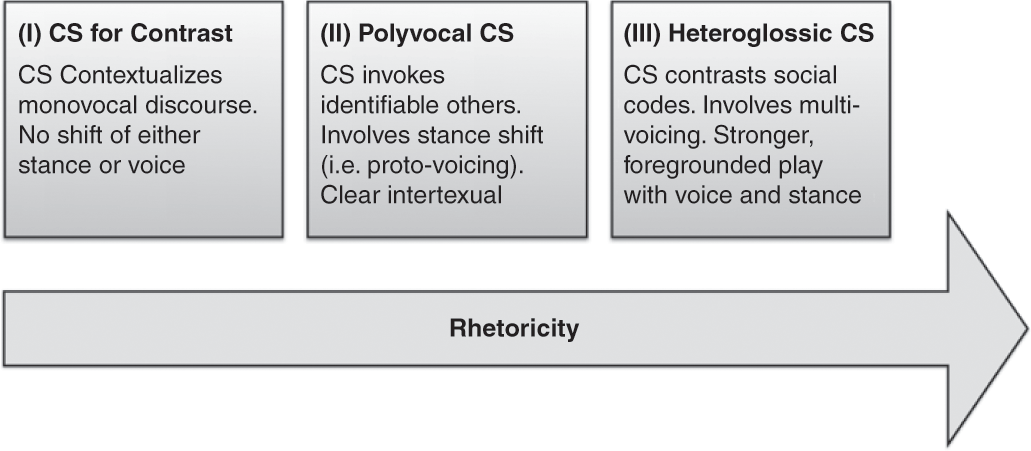
Figure 10.1 Discourse functions of written online code switching in three types, from least to most rhetorical.
Conclusion
The framework for the analysis of WOCS discourse functions according to their degrees of rhetoricity that I have presented captures most or all instances of WOCS and their discourse functions. It is important to recognize that more than one function type may be assigned to any given example of a switch. Most commonly, Type I functions co-occur with Type II or III functions, but other combinations are certainly possible.
I have suggested that the effects of globalization favor greater rhetoricity in WOCS behavior. My data show that the transnational position of diasporic writers leads to more rhetoricity in diasporic writing. At the same time, I have shown that the electronic medium itself, as a site and agent of globalization, fosters rhetoricity. Future research might treat this observation as a testable hypothesis and ask whether WOCS data written in highly diverse, metropolitan contexts for highly mixed audiences shows more highly rhetorical switch types than data produced in more traditional, peripheral settings that show fewer effects of globalization.
As my examples have suggested, rhetoricity is also especially at home in young people’s language practices. For writers whose identities are not yet fixed in ways that mark adulthood – with firm commitments to careers, life partners, and so on – rhetoricity is a mode of playful, temporary alignment with a range of identities. In Bakhtin’s original writings on the pervasiveness of multiple social voices and languages in discourse, he saw these as ways in which speakers could implicitly and symbolically negotiate social struggle under politically oppressive circumstances. Young people in most societies are typically in non-hegemonial, materially powerless positions. Thus, rhetoricity in language use becomes an important mode of connecting the self to the world at the levels of ideation and self-expression.
Introduction
Korean pop culture products have recently become increasingly popular outside Korea, particularly in Asia. The widespread and growing popularity of Korean contemporary cultural products such as TV shows, movies, and K-pop beyond the Korean domestic market has been noticed in the media. According to Huat and Iwabuch (Reference Huat, Iwabuchi, Huat and Iwabuchi2008: 2), “the flood of Korean pop culture – film, pop music and especially TV dramas – into the rest of East Asia came to be known very quickly as the ‘Korean Wave’ by the PRC audience in 1997.” The Korean Wave also known as “Hallyu” (韓流) signifies Korea’s emergence as “a new epicenter of mass media and popular culture in East Asia” over the past ten years (Nam Reference Nam2013: 209). Hallyu is positively viewed since it is “an authentic local response to the homogenizing force of cultural globalization” (Nam Reference Nam2013: 227). Hallyu is also considered “cultural hybridization between Western universalism and Asian exoticism (or particularism) that is pivotal in attracting transnational audiences” (Oh and Park Reference Oh and Park2012: 368).
Hallyu involves a range of Korean pop culture commodities, but melodramas have been particularly successful (Yin and Liew 2005 cited in Park Reference Park2010: 159). Along with Korean dramas, K-pop has become a vital force in the Korean Wave, enabling several Korean “girl groups” and “boy bands” to be popular and successful beyond Korea. These “Hallyu stars” have their websites created and maintained by well-established management companies, and fans all over the world can obtain information about these stars’ latest albums, upcoming performances, and scheduled public appearances through these websites. These websites often have a message board where fans can post messages to their favorite groups and members. As Korean popular culture products are distributed in the global market, consumers are no longer limited to Koreans anymore; transnational fans often exchange their opinions and comments online.
This paper examines microblogging called “fan board” on one of the most successful South Korean entertainment management companies. The fan board is mainly for fans to post relatively short messages for the artists they admire. In theory, fan board participants can respond to one another’s posts; however, in reality, fan board messages tend to contain predominantly one-sided praise for their stars. Although it is not explicitly stated whether censorship is practiced for so-called akphwul (“vicious reply”), it is not far-fetched to assume that some type of “language management” occurs since the website is maintained by the stars’ management companies. This particular company, SM Town (Company S hereafter), has an official YouTube channel streaming its star artists’ recent music videos. Among the artists Company S manages, Super Junior and Girls’ Generation are possibly the two most successful K-pop groups that have a robust global fan base.
This chapter examines their fan board micro posts, focusing mainly on multilingual practices, messages, and features of computer-mediated communication (CMC). Earlier research on CMC is generally based on monolingual data and deals mostly with English. No extensive academic attention has been given to multilingual CMC with the exception of a few recent studies (see, e.g. Androutsopoulos Reference Androutsopoulos2015; Danet and Herring Reference Danet and Herring2007b; Deumert Reference Deumert2014a). Furthermore, the interplay between globalization and language fellowship in online pop music fandom has not been the main focus of sociolinguistic research. This study aims to address questions regarding the linguistic resources fans recruit to mark their different yet intertwined identities as individuals, highlighting their L1 backgrounds, accentuating their group identity, and demonstrating their knowledge and skillful usage of linguistic devices in CMC. It will be further investigated how a sense of audience, or knowing who may read their posts (K-pop stars for example) contributes to their linguistic choices.
Linguistic Impact of Hallyu
Hallyu has facilitated spreading Korean popular culture as well as the Korean language. Increasing popularity of Korean dramas and K-pop has led to growing interest in learning the Korean language. In her study of student motivations for learning Korean, Sotirova (Reference Sotirova and Merinescu2014: 7) mentions Hallyu as a main factor and notes that Korean Studies program students are mostly Hallyu fans. The Korean language students in Sotirova’s study rely not only on traditional instructional materials such as textbooks and lectures, but also on K-pop and Korean dramas and movies, especially for learning colloquialisms.
The Office of Ethnic Communities of the New Zealand Government published an article in 2013 entitled “Korean Wave motivates Kiwis to learn Korean,” which discusses the impact of the pop star Psy’s success with his song “Gangnam Style.” The New Zealand Government report mentioned earlier notes that “as the song gained global popularity, an increasing number of people with no knowledge of the Korean language started singing along to ‘Oppan Gangnam Style’ which translates roughly to ‘Big Brother in Gangnam Style’.” According to a CNN report, Psy’s music video “has surpassed 2,147,483,647 views on YouTube, maxing out the site’s original view counter” (Griggs Reference Griggs2014). It is further noted in the New Zealand Government report that “The Korean Education Centre, supported by the Korean Ministry of Education, has embraced this trend and is actively promoting Korean language education in intermediate schools across the Auckland region.” According to a senior advisor at the Korean Education Centre, approximately 1,700 students take Korean as a second language in 15 schools.
Despite the importance of transnational fans in Hallyu, linguistic studies on K-pop fandom are still limited in number and scope. The involvement of K-pop fans is generally discussed in terms of “fan activism” (Jenkins Reference Jenkins2012) and “spontaneous mobilization of the fans by themselves” (Lee Reference Lee, Lee and Nornes2015: 109). In discussing K-pop fan communities in Palestine and Israel, Otmazgin and Lyan (Reference Otmazgin and Lyan2013: 70) argue that fans act as “cultural mediators” and “harbingers of globalized culture.” Otmazgin and Lyan specifically comment on language usage in K-pop fandom, noting that “an integral part of K-pop fandom includes participating in Internet forums dedicated to Hallyu, in Hebrew (for Israeli Jews) and Arabic (for Palestinians), and sometimes in English and Korean as well” (Otmazgin and Lyan Reference Otmazgin and Lyan2013: 75).
Mixed elements in K-pop are identified as forms of “textual impurity of hallyu” (see e.g. Jenkins et al. Reference Henry, Ford and Green2013; Jin and Yoon Reference Jin and Yoon2014). Jin and Yoon (Reference Jin and Yoon2014: 1286) argue that “Korean pop cultural texts tended to be identified by their hybrid and impure attributes.” Jenkins et al. (Reference Henry, Ford and Green2013: 263) define “impurity” as “unexpected mixing and mingling of cultural materials.” However, this “textual impurity” is argued to improve K-pop’s transnational accessibility and enhance its global appeal. For example, Jin and Yoon (Reference Jin and Yoon2014: 1286) report that most respondents in their research appreciate and prefer “the mixture of Korean and English” in K-pop because it makes the content “more familiar and interesting.” Jin and Yoon (Reference Jin and Yoon2014: 1288) conclude that “the technological affordances of social media and fans’ sociality interplay with each other and rapidly spread hallyu as a set of impure cultural forms.”
Then how does digital communication fit into the discussion of Hallyu? Jung’s (Reference Jung2011) research on K-pop fandom in Indonesia shows that social media affects K-pop fans’ communicative practices and plays a critical role in disseminating K-pop song texts online. Jin and Yoon (Reference Jin and Yoon2014) observe that “while the mainstream media were unable to provide North American fans with the prompt cultural and linguistic translation of Korean content, the fans kept translating and circulating hallyu materials, especially via participatory online social networking or video-streaming portal sites” (Jin and Yoon Reference Jin and Yoon2014: 1285).
Linguistic Choices and Digital Communication
Digital communication has become an integral part of routine interactions with others. As far as language issues in online communication are concerned, research generally reports two tendencies: “the dominance of English as a lingua franca of transnational communication and the representation of linguistic diversity online” (Androutsopoulos Reference Androutsopoulos2006: 428). Dąbrowska (Reference Dąbrowska2013: 66) notes that “English is frequently chosen as a language of Facebook posts, even when used between non-native users of it.” Considering the power of English in many domains of modern society and its widely recognized practical function as a lingua franca, it is no surprise that English is favored in interactions among electronic communicators who do not share the same native language. This study, however, argues that English is used neither exclusively nor dominantly in CMC among fans from different L1 backgrounds. English is definitely present, but it often co-occurs with other languages including fans’ first languages although the intelligibility of messages written in languages other than English is not always guaranteed. Furthermore, many fans also utilize Korean as a foreign language which they possess little to no knowledge of in order to index membership in K-pop fandom.
The language choices speakers make are influenced by several social factors including interlocutors, context, and subject, to name just a few. Social distance, relative status or role, degrees of formality, and functions or goals of interaction also affect language choices (Holmes Reference Holmes2013). Solidarity, group identity, and a sense of belonging often motivate speakers to choose one code over the other as argued in Gumperz’s (Reference Gumperz1982) we code and they code. Similar to code switching in face-to-face interactions, switches in CMC achieve several pragmatic functions (see Hinrichs, this volume). For example, Dąbrowska (Reference Dąbrowska2013: 76–77) notes that Hindi-English switches are used to emphasize and reinforce messages, express emotions, show respect and wishes, and indicate emotional distancing.
Electronic media normally feature informal or semi-formal language (Dąbrowska Reference Dąbrowska2013). Non-standard spelling or “orthography that deliberately rejects the norm” known as “rebellion spelling,” to borrow Sebba’s term (Reference Danesi2003), is quite common. Shaw (Reference Shaw2008: 42) notes that non-standard spelling is generally used “for comic purposes” and concludes that the existence of variable spellings is a reflection of postmodernism and an indicator of “the tensions of global and local, the borrowed and mixed identities, and the freedom to choose one’s belongingness” (Shaw Reference Shaw2008: 49). He also asserts that features representing colloquial styles such as gonna, -in, ya occur without specific affiliation with particular ethnic or local identities (Shaw Reference Shaw2008: 48). It is noted that many of the CMC features are regularly used regardless of their nationalities. African American Vernacular English (AAVE)-influenced or hip-hop related spellings such as <da> for “the” and <dat> for “that” are also found in all three groups that Shaw (Reference Shaw2008: 48) investigated (i.e. the USA, England, and Ireland). Shaw suggests that “an American voice of this kind has covert prestige everywhere (ibid.).”
Punctuation and spelling are often discussed as noteworthy features in CMC (e.g. Baron and Ling Reference Baron and Ling2011; Lewin and Donner Reference Lewin and Donner2002; Shaw Reference Shaw2008). Baron and Ling (Reference Baron and Ling2011: 61) comment specifically on a structured nature of punctuation in textspeak and propose two principles: “A principle of parsimony” and “A principle of information load.” The principle of parsimony refers to “omit punctuation, especially periods, at ends of messages” and the principle of information load is mainly concerned with the idea that “question marks carry more discourse information than periods and exclamation points because they signal a request for a response from interlocutors” (Baron and Ling Reference Baron and Ling2011: 59). Shaw (Reference Shaw2008: 48) summarizes major spelling-related CMC features such as number/letter rebus, clipping, abbreviation, initialisms, expressive oral and visual respelling, representation of spoken forms, and regularization of irregular spelling.
Although previous research provides useful findings on various aspects of CMC, most of the earlier studies focus on cyber texts constructed by single-language groups. If several groups are examined, their linguistic behaviors are compared and often contrasted separately without considering the interaction among these groups. Also, most studies deal with English CMC data. A transnational nature of e-communication is implicitly acknowledged but not discussed explicitly as a topic.
Data
Among the several popular Hallyu K-pop groups, the present study focuses on Super Junior and Girls’ Generation. These two groups are selected mainly because they are arguably the most successful Korean pop groups that became famous relatively early in the Korean Wave yet continue to demonstrate high staying power even today. Super Junior is one of the earliest and most successful groups created and managed by Company S. It has two sub-groups: Super Junior T and Super Junior M. Super Junior T consists of six members (Lee Teuk, Hee Chul, Kangin, Shindong, Sungmin, and Eunhyuk) and debuted with the album Lokkukhe on February 25, 2007. Super Junior M is composed of eight members (Sung Min, Eunhyuk, Donghae, Shiwon, Lyuwook, Kyuhyun, Zhou Mi, and Henry), according to the information available on the Super Junior Fan board.Footnote 1 Girls’ Generation, mostly known as Sonyeoshidae (소녀시대) in Korea and affectionately dubbed Soshi or SNSD, is a nine-member Korean female group that has been active since 2007. Its members are Taeyeon, Yuna, Yuri, Jessica, Sunny, Tiffany, Sooyoung, Hoyyeon, and Seohyun. Three members with English names (i.e., Jessica, Sunny, and Tiffany) were born in California and educated partly outside Korea.
I visited Company S’s website on a monthly basis and randomly collected the first ten fan board messages for the two hallyu groups mentioned above. A total of 100 messages were collected from April through August in 2014. Approximately 33 percent were exclusively in Korean. English only messages comprise 35 percent of the data and 32 percent of the posts involve language mixing. This chapter takes a qualitative approach to the data, examining mainly discourse features, and is not concerned with frequency or number of occurrences of a particular feature. The fan board shows messages from fans with different first language backgrounds around the globe including Australia, Brazil, Indonesia, Iran, Thailand and so forth. Fan board messages are written in English, Korean (in Hangul or in the Roman script), Chinese, Japanese, Thai, and Spanish. Korean words are notably incorporated even into English posts written presumably by non-Koreans. A multilingual nature of the fan board was noticeable and, in a sense, expected considering these two groups’ global fans worldwide.
What is particularly noteworthy is non-Korean speaking fans’ use of Korean expressions – mainly kinship terms, address terms, and encouraging or congratulatory remarks (cf. Garley, this volume). A few predominant patterns and themes emerged from a linguistic analysis of these messages. The following analysis focuses on five noticeable discourse features: Korean address terms and greetings, Korean colloquialisms, Konglish,Footnote 2 language mixing and CMC features.
Analysis
Korean Address Terms and Greetings
According to Speech Accommodation Theory, “converging towards the speech of another person is a polite strategy. It implies that the addressee’s speech is acceptable and worthy imitating” (Holmes Reference Holmes2013: 245). The Hallyu fans in the present study perform speech accommodations mainly through adopting Korean expressions. The most frequently appearing Korean words happen to be address terms directed towards the artists.
A brief discussion of Korean address terms should be in order here. Both gender and age become a determining factor influencing the choice of an address term in Korea. If both the speaker and the hearer are female and the speaker is younger than the addressee, the term unni is appropriate. However, when both the speaker and the hearer are male and the speaker is younger than the addressee, the word hyung is proper. If the speaker is male and the hearer is female and the speaker is younger than the addressee, the term nuna should be used. On the other hand, when the speaker is female and the hearer is male and the speaker is younger than the addressee, the term oppa is suitable. Super Junior fans in this study predominantly use the term oppa (“an older brother”), whereas Girls’ Generation fans mostly use the term unni (“an older sister”). Based on gender identity markers available on fan boards including names and pictures, one can sometimes figure out the gender of an individual without much effort. However, there is no guarantee that e-communicators on the fan board always reveal their identity truthfully, including gender. Age is another sociolinguistic variable which is hard to know because e-communicators do not normally mention how old they are. However, K-pop fans are generally believed to be fairly young, between the ages of 14 and 22, and mostly females (Otmazgin and Lyan Reference Otmazgin and Lyan2013).
What is noteworthy though, is the fact that only unni and oppa appear. The term hyung does not occur in the data and nuna appears only once. This implies, according to the rules of Korean address terms explained above, that all fans who used the terms unni and oppa should be younger than the members of Super Junior or Girls’ Generation (most likely tweens, teens, and twenty-somethings). However, it cannot be verified that all fans using unni and oppa are in fact younger than the members of Girls’ Generation and Super Junior. Also, fans using oppa and unni should be all female since these are gender-exclusive address terms in the Korean language. Again, information such as this cannot be clearly confirmed or denied in online communication, but it will be hard to argue that there are absolutely no male fans among those who used oppa and unni in this study.
Another noteworthy pragmatic feature in the microblog messages in this study is that not only Korean fans but also non-Korean fans use Korean address terms even when their messages are written exclusively in English. It is quite possible that global fans may not necessarily fully understand this rather complicated address term system in Korean but simply focus on the gender of the group and use unni to Girls’ Generation and oppa to Super Junior. In other words, global fans may not consider their own gender and use these Korean address terms indistinguishably. Excerpt (1) is posted by an Indonesian fan who uses the Korean address term oppa to write a message directed towards a member of Super Junior named Yesung.
1. YESUNG OPPA SARANGHAE WE WILL WAITING FOR YOU !!!
“Older Brother Yesung, I love you! We will be waiting for you!!!!”
The message above could be from a female fan because the term oppa can be used only by female speakers when addressing an older male, but no distinctive gender identity marker can be inferred from the fan’s login ID. It is also noteworthy that the Korean expression saranghae (“I love you”) instead of its polite counterpart saranghaeyo is used here even though the use of oppa indicates that the confessor is younger than the confessed, i.e. Yesung. If the confessor is younger than the confessed, the polite verb ending suffix -yo is used, but it is clearly absent in the excerpt. It is paradoxical that the Indonesian fan uses an expression lacking the polite ending -yo, which gives the impression that she is older than Yesung, but calls him oppa (“an older brother”). Yesung is currently inactive, and this particular fan’s wish for Yesung to rejoin the group is conveyed in the expression “WE WILL WAITING FOR YOU !!!,” which contains a syntactic deviation i.e., auxiliary deletion. Similarly, excerpt (2), a fan message from Turkey, features another instance of the Korean address term oppa, but this time the English plural marker is attached to oppa, i.e., oppas.
2. oppas thanks for coming to turkey !!!! it was an amazing show please come back again soon =)
“Older brothers, thanks for coming to Turkey!!!! It was an amazing show. Please come back again soon =)”
In expressing her gratitude for Super Junior’s successful show in Turkey, this Turkish fan addresses the members of Super Junior as oppas. What is noteworthy is that the hybrid plural form, i.e. the English plural marker bound morpheme -s attached to the Korean free morpheme oppa, is used in place of the Korean plural form oppa-tul (“older brothers”). Also, it should be noted that a few oft-cited CMC features including the use of lower case (e.g. turkey) (Frehner Reference Frehner2008), multiple exclamation points (e.g.!!!!), and emoticons indicating a smiley face (e.g., =)) (Baron and Ling Reference Baron and Ling2011) are used here. Korean address terms are also used by Girls’ Generation fans. Considering that their addressee is a “girl group,” unni, not oppa, is expected to occur. Excerpt (3) below has an example of that.
3. Annyeong SooYoung Unnie! I am your No.1 fan in my school and I am just like you, both of us love eating <3 I love you ! Saranghae Sooyoung
“Hi, Older Sister SooYoung! I am your number one fan in my school and I am just like you. Both of us love eating. I love you! I love you, Sooyoung.”
Excerpt (3) above is directly addressed to a member of Girls’ Generation, Soo Young. This particular fan highlights their shared passion for food and expresses her love for Soo Young. Her message contains the address term unni but with a slightly modified spelling (i.e. unnie), which is listed as one of the “101 Korean pop culture words you absolutely MUST know” (Acton Reference Acton2013). The elongated final vowel can carry an enhanced tone of intimacy. In addition, Baron and Ling’s (Reference Baron and Ling2011) “principle of parsimony” is at play since several punctuation marks are omitted including periods and commas, which is reported to be fairly common in CMC. Furthermore, we see the heart symbol emoticon “<3” indicating love, which is followed by the English expression “I love you!” and subsequently reinforced by its Korean verbatim translation “Saranghae.” Similar to the inappropriate use of the plain style in excerpt (1), this fan seems to indicate that she is younger than Soo Young by using the address term “unnie,” but her greeting at the beginning (i.e. “Annyeong”) replaces the usually expected polite counterpart Annyeonghaseyo. Her inappropriately informal speech is also repeated in her Korean expression “Saranghae” (“I love you”), lacking the polite sentence ending suffix -yo. Violating co-occurrence constraints in Korean in her post makes the message appear discourteous and ill-mannered by Korean standards. However, her identity as a global fan may help her avoid criticism because her attempt to use some basic Korean words to connect with the group she admires is likely to be appreciated as a sign of a dedicated fan.
Complicated Korean address terms and honorific endings can be challenging to non-Korean speakers, but some global fans in the present study demonstrate a rather sophisticated understanding of Korean kinship terms. In excerpt (4), a Brazilian fan of Super Junior deliberately uses an improper address term, creating a humor effect.
4. Good night Ajeossis! kekekeke
How are you? I’m from Brazil
I just want thank for the Super Show 5 Brazil, was perfect, I felt like a beautiful dream, I hope can live this all again someday!
We’re ~brazilian fans~ waiting to SS6!!!!
The word “Ajeossi” literally means “an uncle,” but it is not an exclusively blood-related kinship term. Korean speakers use it to address an older married male who is not a close acquaintance. Ajeossi is often contrasted with oppa, which refers to a young male. Oppa is generally used to indicate some level of familiarity or intimacy between the speaker and the addressee. The term oppa is preferred even by older males since it indexes youthfulness. All members of Super Junior are single and most members are in their twenties, so the term oppa is appropriate. However, by addressing Super Junior as ajeossis, the Brazilian fan intentionally flouts the linguistic etiquette. The use of kekekeke mimicking a chuckle shows that her use of the improper address term was intended for comic purposes. Acton (Reference Acton2013) lists kekeke as another one of “the 101 Korean pop culture words you absolutely MUST know” and explains its discourse functions as follows: “When using ‘hehehe’ just doesn’t sound cute enough to express your laughter. Some people actually ‘kekeke’ out loud, which is not recommended. Keep the kekeke-ing to texting. Over use of the kekeke can go from cute to annoying real quick. Use sparingly. Kekeke.” In place of kekekeke, Koreans would useㅋㅋㅋㅋin textspeak to represent a laugh. For non-Koreans who would not necessarily know how to type in Korean, kekekeke is a reasonable alternative to its Korean CMC equivalent. Notably, similar to excerpt (1), the hybridized plural form of ajeossi (i.e. ajeossis) is created through affixation combining the Korean free morpheme ajeossi and the English-bound plural morpheme -s. Moreover, common CMC features such as use of lower case (“we’re brazilian fans”) and omission of punctuation (“I’m from Brazil”) are present as well. Also, it is worth mentioning that an initialism that can be understood only by fans familiar with Super Junior’s international tour dubbed “The Super Show” is used along with the number 6 indicating that the next show will be their sixth worldwide concert tour.
Another Korean address term-related example is found in excerpt (5) below, but it is seems to be unique as it features the only occurrence of the Korean address term “nuna” in the data. The term누나 (nuna “an older sister”) suggests that the poster of this message is a male who is younger than the two Girls’ Generation members mentioned in the message (i.e. Yuna and Yuri). Also, it features a phonetically-oriented spelling of the expression어디이쪼요 (etiiccoyo) in place of the standard expression 어디있어요 (etiisseyo), which is immediately followed by an apology for his “broken Korean.”
5. …윤아 누나, 유리 누나??…어 디이쪼요? … sorry, broken korean..
…Yuna nuna, Yuri nuna??…etiiccoyo? …sorry, broken Korean..
“Older Sister Yuna, Older Sister Yuri?? Where are you? Sorry for my broken Korean.”
Linguistic “errors” made by global fans are not commented on by others. Their linguistic insecurity manifests itself in the form of self-deprecation, which is likely triggered by self-awareness of their “non-native” Korean speaker status. Unlike crossing (Rampton Reference Rampton1995), global fans’ provisional use of Korean may not be sanctioned as “wanna be” behavior mainly because they have already earned their group membership as fans first. Using some linguistic resources (i.e. Korean expressions) may strengthen their status as a “kolswu” (“die hard” or “fanatic”) fan.
Excerpt (6) showcases another message written in Korean. The messages from global fans discussed earlier in the chapter (i.e. excerpts (1)–(4)), are written mostly in English with some Korean address terms. In earlier excerpts, even Korean greetings and colloquial expressions are represented in English transliterations through the Roman script. In contrast, excerpt (6) below features a lengthy message mostly in Hangeul (the Korean alphabet).
6. 안녕하세요 슈퍼 주니어~!! 나는 미셸 요 그리고 난 내가 모든 음악을 사랑한다 말하고 싶어 ~:D…
Annyenghaseyyo Super Junior~!! Nanun Michelle-yo. Kuliko nan nayka eumakul saranghantako malhako siphe ~ :D…
“Hi Super Junior~!! I am Michelle. And I want to say I love all of your music ~:D”
…또한 내가 좋은 일을 계속 고맙다는 말을하고 싶었다! …And sorry, for my bad Hangul!;o;..
…ttohan nayka cohunilul kyeysok komaptanun malul hako siphessta! ……And sorry, for my bad Hangul!;o;..
“I also wanted to say thank you for continuing to do a good job!…And sorry, for my bad Hangul!”
The message above is written in awkward Korean containing several syntactic deviations. A simple greeting such as안녕하세요 (annyenghaseyyo “How are you?”) at the beginning of the message is the only partially grammatically correct and socially appropriate part of the message. This particular fan apologizes for her limited Korean language skills at the end. Her concern for “bad Hangeul” is additionally reinforced by the text-based emoticon “;o;” indicating a feeling of nervousness or embarrassment.
Some languages have rather rigid co-occurrence restrictions regarding various styles. Korean is one of them. Depending on the relationship between the speaker and the hearer, one of the six verb suffixes, namely intimate (-na), familiar (-e), plain (-ta), polite (-e yo), deferential (-supnita), and authoritative (-so), will be used in Korean (Trudgill Reference Trudgill2000: 93). In excerpt (6), this particular fan’s Korean does not sound “natural” because it does not follow co-occurrence restrictions in Korean. In fact, she mixes three different styles in one discourse. When she states that she loves all Super Junior’s music, she switches to the familiar ending -e (어) instead of the polite ending -eyo (어요) and then changes again to the plain suffix -ta (다) in the subsequent sentence.
Although Korean CMC allows informal expressions and abbreviations more liberally than face-to-face communication, co-occurrence style constraints are not generally violated. Failure to adhere to co-occurrence style constraints can still be considered impolite in Korean CMC. If a speaker “upshifts” from familiar to polite, it would not be offensive to the hearer. On the other hand, “downshifting” from polite to familiar is viewed as improper and could be perceived as a serious social blunder since it shows a lack of respect for the addressee. However, similar to excerpt (3), her attempt to use Korean expressions may be appreciated by native speakers as an indicator of her enthusiasm as a global fan even though her message clearly shows that she lacks communicative competence in Korean. No specific comments on global fans’ use of Korean are found in the data, but foreigners’ attempts to speak Korean are generally recognized positively in the form of compliments and/or pleasant surprises. It is not uncommon for Koreans to offer a compliment like “hankwukmal calhasineyyo!” (“Your Korean is good!”) even when foreigners make grammatical and pragmatic errors.
In addition to inappropriate shifts between different styles, her message also contains multiple instances of the redundant first-person pronoun, which is pragmatically inferable and therefore normally omitted in a pro-drop language like Korean. She uses three different forms yet essentially the same nominative case of the pronoun “I” in Korean (i.e. “nanun,” “nan,” “nayka”). Lexical redundancy is also evident in her use of superfluous conjunctions such as 그리고 (kuliko “and”) and 또한 (ttohan “also”). Moreover, we see unusual lexical choices as well. For instance, 좋은 일 (cohunil) means “a good thing or good news,” not “good work” which is presumably intended here as in “keep up the good work.” Furthermore, morphologically, her utterance shows that she has not mastered the ways in which verbs are conjugated in Korean. After her name, Michelle, only the polite verb suffix -yo appears without the verb “be” itself. Korean speakers would insert the verb root -i before adding the suffix.
Multiple morpho-syntactic deviations in excerpt (6) clearly indicate that this fan does not have native fluency in Korean. However, the fact that she chose to communicate in the band’s native language, not her own, signifies something sociolinguistically powerful. Holmes (Reference Holmes2013: 242) argues that speech convergence is a polite strategy indicating that “you are on the same wavelength”. Excerpt (6) is a revealing example of speech accommodation attempting to strengthen the bond between the group and an individual fan through use of a shared language.
Korean Colloquialisms
Bell’s (Reference Bell1984) audience design, the idea that speakers formulate and adjust their speech with a particular addressee in mind, is useful for analysis of the use of Korean colloquialisms in otherwise predominantly English fan board messages in this study. Bell (Reference Bell, Coupland and Jaworski2009: 268) notes that the concept of audience design can be applied to mass communication as well as face-to-face interaction. As he argues, “the basic tenet of audience design is that style is oriented to people rather than to mechanisms such as attention. Style is essentially a social thing. It marks interpersonal and intergroup relations.”
Contemporary Korean slang expressions are commonly incorporated into fan messages in this study. The transnational K-pop fans in the present study seem to have a clear sense of audience and design their language accordingly. They demonstrate a rather skillful incorporation of up-to-date and informal expressions that are popular among young Korean speakers and possibly among Hallyu fans. Two of the most frequently used colloquialisms turn out to be대박 (taypak) and 짱 (jjang), which indicate excitement, delight, and enthusiasm. In excerpt (7) below, a Girls’ Generation fan excitedly comments on their successful new album. It contains the slang expression대박 (taypak), which means “a big success” or “a great hit.”
7. i already hear all song in the album..,its 대박!!! (taypak)
“I’ve heard all the songs on the album. It is a huge success!!!”
Excerpt (8), a message from a Malaysian fan of Super Junior, contains another tremendously popular Korean slang expression, jjang (“awesome”).
8. super junior jjang!!!!!!!!!!!
annyangbuseyo,,, hai super junior!! iam your fan from malaysia!!! eventho iam not a fanatic one because iam not really know your group members, but i love your song!!! iam really love to saw donghae, eunhyuk, kangin, khuhyun, siwon, and ryeowok!!!!! these are my fav members.. but,, other members also best,, i love u all,, oh,, and of course the most adorable sungmin…. hehehe…
In addition, excerpt (8) has several syntactic deviations the most notable being overextension of the verb “am” (e.g. Iam not really know…, iam really love…) and inappropriate tense-marking (e.g., “love to saw… ”). Furthermore, we observe a few features typical of CMC: a lack of capitalization and 11 exclamation points in the first line when she praises Super Junior. This excessive use of exclamation points coupled with the Korean colloquial expression “jjang” unequivocally magnifies her praise of the band she so admires. In contrast to her explicitly expressed admiration for the entire group, her personal attachment to one member, Sungmin, is revealed somewhat timidly as indexed by her giggle or muffled laughter, i.e. hehehe.
Use of “Konglish”
Some fan board messages include so-called “Konglish” expressions which are generally understood by Koreans and used for intranational communication among Koreans. These expressions are not necessarily intelligible to non-Koreans. It is linguistically significant to note that some Hallyu fans in the present study use Konglish, although it is not for “intranational” communication among Koreans. This type of conditional use of Konglish can be viewed as a form of crossing (Rampton Reference Rampton1995); crossing refers to provisional use of linguistic features that are not generally affiliated with speakers themselves. As a result, crossing may be subject to an unfavorable characterization of inauthentic, unauthorized language use by second-language learners. However, transnational discourse space such as K-pop fandom may not mark it as “inauthentic”; rather it can be arguably viewed as a sign of linguistic loyalty and dedication. Excerpt (9) shows a message written by a supposedly Chinese fan of Donghae, a member of Super Junior M.
9. fighting!!!
The expression “fighting” is commonly used as a catchphrase to cheer at sports events in Korea, but it is also generally used to encourage someone to do a good job. An entry on the K-pop dictionary blog by MTV K reads, “pronunciation: hwaiting. noun. a term used as a word of encouragement it can also be used as a cheer.” A follow-up comment on the same blog states, “one of the most commonly used phrases in Korea is absolutely everywhere in K-Pop. While most of you may know what it means…for those of you who don’t – now, you don’t have to wonder why all your favorite idols keep telling you to ‘fighting!’” This particular fan, whose ethnic background is presumed to be Chinese based on the login name, encourages Donghae to keep up the good work by offering a Koreanized English expression. In a situation to encourage someone in action, Chinese speakers would generally use the expression jiayou (加油), which literally means “add gas or refuel.” However, this Chinese fan uses Konglish as a linguistic convergence strategy to encourage a Korean speaking member of Super Junior. Girls’ Generation fans also use the expression “fighting” as shown in excerpt (10) below. However, unlike excerpt (10), it is orthographically represented in Korean, i.e., 파이팅 (“fighting”).
10. 파이팅!!…i just want to ask..did you girls ever chat with your fan using some other application?..?..
Multilingual Practices
Along with English, Korean, and Konglish, other languages are also found in the data including Chinese, Japanese, Thai, and Spanish.
Excerpt (11), a message written by the Brazilian fan discussed earlier in excerpt (4), shows Chinese expressions in pinyin (phonetic transcribing system for Mandarin Chinese) addressed to Henry and Zhou Mi, ethnically Chinese members of Super Junior. The expressions xie xie (“thank you”) and wo ai ni (“I love you”) are offered specifically to two members who speak Chinese. Henry Lau, of Chinese ancestry, was born and raised in Toronto, Canada. English is his first language but he speaks several languages including Chinese and Korean. Zhou Mi is originally from Wuhan, China.
11. Henry and Zhoumi in next time I want hug you <3
Thanks for coming!!!!
Xie xie and wo ai ni 8D
Also, notice that EMC features such as the heart shape “<3” indicating “love,” multiple exclamation points “!!!!”, and “8D”, a manic face indexing insanity or hypomania, are used to express intense affection towards these Chinese-speaking members of Super Junior M. Although they are not extensively used, Spanish expressions occasionally appear. A message from a Miami fan in excerpt (12) below is a case in point.
12. Hola amigos. My name is Stephanie, and I just wanted to say what a great video you have on Netflix. It was the first time hearing about your group so I wanted to let you know it was excellent. I’m glad to see there is plenty of talent around the world.
She starts with a Spanish greeting, which indexes her regional affiliation. Considering that she is from a city highly populated with Latin-Americans, Spanish is a reasonable linguistic choice to mark her local identity. Although the Spanish greeting she uses is very basic, the members of Super Junior (whom she identifies as her main addressee as indicated in the pronoun “you”) would not necessarily understand Spanish. Therefore, it is challenging to view the use of Spanish here as a form of audience design, unlike the use of Korean in other examples. Excerpt (13) is a message from a Japanese fan mostly written in Japanese with a few English expressions.
13. 今君は You’re here スーパージュニア
Ima Kimi-wa You’re here Super Junior
Now you-nom You’re here Super Junior
‘Now you are here, Super Junior.’
初めて その時のように 記憶するよ Dear You
Hajimete sono tokinoyouni kiokkusuruyo Dear You
First time that time like remember-verb suffix Dear You
“I’ll remember just like the first time we met Dear You.”
When linguistic resources are not fully at their disposal, some fans are apologetic and attempt to provide some alternatives. Consider the following message sent from Spain.
14. Well, i really like this website, althouth i don’t understand it well, anyway, I wanted to say that I’m already supporting you, guys. I like your music and I think All of you are funny and tender uniquely. I’ve been crazy looking for a way to contact you, it is not the same to speak Spanish to Korean, I hope this serves as something. Regrets from spain and let me tell you, that you have a NEW BIG FAN.
The author reveals how little he (inferenced by the login name provided) can understand when he visits Super Junior’s website. Their website is not exclusively in Korean as it contains some English as well. This Spanish-speaking fan understands some but not all of the information on the website. Nonetheless, he wants to express his support for the group. Writing a fan message exclusively in Spanish would not be communicatively appropriate since the members of Super Junior do not have proficiency in Spanish. However, writing a fan message in Korean is not feasible for him because he lacks Korean language skills. Thus, he opts for a third language, English, to convey his message.
Eastern/Asian CMC Features
Although I mentioned a few CMC features earlier in the chapter whenever relevant, I will point out additional CMC features that are rather unique to Korean or Asian contexts. According to Park et al. (Reference Park, Barash, Fink and Cha2013), different emoticons are used by online communicators in Eastern and Western countries. They note that the horizontal style is favored in Western countries using the colon (:) for eyes and different mouth shapes expressing feelings, whereas the vertical style is preferred in Eastern countries using the underscore (_) for the mouth and various shapes and characteristics representing emotions for eyes (Park et al. Reference Park, Barash, Fink and Cha2013: 467–468). For example, to express happiness, :) is commonly used in Western countries, while ^^ is frequently used in Eastern countries. The present study shows that Hallyu fans utilize mostly vertical style emoticons. Below are a few examples.
15. i know you girls have FB page but the page did not reply my message… i am sad… ㅠ.ㅠ … i will always support you girls.
In the message above posted by a fan in Malaysia, the emoticon indicating a sad or crying face, ㅠ.ㅠ, is used to express disappointment about not receiving any replies to his or her Facebook message. ㅠ.ㅠ, generally pronounced yu yu, phonologically approximates crying and visually represents tears streaming down one’s face. This text-based emoticon is commonly known to most Korean internet users, but its meaning is unlikely to be immediately clear to non-Koreans. Although we do not know whether or not this particular fan in Malaysia is an ethnic Korean, it is noteworthy that he or she incorporates a Korean text-based emotion into a predominantly English text.
Excerpt (16), a message from a Super Junior fan in the Philippines, contains emoticons indexing a kiss “ :**” and a happy face “ ^^”. This particular fan uses only Korean and the emoticon in the post. The Korean expression 사랑해 (saranghae) means “I love you” in the familiar style similar to Excerpt (1), but unlike Excerpt (1), the address term oppa is not used here. This is possibly because the message is directed towards the entire group (i.e. Super Junior) not just one member as in Excerpt (1).
16. 사랑해 슈퍼주니어 :** ^^
Saranghae Super Junior :** ^^
‘I love you Super Junior :** ^^
Lewin and Donner’s (Reference Lewin and Donner2002) research on bulletin board messages lists the inappropriate use of lower and upper case letters as one of the most prevalent CMC features. Messages written exclusively in lower case are fairly common in the data. Excerpt (17), a message from a German fan named “steffi” writing to a member of Super Junior about his birthday, is an illustrative example of this.
17. hello eunhyuk oppa my name is steffi and i’m from germany also i’m a big fan of super junior. i have noticed that today is your birthday so I wanted to gratulate you. please have a nice day with your friends and have a nice party.^-
She addresses Eunhyuk as “eunhyuk oppa,” which is a combination of his name and the address term oppa. Capitalization is noticeably absent in the text. Also, similar to other messages, an emoticon is used to indicate a wink, “^.-”, which is used suggestively as a form of flirtation. What is unusual about this text is the use of an archaic verb such as “gratulate” in Netspeak (Crystal Reference Crystal2001). Arguably, the selection of the verb “gratulate” is motivated by a principle of parsimony (Baron and Ling Reference Baron and Ling2011).
Conclusion
The Korean Wave (Hallyu) has produced a group of highly successful and globally popular K-pop stars. Data dealing with fan board messages for two powerful K-pop groups in the present study show multilingual practices in cyberspace. Along with English and Korean, Chinese, Japanese, Konglish, Spanish, Thai, and other languages are used. Messages in English and Korean tend to be lengthier than the other languages. Language mixing is also common. Language mixing in this study seems to have two main functions. Global fans use Korean to demonstrate their active interest in K-pop stars’ linguistic heritage and use their native language to highlight their own national identity. Despite the fact that many of these global fans do not speak Korean, they tend to demonstrate linguistic convergence strategies utilizing certain Korean expressions. These Korean expressions range from simple greetings and address terms to contemporary slang expressions to highly Koreanized English expressions. Because they do not possess native fluency in Korean, their use of Korean address terms and colloquial expressions is not always socially appropriate, often showing limited communicative competence particularly in Korean honorific systems and co-occurrence constraints. However, I argue that the bond between stars and their fans is not based on linguistic accuracy but on linguistic fellowship, which relies on perceived shared interest and mutual support. In that regard, the sometime incorrect use of kinship terms such as oppa (“an older brother”) and unni (“an older sister”) is particularly noteworthy as it contributes to the enhanced, albeit imagined, closeness between the fan and the artist. Global fans also incorporate contemporary Korean colloquial expressions into their messages. When the text contains Korean sentences beyond the usual, well-known phrases, fans often apologize for their “poor Korean.”
Most sociolinguistic studies on linguistic insecurity focus on English. “Non-native” speakers of English often suffer from English language anxiety (Lee Reference Lee2014). The desire to learn English or speak “better” English is often instrumentally motivated and strengthened by the status and power the English language enjoys around the world as a global language. So-called small languages such as Korean have not experienced such success so far. However, what we observe in this study, albeit on a much smaller scale, is the increasing power of the Korean language as a result of the Korean Wave. As the status of Korea as a successful exporter of pop culture products improves, more fans are exposed to the Korean language, which is leading to an increased interest in learning and using Korean expressions (similar to Asian teenagers reciting English lyrics and rap due to their vested interest in American pop music and MTV). Song Hyang-geun, president of the International Korean Language Foundation notes that “a recent study revealed that most students are taking the class for their personal interests so that they can understand more about Korean dramas or send fan letters to Korean stars” (cited in Lee Reference Lee2012).
Lee (Reference Lee2012) reports that “the Ministry of Culture, Sports and Tourism, in partnership with Korea Broadcasting Advertising Corporation, announced their plan to introduce an easy and entertaining way of learning the Korean language. The lessons make use of content from K-pop music programs and hit Korean dramas that played a central role in leading the Hallyu craze.”
In addition, websites advertising Korean language programs outside Korea mention the ability to understand Korean dramas as a learning outcome. Ngee Ann Polytech, a Singaporean university, advertises its Korean language program with the catchphrase “Stay on top of the K-pop wave by learning to speak Korean!” (Ngee Ann Polytech, School of Interdisciplinary Studies).
Technology-enabled social networks and platforms such as YouTube, Twitter, Facebook, and devices like smartphones allow Hallyu artists to easily and conveniently communicate with their fans regardless of their place of residence. Their fans can be better connected with other fans around the globe as well. Language resources can be easily shared and distributed using technology. Although they all speak different languages, fans can still communicate and identify with one another using the language only they can recognize without abandoning their L1 identity. As shown in this study, fans construct a fan group identity via strategic use of Korean address terms indicating familiarity with and closeness to the artists. In other words, using Korean expressions, particularly kinship terms, creates a sense of belonging and strengthens solidarity and group identity. Korean serves as a connector, a relationship-building device, and a social bonding tool.
Another significant sociolinguistic feature in the data is global fans’ reference to their own regional identity. They generally reveal their local affiliation at the beginning of their messages, explicitly mentioning city or country names. Their national identity is often highlighted through brief L1 greetings such as Spanish hola and Chinese xie xie. However, global fans, particularly those who do not speak English as their mother tongue, do not write their fan messages exclusively in their native languages. Fans from Brazil, for example, do not write in Portuguese. Spanish-speaking fans do not use Spanish exclusively. Rather, they tend to opt for English. This seems to be done out of consideration for the main audience, i.e. K-pop stars who speak Korean and understand English but not necessarily other languages.
In addition, most global fans in the study are fairly well versed in CMC. Their messages contain oft-cited CMC features including clipping, initialisms, expressive respelling, unconventional spelling, representation of spoken forms, multiple exclamation points, and emoticons. Notably, several initialisms and text-based emoticons used by global fans in the data show that linguistic in-group membership is presumed to a certain degree; these expressions are not easily decipherable without some familiarity with contemporary Korean textspeak and acronyms.
The transnational fandom and its multilingual practices in online communication discussed in this study indicate that global fans make linguistic accommodations to Hallyu K-pop stars. Languages that are unknown to the artists are not generally used or minimally used. As a linguistic convergence strategy, global fans frequently utilize Korean kinship terms and popular Korean informal expressions. Arguably, this type of linguistic convergence (quantitatively significant or not) may facilitate forming and solidifying fellowship, which is so greatly desired in a fandom.

