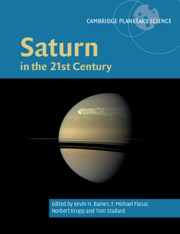
Book contents
- Saturn in the 21st Century
- Cambridge Planetary Science
- Saturn in the 21st Century
- Copyright page
- Contents
- Contributors
- Reviewers
- 1 Introduction to Saturn in the 21st Century
- 2 The Origin and Evolution of Saturn, with Exoplanet Perspective
- 3 The Interior of Saturn
- 4 Saturn’s Magnetic Field and Dynamo
- 5 The Mysterious Periodicities of Saturn
- 6 Global Configuration and Seasonal Variations of Saturn’s Magnetosphere
- 7 Saturn’s Aurorae
- 8 Saturn’s Ionosphere
- 9 Saturn’s Variable Thermosphere
- 10 Saturn’s Seasonally Changing Atmosphere
- 11 The Global Atmospheric Circulation of Saturn
- 12 Saturn’s Polar Atmosphere
- 13 The Great Saturn Storm of 2010–2011
- 14 The Future Exploration of Saturn
- Index
- References
2 - The Origin and Evolution of Saturn, with Exoplanet Perspective
Published online by Cambridge University Press: 13 December 2018

Book contents
- Saturn in the 21st Century
- Cambridge Planetary Science
- Saturn in the 21st Century
- Copyright page
- Contents
- Contributors
- Reviewers
- 1 Introduction to Saturn in the 21st Century
- 2 The Origin and Evolution of Saturn, with Exoplanet Perspective
- 3 The Interior of Saturn
- 4 Saturn’s Magnetic Field and Dynamo
- 5 The Mysterious Periodicities of Saturn
- 6 Global Configuration and Seasonal Variations of Saturn’s Magnetosphere
- 7 Saturn’s Aurorae
- 8 Saturn’s Ionosphere
- 9 Saturn’s Variable Thermosphere
- 10 Saturn’s Seasonally Changing Atmosphere
- 11 The Global Atmospheric Circulation of Saturn
- 12 Saturn’s Polar Atmosphere
- 13 The Great Saturn Storm of 2010–2011
- 14 The Future Exploration of Saturn
- Index
- References
Summary
Saturn formed beyond the snow line in the primordial solar nebula, and that made it possible for it to accrete a large mass. Disk instability and core accretion models have been proposed for Saturn’s formation, but core accretion is favored on the basis of its volatile abundances, internal structure, hydrodynamic models, chemical characteristics of protoplanetary disk, etc. The observed frequency, properties, and models of exoplanets provide additional supporting evidence for core accretion. The heavy elements with mass greater than 4He make up the core of Saturn, but are presently poorly constrained, except for carbon. The C/H ratio is super-solar, and twice that in Jupiter. The enrichment of carbon and other heavy elements in Saturn and Jupiter requires special delivery mechanisms for volatiles to these planets. In this chapter we will review our current understanding of the origin and evolution of Saturn and its atmosphere, using a multi-faceted approach that combines diverse sets of observations on volatile composition and abundances, relevant properties of the moons and rings, comparison with the other gas giant planet, Jupiter, and analogies to the extrasolar giant planets, as well as pertinent theoretical models.
Information
- Type
- Chapter
- Information
- Saturn in the 21st Century , pp. 5 - 43Publisher: Cambridge University PressPrint publication year: 2018
References
Adachi, I., Hayashi, C. and Nakazawa, K. (1976), The gas drag effect on the elliptical motion of a solid body in the primordial solar nebula, Prog. Theor. Phys., 56, 1756–1771.10.1143/PTP.56.1756CrossRefGoogle Scholar
Adams, F. C., Hollenbach, D., Laughlin, G. et al. (2004), Photoevaporation of circumstellar disks due to external far-ultraviolet radiation in stellar aggregates, Astrophys. J., 611, 360–379.CrossRefGoogle Scholar
Alibert, Y. and Mousis, O. (2007), Formation of Titan in Saturn’s subnebula: Constraints from Huygens probe measurements, Astron. Astrophys., 465, 1051–1060.10.1051/0004-6361:20066402CrossRefGoogle Scholar
Alibert, Y., Mousis, O. and Benz, W. (2005a), On the Volatile enrichments and composition of Jupiter, Astrophys. J., 622, L145–L148.10.1086/429662CrossRefGoogle Scholar
Alibert, Y., Mousis, O., Mordasini, C. et al. (2005b), New Jupiter and Saturn formation models meet observations, Astrophys. J., 626, L57–L60.10.1086/431325CrossRefGoogle Scholar
Ali-Dib, M., Mousis, O., Petit, J. M. et al. (2014), Carbon-rich planet formation in a solar composition disk, Astrophys. J., 785, 125–131.CrossRefGoogle Scholar
Altwegg, K., Balsiger, H., Bar-Nun, A. et al. (2015), 67P/ Churyumov-Gerasimenko: A Jupiter family comet with a high D/H ratio, Science, 347(6220). 1261952–1 – 1261952–3.10.1126/science.1261952CrossRefGoogle Scholar
Amelin, Y. A., Kaltenbach, A., Iizuka, T. et al. (2010), U-Pb chronology of the solar system’s oldest solids with variable 238U/235U, Earth Planet. Sci. Lett., 300, 343–350.10.1016/j.epsl.2010.10.015CrossRefGoogle Scholar
Anders, E. and Grevesse, N. (1989), Abundances of the elements: meteoritic and solar, Geochim. Cosmochim. Acta, 53, 197–214.10.1016/0016-7037(89)90286-XCrossRefGoogle Scholar
Armitage, P. (2010), Astrophysics of Planet Formation, Cambridge University Press, Cambridge.Google Scholar
Arpigny, C., Jehin, E., Manfroid, J. et al. (2003), Anomalous nitrogen isotope ratio in comets, Science, 301, 1522–1524.10.1126/science.1086711CrossRefGoogle ScholarPubMed
Asplund, M., Grevesse, N., Sauval, J. et al. (2009), The chemical composition of the Sun, Annu. Rev. Astron. Astrophys, 47, 481–522.10.1146/annurev.astro.46.060407.145222CrossRefGoogle Scholar
Atreya, S. K. (1986), Atmospheres and Ionospheres of the Outer Planets and their Satellites, pp. 66–79. Springer-Verlag, New York-Heidelberg.10.1007/978-3-642-71394-1_4CrossRefGoogle Scholar
Atreya, S. K., Adams, E. Y., Niemann, H. B. et al. (2006), Titan’s methane cycle, Planet. Space Sci., 54, 1177–1187.10.1016/j.pss.2006.05.028CrossRefGoogle Scholar
Atreya, S. K., Donahue, T. M. and Kuhn, W. R. (1978), Evolution of a nitrogen atmosphere on Titan, Science, 201, 611–613.10.1126/science.201.4356.611CrossRefGoogle ScholarPubMed
Atreya, S. K., Lorenz, R. D. and Waite, J. H. (2009), Volatile origin and cycles: Nitrogen and methane, in Titan from Cassini-Huygens, edited by Brown, R. H., Lebreton, J. P., and Waite, J., pp. 177–199, Springer Dordrecht, Heidelberg-London-New York.10.1007/978-1-4020-9215-2_7CrossRefGoogle Scholar
Atreya, S. K., Mahaffy, P. R., Niemann, H. B. et al. (2003), Composition and origin of the atmosphere of Jupiter: An update, and implications for the extrasolar giant planets, Planet. Space Sci., 51, 105–112.10.1016/S0032-0633(02)00144-7CrossRefGoogle Scholar
Atreya, S. K., Trainer, M. G., Franz, H B. et al. (2013), Primordial argon isotope fractionation in the atmosphere of Mars measured by the SAM instrument on Curiosity, and implications for atmospheric loss, Geophys. Res. Lett., 40, 5605–5609.10.1002/2013GL057763CrossRefGoogle Scholar
Atreya, S. K. and Wong, A. S. (2005), Coupled chemistry and clouds of the giant planets: A case for multiprobes, Space Sci. Rev., 116, 121–136.10.1007/s11214-005-1951-5CrossRefGoogle Scholar
Atreya, S. K., Wong, M. H., Owen, T. C. et al. (1999), A Comparison of the atmospheres of Jupiter and Saturn: Deep atmospheric composition, cloud structure, vertical mixing, and origin, Planet. Space Sci., 47, 1243–1262.10.1016/S0032-0633(99)00047-1CrossRefGoogle ScholarPubMed
Ayliffe, B. and Bate, M. (2009a), Circumplanetary disc properties obtained from radiation hydrodynamical simulations of gas accretion by protoplanets, MNRAS, 397, 657–665.10.1111/j.1365-2966.2009.15002.xCrossRefGoogle Scholar
Ayliffe, B. and Bate, M. (2009b), Gas accretion on to planetary cores: Three-dimensional self-gravitating radiation hydrodynamical calculations, MNRAS, 393, 49–64.10.1111/j.1365-2966.2008.14184.xCrossRefGoogle Scholar
Ayliffe, B. and Bate, M. (2012), The growth and hydrodynamic collapse of a protoplanet envelope, MNRAS, 427, 2597–2612.10.1111/j.1365-2966.2012.21979.xCrossRefGoogle Scholar
Baraffe, I., Chabrier, G. and Barman, T. (2008), Structure evolution of super-Earth to super-Jupiter exoplanets. I. Heavy element enrichment in the interior, Astron. Astrophys., 482, 315–332.10.1051/0004-6361:20079321CrossRefGoogle Scholar
Baraffe, I., Chabrier, G., Fortney, J. et al. (2014), Planetary internal structures, in Protostars and Planets VI, edited by Beuther, H., Klessen, R., Dullemond, C., and Henning, Th, University of Arizona Press, Tucson, AZ.Google Scholar
Barstow, J. K., Aigrain, S., Irwin, P. G. J. et al. (2014), Clouds on the Hot Jupiter HD189733b: Constraints from the Reflection Spectrum, Astrophys. J. 786, 154.10.1088/0004-637X/786/2/154CrossRefGoogle Scholar
Baruteau, C., Crida, A., Paardekooper, S. J. et al. (2014), Planet-disc interactions and early evolution of planetary systems, in Protostars and Planets VI, edited by Beuter, H., Klessen, R., Dullemond, C., and Henning, T.. University of Arizona Press, Tucson, AZ.Google Scholar
Bate, M. R., Lubow, S. H., Ogilvie, G. I. et al. (2003), Three-dimensional calculations of high- and low-mass planets embedded in protoplanetary discs, MNRAS, 341, 213–229.10.1046/j.1365-8711.2003.06406.xCrossRefGoogle Scholar
Batygin, K. and Stevenson, D. J. (2010), Inflating hot Jupiters with ohmic dissipation, Astrophys. J., 714, L238–L243.10.1088/2041-8205/714/2/L238CrossRefGoogle Scholar
Birkby, J. L., de Kok, R. J., Brogi, M. et al. (2013), Detection of water absorption in the day side atmosphere of HD 189733 b using ground-based high-resolution spectroscopy at 3.2 μm, MNRAS, 436, 35–39.10.1093/mnrasl/slt107CrossRefGoogle Scholar
Bitsch, B., Crida, A., Morbidelli, A. et al. (2013), Stellar irradiated discs and implications on migration of embedded planets. I. Equilibrium discs, Astron. Astrophys., 549, A124–137.CrossRefGoogle Scholar
Bitsch, B., Morbidelli, A., Lega, E. et al. (2014), Stellar irradiated discs and implications on migration of embedded planets. II. Accreting-discs, Astron. Astrophys., 564, A135–146.10.1051/0004-6361/201323007CrossRefGoogle Scholar
Black, D. C. (1972), The origins of trapped helium, neon, and argon isotopic variations in meteorites-I, Geochim. Cosmochim. Acta, 36, 347–375.10.1016/0016-7037(72)90028-2CrossRefGoogle Scholar
Bockelée-Morvan, D., Biver, N., Jehin, E. et al. (2008), Large excess of heavy nitrogen in both hydrogen cyanide and cyanogen from comet 17P/Holmes, Astrophys. J., 679, L49–L52.CrossRefGoogle Scholar
Bolton, S. J., Adriani, S., Adumitroaie, V., Allison, M., Anderson, J., Atreya, S. K. et al. (2017), Jupiter’s interior and deep atmosphere: the initial pole-to-pole passes with the Juno spacecraft, Science, 356, 821–825.10.1126/science.aal2108CrossRefGoogle ScholarPubMed
Bodenheimer, P., Lin, D. N. C. and Mardling, R. A. (2001), On the tidal inflation of short-period extrasolar planets, Astrophys. J., 548, 466–472.10.1086/318667CrossRefGoogle Scholar
Boss, A. P. (2000), Possible rapid gas giant planet formation in the solar nebula and other protoplanetary disks, Astrophys. J., 536, L101–L104.10.1086/312737CrossRefGoogle ScholarPubMed
Briggs, F. H. and Sackett, P. D. (1989), Radio observations of Saturn as a probe of its atmosphere and cloud structure, Icarus, 80, 77–103.10.1016/0019-1035(89)90162-0CrossRefGoogle Scholar
Brogi, M., Snellen, L. A. G., de Kok, R. J. et al. (2012), The signature of orbital motion from the dayside of the planet τ Boötis b, Nature, 486, 502–504.10.1038/nature11161CrossRefGoogle ScholarPubMed
Burrows, A., Hubeny, I., Budaj, J. et al. (2007), Possible solutions to the radius anomalies of transiting giant planets, Astrophys. J., 661, 502–514.10.1086/514326CrossRefGoogle Scholar
Cameron, A. G. W. (1973), Abundances of the elements in the solar system, Space Sci. Rev. 15, 121–146.CrossRefGoogle Scholar
Cameron, A. G. W. (1979), The interaction between giant gaseous protoplanets and the primitive solar nebula, The Moon and the Planets, 21, 173–183.10.1007/BF00897086CrossRefGoogle Scholar
Cameron, A. G. W. (1982), Elemental and nuclidic abundances in the solar system, in Essays in Nuclear Astrophysics, edited by Fowler, W. A., pp. 23–43, Cambridge University Press.Google Scholar
Canup, R. M. (2010), Origin of Saturn’s rings and inner moons by mass removal from a lost Titan-sized satellite, Nature, 468, 943–946.10.1038/nature09661CrossRefGoogle ScholarPubMed
Canup, R. M. and Ward, W. R. (2002), Formation of the Galilean satellites: Conditions of accretion, Astron. J., 124, 3404–3423.10.1086/344684CrossRefGoogle Scholar
Castillo-Rogez, J., Johnson, T. V., Lee, M. H. et al. (2009), 26Al decay: Heat production and a revised age for Iapetus, Icarus, 204, 658–662.10.1016/j.icarus.2009.07.025CrossRefGoogle Scholar
Charbonneau, D., Knutson, H. A., Barman, T. et al. (2008), The broadband infrared emission spectrum of the exoplanet HD 189733b, Astrophys. J., 686, 2, 1341–1348.10.1086/591635CrossRefGoogle Scholar
Charnoz, S., Crida, A., Castillo-Rogez, J. C. et al. (2011), Accretion of Saturn’s mid-sized moons during the viscous spreading of young massive rings: Solving the paradox of silicate-poor rings versus silicate-rich moons, Icarus, 216, 535–550.10.1016/j.icarus.2011.09.017CrossRefGoogle Scholar
Charnoz, S., Salmon, J. and Crida, A. (2010), The recent formation of Saturn’s moonlets from viscous spreading of the main rings, Nature, 465, 752–754.10.1038/nature09096CrossRefGoogle ScholarPubMed
Chiang, E. and Goldreich, P. (1997), Spectral energy distributions of T Tauri stars with passive circumstellar disks, Astrophys. J., 490, 368–376.10.1086/304869CrossRefGoogle Scholar
Chick, K. M. and Cassen, P. (1997), Thermal processing of interstellar dust grains in the primitive solar environment, Astrophys. J., 477, 398–409.CrossRefGoogle Scholar
Conrath, B. J. and Gautier, D. (2000), Saturn helium abundance: A reanalysis of Voyager measurements, Icarus, 144, 124–134.10.1006/icar.1999.6265CrossRefGoogle Scholar
Conrath, B. J., Gautier, D., Hanel, R. A. et al. (1984), The helium abundance of Saturn from Voyager measurements, Astrophys. J., 282, 807–815.CrossRefGoogle Scholar
Conrath, B. J., Hanel, R. A. and Samuelson, R. E. (1989), Thermal structure and heat balance of the outer planets, in Origin and Evolution of Planetary and Satellite Atmospheres, edited by. Atreya, S. K., Pollack, J. B., and Matthews, M. S., pp. 513–538, University of Arizona Press, Tucson, AZ.CrossRefGoogle Scholar
Cossou, C., Raymond, S. and Pierens, A. (2013), Convergence zones for Type I migration: An inward shift for multiple planet systems, Astron. Astrophys., 553, L2 (5 pp.).10.1051/0004-6361/201220853CrossRefGoogle Scholar
Crida, A. and Batygin, K. (2014), Spin-Orbit angle distribution and the origin of (mis)aligned hot Jupiters, Astron. Astrophys., 567, A42 (8 pp.).10.1051/0004-6361/201323292CrossRefGoogle Scholar
Crida, A. and Charnoz, S. (2012), Formation of regular satellites from ancient massive rings in the solar system, Science, 338, 1196–1199.10.1126/science.1226477CrossRefGoogle ScholarPubMed
Crida, A. and Morbidelli, A. (2007), Cavity opening by a giant planet in a protoplanetary disc and effects on planetary migration, MNRAS, 377, 1324–1336.10.1111/j.1365-2966.2007.11704.xCrossRefGoogle Scholar
Crida, A., Morbidelli, A. and Masset, F. (2006), On the width and shape of gaps in protoplanetary disks, Icarus, 181, 587–604.10.1016/j.icarus.2005.10.007CrossRefGoogle Scholar
Croll, B., Lafreniere, D., Albert, L. et al. (2011), Near-infrared thermal emission from WASP-12b: Detections of the secondary eclipse in Ks, H, and J, Astron. J., 141, 30–42.10.1088/0004-6256/141/2/30CrossRefGoogle Scholar
Currie, T., Burrows, A., Itoh, Y. et al. (2011), A combined Subaru/VLT/MMT 1–5 μm study of planets orbiting HR 8799: Implications for atmospheric properties, masses, and formation, Astrophys. J., 729, 128–147.10.1088/0004-637X/729/2/128CrossRefGoogle Scholar
Dahmen, G., Wilson, T. L. and Matteucci, F. (1995), The nitrogen isotope abundance in the galaxy 1: The galactic disk gradient, Astron. Astrophys., 295, 194–198.Google Scholar
Dartois, E., Dutrey, A. and Guilloteau, S. (2003), Structure of the DM Tau outer disk: probing the vertical kinetic temperature gradient, Astron. Astrophys., 399, 773–787.10.1051/0004-6361:20021638CrossRefGoogle Scholar
Delgado-Mena, E., Israelian, G., González Hernández, J. I. et al. (2010), Chemical clues on the formation of planetary systems: C/O versus Mg/Si for HARPS GTO sample, Astrophys. J., 725, 2349–2358.10.1088/0004-637X/725/2/2349CrossRefGoogle Scholar
Deming, D., Wilkins, A., McCullough, P. et al. (2013), Infrared transmission spectroscopy of the exoplanets HD 209458b and XO-1b using the wide field camera-3 on the Hubble Space Telescope, Astrophys. J., 774, 95–112.CrossRefGoogle Scholar
Demory, B. J., de Wit, J., Lewis, N. et al. (2013), Inference of inhomogeneous clouds in an exoplanet atmosphere, Astrophys. J. Lett., 776, L25 (7 pp.).CrossRefGoogle Scholar
de Pater, I. and Massie, S. T. (1985), Models of the millimeter-centimeter spectra of the giant planets, Icarus, 62, 143–171.CrossRefGoogle Scholar
Dodson-Robinson, S. E., Bodenheimer, P., Laughlin, G. et al. (2008), Saturn forms by core accretion in 3.4 Myr, Astrophys. J., 688, L99–L102.10.1086/595616CrossRefGoogle Scholar
Dubrulle, B., Morfill, G. and Sterzik, M. (1995), The dust subdisk in the protoplanetary nebula, Icarus, 114, 237–246.CrossRefGoogle Scholar
Dürmann, C. and Kley, W. (2015), Migration of massive planets in accreting disks, Astron. Astrophys., 574, A52.CrossRefGoogle Scholar
Dyudina, U. A., Ingersoll, A. P., Ewald, S. P. et al. (2010), Detection of visible lightning on Saturn, Geophys. Res. Lett., 37, L09205.10.1029/2010GL043188CrossRefGoogle Scholar
Dyudina, U. A., Ingersoll, A. P., Ewald, S. P. et al. (2013), Saturn’s visible lightning, its radio emissions, and the structure of the 2009–2011 lightning storms, Icarus, 226, 1020–1037.10.1016/j.icarus.2013.07.013CrossRefGoogle Scholar
Eberhardt, P. (1974), A Neon-E-rich phase in the orgueil carbonaceous chondrite, Earth Planet. Sci. Lett., 24, 182–187.10.1016/0012-821X(74)90095-8CrossRefGoogle Scholar
Estrada, P. R., Mosqueira, I. and Charnoz, S. (2009), The Ganymede, Titan, Callisto, Iapetus trend: Interpretation of Iapetus’ composition, AGU Fall Meeting Abstracts, C1148.Google Scholar
Evans, T. M., Pont, F., Sing, D. K. et al. (2013), The deep blue color of HD 189733b: albedo measurements with Hubble Space Telescope/space telescope imaging spectrograph at visible wavelengths, Astrophys. J. Lett. 772, L16 (5 pp.).10.1088/2041-8205/772/2/L16CrossRefGoogle Scholar
Fabrycky, D. and Tremaine, S. (2007), Shrinking binary and planetary orbits by Kozai cycles with Tidal friction, Astrophys. J., 669, 1298–1315.10.1086/521702CrossRefGoogle Scholar
Fegley, B. and Prinn, R. G. (1985), Equilibrium and nonequilibrium chemistry of Saturn’s atmosphere: Implications for the observability of PH3, N2, CO, and GeH4, Astrophys. J., 299, 1067–1078.10.1086/163775CrossRefGoogle Scholar
Flasar, F. M., Achterberg, R. K., Conrath, B. J. et al. (2005), Temperatures, winds, and composition in the Saturnian system, Science, 307, 1247–1251.CrossRefGoogle ScholarPubMed
Fletcher, L. N., Baines, K. H., Momary, T. W. et al. (2011), Saturn’s tropospheric composition and clouds from Cassini/VIMS 4.6–5.1 μm nightside spectroscopy, Icarus, 214, 510–533.10.1016/j.icarus.2011.06.006CrossRefGoogle Scholar
Fletcher, L. N., Greathouse, T. K., Orton, G. S. et al. (2014), The origin of nitrogen on Jupiter and Saturn from the 15N/14N ratio, Icarus, 238, 170–190.10.1016/j.icarus.2014.05.007CrossRefGoogle Scholar
Fletcher, L. N., Orton, G. S., Teanby, N. A. et al. (2009a), Phosphine on Jupiter and Saturn from Cassini/CIRS, Icarus, 202, 543–564.10.1016/j.icarus.2009.03.023CrossRefGoogle Scholar
Fletcher, L. N., Orton, G. S., Teanby, N. A.(2009b), Methane and its isotopologues on Saturn from Cassini/CIRS Observations, Icarus, 199, 351–367.10.1016/j.icarus.2008.09.019CrossRefGoogle Scholar
Folkner, W. M., Woo, R. and Nandi, S. (1998), Ammonia abundance in Jupiter’s atmosphere derived from attenuation of the Galileo Probe’s radio signal, J. Geophys. Res., 103, 22847–22856.10.1029/98JE01635CrossRefGoogle Scholar
Fortney, J. J., Lodders, K., Marley, M. S. et al. (2008), A unified theory for the atmospheres of the hot and very hot Jupiters: Two classes of irradiated atmospheres, Astrophys. J., 678, 1419–1435.CrossRefGoogle Scholar
Fouchet, T., Lellouch, E., Bezard, B. et al. (2000), ISO-SWS observations of Jupiter: measurement of the ammonia tropospheric profile and of the 15N/14N isotopic ratio, Icarus, 143, 223–243.10.1006/icar.1999.6255CrossRefGoogle Scholar
Fujii, Y. I., Okuzumi, S. and Inutsuka, S. (2011), A fast and accurate calculation scheme for ionization degrees in protoplanetary and circumplanetary disks with charged dust grains, Astrophys. J., 743, 53–61.10.1088/0004-637X/743/1/53CrossRefGoogle Scholar
Fujii, Y. I., Okuzumi, S., Tanigawa, T. et al. (2014), On the viability of the magnetorotational instability in circumplanetary disks, Astrophys. J., 785, 101–108.10.1088/0004-637X/785/2/101CrossRefGoogle Scholar
Gaudi, B. S. and Winn, J. N. (2007), Prospects for the characterization and confirmation of transiting exoplanets via the Rossiter–McLaughlin effect, Astrophys. J., 655, 550–563.10.1086/509910CrossRefGoogle Scholar
Gaulme, P., Schmider, F. X., Gay, J. et al. (2011), Detection of Jovian seismic waves: A new probe of its interior structure, Astron. Astrophys., 531, A104 (7 pp.).10.1051/0004-6361/201116903CrossRefGoogle Scholar
Gautier, D., Hersant, F., Mousis, O. et al. (2001), Enrichments in volatiles in Jupiter: A new interpretation of the Galileo measurements. Astrophys. J., 550, L227–L230.10.1086/319648CrossRefGoogle Scholar
Geiss, J. (1993), Primordial abundance of hydrogen and helium isotopes, in Origin and Evolution of the Elements, edited by Prantzos, N., Vangioni-Flam, E., and Cassé, M., pp. 89–106, Cambridge University Press, Cambridge.Google Scholar
Geiss, J. and Gloeckler, G. (1998), Abundances of deuterium and helium-3 in the protosolar cloud, Space Sci. Rev., 84, 239–250.10.1023/A:1005039822524CrossRefGoogle Scholar
Geiss, J. and Reeves, H. (1972), Cosmic and solar system abundances of deuterium and helium-3, Astron. Astrophys., 18, 126–132.Google Scholar
Gibb, E. L., Whittet, D. C. B., Boogert, A. C. A. et al. (2004), Interstellar ice: The infrared space observatory legacy, Astrophys. J. Supp. Ser., 151, 35–73.CrossRefGoogle Scholar
Gorti, U., Dullemond, C. P. and Hollenbach, D. (2009), Time evolution of viscous circumstellar disks due to photoevaporation by far-ultraviolet, extreme-ultraviolet, and X-ray radiation from the central star, Astrophys. J., 705, 1237–1251.10.1088/0004-637X/705/2/1237CrossRefGoogle Scholar
Grevesse, N., Asplund, M. and Sauval, A. J. (2005), The new solar chemical composition, in Elements Stratification in Stars, 40 Years of Atomic Diffusion, edited by Alecian, G., Richard, O., and Vauclair, S., 17, pp. 21–30, EAS Publications Series.10.1051/eas:2005095CrossRefGoogle Scholar
Grevesse, N., Asplund, M. and Sauval, A. J. (2007), The solar chemical composition, Space Sci. Rev., 130, 105–114.10.1007/s11214-007-9173-7CrossRefGoogle Scholar
Grossman, A. S., Pollack, J. B., Reynolds, R. T. et al. (1980), The effect of dense cores on the structure and evolution of Jupiter and Saturn, Icarus, 42, 358–379.10.1016/0019-1035(80)90102-5CrossRefGoogle Scholar
Guillot, T. and Hueso, R. (2006), The composition of Jupiter: Sign of a (relatively) late formation in a chemically evolved protosolar disc, MNRAS, 367, L47–L51.10.1111/j.1745-3933.2006.00137.xCrossRefGoogle Scholar
Guillot, T., Santos, N. C., Pont, F. et al. (2006), A correlation between the heavy element content of transiting extrasolar planets and the metallicity of their parent stars, Astron. Astrophys, 453, L21–L24.10.1051/0004-6361:20065476CrossRefGoogle Scholar
Guillot, T. and Showman, A. P. (2002), Evolution of “51 Pegasus b-like” planets, Astron. Astrophys., 385, 156–165.10.1051/0004-6361:20011624CrossRefGoogle Scholar
Guillot, T., Stevenson, D. J., Hubbard, W. B. et al. (2004), The interior of Jupiter, in Jupiter. The Planet, Satellites and Magnetosphere, edited by Bagenal, F., Dowling, T. E., and McKinnon, W. B., pp. 35–57, Cambridge University Press, Cambridge.Google Scholar
Hartogh, P., Lis, D. C., Bockelée-Morvan, D. et al. (2011), Ocean-like water in the Jupiter-family comet 103P/Hartley 2, Nature, 478, 218–220. doi:10.1038/nature10519; pmid: 21976024.CrossRefGoogle ScholarPubMed
Hayashi, C. (1981), Structure of the solar nebula, growth and decay of magnetic fields and effects of magnetic and turbulent viscosities on the nebula, Prog. Theor. Phys. Supp., 70, 35–53.10.1143/PTPS.70.35CrossRefGoogle Scholar
Haynes, K., Mandell, A. M., Madhusudhan, N. et al. (2015), Spectroscopic evidence for a temperature inversion in the dayside atmosphere of hot Jupiter WASP-33b, Astrophys. J., 806, 146, 12 pp.10.1088/0004-637X/806/2/146CrossRefGoogle Scholar
Helled, R. and Guillot, T. (2013), Interior models of Saturn: Including the uncertainties in shape and rotation, Astrophys. J., 767, 113–119.10.1088/0004-637X/767/2/113CrossRefGoogle Scholar
Helled, R. and Lunine, J. I. (2014), Measuring Jupiter’s water abundance by Juno: The link between interior and formation models, MNRAS, 441, 2273–2279.10.1093/mnras/stu516CrossRefGoogle Scholar
Helling, C., Woitke, P., Rimmer, P. B. et al. (2014), Disk evolution, element abundances and cloud properties of young gas giant planets, Life, 4, 142–173.10.3390/life4020142CrossRefGoogle ScholarPubMed
Hersant, F., Gautier, D., Tobie, G. et al. (2008), Interpretation of the carbon abundance in Saturn measured by Cassini, Planet. Space Sci., 56, 1103–1111.CrossRefGoogle Scholar
Hoffman, J. H., Hodges, R. R., McElroy, M. B. et al. (1979), Composition and structure of the Venus atmosphere: Results from Pioneer Venus, Science, 205, 49–52.10.1126/science.205.4401.49CrossRefGoogle ScholarPubMed
Howard, A. W. (2013), Observed properties of extrasolar planets, Science, 340, 572–576.10.1126/science.1233545CrossRefGoogle ScholarPubMed
Hubeny, I., Burrows, A. and Sudarsky, D. (2003), A possible bifurcation in atmospheres of strongly irradiated stars and planets, Astrophys. J., 594, 1011–1018.10.1086/377080CrossRefGoogle Scholar
Ida, S., Lin, D. N. C. and Nagasawa, M. (2013), Toward a deterministic model of planetary formation. VII. Eccentricity distribution of gas giants, Astrophys. J., 775, 42–66.10.1088/0004-637X/775/1/42CrossRefGoogle Scholar
Ikoma, M., Emori, H. and Nakazawa, K. (2001), Formation of giant planets in dense nebulae: Critical core mass revisited, Astrophys. J., 553, 99–1005.CrossRefGoogle Scholar
Ishimaru, R., Sekine, Y., Matsui, T. et al. (2011), Oxidizing proto-atmosphere on Titan: Constraint from N2 formation by impact shock, Astrophys. J. Lett., 741, L10 (6 pp.).10.1088/2041-8205/741/1/L10CrossRefGoogle Scholar
Janson, M., Brandt, T. D., Kuzuhara, M. et al. (2013), Direct imaging detection of methane in the atmosphere of GJ 504 b, Astrophys. J. Lett., 778, L4 (6 pp.).10.1088/2041-8205/778/1/L4CrossRefGoogle Scholar
Jewitt, D., Matthews, H. E., Owen, T. et al. (1997), The 12C/13C, 14N/15N and 32S/ 34S isotope ratios in comet Hale–Bopp (C/1995 O1), Science, 278, 90–93.10.1126/science.278.5335.90CrossRefGoogle ScholarPubMed
Johansen, A., Oishi, J. S., Mac Low, M. et al. (2007), Rapid planetesimal formation in turbulent circumstellar disks, Nature, 448, 1022–1025.10.1038/nature06086CrossRefGoogle ScholarPubMed
Johansen, A. and Youdin, A. (2007), Protoplanetary disk turbulence driven by the streaming instability: Nonlinear saturation and particle concentration, Astrophys. J., 662, 627–641.10.1086/516730CrossRefGoogle Scholar
Johansen, A., Youdin, A. and Mac Low, M. M. (2009), Particle clumping and planetesimal formation depend strongly on metallicity, Astrophys. J., 704, L75–L79.10.1088/0004-637X/704/2/L75CrossRefGoogle Scholar
Johnson, J. A., Aller, K. M., Howard, A. W. et al. (2010), Giant planet occurrence in the stellar mass-metallicity plane, PASP, 122, 905–915.10.1086/655775CrossRefGoogle Scholar
Jones, T. D. and Lewis, J. S. (1987), Estimated impact shock production of N2 and organic compounds on early Titan, Icarus, 72, 381–393.CrossRefGoogle Scholar
Karkoschka, E. and Tomasko, M. G. (2011), The haze and methane distributions on Neptune from HST-STIS spectroscopy, Icarus, 211, 328–340.10.1016/j.icarus.2010.08.013CrossRefGoogle Scholar
Knutson, H. A., Howard, A. W. and Isaacson, H. (2010), A correlation between stellar activity and hot Jupiter emission spectra, Astrophys. J., 720, 1569–1576.10.1088/0004-637X/720/2/1569CrossRefGoogle Scholar
Kokubo, E. and Ida, S. (1998), Oligarchic growth of protoplanets, Icarus, 131, 171–178.10.1006/icar.1997.5840CrossRefGoogle Scholar
Konopacky, Q. M., Barman, T. S., Macintosh, B. A. et al. (2013), Detection of carbon monoxide and water absorption lines in an exoplanet atmosphere, Science, 339, 1398–1401.10.1126/science.1232003CrossRefGoogle Scholar
Kouchi, A., Yamamoto, T., Kozasa, T. et al. (1994), Conditions for condensation and preservation of amorphous ice and crystallinity of astrophysical ices, Astron. Astrophys., 290, 1009–1018.Google Scholar
Kreidberg, L., Bean, J. L., Désert, J. M. et al. (2014), A precise water abundance measurement for the hot Jupiter WASP-43b, Astrophys J. Lett., 793, L27 (6 pp.).10.1088/2041-8205/793/2/L27CrossRefGoogle Scholar
Lainey, V., Jacobson, R. A., Tajeddine, R. et al. (2015), New constraints on Saturn’s interior from Cassini astrometric data. Submitted.Google Scholar
Lainey, V., Karatakin, Ö., Desmars, J. et al. (2012), Strong tidal dissipation in Saturn and constraints on Enceladus’ thermal state from astrometry, Astrophys. J., 752, 14–32.10.1088/0004-637X/752/1/14CrossRefGoogle Scholar
Lambrechts, M. and Johansen, A. (2012), Rapid growth of gas-giant cores by pebble accretion, Astron. Astrophys., 544, A32.10.1051/0004-6361/201219127CrossRefGoogle Scholar
Lambrechts, M., Johansen, A. and Morbidelli, A. (2014), Separating gas-giant and ice-giant planets by halting pebble accretion, Astron. Astrophys., 572, A35.10.1051/0004-6361/201423814CrossRefGoogle Scholar
Laraia, A. L., Ingersoll, A. P., Janssen, M. A. et al. (2013), Analysis of Saturn’s thermal emission at 2.2-cm wavelength: Spatial distribution of ammonia vapor, Icarus, 226, 641–654.10.1016/j.icarus.2013.06.017CrossRefGoogle Scholar
Leconte, J., Chabrier, G., Baraffe, I. et al. (2010), Is tidal heating sufficient to explain bloated exoplanets? Consistent calculations accounting for finite initial eccentricity, Astron. Astrophys., 516, A64 (13 pp.).10.1051/0004-6361/201014337CrossRefGoogle Scholar
Lee, J. M., Fletcher, L. N. and Irwin, P. G. J. (2012), Optimal estimation retrievals of the atmospheric structure and composition of HD 189733b from secondary eclipse spectroscopy, MNRAS, 420, 170–182.10.1111/j.1365-2966.2011.20013.xCrossRefGoogle Scholar
Lellouch, E., Bézard, B., Fouchet, T. et al. (2001), The deuterium abundance in Jupiter and Saturn from ISO-SWS observations, Astron. Astrophys., 370, 610–622.10.1051/0004-6361:20010259CrossRefGoogle Scholar
Li, C. and Ingersoll, A. P. (2015), Moist convection in hydrogen atmospheres and the frequency of Saturn’s giant storms, Nat. Geosci. 8, 398–403.10.1038/ngeo2405CrossRefGoogle Scholar
Lin, D. N. C., Bodenheimer, P. and Richardson, D. C. (1996), Orbital migration of the planetary companion of 51 Pegasi to its present location, Nature, 380, 606–607.10.1038/380606a0CrossRefGoogle Scholar
Lin, D. N. C. and Papaloizou, J. (1986), On the tidal interaction between protoplanets and the protoplanetary disk. III. Orbital migration of protoplanets, Astrophys. J., 309, 846–857.10.1086/164653CrossRefGoogle Scholar
Lodders, K. (2004), Jupiter formed with more tar than ice, Astrophys. J., 611, 587–597.10.1086/421970CrossRefGoogle Scholar
Lodders, K. (2008), The solar argon abundance, Astrophys. J., 674, 607–611.10.1086/524725CrossRefGoogle Scholar
Lodders, K. and Fegley, B. (2002), Atmospheric chemistry in giant planets, brown dwarfs, and low-mass dwarf stars. I. Carbon, nitrogen, and oxygen, Icarus, 155, 393–424.10.1006/icar.2001.6740CrossRefGoogle Scholar
Lodders, K., Palme, H. and Gail, H. P. (2009), Abundances of the elements in the solar system, in Landolt-Börnstein New Series, Astron. and Astrophys., edited by Trümper, J. E., vol. VI/4B, pp. 560–630, Springer-Verlag, Berlin.Google Scholar
Lunine, J. I., Atreya, S. K. and Pollack, J. B. (1989), Present state and chemical evolution of the atmospheres of Titan, Triton, and Pluto, in Origin and Evolution of Planetary and Satellite Atmospheres, edited by Atreya, S. K., Pollack, J. B., and Matthews, M. S., pp. 605–665, University of Arizona Press, Tucson, AZ.CrossRefGoogle Scholar
Lyra, W., Paardekooper, S. and Mac Low, M. (2010), Orbital migration of low-mass planets in evolutionary radiative models: Avoiding catastrophic infall, Astrophys. J. Lett., 715, L68–L73.10.1088/2041-8205/715/2/L68CrossRefGoogle Scholar
Machida, M. N., Kokubo, E., Inutsuka, S. I. et al. (2008), Angular momentum accretion onto a gas giant planet, Astrophys. J., 685, 1220–1236.10.1086/590421CrossRefGoogle Scholar
Macintosh, B., Graham, J. R., Barman, T. et al. (2015), Discovery and spectroscopy of the young Jovian planet 51 Eri b with the Gemini Planet Imager, Science, 350, 64–67.CrossRefGoogle Scholar
Madhusudhan, N. (2012), C/O ratio as a dimension for characterizing exoplanetary atmospheres, Astrophys. J., 758, 36–57.10.1088/0004-637X/758/1/36CrossRefGoogle Scholar
Madhusudhan, N., Amin, M. A. and Kennedy, G. M. (2014c), Toward chemical constraints on hot Jupiter migration, Astrophys. J. Lett., 794, 12.10.1088/2041-8205/794/1/L12CrossRefGoogle Scholar
Madhusudhan, N., Crouzet, N., McCullough, P. R. et al. (2014a), H2O abundances in the atmospheres of three hot Jupiters, Astrophys. J. Lett., 791, L9 (5 pp.).10.1088/2041-8205/791/1/L9CrossRefGoogle Scholar
Madhusudhan, N., Harrington, J., Stevenson, K. B. et al. (2011a), A high C/O ratio and weak thermal inversion in the atmosphere of exoplanet WASP-12b, Nature, 469, 64–67.10.1038/nature09602CrossRefGoogle Scholar
Madhusudhan, N., Knutson, H., Fortney, J. et al. (2014b), Exoplanetary atmospheres, in Protostars and Planets VI, edited by Beuther, H., Klessen, R., Dullemond, C., and Henning, Th., University of Arizona Press, Tucson, AZ.Google Scholar
Madhusudhan, N., Mousis, O., Johnson, T. V. et al. (2011b), Carbon-rich giant planets: atmospheric chemistry, thermal inversions, spectra, and formation conditions, Astrophys. J., 743, 191–202.10.1088/0004-637X/743/2/191CrossRefGoogle Scholar
Madhusudhan, N. and Seager, S. (2010), On the inference of thermal inversions in hot Jupiter atmospheres, Astrophys. J., 725, 261–274.10.1088/0004-637X/725/1/261CrossRefGoogle Scholar
Mahaffy, P. R., Donahue, T. M., Atreya, S. K. et al. (1998), Galileo Probe measurements of D/H and 3He/4He in Jupiter’s atmosphere, Space Sci. Rev., 84, 251–263.10.1023/A:1005091806594CrossRefGoogle Scholar
Mahaffy, P. R., Niemann, H. B., Alpert, A. et al. (2000), Noble gas abundances and isotope ratios in the atmosphere of Jupiter from the Galileo probe mass spectrometer, J. Geophys. Res. (Planets), 105 (E6), 15061–15071.10.1029/1999JE001224CrossRefGoogle Scholar
Mahaffy, P. R., Webster, C. R., Stern, J. C. et al. (2014), The imprint of atmospheric evolution in the D/H of Hesperian clay minerals on Mars, Science, 347, 415–417.Google Scholar
Mandell, A., Haynes, K., Sinukoff, E. et al. (2013), Exoplanet transit spectroscopy using WFC3: WASP-12 b, WASP-17 b, and WASP-19 b, Astrophys. J., 779, 128.10.1088/0004-637X/779/2/128CrossRefGoogle Scholar
Mandt, K. E., Mousis, O., Lunine, J. I. et al. (2014), Protosolar ammonia as the unique source of Titan’s nitrogen, Astrophys. J. Lett., 788, L24 (5 pp.).10.1088/2041-8205/788/2/L24CrossRefGoogle Scholar
Marboeuf, U., Thiabaud, A., Alibert, A. et al. (2014), From stellar nebula to planetesimals, Astron. Astrophys., 570, 35.10.1051/0004-6361/201322207CrossRefGoogle Scholar
Marley, M. S., Saumon, D., Cushing, M. et al. (2012), Masses, radii, and cloud properties of the HR 8799 planets, Astrophys. J., 753, 135–152.10.1088/0004-637X/754/2/135CrossRefGoogle Scholar
Marois, C., Zuckerman, B., Konopacky, Q. M. et al. (2010), Images of a fourth planet orbiting HR 8799, Science, 468, 1080–1083.Google ScholarPubMed
Marty, B., Chaussidon, M., Wiens, R. C. et al. (2011), A 15N-poor isotopic composition for the solar system as shown by genesis solar wind samples, Science, 332, 1533–1536.10.1126/science.1204656CrossRefGoogle ScholarPubMed
Masset, F. and Snellgrove, M. (2001), Reversing type II migration: Resonance trapping of a lighter giant protoplanet, MNRAS, 320, L55–L59.CrossRefGoogle Scholar
Mathew, K. J. and Marti, K. (2001), Early evolution of Martian volatiles: Nitrogen and noble gas components in ALH84001 and Chassigny, J. Geophys. Res., 106, 1401–1422.10.1029/2000JE001255CrossRefGoogle Scholar
Matter, A., Guillot, T. and Morbidelli, A. (2009), Calculation of the enrichment of the giant planet envelopes during the “late heavy bombardment,” Planet. Space Sci., 57, 816–821.10.1016/j.pss.2009.01.010CrossRefGoogle Scholar
Mayer, L., Quinn, T., Wadsley, K. et al. (2002), Formation of giant planets by fragmentation of protoplanetary disks, Science, 298, 1756–1759.10.1126/science.1077635CrossRefGoogle ScholarPubMed
McCullough, P. R., Crouzet, N., Deming, D. et al. (2014), Water vapor in the spectrum of the extrasolar planet HD 189733b: 1. The transit, Astrophys. J., 791, 55.10.1088/0004-637X/791/1/55CrossRefGoogle Scholar
McKay, C. P., Scattergood, T. W., Pollack, J. B. et al. (1988), High-temperature shock formation of N2 and organics on primordial Titan, Nature, 332, 520–522.10.1038/332520a0CrossRefGoogle ScholarPubMed
Menou, K. (2012), Thermo-resistive instability of hot planetary atmospheres, Astrophys. J., 754, L9–L14.10.1088/2041-8205/754/1/L9CrossRefGoogle Scholar
Mizuno, H. (1980), Formation of the giant planets, Progr. Theor. Phys. 64, 544–557.10.1143/PTP.64.544CrossRefGoogle Scholar
Morbidelli, A. and Crida, A. (2007), The dynamics of Jupiter and Saturn in the gaseous protoplanetary disk, Icarus, 191, 158–171.10.1016/j.icarus.2007.04.001CrossRefGoogle Scholar
Morbidelli, A. and Nesvorny, D. (2012), Dynamics of pebbles in the vicinity of a growing planetary embryo: Hydro-dynamical simulations, Astron. Astrophys., 546, A18–25.10.1051/0004-6361/201219824CrossRefGoogle Scholar
Morbidelli, A., Szulágyi, J., Crida, A. et al. (2014), Meridional circulation of gas into gaps opened by giant planets in three-dimensional low-viscosity disks, Icarus, 232, 266–270.10.1016/j.icarus.2014.01.010CrossRefGoogle Scholar
Mordasini, C., Alibert, Y. and Benz, W. (2009), Extrasolar planet population synthesis. I. Method, formation, tracks, and mass-distance distribution, Astron. Astrophys., 501, 1139–1160.CrossRefGoogle Scholar
Moses, J. I., Madhusudhan, N., Visscher, C. et al. (2013), Chemical consequences of the C/O ratio on hot Jupiters: Examples from WASP-12b, CoRoT-2b, XO-1b, and HD 189733b, Astrophys. J., 763, 25–51.10.1088/0004-637X/763/1/25CrossRefGoogle Scholar
Mousis, O., Alibert, Y. and Benz, W. (2006), Saturn’s internal structure and carbon enrichment, Astron. Astrophys., 449, 411–415.10.1051/0004-6361:20054224CrossRefGoogle Scholar
Mousis, O., Gautier, D. and Bockelée-Morvan, D. (2002), An evolutionary turbulent model of Saturn’s subnebula: Implications for the origin of the atmosphere of Titan, Icarus, 156, 162–175.10.1006/icar.2001.6782CrossRefGoogle Scholar
Mousis, O., Lunine, J. I., Madhusudhan, N. et al. (2012), Nebular water depletion as the cause of Jupiter’s low oxygen abundance, Astrophys. J. 751, L7 (5 pp.).10.1088/2041-8205/751/1/L7CrossRefGoogle Scholar
Mousis, O., Lunine, J. I., Pasek, M. et al. (2009a), A primordial origin for the atmospheric methane of Saturn’s moon Titan, Icarus, 204, 749–751.10.1016/j.icarus.2009.07.040CrossRefGoogle Scholar
Mousis, O., Lunine, J. I., Thomas, C. et al. (2009b), Clathration of volatiles in the solar nebula and implications for the origin of Titan’s atmosphere, Astrophys. J., 691, 1780–1786.10.1088/0004-637X/691/2/1780CrossRefGoogle Scholar
Mousis, O., Marboeuf, U., Lunine, J. I. et al. (2009c), Determination of the minimum masses of heavy elements in the envelopes of Jupiter and Saturn, Astrophys. J., 696, 1348–1354.10.1088/0004-637X/696/2/1348CrossRefGoogle Scholar
Nettelmann, N., Püstow, R. and Redmer, R. (2013), Saturn layered structure and homogeneous evolution models with different EOSs, Icarus, 225, 548–557.10.1016/j.icarus.2013.04.018CrossRefGoogle Scholar
Niemann, H. B., Atreya, S. K., Bauer, S. J. et al. (2005), The abundances of constituents of Titan’s atmosphere from the GCMS instrument on the Huygens probe, Nature, 438, 779–784.10.1038/nature04122CrossRefGoogle Scholar
Niemann, H. B., Atreya, S. K., Carignan, G. R. et al. (1998), The composition of the jovian atmosphere as determined by the Galileo probe mass spectrometer, J. Geophys. Res., 103, 22831–22845.10.1029/98JE01050CrossRefGoogle Scholar
Niemann, H. B., Atreya, S. K., Demick, J. E. et al. (2010), The composition of Titan’s lower atmosphere and simple surface volatiles as measured by the Cassini–Huygens probe gas chromatograph mass spectrometer experiment, J. Geophys. Res. (Planets), 115, E12006.10.1029/2010JE003659CrossRefGoogle Scholar
Notesco, G. and Bar-Nun, A. (2005), A ~25 K temperature of formation for the submicron ice grains which formed comets, Icarus, 175, 546–550.10.1016/j.icarus.2004.12.001CrossRefGoogle Scholar
Öberg, K. I., Boogert, A. C. A., Pontoppidan, K. M. et al. (2011a), II, The Spitzer ice legacy: Ice evolution from cores to protostars, Astrophys. J., 740, 109–124.10.1088/0004-637X/740/2/109CrossRefGoogle Scholar
Öberg, K. I., Murray-Clay, R. and Bergin, E. A. (2011b), The effects of snowlines on C/O in planetary atmospheres, Astrophys. J. Lett., 743, L16 (5 pp.).10.1088/0004-637X/743/2/152CrossRefGoogle Scholar
Owen, T. and Encrenaz, T. (2006), Compositional constraints on the giant planet formation, Planet. Space Sci. 54, 1188–1196.10.1016/j.pss.2006.05.030CrossRefGoogle Scholar
Owen, T., Mahaffy, P., Niemann, H. et al. (1999), A low-temperature origin for the planetesimals that formed Jupiter, Nature, 402, 269–270.10.1038/46232CrossRefGoogle Scholar
Owen, T., Mahaffy, P., Niemann, H. et al. (2001), Protosolar nitrogen, Astophys. J., 553, L77–L79.10.1086/320501CrossRefGoogle Scholar
Paardekooper, S. J., Baruteau, C., Crida, A. et al. (2010), A torque formula for non-isothermal type I planetary migration: I. Unsaturated horseshoe drag, MNRAS, 401, 1950–1964.10.1111/j.1365-2966.2009.15782.xCrossRefGoogle Scholar
Paardekooper, S. J., Baruteau, C. and Kley, W. (2011), A torque formula for non-isothermal Type I planetary migration: II. Effects of diffusion, MNRAS, 410, 293–303.10.1111/j.1365-2966.2010.17442.xCrossRefGoogle Scholar
Paardekooper, S. J. and Mellama, G. (2006), Halting type I planet migration in non-isothermal disks, Astron. Astrophys., 459, L17–L20.10.1051/0004-6361:20066304CrossRefGoogle Scholar
Palme, H. and Jones, A. (2003), Solar system abundances of the elements, in Treatise on Geochemistry, edited by Holland, H. D. and Turekian, K., Elsevier, pp. 41–61.10.1016/B0-08-043751-6/01060-4CrossRefGoogle Scholar
Papaloizou, J. and Lin, D. N. C. (1984), On the tidal interaction between protoplanets and the primordial solar nebula: I. Linear calculation of the role of angular momentum exchange, Astrophys. J., 285, 818–834.10.1086/162561CrossRefGoogle Scholar
Pollack, J. B., Hubickyj, O., Bodenheimer, P. et al. (1996), Formation of the giant planets by concurrent accretion of solids and gas, Icarus, 124, 62–85.CrossRefGoogle Scholar
Pont, F., Sing, D. K., Gibson, N. P. et al. (2013), The prevalence of dust on the exoplanet HD 189733b from Hubble and Spitzer observations, Mon. Not. R. Astron. Soc., 432, 2917–2944.CrossRefGoogle Scholar
Prinn, R. G. and Fegley, B. (1981), Kinetic inhibition of CO and N2 reduction in circumplanetary nebulae: Implications for satellite composition, Astrophys. J., 249, 308–317.10.1086/159289CrossRefGoogle Scholar
Prinn, R. G. and Fegley, B. (1989), Solar nebula chemistry: Origins of planetary, satellite and cometary volatiles, in Origin and Evolution of Planetary and Satellite Atmospheres, edited by Atreya, S. K., Pollack, J. B., and Matthews, M. S., pp. 78–136, University of Arizona Press, Tucson, AZ.10.2307/j.ctv20dsb5m.7CrossRefGoogle Scholar
Rasio, F. A. and Ford, E. B. (1996), Dynamical instabilities and the formation of extrasolar planetary systems, Science, 274, 954–956.10.1126/science.274.5289.954CrossRefGoogle Scholar
Redfield, S., Endl, M., Cochran, W. D. et al. (2008), Sodium absorption from the exoplanetary atmosphere of HD 189733b detected in the optical transmission spectrum, Astrophys. J., 673, L87–L90.CrossRefGoogle Scholar
Remus, F., Mathis, S., Zahn, J. P. et al. (2012), Anelastic tidal dissipation in multi-layer planets, Astron. Astrophys., 541, A165 (17 pp.).10.1051/0004-6361/201118595CrossRefGoogle Scholar
Rivier, G., Crida, A., Morbidelli, A. et al. (2012), Circum-planetary discs as bottlenecks for gas accretion onto giant planets, Astron. Astrophys., 548, A116 (7 pp.).10.1051/0004-6361/201218879CrossRefGoogle Scholar
Rosman, K. J. R. and Taylor, P. D. P. (1998), Isotopic compositions of the elements, J. Phys. Chem. Ref. Data, 27, 1275–1287.10.1063/1.556031CrossRefGoogle Scholar
Roulston, M. S. and Stevenson, D. J. (1995), Prediction of neon depletion in Jupiter’s atmosphere (abstract), EOS Abstr., AGU Fall Mtg., 76, 343.Google Scholar
Rousselot, P., Pirali, O., Jehin, E. et al. (2014), Toward a unique nitrogen isotopic ratio in cometary ices, Astrophys. J. Lett, 780, L17 (5 pp.).Google Scholar
Salmon, J., Charnoz, S., Crida, A. et al. (2010), Long-term and large-scale viscous evolution of dense planetary rings, Icarus, 209, 771–785.10.1016/j.icarus.2010.05.030CrossRefGoogle Scholar
Seager, S. and Sasselov, D. (2000), Theoretical transmission spectra during extrasolar giant planet transits, Astrophys. J., 537, 916–921.10.1086/309088CrossRefGoogle Scholar
Sekine, Y., Genda, H., Sugita, S. et al. (2011), Replacement and late formation of atmospheric N2 on undifferentiated Titan by impacts, Nature Geoscience, 4, 359–362.10.1038/ngeo1147CrossRefGoogle Scholar
Sekine, Y., Sugita, S., Shido, T. et al. (2005), The role of Fischer Tropsch catalysis in the origin of methane-rich Titan, Icarus, 178, 154–164.10.1016/j.icarus.2005.03.016CrossRefGoogle Scholar
Sing, D. K., Pont, F., Aigrain, S. et al. (2011), Hubble Space Telescope transmission spectroscopy of the exoplanet HD 189733b: High-altitude atmospheric haze in the optical and near-ultraviolet with STIS, Mon. Not. R. Astron. Soc., 416, 1443–1455.10.1111/j.1365-2966.2011.19142.xCrossRefGoogle Scholar
Snellen, I. A. G., de Kok, R. J., de Mooij, E. J. W. et al. (2010), The orbital motion, absolute mass and high-altitude winds of exoplanet HD209458b, Nature, 465, 1049–1053.10.1038/nature09111CrossRefGoogle Scholar
Spiegel, D. S. and Burrows, A. (2013), Thermal processes governing hot-Jupiter radii, Astrophys. J., 772, 76–89.10.1088/0004-637X/772/1/76CrossRefGoogle Scholar
Spiegel, D. S., Silverio, K. and Burrows, A. (2009), Can TiO explain thermal inversions in the upper atmospheres of irradiated giant planets?, Astrophys. J., 699, 1487–1500.10.1088/0004-637X/699/2/1487CrossRefGoogle Scholar
Sromovsky, L. A., Fry, P. M. and Kim, J. H. (2011), Methane on Uranus: The case for a compact CH4 cloud layer at low latitudes and a severe CH4 depletion at high-latitudes based on re-analysis of Voyager occultation measurements and STIS spectroscopy, Icarus, 215, 292–312.10.1016/j.icarus.2011.06.024CrossRefGoogle Scholar
Stevenson, K. B., Desert, J.-M., Line, M. R. et al. (2014), Thermal structure of an exoplanet atmosphere from phase-resolved emission spectroscopy, Science, 346, 838–841.CrossRefGoogle Scholar
Sudarsky, D., Burrows, A. and Hubeny, I. (2003), Theoretical spectra and atmospheres of extrasolar giant planets, Astrophys. J., 588, 1121–1148.10.1086/374331CrossRefGoogle Scholar
Sumi, T., Kamiya, K., Udalski, A. et al. (2011), Unbound or distant planetary mass population detected by gravitational microlensing, Nature, 473, 349–352.Google Scholar
Szula×i, J., Morbidelli, A., Crida, A. et al. (2014), Accretion of Jupiter-mass planets in the limit of vanishing viscosity, Astrophys. J., 782, 65–75.CrossRefGoogle Scholar
Tanigawa, T., Ohtsuki, K. and Machida, M. N. (2012), Distribution of accreting gas and angular momentum onto circumplanetary disks, Astrophys. J., 747, 47–62.10.1088/0004-637X/747/1/47CrossRefGoogle Scholar
Triaud, A. H. M. J., Collier Cameron, A., Queloz, D. et al. (2010), Spin-orbit angle measurements for six southern transiting planets: New insights into the dynamical origins of hot Jupiters, Astron. and Astrophys, 524, A25.10.1051/0004-6361/201014525CrossRefGoogle Scholar
Tsiganis, K., Gomes, R., Morbidelli, A. et al. (2005), Origin of the orbital architecture of the giant planets of the Solar System, Nature, 435, 459–461.10.1038/nature03539CrossRefGoogle Scholar
Turner, N. J., Fromang, S., Gammie, C. et al. (2014), Transport and accretion in planet-forming disks, in Protostars and Planets VI, edited by Beuter, H., Klessen, R., Dullemond, C., and Henning, T.. University of Arizona Press, Tucson, AZ.Google Scholar
Turner, N. J., Lee, M. H. and Sano, T. (2010), The formation environment of the Galilean moons. American Astronomical Society, DPS Meeting No. 42, Abst. 24.08.Google Scholar
Turner, N. J., Lee, M. H. and Sano, T. (2014), Magnetic coupling in the disks around young gas giant planets, Astrophys. J., 783, 14–28.10.1088/0004-637X/783/1/14CrossRefGoogle Scholar
Vidal-Madjar, A., Lecavelier des Etangs, A., Désert, J. M. et al. (2003), An extended upper atmosphere around the extrasolar planet HD209458b, Nature, 422, 143–146.CrossRefGoogle Scholar
Visscher, C. and Fegley, B. (2005), Chemical constraints on the water and total oxygen abundances in the deep atmosphere of Saturn, Astrophys. J., 623, 1221–1227.10.1086/428493CrossRefGoogle Scholar
Vogel, N., Heber, V. S., Baur, H. et al. (2011), Argon, krypton, and xenon in the bulk solar wind as collected by the genesis mission, Geochim. Cosmochim. Acta, 75, 3057–3071.10.1016/j.gca.2011.02.039CrossRefGoogle Scholar
von Zahn, U., Hunten, D. M. and Lehmacher, G. (1998), Helium in Jupiter’s atmosphere: results from the Galileo probe helium interferometer experiment, J. Geophys. Res., 103, 22815–22830.10.1029/98JE00695CrossRefGoogle Scholar
von Zahn, U., Komer, S., Wieman, H. et al. (1983), Composition of the Venus atmosphere, in Venus, edited by Hunten, D. M., Colin, L., Donahue, T. M., and Moroz, V. I., pp. 297–430, University of Arizona Press, Tucson, AZ.Google Scholar
Walsh, K., Morbidelli, A., Raymond, S. N. et al. (2011), A low mass for Mars from Jupiter’s early gas-driven migration, Nature, 475, 206–209.10.1038/nature10201CrossRefGoogle Scholar
Ward, W. R. (1997), Protoplanet migration by nebula tides, Icarus, 126, 261–281.10.1006/icar.1996.5647CrossRefGoogle Scholar
Webster, C. R., Mahaffy, P. R., Flesch, G. J. et al. (2013), Isotope ratios of H, C, and O in CO2 and H2O of the martian atmosphere, Science, 341, 260–263.10.1126/science.1237961CrossRefGoogle Scholar
Weidenschilling, S. J. (1984), Evolution of grains in a turbulent solar nebula, Icarus, 60, 553–568.10.1016/0019-1035(84)90164-7CrossRefGoogle Scholar
Wilson, H. F. and Militzer, B. (2010), Sequestration of noble gases in giant planet interiors, Phys. Rev. Lett., 104, 121101 (4 pp.).Google Scholar
Wilson, H. F. and Militzer, B. (2012), Solubility of water ice in metallic hydrogen: Consequences for core erosion in gas giant planets, Astrophys. J., 745, 54–58.10.1088/0004-637X/745/1/54CrossRefGoogle Scholar
Winn, J. N., Fabrycky, D., Albrecht, S. et al. (2010), Hot stars with hot Jupiters have high obliquities, Astrophys. J. Lett., 718, L145–L149.10.1088/2041-8205/718/2/L145CrossRefGoogle Scholar
Wong, M. H., Atreya, S. K., Kuhn, W. R. et al. (2015), Fresh clouds: A parameterized updraft method for calculating cloud densities in one-dimensional models, Icarus, 245, 273–281.10.1016/j.icarus.2014.09.042CrossRefGoogle Scholar
Wong, M. H., Atreya, S. K., Mahaffy, P. N. et al. (2013), Isotopes of nitrogen on Mars: atmospheric measurements by Curiosity’s mass spectrometer, Geophys. Res. Lett., 40, 6033–6037.10.1002/2013GL057840CrossRefGoogle Scholar
Wong, M. H., Mahaffy, P. R., Atreya, S. K. et al. (2004), Updated Galileo probe mass spectrometer measurements of carbon, oxygen, nitrogen, and sulfur on Jupiter, Icarus, 171, 153–170.10.1016/j.icarus.2004.04.010CrossRefGoogle Scholar
Youdin, A. N. and Goodman, J. (2005), Streaming instabilities in protoplanetary disks, Astrophys. J., 620, 459–469.CrossRefGoogle Scholar
Youdin, A. N. and Mitchell, J. L. (2010), The mechanical greenhouse: Burial of heat by turbulence in hot Jupiter atmospheres, Astrophys. J., 721, 1113–1126.10.1088/0004-637X/721/2/1113CrossRefGoogle Scholar
Accessibility standard: Unknown
Why this information is here
This section outlines the accessibility features of this content - including support for screen readers, full keyboard navigation and high-contrast display options. This may not be relevant for you.Accessibility Information
Accessibility compliance for the HTML of this chapter is currently unknown
and may be updated in the future.
- 33
- Cited by