

When the Asian Institute of Management (AIM) was established in 1968, it was with the vision that AIM would develop the next generation of socially responsible leaders and managers who would make a difference in Asia’s emerging markets. It is this core philosophy that has propelled AIM to constantly improve its curriculum and degree programs, and generate research and cases that our societies can learn and benefit from.
This 2015, we are presented with a multitude of opportunities, inasmuch as challenges, with the ASEAN economic integration. Our ten member states comprise an economic bloc that could easily become the fourth largest economy in the world by 2050. Our diverse population numbers over 620 million people.
With goals of a single market and production base, the need for talent has dramatically increased. We need leaders who can adeptly navigate the shifting ASEAN business landscapes. That is where AIM, as a pioneer in management education in Asia, can and has already contributed.
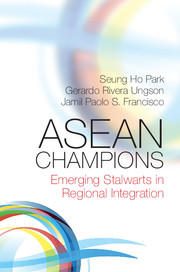
Professors Sam (Seung Ho) Park, Buddy Ungson of Rough Diamonds fame, and AIM’s own Professor Paolo Francisco share invaluable insights into the economic integration through their stories on the fifty-eight ASEAN organizational champions. These champions represent industries ranging from power generation and distribution to air transportation and civil construction, from telecommunications and agriculture to health care, education, and real estate.
Learning from the experiences of these successful organizations, we get to understand what contributes to their resiliency, despite periods of financial crises, challenging macroeconomic conditions, cultural diversity, and inconsistent and/or inadequate government policies.
These analyses of the ASEAN champions included in this book are important to us because they are able to provide prescriptive frameworks on how to best take advantage of the regional economic integration and how we, as leaders, can best steer our respective organizations’ strategies and take calculated risks to ensure that we can achieve sustained success.
But, most important, Sam, Buddy, and Paolo raise vital questions to remind us that the future of the region is in our able hands. How can we creatively bridge the gap between institutional voids and inclusive market growth? How do we compete with the large multinational companies? How do we grow with the economies? They see education through the enhancement of human skills as one way of addressing these questions, which I heartily endorse.
This book captures the energy of the bustling ASEAN economic community, and presents us with the exciting growth possibilities that lie ahead. I hope your reading experience is a most enriching one and you, too, will be able to capture the opportunities as they arise.
