

The science of gravity began with Aristotle (384–322 BC). He explained why it is that what goes up must come down. The explanation is found in his physics. He also accounted for the motions of the planets. This is in his astronomy. And so we will start with Aristotelian physics and astronomy. The physics remained pretty much unchanged for millennia, but the astronomy was put through stages of revision, settling on the Ptolemaic model (Ptolemy, c. 110–c. 170). The plan is to clarify Aristotle's explanation for why a dropped object falls to the ground, and to clarify his methods in support of the explanation. And we will present the details of the Aristotelian–Ptolemaic description of planetary motion, also with an eye on the methods to derive the astronomical conclusions. This will be the historical entry to the science of gravity and the analysis of scientific method.
The modern science of gravity, as summarized in the previous chapter, applies the same laws of physics to phenomena on the Earth as to astronomical objects and events. It is, after all, the law of universal gravitation. Aristotle would have objected to this as an inappropriate and confused unification. At the time, and for a very long time after, the study of the physical world was separated into the terrestrial and the celestial. Physics was about what happens on the Earth, and astronomy described the heavens. Different laws applied. A department of astrophysics, as you might find at a modern university, would be viewed by Aristotelian and medieval scientists as a marriage of convenience, at best, or a huge blunder at worst. Doing experiments in an Earth-bound laboratory as a way to understand what happens on planets or stars is as misguided as experimenting on people to understand what happens in rocks. You might end up saying that the red rocks in the Grand Canyon get their color by blushing, embarrassed by all those tourists staring at them. People and rocks are importantly different kinds of things, understood by importantly different laws. The same is true, in the Aristotelian analysis, of terrestrial and celestial things.
The distinction between the terrestrial and celestial, and the corresponding separation of the sciences of physics and astronomy, were based on evidence. Aristotle noted that there is a uniformity observed in astronomical events that is missing here on Earth. Stars and planets move, but on unchanging, eternally repetitive trajectories. None of the lights in the sky ever goes out, and no new lights appear. On the Earth, by contrast, objects move in all directions, stop and go, and speed up and slow down. They can even be destroyed or created. In contrast to the perfect and eternal harmony in the sky, there is episodic imperfection on the Earth, and this difference demands two separate sciences.
The regularity of action in the celestial realm indicates a uniformity of composition. There is just one celestial element, aether, later called quintessence, the fifth element. There are four terrestrial elements, and everything on the Earth is composed of some combination of earth, air, fire, and water. Each of these elements has a natural motion, a way of moving when left alone, left to its own intrinsic nature. Aetherial objects, that is, everything in the sky beyond the orbit of the Moon, naturally moves in a circle, a perfect circle. This matches the perfect, recurring, eternal trajectories of the stars and the planets. The natural motion of terrestrial elements is in a straight line, up or down. The directions up and down are determined by the single point that is the center of the universe. Thus, earth, the element, naturally moves straight toward the center of the universe, while air moves naturally away. Water goes down, straight toward the center of the universe, and fire goes up.
This explains a lot. For example, the Greeks knew the Earth is round, and the Aristotelian system of elements and their natural motions explains why the Earth is round. The solid components of the Earth are composed primarily of the element earth. A collection of pieces all falling into a single point, in this case the center of the universe, would naturally form a sphere.
Notice how a subtle change in the wording of this account of the round shape of the Earth brings the Aristotelian theory very close to a modern version. Change the “pieces all falling into a single point” to “attracted to a single point” and this would not be out of place in a physics textbook today. Actually, both versions would fit. The original, the description in terms of falling, is the kinematic result of the second version, the dynamic cause. One key difference between Aristotle and our basic Newtonian version is that in the former the objects are falling toward a point in space rather than toward another physical object. It could be an empty point in space that determines the motion, the natural motion of objects.
The natural motions of elements gives Aristotle a way to explain and anticipate the motions of real objects on the Earth. What goes up, must come down. That's because what goes up is, in the usual experiment, composed mostly of earth, and going up is not only against its nature but also puts it above some air. The act of lifting or throwing a stone, displacing it from its natural place, is what Aristotle called violent or enforced motion. Once you let go, once the violence (the force) is stopped, the stone will follow its nature and return to where it belongs. Earth moves down, air moves up, and the stone is naturally located beneath the air, that is, closer to the center of the universe. The stone falls because it is in the nature of things made of earth, the primary element in a stone, to be below air.
When the stone is above air, it has the potential to fall, to seek out its proper place, and you can feel this potential if you are holding the stone. This is the stone's weight. Some stones have more potential than others, that is, they weigh more. You would expect the heavier object to fulfill its nature and seek its proper place with greater speed than does a lighter object, just as a more motivated person moves faster toward his or her goal than does someone who cares less. Expect a heavy thing to fall faster than a light thing. And this is exactly what usually happens. Drop a stone and a feather together and the stone falls faster. The heavy stone is composed almost entirely of earth, while the light feather must be made of some earth but a significant amount of air as well. This accounts for both the light weight of the feather and the slow descent of its fall.
There is agreement between theory and evidence in Aristotle's account of things falling. Unsupported objects fall, and the theory explains why. Heavy things are seen to fall faster than light, and the theory explains why. The agreement is not perfect, though, since Aristotle claims that the speed at which an object falls will be in proportion to its heaviness. This would have a 10 kg stone falling twice as fast as a 5 kg stone, and that just doesn't happen.
The disagreement in the details between theory and evidence reveals a more systemic difference between Aristotelian and modern physics. We would call it a flaw in his method. Aristotelian physics is strictly qualitative; there is no mathematics and no quantitative measurement. Had he applied mathematics to physics, Aristotle might have been less satisfied with the theory of falling objects. But there is a reason Aristotle did not mix mathematics with physics, and consequently did not pursue quantitative analysis in either the theory or the evidence. Mathematics, primarily geometry in Aristotle's time, is about perfection and precision. Life on Earth is a mess, an ongoing whirlwind of disruption, displacement, and disorder. Geometry applies to, for example, perfect circles, not wobbly misshapen circles as we can draw or find in the real terrestrial world. The lines of a triangle are exactly straight, but no line in nature is exactly straight, since natural motion is generally interrupted and corrupted by some violent intervention. Mathematics cannot describe what is imperfect and distorted, so mathematics cannot be applied to physics.
Mathematics, geometry in particular, can be applied to the uniformly circular motion of the planets and stars. Astronomy, in other words, can be done quite differently from physics. Astronomy can take full advantage of the best mathematics, since celestial objects and their motions are, as is appropriate to mathematics, uniform and perfect. This shows that the transition from Aristotle's physics, in which he explains why things fall to the ground, to Aristotle's astronomy, in which he describes the orbits of celestial objects, is abrupt. It is somewhat anachronistic, even a little bit Whiggish, for us to look for a unifying theme, namely gravity, between the two, but much of our modern theory of gravity was developed as revision and reaction to Aristotle, both the physics and the astronomy, so we need to understand both. From the turmoil that is the Earth, then, we'll look up to the harmony that is heaven.
There are seven planets in the Aristotelian cosmological model, five that we regard as planets today – Mercury, Venus, Mars, Jupiter, and Saturn – and the Sun and the Moon. Each of these wanders through the unchanging backdrop of the stars. Each follows essentially the same kind of orbit and is described in the same way. So, to understand the orbit of one is to basically understand them all. This allows us to talk in terms of the generic planetary orbit.
Like the stars on the celestial sphere, a planet orbits the center of the universe once per day. The shape of the orbit is perfectly circular. This is the diurnal rotation of celestial objects, from east to west, and it accounts for the visible motion that is the rising and setting and movement across the sky. A planet has an additional motion, on its own spherical shell and at its own pace, very slowly from west to east. This is why the planet appears to move through the pattern of stars, usually showing up a little bit east, compared to where it was the day or night before. The Sun, for example, moves eastward through the constellations of the Zodiac at roughly one degree per day. This brings it once completely around in the course of a year. The path of the Sun as it moves against the background of the stars is called the ecliptic.
The Roman architect and scientist Vitruvius (85–20 BC) provided a homely analogy of the Aristotelian planetary system. “If seven ants were to be placed on a potter's wheel, and as many channels were to be made around the center of the wheel, growing in size from the smallest to the outermost, and the ants were forced to make a circuit in these channels, then as the wheel was spun in the opposite direction…” (Vitruvius, Reference Vitruvius, Rowland, Rowland and Howe2001, p. 111) the motion of the ants would resemble that of the planets.
Notice that there is no mention yet of the Earth. This is astronomy, not physics. The planets orbit the center of the universe, as the ants circle the center of the wheel. As it happens, the Earth occupies that point at the center of the universe, but it plays no causal role. The Earth has only an incidental role in describing the motion of the planets.
Figure 4.1 shows the basics of an orbit of any of the seven planets. The planet is at point P; the Earth is at E. The entire model rotates clockwise once every 24 hours, as does the celestial sphere of the stars. This is the diurnal rotation. The individual orbit of the planet is much slower and depends on the particular planet. Mars, for example, takes more than a year to orbit counterclockwise.

Figure 4.1. The orbit of a planet in the most basic Aristotelian model. The Earth E is at the center of the universe. All the celestial objects rotate clockwise around the center, once around in 24 hours. This is the diurnal rotation. Each planet P also rotates slowly counterclockwise. This results in its moving a little bit each night eastward against the background of the stars.
The basic Aristotelian account of planetary motion is a paradigm of simplicity and elegance. It is composed of perfect concentric spheres and eternally uniform motion. But it suffers significant empirical inadequacy, noted even at the time. The planets other than the Sun and the Moon are seen to get brighter and dimmer from time to time, suggesting that they get closer and further from the Earth. This defies the model of perfect circular orbits centered, even coincidentally, on the Earth. Furthermore, the motion of these planets as measured against the background of the stars is not uniformly west to east. The planet is seen to stop and change direction, only to soon resume its west-to-east motion. This retrograde motion defies the model of constant angular speed. With these anomalies, we might then consider the Aristotelian model to be only a first-order approximation of the nature of planetary orbits, with higher-order terms to follow.
The first significant modification of the basic Aristotelian model was made by Apollonius of Perga (mid third century to early second century BC), and Hipparchus (second century BC). In the model of Apollonius and Hipparchus, each planetary orbit requires two circles, an epicycle and a deferent. The planet itself orbits on the epicycle, a circle that is centered on a point that also moves on another circle, the deferent. This is shown in Figure 4.2.
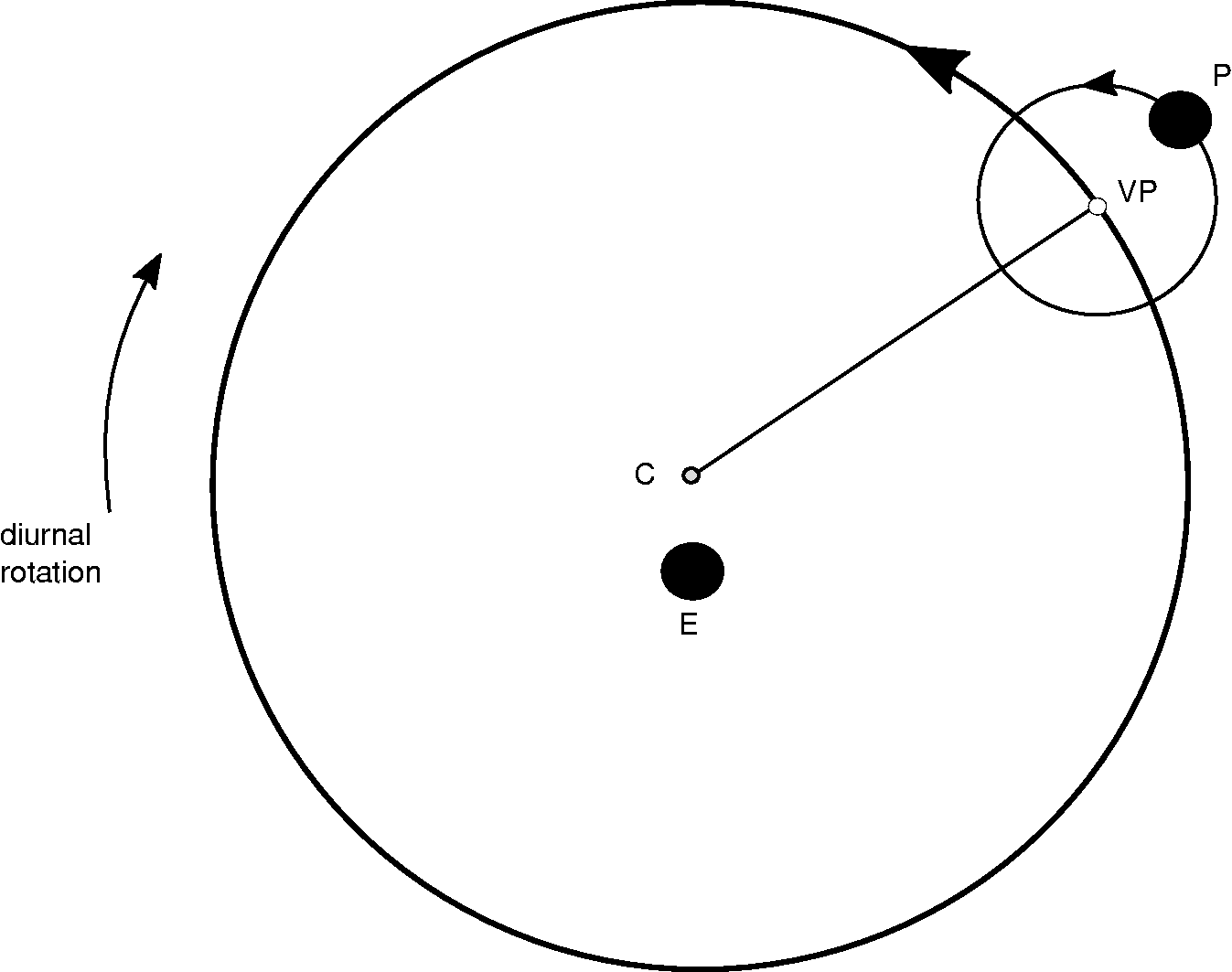
Figure 4.2. The planetary model of Apollonius and Hipparchus. All celestial objects have the 24-hour diurnal rotation clockwise. A planet P also orbits on a circular epicycle. The center of the epicycle itself moves in a circular orbit, the deferent, centered at the point C. The center of the epicycle is marked VP to indicate that it is a void point, an empty point in space that plays an essential role in determining the motion of the planet. The Earth E is not quite at the center of the deferent. The displacement between C and E is the eccentric.
Note again the clockwise diurnal rotation of the entire model, once around in 24 hours. Motion on the epicycle and deferent are there to account for the movement of the planet against the background of the stars. The epicycle results in both retrograde motion of the planet and its changing brightness. Retrograde happens when the planet is closest to the Earth and its orbit on the epicycle is in the opposite direction from the motion on the deferent. The size and period of the epicycle can be adjusted to match the observed movement of each individual planet. To achieve the retrograde motion, the radius and period of the epicycle must result in the planet moving backward, from the perspective of the Earth, and hence crossing its own orbital path. This produces a rosette, a loop-de-loop pattern. The path of the planet is no longer a perfect circle, but it is composed of two perfect circles. Thus is the harmony and uniformity of celestial motion preserved. It is naturally eternal and repetitive and without deviations.
The center of the epicycle, that is, the center of the planet's actual circular motion, is an empty point in space. Julian Barbour calls these void points (Barbour, Reference Barbour2001, p. 175). A void point is a point in space where no object, no matter, is located but that plays an essential role in describing the motion of a planet or even an active role in causing features of the motion. It is worth keeping track of the void points in early astronomical models, because they seem entirely contrary to our modern sense of what can hold a planet in orbit. It takes a real thing with mass to provide the centripetal force needed by Newtonian theory. But in this ancient account of orbit, the planet seems to be tethered to nothing at all.
The Aristotelian model with its Apollonius–Hipparchus revision clearly contains a void point. In fact, the new model has two void points. If you look closely at Figure 4.2 you will see that the Earth is not exactly at the center of the deferent circle. This displacement between Earth and orbital center is called the eccentric. It is a feature of the Apollonius–Hipparchus model to accommodate observations that the planets spend a longer time on one half of their orbit than on the other. Even in the original Aristotelian model it was the point in space, the center of the universe, and not the object, the Earth, that determined the center of a planetary orbit. The Earth just happened to be at that point. The eccentric has the effect of exposing the implicit void point in the Aristotelian model, showing that the motion of a planet is not in relation to another object but to a feature of space.
With the epicycle, deferent, and eccentric, the revised model of planetary orbit has lost much of its original simplicity and elegance. It's the price paid to keep the model empirically accurate and true to the theoretical requirement that the motions are, or at least are composed of, perfect circles. This compromise highlights a three-way balance that is generally the challenge of scientific method. The empirical data, in this case how the planets move and change brightness, cannot be ignored and there is an ongoing obligation to observe more, and more precisely. A second constraint is theoretical. The description of nature must be consistent with the generally accepted theoretical understanding of the fundamentals. In this case, the planetary orbits must be composed of perfect circles rotating at uniform speed. The empirical and theoretical must fit together, although the fit is never perfect, and there is an obligation to improve the fit in response to new and better data. There is a third consideration in evaluating scientific results, the more abstract and sometimes aesthetic virtues of a theory such as simplicity, beauty, or elegance. We can call these simply conceptual virtues. None of these three factors has ultimate authority over the others. At this point in the history of planetary astronomy, the conceptual virtues have been sacrificed to accommodate the empirical and theoretical. It won't always be like this.
Commitment to the Aristotelian theoretical requirement of perfect circles, and continued improvement in measuring the motions of planets, led to further complication of the model. Ptolemy in the first century AD added one more term of correction to the basic Aristotelian model, the equant. He kept the Apollonius–Hipparchus features of epicycle, deferent, and eccentric, and thereby retained the rosette shape of the planetary orbit and the void point at the center of the epicycle. Only the void point at the center of the deferent got some revision.
The Ptolemaic model still has the deferent as a perfect circle centered at a point a bit removed from the Earth, but the angular speed of the deferent void point, the center of the epicycle, is not constant around this point; it is constant around the equant point that is opposite the Earth and an equal distance from the center. This equant is another void point. In Figure 4.3, again the planet is at P and it orbits on an epicycle. The center of the epicycle, a void point, orbits on the deferent that is geometrically centered at C, the eccentric point. The line in the figure is drawn not to the center of the deferent but to Q, the equant. This is the line that rotates at a constant angular speed.
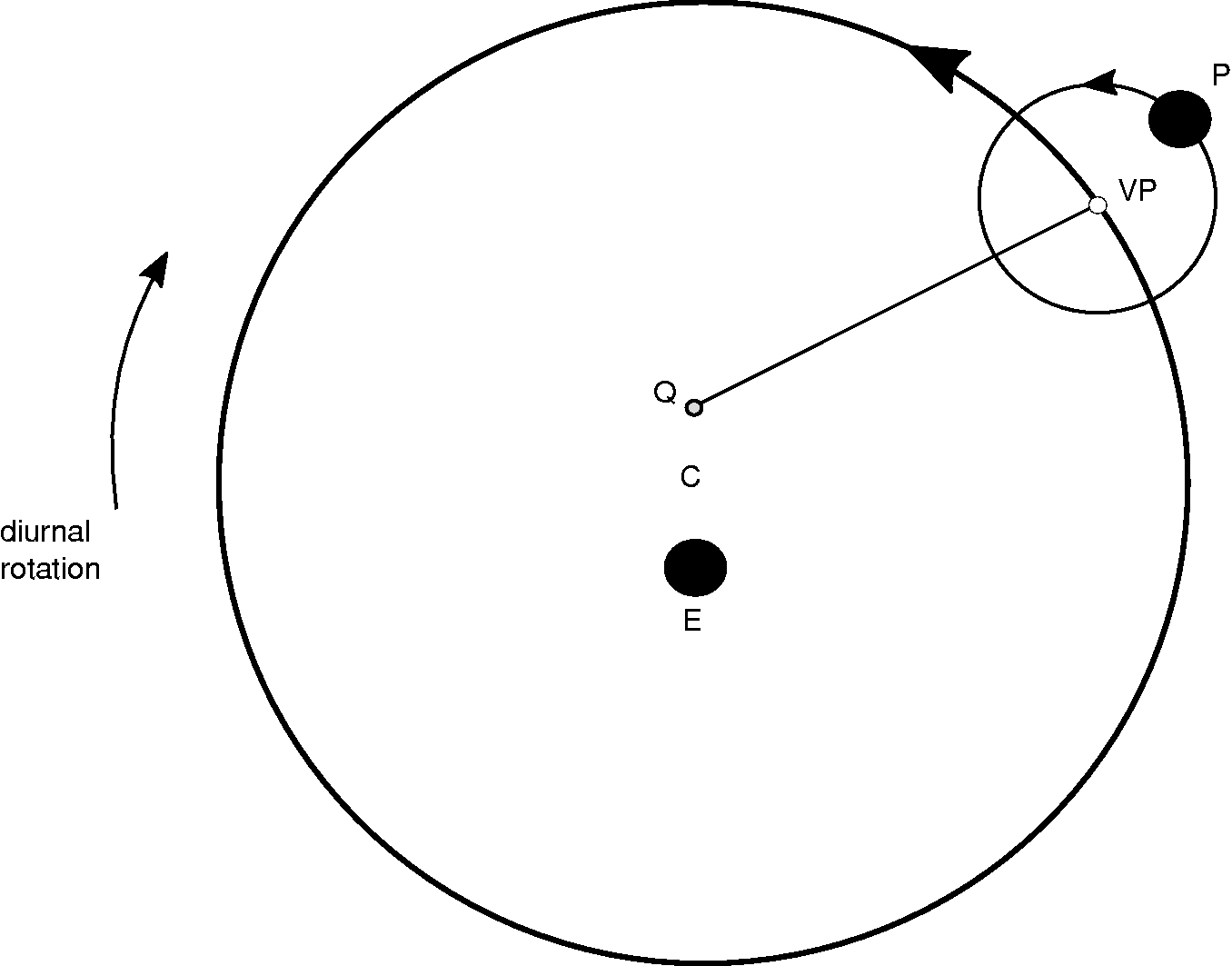
Figure 4.3. The planetary model of Ptolemy. The diurnal motion, epicycle, deferent, and eccentric are all the same as in the Apollonius–Hipparchus model of Figure 4.2. Ptolemy adds the equant at Q. The line between Q and the planet P rotates with a constant angular speed.
The theoretical purpose of the equant is to accommodate more precise data on the speed of the planet across the sky. The planet moves faster on one side of the circle than it does on the other. Rather than have the angular speed of orbit vary, the point of determining the angular speed is relocated to the equant. This is consistent with the Aristotelian theoretical ideal of perfection in celestial phenomena. The orbits are perfect circles and the rate of rotation is perfectly uniform.
The Ptolemaic model has a lot of adjustable parameters. The radii of both the epicycle and the deferent, and the period of orbit around each, can all be adjusted to match each planet in its movement against the background of the stars and the timing of its retrograde motion. The theory prescribes the basic concepts and components of the model, perfect circles and uniform rotation, but then the phenomena themselves dictate the details.
It may seem to us that the theoretical insistence on perfect circles in any model of planetary motion has resulted in some implausible results. The epicycles, for example, orbits upon orbits, may seem unnecessarily complicated. Simplicity in a theory sometimes has to be compromised, but this may be a reckless forfeiture. And the void points, empty points in space that determine the planet's orbit, seem to require that a bit of nothing does some real work.
These days, it is usually the epicycles that draw our criticism of previous models of planetary motion. These extra orbits violate our code of simplicity and elegance, and so should be avoided if possible. But a quick look at the Solar system as currently described shows that we really should have no principled objection to epicycles. The orbit of any moon is on an epicycle around the planet, as the planet orbits around the Sun on the deferent. This is wholly unobjectionable because the center of the epicycle orbit that tracks around on the deferent is occupied by an object, the planet. And since the planet has mass, it plays a dynamic role. As the source of a gravitational force, the planet acts as a tether for the orbiting moon. So, it's not the epicycle per se that would be objectionable; it's an unoccupied orbital center that presents the dynamic impossibility. The problem is the void point.
The void point at the center of the epicycle, certainly, and at least one of the two void points at or near the center of the deferent, probably, are dynamic in the sense of having a causal role in determining the trajectory of the planet. From our perspective this is problematic, since it leaves a fundamental aspect of the cause, and hence the explanation, of the orbit to rest on nothing at all. But in the Ptolemaic context, the void points are acceptable. Aristotelian and Ptolemaic astronomers were not interested in the causes of planetary motion. Since the motion was circular it was natural and didn't need a cause. For this reason, astronomy was a strictly kinematic endeavor, with the goal of describing planetary orbits but not explaining them. As simply descriptive tools, that is, in a strictly kinematic role, the void points present no conceptual challenges. They are not causal, that is, dynamic, and consequently not necessarily asserted as real features of nature.
The last part of the devaluation of the void points, not claiming them to be real physical things in nature, is compatible with the usual interpretation of Ptolemy as an instrumentalist. Instrumentalism is an attitude toward science that regards utility for calculation and prediction as the only important virtue of a theory. Truth is irrelevant. If a theory works it's a good theory. End of story. If the model of planetary orbit is just a useful model, or, as Ptolemy is translated, a hypothesis, then there is no need to worry about the physical possibility or the causal mechanism. It's just a way to keep track of where and when a planet will appear. But there are reasons to think that Ptolemy was not strictly instrumentalist about his account of the planets, and, more importantly, that subsequent astronomers evaluated the model not simply in terms of its pragmatic virtues like accuracy of prediction but in terms of its being true or false. Ptolemy inherited from Aristotle the theoretical idea that the planets were carried along in their orbits by being embedded in transparent, crystalline, spheres. It's the spheres that rotate. And in all his work, Ptolemy saw the need to adjust the radii of deferents so that the spheres that carried the planets did not intersect, as they can't since they are solid. If the spheres were merely calculating devices, ways of our thinking, it wouldn't matter if they intersected. Only a realist interpretation of at least this aspect of the model would necessitate the adjustment.
Ptolemy the person, and his attitude regarding the physical reality, or not, of the components of the planetary model are not as important as the status of the Ptolemaic model itself. Later interpretations of the model, and reactions to it at the time of Copernicus, were decidedly in realist terms. Georg Peurbach (1423–1461) presented the Ptolemaic model in Theoricae novae planetarum (1454) as physical reality, complete with solid quintessential spheres to carry the planets. This was the model to which Copernicus responded. And even after Copernicus, Georg Rheticus (1514–1574) argued against the possibility of the equant as “a relation that nature abhors.” (Quoted in Hoskin and Gingerich, Reference Hoskin1999, p. 87.) The criterion for rejecting the idea, in other words, is not that we abhor the equant, as we would for pragmatic reasons, but that nature abhors the equant. It's about what is or is not in nature, not what works or does not work for describing nature.
These interpretations, historical and modern, regard the void points in the Ptolemaic model and the rosettes it retains from Apollonius and Hipparchus as real features of nature. So are the quintessential spheres, and this takes the dynamic burden off the void points. With the solid sphere holding the planet and rolling it around on a circular orbit, the center of the sphere, the location of the void point, does not have to act as a guide or tether. In this way, the void points in the Ptolemaic model, even a physically real Ptolemaic model, have only a kinematic role, allowing Ptolemy and Ptolemaic astronomers to accept them as neither puzzling nor problematic.
Instrumentalist or not, the Aristotelian–Ptolemaic astronomy was not concerned with the causes of celestial events. The goal was simply a model of movements that matches the observations. The method was to do whatever it takes, as was said at the time, to save the phenomena. Using the theoretical tools of the day, not forces and fields but spheres and quintessence, one adjusted the parameters in whatever way it took to agree with past observations and predict where planets would be seen in the future.
The method was quite different in physics, the science of terrestrial events. In this case, knowing about causes, and hence being able to explain why things happened as they did, was important. Why is the Earth round? Because the element earth naturally moves toward the single point that is the center of the universe. Why does a heavy object fall to the ground faster than a light one? Because the heavy one contains more earth and consequently has more potential to seek its proper place, closer to the center of the universe. The faster fall is what you would expect, given the composition of the object.
In physics, the explanation starts with a logical deduction. Aristotle's scientific method is often described, and often with some disapproval, as being a kind of top-down reasoning. It starts with general principles, like the natural motion of elements, and reasons a priori, without further evidence, as to what nature must be like. The logic of Aristotelian physics is deductive and the results are both certain and necessary. The Earth must be round, and heavy things must fall faster than light. These are not simply generalizations about features of nature; they are laws of nature.
How does this aspect of Aristotle's method compare to modern science? Some things are the same, for example the idea of laws of nature. What goes up, must come down, by the law of gravity. But some things are different, for example the requirement that the conclusions be drawn with absolute certainty. Aristotle regarded certainty as a necessary requirement of knowledge. There was no doubt, no uncertainty, in Aristotelian science. By modern standards this is dogmatic and contrary to the open mind expected of a scientist. A requirement of scientific method, or at least scientific attitude, is a recognition of the uncertainty of any result and a willingness to consider alternatives and challenges.
Aristotelian physics wasn't all a priori logic. There was an important role for observation. Heavy things do in fact hit the ground before light. This is directly observable. There is evidence that the Earth is round, and so its shape is indirectly observable. During a lunar eclipse, the shadow of the Earth on the Moon is rounded not straight. And ships sailing away from harbor are seen to disappear bottom first, then the mast, as if they are sinking or descending along the curved surface of the Earth. There is even evidence in Aristotle's physics that shows the Earth cannot be moving. It is a very indirect observation that the Earth stands still, but it is an important contribution to the science. Drop a stone from the top of a tall tower and observe that the stone falls straight down. If the Earth were moving, the stone would fall some distance away, as the Earth and tower moved out from under it. Galileo will have a lot to say about this argument, but for now it shows one of many examples of Aristotle's a posteriori reasoning. It shows the role of evidence in his scientific method.
No scientific method is an algorithmic sequence of steps, but Aristotle's approach to understanding terrestrial nature generally has observations coming before theorizing. We see what needs to be explained. A theory is then deduced. And since the logic of deduction is foolproof, with no possibility of error or uncertainty, there is no need to follow with empirical testing. This is another big difference between Aristotle's method and what happens now in science. The Aristotelian theory is not tested, and there are no controlled experiments in which the scientist sets up specific circumstances and regulates specific variables. And, with no quantitative observations or analysis, because perfect mathematics can't describe the imperfect events on Earth, there is no precise comparison between theory and data. Theory claims not only that a heavy thing falls faster than a light but falls faster in proportion to its heaviness. This seems never to have been measured, since measurement is an application of mathematics to nature, and since there should be no need to confirm a deduced theory.
Aristotle's scientific method puts observation in what philosophers of science now call the context of discovery. This is the formative stage of scientific theorizing, when ideas are suggested but not endorsed. It must be followed, if the process is to be genuinely scientific, with a context of justification. This means doing whatever it takes to test the ideas, to challenge those that fail and provisionally endorse those that pass. For Aristotle, the proof of a theory was in its deductive derivation. This results in certainty. Modern scientific method, and this will be one of Galileo's important contributions, will require not just the reasoning and evidence that lead to a hypothesis, but also after-the-hypothesis evidence. And because the testing has an essential empirical component it will be unavoidably uncertain. No experiment is perfect, and no experimental results are beyond question. It will be Galileo's achievement to show how to apply perfect mathematics to the imperfect phenomena on Earth. He will bring mathematics to physics and allow the marriage of astronomy, already mathematical, and physics.
Aristotle and Ptolemy provided an account of why things fall to the ground and how planets orbit, and in this sense they initiated the science of gravity. Their account differs in many ways from what is currently on the books in the chapter on gravity, but the modern theory was formed largely in reaction to the ancient theory, so understanding the latter will help in understanding the former. The same is true for the methods used. That is, the Aristotelian scientific method differs in some important ways from what we require of scientific method today. The modern method will make more sense, and the reason for various components will be more important, by comparison.
