

Abbreviations
We use the Leipzig abbreviations (www.eva.mpg.de/lingua/resources/glossing-rules.php), with the following additions:
- ABLE
ability marker
- ACT
active voice
- ADJP
adjectival phrase
- AOR
aorist
- C:TEL
culminative telic V2
- CONT
continuous V2
- EMPH
emphatic
- FAC
factive
- HON
honorific
- HS
hearsay
- HUM
human
- IF
illocutionary force
- INT
interrogative
- ISC
intentional state construction
- MID
middle voice
- N
neuter, neutral
- NHUM
non-human
- OBLIG
obligation
- OPT
optative
- POL
politeness
- PRESUM
presumptive evidential
- PROX.HEARER
proximate to hearer
- PSBL
possibility
- QUAL
qualitative predication (≈ ‘be’)
- REAL
realis
- REM
remote
- RP
reference phrase
- SH
subject honorific
- TAM
tense, aspect, mood
- THEM
theme
- TNS
tense
- V2
unit denoting aspect/Aktionsart
- VIC
verbal inflectional clitic
2.1 Introduction
The present chapter deals with the status of lexical and grammatical categories in RRG, including parts-of-speech systems and grammatical categories such as tense, aspect, mood (TAM) and negation, which are referred to in RRG as ‘operators’.Footnote * With respect to lexical categories, RRG differs from many other theories of language which assume a small, closed set of universal parts of speech such as ‘noun’, ‘verb’ ‘adjective’, etc., and which consider these to be the heads of corresponding syntactic categories, namely NP, VP and AdjP. By contrast, RRG does not assume that such categories are universal, in line with an increasing amount of typologically oriented research questioning the universality of these categories. Instead, RRG assumes functionally motivated, non-endocentric syntactic categories, such as nucleus or NUC (containing the predicate), referential phrases or RPs, and modifying phrases or MPs. Although these syntactic slots are typically realized by verbs, nouns and adjectives/adverbs, respectively, this is not required by the theory. Many languages, including English, allow for non-verbal predicates, non-adjectival modifying phrases, etc., while others show little or no evidence for lexical categories such as ‘noun’ and ‘verb’ or allow for clausal referents, modifiers and predicates. And even those languages which do possess traditional parts of speech often show so-called ‘category squishes’, in which assignment to a particular category is at best an arbitrary decision. Hence, categories such as NUC, RP and MP are not universally linked to particular lexical categories per se, although individual languages will generally have language-specific restrictions as to which elements may occupy these slots.
The present chapter also provides a description of the grammatical categories referred to in RRG as operators, that is, those categories which ‘ground’ a clause, core or nucleus and which are closely linked to finiteness, a topic which has been receiving increasing attention in typological research in recent years. These categories include tense, aspect, deontic mood (‘modality’ in RRG terms), epistemic mood (‘status’), evidentials, etc. These units all have scope over a particular level of the sentence structure (nucleus, core, clause) and play an important role in the determination of nexus relations in complex sentences within the theory. This also includes categories which are primarily concerned with questions of reference, such as definiteness and deixis, which ground the RP.
2.2 Lexical and Syntactic Categories in RRG
2.2.1 General Issues
A basic tenet of descriptive linguistics is that linguistic categories are only valid to the extent that they are empirically justified, and the view that there is no such thing as a universal grammatical category is gaining acceptance.1 This holds for all categories, including lexical categories such as noun, verb and adjective (to name just three) as well as the corresponding endocentric syntactic categories, NP, AdjP and VP, even though these categories – or at least the lexical categories – are generally considered universal.
Although there are considerable differences of opinion with respect to the ‘correct’ approach to this topic, most researchers would probably agree with an approach which views lexical categories as language-specific categories based on feature bundles, in which ‘prototypical’ members of a particular class possess all of the features potentially associated with the particular class.2 For example, prototypical nouns in English would denote persons, places or things, mark for the plural (usually with ‑s), be compatible with definite and indefinite articles, etc., while less prototypical nouns, for example, may not be compatible with plural marking or the definite article. Problematic for this approach, however, is determining which features are more important than others, if indeed a hierarchy can be established at all, as well as how many features are ‘enough’ for an item to be assigned to a particular category. We will return to this topic in the following pages.
As Himmelmann (Reference Himmelmann, Austin and Musgrave2008: 260) notes, there is little doubt that ‘the inventory of function words is highly language-specific’. Rather, ‘[w]henever there is a controversy regarding the number and kind of syntactic categories in a given language, it pertains to the linguistic classification of content words’. Himmelmann assumes two grammatical levels for the discussion of parts of speech: (i) ‘the level of terminal syntactic categories where lexical items are categorised according to their phrase-structural properties’, and (ii) ‘the level of lexical categories proper where lexical items are categorised according to those grammatical features which are not directly relevant for phrase structure’ (Himmelmann, Reference Himmelmann, Austin and Musgrave2008: 263). To illustrate these two levels,3 Himmelmann proposes a hypothetical example in a language L, in which the most basic phrasal categories always consist of an overt function word X and an overt content word Y, with virtually all content words being compatible with all function words. This can be schematically portrayed as in (1). Here the status of the function word X distinguishes the phrase from other phrase types, hence ‘XP’.
[XP [X] [Y]]
These two levels, that is, lexical and syntactic, need not correspond to one another directly, although this will often be the case, as, for example, with Ns as heads of NPs, Adjs as heads of AdjPs and Vs as heads of VPs in many languages. Himmelmann (Reference Himmelmann, Austin and Musgrave2008: 264) notes five logical possibilities with respect to these two levels and their correspondence to one another, given in Table 2.1. With respect to category I, both levels possess distinct categories but these do not directly correlate in Ia (‘≠’), while they do in Ib (‘=’).
Table 2.1 Possible alignments between lexical and syntactic categories (Himmelmann, Reference Himmelmann, Austin and Musgrave2008: 264)
| Lexical categories | Terminal syntactic categories | ||
|---|---|---|---|
| Ia | distinct | ≠ | distinct |
| Ib | distinct | = | distinct |
| II | indistinct | distinct | |
| III | distinct | indistinct | |
| IV | indistinct | indistinct |
Returning to our example above, if, following Himmelmann, we imagine that L has a further restriction such that not all content words Y behave similarly, as some Ys take plural suffixes, others take plural prefixes, while the members of a third class do not allow pluralization, then we would have case Ia, with distinct lexical categories based on the compatibility of Y with plural markers and also distinct terminal syntactic categories, but with no direct correspondence between the two levels, as the compatibility of plural affixes does not correlate with the compatibility of a particular Y with a particular X.
To these two descriptive levels we can add a third level, that of function, here primarily reference, predication and attribution. This can involve a direct correlation between terminal syntactic cateogies and functional categories, that is, XP1 = reference, XP2 = predication, etc., or there can be no direct correlation, so that XP1, XP2, etc. can both be used in reference, predication and modification. At one extreme we would then have endocentric categories specialized for certain sentence-level functions, for example N = NP = reference, V = VP = predication, etc., and at the other extreme – at least putatively – no correlations whatsoever, although it is questionable whether such a language is possible.
Such mismatches are not only a theoretical possibility; many researchers have claimed that the languages they are describing either do not in fact possess a certain category such as ‘N’ or ‘NP’, or that the respective language can at least best be described without recourse to such categories. Even in languages such as English, which possess relatively clearly defined lexical classes such as noun, verb, and adjective, it has long been known that there is no one-to-one relationship between part of speech and function. Consider the examples in (2a–g), from Van Valin (Reference Van Valin2008: 165).
(2)
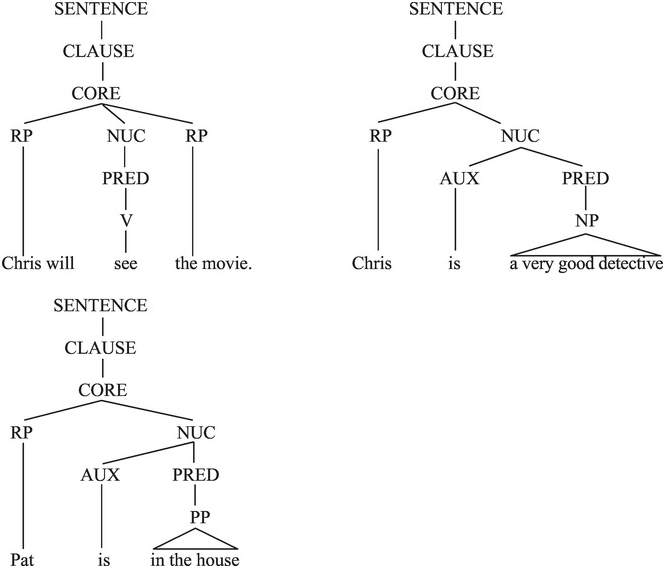
a. Chris will [nuc [pred see]] the movie. PRED in NUC = V b. Chris [nuc is [pred a very good detective]]. PRED in NUC = NP c. Pat [nuc is [pred exceedingly tall]]. PRED in NUC = ADJP d. Pat [nuc is [pred in the house]]. PRED in NUC = PP e. Chris [nuc [pred wiped]] PRED in NUC1 = V the table [nuc [pred squeaky clean]]. PRED in NUC2 = ADJP f. Pat [nuc [pred pushed]] PRED in NUC1 = V the table [nuc [pred out the door]]. PRED in NUC2 = PP g. Chris [nuc was [pred elected]] PRED in NUC1 = V [nuc [pred president of the club]] PRED in NUC2 = NP
As the examples in (2) show, the predicate of a nucleus in English need not be verbal. While the predicate is verbal in (2a), in (2b) it is an NP, in (2c) an AdjP and in (2d) a PP. Figure 2.1 presents the constituent projections for (2a) (from this author), and (2b) and (2d) (adapted from Van Valin, Reference Van Valin2008: 166).4
In English, as in many other languages, there is a general requirement that clauses in which the predicate is not verbal must contain a kind of ‘auxiliary’ such as the copula is in order for the clause to be grammatical. As a very good detective in (2b), exceedingly tall in (2c) and in the house in (2d) are not verbs, the copula is is required; however, it is important to stress two things here. First, that while is is a verb, it is not the predicate; this function is filled by the NP in (2b), by the AdjP in (2c), and by the PP in (2d). Second, this is a language-specific criterion which is not found in all languages or which is only found with certain interpretations. For example, one quite common situation is found in Russian, where a clause whose predicate is non-verbal does not require a copula when there is a present or atemporal interpretation, as in (3).
(3)
Russian eto stol this table ‘This [is a] table.’
In other languages, the element which is often considered a copula may not even be verbal, as in Maltese (Semitic, Malta), where the ‘copula’ is in fact a pronoun agreeing with the subject with respect to person and number (and gender in the third-person singular) with a present or atemporal interpretation, as in (4).
(4)
Maltese (Ambros Reference Ambros1998: 69) Dan il-professur huwa Malti. this.m.sg def-professor 3m.sg Maltese.m.sg ‘This professor is Maltese.’
As Van Valin (Reference Van Valin2008: 166) notes, non-verbal predicates do not pose a problem in RRG, since the clause is not an endocentric category: ‘Indeed, there is no head at all. The nucleus cannot be considered the “head” of the core or the clause, because it is not a lexical category, on the one hand, and is often phrasal, on the other. The notion of “head” is of no relevance to the layered structure of the clause.’ Instead, all universal categories assumed in RRG are semantically motivated, so that in RRG a clause minimally consists of a core – which minimally consists of a nucleus which contains the predicate – and possibly one or more arguments.
Instead of positing universal lexical categories which are also the heads of corresponding phrasal categories – cross-linguistically an even more problematic assumption – mainstream RRG has assumed since Van Valin (Reference Van Valin2008) that the core contains a predicate, the functional/semantic base of the nucleus, and possibly one or more referential phrases, referred to as RPs. Just as the predicate need not necessarily be verbal, neither does an RP have to be nominal. In addition, RRG assumes that these units may be modified by modifying phrases or MPs, which can (but need not) be specialized so as to modify only an RP, as with prototypical adjectives, or only predicative elements, as with prototypical adverbs, although again this is not necessary, as there are many languages with either no or only very few adjectives and/or adverbs, where these functions are realized by other categories, such as nouns or verbs.
Not all NPs are RPs and not all adjectives or adverbs are MPs. For example, expletive or ‘dummy’ subjects like those in (5a) are not referential and hence not RPs: these are pronouns and therefore NPs, but they are not referential and hence not RPs. Similarly, while a very good detective in example (2b) is an NP, repeated here as (5b), it is not referential and therefore also not an RP.
(5)
a. It looks like it’s going to rain today. b. Chris is a very good detective.
The same holds for the relationship between adjectives / adjective phrases and the MP. For example, while the AdjP very good in (5b) is a modifier in the NP a very good detective, and hence an MP, the AdjP very good in (6) is not a modifier, and therefore not an MP.
That detective is very good.
In languages which do not have the usual parts of speech such as noun, adjective or verb, these units will of course belong to different, language-specific categories. For example, as we will see in Section 2.2.3.1 on Kharia, translation equivalents of nouns, adjectives and verbal stems all belong to the open class of contentive lexemes of that language, whereas NPs and finite verbs in English correspond most closely to the Kharia-specific units ‘Case-syntagma’ and ‘TAM/Person-syntagma’, respectively. Again, these structural units must be carefully distinguished from the functionally motivated units RP, MP and predicate.
As mentioned above, modifying phrases or MPs in many languages have as their default value either adjectives or adverbs, depending on what is being modified, that is, a noun (the tall tree) or a verb (the mouse ran quickly into the closet). These appear in the peripheries of RPs and clauses (Van Valin Reference Van Valin2008: 172).5 As Van Valin notes, MPs also have a layered structure, for two reasons. First, many languages allow modifier phrases with an adjectival nucleus to take a core argument, such as the German der auf seinen Sohn stolze Vater (lit. ‘the of his son proud father’). Secondly, the modifiers can themselves be modified, ‘which means that they must have a periphery to house the modifying MP, e.g. the very quickly extinguished fire’ (Van Valin 2008: 172).
In addition to adjectives and adverbs, many languages, including English, also allow other, much more complex categories to serve as modifiers. Consider the following examples, from the same source.
(7)
a. The Charles and Di syndrome is no longer relevant. b. The God is dead philosophers are mostly dead. c. My grandson likes to give me the who’s the boss now, silly old grandpa wink frequently.
In (7a) the MP contains a conjoined RP in its nucleus, that in (7b) contains a clausal nucleus, and the nucleus of the MP in (7c) contains a constituent question as well as a vocative in its post-detached position [PoDP]. Figure 2.2 gives the constituent projection of (7c) (PrCS = pre-core slot).
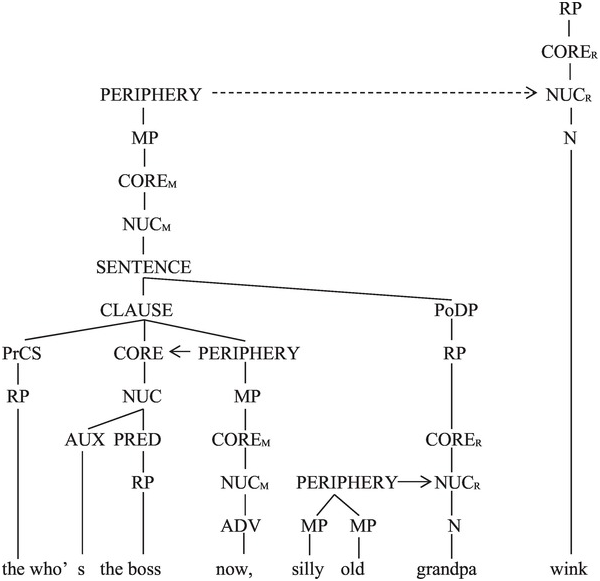
Figure 2.2 Structure of RP with MP containing sentential nucleus
Even the seemingly inconspicuous category of pre-/postpositional phrases is not without problems. As Van Valin (Reference Van Valin2008: 170) notes, these are normally thought of as endocentric projections of a (pre- or postpositional) lexical head in predicative adpositional phrases, such as the underlined element in (8), which has a prepositional nucleus consisting of the preposition in, which functions as a predicate and thus licenses the object the library.
Chris saw Pat in the library.
The status of this unit in (8) is markedly different from that of the underlined units in (9), from the same source, referred to as non-predicative PPs as these units do not predicate but are licensed by the verb and therefore do not license an object.
(9)
a. Chris showed the photo to Pat. b. Chris stole the photo from Pat. c. Chris presented Pat with the photo.
As the underlined units in (9) are non-predicative, they do not contain a PRED and hence neither a NUCp (nucleus of the PP) nor a COREp . Rather, they consist merely of a pre- or postpositon and an RP. Figure 2.3 contrasts the internal structure of these two PP types (see also Chapter 10 for adpositional phrases in RRG).
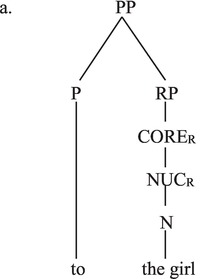
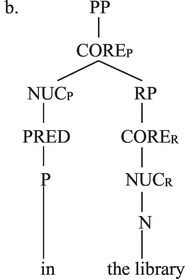
With respect to these two PP types, Van Valin (Reference Van Valin2008: 171) notes that predicative PPs most closely correspond to the X-bar notion of an endocentric category, as the nucleus here is always a P and always a head. He also notes that a modifier like right in right under the table can be handled in terms of a modifier in the periphery within the predicative PP, while with a non-predicative PP there is no prepositional nucleus, the only nucleus being that of the RP. As such, they can arguably be analysed as ‘exocentric PPs, i.e. PPs without a prepositional nucleus. Hence there is no layered structure, and this predicts that the admittedly limited set of PP-internal modifiers should not occur with a non-predicative PP, which seems to be the case: *Chris showed the photo right to Pat/*Chris stole the photo right from Pat/*Chris presented Pat right with the photo.’
2.2.2 Gradience in Lexical Categories
Any definition of lexical classes in terms of feature bundles will eventually run into problems as there will always be at least some content morphemes which show many but not all of the ‘prototypical’ features associated with a certain lexical category. For example, although most nouns in English and many other languages can appear in the plural, this is problematic with others, such as peace. Similarly, while most nouns in German are compatible with definite and indefinite articles, such as der/ein Mann ‘the/a man’, others, such as Verlaub ‘leave; permission’ are compatible with neither, in this case being restricted to occurrence in the fixed (prepositional) phrase mit Verlaub with the preposition mit ‘with’ and the meaning ‘with respect; if you will pardon my saying so’. Although Verlaub is listed in many dictionaries with the definite article der (masculine, singular), it is in fact probably never found with this article in actual speech, although it is considered a noun for other reasons, for example its compatibility with the preposition mit, which presupposes an NP (which is assumed to have a nominal head!) and its perceived inherent (masculine) gender, as inherent gender is restricted to nouns in German.
Similar problems are encountered with what Ross (Reference Ross1972) refers to as ‘category squishes’ or sequences of forms whose feature bundles gradually change so that it is often difficult to decide which category they should belong to. Van Valin (Reference Van Valin2008: 174) cites the examples in (10).
(10)
a. The savant quickly proved the theorem b. That the savant quickly proved the theorem (astonished the professors) c. the savant/*the quickly proving the theorem (astonished the professors) c′. the savant having quickly proved the theorem c′′. (I am aware of) the theorem having quickly been proved by the savant. d. the savant’s/*the quickly proving the theorem (astonished the professors) d′. the savant’s having quickly proved the theorem d′′. the theorem’s quickly being proved by the savant e. the savant’s/the quick proving of the theorem (astonished the professors) e′. *the savant’s quick having proved of the theorem e′′. the quick proving of the theorem by the savant e′′′. *the theorem’s quick proving by the savant f. the savant’s/the quick proof of the theorem (astonished the professors) f′. the quick proof of the theorem by the savant f′′. the savant’s/the quick proof (astonished the professors)
Although proved in example (10a) is clearly verbal and proof in the (10f) examples is clearly nominal, the status of the forms ending in ‑ing is much less clear. While some instances of proving, such as those in (10c) and (10d), take a direct object, suggesting that this form is a verb, the forms in (10e) and (10e′′) require an ‘object’ marked by the preposition of, suggesting that this is a noun. Furthermore, the ‘subject’ NP in (10c) appears as a bare NP, while in (10d) – as in the more ‘nominal’ form in (10e) or the clearly nominal form proof in the (10f) examples – it appears in the genitive. These and other factors such as adjectival modification, optional complements, tense, aspect and voice are summarized in tabular form in Van Valin (Reference Van Valin2008: 175).6
As we see in (10), even in languages such as English, which otherwise seem to have quite clear lexical classes, it is often not feasible to assume that each and every word form unambiguously belongs to a particular lexical category. RRG thus assumes that it is the individual features which are relevant and not the labels themselves:
What is relevant to the grammar is the features themselves, not any category labels that might be overlaid on them. So ‘noun’ is just a useful descriptive label for a certain pattern of lexical item distributions in a language, just like ‘subject’ is a useful descriptive label for a certain consistent pattern of restrictive neutralizations in a language. Analogous to grammatical relations, some languages have well-defined and sharply differentiated lexical categories, while others do not.
In the following two subsections, we discuss concrete examples from two other languages, Kharia (Munda, India) and Wari’ (Chapakuran, Brazil and Bolivia), where assuming clear-cut lexical classes and strictly endocentric syntactic categories is even more difficult, and we will show how these ‘problematic’ elements are in fact dealt with straightforwardly in RRG.
2.2.3 ‘Problematic’ Categories
2.2.3.1 Parts of Speech in Kharia
In the South Munda language Kharia, spoken in eastern-central India, Peterson (e.g. Reference Peterson2011a, b, 2013) argues that the familiar lexical categories of ‘noun’, ‘verb’, ‘adjective’ etc. are not only unnecessary for an adequate grammatical description of the language, assuming their presence in fact considerably complicates the discussion.
Peterson divides the Kharia lexicon into two major classes: the vast majority of content morphemes, that is, morphemes denoting referents, attributes and events/states, may be used freely in referential, attributive and predicative functions with no overt derivational marking, ‘light verbs’, etc. This class is open as new morphemes (e.g. modern technology and loanwords in general) are constantly being added to its ranks. There is also a closed class which can be further divided into two subclasses: ‘Proforms/Deictics’, which may be used freely in referential and predicative function, but may only be used attributively if marked for the genitive, and ‘grammatical morphemes’, which may never be used referentially, predicatively or attributively. This is illustrated in Figure 2.4.
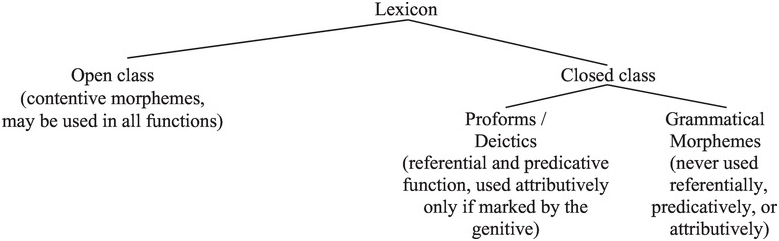
Figure 2.4 The Kharia lexicon
(11)–(12) present two examples demonstrating the flexibility of content morphemes.
(11)
Kharia ((11a) from Peterson (Reference Peterson2011a: 76); (11b) adapted from Malhotra (Reference Malhotra1982: 136)) a. lebu ɖel=ki. man come=mid.pst ‘The/a man came.’ b. bhagwan lebu=ki ro ɖel=ki. God man=mid.pst and come=mid.pst ‘God became man [= Jesus] and came [to earth].’
(12)
Kharia (Peterson Reference Peterson2013: 133) [In a play about me and you, in which both of us will be taking part.] ‘naʈak=te iɲ=ga ho=kaɽ=na=iɲ ro am=ga iɲ=na=m.’ ‘umboʔ. play=obl 1sg=foc that=sg.hum=mid.irr=1sg and 2sg=foc 1sg=mid.irr=2sg no am=na um=iɲ pal=e. ɖirekʈar seŋ=gaʔ iɲ=te ho=kaɽ=oʔ. 2sg=inf neg=1sg be.able=act.irr director early=foc 1sg=obl that=sg.hum=act.pst am=ga am=na=m.’ 2sg=foc 2sg=mid.irr=2sg ‘“In the play I will be him and you will be me.” “No. I can’t be you. The director already made me him. You will be you.”’
This process is entirely productive, given a proper context. See examples (13)–(22), from Peterson (Reference Peterson2011a: 75–92), which give some idea of the pervasiveness of this flexibility throughout the lexicon.
Interrogatives: i ‘what; which; do what?’
Indefinites: jahã ‘something; some (attribution); do something’
Quantifiers: moɲ ‘one (referential/attributive); become one’
Properties: rusuŋ ‘red (one); red (attributive); become red’, maha ‘big (one); big; grow, become big’
Proper names: aʔghrom ‘Aghrom (name of a town) (referential/attributive); come to be called “Aghrom” (middle voice), name [something] “Aghrom” (active voice)’
Status and Role: ayo ‘mother; become a mother (middle voice), accept someone as a mother (active voice)’
Deictics and proforms: iɖaʔ ‘yesterday; become yesterday (middle), turn (e.g. today) into yesterday (active, e.g. with God as subject)’
Physical objects and animate entities: kaɖoŋ ‘fish; become a fish (middle), turn into a fish (active)’
Locative: tobluŋ ‘top, rise (middle), raise (active)’
Activities: siloʔ ‘plowing (n.); plowed; plow’
In addition to this precategoriality, what appear to be entire NPs can also denote an event. Consider examples (23)–(24), both of which have the same propositional content.
(23)
Kharia (Peterson Reference Peterson2013: 134) ho rochoʔb=te col=ki=ɲ that side=obl go=mid.pst=1sg ‘I went to that side’
(24)
Kharia (Peterson 2013: 134) ho rochoʔb=ki=ɲ that side=mid.pst=1sg ‘I went to that side’ (lit.: ‘I that-side-d’)
Example (24) shows that an analysis of Kharia as possessing an N/V distinction is problematic. Even if we were to treat rochoʔb ‘side’ in (24) as a (presumably zero-derived) verb, we would then have a verb modified by the demonstrative ho ‘that’. As (25)–(26) show, the construction in (24), with an apparent NP as the semantic base of the predicate, is entirely productive and can also contain both quantifiers and genitive attributes, in addition to demonstratives. This is especially problematic for assuming ‘rampant zero conversion’ (Evans and Osada Reference Evans and Osada2005), as this would entail productive zero derivation of a verb (i.e. a lexical stem), from a full-fledged NP (i.e. from a complex syntactic unit).
(25)
Kharia (Peterson Reference Peterson2013: 134) ubar rochoʔb=ki=ɲ two side=mid.pst=1sg ‘I moved to both sides (i.e. this way and then that).’
(26)
Kharia (Peterson 2013: 135) a. oʔ=yaʔ teloŋ=ki. house=gen roof=mid.pst ‘The house’s roof was thatched.’ b. oʔ=yaʔ teloŋ=oʔ=ki. house=gen roof=act.pst=pl ‘They thatched the house’s roof.’
On the basis of data such as these, Peterson (Reference Peterson2013) assumes two structurally defined categories, the Case-syntagma and the TAM/Person-syntagma, both of which have the same potential structure for the semantic base and which differ only with respect to their functional marking, namely case or TAM/voice and person/number/honorific marking, motivated by similar structures assumed for Tongan by Broschart (Reference Broschart1997). The structure of the semantic base is given in (27). None of these elements is obligatory, as long as some non-enclitic unit is present. The Kleene star (*) denotes that potentially any number of content morphemes (lex) is possible, including zero.
(lex=gen) (dem) (quant (clf)) (lex=gen) (lex*) (=poss) (=num)
The maximal potential structure of the Case-syntagma is given in (28), where X is equal to the structure of the semantic base in (27).
X=case
Case in (28) refers to postpositions such as buŋ ‘with; ins’, seŋ ‘before’, etc., as well as the two cases given in (29), so that any postposition, =te, or the lack of any overt marking signals that the unit is a Case-syntagma.
(29)
Case: Direct (zero marking)7 − the case of subjects and indefinite direct objects; Oblique (marked by =te) − marks definite direct objects, ‘indirect objects’ and adverbials
The genitive is not a case in this sense: whereas the direct and oblique cases are relevant at the clause level to mark the relation of a constituent to the predicate (roughly: subject/non-subject), the genitive is only relevant within the semantic base and serves to integrate one semantic base into a larger semantic base. The oblique case also cannot appear in a TAM/Person-syntagma, as (30) shows, whereas the genitive can (31).
(30)
Kharia (Peterson Reference Peterson2013: 139) *sahar=te=ki=ɲ. city=obl=mid.pst=1sg ‘I went to the city.’
(31)
Kharia (Peterson 2013: 139) ayo=yaʔ=yoʔ mother=gen=act.pst.3sg ‘he or she made [it] mother’s’ (lit. ‘he or she mother’s-ed [it]’)
The structure of the TAM/Person-syntagma is given in (32), where X again refers to the semantic base given in (27). (V2) or ‘vector verbs’, as they are often referred to in South Asian studies, refers to phonological and morphosyntactic words which mark Aktionsart or the passive. voice refers to basic voice, that is, the active and middle (Klaiman Reference Klaiman1991).8
X (V2*) (=prf)=tam/voice=person/num/hon
Examples (33)–(36) illustrate this structure with a number of TAM/Person-syntagmas in Kharia. The semantic base is underlined.
(33)
Kharia (Peterson Reference Peterson2013: 142) col=ki=may go=mid.pst=3pl ‘they went’
(34)
Kharia (Peterson 2013: 142) boksel=nom goʔɖ=ki sister.in.law=2poss c:tel=mid.pst ‘she became your sister-in-law’ (= ‘she your sister-in-law-ed’)
(35)
Kharia (Peterson 2013: 142) ho=jeʔ u=jeʔ=ki goʔɖ=ki that=sg.nhum this=sg.nhum=pl c:tel=mid.pst ‘that became these’ (= ‘that these-d’)
(36)
Kharia (AK, 1: 69)9 ro tama am=pe u nãw kuʈum=te=ga and now 2=2pl this nine family=obl=foc sadi biha kersoŋ=na=pe … marry marry marry=mid.irr=2pl ‘And now you will marry in only these nine families …’
Examples (37)–(38) show a Case-syntagma and a TAM/Person-syntagma with the same semantic base (underlined), differing only with respect to their functional marking. Their basic structures are illustrated in Figure 2.5.10
(37)
Kharia (elicited) bides=aʔ lebu=ki=yaʔ rupraŋ=te abroad=gen person=pl=gen appearance=obl ‘the appearance of foreigners’ (e.g. as the object of the predicate)
(38)
Kharia (Peterson 2013: 157) bides=aʔ lebu=ki=yaʔ rupraŋ=ki=may. abroad=gen person=pl=gen appearance=mid.pst=3pl ‘They took on the appearance of foreigners (e.g. by living abroad so long).’
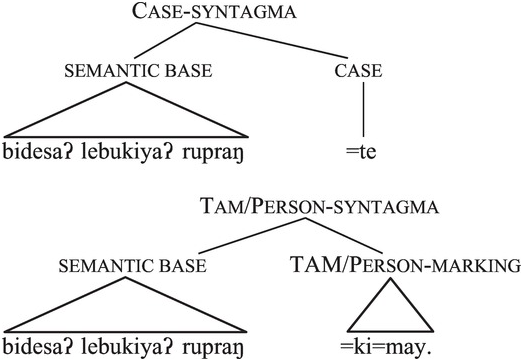
Figure 2.5 TAM/Person- and Case-syntagmas with the same semantic base
These two syntactic units are defined purely structurally, and both can appear in attributive, predicative and referential functions, as examples (39)–(42) from Peterson (Reference Peterson2013: 137) show.
Case-syntagma in attributive function
(39)
Kharia kuda koloŋ daru millet bread Tree ‘a millet bread tree’ (name of a children’s story) (Note: kuda modifies koloŋ and the two together modify daru.)11
TAM/Person-syntagma in attributive function
(40)
Kharia (Peterson Reference Peterson2011a: 74) yo=yoʔj lebu col=ki. see=act.pst.1sg man go=mid.pst ‘The man I saw left.’
Case-syntagma in predicative function
(41)
Kharia (AK 1: 57) … ro u=ga ho jinis=aʔ komaŋ. and this=foc that animal=gen meat ‘… and this [is] that animal’s meat.’
TAM/Person-syntagma in referential function
(42)
Kharia (MT, 1: 180) kunɖab aw=ki tomliŋ khaɽiya gam ɖom=na behind qual=mid.pst milk Kharia say pass=inf laʔ=ki=may ina no ipfv=mid.pst=3pl because u=ki tomliŋ uʔɖ=ga ɖel=ki=may. this=pl milk drink=foc come=mid.pst=3pl ‘[Those who] were in the rear (= literally: ‘they were behind’) were called ‘Milk Kharia’ because they came drinking milk.’
Finally, an analysis of the forms given in the preceding pages as consisting of nominals and ‘hidden verbs’ is also not tenable. As noted above, it is not possible in Kharia to combine TAM/Person marking with case marking or with postpositions, so that a construction such as the one in (43), which ends in a postposition, is not grammatical if directly followed by TAM/Person-marking, as (44) shows.12
(43)
Kharia (Peterson Reference Peterson2013: 145) ikuʔɖ jughay duʔkho buŋ very much sorrow ins ‘very sad’, literally: ‘with very much sorrow’
(44)
Kharia (Peterson 2013: 145) *ikuʔɖ jughay duʔkho buŋ goʔɖ=ki. very much sorrow ins c:tel=mid.pst ‘(He) became very sad’ (= ‘with very much sorrow’)
However, if the semantic part of this unit is re-ordered as in (45), with two constituents instead of just the one in (43), the unit which is not marked by a postposition may serve as the semantic base of a TAM/Person-syntagma. This is a common predicate type in Kharia (Peterson Reference Peterson2011a: 220).
(45)
Kharia (RD, 1: 18) gupa lebu duʔkho buŋ ikuʔɖ jughay goʔɖ=ki. watch person sorrow ins very much c:tel=mid.pst ‘The shepherd (= watch person) became very sad.’
At issue here is that the unit ending in the postposition may not be directly followed by a TAM marker, whereas the unit which does not end in a postposition/case marker can. Furthermore, if a ‘light verb’ such as hoy ‘become’ (borrowed from Kharia’s Indo-Aryan neighbour Sadri) is inserted between buŋ ‘ins’ and goʔɖ=ki in (44), this results in a grammatical predicate, consisting of a Case-syntagma and a marker of qualitative predication (≈ copula).13
(46)
Kharia (Peterson Reference Peterson2011a: 111) ikuʔɖ jughay duʔkho buŋ hoy goʔɖ=ki. very much sorrow ins become c:tel=mid.pst ‘(He) became very sad.’
Thus ‘hidden verbs’ in Kharia would have a very different distribution from the ‘light verb’ hoy ‘become’ or in fact any other supposed verb. They could only be assumed to occur after ‘predicate nominals’ which are not case-marked (e.g. for the structure in (34), i.e. those units we consider to be the semantic base of either a TAM/Person- or a Case-syntagma), but not in structures such as (44), so that they would also not be able to occur where the overt ‘light verb’ hoy does (compare (44) with (46)). Thus, hidden verbs do not simplify the analysis but rather complicate it considerably, as they would not only be non-overt but would also have a unique distribution.
Example (47) presents a simplified example of an intransitive sentence in Kharia and Figure 2.6 presents its constituent projection in the present analysis.
(47)
Kharia (adapted from Roy and Roy Reference Roy and Roy1937: 180–181) u=kiyar taŋ el=aʔ sori=ga ɲog=e uɖ=e=kiyar. this=du now 1pl.excl=gen com=foc eat=act.irr drink=act.irr=du ‘They two will now eat and drink with us.’

Figure 2.6 The constituent projection of (47)
RRG can thus easily account for analyses of individual languages which do not have supposedly universal categories such as ‘noun’, ‘adjective’ and/or ‘verb’, without needing any empty categories or hidden verbs.
Finally, there is a rather marginal type of TAM/Person-syntagma in Kharia, quotatives, in which the semantic base consists of an entire sentence, as in example (48).
(48)
Kharia (Kerkeʈʈā Reference Kerkeʈʈa1990: 31) iɖib tunboʔ ‘kersoŋ=e la! kersoŋe la!’ loʔ=na=kiyar. night daytime marry=act.irr voc rep cont=mid.irr=du ‘Day and night they both will keep on [say]ing “Marry! Marry!”’
Although Peterson (Reference Peterson2013) offers no final analysis of this form, as it is unique in his corpus, the next section, which deals with very similar predicates in the Chapakuran language Wari’ in which these structures appear to be much more common, offers a possible solution to analysing predicates of this type in Kharia.
2.2.3.2 The ‘Intentional State Constructions’ in Wari’
A similar construction to the rather marginal Kharia quotative predicate discussed in the previous section is the much more productive ‘intentional state construction’ (ISC) in Wari’, a member of the Chapakuran family of Brazil and Bolivia, to which we now turn.
As Everett (Reference Everett2008: 383) notes, in Wari’, a predicate-initial language (VOS), in verb-initial sentences the verb is immediately followed by the VIC or ‘verbal inflectional clitic’, which marks for tense, voice, person, number and gender and agrees with both subject and object. See examples (49)–(50), where the VIC is underlined.
(49)
Wari’ (Everett Reference Everett2008: 383) Quep na-in xirim te pane ta. do 3sg.real.pst/prs-3n house father.1sg rem.pst emph ‘My father made a house long ago.’
(50)
Wari’ (Everett 2008: 384) Ten ta wao’. weave pass.3sg type of basket ‘Baskets are woven.’
In sentences in which the verb is not the first sentence constituent, for example with constituent questions, this sentence-initial unit is followed by a different class of clitics which mark tense and which agree with the gender of the item in sentence-initial position, regardless of its function in the sentence, as in (51).
(51)
Wari’ (Everett 2008: 385) Ma’ co tomi’ na? that.prox.hearer m/f.real.pst/prs speak 3sg.real.pst/prs ‘Who is speaking?’
As Everett (Reference Everett2008: 386) writes, ‘Many Amazonian languages report on others’ thoughts, character, reactions, and other results of intentional states by means of quotatives, i.e. literally putting words in people’s mouths.’ Wari’ also makes use of quotatives for these purposes, but their use is apparently much more common in that language, having also spread to other uses. What is interesting is that in Wari’, similar to the Kharia example in (48), there is no morpheme denoting ‘say’. (52) provides an example of this construction in Wari’, where the indices i, j and k show the respective congruence relationships.
(52)
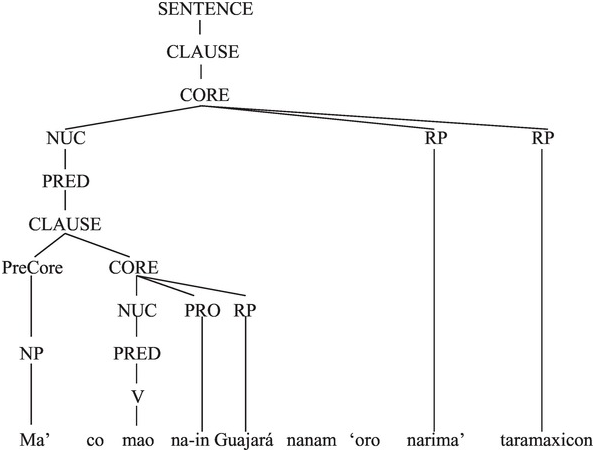
Wari’ (Everett Reference Everett2008: 386) Ma’ co mao na -ini that.prox.hearer m/f.real.pst/prs go.sg 3sg.real.pst/prs-3n Guajarái naj -namk ‘oro narimak’ taramaxiconj. Guajará (Brazilian city) 3sg.real.pst/prs-3pl.f collective woman chief ‘“Who went to Guajará?” (said) the chief to the women.’
Everett (Reference Everett2008: 391–392) notes a number of similarities between the ISC predicator and simple verbs, suggesting that the clausal semantic base of the ISC occupies the same functional slot as verbs otherwise do, namely the predicate, although it consists of an entire clause. These include:14
the ISC predicate appears in the clausal position otherwise occupied exclusively by the verb
the last syllable of the ISC predicate is stressed, as with the verb in other sentence types. This suggests that the ISC predicate is considered a single unit
the predicate of an ISC may be modified just like a verb
the predicate of an ISC may undergo compounding, like all verbs.
If the ISC predicate is considered the predicate, just like verbs in verb-initial sentences, the following generalizations may be made for constituent order in Wari’ (Everett Reference Everett2008: 392):
Wari’ sentences always begin with a verb, ISC predicate, or preverbal mood marker
the VIC appears directly after the predicate, whether this is clausal or a simple verb
tense appears in sentence-second position.
Everett (Reference Everett2008: 399) argues that Wari’ inflectional clitics – that is, those which follow the predicate of the clause – follow the NUC in an RRG analysis. As such, they follow the ISC predicate as well, which then occupies the NUC slot. Figure 2.7, adapted from Everett (Reference Everett2008: 398),15 shows the structural analysis which he assumes for example (52), where the entire ‘quote’ is viewed as a nucleus.16 The structure in Figure 2.7 captures the fact that the nucleus of the clause, which contains the predicate, consists of a form which, despite its role as the predicate, also has many of the trappings of a clause, as it consists of a precore unit and a core, which itself contains a nucleus (predicate) and two arguments. Nevertheless, it is clearly the predicate of the larger clause. This then, together with the two RPs narima’ and taramaxicon, forms the core of the higher-level clause.
2.3 Grammatical Categories: The Operators
A great deal of research has traditionally gone into modelling an appropriate representation of the argument structure of predicates – both in RRG and other syntactic theories. As discussed in Chapter 6 of the present volume, in RRG this information is stored in the lexicon in the form of logical structures, which contain information on the basic meaning of the predicate, its Aktionsart class(es), and the number of arguments and their thematic relations. The predicate and its arguments provide us with what can be termed the ‘sentence base’ (see Maas Reference Maas2004), that is, the basic propositional information, but without any information relating to the specifics of the utterance (i.e. is the information a command, a request, a statement or a question? Does it refer to a past, present, future, iterative or hypothetical event/state? Are the referents identifiable, etc.?) Information of this type is referred to as ‘sentence modality’ or ‘semantic finiteness’ in Maas (Reference Maas2004), to distinguish it from the overt marking of this information, which he refers to as ‘morphological finiteness’. This information is also often referred to collectively as the ‘grounding’ or ‘anchoring’ of the sentence. This can be portrayed as in Figure 2.8.

Figure 2.8 The sentence base and sentence modality
This grounding corresponds closely to Tomasello’s (Reference Tomasello2008) three kinds of ‘syntax’ , that is, ‘simple’, ‘serious’ and ‘fancy syntax’, which accompany what he views as the three basic evolutionary foundations of human cooperative communication:
Thus, since requesting prototypically involves only you and me in the here and now and the action I want you to perform, combinations of natural gestures and/or linguistic conventions require no real syntactic marking but only a kind of ‘simple syntax’ in a grammar of requesting … But when we produce utterances designed to inform others of things helpfully, this often involves all kinds of events and participants displaced in time and space, and this creates functional pressure for doing such things as marking participant roles and speech act functions with ‘serious syntax’ in a grammar of informing. Finally, when we want to share with others in the narrative mode about a complex series of events with multiple participants playing different roles in different events, we need even more complex syntactic devices to relate the events to one another and to track the participant across them, which leads to the conventionalization of ‘fancy syntax’ in a grammar of sharing and narrative.
In RRG, this information is divided into two broad categories: the first group we will refer to as ‘proposition-grounding’, as these categories ground the event or state with respect to time, modality, speech act, etc. The second group we will refer to as ‘referent-grounding’, as it refers to referential identifiability.
2.3.1 Proposition-Grounding Operators
We begin with a discussion of propositional grounding, which is expressed in individual languages by language-specific grammatical categories, such as present tense, past tense, hearsay, mirative, etc. The grounding information expressed by these language-specific categories is divided into three different groups according to which level of the layered structure of the clause (LSC) they ground, the nucleus, the core or the clause. RRG assumes that individual languages will differ as to which of these grounding concepts are expressed through grammatical categories, and there is no requirement that every language have all of the possible operators. In fact, most languages do not have grammatical categories expressing all of these semantic categories, although it is assumed that all languages will have grammatical means to express at least two of these categories – negation and illocutionary force (Van Valin 2005: 9). These operators are summarized in Table 2.2.
Table 2.2 Operators in the layered structure of the clause, from Van Valin (Reference Van Valin2005: 9)
| Nuclear operators: | |
| Aspect | |
| Negation | |
| Directionals (only those modifying the orientation of an action or event without reference to the participants) | |
| Core operators: | |
| Directionals (only those expressing the orientation or motion of one participant with reference to another participant or to the speaker) | |
| Event quantification | |
| Modality (root modals, e.g. ability, permission, obligation) | |
| Internal (narrow scope) negation | |
| Clause operators: | |
| Status (epistemic modals, external negation) | |
| Tense | |
| Evidentials | |
| Illocutionary force (IF) | |
Nuclear operators such as aspect or directionals modify the state/event itself without reference to the participants, while the core-level operators modify the relation between the arguments and the event, most notably directionals, (deontic) modality (‘be able’, ‘must’, etc.), narrow scope negation, and event quantification. Finally, operators which have scope over the entire clause include ‘status’ (epistemic modality and external negation), as well as tense, evidentials and illocutionary force.
Operators are represented by an operator projection, given below the respective language example. This projection is joined to the constituent projection through the nucleus. Figures 2.9 and 2.10 illustrate this for English and Japanese.

Figure 2.9 Constituent and operator projections for two English sentences
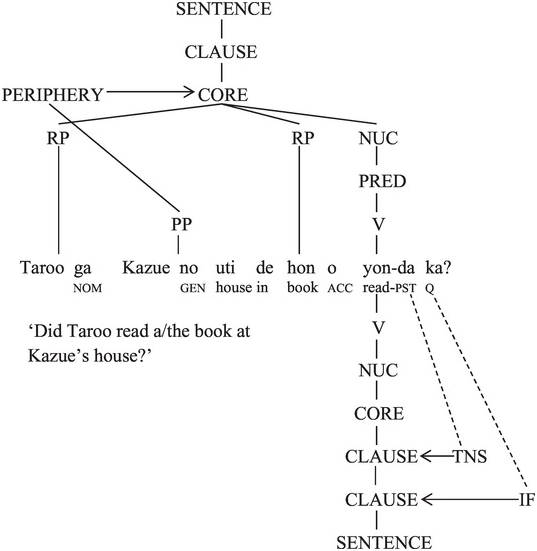
Figure 2.10 Constituent and operator projections in a Japanese sentence
Note that in the left-hand example in Figure 2.9 the information for the aspect operator comes from two different positions: the auxiliary be preceding leaving and the suffix ‑ing on this form. In fact, this information can potentially appear anywhere in the sentence. The only claim that RRG makes with respect to the placement of operators is that ‘the ordering of the morphemes expressing operators with respect to the verb indicates their relative scopes. That is, taking the nucleus as the reference point, the morphemes realizing nuclear operators should be closer to the nucleus than those expressing core operators, and those manifesting clausal operators should be outside of those signaling nuclear and core operators’ (Van Valin Reference Van Valin2005: 11). All evidence so far suggests that this is true of language in general. Although there may be language-specific variation of the ordering of the operators within a particular level, cross-linguistic data for operator marking appears to substantiate this claim for those markers for different levels which appear together on the same side of the nucleus: see examples (53)–(57) (from Van Valin 2005: 10).18
(53)
(54)
Turkish (Van Valin 2005: 10) a. Gel-iyor-du-m. come-prog-pst-1sg ‘I was coming.’ (V-ASP-TNS) b. Gel-emi-yebil-ir-im. come-able.neg-psbl-aor-1sg ‘I may be unable to come.’ (V-MOD-STA-TNS)
(55)
(56)
English (Van Valin 2005: 10) a. He may be leaving soon. (IF/TNS-STA-ASP-V)20 b. She was able to see them. (IF/TNS-MOD-V) c. Will they have to be leaving? (IF/TNS-MOD-ASP-V)
Cross-linguistic data on the position of operators (or markers of finiteness in general)21 within the sentence also suggests that these operators can theoretically appear at any position in the sentence and are not restricted to any particular position (e.g. adjacent to the verb, sentence-final, or sentence-second (i.e. the Wackernagel position)), and it is only their respective order when they appear together on the same side of the predicate which is restricted. For example, in his cross-linguistic study of finiteness, Maas (Reference Maas2004) suggests the typology of morphological finiteness given in Table 2.3. Types I, II and III denote simple predicates which consist of a single predicating unit (generally a simple verb), while Types Ia, IIa, IIb and IIc are complex predicate types which consist of at least two parts (whether verbal or not) which together express a single predicate.
Table 2.3 Predicate types with respect to ‘finiteness’ marking
| Type | Scheme | |
|---|---|---|
| I | E + P | No (verbal) morphology |
| Ia | E + P (Modifying + Modified) | No (verbal) morphology |
| II | E + P-finite | Morphologically finite predicate |
| IIa | E + P (Modifying + Modified-finite) | Modified element (= ‘lexical verb’) is finite, modifying (or ‘situating’) element is invariable (e.g. ‘particle’) |
| IIb | E + P (Modifying-finite + Modified) | Modifying element is finite, modified element is non-finite (= auxiliary-participle type) |
| IIc | E + P (Modifying-finite + Modified-finite) | Both elements are finite |
| III | (E + P)-finite | Movable affixes |
E refers to the complement of a predicate, which may be either an argument or an adjunct; P denotes the predicate; + refers to a loose concatenation of words and - to a narrow morpheme concatenation.
Types I and Ia are typical of isolating languages. Here, neither the simple predicate, consisting of a single element (usually a verb) (Type I, cf. (58)a), nor either of the two or more parts of the complex predicate (Type Ia) is morphologically marked for ‘finite’ categories (cf. (58)b).
(58)
Mandarin Chinese a. Type I: tā qù 3sg go ‘s/he goes’ b. Type Ia: tā yào qù 3sg want/fut go ‘s/he wants to / will go’
In Type II, typical of fusional and agglutinating languages, the simple predicate is marked for all finite categories (Type II), while for the complex predicates in Types IIa–c either the modified element (i.e. the lexical verb), the modifying or situating element (e.g. the auxiliary) or both is/are marked for all finiteness categories. Note that only complex predicates of Type IIb correspond to the traditional notion of auxiliaries. Also, as the Maltese examples in (59b–c) and (61a–b) show, languages can belong to more than one category.
(59)
Maltese (Semitic, Neo-Arabic, Malta) a. Type II ji-kteb 3sg.m-write.ipfv fut ‘he writes’ b. Type IIa sa ji-kteb fut 3sg.m-write.ipfv ‘he will write’ c. qed ji-kteb prog 3sg.m-write.ipfv ‘he is writing’
(60)
Type IIb: English a. She has written. b. I have gone.
(61)
Type IIc: Maltese a. ir-rid im-mur 1sg-want.ipfv 1sg-go.ipfv ‘I want to go’ (literally: ‘I-want I-go’) b. kon-t mur-t cop.pst-1sg go.pfv-1sg ‘I had gone’ (literally: ‘I-was I-went’)
Finally, in Type III at least some of the language-specific finiteness categories are marked elsewhere in the clause and not together with the other finiteness categories. For example, in (62), from Paez, a Chibcha language (possibly a language isolate) spoken in Columbia, all finiteness markers attach to the predicate in the default case, as in example (62a), with the form uʔxuetstxu ‘I went’, where the marker ‑txu ‘fac.1sg’ directly attaches to the verb form. In (62b), on the other hand, it attaches (in its phonologically determined alternative form ‑tx) to the nominal element nengasu ‘through Belcazar’ to mark this element as focused, while the verb form uʔxuets is now ‘partially finite’ (see the discussion in Maas Reference Maas2004: 378).
(62)
Type III: Paez (Maas Reference Maas2004: 378) a. xuʔna ʧamb-na uʔx-ue-ts-txu juʔ nava kar:o suw-ku. yesterday village-to go-ipfv-prog-fac.1sg them but car broken-fac.3sg ‘Yesterday I went to the village, but the car was broken.’ b. nenga-su-tx uʔx-ue-ts juʔ saʔ tja-xu paʔ jaʔ-tx. Belcazar-through-fac.1sg go-ipfv-prog them and dem-from come already-fac.1sg ‘I passed Belcazar and am already back from there.’
As noted above, RRG does not posit a privileged position for such marking, and markers of these categories can appear almost anywhere in the sentence. This allows us to account for such cross-linguistic variability in a straightforward way, without having to resort to movement or other processes to derive the actual word order in a particular language. In fact, the only claim that RRG makes is that the ordering of these morphemes with respect to the predicate – when they appear on the same side of this unit – corresponds to the relative scopal properties of the individual operators. And in the case of the Paez example in (62) this is unproblematic, as the ‘mobile’ markers are clausal operators which appear in the final position when attached to the verb in (62a), after aspectual marking and therefore conforming to this constraint. The position of this marking in (62b) directly preceding the predicate is also not an exception to this rule, as here the marking of this clausal operator is not on the same side of the verbal root as the other operators and hence this constraint does not apply here.
Finally, as discussed in Chapter 13 of this volume, the scopal properties of these operators play a pivotal role in the discussion of nexus and juncture relations in RRG. Consider Figure 2.11, from Kharia (own data), which provides an example of nuclear cosubordination, as the scope of kan, a marker of aspect/Aktionsart, has obligatory scope over both nuclei, leŋ ‘fly’ and col ‘go’.

Figure 2.11 Constituent and operator projections in Kharia
Operators are represented formally in the semantic representation of the sentence in italicized caps within angled brackets indicating their scope within the logical structure. The overall pattern is given in (63), from Van Valin (Reference Van Valin2005: 50), with arbitrarily chosen values. Note that each of the individual operators refers to a grammatical category within a specific language and as such its value is subject to the system of that language, for example, with respect to tense, which could be pst/npst in one language, pst/prs/fut in another, or fut/nfut in yet another.
〈IF DEC 〈EVID HS 〈TNS PST 〈STA IRR 〈NEG Ø 〈MOD OBLIG 〈EVQ SG 〈DIR Ø 〈ASP PERF 〈LS〉〉〉〉〉〉〉〉〉〉
(64), also from Van Valin (Reference Van Valin2005: 50), provides an example of the formal representation of the operators for the English question Has Kim been crying?.
〈IF INT 〈TNS PRS 〈ASP PERF PROG 〈do′ (Kim, [cry′ (Kim)])〉〉〉〉
2.3.2 Reference-Grounding Operators
As noted in Section 2.3, the RP also partakes in the semantic/pragmatic grounding of the clause, for instance with respect to definiteness. Table 2.4 summarizes those operators which are assumed for the RP in RRG. Table 2.4 is still somewhat tentative as it is based on the operators which RRG assumed for the NP before the notion of the RP was introduced in Van Valin (Reference Van Valin2005: 28) and further justified in Van Valin (Reference Van Valin2008). We thus tentatively assume that the same operators hold for the RP as for the NP, as we are dealing with the same underlying function here, namely the semantic/pragmatic grounding of referential units, although this topic requires further study.
As with the sentence, RPs also possess an operator projection. Figure 2.12 provides an example of such a projection for an RP in English.

Figure 2.12 Layered structure of the RP in English
Similar to the position of sentence-grounding operators discussed in the previous section, there are no general requirements in RRG that the individual operators appear adjacent to any particular element(s) of the RP, only language-specific rules regulating this, although it is expected that operators appearing on the same side of the nucleus will be arranged according to their scope, with nuclear operators appearing closer to the nucleus, followed by core operators.
To give an example of the positional variability of these operators, consider the different orders in the Dyirbal examples in (65). Dyirbal is spoken in northern Australia and has exceptionally free word order. Note that all three variants in (65) are grammatical and have the same meaning. Note also the position of the determiners with respect to the nouns which these modify.
(65)
Dyirbal (Van Valin 2005: 28) a. Bayi bargan baŋul yaɽa-ŋgu d̨urga-ɲu gambi-ɽa. det.abs wallaby.abs det.erg man-erg spear-tns mountains-loc ‘The man speared the wallaby in the mountains.’ b. Baŋul gambi-ɽa yaɽa-ŋgu bayi d̨urga-ɲu bargan. det.erg mountains-loc man.erg det.abs spear-TNS wallaby.abs c. Yaɽa-ŋgu d̨urga-ɲu gambi-ɽa bargan baŋul bayi. man.erg spear-TNS mountains-loc wallaby.abs det.erg det.abs
The operator projection of the various orders in (65) is straightforward and is given in Figure 2.13, which presents the projection of the structures in (65b).

Similar to the proposition-grounding operators in the semantic representation of the sentence, the reference-grounding operators are represented in the semantic representation of the RP. An example is given in (66), from Van Valin (Reference Van Valin2005: 52), assuming that these are the same for the RP as those previously assumed for the NP. The conventions used here (i.e. angle brackets denoting scope, italicized small caps, etc.) are the same as those used to represent the proposition-grounding operators. ∃ is the existential operator, roughly meaning ‘there is (at least one)’.
〈DEIC PROX 〈DEF + 〈NEG Ø 〈QNT ∃ 〈NUM SG 〈nasp count 〈N〉〉〉〉〉〉〉
The logical structure for a phrase like the scarf would then be represented as in (67), also from Van Valin (Reference Van Valin2005: 52).
〈DEF + 〈NEG Ø 〈QNT ∃ 〈NUM SG 〈NASP COUNT 〈(scarf)〉〉〉〉〉〉
Although in principle every RP in a sentence has such a semantic representation, for practical reasons it is seldom feasible to include all of this information in the full semantic representation of the sentence, hence it is generally omitted. An example of a full structure is given in (68) for the simple intransitive question Has the tall man been crying? (Van Valin 2005: 53). The underlining of man in the semantic representation of the RP denotes that it is the head of the RP.22

2.4 Questions for Future Research
Rauh (Reference Rauh2010: 378–383) raises a number of important questions with respect to lexical and syntactic categories in RRG which need to be addressed and to which we now turn. These questions can be divided into two broad categories. The first are questions concerning the status of lexical and syntactic categories and how these relate to one another in RRG. For example, Rauh (Reference Rauh2010: 380) raises a question with respect to examples (2b–d) above, repeated here in (69).
(69)
b. Chris [nuc is [pred a very good detective]]. PRED in NUC = NP c. Pat [nuc is [pred exceedingly tall]]. PRED in NUC = ADJP d. Pat [nuc is [pred in the house]]. PRED in NUC = PP
As Rauh notes, is in these examples is not viewed as the predicate in RRG, but rather the predicate is the NP, AdjP and PP, respectively. As such, the question arises as to how is is introduced into the sentence. The usual answer would be to assume that English, like many languages, requires a ‘dummy verb’ such as the copula when the predicate is not verbal. However, as Rauh rightly notes, if labels such as noun and verb are merely useful descriptive labels for certain language-specific feature-bundle patterns and not universally valid categories, this is not an option.
As has been argued in the preceding pages, in RRG there is no need to specify that predicates which are traditionally viewed as consisting of NPs, AdjPs, PPs, etc., require a ‘dummy verb’ – in English or elsewhere. Recall from Section 2.2 that it is the features which are relevant to the grammar, not these convenient categorial labels (Van Valin 2008: 176). It would therefore be more correct to say that a copula is required with stative predication in English when the distributional properties of the content morpheme of the predicate are not compatible with TAM/person marking (*Pat (exceedingly) talls.). No reference is necessary to categories such as noun, adjective, verb, etc. Rather, the theory recognizes that individual content morphemes can have language-specific distributional properties, which can only be determined through tests and not through ‘logical’ conjecture, based, for example, on whether they denote an action, object, etc. These language-specific restrictions include the (non‑)compatibility of a particular content morpheme with TAM or case markers, determiners, etc. However, as we saw in Section 2.3.1 for Kharia, this is not equivalent to saying that these content morphemes actually are nouns or verbs. Also, in view of the problems with ‘category squishes’ described in Section 2.2, where only some of the supposedly defining features of a particular category are present, direct reference to specific features as opposed to (at best more-or-less predictable) feature bundles provides us with a much more exact description of the grammatical operations involved.
Another area mentioned by Rauh, qualia structure (Pustejovsky Reference Pustejovsky1995), is of a very different nature and raises more serious questions, which we can only touch upon here. Qualia structure is one of four interpretive levels, the other three being argument structure, event structure and the interaction of semantic levels. This level consists of four basic roles (Pustejovsky 1995: 76):
CONSTITUTIVE: the relation between an object and its constituent parts
FORMAL: that which distinguishes the object within a larger domain
TELIC: its purpose and function
AGENTIVE: factors involved in the origin or ‘bringing it about’.
Rauh refers to qualia structure on two occasions with respect to open questions in RRG, highlighting what is in her view the importance of lexical categories in constructing the logical structure of the sentence from the lexicon. For example, ‘Lexically, the NPs should be represented by items which are described on the basis of qualia structures in the lexicon, since such a description identifies them as Ns and indicates their compatibility with those peripheries and operators that are N-specific rather than CLAUSE-specific’ (Rauh Reference Rauh2010: 380). Also, ‘To begin with, in order to construct the semantic representation of predicates and their arguments, a specification of nouns (items with a qualia structure) is required’ (Rauh Reference Rauh2010: 382). As just noted, we believe that there is no need to refer to lexical categories in describing the compatibility which Rauh is referring to, if such restrictions are described in terms of individual features and not lexical categories.
The status of qualia structure, however, requires some discussion. To begin with, the presence of qualia structure is not restricted to ‘nouns’, since verbs also have qualia structure (see e.g. §6.2.5 in Pustejovsky Reference Pustejovsky1995). Nor is event structure restricted to ‘verbs’, since nominalizations or nouns such as war in English also have event structures (see e.g. Pustejovsky, 1995, §§8.4 and 8.5). Of course, the structure and type of information contained at these levels depends among other things on whether an action or an object is being described, but it is worth recalling here that saying that a content morpheme denotes an action is not equivalent to saying that it is a ‘verb’ with a predictable set of distributional (and other) features, and to my knowledge, the lexical structures given in Pustejovsky (Reference Pustejovsky1995) do not contain any direct reference to such lexical categories, although they do, of course, contain information relating to semantic features, such as ‘physobj’, ‘process’, ‘state’, etc.
This issue requires further study, and it is likely that we will have to re-evaluate a number of assumptions with respect to semantic structure in order to be able to do away with lexical categories entirely. Furthermore, languages such as Kharia, discussed in Section 2.3.1, where virtually all content morphemes can be used predicatively, referentially and attributively, will undoubtedly present us with new challenges with respect to structuring the lexicon. However, as lexical categories do not play a very prominent role in Pustejovsky’s (Reference Pustejovsky1995) formalism, this does not appear to be an insurmountable task, although Rauh (Reference Rauh2010: 378–383) is certainly correct in noting that this will require assuming a much richer lexicon in RRG, containing considerably more language-specific information on individual morphemes than is currently the case. At any rate, languages such as Kharia with its almost total lack of distributional restrictions on content morphemes, or Wari’ with its clausal predicates in the highly productive intentional state constructions, discussed in Section 2.3.2, as well as ‘category squishes’ even in languages where we have come to accept the presence of clear-cut lexical categories as self-evident, force us to accept that these highly intuitive lexical categories cannot play a role in a theory of language with claims to universality.
In sum, while much work remains to be done, it seems clear that traditional ‘categorial thinking’ cannot serve as the basis for a universal theory of language and is in fact at the heart of many descriptive problems which have plagued linguistic theory for decades. The view taken here is that these problems can only be overcome by the wholesale rejection of such categories in language theory, granting them nothing more than the status of convenient labels in informal discussion.
3.1 Introduction
This chapter discusses semantic representation in Role and Reference Grammar (RRG) and how it can be enriched with a more conceptual or ontologically oriented approach.Footnote * An ontologically oriented model of semantic representation would provide a framework for the formalization of meaning construction. In fact, Van Valin and Mairal Usón (Reference Van Valin, Mairal Usón, Gómez, de Mendoza and Gonzálvez-García2014) argue that if the RRG linking system is given a more conceptual orientation, this can substantially enhance its semantic representations. Frameworks such as Wierzbicka’s (Reference Wierzbicka1996) Natural Semantic Metalanguage and Pustejovsky’s (Reference Pustejovsky1995) Generative Lexicon Theory have moved or are moving in this direction. A case in point is the Brandeis Semantic Ontology (BSO) (Havasi et al. Reference Havasi, Pustejovsky and Rumshisky2007; Pustejovsky et al. Reference Pustejovsky, Havasi, Littman, Rumshisky and Verhagen2006), a large lexicon ontology and lexical database. The BSO depends on the Generative Lexicon (GL), a theory of linguistic semantics that focuses on the distributed nature of compositionality in natural language. This is an issue that RRG will also have to address.
Previous RRG research on the linking algorithm has primarily targeted the syntactic level (layered structure of the clause) and paid somewhat less attention to the semantic level (logical structure). However, semantic decomposition is an important issue in RRG because its goal is to draw empirically valid generalizations for as wide a range of languages as possible. A linguistic theory that aspires to universal applicability should base meaning construction and semantic representation on a set of basic concepts or near-primitives, which can be found in a wide range of languages. Although there have been various proposals for a finer-grained representation of states and activities (Van Valin and Wilkins Reference Van Valin, Wilkins and Van Valin1993; Van Valin and LaPolla Reference Van Valin and LaPolla1997) and of active accomplishments (Van Valin, Reference Van Valin2005, Reference Van Valin, Kailuweit, Künkel and Staudinger2018; cf. Bentley Reference Bentley2019), these issues still need to be explored in greater depth.
It goes without saying that the most basic function of language is to convey meaning, and this involves considerably more than syntactic structures. At some level, an enriched lexical representation system would have to account for the encyclopedic knowledge that speakers possess, which enables them to choose the predicate that best represents the meaning they wish to convey. For example, native speakers of English are intuitively aware of the difference between related verbs such as those referring to loss of possession (e.g. steal, purloin, pilfer, filch, swipe) or those referring to the emission of a loud sound (e.g. scream, shriek, screech, bawl).
However, the ability of language users to differentiate between related predicate meanings not only entails the consideration of single events (e.g. drink) as compared to others in the same lexical domain (tipple, sip), but also an awareness of the configuration of subevents designated by the same verb within a larger ‘frame’ (Fillmore Reference Fillmore and Zampolli1977, Reference Fillmore1982). Frame Semantics (Fillmore Reference Fillmore and Geeraerts2006) studies how linguistic forms evoke frame knowledge, and how the frames thus activated can be integrated into an understanding of the passages that contain these forms. Frames are crucial elements to consider in the representation of lexical meaning.
For example, in certain cases, frames override constraints on the events that a single predicate can encode. According to Croft (Reference Croft1991, Reference Croft2012), the only way in which two subevents can co-exist in the same verb is if they are causally related (e.g. smash, which encodes the action of smashing as well as its result). However, this is not necessarily true. Goldberg (Reference Goldberg, Hovav, Doron and Sichel2010: 44–49) states that the verb double-cross designates an event of betrayal following a state or event of understood cooperation. The betrayal is not caused by the state of trust, nor does the betrayal cause the state of trust. Instead the state of trust is part of the background frame that is presupposed in order for the profiled or asserted act to count as double-crossing. This one subevent is profiled, while the background frame presupposes one or more subevents without a causal relation between them. Frame knowledge is thus essential to understanding the meaning of the verb.
A considerable part of a speaker’s language competence is the ability to choose the right predicate and to select the most suitable arguments to fill the slots activated by it in the communicative context. An effective lexical representation system should be capable of accounting for differences in lexical meaning within the context of a semantic domain and frame.
The first step in designing a representation for this purpose would presumably involve the specification of a core set of basic concepts that serves as a foundation for meaning representations. This is the only way to obtain a formal representation with sufficient explanatory adequacy to account for those aspects of meaning that transcend the code itself and are part of the shared cultural knowledge and frames of a given speaker community.
Indeed, RRG acknowledges the need for a more fine-grained system of semantic representation. In fact, Van Valin and LaPolla (Reference Van Valin and LaPolla1997: 114) admit that ‘there is as yet no adequate decompositional representation for the primitive state and activity predicates which are the building blocks of the system’. Despite the various proposals made to improve and enhance the decompositional representation in RRG, none of them has as yet been entirely satisfactory.
The rest of this chapter is organized as follows. Section 3.2 gives an overview of semantic representation in RRG for all grammatical categories and discusses semantic decomposition. Section 3.3 explores how logical structures can be enhanced by conceptual information, more specifically by the ontology in FunGramKB. Section 3.4 lists the most relevant conclusions that can be derived from this chapter.
3.2 Semantic Representation in RRG
Since Foley and Van Valin (Reference Foley and Van Valin1984), the core component of RRG has been the bidirectional linking algorithm that captures how syntactic and semantic representations are mapped onto each other. This linking algorithm comprises a semantic level and a syntactic level, which model the communication act between a speaker and an addressee. The semantic phase of the linking algorithm begins in the lexicon, where a meaning representation is constructed from the information stored there. This representation is the input for the syntactic phase, which involves the assignment of syntactic functions and morphosyntactic properties. The syntactic phase, which proceeds in the opposite direction, starts with an utterance. After the application of a syntactic parser, the morphosyntactic properties of the input sentence are represented by means of the layered structure of the clause (LSC). This syntactic representation is a combination of both universal and language-specific distinctions. The interpretation of the sentence stems from mapping rules that link the syntactic representation to the semantic representation.
3.2.1 Semantic Representation of Predicates
The classification of predicates in RRG is an enriched version of Vendler’s (Reference Vendler1967) theory of Aktionsart. Van Valin (Reference Van Valin2005) augments the four basic classes (state, activity, achievement and accomplishment) with one more class, namely, semelfactives. He also distinguishes causatives as a parameter that crosscuts these classes.1 Each of these classes is represented by a logical structure (see Chapter 1). States and activities are primitives. In fact, they are the definiens or genus in the representation of achievements, semelfactives and accomplishments.
For example, a state predicate, such as see is represented by see′ (x, y). The representation is composed of a primitive and two argument variables. Activity predicates are expressed with do′,2 which is a characteristic of this class of predicate, along with a primitive designating the activity carried out. Activity predicates can have one argument (do′ (x, [hiccup′ (x)])), or two arguments (do′ (x, [write′ (x, y)])). As previously mentioned, achievements, semelfactives, accomplishments and active accomplishments are based on states and activities in combination with operators.
More specifically, an achievement comprises a state or activity predicate combined with INGR,3 indicating the sudden onset of the eventuality. For instance, the vase cracked is represented as INGR cracked′ (vase). Semelfactive predicates have a SEML operator and can be either activities or states. The activity designated by these predicates is punctual but does not cause a change of state or lead to a result. Thus, the janitor hiccupped would be SEML do′ (janitor, [hiccup′ (janitor)])). A semelfactive predicate can also be a state, for example flicker (SEML shine′ (x, y)).
Accomplishments are represented by means of BECOME, which signals a change of state that reflects some sort of internal transition or transformation, for example ossify: BECOME hardened′ (x). In Van Valin (Reference Van Valin2005: 44, Reference Van Valin, Kailuweit, Künkel and Staudinger2018), BECOME is broken down into PROC, the operator which indicates the duration of the change, and INGR, the operator which indicates the change of state itself. Active accomplishments are a complex structure, composed of an activity and an achievement, which reflects the telic nature acquired by the predicate in conjunction with a noun phrase or an adpositional phrase. For example, the witch brewed a potion is represented as follows: do′ (witch [brew′ (witch, potion)]) & INGR exist′ (potion). This formulation also includes the ampersand (&), which means ‘and then’. Finally, each of these predicate classes also has a causative version.4
Although verbs are extremely important, language competence also involves other categories. The RRG treatment of adjectives, adverbs and nouns is explained in Van Valin (Reference Van Valin2005: 48–51) and Van Valin and LaPolla (Reference Van Valin and LaPolla1997: 154–171). When adjectives function as predicates, they are treated as states in RRG logical structures (Van Valin Reference Van Valin2005: 48).
The chandelier is broken
broken′ (chandelier).
Adjectives can also occur as part of attributive predications. Note that be′ is only found in the representation of attributive predications, not in the representation of the resulting state; moreover, be′ is not the representation of the copula, but the operator of a state, comparable to the operator do′. The operator be′ thus figures in these representations as the principal characteristic of attributive logical structures:
(2)
a. Laura is wealthy. be′ (Laura, [wealthy′]) b. John is afraid of birds. feel′ (John, [afraid′ (birds)])
In regard to adverbs, Van Valin (Reference Van Valin2005: 49) explains that they are represented as one-place predicates and can modify different parts of a logical structure. For example, the argument of a time adverb can be the entire logical structure. In (3), the entire event of Lucas walking and then beginning to be at the zoo takes place within the time frame designated by tomorrow.
Tomorrow, Lucas will walk to the zoo.
tomorrow′ (do′ (Lucas, [walk′ (Lucas) ]) & INGR be-at′ (zoo, Lucas))
Generally speaking, manner adverbs modify activity predicates, whereas pace adverbs can modify any type of durational predicate. In (4), the activity of stealing, performed by Bugsy, is both an activity and durational predicate. As a result, it can be carried out in a certain way (furtively) and at a certain speed (fast):
Bugsy furtively stole the jewels fast.
furtive′ (do′ (Bugsy, [steal′, (Bugsy, jewels))]) CAUSE [fast′ (BECOME stolen′ (jewels))]
Aspectual adverbs modify basic state or activity predicates. In (5), there is an evident change of state since the water that was in the teapot is no longer in a liquid state because it has been transformed into vapour.
The water in the teapot totally evaporated.
BECOME (total′ (evaporated′ (water)))
In (6), a sustained activity is performed by the juror, who does not stop moving throughout the time period of the stated event (trial).
The juror fidgeted continuously.
continuous′ (do′ (juror, [fidget′ (juror)]))
Finally, Van Valin (Reference Van Valin2005) describes how predicative prepositions are represented and underlines the fact that they are also state predicates. As shown in (7), the logical structure be-in′ is the highest predicate since the grassland is the place where the kangaroo is jumping. As such, it has two arguments, namely, the grassland and the logical structure for jump.
The kangaroo jumped in the grassland.
be-in′ (grassland, [do′ (kangaroo, [jump′ (kangaroo)])])
This contrasts with the logical structure of the active accomplishment, the kangaroo jumped to the grassland, in which the predicative preposition (PP) indicates the final location of the kangaroo and not the location of the jumping event.
3.2.2 Semantic Representation of Nouns
Nouns as a grammatical and semantic category have never been a focus in RRG since their syntax is less complex. Up until now, RRG has proposed a semantic representation based on the qualia analysis in Pustejovsky (Reference Pustejovsky1995). Although, unlike verbs, nouns (e.g. cat and table) lack a logical structure, they have semantic properties in the form of qualia roles, which parameterize their meaning. According to Pustejovsky et al. (Reference Pustejovsky, Havasi, Littman, Rumshisky and Verhagen2006: 3), nouns can be described in terms of the following:
formal role: the basic type distinguishing the meaning of a word
agentive role: the factors involved in the object’s origins or ‘coming into being’
telic role: the purpose or function of the object if there is one
constitutive role: the relation between an object and its constituent parts.
Since the formal role refers to the type_of relation and the constitutive role refers to the part_of relation, this is still another indicator of an implicit typology of concepts underlying the semantic description of nouns. Just as important is the fact that the agentive role identifies a set of events linked to the object concept, whereas the telic role refers to an event description, which is associated with that object as its function (Pustejovsky et al. Reference Pustejovsky, Havasi, Littman, Rumshisky and Verhagen2006: 333). According to Pustejovsky (Reference Pustejovsky, Bouillon and Busa2001: 5), qualia provide functional tags for words, which are linked to the network of concepts in Figure 3.1.
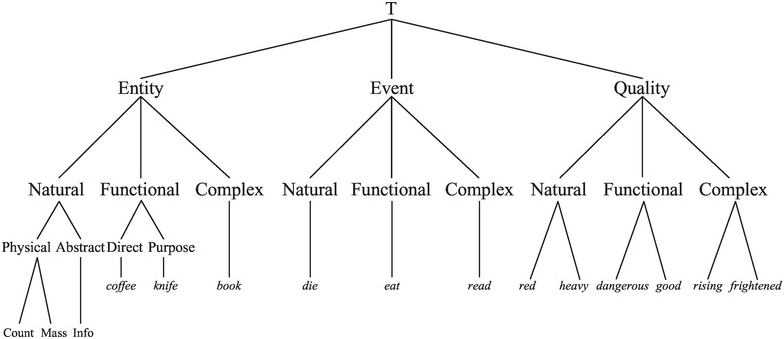
Within the context of this concept lattice or network, each entity is described in terms of its qualia structure. For example, Figure 3.2 shows the representation of the qualia structure of violin, which is classified as a functional entity or artefact that has been created for a purpose. The formal role (F) indicates that violin is a type of musical instrument. Its agentive role (A) shows that a violin is the result of a building process. The telic role (T) reflects that the purpose of a violin is to produce music; and the constitutive role (C) indicates the parts of the violin, such as the strings.

Figure 3.2 Qualia structure of violin
The variables w, x, y and z refer to the different entities involved in events typically associated with a violin. The violin itself is assigned the variable x and is given a basic type in F; the agent building the violin is y (‘y builds x’), as expressed in A. The person using the violin in T to produce the musical sound on the violin is z (‘z produces sound on x’); and in C, the strings are identified as w (‘w of x’) (Pustejovsky and Batiukova Reference Pustejovsky and Batiukova2019: 162).
This overview of the RRG treatment of lexical units shows that words belonging to all grammatical categories would benefit from a system of semantic decomposition, which would make their meaning explicit and highlight the relations between words in the same category as well as with those in different categories.
For example, such a system would show that predicates describing emotional states could be further decomposed in terms of feel, or those predicates that express possession could be decomposed in terms of have. Artefact entities such as table, gun and bread would be assigned to conceptual categories of furniture, weapon and food, respectively. Humans would also have different types of social roles (aunt, neighbour, friend, etc.) and professional roles (lawyer, zookeeper, hairdresser, etc.).
Despite the fact that in RRG there is still no clearly defined system that indicates which words should be treated as primitives and which should be defined in terms of other more basic lexical units, this could be achieved by specifying the meaning representations of lexemes and linking them to an underlying ontological system.
3.2.3 Semantic Decomposition in RRG
Although the use of English words to designate potential primitives is a notational convenience (Van Valin Reference Van Valin2005: 46), the criteria used to select these primitives are somewhat less clear. Even though lexical primitives may have conceptual correlates, they still lack an ontology. There is also the need for research that will provide evidence of the scope of semantic primitives or at least give some indication of their potential cross-linguistic validity. This would doubtlessly contribute to clarifying the lexical–conceptual interface and how it works.
In the RRG lexical representation system, another issue is why certain predicates undergo semantic decomposition whereas others do not. For example, in the lexical representations for love (8) and snore (9), the same predicates (love′ and snore′) are used in their own definitions. Nonetheless, love, which is a verb of feeling, could be defined in terms of feel, whereas snore is a type of sound emission.
love love′ (x, y)
snore do′ (x, [snore′ (x)])
The same also occurs in (10) and (11) except for the fact that the BECOME operator introduces the resulting state.5
soften BECOME soft′ (x)
scatter [do′ (x, Ø)] CAUSE [BECOME scattered′ (y)]
These examples are in direct contrast to the representations in (12–14) in which each predicate is semantically decomposed. More specifically, learn is defined as to come to know, receive is to come to have, and show is to cause to see. In this causative sense, x does something that causes y to come to see z.
learn BECOME know′ (x, y)
receive BECOME have′ (x, y)
show [do′ (x, Ø)] CAUSE [BECOME see′ (y, z)]
According to Van Valin (Reference Van Valin1993) and Van Valin and Mairal Usón (Reference Van Valin, Mairal Usón, Gómez, de Mendoza and Gonzálvez-García2014), it is necessary to improve the lexical representation system so as to obtain more consistent semantic decompositions. However, part of the problem lies in the fact that logical structures, as they were initially conceived, only focus on capturing grammatically relevant aspects of word meaning and neglect contextual meaning.
3.3 Towards a Conceptual Approach
Semantic decomposition of any kind is problematic because there is no simple solution for the atomization of meaning. Nevertheless, semantic features or attributes tend to pop up in different guises within a wide variety of approaches, such as Wierzbicka’s Natural Semantic Metalanguage (NSM) (see Goddard and Wierzbicka Reference Goddard and Wierzbicka2002), Mel’cuk’s Meaning Text Theory (e.g. Mel’cuk Reference Mel’cuk1989, Reference Mel’cuk2012), Jackendoff’s (Reference Jackendoff1983, Reference Jackendoff1990, Reference Jackendoff1997) Conceptual Semantics, or Ontological Semantics (see Nirenburg and Raskin Reference Nirenburg and Raskin2004). This is also something that Role and Reference Grammar has to deal with.
Even though semantic decomposition may at first appear to be a difficult enterprise, the intuition persists that smaller meaning units must exist at some level to encode conceptual content. This means organizing the lexicon in lexical classes or domains. Each lexical domain has a basically hierarchical organization with other types of relations linking each predicate to others in a network structure. Factorization determines where the chain of the decompositional system ends.
More specifically, conceptual information is encoded in a predicate definition, which to a certain extent is conceived as a frame with slots, having certain selection restrictions and default values. In this respect, each verb in the lexicon can be said to activate its own scenario, which determines its semantic participants.
Designating a set of undefinables for a semantic metalanguage means the adoption of a system of lexical decomposition which can possibly function cross-linguistically. In this regard, each lexical domain has a set of functions that act on the superordinate term to generate more specific hyponyms and codify the most relevant subdomains. Ideally, the metalanguage established through semantic decomposition could also be used for conceptual representations.
A more ontologically driven representation can thus provide a solution to the problems arising from the use in lexical representations of an unstructured inventory of semantic primes that are created as needed. Meaning definitions within the lexicon can and should point to the position of a concept within a network. This is in line with Pustejovsky (Reference Pustejovsky1995: 6) when he writes
the meanings of words should somehow reflect the deeper conceptual structures in the cognitive system, and the domain it operates in. This is tantamount to stating that the semantics of natural language should be the image of nonlinguistic conceptual organizing principles, whatever their structure.
Such a conceptual configuration can be organized onomasiologically (in meaning areas) rather than semasiologically (in alphabetical order). The definitions in an ideal dictionary would thus reflect conceptual categories, as codified in the genus or superordinate term of each definition. The features or properties that distinguish concepts from others in the same category would be linguistically represented by the clauses that modify the genus. Definitions would be coherent not only on a microstructural level, but also on a macrostructural one (Mairal Usón and Faber Reference Mairal Usón and Faber2007).
According to Levy (Reference Levy2003), it is only through the study of the usage of terms in a public language that we can have an independent way of fixing the contents of people’s concepts. This coincides with Dummett’s (Reference Dummett1991) Priority Thesis, which takes language first and concepts second. Since dictionaries are the codification of conceptual content in public language, they are valid texts for the extraction of conceptual information regarding meaning parameters, arguments, semantic roles, semantic restrictions, etc.
It is well known that categories have a basically hierarchical organization, given that hierarchies are central to cognition (Jackendoff Reference Jackendoff1997: 16). Within such hierarchies, concepts are related both vertically and horizontally by different types of conceptual relation. When this organization is applied to the structure of a semantic or conceptual domain, the resulting structure is an ontology (in the artificial intelligence sense rather than the philosophical sense), defined by Gruber (Reference Gruber1976) as an explicit specification of a conceptualization. One crucial property of a conceptual system is that no concept can be described without an account of its relationships to others (Lamb Reference Lamb1998: 147).
When such representations are anchored to a well-designed conceptual ontology or network that relates word senses, the primitives in a conceptual lexical structure are no longer regarded as predicates but rather as conceptual units taken directly from an ontology.6
The ontology that can be used to specify the concepts in conceptual logical structures is FunGramKB, a multilingual online environment for the semi-automatic construction of a multipurpose lexico-conceptual knowledge base for natural language processing (NLP) systems (Periñan-Pascual and Arcas-Tuñez Reference Periñán Pascual and Arcas-Túnez2007, Reference Periñán Pascual and Arcas-Túnez2010; Mairal Usón and Periñan-Pascual Reference Mairal Usón and Pascual2009).7 The structure of FunGramKB has two levels: a linguistic level and a conceptual level. The three components of the linguistic level are the lexicon, grammaticon and morphicon, which store the lexical, grammatical and morphological information for each word. In a parallel way, the conceptual level is also composed of three modules: the ontology (concept hierarchy), the cognicon (scripts encoding procedural knowledge) and the onomasticon (proper names of entities and events).
In the same way as other lexically based ontologies, the main premise of FunGramKB is that the conceptual representations of objects, attributes and events are mapped onto language in some significant way. The assumption is that the structure of the lexicon is based on a core set of undefinables or conceptual invariants and that these invariants can be extracted from lexicographic resources that document our shared knowledge of the world. Whereas the lexicon houses language-specific syntactic and morphological information, the language-neutral ontology captures the meanings and interrelationships of concepts that are not explicitly stated in the lexicon.
The first step in building the ontology was the specification of an inventory of basic concepts that are assumed to be lexicalized in a wide range of languages. The ontology acquisition methodology is based on the extraction of type_of hierarchies from dictionary definitions (Martín-Mingorance Reference Martín Mingorance and Hartmann1984, Reference Martín Mingorance, Tomaszczyk and Lewandowska-Tomaszczyk1990, Reference Martín Mingorance and Hoinkes1995; Hirst Reference Hirst, Staab and Studer2009; Amsler Reference Amsler1980, Reference Amsler1981). Whereas the genus designates the superordinate concept of the defined word, the differentiating features are the properties that make the concept different from other members of the same conceptual category. The meaning of a word is thus an access point to a concept or conceptual structure of some kind. Pustejovsky (Reference Pustejovsky, Bouillon and Busa2001: 5) also claims that his qualia are linked to a network of concepts (though this relational structure is never specified). Consequently, all problems are transferred to the ontology since each word sense is represented as a pointer to some concept or category within the ontology.
The FunGramKB ontology has the following levels. At the highest level are meta-concepts (e.g. #EVENT). At the next level are basic concepts (e.g. +HUMAN_00), which are used to define other basic concepts and terminal concepts. At still another level are terminal concepts (e.g. $METEORITE_00), which are more specific and not used in the meaning postulates of other concepts. The final level of subconcepts (e.g. −PASTEURIZE), has the same thematic frame as a terminal concept (i.e. $STERILIZE_00), but specifies one of its arguments to a greater degree. (In the case of −PASTEURIZE, the second argument is restricted to milk products.) The concepts at the meta-conceptual, basic, terminal, and subconcept levels are preceded by the symbols, #, +, $, and −, respectively. Except for the subconcept level, each also has a numerical code, (_00, _01, _002, etc.).
The methodology used to extract concepts consists of four phases: (1) conceptualization, (2) hierarchization, (3) remodelling, and (4) refinement.8 The source was the Longman Dictionary of Contemporary English (Procter Reference Procter1978). All basic and terminal concepts in FunGramKB are described in terms of semantic properties represented in thematic frames and meaning postulates. Each event is assigned to one thematic frame.
A thematic frame contains the number and type of participants (with selection restrictions) involved in the event or quality. Although not all participants are lexicalized, they are implicit to the understanding of the concept. The second type of conceptual schema is a meaning postulate, which is a set of one or more logically connected predications (e1, e2, etc.) with the generic features of concepts. Only one thematic frame and one meaning postulate are assigned to each concept.
Meaning postulates are encoded in COREL (Conceptual Representation Language) (Periñán-Pascual and Mairal Usón Reference Periñán-Pascual and Mairal Usón2010). This machine-readable language defines all of the units. It can also be used to obtain conceptual relations by applying inheritance and inference mechanisms to the meaning postulates (Periñán-Pascual and Arcas-Túnez Reference Periñán Pascual and Arcas-Túnez2005). In each representation, the meaning postulates provide the basis for natural semantic decomposition since each lexeme is linked to a concept.
3.3.1 Conceptual Logical Structures
Adopting this conceptual approach would significantly modify RRG in that logical structures (LSs) would become conceptual logical structures (CLSs). Although CLSs resemble LSs in that they maintain the Aktionsart distinctions, the two differ because in CLSs, predicates become concepts. This type of ontologically based representation has the format in Table 3.1.
Table 3.1 Inventory of conceptual logical structures
| Predicate class | Conceptual logical structure |
|---|---|
| State | <C> (x) or (x, y) |
| Activity | do′ (x, [<C> (x) or (x, y)]) |
| Achievement | INGR <C> (x) or (x, y), or INGR do′ (x, [<C> (x) o (x, y)]) |
| Semelfactive | SEML <C> (x) or (x, y) SEML do′ (x, [<C> (x) or (x, y)]) |
| Accomplishment | BECOME <C> (x) or (x, y), or BECOME do′ (x, [<C> (x) or (x, y)]) |
| Active accomplishment | do′ (x, [<C> (x, (y))]) & BECOME <C> (z, x) o (y) |
| Causatives | α CAUSE β, where α and β are logical structures of any type |
As can be observed, in Table 1, the lexical primitives are replaced by concepts (<C>), which provide a more granular semantic decomposition and represent any conceptual unit, whether basic or terminal. One of the advantages of this approach is that each lexical unit is linked to a conceptual unit and is enriched by the inheritance of the conceptual properties (i.e. thematic frame and meaning postulate) of the related conceptual unit. As widely discussed in Van Valin and Mairal Usón (Reference Van Valin, Mairal Usón, Gómez, de Mendoza and Gonzálvez-García2014), CLSs arise from the interaction of information in the ontology and the lexicon. In order to ascertain how the ontology and the lexicon actually interact and arrive at what has come to be known as the lexical–conceptual interface, it is necessary to review what type of information is present in both the ontology and the lexicon.
The choice of English as the conceptual language for lexical representation is not a problem since FunGramKB is based on the premise that at a certain level, all languages contain a set of core concepts that lie at the heart of communication. Since the ontology contains non-language-specific information, the language used to encode concepts is irrelevant (in fact, numbers could also have been used). Each concept derives its meaning from its position in the ontology as well as from its relations with other concepts. In other words, a concept is defined by its conceptual route. This is exemplified in the representation of $STERILIZE _00 in Figure 3.3.

Figure 3.3 FunGramKB Ontological Hierarchy for $STERILIZE_00
The ontology in Figure 3.3 represents $STERILIZE_00 as a material event that is a type of transformation process, represented by the meta-concept #TRANSFORMATION. At the more subordinate levels are the basic concepts, +CHANGE_00 and +CLEAN_01. As shown, +CHANGE_00 is a type of transformation, whereas +CLEAN_01 is a type of change in that an entity that is dirty is changed, so that the dirt is removed and it becomes clean.
In Figure 3.3, $STERILIZE_00 is a daughter concept of +CLEAN_01. The cleaning process in $STERILIZE_00 involves killing bacteria (or something perceived to have bacteria). As such, $STERILIZE_00 is a terminal concept with various predicates bound to it, namely, fumigate, sanitize, disinfect, pasteurize, decontaminate and sterilize. Predicate selection is constrained by the context. World knowledge (not syntax) pertaining to the entity with bacteria, the sterilization instrument or method used, and the end result pursued guide the speaker’s choice of predicate. Although the meaning distinctions encoded in the predicates do not have an impact on syntactic form, this type of semantic–pragmatic information should be included in the RRG lexicon since it is a major component of lexical competence.
Moreover, the fact that lexical entries are linked to conceptual units and thus have different conceptual routes is a way of resolving polysemy. CLSs facilitate the selection of the most suitable concept in the case of predicates with more than one meaning. In this sense, each meaning of a predicate is linked to a different concept. The result is a robust enumerative lexicon with fine-grained meaning postulates, capable of generating a complex conceptual network. It is thus no longer necessary to condense all the meanings of a lexical unit into a single infra-specified representation as proposed by Generative Lexicon Theory.
In CLSs, differences in meaning are not marked by the syntactic behaviour of a lexeme but rather are specified in its meaning. Accordingly, nuances of meaning resulting from differences in syntactic constructions do not affect the conceptual representation or the selection of the conceptual unit. This method of dealing with polysemy is exemplified by fix. For instance, one of the various meanings of fix is to repair something that is broken or not working properly (15).
The plumber fixed the leaky tap.
Another meaning of fix is to prepare a meal or drinks.
The chef fixed a dish of stewed artichokes.
FunGramKB links each of these senses to a different concept: +REPAIR_00 and +COOK_00, respectively. Consequently, depending on the sense, fix has one of the following formats:
(17)
a. do′ (x, [+REPAIR_00 (x, y)]) b. do′ (x, [+COOK_00 (x, y) & become <+EXIST_00> (y)]
The selection of (17a) or (17b) depends on the basic conceptual event since cooking is a creation event whereas repairing is a change event. Accordingly, +REPAIR_00 and +COOK_00 differ in their conceptual routes and positions in the ontology. In the case of +COOK_00, the conceptual path is #MATERIAL >> +DO_00 >> +CREATE_00 >> +COOK. Its meaning postulate is the following:
+(e1: +CREATE_00 (x1) Theme (x2) Referent (f1: +HUMAN_00) Beneficiary (f2) Instrument (f3: +FOOD_00)Means (f4: (e2: +HEAT_00 (x1) Theme (x3: f3) Referent))Manner)
In contrast, the conceptual path of +REPAIR_00 is: #MATERIAL >> #TRANSFORMATION >> +CHANGE_00 >> +REPAIR_00. However, the change resulting from a +REPAIR_00 event is of a different type since it involves changing an entity that was damaged in the past so that it can function again.
+(e1: +CHANGE_00 (x1)Theme (x2)Referent (f1: (e2: past +DAMAGE_00 (x3)Theme (x2)Referent))Reason (f2: (e3: pos +OPERATE_00 (x4)Theme (x2)Referent))Result)
The existence of a previously specified ontology provides a more specific conceptual context that allows users to access concepts from a structured inventory. There is thus no need to create ad hoc primitives on demand since it is the ontology that determines the concept unit in the representation.
3.3.2 Case Studies: pasteurize, obsolete and invoice
This section provides examples of the CLSs of verbs, adjectives and nouns.9 As previously mentioned, each lexical unit in the lexicon is linked to a conceptual unit in the ontology.
For example, −PASTEURIZE is a subconcept linked to the terminal concept, $STERLILIZE_00 and as such, it is marked with a dash (−). Its conceptual route is #EVENT > #MATERIAL > #TRANSFORMATION > +CHANGE_00 > +CLEAN_01 > $STERILIZE_00. It does not appear in the basic hierarchical structure of the ontology since it shares the basic thematic frame and meaning of $STERILIZE_00. The difference lies in the fact that in −PASTEURIZE, there is a specification of the second argument (milk). Words in different languages can thus be linked to −PASTEURIZE, such as pasteurize (English), pasteurizar (Spanish), pastörize etmek (Turkish), 巴氏滅菌法 (Chinese). Example (20) shows a partial representation of the CLS for the predicate pasteurize.
pasteurize: do′ (x [−PASTEURIZE (x, y)])
In (20), pasteurize is represented as an activity predicate that is the lexical designation of the conceptual unit −PASTEURIZE. However, this predicate can be decomposed further. Figure 3.4 shows the conceptual entry for −PASTEURIZE, which consists of a thematic frame and a meaning postulate. Thematic frames and meaning postulates are two complementary types of conceptual schema used to encode the meaning of the concepts in the ontology.

Figure 3.4 FunGramKB conceptual entry for −PASTEURIZE
The thematic frame for −PASTEURIZE is inherited from the terminal concept $STERILIZE_00, which involves #TRANSFORMATION. In the thematic frame of #TRANSFORMATION concepts, there are two participants: (i) a Theme Entity that transforms another entity and (ii) a Referent Entity that is transformed by another entity. However, the selection restrictions for −PASTEURIZE specify that the theme is human and the referent is restricted to milk.
In Figure 3.4, the meaning postulate of pasteurize is composed of two events, the second of which is the purpose of the other. In the second event (e2), the theme (x1) kills a referent (x3), in this case, bacteria. Since −PASTEURIZE is a type of $STERILIZE_00, which entails a cleaning event as well as a killing event, there is a semantic decomposition of this predicate into more basic units. In fact, it is possible to reach a semantic representation in COREL composed of semantic primitives by applying stepwise conceptual decomposition (Periñán-Pascual and Arcas-Túnez Reference Periñán Pascual and Arcas-Túnez2005), where the defining term in a meaning postulate can become the defined term in another. This process is based upon Dik’s (Reference Dik1978) stepwise lexical decomposition as applied in Faber and Mairal Usón (Reference Faber and Mairal Usón1999). However, instead of lexical items, the results of this process are regarded as conceptual units.
This type of conceptual representation can also be used to represent qualities designated by adjectives such as obsolete. The ontological hierarchy in Figure 3.5 shows that obsolete is linked to the meta-concept of #QUALITY, and that it exists as a social perception #SOCIAL. An entity can only be perceived as +USELESS_00 (→obsolete)) within a social context in which something better has been created to replace it.
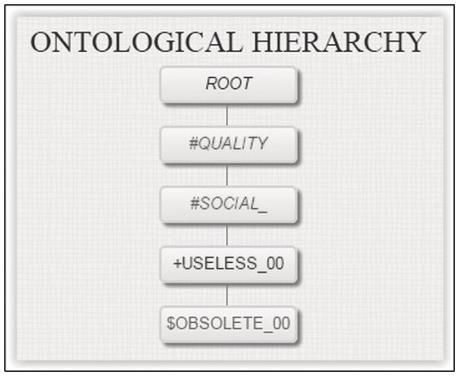
Figure 3.5 FunGramKB Ontological Hierarchy for concepts linked to $OBSOLETE_00
In the same way as with −PASTEURIZE, words from different languages can also be linked to $OBSOLETE_00 (e.g. Engl. obsolete, Sp. obsoleto, Fin. vanhentunut, Hung. elavult). The CLS for these predicates has the following format:
$OBSOLETE_00 (x)
This CLS for obsolete consists of the conceptual unit $OBSOLETE_00, which, in turn, is composed of a thematic frame and a meaning postulate (Figure 3.6). Since it is a state, the thematic frame only has one participant (x1), which is a previously useful entity that is now socially perceived as useless.
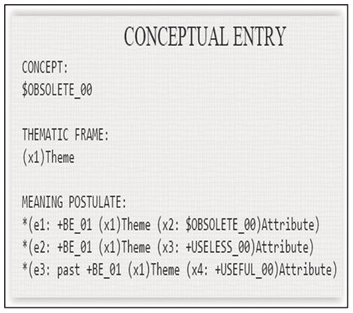
Figure 3.6 FunGramKB conceptual entry for $OBSOLETE_00
Obsolete is a predicate that can be applied to a wide variety of objects, such as typewriter. As is well known, a typewriter is a machine with keys that are pressed to print letters of the alphabet onto paper. Since the 1990s, personal computers more efficiently perform the functions of typewriters. Thus, understanding why typewriters have become obsolete entails elements of world knowledge, such as an awareness of past and present time frames as well as of the affordances of typewriters in comparison to those of more modern machines that can be used for the same purpose. The meaning postulate in Figure 3.6 describes the three events that occur when an entity, such as a typewriter, is described as obsolete:
(e1: +BE_01 (typewriter)Theme (x2: $OBSOLETE_00) Attribute)
The typewriter is obsolete.
(e2: +BE_01 (typewriter)Theme (x2: +USELESS_00) Attribute)
The typewriter is useless (in the present).
(e3: +BE_01 (typewriter)Theme (x2: +USEFUL_00) Attribute)
The typewriter was useful (in the past).
As reflected in (22–24), $OBSOLETE_00 is a more specific type of +USELESS_00 since it presupposes a time sequence or period during which the (once useful) entity has become useless. The representation in (25) portrays +USELESS_00 as the negation of +USEFUL_00.
*(e1: +BE_01 (x1)Theme (x2: +USELESS_00)Attribute)
+(e2: n +BE_01 (x1)Theme (x3: +USEFUL_00)Attribute)
The conceptual entry for +USEFUL_00 in (26) states that something is useful when it helps a human to do something.
+(e1: +BE_01 (x1)Theme (x2: +USEFUL_00)Attribute)
+(e2: pos +HELP_00 (x1)Theme (x3: (e3: +DO_00 (x4: +HUMAN_00)Theme (x5)Referent))Referent)
All of this information is inherited by $OBSOLETE_00. When specifically applied to a typewriter, what is also activated is the list of affordances provided, which other more modern machines now perform more efficiently.
Finally, nouns, such as invoice, are also represented in terms of a conceptual logical structure. From an ontological perspective, +INVOICE_00 is a basic concept (see Figure 3.7). It is a member of the meta-conceptual category of #PHYSICAL_OBJECT and more specifically, that of #SELF_CONNECTED_OBJECT. Its conceptual path is +INFORMATION_OBJECT_00→ +WRITING_00→ +DOCUMENT_00. An invoice is a type of information object, which is informative because of the writing in/on it, and which has the form of a document.

Figure 3.7 FunGramKB Ontological Hierarchy for +INVOICE_00
Again, lexemes in different languages, such as invoice (English), factura (Spanish), faktura (Norwegian), فاتورة (Arabic), can be linked to this conceptual entry, which has the following CLS:
+INVOICE_00 (x)
As a noun, invoice does not have a thematic frame. However, this does not mean that it lacks a relational structure. As a commercial document that itemizes a transaction between a buyer and a seller, invoice indirectly refers to a complex knowledge configuration, which speakers have to access in order to understand the term. This information should be included in the meaning postulate of the conceptual entry. Accordingly, the conceptual entry for +INVOICE_00 in Figure 3.8 is composed of a meaning postulate with two main events, which state what type of entity an invoice is (e1) and the context in which it is produced (e2).
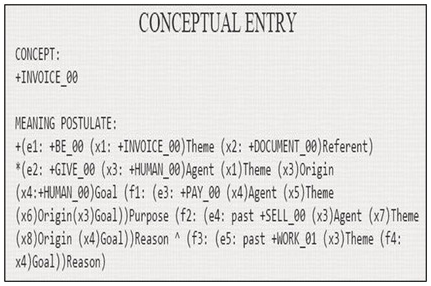
Figure 3.8 FunGramKB conceptual entry for +INVOICE_00
This second event contains three subevents (e3, e4, e5). Examples (28–31) show each event and subevent within the corresponding frame, which encodes the purpose of an invoice (f1) and the possible reasons for issuing it (f2, f3).
(e1: +BE_00 (x1: +INVOICE_00)Theme (x2: +DOCUMENT_00) Referent)
[An invoice is a document.]
(e2: +GIVE_00 (x3: +HUMAN_00)Agent (x1)Theme (x3) Origin (x4: +HUMAN_00) Goal)
[A human (x3) gives an invoice to another human (x4)]
(f1: (e3: +PAY_00 (x4) Agent (x5)Theme (x6) Origin (x3) Goal))Purpose
[The purpose of an invoice is for x4 to pay x3.]
(f2: (e4: past +SELL_00 (x3)Agent (x7)Theme (x8)Origin (x4)Goal))Reason ∧ (f3: (e5: past +WORK_01 (x3)Theme (f4: x4) Goal))Reason
[The reason for issuing an invoice is because x3 sold something to x4 in the past or because x3 worked for x4 in the past.]
As reflected in (28–31), an invoice activates knowledge that is linked to a given sociocultural context. This shows that language does not exist in a void but is closely related to the culture and society in which it is used. Evidently, invoices would have little or no meaning for a tribe in the Amazon rainforest. In contrast, invoices are crucial in a sociocultural environment that contemplates commercial transactions involving the emission of documents that notify a receiver that payment is due for goods or services of some type. When this kind of encyclopedic knowledge is included in a conceptual entry, it provides users with the information necessary to understand the concept.
As can be observed, within the context of an underlying ontology, a relatively simple representation, such as +INVOICE_00 (x), do′ (x [ −PASTEURIZE (x, y)]), or $OBSOLETE_00 (x), allows users to access a rich variety of encyclopedic information regarding objects, processes and attributes. This is possible because of the thematic frames, meaning postulates and inference mechanisms stored in the knowledge base.
In sum, the only difference from current LSs is that CLSs are made of conceptual units and not lexical words. CLSs maximize informativeness and minimize redundancy without losing the simplicity and elegance of the formalism in LSs. A lexical entry is now defined within the framework of a CLS, which is able to connect to a huge knowledge base from where it is feasible to retrieve information via a reasoning engine, which in turn uses two major functions: inheritance and inference (see Periñán-Pascual and Arcas-Túnez Reference Periñán Pascual and Arcas-Túnez2010). By using artificial intelligence techniques, an RRG lexical representation in terms of a CLS can be successively augmented by information coming from different modules of the knowledge base (i.e. the ontology, the cognicon and the onomasticon).10 Finally, a CLS is further enriched by the inclusion of the operators that provide a fully-fledged semantic representation of an input sentence (Van Valin and Mairal Usón Reference Van Valin, Mairal Usón, Gómez, de Mendoza and Gonzálvez-García2014).
3.4 Conclusion
RRG acknowledges the need for a more detailed theory of semantic representation in order to justify semantic decomposition as well as the primitive states and activities upon which it is based. This requires the formulation of a representation that is not limited to syntactically relevant factors. Such a representation system would be able to specify which lexeme would serve as the generic term in the definition of a concept and would allow users to effectively retrieve the semantic properties of each predicate in the lexicon. RRG requires an ontological semantic theory, which is the natural evolution of previous efforts to improve lexical representations, such as lexical templates with internal and external variables, based on lexical functions and qualia.
For this reason, this chapter has provided a detailed description of a conceptually oriented representation system that accounts for the non-propositional dimension of meaning, and which allows users to access contextual or encyclopedic meaning. In addition, it argues that adopting an ontological approach in the form of CLSs instead of standard LSs in RRG has numerous advantages. For example, CLSs can be automatically transduced to a COREL scheme which can be used to obtain inference operations with a reasoning engine. Consequently, the addition of CLSs to the RRG system substantially enriches its semantic representations.
4.1 Introduction
Semantic macroroles are a major contribution of Role and Reference Grammar (RRG) to linguistic theory. Foley and Van Valin (Reference Foley and Van Valin1984) introduced two levels of semantic roles: an open list of specific thematic relations and two generalized semantic roles, or macroroles, actor and undergoer. Specific thematic relations were arranged in a graded Aktionsart-based continuum. Further work in RRG (Van Valin Reference Van Valin and Van Valin1993, Reference Van Valin2005, Reference Van Valin, Heine and Narrog2010; Van Valin and LaPolla Reference Van Valin and LaPolla1997) slightly modified the initial formalization. Dowty (Reference Dowty1991) took up the basic insights of Foley and Van Valin (Reference Foley and Van Valin1984), introducing the concept of proto-roles (Kailuweit Reference Kailuweit2004). It should be acknowledged that Dowty (Reference Dowty1991) is currently the most prominent approach to generalized semantic roles1 (Rappaport Hovav and Levin Reference Rappaport Hovav, Levin, Lappin and Fox2015). However, approaches in typology (Haspelmath Reference Haspelmath2008; Bickel Reference Bickel and Song2011) as well as in cognitive semantics (Jackendoff Reference Jackendoff2007) have built upon the RRG concept of macroroles to develop specific semantic generalizations.
This chapter will deal with the theoretical foundations of macrorole assignment in RRG. In the first part, the status of thematic relations in RRG will be discussed in the context of a short historical review of Fillmore’s (Reference Fillmore, Bach and Harms1968) deep cases and Gruber’s (Reference Gruber1965 [1976]) theta-roles, as well as of the discussion on generalized semantic roles in the 1980s and early 1990s. In the second part, special attention will be paid to the role of Aktionsart, semantic and syntactic transitivity, and causativity in macrorole assignment. Although the focus of the chapter is on standard RRG, the third part of the chapter discusses alternative approaches, concerning the number of macroroles that should be postulated and the features that are pertinent to macrorole assignment.
4.2 Thematic Relations
In RRG, semantic roles, called thematic relations, are understood as a function of decomposed logical structures, following Gruber ([Reference Gruber1965] 1976) and Jackendoff (Reference Jackendoff1972), in contrast with Fillmore’s (1968) lists of case roles. Thematic relations are fundamental to making the concept of valency fruitful for syntactic description. Tesnière ([1959] Reference Tesnière1965), along with Hockett (Reference Hockett1958), one of the founders of the concept of valency, did not distinguish clearly between syntactic and semantic functions in the definition of the up to three actants a predicate could take. Hence, Tesnière ([1959] Reference Tesnière1965) was not able to account for the passive construction in a coherent way.2 As was pointed out by Ruwet (Reference Ruwet1972), this is only possible if the levels of syntactic functions and thematic relations are clearly separated. Thematic relations, such as agent and patient, refer to the semantics of the predicate’s arguments, which remain stable, while the syntactic realization of the arguments varies between the active and the passive construction.
Peter ate an apple.
[Peter = agent, apple = patient]
The apple was eaten by Peter.
[Peter = agent, apple = patient]
Thematic relations are not just isolated representations of the individual arguments that are taken by a predicate. They are sets of labels, one for each argument, with each label specifying the relation of that argument in the event in comparison to the other arguments. However, research in line with the initial approaches of Gruber ([1965] Reference Gruber1976) and Fillmore (Reference Fillmore, Bach and Harms1968) failed to determine the criteria to establish a coherent set of thematic relations. Thematic relations such as agent, patient or theme, etc. were supposed to be systematic generalizations across verb-specific roles such as runner (for run′), killer and killed (for kill′), possessor and possession (for have′), judger and judgement (for consider′), etc. Nonetheless, the number of thematic relations varied considerably in the literature, ranging from six (agent, theme, location, source, path, goal) in rigorous localist approaches to a few dozen in other approaches (see Rauh Reference Rauh1988; Dowty Reference Dowty1991; Fillmore Reference Fillmore, Ágel, Eichinger, Eroms, Hellwig, Heringer and Lobin2003; Rappaport Hovav and Levin Reference Rappaport Hovav and Levin1988; see Rappaport Hovav and Levin Reference Rappaport Hovav, Levin, Lappin and Fox2015: 600 for an overview). Fillmore introduced several non-localist roles – deep structure cases in his terminology – which have been widely discussed in the literature: instrument, force, experiencer, beneficiary, etc. However, while natural forces are participants of very specific events, experiencers are generalizations at a more abstract level, referring to arguments of verbs of emotion, perception and cognition. The difficulties in elaborating a coherent inventory of thematic relations led some authors to do away with thematic roles as categories of semantic description.
Rappaport Hovav and Levin (Reference Rappaport Hovav and Levin1988), Grimshaw (Reference Grimshaw1990) and Tenny (Reference Tenny1994) advocated an aspectual approach. According to these authors, the aspectual properties of a predicate alone determine the syntactic realization of the arguments. Telicity was deemed to be a pertinent criterion: an argument affected by a telic process has to be realized as an object at some level of representation.3 However, Rappaport Hovav and Levin (Reference Rappaport Hovav, Levin, Lappin and Fox2015: 606) pointed out that change-of-state verbs, the most stable class in terms of their linking properties, are aspectually heterogeneous, including telic or variably telic verbs (degree achievements according to Dowty (Reference Dowty1979), e.g. flatten versus widen).4 Moreover, no aspectual criterion is available to predict the linking of two-place state predicates such as those in (3) and (4).
Peter abstained from alcohol and smoking.
Mary believed in justice.
Hence, not only aspectual properties, but also non-aspectual properties such as sensation, perception, volition and control, play an important role in argument linking. According to François (Reference François, François and Denhière1997), aspectual as well as participant-oriented properties (sensation, perception, control and causation5) are indispensable for argument linking. Macroroles in RRG as instantiations of generalized semantic roles are a construct that allows such an integration.
4.3 Macroroles as Generalized Semantic Roles
Foley and Van Valin (1984) considered macroroles to be generalizations about thematic relations. After developing logical structures (LS) as a formalism for decompositional representation of verb semantics,6 they based macrorole assignment on both LS and thematic relations (ibid., p. 53). As Van Valin (Reference Van and Valin1999) pointed out, later versions of RRG denied thematic relations theoretical status, arguing that thematic relations are redundant for lexical representations.7 Thematic relation labels of the kind we find added to LS in Table 4.1 are only maintained for convenience as mnemonics (Van Valin and LaPolla Reference Van Valin and LaPolla1997: 128).
Table 4.1 Logical structures of states and activities and thematic relations (see Van Valin and LaPolla Reference Van Valin and LaPolla1997: 115)
| I. STATE VERBS | ||||
| A. Single argument | ||||
| 1. State or condition | broken′ (x) | x = patient | ||
| 2. Existence | exist′ (x) | x = entity | ||
| B. Two arguments | ||||
| 1. Pure location | be-LOC′ (x, y) | x = location, y = theme | ||
| 2. Perception | hear′ (x, y) | x = perceiver, y = stimulus | ||
| 3. Cognition | know′ (x, y) | x = cognizer, y = content | ||
| 4. Desire | want′ (x, y) | x = wanter, y = desire | ||
| 5. Propositional att. | consider′ (x, y) | x = judger, y = judgement | ||
| 6. Possession | have′ (x, y) | x = possessor, y = possessed | ||
| 7. Internal experience | feel′ (x, y) | x = experiencer, y = sensation | ||
| 8. Emotion | love′ (x, y) | x = emoter, y = target | ||
| 9. Attrib./Identific. | be′ (x, y) | x = attributant, y = attribute | ||
| II. ACTIVITY VERBS | ||||
| A. Single argument | ||||
| 1. Unspecified action | do′ (x, Ø) | x = effector | ||
| 2. Motion | do′ (x, [walk′ (x)]) | x = mover | ||
| 3. Static motion | do′ (x, [spin′ (x)]) | x = st-mover | ||
| 4. Light emission | do′ (x, [shine′ (x)]) | x = l-emitter | ||
| 5. Sound emission | do′ (x, [gurgle′ (x)]) | x = s-emitter | ||
| B. One or two arguments | ||||
| 1. Performance | do′ (x, [sing′ (x, (y))] | x = performer, y = performance | ||
| 2. Consumption | do′ (x, [eat′ (x, (y))]) | x = consumer, y = consumed | ||
| 3. Creation | do′ (x, [write′ (x, (y))]) | x = creator, y = creation | ||
| 4. Directed perception | do′ (x, [see′ (x, (y))]) | x = observer, y = stimulus | ||
| 5. Use | do′ (x, [use′ (x, y)]) | x = user, y = implement | ||
In RRG the relevant generalizations for macrorole assignment do not operate directly over thematic relations but over argument positions in logical structures representing activities and states, as can be seen in Table 4.1.8 Importantly, the criteria applied in macrorole assignment are not entirely aspectual. This becomes evident if we compare the two leftmost positions of the Actor-Undergoer Hierarchy (AUH) illustrated in Table 4.2. Both positions imply an activity component (DO (x,…)) or (do′ (x,…)). The argument of DO is a controlling human argument: for example, the first argument of murder. In contrast, the first argument of kill need not have the referential value +human. A natural force (e.g. hurricane) or an abstract concept or state of affairs (e.g. disease, drinking so much) can be the first argument of (do′ (x,…)).9
Table 4.2 Actor-Undergoer Hierarchy (see Van Valin and LaPolla Reference Van Valin and LaPolla1997: 127, 146; Van Valin Reference Van Valin2005: 61)
| Actor | Undergoer | |||
|---|---|---|---|---|
 | ||||
 | ||||
| argument of DO | 1. argument of do′ (x,…) | 1. argument of pred′ (x, y) | 2. argument of pred′ (x, y) | argument of pred′ (x) |
| agent | effector | location | theme | patient |
| mover | perceiver | stimulus | entity | |
| st-mover | cognizer | content | ||
| l-emittor | wanter | desire | ||
| s-emittor | judger | judgement | ||
| performer | possessor | possessed | ||
| consumer | experiencer | sensation | ||
| creator | emoter | target | ||
| speaker | attributant | attribute | ||
| observer | performance | |||
| user | consumed | |||
| creation | ||||
| locus | ||||
| implement | ||||
 = increasing markedness of realization of argument as macrorole
The other three positions are related to a stative component in the LS (pred′ (x, y) or pred′ (x)). RRG distinguishes between one-place and two-place states. The argument of a one-place state is not only an entity that exists, but also and most prototypically an entity undergoing a change of state, being destroyed or killed, or coming into existence. Hence, the aspectual properties of accomplishments and achievements, which macrorole assignment does not directly refer to, are indirectly represented insofar as (pred′ (x)) prototypically formalizes the last component of the LS of achievements and accomplishments.10 Note that not all one-place states are represented in the lexicon as monovalent verbs. Most typically, one-place states appear as part of the semantic representation of causation. Causative verbs show a complex semantic representation with both a cause and an effect component (αCAUSEβ). Causativity itself is not represented in the AUH. As Van Valin (2005: 57) points out: ‘the role assignments of the causative logical structure are those of the constituent activity and other logical structures; no new roles are added. The effect component (…CAUSEβ) prototypically consists of a resultative one-place state. As an effect of a breaking event, for example, an entity becomes broken.’
Two-place states (pred′ (x, y)) formalize the semantics of bivalent stative verbs of possession or emotion such as own or like. In line with localist approaches (Gruber [Reference Gruber1965] 1976; Jackendoff Reference Jackendoff1972), the x-argument of (pred′ x, y) could be thought of informally as a specific instance of a location. The y-argument of (pred′ x, y) informally corresponds to specific instances of a theme in terms of Gruber ([Reference Gruber1965] 1976).
To sum up, the AUH represents a continuum of argument positions in different subparts of lexical representations. The leftmost argument is the prototypical candidate for actor, the rightmost argument the prototypical candidate for undergoer.11 By default, the number of macroroles follows from the LS. For lexical representations with no arguments, for example rain′, no macrorole will be assigned. One-place intransitive activities, for example do′ (x, [shine′ (x)]), will take an actor. One-place intransitive non-activities, for example exist′ (x), will take an undergoer. Macroroles always correspond to direct core arguments, although not every direct core argument bears a macrorole.12 By default, transitive predicates with two or three arguments take two macroroles. The default macrorole assignment principles are the following.
(5)
Default Macrorole Assignment Principles a. Number: the number of macroroles a verb takes is less than or equal to the number of arguments in its LS: 1. If a verb has two or more arguments in its LS, it will take two macroroles. 2. If a verb has one argument in its LS, it will take one macrorole. b. Nature: for verbs which take one macrorole: 1. If the verb has an activity predicate in its LS, the macrorole is actor. 2. If the verb has no activity predicate in its LS, the macrorole is undergoer.
(6)
a. The hunter [A(ctor)] killed the bear [U(ndergoer)] [do′ (x, Ø]CAUSE[BECOME dead′ (y)].13 b. The child [A] saw her friends [U] do′ (x, [see′ (x, y)]) c. The girl [A] was running do′ (x, [run′ (x)]) d. The stars [A] were shining do′ (x, [shine′ (x)]) e. The ghost [U] did not exist exist′ (x)
However, there are important cases where the number of macroroles is not entirely predictable from the LS. The LS have′ (x, y) corresponds to two-place predicates of possession independently of whether these predicates are syntactically transitive (the own-type, e.g. German besitzen) or intransitive (the belong to-type, e.g. German gehören). The same holds for two-place predicates of liking. The LS like′ (x, y) corresponds to transitive predicates (English like, French aimer bien, German mögen, etc.) as well as intransitive predicates (French plaire, German gefallen, etc.). In such cases, macrorole intransitivity has to be marked in the lexicon.
(7)
a. German gefallen like′ (x, y) [MR1] b. German gehören have′ (x, y) [MR1]
For transitive verbs, the default macrorole assignment rules predict the number of macroroles but do not stipulate which argument takes the actor macrorole and which argument takes the undergoer macrorole. The default choice follows from the consideration that ‘given the LS for a transitive verb, the leftmost argument in it will be the actor and the rightmost will be the undergoer’ (Van Valin Reference Van Valin, Pustejovsky, Bouillon, Isahara, Kanzaki and Lee2013: 78).
It follows from the examples in Van Valin (Reference Van Valin, Pustejovsky, Bouillon, Isahara, Kanzaki and Lee2013: 78) that this also holds for causatives with two LS components (cause and effect) linked together with a CAUSE operator. Starting from the left with the αCAUSE component of the LS, in example (8) the actor macrorole is assigned to the x-argument (dog). Undergoer assignment will start from the right of the CAUSEβ component. The rightmost accessible argument will be the y-argument (boy) that will be selected for undergoer.
The dog scared the boy. [do′ (x = dog, Ø] CAUSE [feel′ (y = boy, afraid′])]).
Note that if the undergoer were always the rightmost argument, predicates represented by a causative structure with a two-place state in the CAUSEβ component should always select the second argument of pred′ (x, y) as undergoer.
give [do′ (x, Ø)] CAUSE [BECOME have′ (y, z)]
load [do′ (x, Ø)] CAUSE [BECOME be-on′ (y, z)]
However, some three-place predicates of transfer (give), putting (load, spray), or removal (drain, empty) show variable undergoer choice. Depending on the language, the verb subclass, and, in the last analysis, the individual lexeme,14 some predicates allow the first argument of the two-place state in the CAUSEβ component (pred′ (x,…)) to take the undergoer macrorole (e.g. Mary gave Peter a book. Max loaded the truck with hay).
In standard RRG, this pattern was considered to be a marked undergoer choice. The German applicative construction provides a theory-independent argument for the markedness of the pred′ (x,…)-as-undergoer construction. While the morphological unmarked laden (‘load’) realizes pred′ (…,y)) as undergoer, the pred′ (x,…)-as-undergoer construction requires additional marking with the morpheme be-.
(11)
a. Max lädt die Kisten auf den Laster Max load.3sg the box.f.pl.acc on the truck ‘Max loads the boxes on the truck.’ b. Max belädt / *lädt den Laster mit Kisten Max be.load3sg load3sg the truck.acc with box.f.pl.dat ‘Max loads the truck with boxes.’
Van Valin (Reference Van Valin2005: 126) acknowledged that from a strictly typological viewpoint, the markedness hypothesis has to be abandoned due to the fact that in primary object languages15 the pred′ (x,…)-argument seems to be the unmarked choice for undergoer (see Guerrero and Van Valin Reference Van Valin, Kailuweit and Hummel2004; Diedrichsen Reference Diedrichsen2008). While most languages follow principle A in (12), some languages follow principle B.
(12)
Principles for Undergoer-choice (Van Valin 2005: 126) 1. Principle A: lowest-ranking argument in LS (default) 2. Principle B: second-highest-ranking argument in LS
Obviously, one could also apply these principles to different constructions in one and the same language, in which case the pred′ (x,…)-as-undergoer construction of English give or load would no longer be an instance of marked undergoer choice but of principle B in a language that generally follows principle A.
In Foley and Van Valin (Reference Foley and Van Valin1984: 29), macroroles were defined in purely semantic terms, actor as ‘the argument which expresses the participant which performs, effects, instigates or controls the situation denoted by the predicate’, and undergoer as ‘the argument which expresses the participant which […] is affected by it in some way’. However, macrorole (in)transitivity at the lexical level and variable undergoer choice show that macrorole assignment is not only determined by position in LS but also by the semantic properties which determine whether a core argument is realized as a direct core argument in the morphosyntax.16 Indirect core arguments cannot be undergoers. From the RRG point of view, it is because of the semantic entailments that they get from verbs that core arguments are realized as direct or indirect.
If undergoer selection is flexible, at least for some predicates, then one might be tempted to assume that macrorole assignment parallels the basic claim of the so-called (neo-)constructionist approach. In her syntactic predicate-based approach Borer (Reference Borer, Benedicto and Runner1994, Reference Borer2005) claims that semantic interpretation derives mostly from the syntactic realization of arguments. There is evidence that, at least from the hearer’s perspective, the syntactic configuration entwined with the undergoer choice determines meaning (see Rappaport Hovav and Levin Reference Rappaport Hovav, Levin, Lappin and Fox2015: 615–616 for relevant discussion). However, in the neo-constructionist perspective, the meaning is assigned by a syntactic substructure, in RRG the meaning derives from the lexically determined and in some cases flexible assignment of undergoer, that is, a semantic category playing a role in syntax (Van Valin Reference Guerrero and Van Valin2004: 74–78).
Let us consider again the case of the locative alternation. The semantics of the two constructions with load are not equivalent. According to Anderson (Reference Anderson1971), there is always a holistic interpretation of the direct object (i.e. the undergoer). All of the hay is loaded onto the truck when the pred′ (…,y)-argument is chosen as undergoer and appears in the direct object position, and the truck may or may not be full. When the pred′ (x,…)-argument is chosen as undergoer and as direct object, the truck is completely filled, without any implication as to whether all of the hay is loaded or not (cf. Van Valin Reference Van Valin2007). Kailuweit (Reference Kailuweit2008: 350) described the semantic effects of marked undergoer choice in the following way: if the x-argument of a transitive predicate pred′ (x, y) is exceptionally chosen as undergoer, its interpretation does not rely on its inherent semantic properties. It is the undergoer function that contributes certain prototypical semantic values to the argument, that is, at least one of the following properties: ‘causally affected’, ‘change of state’, or ‘incremental theme’. In psycholinguistic terms, one could argue that the linking from syntax to semantics reveals that the ‘wrong’ argument in the LS has been chosen for undergoer. This leads to cognitive dissonances that can only be resolved by referring to the semantics prototypically associated with the undergoer. Hence, the pred′ (x,…)-argument is not just conceived as a location, but as an argument primarily affected in the event. The truck the hay is loaded onto is interpreted as being completely filled, which is not the case when the pred′ (…,y)-argument, the hay, is chosen as undergoer.
To sum up, RRG macroroles are neither mere generalizations of thematic relations, nor is their assignment entirely motivated by aspectual (Aktionsart) differences. While the basic Aktionsart opposition between activities and states plays a crucial role, other aspects are pertinent, too. Not only do the proto-agent properties ‘volition’, ‘sensation’ and ‘control’17 help to distinguish a prototypical agent (argument of DO) from a mere effector (first argument of do′ (x,…)), but they also implicitly motivate the order of the arguments in two-place states. Proto-agent properties characterize a perceiver, cognizer, wanter, judger, possessor, or experiencer argument and justify placing it at a higher level of activity (pred′ (x,…)) in comparison with a stimulus, content, desire, judgement, possessed, or sensation argument (pred′ (…,y)).18 The processing rule, which processes logical structures from left to right (or starting from the element that comes first in time), is a syntactic device to cope with causal chains such as (agent > instrument). Since RRG presupposes identical LSs for transitive and intransitive predicates of possession or liking, macrorole transitivity is affected by the semantic properties which result in the morphosyntactic realization of core arguments as direct or indirect. Finally, to our mind, variable undergoer choice adds an element to the projectionist RRG approach that shows interesting parallels with the neo-constructionist approach. The undergoer function, although semantic in nature, can override the semantics associated with the argument position of the LS of a given entry in the lexicon. However, variable undergoer choice is not a putative structural option for any three-place predicate, but a semantic property determined by the lexicon.
4.4 Putative Challenges to Macrorole Assignment
In this section, we deal with some types of predicates that can be said to be challenging for the RRG theory of macrorole assignment.
4.4.1 Causativity
When Foley and Van Valin (Reference Foley and Van Valin1984) first proposed the AUH, they presupposed – in line with Dowty (Reference Dowty1979) – a logical link between causative constructions and accomplishments. In addition, they considered the argument of αCAUSE to be an argument of DO. As the argument of αCAUSE is necessarily the most active argument in the hierarchy, no problem arose with macrorole assignment.
Joan broke the glass [DO (Joan)] CAUSE [BECOME broken′ (glass)]
However, later research in RRG (Van Valin and LaPolla Reference Van Valin and LaPolla1997: 97, 106–109; Van Valin Reference Van Valin, Kailuweit, Künkel and Staudinger2018) has shown that equating causative constructions with accomplishments was erroneous. On the one hand, there are accomplishments that are not causative, like the one in (14a), which contrasts with its causative counterpart in (14b).
(14)
a. The ice melted (accomplishment) b. Hot water melted the ice (causative accomplishment)
On the other hand, non-causative states, activities and achievements can also have corresponding causative constructions.
(15)
a. The boy is afraid (state) b. The ball bounced around the room (activity) c. The balloon popped (achievement)
(16)
a. Bill’s owning a gun frightened Martha (causative state) b. The girl bounced the ball around the room (causative activity) c. The cat popped the balloon (causative achievement)
The representation of causativity did not pose formal macrorole assignment and linkage problems for Foley and Van Valin (Reference Foley and Van Valin1984). Perhaps for this reason, the interaction of the AUH and causative constructions has not been discussed in detail in later versions of RRG. Some putatively problematic cases for macrorole assignment that arise from the isolated application of the AUH for the individual predicates in causative constructions can easily be ruled out if macrorole assignment begins with the actor and simply occurs in the causal chain from left to right. These cases are discussed below.
We will start with causative activities. Van Valin and LaPolla (Reference Van Valin and LaPolla1997: 107) propose the LS [do′ (girl, Ø)] CAUSE [do′ (ball, [bounce′ (ball)])] for (16b). Both components of this LS consist of activities. Hence, the two arguments (girl and ball) occupy the same position in the hierarchy, but the processing rule assures that the actor is assigned to girl. Being the rightmost argument, ball in the CAUSEβ part takes the undergoer macrorole, although it is an argument of do′ (x,…). Obviously, this a coherent interpretation from the semantic point of view, since the CAUSEβ component is the effect of the causing event.
This is also true for activities embedded into causative chains (Van Valin and LaPolla Reference Van Valin and LaPolla1997: 121). The AUH explains why knife could eventually become actor in an instrument-subject construction (cf. 17b).
(17)
a. Tom is cutting the bread with a knife [do′ (Tom, [use′ (Tom, knife)])] CAUSE [[do′ (knife, [cut′ (knife, bread)])] CAUSE [BECOME cut′ (bread)]] b. The knife cuts the bread [do′ (knife, [cut′ (knife, bread)])]
A proposal to make the possible undergoer assignment to arguments of do′ (x,…) more explicit would be to mark this position as accessible for undergoer choice in the AUH (Kailuweit Reference Kailuweit2012: 110) (see Table 4.3).
Table 4.3 Features and values for activity clusters (from Kailuweit 2013)
| +c | ±c | −c | +m | ±m | −m | −r | ±r | +r |
| 4 | 2 | 0 | 2 | 1 | 0 | 0 | −2 | −4 |
In (16a), an example of a causative state, macrorole assignment does not follow straightforwardly from the AUH. Van Valin and LaPolla (Reference Van Valin and LaPolla1997: 107) propose the LS [have′ (Bill, gun)] CAUSE [feel′ (Martha, [afraid′])] for (16a). Both compounds of CAUSE consist of a two-place state predicate (have′(x ,y) and feel′ (x, y)). For the β part the y-argument is a predicate [afraid′]. The two x-arguments of these predicates (Bill and Martha) are both instances of the same middle position of the AUH. If we follow the rule of processing from left to right, Bill will be the actor. However, this is inaccurate from a semantic point of view. It is not Bill, but his possession of a gun that is responsible for causing Martha’s fear. Hence, the actor of frighten is not Bill, but the whole αCAUSE compound. It may seem strange to think of a state of affairs as an actor, but otherwise frighten would cease to be a macrorole transitive predicate in (16a).
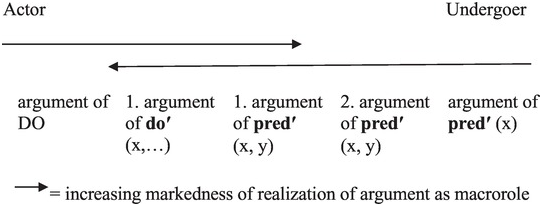
Figure 4.1 Actor-Undergoer Hierarchy (modified)
4.4.2 Three-Place Predicates
According to Van Valin (Reference Van Valin2007), almost all three-place predicates are causative constructions. We have noted that these predicates give rise to problems of variable undergoer choice. The overall LS of these predicates would be [do′ (x, Ø)] CAUSE [BECOME pred′ (y, z)]. The actor is represented in the αCAUSE part and the CAUSEβ part hosts the remaining two arguments that are accessible for undergoer assignment. As we have already seen, the conditions of undergoer assignment vary across languages and even across individual predicates. Nonetheless, there are a few (but highly frequent) three-place predicates that do not seem to be causative. In the remainder of this section, I will deal with talk (to somebody about something)19 as a candidate for a possible non-causative three-place activity and with envy (somebody (for) something) as a candidate for a possible a non-causative three-place state.
In Van Valin and LaPolla (Reference Van Valin and LaPolla1997: 116–118) we find a detailed description of English verbs of saying, including verbs of talking. The authors propose a general LS for non-causative verbs and an LS for causative verbs of telling.
talk: [do′ (x, [express.(α).to.(β).in.language.(γ)′ (x, y)])]
tell: [do′ (x, [express.(α).to.(β).in.language.(γ)′ (x, y)])] CAUSE [BECOME aware.of′ (y, z)], where y = β, z = α
Talk is listed as a verb that selects an α component and a β component (talk to Pat about Sandy) or a γ component (talk Cajun). Since it is the absence of causativity that distinguishes verbs of talking from verbs of telling, the causative LS in (18) cannot describe the three-place use of talk. In a later chapter concerned with coreference, Van Valin and LaPolla (Reference Van Valin and LaPolla1997: 401) propose an LS for talk, when they discuss the coreference of the reflexive in Bob talked to Susan about herself.
[do′ (Bob, [express.(α).to.(β).in.language.(γ)′ (Bob, Susani)])] ᴧ [about′ (herselfi)]
The binding facts seem to be the reason why the β component appears as the y-argument of the two-place state and the α component as the argument of the preposition co-referring with the y-argument. In a footnote Van Valin and LaPolla (Reference Van Valin and LaPolla1997: 668) remark that about herself is an argument PP and not an argument-adjunct, because the PP is ‘the optional realization of the α variable’. The fact that the preposition seems to be semantically empty and commutable (talk about, talk of as well as German sprechen über, sprechen von) corroborates this view. However, it is precisely for this reason that it seems problematic to use an argument-adjunct construction to represent the third argument of talk.20
Staudinger et al. (Reference Kailuweit, Wiemer, Staudinger and Matasović2008) proposed an alternative analysis. RRG allows for several classes of two-place activities: do′ (x, [sing′ (x,(y))]); do′ (x, [see′ (x,(y))]); do′ (x, [tap′ (x,(y))]), etc. (Van Valin and LaPolla Reference Van Valin and LaPolla1997: 115).21 The second argument represents an instance of pred′ (x, y) (ibid.: 127), but the predicate embedded in activities is not a state. Hence, RRG could theoretically allow for three-place activities with an argument in each of the three medium positions of the AUH: do′ (x), pred′ (x, …), and pred′ (…, y). Staudinger et al. (Reference Kailuweit, Wiemer, Staudinger and Matasović2008) thus suggested the following LS for French parler, the counterpart of English talk.
parler à qn de qc = do′ (x, [talk′ (x, y, z)])
Note that according to the formalism used in RRG, the predicate talk′ (x,(y),(z)) is not a state, similarly to sing′ (x, (y)) in do′ (x, [sing′ (x, (y))]). As indicated before, activities do not consist of states embedded under a do′ operator. Hence, in an RRG description of talk, one could associate the two arguments y and z with the positions pred′ (x, …) and pred′ (…, y) of the AUH, as RRG associates the y-argument of sing′ with the pred′ (…, y) position.
However, this solution would not be available for three-place non-causative states. Verbs of envy are possible candidates for this class (Kailuweit Reference Kailuweit2012: 118). In line with two-place stative verbs of emotion such as love or hate, envy takes an emoter argument, the person who experiences envy, and a target argument, the envied person. In addition, envy possesses a third argument expressing the object or circumstance the target argument is envied for.22 For the English verb envy, this third argument could be realized as a direct core argument (21a) or as an oblique (21b).
(21)
a. Many people envied the shareholders their large profits. b. Max envied Paul for his wealth. c. Max envied him.
The fact that the third argument, the object of envy, can also be marked by for (21b) may suggests that it is an adjunct, which gets incorporated into the core as a direct argument, by analogy with recipient beneficiaries, such as Max baked a cake for Paul vs. Max baked Paul a cake. Thus, a possible LS for (21b) could be because.of′ ([have′ (Paul, wealth)], [envy′ (Max, Paul)]). However, in (21a) and (21b) the target, the envied person, is the undergoer, while the for-complement becomes the undergoer in the recipient-beneficiary construction Max baked a cake for Paul → Max baked Paul a cake.
French envier (‘envy’) shows variable undergoer choice. The target can be realized either as an undergoer (22a) or as non-macrorole direct core argument in the dative case (22b). As in English (21c), the object of envy argument is optional if the target argument is realized as undergoer.
(22)
a. Beaucoup d’hommes vous envient pour Madame Linné Many of men you.2pl.acc envy.3pl for Mrs Linné ‘Many men envy you for Mrs Linné’ (FRANTEXT: HERMARY-VIEILLE, C.) b. …cette belle figure creuse […] il la lui enviait this pretty face haggard he 3f.sg.acc 3m.sg.dat envied ‘It was this pretty haggard face that he envied him for.’ (FRANTEXT: ETCHERELLI)
The same case variation as in French can be found in German. In addition, the contrast between the two constructions is realized with the help of the applicative construction with the prefix be-. German neiden (‘envy’) realizes the target argument as a non-macrorole direct core argument in the dative case and the object of envy as the undergoer. German beneiden realizes the target as the undergoer and the object of envy as a prepositional object: jemanden um etwas beneiden (‘to envy somebody for something’). Hence, the object of envy seems to be the unmarked choice for undergoer in German.
Admitting that envy is a three-place state would raise the problem of assigning an LS that provides information about macrorole assignment. One might consider envy′ (x, y, (z)) as a possible LS for envy. However, the three argument positions in this LS cannot correspond to the three stative argument positions in the AUH. As far as the three positions referring to states are concerned – first argument of pred′ (x, y), second argument of pred′ (x, y) and argument pred′ (x) – they represent two basically different types of state. On the one hand, there are two-place states (pred′ (x, y)), for example verbs of emotion (love′ (x, y)) or possession (have′ (x, y)), with a less affected second argument (a theme in Gruber’s terms). On the other hand, there are one-place states (pred′ (x)) with an affected prototypical undergoer argument, for example resultative verbs of dying (BECOME dead′ (x)) or destruction (BECOME broken′ (x)). Hence, the structures pred′ (x) and pred′ (x, y) logically exclude each other and cannot be added to each other.
Note that verbs of envy are not the only candidates for non-causative three-place states. A more language-specific case is the French verb en vouloir à quelqu’un de quelque chose ‘to be angry with someone about something’.23 The argument denoting the person who experiences anger is realized as the subject, and hence it takes a macrorole. In contrast to verbs of envy, en vouloir is M-intransitive. Therefore, the two other arguments, the person the anger is directed at, and the circumstance that the anger is related to, are realized as a direct core argument in the dative case and as an oblique object respectively. In comparison with verbs of envy, en vouloir raises an additional problem: the nature of the macrorole. RRG describes non-episodic verbs of anger as instances of verbs of internal experience with the LS feel′ (x, y). The x-argument corresponds to the experiencer, and the y-argument is a predicate of sensation having one internal argument that is not accessible for macrorole assignment. Therefore, the predicates of internal sensation are by default M-intransitive. As intransitive states, they select an undergoer. The undergoer macrorole is assigned to the x-argument, the experiencer.
Episodic verbs of emotion (Van Valin and LaPolla Reference Van Valin and LaPolla1997: 156, 402)
Pat is angry at Kelly.
[feel′ (Pat = experiencer → 1. arg. of pred′ (x, y) → Undergoer → PSA, [angry.at′ (Kelly)] = sensation → 2. arg. of. pred′ (x, y))]
A possible LS for three-place en vouloir would be feel′ (x, angry.at′(y).about′(z)) with two internal arguments of the sensation predicate. However, the feel′ (experiencer, sensation) analysis is neither convincing for the French three-place en vouloir nor for its two-place German or Spanish counterparts zürnen and rabiar ‘to be angry at’. While German zürnen realizes the argument denoting the person the anger is directed at as a dative, Spanish rabiar expresses this with a preposition (contra, lit. ‘against’). Independently of these syntactic differences, this argument is obligatory for French en vouloir, German zürnen and Spanish rabiar. To consider an obligatory argument inaccessible for macrorole assignment seems to be problematic. In addition, if the argument denoting the person the anger is directed at were embedded into the sensation predicate, ‘being angry at James’ and ‘being angry at Paul’ would be two different sensations. Kailuweit (Reference Kailuweit2005b, Reference Kailuweit, Nolan and Diedrichsen2013) proposes that French en vouloir, German zürnen and Spanish rabiar are atypical activities rather than states. They denote an emotional behaviour motivated by anger and directed at a person held responsible for the annoying situation.24 Therefore, the macrorole is an actor and not an undergoer. An LS that parallels the one proposed for verbs of saying (Staudinger et al. Reference Kailuweit, Wiemer, Staudinger and Matasović2008) would be able to deal with macrorole assignment and linking.
4.5 Alternative Approaches to Macroroles
The fact that languages such as German or Russian possess direct core arguments in the dative case, which behave differently from other non-macrorole arguments in syntax, led to intense discussion of the necessity for a third macrorole. The German passive construction with bekommen (‘get’) seems to be a candidate for illustrating the theoretical contribution that a third macrorole could make.
Diedrichsen (Reference Diedrichsen2008) discusses the following data.
(24)
LS: [do′ (Eltern, Ø)] CAUSE [BECOME have′ (ich, Computer)] a. Active voice Meine Eltern haben mir diesen Computer geschenkt my parents have.3pl 1sg.dat dem.acc computer given ‘My parents gave me this computer.’ b. Passive voice Dieser Computer ist mir von meinen Eltern geschenkt worden dem.nom computer be.3sg 1sg.dat by my parents given become ‘This computer was given to me by my parents.’ c. Bekommen-passive voice Ich habe diesen Computer von meinen Eltern geschenkt bekommen I.nom have.1sg dem.acc computer by my parents given received ‘I got/received this computer, given by my parents’, ‘I was given this computer by my parents.’
(25)
a. Er bekam von der Polizei den 3m.sg.nom get/receive.3sg.pst by def.f.sg.dat police def.m.sg.acc Führerschein entzogen. driving licence.sg revoke.pst ‘He got/received the driving licence revoked by the police.’ b. *Er bekam den Führerschein. Er wurde von der Polizei entzogen. ‘He received the driving licence. It was revoked by the police.’
In addition to the passive construction where the privileged syntactic argument (PSA) is the argument marked by accusative in the active voice (24b), German allows the dative-coded recipient argument of many ditransitive verbs to become a PSA in the passive (24c). PSA assignment to the accusative argument of the active construction requires the werden-passive construction, while PSA assignment to the dative argument of the active construction is realized by the bekommen-passive construction.
Diedrichsen (Reference Diedrichsen2008) analyses the bekommen-passive construction in (24c) as a nuclear juncture, as Bentley (Reference Bentley2006: 39) does for the corresponding Italian construction with avere ‘have’. However, German bekommen is further grammaticalized as shown in (25), where it loses its physical reception meaning. Hence, according to Diedrichsen (Reference Diedrichsen2008), the PSA-argument in (25) cannot be considered the actor of a complex predicate bekommen (‘receive’) + entziehen (‘revoke’).
Since PSA choice is restricted to macrorole arguments, Diedrichsen (Reference Diedrichsen2008) considers Lehmann et al.’s (Reference Lehmann, Shin and Verhoeven2004) proposal of introducing a third macrorole, called ‘indirectus’. Like the proto-recipient introduced by Primus (Reference Primus1999) into the proto-role-approach,25 the indirectus controls and affects the undergoer, but is controlled and affected by the actor. Lehmann et al. (Reference Lehmann, Shin and Verhoeven2004: 19) define the indirectus as a generalization about the thematic relations (microroles) recipient, beneficiary, experiencer, emittent (the participant of a transfer event that gives something away) and sympatheticus (the secondary affected participant with a three-place predicate).
However, the notion of indirectus is restricted to the third argument of three-place predicates. Hence, from a syntax-to-semantics viewpoint, generalizations concerning the semantics of dative arguments cannot be captured.26 A third macrorole would be a qualitatively different concept in comparison with actor and undergoer (Van Valin Reference Van Valin, Kailuweit and Hummel2004). While the two established macroroles are universally valid for the description of morphosyntactic phenomena, the third macrorole is not. As Lehmann et al. (Reference Lehmann, Shin and Verhoeven2004) themselves recognize, some languages do not permit three core arguments. From a semantics-to-syntax viewpoint, there is no consistent treatment of the arguments that are candidates for the indirectus. German, Russian and Dyirbal assign dative to the recipient, beneficiary, experiencer, emittent, or sympatheticus of three-place predicates, while English or Jakaltek marks this argument with an adposition (Van Valin Reference Guerrero and Van Valin2004: 81). In English, the assumption of a third macrorole would single out the to-PP as a special type of prepositional object. This is not justified on morphosyntactic grounds.
As far as the German bekommen-passive is concerned, Diedrichsen (Reference Diedrichsen2008) rejects Lehmann et al.’s approach, putting forward two alternative solutions. First, she considers the bekommen-passive as a PSA-selection mechanism whose function is to select a highly topical dative undergoer as PSA. This would imply accepting datives as undergoers, which is not foreseen in standard RRG. Alternatively, an approach more in line with standard RRG would account for the bekommen construction as a lexical passive in that undergoer status is assigned to a dative recipient that is the non-macrorole argument of the ditransitive active.
From the viewpoint of typology, Bickel (Reference Bickel and Song2011) and Bickel et al. (Reference Bickel, Zakharko, Bierkandt and Witzlack-Makarevich2014) refer explicitly to the concept of macroroles to develop a descriptive toolkit for the different alignment types of ditransitive constructions. Bickel et al. distinguish between different sets of macroroles (or proto-roles) for one-place, two-place and three-place predicates. Building on a tradition in typology which started with Comrie (Reference Comrie and Lehmann1978) and Dixon (Reference Dixon1979), they distinguish between S as the argument of an intransitive verb, A as the most actor-like argument in a transitive verb, and O or P (in Bickel et al. Reference Bickel, Zakharko, Bierkandt and Witzlack-Makarevich2014)27 as the not most actor-like argument in a transitive verb. In addition, they label the two non-actor-like arguments of ditransitives as G (for goal) and X or T (for theme). The generalized semantic roles G28 and X/T stand for the most goal-like and for the other (not most goal-like, not most actor-like) argument respectively. While the only semantic motivation for S is the fact that the predicate takes only one argument, S does not serve to describe split intransitivity. A and O/P seem to correspond to actor and undergoer in RRG. However, the generalized semantic roles are assigned to any two-place predicate, even to predicates lacking a referential second direct core argument. In addition, neither G nor X, the two less active arguments of three-place predicates, have to be direct core arguments. In typology, the function of the generalized semantic roles is to serve as a tertium comparationis for different forms of alignment. For example, marking S and A in the same way characterizes accusative alignment. While grouping O/P and X/T together corresponds to indirective alignment, secundative alignment is characterized by marking O/P and G/R identically (Bickel Reference Bickel and Song2011).
Haspelmath (Reference Haspelmath2008) pursues a very similar approach, which he includes directly into the RRG framework. He proposes four macroroles: A = actor, U = undergoer of monotransitive sentences, R = macro-recipient, corresponding to Primus’s (Reference Primus1999) proto-recipient and the aforementioned indirectus of Lehmann et al. (Reference Lehmann, Shin and Verhoeven2004), and finally T = (macro-)theme (see Figure 4.2). These macroroles are defined in purely semantic terms. They account for the parallels between monotransitive and ditransitive alignments in a straightforward way without needing to refer to marked or unmarked undergoer choice, as in standard RRG, or to parameterize undergoer selection for the indirective–secundative contrast, as in Guerrero and Van Valin (Reference Guerrero and Van Valin2004).

Figure 4.2 Four types of languages, accusative and ergative alignment
Although U, T, R and A seem to correspond to the four rightmost positions of the AUH, it is unclear how their semantic values could be determined in a precise way. Haspelmath (2011) himself criticizes the approach of Bickel et al. (Reference Bickel, Zakharko, Bierkandt and Witzlack-Makarevich2014), but his critique refers indirectly to his own RRG approach, too (Haspelmath, p.c., 30 January 2013). His point is that Bickel’s generalized semantic roles are universal semantic categories aimed at the description of individual languages. However, being not only syntactically undetermined but also semantically highly heterogeneous, they do not serve to draw typological generalizations. Indeed, it remains unclear in both approaches what agent-like, goal-like or theme-like mean beyond purely intuitive notions.29
In line with Comrie’s approach, Haspelmath (Reference Haspelmath2011) points out that S, A, P/O/U, T/X, and R/G should only be comparative concepts referring to the syntactic relations associated in a given language with verbs selecting a prototypical agent and patient (A:P), verbs of transfer (A:R:T), and one-place verbs of uncontrolled change of state such as verbs of dying (S). This means that not every two-place predicate assigns an active and a passive generalized semantic role. Only predicates that code the opposition of the arguments, like prototypical verbs with an agent and a patient, do: for example verbs like English see, like, own or enter follow the pattern of break or kill, but appeal to and belong to do not. This is in line with standard RRG. However, Haspelmath’s (2011) comparative concepts do not apply to all predicates in every language and do not formulate hypotheses about universal semantic structure. Hence, they differ considerably from RRG macroroles.
Kailuweit (Reference Kailuweit, Nolan and Diedrichsen2013, Reference Kailuweit, Kailuweit, Künkel and Staudinger2018) maintains the two macroroles of standard RRG, devising, however, a feature-based Activity Hierarchy, which departs from the RRG AUH. Following Rozwadowska (Reference Rozwadowska1988), Kailuweit (Reference Kailuweit, Nolan and Diedrichsen2013) takes three features into account: causative and/or control [c], mental (sentient) [m], and resultative (change of state) [r]. In line with Reinhart (Reference Reinhart2002), these features can assume one of the three values +, − or ±. In addition, the features are weighted (see Table 4.3). The feature [c] is a strong actor feature, [m] is a weak actor feature, and [r] is a strong undergoer feature. The presence of a strong feature, indicated with [+], will duplicate the value of the presence of a weak feature. If an argument is underspecified for one feature or has an intermediate degree of that feature [±], the value will be half of the [+] value.
The combination [+c+m−r] represents the prototypical actor with the value 4+2+0 = 6, while the prototypical undergoer corresponds to the combination [−c−m+r] 0+0−4 = −4. Nine intermediate combinations are mathematically possible. Hence, the system distinguishes eleven possible degrees of activity. The attribution of the values follows from a detailed semantic analysis of events and participants, evaluating aspectual properties as well as causativity, sentience, responsibility and control.
In the following, sketch-like descriptions will be given to account for the non-causative three-place predicates talk and envy as well as for some two-place verbs of emotion. Some of the examples discussed above are repeated for convenience.
Bob talked to Pat about Sandy
(27)
a. Many people envied the shareholders their large profits b. Max envied Paul for his rewarding task
(28)
a. Bill’s owning a gun frightened Martha b. The mother feared for her children c. The mother feared her children
As far as talk is concerned, the speaker controls their activity to a certain degree, but not entirely (mimics and gesture, unforeseen effects of the speech, slips of the tongue, etc.), hence, the value for [c] is ±. The addressee does not control the event but takes part in it as a sentient being. The topic of conversation neither controls the event nor is it affected by it. Hence, the speaker is the most active argument assuming the actor macrorole. The addressee is neither the most active nor the most passive argument. As with other arguments exhibiting an intermediate degree of activity, it is realized with the preposition to in English (and the dative in the case of French parler ‘talk’). The topic of conversation is the most passive argument of the event, although it assumes rather a high degree of activity (0 in comparison with −4 of the prototypical patient). This may explain the realization with a preposition (about/of in English, sur/de in French).
Verbs of envy denote non-episodic emotions with three participants. In episodic emotions, prototypically the target, for example the person or the state of affairs the emotion is directed at, is at the same time the causer of the emotion. The experiencer is affected, undergoing a change of emotional state in a given situation. This is the case of frighten in (28a) selecting a target that functions as an inanimate causer. By contrast, emoters of non-episodic emotions express a subjective judgement that they are held responsible for, because they control it to a certain degree [±c]. Some verbs of emotion show another argument, helping to identify the target. In (28b), for example, the children are in danger, but they are not the danger themselves as in (28c). Hence, the children represent a point of reference to find out about the danger as the target of the mother’s fear. With envy, the target and the point of reference are realized. The envy is directed to a person being the target. The third argument specifies why this person has become the target of envy. The attribution of [±m] accounts for the fact that the point of reference is a human being (prototypically, but not necessarily with fear for) or a property associated with a human being (in the case of envy). For English envy, the emoter as the most active argument represents the actor, the target as the most passive argument the undergoer. The point of reference of a middle degree of activity appears as the non-macrorole argument.30
Table 4.4 Activity Hierarchy of arguments of selected predicates
| [+c+m−r] | 6 | agent-causer | murder (x,…) |
| [+c−m−r] | 4 | inanimate causer | frighten (x,…) |
| [±c+m−r] | 4 | speaker / emoter | talk (x,…), envy (x,…), fear (x,…), fear for (x,…) |
| [−c+m−r] | 2 | addressee | talk (…,y,…) |
| [−c±m−r] | 1 | point of reference of emotions | fear for (…,y), envy (…,y,…) |
| [−c−m−r] | 0 | target of emotions / topic of conversation | envy (…,z), talk (…,z) |
| [−c+m+r] | -2 | affected experiencer | frighten (…,y) |
| [−c−m+r] | -4 | patient (undergoing a change of state) | murder (…,y) |
Further research will determine whether the Activity Hierarchy can describe the same number and even more predicate classes in as coherent a way as the LS-based AUH does.31 Perhaps LSs and activity values can also be combined in the lexical entries of the predicates to enable a fine-grained semantic description of the linking-relevant properties.
4.6 Conclusion
The macroroles of RRG constitute a powerful tool to address the challenges of argument realization. Specifically, the theory of macrorole assignment captures the key insights of the approaches called ‘aspectual’, ‘causal’ and ‘neo-constructionist’ by Rappaport Hovav and Levin (Reference Rappaport Hovav, Levin, Lappin and Fox2015). In the vast majority of cases, RRG makes correct predictions about argument linking by using predicate decompositions and identifying the relevant facets of the predicate’s meaning. Individual facets may be more effectively captured by other approaches, which are mainly, or exclusively, ‘feature-based’, ‘decompositional’, ‘aspectual’, ‘causal’ or ‘neo-constructionist’. Nevertheless, macrorole assignment in RRG currently seem to be the most complete approach to capture meaning generalizations relevant to the syntactic realization of arguments.
5.1 Introduction
This chapter discusses one of the major advances of Role and Reference Grammar (RRG) relative to other theories of grammar: the view of grammatical relations as construction-based, and so not only language-specific but construction-specific, rather than being global categories of the whole language and found in every language. We also discuss the RRG conception of the function of grammatical relations in referent tracking, which was one of the major insights that led to the development (and naming1) of RRG. These two insights have influenced the development of ideas outside RRG.
5.2 Background
Before the mid 1970s, a common assumption among linguists was that there is a global category in all languages called ‘subject’ as well as other grammatical relations that we can talk about, and most theories assumed some conception of grammatical relations, though there was much disagreement about and no universal notion of ‘subject’, the grammatical relation discussed the most (Platt Reference Platt1971; Van Valin Reference Van Valin1977, Reference Van Valin1981; Foley and Van Valin Reference Foley and Van Valin1977, Reference Foley and Van Valin1984; Keenan Reference Keenan and Li1976; Gary and Keenan Reference Gary, Keenan, Cole and Sadock1977; Comrie Reference Comrie1981). The word ‘subject’ derives from a Latin translation (subiectum) of Greek hypokeímenon ‘the underlying thing’, a concept that began with Aristotle’s theory of truth, where Aristotle defined ‘subject’ as the entity that can have a predication about it, that is, what the proposition is about, the topic about which a predication is made. Aristotle did not have a separate term for grammatical subject. This led to centuries of debate about the nature of subject (see Seuren Reference Seuren1998, pp. 120–133, for an overview). Attempts were made to distinguish grammatical subject from psychological subject (e.g. von der Gabelentz Reference Gabelentz and Georg1869: 378), the latter essentially topic, and what was called ‘theme’ in the Prague School terminology. A third term, ‘logical subject’ (often now seen as agent), was sometimes used, but different scholars associated it either with grammatical subject or with psychological subject (particularly in logic). Bloomfield (Reference Bloomfield1914: 61) used the term ‘subject’ to refer to topics and also to heads of phrases.
Starting with Van Valin (Reference Van Valin1977, Reference Van Valin1981) and Foley and Van Valin (Reference Foley and Van Valin1977, 1984), there were challenges to the notion of ‘subject’ and other grammatical relations (‘direct object’, ‘indirect object’) as global categories within a single language, and as valid categories cross-linguistically (see also Dryer Reference Dryer, Bybee, Haiman and Thompson1997). Currently there are three major positions on this question: (1) grammatical relations are global within a language and universal cross-linguistically, and just need to be identified in different languages (the rationalist/generativist/Chomskyan tradition); (2) grammatical relations exist, but are not necessarily global and not universal, and so need to be defined in each language in terms of the constructions that manifest them, if there are any (most empiricist/typological/explanatory approaches); and (3) there are no grammatical relations, only part–whole relations within constructions (Radical Construction Grammar; Croft Reference Croft2001, Reference Croft, Trousdale and Hoffmann2013). Marantz (Reference Marantz and Zaenen1982, Reference Marantz1984) has argued that grammatical relations should not be seen as primitives or tied to semantic roles. For example, ‘subject’, as a grammatical category, is not simply a particular semantic role, such as agent (see also Jespersen Reference Jespersen1909–1949, vol. III, 11.1). ‘Subject’ is also not simply topic; it must have grammatical properties beyond just being what the clause is about. Empiricist linguists would generally agree with this position.
5.3 The RRG View of Grammatical Relations
The RRG view of grammatical relations is of the second type mentioned above, though it does not accept the traditional typology of grammatical relations as ‘subject’, ‘direct object’ and ‘indirect object’. Grammatical relations are seen as construction-specific conventionalized patterns where the construction limits the possible interpretations of the role of a particular participant in the action described in the clause (see Van Valin and LaPolla Reference Van Valin and LaPolla1997: 242–316; Van Valin Reference Van Valin2005; LaPolla Reference LaPolla, Tsunoda and Kageyama2006). It is the identification of the semantic and/or pragmatic role of the referent in an event or state of affairs that is relevant to the concept of grammatical relations. There are other types of conventionalized constraints on referent identification in some languages, such as the gender or noun class markers in many languages, and the sortal classifiers of Thai and Chinese, but while they do participate in referent tracking (see Van Valin 1987 for a typology of referent tracking systems), as these are not relational and do not constrain the interpretation of the role of the referent in the event, they are not considered relevant to grammatical relations.
Grammatical relations may be conventionalized associations of the position of a referring expression in the clause with some semantic role or macrorole, such as in English, where an immediate preverbal reference to some referent in a clause with an active transitive verb will constrain the interpretation to one in which that referent is seen as the Actor2 of the action denoted by the verb, and an immediate postverbal reference to some referent in the same clause will constrain the interpretation to one in which that referent is seen as the Undergoer of the action (e.g. given the expression Bob hit Bill, the conventions of English usage constrain the interpretation to one in which Bob must be understood as the one doing the hitting and Bill must be understood as the one being hit). This is construction-specific and language-specific, that is, not all constructions in English work that way and not all languages have the same constraints on interpretation.
Grammatical relations may be conventionalized associations of marking on nouns or pronouns with particular semantic roles, such as in English, where Nominative case marking of a pronoun in an active transitive clause constrains the interpretation to one in which the referent of the pronoun is seen as the Actor of the action denoted by the verb, and Accusative case marking of a pronoun constrains the interpretation to one in which the referent of the pronoun is seen as the patient or recipient of the action, such as in HeNominative took meAccusative to the station. In the case of Modern English, the case marking is largely redundant, in that grammatical relations are also marked by word order, and in fact case marking has largely come to be determined by word order, but this was not the case in older varieties of English, which did not use word order consistently to mark grammatical relations, and in many other languages, such as Dyirbal (see below). In these languages the case marking is very important not only for tracking the roles of referents in discourse, but also for tracking the different constituent parts of phrases, as they do not necessarily appear together in the clause.
Grammatical relations may also be conventionalized assumptions that referring expressions in two clauses both refer to the same referent, such as in English, where there is a conventionalized assumption of coreference in conjoined clauses such that a referring expression representing a particular role in one of the clauses and a particular role implied in the other clause must be understood as coreferential (e.g. in Jim picked up the newspaper and threw it, there is a forced assumption that the referent of Jim is the same referent as the implied Actor of the second clause, the one that threw the newspaper).3 Many other possible ways of constraining this particular functional domain exist as well. See Section 5.3.3 for more discussion.
Each of these conventionalized forms or constructions has the function of limiting the possible interpretation(s) of the role of a referent referred to or implied in an utterance, to aid in the interpretation of the identity and role of the referent. Although traditionally these different constructions have been seen as part of one grammatical category (e.g. ‘subject’), they are not one category, but instead are individual ways of constraining the interpretation of who is doing what to whom, and languages differ in terms of whether or not they constrain this functional domain at all, and if they do constrain it, they differ in terms of which particular roles are identified, and the particular mechanisms used to constrain the interpretation.
5.3.1 Privileged Syntactic Argument: Controller and Pivot
As the phenomenon we are talking about is construction-specific, and there are many different types of restricted neutralizations, the term ‘subject’ is not appropriate, and instead we use the term ‘privileged syntactic argument’ (PSA) for an argument that is the controller or pivot of a restricted neutralization of semantic roles for grammatical purposes, generally referent tracking (i.e. keeping track of who is doing what in discourse). No other grammatical relations are recognized in this approach; the characteristics that have traditionally been associated with ‘direct object’, such as taking accusative case, being able to appear as the privileged syntactic argument in a passive clause or being the target of applicative constructions, are seen as properties of the macrorole Undergoer, while those associated with ‘indirect object’ are seen as properties of the non-macrorole direct core argument (see the discussion of (5) below).
The terms ‘controller’ and ‘pivot’ (first used in Heath Reference Heath1975) refer to different types of PSA, as in the examples in (1), the English conjoined clause coreference construction, where the immediately preverbal (core-initial) referring expression in the first clause is the controller, while the implied argument of the second clause is the pivot of the construction (marked by ‘(pivot)’, where the implied argument would be if it appeared in an independent clause), regardless of whether either clause is an active or passive construction.
(1)
a. Bobcontroller handed Jim the money and (pivot) left. [A,S] b. Jimcontroller was handed the money by Bob and (pivot) left. [S,S] c. The moneycontroller was handed to Jim but (pivot) not seen again after that. [S,S] d. Jimcontroller took the money and (pivot) was seen later buying a new car. [A,S] e. Jimcontroller took the money and (pivot) thanked Bob for it. [A,A] f. Jimcontroller smiled and (pivot) took the money. [S,A]
In this construction, there is obligatory coreference between the controller, whether it is the Actor (A) of an active transitive clause or single direct argument of an intransitive clause (S)4 or the Undergoer of a passive clause (S), and the pivot, again whether it is A or S. The construction then aids in the inference of who is doing what. The restricted neutralization we find in this particular construction is [A,S], but as shown in the examples, the correspondence can be [A,A] or [S,S] as well, as what is important is that the arguments participating in the coreference are grammatically either A or S; the Undergoer of an active transitive clause does not participate in this coreference. The Undergoer argument cannot simply be left to implication when using this structure, and so a different construction must be used to allow the Undergoer to participate in the coreference of the conjoined clause coreference construction. The construction used is the English passive construction, as in (1b, c ,d), as it is an intransitive clause in which the Undergoer is the PSA. Using the passive construction in this conjoined clause coreference construction allows the Undergoer argument (regardless of what specific semantic role it has) to participate in the coreference construction by casting it as an S.
The English passive construction allows limited variable access to the syntactic controller and syntactic pivot positions. Without that construction the Undergoer would not be able to appear as the PSA. Some languages manifest constructions with a particular restricted neutralization but do not have constructions that allow variable access to the PSA (i.e. they do not have alternative voice constructions such as passive; e.g. Enga (Papua New Guinea), Warlpiri (Australia), Lakhota (North America); see Van Valin and LaPolla Reference Van Valin and LaPolla1997, pp. 274–285 for details). These constructions are said to have an invariable syntactic controller and invariable syntactic pivot. Some languages have one or a few constructions (e.g. the English passive construction or the Dyirbal antipassive construction – see the next section) that allow limited variable access to the PSA. These constructions are said to have a variable syntactic controller and a variable syntactic pivot. And some languages, such as Tagalog (see Section 5.3.2), have many constructions allowing a range of semantic roles access to the PSA. These constructions have a semantic controller with no neutralization. As we will see, in Tagalog there is no neutralization we can call S, nor even neutralization of a single grammatical category of Actor or Undergoer in terms of the marking on the predicate, as different types of actor and undergoer (e.g. with different degrees of intention, agentivity, transitivity, affectedness) are marked differently on the predicate depending on the nature of the action and the Topic of the clause.5 In other constructions (e.g. the Reflexive Construction) there is a generalized Actor, and it is an invariable semantic controller. For ease of discussion we will generalize across the different types of actor, patient and location in Tagalog by glossing the various relevant forms as ‘Actor-Topic’, ‘Patient-Topic’ or ‘Location-Topic’, respectively.
5.3.2 Alignment
The particular PSAs in the conjoined clause coreference construction discussed here are found in English, but many other languages, even closely related ones, do not manifest PSAs in conjoined clause coreference constructions, and so the determination of the relevant argument of the second clause would be left to inference unconstrained by the grammar, and undergoers in active clauses could be left to inference as easily as A and S. It is also the case that some languages manifest constructions for conjoined clause coreference with particular PSAs, but the restricted neutralization is [S,U] rather than [S,A].6 Dyirbal, a Pama-Nyungan language spoken in north-eastern Australia (Dixon Reference Dixon1972, 1980), is a well-known example of a language that has grammaticalized an [S,U] restricted neutralization for conjoined clause coreference. That is, the arguments participating in the coreference must be U and/or S, but A does not participate in the coreference unless it is cast as an S in the Dyirbal antipassive construction. Consider the examples in (2) (adapted from Dixon Reference Dixon1980: 462).
(2)
a. balan guda buŋa-n baŋgul yara-ŋgu bura-n 3sgf.abs dog.abs descend-pst 3sgm.erg man-erg see-pst The dogcontroller went downhill and the man saw (pivot). b. bayi yara buŋa-n buralŋanyu bagun guda-gu 3sgm.abs man.abs descend-pst see:pst:antip 3sgm.abs dog-dat The mancontroller went downhill and (pivot) saw the dog. c. balan guda baŋgul yara-ŋgu bura-n buŋa-n. 3sgf.abs dog.abs 3sgm.erg man-erg see-pst descend-pst The man saw the dogcontroller and (pivot) went downhill.
These examples parallel the English examples in (1), but the interpretation of the implied argument in the second clause of (2a) is obligatorily coreferential with the Undergoer in the first clause, that is, it must be that the dog is the controller and pivot (i.e. is the one that went downhill). In order to have coreference that involves an A argument, the Dyirbal antipassive construction must be used. This construction is an intransitive construction with the verb marked with the antipassive marker ŋa, and has the Actor as the single direct argument in the absolutive case and the Undergoer in the dative case. Because Dyirbal has this antipassive construction, there is variable access to the controller and pivot positions, and so the controller is a variable syntactic controller and the PSA is a variable syntactic PSA, though they manifest a different restricted neutralization from the corresponding English construction. These grammaticalized constraints on interpretation we have been looking at force a particular interpretation of an utterance in both English and Dyirbal, but as the restricted neutralizations are different, the interpretations are different. For example, if The man saw the dog and went downhill is said in English, the interpretation has to be that the man went downhill; but if the corresponding structure is used in Dyirbal, as in (2c), the meaning has to be that the dog went downhill. We see here that the construction must be taken as a whole, as it is the total construction that influences the interpretation, and is not simply the sum of the individual words.
Where there is a choice of argument for PSA, the RRG theory of PSA selection posits a default choice, depending on the Privileged Syntactic Argument Hierarchy (3) and the privileged syntactic argument selection principles (4): actor for PSA in so-called nominative-accusative alignment, and Undergoer in ergative-absolutive alignment.
Privileged Syntactic Argument Selection Hierarchy
arg. of DO > 1st arg. of do′ > 1st arg. of pred′ (x, y) > 2nd arg. of pred′ (x, y) > arg. of pred′ (x)
(4) Privileged syntactic argument selection principles
a. Syntactically accusative constructions: highest-ranking macrorole is default choice.
b. Syntactically ergative constructions: lowest-ranking macrorole is default choice.
Yet it isn’t the case that all languages necessarily have such a default choice. As Foley and Van Valin argued (Reference Foley and Van Valin1984, §4.3) Tagalog has many different constructions for having different semantic roles as PSA, yet none is a default choice. In all these languages where we have seen a choice of PSA, the choice of pivot is determined by pragmatic factors, such as the identifiability or topicality of the referent involved (the default is used when there is no difference in terms of the pragmatic factors), and so we refer to these as pragmatic PSAs, as opposed to those based strictly on semantic factors, which we call semantic PSAs.
While the conjoined cross-clause coreference construction in English manifests an [S,A] restricted neutralization, it is not the case that all constructions in English manifest a restricted neutralization, and it is not the case that all of the constructions that do manifest a PSA in English manifest the same restricted neutralization. For example, in the following example of the English purposive construction the controller and pivot of the construction are the Undergoers of the two clauses, not the Actor or S of the clauses:
He left this formcontroller for you to sign (pivot).
As in the construction in (1), the controller determines the reference of the implied argument in the second clause, but in this case the referent referred to appears as the traditional direct object (the Undergoer in RRG) of the first clause, and is understood as the traditional direct object (the Undergoer in RRG) of the second clause as well. This shows that the concept of PSA is not the same as the traditional concept of ‘subject’.
Aside from the possibility of different restricted neutralizations, there is also the possibility of unrestricted neutralization. Some languages, such as Riau Indonesian (Gil Reference Gil1994) and Mandarin Chinese (LaPolla 1993), have not conventionalized any constraints on referent role identification of the type associated with grammatical relations in any constructions in the language (though they may have conventionalized other types of constraints on interpretation). This means that in all the constructions we have looked at interpretation is based entirely on inference from context and is not constrained by the structure. In other languages, only some constructions will have unrestricted neutralization. It is entirely language-specific and construction-specific. In English, for example, the relative clause construction manifests neutralization, but no restriction, that is, any argument of the modifying clause can appear as the head of this construction, as shown in (6):
(6)
a. the girl who[A] sang the song b. the girl who[U] the police saved c. the girl who[S] just came in d. the girl to whom[non-macrorole core argument] the award was given e. the car in which[peripheral argument: location] the man was held up f. the car out of which[peripheral argument: source] the radio was stolen
In Tagalog, a Malayo-Polynesian language spoken in the Philippines, on the other hand, there is a restricted neutralization for the Tagalog relative clause construction: the head of the construction must be the grammatical Topic of the modifying clause, and so it is a syntactic pivot for that construction. To explain this we will first give some background on the structure of the Tagalog main clause.
Tagalog is a consistently focus-initial language and so in general the predicate appears in initial position and the Topic appears (when it is not a pronoun and not in focus) at the end of the clause, and the information structure is Comment-Topic rather than Topic-Comment. The predicate in most cases marks aspect, realis/irrealis, and the semantic role of the Topic of the clause, and so the Topic is the controller of the semantic role marking (it is a semantic and not syntactic controller because the marking differs with each semantic role, i.e. there is semantic restriction but no neutralization relative to each type of marking). Topic here is actually a grammatical status, as it is an argument singled out for special morphological treatment, as well as a pragmatic status, as it is what the clause is about. Generally, almost any referent associated with the situation in some way, whether core or peripheral argument semantically or even a very indirectly affected referent, can be the Topic of the clause, though usually (but not always) it is one that is identifiable to the hearer, and in many cases the predicate takes a form to reflect the semantic role of that referent, and the marking of the other references in the clause is usually also different.7 These different constructions are not passive or antipassive, but simply different ways of profiling the event (Foley and Van Valin Reference Foley and Van Valin1984, §4.3), similar to the choice of the A Construction vs. the O Construction in Jawarawa (Dixon Reference Dixon2000, Reference Dixon2004), depending on what is considered to be what the clause or discourse is about, but with more choices for Topic in Tagalog.
The representation of the Topic argument (if it appears in the clause and is not a pronoun) generally takes either a marker of specificity (ang or si with proper names of single referents) or a topic form of demonstrative pronoun (most commonly ’yung) to mark it as the Topic. The set of pronouns, which appear as second-position clitics, also distinguishes Topical from non-Topical referents, with the latter appearing as possessive forms or dative forms. In (7) there is a short natural conversation to exemplify this feature (from my own fieldwork; see also Schachter (Reference Schachter, Reid and Comrie2008: 337–338) for sets of constructed parallel examples with the same arguments but with different choices of topic, and Schachter and Otanes (Reference Schachter and Otanes1972, Ch. 5) for many of the major constructions used for marking different semantic roles).8
(7)
1. Jirehel: Madali lang kasi’ng gumawa ng salsa eh. ma-dali lang kasi ang g<um>awa ng salsa eh stat-easy just because spec <at>make poss sauce emphatic ‘Making sauce is easy.’ 2. Wendy: Oo, madali lang. oo ma-dali lang yes stat-easy just ‘Yes, it’s easy. 3. Gawin mo lang ketsap, gawa-in mo lang ketsap do-pt:irr 2sg.poss just ketchup You just make it with ketchup, 4. tapos lagyan mo ng tomatoes, tapos lagay-an mo ng tomatoes finish put-lt 2sg.poss poss tomatoes then you add tomatoes, 5. lagyan mo ng salt and pepper to taste, tapos na. lagay-an mo ng salt and pepper to taste tapos na put-lt 2sg.poss poss salt and pepper to taste finish cs add salt and pepper to taste; then, it’s done.’
In (7), the first speaker, Jirehel, refers to the making of sauce using a form (gumawa) where the infix ‑um- marks it as Actor-Topic (it happens that in this utterance the speaker has made the relevant clause the Topic of a higher clause, but the phenomenon is the same), then the second speaker, Wendy, uses the same root in line 3 of the example, but in the irrealis Patient-Topic construction, to profile the event from the point of view with the sauce as the Topic. She then follows this in lines 4 and 5 with two tokens of the root lagay ‘put’ in the Location-Topic construction, to keep the sauce as the Topic, but with the sauce now having the semantic role of the location where the tomatoes and salt and pepper are to be added. Notice how there is no overt reference to the Topic in any of Wendy’s utterances (e.g .’yung salsa ‘the sauce’ could have been added to the end of each of Wendy’s utterances in lines 3–5, but it wasn’t), yet we can tell what is being talked about (what is the pragmatic and grammatical Topic) because of the marking on the predicate.
We now can return to the issue of grammatical relations, that is, restricted neutralizations. The choice of different roles as Tagalog Topic affects the particular form of the construction and the behaviour of the Topic in this and other constructions, such as the Tagalog relative clause construction, where the head of the construction generally must be the Topic of the modifying predicate (i.e. the form of the predicate must be the same as if it were a main clause with that referent as Topic). For example, if we were to recast the clauses in (7) as relative clause constructions (and with realis predicates), we would get the forms in (8):
(8)
a. lalaking gumawa ng salsa ‘man who made salsa’ lalake =ng g<um>awa ng salsa man lnk <at.realis>make poss sauce b. salsang ginawa ng ketsap ‘salsa made with ketchup’ salsa =ng g<in>awa ng ketsap sauce lnk <pt.realis> poss ketchup c. salsang nilagyan ng tomatoes ‘salsa in which tomatoes were put’ salsa =ng in-lagay-an ng tomatoes sauce lnk realis-put-lt poss tomatoes
In Tagalog, then, for this construction there is a clear restricted neutralization: the head of the construction must be the grammatical Topic of the predicate that modifies it, unlike in English, where there is neutralization but no restriction on what argument can be the head of an English relative clause construction.
We saw that in Tagalog the controller of the semantic role marking on the predicate (the Topic) is a semantic controller. English agreement, on the other hand, manifests a syntactic controller. That is, the agreement is not with a particular semantic role like in Tagalog, but manifests a restricted neutralization, where the agreement is with the Actor or S of the clause, regardless of its semantic or pragmatic role. We can see this from the examples in (9).
(9)
a. I am helping Bill with his homework [agreement with A] b. Bill is being held up by the activities [agreement with Undergoer as passive S] c. Bill is smiling [agreement with S Actor] d. Bill is falling into a trap [agreement with S Undergoer] e. There are many people in the park [agreement with non-topical S] f. There are people grilling meat there [agreement with non-topical A]
Acehnese (Durie Reference Durie1985, Reference Durie1987), an Austronesian language spoken in Indonesia, manifests a system of pronominal agreement on the verb with Actor-marking prefixes and Undergoer-marking suffixes on the verb. The marking is restricted to Actor and Undergoer, respectively, and there is no neutralization of Actor and Undergoer, even with intransitive constructions. See, for example, the following (from Durie Reference Durie1987: 366, 369):
(10)
a. (Gopnyan) geu-mat lôn b. (Lôn) lôn-mat-geuh (3sg) 3-hold 1sg (1sg) 1sg -hold-3 ‘(S)he holds me.’ ‘I hold him/her.’ c. Geu-jak (gopnyan) d. Lôn rhët(-lôn). 3-go (3sg) 1sg fall(-1sg) ‘(S)he goes.’ ‘I fall.’
From these examples we can see that the prefixes are used for the Actors of transitive constructions (10a, b) and the single arguments of intransitive constructions where the action is voluntary and so the argument is an Actor (so-called SA), as in (10c), and the suffixes are used for the Undergoers of transitive constructions and the single argument of intransitive constructions where the action is involuntary (an Undergoer, so-called SP or SO), as in (10d).9
5.3.3 Referent Tracking
The different choices of grammatical Topic we saw in Tagalog have the same function in discourse as the variable syntactic pivots in English and Dyirbal in terms of allowing for topic chains where an (often unmentioned) referent can remain the topic across clauses even if its semantic role changes, and the structure helps constrain the inference of the identity and role of the relevant referent, as in (7). This type of referent-tracking mechanism is known as a ‘switch function’ (Foley and Van Valin Reference Foley and Van Valin1984: 321–374; Van Valin Reference Van Valin, Verschueren and Bertuccelli-Papi1987; Van Valin and LaPolla Reference Van Valin and LaPolla1997, §6.4), as the structure identifies the difference in function of the referent while maintaining it as topic. There are differences among languages, though, not only in the type of restricted neutralization, such as in English vs. Dyirbal, but also in terms of what referents can be an unmarked topic of the clause: if we contrast English, Dyirbal, Tagalog and Chinese, we can see that English and Dyirbal severely limit what can be topic in the unmarked clause structure ([S,A] or [S,U] respectively); Tagalog allows just about anything relevant to be topic, but marks it morphosyntactically, thereby constraining the inference of the referent and its role; Chinese does not manifest any restricted neutralizations (LaPolla Reference LaPolla1993) and so there is no grammatical restriction on what can be topic in the unmarked clause structure, though there is no marking of it as topic other than initial word order, and no marking of its role or identity, and so identification of the referent and its role is not aided by the structure (see, for example, the discussion of (12) below). This forms a separate though related typological cline, from most restricted to least restricted in terms of access to topic, aside from the typological cline related to the degree to which the structure constrains the interpretation of the role and identity of the referent being tracked.
Yet another type of restricted neutralization with variable PSAs, known as the ‘switch-reference’ pattern, is found in Barai, a language of Papua New Guinea (Olsen 1978, 1981; Van Valin Reference Van Valin2009, §4), and in Choctaw, a Muskogean language of North America (Heath Reference Heath1975, Reference Heath1977), among others. In this type of system, when clauses are coordinated, the PSAs of the individual clauses (defined differently in each construction and in each language) can be coreferential or not, and there is marking on the predicate to show this (i.e. whether the PSA is the same as in the following clause or different from the following clause), as in the following Choctaw examples (adapted from Heath Reference Heath1977: 212):
(11)
a. (0i)-0-pi:sa-ča:, 0i-iya-h ‘Hei sees himj and hei goes’ (3A)-3P-see-same 3A-go-present b. 0-0i-pi:sa-na:, 0i-iya-h ‘Hei sees himj and hej/k goes’ 3A-3P-see-different 3A-go-present
As can be seen from these examples, even without overt arguments, the affix on the predicate marking whether the PSA in the following clause is the same or different from that of the marked clause constrains the interpretation of who is doing what. The pivots in this sort of system are generally invariable syntactic pivots.
We have seen above that there are different kinds of constructions languages can have for constraining the inference of who is doing what, if they have any at all. They may have some constructions that have invariable semantic pivots (i.e. restriction with no neutralization), such as the verbal marking in Tagalog and Acehnese, or invariable syntactic pivots, such as reference across conjoined clauses in Warlpiri and Enga, or variable syntactic pivots, such as reference across clauses in Dyirbal and English, and the relative clause construction in Tagalog. The restricted neutralization found in a construction could treat [S,A] the same in opposition to [U], or it may treat [S,U] the same in opposition to [A]. As this is a construction-specific phenomenon, the same language may have different constructions with different PSAs, as we saw with Tagalog (see also Van Valin 1981 on Jakaltek and Van Valin and LaPolla Reference Van Valin and LaPolla1997: 282ff. on Tzutujil), and constructions with different PSAs can sometimes be combined into a single complex structure, such as when a Tagalog reflexive construction (invariable semantic pivot) and any type of Tagalog clause structure (variable syntactic pivot) are combined to form a complex structure. And of course a language may not have any constructions that manifest PSAs, such as Mandarin Chinese and Riau Indonesian.
5.4 How Grammatical Relations Develop
Lexico-grammatical structure becomes ‘grammaticalized’ or ‘lexicalized’ (becomes what we think of as grammar or words) through repeated use of particular patterns to constrain the hearer’s interpretation of the speaker’s intention in a particular way until it becomes conventionalized on the societal level and habitualized on the individual level (LaPolla Reference LaPolla, De Busser and LaPolla2015). Ontogenetically we start with no structure, including no grammatical relations, and in each society different types of constructions will emerge out of the interactions of the speakers, and so each language is unique in terms of what sorts of structures have conventionalized in the language. There are some languages, such as Riau Indonesian (Gil Reference Gil1994) and Mandarin Chinese (LaPolla Reference LaPolla1993), which have not conventionalized constraints on referent identification of the type associated with grammatical relations (though they may have conventionalized other types of constraints on interpretation). What this means is that there are no conventionalized associations which relate position in word order, the marking on the nouns or verb, and so on with particular semantic roles, and so the structures of the language do not force particular interpretations of the role of referents mentioned in discourse. The addressee can still infer a context of interpretation in which the utterance will make sense, but this inferential process is relatively unconstrained compared to a language that has constructions that force a particular interpretation within this functional domain, and so the addressee will have to rely more on the assumptions of real-world semantics (what makes sense given common knowledge about the world) to make sense of the utterance. This does not mean that the inference won’t be influenced by conversational implicatures. There may be common conversational implicatures that can influence the interpretation. For example, as there is a rather strong frequency correlation between topic and actor in Chinese (and many other languages), there is a conversational implicature that an animate topic (the referent referred to by the utterance-initial referring expression) is the actor of the clause. It is simply a conversational implicature because it can be cancelled by the semantics of the referents or the requirements of the context of interpretation, such as in (12):
(12)
Xuéshēng yǐjīng fā-le chéngjī student(s) already distribute-pfv grade ‘The students were already given their grades.’
This expression could potentially be understood as either ‘The students were already given their grades’ or ‘The students already gave out grades (to someone else)’, but it was understood in the context in which it was uttered as ‘The students were already given their grades’ because students normally receive grades, not give them out, and it made more sense in the context. What happens in one type of conventionalization of grammatical relations is that a conversational implicature of ‘actor as topic’ appears so often in discourse that it becomes a conventional implicature, and then becomes so strongly conventionalized that speakers cannot accept any other interpretation.10 Note that all conventionalization (grammaticalization) is of constructions, not individual words, and not globally in the language (Bybee Reference Bybee, Joseph and Janda2003; Himmelmann Reference Himmelmann, Bisang, Himmelmann and Wiemer2004; Gisborne and Patten Reference Gisborne, Patten, Narrog and Heine2011), so the RRG assumption that grammatical relations are construction-specific is much more in line with what we know about grammaticalization and with the facts of languages, and so is more empirically sound than a view that posits abstract global grammatical relations in all languages.
The difference between conversational implicature, conventional implicature, and obligatory marking forcing a particular interpretation is the degree to which speakers are free to use or not use the particular form to constrain the hearer’s inferential process, and also the degree to which the form forces a particular interpretation. Old English did not constrain the identification of the role of a referent with word order, though it did constrain the interpretation of referent role using a complex system of case. Even so, the frequency with which reference to actors preceded the verb in topic position led to a conversational implicature that gradually strengthened as the case-marking system weakened, until we ended up with the current system of Modern English, where word order alone constrains the interpretation of the role of the main referents, and what was originally the primary means of constraining the interpretation of the role of the referent (the case marking) is now non-existent or, in the case of pronouns, is now secondary, often assigned by word order.
Conventionalized constraints on the interpretation of coreference across clauses also develop in a similar way. Initially there is no syntactic constraint on cross-clause coreference, and so the interpretation of which referring expressions (including zero) co-refer is completely dependent on inference from real-world semantics. For instance, in the following example from Rawang, a Tibeto-Burman language of northern Myanmar, any of the three coreference patterns given in the three translations would be possible, and which would be correct would depend on the addressee’s inference of which is most likely to be the interpretation intended by the speaker given the addressee’s assumptions about hitting and crying and what is known about the people involved.11
(13)
əpʰūŋí ədɯ́sə̀ŋ ədip bɯ́à nɯ̀ ŋɯ̄a:ʔmì əpʰūŋ-í ədɯ́-sə̀ŋ ədip bɯ́-à nɯ̀ ŋɯ̄-ap-ì Apung-agt Adeu-loc hit pfv-tr.pst ps cry-tmdys-intr.pst (i) ‘Apung hit Adeu and (Apung) cried’ or (ii) ‘Apung hit Adeu and (Adeu) cried’, or (iii) ‘Apung hit Adeu and (someone else) cried’
Utterances of this type are somewhat rare, though; more often only one possible actor is mentioned, as in an utterance like John finished eating and left, and so the conversational implicature that the actor is the same in both clauses (and it is only an implicature at first) can become strengthened to the point that it becomes conventionalized as the only possible interpretation, as in English, where a clause such as John put the rock next to the chameleon and turned brown has to mean that John turned brown, even if it makes no sense, unlike in a language where this coreference pattern has not conventionalized (e.g. Chinese) and so it would more likely be interpreted as meaning the chameleon turned brown.
Agreement or cross-referencing on the verb develops as an unstressed pronoun is reinforced by a stressed pronoun or full noun phrase often enough for the unstressed pronoun to become cliticized to the verb. We clearly see this process in Angami Naga, a Tibeto-Burman language of Northeast India (Giridhar Reference Giridhar1980: 32, 59): the verbal prefixes (1sg ā-, 2sg n̂-, 3sg puô-) are transparently derived from the free pronouns (1sg ā, 2sg nō, 3sg puô), and can be used together with the free pronouns, as in (14a), or with a noun phrase, as in (14b) (see LaPolla Reference LaPolla1992a, Reference LaPolla1994 for other examples from Tibeto-Burman languages).
(14)
a. nō n̂-dōvī b. nhîcûnyô puô-dōvī 2sg 2sg-clever boy 3sg-clever ‘You are clever.’ ‘(The) boy is clever.’
Relational marking on noun phrases often arises as marking of location, such as a locational noun, is used to constrain the inference of the relationship of some referent to the state of affairs being predicated to a locational sense, such as source, and then gets extended to the marking of other sorts of participants (e.g. agents) through predictable pathways (see the following section for more discussion, and also LaPolla Reference LaPolla, Lin, Hsu, Lee, Sun, Yang and Ho2004). This can further conventionalize into fully paradigmatic case marking.
5.5 Why Syntactic Relations Develop
We have seen that syntactic relations develop from a form that is repeated over and over again in discourse to the point that it becomes conventionalized as an obligatory part of the language, and thereby forces a particular interpretation where otherwise there would be two or more possible interpretations. But why would speakers repeat a form so often that this would happen?
The answer lies in the culture of the speakers of the language, their way of thinking, their value system. For a form to be used often enough for it to become conventionalized, it must constrain the interpretation process of the addressee in a way that is important to the speaker, so important that the speaker is willing to put extra effort into constraining the addressee’s inferential process in that particular way to make it more likely the addressee will ‘get it right’. That is, the speaker wants to make sure the addressee will infer that part of the communicative intention correctly, more so, possibly, than other parts of the intention, and often uses a particular form that they have used successfully before (and/or other people have used successfully before) to constrain the interpretation in the same way, over and over again. (We are creatures of habit and imitation, and although we sometimes innovate, we more often go along with our usual habits and also will imitate others.)
In the case of syntactic relations, what must be important to the speakers is that the addressee correctly infer the roles of the major participants. The clearest example of this is the development of relation morphology on the noun phrase of the type agentive, patient, and/or anti-agentive.12 Marking of participant role is, at least initially, marking of semantic role. In many of the languages I’ve looked at (the Tibeto-Burman languages; LaPolla Reference LaPolla1995, Reference LaPolla, Lin, Hsu, Lee, Sun, Yang and Ho2004), there is a clear development of agentive marking through the extension of ablative or instrumental marking to constrain the inference of which participant is the agent. This begins only in contexts where there could be confusion, such as when there are two human referents mentioned in an utterance, and it is optional at that stage. The first speaker to do this would have had the desire to constrain the interpretation of the semantic roles, and in order to do so used a form already in the language (e.g. ablative marking; it is easier to use material already in the language than to create totally new material). Over time, this marking can become obligatory and can also be extended to other sorts of agent-like referents. The motivation for patient or anti-agentive marking is the same, but in the case of these markers, the speakers chose to constrain the interpretation of the role of a non-agent rather than an agent. In some of the older systems this type of marking has developed beyond simple semantic marking, as speakers have used material already in the language (the semantic marking) to constrain the interpretation in new ways.
In some cases the pattern that gets conventionalized might not specifically involve extra effort on the part of the speaker but simply reflects the discourse habits of the speakers (which again will reflect the culture of the speakers). For example, in a culture where actors are very often made the topic of conversation, and topics are mentioned in clause-initial position (also a choice that influences the construction of the context of interpretation – see LaPolla Reference LaPolla, Martin, Doran and Figueredo2019), we might see this result over time in the conventionalization of a word order constraint such as that in English. We can see this tendency developing in some Tibeto-Burman languages, such as Qiang (LaPolla with Huang Reference LaPolla and Huang2003), but it has not yet fully conventionalized. For example, in a Qiang transitive clause construction with two unmarked noun phrases referring to human referents, usually the first one will be understood as referring to the Agent, but pragmatics still controls word order more than semantics, and so if some other referent is more topical than the Agent, the noun phrase referring to the Agent will not appear first. In this kind of situation the Qiang Agentive marking is often used to constrain the addressee’s interpretation of the relative roles. Agent-first is then the default and unmarked situation, and could develop into an obligatory interpretation with more reinforcement through repeated occurrence.
The motivation for the development of constraints on a particular functional domain may not originally be part of the native culture but can come though language contact: when people are bilingual in another language that obligatorily constrains the interpretation of some functional domain, such as the marking of source of information (i.e. has obligatory evidential marking), and they use that language often enough for the habit of constraining the evidential sense to become established, they may eventually feel the necessity to constrain the interpretation of source of information when using their own language. They can then borrow the forms of the language that already has it, or use native material for that purpose, and it may then develop into an obligatory category in their own language. This is still repeated action based on the desire to constrain the interpretation in a particular way leading to conventionalization, but in this case the motivation came into the culture of the speakers through the influence (habits) of another culture (see LaPolla Reference LaPolla and Nagano2009). Relevant to grammatical relations, the development of person marking on the verb in some Tibeto-Burman languages seems to be related to language contact (see LaPolla Reference LaPolla, Dixon and Aikhenvald2001).
Although all conventionalization has its origin in repeated actions that have a cultural motivation, it is not always possible to find a direct link between some motivation and the linguistic form post facto, especially if the conventionalization happened in the far-distant past (though see the papers in Enfield Reference Enfield2002 and De Busser and LaPolla Reference LaPolla, De Busser and LaPolla2015) and if there has been considerable phonetic reduction of the forms used in the constructions. We continue to use forms that are no longer transparently motivated just because they are there, and are part of our habits of language use. We can see this in the layering of marking, for example the fossilization and maintenance of the ‑r plural in children, even though it is not seen as a plural marker by most modern English speakers.13 The motivations for many words used in English today are opaque to modern English speakers, such as why we say dial to make a phone call, but they use the forms anyway. In some cases, sound changes can make what was once transparently motivated opaque. For example, the modern word for ‘crow’ in Mandarin Chinese is wū, which is not transparent, but when we look at the way it would have been pronounced when it was first used (reconstructed as *ʔa), we can see that at that time it was motivated as onomatopoeia. In terms of syntax, we may have less evidence for the motivation of a particular word-order pattern, but in some cases we can see the effect it has and possibly assume that that effect was the motivation. For example, the English pattern of marking mood with word order, that is, putting a different element in initial (Theme) position in different moods,14 may have developed because of a desire to clearly constrain the interpretation of mood.
Abbreviations
We use the Leipzig abbreviations (www.eva.mpg.de/lingua/resources/glossing-rules.php), with the following additions:
- ANTIC
anticausative
- ASP
aspect marker (general)
- CON
continuative
- CONN
connective
- DIR
direction, secondary theme
- ELAT
elative
- MOOD
mood
- NONFUT
non-future
- PREP
preposition
- PRON
pronominal
- PV
preverb (Abaza)
- SP
subject prefix (Bantu)
6.1 Introduction
In the most general sense, ‘argument structure’ refers to ‘the specification of and relation between a word’s semantic and syntactic arguments’ (Jackendoff Reference Jackendoff2002: 134). Specifying the arguments that are semantically determined by a predicate and determining the relationship between those arguments and their syntactic realization has been a key field of research in all current linguistic theories. We can imagine a spectrum of possibilities, from the possibility that all the details of a word’s syntax follow from a correct account of its semantics to the other extreme claiming that the relation between the semantic and syntactic configurations are simply arbitrary. Role and Reference Grammar (RRG) takes a middle course in accounting for the relationship between a verb’s meaning and its syntax: the syntactic argument structure is projected from the verb’s lexical information, along with other predicates in the clause, and is also modified by discourse pragmatics.
The purpose of this chapter is to give an introductory account of how verbal argument structures and their alternations are handled in RRG.Footnote * The literature across linguistic theories on these issues is vast and there is no space to review other models or make detailed comparisons or to discuss argument structures of non-verbal predicates.
RRG proposes a logical structure (LS) associated with each verb that is based on a system of lexical decomposition. Unlike the lexical decomposition found in Generative Semantics, or, more recently in Distributed Morphology, the decomposition is largely defined by Aktionsart or lexical aspect (Vendler Reference Vendler1967[1957]). Following work by Dowty (Reference Dowty1979), RRG applies semantic tests to determine a verb’s syntactically relevant lexical decomposition.
The alternations in the syntactic arrangements of a verb’s arguments complicate attempts to generalize about the verb’s argument structure. In the Chomskyan tradition, such alternations are often accounted for by a derivational process involving movement. RRG, however, is a monostratal theory in which each sentence has a single morphosyntactic representation linked by a set of rules to its semantic representation. It is important to note that the mapping between the semantic and syntactic representation does not involve movement or syntactic derivation of any kind.
Argument structure alternations involve different syntactic alignments among arguments projected by the LS and may also involve adjuncts (the elements of the peripheries of the layered structure of the clause). The order of presentation in this chapter is based in part on the distinction between lexical and syntactic aspects of argument structure. After some introductory comments in Section 6.2, Section 6.3 focuses on lexical processes that affect the linking of arguments to macroroles. Section 6.4 looks at syntactic processes that affect the linking of arguments or adjuncts to the privileged syntactic argument (PSA). Section 6.5 discusses two processes, the passive and antipassive, that reflect marked mappings at both levels: they can have a lexical effect on the linking to macroroles and also a syntactic effect, determining which argument functions as the PSA.
The examples in this chapter come from a selection of languages from different linguistic families, including some that have been discussed before in the RRG literature. However, most of my fieldwork has been in the Tepehua branch of the Totonac-Tepehua language family (Mexico). Because of this, apart from English examples, illustrations of some of the more complex issues will often be drawn from examples in Tepehua.1
A key concept in RRG is the Completeness Constraint, which places an important restriction on argument structure alternations.
(1)
Completeness Constraint:
All of the arguments explicitly specified in the semantic representation of a sentence must be realized syntactically in the sentence, and all of the referring expressions in the syntactic representation of a sentence must be linked to an argument position in a logical structure in the semantic representation of the sentence.
This constraint allows for a bidirectional mapping between the syntactic structure of the clause and the lexical structure. Two points of clarification: (a) Van Valin points out that ‘explicitly specified’ means that a variable or a constant fills the argument position in the logical structure; if it is filled by ‘Ø’, it is unspecified (2005: 130); and (b) note that only referring expressions in the syntax need to be linked to an argument in the semantic representation. These points will be relevant in some of the discussion in this chapter.
6.2 Argument Structure Alternations
Consider the verb give in English or its equivalent in some other language. It evokes a scene that includes a giver, something given, and a person or object that receives what is given. As part of the meaning of the verb, these arguments are included in the lexical entry for give but the arguments may be realized in different ways syntactically. For example, argument structure alternations discussed in the literature on English syntax include examples such as the following.
(2)
a. Randy gave the book to Kim. b. Randy gave Kim the book.
This particular kind of alternation, commonly known as the dative alternation, is a lexical alternation, affecting the mapping from the LS to the undergoer. As will be seen in 6.3.2, not all languages have such an alternation.
Other alternations in the argument structure of give in English are possible.
(3)
a. The book was given to Kim (by Randy). b. Kim was given the book (by Randy). c. Randy gave the book. d. Randy was always giving.
In each of these examples, the sentence entails that someone gave, something was given, and someone was the recipient or intended recipient (see Williams Reference Williams2015: 199–202). The argument structure is shaped by the passive constructions in (3a) and (3b). The examples in (3c) and (3d) show that each may have one unspecified argument but, unlike many languages, without any morphology to signal the change. The syntactic arrangement of the verb and its arguments is significantly different in each case.
The linking of arguments has been a key element of RRG since its inception (Foley and Van Valin Reference Foley and Van Valin1984). As pointed out by Van Valin and LaPolla (Reference Van Valin and LaPolla1997: 384, 389–392), the linking between semantic arguments and their position in the syntax has two major phases:
1. mapping the arguments in logical structures onto macroroles, and
2. mapping the macroroles and other arguments onto the syntax.
The core arguments are those that are determined by the semantic decomposition of the verb. Adjuncts are non-argument PPs and adverbs, which occur in a periphery. RRG recognizes a third class of argument, the ‘argument-adjuncts’, which will be presented in 6.4.
The syntactically relevant semantics of a sentence is represented in the LS (see Chapter 3 of this volume). That semantic representation determines the kind of syntactic template (e.g. tree structure) that the sentence maps onto, following a default principle.
Syntactic template selection principle:
The number of syntactic slots for arguments and argument-adjuncts within the core is equal to the number of distinct specified argument positions in the semantic representation of the core.
There are typically language-specific restrictions, as well, such as the English constraint that all cores have a syntactic valence of 1 (i.e. English requires dummy subjects for predicates without any semantic argument, such as rain).
6.3 Lexical Alternations
The standard mapping of a verb’s arguments onto the actor and undergoer macroroles follow the Actor-Undergoer Hierarchy (AUH; Chapter 4). There are, however, processes that are common cross-linguistically that alter the standard argument structure or alignment. These include the two types of constructions discussed in this section: noun incorporation and the ditransitives or dative constructions.
6.3.1 Noun Incorporation
A common feature of head-marking languages is noun incorporation. In some languages, such as West Greenlandic, noun incorporation is so productive that it is reported ‘there are infinitely many possible forms involving noun incorporation’ (Sadock Reference Sadock1991: 84).
We can start with an example from Nahuatl (Uto-Aztecan) given by Sapir (Reference Sapir1911: 260) in one of the first discussions of noun incorporation.
(4)
a. ni-c-qua in nacatl 1sbj-3obj-eat the flesh ‘I eat the flesh.’ b. ni-nica-qua 1sbj-flesh-eat ‘I flesh-eat.’
In (4a) the verb is clearly transitive, requiring the direct object pronominal form. The verb in (4b), however, is intransitive and so lacks the direct object marking. Now consider the following examples from Tongan (Polynesian) (5a–b) and Yucatec Maya (6a–b) (from Mithun Reference Mithun1984: 851, 857).
(5)
a. Na'e inu 'a e kavá -'é Sione. pst drink abs conn kava erg John ‘John drank the kava.’ b. Na'e inu kava 'a Sione pst drink kava abs John ‘John kava-drank.’
(6)
a. t-in-č’ak-Ø-ah če'. comp-I-chop-it-prf tree ‘I chopped a tree.’ b. č'ak-če'-n-ah-en. chop-tree-antip-prf-I(abs) ‘I wood-chopped.’
In both of these alternations, the verb is intransitive when the noun is incorporated, as can be seen by the absolutive case for the actor in both (5b) and (6b). (The intransitivity of the Yucatec Maya form in (6b) is also marked by the antipassive suffix, which is typically present in the derivation of an intransitive verb from a transitive.)
The key difference regarding semantic arguments in (4), (5) and (6) is that the unincorporated patient is referential and maps onto the undergoer position in a transitive construction. The incorporated nouns, however, are non-referential and therefore do not correspond to any specific argument in the LS, resulting in intransitive sentences. This kind of noun incorporation, therefore, has a detransitivizing effect.
Another type of noun incorporation – perhaps the most common cross-linguistically (McGregor Reference McGregor, Simon-Vandenbergen, Davidse and Noël1997) – is the incorporation of nouns referring to body parts. These constructions typically do not change a transitive verb into an intransitive. Rather than deleting the undergoer macrorole, they display an alternation in the linking to undergoer: in the non-incorporated forms, the body part is the undergoer; in the incorporated forms, the undergoer is the person, the possessor of the body part. In some languages the only nouns that can be incorporated into the verb are body parts.
Body part incorporation
results in part from the frequent recurrence and natural cohesion of many activities affecting parts of the body, e.g. ‘to hand-wash’ or ‘to tooth-brush’. In addition, noun incorporation of body parts allows affected persons to assume a primary case role, such as subject or direct object, rather than merely oblique possessor.
The person affected can assume ‘a primary case role’ in these constructions because the transitivity of the verb is unchanged, with the possessor of the body part linking to the undergoer macrorole, as the ʻaffected personʼ.2 Mithun (Reference Mithun1984: 857) provides the following example from Tupinamba (Tupí).
(7)
a. s-oβá a-yos-éy his-face I-it-wash ‘I washed his face.’ b. a-s-oβá-éy I-him-face-wash ‘I face-washed him.’
Unlike the previous examples of noun incorporation, the verb continues to be transitive – both forms in (7) have an actor and undergoer. Both sentences have the same LS but differ in regard to undergoer selection.
In both examples, the first person singular prefix a- maps onto the actor macrorole. In (8a) ‘his face’, as patient, is the unmarked choice for undergoer. The incorporated form in (8b) requires the marked choice for undergoer and the possessor maps onto the undergoer macrorole.
One other kind of noun incorporation needs to be briefly discussed here. At the beginning of this section, it was mentioned that Greenlandic Eskimo is known to have extremely productive noun incorporation (Sadock Reference Sadock1991). A language with similar constructions is Southern Tiwa (Kiowa-Tanoan) and both languages are discussed in Rosen (Reference Rosen1989). Consider the following examples from Allen et al. (Reference Allen, Gardiner and Frantz1984: 297).
(9)
a. Wisi bi-musa-tuwi-ban two 1sg:B-cat-buy-pst3 ‘I bought two cats.’ b. Yedi ibi-musa-tuwi-ban those cats-B:B-buy-pst ‘They bought those cats.’
These examples, like many in Allen et al. (Reference Allen, Gardiner and Frantz1984) and Sadock (Reference Sadock1991), are notably different from the noun-incorporation examples discussed previously, in at least two ways. First, the incorporated nouns are modified by a quantifier (9a) and a deictic (9b), and, second, they are clearly referential. Van Valin and LaPolla (Reference Van Valin and LaPolla1997: 66–68) present an analysis of similar constructions in Greenlandic Eskimo, showing how RRG accommodates such structures with distinct operator and constituent projections in the layered structure of the noun phrase. The significant conclusion is that, unlike the earlier examples discussed in this section, these do not involve the incorporation of a bare noun, but rather full RPs, as shown by the fact that they are referential and by the presence of modifiers.
6.3.2 Ditransitives
For our purposes here, I will assume the definition of ditransitives offered by Malchukov et al. (Reference Malchukov, Haspelmath, Comrie, Malchukov, Haspelmath and Comrie2010: 1):
A ditransitive construction is defined here as a construction consisting of a (ditransitive) verb, an agent argument (A), a recipient-like argument (R), and a theme argument (T).
As they point out, this excludes some verbs of transfer which do not involve a recipient (such as put) as well as benefactives (discussed in Section 6.4); but it includes verbs with a ‘recipient’ in both a literal and an extended sense. These are verbs that in English manifest the well-known dative alternation.
In RRG, ditransitives and other verbs with three arguments require a complex representation with more than one predicate. The common LS for a ditransitive involves two states of affairs joined by CAUSE.
(10)
[do′ (x, Ø)] CAUSE [BECOME have′ (y, z)]
Following the AUH, the first argument of do′, x, is the actor, while the theme, the second argument of have′, z, is the undergoer.
Over the last fifty years, there have been many studies of the English dative alternation that try to account for the semantic similarities and differences between pairs of sentences such as those in (2) and (11).
(11)
a. Chris sent the money to Sam. b. Chris sent Sam the money.
It should be noted that dative alternation is absent from many languages. Consider the following examples from Alacatlazala Mixtec, an Otomanguean language of Mexico (from Zylstra Reference Zylstra, Bradley and Hollenbach1991: 13) and from French.
(12)
táshī i tūtū ndāha sīhí ñá (con)give I paper hand mother her ‘I’m giving the paper to her mother.’
(13)
sīkō ñá noní noo i (compl)sell she corn face my ‘She’s selling corn to me.’
(14)
Jean a donné le livre à Marie John has given the book to Mary ‘John gave the book to Mary.’
(15)
*Jean a donné Marie le livre. John has given Mary the book ‘John gave Mary the book.’
Unlike English, Mixtec and French do not have dative alternation. In Mixtec languages the indirect object requires a body-part relational noun, functioning as a preposition (p.c. Carol Zylstra). If the indirect object follows the verb the result is ungrammatical. Likewise in French, a construction similar to the English ‘dative movement’ is ungrammatical. In both languages, the direct object behaves like the direct object in a simple transitive clause and the indirect object must be preceded by a preposition (or a relational noun, in the case of Mixtec). These exemplify what Dryer (Reference Dryer1986: 815) calls a ‘direct object’ language: the undergoer of the simple transitive continues to manifest the same morphosyntactic properties in the ditransitive construction (the ‘direct object’ is still the ‘direct object’). Such ‘direct object’ languages require the unmarked undergoer choice predicted by the AUH in ditransitives, choosing theme or patient as undergoer rather than the recipient.
However, some languages require a marked undergoer choice in ditransitives: the recipient, not the theme, is consistently linked to the undergoer macrorole. Dryer (Reference Dryer1986: 815) calls these ‘primary object languages’. Peterson (Reference Peterson2007: 144) provides the example of Hakha Lai, a Tibeto-Burman language.
(16)
a. vok na-Ø-hmuʔ pig 2sg.sbj-3sg.obj-see ‘You saw the pig.’ b. na-ka-hmuʔ 2sg.sbj-1sg.obj-see ‘You saw me.’ c. vok na-ka-peek pig 2sg.sbj-1sg.obj-give ‘you gave me the pig.’
The verb agrees with the actor and the undergoer in the simple transitive clauses (16a) and (16b) and with the recipient in the ditransitive clause (16c). This agreement pattern in the ditransitive is obligatory – the alternation found in English dative movement is absent. (For further discussion of Tibeto-Burman examples, see Van Valin and LaPolla Reference Van Valin and LaPolla1997: 272–273.) In ‘primary object languages’, unlike the Mixtec and French examples, the recipient is obligatorily linked to the undergoer macrorole.
In Van Valin and LaPolla (Reference Van Valin and LaPolla1997: 387) this marked choice for undergoer is attributed to animacy – the animate indirect object is chosen over the inanimate direct object for undergoer position (see, however, Guerrero and Van Valin Reference Guerrero and Van Valin2004 for further discussion).
Some languages, such as Mixtec and Tepehua, have no syntactically ditransitive verb roots. Although Tepehua has no verb roots with three direct core arguments, the LS for predicates such as ma:laqatʃa: ‘send’ (17a) and stʼa: ‘sell’ (18), like their counterparts in other languages, require three semantic arguments. Consider the examples in (17) and (18).
(17)
a. ma:laqatʃa:-ɬ send-pfv ‘s/he sent it’ b. ma:laqatʃa:-ni-ɬ send-dat-pfv ‘s/he sent it to him/her’
(18)
a. ʃtaq-ɬi give-pfv ‘s/he gave it.’ b. ʃtaq-ni-ɬ give-dat-pfv ‘s/he gave it to him/her’
Totonac-Tepehua languages have only one (or two) adpositions, with applicatives fulfilling a preposition-like function (Watters Reference Watters and Guerrero2019). Rather than employing a preposition to refer to the recipient, Totonac-Tepehua languages use the suffix ‑ni, signalling a marked undergoer choice. The applicative ‑ni licenses a third argument.
In (17) and (18), both the transitive and the ditransitive forms have the basic LS given in (10). The only difference is that the transitive constructions in (17a) and (18a) do not specify the y-argument (the recipient) in the LS.
(19)
a. [do′ (x, Ø)] CAUSE [BECOME have′ (Ø, z)] (= (17a), (18a)) b. [do′ (x, Ø)] CAUSE [BECOME have′ (y, z)] (= (17b), (18b))
Following the Completeness Constraint (1) the unspecified recipient in (19a) is absent from the syntax; in (19b) the recipient is specified in the LS, so must also be syntactically present. The recipient argument cannot appear in a clause unless the applicative suffix, ‑ni, occurs on the verb.
In the case of the verbs in (17a) and (18a), the theme is linked to the undergoer position and what would correspond to the indirect object is unexpressed. In both cases the simple transitive forms of such verbs are typically used in contexts where the recipient must be invoked from the context, as a definite null complement (Fillmore Reference Fillmore, Nikiforidou, VanClay, Niepokuj and Feder1986). Semantically, the recipient is required to complete the predication. This is one way in which an argument – in this case the unexpressed recipient – contrasts with adjuncts. Adjuncts modify the predication rather than complete it, and, when syntactically absent, the interpretation of the utterance does not require they be invoked by the listener.
The key evidence that the argument of the applicative ‑ni (the recipient) is linked to the undergoer macrorole is the effect of the antipassive suffix, ‑nVn (20b) (see Section 6.5.2), which deletes the undergoer.4 With a simple transitive verb in Tepehua, the direct object is syntactically obligatory. Consider the example sentences in (20). If no object noun phrase appears in the clause, it is still transitive, requiring a translation with a definite third singular pronoun (20a).
(20)
a. kin-kuku st’a:-y 1poss-uncle sell-ipfv ‘My uncle sells it.’ b. kin-kuku st’a:-nan 1poss-uncle sell-antip ‘My uncle sells.’ c. kin-kuku ki-st’a:-ni-y laqtʃ’iti 1pos-uncle 1obj-sell-dat-ipfv clothes ‘My uncle sells me clothes.’ d. kin-kuku st’a:-ni-nin laqtʃ’iti 1poss-uncle sell-dat-antip clothes ‘My uncle sells clothes’
The translation of (20b) shows that the antipassive suffix ‑nVn in Tlachichilco Tepehua results in deletion of the patient undergoer. In (20c), the presence of the applicative suffix ‑ni, marks the recipient as undergoer. This is evidenced by the fact that it is the recipient that is deleted in (20d), when the antipassive suffix is present.
In sum, RRG posits only two macroroles even though predicates may have more than two arguments in their logical structure. Ditransitive constructions display different approaches to the syntactic position of the recipient argument. In some languages, the theme is the undergoer, following the default choice on the AUH. In other languages, the recipient is regularly the marked choice for undergoer, reflecting its prominence as the typically more animate non-actor argument. Finally, other languages allow variable linking to the undergoer macrorole.
6.3.3 Other Three-Place Predicates and Lexical Applicatives
While cross-linguistic studies such as Malchukov et al. (Reference Malchukov, Haspelmath, Comrie, Malchukov, Haspelmath and Comrie2010) limit the notion of ditransitive to three-place predicates in which the third argument is some kind of recipient, there are, of course, other kinds of three-place predicates. Common examples in English include the following.
(21)
a. Chris put the jar on the table. b. Kim sprayed insect repellent under the bed.
The constructions in (21) involve a predicate with an indirect core argument of location. The predicates put and spray both have the LS [do′ (x, Ø)] CAUSE [BECOME be-loc′ (y, z)] and ‘in the actual semantic representation of a sentence be-loc′ would be replaced by the LS of a preposition’ that corresponds to the specific example (e.g. on, under, in, etc.) (Van Valin and LaPolla Reference Van Valin and LaPolla1997: 160).
There are at least two ways that the English dative constructions discussed in 6.3.2 are different from three-place predicates like these. First, these three-place predicates do not display similar argument alternations that affect undergoer assignment. Second, they involve predicative prepositions rather than the non-predicative prepositions found in ditransitives.
There are other classes of three-place verbs in English and other European languages that do not involve a dative argument but do display alternating argument structure. One well-known set of such verbs is the spray/load class (Fillmore Reference Fillmore, Bach and Harms1968: 48; Levin Reference Levin1993: 50–51).
(22)
a. He sprayed the paint on the wall. b. He sprayed the wall with the paint.
It has often been noted that this alternation reflects a semantic distinction in that the NP or RP immediately following the verb shows a higher level of affectedness: as Fillmore notes (1968: 48, fn.49), the sentence in (22b) implies the entire wall got painted but (22a) does not. Furthermore, in the corresponding passive sentences, the semantic distinction is maintained, showing that the difference in affectedness is due to undergoer status, not to the syntactic position of direct object.
(23)
a. The paint was sprayed on the wall. b. The wall was sprayed with the paint.
This alternation is a modulation of argument structure and, like the dative alternation, reflects different linkings to the undergoer macrorole. The semantic macrorole of undergoer, not the syntactic position of direct object, ‘represents the non-instigating, affected participant in a state of affairs’ (Van Valin Reference Van Valin2005: 61–62). Thus, considering the two non-actor arguments in each of the sentences in (22) and (23), the undergoer is the more affected one (see Van Valin Reference Van Valin2005: 113–114).
6.3.4 Causative
Lexical causative constructions built on intransitive verbs are generally straightforward when it comes to argument structure: the causee is linked to undergoer in both the intransitive and transitive constructions; in the transitive construction, the causer links to actor.
(24)
a. The door opened. b. [BECOME open′ (door)]
(25)
a. Chris opened the door. b. [do′ (Chris, Ø)] CAUSE [BECOME open′ (door)]
However, in languages that allow a causative built on a transitive verb base, the result is a predicate with three core arguments. The causer will be linked to the actor macrorole, but, as in the case of ditransitives, the question arises about which of the remaining two arguments will be linked to the undergoer position.
West Coast Bajau, one of the Sama-Bajaw languages of the Western Malayo-Polynesian branch of Austronesian, as reported by Miller (Reference Miller2007: 303), has a productive morphological causative prefix pe-.
(26)
a. Togor bana tiang pagar e. upright very post fence dem ‘The fence post stands very straight.’ b. Boi pe-togor Mali tiang pagar e. comp caus-upright Mali post fence dem ‘Mali erected the fence post.’
Miller (Reference Miller2007: 302–308) includes various examples of causatives with pe- on statives, inchoatives, manner, and activity verbs. He reports that few transitive verb roots take the pe- causative, but when they do, ‘the causee is the new undergoer’ (2007: 306). This is also the case in Tepehua, but in a more indirect fashion. The causee appears in the clause due to the presence of the same applicative ‑ni, presented in 6.3.2, which links an indirect object to the undergoer (the vowel of ‑ni is lengthened as part of the causative formation rule).
(27)
transitive causative of transitive ʔah-ya ‘s/he digs it’ maːʔah-ni:-y ‘s/he makes her/him/it dig it’ ʃʔoq-ya ‘s/he unties it’ ma:ʃʔoq-niː-y ‘s/he makes him/her/it untie it’
In clear contrast to the pattern in the West Coast Bajau and Tepehua examples is causative formation on a transitive verb in which the undergoer of the base verb retains the syntactic marking and behaviour of undergoer. The causee then appears as a peripheral or indirect core argument. An example of this can be seen in the Turkish sentences in (28) (from Underhill Reference Underhill1976: 346):
(28)
a. Yusuf diș-in-i çek-ti Yusuf tooth-3poss-acc pull-pst ‘Yusuf pulled his tooth.’ b. Yusuf doktor-a diș-in-i c̣ek-tir-di Yusuf doctor-dat tooth-3poss-acc pull-caus-pst ‘Yusuf had the doctor pull his tooth.’
In both the basic transitive as well as the causative construction, the direct object, diṣ, ‘tooth’ is marked as accusative and, in the causative, the causee must be marked as dative.
Like other lexical constructions in this section, morphological causatives affect the level of mapping from predicate argument structure onto the actor and undergoer macroroles. For causatives formed on a transitive verb base, two non-actor core arguments are present in the LS, and languages differ in regard to which of the two links to the undergoer macrorole.
6.3.5 Anticausative
The anticausative construction has been described as the inverse of the causative: instead of adding a causer and causing event to the LS, the anticausative is a derived intransitive in which the undergoer is the PSA. Haspelmath and Müller-Bardey (Reference Haspelmath and Müller-Bardey2001) call the anticausative ‘the most radical agent-removing category’ and include examples such as the following from Hungarian and Turkish.
(29)
a. András-t három tárgy-ból elvág-t-ák András-acc three subject-elat fail-pst-3pl ‘They failed András in three subjects.’ b. András három tárgy-ból elvág-ód-ott. András three subject-elat fail-antic-pst(3sg) ‘András failed in three subjects.’
(30)
a. Anne-m kapı-yı aç-tı. mother-1sg door-acc open-pst(3sg) ‘My mother opened the door.’ b. Kapı aç-ıl-dı. door open-antic-pst(3sg) ‘The door opened.’
In each of these examples, the verb root is causative with actor and undergoer and the intransitive is derived by a morphological operation.
The RRG literature discusses two kinds of anticausatives. The alternations in (29) and (30) display an anticausative that is similar to the ‘middle’ construction in traditional grammar. In these constructions, ‘the function of the morphological markers is to cancel part of the logical structure’ (Van Valin Reference Van Valin2005: 46) – the anticausative removes the causer and causing event from an otherwise causative verb. Typically, the anticausative alternation applies to a minor subclass of verbs. This is the case in Tepehua languages, which have a small group of transitive verb roots that have derived intransitive forms marked by the inchoative prefix, ta-, as in the following examples.
(31)
Base verb (causative) Gloss Derived form (anticausative) Gloss laːqaːɬi-y ‘x breaks it down’ ta-laːqaːɬi-y ‘it breaks down’ tʃeʔe-y ‘x shatters it’ ta-tʃeʔe-y ‘it shatters’ ʔeʃ-a ‘x tears it’ ta-ʔeʃ-a ‘it tears’ teʔe-y ‘x cracks it’ ta-teʔe-y ‘it cracks’
The obvious similarity between the passive and this anticausative construction is that both remove the actor as a core argument. However, there is a key difference between them: the passive has an implicit or understood actor and causing event but this anticausative construction does not. In RRG this means that, unlike the passive, in which the actor is implicit but not a core argument, in these anticausatives the actor and causing event are missing altogether.
(32)
causative achievement/accomplishment → achievement:
[do′ (x, Ø)] CAUSE [BECOME/INGR pred′ (y)] → BECOME/INGR pred′ (y)
This kind of anticausative converts a causative achievement or causative accomplishment with two macroroles into an intransitive achievement or accomplishment with only the undergoer macrorole.
A second kind of anticausative maintains the causing activity in the LS but the agent of the activity is unspecified. This kind of anticausative is found in Romance languages and involves a reflexive construction. The analysis is presented in Van Valin and LaPolla (Reference Van Valin and LaPolla1997: 408–414), based on Centineo (Reference Centineo, Simmons and Galloway1996), who gives evidence for the presence of the activity predicate in the LS: the occurrence of manner adverbs – which only occur with activities – and an implicit agent (see also Bentley Reference Bentley2006: 126–136). Consider these Spanish examples from González Vergara (Reference González Vergara, Guerrero, Cerda and Belloro2009: 366–374).
(33)
a. Pedro ensució la camisa. Pedro stained.3sg the shirt ‘Pedro stained the shirt.’ b. La camisa se ensució. the shirt refl stained.3sg ‘The shirt got dirty.’
González Vergara shows that (33b), like the Italian examples in Centineo (Reference Centineo, Simmons and Galloway1996), has an implicit causing agent and can occur with manner adverbs. Thus, unlike the anticausatives accounted for by (32), these maintain the causing activity in the LS.
(34)
Causative achievement/accomplishment ⇒ achievement:
[do′ (x, Ø)] CAUSE [BECOME/INGR dirty′ (y)] ⇒
[do′ (Ø, Ø)] CAUSE [BECOME/INGR dirty′ (y)]
Both of the rules in (32) and (34) change an event with two specified arguments into an achievement or accomplishment with one undergoer but they have significantly different logical structures.
6.3.6 Null Complements and the Activity–Active Accomplishment Alternation
Van Valin (Reference Van Valin, Pustejovsky, Bouillon, Isahara, Kanzaki and Lee2012: 69) discusses the following examples of the relation between argument structure and telicity.
(35)
a. Sandy wrote (poetry) for an hour/*in an hour. Atelic b. Sandy wrote the poem in an hour. Telic
(36)
a. Chris drank (beer) for an hour/*in an hour. Atelic b. Chris drank the beer in an hour. Telic
To account for this common alternation between atelic and telic uses of some verbs, ‘not just verbs but in fact whole verb phrases must be taken into account to distinguish activities from accomplishments’ (Dowty Reference Dowty1979: 60–62). The RRG analysis of the examples in (35) and (36) requires distinct logical structures for the atelic and telic readings of the verbs. The objects in (35a) and (36a) are non-referring NPs but those in (35b) and (36b) are RPs. As a result, there is a difference in macrorole status, since activities, including multiple-argument activity verbs (the atelic examples), never have an undergoer macrorole. A common explanation for the data in (35) and (36), then, is that the alternation is due to the change in the referential status of the object, that is, whether it is an RP or NP.
Van Valin (Reference Van Valin, Pustejovsky, Bouillon, Isahara, Kanzaki and Lee2012: 69–71) shows that the activity–active accomplishment alternation in other languages often is not due to the inferred status of the object, but is marked on the verb. Changing the aspect marking on the verb can result in a change from activity to active accomplishment (‘He was eating everything for two hours,’ vs. ‘He ate everything in two hours.’) The following lexical rules account for the alternations, showing the change in the LS (see also Van Valin and LaPolla Reference Van Valin and LaPolla1997: 180 and, for a revised LS of active accomplishments which has no consequences for the current discussion, Van Valin Reference Van Valin, Kailuweit, Künkel and Staudinger2018 and Bentley Reference Bentley2019).
(37)
a. Activity [motion] ⇒ Active Accomplishment: do′
(x, [pred′ (x)]) ⇒ do′ (x, [pred′ (x)]) & INGR be-LOC′ (y, x)b. Activity [consumption] ⇒ Active Accomplishment: do′
(x, [pred′ (x, y)]) ⇒ do′ (x, [pred′ (x, y)]) & INGR consumed′ (y)c. Activity [creation] ⇒ Active Accomplishment: do′
(x, [pred′ (x, y)]) ⇒ do′ (x, [pred′ (x, y)]) & INGR exist (y)
These lexical rules reflect the productivity of an alternation between two LSs involving the same base verb.
To show that this alternation cannot be attributed simply to the presence of a definite direct object, Van Valin (Reference Van Valin, Pustejovsky, Bouillon, Isahara, Kanzaki and Lee2012: 70) presents examples from Georgian (Holisky Reference Holisky, Comrie and Polinsky1981), in which the preverb da- imposes a telic reading of the event.
(38)
a. K’ac-i (c’eril-s) c’er-s xuti saati. man-nom (letter-dat) write.prs-3sg five hours ‘The man is writing (letters) for five hours.’ b. K’ac-i c’eril-s da-c’er-s at c’ut-ši. man-nom letter-dat pv-write.prs-3sg ten minutes-in ‘The man will write the letter in ten minutes’
The kind of alternation accounted for in the rule in (37) is not marked morphologically in English but is in languages such as Georgian and it is marked by aspectual markers in other languages such as Russian. The distinct logical structures of activities and their corresponding active accomplishments have both semantic and syntactic consequences.
6.4 Syntactic Alternations
This section offers a brief survey of benefactives and constructions which involve an adjunct. These constructions involve both adjunct prepositions in the periphery and argument-adjunct prepositions which ‘introduce an argument into the clause and share it with the logical structure of the core, rather than taking the logical structure of the core as an argument’ (Van Valin and LaPolla Reference Van Valin and LaPolla1997: 159). These categories of prepositions also characterize adpositions and many applicatives cross-linguistically.
6.4.1 Benefactive
Though often treated as a subtype of the dative construction, a benefactive typically has a different relation to the event referred to by the verb. In the case of ditransitives, that is, constructions in which the third argument in some sense ‘receives’ the second one, the verb itself introduces an LS that includes the three arguments. This is not the case with a benefactive construction. A benefactive construction involves an argument external to the event. Unlike the semantic representation of an adjunct, the semantic representation of a benefactive shares an argument with the LS of the verb.
In RRG, the benefactive involves purpose, and can be represented by the semantic representation given for ‘purposive for’ in English in Van Valin and LaPolla (1997: 383) (based on Jolly Reference Jolly1991).
(39)
Semantic representation of purposive for:
want′ (x, LS2 ∧ DO (x,[LS1 …CAUSE…LS2])
Like adjunct adpositional phrases, the benefactive has the argument it licenses as its first argument and embeds the LS of the core as its second argument. However, the benefactive, unlike an adjunct, shares an argument with the core. (41) is a simplified analysis of the benefactive example (40).
(40)
ki-makaː-ni-ɬ ʔaqa-tawn tʃaqaʔ 1sg.obj-make-dat-pfv clf-one house ‘He made me a house.’
(41)
[want′ (x, LS2 ∧ DO (x,[make′ (x, house)]) CAUSE [have′ (I, house)]
This benefactive has some similarities to a ditransitive. However, unlike ditransitives, constructions that include CAUSE and a recipient, benefactives more generally describe a situation of affectedness. Thus, many languages use the benefactive construction to express malefactives, as well as with intransitive activities:
(42)
ʔik-maqniː-ni-ka-ɬ ki-ʃʔoy 1sbj-kill-dat-pas-pfv 1poss-dog ‘(Someone) killed my dog on me.’
(43)
ʔik-miɬpaː-ni-ya-n 1sbj-sing-dat-fut-2obj ‘I will sing for you.’
The benefactive marks the presence of an argument-adjunct that is not part of the LS associated with the bare verb but, unlike a simple adjunct, it shares an argument with that LS. Therefore, though it is an example of argument structure alternation at the syntactic level, it is a lexical process. Indeed, the Tepehua applicative ‑ni that marks the presence of the recipient in ditransitives and the experiencer in benefactives is never used to mark the presence of an adjunct in a clause.
6.4.2 Syntactic Applicatives
Applicative constructions in head-marking languages correspond in large part to prepositional phrases in dependent-marking languages. This has led some to analyse applicatives as ‘preposition incorporation’, following Baker (Reference Baker1988: 229–304). As already shown, the Tepehua applicative dative suffix ‑ni results in the indirect object being linked to the undergoer position. This is also true of the applicative constructions in the following examples from Chicheŵa (Bantu), as reported in Baker (Reference Baker1988: 247–248).
(44)
a. kalulu a-na-gul-ir-a mbidzi nsapato hare sp-pst-buy-for-asp zebras shoes ‘The hare bought shoes for the zebras.’ b. mbidzi zi-na-gul-ir-idw-a nsapato (ndi kalu!u) zebras sp-pst-buy-for-pas-asp shoes by hare ‘The zebras were bought shoes by the hare.’
Baker points out that in this construction, the applicative ‑ir has resulted in the benefactive argument usurping properties associated with the direct object: immediate postverbal position, object pro-drop, and (in this example) subject of the passive (compare 44a and 44b). In RRG terms, this is evidence that in the Chicheŵa applicative construction, the benefactive is the undergoer. As we saw in 6.4.1, this is not surprising, as the benefactive is typically an example of an argument-adjunct rather than a simple adjunct.
However, some applicatives allow adjuncts to appear as syntactic arguments of the verb. As reported in Peterson (Reference Peterson2007: 18, 19, 22), Hakha Lai, a Tibeto-Burman language, has several optional applicative constructions that allow an adjunct to appear as a verbal argument.
(45)
a. ka-law ʔan-ka-thloʔ-pii 1sg.poss-field 3pl.sbj-1sg.obj-weed-com ‘They weeded my field (together) with me.’ b. tiilooŋ khaa tivaa kan-Ø-tan-naak boat top river 1pl.sbj-3sg.obj-cross-ins ‘We used the boat to cross the river.’
The Hakha Lai examples in (45) have paraphrases in (46):
(46)
a. kay-maʔ=hee ka-law ʔan-thlaw 1sg-pron=com 1sg.poss-field 3pl.sbj-weed ‘They weeded my field together with me.’ b. tiilooŋ=ʔin tivaa (khaa) kan-tan boat=ins river top 1pl.sbj-cross ‘We used the boat to cross the river.’
Tepehua has three applicative prefixes that allow adjuncts to appear as arguments of the verb: comitative tʼaː, instrumental puː, and direction ɬi.
(47)
a. kin-ta-tʼaː-ʔa-ɬ 1obj-3pl.sbj-com-go-pfv ‘They went with me.’ b. puː-mi-ɬ huːki ins-come-pfv horse ‘S/he came by horse.’ c. waː yuːtʃa ɬiː-stʼaː-ɬ foc 3pron dir-sell-pfv ‘S/he sold it for that (price) / sold it for that (reason).’
The instrumental in (47b) has a paraphrase with a Tepehua preposition but paraphrases of the applicative constructions in (47a) and (47c) require prepositions borrowed from Spanish. (The paraphrase of the comitative requires kun from Spanish con and the price reading of ɬiː- requires por.)
The two key questions in an RRG account of applicative constructions built on a transitive verb base involve the lexical level (48a) and the syntactic level (48b).
(48)
a. Does the argument of the base verb or the argument of the applicative link to the undergoer macrorole? b. Is there a restriction regarding which of the non-actor arguments may occur as PSA in a passive construction?
The question in (48b) is touched on in Section 6.5. Data regarding (48a) is provided by Peterson (Reference Peterson2007) regarding applicatives in Bakusu (Bantu) and Hakha Lai (Tibeto-Burman). In Bakusu, the instrumental applicative does not manifest standard object properties and a first hypothesis would be that the instrument does not link to undergoer position though it is a syntactic argument of the derived verb. In Hakha Lai, in six of the seven applicative constructions the applied object apparently links to undergoer position, taking on standard object properties. The one exception, again, is the instrumental, a feature that Peterson suggests is due to the fact that instrumentals are typically inanimate, and, therefore, less salient in reported events.
In Tlachichilco Tepehua, only the argument of the dative applicative, ‑ni, is regularly linked to the undergoer macrorole. The other three applicatives, ɬiː-, puː-, tʼaː-, most often simply allow adjuncts to appear as syntactic arguments of the verb – an important feature since only direct arguments of the verb can be questioned or relativized in Tepehua. However, the linking of the PSA in a passive construction is not limited to the undergoer: any direct syntactic argument of the verb can be the PSA.
6.5 Voice
The RRG account of voice alternations – passive and antipassive – distinguishes two areas of argument linking. RRG’s universal formulation of voice oppositions refers to both the syntactic and lexical dimensions of voice modulation.
(49)
General characterization of basic voice constructions in RRG5
a. PSA modulation voice: permits an argument other than the default argument … to function as the privileged syntactic argument.
b. Argument modulation voice: gives non-canonical realization to a macrorole argument.
In RRG, the general cross-linguistic characterization of passive and antipassive voice involves both levels of mapping: the lexical assignment of macrorole status and the syntactic determination of PSA. Van Valin and LaPolla (Reference Van Valin and LaPolla1997) provide the English passive and the Dyirbal (a Pama-Nyugan language spoken in north-eastern Australia) antipassive as prototypical constructions.
(50)
a. English passive construction b. Dyirbal -ŋay antipassive construction
Though these are given as prototypical examples, it should be noted that there are languages with passive or antipassive constructions in which modulation occurs on only one of the two levels mentioned in (49).
As a result of argument modulation, in a passive construction, the actor macrorole is removed from the core – it is either deleted or moved to the periphery. This typically results in some other argument occurring as the PSA. In the case of the antipassive, the undergoer is similarly removed, typically making an otherwise transitive verb into an intransitive.
6.5.1 Passive
According to Keenan and Dryer (Reference Keenan, Dryer and Shopen2007: 328–329), the following passives are ‘basic passives’ ((51) is their example, (52) is Tlachichilco Tepehua).
(51)
John was slapped.
(52)
Pa:laqsti-saː-ka-ɬ ni Juan cheek-hit-pass-pfv art John ‘John was slapped.’
This is considered to be a ‘basic’ passive because passives like this ‘are the most widespread across the world’s languages’. They have the following characteristics: (i) there is no agent phrase (in Tepehua, as in many other languages, the passive does not allow the actor to appear in the clause at all); (ii) the verb is a transitive verb that is passivized; (iii) in its non-passivized form, the verb expresses an action with an agent subject and patient object.
By these criteria, then, English passives with an explicit actor as well as impersonal passives (passives of intransitives) are not basic passives. The contrast between the two Tepehua forms in (53) illustrates the use of the passive with intransitive verbs, as do the examples from German and Turkish in (54a) and (54b), respectively.
(53)
a. Tapaːtsaː-kan maɬkuyuː abril y mayu work-pass(ipfv) month April and May ‘It is worked (people work) the months of April and May.’ b. ʔantʃa ʔalin-kan there exist-pass(ipfv) ‘It is existed there./Something is there.’
(54)
a. Es wird hier getanzt it is here danced. ‘Dancing takes place here.’ b. Eğlen-il-di. have.fun-pass-pst ‘Fun was had.’
The existence of impersonal passives shows the importance of distinguishing the two aspects of passive in (49). The forms in (53) and (54) involve the argument modulation of (49b), in that the actor is absent from the clause. However, the PSA modulation is irrelevant in these constructions, as there is no PSA.
Even very closely related languages can have passive constructions that differ in either the PSA modulation or the argument modulation. In Tlachichilco Tepehua, first- and second-person undergoers (but not third plural) are marked as PSA in the passive construction (55a). In Pisaflores Tepehua, while second-person undergoers must be marked as PSA, first-person undergoers more commonly retain the undergoer marking (55b).
(55)
a. k-laqtsʼin-kan-a:-w 1sbj-see-pass-ipfv-1pl ‘We are seen.’ b. kin-ta-laqts’in-kan-a:-n 1obj-3plsbj-see-pass-ipfv-2obj ‘We are seen.’
In the Tlachichilco Tepehua example, (55a), the actor is removed (argument modulation) and the undergoer is the PSA, marked by the ‘subject’ form (PSA modulation). In the Pisaflores Tepehua example (55b), the actor is removed (argument modulation) but the undergoer is still marked as ‘object’, not as PSA (there is no PSA modulation).
Besides the variation regarding the presence or absence of PSA modulation, there is notable cross-linguistic variation regarding what arguments can be linked to the PSA.
Yaqui (Uto-Aztecan) is an example that only allows a macrorole to appear as PSA, so in the following passive forms, only the undergoer can function as PSA (from Guerrero and Van Valin Reference Guerrero and Van Valin2004: 299–300).
(56)
a. U chu’u-W ki’i-wa-k. the dog-nom bite-pass-pst.pfv ‘The dog was bitten.’ b. Jamut-ta-u nooka-wa-k. woman-acc-dir talk-pass-pst.pfv ‘Someone talked to the woman’ / *‘The woman was talked to.’
In the passive construction in (56a) the undergoer assumes PSA status; in the passive in (56b), however, the woman is marked by the directional postposition, ‑u, and is not linked to the undergoer position. As a result, the PSA modulation of the passive does not apply, only the argument modulation, removing the actor.
However, some languages allow a wide variety of arguments to link to the PSA position. Van Valin (Reference Van Valin2005: 121) gives examples from Kinyarwanda (Bantu), in which applicatives can mark several semantic roles. Tepehua is another example. The Totonac-Tepehua languages have pragmatically determined word order and no case marking on the NPs. It is not possible to determine, for a transitive clause in isolation with two third-person singular participants, which is the PSA. The passive and antipassive play a major role in tracking referents. In (57), the instrumental and comitative appear as syntactic arguments of the verb due to the applicatives though they do not have macrorole status. However, in the passive they can map onto the PSA.
(57)
a. waː yuːtʃa puː-tʃʼan-nan-kan foc that ins-sow-antip-pass(ipfv) ‘That’s what it’s planted with (instrumental).’ b. ʔik-tʼaː-tʃiwin-ka-ɬ 1sbj-com-speak-pass-pfv ‘I was spoken with (comitative).’
In Tepehua, the discourse-pragmatics directly influence the selection of the PSA, and the freedom for different arguments to function as PSA serves a key pragmatic function: maintaining topics and tracking referents (see Watters Reference Watters, González and Navarro2017).
6.5.2 Antipassive
The term ‘antipassive’ refers to a change in syntactic alignment of arguments that has traditionally been used to describe a detransitivizing form in ergative languages, such as in the following examples from Dyirbal (from Dixon Reference Dixon1994: 161, 170).
(58)
a. yabu banaga-nyu mother.abs return-nonfut ‘Mother returned.’ b. ŋuma yabu-ŋgu bura-n father.abs mother-erg see-nonfut ‘Mother saw father.’ c. yabui [bural-ŋa-ŋu ŋuma-gu] banaga-nyu mother.abs see-antip-rel.abs father-dat return-nonfut ‘Mother, who saw father, was returning.’
The examples in (58a) and (58b) exemplify the standard ergative-absolutive marking for actor in an intransitive clause and in a transitive clause. The absolutive is the PSA in Dyirbal and only the PSA can be relativized. As a result, unlike nominative-accusative languages, for the actor to be relativized, it must be absolutive. The sentence in (58c) shows how this can be done. The antipassive suffix on the verb in the relative clause results in an intransitive construction, the undergoer is no longer a core argument and the actor, as with any intransitive, is in the absolutive, allowing the formation of the relative clause.
Much of the discussion in the RRG literature regarding antipassives involves syntactically ergative languages such as Dyirbal. In those cases, the antipassive construction allows the actor to function as PSA. Some linguists use the term antipassive only for ergative languages. However, I am following the perspective articulated by Polinsky (Reference Polinsky, Dryer and Haspelmath2013):
Some researchers insist on the link between the antipassive and ergativity …, while others propose that the antipassive is not limited to ergative languages … The transitive/antipassive alternation is simply more visible in an ergative language, where it typically involves a change in subject case marking from ergative to absolutive.
Considering the two aspects of voice in RRG (49), the same can be said for antipassives as for passives: in some languages the relevant construction only affects the argument modulation and does not directly affect the PSA modulation. In fact, many ergative languages are only ergative in their morphology and do not have the syntactic ergativity found in a language like Dyirbal.
In a non-ergative language like Tepehua, the antipassive only involves the level of argument modulation (49b). It occurs on a transitive verb base, marking the absence of the undergoer, whether it is the undergoer of the verb root or the marked undergoer, that is, the argument of the dative suffix ‑ni. But it never marks the absence of the applicative argument associated with one of the applicative prefixes (comitative, instrumental, directional).
(59)
a. puː-stʼaː-na-ɬ ki-muːral ins-sell-antip-pfv 1poss-bag ‘S/he sold using my bag.’ b. José tʼaː-stʼaː-na-ɬ Kwan José com-sell-antip-pfv Kwan ‘José sold with Kwan.’
These examples involve the antipassive construction, which marks the absence of the undergoer. However, the arguments of the instrumental and comitative applicatives are present. This supports the analysis in 6.4.2 that Tepehua applicatives other than the dative ‑ni, do not link to undergoer.
6.6 Conclusion
Alternations in argument structure at the lexical and syntactic levels have important functions. Some lexical processes such as causatives and anticausatives are often more limited in productivity and serve to enrich the lexicon. Others, such as noun incorporation and ditransitive alternations, and some applicatives, clearly have semantic effects regarding which argument is the most affected or patient-like (i.e. the undergoer). The activity–active accomplishment alternation involves a change in transitivity and is tied to a difference in the telic or non-telic nature of the event.
Syntactic processes discussed in this chapter add syntactic arguments to the verb or affect the linking to the PSA. Voice alternations, such as passive and antipassive, involve mappings at both the lexical and syntactic levels. Apart from simply removing an argument from the core because that argument is not salient at the moment, these constructions often play an important role in tracking referents or maintaining the discourse topic.
RRG provides a framework that has the heuristic value of requiring one to determine the logical structure associated with a verb and the linking of arguments in the logical structure to the macroroles and from the macroroles to PSA and syntactic positions in the clause. The alternations discussed in this chapter are captured by capitalizing on the distinction between these levels of linguistic analysis.
Abbreviations
We use the Leipzig abbreviations (www.eva.mpg.de/lingua/resources/glossing-rules.php), with the following additions:
- ACT
actor
- ADE
adessive
- AV
actor voice
- BV
benefactive voice
- C
catalyst particle
- CC
Completeness Constraint
- DCA
domain of case assignment
- DMAP
default macrorole assignment principles
- ELA
elative
- GER
gerund
- ICR
instrumental case rule
- ILL
illative
- INE
inessive
- IO
indirect object
- LS
Logical Structure
- MP
modifier phrase
- MR
macroroe
- NUC
nuclear
- OT
Optimality Theory
- PRT
partitive
- PSA
privileged syntactic argument
- PURP
purpose
- PV
patient voice
- QS
qualia structure
- REC.PFV
recent perfective
- RP
reference phrase
- UND
undergoer
7.1 Introduction
The aim of this chapter is twofold: to explicate the theory of case assignment in Role and Reference Grammar (RRG; Van Valin Reference Van Valin1991, Reference Jolly and Van Valin1993, Reference Van Valin2005, Reference Van Valin, Malchukov and Spencer2009; Van Valin and LaPolla Reference Van Valin and LaPolla1997) and to outline its Optimality-Theoretic (OT) implementation (Nakamura Reference Nakamura and Darnell1999a, Reference Mohanan1999b) and its extension to instrumental case assignment and case syncretism (Nakamura Reference Nakamura and Nakamura2011, Reference Nakamura and Van Valin2021).
Case in RRG constitutes part of the linking system in which verbal arguments are realized by case/cross-referencing markers, agreement markers, and/or word-order positions, but it plays no direct syntactic role in RRG, unlike in Government and Binding (GB)/Minimalism. Another distinguishing feature of the RRG theory of case assignment is that it ties the core cases (i.e. those that mark A, O and S arguments) to macrorole status (instead of identifying semantic roles of arguments they mark or assigning them to either particular grammatical relations or structural positions) and treats dative case on a par with those core cases by defining it as the default case for non-macrorole core arguments (Van Valin Reference Van Valin1991; cf. Silverstein Reference Silverstein and Van Valin1980/1993). What is notable about the macrorole-dependent theory of case assignment in RRG is that it makes no reference to any phrase-structural positions and therefore is well equipped to handle case-marking systems in both configurational and non-configurational languages.
There are five major features of the RRG theory of case assignment as outlined in Van Valin and LaPolla (Reference Van Valin and LaPolla1997) and Van Valin (Reference Van Valin1993, Reference Van Valin2005). First, RRG assigns the core cases (i.e. nominative, accusative, absolutive and ergative) in terms of the ranking of macroroles instead of tying them to grammatical relations or structural positions (cf. Yip et al. Reference Yip, Maling and Jackendoff1987; Marantz Reference Marantz1991; Baker Reference Baker2015). Second, unlike GB/Minimalism, RRG does not assume that case assignment takes place in all languages whether or not they have any overt case markers; it does not distinguish between syntactic cases and morphological cases and assigns case markers directly to NPs (see Section 7.5 for an alternative proposal). Third, RRG adopts the macrorole-based definition of dative case and treats it on a par with the core cases. Fourth, RRG treats verbal cross-reference and nominal case systems in a unified way due to their functional equivalence. Finally, RRG parameterizes the domain of case assignment (DCA) into the core and clause and allows the set of case assignment rules to apply in each core independently or to all of the cores in a clause jointly. Taken together, these features distinguish RRG from the other syntactic frameworks with respect to case assignment.
This chapter is organized as follows. Section 7.2 provides a brief summary of the RRG linking system, highlighting those aspects of it that are relevant to case assignment. Section 7.3 presents the RRG account of accusative, ergative, and active(-stative) (or split-S) case systems and summarizes the RRG account of oblique case assignment with a particular focus on dative and instrumental case. Section 7.4 outlines the OT implementation of the RRG theory of case assignment (Nakamura Reference Nakamura and Darnell1999a, Reference Nakamura1999b) and its extension to instrumental case (Nakamura Reference Nakamura and Van Valin2021). Section 7.5 introduces the distinction between syntactic and morphological cases into RRG to develop the OT-RRG account of case syncretism. Section 7.6 concludes the chapter.
7.2 Linking Theory in RRG
7.2.1 Syntactic Structure
RRG is a monostratal theory that posits only a single syntactic representation for a sentence that consists of two projections, the constituent structure projection and the operator projection. The former projection represents the clause structure with three nested layers, the nucleus (the predicate), the core (the predicate and its arguments), and the clause (the core and any peripheral elements that modify the core) (as illustrated in Figure 7.1), while the latter consists of auxiliary elements (e.g. aspect, tense, root/epistemic modal, status, evidential, speech act) that are hierarchically and topologically ordered according to the layer they modify.
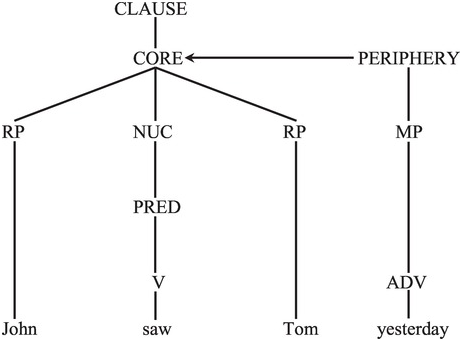
Figure 7.1 The constituent structure of the simple clause in English (RP = reference phrase; MP = modifier phrase)
7.2.2 Semantic Representation and Syntactic Function
The above syntactic representation is coupled with the semantic representation of the clause based on the following decompositional representations of predicates (termed logical structures (LS)), adapted from Vendler (Reference Vendler1967) and Dowty (Reference Dowty1979) (Van Valin Reference Van Valin2005: 42–49).
(1)
Decompositional representations for Aktionsart classes a. State predicate′ (x) or (x, y) b. Activity do′ (x, [predicate′ (x) or (x, y)]), or c. Achievement INGR predicate′ (x) or (x, y), or INGR do′ (x, [predicate′ (x) or (x, y)]) d. Semelfactive SEML predicate′ (x) or (x, y), or SEML do′ (x, [predicate′ (x) or (x, y)]) e. Accomplishment BECOME predicate′ (x) or (x, y), or BECOME do′ (x, [predicate′ (x) or (x, y)]) f. Active accomplishment do′ (x, [predicate1′ (x) or (x, y)]) & INGR predicate2′ (z, x) or (y) g. Causative α CAUSE β, where α and β are logical structures of any type
(2a)–(2g) illustrate the above decompositional representations.
(2)
a. State The cup is shattered. shattered′ (cup) Carl is in the library. be-in′ (library, Carl) b. Activity The children cried. do′ (children, [cry′ (children)]) Kim ate fish. do′ (Kim, [eat′ (Kim, fish)]) c. Achievement The windows shattered. INGR shattered′ (windows) The balloon popped. INGR popped′ (balloon) d. Semelfactive Dana glimpsed the dog. SEML see′ (Dana, dog) Mary coughed. SEML do′ (Mary, [cough′ (Mary)]) e. Accomplishment The snow melted. BECOME melted′ (snow) Chris learned French. BECOME know′ (Chris, French) f. Active accomplishment John ran to the park. do′ (John, [run′ (John)]) & INGR be-at′ (park, John) Kim ate the fish. do′ (Kim, [eat′ (Kim, fish)]) & INGR consumed′ (fish) g. Causative The dog scared the boy. [do′ (dog, ø)] CAUSE [feel′ (boy, [afraid′])] Max melted the ice. [do′ (Max, ø)] CAUSE [BECOME melted′ (ice)] Felix bounced the ball. [do′ (Felix, ø)] CAUSE [do′ (ball, [bounce′ (ball)])]
A key component of the RRG linking system is the two-tiered system of semantic roles. The first tier is thematic relations such as effector, experiencer, theme and patient. They are defined in terms of argument positions in the decompositional representations. The second tier comprises two semantic macroroles (MR), actor (ACT) and undergoer (UND). These are generalized semantic roles that subsume a number of LS arguments for morphosyntactic purposes and correspond to the two primary arguments of a transitive verb.1
The number and nature of macroroles that a verb takes is determined by the default macrorole assignment principles (DMAP) in (3).
(3)
Default Macrorole Assignment Principles a. Number: the number of macroroles which a verb takes is less than or equal to the number of arguments in its LS: 1. If a verb has two or more arguments in its LS, it will take two macroroles. 2. If a verb has one argument in its LS, it will take one macrorole. b. Nature: for verbs which take one macrorole: 1. If the verb has an activity predicate in its LS, the macrorole is actor. 2. If the verb has no activity predicate in its LS, the macrorole is undergoer.
(3a) determines the number of macroroles a verb takes, while (3b) determines which macrorole (actor or undergoer) it is when the verb receives only one macrorole. When the number of macroroles does not follow from the DMAP, it has to be specified in the lexical entry of the verb by a feature [MRα] (where α represents the number of macroroles).
The relationship between LS argument slots (or thematic relations serving as mnemonics for them) and macroroles is captured by the Actor-Undergoer Hierarchy (AUH) in Figure 7.2.

Figure 7.2 Actor-Undergoer Hierarchy
The AUH states that given the LS of a multi-argument verb, the leftmost argument will be the actor and the rightmost argument will be the undergoer.
(4a)–(4f) illustrate the default macrorole assignment.
(4)
a. John [Effector, ACT] killed Bill [Patient, UND]. b. Bill [Patient, UND] was killed by John [Effector, ACT]. c. John [Effector, ACT] gave a book [Theme, UND] to Bill [Recipient, Non-MR]. d. John [Experiencer, ACT] knew the student [Theme, UND]. e. John [Effector, ACT] ran to the park. f. John [Patient, UND] disappeared suddenly.
It is important to note that marked assignments to undergoer are possible, as illustrated by the locative alternation in (5a,b), in which the locative argument (the truck) may be chosen as undergoer in violation of the AUH.
(5)
a. John loaded hay on the truck. b. John loaded the truck with hay.
The observation that the locative argument in (5b) (the truck) is construed as being fully loaded motivates its choice as undergoer.2
Finally, the privileged syntactic argument (PSA) selection is based on the PSA Selection Hierarchy in (6), the PSA selection principles in (7), and restrictions in (8) (Van Valin Reference Van Valin2005: 100).
(6)
PSA Selection Hierarchy arg. of DO > 1st arg. of do′ > 1st arg. of pred′ (x, y) > 2nd arg. of pred′ (x, y) > arg. of pred′ (x)
(7)
Privileged syntactic argument selection principles a. Accusative constructions: highest-ranking direct core argument in terms of the PSA Selection Hierarchy (default) b. Ergative constructions: lowest-ranking direct core argument in terms of the PSA Selection Hierarchy (default)
(8)
Since an actor argument always outranks an undergoer argument in the PSA Selection Hierarchy, (7a) groups A and S arguments against O arguments, while (7b) groups O and S arguments against A arguments.
7.3 The Theory of Case Assignment
7.3.1 Regular Cases
This subsection is a summary of the RRG theory of case assignment outlined in Van Valin and LaPolla (Reference Van Valin and LaPolla1997) and Van Valin (Reference Van Valin2005). (9) and (10) are the sets of case assignment rules for accusative and ergative case systems, respectively. They refer crucially to the PSA Selection Hierarchy in (6), and not to grammatical relations or phrase structural positions.
(9)
(10)
‘The highest-ranking macrorole argument’ in (9a) conflates A and S arguments, while ‘the lowest-ranking macrorole argument’ in (10a) conflates O and S arguments. What is noteworthy about (9) and (10) is that they define all the core cases (i.e. nominative, absolutive, accusative and ergative) and dative case with reference to (non-)macrorole status and, in so doing, treat dative as one of the regular cases along with the core cases.3
Defining dative as the default case for non-macrorole core arguments accounts for why source arguments of ditransitive verbs may receive dative case as well as ablative case in many languages and leaves room for its being overridden by other oblique cases that denote a more specific semantic content in terms of LS configuration.4 For example, (11a) is the ablative preposition assignment rule for English, which applies to the uses of from in (11b).
(11)
a. MR: Non-MR LS: the first argument in the following LS configuration ‘… BECOME/INGR NOT have′/be-LOC′ (x, y)’ b. 1. John came from Chicago. 2. John received the watch from Mary.
(11a) is more specific than the macrorole-based definition of dative case in (9c) and (10c), in that it refers to a particular LS argument in addition to its non-macrorole status. This accounts for why the ablative preposition is used to mark source arguments as illustrated in (11b).5
The following shows how (9) and (10), respectively, work in Icelandic and Warlpiri and how the macrorole-based account of case assignment extends to active(-stative) case systems. First, let us consider the Icelandic data given in (12).
(12)
Icelandic (Andrews Reference Andrews, Maling and Zaenen1990: 188; Van Valin Reference Van Valin1991: 172) a. Stelpurnar hláu. the.girls.nom laughed ‘The girls laughed.’ b. Lögreglan tók Siggu fasta. the.police.nom took Sigga.acc fast.acc ‘The police arrested Sigga.’ c. Stelpan sýndi stráknum myndavélina. the.girl.nom showed the.boy.dat the.camera.acc ‘The girl showed the boy the camera.’ d. Ég tel lögregluna hafa tekið Siggu I.nom believe the.police.acc have taken Sigga.acc fasta. fast.acc ‘I believe the police to have arrested Sigga.’
(12a)–(12c) illustrate canonical intransitive, transitive and ditransitive constructions, while (12d) illustrates matrix-coding (‘raising’) constructions in which the PSA of the dependent core shows up in the matrix core. The case assignment in (12a)–(12d) proceeds as follows. The actor arguments in (12a)–(12c) correspond to ‘the highest-ranking macrorole argument’ in (9a) and receive nominative case. The undergoer arguments in (12b,c) correspond to ‘the other macrorole argument’ in (9b) and take accusative case. Likewise, the experiencer argument in the matrix core of (12d) receives nominative case from (9a), while both the matrix-coded argument lögreglan ‘the police’ and the patient argument Sigga in the dependent core correspond to ‘the other macrorole argument’ in (9b) and receive accusative case.
Next, let us consider how to account for the DAT-NOM and NOM-DAT-DAT case frames in (13a)–(13c), in which the macrorole assignment does not follow straightforwardly from the DMAP in (3).
(13)
Icelandic (Andrews Reference Andrews, Maling and Zaenen1990: 210; Van Valin Reference Van Valin1991: 174, 175) a. Stráknum líkar slíkir bílar. the.boy.dat likes such cars.nom ‘The boy likes such cars.’ b. Henni hefur alltaf þótt Ólafur leiðinlegur. her.dat has always thought Olaf.nom boring.nom ‘She has always considered Olaf boring.’ c. Ég skilaði henni peningunum. I.nom returned her.dat the.money.dat ‘I returned her the money.’
The DMAP predicts that all of the multiple-argument verbs in (13a)–(13c) take a pair of actor and undergoer. However, this prediction is not borne out; contrary to (3a1), all of (13a)–(13c) contain only one macrorole argument.
In contrast to the earlier analyses of quirky case in Icelandic (e.g. Andrews 1982, 1990; Yip et al. Reference Yip, Maling and Jackendoff1987), RRG derives the irregular (quirky) case marking illustrated in (13a)–(13c) from the irregularity in their macrorole transitivity. Specifically, Van Valin (1991) posits that þykja ‘think’, líka ‘like’, and skila ‘return’ in (13) are lexically prespecified for having only one macrorole ([MR1]) despite having two arguments in their LS.
Let us see how this lexical pre-specification allows us to treat dative as one of the regular cases (Van Valin Reference Van Valin1991; cf. Narasimhan Reference Narasimhan1998; Nakamura Reference Nakamura1999b, Reference Nakamura and Van Valin2008). First, suppose that the two-place state verb líka ‘like’ receives only one macrorole because of its lexical specification. (3b) dictates that the only macrorole is an undergoer, since the verb has no activity predicate in its LS. The AUH requires the theme argument slíkir bílar ‘such cars’ to become an undergoer. This leads the experiencer argument to receive a non-macrorole status.
(14)
Macrorole assignment of the verb líka ‘like’ ([MR1]) MR Non-MR Undergoer 
LS: like′ (boy, such cars)

The case assignment rules in (9) apply to the combination of the non-macrorole and undergoer arguments and yield the DAT-NOM case frame in (13a). The same account holds for the DAT-NOM case frame in (13b). Likewise, suppose that skila ‘return’ in (13c) is lexically specified for having only one macrorole ([MR1]). (3b) requires that the only macrorole that the verb takes is an actor, since it has an activity predicate do′ in its LS in (15).
LS of the verb skila ‘return’
[do′ (x, ø)] CAUSE [INGR have′ (y, z) ∧ NOT have′ (x, z) ] [MR1]
The effector argument is an actor, but the remaining non-PSA arguments have no choice but to receive a non-macrorole status, as shown in (16):
(16)
Macrorole assignment of the verb skila ‘return’ ([MR1]) MR Actor Non-MR Non-MR LS: [do′ (I, ø)] CAUSE [INGR have′ (she, money) ∧ NOT have′ (I, money)]
This macrorole assignment accounts for why the non-PSA arguments in (13c) receive dative case. Lexical specification of the number of macroroles that þykja ‘think’, líka ‘like’, and skila ‘return’ involve allows RRG to treat dative not as an example of quirky cases, but as one of the regular cases. This is one of the major points of contrast between RRG and the other syntactic theories with respect to case assignment.
(9) also accounts for the contrast between (17) and (18) with respect to case preservation under passivization.
(17)
Icelandic (Van Valin Reference Van Valin1991: 150, 151) a. Lögreglan tók Siggu fasta. the.police.nom took Sigga.acc fast.acc ‘The police arrested Sigga.’ b. Sigga var tekin föst af lögreglunni. Sigga.nom was taken fast.nom by the.police.dat ‘Sigga was arrested by the police.’
(18)
Icelandic (Van Valin 1991: 152) a. Ég hjálpaði honum. I.nom helped him.dat ‘I helped him.’ b. Honum var hjálpaði (af mér). him.dat was helped (by me.dat) ‘He was helped (by me).’
The patient argument Sigga receives nominative case in (17b), since it corresponds to ‘the highest-ranking macrorole argument’ in (9a). The reason for the preservation of dative case under passivization in (18b) is that the non-actor argument in (18a) retains its non-macrorole status after it undergoes passivization in (18b).6
Icelandic provides us with an opportunity to illustrate the effect of an important typological parameter concerning the DCA (i.e. domain of case assignment). As an initial motivation for the DCA parameter, let us consider (19).
(19)
Icelandic (Van Valin and LaPolla Reference Van Valin and LaPolla1997: 578) Jón telur mér hafa alltaf ϸótt Ólafur John.nom believes me.dat have always thought Olaf.nom leiðinlegur. boring.nom ‘John believes me to have always considered Olaf boring.’
What is intriguing about (19) is that the theme argument of þykja ‘think’ in the dependent core receives nominative case. This Icelandic example casts doubt on the assumption shared by major syntactic theories that nominative case assignment may occur only in finite clauses and suggests the necessity of making it an option for a language to allow (9) or (10) to apply in each core within a clause independently.
Van Valin and LaPolla (Reference Van Valin and LaPolla1997: 575–581) propose to derive the nominative case assignment in the dependent core in (19) from the DCA parameterization. The fact that the theme argument in the dependent core receives nominative case suggests that the DCA for Icelandic is the core, in contrast to languages such as German, which allows no nominative-marked argument to occur in any dependent core.7 (20) is a summary of the above discussion.
(20)
DCA Parameterization a. DCA=Clause (e.g. English, German) b. DCA=Core (e.g. Icelandic, Japanese)
The assumption that the DCA for Icelandic is the core explains the DAT-NOM case frame of the dependent verb in (19). First, let us assume that the dependent verb in (19) is irregular with respect to macrorole transitivity and that the two-place verb þykja ‘think’ has the feature [MR1] in its lexical entry. (3b) requires the only macrorole to be an undergoer, since þykja ‘think’ has no activity predicate in its LS. The AUH requires the theme argument to be an undergoer, which leads the experiencer argument of þykja to become a non-macrorole core argument. On the other hand, the experiencer argument of the matrix verb telja ‘believe’ is an actor and counts as ‘the highest-ranking macrorole argument’ in (9a). (21) shows how the macrorole assignment proceeds in the matrix and dependent core of (19).
(21)
Macrorole assignment in (19) Matrix core [Jón telja mér] ACT Non-MR Dependent core [(mér) þykja Ólafur] (Non-MR) UND
Applying the set of case assignment rules in (9) to the dependent core in (21) accounts for the nominative marking of the theme argument (Ólafur) in (19).
In contrast to (9), which derives accusative case systems, (10) accounts for ergative case systems. (22a)–(22c) come from Warlpiri (Pama-Nyungan).
(22)
Warlpiri (Hale Reference Hale1983: 6, 13) a. Kurdu ka parnka-mi. child.abs aux run-npst ‘The child is running.’ b. Kurdu kapi wanti-mi. child.abs aux fall-npst ‘The child will fall.’ c. Ngarrka-ngku ka wawirri panti-rni man-erg aux kangaroo.abs spear-npst ‘The man is spearing the kangaroo.’
Warlpiri is a double-marking language in which the agreement clitic system operates on a nominative-accusative basis, while independent pronouns and lexical NPs are case-marked according to an ergative-absolutive pattern. The Warlpiri case-marking pattern falls out from (10), which assigns absolutive case to O and S arguments, while assigning ergative case to A arguments.8
Finally, RRG extends the macrorole-based account of accusative and ergative case systems to active(-stative) cross-reference/case systems, illustrated by (23) and (24).9
(23)
Acehnese (Austronesian: Durie Reference Durie1985, Reference Durie1987) a. (Gopnyan) geu=mat lôn (3sg) 3=hold me ‘(S)he holds me.’ b. Geu=jak (gopnyan) 3=go (3sg) ‘(S)he goes.’ (Actor) c. Lôn ehët(=lôn) 1sg fall(=1sg) ‘I fall.’ (Undergoer)
(24)
Western dialect of Basque (Aldai Reference Aldai2009: 785, 786) a. Peru-k sagarr-a-ø jan d-u-ø. Peru-erg apple-det-abs eaten 3sg.abs-aux-3sg.erg ‘Peru has eaten the apple.’ b. Peru-k dantzatu d-u-ø. Peru-erg danced 3sg.abs-aux-3sg.erg ‘Peru has danced.’ (Actor) c. Peru erori d-a. Peru.abs fallen 3sg.abs-aux ‘Peru has fallen.’ (Undergoer)
Acehnese is a head-marking language with clitics on the verb stem that cross-reference arguments and distinguishes between actor and undergoer arguments in terms of where their cross-referencing clitics occur: obligatory proclitics index actor arguments, while optional enclitics index undergoer arguments. In contrast to Acehnese, Basque is a double-marking language in which up to three arguments may be cross-referenced on the auxiliary verb, while independent pronouns and lexical NPs receive case. Aldai (Reference Aldai, Donohue and Wichmann2008, Reference Aldai2009) classifies dialects of Basque into three major types (Western, Eastern and Central) and states that the Western dialect marks actor and undergoer arguments with ergative and absolutive case, respectively, while the Eastern dialect operates on an ergative-absolutive basis.10
It is important to recall from Section 7.1 that RRG views verbal cross-reference systems as being functionally equivalent to nominal case systems (Van Valin Reference Van Valin, Bickel, Grenoble, Peterson and Timberlake2013): the same set of case assignment rules applies to both cross-reference and case systems that exhibit the split-S pattern, whether it is realized by linear morphological slots of cross-referencing affixes/clitics or nominal case affixes/clitics. Their unified account enables us to handle active(-stative) case systems (most of which are head-marking) on a par with accusative and ergative ones.
(25) and (26) are the sets of case assignment rules for the two types of active(-stative) cross-referencing/case systems, which apply to linear morphological positions of verbal cross-referencing clitics (e.g. Acehnese) and nominal case affixes (e.g. Western dialect of Basque).
(25)
(26)
Case assignment rules (Ergative-active) a. Assign ergative case to the actor argument. b. Assign absolutive case to the undergoer argument. c. Assign dative case to non-macrorole core arguments (default).
To summarize, the four sets of macrorole-based case assignment rules in (9) (accusative), (10) (ergative), (25) (accusative-active) and (26) (ergative-active), together with the DCA parameter in (20), constitute the core part of the RRG theory of case assignment.
7.3.2 Non-Dative Oblique Cases
We saw in the last subsection that RRG defines dative as the default case of non-macrorole core arguments and treats it as one of the regular cases along with the core cases. This raises the question of how RRG handles oblique cases (or adpositions) other than dative case.
RRG defines non-dative oblique cases in terms of the LS configuration in which the referent of the noun they mark occurs and its (non-)macrorole status (Jolly Reference Jolly1991, Reference Jolly and Van Valin1993; Van Valin Reference Jolly and Van Valin1993, Reference Van Valin2005; Van Valin and LaPolla Reference Van Valin and LaPolla1997). As a case in point, let us consider how RRG defines instrumental case, with a focus on the instrument, implement, locatum and comitative uses of the English instrumental preposition with.
(27)
Instrument with a. John cut the meat with a knife. [do′ (John, [use′ (John, knife)])] CAUSE [[do′ (knife, [cut′ (knife, meat)])] CAUSE [BECOME cut′ (meat)]] Implement with b. Chris wrote the letter with a pen. do′ (Chris, [write′ (Chris, letter) ∧ use′ (Chris, pen)]) & INGR exist′ (letter) Locatum with c. John loaded the truck with hay. [do′ (John, Ø)] CAUSE [BECOME be-on′ (truck, hay)] (UND=locative) Comitative with d. John walked to the concert with Pat. (John and Pat went to the concert.) [do′ (John ∧ Pat, [walk′ (John ∧ Pat)])] & INGR be-at′ (concert, John ∧ Pat) e. Pat served wine with cheese to the guest. (Pat served wine and cheese to the guest.) [do′ (Pat, Ø)] & [BECOME have′ (guest, wine ∧ cheese)]
Two points are worth making about (27). First, the implement with is distinct from the instrument with, in that the instrument argument is part of a verb’s causal chain, while the implement argument is not. Second, with exhibits an instrumental/comitative syncretism.
Jolly (Reference Jolly1991, Reference Jolly and Van Valin1993) makes an important observation that the instrument with marks a potential actor that fails to function as actor, while the locatum with marks a potential undergoer that fails to serve as undergoer and that the comitative with marks one of the co-participants that would otherwise appear as an actor or undergoer but does not. (28) is the unified definition of the instrument, locatum and comitative uses of with.11
Instrumental case rule (ICR) (Van Valin Reference Van Valin2005: 110)
Assign instrumental case to non-MR b argument if, given two arguments, a and b, in a logical structure, with (i) both as possible candidates for a particular macrorole and (ii) a is equal or higher (to the left of b) on the AUH, b is not selected as that macrorole.
The basic idea is that all of the instrument, locatum and comitative uses of with are non-predicative: they are associated with the outcome of certain linking options (as described in (28)), in contrast to locative prepositions (as illustrated in (29)), which are linked to a specific LS configuration.
(29)
a. John was running in the park. LS: be-in′ (park, [do′ (John, [run′ (John)])]) b. John walked to the station. LS: do′ (John, [walk′ (John)]) & INGR be-at′ (station, John)
The two prepositions in (29) are associated with their LSs: in introduces the LS ‘be-in′ (…)’, a two-place predicate that takes the entire event (‘[do′ (John, [run′ (John)])]’) as the second argument and situates it in a location designated by the first argument, while to introduces the LS ‘INGR be-at′ (…)’, whose first argument designates the goal of the movement.
Three remarks are in order about the ICR in (28). First, (28) does not extend to the implement with illustrated in (27b). The fact that the two-place activity verb write has no ready-made argument slot for the implement NP a pen disqualifies it as a possible candidate for an actor and puts the implement use of with outside the scope of (28). Second, (28) interacts with the dative case assignment rule in (9c) in an intricate way. For example, (27c) (repeated below) involves a marked undergoer assignment to the locative argument, which forces the theme argument hay to become a non-macrorole.12
c. John loaded the truck with hay.
The problem is that both (9c) and (28) may apply to hay. Van Valin (2005) argues that the ICR in (28) overrides (9c) and accounts for why hay is marked by the instrumental preposition under the crucial assumption that both instrumental with-phrases (as illustrated in (27a)) and locatum with-phrases (as illustrated in (27c)) constitute a subset of non-macrorole core arguments and that (28) applies to them.13 Finally, (28) applies to nominal cases and adpositions that nullify the morphological distinction between instrumental and comitative, but it is important to note that their syncretism is not common outside the Indo-European languages (Stolz et al. Reference Stolz, Stroh and Urdze2006). The fact that the majority of languages outside the Indo-European family distinguish the two cases (as illustrated in (30)) suggests an alternative strategy to analyse the non-comitative and comitative uses of with separately and then to derive the instrumental-comitative syncretism (instead of deriving the two uses of with from a single rule).
(30)
To summarize, RRG divides oblique cases into predicative and non-predicative oblique cases: the former (e.g. ablative, allative, locative) are associated with their LSs, while the latter (e.g. dative, instrumental) are either assigned to a non-macrorole core argument (only when no other case rule may apply) or are associated with the linking pattern in (28). Van Valin (Reference Jolly and Van Valin1993, Reference Van Valin2005) and Van Valin and LaPolla (Reference Van Valin and LaPolla1997) lay a foundation for the decompositional account of oblique case assignment, but they leave it as an open question how to provide a unified account of non-dative oblique cases/adpositions, most notably the instrumental case/adposition.
7.4 An OT Implementation
7.4.1 Regular Case Assignment
This section outlines an OT implementation of the RRG theory of case assignment and its extension to instrumental case assignment (Nakamura Reference Nakamura and Darnell1999a, Reference Nakamura1999b, Reference Nakamura2015, Reference Nakamura and Van Valin2021).14
OT is a constraint-based formalism with an emphasis on constraint interaction that views a grammar as a function that maps each input to its correct structural description (Prince and Smolensky Reference Prince and Smolensky2004). Three fundamental principles of OT are relevant here. First, all constraints are violable. The only requirement for a candidate to be optimal is that it is the minimal violator in the given candidate set. Second, a grammar resolves conflicts among constraints by ranking them in a strict dominance hierarchy, in which each constraint has absolute priority over all the lower-ranking constraints. Third, re-ranking of a set of individually simple constraints yields typological variation.
Nakamura (Reference Nakamura and Darnell1999a) proposes the set of OT constraints for the regular case assignment in (31).
(31)
(31a)–(31d) constitute a dominance hierarchy that receives as an input a pair of the two-tiered semantic representations of a predicate and outputs its case frame. Unlike (9a,b) and (10a,b), (31a)–(31c) make no reference to the ranking of actor and undergoer.
Five remarks are in order about (31a)–(31d). First, (31a) comes originally from Jakobson (1936/1984), who analyses nominative as the default case with no semantic content, and is required by languages such as Japanese where every core has to have at least one nominative-marked argument. Second, the relative ranking of (31a,d) determines whether or not a language allows preservation of dative (or some other oblique) case under passivization: when (31d) outranks (31a), non-macrorole core arguments cannot receive nominative case (as illustrated by (18)), while when (31a) outranks (31d), no case preservation under passivization is allowed.15 The latter situation is illustrated by Japanese examples given in (32).
(32)
a. John-ga Tom-ni butsukat-ta. John-nom Tom-dat bump.into-pst ‘John bumped into Tom.’ b. Tom-ga/*ni John-ni butsuka-rare-ta. Tom-nom/dat John-dat bump.into-pass-pst ‘Tom was bumped into by John.’
The dative-marked argument in (32a) bears nominative case under passivization (as shown in (32b). Third, (31a) groups nominative case in accusative systems and absolutive case in ergative systems as a single category in spite of their distributional difference. Fourth, (31b,c) are derived from the hypothesis that accusative and ergative case, respectively, mark undergoer and actor arguments exclusively. Finally, various rankings of (31a)–(31c) yield the accusative, ergative, and two types of active(-stative) case systems, as shown in (33).16
(33)
Accusative case system a. (31d) >> (31a) >> (31b) (>> (31c)) e.g. Icelandic, German b. (31a) >> (31d) >> (31b) (>> (31c)) e.g. Japanese, French Ergative case system c. (31d) >> (31a) >> (31c) (>> (31b)) e.g. Warlpiri Accusative-active case system d. (31d) >> (31b) >> (31a) (>> (31c)) e.g. Acehnese Ergative-active case system e. (31d) >> (31c) >> (31a) (>> (31b)) e.g. Western dialect of Basque
Let us see how the constraint ranking in (33a) derives the NOM-ACC and DAT-NOM case frames in Icelandic. Tableau 7.1 shows how (33a) outputs the NOM-ACC case frame illustrated in (12b).17
(12)
b. Lögreglan tók Siggu fasta. the.police.nom took Sigga.acc fast.acc ‘The police arrested Sigga.’
The input to the constraint hierarchy consists of an actor and undergoer argument. The first and third candidates violate (31b), while the fourth candidate violates (31a). In contrast, the second candidate violates the lowest-ranking constraint alone and emerges as the winner. The winner may violate constraints in OT, as long as the other candidates violate any higher-ranking constraint(s).
Tableau 7.2 shows how the DAT-NOM case frame in (13a) is derived.
(13)
a. Stráknum líkar slíkir bílar. the.boy.dat likes such cars.nom ‘The boy likes such cars.’
The first and second candidates violate the top-ranking constraint (31d), since the non-macrorole core argument receives nominative case. The fourth candidate violates (31a), since it contains no nominative argument. The above consideration leaves the third candidate as the winner. The third candidate violates (31b), but it fares better than the other candidates, since the other candidates violate either (31d) or (31a) (which is ranked higher than (31b)).
An analogous account holds for ergative and active(-stative) case systems. Tableau 7.3 shows how the ERG-NOM case frame is derived in (22c).
(22)
c. Ngarrka-ngku ka wawirri panti-rni man-erg aux kangaroo.nom spear-npst ‘The man is spearing the kangaroo.’
The difference between Tableau 7.1 and Tableau 7.3 comes down to the relative ranking of (31b) and (31c): when (31b) outranks (31c), an accusative case system emerges, while when (31c) outranks (31b), an ergative case system emerges. This suggests that the traditional distinction between nominative and absolutive is a by-product of the relative ranking of (31b) and (31c) and that there is no need to postulate absolutive case in addition to nominative case.
Finally, the constraint rankings in (33d) and (33e) yield accusative-active and ergative-active case systems, respectively. When (31b) outranks (31a) as in (33d), undergoer arguments always receive accusative marking, while actor arguments receive nominative marking. In contrast, when (31c) outranks (31a) as in (33e), actor arguments receive ergative case, while undergoer arguments receive nominative case.
To summarize this subsection, the OT reformulation of the case assignment rules in (9), (10), (25) and (26) in terms of the case assignment constraints in (31) accommodates the major case frames of simple clauses in accusative, ergative, and two types of active case systems and derives the typological variation of case systems from re-ranking of the individually simple constraints that make no reference to the relative ranking of actor and undergoer.
7.4.2 Instrumental Case Assignment
Nakamura (Reference Nakamura2015, Reference Nakamura and Van Valin2021) extends the domain of regular case assignment to instrumental case within the OT-RRG framework outlined in the previous subsection (cf. Van Valin and LaPolla Reference Van Valin and LaPolla1997; Van Valin Reference Van Valin2005, Reference Van Valin, Malchukov and Spencer2009). This extension is inspired by Jakobson (Reference Jakobson1936/1984), who decomposes eight cases in Russian in terms of three privative semantic features ([peripheral], [directional] and [quantified]) (as partially shown in Table 7.1 below) and defines instrumental case as having the [peripheral] feature alone (which covers oblique core arguments and adjuncts put together), while defining dative case as having the [peripheral] and [directional] feature.
Table 7.1 Jakobson’s (Reference Jakobson1936/1984) featural definitions of nominative, accusative, dative and instrumental cases
| Peripheral | Directional | Quantified | |
|---|---|---|---|
| Nominative | |||
| Accusative | + | ||
| Dative | + | + | |
| Instrumental | + |
These featural definitions suggest that dative case marks oblique arguments whose referents are at the receiving end of an action (e.g. recipient arguments of ditransitive verbs), while instrumental case serves as the default case for adjuncts.
Three problems remain to be solved before proposing an OT-RRG account of instrumental case assignment. First, instrumental case marks not only a wide range of adjuncts as illustrated in (34a)–(34e), but also non-macrorole core arguments that involve a violation of the AUH, as illustrated in (34f).
(34)
Russian (Kilby Reference Kilby1977: 75; Wierzbicka Reference Wierzbicka1980: 23; Janda Reference Janda1993: 147, 156) a. Ivan napisal pisʹmo ručkoj. Ivan.nom wrote letter.acc pen.ins ‘Ivan wrote the letter with a pen.’ b. Ivan pil vino litrami. Ivan.nom drank wine.acc liters.ins ‘Ivan drank wine by the litre.’ c. Petr kivnul golovoj. Peter.nom nodded head.ins ‘Peter nodded his head.’ (lit. ‘Peter nodded with the head.’) d. Monax dolžen svjazatʹ usta svoi molčaniem. monk.nom must tie.up lips.acc own.acc silence.ins ‘A monk must seal his lips with silence.’ e. Lošadʹ soseda lučše moej horse.nom neighbour.gen better mine.gen i siloj i krasotoj and strength.ins and beauty.ins ‘The neighbour’s horse is better than mine both in strength and in appearance.’ f. Oni gruzili baržu drovami. they.nom loaded barge.acc firewood.ins ‘They loaded the barge with firewood.’
In order to treat instrumental case on a par with the regular cases (i.e. nominative, dative, accusative and ergative), it is imperative to derive all the argument and adjunct uses of instrumental case from a single constraint associated with a unitary meaning. Second, the question of how the instrumental case assignment interacts with the dative case assignment needs to be addressed. What is at stake here is how to explain why hay in (34f) receives instrumental marking despite being qualified to receive dative case because of its status as a non-macrorole core argument. This is a clear indication that it is not enough to define instrumental as the default case for adjuncts. Finally, it remains to be shown how to derive the wide range of interpretations an instrumental-marked noun may have from its unitary meaning.
In order to solve the first problem, Nakamura (Reference Nakamura2015, Reference Nakamura and Van Valin2021) defines instrumental case as the default case for everything other than macrorole arguments and proposes (35b) as a constraint that represents the unitary meaning of instrumental case. Nakamura goes on to revise (31d) (as shown in (35a)) in such a way that it does not apply to non-macrorole core arguments as in (34f) that involve a violation of the AUH (in this case, failure to assign undergoer status to the lowest-ranking argument) and proposes to rank (35a) higher than (35b) universally.18
(35)
Dative and instrumental case assignment a. Non-macrorole core arguments that do not involve a violation of the AUH receive dative case (the underlined part is added to (31d)). b. Case-bearing elements other than macrorole (core) arguments receive instrumental case.
(35a,b) and their ranking recast the Jakobsonian definition of instrumental case in terms of the three-layered clausal structure and semantic macroroles and account for why non-macrorole core arguments such as the one in (34f) (which are beyond the scope of the decompositional definition of instrumental case given in Table 7.1) receive instrumental case.19
(35b) accommodates a wide range of instrumental-marked adjuncts in Russian (and, by extension, other languages) whose interpretations are not determined by predicate semantics, but the highly underdetermined meaning of instrumental case raises the question of how to interpret each of its adjunct uses appropriately. This third problem requires serious consideration, since (35b) alone leaves an instrumental-marked noun unlinked to any argument position in the LS and provides no clue as to the specific role it plays in the clause.20 This amounts to a violation of the Completeness Constraint (CC), a very general principle in RRG that governs the linking between the syntactic and semantic representations.
(36) Completeness Constraint (Van Valin Reference Van Valin2005: 129–130)
All of the arguments explicitly specified in the semantic representation of a sentence must be realized syntactically in the sentence, and all of the referring expressions in the syntactic representation of a sentence must be linked to an argument position in a logical structure in the semantic representation of the sentence.
Jakobson (Reference Jakobson1936/1984) suggests that particular meanings of instrumental case (e.g. instrument, implement, unit, manner, path, cause) arise through its interaction with context, but he leaves it open what the context consists of and how its contextual interpretation is derived.
There is no space in this chapter to provide a full account of how the various meanings of instrumental case are derived in context (see Nakamura (Reference Nakamura and Van Valin2021) for detailed discussion), but a few illustrations can be given. First, we may follow Van Valin (Reference Van Valin, Pustejovsky, Bouillon, Isahara, Kanzaki and Lee2012) in deriving the meaning of implement as in (27b) (and, by extension, (34a)) from the qualia structure (QS) (Pustejovsky Reference Pustejovsky1995) of the instrumental-marked noun in (37a).21
(27)
b. Chris wrote the letter with a pen.
(37)
a. Formal: physical-object′ (a), stationery′ (a) Telic: do′ (b, [write′ (b, c) ∧ use′ (b, a)]) Agentive: artifact′ (a) Constitutive: … b. do′ (b, [write′ (b, c)]) & INGR exist′ (c) c. do′ (Chris, [write′ (Chris, letter) ∧ use′ (Chris, pen)]) & INGR exist′ (letter)
Invoking the QS of pen (more specifically, its telic quale) for interpreting the prepositional phrase (and the whole sentence that contains it) in (27e) leads to introducing a new argument position for its complement noun (pen) and thereby prevents a violation of the CC. Van Valin (Reference Van Valin, Malchukov and Spencer2012) derives the LS of (27e) (given in (37c)) by merging the LS in the telic quale in (37a) with the LS of the active accomplishment use of the activity verb write in (37b). This operation is termed co-composition (Pustejovsky Reference Pustejovsky1995), an operation that derives the meaning of a phrase compositionally from the head (in this case, the preposition) and its argument when the latter affects the meaning of the phrase (and the clause that contains it) beyond its role as an argument of the head. An analogous account holds for (34a).
Second, Nakamura (Reference Nakamura and Van Valin2021) takes the above QS-based account of (27e) as the first step toward identifying contextually appropriate interpretations of instrumental-marked nouns and extends it to other uses of instrumental-marked nouns, four of which are given in (34b)–(34e). Let us begin with (34b), which involves a measure unit by which to quantify an indefinite amount of some object, while engaging in some activity involving it (in this case, drinking wine). We may take the instrumental-marked noun litrami ‘litres’ as an adjunct, since it is not subcategorized by the verb. The underspecified meaning of instrumental case requires the unit noun litr ‘litre’ to be linked to an argument position of an event involved by its QS. I propose that the unit interpretation of litrami is derived from its telic qualia given in (38a): litr ‘litre’ refers to a unit that is used to measure an amount of liquid.
(38)
a. Qualia structure of litr ‘litre’ TELIC: do′ (x, [use′ (x, y)]) PURP do′ (x, [measure′ (x, z)]) b. LS of pitʹ: do′ (x, [drink′ (x, z)]) c. LS of (34b): do′ (Ivan, [drink′ (Ivan, wine)] ∧ [use′ (Ivan, litre) PURP measure′ (Ivan, wine)])
The CC requires us to interpret litrami ‘litres’ as a participant of the event involved by its telic quale. Merging the LS of the activity verb pitʹ ‘drink’ in (34b) with the LS in the telic quale of litr in (38a) yields the LS of (34b) in (38c).
Third, the instrumental-marked noun in (34c) fulfils two functions simultaneously. First, the body-part noun golovoj ‘head’ serves as an adjunct to the main predicate and restricts the verb’s meaning by identifying the body part that is directly involved in the event rather than designating a target of Peter’s action (Wierzbicka Reference Wierzbicka1980). Second, the body-part noun forms a possessive relation with the subject argument: its constitutive quale (‘have.as.part′ (x:human, y)’) allows the hearer to associate Petr and golovoj with the possessor (‘x’) and possessum (‘y’), respectively. Another point to note in this connection is that (34c) encodes the possessive relation in terms of predication (and not in terms of reference, as illustrated in (39)) despite the fact that the possessive predicate remains covert.
(39)
golova Petra head.nom Peter.gen ‘Peter’s head’
(40)
a. Main predicate: SEML do′ (Peter, [nod′ (Peter)]) b. Covert possessive predicate: have.as.part′ (Peter, head)
The main predicate kivnutʹ ‘nod’ and the covert possessive predicate share the subject argument Petr, but these predicates do not form a nuclear juncture, since Petr participates in the two events in (40a,b) independently.22 This suggests that (34c) embodies a non-subordinate core juncture, in which each of the predicates has its own core.
The macrorole assignment proceeds in the two cores independently. The main predicate kivnutʹ ‘nod’ is a single-macrorole verb. Petr functions as undergoer when it counts as the first argument of the covert possessive predicate in (40b) (since it has no activity predicate do′ in its LS), while Petr serves as actor when it counts as the effector argument of the main predicate. The possessum argument golova ‘head’ becomes a non-macrorole core argument and receives instrumental case from (35b), since the possessor argument Petr bears the undergoer status in violation of the AUH.23
In contrast to (34a)–(34c), the instrumental-marked noun in (34d) (molčanie ‘silence’) has no (default) value for its constitutive, telic or agentive quale: it is not conventionally associated with any particular material, purpose, function or origin. This yields the consequence that we need to understand the function of molčanie with no reference to its QS. Since molčanie is neither an argument of the predicate nor part of the predicate, we have to conclude by a process of elimination that this instrumental-marked noun serves as a modifier: it modifies the manner of the action denoted by the verb svjazatʹ ‘tie up.’
Finally, let us consider how the meaning of domain restriction is derived in (34e). The first point to note here is that both sila ‘strength’ and krasota ‘beauty, appearance’ are part of the formal qualia of lošadʹ ‘horse.’ The fact that these attributes constitute part of the attributes of a horse explains why the two instrumental-marked abstract nouns serve to relativize the evaluation of the neighbour’s horse by the speaker and receive the interpretation of domain restriction. The fact that the two abstract nouns are not subcategorized by lučše suggests that they function as a modifier of the predicate and receive instrumental case from (35b) as dominated by (35a) (since they are not syntactic arguments).
To summarize, this section has shown that the OT reformulation of the case assignment rules in (9) (accusative), (10) (ergative), (25) (accusative-active) and (26) (ergative-active) clarify what these case systems share and where they diverge and has provided a brief summary of how to extend the OT-RRG account of the regular cases to instrumental case.
7.5 An OT-RRG Account of Case Syncretism
One of the major principles of the RRG theory of case assignment (Van Valin Reference Jolly and Van Valin1993, Reference Van Valin2005; Van Valin and LaPolla Reference Van Valin and LaPolla1997) is that it does not distinguish syntactic cases from morphological cases, under the assumption that each case receives its unique morphological realization (see Section 7.1). However, this assumption is called into question by case syncretism phenomena, where a single case morpheme realizes more than one syntactic case. This section outlines the OT-RRG account of case syncretism (based mainly on Nakamura (Reference Nakamura and Van Valin2011)), with a particular focus on those instances of syncretism in which a single case morpheme realizes more than one regular case other than instrumental case (i.e. nominative, accusative, ergative, dative and genitive).
The rest of this section is organized as follows. First, I will introduce the case hierarchy (CH) (Silverstein Reference Silverstein and Van Valin1980/1993; cf. Blake Reference Blake2001; Caha Reference Caha2013) and will summarize what the CH has to say about the typological variation of case syncretism among the regular cases. Second, I will illustrate the representative types of syncretism predicted by the CH. Finally, I will show how and to what extent these instances of case syncretism are derivable in terms of OT.
7.5.1 The Case Hierarchy
The CH comprises two parts: the upper part represents implicational relations among propositional and adnominal case morphemes, while the lower part represents implicational relations among adverbial and propositional case morphemes.
(41)
Case Hierarchy (Silverstein Reference Silverstein and Dixon1976, Reference Silverstein and Van Valin1980/1993)24 a. Propositional/Adnominal: Nom/Abs: Dat1 ⟵ {Acc, Erg} ⟵ Gen b. Adverbial/Propositional: Dat2 ⟵ Instr, Loc…
(41a) states that if a language has a distinct morpheme for genitive, it has a distinct morpheme for accusative and/or ergative, that if a language has a distinct morpheme for accusative and/or ergative, it has a distinct morpheme for dative and nominative/absolutive, while (41b) states that if a language has a distinct morpheme for representing instrumental and/or locative, it has a distinct morpheme for dative.
Five remarks are in order about (41). First, (41a) states that nominative/absolutive and dative constitute the minimal case-marking system and that three/four/five-way case-marking systems arise as a gradual elaboration of this fundamental contrast.25 Second, (41a) treats nominative and absolutive as different manifestations of the same case (Section 7.4.1). Third, some languages (e.g. Estonian) have no case morpheme termed ‘dative’, but they have some other oblique case morpheme that behaves like it (Matsumura Reference Matsumura1994, 1996; see Section 7.5.2). Fourth, a genitive case expresses a possessive relation as distinguished from an attributive modification. This means that attributive markers are not analysed as genitive.26 Finally, (41a) and split accusativity and ergativity determine the possible range of case syncretism among the regular cases. (42) is a list of the patterns of case syncretism predicted by (41a).
(42)
7.5.2 Patterns of Case Syncretism
(42a)–(42c) are two-way case-marking systems illustrated by Yagnob (Iranian), Kabardian (Northwest Caucasian), and Palauan (Austronesian). They exhibit an extensive syncretism that applies to all non-nominative case morphemes available. (43a)–(43f) come from Kabardian.
(43)
Kabardian (Colarusso Reference Colarusso1992: 167; Smith Reference Smith1996: 108, 111, 113) a. ɬ’ə-m šə-r fə́zə-m jərəjtáhṣ. man-obl horse-nom woman-obl (nom.3).io.act.gave ‘The man gave the horse to the woman.’ b. ɬ’ə-m šə-r jə-wəh’áhṣ. man-obl horse-nom (nom.3)-act-killed ‘The man killed the horse.’ c. ḫa-r žáṣə-m mabáhna. dog-nom night-obl (nom.3)-bark ‘The dog barks at night.’ d. ɬ’ə-r fə́zə-m náxra nax’’ə́ẓṣ. man-nom woman-obl older (nom.3)-is ‘The man is older than the woman.’ e. mázə-m jahḫ. forest-obl act.(nom.3).carry ‘They carry it to the forest.’ f. ḫa-m Ø-yə-pa-r dog-obl 3-poss-nose-nom ‘the dog’s nose’
The nominative case suffix ‑r marks S and O arguments, while the oblique case suffix ‑m marks A arguments, a wide range of oblique core arguments and adjuncts, and adnominal possessors. In contrast to the nominative case suffix, which may appear only once per clause, the oblique case suffix may appear multiple times within a clause. The fact that Kabardian distinguishes A arguments from S and O arguments in terms of case marking suggests that its case system (as well as its cross-referencing system) involves an ergative alignment.
In contrast to Kabardian, Palauan involves an accusative case alignment. (44a)–(44f) show that it uses the oblique preposition er to mark non-macrorole core arguments, human and/or specific-and-singular O arguments in imperfective clauses, adjuncts and adnominal possessors, while leaving S and A arguments unmarked.27
(44)
Palauan (Josephs Reference Josephs1975: 235; Georgopoulos Reference Georgopoulos1991: 26, 27, 29) a. ak-mo er a katsudo. r.1sg-go obl movies ‘I am going to the movies.’ b. ng-kiltmekl-ii a ulaol a Peter. r.3sg-clean-3sg floor Peter ‘Peter cleaned the floor.’ c. ng-diak ku-nguiu er a hong. neg irr.1sg-read obl book ‘I am not reading the book.’ d. ng-mo er a ngebard er a klukuk. r.3sg-go obl west obl tomorrow ‘She is going to America tomorrow.’ e. A Romana a omeka er a rengalek Romana feed obl children er a kukau. obl taro ‘Romana is feeding the children the taro.’ f. ak-uleldanges er a resensei er ngak r.1sg-honor.ipfv obl teachers obl me ‘I respected my teachers.’
Tables 7.2(a,b) represent the extensive case syncretism in Kabardian and Palauan.
Yagnob (Iranian) exhibits an even broader range of syncretism than Kabardian and Palauan: non-macrorole core arguments, A arguments in ergative constructions, definite O arguments in accusative constructions, and adnominal possessors receive the same oblique case marker ‑i (Comrie Reference Comrie1981: 169–170).
Table 7.2(a) Case syncretism in Kabardian
| Case | Case marking |
|---|---|
| NOM | -r |
| ERG | -m (oblique) |
| GEN | |
| DAT | |
| INSTR, LOC … |
Table 7.2(b) Case syncretism in Palauan
| Case | Case marking |
|---|---|
| NOM | ø |
| ACC | er (oblique) |
| GEN | |
| DAT | |
| INSTR, LOC … |
(42d)–(42i) illustrate three-way case-marking systems with a genitive-dative, genitive-ergative, genitive-accusative, or dative-accusative syncretism. Let us begin with the genitive-dative syncretism in (42d,e). (45a)–(45c) come from Djaru (Pama-Nyungan).
(45)
Djaru (Tsunoda Reference Tsunoda1981: 110, 115, 124) a. ŋaniŋa guɲar guɳga ɲir-a waɽulu-la. 1sg.dat dog dead stay-pst night-loc ‘My dog died last night.’ b. ŋumbir-u ŋa-la maŋari jambagina-wu juŋ-an. woman-erg child-3sg.dat food child-dat give-prs ‘A woman gives food to a child.’ c. ŋaᶁu-ŋgu ŋa-ɳa-ŋgu guju man-i 1sg-erg c-1sg.nom-3sg.dat meat take/get-pst ɲunuŋa. 2sg.dat ‘I obtained meat for you.’ (or ‘I took/stole your meat.’)
(45a,b) indicate that the same case morpheme is used to mark recipient arguments of ditransitive verbs and adnominal possessors. This genitive-dative syncretism renders (45c) ambiguous and allows the second-person dative pronoun in (45c) to be construed as a benefactive or possessor (Tsunoda Reference Tsunoda1981: 110).
Likewise, Old Persian (Indo-Iranian) exhibits the same syncretism in its accusative case system (Benvenuto and Pompeo Reference Benvenuto, Pompeo, Krasnowolska and Rusek-Kowalska2015). Romanian (Romance) provides another illustration of genitive-dative syncretism.
(46)
Romanian (Cornilescu Reference Cornilescu2000: 91; Hill Reference Hill2013: 140) a. cartea profesorului book.def teacher.def.obl ‘the teacher’s book’ b. Copiii n-au rãspuns deloc bine profesoarei. children neg-have responded at.all well teacher.def.obl ‘Children have not responded at all well to the teacher.’ c. Ion li-a admirat pe prietenuli lui. Ion him-has admired acc friend.def his ‘Ion admired his friend.’
Romanian has a two-way inflectional case-marking system for nouns, while using a differential object marker pe usually accompanied by clitic doubling (as illustrated in (46c)) to mark those undergoer arguments of transitive verbs that are relatively high on the definiteness and animacy scales (see Mardale (Reference Mardale2008) for discussion of how the two scales are combined). Table 7.3 is a summary of the hybrid case-marking system of Romanian.28
Table 7.3 Case syncretism in Romanian
| Case | Case marking | |
|---|---|---|
| Inflection | Preposition | |
| NOM | Nominative | |
| ACC | pe | |
| GEN | Oblique | |
| DAT | ||
The Romanian case-marking system involves split-accusativity triggered by definiteness and animacy in addition to the genitive-dative syncretism. The genitive-dative syncretism is also attested in Macedonian, Bulgarian, Albanian and Modern Greek and has been recognized as one of the Balkan Sprachbund properties (Tomić Reference Tomić and Tomić2004: 12–15).
Halkomelem (Salish) is a double-marking language that exhibits a two-way case-marking system for nouns, while possessing a split-ergative agreement system:29 it involves a genitive-dative syncretism (using the same oblique case suffix to mark oblique nouns and proper-noun adnominal possessors) and makes no formal distinction among A, O and S arguments, all of which receive nominative (‘straight’) case (Gerdts Reference Gerdts1988).
The genitive-accusative syncretism is attested in Northern Sámi, Estonian and Finnish (Finno-Ugric). As a point of departure, let us consider the case-marking system in Northern Sámi. The genitive/accusative case morpheme in Northern Sámi marks (i) complement nouns of postpositions and prepositions, (ii) subject arguments of non-finite verbs, and (iii) nouns that designate a standard of comparison in comparative constructions, in addition to adnominal possessors and undergoer arguments of transitive verbs.30
(47)
Northern Sámi (Valijärvi and Kahn Reference Valijärvi and Kahn2017: 52, 53) a. Máret orru vánhemiid luhtte. Máret lives parents.gen.pl with ‘Máret lives with her parents.’ b. Son ođii Máhte humadettiin. 3sg.nom slept Máhtte.gen.sg talk.ger ‘S/he slept while Máhtte was talking.’ c. Biila lea skohtera ođđaseabbo. car.nom.sg is snowmobile.gen.sg newer ‘The car is newer than the snowmobile.’
The genitive-accusative syncretism holds across the board in Northern Sámi. The semantic and syntactic diversity of genitive/accusative-marked nouns indicates that the genitive/accusative case is assigned to nouns that would remain caseless otherwise.
Estonian represents a more complex situation than Northern Sámi, in that the genitive-accusative syncretism holds only in the singular, and the genitive/accusative case alternates with the partitive case when it occurs on undergoer arguments of transitive verbs. When the genitive/accusative case alternates with the partitive case, it serves as an indicator of aspectual boundedness, as demonstrated by the contrast between (48b) and (48c).31 (48d) indicates that when transitive constructions with plural undergoer arguments denote a telic event, they receive the nominative case (instead of the genitive/accusative case).
(48)
Estonian (Miljan Reference Miljan2008: 2, 177) a. maja aknad house.gen.sg window.nom.pl ‘windows of the house’ b. Raul ehitas suvila. Raul.nom build.pst.3sg cottage.gen.sg ‘Raul built a cottage.’ (completed) c. Raul ehitas suvila-t. Raul.nom build.pst.3sg cottage-prt.sg ‘Raul was building a cottage.’ (incomplete) d. Kass sõi hiire/hiired ära. cat.nom.sg eat.pst.3sg mouse.gen.sg/mouse.nom.pl up ‘The cat ate the mouse/the mice.’
Table 7.4 shows how undergoer arguments of transitive verbs are case-marked in Estonian.
Table 7.4 Case marking of O arguments in Estonian
| Number | Telicity | Case marking | |
|---|---|---|---|
| O arguments | singular | bounded | Genitive/Accusative |
| unbounded | Partitive | ||
| plural | bounded | Nominative | |
| unbounded | Partitive |
Furthermore, Finnish syncretizes genitive and accusative in the singular declension, exhibits an aspectually conditioned case alternation on undergoer arguments of transitive verbs (which is analogous to the one shown in Table 7.4), and allows the genitive/accusative case to mark a wide variety of nouns, including complement nouns of many postpositions and subject arguments of non-finite verbs, but Finnish is in contrast to Estonian, in that it has distinct accusative case forms for first-person pronouns, second-person pronouns, and third-person animate pronouns and animate interrogative pronouns.
A genitive-ergative syncretism is attested in Tagalog (Austronesian), Inuktitut (Eskimo-Aleut) and Mayan languages. (49a)–(49c) come from Inuktitut.
(49)
Inuktitut (Johns Reference Johns1992: 58, 59, 69) a. arna-up angut kuni-ga-a. woman-rel man.abs kiss-pass.ptcp-3sg/3sg ‘John is stabbing/stabbed the seal.’ b. angut ani-juq. man.abs go.out-intr.ptcp.3sg ‘The man went out.’ c. anguti-up qimmi-a man-rel dog-3sg ‘the man’s dog’
The case morpheme that marks adnominal possessors and actor arguments of transitive verbs in the Eskimo languages has been termed ‘relative case’ in Eskimo linguistics. This and similar instances of the genitive-ergative syncretism have repeatedly been argued to have arisen from (a reanalysis of) nominalized constructions (Trask Reference Trask and Plank1979; Bricker Reference Bricker1981; Starosta et al. Reference Starosta, Pawley, Reid, Halim, Carrington and Wurm1982; Johns Reference Johns1992; Kaufman Reference Kaufman2009; Coon Reference Coon2009, Reference Coon2013). The consensus in the literature cited here is that the syntactic parallelism between the possessive and transitive constructions goes a long way toward accounting for the genitive-ergative syncretism.
Another example of the genitive-ergative syncretism comes from Tagalog, which displays a symmetrical voice system with verbs bearing voice morphology to indicate the semantic role of a nominative-marked argument, as illustrated by (50a)–(50h).
(50)
Tagalog (Kroeger Reference Kroeger1993: 13, 14, 23, 32, 50; Sabbagh Reference Sabbagh2016: 658) a. Pinutol ng=magsasaka ang=sungay ng=kalabaw. pfv.pv.cut gen=farmer nom=horn gen=buffalo ‘The farmer cut off the buffalo’s horn.’ (Patient voice) b. Ibinigay lahat ng=mga=guro sa=mga=bata pfv.pv.give all gen=pl=teacher dat=pl=child ang=pera. nom=money ‘The teachers gave all the money to the children.’ (Patient voice) c. Bumili ang=lalake ng=isda sa=tindahan. pfv.av.buy nom=man gen=fish dat=store ‘The man bought fish at the store.’ (Actor voice) d. Binili ng=lalake ang=isda sa=tindahan. pfv.pv.buy gen=man nom=fish dat=store ‘The man bought the fish at the store.’ (Patient voice) e. Ibinili ng=lalake ng=isda ang=bata. pfv.bv.buy gen=man gen=fish nom=child ‘The man bought fish for the child.’ (Benefactive voice) f. Tanging pumansin kay=Elias si=Maria Clara. only pfv.av.notice dat=Elias nom=Maria Clara ‘Only Maria Clara noticed Elias.’ (Actor voice) g. Kaaalis pa lamang ni=Pedro nang rec.pfv.leave yet only gen=Pedro adv dumating ako. pfv.av.arrive 1sg.nom ‘Pedro had just left when I arrived.’ (Voiceless) h. Kapangunguha pa lamang ng=bata ng=mga=mangga. rec.pfv.gather yet only gen=child gen=pl=mango ‘The child has just gathered some/the mangoes.’ (Voiceless)
Four comments are in order about (50a)–(50h). First, (50a,c,d,e) show that the genitive case marker ng/ni encodes not only adnominal possessors, but also transitive actor arguments in non-actor (i.e. patient, benefactive, locative or instrumental) voice constructions and transitive undergoer arguments in non-patient voice constructions. Second, (50c) and (50d) show that nominative-marked undergoer arguments of transitive verbs in non-actor voice constructions are construed as specific (or generic), while genitive-marked undergoer arguments of transitive verbs in actor voice constructions are typically construed as non-specific.32 Third, Tagalog requires undergoer arguments of transitive verbs to receive dative case when they are pronouns or proper names that refer to animate entities (as illustrated in (50f)).33 We may interpret the oblique marking of Elias in (50f) as an instance of differential object marking, under the assumption that sa syncretizes dative and accusative. Finally, Tagalog has a voiceless construction with no overt dependency between the verb inflected for recent-perfective aspect and one of its arguments: the verb bears no voice morphology and neither of its arguments receives nominative marking (Kroeger 1993: 50).34 (50g,h) show that single arguments of intransitive verbs and two major arguments of transitive verbs receive genitive case in recent-perfective constructions.35 This suggests that ng/ni serves as the default case marker of core arguments (cf. Foley and Van Valin Reference Foley and Van Valin1984: 389).
Finally, the accusative-dative syncretism is found in a number of Indo-Aryan languages (e.g. Hindi, Punjabi, Kashmiri) and Romance languages (e.g. Spanish, Catalan, Southern dialects of Italian). For example, Hindi uses the case clitic ‑ko to encode animate and/or specific undergoer arguments of transitive verbs and recipient arguments of ditransitive verbs.
(51)
Hindi (Mohanan Reference Mohanan1994: 59, 80) a. ilaa-ne haar-ko uṭʰaayaa. Ila-erg necklace-acc lift.pfv ‘Ila lifted the/*a necklace.’ b. ilaa-ne bacce-ko/*baccaa uṭʰaayaa. Ila-erg child-acc/child.nom lift.pfv ‘Ila lifted a/the child.’ c. niinaa-ne bacce-ko kitaab dii. Nina-erg child-dat book.nom give.pfv ‘Nina gave the child a book.’
Likewise, Spanish uses the preposition a to mark not only recipient arguments of ditransitive verbs and goal arguments of intransitive motion verbs, but also undergoer arguments of transitive verbs that are typically both human and specific.
(52)
Spanish (Zagona Reference Zagona2001: 13, 14) a. En el mercado vi *(a) los vecinos. at the market saw-1sg (acc) the neighbours ‘At the market (I) saw the neighbours.’ b. En el escritorio vi (*a) los papeles. on the desk saw-1sg (acc) the papers ‘On the desk (I) saw the papers.’ c. Juan lei mandó un paquete a Joséi. Juan dat sent-3sg a package dat José ‘Juan sent a package to José.’
Since Spanish has no genitive case morpheme in both nouns and pronouns, it exhibits the two-way case-marking system (consisting of nominative and dative) for nouns and local (first and second) person pronouns and the three-way case-marking system (consisting of nominative, dative and accusative) for third-person pronouns.36
7.5.3 ‘Dative’ Case in Northern Sámi, Estonian, Finnish and Tolmači Karelian
Before considering how to derive the variation of case syncretism, a digression is in order about whether or not the case-marking systems in Northern Sámi, Estonian, Finnish and Tolmači Karelian fall within the scope of the CH, since they seem to have no dedicated ‘dative’ case morpheme despite having an accusative or genitive/accusative case morpheme.
Let us begin with Northern Sámi.
(53)
Northern Sámi (Aikio Reference Aikio2009; Valijärvi and Kahn Reference Valijärvi and Kahn2017: 54–56) a. Bussá čohkká stuolus. cat.nom sit.prs.3sg chair.loc ‘The cat is sitting on a chair’ (Static location) b. Bussá njuike stuolus láhttái. cat.nom jump.prs.3sg chair.loc floor.ill ‘The cat jumps from the chair onto the floor.’ (Source) c. Nieiddas lea ođđa irgi. girl.loc be.prs.3sg new boyfriend.nom ‘The girl has a new boyfriend.’ (Possessor) d. Mun lean ožžon e-boastta 1sg.nom be.prs.1sg receive.pst.ptcp e-mail.gen Ristenis. Risten.loc ‘I have received an e-mail from Risten.’ (Sender) e. Mun adden beatnagii dávtti. 1sg.nom give.pst.1sg dog.ill bone.gen ‘I gave a bone to the dog.’ (Receiver) f. Máhtes oaivi bávččasta. Matthew.loc head.nom ache.prs.3sg ‘Matthew has a headache.’ (Experiencer) g. Máhtes dállu bulii. Matthew.loc house.nom burn.pst.3sg ‘Matthew’s house burned down on him.’ (Experiencer) h. Máhtes gahčai lássa láhttái. Matthew.loc fall.pst.3sg glass.nom floor.ill ‘Matthew dropped a glass on the floor.’ (Low degree of agentivity)
(53a)–(53e) show that the locative case conflates the distinction between location and source in both the concrete local and possessive domains, while the illative case marks goal arguments of motion verbs and recipient arguments of ditransitive verbs. (53f,g) show that the locative case may mark animate experiencer arguments and demonstrate that the locative case has detached itself from the concrete locative system and has become able to mark a non-spatial (as well as spatial) participant of an event.37 (53h) illustrates a further step taken by the locative case to move out of the physical local domain, since it construes the action taken by Matthew as involuntary or beyond his control (Aikio Reference Aikio2009).38 The fact that the locative case conflates the location/source distinction and covers the dative domain (Seržant Reference Seržant, Arkadiev, Holvoet and Wiemer2015) except for recipient arguments and has been grammaticalized to be able to form a paradigmatic contrast with the nominative case and to denote the low degree of agentivity suggests that the locative case in Northern Sámi is abstracted from concrete locative domains to represent pure obliqueness, which the dative case in other languages is supposed to represent.39
Second, the adessive case (one of the external local cases) in Estonian encodes possessive and other non-spatial relations much more frequently than spatial ones (Matsumura Reference Matsumura1994); it marks possessor arguments, experiencer arguments, and causee arguments of causative verbs, and ‘logical subjects’ of impersonal verbs, as illustrated by (54a)–(54i).40
(54)
Estonian (Matsumura Reference Matsumura1994: 225, 230, 231; Lindström and Vihman Reference Lindström and Vihman2017: 2, 10) a. Raamat on laua-l. book.nom be.prs.3sg desk-ade ‘The book is on the desk.’ (Location) b. Mu-l on uus auto. 1sg-ade be.prs.3sg new.nom car.nom ‘I have a new car.’ (Possessor) c. Ta-l sur-i laps. 3sg-ade die-pst.3sg child.nom ‘Her child died.’ (Deprived possessor) d. Ta-l on soov kodus olla. 3sg-ade be.prs.3sg wish.nom at.home be.inf ‘She has a wish to be at home.’ (Possessor with an infinitival complement) e. Mu-l on tema-st kahju. 1sg-ade be.prs.3sg s/he-ela sorry ‘I feel sorry for him/her.’ (Experiencer) f. Mu-l/lle on vaja uut arvuti-t. 1sg-ade/all be.prs.3sg need new.prt computer-prt ‘I need a new computer.’ (Modal experience with a nominal complement) g. Mu-l on vaja koju minna. 1sg-ade be.prs.3sg need home.ill go.inf ‘I need to go home.’ (Modal experiencer with an infinitival complement) h. Jaan lase-b ta-l vene keele-s Jaan.nom let-prs.3sg 3sg-ade Russian language-ine vasta-ta. answer-inf ‘Jaan makes/lets her answer in Russian.’ (Causee) i. Ta-l õnnestu-s ülikooli astu-da. 3sg-ade succeed-pst.3sg university.ill enter-inf ‘She succeeded in entering the university.’
The fact that the adessive case not only covers part of the dative domain (i.e. possessor and experiencer arguments) but also causee arguments of transitive verbs and ‘logical subjects’ of impersonal verbs (e.g. (54i)) leads Matsumura (Reference Matsumura1994) to define the adessive as a functional equivalent to dative (termed ‘adessive-dative’). The allative case also marks some experiencer arguments as well as recipient arguments of ditransitive verbs, as illustrated in (55a,b).
(55)
Estonian (Lindström and Vihman Reference Lindström and Vihman2017: 10) a. Ta and-i-s mu-lle medali 3sg.nom give-pst-3sg 1sg-all medal.gen ‘S/he gave me a medal.’ (Recipient) b. Mu-lle meeldi-b su uus müts. 1sg-all like-3sg 2sg.gen new.nom hat.nom ‘I like your new hat.’ (Experiencer)
However, the crucial difference between the adessive and allative is that experiencer arguments require or prefer the adessive marking when accompanied by an infinitival complement (as illustrated by (54g)) (Lindström and Vihman 2017).41 (54h,i) represents a further departure from the locative use in (54a), since the adessive case in (54h,i) only marks the highest-ranking direct core argument (‘logical subject’) of the embedded infinitival verb. We may take these facts as an indication that the adessive case in Estonian has been grammaticalized to be able to behave as the ‘pure’ oblique marker abstracted from concrete locative relations (Matsumura Reference Matsumura1994).
The wide range of functions encoded by the adessive case in Estonian suggests that, like the locative case in Northern Sámi, the adessive case is more prone to grammaticalization than the allative case and hence behaves as the least-marked oblique case morpheme in Estonian.
Third, Finnish partitions the dative domain in such a way that possessor and experiencer arguments receive the genitive or adessive (or some other local) case, while recipient arguments of ditransitive verbs receive the allative case, as illustrated by (56a)–(56j).42
(56)
Finnish (Sulkala and Karalainen Reference Sulkala and Karalainen1992: 295; Huumo Reference Huumo1996: 81, 82; Karlsson Reference Karlsson1999: 96; Kiparsky Reference Kiparsky2001: 356; Metslang and Erelt Reference Metslang and Erelt2006: 263; Mazzitelli Reference Mazzitelli2017: 28) a. Poja-lla/*-n ol-i kirje. boy-ade/gen be-pst.3sg letter.nom ‘The boy had a letter.’ (Possessor) b. Poja-lta/*-n katos-i kolikko. boy-abl/gen disappear-pst.3sg coin.nom ‘The boy lost a coin.’ (Deprived possessor) c. Minu-n/lla ol-i nälkä. 1sg-gen/ade be-pst.3sg hunger.nom ‘I was hungry’ (Experiencer) d. Minu-n/lla on ikävä hän-tä. 1sg-gen/ade be.prs.3sg sorry.nom he-prt ‘I feel sorry for him.’ (Experiencer) e. Mies-ten on pakko poistua. man-gen.pl be.prs.3sg obligation.nom leave.inf ‘The men have to leave.’ (Modal experiencer) f. Mauno-n ol-i hauska pääs-tä kotiin. Mauno-gen be-pst.3sg pleasant get-inf home.ill ‘It was nice for Mauno to get home.’ g. Vireni-n onnistui voittaa. Viren-gen succeed.pst.3sg win.inf ‘Viren succeeded in winning.’ h. Anno-i-n sinu-n/Mati-n näh-dä karhu-n. let-pst-1sg 2sg-gen/Matti-gen see-inf bear-gen ‘I let you/Matti see a/the bear.’ i. Pauli kirjoituttaa Harri-lla kirje-en. Pauli.nom write.caus.prs.3sg Harri-ade letter-gen ‘Pauli makes Harri write a letter.’ (Causee) j. Anno-i-n hei-lle karhu-n. give-pst-1sg 3pl-all bear-gen ‘I gave them a bear.’ (Recipient)
The uses of the genitive case in (56c)–(56h) (termed ‘dative-genitive’ in the literature) are distinguished from those uses of it that mark adnominal possessors and undergoer arguments of transitive verbs. Comparing (56a)–(56i) with (54a)–(54i) reveals that the genitive case in predicative possessive constructions has been replaced by the external local cases (including the adessive case) and those uses of the genitive case that mark experiencer arguments are competing with the adessive case (as in (56c,d)). (56h,i) show that causees of transitive verbs receive genitive or adessive case, depending on whether they occur in periphrastic or morphological causative constructions.43 What is peculiar about Finnish is that the adessive case has been replacing the ‘dative-genitive’ case, in contrast to Northern Sámi and Estonian, which, respectively, use the locative and adessive case as some kind of ‘pure’ oblique marker.44
Finally, Tolmači Karelian, a dialect of Karelian (Finnic), uses the adessive case to mark not only possessor and experiencer arguments but also recipient arguments of ditransitive verbs, due to the loss of the allative case morpheme (which formerly marked goal and recipient arguments) (Oranen Reference Oranen2019). Oranen chooses to retain the traditional term ‘adessive’ (instead of ‘dative’) for etymological and historical reasons, but notes that the adessive case in Tolmači Karelian is comparable to the dative case in Russian.45
To summarize, Northern Sámi, Estonian and Finnish use a different case morpheme for recipient arguments of ditransitive verbs than the one used for the rest of the dative domain (in contrast to Tolmači Karelian, which uses the adessive case for the entire dative domain), but the fact that the locative case (Northern Sámi), the adessive case (Estonian) and the genitive or adessive case (Finnish) behave, to varying degrees, as a ‘pure’ oblique marker abstracted from concrete locative domains in a paradigmatic contrast with the core cases suggests that the CH holds true even in languages with no dedicated ‘dative’ case morpheme. Table 7.5 summarizes the data from the four languages that are discussed in this subsection.
Table 7.5 Dative domain in Northern Sámi, Estonian, Finnish and Tolmači Karelian
| Northern Sámi | Estonian | Finnish | Tolmači Karelian | |
|---|---|---|---|---|
| Possessor | LOC | ADE | ADE, ABL | ADE |
| Experiencer | LOC | ADE/ALL | GEN/ADE | ADE |
| Causee | ADE | GEN/ADE | ||
| Recipient | ILL | ALL | ALL | ADE |
7.5.4 Deriving Case Syncretism
In order to derive the patterns of case syncretism in (42), Nakamura (Reference Nakamura and Nakamura2011) introduces the distinction between syntactic and morphological cases into RRG and derives their multiple correspondence from an OT-style constraint hierarchy.
There are three steps in deriving the patterns of case syncretism in (42). The first step is to recast the case assignment constraints in (31) and another one that assigns genitive case to adnominal possessors as constraints for syntactic case assignment.
The second step is to propose two types of constraints that determine the correspondence between syntactic cases and morphological cases: markedness and faithfulness constraints. The markedness constraints are derived from the CH in (41a).
(41)
Case Hierarchy (Silverstein Reference Silverstein and Dixon1976, 1980/1993) a. Propositional/Adnominal: Nom/Abs: Dat1 ⟵ {Acc, Erg} ⟵ Gen
(41a) ranks the propositional and adnominal case morphemes according to their morphological markedness. ‘{Acc, Erg}’ indicates that either of the two case morphemes may be missing and that there is no inherent markedness relation between the two. This means that ‘*Erg’ may outrank ‘*Acc’ or the other way around when both of them are available. From (41a), we may derive a fixed hierarchy of markedness constraints in (57a), which compete against two faithfulness constraints in (57b,c), ‘MAX [Case]’ and ‘IDENT [Case]’ (‘*Acc, *Erg’ in (57)–(59) indicates that ‘*Acc’ and ‘*Erg’ are equally ranked).46
(57)
a. *Gen >> {*Erg, *Acc} >> *Dat b. MAX [Case] c. IDENT [Case] (i.e. IDENT [Gen, Acc, Dat] & IDENT [Gen, Erg, Dat])
‘MAX [Case]’ requires each case feature value in the input (syntactic case) to be realized by some case morpheme (morphological case) in the output, while ‘IDENT [Case]’ requires the case feature values in the input not to be different from the case value in the output. It is important to keep in mind that ‘IDENT [Case]’ amounts to a local conjunction of ‘IDENT [Gen, Acc, Dat]’ and ‘IDENT [Gen, Acc, Dat],’ which means that ‘IDENT [Case]’ is satisfied when a distinct accusative or ergative case morpheme is available in the presence of a distinct genitive case morpheme.47 This is derived from (41a), which requires a distinct accusative and/or ergative case morpheme in the presence of a distinct genitive case morpheme.48
The third step is to derive the patterns of case syncretism in (42) from the interaction of the markedness and faithfulness constraints in (57). Let us begin with the massive syncretism in Kabardian, a Northwest Caucasian language that involves an ergative case alignment. (58) is the constraint ranking for Kabardian.
*Gen >> {*Acc, *Erg} >> MAX [Case] >> IDENT [Case] >> *Dat
(58) ensures that the genitive and ergative case in the input are morphologically realized by the dative case. This explains why actor arguments of transitive verbs, adnominal possessors, and a wide range of oblique arguments and adjuncts bear the same morphological case marking. Tableau 7.4 shows that the constraint ranking in (58) outputs the dative case morpheme in Kabardian when it receives the syntactic ergative or genitive case as input.
Tableau 7.4 Case syncretism in Kabardian
| *Gen | *Acc | *Erg | MAX [Case] | IDENT [Case] | *Dat | |
|---|---|---|---|---|---|---|
| GEN | *! | |||||
| ERG | *! | |||||
| ☞DAT | * | * | ||||
| NOM | *! |
Re-ranking of ‘MAX [Case]’ and ‘IDENT [Case]’ as shown in (59) yields the genitive-dative syncretism, illustrated by Old Persian.
*Gen >> MAX [Case] >> IDENT [Case] >> {*Acc, *Erg} >> *Dat
The constraint ranking in (59) yields an accusative or ergative case system in which the dative and genitive cases receive the same morphological marking. Tableau 7.5 shows that the genitive case in the input is mapped to the dative case morpheme in Old Persian.
Tableau 7.5 Case syncretism in Old Persian
| *Gen | MAX [Case] | IDENT [Case] | *Acc | *Erg | *Dat | |
|---|---|---|---|---|---|---|
| GEN | *! | |||||
| ACC | * | *! | ||||
| ☞DAT | * | * | ||||
| NOM | *! |
The hierarchized markedness constraints in (57a) require genitive to turn into dative when ‘*Gen’ outranks the two faithful constraints, since dative is the least-marked non-nominative case morpheme. This raises the question of how to handle the genitive-ergative and genitive-accusative syncretism, since no matter how the constraints in (57a)–(57c) may be ranked, their ranking cannot output ergative or accusative when it receives genitive as input.
For the purpose of illustration, let us examine the Tagalog case-marking system, which displays both the accusative-dative and genitive-ergative syncretism. The first point to note is that the accusative-dative syncretism is derived from the following constraint ranking.
MAX [Case] >> IDENT [Case] >> *Gen >> *Acc >> *Erg >> *Dat
Given that ‘IDENT [Case]’ requires a distinct accusative and/or ergative case morpheme in the presence of a distinct genitive case morpheme and that faithful realization of accusative incurs a more serious violation than that of ergative in (60), (60) leads accusative to be syncretized with dative, while requiring ergative to be realized faithfully, as shown in Table 7.6.49
Table 7.6 Syntax–morphology mapping in Tagalog
| Syntax | GEN | ERG | ACC | DAT | NOM |
|---|---|---|---|---|---|
| Morphology | Gen | Erg | Dat | Nom | |
| Case morpheme | ng/ni | sa/kay | ang/si | ||
The next question to ask is how to derive the genitive-ergative syncretism. It is important to note that no matter how the constraints in (57) may be ranked, it is impossible to turn the genitive into the ergative. The reason is, simply, that the dative case always beats the ergative case. This leaves us with no choice but to postulate a case morpheme that underspecifies its case value, so that it may be compatible with the genitive or ergative.50 The above discussion suggests that ng/ni, sa/kay and ang/si constitute a case morpheme with no inherent case value, a dative case morpheme and a nominative case morpheme, respectively.
The major piece of evidence for analysing ng/ni as having no inherent case value comes from the fact that they mark not only A, O and S arguments in voiceless constructions but also some instrumental nouns, as illustrated by (61a,b) (Kroeger Reference Kroeger1993: 45).
(61)
Tagalog (Kroeger Reference Kroeger1993: 45) a. Binalutan niya ng=papel ang=libro. pfv.wrap.lv 3sg.gen gen=paper nom=book ‘He covered the book with paper.’ b. Dadalhin ko ng=sipit ang=isda fut.bring.pv 1sg.gen gen=chopsticks nom=fish sa=mesa. dat=table ‘I’ll take the fish to the table with chopsticks.’
The fact that ng/ni-marked nouns include, but are not restricted to, actor arguments of transitive verbs and adnominal possessors demonstrates that ng/ni lack any inherent case value and that ng/ni functions as the default (elsewhere) case morpheme.51
An analogous account can be given of the genitive-accusative syncretism in Northern Sámi, which allows its genitive/accusative case morpheme to mark complement nouns of both postpositions and prepositions, subject arguments of non-finite clauses, and nouns that represent a standard of comparison in comparative constructions (see Section 7.5.3) in addition to undergoer arguments of transitive verbs and adnominal possessors.
(62)
Northern Sámi (Valijärvi and Kahn Reference Valijärvi and Kahn2017: 51, 52) a. Oahppit lohket ollu girjjiid. student.nom.pl read.prs.3pl a.lot book.gen.pl ‘Students read a lot of books.’ b. Beatnaga namma lea Čáhppe. dog.gen.sg name.nom.pl is Čáhppe ‘The dog’s name is Čáhppe.’ c. Máret orru vánhemiid luhtte. Máret lives parents.gen.pl with ‘Máret lives with her parents.’ (=(47a)) d. Son ođii Máhte humadettiin. 3sg.nom slept Máhtte.gen.sg talk.ger ‘S/he slept while Máhtte was talking.’ (=(47b)) e. Biila lea skohtera ođđaseabbo. car.nom.sg is snowmobile.gen.sg newer ‘The car is newer than the snowmobile.’ (=(47c))
(62a,b) and (47a)–(47c) (repeated above as (62c)–(62e)) show that the genitive/accusative case morpheme in Northern Sámi behaves rather as the default case morpheme and hence has no inherent case value of its own.52
The genitive-accusative syncretism also obtains in Estonian. The genitive/accusative case morpheme in Estonian not only marks adnominal possessors and some undergoer arguments of transitive verbs (see Section 7.5.2), but also modifiers of adjectives, complement nouns of most postpositions and some prepositions, and measure adverbials that are singular (Ehala Reference Ehala1994: 180–181; Miljan Reference Miljan2008: 176). The latter two uses are illustrated in (63a)–(63d).
(63)
Estonian (Miljan and Cann Reference Miljan and Cann2013: 351, 363) a. poisi kõrvale boy.gen.sg beside.all ‘(to) beside the boy’ b. Ta viibis Londonis nädala/nädalaid. 3sg.nom stay.pst.3sg London.ine week.gen.sg/prt.pl ‘S/he stayed in London for a week/for weeks.’ c. Raul ehitas suvila. Raul.nom build.pst.3sg cottage.gen.sg ‘Raul built a cottage.’ (=(48b)) (completed) d. Raul ehitas suvila-t. Raul.nom build.pst.3sg cottage-prt.sg ‘Raul was building a cottage.’ (=(48c)) (incomplete)
The case alternation in (63b) shows that measure adverbials that are plural receive partitive case, while those that are singular receive genitive case.53 I follow Miljan and Cann (Reference Miljan and Cann2013) in defining the genitive/accusative case in Estonian as involving ‘non-subject’ dependency on some head (i.e. a verb, noun or adposition) and deriving its contextual interpretation as found in (63b) and (48b) (repeated as (63c), which is in contrast with (63d)) (quantitative specification and aspectual boundedness) inferentially from its paradigmatic contrast with the partitive case (which Miljan and Cann (Reference Miljan and Cann2013) analyse as carrying the meaning of ‘part of’; cf. Brattico Reference Brattico2011; Metslang Reference Metslang, Luraghi and Huumo2014; Norris Reference Norris2018). Their analysis of the genitive/accusative case morpheme in Estonian as being ‘structural’ amounts to defining it as having no case value.
To summarize, this subsection has shown that there are two types of case syncretism, one that involves markedness reduction and is derived from ranking the constraints in (57) (i.e. the genitive-dative, genitive-ergative/accusative-dative, and accusative-dative syncretism) and the other that cannot be derived from any ranking of the constraints in (57) (i.e. the genitive-ergative and the genitive-accusative syncretism) and necessitates introduction of the default case morpheme with no case value of its own. It has used the Tagalog, Northern Sámi and Estonian examples to illustrate how the latter type of syncretism is derived by introducing the default case morphemes that are assigned to any NP that would be caseless otherwise.
7.6 Conclusion
This chapter has outlined the RRG theory of case assignment in its original formulation (Van Valin Reference Van Valin1991, Reference Jolly and Van Valin1993, Reference Van Valin2005, Reference Van Valin, Malchukov and Spencer2009; Van Valin and LaPolla Reference Van Valin and LaPolla1997), its OT implementation (Nakamura Reference Nakamura and Darnell1999a, Reference Nakamura1999b) and its extension to instrumental case assignment and case syncretism (Nakamura Reference Nakamura and Nakamura2011, Reference Nakamura2015, Reference Nakamura and Van Valin2021). The original RRG case theory is a version of dependent case theory that is dependent not on phrase-structural asymmetry but on the ranking of actor and undergoer, while its OT implementation not only defines nominative and absolutive (conflated as the any-argument case despite their distributional difference), accusative and ergative case with no appeal to the ranking of macroroles, but also derives the typological variation of case systems from re-ranking of the four simple constraints.
Assuming either version of the RRG case theory, the chapter has also outlined two attempts to further extend its scope: (i) providing the new macrorole-based definition of instrumental case and deriving the diverse interpretations of instrumental-marked nouns from the interaction of its monosemous meaning with various contextual information rather than from the alleged polysemy of instrumental case (Wierzbicka Reference Wierzbicka1980; Janda Reference Janda1993; Narrog and Ito Reference Narrog and Ito2007) and (ii) deriving the typological variation of case syncretism among dative, accusative, ergative and genitive from the competition of the markedness constraints derived from the Case Hierarchy (Silverstein Reference Silverstein and Dixon1976, Reference Silverstein and Van Valin1980/1993) and the faithfulness constraints and the default case morphemes with no case value (Nakamura Reference Nakamura and Rapp2002, Reference Nakamura and Nakamura2011).
8.1 Introduction
This chapter offers an overview of the place of inflectional and derivational morphology in Role and Reference Grammar (RRG). A number of researchers have devoted their efforts to outlining the key topics of a functional theory of morphology within this model. Martín Arista (Reference Martín Arista and Valin2008: 126) summarizes the different approaches that would give support to such a theory. He suggests that this would draw on structural-functional models such as those of Dik (Reference Dik1997), Van Valin and LaPolla (Reference Van Valin and LaPolla1997) and Van Valin (Reference Van Valin2005). Specific relevant elements in the determination of the theory are the layering proposals for grammatical structures such as the clause (Foley and Van Valin Reference Foley and Van Valin1984; Hengeveld Reference Hengeveld1989) or the phrase (Rijkhoff Reference Rijkhoff2002) and the manner in which they can be extended to the word domain. Word Syntax approaches – stemming from Marchand (Reference Marchand1969) and continuing in syntacticist theories of morphology such as Selkirk (Reference Selkirk1982) and Baker (Reference Baker2003) – are also influential. To these, it is necessary to add the studies that view morphology from a lexical-semantic perspective, as do Martín Mingorance (Reference Martín Mingorance and Rubiales1998 [1985]), Lieber (Reference Lieber2004) and Štekauer (Reference Štekauer2005a, Reference Štekauer, Štekauer and Lieber2005b), as they are crucial for the approach to word formation put forward in this chapter. Nevertheless, despite its centrality within a theory of grammar, there are still some issues to address for a fully developed morphological theory within RRG.
In order to provide a description of the state of morphological research within RRG, we will follow a widely accepted distinction between two approaches in morphological studies, analytic and synthetic, as described by Aronoff and Fudeman (Reference Aronoff and Fudeman2011: 12). The former deals with the description of the internal constituency of words: analytical descriptions must state which units are considered to be the components of morphologically complex structures; units such as morphemes, lexemes, affixes, etc. will come into play here.
The synthetic approach has to do with the mechanisms that are invoked by morphological models to account for the production of morphologically complex words. From a constructivist perspective, analytical morphology takes the perspective of the decoder, whereas when a speaker produces a new complex word they make use of the synthetic machinery.
From the point of view of theory building and description, the analytical approach must come first. Only after a morphological theory has established what the building blocks of words are will it be in a position to give an account of the manner in which such pieces are put to work to create complex lexical units. In line with this, our description of morphological theory within RRG will also start with an overview of the proposals offered within the model to provide a sound description of the internal constituents of words. This is the main goal of Section 8.2 in this chapter. Based on the programmatic contribution by Everett (Reference Everett2002) and the developments into a fully articulated model in Martín Arista (Reference Martín Arista and Valin2008, 2009, Reference Martín Arista2011), we will spell out the details of the layered structure of the word (henceforth LSW). Some alternative views on specific aspects of Martín Arista’s proposal (such as those expressed in Cortés-Rodríguez and Sosa Reference Cortés-Rodríguez, Sosa, Mairal, Guerrero and González2012; Nolan 2011; Diedrichsen Reference Diedrichsen and Nolan2011) will also be considered.
The synthetic aspects of morphological processes are considered in Sections 8.3 and 8.4. From a synthetic viewpoint, attention is paid to issues such as whether there are specific morphological rules to generate complex words or, on the contrary, they are the result of other types of processes, as are syntactic or phonological operations. Consequently, in synthetic descriptions, one must take into account whether morphology is a separate component of grammar or just a set of phenomena assimilated to other modules. The functional orientation of RRG has led researchers interested in this area to place the emphasis on the external motivation of morphological phenomena. In this regard, there is widespread consensus among RRG morphologists that lexis, syntax, semantics and pragmatics motivate morphology.1
It is at this point, however, that inflectional and derivational morphology take different paths, inflectional morphology aligning itself with syntactic processes while word-formation processes are treated as essentially lexical-semantic phenomena. Following Stump’s (Reference Stump2001) four-way classification of morphological theories, inflectional morphology in RRG follows an inferential-realizational approach. In opposition to lexical theories of inflection, in which inflectional affixes have lexical entries specifying their morphosyntactic properties, an inferential theory associates morphosyntactic properties with morphological rules, which relate a given inflected word-form to its root. Furthermore, instead of being incremental, the RRG approach to inflection is realizational: the association of a given root or lexeme (e.g. work) to a set of properties like ‘3rd person singular’, ‘present tense’ and ‘indicative mood’ licenses the attachment of the affix ‑s (cf. Stump Reference Stump2001: 1–3).2 Derivational morphology lies outside this typology, as it is, in essence, a lexical phenomenon involving lexical units and the properties encoded in their corresponding lexical entries.
In accordance with the distinction between inflectional and derivational morphology, Section 8.3 will be devoted to the manner in which inflectional phenomena are dealt with within the overall apparatus of RRG, while in Section 8.4 we will turn to word-formation processes.
After the description of how inflection is encoded in the LSW, Section 8.3 offers an explanatory account of the factors that motivate inflectional marking. The functional orientation of RRG will play a significant role in this account. A description based on this functional standpoint presupposes a view of morphology distributed throughout the different components of the grammatical model. Additionally, the typological commitment of RRG requires paying close attention to the role of inflectional processes not only in dependent-marking languages, but also in head-marking languages, since the interface between inflectional morphology and syntax is much tighter in head-marking than in dependent-marking structures.
Section 8.4 will shift the focus to the domain of morphology as a lexical phenomenon. Proposals explaining word formation as a lexicological process involving the interaction of lexical semantics and morphology within RRG will be discussed. The approach to derivational morphology within RRG can be said to be markedly motivated by semantics. Word formation is tightly connected to lexical semantics, and lexical-semantic representations, which are at the core of RRG, become crucial for the development of a theory of derivation. The inclusion of Qualia Theory in semantic representations provides RRG with a very robust system to account for word-formation phenomena, in contrast to other approaches. Some conclusions are drawn in the final section.
8.2 Foundations of RRG Morphology: The Layered Structure of the Word
This section will establish the set of common assumptions that support the different contributions for the development of morphology within RRG from an analytical viewpoint. The description will proceed as follows. Section 8.2.1 lists the basic underpinnings of the morphological theory outlined in this chapter. Section 8.2.2 outlines the layered structure of the word, the analytical tool responsible for grammatical analyses within the word domain in RRG. Finally, Section 8.2.3 sketches the state of research on operators in the LSW.
8.2.1 Theoretical Underpinnings
The goal of this section is to lay the foundations of our functional theory of morphology. The notions upon which we will base the description of the internal makeup of complex units are the following:3
(a) There are two types of lexical morphemes (or lexemes): free and bound lexemes. Free lexemes belong to the major lexical categories, whereas bound lexemes are derivational affixes. Both free and bound lexemes will be semantically represented by means of their corresponding lexical entry. Both are also grouped within the lexicon into lexical classes defined by their similarity of meaning. The difference between these types of lexeme lies only in their distributional behaviour.4
(b) It follows from what is outlined in (a) that affixal derivation and compounding are essentially the same type of phenomenon. Despite this, in languages like Spanish or English, there are some differences between these two types of process. Whereas the grammatical makeup of affixal formations is quite predictable, since derivative affixes usually specify both the type of base they are attached to and the type of lexical category that outputs from its combination, ‘compounding is only barely syntactic’ (Jackendoff Reference Jackendoff, Lieber and Štekauer2009: 14), since the elements of a compound are rather opaque, in that they do not provide this kind of specification. This is especially clear in Spanish compounds, which can have as their nucleus either the rightmost (as in puti-club ‘whorehouse’, lit. ‘hooker-club’) or the leftmost constituent (as in hombre-anuncio ‘sandwich-board man’, lit. ‘man-advertisement’).
(c) Inflectional affixes are treated differently, as they are considered to be morphemes with no lexical status (i.e. they are not lexemes) and therefore they are not stored in the lexicon. Apart from Nolan (Reference Nolan and Nakamura2011: 74–75), for whom inflectional affixes are allocated to a ‘morpheme store’, other researchers working in RRG morphology (Everett Reference Everett2002; Martín Arista Reference Martín Arista and Valin2008; Boutin Reference Boutin and Nakamura2011; Van Valin Reference Van Valin, Bickel, Grenoble, Peterson and Timberlake2013) argue for an inferential realizational approach to inflection (cf. Spencer Reference Spencer, Spencer and Zwicky1998, Reference Spencer, Sadler and Spencer2004; Stump Reference Stump2001): phonological operations/rules will be responsible for providing the morphosyntactic representation of a given inflected form.5
(d) Whereas derivation and compounding are unified, inflection and word formation are regarded as disparate phenomena from a functional point of view, since they serve different purposes within the overall structure of our grammatical model. Despite this, they must be treated together at some point, as they contribute to the formal structure of the word, which is the maximal unit in morphology. The main theoretical construct that handles the overall internal makeup of the word, and which consequently accounts for the structural distribution of inflectional and derivational morphology, is the layered structure of the word (LSW). Parallel to clauses and phrases, the internal structure of words is based on layering. The first outline of the LSW can be found in Everett (Reference Everett2002), and it becomes a fully articulated model in Martín Arista’s studies (2008, 2009, 2011).
8.2.2 The Layered Structure of the Word
In a fashion similar to the layering analysis for clauses and phrases in RRG, the LSW distinguishes three layers: the nucleus, the core and the word. Figure 8.1 represents the LSW of a predicate of the category α as described by Martín Arista (2009: 91).

Figure 8.1 The layered structure of the word
The LSW consists of the constituent projection for lexical constituents (free and bound lexemes) and the operator projection for inflectional exponents.6 Figure 8.2 shows the LSW of the Present-Day English genitive form friends’, with the operators of number and case encoded in the operator projection. A typical feature of the LSW of a simplex word is that it shows no functions in the constituent projection. Compare this with Figure 8.3, which analyses the Old English complex word bell-ring-estre (bell-ring-er.nom.sg ‘bell ringer’; Martín Arista Reference Martín Arista and Valin2008: 129). In this case, the lexical constituents bell and ‑estre occupy the syntactic positions of first and second argument in the constituent projection.7 Because of this, the LSW of compound and derived words takes the additional layer of the Complex word, which has scope over the word layer (Martín Arista Reference Martín Arista2011: 397).
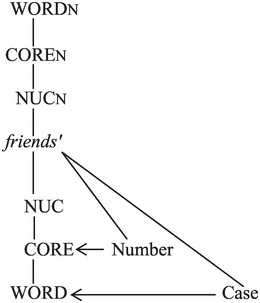
Figure 8.2 The LSW of friends’

Figure 8.3 The LSW of the OE complex word bellringestre ‘bell ringer’
Figure 8.4 analyses the constituent projection of the recursive formation takal-takal mananyi (‘give out a repeated knocking’) from Pitjantjatjara-Yankunytjatjara (Australia) (adapted from Martín Arista 2009: 110).
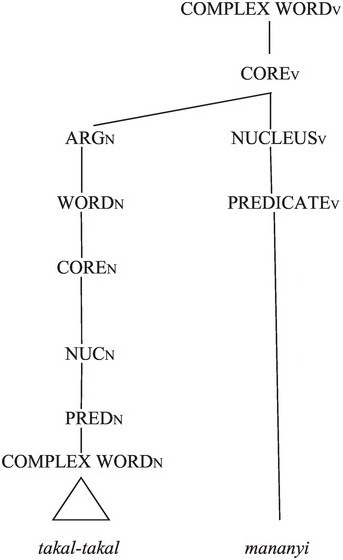
Figure 8.4 The LSW of a recursive complex word
As is the case in the layered structure of the clause (LSC) and the layered structure of the phrase (LSP), operators from outer layers have scope over the inner layers. There is a further logical basis for considering inflectional phenomena as operators in the LSW, since this is consonant with the way in which they are analysed in the other syntactic domains in RRG, the LSC and the LSP.
8.2.3 Operators in the LSW
Even though there is as yet no detailed description of the types of operators that modify each of the different layers within the LSW, some general guidelines can be offered. Drawing on data from Old and Present-Day English, Martín Arista (2009: 93) takes the morphological status of the bases as the central criterion for the distribution of operators: affixes that cannot combine with derived bases encode nuclear lexical operators, whereas those that attach to derived bases represent core lexical operators. Inflection is also added to this as a ‘G[rammatical]-WORDop[erator]’ (Martín Arista Reference Martín Arista and Valin2008: 135). Thus, inflectional categories will at least appear distributed between the core and the word lexical operators, as we see above in Figure 8.2 for friends’. From the analysis offered in Figure 8.3 it seems clear that among the nominal inflectional features, number (and probably gender) are core operators, whereas case has scope over the word node.8
Nuclear operators, on the other hand, will encode those features that are not subject to percolation into higher structures (i.e. syntax-blind features). Thus, good candidates to be classified as nuclear operators are aspectualizers in languages where lexical aspectual features are regularly marked by morphological means, as is typical of Slavic languages.9 Other possible nuclear operators are some types of lexical distributive processes in Amele (Papua New Guinea) which involve a reduplication process, as in the following clauses (data from Roberts Reference Roberts2015: 19–20):10
(1)
Tob-i ton-i egi-na. ascend-pred descend-pred 3pl.sbj-prs ‘They ascend and descend.’
(2)
L-i l-i h-u h-u ena. go-pred go-pred come-pred come-pred 3pl.sbj-prs ‘He comes and goes.’
Roberts (2015: 19) explains that this type of reduplication takes place within the verbal nucleus, in contrast with other types of reduplication processes that take place outside the nucleus in higher layers, as shown by the different distribution of grammatical markers.11
(3)
Mel f-ec-eb f-ec-eb egi-na. boy see-ds-3sg.su see-ds-3sg.su 3pl.sbj-prs ‘The boys are looking at each other.’
In (3) each verb has a different subject (DS) marker and 3SG subject agreement. This is followed by verb inflection which includes 3PL agreement with the matrix clause subject, mel ‘boys’, as well as present tense.
Table 8.1 shows a classification of the operators mentioned in the previous description; it must be stressed that it is not an exhaustive classification and that this is an issue that still needs further research.
Table 8.1 Operators in the LSW (a partial classification)
| Layer | Operator | Bases | Examples | |
|---|---|---|---|---|
| Nucleus | Aspectualizers (verb) Distributives (verb) | Underived stems/words | na-pisat (Russ. ‘write up’) to- teran (OE ‘tear to pieces’) | |
| Core | Number (Noun) Gender (Noun) | Derived | book-s vecin-a (Sp. neighbour-fem) | |
| Word | Case (Noun) | Derived | John’s |
Diedrichsen (Reference Diedrichsen and Nolan2011) draws attention to certain features of inflection which must be considered. She mentions that every lexical category has its own distinct set of inflectional categories. For instance, in German, nouns are inflected for number, case and gender, whereas verbs inflect for tense, modality and also number and person. Furthermore, the typology of inflectional categories and their distribution among word classes show great variability across languages. For instance, whereas definiteness is a grammatical category realized only on the determiner in West Germanic languages (Diedrichsen Reference Diedrichsen and Nolan2011: 5), it is an inflectional category marked on the noun in Scandinavian languages (Nübling Reference Nübling2008: 46, quoted also in Diedrichsen Reference Diedrichsen and Nolan2011: 5). Other languages are much less rigid concerning the distribution of inflectional features across word classes, as illustrated by the following examples from Bella Coola (Western Canada; data from Pavey Reference Pavey2010: 86–87).
(4)
nuyamł-Ø ti-?immlllkī-tx sing-3sg.sbj prox-boy-prox ‘the boy is singing’
(5)
?immllkī-Ø ti-nus?ūlχ-tx boy-3sg.sbj prox-thief-prox ‘the thief is a boy’
(6)
sx-Ø ti-nus?ūlχ-tx bad-3sg.sbj prox-thief-prox ‘the thief is bad’
(7)
?imlk-Ø ti-nuyamł-tx man-3sg.sbj prox-sing-prox ‘the one who is singing is a man’
(8)
nus?ūlχ-Ø ti-ģs-tx thief-3sg.sbj prox-ill-prox ‘The one who is ill is a thief’
In Bella Coola, the attachment of person, number and case affixes, on the one hand, and proximal morphemes, on the other, is flexible with regard to class form, and is instead conditioned by the function of words in a given sentence (Van Valin Reference Van Valin and Van Valin2008). This type of phenomenon seems to run counter to the establishment of a typologically valid arrangement of inflectional operators in the LSW (see Aronoff and Fudeman Reference Aronoff and Fudeman2011: 201–202 for further arguments on this); this is an issue which calls for further research.
8.3 The Functional Motivation of Inflectional Morphology: Morphological and Syntactic Inflection
One of the main tenets of a functional model of language is the teleological orientation which holds for every language phenomenon. RRG is strongly committed to this functional prerequisite and always seeks external motivation for grammatical phenomena.12 From a synthetic perspective, this implies that the word-internal elements described in the previous section as components of the LSW need an external motivation, which is tantamount to stating that morphological processes are visible to syntax, semantics and pragmatics (Martín Arista Reference Martín Arista2011: 395).13 In essence, this section seeks to provide an answer to the following issue posited in Van Valin (Reference Van Valin, Bickel, Grenoble, Peterson and Timberlake2013: 96): How is it that syntax can target elements inside a word?
In order to provide an answer to this question, it is necessary to take into account that the degree and modes of interaction between the LSW and higher structures in the model is different in dependent-marking and head-marking languages. Head-marked structures are especially challenging since a single phonological word can at the same time be a clause, as shown in the following example from St’át’imcets (Salishan, Canada) (Pavey Reference Pavey2010: 80; from Roberts Reference Roberts1999: 278–279):
(9)
tsún-tsi-lhkan tell-2sg.obj-1sg.sbj ‘I told you’
From the perspective of a morphological theory in RRG, it is essential to explain the relationship that holds between the internal structure of the word and the internal structure of its corresponding clause.
In this section we aim to illustrate the interaction of the morphosyntactic features encoded in the LSW with those in the layered structures of phrases and clauses in both types of languages. As will be described, feature percolation across the LSW and the other grammatical domains is significantly different if we compare head- vs. dependent-marking structures. Whereas in the latter type of language, percolation is restricted to operators across different structures (see Section 8.3.1), in head-marking structures, morphological features percolate up to the constituent projection in the LSC (cf. Section 8.3.2).
8.3.1 Dependent-Marking Inflectional Morphology
Inflectional categories are grammatical markers in the structure of the word to signal its semantic and/or pragmatic import in the construction of higher order structures, namely phrases and clauses. Furthermore, the (complex) word domain is parsimoniously integrated into higher grammatical domains (clauses and phrases) by the inheritance of relational morphological features (i.e. inflection operators). As pointed out in Martín Arista (Reference Martín Arista and Valin2008: 137): ‘Inflection at Word or Complex Word Level is tantamount to inflection at the Nucleus level of the Phrase. Consequently, the node Word or Complex Word represents the limit of percolation of morphological features as well as the limit of inheritance of inflectional features from the NP.’ Figure 8.5 illustrates this.
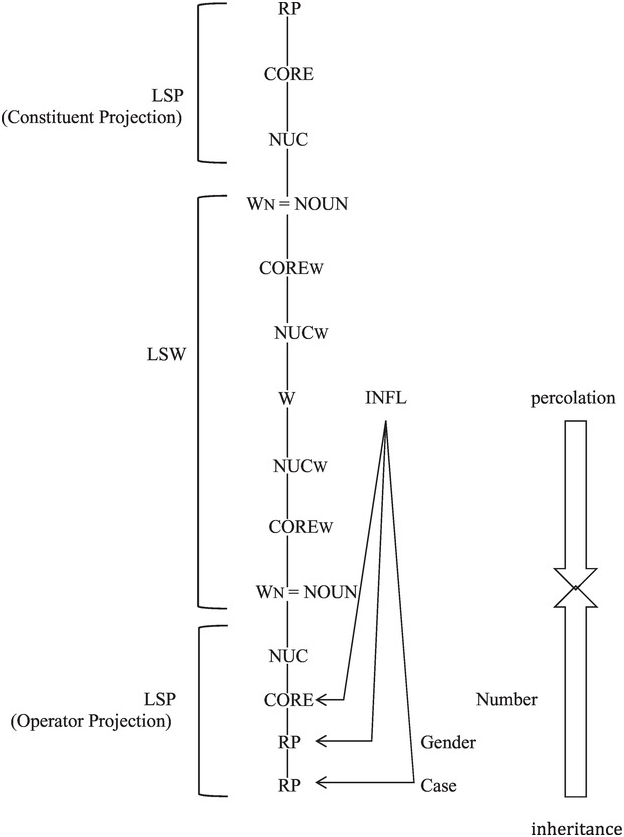
Figure 8.5 Feature percolation in RPs
The set of semantic markings that may be realized morphologically are those encoded in the operator projections of both the LSC and the LSP. Thus, the morphologically complex Spanish verb cant-aba-n (sing-ipfv.pst-3pl, ‘they were singing’) will trigger percolation of the aspect and tense features when acting as a predicate in a clause like Los niños cantaban villancicos (‘the children were singing carols’).
In Figure 8.6 the square brackets delimit the LSW of the word cant-aba-n (sing-ipfv.pst-3pl, ‘they were singing’), which occupies the position of predicate in the LSC of the sentence. There are four operators in the LSW, encoded by two affixes, ‑aba, which signals both imperfective aspect and past tense, and the suffix ‑n which marks both third person and plural number. Note that not all four inflectional features are subject to percolation: the ‑n suffix signals the person and number features that mark agreement of the verb with the subject, but since they are not categories that can be matched to the set of operators available in the LSC, where the verb acts as nucleus, they are not inherited by the clause structure. On the other hand, the imperfective and past operators are inherited by the operator projection in the LSC of this sentence, as indicated by the dotted lines in the figure.

Figure 8.6 Feature percolation in the LSC
8.3.2 Inflectional Morphology in Head-Marking Structures
The analyses presented in Figures 8.5 and 8.6 illustrate the behaviour of inflectional features as encoded in the LSW in dependent-marking languages when integrated into higher syntactic structures. In head-marking languages the integration of the structural domains of the word and the clause is tighter: not only may feature percolation of the operator projection from the LSW to the operator projection of the LSC come into play, but some features of the LSW also occupy positions in the constituent projection of the LSC. Van Valin (Reference Van Valin, Bickel, Grenoble, Peterson and Timberlake2013) offers an analysis of morphologically complex words in head-marking languages based on Everett’s (Reference Everett2002) proposal for the LSW. As mentioned earlier, Everett’s model postulates only a constituent projection in which inflectional affixes are daughters of the lexical core, while derivation takes place within the nucleus. As a consequence, the nucleus is opaque to syntax, but the core is accessible to it. The morphological structure of the Lakhota (Siouan, North America) word Ø‑wičhá-wa-k’u (inan-3pl.anim.u-1sg.a-give, ‘I gave it to them’) would then be as shown in Figure 8.7.

Figure 8.7 The LSW of Lakhota verb wičhá-wa-k’u
(NMR = non-macrorole, ANIM = animate, U = undergoer, A = actor)
The fact that in Figure 8.7 the morphological markers are part of the constituent projection illustrates the difference between dependent- and head-marking languages with respect to the status of inflection. In head-marking languages, the constituent projection in the LSW will house those inflectional features that instantiate the arguments in the semantic representation of the core of the clause. In fact, the structure of the lexical unit in the LSW will provide the structure of the core of the clause in the LSC; Van Valin (Reference Van Valin, Bickel, Grenoble, Peterson and Timberlake2013: 115) describes that the two structures are coextensive, since the structure of the COREw provides the structure of the core of the clause.
Note that the analysis of the COREw structure in Figures 8.7 and 8.8 is almost identical to the structure of the core in the equivalent English clause ‘I gave it to them’. This proposal thus manages to provide comparable structures for comparable sentences among typologically different languages while at the same time coping successfully with the differences among such structures. In fact, the disparity between head-marking and dependent-marking structures stems from the fact that while inflectional features are consistently located in the operator projection of the LSC in the case of dependent-marked constructions, they can appear distributed between both the constituent and the operator projections in head-marked structures. The analysis of head-marked constructions can also sit comfortably within the model by Martín Arista (2008, 2009, 2011), as is shown in Figure 8.9, which illustrates the percolation of morphological markers from the LSW to both the operator and the constituent projections in the LSC of the Spanish clause cant-aba-n villancicos (sing-ipfv.pst-3pl carols, ‘they were singing carols’).

Figure 8.8 The LSC of Lakhota sentence wičhá-wa-k’u
(NMR = non-macrorole, ANIM = animate, U = undergoer, A = actor, PSA = privileged syntactic argument)
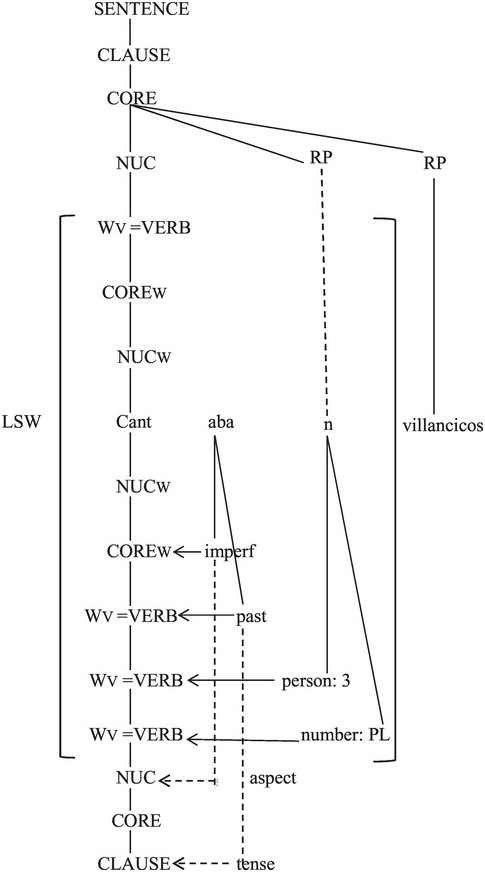
Figure 8.9 The LSC of Spanish sentence cantaban villancicos
Even though Spanish is mainly a dependent-marking language, it shows subject marking on the verb by means of person and number inflectional affixes. This makes unnecessary the presence of an independent subject constituent, as happens in this sentence, thus allowing head-marked structures. In the absence of an overt subject argument (e.g. los niños ‘the children’ in Figure 8.6), the suffix ‑n is mapped from the LSW of the verb into the constituent projection of the LSC; this is indicated by the dotted line in the analysis. The other morphological features in the LSW of cant-aba-n (sing-ipfv.pst-3pl), namely imperfective and past as encoded in the suffix ‑aba, percolate into the operator projection of the LSC (cf. also Figure 8.6).
8.4 Word Formation
This section deals with the other basic domain of morphology, namely the creation of new lexical units. It is important to note that more often than not grammatical models tend to focus their interest on the semantic representation of clauses and phrases, but they usually leave aside the question of how to account for the semantic representation of other grammatical structures such as compound and derived words. Contrary to this tendency, the model outlined in this section offers a design for the semantic representation of such units which complies with the following issues: firstly, it captures the semantic variability of word-formation patterns. The introduction of a two-tier enriched representation of lexical structures, which includes not only the event features encoded in logical structures, but also encyclopedic knowledge as captured by Qualia Theory, places RRG in an outstanding position when compared with other proposals of derivational morphology. Section 8.4.1 deals with these aspects and Section 8.4.2 offers some illustrative analyses of the most relevant affixal units in Spanish and English. Secondly, such a format of semantic representation will allow us to account for the grammatical relations that hold between the components of a derived lexeme within its corresponding LSW. This will be the aim of Section 8.4.3.
These two aspects reveal a conception of derivational morphology as a double-sided phenomenon: as a lexical process, word-formation involves the creation of a new semantic structure in the wrapper of a lexical unit; at the same time, the constituents of a derivationally complex lexical item are interrelated by different types of grammatical relations, that is, word formation is also a syntactic phenomenon within the word domain.
8.4.1 Word Formation as a Lexical Process: Lexical Representations and the Derived Lexicon
As has already been mentioned, there is a great portion of morphology that is lexical in nature. Word formation unquestionably falls into the realm of lexical semantics, though the vast majority of models tend to overlook this aspect. Levin and Rappaport Hovav (2001: 248–249) offer a brief but revealing description of the neglect of the relationship between lexical semantics and morphology in generative approaches, especially after Lieber (1980). Even in those cases in which attention is paid to argument structure operations in morphological theories (such as, for example, in Baker Reference Baker1988; Bresnan Reference Bresnan1982; Rosen Reference Rosen1989 and Williams Reference Williams1981, among many others), such operations are essentially syntactic, not semantic. They also cite a fundamental reason for this neglect, namely that these models often lack a comprehensive theory of lexical-semantic representations, a fundamental framework for a sound study of such a feature of morphology. A notable exception is the work of Lieber (Reference Lieber2004), which can be considered a major contribution to the lexical semantics of morphology. She contends that a precondition for the study of derivational morphology is the existence of a solid theory of lexical-semantic representation. She also explains that such a theory must be decompositional and based in semantic primitives or atoms ‘of the right “grain size” to allow us to talk of the meanings of complex words’ (Lieber Reference Lieber2004: 4); furthermore, semantic representations must facilitate the analysis of lexical semantics and not only of the semantic properties of higher syntactic structures (such as phrases or clauses). Lastly, it must also allow us to describe the meanings of complex words in the same terms as the meanings of simplex lexemes.
RRG can also claim to be exceptional with regard to this issue: lexical-semantic representations lie at the heart of the model, and morphosyntactic phenomena are always externally motivated by the semantic representations assembled from the lexical-semantic structure of its components. There have been many important contributions to the enhancement of RRG lexical representations in the primary lexicon,14 and in the derived lexicon (in the works of Cortés-Rodríguez 2006a, Reference Cortés-Rodríguez2006b, Reference Cortés-Rodríguez, Butler and Martín Arista2009; Cortés-Rodríguez and Sosa Reference Cortés-Rodríguez and Sosa2008, Reference Cortés-Rodríguez, Sosa, Mairal, Guerrero and González2012, also Nolan 2011). From all these studies it is possible to obtain a detailed picture of the overall configuration of the lexicon in RRG and, specifically, of the structure of lexical semantic representations.
As was stated in Section 8.2, the lexicon consists of lexical morphemes of two types: free lexical morphemes or lexemes (which would belong to the traditionally named open word classes) and bound lexemes (derivational affixes). They differ only in their distributional freedom of occurrence in discourse. Both the primary and the derived lexicons are organized internally in lexical groupings of semantic and syntactic affinity, which can be termed lexical classes (see Faber and Mairal Usón Reference Faber and Mairal Usón1999 for an overview of the hierarchical organization of the English verbal lexicon). The lexical entries for both types of lexeme include a formal semantic representation in the format of lexical templates. The latest version of lexical templates for free lexemes (Cortés-Rodríguez Reference Cortés-Rodríguez, Butler and Martín Arista2009; Mairal Usón, Periñan-Pascual and Pérez Cabello de Alba Reference Mairal Usón, Periñán-Pascual, Pérez Cabello de Alba, Mairal, Guerrero and González2012; Ruiz de Mendoza Reference Ruiz de Mendoza, Nolan and Diedrichsen2013) takes as a backbone for lexical representation the Aktionsart properties of predicates as formally encoded in the logical structures of RRG and enriches them by integrating Pustejovsky’s (Reference Pustejovsky1995) Qualia Theory together with the set of lexical functions from the explanatory and combinatorial lexicology (Mel’cuk Reference Mel’cuk1989; Mel’cuk and Wanner Reference Alonso Ramos, Tutin and Wanner1996; Alonso and Tutin Reference Alonso Ramos, Tutin and Wanner1996). Despite their complexity, lexical templates are fully fledged repositories of the semantic features associated with a lexeme, either free or bound. By way of example, the lexical template for the Spanish verb captar ‘fathom’ would have the following format (Cortés-Rodríguez and Sosa Reference Cortés-Rodríguez, Sosa, Mairal, Guerrero and González2012: 22):
(10)
captar: eventstr: know′ (x, y) qualiastr: {Qf: manner : MagnObstr think′ (x, y) Qt: Culm know′ (x, y <all>)}
The format of a lexical entry now consists of two basic components: the event and the qualia structure. In this case, since captar belongs to the class of Cognition verbs, the event structure is a state logical structure which takes know′ as a primitive and has two arguments (x, y), following the format of the logical structures of RRG. The second part of the lexical template includes its qualia structure. Qualia Theory is borrowed from Pustejovsky’s (Reference Pustejovsky1995, Reference Pustejovsky2001) semantic model. Van Valin and LaPolla (1997: 184–186) already incorporated qualia as part of the semantic representation of nouns. Our proposal takes it beyond this and aims at including it as a part of any lexical semantic representation. What qualia tell us about a concept is the set of semantic constraints by which we understand a word when embedded in the language, which is also the purpose of our lexical templates. As Pustejovsky and Batiukova (2019: 162) state:
The core notion of qualia structure is that there are four aspects that make up our knowledge of a word: the class of entities it denotes (the formal role or quale), how the denoted entity was created (the agentive role), the intended function of this entity (the telic role), and the internal makeup of this entity (the constitutive role).
They offer as an example the qualia structure of the noun violin.
(11)
violin (x) QS = Formal = musical_instrument (x) Agentive = build (y, x) Telic = produce_music_on (z, x) Constitutive = strings_of (w, x)
Turning to the representation of Spanish captar in (10), the template encodes two qualia characterizations: the formal quale Qf encodes a subevent in which a semantic function manner is combined with the lexical functions ‘Magn’ (‘intensity’) and Obstr (‘difficulty’); the combination of these functions in turn modify the primitive think′. Thus, the formal quale describes the degree of difficulty in carrying out the process of thinking implicit in the meaning of captar. The telic quale as encoded in Qt: Culm know′ (x, y) depicts the section of the event that expresses the final aim of the event, to reach knowledge or to understand. As can be seen, one of the goals of the qualia structure section is to represent the semantic attributes by means of which a lexeme is semantically distinguished within the larger set of units that belong to its lexical class.
These two components of lexical entries, event structure and qualia, are similar to the so-called ‘skeleton’ and ‘body’ of lexical representations in Lieber’s (Reference Lieber2004, Reference Lieber2009) proposal. However, we believe that the lexical entries of RRG have some advantages over Lieber’s system: the event structure captures in essence the semantic features encoded in the logical structures of RRG. Logical structures are formalized representations of the Aktionsart features of a given unit and are solid typologically based representations. Even though Lieber’s skeleton is meant to include a set of universal semantic features, no such set is described, and she defines only those that are syntactically relevant for English (Lieber 2009: 83). Similarly, the body, or set of semantic/pragmatic features which form encyclopedic knowledge, is to a certain extent similar to qualia features, though Lieber allows for some ‘unsystematicity’, insofar as a part of the ‘body’ (the ‘fat’; Lieber 2009: 83) varies from one individual to another. As regards the other part of the ‘body’ (the ‘muscle’), which is shared by a community, again a coherent and systematic description of what it consists of is still lacking. In comparison, qualia theory is restrictively based on the Aristotelian modes of explanation or aitia, meant to give a principled account of how humans understand the world. As described in Pustejovsky and Batiukova (2019: 162), qualia structure is ‘a relational system whose parameters allow us to decompose word meaning in a principled way, accounting for what other concepts and words it can be associated with in different contexts, based on its meaning’. Furthermore, qualia features and event structure descriptions are formally represented by means of the same metalanguage, which enhances the interaction between all elements in semantic representations of lexical and syntactic structures in RRG.
8.4.2 Some Illustrative Analyses
In a similar way to free lexical units, affixes are also clustered in affixal classes, and their behaviour as members of these classes is also parallel to that exhibited by words in the primary lexicon. Some units are more central or higher in the structure whereas other affixes are peripheral, and some are even located in between two lexical classes. In this section a brief description of some of the most relevant affixal classes in Spanish and English will be offered (for a more detailed account, see Cortés-Rodríguez 2006a, Reference Cortés-Rodríguez2006b, Cortés-Rodríguez and Sosa Reference Cortés-Rodríguez and Sosa2008, Reference Cortés-Rodríguez, Sosa, Mairal, Guerrero and González2012). More specifically, an account of the semantic aspects of one important group of nominalizations is given first, followed by an explanation of the intricate meaning relationships between the components of derived causative verbal formations.
8.4.2.1 Macrorole Nominalizations
Let us consider how the semantic content of the Spanish nominalizing affixes ‑ero (e.g. camión ‘lorry’ > camionero ‘lorry-driver’, guerra ‘war’ > guerrero ‘warrior’, café ‘coffee’> cafetera ‘coffee pot’), ‑or (e.g. afilar ‘to sharpen’ > afilador ‘sharpener’, calentar ‘to heat up’ > calentador ‘heater’, despertar ‘to wake up’ > despertador ‘alarm clock’, poseer ‘to own’ > poseedor ‘owner’) [‑a/‑e/‑ie]nte (e.g. humillar ‘to humiliate’ > humillante ‘humiliating’, galopar ‘to gallop’ > galopante ‘rapidly advancing / out of control’, desinfectar ‘to disinfect’ > desinfectante ‘disinfectant’), ‑ista (e.g. novela ‘novel’> novelista ‘novelist’, ébano ‘ebony’ > ebanista ‘cabinetmaker’, izquierda ‘left’ > izquierdista ‘leftist’), [‑a/‑i]do (e.g. embravecer ‘to become rough’ > embravecido ‘furious/rough’, errar ‘to err’ > errado ‘mistaken/wrong’) and ‑ario (e.g. arrendar ‘to rent’ > arrendatario ‘tenant’, concesión ‘licence/concession’ > concesionario ‘licensee/franchisee’) and also English ‑er, ‑ist, [‑a/e]‑nt, ‑ee is represented in this proposal:
φiN: [(xi…, [(e2: [LT…φBASE: (Qualia:…xi)])])], where
x = macrorole
φ = lexical unit
LT = lexical template
φBASE = base lexeme
i = denotational co-indexation
This formula reads as follows: Any derived nominal lexeme φiN belonging to this class denotes a participant entity xi of one of the events encoded in the qualia structure (Qualia:…xi) that forms part of the lexical template of the base lexeme LT…φBASE; hence the derived lexeme and that entity are co-indexed by a superscript i. Another way to express this is to describe these processes as nominalizations oriented towards an argument in the semantic representation of the lexical unit that functions as the base of the derivation. There is an additional restriction on this entity: it must have macrorole status. Therefore, the structure in (12) represents the ‘event structure’ of the derivational class of concrete nominalizing affixes, or concrete processual substances/things/essences in Lieber’s (Reference Lieber2004: 36) terminology. We propose labelling this derivational class as ‘macrorole nominalizations’ since they encompass both actor and undergoer nominalizations. Actor nominalizations include derived instruments, agents, experiencers, locations, etc., and undergoer formations are prototypically formed in Spanish by means of (‑a/‑i)do and ‑ario and in English by ‑ee and ‑ed. The two corresponding templates are the following.
φiN: [LT (xi…, [(e2: [LT…φBASE: (Qualia:…xi)])])], x = actor
E.g. escritor ‘writer’, poseedor ‘owner’, panfletista ‘pamphleteer’, desodorante ‘deodorant’, lechero ‘milkman’.
φiN: [LT (…xi, [(e2: [LT…φBASE: (Qualia:…xi)])])], x = undergoer
E.g. arrendatario ‘tenant’, fideicomisario ‘trustee’, fallecido ‘deceased’
The labels ‘actor and undergoer nominalizations’ explain the wide scope of these types of derivational processes. The semantics of the templates cannot be associated with a specific semantic function such as ‘agent’. Even though the most prototypical formations correspond to agent nominals, like English writer, runner, violinist, etc., there are many other formations where the notion of ‘agenthood’ is absent (cf. formations like believer, owner, lover, to mention just a few). The term ‘actor’ indicates that all the formations are nominalizations of the macrorole actor, as defined within RRG (see Chapter 4). This, in turn, justifies the superscript i which co-indexes the lexical variable for the derived word (φN) with the participant that would receive that macrorole function. That is, they mark the nominals as oriented towards one entity (xi) involved in one of the subevents that form part of the state of affairs depicted by the base word. The variable LT (‘lexical template’) indicates that the event in which this entity participates can be of any kind, a state (pred′), an activity (do′), or any other logical structure.
The following representation is to be understood as a subspecification of the actor template, and corresponds to the traditionally labelled ‘agent nominals’, which in RRG terms should be described as ‘effector nominalizations’ (Van Valin and Wilkins Reference Van Valin, Wilkins, Shibatani and Thompson1996).
φiN: [do′ (xi, [φBASE])], x = actor. E.g. driver, runner, smoker.
This structure expresses the semantic content of the most prototypical nominalizations within the class: the derived words corresponding to this construction describe the effector involved in the event expressed by the semantics of the base word. There are two co-indexing possibilities expressed in the above representation depending on whether the formation is deverbal (φV) or not (φ[-V] ). In the case of deverbal effector nouns, co-indexation is usually quite straightforward: the verbal bases typically encode an event that is dynamic, and therefore the meaning of effectorhood derives from the semantic function of its first argument. This is the case of hunter.
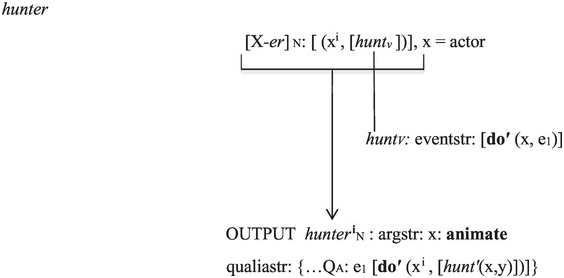
The semantic structure of the Spanish nominal creyente ‘believer’ in (17) illustrates the fact that these kinds of derived actor nominals do not exclusively refer to agent arguments. Let us recall that the actor macrorole is assigned to the leftmost argument in a logical structure with two arguments, irrespective of the type of event encoded (Van Valin Reference Van Valin2005: 60–67).

The semantic interpretation of denominal actor lexemes – such as pianista ‘pianist’, cabrero <cabra ‘goat’+ero> ‘goatherd’, banquero ‘banker’, pensionista ‘pensioner’ – likewise arises from co-indexation with one argument in one of the events depicted in the qualia structure of the base noun, as is the case of violinista, where semantic composition is based on the event encoded as the telic quale of violin.

The representation in (18) also reveals that there are interesting semantic differences among the members of this subclass. The affix ‑ista is more restrictive than other members among the actor nominalizing affixes in terms of: (a) the types of bases (it prefers nouns and adjectives, in contradistinction with the more deverbal ‑or and ‑nte); and (b) its meaning, as it always involves a degree of volitionality not necessarily present in the other affixes. Thus, its LT would be more specific or hyponymic.
[φBASE: N/adj + istaiN] iN : [DO (xi, [do′ (xi, [e2: LT …φBASE: (Qualia: …LT (xi…)])])]
(19) is a good instance of the kind of information that is encoded in an affixal LT. It includes a morphological frame with the constituent makeup of the derived words: [φBASE:N/adj + istiN] iN (cf. Nolan Reference Nolan and Nakamura2011). This frame includes information of the categories of both the base [φBASE:N/Adj] and the complex word (…] iN).
The semantic specificity of ‑ista is expressed through the agent operator ([DO (xi,) (see Van Valin and LaPolla Reference Van Valin and LaPolla1997: 118–120), which is understood as an overlay of the effector thematic role. Note that the specific semantic content of this formation is spelled out by the joint effect of the selection of one quale from the LT of the base word, and co-indexation of the affix with one of the arguments involved in the subevent of such a quale.15
Macrorole nominalizations are probably the most significant class to look at if we are to fully appreciate how relevant co-indexation is for the construction of the meaning of complex words. However, there is another mechanism that is to be used in this meaning-construction process: qualia selection. Qualia selection is essential to understand the semantics of derived causative verbs.
8.4.2.2 Derived Causative Verbs
One of the great difficulties of a lexical-semantic approach to word formation is the rampant polysemy that most affixes and composition patterns exhibit. Jackendoff (Reference Jackendoff, Lieber and Štekauer2009: 117) explains that a compound like box car can have a plethora of paraphrases (car that carries boxes, that looks like a box, that is used as a box, etc.) However, this does not mean that complex words are ambiguous or vague; Jackendoff describes them as semantically ‘promiscuous’, which means that it is possible for a complex word to take up all those meanings. A similar approach is defended in the works on word formation within Pustejovsky’s Generative Lexicon framework (Batiukova Reference Batiukova2008; Johnston and Busa Reference Johnston, Busa and Viegas1999). This proposal follows the same path in considering that complex words are prima facie semantically and grammatically underspecified structures. However, this does not mean that there are no limits to compositionality. All possible interpretations of a complex word must be anchored – directly or indirectly – in the richer semantic information encoded in the LTs of its components, and all word-formation processes involve the activation of mechanisms to select the meaning or network of possible meanings of the complex word. In this regard, qualia selection from LTs plays a fundamental role.
The derivational class of causative verbal lexemes will be of help to provide examples of this phenomenon. The basic lexical template for this class is as follows.

The formula in (20) encodes a complex semantic structure in which there is a causal bond between two subevents, the induced one corresponding to a state of affairs in which the base word is involved or affected more or less directly. Typically, causative formations are category-changing processes, the bases being nouns or adjectives. Some conversion processes (e.g. conciencia ‘awareness’ > concienciar ‘raise awareness’, completo ‘complete’ > completar ‘to complete’, alegre ‘happy’ > alegrar ‘gladden’) and the affixes a- (e.g. feo ‘ugly’ > afear ‘spoil, make ugly’, largo ‘long’ > alargar ‘lengthen’), ‑iz- (e.g. suave ‘soft’ > suavizar ‘soften’, colonia ‘colony’ > colonizar ‘colonize’), ‑ific- (e.g. sólido ‘solid’ > solidificar ‘solidify’, puro ‘pure’ > purificar ‘purify’), and en- (e.g. ancho ‘wide’ > ensanchar ‘widen’, lata ‘can’ > enlatar ‘to can’, jaula ‘cage’ > enjaular ‘encage’) are members of this derivational class in Spanish.
The semantic interpretation of every complex word that is an output of causativization is determined by the selective binding or exploitation of one quale of the LT of the base, expressed in (20) by φBASE<Quale i> (cf. Cortés-Rodríguez 2006a; Batiukova Reference Batiukova2008). To be more precise, the quale that is selected for binding will endow the caused subevent in (20) ([e2: (LT: …φBASE… )]) with a specific content. For instance, a formation like Spanish enlatar ‘to can’ has a causative-locative interpretation, which is promoted by the selection of the formal quale (Qf: container′ (xi, y)) of the noun lata ‘can’.16 Consequently, the abstract operator LT corresponding to the caused subevent would receive a specific locative interpretation (BECOME be-in′ (xi, y)]); co-indexation (represented by the arrow in (21)) specifies further that the base entity designates a locus (Cortés-Rodríguez and Sosa Reference Cortés-Rodríguez, Sosa, Mairal, Guerrero and González2012: 27).

On the other hand, deadjectival forms like Spanish suavizar ‘soften’, ensanchar ‘widen’, solidificar ‘solidify’, etc. select the formal quale of the base and the meaning of the complex word will be that of a prototypical causative-resultative verb (‘cause become adj’), as shown in (22) (Cortés-Rodríguez and Sosa Reference Cortés-Rodríguez, Sosa, Mairal, Guerrero and González2012: 28).

As can be seen, co-indexation works hand-in-hand with qualia selection: its function is to bind one element from the base template with another from the affixal template, or the modifying lexeme in the case of compounds.17
8.4.3 Word Formation as a Grammatical Process: The Interface between Lexical Templates and the LSW
We are now in a position to consider how the semantic structures underlying word-formation products of the kind outlined previously can find a syntactic counterpart in a syntactic theory of the word. Martín Arista’s (Reference Martín Arista and Valin2008, 2009, Reference Martín Arista2011) LSW as described in Section 8.2 offers a number of significant advantages for this task: it will enable us to design a semantics-to-syntax interface between the semantic descriptions proposed here and the layered structure of the corresponding complex word. In fact, only a few adjustments are needed in order to achieve this goal. The most important of these would be to reassess the grammatical status of some constituents in the LSW, as proposed in the original model. A good example for this would be the LSW of bookseller, analysed in Martín Arista (2009: 92) as an exocentric formation (Figure 8.10).
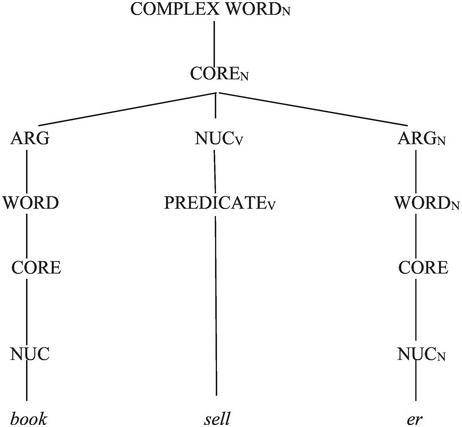
Figure 8.10 Exocentric analysis of compound bookseller
This analysis, which takes as nucleus the verbal base, seems to be based on the fact that the elements of word syntax are a kind of carbon-copy of what they could be at clause level; this is what seems to be stated in the following quotation (Martín Arista 2009: 94):
The definition of Word functions is based on Clause functions, which requires an indirect association with a clausal expression: incomer expresses a First Argument whereas income expresses a Second Argument, incomer, outflow and inflow express an Argument-Adjunct, etc.
However, if we want to do justice to the lexical-semantic dimension of word formation, we must provide a semantic motivation for the functional constituents of the LSW, which in turn would be more in line with what is done in the other RRG grammatical domains (Van Valin and LaPolla Reference Van Valin and LaPolla1997: 68):
The elements functioning as nuclei of PPs and clauses are predicates in the semantic representation, while nominal nuclei are designated within the semantic representation of the NP. Thus the head of a phrase is a function of its semantics: an NP is headed by a nominal nucleus, a PP by an adpositional nucleus, and a clause by a predicating nucleus.
The logical follow-on from this statement is that if a word has a referential semantic function, its nucleus (or head) should be the element that confers such a value. We can borrow some criteria from Štekauer (Reference Štekauer, Štekauer and Lieber2005b: 225–226) to select the nucleus element within the LSW of a complex word: (i) Hyponymy: the complex word is a semantic specification of the head; storyteller, for example, is a hyponym of teller, which in turn is a hyponym of ‑er. (ii) Subcategorization: heads impose subcategorization restrictions; ‑ist selects noun bases, ‑en has a strong preference for monosyllabic bases with final plosives, as in red > redden, short > shorten. (iii) Distributional and categorial equivalence: the head (or nucleus) specifies the lexical class of the derived word. For example, ‑er formations are consistently denominal; on the other hand, locative prefixes (pre-field or sub-way) are not heads as they do not determine the class form of the derived word.
This last criterion draws a key parallel between the nature of the head or nucleus of clauses and phrases, on the one hand, and complex words, on the other. If we take these conditions into account, the layered structure of bookseller could be as shown in Figure 8.11 (Cortés-Rodríguez and Sosa Reference Cortés-Rodríguez, Sosa, Mairal, Guerrero and González2012: 36).
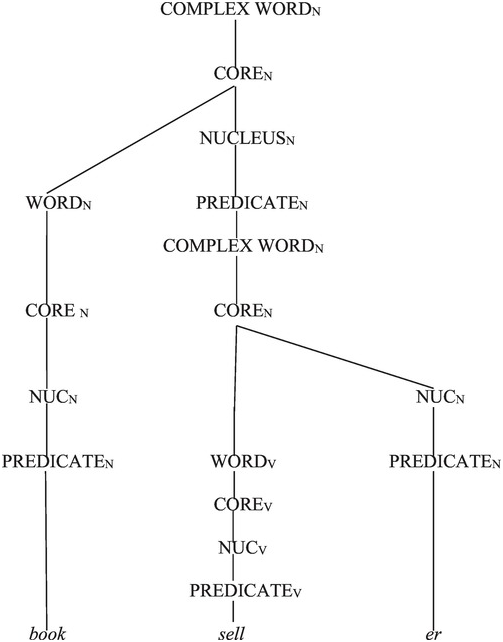
Figure 8.11 Endocentric analysis of compound bookseller
The structure captures the endocentric character of the bound lexeme ‑er in the derivation of seller and the recursive compositional process with book. Figure 8.12 shows the structure of non-endocentric complex words in Spanish, which includes compounds like lavaplatos ‘dishwasher’, sacacorchos ‘corkscrew’, pagafantas (lit. ‘Fanta payer’) ‘conned cuckold’ and conversion formations like destino ‘destiny’, ‘end use ’> destinar ‘assign’, amigo ‘friend’ > amigar ‘make/become friends’, deseo ‘desire’ > desear ‘to desire’. Co-indexation in all these cases is revealing: none of the components of the morphological template is co-indexed with the lexical variable of the complex word [lavaN/adj + platosNα] iNβ, in sharp contrast with endocentric formations as in pianista [pianoN + istaiN] iN. Thus, it may be more appropriate to describe these complex words as ‘acentric’, since they do not have a lexically saturated nucleus (Cortés-Rodríguez and Sosa Reference Cortés-Rodríguez, Sosa, Mairal, Guerrero and González2012: 37).
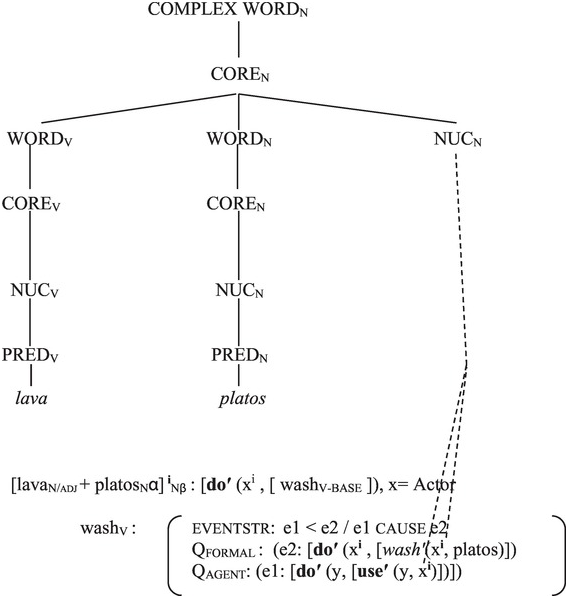
Figure 8.12 ‘Acentric’ Spanish compound lavaplatos (‘dishwasher’)
8.5 Conclusion
The aim of this chapter was to present an overview of morphology in RRG. As stated at the outset, despite the obvious recognition of the centrality of morphological structure, there is as yet no fully articulated theory of the structure of the word domain and the way it interacts with the structure of higher grammatical domains such as phrases and clauses. However, there are some significant contributions leading to the development of such a morphological theory. The first challenge, the establishment of descriptive tools for the structure of the word, was the topic of Section 8.2, in which we offered the guidelines for a layered structure of the word. Given the explanatory character of the model and its functional (or better, communication-and-cognition) orientation, Sections 8.3 and 8.4 were dedicated to accounting for the functional motivation of inflection and word formation, respectively. In Section 8.3 we offered a description of the interface of inflection within and outside the word. This has in turn revealed the potential of the LSW for the explanation of the interaction between syntactic and semantic structures, closely tied to the notion of ‘operator percolation’ between the LSW and the LS of higher grammatical structures. However, the intricate relation between word structure and clause structure goes beyond feature percolation in the case of head-marking languages, as we also pointed out in this section.
Section 8.4 was devoted to the explanation of word formation within RRG. This involves identifying the nature of the connections that hold between morphology, on the one hand, and lexical semantics and syntax, on the other. As a lexicological phenomenon, derivational affixes and processes form part of the lexicon in RRG and – very much like free lexemes – are endowed with a semantic representation in the format of a lexical template. The interaction of affixal and word templates is accounted for by means of two explanatory devices: co-indexation and qualia specification. The section closed with a brief overview of how the semantic structure underlying a derivationally complex word also finds its syntactic counterpart in the LSW, as described in Section 8.2, with some slight adjustments to the proposal put forward by Martín Arista (Reference Martín Arista and Valin2008, 2009, Reference Martín Arista2011).
In our opinion, taken together, the proposals outlined in this chapter, which draw on several contributions both from inside and outside RRG, constitute an explanatory framework for the study of morphological phenomena within this model.
Abbreviations
We use the Leipzig abbreviations (www.eva.mpg.de/lingua/resources/glossing-rules.php), with the following additions:
- ASP
aspect
- F
factitive
- IDEO
ideophone
- IF
illocutionary force
- L
linker
- LSC
layered structure of clause
- MI
mimetic
- NUC
nuclear
- P
particle
- PP
pre-/post-positional phrase
- RP
reference phrase
- TNS
tense
9.1 Introduction
The syntax of adverbs has triggered much controversy both within and across theories (see, for example, Alexiadou Reference Alexiadou1997; Cinque Reference Cinque1999; Engels Reference Engels2012; Ernst Reference Ernst2002, Reference Ernst2020).Footnote * The central concern includes the ability to offer a principled account of (i) which positions an adverb can occupy within a syntactic representation and (ii) what determines the ordering of multiple adverbs in sentence structure. Reflecting on recent developments in the generative approach to adverbial syntax, Ernst notes the critical consensus that ‘the semantics of individual adverbs is an important determinant – perhaps the main determinant of their ordering’ (2014: 108). While Ernst is considering generative syntax, the essence of his reflection has close affinity with how Role and Reference Grammar (RRG) analyses adverbs: it too considers semantics a critical component in theorizing the syntax of adverbs. This affinity may not be accidental, as a series of Ernst’s own work (e.g. 2002), characterized by him as a ‘scopal approach’ (Ernst Reference Ernst, Carnie, Siddiqi and Sato2014), is rooted in Jackendoff (Reference Jackendoff1972), and RRG draws on insights from that same work.
Assuming that adverbs can be defined as ‘modifiers of constituents other than nouns’ (Schachter Reference Schachter and Shopen1985: 20), the first part of this chapter offers a foundational sketch of the RRG approach to adverbs using English data, drawing on Van Valin (Reference Van Valin2005) and Van Valin and LaPolla (1997), with a focus on their subsets, including aspectual adverb (completely), manner adverb (clumsily), temporal adverb (yesterday), evidential adverb (evidently), and other clausal adverbs. It is pointed out that adverbs modify distinct layers of the clause – the nucleus, the core, and the clause – and when the sentence contains multiple adverbs, their appearance corresponds to the order of the layers they modify in terms of the distance from the verb. The second part of the chapter moves to an exemplification of how the RRG approach can be used to analyse the ideophonic adverb, which is typically a type of manner adverb (Schachter Reference Schachter and Shopen1985: 21).1 While the category status of ideophones remains disputed,2 it has frequently been noted that some function as adverbs, appearing in the same syntactic position as adverbs of prosaic words (Beck Reference Beck2008: 41; Bobuafor Reference Bobuafor2013: 351; Ibarretxe-Antuñano Reference Ibarretxe-Antuñano2006: 19; Nuckolls Reference Nuckolls1996: 72, among others). For instance, observing an example like (1), wherein the ideophone expresses a manner of running, Schaefer notes: ‘Emai IA [i.e. ideophonic adverb] forms assume the canonical syntactic position of adverbs. They occupy [the] postverbal position’ (2001: 341).
(1)
Emai (Nigeria’s Edoid group; Schaefer Reference Schaefer, Voeltz and Kilian-Hatz2001: 347) óli ómohe láí nyényényé the man run-f ideo (with a dash) ‘The man dashed off’/‘the man ran off with a dash’
Despite the pervasive presence of ideophones in the languages of the world (Voeltz and Kilian-Hatz Reference Voeltz and Kilian-Hatz2001), virtually no work has analysed ideophonic adverbs from a cross-linguistic perspective applying a specific syntactic theory to the data. This chapter represents the first step toward closing the gap by presenting an initial RRG view of the syntax of ideophonic adverbs.
The chapter is organized as follows. Section 9.2 lays out theoretical assumptions in RRG’s treatment of adverbs (Van Valin Reference Van Valin2005; Van Valin and LaPolla Reference Van Valin and LaPolla1997), explaining the syntactic behaviour and properties of adverbs. This is followed by a brief precis of the semantic representation of adverbs. Section 9.3 turns to characteristics of ideophonic adverbs. Section 9.4 contains concluding remarks.
9.2 Theoretical Assumptions
9.2.1 Structural Representation of Clause Structure
9.2.1.1 Layered Structure of the Clause (LSC)
RRG’s approach to adverbs is grounded in the conception of the layered structure of the clause (LSC). Figure 9.1 previews an example of the representation of the sentence, Leslie has evidently been slowly immersing herself completely in the new language.

Figure 9.1 consists of two parts. The top part of the representation, called the ‘constituent projection’ of the LSC, is centred on three primary syntactic units: the clause (the outermost layer), the core (the mid layer), and the nucleus (the innermost layer). The clause contains the core, which, in turn, contains the nucleus and the arguments of the predicate, categorized as the ‘reference phrases’ (Van Valin Reference Van Valin and Van Valin2008). The nucleus contains the predicate, usually a verb or an adjective. The peripheries contain a modifier phrase (MP) (Van Valin Reference Van Valin and Van Valin2008: 172) whose nucleus is usually an adverb or an adjective. Each layer of the clause can be modified by a periphery, as indicated by an arrow in the figure. In Figure 9.1, evidently modifies the clause, slowly modifies the core, and completely modifies the nucleus. A brief note on the term ‘periphery’ is in order, as it is sometimes confused with a concept in prototype theory (e.g. Lakoff Reference Lakoff1987), whereby membership in a category is characterized as ‘central’ (i.e. prototype) vs. ‘peripheral’ (non-prototypical), or given a configurational region of ‘central’ (i.e. core) vs. ‘peripheral’ (i.e. margin). As Figure 9.1 makes clear, in RRG, ‘periphery’ means neither a ‘non-prototypical member’ nor a ‘margin’ but refers to a structural unit containing a modifier such as an adverb (Van Valin Reference Van Valin2005: 4).
The bottom part of the representation in Figure 9.1 is called the ‘operator projection’. Operators refer to ‘grammatical categories … [that] modify the clause and its parts’ (Van Valin and LaPolla Reference Van Valin and LaPolla1997: 40). They are posited to have scope over a specific layer of the clause:
The nuclear operators have scope over the nucleus; they modify the action, event or state itself without reference to the participants. Core operators modify the relation between a core argument, normally the actor, and the action … Clausal operators, as the name implies, modify the clause as a whole.
Again, the arrows in the figure indicate the modificational relations. Incidentally, Figure 9.1 contains only three grammatical categories (ASP, TNS, IF (i.e. aspect, tense, illocutionary force)), but RRG posits nine operator categories: (i) aspect, (ii) negation, (iii) directional, (iv) event quantification, (v) modality, (vi) status,3 (vii) tense, (viii) evidentials, and (ix) illocutionary force (Van Valin Reference Van Valin2005: 12). Each modifies a designated layer (or layers) of the clause, as represented in Figure 9.2: for instance, aspect is a nuclear operator. Some of the operator categories become relevant when we discuss the syntactic characteristics of ideophones.

9.2.1.2 Adverb Ordering
Although adverbs are not operators (Van Valin Reference Van Valin2005: 19),4 like operators, they are assumed to modify a specific layer of the clause, as exemplified in (2).
(2)
Layer Examples of adverbs modifying the specific layer (English) Nucleus: aspectual: completely, continuously Core: pace: quickly; manner: gently; temporal: yesterday Clause: epistemic: probably; evidential: evidently;
evaluative: unfortunately
The distribution of these adverbs is semantically motivated. Nuclear adverbs modify the predicate in the nucleus. For instance, aspectual adverbs such as completely are nuclear adverbs, because they add information about the aspectual unfolding of the event denoted by the predicate. Core adverbs modify the semantic content of the event denoted by the predicate and the core argument(s). For instance, ‘subject-oriented’ adverbs such as clumsily are core adverbs, as they add information on how the event participant performs the action. Lastly, clause adverbs modify the entire proposition expressed by the clause. Evaluative adverbs such as unfortunately, a type of ‘speaker-oriented’ adverb, are clausal, as they are concerned with the speaker’s evaluation of the propositional content.5
A frequently noted aspect of adverbs in English is that they are not free to occur anywhere within the sentence to yield a given reading. Drawing on Jackendoff (Reference Jackendoff1972) and McConnell-Ginet (Reference McConnell-Ginet1982), Van Valin (Reference Van Valin2005: 20) discusses the case of manner adverbs, which ‘interact in an important way with the tense operator’: that is, ‘those [adverbs] which occur before the tense operator can be construed as clausal modifiers, while those occurring after tense cannot be’ (Van Valin Reference Van Valin2005: 20). This is illustrated in (3).
(3)
a. Ruth hid the cash cleverly. b. Cleverly, Ruth hid the cash. c. The manner in which Ruth hid the cash was clever. (=3a) d. The fact that Ruth hid the cash was clever. (=3b) e. Ruth cleverly hid the cash.
(3a) has the adverb cleverly after tense. It can have the manner reading given in (3c) but lacks the reading of a clausal modifier given in (3d). By contrast, (3b) has the adverb before tense, in which case, the reading as a clausal modifier (3d) is available but the manner reading (3c) is absent. Meanwhile, (3e) locates the adverb immediately before the verb, generating both readings.
If a sentence contains multiple adverbs of different types, their distribution is constrained by the ordering of the layers to which they are related. That is, ‘adverbs related to more outer operators occur outside of adverbs related to more inner operators’ (Van Valin Reference Van Valin2005: 20). In the case of English, with its ability to place adverbs either preverbally or postverbally, the order of adverbs is affected by their position relative to the verb (cf. Ernst Reference Ernst2002: 154, 2014: 114–115).
First, consider the case of the core adverb occurring preverbally. (4) shows the predicted order of three types of adverbs, and (5) shows different patterns of a sentence containing the three adverbs in different positions.
(4)
Order of adverbs when the core adverb precedes the verb:
clausal > core > nuclear
e.g. evidently [evidential: clausal] > slowly [pace: core] > completely [aspectual: nuclear]
(5)
a. Evidently, Leslie has slowly been completely immersing herself in the new language. b. Leslie has evidently been slowly immersing herself completely in the new language. c. * Evidently, Leslie has completely been slowly immersing herself in the new language. d. * Slowly, Leslie has evidently been completely immersing herself in the new language. e. * Slowly, Leslie has completely been evidently immersing herself in the new language. f. * Completely, Leslie has evidently been slowly immersing herself in the new language. g. * Completely, Leslie has slowly been evidently immersing herself in the new language.
In (5a), the three adverbs appear preverbally, whereas in (5b), the clausal adverb evidently and the core adverb slowly occur preverbally, but the nuclear adverb completely is postverbal. The adverbs in (5a)–(5b) observe the predicted order, rendering the sentences grammatical. In contrast, (5c)–(5g) are judged ungrammatical, as the adverbs disobey the predicted order given in (4): for example, in (5c), when the nuclear adverb completely precedes the core adverb slowly, the sentence is infelicitous; in (5d), when the core adverb slowly precedes the clausal adverb evidently, the sentence is similarly infelicitous.
A similar situation arises when the core adverb occurs postverbally. (6) shows the predicted order, and (7) gives examples with adverbs occurring in different positions.
(6)
Order of adverbs when the core adverb follows the verb:
nuclear < core < clausal
e.g. completely [aspectual: nuclear] < slowly [pace: core] < evidently [evidential: clausal]
(7)
a. Leslie has been immersing herself completely in the new language slowly evidently. b. Leslie has been completely immersing herself slowly in the new language evidently. c. * Leslie has been immersing herself slowly in the new language completely evidently. d. * Leslie has been immersing herself completely in the new language evidently slowly. e. * Leslie has been immersing herself evidently in the new language completely slowly. f. * Leslie has been immersing herself slowly in the new language evidently completely. g. * Leslie has been immersing herself evidently in the new language slowly completely.
Among the different patterns, (7a) and (7b) are felicitous, wherein the three adverbs appear as nuclear, core, and clausal adverbs, in that order, toward the end of the sentence (although the nuclear adverb appears before the verb in (7b)). In contrast, the sentences in (7c)–(7g) are infelicitous; they do not observe the order in (6). For instance, in (7c), the nuclear adverb completely occurs between the core adverb slowly and the clausal adverb evidently, and in (7d) the core adverb slowly appears after the clausal adverb evidently.
These examples show that the ordering constraints work in both directions, substantiating the argument that ‘the scope constraints require that the nuclear adverb be closer to the verb than the core adverb, and likewise for the core adverb with respect to the clausal adverb’ (Van Valin Reference Van Valin2005: 21). These relationships are readily depicted in the LSC. Figure 9.3 shows the constituent and operator projection of (7a) (see Figure 9.1 for the syntactic representation of (5b)).

Although the examples discussed to this point are English, the fundamental point about adverb order is expected to be cross-linguistically valid. That is, regardless of which language is under investigation, the relative order of adverbs should observe the order of the layers they modify: for example, adverbs modifying the entire clause should appear away from the predicate, and adverbs modifying the predicate should appear in closer proximity to the predicate.
It is worth pointing out that temporal adverbs such as tomorrow (in their default position) are core modifiers, not clausal modifiers, although the meaning of temporal adverbs is related to tense, and tense is a clausal operator (Van Valin Reference Van Valin2005: 19; Van Valin and LaPolla Reference Van Valin and LaPolla1997: 32, 426–428). This point is elaborated by Bohnemeyer and Van Valin (Reference Bohnemeyer and Van Valin2017), who note that ‘verbal cores are inherently constituents that describe (sub)events and that each core … has its own time-positional modifier’ (2017: 159). For instance, in (8), on Monday modifies the event of persuading, whereas on Friday modifies the event of visiting.
Tom persuaded Sally on Monday to visit her sister on Friday.
It should be emphasized that the occurrence of temporal adverbs in the periphery is a default case; they can also occur in the ‘pre-detached position’, which is ‘outside of the clause but within the sentence’ (Van Valin and LaPolla Reference Van Valin and LaPolla1997: 36). For example, consider (9).
(9)
a. Sam decided to leave tomorrow. b. Yesterday, John did not show the book to Mary. c. *Tomorrow, Sam decided to leave.
In (9a), tomorrow appears in the default position, whereas in (9b), yesterday appears in the pre-detached position. When a temporal adverb appears in the latter position, it is no longer contained in the periphery and no longer modifies the core: ‘If a temporal adverb occurs in the left [i.e. pre]-detached position, then it is a clausal modifier’ (Van Valin and LaPolla Reference Van Valin and LaPolla1997: 170). This point can be illustrated by comparing (9a) and (9c). If a temporal adverb always remains a core modifier regardless of its position within the sentence, tomorrow in (9a) should be able to be fronted, yielding the meaning of (9a). However, this is not the case. As indicated by the unacceptability of (9c), if the temporal adverb tomorrow appears in the pre-detached position, the ensuing clausal reading implies that the event of deciding will take place tomorrow. However, this turns out to be incompatible with the information of tense, which is past.
Now that we have noted the modificational unit of temporal adverbs, it may be worth asking about possible constraints when multiple adverbs modify the same layer of the clause. In fact, when discussing examples like (10), Van Valin (p.c.) suggests semantic-based constraints may be at work; more specifically, if three kinds of core adverbs co-occur (as in (10): a pace adverb quickly, a manner adverb carefully, and a temporal adverb yesterday), ordering constraints appear.
(10)
a. John carefully opened the box quickly yesterday. b. ?? John carefully opened the box yesterday quickly. c. John quickly opened the box carefully yesterday. d. ?? John quickly opened the box yesterday carefully. e. * John yesterday opened the box carefully/quickly. f. John opened the box carefully and quickly yesterday. g. * John opened the box carefully and yesterday. h. * John opened the box quickly and yesterday. j. Yesterday John carefully opened the box quickly.
First, with respect to position, the pace adverb and the manner adverb seem to be used interchangeably ((10a) vs. (10c)). Second, the pace adverb and the manner adverb can be conjoined but neither can be conjoined with the temporal adverb ((10f) vs. (10g/10h)). Third, in the postverbal position, the temporal adverb should follow the manner adverb ((10c) vs. (10d)), and preverbally, the temporal adverb should precede the manner adverb (10j). The differences in acceptability in (10) strongly suggest some semantic layering, at least within the core; however, a closer investigation is called for, with more data.
9.2.2 Semantic Representation of Adverbs
Adverbs are represented by logical structures of ‘one-place predicates which take a logical structure or subpart of a logical structure as their argument, following the approach by Jackendoff (Reference Jackendoff1972) and others’ (Van Valin and LaPolla Reference Van Valin and LaPolla1997: 162; cf. Van Valin Reference Van Valin2005: 49). Which part of the logical structure an adverb takes as its argument depends on the meaning of the adverb, given its syntactic position within the sentence. A few examples are given in (11).
(11)
a. Yesterday, Chris ran to the park. a′. yesterday′ (do′ (Chris, [run′ (Chris)]) & INGR be-at′ (park, Chris)) b. Pat elegantly closed the door slowly. b′. [elegant′ (do′ (Pat, Ø))] CAUSE [slow′ (BECOME closed′ (door))] c. The ice melted completely/The ice completely melted. c′. BECOME complete′ (melted′ (ice))
Temporal adverbs like yesterday in (11a) take the entire logical structure as their argument (Van Valin Reference Van Valin2005: 49). Manner adverbs like elegantly in (11b) take the activity component as their argument (indicating the elegant manner in which Pat executed the action of closing), whereas the pace adverb slowly in (11b) takes the accomplishment component as its argument (indicating the slowness of the door’s closing event). Finally, in (11c), the aspectual adverb completely takes the basic state component melted′ (x) as its argument.
It is left for future work to evaluate whether this uniform treatment of adverbs, that is, positing a one-place predicate as their semantic representation, can fully account for the characteristics of adverbs across the board, either within a given language or cross-linguistically.
9.3 Syntax of Ideophonic Adverbs
As noted in Section 9.1, some ideophonic adverbs can express manner (Schachter Reference Schachter and Shopen1985: 21). This leads to the question of whether they pattern in the same fashion as manner adverbs like clumsily: that is, whether ideophonic adverbs are also core or clausal modifiers, as discussed in Section 9.2. In answering this question, we first provide preliminary information about Japanese ideophones, called mimetics, as the ensuing discussion largely relies on Japanese data (Section 9.3.1). Second, we use syntactically relevant semantic criteria to classify ideophones into core and nuclear adverbs (Section 9.3.2). Third, we examine whether the classification holds if the ideophone appears in a given syntactic environment (Section 9.3.3). Finally, we turn to a case where ideophones are not contained in the periphery, drawing on data from a Totonac-Tepehua language (Watters Reference Watters, Nolan and Diedrichsen2013) (Section 9.3.4).
9.3.1 Japanese Mimetic Adverbs
Japanese mimetic adverbs can be classed into three major forms, which we will call ‘singleton’, ‘reduplicated’, and ‘ri-suffixed’, exemplified in (12).
(12)
singleton: kon ‘a knock’ botat ‘a drip’ een ‘a short crying voice’ reduplicated: kurukuru ‘spinning’ batabata ‘continuously falling’ betabeta ‘sticky’ ri-suffixed: sukkari ‘entirely’ yukkuri ‘slowly’ pittari ‘tightly’
Aspect is argued to be part of the lexical meaning of the first two forms (Akita Reference Akita2009; Toratani Reference Toratani2005). Singletons typically express an event/state lasting a short time, such as a semelfactive event, that is, a single-staged event with no outcome (Smith Reference Smith1997: 29) (e.g. kon ‘sound of a knock’), an event with a culmination point (e.g. bokit ‘a snap; a manner of a sudden breakage of an object’), or an atelic event lasting a short time (e.g. een ‘a short-lasting crying voice’). They are repeatable: for example, botat ‘a drip (of liquid)’ can be repeated, as in botat botat ‘drip, drip’, or botat botat botat ‘drip, drip, drip’ and so forth, with a phonological break in between.
Reduplicated forms such as kurukuru ‘manner of continuous spinning’ have a fully reduplicated structure with no word-internal phonological break. They can express the iteration of a cyclic (e.g. kurukuru ‘iteration of a spinning of an object’) or telic event (e.g. batabata ‘continuously falling’), or the continuation of a dynamic (e.g. ziroziro ‘continuation of one’s staring event’) or static condition (e.g. betabeta ‘continuation of a sticky bodily sensation’).
Ri-suffixed mimetics (ending in the form ‑ri) typically express a non-event-specific condition, such as sikkari ‘firmly’ or yukkuri ‘slowly’, and are ‘de-ideophonized’ (cf. Dingemanse Reference Dingemanse2017), in the sense that they lack the expressivity and the aspectual character present in many singletons and reduplicated forms.
When mimetic adverbs occur in a sentence, some forms are marked by to ‘quotative (elsewhere)’ (to-marked) or not marked by to (Ø-marked), depending on the morphological shape of the mimetics, as exemplified in (13).
(13)
a. Zyaguti-kara sizuku-ga potot-to (*Ø) oti-ta. faucet-from drop-nom mimetic-p drip-pst ‘A drop (of water) dripped from the faucet potot.’ b. Zyaguti-kara sizuku-ga potot potot-to (*Ø) oti-ta. faucet-from drop-nom mimetic-p drip-pst ‘(Two) drops (of water) dripped from the faucet potot potot.’ c. Zyaguti-kara sizuku-ga potopoto-to/Ø oti-ta. faucet-from drop-nom mimetic-p drip-pst ‘Drops (of water) dripped continuously from the faucet.’ d. Zyaguti-kara sizuku-ga yukkuri-to oti-ta. faucet-from drop-nom mimetic-p drip-pst ‘Drops (of water) dripped slowly from the faucet.’
On the one hand, singletons are obligatorily marked by to, regardless of how many times the form is instantiated: once (13a), twice (13b), and so forth. On the other hand, reduplicated forms (13c) and ri-suffixed forms (13d) can be marked by to or Ø, yielding no truth-conditional differences between the alternative markings (Hamano Reference Hamano1998, among others; see Akita and Usuki Reference Akita and Usuki2016 for a discussion of ‘optionality’ of to-marking). As (13) suggests, the most frequently occupied position of mimetics of any morphological shape is immediately preverbal (cf. Toratani Reference Toratani, Iwasaki, Sells and Akita2017: 36–41). However, because Japanese, an OV language, has a flexible word order, clause-internal phrases, including mimetics, can scramble rather freely as long as the verb comes at the end of the clause.
9.3.2 Syntactically Relevant Semantic Criteria
Certain grammatical categories and the concept of hyponymy provide a semantic diagnostic for determining which layer of the clause the ideophone potentially modifies.
9.3.2.1 Grammatical Categories
As Section 9.2 notes, operators modify a specific layer of the clause (see Figure 9.2). If an ideophone expresses the same concept as an operator, it is reasonable to posit that it modifies the same layer of the clause. The question is whether an ideophone can express any concept equivalent to that expressed by an operator. The answer is yes, at least in the following two grammatical categories.
The first category is event quantification, which expresses multiple actions of the verb and is classed as a core operator. As (14) shows, some Japanese mimetics express the concept of event quantification.
(14)
a. Hito-ga heya-ni hait-te-ki-ta. person-nom room-dat enter-l-come-pst ‘A person came into the room.’ b. Hito-ga zorozoro heya-ni hait-te-ki-ta. person-nom mimetic room-dat enter-l-come-pst ‘People came into the room in line one after another.’
(14a) represents the base sentence with no mimetic. The noun hito ‘person/people’ has an ambiguous reading, in that it can be singular or plural, as nouns are not obligatorily marked for number in Japanese; yet the default interpretation of the sentence is a single event of coming in. In contrast, (14b)’s mimetic zorozoro implies multiple events of coming in, thereby depicting the motion of a crowd of people lining up and moving forward. Therefore, this mimetic is analysed as a core modifier, as it expresses event quantification.
Other languages have ideophones lexically encoded with the notion of mass, as exemplified below.
(15)
a. Chicheŵa (Bantu; Kulemeka Reference Kulemeka1993: 224) u:nji: ‘gather in a mass’ b. Luwo (Western Nilotic, South Sudan; Storch Reference Storch2014: 44) mɔ̀rmɔ̀r ‘a lot of people/cattle moving together’ c. Siwu (Ghana-Togo Mountain; Dingemanse Reference Dingemanse2011: 48) ɣèèè ‘animals swarming in great numbers’
The sentence from Pastaza Quechua in (16) makes an analogous point. It contains dzhawww, a variant of dzawn, meaning an ‘action, process, or event that involves a clustering together of individual agents, such as people, birds, bats, or insects’ (Nuckolls Reference Nuckolls1996: 148).
(16)
Pastaza Quechua (Ecuador; Nuckolls Reference Nuckolls1996: 149) Putan dzhawww hatari-ra! fly ideo rise up-pst ‘The flies rose up dzhawww!’
According to Nuckolls, ‘dzawn describes the way flies that had gathered on a molting snake rose up in a swarm when a person approached’ (1996: 149). The fact that putan ‘fly’, glossed in the singular, is interpreted as plural in (16) suggests the ideophone plays a role in assigning the mass interpretation. If this is the case, the ideophone in (16) is a core modifier.
The second grammatical concept applicable to ideophones is aspect. As noted in (2), aspectual adverbs are assumed to be nuclear modifiers (Van Valin Reference Van Valin2005: 49). Examples are continuously and completely. The assumption is that ‘aspectual adverbs modify the basic state or activity predicate’ (Van Valin Reference Van Valin2005: 49): e.g. melt completely: BECOME complete′ (melted′ (x)). If ideophonic adverbs can express a concept similar to completely and continuously and modify the basic state or activity predicate, it seems reasonable to posit them as nuclear modifiers. Some languages seem to have them, or at least the English glosses suggest this possibility (e.g. wic ‘eat all up’ (Luwo, Storch 2014: 47), psí:tí: ‘completely finished’ (Chicheŵa, Kulemeka 1993: 252), tdip ‘manner of covering completely’ (Didinga, a Southwest Surmic language, Sudan, de Jong Reference De Jong, Voeltz and Kilian-Hatz2001: 133)). In Japanese, no mimetics precisely express the meaning of completely and continuously. However, as discussed in Section 9.3.3.2, some mimetics affect the interpretation of the lexical aspect of the verb when they occur adjacent to the verb and, as such, seem to qualify as possible nuclear modifiers.
9.3.2.2 Hyponymy
The second semantic criterion to determine which layer of the clause ideophones modify is hyponymy. It has long been noted that some Japanese mimetics co-occur with a limited set of verbs (Hirose Reference Hirose1981). For instance, tekuteku ‘plodding’ or yotiyoti ‘toddling’ typically co-occur with aruku- ‘walk’. In such cases, the mimetic–verb relationship can be characterized in terms of hyponymy (Toratani Reference Toratani2007: 325–327), where the mimetic is considered the hyponym and the verb is the hyperonym of the mimetic, as tekuteku ‘plodding’ and yotiyoti ‘toddling’ both express a kind of a walking event.6
In other languages as well, some ideophones collocate or co-occur with a limited number of verbs/adjectives (Childs Reference Childs, Hinton, Nichols and Ohala1994: 188; Creissels Reference Creissels, Voeltz and Kilian-Hatz2001: 78). For instance, in Didinga (a Southwest Surmic language in Sudan), the ideophone ɪðaatʃ ɪðaatʃ ‘manner of swallowing easily’ co-occurs with kú ‘swallow’ (de Jong 2001: 136), while in Emai (Nigeria’s Edoid group), the ideophone ghóighói ‘glistering-ly’ co-occurs with jín ‘shine’ (Schaefer Reference Schaefer, Voeltz and Kilian-Hatz2001: 351), with the former apparently the hyponym of the latter in each pair.
The hyponymy relationship highlights various ways in which ideophones and core adverbs modify the predicate’s event. Regular core adverbs can co-occur with a wide variety of predicates (clumsily walk/dance/write/sit etc.), as they refer to a general property common to a group of predicates, such as dynamism, conveying how the event participant performs the action without changing the meaning of the action itself; meanwhile, when ideophones co-occur with a limited set of predicates, they change the reading of the action from a more or less neutral manner (e.g. ‘walking’) to a much more detailed one (e.g. ‘toddling’). To interpret this difference in terms of the layer of the clause the adverbs modify, we could say the semantic function of ideophones closely parallels that of nuclear adverbs, in that their functions are in line with the nuclear operators’ function of ‘modify[ing] the action, event or state itself without reference to the participants’ (Van Valin Reference Van Valin2005: 8–9). This parallelism suggests ideophones that co-occur with the verbs/adjectives of their hyperonymous category are nuclear adverbs, unless they refer to multiple event participants, in which case, the ideophones are core modifiers.7
The preceding discussion may give the impression that all ideophones are hyponyms (cf. Watson Reference Watson, Voeltz and Kilian-Hatz2001: 393). This is not the case. To draw again on Japanese data, while some mimetics are clearly hyponyms (candidates for nuclear adverbs) as exemplified in (17), others are non-hyponyms (candidates for core adverbs).8
(17)
Hyponyms (candidates for nuclear adverbs) a. yotiyoti ‘toddle-toddle’ b. musyamusya ‘munch-munch’ c. turuturu ‘slippery-slippery’ d. guruguru ‘spinning round and round’
(18)
Non-hyponyms (candidates for core adverbs) a. yukkuri ‘slowly’ b. sot ‘gently’ c. syonbori ‘dispiritedly’ d. bonyari ‘absentmindedly’
Non-hyponyms in (18) include a pace adverb, yukkuri ‘slowly’, and several ‘subject-oriented’ adverbs. The latter category includes general manner adverbs such as sot ‘gently’ and a subset of ‘psychomimes’ (Martin Reference Martin1975: 1025) (those expressing a psychological state) such as bonyari ‘absentmindedly’ (18d). An entailment test can be used to distinguish hyponyms from non-hyponyms. If the utterance of an ideophone entails the occurrence of a specific set of events, it can be judged a hyponym; otherwise, it is a non-hyponym. For instance, the utterance of the hyponymous mimetic guruguru ‘spin-spin’ entails that something continuously rotates and is readily associated with a verb such as mawaru ‘turn’, but the utterance of the non-hyponymous mimetic yukkuri ‘slowly’ does not entail a specific event and thus disallows the instantaneous association available with the hyponymous mimetic.
Other languages seem to have non-hyponymous types of ideophones as well. For instance, Patent (Reference Patent1998: 196–197) discusses the case of Lai Chin (Sino-Tibetan), noting that while typical ideophones have elaborate meanings, some have very general meanings and can co-occur with a number of different verbs, such as tsiam-maam ‘with effort/forcefully’ and leŋ-maŋ ‘always’.
To sum up, we make four observations, expressed in (19), albeit with a proviso: as all observations are based on meaning, they may not apply if an overriding syntactic factor comes into play.
(19)
These observations imply that ideophones are not clausal modifiers. This possibility can be confirmed with Japanese data. As noted in Section 9.2.1.2, typical clausal adverbs express the speaker’s evaluation or judgement of a propositional content (e.g. unfortunately, probably). Mimetics do not seem to convey these concepts. Furthermore, like mimetics, the large majority of ideophones express sound, manner, and the state of an entity, detailing the actions and states expressed by the clause-mate verbs/adjectives, but they do not seem to convey any concepts paralleling those conveyed by clausal adverbs. This suggests that ideophones are not clausal adverbs cross-linguistically as far as the meaning is concerned, but this suggestion requires validation.9
9.3.3 Syntactic Positions of Ideophonic Adverbs
As the observations in (19) are based on meaning, the next question is whether a syntactic unit modified by an ideophone can be maintained when it actually appears in a sentence. To answer this question, we begin by considering whether core adverbs can occur as clausal adverbs, just as English manner adverbs such as clumsily can be core or clausal modifiers (Section 9.3.3.1). Next, we examine whether nuclear adverbs can occur as core adverbs (Section 9.3.3.2).
9.3.3.1 Possibility of a Core Adverb Occurring as a Clausal Adverb
The first question is whether ideophonic adverbs expressing manner can yield an alternative evaluative (clausal) reading when they change position within a sentence, just like English manner adverbs such as clumsily. (20) shows this type of alternation is unavailable to Japanese mimetics. It is assumed that the mimetic batan ‘a bang’ is a core adverb, as it is not a hyponym of sime- ‘close’. Rather, it refers to the sound of the object (door), re-enacting the event of the door’s having been shut.
(20)
a. Taroo-ga to-o batan-to sime-ta. Taro-nom door-acc mimetic-p close-pst ‘Taro closed the door with a bang.’ b. Taroo-ga batan-to to-o sime-ta. Taro-nom mimetic-p door-acc close-pst ‘Taro closed the door with a bang.’ c. Batan-to Taroo-ga to-o sime-ta. mimetic-p Taro-nom door-acc close-pst ‘With a bang Taro closed the door.’
Example (20) contains the mimetic batan ‘(sound of) a bang’ in three different preverbal positions. As the identical gloss (with a bang) indicates, it yields only one reading, that of manner, irrespective of where the mimetic occurs within the sentence.
This unambiguity of reading is supported by the paraphrasability of the meaning of the mimetic into a manner reading (21a) but not into an evaluative (i.e. clausal adverb) reading (21b).
(21)
a. Taroo-no to-no sime-kata-wa batan-to-dat-ta. Taro-gen door-gen close-way-top mimetic-p-cop-pst ‘The way Taro closed the door was with a bang.’ b. *Taroo-ga to-o sime-ta-no-wa batan-to-dat-ta. Taro-nom door-acc closed-pst-nmlz-top mimetic-p-cop-pst ‘The fact that Taro closed the door was with a bang.’
In other words, the mimetic remains a core modifier and cannot be clausal, even if it changes syntactic position. This leads to the following two predictions. First, the mimetic should be able to co-occur with a clausal adverb: more specifically, because the mimetic and the clausal adverb modify distinct layers of the clause, they will not cause a semantic clash, unlike two clausal adverbs as in evidently and probably in *Evidently, John probably left (Jackendoff Reference Jackendoff1972: 87). Second, the mimetic should observe the order constraint with respect to the clausal adverb. That is, the clausal adverb should occur first, followed by the mimetic. (22) and (23) illustrate these points (the mimetic gatyan ‘sound of a clank’ is a core modifier as it is not a hyponym of otosu ‘drop’).
(22)
a. Bukiyooni-mo kabin-o gatyan-to otosi-te.simat-ta. clumsy-p vase-acc mimetic-p drop-asp-pst ‘Clumsily (he) dropped the vase with a clank.’ b. Bukiyooni-mo gatyan-to kabin-o otosi-te.simat-ta. clumsy-p mimetic -p vase-acc drop-asp-pst ‘Clumsily (he) dropped the vase with a clank.’
(23)
?? Gatyan-to bukiyooni-mo kabin-o otosi-te.simat-ta. mimetic-p clumsy-p vase-acc drop-asp-pst ‘With a clank clumsily (he) dropped the vase.’
The first point is illustrated in (22) by the ability of the mimetic gatyan ‘sound of a clank’ to co-occur with the clausal adverb bukiyooni-mo ‘clumsily’.10 The second point (word order) is also illustrated in (22) by the expected word order: the clausal adverb bukiyooni-mo ‘clumsily’ precedes the mimetic (core/nuclear adverb). This is further supported in (23) by the mimetic’s inability to cross the clausal adverb.
To reiterate, unlike English manner adverbs like clumsily, mimetic adverbs do not yield a clausal reading, even if they change syntactic position. Though verification is necessary, this seems to apply to ideophones across languages.
9.3.3.2 Possibility of a Nuclear Adverb Occurring as a Core Adverb
Next, we examine whether ideophones that are semantically determined as nuclear adverbs (those expressing aspect and/or all hyponymous ideophones co-occurring with their clause-mate predicates from their hyperonymous categories) are always nuclear adverbs, regardless of their position within the sentence. To explore this question, we use Japanese data, drawing on Tsujimura and Deguchi’s (2007) observation that the acceptability of the sentence with a for/in-phrase (24a) is affected if a mimetic is added (24b).
(24)
a. Mizu-o gohunkan/gohun-de nonda. water-acc for/in 5 minutes drank ‘I drank water for/in five minutes.’ b. Mizu-o gohunkan/*?gohun-de gokugoku nonda. water-acc for/in 5 minutes mimetic drank ‘I drank water (repeatedly) for/*?in five minutes.’
Example (24a) is a simple sentence containing a transitive verb nomu ‘drink’ and a for/in-phrase, diagnostics for atelicity and telicity, respectively. The verb can co-occur with either phrase, making it either atelic or telic. In contrast, in (24b), the verb must be interpreted as atelic when the mimetic gokugoku ‘gulp-gulp’ is present, as indicated by the acceptability of the for-phrase but the unacceptability of the in-phrase. Tsujimura and Deguchi note that ‘the sense of repetition associated with reduplicated mimetics … affects the telicity of the sentences in which they occur’ (Tsujimura and Deguchi 2007: 344). In RRG terms, this sensitivity of the mimetic to the verbal aspect implies that the mimetic is a nuclear adverb.
This, however, does not mean mimetics always function as nuclear adverbs. Observing the pattern in (24), discussed in Tsujimura and Deguchi (2007: 344), Toratani (Reference Toratani2007) points out that the mimetic compatible with the atelicity reading of the verb appears in a particular environment. First, the mimetic gokugoku is Ø-marked. Second, it occurs in the immediately preverbal position. Third, the verb comes from the mimetic’s hyperonym category. Of these, if the first two conditions are altered, the mimetic no longer participates in specifying the verb’s aspect, as illustrated in (25), in which the to-marked version of the mimetic moved out of the immediately preverbal position.
(25)
Kodomo-ga gokugoku-to mizu-o gohunkan/gohun-de non-da. child-nom mimetic-p water-acc for/in 5 minutes drink-pst ‘The child, in a gulping manner, drank the water in/for five minutes.’
The mimetic gokugoku in (25) is reduplicated, expressing aspectual continuity. Furthermore, it co-occurs with a verb of its hyperonymous category, thus satisfying the semantic criterion for nuclear adverbs. However, it does not affect the aspectual reading of the verb; thus, satisfying the semantic criterion alone (Observations 2 and 3 in (19)) is insufficient to claim that the mimetic is a nuclear adverb. The mimetic must satisfy the morphosyntactic condition: it must appear in the immediately preverbal position with no elements intervening between it and the verb.
Although a more thorough investigation is necessary, those mimetics and ideophones affecting the aspectual readings of their clause-mate predicates can be posited to be nuclear adverbs; otherwise they are core adverbs. In light of this point, the semantic-based observations in (19) can be revised as (26), which is a working hypothesis for ideophones that co-occur with the predicates of their hyperonymous categories (without making reference to a plural number of event participants).
The ideophone that specifies the aspect of the predicate is a nuclear adverb; all other ideophones are core adverbs.
Ideophonic nuclear adverbs likely occur adjacent to the predicate belonging to the hyperonymous category of the ideophone, but this requires confirmation in individual languages.
Figure 9.4 represents a nuclear adverb, and Figure 9.5 shows a core adverb (the internal layers of RPs, PPs and MPs are simplified; the operator projections are omitted).


As Figures 9.4 and 9.5 show, when they are at clause-internal positions, mimetics are contained in the periphery and modify a specific layer of the clause.
9.3.3.3 Nuclear-Internal Modifier
The foregoing discussion suggests ideophonic adverbs modify the nucleus and the core, unlike the clumsy-type manner adverbs, which can modify the core and the clause. Recent RRG work by Watters (Reference Watters, Nolan and Diedrichsen2013) suggests ideophones can fall into another type, not found in the pattern of ideophonic adverbs discussed so far.
Example (27) shows how ideophones are used in a Totonac-Tepehua language. Noting that nothing can intervene between the ideophone and the verb, Watters (Reference Watters, Nolan and Diedrichsen2013) proposes a schematic structure (28) capturing the syntactic tightness of ideophone and verb.
(27)
Tlachichilco Tepehua (Totonacan; Watters Reference Watters, Nolan and Diedrichsen2013: 32) a. sk’uli ʔu-y ki-makaː itchily eat-ipfv 1poss-hand ‘it itches my hand’ b. spuy tsuku-y xkaːn in.drops be-ipfv water ‘it’s sprinkling’ c. ʃtay ʔan-Ø circularly go-ipfv ‘it rotates’
[[X]ADV:IDEOPH [Y]VERB]NUC
Interestingly, in these examples, the ideophones co-occur with a very particular verb; unlike the case of Japanese mimetics, however, the verbs do not belong to the hyperonymous category of ideophones, such as ‘scratch’ for ‘itchily’ and ‘turn’ for ‘circularly’. According to Watters (p.c.), the language has ‘a much more limited verb vocabulary compared to English’ and must, therefore, recruit semantically lighter verbs, such as ‘be’ and ‘go’, to partner with ideophones, with the ideophones assuming the more substantial semantic load.11 This implies reconceptualization is necessary to characterize the structural position of ideophones in (27) since, unlike the subsumption relation noted for Japanese mimetics, the verb can no longer subsume the semantics of the ideophone. Absence of the subsumption relation in (27) indicates the ideophone becomes a critical component in the expression of a given meaning. As Watters (p.c.) notes, the ideophones in (27) are, in theory, adjuncts, in that the sentence remains grammatical even without them, but the omission of the ideophones drastically changes the meaning, suggesting they are required to portray the intended event type.
How should (28) be represented in terms of the LSC? There seem to be three possibilities, as shown in Figure 9.6, using (27c) as an example.

Figure 9.6 Three possible representations for (27c)
First, Figure 9.6(c) models according to the representation of nuclear adverbs of prosaic words, in which the adverbs are adjuncts. Since the ideophone in (27c) is the required part of the sentence to convey the intended meaning, this cannot be the correct representation. Next, Figure 9.6(b) indicates that the ideophone and the verb are each dominated by a PRED node of their own, thus implying each element expresses its own meaning: that is, something ‘(moves) circularly’, and it ‘goes’. This cannot be the correct representation either, because the ideophone and the verb are semantically dependent on each other to express the intended meaning of ‘it rotates’. This semantic dependency of the ideophone and the verb suggests they form a complex predicate, which, in turn, implies that Figure 9.6(a) is the correct representation, with the ideophone and the verb dominated by the same PRED node in the nucleus. The representation is also consistent with the understanding that nothing can intervene between the ideophone and the verb.
To sum up, the Tepehua ideophones in (27) lend themselves to a category distinct from the ideophonic adverbs discussed in the previous subsections. They enter into a particular semantic relationship with the verbs. The verbs with which they co-occur are not as ‘light’ as DO/SAY verbs, often said to be required by ideophones to function as a predicate (Childs Reference Childs, Hinton, Nichols and Ohala1994: 187) (e.g. nikoniko-suru smilingly-do ‘smile’, an example from Japanese); nor are they as ‘heavy’ as verbs in the ideophones’ hyperonym category, the pattern commonly observed in Japanese mimetics (e.g. nikoniko warau [smilingly laugh] ‘smile’). In other words, the Tepehua ideophone–verb semantic relationship constitutes an intermediary type, a category thus far undiscussed.
9.4 Concluding Remarks
This chapter outlines the RRG approach to adverbs, paying particular attention to ideophonic adverbs. It has introduced relevant RRG assumptions on adverbs: (i) that adverbs contained in the periphery and represented in the ‘constituent projection’ of the layered structure of the clause may modify all three layers of the clause, that is, the nucleus, the core, and the clause; (ii) that the order of adverbs modifying a distinct layer of the clause observes the order of the layers of the clause with respect to the position of the verb, as the nuclear adverb is constrained to occur closer to the verb than the core adverb, which, in turn, is constrained to occur closer to the verb than the clausal adverb.
The RRG approach to adverbs remains rather preliminary (cf. Cortés-Rodríguez and Rodríguez-Juárez Reference Cortés-Rodríguez and Rodríguez-Juárez2019), dealing only with basic phenomena. More analyses are certainly required, for instance, to identify the ordering constraints among the adverbs modifying the same layer, considering their motivations, or to substantiate how the logical structure of ideophonic adverbs can be represented (for example, does this call for a one-place predicate just like adverbs of prosaic words?) to capture the unique semantics of ideophones.
10.1 Introduction
This chapter has a twofold aim: to discuss the RRG treatment of adpositional phrase (AP) types and adpositional assignment (Foley and Van Valin Reference Foley and Van Valin1984; Van Valin Reference Van Valin1991, Reference Van Valin1993, Reference Van Valin2005; Van Valin and LaPolla Reference Van Valin and LaPolla1997; Jolly Reference Jolly1993) and to propose a new typology of adpositional phrase types, following Ibáñez Cerda (Reference Shimojo, Guerrero, Cerda and Belloro2009, Reference Ibáñez Cerda and Nakamura2011). Although we only discuss data from English and Spanish, the insights and analyses presented here can be broadly applied to other languages.
The RRG treatment of adpositional systems relies on three principal assumptions. First, the function of adpositions is comparable to that of morphological case, in that adpositional assignment may depend on the semantic role of the argument. In this sense, adpositions can be considered to be analytic case forms (see Chapter 7). Second, RRG assumes that the assignment of adpositions is not idiosyncratic and need not be postulated as part of the lexical entries of verbs. Instead, adpositional assignment follows systematic rules, which are applied in the linking and, rather than being based on grammatical relations or phrase structure positions, depend on the semantic content of the logical structure (LS) of the predicate and on the semantic/syntactic distinction between direct and oblique core arguments. The third assumption is the distinction, based on Bresnan (Reference Bresnan1982), between predicative and non-predicative adpositions. Non-predicative adpositions mark verbal arguments: they do not license these arguments and they do not add any substantive semantic information to the clause. They are a function of the semantics of the predicate and, thus, they are free-morphemic case markers assigned by the predicate (e.g. to in Pat gave a book to Peter). Contrastingly, predicative adpositions are predicates, in that they contribute substantive semantic information to the clause in which they occur, both in terms of their own meaning and of the meaning of the argument that they license. A typical example of a predicative adposition is one that introduces a peripheral locative – or setting – complement (e.g. in in Julia had dinner in the garden). Importantly, the two types of adposition are closely related. In fact, both functions, predicative and non-predicative, can be, and usually are, played by the same forms. Jolly (Reference Jolly1993) takes the predicative adposition to be basic and to be stored in the lexicon. Generally, adpositions will have a case-marking function when their LS is a portion of the LS of the predicate that licenses the argument they mark. For example, English predicative in (as in John had dinner in the park) is closely related to non-predicative in, which marks the locative argument in John inserted the key in the lock. The LS of predicative in is be-in′ (z, y), while the LS of insert is [[do′ (x, Ø)] CAUSE [INGR be-in′ (z, y)]]. Thus, a segment of this last LS is the same as the LS of the preposition, and this is what is behind the marking of an argument of insert with in. As will be pointed out in Section 10.5, the distinction between predicative and non-predicative adpositions, along with the semantic distinction between the notions of verbal argument and free adjunct, and the syntactic difference between those arguments or adjuncts that can display core features – such as the possibility of functioning as controllers or pivots – and those that cannot, will allow us to outline a system of seven adpositional types.
The chapter is organized as follows: Section 10.2 summarizes the tenets of RRG which are key for an understanding of adpositions within the framework. Section 10.3 is an introduction to case and adpositions in RRG. The current RRG account of adpositional assignment is discussed in Section 10.4. We then propose our own classification of adpositional phrases (Section 10.5). Finally, in Section 10.6, we draw some brief conclusions.
10.2 Relevant Tenets of RRG
As is stated in Van Valin (2005: 4), RRG bases its analysis of clause structure on two universal semantic distinctions: the one between the predicate and non-predicating elements and, on the other hand, among the non-predicating elements, the distinction between arguments and non-arguments (see Figure 10.1).

Figure 10.1 Universal oppositions underlying clause structure
The distinction between arguments and non-arguments is based on the idea that the states of affairs represented by the predicates inherently determine the number and type of participants involved in them. The nature of the situation conditions the presence of the participants that are needed in order to make possible the state of affairs. In this view, the participants inherently required by a predicate are the arguments, while those that are not are the non-arguments or adjuncts.
Based on these semantic oppositions, RRG proposes the layered structure of the clause (LSC), which consists of the nucleus, the core and the periphery, as represented in Figure 10.2.

Figure 10.2 Components of the layered structure of the clause
Similarly to Lexical Functional Grammar (Bresnan Reference Bresnan2001) and Functional Grammar (Dik Reference Dik1989), RRG assumes that syntax and semantics work in parallel. There are no derivations, or any deep levels of representation, but just one single level with two parallel representations.1 There are natural correspondences between syntax and semantics. To begin with, the semantic predicate corresponds to the nucleus of the clause in syntax. Following an iconicity principle (Haiman Reference Haiman1980), arguments, along with the nucleus, belong to the core, whereas the non-arguments are peripheral elements of the clause. Depending on their morphosyntactic properties, arguments can be direct or oblique. The direct core arguments are marked by direct morphological case: nominative and accusative in nominative-accusative systems, and absolutive and ergative in absolutive-ergative systems. Peripheral non-arguments are adjuncts. Against this backdrop, a clause like John gave a book to Mary in the library can be represented as in Figure 10.3.

Figure 10.3 Layered structure of John gave a book to Mary in the library
Using the notions just outlined, we can say that John and a book are direct core arguments, while to Mary is an oblique core argument. The three of them are participants semantically required by the verb to give. As for the library, it is an adjunct. Table 10.1 summarizes the relation between the units of the syntactic and semantic representations.
Table 10.1 Semantic units underlying the syntactic units of the layered structure of the clause (Van Valin 2005: 5)
| Semantic unit | Syntactic unit |
|---|---|
| Predicate | Nucleus |
| Argument in semantic | |
| representation of predicate | Core argument |
| Non-argument | Periphery |
| Predicate + Arguments | Core |
| Predicate + Arguments + | |
| Non-arguments | Clause (= Core + Periphery) |
A third type of clausal component, originally proposed by Jolly (Reference Jolly1993), is that of argument-adjuncts in the core. This complement type corresponds to APs that code a verbal argument but, at the same time, are introduced by a predicative preposition.
The semantic representation of the clause is built upon the semantic representation of the verb or the predicating element; it starts from six basic Aktionsart types (see (1)) and their causative counterparts (2).
(1)
a. State: The boy is afraid. b. Achievement: The balloon popped. c. Semelfactive: The pencil tapped on the table. d. Accomplishment: The ice melted. e. Activity: The soldiers marched in the park. f. Active accomplishment: The soldiers marched to the park.
(2)
a. Causative state: The dog frightens/scares the boy. b. Causative achievement: The cat popped the balloon. c. Causative semelfactive: The teacher tapped the pencil on the table. d. Causative accomplishment: The hot water melted the ice. e. Causative activity: The sergeant marched the soldiers in the park. f. Causative active accomplishment: The sergeant marched the soldiers to the park.
RRG uses a modified version of the representational scheme proposed in Dowty (Reference Dowty1979) to capture these classes (see Table 10.2).
Table 10.2 Lexical representations for Aktionsart classes
| Aktionsart class | Logical structure |
|---|---|
| STATE | predicate′ (x) or (x, y) |
| ACTIVITY | do′ (x, [predicate′ (x) or (x, y)]) |
| ACHIEVEMENT | INGR predicate′ (x) or (x, y), or |
| INGR do′ (x, [predicate′ (x) or (x, y)]) | |
| SEMELFACTIVE | SEML predicate′ (x) or (x, y) |
| SEML do′ (x, [predicate′ (x) or (x, y)]) | |
| ACCOMPLISHMENT | BECOME predicate′ (x) or (x, y), or |
| BECOME do′ (x, [predicate′ (x) or (x, y)]) | |
| ACTIVE ACCOMPLISHMENT | do′ (x, [predicate1′ (x, (y))]) & INGR predicate2′ (z, x) or (y) |
| CAUSATIVE | α CAUSE β, where α, β are logical structures of any type |
An assumption which distinguishes RRG from all other syntactic frameworks is that it posits two types of semantic role. The traditional thematic relations of agent, patient, theme, instrument, etc. are only mnemonics for five structural positions in the LS of predicates. In addition to these five positions, RRG postulates the two semantic macroroles actor and undergoer, which are generalizations across thematic relations. Actor is a generalization across agent, experiencer, instrument, and other roles, while undergoer is a generalization subsuming patient, theme, recipient, and other roles. Agent is the prototype for actor, and patient is the prototype for undergoer. The two macroroles are the two primary arguments of a transitive predication, and either one of them can be the single argument of an intransitive verb.
The logical structure of the predicate determines which macroroles it takes. If it takes two macroroles, then they must be actor and undergoer. For verbs which have a single macrorole, the default choice follows directly from the logical structure of the verb: if the verb has an activity predicate in its logical structure, the macrorole will be actor; otherwise, it will be undergoer. The default macrorole assignment principles are summarized in (3) (Van Valin 2005: 63).
(3)
Default Macrorole Assignment Principles a. Number: the number of macroroles a verb takes is less than or equal to the number of arguments in its logical structure. 1. If a verb has two or more arguments in its logical structure, it will take two macroroles; 2. If a verb has one argument in its logical structure, it will take one macrorole. b. Nature: for verbs which take one macrorole, 1. If the verb has an activity predicate in its logical structure, the macrorole is actor. 2. If the verb has no activity predicate in its logical structure, the macrorole is undergoer.
Although most verbs follow these defaults assignments, there are exceptions (e.g. intransitive two-place predicates such as locative or psych verbs). These must be specified in the lexical entries of the relevant verbs in terms of a simple feature [MR α], with values [MR 0], [MR 1] and [MR 2].
Finally, the relation between macroroles and logical structure argument positions is captured in the Actor-Undergoer Hierarchy (AUH) in Figure 10.4 (Van Valin 2005: 61).

Figure 10.4 Actor-Undergoer Hierarchy
Given the logical structure of a transitive verb, the leftmost argument will by default be the actor and the rightmost argument will be the undergoer. Marked assignments to undergoer are possible, typically with three-place predicates, where there can be two arguments competing for a macrorole function, as in (4a–c).
(4)
a. [do′ (Pat, Ø)] CAUSE [BECOME have′ (Chris, book)] b. Pat [actor] gave the book [undergoer] to Chris. c. Pat [actor] gave Chris [undergoer] the book.
Example (4c) illustrates the dative shift alternation, whereby the first argument of the two-place state predicate, not the second, is assigned the macrorole undergoer.
10.3 Adpositions in RRG
10.3.1 Case and Adpositions
‘Case is a system of marking dependent nouns for the type of relationship they bear to their heads’ (Blake Reference Blake2001: 1). Its primary function is to establish and to differentiate, in semantic and grammatical terms, the role or function of verbal arguments with respect to the event denoted by the verb. RRG differs from other syntactic theories, where case marking and agreement are invariably tied to grammatical relations. Since notions like subject and direct object have no place in this framework (see Chapter 5), neither case marking nor agreement can be based on them. Rather, case-marking rules make crucial reference to macroroles and direct core argument status, in addition to the content of the LS in the lexical entry of the verb, as we will show in Section 10.4.2 for oblique case adpositions. Grammatical aspect, modality and negation can also play a role in case marking. For example, in Slavic languages, the direct object of negated clauses is marked by genitive instead of accusative case. In addition, in Spanish and other languages, the animacy or inherent lexical content of a reference phrase (RP) (Silverstein Reference Silverstein and Dixon1976, 1981, 1993) also plays a role in case marking. For example, dative appears instead of (al)lative or genitive case in many constructions to mark nominals whose referent is animate.
RRG posits a set of rules for direct or grammatical case assignment (see Chapter 7). Grammatical or direct cases are not normally marked by adpositions and can have an agreement cross-reference on the verbal head: nominative, accusative and dative in accusative languages, and absolutive, ergative and dative in ergative languages. However, in some languages, direct cases can be instantiated by adpositions, like the a preposition for dative case in Spanish, as in Román dio una flor a Tere ‘Román gave a flower to Tere’. Besides the morphological case forms, many languages have a complementary system of adpositions. In addition, in some languages, such as Latin and other Indo-European languages, adpositions can govern specific case forms, although this type of case marking goes beyond the scope of this chapter.
In RRG, the notion of case marking is extended to cover the function of the cross-referencing pronominal affixes which appear on the verbal base in head-marking languages (Nichols Reference Nichols1986, Van Valin 2005: 16–17). These affixes perform a twofold function: on the one hand, they indicate the relation between the arguments and the verb, and on the other hand, they are arguments in syntax. Only the grammatical or direct cases are marked on the head verb; other semantic relations, if marked, will be marked through adpositions or morphological case on the dependents.
10.3.2 Difference between Predicative and Non-Predicative Adpositions
Building upon Bresnan (Reference Bresnan1982), RRG posits two types of adposition: predicative and non-predicative. Predicative adpositions function as predicates in that they introduce a participant which is not licensed by the verb. This participant is their object, and they are the head of the phrase, which is an adjunct. Non-predicative prepositions, on the other hand, mark an argument licensed by the verb. Thus, they are a function of the semantics of the verb; they themselves do not add any semantic information to the clause. They are like free-morphemic case markers assigned by the predicate. In John gave a book to Mary in the library (see Figure 10.3), to Mary is a non-predicative prepositional phrase (PP) functioning as a core argument, while in the library is a predicative PP functioning as an adjunct.
The two types of adposition are represented differently in the layered structure of the clause and hence in the constituent projection. Since non-predicative adpositions mark arguments of the verb, the phrases in which they occur are APs in the core; the adposition is treated as a case marker, and it is not the head of the phrase. Predicative adpositions, on the other hand, have their own LS and are the head of the phrase in which they occur. The nominal they introduce is their object or argument. The structure of a non-predicative or argument AP and a predicative AP is given in Figure 10.5 and Figure 10.6, respectively.

Figure 10.5 English non-predicative PP

Figure 10.6 English predicative PP
As mentioned before, there is a third function that an adposition can have: it can mark an argument of the verb, while at the same time contributing its semantics to the clause. This type of PP typically, but not exclusively, appears with locative verbs like those that denote a change of place (e.g. put). Such verbs require a goal argument but the choice of the locative adposition is not completely determined by the verb, as the speaker can choose among some very closely related adpositions, which semantically elaborate on the type of locative relation between the theme and the goal, as shown in (5).
Kim put the book {in / on / next to / behind / on top of / under} the box.
In this example, the different prepositions contribute an important component of meaning, unlike the preposition to with a verb like give or show, and therefore they must be considered to be predicative prepositions. As such, they have the structure of a predicative AP (see Figure 10.5), although they occur in the core, as they mark a verbal argument. In RRG terms, they are ‘argument-adjuncts’ in the core. In Section 10.5 we propose a typology of adpositional phrases in terms of their different semantic and syntactic status.
10.4 Adpositional Phrase Types and Adposition Assignment in RRG
In this section, we discuss the RRG treatment of the three types of adpositional phrase introduced above: predicative (10.4.1), non-predicative (10.4.2) and argument-adjunct (10.4.3), drawing on Jolly (Reference Jolly1993), Van Valin and LaPolla (1997) and Van Valin (2005).
10.4.1 Predicative or Adjunct Adpositional Phrases
As was mentioned, predicative prepositions introduce a participant which is not an argument in the LS of the main verb, that is, an adjunct. They are treated as primitives, in that they have their own lexical entry in the lexicon, and the syntactic phrases of which they are heads have the status of modifiers in the periphery. There are three main types of predicative adposition: (a) locative and temporal setting adpositions (e.g. in the park in (6a) below); (b) sequential adpositions (before, after and during/while); and (c) causative adpositions (e.g. English for). In the standard RRG treatment, predicative adpositions are taken to be two-place predicates which take the LS of the nuclear verb of the clause as one of their arguments. This is illustrated in (6a–b).
(6)
a. Chris ran in the park. b. be-in′ (park, [do′ (Chris, [run′ (Chris)])]) c. Chris ran to the park. d. (do′ (Chris, [run′ (Chris)]) & INGR be-at′ (park, Chris))
In (6a), Chris’s running takes place in the park, and therefore the logical structure of the predicative preposition in is the highest predicate in the logical structure; it takes the park and the logical structure for run as its two arguments. This contrasts with the logical structure of a clause like (6c) Chris ran to the park, where the PP expresses the location of the referent of Chris, not the location of the event of running, and in this example to the park is an argument-adjunct PP (see Section 10.4.2).
As pointed out in Ibáñez Cerda (2009), predicative or setting PPs are like adverbs, in that they can modify different parts of a verbal LS, and not necessarily all of it, as shown in (7) for Spanish.
(7)
Juan cortó el pastel sobre la tabla de madera. John cut the cake on the board of wood ‘John cut the cake on the wooden board.’
Here the PP sobre la tabla de madera ‘on the wooden board’ only refers to the place where the change of state takes place; more precisely, the wooden board is the place where the event of ‘dividing the cake into pieces’ happens. Certainly, Juan is doing something that involves the wooden board, but, clearly, he is not located on the board. Consequently, the semantic scope of the PP is not over the core but only part of it. In this way, we can consider PPs like the one in (7) as partial modifiers of the core. A possible representation for (7) is thus shown in (8).
[do′ (Juan, Ø)] CAUSE [be-on′ (tabla, [BECOME cut′ (pastel)])]2
In contrast to the LS in (6b), here the adverbial predicate be on′ only has scope over the subevent of change of state, leaving the activity subevent out. Apart from the case of (7), the fact that adjunct PPs can modify structural elements other than the whole core can be seen in a sentence with an added instrumental complement (9).
(9)
Juan cortó el pastel con un cuchillo sobre la tabla de madera. John cut the cake with a knife on the board of wood ‘John cut the cake with a knife on the wooden board.’
Not only is the change of state under the scope of the locative PP, but part of the action performed by the effector falls inside its scope: John’s knife manipulation and, more clearly, the contact of this instrument with the cake, takes place on the wooden board. This can be represented as follows.
[do′ (Juan, use′ [Juan, cuchillo])] CAUSE [[be-on′ (tabla, [do′ (cuchillo, [cut′ (cuchillo, pastel)])])] CAUSE [BECOME cut′ (pastel)]]
Here, only one of the activity subevents, the one that has the instrument as an effector, is under the scope of be-on′, while the more external one, the one where Juan is the effector, falls out of the scope of the preposition.
In sum, following Ibáñez Cerda (2009), we have argued that the PPs in (7) and (9) behave differently from the one in (6a): the whole core of the clause is one of the arguments of the PP in (6a), but this is not the case with (7) and (9). Nevertheless, none of these PPs codify verbal arguments, they are all headed by a predicative preposition, and they are all modifiers in the periphery. In this sense, they represent different cases of adjunct complements introduced by predicative PPs.
10.4.2 Non-Predicative Adposition Assignment and Oblique Core Arguments
Non-predicative adpositions mark a verbal argument: specifically, in RRG terms, an oblique core argument. As was mentioned, these adpositions are not idiosyncratically listed in the lexical entries of verbs, but rather assigned in terms of systematic rules (Foley and Van Valin Reference Foley and Van Valin1984; Jolly Reference Jolly1993; Van Valin and LaPolla Reference Van Valin and LaPolla1997). The basic rules governing the assignment of to, from and with in English are given here.
(11)
a. Assign to to non-MR y-argument in logical structure segment: BECOME/INGR pred′ (y, z) b. Assign from to non-MR y-argument in logical structure segment: BECOME/INGR NOT pred′ (y, z) c. Assign with to non-MR b argument if, given two arguments, a and b, in a logical structure with (i) both as possible candidates for a particular macrorole and (ii) a being equal or higher (to the left of b) on the AUH, b is not selected as that macrorole.
We provide some examples of the assignment of the English preposition to in (12a–c). Then, in (13) we illustrate the relevant LS segments.
(12)
a. Sally gave/sent/handed the box to Pat. b. Sally showed the box to Pat. c. Sally taught basketweaving to Pat.
(13)
a. …BECOME have′ (Pat, box) = give, hand, (send) b. …BECOME see′ (Pat, box) = show c. …BECOME know′ (Pat, basketweaving) = teach
In all these examples, the RP marked by to is the first argument of a two-place predicate embedded under a BECOME operator, and it is also a non-macrorole core argument. The state predicate can be a possession (12a, 13a), perception (12b, 13b) or cognition verb (12c, 13c), as well as a locative predicate (as with send in 12a). Therefore, the argument marked by to can be a possessor, a perceiver, a cognizer or a location. Although to marks different types of semantic argument, it always appears in the same kind of LS environment, precisely the one foreseen in the rule in (11a): BECOME/INGR pred′ (y, z)
A similar analysis can be posited for from, which appears in the examples in (14a–c), the relevant LS segments being given in (15a–c).
(14)
a. Sandy took/stole/bought the keys from Kim. b. Pat drained the water from the pool. c. Kim escaped from the burning house.
(15)
a. … BECOME NOT have′ (Kim, keys) = take, steal, buy b. … BECOME NOT be-in′ (pool, water) = drain c. … BECOME NOT be-in′ (burning house, Kim) = escape
In each of the LS segments in (15a–c), from marks the first argument of the two-place state predicate, which is a non-macrorole core argument. The difference between these segments and those in (13a–c) is the presence of NOT. This difference in content between to and from was first proposed by Gruber (1965). Again, like to, from does not mark a single thematic relation, but rather it is assigned in a particular LS context – BECOME/INGR NOT pred ′ (y, z), and the rule (11b) rightly predicts its appearance.
The rule (11c) for preposition with applies in the single-prime examples in (16a′, b′), where the theme argument z is not selected as undergoer and is instead marked by with. In contrast, the non-prime examples (16a, b) obey rule (11a), which requires the marking with to.
(16)
a. Sally presented the flowers [z] to Kim [y]. a′. Sally presented Kim [y] with the flowers [z]. a′′. [do′ (Sally, Ø)] CAUSE [BECOME have′ (Kim, flowers)] b. Max loaded the olives [z] into his minivan [y]. b′. Max loaded his minivan [y] with the olives [z]. b′′. [do′ (Max, Ø)] CAUSE [BECOME be-in′ (minivan, olives)]
Thus, with is assigned in contexts where two arguments can be selected for the undergoer status, but the marked option – in terms of (11a) – is the one that prevails.
There are two further contexts where with is assigned: in the marking of an instrument (17a) and in a comitative PP (17b).
(17)
a. Tom cut the bread with the knife a′. The knife cut the bread a′′. [do′ (Tom, [use′ (Tom, knife)])] CAUSE [[do′ (knife, Ø)] CAUSE [BECOME cut′ (bread)]] b. Sandy went to the store with Kim b′. Sandy and Kim went to the store b′′. [do′ (Sandy/Kim, [move′ (Sandy/Kim)]) ∧ PROC cover.path.distance′ (Sandy/Kim)] & INGR be-LOC′ (store, Sandy/Kim)
In (17a), following the AUH, it is the leftmost argument, Tom, which is assigned the macrorole actor, and as such it is projected as subject. The other argument, the instrument, the knife, is marked by the preposition with. However, when the effector is not projected, the instrument can be selected as actor and then projected in the subject function, as can be seen in (17a′). A similar alternation is found with the comitative. The LS in (17b′′) has two co-agent arguments, Sandy and Kim, and each one can be assigned the macrorole actor and be projected as subject. In (17b) Sandy is projected as subject and, applying the rule (11c), Kim is marked by the preposition with; but in (17b′) both referents are arguments as subject, through a single complex RP.
Summing up, English with appears in contexts where two arguments compete for a macrorole status, actor or undergoer, and one is not selected as such, the context foreseen by the rule in (11c).
In languages with morphological case (see Chapter 7), dative is usually assigned to mark the recipient of transfer verbs, like those in (12a–c). This marking obeys what is considered in RRG (Van Valin and LaPolla Reference Van Valin and LaPolla1997) to be the default rule for the assignment of oblique cases.
Assign dative case to non-macrorole arguments (default).
Thus, in a Croatian example like (19), unuc- ‘grandsons’, the highest-ranking argument, is selected as actor; cvijet- ‘flowers’, the lowest-ranking argument, is selected as undergoer, and bak- ‘grandmother’, the non-macrorole core argument, receives dative case.
(19)
Unuc-i su bak-i darova-l-i cvije′c-e. grandson-m.pl.nom be.3pl grandmother-f.sg.dat give-pst-pl flower-m.pl.acc ‘The grandsons gave flowers to [their] grandmother.’
As seen above, languages which do not have morphological case marking on nouns use adpositions to mark oblique case. While English uses the preposition to, Spanish uses the preposition a, which is the same form as appears with the goal argument of motion verbs. The difference between the goal preposition and the dative one is that the complement marked by dative a is replaceable or commutable for the dative clitic pronoun le/les; indeed, it usually appears reduplicated or cross-referenced by this clitic.
This same preposition a, cross-referenced by the pronoun le/les, also appears with M-intransitive verbs, like the psychological ones gustar ‘to like’ and encantar ‘to love’, as in A María le gusta el chocolate ‘Mary likes chocolate’. These are two-place predicates with only one macrorole argument, which is what the M-intransitive specification means. Since they are also state predicates – like′ (María, chocolate) – their only macrorole argument must be an undergoer and, in terms of the AUH, the second argument outranks the first for the undergoer status. The undergoer receives nominative case, while the non-macrorole argument is assigned dative case, which is the default oblique case.
Besides psych verbs, there is, however, another large class of M-intransitive predicates in Spanish, whose non-macrorole argument is marked by the preposition de ‘of’, which is the form which also marks the genitive and the ablative. These are verbs like carecer ‘to lack’, constar ‘to consist’, desconfiar ‘to distrust’, abusar ‘to abuse’ and prescindir ‘to dispense’, which, according to the literature (Alarcos Llorach Reference Alarcos Llorach1972; Martínez García 1986; Hernández Alonso Reference Hernández Alonso1990; Cano Aguilar Reference Cano Aguilar, Bosque and Demonte1999; among others), govern their preposition, which basically means that they have their specific prepositional mark idiosyncratically specified in their lexical entry. Given that the presence of the preposition de is systematic with the majority of these verbs, one can consider them as M-intransitive and, then, postulate the application of a general rule for the assignment of the genitive preposition. This would need, however, an extra specification U=x in the verbal entries, to signal that a marked choice of undergoer must take place, given that in these cases the first argument is selected as undergoer, contrary to the specifications of the AUH. In this way, in an example like (20a), it is María which gets the macrorole status and the nominative case, and oportunidades is marked by the genitive case.
(20)
a. María carece de oportunidades. Mary lacks gen opportunities ‘Mary lacks opportunities.’ b. lack′ (María, oportunidades) c. lack′ (x, y) U=x
In Spanish, then, there are two clearly identifiable classes of M-intransitive verbs: one marked by dative case and another one marked by genitive case. Thus, the Spanish non-macrorole assignment rule can be reformulated as (21).
(21)
a. Assign dative case to non-macrorole arguments (default). b. Assign genitive case to non-macrorole arguments of verbs with the specification U=x
The importance of the genitive adposition as a non-semantic or grammaticalized mark for non-macrorole arguments in Spanish is additionally attested when considering its ‘competing’ role for marking arguments that are not selected for macrorole status, in contexts where those arguments could or should have been picked up as such. These are contexts where, in English, the rule for with would apply. This is the case with the oblique argument of the transfer (16a′) and locative (16b′) alternation construction. Although some constructions of this type, where a non-default assignment has taken place, can be marked by the preposition con, the equivalent of with (see, e.g. 22e′, f′), the genitive preposition de appears in all of them.
(22)
a. La oficina de prensa informó la noticia al público. The office of press informed the notice dat.def.art public ‘The press office gave the news to the public.’ a′. La oficina informó al público de/*con la noticia. The office informed acc.def.art public gen/*ins the notice ‘The press office informed the public the notice.’ b. Elia le perdonó su mala educación a Marcelo. Elia dat forgave his bad education dat Marcelo ‘Elia forgave his bad manners to Marcelo.’ b′. Elia perdonó a Marcelo de/*con su mala educación. Elia forgave acc Marcelo gen/*ins his bad education ‘Elia forgave Marcelo his bad manners.’ c. Ramón denunció el robo de Martha. Ramón reported the robbery of Martha ‘Ramón reported Martha’s robbery’. c′. Ramón denunció a Martha de/*con robo. Ramón reported acc Martha gen/*ins robbery ‘Ramón reported Martha for the robbery’. d. Ludmila vació todo el líquido de la botella. Ludmila emptied all the liquid from the bottle ‘Ludmila emptied all the liquid from the bottle.’ d′. Ludmila vació la botella de/*con todo su líquido. Ludmila emptied the bottle gen/*ins all its liquid ‘Ludmila emptied the bottle of all its liquid.’ e. Leonardo cargó las manzanas en el camión. Leonardo loaded the apples in the truck ‘Leonardo loaded the apples into the truck.’ e′. Leonardo cargó el camión de/ con manzanas. Leonardo loaded the truck gen/ins apples ‘Leonardo loaded the truck with the apples.’ f. Fernando roció cerveza en todo el cuarto. Fernando sprayed beer in all the room ‘Fernando sprayed beer all over the room.’ f′. Fernando roció el cuarto de/con cerveza. Fernando sprayed the room gen/ins beer ‘Fernando sprayed the room with beer.’
As can be seen from the prime examples in (22), de ‘of’, is the preposition that, in effect, can appear in all contexts of non-default projection of a theme, when the competition for the undergoer function is between asymmetrical arguments, that is, two arguments which do not have the same status in LS. The domain of con ‘with’ is instead much narrower.
One way of analysing these facts is to consider de to be the basic preposition for marking non-prototypical argument projections in Spanish. In this analysis, Spanish de – including the one with genitive function – is an empty preposition which marks asymmetric relations in non-default cases: (i) lexically asymmetrical relations between the two arguments of M-intransitive verbs with the U=x specification; (ii) non-default coding of asymmetrical arguments; and (iii) the asymmetrical relations between a noun and its modifiers. We can thus posit the rule in (23) for the assignment of the de preposition to verbal arguments in Spanish.
Assign de to non-macrorole arguments in non-default projections.
The dative preposition a can still be the default preposition for non-macrorole arguments, whereas con ‘with’ is the preposition for: (i) the non-actor co-agent in comitative constructions (e.g. Lola fue al cine con Domingo ‘Lola went to the movies with Domingo’); (ii) the non-actor instrument of cut and break verbs; and (c) the non-default coding of arguments with locative and spray verbs.3
Note that the instrumental case rule in (11c) can still partially apply for the assignment of the preposition con in Spanish.
Assign con to non-MR b argument if, given two arguments, a and b, in a logical structure with (i) both as possible candidates for a particular macrorole and (ii) a being equal or higher (to the left of b) on the AUH, b is not selected as that macrorole.
This rule effectively covers the cases where con competes with de for the marking of theme arguments not selected as undergoer (locative and spray verbs) and cases where de does not appear: for example, those where there are two arguments competing for the actor macrorole (comitative and instrument cases). De, on the other hand, appears in marked cases where a theme argument is not selected as undergoer. Thus, the rule in (23) must be revised as in (25).
Assign de to non-macrorole arguments in non-default undergoer selections.
Although both (24) and (25) apply with locative and spray verbs, elsewhere they have their own niche of functionality.
10.4.3 Argument-Adjuncts
Currently, two kinds of argument-adjunct adpositional phrases are recognized in RRG: (a) those that are headed by an adposition which has semantic content but nonetheless marks a verbal argument, and (b) those phrases headed by a predicative adposition which introduces a participant not licensed by the verb (i.e. an adjunct) but does not take the whole LS of the verb as an argument, sharing its argument with the verbal LS. Both types are core phrases in syntactic terms.
A typical example of the first type of argument-adjunct is the variable preposition which codes the goal argument of motion and change-of-place verbs. Spanish examples are provided in (26) (see also the English example in (5)).
(26)
a. Juan fue a / hacia / hasta / adentro de la tienda. John went to / towards / as far as / inside of the house. ‘John went to / towards /as far as / inside the house.’ b. Juan puso el libro en /sobre / dentro de / debajo de la caja. John put the book in-on /over / inside of / under of the box ‘John put the book in-on /over / inside / under the box.’
Ibáñez Cerda (2009) points out that these PPs have different status depending on the preposition that introduces them. In Spanish, if a goal argument is coded by a PP introduced by the preposition a ‘to’, with intransitive motion verbs, and by en ‘in/on’, with change-of-place verbs, it should be analysed as an oblique core argument. Indeed, these prepositions are canonical with the said verb classes. A corpus-based study (Ibáñez Cerda 2005) shows that the goal PP of intransitive motion verbs was coded with a in over 90 per cent of cases. Similarly, the PP of the change-of-place verbs strongly tended to be introduced by en. These prepositions are thus assigned systematically as the unmarked prepositions in the following contexts: a appears when the LS of a predicate has a BECOME pred′ (z, y) segment, which is the case of motion verbs, and en shows up in the structural environment characterized by the presence of INGR pred′ (z, y), which characterizes ‘putting’ verbs.
By contrast, when the goal arguments are introduced by other prepositions that have more semantic content, such as dentro ‘inside’, hacia ‘towards’, etc., they should be considered as argument-adjuncts in the core, because although these kinds of prepositions are clearly predicative, the possibility of using them for introducing the goal argument of change-of-place verbs is not entirely free, as is the case of the locative PPs that do have the status of adjuncts. Poner ‘to put’, the predicate that serves as nucleus in the sentences exemplified in (26b), is the hypernym in the domain of change-of-place verbs. As such, it has a very general and abstract locative meaning; it does not inherently specify much about its goal, and that is why it can be used with goals introduced by almost any locative preposition. This is not the case, however, with other verbs whose inherent semantics blocks the use of certain prepositions for coding their goals, as can be seen in (27).
(27)
a. ??Juan metió el libro fuera de la caja. John put.inside the book out of the box ‘John put inside the book out of the box.’ b. ??Juan sacó el libro dentro de la caja. John took.out the book inside of the box ‘John took the book out inside the box.’ c. ?? Juan encerró su perro hacia su casa. John locked his dog towards his house ‘John locked his dog towards his house.’ d. ?? Juan hospedó a Pedro fuera de su casa. John lodged acc Peter out of his house ‘John lodged Peter out of his house.’ e. ??Juan clavó el clavo detrás de la pared. John nailed the nail behind of the wall ‘John nailed the nail behind the wall.’ f. ??Juan sumergió la cabeza debajo de la fuente. John submerged the head under of the fountain ‘John submerged his head under the fountain.’
The examples in (27) indicate that the preposition is determined by the predicate it appears with, and hence, it is a function of that predicate, although it can in turn contribute a portion of meaning to the argument.
Importantly, the PPs with non-canonical prepositions behave as core arguments. They control pivots in coordinated clauses, which in RRG is a standard diagnostic for core participants. Thus, the most straightforward reading of (28a) is one where it is the cabin that looks fine. Similarly, (28b) would normally be taken to mean that the fishbowl looks good.
(28)
a. Paseando por el bosque, Juan i llegó hasta la vieja cabañaj Walking through the forest John arrived to.limit the old cabin y aún i/j se veía bien. and still refl looked fine ‘Walking in the forest, John came across the old cabin and (it) looked fine.’ b. Juan i puso un pezh dentro de la pecera nuevaj y *i/ h/j se ve bien. John put a fish inside of the fishbowl new and refl looks good ‘John put a fish inside the new fishbowl and (it) looks good.’
The LS representation of clauses with these types of argument-adjunct phrase is not different from those with a goal oblique core argument (cf. (13)). The argumental value of the goal is guaranteed by the BECOME pred′ (z, y) segment of the LS of the verb. What changes is the LS of the preposition which fills the pred′ function and instantiates the semantic value which that form has in the lexicon.
The second type of argument-adjunct is best exemplified by benefactive complements, like for Sandy in (29).
Robyn baked a cake for Sandy.
Here, for Sandy is an argument-adjunct because the LS of the predicative preposition that heads it, for, has an argument that is also an argument of the main predicate, as can be seen in the representation in (30), proposed by Van Valin and LaPolla (1997: 383).
[[do′ (Robin, Ø)] CAUSE [BECOME baked′ (cake)]] PURP [BECOME have′ (Sandy, cake)]
In (30), the PP for Sandy is represented by the segment introduced by the PURP operator. This introduces a substructure with two arguments: Sandy, the beneficiary, is the argument of the preposition; the other argument, cake, is shared with the LS of the verb. The sharing of an argument with the verb differentiates this kind of PP from the adjunct ones, and it is because of this sharing that they are argument-adjuncts in the core.
We propose here, however, that there are differences between the two types of argument-adjunct introduced above. The goal of motion and change-of-place verbs, which can be introduced by variable prepositions, are arguments of the verb and, as shown above, can function as controllers of pivots. Thus, they are proper arguments-adjunct in the core. The benefactive, instead, can hardly be said to be a notion that is inherently linked, in semantic terms, to a particular state of affairs. Although it usually appears in clauses where the main verb is an accomplishment predicate (Jolly Reference Jolly1993), beyond this, there is no other clue for predicting its appearance with particular semantic classes of predicates. Moreover, benefactives cannot control pivots in coordinated clauses, as is suggested by the Spanish example in (31). As noted above, this behaviour is a standard test for identifying arguments that belong to the core.
(31)
Juani hizo un traje para Pedro j y lo i /??j usó todo un día. John made a suit for Peter and acc.3sg wore all one day ‘John made a suit for Peter and (he) wore it one complete day.’
Even though the suit was made for Pedro, the most natural reading of this example is that John was the one who wore it for a day (perhaps to check how it looked on him before giving it to Pedro).
These facts suggest that, in marked contrast with the goal arguments of motion and change-of-place verbs, benefactives introduced by para are not core arguments. This suggestion is further supported by the fact that Spanish has an alternative mechanism for making core arguments out of benefactives; this is the dative or indirect object construction, where the beneficiary is introduced by the preposition a, and in which it can be doubled by the clitic pronoun le. We refer to Ibáñez Cerda (2009) for more in-depth discussion on the different behaviour of benefactives, on the one hand, and datives and recipients, on the other.
Another independent criterion to determine that the PPs introduced by para in Spanish do not belong to the core is that there are no non-predicative uses of this preposition. The Spanish counterparts of the English verbs to long and to hope, which appear with non-predicative for, are mostly transitive (e.g. espero las buenas nuevas ‘I’m waiting/hoping for good news’). When they are used intransitively, they are coded with the preposition por, and not with para (e.g. espero por la buena nueva).
In sum, PPs introduced by para in Spanish are always predicative and do not behave as core arguments: they code a participant that is not part of the verb semantics. Nevertheless, they are not like the adjunct PPs analysed in Section 10.4.1, because they share one argument with the LS of the verb and, although they are introduced by a predicative preposition, they do not take the whole clause as one of their arguments. Our proposal is that they are argument-adjuncts in the periphery.
As pointed out by Jolly (Reference Jolly1993) and Van Valin and LaPolla (1997), the preposition for is a good example of an adposition which can have the three main functions discussed above: it can be a non-predicative case marker in an oblique argument PP (32a), it can function as an argument-adjunct, as in (29), which is repeated in (32b) for convenience, and it can appear as a predicative preposition heading an adjunct phrase (32c).
(32)
a. Lucy longs for a diamond ring. b. Robyn baked a cake for Sandy. c. Rita sang for the students.
As a way of unifying these three uses, Jolly (Reference Jolly1993) proposes this extended semantic representation, which is abbreviated as PURP […] in the logical structure in (30).
want′ (x, LS) ∧ DO (x, [LS1…CAUSE…LS2])
This can be paraphrased as ‘x wants some state of affairs (described in LS2) to obtain, and intentionally does LS1, in order to make LS2 happen’. The DO implies that the action in LS1 cannot be non-volitional. In the case-marking function of the preposition, only the first part of (33) gets projected. Lucy longs for a diamond ring can be also paraphrased as ‘Lucy longs to have a diamond ring’, so for really stands for a reduced proposition. Thus, the LS of (32a) is want′ (Lucy, [have′ (Lucy, diamond ring)]), a representation that exactly matches the first part of (33).
As seen above, the argument-adjunct use implies the projection of the whole LS in (33). The complete representation of Robyn baked a cake for Sandy is thus as follows.
[want′ (Robyn, [BECOME have′ (Sandy, cake)])] ∧ [[DO (Robyn, [do′ (Robyn, Ø)] CAUSE [BECOME baked′ (cake)]] CAUSE [BECOME have′ (Sandy, cake)])]
The representation of the predicative use of for in (32c) is very similar to that in (34), except that there is no sharing of arguments between LS1 and LS2. The benefactive the students, the sole argument of LS2, is introduced as a new argument in LS1.
[want′ (Rita, [BECOME entertained′ (the students)])] ∧ [[DO (Rita, [do′ (Rita, [sing′ (Rita)])])] CAUSE [BECOME entertained′ (the students)]]
10.5 A New Typology of Adpositional Phrases in RRG
The current RRG three-way distinction between oblique core arguments, peripheral adjuncts and argument-adjuncts in the core has been very helpful in overcoming the limitations of the traditional binary distinction between arguments and adjuncts. However, on closer examination, it appears that adpositional phrases can play several different functions, in terms of their relation to the clause they appear in. In fact, in Section 10.4.3, we argued that the argument-adjunct status can be ascribed to prepositional phrases with both core and peripheral behaviour, giving rise to a new distinction between argument-adjuncts in the core (goals of motion and change-of-place verbs) and argument-adjuncts in the periphery (benefactives), a distinction that accounts for the different syntactic behaviour of these kinds of adpositional phrases.
Following this line of argument and drawing on the RRG distinction between semantic arguments and adjuncts, syntactic core and periphery, and predicative and non-predicative prepositions, Ibáñez Cerda (2011) proposes a principled system of eight logical types of adpositional phrases (APs). Each type is defined in terms of a combination of features relating to the three structural – semantic, syntactic and categorical – dimensions. The values for each dimension can be defined as follows: (a) in consideration of the semantic nature of the participant they code, APs can be [+/− argument]; (b) in terms of their syntactic status, they can be [+/− core]; and (c) with respect to the categorical status of their preposition, they can be [+/− predicative]. The combination of features gives us the following set of possibilities.
1. Oblique Core Argument
(+) Argument (semantic level)
(+) Core (syntactic level)
(−) Predicative preposition (intra-syntagmatic or categorical level)
2. Peripheral Adjunct
(−) Argument
(−) Core
(+) Predicative preposition
3. Argument-Adjunct in the Core
(+) Argument
(+) Core
(+) Predicative preposition
4. Argument in the Periphery
(+) Argument
(−) Core
(−) Predicative preposition
5. Argument-Adjunct in the Periphery
(+) Argument
(−) Core
(+) Predicative preposition
6. Adjunct in the Core
(−) Argument
(+) Core
(+) Predicative preposition
7. Adjunct-Argument in the Core4
(−) Argument
(+) Core
(−) Predicative preposition
8. Not labelled
(−) Argument
(−) Core
(−) Predicative preposition
Of the eight logical possibilities, only the last type, that is, the one defined by the negative value of all the features, is ruled out by functional principles: there is no way, it seems, in which a semantic adjunct, with no core privileges, can be introduced by a non-predicative preposition. In the following section, examples from English and Spanish of each of the other seven types are provided.
10.5.1 Oblique Core Argument
(+) Argument
(+) Core
(−) Predicative preposition
These are canonical oblique core arguments in RRG terms: semantic arguments of the predicate in the nucleus of the clause, which are coded as APs introduced by a non-predicative adposition. This is the case with the recipient argument of transfer verbs in English (36a) and of the goal of motion and change-of-place verbs (36b–c), when they are introduced by canonical prepositions, like a and en in Spanish, respectively, as these prepositions are predictable from specific positions in the LS of those predicates.
(36)
a. Tony gave the book to Peter. b. Juan fue a la tienda. John went to the store ‘John went to the store.’ c. Juan puso el libro en la caja. John put the book in the box ‘John put the book in the box.’
10.5.2 Peripheral Adjuncts
(−) Argument
(−) Core
(+) Predicative preposition
These are canonical peripheral clause participants. They are not semantically required by the predicate in the nucleus of the clause, and thus they are adjuncts. They cannot function as controllers, and hence they must be outside of the core, that is, in the periphery. Finally, their preposition is predicative and, as such, it licenses the participant as its argument. The most straightforward examples of this type of PP are the temporal and locative adjuncts that function as settings of the state of affairs denoted by the predicate.
(37)
a. John baked a cake after work. b. John baked a cake in the kitchen.
10.5.3 Argument-Adjunct in the Core
(+) Argument
(+) Core
(+) Predicative preposition
This specification of features implies that the participant is an argument, that it is in the core, and that its preposition is predicative, and this is in fact what differentiates this type of PP from the standard oblique core argument. As seen in Section 10.4.3, in Spanish this type of adpositional phrase is exemplified by the goal PPs of intransitive motion and change-of-place verbs, but only when they are introduced by non-canonical prepositions. These add a semantic specification to the referent of the verbal argument, and that is why they are predicative, although both the argument and the preposition variability are lexical features of the verbal item. As seen before, argument-adjuncts in the core can control pivots in coordinate and subordinate clauses, and hence they behave as core phrases.
(38)
a. Juan fue hacia /hasta / adentro de la tienda. John went towards /as far as inside of the store ‘John went towards /as far as / inside the store.’ b. Juan puso el libro sobre / dentro de / debajo de la caja. John put the book on / inside of / under of the box ‘John put the book on / inside / under the box.’
10.5.4 Argument in the Periphery
(+) Argument
(−) Controller
(−) Predicative preposition
As expected from the iconic principle in the semantic–syntactic correlation, semantic arguments of the verb are canonically in the core, that is, they ‘naturally’ have access to some syntactic privileges that set them apart from canonical adjuncts, which in principle do not have those privileges and are peripheral. Nevertheless, there are cases in which a semantic argument can be deprived of all its possible syntactic privileges, and when this happens, it belongs to the core-level periphery. A well-established case of this type is the agent PP of the passive construction in English, in which the agent loses all its syntactic privileges and, as a result, it cannot be projected as a core argument. In fact, there are languages in which only the direct arguments are in the core; that is, all oblique arguments seem not to have control or pivot functions or any other type of syntactic privilege (Bickel Reference Bickel2003).
Other possible examples of this type are those APs which code participants that are semantically required by the verb, for instance arguments, like en francés in (39a) and con un gesto in (39b), but in an alternative construction can be projected as subject or as direct object, as can be seen in (39c) and (39d). This behaviour indicates that they are indeed arguments.
(39)
a. Pedro habló con María (en francés). Pedro talked with Mary (in French) ‘Pedro talked to María in French.’ b. Mauricio le declaró su amor a Tere (con un gesto). Mauricio dat.3sg declared his love dat Tere (with a gesture) ‘Mauricio declared his love to Tere with a gesture.’ c. Pedro habla francés perfectamente. Pedro speaks French perfectly ‘Pedro speaks perfect French.’ d. Su gesto lo declaró todo. His gesture acc.3sg declared all ‘His gesture declared it all.’
Importantly, when these participants are coded as APs, they are clearly optional and peripheral, so they have the status of arguments in the periphery.
10.5.5 Argument-Adjunct in the Periphery
(+) Argument
(−) Core
(+) Predicative preposition
This type of AP is exemplified by the goal complement of Spanish motion verbs which inherently imply a source, like salir ‘to go out’ and partir ‘to leave’.
(40)
a. Lolai salió a la callej y i/j estaba sucia. Lola went.out to the street and was dirty ‘Lola went out to the street and she/it was dirty.’ b. Marisai salió para la cabañaj y i/*j estaba sucia. Marisa went.out for the cabin and was dirty ‘Marisa went out to the cabin and she was dirty.’ c. Ramóni partió al bosquej y i/j estaba sucio. Ramón left to.art.def wood and was dirty ‘Ramón left for the wood and he/it was dirty.’ d. Toñoi partió para el bosquej y i /*j estaba sucio. Toño left for the wood and was dirty ‘Toño left for the wood and he was dirty.’
As proposed in Ibáñez Cerda (2005), a goal complement may appear with these verbs, although it is not inherently implied by them, because this participant belongs to an enhanced movement frame, which permits those verbs to be frequently coded with this argument. When the goal is introduced by the canonical preposition a, it behaves as a core argument, as can be seen from the fact that it can control a pivot in a coordinate clause as in (40a, c). When the goal of salir and partir is coded with a non-canonical preposition, like para in (40b, d), it cannot function as a controller, and this signals that it is not in the core. One can say that in these examples, the goal is an argument, but it is not syntactically focalized. Hence, in this case, the goal is an argument-adjunct in the periphery.
10.5.6 Adjuncts in the Core
(−) Argument
(+) Core
(+) Predicative preposition
This AP type projects an adjunct, that is, a participant that is not required by the predicate in the nucleus of the clause. Nevertheless, the (+) core feature indicates that, contrary to what is expected of adjuncts, this kind of AP exhibits some important syntactic properties which give it core status. This is the case with some Spanish manner, temporal and locative PPs, exemplified in (41a–c).
(41)
a. La mujer viste con elegancia. The woman dresses with elegance ‘The woman dresses with elegance.’ b. María actuó en el momento adecuado. María acted at the momento right ‘María acted at the right moment.’ c. El puente fue construido en el lado este de la ciudad. the bridge was built in the side east of the city ‘The bridge was built in the east side of the city.’ d. *La mujer viste. the woman dresses e. *María actuó. María acted f. ??El puente fue construido. the bridge was built
The PPs in (41a–c) are obligatory for the grammaticality of these clauses, as can be seen from the comparison with their counterparts in (41d–f), which are pragmatically odd and need some addition to become acceptable (e.g. Finalmente, el puete fue construido ‘In the end the bridge was built’). Nevertheless, the participants projected through them are not semantically required by their respective nucleus predicates, so they are adjuncts in the core.
10.5.7 Adjunct-Arguments in the Core
(−) Argument
(+) Core
(−) Predicative preposition
This kind of AP is found in one of the two dative constructions of Spanish. As has been pointed out by Gutiérrez (Reference Gutiérrez1978) and Demonte (Reference Demonte and Demonte1994), among others, in Spanish there are two types of dative construction: one is formed with PPs which code recipient participants that are semantically required by the predicate in the nucleus of the clause, and these are proper core arguments (cf. 42a–b); the other dative construction exhibits PPs which code participants that are not inherent arguments of the verbs they appear with (see 42c–d).
(42)
a. Susana (le) dio un regalo a María. Susana (dat.3sg) gave a gift dat María ‘Susana gave a gift to María.’ b. Dulce (le) ofreció un vaso de vino a Julio. Dulce (dat.3sg) offered a glass of wine dat Julio ‘Dulce offered a glass of wine to Julio.’ c. Mario le pintó la casa a Rosa. Mario dat.3sg painted the house dat Rosa ‘Mario painted Rosa’s house (for her).’ d. Ramiro le trabajó dos años al Sr. Rodríguez. Ramiro dat.3sg worked two years dat.def.art Mr. Rodríguez ‘Ramiro worked for Mr. Rodríguez during two years.’ e. *Mario pintó la casa a Rosa. Mario painted the house dat Rosa ‘Mario painted Rosa’s house (for her).’ f. *Ramiro trabajó dos años al Sr. Rodríguez. Ramiro worked two years dat.def.art Mr. Rodríguez ‘Ramiro worked for Mr. Rodríguez during two years.’
As can be seen from the contrast between (42c–d) and (42e–f), the PP of (42c–d) obligatorily co-occurs with the clitic le, whereas this is not the case with (42a–b). However, both types of dative PP can control pivots in non-finite subordinate clauses.
(43)
a. Juani dio un libro a Pedroj para _ j leer. John gave a book dat Peter for read ‘John gave a book to Peter to read.’ b. Juan i le hizo un traje a Pedroj para _ j usar en la fiesta. John dat.3sg made a suit dat Peter for wear at the party ‘John made Peter a suit to wear at the party.’
Therefore, we conclude that the second type of dative AP is an adjunct-argument in the core.
10.6 Conclusion
This chapter introduced the standard RRG theory of adposition functions and adposition assignment (Foley and Van Valin Reference Foley and Van Valin1984; Van Valin Reference Van Valin1991, Reference Van Valin1993, Reference Van Valin2005; Van Valin and LaPolla Reference Van Valin and LaPolla1997; Jolly Reference Jolly1993). Starting from the three-way classification of AP types that is standard in RRG, and capitalizing on the distinction between semantic argument and adjunct, syntactic core and periphery, and the categorical distinction between predicative and non-predicative preposition, we then discussed the principled system of adpositional phrase types which was first proposed in Ibáñez Cerda (Reference Ibáñez Cerda and Nakamura2011).
11.1 Introduction
In this chapter we introduce the theoretical constructs adopted by RRG in the treatment of information structure, and we address the question of where information structure fits in the architecture of a grammar.Footnote * Different frameworks give different answers to this question. RRG is a parallel architecture theory (Jackendoff Reference Jackendoff2002), which aims to describe and explain cross-linguistic variation in the interaction of semantics, syntax and discourse pragmatics. To achieve this objective, RRG posits a direct linking between semantics and syntax. Discourse constitutes an independent component of grammar whose role is pervasive in the linking. A correlate of this key aspect of the RRG approach to information structure is that, while some syntactic positions are motivated in pragmatic terms, and it is recognized that the left portion of the clause has pragmatic prominence in discourse-configurational languages, there is no universal association of specific syntactic positions or projections with specific discourse roles. Put differently, the discourse properties and functions of individual syntactic constituents are not contingent upon the placement in – or the displacement to – particular syntactic positions. Rather, syntax and discourse are independent, though crucially interfacing, components of grammar. In addition, discourse-related meaning (for example, the distinction between the information that has already been given and the new information that is provided with the utterance) is not only expressed syntactically, but also in prosody, morphology and even in lexical choices, as is the case with the selection of verbs with particular types of argument structure.
With respect to the constructs that are key in the treatment of information structure, RRG follows Lambrecht (Reference Lambrecht1994) in drawing a distinction between the notions of topic and focus, which are defined in terms of the relations established between, and within, pragmatically structured propositions and, on the other hand, the status of discourse referents in the minds of the speech act participants. A key role in the RRG treatment of information structure is also played by the distinction between presupposition and assertion. The presupposition of an utterance is the information that is shared by speaker and hearer prior to a sentence being uttered. The assertion is the information that is known to the hearer as a result of the sentence being uttered. Pragmatic relations and states will be dealt with in Section 11.2. Then, in Section 11.3, we introduce the positions on the layered structure of the clause that are motivated in terms of the encoding of pragmatic relations.
The contrast between presupposition and assertion is reflected in focus structure (Lambrecht Reference Lambrecht1994), that is, the conventional associations of focus meanings with sentence forms. In accordance with the goal of typological adequacy (Van Valin and LaPolla Reference Van Valin and LaPolla1997: 8), these associations are assumed to vary across languages. Focus structure is discussed in Section 11.4, where we also introduce the distinction between the potential domain of focus in the syntax of a given language and the actual domain of focus in an utterance of that language. We then provide examples of cross-linguistic variation in focus structure that depends on the variation in the potential domain of focus as well as on the respective roles of prosody and syntax in the expression of discourse-related meaning (Section 11.5).
In Section 11.6 we discuss the pervasive role of discourse in linguistic production and processing, illustrating it with reference to various steps in the semantics–syntax linking. Lastly, we draw some conclusions (Section 11.7).1
11.2 Pragmatic States and Pragmatic Relations
RRG adopts Lambrecht’s (Reference Lambrecht1994: 49) distinction between non-relational and relational constructs in information structure.2 Thus, on the one hand, it is concerned with the status of the discourse referents in the minds of the speech participants: whether they are already established or new from the perspective of the hearer or both interlocutors, and, if they are new, whether they can be individuated or, alternatively, related to previously introduced referents. On the other hand, RRG takes information to be organized relationally and studies the relation between the presupposition, that is, the information that can be taken for granted when an utterance is produced, and the assertion, that is, the information which is known to the hearer as a result of the utterance being produced. Although the two kinds of relational and non-relational construct must be kept separate, and, indeed, research in RRG suggests that they tend to be relevant to different steps in the linking (Section 11.6), in due course we will highlight some alignment tendencies between the cognitive states of discourse referents and the packaging of information in the utterance (Section 11.2.2). In the remainder of this section, we discuss the non-relational and relational information structure constructs in turn.
11.2.1 The Pragmatic Status of Discourse Referents
When a discourse referent is introduced for the first time, it is new from the perspective of the speech participants or, simply, that of the hearer.3 Following Prince (Reference Prince and Cole1981), RRG differentiates between two types of new referent, called brand-new anchored and unanchored. The former type of referent, but not the latter, is explicitly related to referents that have already been established, or can be identified, in discourse. Examples of referents with these two kinds of cognitive status are provided by the noun phrases in italics in (1a–b).
(1)
a. I saw a student outside your door. b. I saw a student from the linguistics department outside your door.
Not only is the referent of the italicized expression introduced as new in both (1a) and (1b), as testified, in English, by the use of an indefinite article, but in neither case can it be individuated by the speech participants. Thus, the pragmatic state of this referent is unidentifiable in both cases, although in (1b) the new referent is explicitly related to the known referent the linguistics department. Contrastingly, in (1a), there is no such correlation.4
After they have been introduced, referents are normally treated as identifiable, that is, as referents which can be individuated by the hearer. In English, this may involve marking with a definiteness operator, like the in (2a) and that in (2b), although we should note that cross-linguistically definiteness does not necessarily signal identifiability and, vice versa, identifiability does not necessarily correlate with definiteness.
(2)
a. The student I saw outside your door asked me if I knew where you were. b. That student asked me if I knew where you were.
Observe that the individuals referred to by the italicized expressions in (2a) and (2b) are only identifiable insofar as this is not their first mention, and thus a linguistic representation – or a file – has been created for them in discourse (Lambrecht Reference Lambrecht1994: 77, see also Chafe Reference Chafe and Li1976). Proper identifiability involves the possibility for the hearer to individuate a single individual or entity, or a single set of individuals or entities, that can be designated with the linguistic expression chosen by the speaker. This case is illustrated in (3).
The head of department is a semanticist.
Although many individuals can be designated with the expression head of department, in this case the use of the definite article signals the speaker’s expectation that the hearer will be able to single out the sole individual that is being referred to with this expression in the given utterance.
The notion of frame or schema (Fillmore 1982; Lambrecht Reference Lambrecht1994: 90) can be relevant to the treatment of a referent as an identifiable one. A frame or schema is a system of associated concepts that are related in such a way that to understand one of them one has to understand the whole system. These systems of concepts justify the treatment of certain referents as identifiable, because, when one of them is introduced, all the associated ones become available. For example, if one is familiar with the concept of an academic department, one will know that departments have heads. Once the notion of department has been introduced, then the concept of the department’s head becomes available.
Referents like those in the italicized expressions in (2a–b), which are to some extent cognitively available with reference to the linguistic context or (co‑)text, are said to be textually accessible (recall that the intended context of 2a–b is 1a–b). In some cases, these are referents that have been introduced at an earlier stage in discourse and have not been mentioned for a while. Other forms of cognitive availability are inferential or situational accessibility, namely the property of an entity or an individual to be individuated in the physical context, as is the case with (4b) or by means of some relation with an element in the physical or linguistic context. The latter case is illustrated in (5), where the referent of the noun phrase his head of department may not be known to the hearer, but this referent is nonetheless accessible by virtue of its relation to another referent (the latter is encoded by the third-person pronoun his).
(4)
a. «Which of these two classrooms do you teach in?» b. «The large one.»
His head of department is a semanticist.
Accessible referents are not in the current focus of attention prior to the sentence being uttered (Van Valin and LaPolla Reference Van Valin and LaPolla1997: 200). Identifiable referents that are in the hearer’s long-term memory, but neither in the short-term memory nor in the current focus of consciousness, are called inactive, whereas referents that are in the hearer’s current focus of consciousness are activated or active.5 An active referent is encoded by them in (6).
Remember John and Pete, the identical twins from high school? I saw them in the lecture today.
Active referents can be deactivated and downgraded to a state of semi-activity or mere accessibility due to the attentional and short-term memory limitations of the interlocutors.
In Figure 11.1 we provide a graphic representation of the pragmatic states introduced above.

Figure 11.1 The cognitive states of referents in discourse
The different strategies exhibited by languages for the coding of referents, for example the marking with definiteness or indefiniteness operators, correspond to different degrees of cognitive accessibility, reflecting the speaker’s assumptions on the addressee’s knowledge and attention at the time of the utterance, and ensuring that the least amount of processing effort is made by the hearer (Van Valin and LaPolla Reference Van Valin and LaPolla1997: 201). An important background assumption is, thus, that the speaker makes their utterance congruent with their assumption of the interlocutor’s mental knowledge and disposition. Zero marking normally indicates activation, while pronominal marking tends to correspond to activation or accessibility, and so on. It should nonetheless be borne in mind that, although such tendencies are recurrent cross-linguistically, languages differ in their coding of the pragmatic states of discourse referents (Gundel et al. Reference Gundel, Hedberg and Zacharski1993), and such cross-linguistic differences are within the domain of investigation of RRG.
To give but one example, the importance of the notion of cognitive accessibility is evidenced by Belloro’s (Reference Belloro2004, Reference Belloro2015) RRG account of object doubling in Argentinian Spanish dialects.
(7)
Argentinian Spanish (Belloro Reference Belloro2015: 8–9) a. Le gusta el cine a Juan. him please.3sg the cinema to John ‘John likes cinema’ b. Lo vi a él. him see.pst.1sg acc him ‘I saw him.’
Belloro points out that the object doubled by a clitic is not normally indefinite in the dialects that she investigates. This fact would be puzzling, should the key property of the doubled object be specificity, as was claimed in earlier literature. Specifics can, in fact, be formally indefinite. While a semantic analysis in terms of specificity is challenged by the evidence, an information structure account in terms of identifiability would also seem to be problematic on empirical adequacy grounds, since it is not the case that all definite objects are doubled. The failure of some definite objects to be doubled is captured with reference to the gradience of identifiability (see Figure 11.1). Belloro (Reference Belloro2015: 39) argues that the doubled objects encode identifiable referents that are not active, but rather accessible. This claim explains the facts exhaustively, predicting that the construction will not exhibit indefinites, since indefinites encode unidentifiable referents or specifics which are unidentifiable from the perspective of the hearer. On the other hand, it can host generics, in which case the discourse interlocutors identify a class (Lambrecht Reference Lambrecht1994: 82, 88). An example of doubling of a generic object is given here.
(8)
Argentinian Spanish (Belloro Reference Belloro2015: 33) [Nuestro voseo] los divierte mucho a los peruanos our voseo them amuses much acc the Peruvians ‘Our voseo amuses Peruvians a lot.’
Object doubling in Argentinian Spanish thus turns out to be a strategy to mark identifiable referents which may have temporarily fallen out of the current focus of the hearer’s attention, and Belloro’s (Reference Belloro2015) analysis of object doubling in terms of the cognitive accessibility of the referent of the object has explanatory power.
Other pragmatic states have been the object of research in RRG, for example saliency, or persistence in discourse (Shimojo Reference Shimojo, Guerrero, Cerda and Belloro2009), although due to space limitations, we will not offer an account of such notions here. In the next section, we turn to the pragmatic relations between units of information that make the flow of information possible.
11.2.2 The Pragmatic Relations between Information Units
The construal and processing of information is not only analysed in terms of the status of the discourse referents in the minds of the speech participants, but also in terms of the relations between units of information. An information unit (Van Valin Reference Van Valin2005: 77) typically corresponds to the information content of a single syntactic constituent, although it can also refer to the content of a unit that is larger or smaller than a syntactic constituent. Following Gundel (Reference Gundel, Hammond, Moravcsik and Wirth1988) and Lambrecht (Reference Lambrecht1986, Reference Lambrecht1994, Reference Lambrecht2000), RRG defines topic as what the speaker wants to request information about, or increase the addressee’s knowledge of, or get the addressee to act with respect to (Van Valin Reference Van Valin2005: 68). The definition of topic is, therefore, inherently relational, in that it makes reference to the information unit about which new information is being requested or conveyed in the utterance. Thus, the information unit in italics in (9) is not a topic by virtue of its information content, but rather it can be considered to be a topic because the utterance increases the addressee’s knowledge about it.
The head of department has resigned.
The topic is often presupposed, insofar as its status as a matter of interest or concern in the utterance is part of the pragmatic presupposition. As was mentioned in Section 11.1, the presupposition of an utterance is the set of relevant propositions, or the information, which is shared by speaker and hearer prior to the utterance.6 The topicality of the information unit in italics in (9) is clear in the context of questions like ‘What did the head of department do?’, since in this context, it is explicit that the head of department is at issue.
Even in the absence of such a question, however, it can be claimed that the unit the head of department is topical in (9). Indeed, in light of recent scholarship (Cruschina Reference Cruschina2012, Reference Cruschina, Bentley, Ciconte and Cruschina2015; Bentley et al. Reference Bentley, Ciconte, Cruschina, Ramsammy, Jocelyne Fernandez-Vest and Van Valin2016, building on Reinhart Reference Reinhart1981; Frascarelli and Hinterhölzl Reference Frascarelli, Hinterhölzl, Winkler and Schwabe2007; Frascarelli Reference Frascarelli, Dufter and Stark2017, among others) we propose that a distinction ought to be drawn in RRG between aboutness and referential topics. Aboutness topics are referentially new because they are introduced with the utterance, but they are topics in the relational sense of what the utterance increases the addressee’s knowledge about. Referential topics, on the other hand, are shared and referentially old, and, hence, they are typically encoded by anaphoric expressions. In terms of this distinction, the italicized information unit in (9) can be said to be an aboutness topic in an out-of-the-blue context, since it is the subject matter of the sentence. By contrast, the utterance in (10b) has a referential topic, whose status as the current matter of interest is part of the presupposition.
(10)
a. «What did the head of department do?» b. «She resigned.»
Referential topics can – but need not – be detached in extra-clausal positions, with the consequent language- and construction-specific requirement for a clause-internal resumptive pronoun (cf. 11a–b). There is no extra-clausal detachment with aboutness topics (cf. 9).
(11)
a. As for the head of department, she resigned. b. As for the head of department, I saw her in the staff room.
The distinction between aboutness and referential topic highlights the conceptual difference between what the speaker wants to increase the addressee’s knowledge of, or to request information about, and the presupposed, shared, common ground, which the speaker relies upon, and which both interlocutors know to be a current matter of interest. To be sure, a referential topic can be both what the sentence is about and what speaker and hearer know to be at issue. The examples in (10b) and (11a–b) are illustrations of this, in that their referential topics are also what the sentence increases the addressee’s knowledge of. According to an anonymous reviewer, the fact that a referential topic can also be what a particular utterance is about suggests that the notion of referential topic ought to be subsumed within that of aboutness topic. While acknowledging that a referential topic can have the aboutness function in an utterance, we believe, however, that the two notions ought to be kept apart, in that only referential topics are established in previous context. In fact, in textual sequences, when a new aboutness topic is introduced, a previous aboutness topic can take the role of a referential topic, which, however, will not play a role in the topic-comment articulation of the utterance. The aboutness topic of (12a), the proposal, turns into a referential topic in (12b), where the new aboutness topic the teaching assistants is introduced.
(12)
a. «The proposal was advanced unanimously by the students.» b. «That’s right, but the teaching assistants were sceptical about it. In particular, they felt that their role was misrepresented …»
This is an important reason for distinguishing referential and aboutness topics. In Section 11.4, we shall point out some other advantages of this distinction, which emerge in the analysis of focus structure. In this context, we should stress that both kinds of topic are relational, insofar as a topic is never identified in terms of its information content, but rather by virtue of its relation to the information provided in the sentence or in the broader text or discourse.
We should also mention in passing that since an utterance like (9) (The head of department has resigned) presupposes knowledge about academic departments having a head, it could be argued that the referent head of department is part of the presupposition regardless of whether the sentence is uttered in an out-of-the-blue context. We propose, however, that the kind of knowledge mentioned here pertains to the notion of frame or schema (see Section 11.2.1) and that this notion is relevant to the pragmatic states of discourse referents rather than to their relations. Finally, the concept of frame or schema is not to be confused with that of frame-setting topic, which is an information unit that specifies the spatio-temporal coordinates within which the eventuality described in the following utterance holds true, as is the case with After the meeting in After the meeting, we all went for a drink. In RRG, frame-setting topics are normally assumed to occupy the extra-clausal pre-detached position (see Chapter 1, Section 1.6.1 and Figure 1.34).7
The focus of an utterance is defined in RRG as what is asserted, in a declarative sentence, and what is questioned, in an interrogative one (Van Valin Reference Van Valin2005: 69). Let us consider the following conversational exchange.
(13)
a. «Who has resigned?» b. «The head of department.»
The question in (13a) presupposes the proposition that someone has resigned. The information conveyed by the reply in (13b), in turn, is not the content of the information unit the head of department as such, but rather the content of this unit in relation to the presupposed proposition that someone has resigned. Only the information unit requested in the question and that provided in the answer are focal in the respective utterances, but they are so with respect to the whole proposition of which they are components.8 Accordingly, focus is defined with reference to the pragmatic relation between two components of a proposition, the one being presupposed, the other being the new contribution of the assertion, or the contribution sought with a question. Thus, the notion of focus is relational, on a par with that of topic. In the last analysis, the notions of topic and focus are to be defined in terms of the speaker’s assessment of the pragmatic relations between the components of a proposition in a given discourse context. These notions will be discussed further in subsequent sections, after we have introduced other aspects of the RRG approach to information structure.
Before we conclude this section, we return to the issue of the alignment of cognitive states with pragmatic relations. Underlying the correlation between these two types of pragmatic notion is the following principle: the more accessible the topical information unit is, the less effort is required to process an utterance. Accordingly, accessibility strongly aligns with topicality. On the basis of this principle, a Topic Acceptability Scale was proposed by Lambrecht (Reference Lambrecht1994: 165) and a slightly revised version was then adopted in RRG (see Figure 11.2).

Figure 11.2 The Topic Acceptability Scale
Recall that in the discussion of the cognitive states of discourse referents, we pointed out that different strategies are adopted for the encoding of different degrees of accessibility, thus ensuring that the least amount of processing effort is made by the hearer. Zero marking tends to express activation, while pronominal marking tends to correspond to activation or accessibility, and so on. If we combine these coding strategies, ordered in terms of the cognitive states that they express cross-linguistically, with the Topic Acceptability Scale, we obtain the hierarchy shown in Figure 11.3, which expresses the likelihood of coding of topic and focus by means of the strategies that mark arguments in terms of their relative accessibility.

Figure 11.3 Coding of referents as topic and focus
11.3 Information Structure and the Layered Structure of the Clause
Before we discuss how presupposed and asserted information is packaged in sentence structure, we briefly introduce the positions on the layered structure of the clause that tend to be associated with discourse functions. These are the pre-detached position (PrDP), which hosts referential and frame-setting topics, and the post-detached position (PoDP), which hosts afterthoughts or referential topics.9 Contrastingly, the pre- and post-core slots are filled by foci, although there can be restrictions on the kinds of foci that they admit. In English, the pre-core slot hosts preverbal wh-words (14a) and fronted constituents (14b).
(14)
a. What did you read? b. This book I have not read.
The pre-core slot can also, however, host topics in languages with a V2 constraint on word order (Diedrichsen Reference Diedrichsen2008). As for the post-core slot, it has been identified as the position of secondary foci that non-canonically occur in postverbal position in Japanese, which is a verb-final language (Shimojo Reference Shimojo1995).
The pre-detached position can iterate, thus allowing the utterance to have several topics, while the pre- and post-core slots cannot be repeated.
The core-internal positions and the peripheries of the various layers of the clause can also host constituents with particular discourse roles. For example, aboutness topics occur in the core-internal immediately pre-nuclear position in SV languages. However, these positions are not pragmatically motivated. In other words, they are not defined in terms of the discourse roles that they host or in terms of the constructions in which they are involved and which have pragmatic conditions on their occurrence. In Figure 11.4, we indicate with grey shading, and lack thereof, the positions that are pragmatically motivated and those that are not, respectively.

Figure 11.4 Pragmatically motivated (shaded) positions in the layered structure of the clause
With respect to the issue of the relation between discourse and syntax, RRG differs fundamentally from the syntactocentric approaches to linguistic theory. On the one hand, it contrasts with Chomsky’s (Reference Chomsky1995) Minimalist Program, which, at least in its original formulation, denied any status to discourse in the syntactic computation, strictly associating discourse with interface effects. On the other hand, it diverges from Cartography (Rizzi Reference Rizzi and Haegeman1997, 2006), where movement operations targeting pragmatic positions start from a thematic position and land in a position associated with interpretive, scope or discourse effects.
In RRG, arguments acquire their thematic roles by virtue of their position in logical structure and not in syntax. Accordingly, the occurrence of an information unit in a pragmatically motivated position does not involve movement but rather the selection of a syntactic template, from the syntactic inventory of the given language, which has the positions needed to spell out the discourse functions of the given utterance. Importantly, the pragmatically motivated positions of the layered structure of the clause are not claimed to be universal (Van Valin Reference Van Valin2005: 8). Therefore, while some languages have the possibility of expressing discourse roles in extra-core syntax, by selecting a template with one or more of the positions highlighted in grey in Figure 11.4, others solely spell out topic and focus with morphological and prosodic clues within the core (see Sections 11.5, 11.6 and Chapter 12 of this volume for further discussion). No universal one-to-one relation is assumed between discourse roles and functional projections in RRG.
11.4 Focus Structure
The cross-linguistic variation in how presupposed and asserted information is packaged in sentence structure is a concern of RRG. Following Lambrecht (Reference Lambrecht1994: 221–238), the conventional associations of information meanings with sentence forms are referred to as focus structure. Three principal focus structure types are distinguished; two of these involve the interplay of presupposed and asserted information within the clause, whereas the third one does not.
Predicate focus is considered to be the universally unmarked type of focus structure. It expresses the type of proposition normally called categorical judgement or statement, which was first identified by the philosophers Brentano and Marty (see also Kuno Reference Kuno1972 and Sasse Reference Sasse1987, among others). This type of proposition asserts or denies that all or some of the members of a set that is defined by a category are members of another set defined by another category (e.g. Some politicians are honest). In pragmatic terms, a predicate-focus structure is construed as a comment about an information unit which is part of the presupposition. The assertion, in turn, is an aboutness relation between the focal predicate phrase and the presupposed topic. The examples in (15a–d), where small caps indicate prosodic prominence within the asserted predicate, are from Lambrecht (Reference Lambrecht1994: 223).
(15)
Question: «What happened to your car?» Answer: a. «My car / it broke down.» b. Italian «(La mia macchina) si è rotta.» the my car refl be3sg break.ptcp c. French «(Ma voiture) elle est en panne.» my car it be3sg in breakdown d. Japanese «(Kuruma-wa) koshoo-shi-ta.» car-top breakdown-do-pst
The topic of predicate-focus structures is typically treated as the subject of the sentence. It has to be overt, albeit normally pronominal, in English and French, but not in Italian or Japanese. In Japanese, a ‑wa-marked noun phrase only occurs as the topic of a predicate focus structure if it is contrastive (Shimojo 2010: 323 and Section 11.4).
In predicate-focus structures of languages without a grammaticalized subject, for example Mandarin Chinese (LaPolla Reference LaPolla1990, Reference LaPolla1993, Reference LaPolla, Downing and Noonan1995 and see Chapter 5), the topic is not treated as a subject.
(16)
Mandarin (Van Valin and LaPolla Reference Van Valin and LaPolla1997: 207, from Li and Thompson Reference Li, Thompson and Li1976) Nèi xiē shù, shùshēn dà. that few tree trunk big ‘Those trees, the trunks are big.’
Sentence structures which involve a topic vs. comment opposition but no direct syntactic relation between the topic and the comment are also found in languages with a grammatical relation subject, although these are usually pragmatically and syntactically more complex than the examples in (15). An example is given here.
Students, you have to remind them of the deadlines for coursework submission every second week.
The topic of the utterance in (17) is a detached information unit in the pre-detached position (see Figure 11.4), whereas the rest of the sentence is a syntactic core (you have to remind them of the deadlines for coursework submission) with an additional peripheral adverbial (every second week), both being within the domain of the assertion.
As should be clear from the above, a defining feature of predicate focus is the availability of the subject matter at issue from the presupposition. Another defining feature of predicate focus can be explained with respect to an important distinction made by RRG, that is the contrast between the potential focus domain, which is the syntactic domain in the sentence in which focus can occur in a given language, and the actual focus domain, which is the syntactic constituent or constituents of a given sentence that is or are in focus. In light of this distinction, predicate focus is characterized by the limitation of the actual focus domain to the syntactic core minus the subject-topic. This is shown in the speech act projection in (15a), where the continuous line indicates the actual focus domain, while the dotted line indicates the potential focus domain in English.

Sentence focus differs from predicate focus insofar as the matter at issue is not introduced previously in discourse, the whole proposition is asserted, and the whole sentence is in the actual focus domain. Given that they do not have a presupposed topic, sentence-focus structures occur out of the blue. Lambrecht (Reference Lambrecht1994: 223), the source of the following examples, also claims that they reply to the question what happened?
(18)
Question: «What happened?» Answer: a. «My car broke down.» b. Italian «Mi si è rotta la macchina.» poss.dat.1sg refl be3sg break.ptcp the car c. French «J’ai ma voiture qui est en panne.» I have.1sg my car rel be.3sg in breakdown d. Japanese «Kuruma-ga koshoo-shi-ta.» car-nom break.down-do-pst

The fact that the argument is in focus is reflected in the prosody of the English construction in (18a) and in the morphosyntax of the constructions in (18b–d). In both (18b) and (18c), the focal argument occurs postverbally. Since French poses strict constraints on verb–subject order, the focal argument is not encoded as a subject but rather as the undergoer of avoir ‘have’. Verb–subject order can also be found in English, although a locative phrase or dummy there is required preverbally (There arrived three buses at the station) and there are verb-class restrictions on this construction (Levin and Rappaport Hovav 1995: 215–277). In Japanese, the focal argument is marked with the nominative marker ga. The same focus meanings can thus be expressed by different prosodic, morphological and syntactic structures in different languages.
Given that, in sentence focus, information is not structured as a contrast between presupposed and non-presupposed information, this type of focus structure expresses thetic statements, that is, unstructured statements which describe a situation or an event, rather than making a statement about a previously introduced individual or entity. Following Lambrecht (Reference Lambrecht1994), these sentences have traditionally been analysed in RRG as topicless structures. However, scholarship on information structure increasingly suggests that all utterances have a topic. Erteschik-Shir (Reference Erteschik-Shir1997) claims that a predication is a function that maps a topic to a proposition, and that a truth-value is assigned to the proposition in terms of the truth-value of the predicate with respect to its topic. Utterances that do not have an overt topic are argued by Erteschik-Shir (Reference Erteschik-Shir1997: 8, 26–29) to be assessed in terms of a stage topic, which defines the spatial and/or temporal parameters of the situation or event.
The adoption of the contrast between referential and aboutness topics allows us to characterize properly the information structure of out-of-the-blue statements, capturing the insight that all utterances have a topic. Thus, if uttered out of the blue, the sentence in (9) (The head of department has resigned) can be said to be a sentence-focus structure, which comprises an aboutness topic (the head of department) that has not been introduced previously in discourse. This sentence-focus structure differs from predicate focus, in that its topic is not part of the presupposition or, put differently, it is not a referential topic, and, thus, it is within the actual focus domain. In this analysis the topic-comment articulation of the utterance does not correspond to its partition into a background contrasted with the actual focus domain, and we shall return to this point below. As for the stage topic of a seemingly topicless sentence-focus utterance, in RRG it can simply be retrieved from discourse and it need not be assigned a syntactic position.10
The third type of focus structure is called narrow focus (Van Valin Reference Van Valin2005: 71). It has a single information unit – corresponding to a constituent or part thereof – in the actual focus domain, whereas the remainder of the sentence is part of the presupposition. The focal information unit can be an argument, an adjunct, or the verb. The examples in (19) are drawn from Lambrecht (Reference Lambrecht1994: 223) (though the Italian examples in 19b have been slightly modified).
(19)
Question: «I heard your motorbike broke down?» Answer: a. «My car broke down / It was my car that broke down.» b. Italian «Mi si è rotta la macchina.» poss.dat.1sg refl be3sg break.ptcp the car «È la macchina che mi si è rotta.» be.3sg the car that poss.dat.1sg refl be3sg broken «La macchina mi si è rotta.» The car poss.dat.1sg refl be3sg broken c. French «C’est ma voiture qui est en panne.» it be.3sg my car that be.3sg in breakdown d. Japanese «Kuruma-ga koshoo-shi-ta.» car-nom break.down-do-pst

Lambrecht refers to this focus-structure type as argument focus to distinguish it clearly from predicate focus. Indeed, it could be argued that, when the verb phrase is in focus, narrow focus cannot be distinguished from predicate focus. This would be misleading, however, since, in predicate focus, the domain of focus consists of the whole core minus the subject-topic, and this definition subsumes structures with two coordinated or co-subordinated cores (cf. 20). In narrow focus, instead, a single constituent or part thereof is in focus (cf. 21).11


At this juncture it should be noted that the distinction of actual focus domain (AFD) and background (non-AFD) does not always correspond to the topic–comment opposition, as was the case with (15a). Thus, in the reply to the question in (22a), the topic is he, since the utterance is about the referent of this pronoun and its antecedent John, whereas the verb bought is both part of the background (the non-AFD) and of the comment on the topic John (see Van Valin and Latrouite in Chapter 12 of this volume for further discussion of this point).

Although bought a car is the comment on the topic he, only a car is in the actual focus domain, since it is in narrow focus.
A distinction has been drawn between marked and unmarked narrow focus (Van Valin and LaPolla Reference Van Valin and LaPolla1997: 209–210). The latter type of narrow focus occurs in an unmarked focus position in the clause, such positions being clearly identifiable in many languages. The two English sentences below, for instance, both illustrate unmarked narrow focus, in that the final position in the core is the unmarked focus position in this language (cf. 23a), the sole exception being wh-words, which are focal and occur by default in the pre-core slot (cf. 23b).
(23)
a. [Core He gave the book to Pat]. b. [Pre-Core S Who] [Core did he give the book to]?
However, since the potential focus domain extends to the whole clause, in English, and focus is primarily marked prosodically, it can also fall in marked positions, as is shown in (24).
(24)
a. [Core He gave the book to Pat]. b. [Core He gave the book to Pat]. c. [Core He gave the book to Pat].
When narrow focus falls in a marked position, it is contrastive or corrective, in that it identifies a new selection out of a finite set of alternatives. Thus, (24a–c) involve contrastive narrow focus in the respective contexts listed in (25a–c).
(25)
a. She gave the book to Pat. b. He sold the book to Pat. c. He gave the pen to Pat.
It should be noted, however, that narrow focus can be contrastive even when it occurs in an unmarked position.
Contrastiveness as a relational information structure property that selects from alternatives is orthogonal to the distinction between presupposition and assertion, in that the alternatives can be stated or predicted as part of the presupposition. Thus, not only can foci be contrastive, but topics can, too.
(26)
a. «I heard Mary and Jane came yesterday.» b. «Jane came.»
To the extent that its status as a matter of interest or concern in the utterance has been introduced in (26a), the contrastive information unit in (26b) (Jane) is presupposed. The new information introduced in the assertion in (26b) is the relation between this information unit and the proposition introduced in the previous utterance, as well as the notion that the same relation does not hold true of the other referent introduced previously (Mary).
Interestingly, some languages allow the same marking of contrastive topics and foci. This is the case with Japanese, where contrastive topics and foci can both be marked with ‑wa, although by default contrastive foci are marked with ‑ga, and contrastive topics with ‑wa (see Shimojo Reference Shimojo, Guerrero, Cerda and Belloro2009, 2010, Reference Shimojo and Nakamura2011 for extensive discussion). To capture the topic–focus ambivalence in topic marking in Japanese, Shimojo (2011) subsumes Erteschik-Shir’s (Reference Erteschik-Shir1997, Reference Erteschik-Shir2007) notion of subordinate f(ocus) structure within the RRG framework. A subordinate f‑structure is a complex f‑structure involving embedding. Contrastive information units can be topics or foci because there is a contextually available set, which is topical, whereas the contrastive information units that are selected from this set are foci. A structure with contrastive ‑wa is thus represented as follows by Shimojo (Reference Shimojo and Nakamura2011: 275).
[{xfoc, y}top]-watop [predicate]foc
In terms of sentence structure, Shimojo (2010, Reference Shimojo and Nakamura2011) proposes that the ‑wa-marked constituent figures outside the domain of focus in syntax, specifically in the pre-detached position.12
11.5 The Interplay of Focus Structure and Syntax
Since typological variation is a key concern of RRG, attention has been paid to the cross-linguistic variation in the interplay of prosody and syntax in the expression of information structure (Van Valin Reference Van Valin, Raxilina and Testelec1999). In some languages, the three types of focus structure discussed in Section 11.4 are primarily encoded in syntax by means of word order, whereas in others they are mainly encoded prosodically. In this second type of language, focus structure tends to be syntactically flexible, insofar as the potential focus domain is not restricted to a particular portion of the clause.
Van Valin (Reference Van Valin, Raxilina and Testelec1999) discusses this kind of typological variation in terms of the relative rigidity or flexibility of focus structure and syntax across languages. French, Toba Batak (a Western Austronesian language spoken in Indonesia) and other languages have rigid syntax and rigid focus structure. This means that while the potential focus domain (see Section 11.4) does not extend to the whole clause, focus cannot be freely marked by the syntactic position of the focal unit either, since the syntactic position of arguments is fixed to various degrees. In French, the actor of an active clause occurs in the core-internal immediately pre-nuclear position. In the spoken registers, it is usually omitted, or detached outside the clause, while a coreferent clitic pronoun is spelled out preverbally. We shall not dwell here on the status of this pronoun in morphosyntax, namely whether it must be assumed to occur in a pre-nuclear position or, rather, under the nuclear node (see Belloro Reference Belloro2004, Reference Belloro2015 for the position of core clitic arguments in RRG). The point that is relevant in the current discussion is that the actor of the active voice cannot normally occur in post-nuclear position in French. Using terminology adopted in other frameworks, French disallows free subject inversion (though see Lahousse Reference Lahousse2011 and Lahousse and Lamiroy Reference Lahousse and Lamiroy2012 for further discussion). Focus, in turn, is avoided in the core-internal immediately pre-nuclear position and is marked post-nuclearly by default.13 The potential focus domain in the French clause is thus as shown in (28).

Wh-words, which are focal, can occur preverbally, though in the pre-core slot, rather than in a core-internal position. However, they can also occur in situ, thus taking a post-nuclear position (cf. 29a–b). Otherwise, they are clefted (cf. 30a).
(29)
French a. Vous avez vu qui? you.2pl have.2pl seen who ‘Who have you seen?’ b. Vous allez où? you.2pl go.2pl where ‘Where are you going?’
Given that the extent of the potential focus domain rules out focal subjects in situ, while the syntax of French normally bans post-nuclear subjects, the violation of these pragmatic and syntactic restrictions is avoided by clefting (cf. 30b) or by using subjectless VS constructions (cf. 31).
(30)
French a. C’est qui qui a fait ça? it be.3sg who who have.3sg done this ‘Who has done this?’ b. C’est Marie qui a fait ça. it be.3sg Mary who have.3sg done this ‘It’s Mary who did this.’
(31)
French Il s’ est produit des problèmes. it refl be.3sg produced some problems ‘There occurred some problems.’
In Toba Batak, which is a language with rigid VOS order and immediately post-nuclear focus, the verb must carry a voice prefix when the undergoer is topical and the actor is not (Van Valin Reference Van Valin, Raxilina and Testelec1999). This suffix indicates that the undergoer has privileged syntactic argument status: the syntactic constraints on the position of O and S are satisfied, as is the constraint on the position of focus. The postverbal actor receives a non-specific reading in the postverbal position.
(32)
Toba Batak (Van Valin Reference Van Valin, Raxilina and Testelec1999) Di-jaha guru buku i. pass-read teacher book the ‘The book is read by a teacher.’/‘A teacher is reading the book.’
The case of flexible syntax, which adapts to focus structure, is illustrated by many Indo-European languages, for example Italian, and by Bantu, for example Sesotho and Setswana (Demuth Reference Demuth1989, Reference Demuth1990). Whereas in both groups of languages the potential focus domain is restricted to the nucleus and the following constituents in the clause, as is the case with French (cf. 28), in these languages the syntax allows VS order to mark a subject as focal.

An important difference between Italian and Sesotho or Setswana is that, in the two Bantu languages, there is an absolute constraint against pre-nuclear foci, including wh-words. Thus, while Italian does have a pre-nuclear focal domain, which is the pre-core slot (cf. 34), the two Bantu languages do not.
(34)
Italian [PrCS Chi] [Core [Nuc ha fatto] questo]? who have.3sg done this ‘Who did this?’
In Setswana, passivization or clefting of an actor is necessary to avoid a breach of grammaticality (i.e. a subject wh-word in a pre-nuclear position).
(35)
Setswana (Van Valin Reference Van Valin, Raxilina and Testelec1999) *Mang o-pheh-ile lijo? who sbj-cook-prf food ‘Who cooked the food?’
(36)
Setswana (Van Valin 1999) Lijo li-pheh-li-o-e ke mang. food sbj-cook-prf-pass-mood by who ‘Who cooked the food?’ (Lit. ‘The food was cooked by who?’)
(37)
Setswana (Van Valin 1999) Ke mang ea o-f-ile-ng ntja? cop who rel obj-give-prf-rel dog ‘Who gave you the dog?’ (Lit. ‘It is who that gave you the dog?’)
To return to Italian, not only does the pre-core slot host wh-words, but it also admits contrastive narrow foci. This type of focus fronting is shown in (38b).
(38)
Italian a. «Cosa ha comprato Giorgio? La macchina?» what have.3sg bought George the car ‘What did George buy? A car?’ b. «La bicicletta, Giorgio ha comprato, non la macchina.» the bike George have.3sg bought neg the car ‘A bike George bought, not a car.’14
The fact that, in (38b), the focal argument co-occurs with the actor in pre-nuclear position indicates that the position of the contrastive focus is core-external, specifically, the pre-core slot (see Bentley 2008 for a fuller discussion of this point). Observe that the preverbal actor must be assumed to occur core-internally, specifically in the core-initial position. Indeed, RRG rules out the assumption that a topic can follow the focus in the pre-core positions, that is, those positions which, in other frameworks, are referred to as the left periphery of the clause (Van Valin Reference Van Valin2008: xx in disagreement with Rizzi Reference Rizzi and Haegeman1997).
Languages with flexible syntax and flexible focus structure extend the potential focus domain to the whole clause. Van Valin (Reference Van Valin, Raxilina and Testelec1999) provides relevant examples from Slavic, which are reported here.
(39)
Russian (Van Valin Reference Van Valin, Raxilina and Testelec1999) a. «Čto slučiloc’?» what happened ‘What happened?’ b. «Mašina slomalac’.» car broke.down c. «Slomalac’ mašina.» broke.down car ‘[My] car broke down’
The fact that both SV and VS order are allowed in sentence focus sets Russian apart from the languages discussed previously, suggesting that preverbal focus is not constrained in Russian in the same way as it is in Italian.
It should be noted, however, that the topic–focus order is adhered to in declarative clauses with focus on the postverbal argument, while wh-words occur in the pre-core slot (Van Valin 1999, based on Comrie Reference Comrie and Shopen1979, Reference Comrie and Chisolm1984).
(40)
Russian (Van Valin Reference Van Valin, Raxilina and Testelec1999) a. «Kogo zaščiščajet Maksim-Ø?» who.acc defends Maxim-nom ‘Who(m) does Maxim defend?’ b. «Maksim-Ø zaščiščajet Viktor-a.» Maxim-nom defends Viktor-acc ‘Maxim defends Viktor.’
Therefore, it can be hypothesized that, in Russian, core-internal pre-nuclear focus is confined to sentence focus.
Further evidence that languages where the potential focus domain extends to the whole clause may nonetheless exhibit restrictions on the type of focus associated with particular sentence forms is provided by Sicilian, which is cognate with Italian. Like Italian, Sicilian places contrastive foci and wh-words in the pre-core slot (Bentley 2008, 2010).
(41)
Sicilian (Bentley 2008) a. «Chi ci accattau Pippinu a so niputi? A machina?» what to.him buy.pst.3sg Joseph to his nephew the car ‘What did Joseph buy for this nephew? A car?’ b. «A bicicretta, Pippinu ci accattau.» the bike Joseph to.him buy.pst.3sg ‘Joseph bought him a bike.’
Unlike Italian (cf. 42a), Sicilian also admits non-contrastive pre-nuclear focus. In this case, the focal unit must be assumed to figure core internally, as suggested by its scarce compatibility with another core-internal pre-nuclear constituent (cf. 43b–c).
(42)
Italian a. «Che ha comprato Giuseppe a suo nipote?» what has buy.ptcp Joseph to his nephew ‘What did Joseph buy for this nephew?’ b. «*La bicicletta ha comprato.» the bike has buy.pst.3sg ‘He bought him a bike.’
(43)
Sicilian (Bentley 2008) a. «Chi ci accattau Pippinu a so niputi?» what to.him buy.pst.3sg Joseph to his nephew ‘What did Joseph buy for this nephew?’ b. «A bicicretta (*?Pippinu) ci accattau.» the bike Joseph to.him buy.pst.3sg ‘Joseph bought him a bike.’ c. «A bicicretta (*?a so niputi) ci accattau.» the bike to his nephew dcl buy.pst.3sg ‘He bought a bike for his nephew.’
Data like (42)–(43) differentiate Sicilian from Italian, indicating that there is no ban on core-internal pre-nuclear focus in Sicilian, and that the latter language is more flexible than the former in terms of its focus structure. Sicilian pre-nuclear focus, however, is not entirely free, but rather has affective and emphatic connotations, which are absent from post-nuclear focus (Sornicola 1983; Leone Reference Leone1995; Cruschina Reference Cruschina and Frascarelli2006). In particular, preverbal focus in (43b–c) suggests that the response being provided should be expected by the hearer. In light of its special relevance effects, Sicilian core-initial focus is not readily found in sentence focus.15
To sum up, while the extent of the potential focus domain allows languages like Russian and Sicilian to express focus in any position in the clause, their syntactic flexibility allows them to associate specific word orders with specific types of focus structure or even to associate specific syntactic positions with specific types of focus (as is the case with contrastive focus in the pre-core slot and non-contrastive focus in the core-initial position in Sicilian). Therefore, in these languages, the flexibility of focus structure amounts to the extent of the potential focus domain alone and not to the lack of conventional associations between focus meanings and sentence forms.
By contrast with Russian and Sicilian, English has flexible focus structure but rigid syntax. Thus, while its syntax normally adheres to SVO order, the prosody is tasked with the expression of focus structure. In (44) to (46), we indicate the domain of focus in predicate focus, sentence focus and narrow argument focus.


Narrow focus can fall in any position in the English clause (cf. 46b, 47a–d) and is marked prosodically.
(47)
a. [Core He gave the book to Pat]. b. [Core He gave the book to Pat]. c. [Core He gave the book to Pat]. d. [Core He gave the book to Pat].
Adopting the Autosegmental-Metrical/Tones and Break Indices approach to intonation (Pierrehumbert Reference Pierrehumbert1980), O’Connor (2008) has proposed a prosodic projection to represent the prosodic encoding of focus structure in RRG. An important aspect of this proposal is that different languages are said to avail themselves of different prosodic templates, comparable to the syntactic templates which constitute the syntactic inventories of different languages. Although O’Connor (2008) begins to establish the principles which govern the interaction of the prosodic projection with the speech act projection in English, to our knowledge his insights have not yet been extended to the study of the prosodic encoding of information structure in other languages.
Significantly, even languages with rigid syntax can deviate from their default word order. For example, English allows fronting, in structures like This book I did not read, and VS order, in there sentences and locative inversion (There arrived three buses at the station) (see Section 11.4). In these cases, information structure is not spelled out by prosody alone, but rather by the choice of a particular constructional schema (Van Valin Reference Van Valin2005: 131–135) in semantics–syntax linking. It is to the role of discourse in the linking that we now turn.
11.6 The Role of Discourse in the Linking
In RRG it is assumed that discourse operates at all stages of the semantics–syntax linking, starting from the choice of a predicate for the clause (see Chapter 12 for fuller discussion). Consider lexical alternations like the one between actor and undergoer experiencer verbs, for example fear and frighten. The availability of a topical stimulus as the subject matter at issue may trigger the choice of frighten, which has a stimulus as its actor and subject in the active voice (actor and subject align with topic cross-linguistically).
(48)
a. «Did you hear about the funding cuts?» b. «Yes, it frightened everyone at the meeting.»
Conversely, the availability of an experiencer in the presupposition may trigger the choice of fear, since this verb takes an experiencer as its actor and subject in the active voice.
(49)
a. «Do you like this resolution?» b. «Actually, I fear its possible consequences.»
Once the logical structure of the predicate is retrieved from the lexicon, its argument positions are filled with the core arguments, which are coded in accordance with their pragmatic states and their roles as part of the presupposition or the assertion (see Figures 11.2 and 11.3). Thus, in English, the activated topical subject of a predicate-focus structure would most likely be an unstressed pronoun, while in Italian and in the languages that allow phonologically null subjects it would most likely not occur at all. Phonologically null arguments can figure in logical structure with their person and number features, when these features are spelled out in the verb inflection.
(50)
Italian Parl-o. speak-1sg ‘I speak.’ do′ (1sgact, [speak′ (1sgact)])
Alternatively, in the absence of an overt RP or of verb inflection, phonologically null arguments were previously assumed to be expressed by pro, which is a silent variable that receives its value from discourse in the linking (Van Valin Reference Van Valin2005: 171–174). However, the current assumption in RRG is that there is no silent pronoun in logical structure, consistently with the RRG ban on null pronouns in syntax, and that the discourse antecedents of the unfilled positions in logical structure can satisfy the valence requirements of the verb. We return to this point at the end of the section.
The next step in the linking is macrorole assignment, which is not affected by the discourse status of the arguments. Contrastingly, the latter can play a key role in their morphosyntactic coding with case. We provide here an example from Kaluli, an ergative language spoken in Papua New Guinea (Van Valin 2015). In Kaluli, the predominant word order is OV, and, as is the case with many languages, there is a strong association of actor with topic. Ergative case is normally only marked on the topical actor when the undergoer is animate. Otherwise, both actor and undergoer take absolutive case (51). Pronominal arguments are marked by syntactic position rather than case (52).16
(51)
Kaluli (Van Valin 2015) a. Abi-yò siabulu-wò mènigab. Abi-abs sweet.potato-abs eat.3.tns ‘Abi is about to eat a sweet potato.’ b. Abi-yè Suela-yò sandab. Abi-erg Suela-abs hit.3.tns ‘Abi hits Suela.’
(52)
Kaluli (Van Valin 2015) a. E ne sandab. 3sg 1sg hit.3.tns ‘He/she hits me.’ b. Ne e sondòl. 1sg 3sg hit.1.tns ‘I hit him/her.’
However, when the actor is focal and the undergoer is not, the former is marked by contrastive ergative morphology on pronominal actors and by ergative case on non-pronominal ones, regardless of the animacy of the undergoer.
(53)
Kaluli (Van Valin 2015) a. Nodo-wò niba diòl. one.side- abs 1sg.contr take.1.tns ‘I (not you) take one side.’ b. Nodo-wò Suela-wè diab. one.side- abs Suela-erg take.3.tns ‘SUELA takes one side.’
This complex split-ergative system is captured in RRG in terms of the effect of discourse on case marking in the linking.
Voice alternations and the choice of privileged syntactic argument are also affected by discourse. Thus, although accusative alignment normally involves the selection of the actor as the subject, this default choice may be overridden because of the role of actor and undergoer in the presupposition and assertion. In particular, the passive, which maps the undergoer to subject, may be chosen when this macrorole is topical and the actor is not. An example is provided in (54), where the salience of an argument as the matter at issue in the first utterance results in the marked subject assignment in the second one.
(54)
a. «The students’ proposal has many advantages.» b. «Yes, I know. It will be discussed at tomorrow’s staff meeting.»
We pointed out above that passivization can also be a strategy to avoid preverbal foci, as is the case with the Setswana data in (36).
The next step in the linking is the choice of a syntactic template from the syntactic inventory. This is affected by discourse in several ways. To begin with, passivization results in the failure of overt realization of the actor or its occurrence outside the syntactic core. In such cases, the syntactic template chosen for the clause does not have positions for all the arguments within the core, but can host the actor in a periphery of the core (cf. 55b–c vs. 55a).
(55)
a. [Core The staff [Nuc will discuss] the proposal] b. [Core The proposal [Nuc will be discussed]] c. [Core The proposal [Nuc will be discussed]] [Per by the staff].
Secondly, we pointed out above that referential topics, afterthoughts, wh-words and fronted foci occur in extra-clause or extra-core positions, in which case the template selected for the sentence must include these positions.
(56)
Finally, in languages with flexible syntax, narrow focus and sentence focus may involve marked word order patterns, for example VS, in languages with default SV order (Section 11.5). Again, this is reflected in the choice of a syntactic template for the clause, as is the case with the Russian example of sentence focus previously given in (39c) and repeated below for convenience.
(57)
Russian [Core [Nuc Slomalac’] mašina]. broke.down car ‘[My] car broke down’
Prosody also plays a role in the linking, spelling out focus and providing clues on the domains of presupposition and assertion in the processing of the sentence. As was mentioned in Section 11.5, it has been proposed that the role of prosody in information structure ought to be represented in a prosodic projection (O’Connor 2008).
Although in this section we have discussed the role of discourse in the linking from semantics to syntax, which pertains to language production, we should note that discourse also plays a key role in the linking from syntax to semantics, which pertains to language comprehension. By way of conclusion of the section, we will briefly touch upon this direction in the linking with reference to zero anaphora.
Zero anaphora is puzzling because it would seem to challenge the Completeness Constraint (Van Valin and LaPolla Reference Van Valin and LaPolla1997: 325), which states that all the arguments explicitly specified in the semantic representation of a sentence must be realized syntactically in that sentence. In Mandarin Chinese and other languages, a presupposed argument can be entirely silent (Van Valin Reference Van Valin2005: 174). Differently from the silent privileged syntactic argument of many pro-drop languages (see the Italian example in (50)), the silent argument under discussion here has no pronominal or affixal expression on the verb. Another puzzling case of zero anaphora is that of the Japanese verb-less numeral quantifier construction, where an argument bears accusative case, but there is no overt case assigner in clause structure. In this case, syntax lacks a verb rather than an argument.
RRG captures these patterns of zero anaphora by linking the semantic representation directly with discourse, drawing upon Kamp and Reyle’s (Reference Kamp and Reyle1993) Discourse Representation Theory. Proper discussion of the application of this theory to RRG is provided in Chapter 12, where Van Valin and Latrouite propose an Extended Completeness Constraint, which states that completeness can be satisfied by discourse representation structures in combination with arguments that are expressed overtly in syntax. Here we note that discourse representation keeps track of presupposed and asserted information, which can be retrieved directly in the semantics of the clause, without being expressed in syntax. Thus, the silent arguments of Mandarin Chinese can be filled into the semantic representation in syntax–semantics linking because they can be drawn from discourse representation, as can the predicator in the case of the Japanese verb-less numeral quantifier construction (for a detailed RRG treatment of this construction, we refer to Shimojo Reference Shimojo2008). Importantly, this kind of direct linking is assumed to be bidirectional and to apply to semantics to syntax linking as well. Thus, the argument positions are linked directly with the discourse representation for zero anaphora in semantics–syntax linking, and, in this kind of linking, the predicator is linked directly to discourse in the Japanese verbless construction mentioned above.
11.7 Conclusion
Some of the most original and significant results of research in RRG suggest that an important way in which languages differ from each other is in terms of the role of discourse in the linking of semantics with syntax and syntax with semantics. RRG offers an approach to information structure which is flexible enough to capture this variation, while also being sufficiently constrained to make important generalizations regarding the expression of pragmatic states and pragmatic relations, and their interface with prosody, morphology and sentence structure across languages. In this chapter we have introduced the constructs adopted in the RRG approach to information structure and we have discussed the role that this framework gives to information structure in the architecture of grammar.
Abbreviations
We use the Leipzig abbreviations (www.eva.mpg.de/lingua/resources/glossing-rules.php), with the following additions:
- A
actor
- AFD
actual focus domain
- AV
actor voice
- COMM
comment
- DCA
direct core argument
- DRS
discourse representation structure
- DRT
Discourse Representation Theory
- CLM
clause-linkage marker
- GCG
general common ground
- IGC
immediate common ground
- IF
illocutionary force
- IS
information structure
- IU
information unit
- LS
logical structure
- LS
logical structure
- NUC
nucleus
- OCA
oblique core argument
- PFD
potential focus domain
- PoCS
post-core slot
- PoDP
post-detached position
- PrCS
pre-core slot
- PrDP
pre-detached position
- PRED
predicator
- PSA
privileged syntactic argument
- RLS
realis
- RP
reference phrase
- U
undergoer
- UV
undergoer voice
12.1 Introduction
The RRG approach to information structure (IS) is laid out by Bentley (Chapter 11), and the linking between syntax and semantics is explicated by Van Valin (Chapter 1), Watters (Chapter 6), Guerrero (Chapter 14) and París (Chapter 15). These discussions did not emphasize the role of IS in linking, and it is to this topic that we turn in this chapter. We begin by presenting the representation of IS in the layered structure of the clause (LSC; Section 12.2), and then we will show how context can be represented using a version of Discourse Representation Theory (Kamp and Reyle Reference Kamp and Reyle1993; von Heusinger 1999) and the different focus types derived from these representations (Section 12.3). The next section illustrates the importance of IS for the analysis of grammatical phenomena (Section 12.4), and this is followed by an analysis of conjunction reduction, which presented problems for an RRG analysis in purely syntactic terms (Section 12.5). Finally, the interaction of IS and the linking algorithm will be explored (Section 12.6).
12.2 The Representation of Information Structure
Bentley introduced the distinction between the potential and actual focus domains and the notion of information units, which are very important parts of the RRG account of IS, along with representation of them in the LSC. The LSC discussed so far has two projections, the constituent projection and the operator projection. The theory posits two more, one for IS and one for prosody (O’Connor 2008). They are treated as distinct projections, because not all languages use prosody to signal IS (Van Valin 2016), even though many, if not most, do.
The essential components of the focus structure projection as presented in Van Valin (2005) are: (i) basic information units (IU), (ii) the potential focus domain (PFD), and (iii) the actual focus domain (AFD). These are illustrated in Figure 12.1.

Figure 12.1 Components of the focus structure projection
The opposition between the PFD and the AFD is central to the RRG analysis of IS. The PFD is a function of the grammar. In English the PFD in simple clauses encompasses the entire clause, as can be readily seen in Figures 12.1 and 12.2. In Italian, on the other hand, it excludes the pre-nuclear core-initial position, as Bentley discusses in some detail (see also Bentley 2008). The AFD is a function of the context in which the sentence occurs; it is the focus of the utterance. It corresponds to the ‘focus domain’ of Lambrecht.
There is a very important IS distinction which is not represented here, namely topic vs. comment. According to both Gundel (Reference Gundel, Hammond, Moravcsik and Wirth1988) and Lambrecht (1994), the topic referent is part of the pragmatic presupposition, which is part of the immediate common ground (ICG) (Berio et al. Reference Berio, Latrouite, Van Valin, Vosgerau, Brézillon, Turner and Penco2017; Krifka and Musan Reference Krifka and Musan2012). The ICG consists of the discourse context, which includes the pragmatic presuppositions, plus the immediate social and physical environment in which the speech event occurs. World knowledge is contained in the general common ground (GCG). In Figure 12.1, there is only a single IU outside of the AFD, namely, the RP Chris, which is interpreted as the topic expression which refers to the topic referent. This is not always the case, however, as it is possible for there to be more than one IU outside the AFD, as illustrated in Figure 12.2.

Figure 12.2 (Unmarked) Narrow focus in English
The utterance represented in Figure 12.2 could be the answer to the question What did John buy?, which establishes the referent of John and the action of buying as part of the pragmatic presupposition in the ICG, and the AFD is a new car. The part of the PFD which does not include the AFD is termed the background.1 The individual referred to by the RP John is presumably the topic, but this is not indicated in the representation. Balogh (Reference Balogh2021) proposes to augment the focus structure representation with notations indicating topic and comment. Following her proposal, the revised representation would be as in Figure 12.3. Since it now codes both focus–background and topic–comment, she labels it the ‘information structure projection’.2

Figure 12.3 Revised IS-projection
In Figure 12.3 he is indicated as the topic expression, and a new car is presented as the (narrow) focus. The verb bought is part of both the comment and the background.
It is possible to represent all three projections – constituent, operator and information structure – in a single diagram, as shown in Figure 12.4. Each projection represents a type of structural information which the grammar may refer to, and the grammar can refer to the content of more than one projection in the analysis of particular phenomena. For example, in Van Valin (2005: 80–81) it is argued that one of the sources of VPs in languages like English is the interaction of the information structure and constituent projections: in predicate focus, as in Figure 12.1, the AFD demarcates a VP-like grouping, which is a crucial part of conjunction reduction constructions (topic-chaining), whereas in ‘VP’-ellipsis and -fronting, there is narrow focus on the privileged syntactic argument (PSA) of the clause, leaving the remainder as a VP-like grouping. In this case the VP-like grouping corresponds to the background, whereas in conjunction reduction (topic-chaining) it corresponds to the comment. (See (4) and (5) in Section 12.3 for more discussion.) The IS-projection is not the only source of VPs, but it is an important one.

Figure 12.4 The constituent, operator and information structure projections of a sentence
12.3 The Representation of the Discourse Context
The focus constructions identified by Lambrecht (predicate focus, sentence focus, and narrow focus) reflect the context in which the utterance occurs. It is important, therefore, to have representations of the discourse context, in order to justify the information structure of the utterance. It will also turn out that the discourse representations will play a role in the linking in certain constructions in some languages.
For the representation of the discourse context Van Valin (2005) and Shimojo (Reference Shimojo2008) employ the version of Discourse Representation Theory (DRT) (Kamp and Reyle Reference Kamp and Reyle1993) proposed in von Heusinger (1999). In this system, referring expressions and their coreference relations are represented in discourse representation structures (DRS), as in Figure 12.5.

Figure 12.5 A simple example of DRSs
The first sentence introduces the referring expression John, which is represented by the variable ‘v’, and the proposition expressed is ‘v stood up’.3 The second sentence carries over the information in the first DRS (which is dark grey rather than black due to its being less salient in the ICG), since that is the context in which it is uttered, and it introduces two new referring expressions, he and the door, which are assigned the variables ‘w’ and ‘x’, respectively. Since ‘w’ is a pronoun, its reference must be specified, and the fact that it refers to ‘v’ is stated, and then the proposition ‘w opened x’ is given. The final sentence is uttered in the context created by the first two sentences, so the information from them is carried over, and the information from the first DRS is light grey and that from the second is dark grey, indicating their relative salience in the ICG. It introduces two more referring expressions, Mary (assigned ‘y’) and him (assigned ‘z’). Him being a pronoun, its reference must be specified as ‘z = w’, and the proposition in it is ‘y kissed z’.
How are focus structures related to the DRSs? In Lambrecht’s approach the focus is defined as the assertion minus the presupposition. Consider the following question–answer pairs, in which the focus is in small caps.
(1)
a. What did Bill do? b. He bought a new car.
(2)
a. What did Bill buy? b. He bought a new car.
The (b) sentence is structurally the same in both pairs, but the focus is different, due to the different presuppositions in the ICG established by the questions. This can be represented as shown in Figures 12.6 and 12.7.

Figure 12.6 Derivation of predicate focus

Figure 12.7 Derivation of (unmarked) narrow focus
Central to the derivations is the introduction of two meta-variables, P ‘unspecified predicate’ and X ‘unspecified individual or entity’. P is typically realized as do P ‘do something’ for an action, happen P ‘something happened’ for an event, or be P ‘be something’ for certain kinds of states. In Figure 12.6, the presupposition is a function of the question in (1a), and the assertion is in (1b). Since the focus is the assertion minus the presupposition, it is bought a new car, with only the PSA he corresponding to an element in the ICG. In (2), on the other hand, both Bill and buy are part of the presupposition, leaving only a new car as the focus. Representing the presupposition and the assertion separately amounts to breaking up the non-initial DRSs in Figure 12.5 into the previous utterances(s) and the current utterance.
What role can the DRSs play in the analysis of grammatical phenomena, beyond explicating question–answer pairs like those in (1) and (2)? They turn out to have a surprising number of applications, as will be shown in the remainder of this chapter. To begin with, consider discourse-driven zero anaphora in languages like Mandarin, Thai and Japanese, in light of RRG’s rejection of phonologically null lexical elements in the syntax. The standard way of dealing with them is to posit phonologically null pronouns (pros) occupying argument positions in familiar tree structures, and the syntax can manipulate the null pronouns exactly like the overt pronouns found in familiar languages. Such an analysis was possible in earlier versions of RRG (e.g. Van Valin and LaPolla Reference Van Valin and LaPolla1997: 231–232) but not in contemporary RRG.4 The key idea is that in languages like these three, discourse antecedents can directly satisfy the valence requirements of verbs; in RRG terms, the Completeness Constraint in these languages can be satisfied by overt RPs in the syntax and discourse referents in DRSs. This obviates the need to posit null pronominals, consistent with the RRG ban on null lexical elements in the syntax.
In order to illustrate how this works in practice, we will present the analysis of the Japanese verb-less numeral classifier construction in Shimojo (Reference Shimojo2008). The construction is given in (3b); (3a) is a simple clause with a transitive verb.
(3)
a. (Taro-ga) ringo-o ni-ko katta. Taro-nom apple-acc 2-clf buy.pst ‘(Taro) bought two apples.’ b. (Oyatu-wa,) ringo-o ni-ko da. snack-top apple-acc 2-clf be.prs ‘(As for snack,) [Taro got/will eat/etc.] two apples.’ [Literally: ‘As for snack, two apples [acc] is’]
In the first example, accusative case is assigned to the undergoer of the transitive verb kau ‘buy’, which is the normal situation in Japanese. In the second example, however, the RP ringo-o ni ko ‘two apples’ carries accusative case (‑o), but there is no transitive verb in the sentence; the only verbal element is the copula, da, which expresses tense and which, importantly, does not assign accusative case. The presence of tense indicates that this is a well-formed clause, not a sentence fragment. The copula is a particular feature of this construction, and without the numeral classifier the clause with the copula and the accusative marking on the undergoer is ungrammatical, unless it is an emphatic utterance to focalize ringo ‘apple’ (M. Shimojo, pers. comm.).
The central question this construction poses is, ‘what licenses the accusative case on the RP in the absence of a transitive verb?’ A second question concerns the interpretation of the actor in the sentence. It is a general principle of Japanese that continuing, highly activated elements of the ICG, especially topical actors (PSAs), are not normally expressed overtly. Hence representing the activated constituents is crucial for explaining this construction. Shimojo did an internet search for instances of this construction and looked at the first hundred examples. In eighty-nine of them the actor and the verb were recoverable from the previous utterance; in eight of them the interpretation was predictable from the preceding context (e.g. ‘I just went to Starbucks. Two tall lattes-acc is,’ where the most likely meaning is ‘bought’ or ‘drank’). The final three cases were online classified ads, where the only verb that fits the context is ‘sell’. Thus, the interpretation of the verb-less numeral classifier construction depends on either the immediately preceding utterance or contextually relevant sociocultural background knowledge (the GCG). Shimojo’s RRG analysis based on representing context via DRSs works for the eighty-nine discourse-context-dependent examples.
The preliminary step in the analysis in terms of linking from semantics to syntax is to represent the activated information in the ICG; in this example, it is ‘Taro got a snack’.5
The first two steps in the linking from semantics to syntax are to get the logical structure (LS) of the predicate from the lexicon along with the referring expressions that fill the argument positions, based on the message to be expressed, first, and assign the semantic macroroles, second. This yields Figure 12.8b.

Figure 12.8a Representation of pragmatic presupposition for (3b)

Figure 12.8b Steps 1 and 2 of the semantics-to-syntax linking in (3b)
The next step is to select the PSA and assign case. This yields Figure 12.8c.

Figure 12.8c Step 3 of the semantics-to-syntax linking in (3b)
This looks like a standard linking with a transitive verb in any accusative language. But now the general principle that highly activated continuing elements in the ICG are not normally expressed overtly in Japanese comes into play. The next step involves the selection of the syntactic templates from the syntactic inventory. The basic principle states that the number of argument slots in the core template corresponds to the number of specified argument positions in the semantic representation, as a default, and it also assumes a slot for the predicate in the nucleus. Based on these representations, it appears that the syntactic template should have two slots for core arguments, but because the actor-PSA and the verb are part of the presupposition, they don’t figure in the determination of the core template. The only part which is not part of the presupposition is ‘two apples’, and so this results in the selection of a core template with only one argument slot (Figure 12.8d).

Figure 12.8d Step 4 of the semantics-to-syntax linking in (3b)
The final step is linking the accusative undergoer ‘two apples’ to the argument position and inserting the copula in the nucleus to carry the tense (not represented in these simplified semantic representations). The actor RP Taro and the verb ‘GET’ do not appear overtly but are represented solely in the DRS, as indicated by the curly brackets. This yields the assertion in (3b) depicted in the ‘assertion DRS’ in Figure 12.8e.

Figure 12.8e Summary of linking from semantics to syntax in Japanese verb-less numeral quantifier construction in (3b)
The Completeness Constraint is satisfied by the presupposition DRS and the syntactic representation. We may refer to the version of the constraint as found in Japanese, Mandarin and Thai as the ‘Extended Completeness Constraint’.
The presupposition DRS plays an equally important role in the linking from syntax (and discourse) to semantics. The entire linking is summarized in Figure 12.9.

Figure 12.9 Summary of linking from syntax and discourse to semantics in Japanese verb-less numeral quantifier construction
The first step is the parser outputting a labelled syntactic tree. The second step is the gleaning of the representation for indicators of the function of the elements. In this example there is only one RP plus the copula in the tree. The RP carries accusative case and so is determined to be an undergoer. Accusative undergoers are associated with M-transitive verbs, which leads to the expectation that there should be a nominative actor and an M-transitive verb in the sentence, but there is neither a nominative RP nor an M-transitive verb in the clause. However, in the presupposition DRS there is an M-transitive verb with an actor argument which would occur as a nominative RP, and so the conclusion is that the x-argument in the DRS, Taro, is the actor which pairs with the overt undergoer, ringo-o ni-ko. The next step is to go to the lexicon and retrieve the logical structure of the verb identified in the previous step. But there is no predicating verb in the sentence, and accordingly it is necessary to refer again to the background DRS for it. The logical structure for ‘GET’ is called up and its two arguments are assigned actor and undergoer macroroles. The final step is the association of the arguments in the DRS and the syntax with the arguments in the logical structure: Taro is the x-argument and the actor of ‘GET’, and the a argument is the actor, hence Taro links to the a argument; similarly, ringo-o ni-ko is an undergoer, and the b argument is the undergoer in the logical structure of ‘GET’, therefore ringo-o ni-ko links to the b argument. The resulting interpretation is given below the assertion DRS. Here again the Extended Completeness Constraint is satisfied by arguments from a DRS and the syntax.
This construction is particularly interesting, because it requires context not only for the recovery of an argument, which is the usual situation with discourse-driven zero anaphora, but also for the interpretation of the predicate (verb). This is a phenomenon which is not limited to languages like Japanese. English provides an example with ‘VP’-ellipsis across speakers, as exemplified in (4b, b′).
(4)
a. Kim is eating an ice cream cone, and Pat is, too. a′. Kim is eating an ice cream cone, and so is Pat. b. Speaker 1: Kim is eating an ice cream cone. Speaker 2: Pat is, too. b′. Speaker 2: So is Pat.
In Van Valin (2005: 231–235) the linking in (4a, a′) was presented in order to show how RRG handles ‘VP’ phenomena despite not positing a VP node in the constituent projection of the clause. Key to the analysis is the projection of the semantic representation of the first clause onto the second clause in the sentence, and this is possible because the two clauses are part of a single sentence produced by a single speaker. This is not the case in (4b, b′), however, as the two clauses are produced by two separate speakers in separate utterances. Yet the interpretation is the same regardless of whether the clauses are part of the same utterance or two utterances.
How can the interpretation be accounted for in the multi-speaker situation? The answer, as with the Japanese verb-less nominal classifier construction, involves DRSs. Instead of copying the semantic representation of the first clause resulting from the syntax-to-semantics linking (with the PSA replaced by a variable) onto the second clause, the result of the linking constitutes the assertion made by the utterance, which is represented by a DRS, and it becomes part of the ICG and functions as the pragmatic presupposition for the second assertion. Because it is necessary for the construction, the DRS contains the tense–aspect values of the clause. The proposition and operators contained in this DRS are projected as the semantic representation of the second utterance, and the single RP in the second utterance is linked as the PSA of the second clause. This can be summarized in Figure 12.10. Thus, here again there is significant propositional information recovered from context, which is represented by a DRS.

Figure 12.10 Linking from DRS in cross-speaker ‘VP’-ellipsis in English
There is another interesting feature of this construction, which is not very common in English, namely the option of having ‘RP AUX [, too]’ or ‘[So] AUX RP’, as in both pairs of examples in (4). What influences the choice? A clue can be found in ‘VP’-fronting, which shows a similar alternation.
(5)
a. I expected to find someone mowing the yard, and mowing the yard was Bill. a′. #I expected to find someone mowing the yard, and mowing the yard Bill was. b. I expected to find Bill mowing the yard, and mowing the yard he was. b′. #I expected to find Bill mowing the yard, and mowing the yard was he.
In the (5a) examples, the first clause does not introduce a specific referent for the actor of mow, and when the referent is introduced, it is more felicitous to have it after the finite auxiliary verb rather than before it; what we have here is in effect ‘focal subject inversion’, rather like what is found in Italian and discussed by Bentley in Chapter 11. When, on the other hand, the first clause introduces a specific referent, as in the (5b) examples, the pronoun referring back to it is strongly preferred in pre-auxiliary position. Thus, when the PSA is focal, it occurs after the finite auxiliary, and when it is topical, it occurs before it. This pattern seems applicable to ‘VP’-ellipsis in (4). When the participant functioning as the PSA of the second clause or utterance has been mentioned before, the ‘Pat is, too’ order is more appropriate, and the PSA, Pat, is a contrastive topic in relation to the PSA of the first utterance or clause, in this case, Kim. When, on the other hand, the PSA referent in the second clause or utterance has not been mentioned before and is therefore new and focal, the ‘so is Pat’ order is more appropriate. Thus, these two constructions offer two of the rare examples of IS-motivated ‘subject inversion’ in English, something normally associated with Italian or Spanish.
12.4 Conjunction Reduction
The opposite of ‘VP’-ellipsis is conjunction reduction: in the former the PSA is focal and is the only core argument in the linked clause, as in (4a), whereas in conjunction reduction the PSA is topical and is missing from the linked clause, for example, Bill is eating an ice cream cone and then will drink a beer. As noted in Section 1.7.2 in Chapter 1, the PSAs of these two (or more) clauses are coreferential, but there is no pronominal element in the linked clauses that can be interpreted as coreferential with the PSA of the first clause. It was suggested there that DRSs are the key to the analysis of conjunction reduction, just as they are to the analysis of ‘VP’-ellipsis.
The crucial fact about this construction is that the controller–pivot relationship is restricted to the controller being the first RP in the core of the first clause, and the pivots being realized by the absence of a pre-nuclear RP in the core of the linked clauses. This means the controller is the PSA of the initial clause, and the pivots are the PSA of each of the linked clauses. Hence, in the constructional schema for conjunction reduction in Figure 12.11 a crucial constraint is the restriction of coreference to the PSAs in adjacent clauses.

Figure 12.11 Constructional schema for English conjunction reduction
The analysis of Mary bought a new car and drove it to Buffalo is given in Figure 12.12.

Figure 12.12 Analysis of conjunction reduction in English
PSA coreference is specified in the DRS, based on the constructional schema, and the linking algorithm (given here in a reduced form) identifies the PSAs in both clauses. The coreference statement ‘x = v’ satisfies the constraint, since both x and v are the PSAs of their respective clauses. The PSA of the second clause is not lexically filled but is coreferential with the PSA of the first clause, thereby avoiding a Completeness Constraint violation. What happens when the PSAs are not coreferential? This is illustrated in Figure 12.13.

Figure 12.13 Ungrammatical conjunction reduction in English
In this example, the PSA of clause 1, Mary (v), is not coreferential with the PSA of clause 2, which is coreferential with a new car (y = w), resulting in an ungrammatical sentence. This was termed ‘grammatically constrained’ coreference in Section 1.7.2 in Chapter 1, and it contrasts with ‘grammatically unconstrained coreference’ as exemplified there by the data from Archi (Kibrik Reference Kibrik and Planck1979).
Thus, the RRG analysis of conjunction reduction of the kind found in English, German, Icelandic and many other languages relies on the coreference statements in the DRSs and the grammatical constraints from the constructional schema.
12.5 Information Structure and Linking between Semantics and Syntax
In the remainder of this chapter we will explore the interaction of the linking algorithm with IS, starting with the linking from semantics to syntax, building on the introduction in Section 1.6. It will be shown that IS can potentially interact with every step of the semantics-to-syntax linking. Some of these interactions are found in all languages, for example the effect of the activation status of a referent on the way the expression referring to it is coded, while others, such as the effect of IS on PSA selection, range from non-existent to crucial in different languages.
The major steps of the semantics-to-syntax linking algorithm are summarized in (6).
(6)
12.5.1 Step 1
According to the model of a speaker proposed in Levelt (Reference Levelt1989), the first step in the production of an utterance is the formulation of an idea or thought to be communicated, and the initial fully linguistic step is to convert it into a semantic representation, which is step 1 in (6). This is primarily semantically driven, but IS can have an influence in a number of ways. First, certain focus constructions favour verbs of certain types. A good example is sentence focus constructions, which have robust contextual constraints on their occurrence (cf. Bentley, Chapter 11). Lambrecht (Reference Lambrecht1987), along with Kuno (Reference Kuno1972a), observed that ‘the predicates most commonly permitted in [sentence focus] sentences involve “presenting verbs”, i.e. intransitive verbs expressing appearance or disappearance of some referent in the internal or external discourse setting, or the beginning or end of some state involving the referent’(1987: 373).
A second example comes from languages without productive voice systems. It was discussed in Chapter 5 on grammatical relations that IS can influence PSA selection in languages with voice operations (see also Section 12.5.3). It doesn’t follow, however, that IS is completely lacking in influence in languages without voice. Languages may possess verbs which present a state of affairs from different perspectives, as illustrated in (7).
(7)
a. Bill gave a book to Sally. a′. Sally received/took a book from Bill. b. Covid-19 killed Bill’s cousin. b′. Bill’s cousin died from Covid-19. c. Sally led Bill through the park to the beach. c′. Bill followed Sally through the park to the beach.
These pairs of sentences have different verbs which reflect different PSA choices from among the participants in the state of affairs, and the selection of a verb with its PSA reflects the salience of the referent of the PSA in the discourse. In a context in which the referent of Bill is the topic and the referent of Sally is newly mentioned, (7a, c′) would be more natural than (7a′, c). Similarly, if the topic is the pandemic, then (7b) is appropriate, whereas if Bill’s cousin is being talked about, then (7b′) is perhaps more natural. In a language without voice, the primary way to vary the PSA in terms of the different topicality statuses of the participants is through selecting a verb which describes the same state of affairs as another verb but with a different PSA, as in (7).6
A third, and very important, case of IS influence concerns the coding of referring expressions. In (7a), for example, the referent of the giver of the book is coded as a proper name, Bill. There are, however, a wide variety of options available to a speaker, depending on the status of the referent in the ICG: someone, a man, this guy, this/that man, the man, the man I met at the party yesterday, the jerk/fool/idiot/genius, Bill, Mr Smith, he, that one, … All of these different referring expressions can be used to denote the individual ‘Bill Smith’, and the choice is a function of a number of factors, such as how recently he has been referred to, how familiar the speaker believes the interlocutor is with him. (See Bentley’s chapter on IS, Section 11.2, for a detailed introduction to these distinctions.) In some languages, especially head-marking languages, coding options include bound morphological pronouns and anaphors, and clitics. The inventory of coding possibilities varies from language to language, but in every language IS factors influence the selection in actual utterances.
12.5.2 Step 2
The second step in (6) is macrorole assignment. In terms of the AUH, the actor is the leftmost specified argument in the LS, and the default choice of undergoer is the rightmost specified argument in the LS. This was shown in the discussion of macrorole choice in Chapters 1 and 4. With respect to actor selection, the only variation is whether the leftmost argument will be specified, that is, morphosyntactically instantiated in the clause, or left unspecified, as in an ‘agent-less’ passive, for example. In some cases this may be motivated by the activation status of the referent of the leftmost argument, as we saw in the Japanese example in (3b) in which highly activated PSA-referents need not be explicitly mentioned again. In sentences involving causal chains with two effectors, for example Sam opened the chest with the skeleton key, the instigating animate effector can be left unspecified and the intermediate inanimate effector, the instrument, can be selected as the actor, yielding The skeleton key opened the chest.7 In both of these versions the actor is the leftmost specified argument in the LS of the verb.
As pointed out in Chapters 1 and 4, undergoer selection is not absolute; in some languages, for some verbs with three or more arguments, it is possible to assign undergoer to an argument other than the rightmost. English is one of the most permissive languages in this regard, as variable undergoer selection is possible with most three-argument verbs. The most common alternations are given in (8).
(8)
a. Dative shift: Sam handed the letter to Alice vs. Sam handed Alice the letter. b. Transfer alternation: Max presented the prize to Sally vs. Max presented Sally with the prize. c. Locative alternation: Mary sprinkled sugar on the cookies vs. Mary sprinkled the cookies with sugar. d. Removal alternation: Larry drained the water from the pool vs. Larry drained the pool of its water.
In many cases, there is a semantic difference as a result of the different undergoer choices, namely affectedness, as illustrated in (9).
(9)
a. Dative shift: Mary taught French to the students (but they didn’t learn a word of it). Mary taught the students French (#but they didn’t learn a word of it). b. Locative alternation: The workmen loaded the boxes onto the truck. (all the boxes loaded, truck may or may not be filled up; default interpretation) The workmen loaded the truck with the boxes. (truck is full, all the boxes may or may not be loaded; default interpretation)
In the dative shift examples the affectedness difference concerns whether the students learned anything from Mary’s teaching: when the students is not the undergoer, there is no implication one way or the other that they learned anything, whereas when the students is the undergoer, it implies that they did learn something, hence the oddity of the denial in the second clause. The contrast in the locative alternation has been much discussed over the past fifty years and needs no further comment.
When the alternation is semantically motivated, there is no direct role for IS to play in it. In many cases, however, there is no semantic contrast, as in (8a), and in such cases, IS can influence the choice of undergoer in English, due to the difference in word order. In a language like German or Russian, if the recipient is more topical than the theme, the order of the dative and accusative RPs can simply be reversed. This is not an option that is available to English speakers, as *Sam handed to Alice the letter or *Max presented with the prize Sally is ungrammatical. Since the undergoer immediately follows the verb in active voice cores, changing the argument selected as undergoer changes the word order. Thus, the non-default undergoer choice better reflects the topic-precedes-focus word order tendency, as the following examples show. (‘>’ means ‘is preferred in this context over’)
(10)
a. Q: What happened with the letter? A: Sam handed it to Alice > Sam handed Alice the letter/*it. b. Q: Why is Alice upset? A: Sam handed her the letter > Sam handed the letter to her.
(11)
a. Q: What did Mary do with the sugar? A: She sprinkled it on the cookies > She sprinkled the cookies with it. b. Q: What did Mary do to the cookies? A: She sprinkled them with sugar > She sprinkled sugar on them.
Each of the questions establishes the referent of either the recipient or the theme as the topic in this limited context, and the more natural response to it is the one in which the topic expression precedes the newly mentioned referent. Thus, it is reasonable to conclude that there are cases in English where IS can influence undergoer selection. It remains to be seen if there is any evidence that this happens in other languages. German and Croatian, for example, have limited variable undergoer selection, and it is doubtful that it could have the same IS motivation as in English, since, as noted earlier, simply reversing the order of dative and accusative RPs achieves the same effect.
12.5.3 Step 3
The third step in the semantics-to-syntax linking is the assignment of morphosyntactic functions and properties. The former concerns primarily PSA selection and the latter agreement and case assignment. The influence of IS on PSA selection in some languages was discussed in the chapters on grammatical relations (5) and IS (11), and we will present a particularly striking example of it. Ever since Schachter (Reference Schachter and Li1976), Tagalog has been seen as a language in which IS plays a role in PSA selection. While this is often discussed in terms of the definiteness or specificity of the undergoer being crucial for PSA and voice selection (see LaPolla Chapter 5), there are additional factors at work, as Latrouite (Reference Latrouite2011) shows. For example, causative change-of-state predicates (e.g. tatay ‘kill’) strongly favour undergoer voice, whereas activity predicates favour actor voice. Latrouite call this ‘event structural prominence’, and it interacts with IS prominence in the determination of voice and PSA selection. A third factor is whether the actor or undergoer argument is displaced to the beginning of the utterance. Latrouite and Van Valin (2021), building on Schachter and Otanes (Reference Schachter and Otanes1972), survey displacement constructions in Tagalog, and the two that are most relevant to this discussion are ang-inversion and ay-inversion; the former is illustrated in (12) with the verb sulat ‘write’.8
(12)
a. S<um>ulat ng liham kay Lisa ang babae. <av.rls>write gen letter dat Lisa nom woman ‘The woman wrote a letter to Lisa.’ b. S<in>ulat ng babae kay Lisa ang liham. <uv.rls>write gen woman dat Lisa nom letter ‘A/The woman wrote the letter to Lisa.’ c. Ang babae ang s<um>ulat ng liham kay Lisa. nom woman nom <av.rls>write gen letter dat Lisa ‘It was the woman who wrote a letter to Lisa.’ d. Ang liham ang s<in>ulat ng babae kay Lisa. nom letter nom <uv.rls>write gen woman dat Lisa ‘It was the letter that a/the woman wrote to Lisa.’
(12a, b) represent the basic word order in a simple clause in Tagalog; (a) illustrates actor voice, (b) undergoer voice. The nucleus is the first element in the clause, and the default position for the ang-marked PSA is core-final. The ang-inversion construction in (c) and (d) is usually translated by an English it-cleft, which indicates that it should be interpreted as narrow focus (see Latrouite 2021). In these examples the inverted RP is the nominative RP congruent with the voice of the predicator in the nucleus, that is, in (c) the verb is actor voice, and the displaced RP is the actor, while in (d) the verb is undergoer voice, and the inverted RP is the undergoer. However, this correlation does not always hold: Latrouite and Riester (Reference Latrouite, Riester, Riesberg and Shiohara2018) found that there were cases where the actor was inverted but the verb was undergoer voice, as exemplified in (13a). It is, however, not possible to invert the undergoer in actor voice, as the ungrammaticality of (13b) shows.
(13)
a. Ang babae ang s<in>ulat kay Lisa ang liham. nom woman nom <uv.rls>write dat Lisa nom letter ‘It was the woman who wrote the letter to Lisa.’ b. *Ang liham ang s<um>ulat kay Lisa ang babae. nom letter nom <av.rls>write dat Lisa nom woman ‘It was the letter that the woman wrote to Lisa.’
What explains this asymmetry? Latrouite and Riester argue that actor and undergoer arguments have default IS values, with the actor being the default topic and the undergoer being the default focus. With a topical actor and an undergoer as part of the focus, IS does not require special marking, and referentiality and verb semantics influence voice selection. If the IS mapping is divergent, for example if the actor is topical (unmarked) and the undergoer is topical (marked), we get undergoer voice to signal this divergence. If the undergoer is a contrastive displaced topic (marked) and the actor is topic (unmarked), we will get undergoer voice. If the actor is focal (marked) and the undergoer is focal (not marked), then actor voice and displacement (in the case of contrastive focus) tends to be used for this divergence.
These default correlations are not surprising, since actors are the default choice for PSA in the vast majority of languages (see Van Valin and LaPolla Reference Van Valin and LaPolla1997, §6.5), and the default focus structure, predicate focus, has the PSA as topic and the undergoer as focal. What is surprising is that IS can override morphosyntactic constraints: focal actors are strongly preferred in displaced (inverted) positions, as in (13a); note that the undergoer is the PSA and therefore topical, which is the non-default IS function of undergoers. Hence a displaced focal actor with a topical undergoer PSA and undergoer voice reflects the marked IS-functions of the arguments. Why is (13b) impossible? Two factors may be at work. First, the ang-marked lowest-ranking argument of the verb is normally non-referential, which makes it a poor candidate for displacement. Moreover, ang-marked arguments are always referential. Hence the occurrence of ang-marking on the lowest-ranking argument is incompatible with actor voice. In (12d), on the other hand, undergoer voice signals that the lowest-ranking argument is referential, and therefore ang-marking is appropriate. Thus one of the functions of the construction in (12d) is to express a focal referential undergoer. This is a complex and interesting example of the interplay of semantic macroroles and IS functions with PSA and voice selection.
Agreement between the verbal complex in the nucleus and one or more core arguments and case assignment shows an interesting asymmetry: there appear to be many more examples of IS-influenced case assignment than of IS-influenced agreement. The main examples of IS-influenced finite verb or auxiliary agreement concern sentence focus constructions in languages with restrictions on the PFD in simple clauses. It was pointed out in Chapter 11 that in Italian the PFD in simple clauses excludes the pre-nuclear position in the core; the AFD is restricted either to the pre-core slot (PrCS) or to the nucleus plus post-nuclear constituents. Hence no core-internal preverbal focus is permitted, and in the case of sentence focus, the focal ‘subject’ must occur after the nucleus. It was also mentioned that in the southern Bantu languages Setswana and Sesotho (Demuth Reference Demuth1989), the restriction is even stricter: no pre-nuclear focal material is permitted at all. In sentence focus the focal argument must be post-nuclear, and the predicate in the nucleus fails to show agreement. The contrast between predicate focus and sentence focus is clear in (14), from Demuth (Reference Demuth1989).
(14)
Setswana a. Monna o-fihl-il-e. man 3sg-arrive-pfv-mood ‘The/*a man arrived.’ b. Ho-filh-il-e monna. loc-arrive-pfv-mood man ‘There arrived a man,’ or ‘A man arrived.’
Monna ‘man’ must be interpreted as topical, in accordance with its pre-nuclear position in (14a), which is predicate focus. In the sentence-focus construction in (14b), on the other hand, monna ‘man’ is focal and must occur after the nucleus, and there is no agreement with it; the agreement prefix in (a) is replaced by a locative prefix. Thus, in Setswana there is a complex interaction among IS, word order and agreement, with the result that in clauses with intransitive predicates there is agreement with the single argument only when it topical and pre-nuclear. Italian, by contrast, does show agreement with a post-nuclear argument in sentence-focus clauses. Bentley (2018) investigates the interaction of word order (RP-V vs. V-RP) and agreement in nine Italo-Romance varieties and finds variation in whether the finite verb or auxiliary shows agreement in VS constructions. In some, agreement is obligatory, like in Italian, in some it does not occur, like in Setswana, and in some it is optional. What we have yet to find is an example in which the PFD includes the entire clause, as in English, and agreement with the PSA depends on whether the pre-nuclear RP is within the AFD or not. This is represented in (15). (The AFD is represented by underlining.)
(15)
a. [CLAUSE [CORE RP [nucleus V/AUX[+AGR] … ]]] b. [CLAUSE [CORE RP [nucleus V/AUX[−AGR] … ]]]
In many languages there is agreement or cross-reference for more than just the PSA with multi-argument verbs. In some languages, Lakhota (Siouan), for example, undergoers of M-transitive verbs are coded on the verb (in the third person primarily by a zero morpheme) regardless of whether there is an overt undergoer RP or not and whether the argument is topical or focal. In many Bantu languages, for instance Chicheŵa (Bresnan and Mchombo Reference Bresnan and Mchombo1987), Setswana (Demuth and Johnson Reference Demuth and Johnson1989), Kikuyu (Kihara Reference Kibrik and Planck2017), on the other hand, the so-called ‘object marker’ is in complementary distribution with an overt undergoer RP. When the referent of the undergoer is focal, it must be expressed by a full RP immediately following the verb; when it is not focal, it must be realized by a bound pronominal on the verb, and an overt undergoer RP is not possible in the same clause but if present must appear in a detached position. Thus, there are clearly IS constraints on ‘object’ agreement or cross-reference in these languages.
Finally, we turn to case assignment. A wonderful example of IS-influenced case assignment from Kaluli (Papua New Guinea, Schieffelin 1985) was given in Section 11.6. Korean exhibits two kinds of IS-influenced case marking, which are called ‘case spreading’ and ‘case stacking’ (Park Reference Park1995; Han Reference Han1999). Nominative case spreading is exemplified in (16) (from Park Reference Park1995), and accusative case spreading and stacking are illustrated in (17) (from Han Reference Han1999).
(16)
a. Thoyoil-ey kongcang-eyse pwul-i na-ass-ta. Basic form Saturday-loc factory-loc fire-nom break.out-pst-decl ‘Fire broke out in the factory on Saturday.’ b. Thoyoil-i kongcang-i pwul-i na-ass-ta. Case spreading Saturday-nom factory-nom fire-nom break.out-pst-decl ‘Fire broke out in the factory on Saturday.’
The contrast in (16) illustrates nominative case spreading with an intransitive verb. The default form in (a) is an appropriate answer to the question ‘What happened at the factory on Saturday?’ The AFD encompasses pwuli naassta ‘fire broke out’, with thoyoil-ey ‘on Saturday’ and kongcang-eyse ‘in/at the factory’ being in the background within the PFD. Sentence (b), on the other hand, would be an appropriate answer to ‘What happened?’, which means that it is a sentence-focus construction in which the AFD includes the entire clause. Thus it appears that the nominative case marks the AFD in this construction. This correctly predicts that if the question were ‘What happened on Saturday?’, then only kongchang ‘factory’ and pwul ‘fire’ would be nominative, and that if it were ‘What happened at the factory?’, then only thoyoil ‘Saturday and pwul would be nominative.
With transitive verbs it is the accusative case that is stacked or spread, and the two forms have different semantic and pragmatic consequences.
(17)
a. Chelswu-ka Yenghi-eykey kkot-ul cwu-ess-ta. Basic form Chelswu-nom Yenghi-dat flower-acc give-pst-decl ‘Chelswu gave a flower to Yenghi.’ b. Chelswu-ka Yenghi-lul kkot-ul cwu-ess-ta. Case spreading Chelswu-nom Yenghi-acc flower-acc give-pst-decl ‘Chelswu gave Yenghi a flower.’ c. Chelswu-ka Yenghi-eykey-lul kkot-ul cwu-ess-ta. Case stacking Chelswu-nom Yenghi-dat-acc flower-acc give-pst-decl ‘Chelswu gave a flower to Yenghi.’
The basic form has default interpretations, both semantic and pragmatic. The default interpretation is that the transfer of the flower to Yenghi was completed, but this is not the only possible reading; it is also possible to say without contradiction ‘but she did not receive it’. In terms of IS, the unmarked focus position in Korean, as in other SOV languages, is the immediate preverbal position (Kim Reference Kim1988), and there are two ways to interpret the AFD in predicate focus in (17a): it may not include Yenghi-eykey ‘Yenghi-dat’ (minimal AFD), or it may include it (extended AFD). In (17b) the accusative case has replaced the dative on the recipient Yenghi; it has ‘spread’ from the undergoer to the non-macrorole recipient. When the recipient is in the accusative case, it is impossible to add ‘but she did not receive it’; it is a contradiction, because the accusative case signals that the transfer was successfully completed. The accusative case canonically marks the undergoer in Korean, and the undergoer codes the most affected participant in the event, as we saw in (9). Assigning the recipient accusative case signals that its referent is affected by the action, which in the context of a transfer event means that it got the item transferred.9
In (17c) the accusative case marker has been added to the dative-marked recipient Yenghi-eykey, resulting in an RP with two case markers. What does the accusative signal? It does not have the same interpretation as the accusative in (b); it is possible to add ‘but she didn’t receive it’ to (c) without contradiction. Rather, it signals that the dative recipient is in the AFD; in other words, it marks the extended AFD. Thus it has a clear IS-related function. What evidence is there that the stacked accusative is a kind of focus marker? One piece of evidence comes from wh-questions. In Korean the wh-word must appear in the preverbal focus position, as in (18a); it is an instance of narrow focus. Stacking the accusative case on the dative RP signals that this RP is in the AFD. Combining case stacking on the recipient with an undergoer wh-question generates a contradiction between the narrow focus of the wh-question and the expanded AFD coded by the case stacking, and the result in (b) is ungrammatical.
(18)
a. Chelswu-ka Yenghi-eykey mwuet-ul cwu-ess-ni? Chelswu-nom Yenghi-dat what-acc give-pst-q ‘What did Chelswu give to Yenghi?’ b. *Chelswu-ka Yenghi-eykey-lul mwuet-ul cwu-ess-ni? Chelswu-nom Yenghi-dat-acc what-acc give-pst-q ‘What did Chelswu give to Yenghi?’
Here we have a clash of IS factors as the explanation for the ungrammaticality of (18b), which supports the analysis of the stacked accusative as focus-related. Han (Reference Han1999) presents an extensive discussion of the full range of case-substitution and case-stacking phenomena and formulates case-marking rules to account for them; they supplement the basic RRG case-marking rules for accusative languages introduced in Chapters 1 and 7.10
12.5.4 Step 4
The next step in the linking is selection of the syntactic template for the utterance. The basic principles were introduced in Chapter 1, and they made primary reference to the number of specified arguments in the LSs in the semantic representation. The only reference to IS is indirect, mentioning displacement of arguments to the PrCS/PoCS (post-core slot) and the occurrence of an argument-modulation voice construction, both of which can be motivated by IS factors. The basic core syntactic templates, as introduced in Chapter 1, are maximally unspecified and would not contain any IS features. While this would be true for languages like English, German, and all SOV and VSO languages, where the PFD includes the whole clause, for SVO languages like French, Italian, Setswana and Sesotho, in which the PFD is constrained and excludes the core-initial, pre-nuclear position, this could be indicated in the syntactic templates, since it is a general constraint in the grammar of these languages. This is shown in Figure 12.14, which represents the constraint that a pre-nuclear core argument is necessarily outside of the PFD. This constraint would be a feature of all core templates in the language.

Figure 12.14 Restricted PFD in some SVO languages
There are syntactic templates that are specialized for specific IS properties, and they would have the AFD specified on them, since it is a feature of the construction. Examples from English include narrow focus on a wh-XP in the PrCS and the locative inversion construction (e.g. Into the room walked a tall stranger), which is always sentence focus. They are illustrated in Figure 12.15, from Van Valin (2005).

Figure 12.15 Syntactic templates for English wh-question and locative-inversion constructions
In a language with a PrCS which always expresses narrow focus, regardless of whether the XP in it is a wh-expression or a plain XP, then there would be no [+WH] feature, and the extent of the PFD would be left unspecified. Italian is interesting, in that it combines the restriction in Figure 12.14 with the wh-template in Figure 12.15, yielding a two-part PFD which includes the PrCS, on the one hand, and the nucleus and post-nuclear constituents, on the other, but excludes the pre-nuclear core-initial position (Bentley 2008). This can be seen in Figure 12.16, which is the structure of (38b) in Chapter 11. It means ‘A bike George bought, not a car.’ (The grey shading indicates the discontinuous PFD.)

Figure 12.16 Split PFD in Italian
The PoDP RP la macchina ‘a/the car’ is outside the scope of the illocutionary force operator of the first clause, due to its being in a detached position. It is therefore necessarily part of the presupposed ICG.
12.5.5 Step 5
The final step involves mapping the elements in the sentence, as developed in steps 1–3, into the syntactic templates determined in step 4, to yield the actual form of the sentence, morphophonological processes aside. A big part of this is linearization of the constituents in the sentence, something that IS has at least some influence on in every language and a great deal of influence in many. Numerous examples of the influence on the linearization of constituents, including displacement to the PrCS, for example, are discussed in the earlier chapter on IS. No further examples need to be introduced here.
One very important area of the interaction of IS and linking concerns extraction phenomena and constraints thereon, which are discussed by Shimojo in Chapter 16. IS plays a central role in explaining constraints on extraction phenomena, and this not only makes possible a more principled and motivated account of cross-linguistic variation in this domain, but it also forms the basis of an empirically testable account of the acquisition of these constraints by children. See Van Valin (1994, 1998, 2008) and Van Valin and LaPolla (1997, Epilog).
12.6 Linking from Syntax to Semantics
The ultimate purpose of IS is to facilitate the assimilation by the interlocutor(s) of the information which the speaker wishes to communicate to them assuming the ICG. Hearers arrive at the IS of an utterance via a complex set of considerations and calculations. In terms of the file card metaphor for representing referents cognitively, the file card for the referent of the topic expression is the one onto which the information in the comment should be entered, with special attention paid to the information in the AFD, which may require the creation of new file cards for newly introduced referents. There are many aspects of the interpretive process summarized in step 1 of the syntax-to-semantics linking algorithm to which IS does not contribute. For example, as we have seen, IS can affect PSA selection in some instances, and this in turn affects voice selection, if the language has voice. As we have suggested, this is the speaker’s perspective on the linking. From the hearer’s perspective, on the other hand, the IS influence on PSA selection will normally have a positive effect on information assimilation by keeping PSAhood aligned with topicality, in that the default for the topic expression is that it functions as the PSA and in most language occurs clause-initially. Deviations from the expected correlation of PSAhood, position and topicality are signalled through special prosody or special morphosyntactic constructions such as displacement of a contrastive RP to the PrCS in some languages, use of a morphological contrastive focus marker in others. In Section 12.5.3 it was shown that in Tagalog there are default discourse statuses for actor and undergoer arguments with a multi-argument verb, namely, topical for actors and focal for undergoers. Deviations from this are signalled overtly: focal actors are obligatorily preposed, while topical undergoers must be the PSA with undergoer voice on the verb. So, from a hearer’s perspective, the interplay of position, voice and IS status gives important clues to the interpretation of arguments.
Three important phenomena at the syntax–semantics interface which crucially involve IS for their interpretation are determining the scope of negation, determining the scope of quantifiers, especially in sentences with multiple quantifiers, and the resolution of intrasentential pronominalization. Negation is the only operator that can function on all three layers of clause structure, and one might reasonably expect that languages would have three distinct negative morphemes, one for nuclear negation, one for core negation, and one for clausal negation, in order to avoid scope ambiguities. One might, therefore, be disappointed to find out that this rational pattern rarely occurs in human languages, and far more common is the English pattern with a single primary negative morpheme, not in English, which occurs in a restricted range of positions, and which can be interpreted as having nuclear, core or clausal scope. IS provides the means to disambiguate the scope of negation. As argued in §5.5 in Van Valin and LaPolla (1997), the scope of negation in a clause is the AFD. This is illustrated in (19) with the sentence Lucy didn’t buy a new car.
(19)
a. Lucy didn’t buy a new car. Sally did. Marked narrow focus b. Lucy didn’t buy a new car. She leased one. Marked narrow focus c. Lucy didn’t buy a new car. She bought a used pickup. Unmarked narrow focus d. Lucy didn’t buy a new car. She leased a new pickup. Predicate focus e. Lucy didn’t buy a new car. Nothing happened. Sentence focus
Each of the possible interpretations of the scope of not corresponds to one of the focus structures proposed by Lambrecht and used in RRG, and is signalled primarily by intonation.
The interpretation of quantifier scope, especially in sentences with multiple quantifiers such as Every girl kissed a boy, has been the topic of much discussion in the generative era, and explanations have been offered in purely syntactic terms, requiring the postulation of covert movement, as well as in formal semantic terms. However, Sgall et al. (Reference Sgall, Hajicova, Panevova and Mey1986), Kuno (1991), Van Valin and LaPolla (1997: §5.5), Kuno et al. (Reference Kuno, Takami and Wu1999) and Van Valin (2005: §3.6) have argued that IS plays a crucial role in the interpretation of these sentences. The basic principle is: everything else being equal, the more topical quantifier has wider scope than the less topical quantifier. In a nutshell, ‘topic Q > focal Q’. For a sentence like Every girl kissed a boy, the default (unmarked) interpretation is every > a, that is, every girl kissed a different boy, which correlates with predicate focus, the default focus structure, in which every girl is the topic expression and a boy is in the AFD. The non-default (marked) interpretation, a > every, that is, there is a boy such that every girl kissed him, is possible if the focus structure is marked narrow focus on the PSA, leaving a boy to be the topic expression. This account makes a number of significant and correct predictions about multiple quantifier sentences cross-linguistically, and data from Italian, Japanese, Mandarin and Toba Batak (Austronesian) are analysed in Van Valin (2005). An interesting interaction of focus structure markedness and linking markedness has not previously been discussed, to our knowledge. Consider Table 12.1 regarding (i) Every girl kissed a boy and (ii) A boy was kissed by every girl.
Table 12.1 Interaction of focus structure markedness with linking markedness
| Sentence | Interpretation | ±marked voice | ±marked focus structure |
|---|---|---|---|
| (i) | a. every > a | −marked | −marked |
| b. a > every | −marked | +marked | |
| (ii) | c. every > a | +marked | +marked |
| d. a > every | +marked | −marked |
The default (unmarked) reading for these sentences has the quantifier in the PSA RP interpreted as having wide scope, as in (a) and (d). To get the other reading requires a marked focus structure, but it appears that these readings are not equally easy to get. Native speakers seem to have a more difficult time getting the reading in (c) than in (b). Why should this be the case? A comparison of (a) and (c) suggests the following: (c) is difficult because it combines the marked (non-default) voice (passive) with marked narrow focus on the PSA, a doubly marked sentence, which yields the same interpretation as the maximally unmarked form, (a). In processing terms, the hearer must process two non-basic patterns to arrive at the same interpretation that the two basic patterns would yield, and it is difficult to justify the processing load. Hence the preference for (a) over (b) with (i) is weaker than the preference for (d) over (c) with (ii). This is an interesting interaction of IS with syntax, namely PSA and voice selection, with semantic consequences.
The final area is intrasentential pronominalization. Following the pioneering work on IS and pronoun resolution by Kuno (Reference Kuno1972a, Reference Kunob, Reference Kuno1975), Bickerton (Reference Bickerton1975) and Bolinger (Reference Bolinger and Givón1979), Van Valin (Reference Van Valin1990) and Van Valin and LaPolla (Reference Van Valin and LaPolla1997: §5.6) proposed an analysis of sentence-internal pronominalization based on the following principle.
(20)
Principle governing intrasentential pronominalization (Van Valin and LaPolla Reference Van Valin and LaPolla1997: 227): Coreference is possible between a lexical [R]P and a pronoun within the same sentence if and only if a. the lexical [R]P is outside of the actual focus domain, and b. if the pronoun is in a syntactic argument position and precedes the lexical [R]P, there is a clause boundary between the pronoun and the lexical [R]P.
Both of these conditions involve IS. The first one is illustrated in (21).
(21)
a. Sami saw hisi/j sister. b. Sami saw his*i/j sister.
In (21a) Sam is the topic expression, and his sister is in the AFD, and accordingly, Sam can be interpreted as being coreferential with his. In (b), on the other hand, Sam is in the AFD and therefore cannot be interpreted as coreferential with his. The second principle in many instances involves a contrast between the pre-detached position (PrDP) and the PrCS, and the phrases in them differ in terms of their IS function.
(22)
a. In Billi’s neighbourhood, hei is a big deal. PrDP a′. In hisi neighbourhood, Billi is a big deal. PrDP b. *In Billi’s living room hei put the new plant. PrCS b′. In hisi living room Billi put the new plant. PrCS
In the example in (22a, a′) there is a PP containing a possessive RP in the PrDP, and in (22a) the possessor is a lexical RP and is coreferential with the pronominal PSA of the following clause, whereas in (a′) the possessor in the PrDP is pronominal and the PSA of the following clause is a lexical RP. If both are predicate focus, then coreference is possible in both, because the lexical RP is not in the AFD, and in the ‘backwards’ coreference case, (a′), condition (20b) is met, because the pronoun is not in an argument position; there is also a clause boundary between them. In (22b, b′) there is again a PP containing a possessive RP, but the PP is in the PrCS, not the PrDP, and this means the possessor in the RP is in the AFD. Consequently, (b) violates condition (20a), and coreference is impossible. In (b′), on the other hand, condition (20a) is met, because the AFD is in the PrCS, and condition (20b) does not apply because the pronoun is not in an argument position.
These three phenomena all involve IS and the interpretation of sentences, which is consonant with the idea that the point of IS is to facilitate the assimilation of information.
12.7 Conclusion
RRG began as a theory of grammatical relations back in the late 1970s, and one of the fundamental claims made then was that the interaction of discourse-pragmatics and semantic roles in the constitution of grammatical relations is variably grammaticalized across languages, and these differences in grammaticalization underly important typological differences among languages. While in the ensuing decades the scope of the investigations carried out in RRG expanded to more and more phenomena, the fundamental insight that grammatical systems crucially involve discourse-pragmatics continues to be at the heart of RRG analyses, and this chapter, along with those by Bentley, LaPolla and Shimojo, as well as the grammatical sketches in Part V, illustrate this. The idea that discourse-pragmatics permeates grammar is summed up in Figure 12.17, from Van Valin (2005: 182).

Figure 12.17 The pervasive role of discourse-pragmatics in grammar


