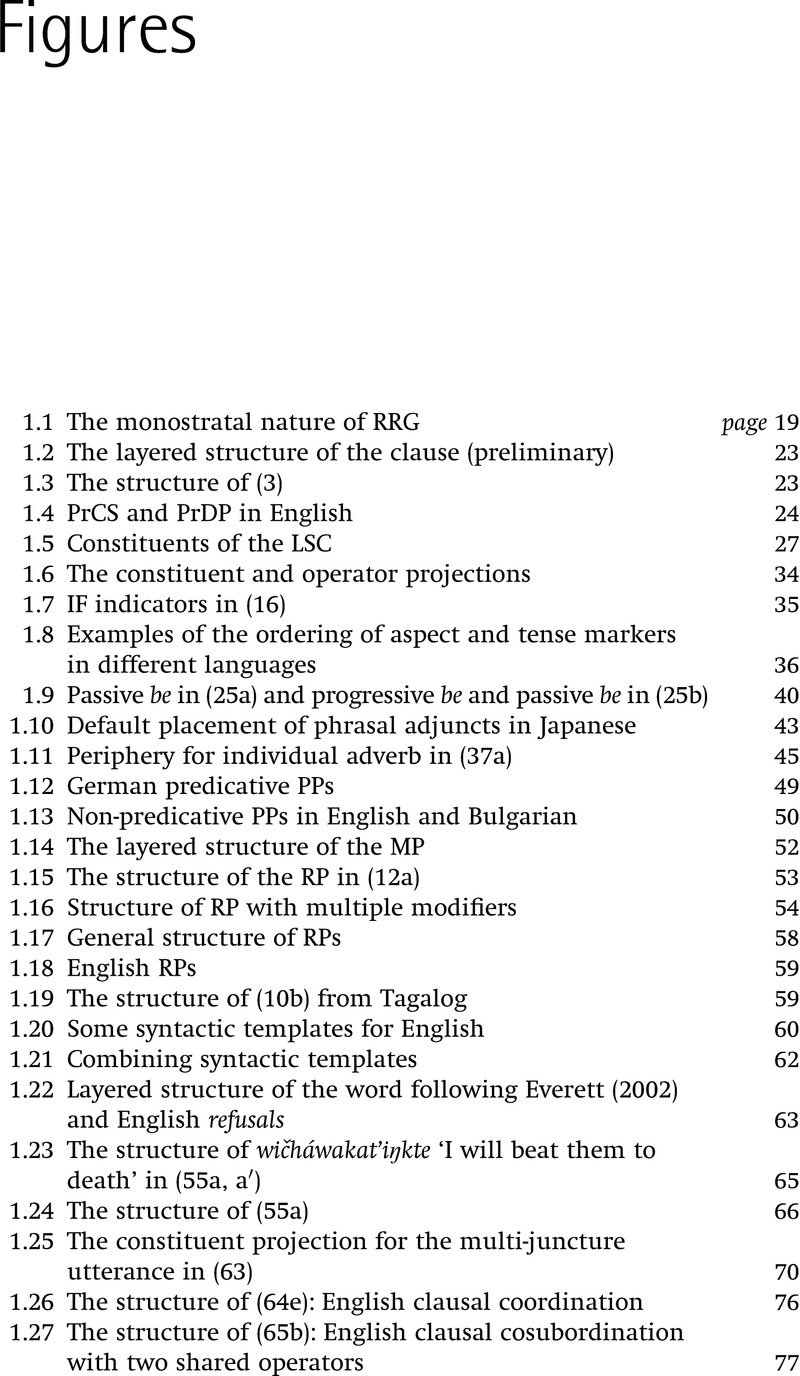
Figures
1.8Examples of the ordering of aspect and tense markers in different languages
1.9Passive be in (25a) and progressive be and passive be in (25b)
1.22Layered structure of the word following Everett (2002) and English refusals
1.23The structure of wičháwakat’iŋkte ‘I will beat them to death’ in (55a, a′)
1.25The constituent projection for the multi-juncture utterance in (63)
1.27The structure of (65b): English clausal cosubordination with two shared operators
1.28The structure of (65c): English clausal cosubordination with one shared operator
1.29The structure of (60b): Mandarin nuclear cosubordination
1.33The constituent, operator and information structure projections of the clause
1.36Summary of the linking from semantics to syntax for (109)
1.41Constructional schema for basic clause structure in English
1.42Constructional schema for English displaced wh-questions
1.47Output of steps 3 and 4 in the syntax-to-semantics linking
1.48The linking from syntax to semantics in terms of the algorithm in (128)
2.1Constituent projections for (2a), (2b) and (2d) (adapted from Van Valin 2008: 166)
2.2Structure of RP with MP containing sentential nucleus (adapted from Van Valin 2008: 173)
2.3Non-predicative (a) and predicative (b) prepositional phrases in English (Van Valin 2008: 171)
2.5TAM/Person- and Case-syntagmas with the same semantic base
2.7Constituent projection of (52) (adapted from Everett 2008: 398)
2.9Constituent and operator projections for two English sentences (adapted from Van Valin 2005: 14)
2.10Constituent and operator projections in a Japanese sentence (adapted from Van Valin 2005: 14)
2.12Layered structure of the RP in English (adapted from Van Valin 2005: 25)
2.13The structure of the Dyirbal sentence in (65b) (adapted from Van Valin 2005: 29)
3.2Qualia structure of violin (Pustejovsky and Batiukova 2019: 162)
3.5FunGramKB Ontological Hierarchy for concepts linked to $OBSOLETE_00
4.2Four types of languages, accusative and ergative alignment (Haspelmath 2008)
7.1The constituent structure of the simple clause in English
7.2Actor-Undergoer Hierarchy (adapted from Van Valin and LaPolla 1997: 146)
8.3The LSW of the OE complex word bellringestre ‘bell ringer’
9.1Example of LSC (modified from Figure 1.13, Van Valin 2005: 22)
9.3Structure of (7a) (modified from Figure 1.14, Van Valin 2005: 22)
9.4The mimetic as a nuclear adverb (adapted from Toratani 2007: 333)
9.5The mimetic as a core adverb (modified from Toratani 2007: 334)
10.1Universal oppositions underlying clause structure (Van Valin 2005: 4)
10.2Components of the layered structure of the clause (Van Valin 2005: 4)
10.3Layered structure of John gave a book to Mary in the library
11.1The cognitive states of referents in discourse (Van Valin and LaPolla 1997: 201)
11.2The Topic Acceptability Scale (Van Valin and LaPolla 1997: 204)
11.3Coding of referents as topic and focus (Van Valin and LaPolla 1997: 205)
11.4Pragmatically motivated positions in the layered structure of the clause
12.1Components of the focus structure projection (Van Valin 2005: 77)
12.4The constituent, operator and information structure projections of a sentence
12.8bSteps 1 and 2 of the semantics-to-syntax linking in (3b)
12.8eSummary of linking from semantics to syntax in Japanese verb-less numeral quantifier construction in (3b)
12.9Summary of linking from syntax and discourse to semantics in Japanese verb-less numeral quantifier construction
12.10Linking from DRS in cross-speaker ‘VP’-ellipsis in English
12.11Constructional schema for English conjunction reduction
12.15Syntactic templates for English wh-question and locative inversion constructions
13.6Clausal subordination (clause-to-core/complement clause) in Huallaga Quechua
13.7Clausal subordination (clause-to-periphery/adverbial clause) in Huallaga Quechua
13.8Clausal subordination (clause-to-noun/relative clause) in Huallaga Quechua
13.11Clausal cosubordination in Udihe with operator projection
13.18Clausal subordination (clause-to-core periphery/ad-core) in English
14.3Simplified structure of reason relations as sentential coordination in Yaqui
14.4Sequential temporal relations as ad-core subordination in Spanish
14.5Sequential temporal relations as core coordination in Spanish
14.6Simplified structure of sentential subordination in Spanish
14.7Simplified structure of purposive core cosubordination in Yaqui
14.8Simplified structure of purposive core coordination in Yaqui
15.2Internally headed relative clauses (from Van Valin 2012)
15.6The contrast between cleft sentences and relative clauses
16.1Potential focus domain in clausal (daughter) subordination (Van Valin 2005: 214)
16.2Potential focus domain in ad-core subordination (Van Valin 2005: 216)
16.3Layered structure of the clause and potential focus domain
19.15Bock and Levelt’s model of grammatical encoding and RRG
20.1Examples of syntactic representation and syntactic templates in RRG
20.7Schematic sketch of simple substitution (a) and sister adjunction (b)
20.8Sister adjunction of periphery elements at different layers
20.9Two possible syntactic representations of wh-extraction from complements
20.10Wh-extraction via simple substitution (a) and wrapping substitution (b)
20.14Basic transitive predication template for English with variants
20.19Encoding the operator structure in node features for (9) and (10)
20.22Obligatory adjunction of a tense operator: derived tree
20.23Keeping track of the operator projection in edge features
20.24Derived tree for (10) before (top) and after (bottom) final edge feature unification
20.26Two ways of compositionally deriving cosubordination constructions
20.27Core cosubordination via sister adjunction: analysis of (13)
20.28Core cosubordination analysis of (14) derived by wrapping substitution
20.30Composition of templates by wrapping substitution for (15a) and (15b)
20.32Subordination via simple and wrapping substitution for (17a) and (17b), respectively
20.40Anchoring the default transitive template with ‘smashed’
21.2MT–RRG-based interlingua bridge approach (from Nolan and Salem 2011: 315)
21.3The RRG interlingua for UniArab (from Nolan and Salem 2011: 315)
21.4The conceptual architecture of the UniArab system (from Nolan and Salem 2011: 321)
21.5Dialogue management framework for a language understanding system supporting conversational agents and a dynamic common ground
21.6Conceptual framework of the conversational software agent (from Panesar 2017: 190)
21.8The hand articulator in 3D space with nodes on fingers and thumb (from Murtagh 2019b: 98)
21.9The architecture of FunGramKB (source: www.fungramkb.com)
22.1Verb structure in Cheyenne (modified from Corral Esteban 2017: 310)
22.2Layered structure of the clause with constituent and operator projections
22.4Representation of an applicative construction with a derived two-place verb
22.5Representation of a clause including an argument-adjunct and an adjunct
22.12Interaction between the Person and Semantic Function hierarchies
23.1Clause structure with constituent, operator and focus projections
23.2Phrase structure with constituent and operator projections
23.4Constituent structure of a non-finite nominalization in Yimas
23.5Constituent structure of a simple finite nominalization in Yimas
23.6Constituent structure of a relative clause (28b) in Yimas
24.2A sentence with pre-detached position and pre-core slot (example 11)
24.3Sentence from example (20) with constituent and operator projections
24.4Complex RP with constituent and operator projections (example 24)
24.6The Interclausal Relations Hierarchy (Van Valin 2005: 209)
25.8Semantics-to-syntax linking in a transitive sentence with acc marking
25.9Semantics-to-syntax linking in an impersonal verb construction
25.10Semantics-to-syntax linking in a ditransitive predicate