

1 Introduction
It is commonly assumed that in stress languages, the stress-bearing unit is the syllable. Hayes (Reference Hayes1995: 401) states this assumption explicitly as follows: “Stress-Bearing Unit = the syllable, universally. Stress contrasts may not occur within heavy syllables, nor may syllables be split between feet.” From this assumption, three solid predictions are derived. First, there can be no contrast of first mora versus second mora stress within heavy syllables; for example, *táa.ta versus taá.ta.Footnote 1 Second, syllables cannot be split by metrical feet – an observation referred to as “syllable integrity” (Prince Reference Prince1976; Hayes Reference Hayes1995: 121 vv.), which prohibits metrical parsings such as *(ta.tá)(a.ta). Third, only syllables, but not morae, can be extrametrical (Hayes Reference Hayes1995: 58 vv.), prohibiting metrical parsings such as *(tá.ta)<a>, in which the second mora of a final heavy syllable is extrametrical. Some earlier analysts have explicitly challenged the SBU=σ assumption (Halle and Vergnaud Reference Halle and Vergnaud1987 on Winnebago; Steriade Reference Steriade1991 on Palestinian Arabic; Buller, Buller, and Everett Reference Buller, Buller and Everett1993, Everett Reference Everett1996, 1997 on Banawá; Blevins and Harrison Reference Blevins and Harrison1999 on Gilbertese).
Since an overwhelming amount of evidence for SBU=σ has been accumulated from stress languages, and relatively little evidence from non-stress languages (e.g. tonal systems), a question arises concerning SBU=σ. Is this (a) an exclusive property of stress systems, or (b) a property intrinsically connected to metrical structure (applying equally to languages with metrical structure, stress, and non-stress)? Under option (a), non-stress languages with metrical structure are expected to disrespect SBU=σ. Alternatively, under option (b), at least some non-stress languages with metrical structure are expected to respect SBU=σ. This article will explore evidence from stress and non-stress languages to assess the merits of syllable versus mora-based metrical parsing.
First we will reassess the SBU=σ assumption based on evidence from Gilbertese, a Micronesian language mostly spoken in the Republic of Kiribati. Gilbertese is particularly interesting because it has both stress and metrically restricted tone. (Yet this property is not typologically unique; for example, Björn Köhnlein (Chapter 9 this volume) proposes an analysis of metrically conditioned pitch accent in Uspanteko.) All examples and generalizations regarding stress, syllabification, and tone in this chapter are taken from Blevins and Harrison’s (Reference Blevins and Harrison1999) study, which is based on Harrison’s original fieldwork. According to these authors, in Gilbertese, high pitch falls on the antepenultimate mora and on every third mora preceding it. Stress, described as “an intensity or loudness peak,” falls on the penultimate mora and on every previous third mora (Blevins and Harrison Reference Blevins and Harrison1999: 217). All rime-internal elements (i.e. vocoids and nasals) are moraic. Tri-moraic and quadri-moraic syllables are freely allowed and nasals can be syllabic. In the following examples in (1), we indicate stress with an acute accent and a high tone with a <h> superscript.Footnote 2
(1)
a. … σμ σμ σ μ # aH.rá.na ‘his/her name’ nH.ná.ka.raH.kí.na ‘I will recount s.t.’ b. … σ μμ σμ σμ # teH. tá.kaaH. ká.ro ‘the/a leisure activity’ ŋke eH. má.tuuH.ná.ko ‘when he fell asleep’ c. … σμμ σμ # aHń.ti ‘spirit, ghost’ d. … σμ σμμ # maH. túu ‘to sleep’ puH. kín ‘end of’ e. … σμμ σμμ # maHá.ki. paH.ná.ko. niH.ká.kaaH.é a ‘and they flew off in search of him’ f. … σμμμ # aH ó i ‘dew’ pwa.kaH mw.naaH. kí i.koHó.ko.reH á i ‘so that you will not cut me up’
The mora is the tone-bearing unit, as well as the stress-bearing unit, since high pitch and stress can fall either on the first or second mora of a heavy syllable, depending on its position in the string (see underlined examples in (1)); the mora is also the counting unit, since the distance between two high-pitched morae or between two stressed morae is always two morae. Even though there is no abundant evidence for the syllable as a phonological constituent in Gilbertese, Blevins and Harrison report that speakers have clear intuitions about syllables and syllable boundaries in the language (“native speakers have little difficulty in identifying the number of syllables in a word, and can, on demand, break a word into its constituent syllables,” Reference Blevins and Harrison1999: 206–207). Beyond native speaker intuitions, additional support for the syllable comes from: (i) a syllable-based morphophonological pattern of reduplication, (ii) a process of vowel assimilation which seems to be syllable based (it applies to tautosyllabic vowels, although alternative explanations are also available), and (iii) several distributional generalizations related to the sonority profile of segments as well as the observation that rhotic r is excluded from syllable rimes (see Blevins and Harrison Reference Blevins and Harrison1999: 206–208 for further details). In sum, following the original source, we will assume that Gilbertese has syllables.
As can be inferred from the data in (1), Gilbertese has the mora both as its tone/stress-bearing unit and as its counting unit. A complete analysis of the ternary metrical pattern will be presented in Section 3. This analysis will have two main representational ingredients: (a) a representation of metrical foot structure based on the internally layered foot (Martínez-Paricio Reference Martínez-Paricio, Arnett and Bennett2012, Reference Martínez-Paricio2013; Martínez-Paricio and Kager Reference Martínez-Paricio and Kager2015), which offers a principled representation of ternary foot structure, and provides the prosodic domain for high pitch distribution; (b) a prosodic representation in which morae can be occasionally immediately dominated by the foot, rather than the syllable. In order to guide the parsing of morae into feet, three sets of constraints will be proposed: foot well-formedness constraints that restrict the moraic size of foot heads and foot dependents; constraints regulating the distribution of metrical feet of different sizes within a prosodic word, which bring about ternarity; and constraints that state requirements on the parsing of morae by feet. Our analysis of Gilbertese will show how syllable integrity disrespecting metrical parsing emerges under duress of foot shape constraints, which take priority over constraints that disfavour metrical parsing of morae immediately dominated by feet.
Next we will embed our analysis of Gilbertese in a broader typological discussion of metrical systems that target the antepenultimate mora, in particular, systems which place a prominence (high tone, pitch fall, or stress) on the syllable that contains the antepenultimate mora, such as Tokyo Japanese loanword accentuation (McCawley Reference McCawley1968; Reference McCawley and Fromkin1978; Kubozono Reference Kubozono2006) and Dihovo Macedonian stress (Groen Reference Groen1977; Crosswhite Reference Crosswhite2001a, 2001b). Some typical Tokyo Japanese examples are presented in (2), illustrating how the accent falls either on the antepenultimate mora (2a) or on the pre-antepenultimate mora in which case this forms a heavy syllable together with the antepenultimate mora (2b).
(2)
a.i … σμ σμ σ μ # gú.ra.su ‘glass’ a.ii … σμμ σμ # gu.róo.bu ‘glove’ a.iii … σμ σμμ # a.má.zoN ‘Amazon’ b.i … σμμ σμ σ μ # dóo.na.tu ‘donut’ (*doó.na.tu) b.ii … σμμ σμμ # aN.dáa.soN ‘Anderson’ (*aN.daá.soN)
In such antepenultimate mora systems, distances from the word edge are counted in terms of morae, while the syllable remains the accent/stress-bearing unit, since no prominence contrasts occur within heavy syllables (i.e. prominence is always placed on the first mora of a heavy syllable, *doó.na.tu). Hence, such metrical systems share characteristics with, on the one hand, purely mora-based metrical systems (such as Gilbertese), where the stress/tone-bearing unit is the mora, while the distribution of stress and tone totally disregards syllable boundaries, and, on the other hand, metrical systems in which the stress/tone-bearing unit is the syllable (such as antepenultimate/penultimate stress in Latin). This partial overlap of “counting units” and “bearing units” poses an interesting theoretical challenge, which we take up here, aiming at a unification of antepenultimate prominence systems by (a) identifying the principles from which the observed dimensions of “mora-counting” versus “syllable-counting” and “syllable integrity respecting” versus “syllable integrity disrespecting” emerge, and (b) formalizing these principles into a constraint-based account in which they interact as violable constraints. Such a unification will yield a continuum of metrical systems (similar to McCawley’s Reference McCawley and Fromkin1978 classification) ranging from “mora counting and syllable integrity disrespecting” (e.g. Gilbertese), through “mora counting and syllable integrity respecting” (e.g. Tokyo Japanese, Dihovo Macedonian), to “syllable counting and syllable integrity respecting” (e.g. Latin). This chapter will make an attempt at such a unification. We will argue that all principles sought for are already provided by the constraints in the analysis of Gilbertese. That is, “mora counting and syllable integrity respecting” systems (e.g. Tokyo Japanese) minimize the violation of mora-based foot well-formedness constraints while disallowing morae to be immediately parsed by feet.
This chapter is organized as follows. Section 2 introduces the model of IL feet, which will be needed for our analysis of mora accentuation in Gilbertese, Tokyo Japanese loanwords, and Dihovo Macedonian. Section 3 illustrates this model by the analysis of Gilbertese high pitch placement and stress. Section 4 analyses Tokyo Japanese loanword accentuation, in two varieties, a conservative pattern (in which the accent falls on the syllable containing the antepenultimate mora) and an innovative pattern (which retracts the accent to the antepenultimate syllable in forms ending in light–heavy). Section 5 analyses the stress system of Dihovo Macedonian, which turns out to be an exact stress counterpart to the Tokyo Japanese conservative pattern. The conclusions are given in Section 6.
2 A Framework with IL Feet
An internally layered (IL) foot consists of a binary (bisyllabic (3a) or bimoraic (3b)) foot with a left- or right-adjoined syllable (vertical lines indicate headedness):
(3)
Examples of IL feet 

This type of IL foot, in which a single foot layer is occasionally stacked on top of another foot, was originally proposed in seminal studies on foot structure in the early 1980s (Selkirk Reference Selkirk1980; Prince Reference Prince1980) and it has since occasionally been invoked in the analysis of particular languages (see, for example, McCarthy Reference McCarthy1982; Withgott Reference Withgott1982; Grijzenhout Reference Grijzenhout, Bok-Bennema and Coopmans1990; Hewitt Reference Hewitt1992; Rice Reference Rice1992; Kager Reference Kager1994). Still, standard metrical theory and prosodic hierarchy theory have traditionally banned these structures reasoning they incur a violation of two inviolable universal restrictions: (i) feet should be maximally disyllabic and (ii) feet should be immediately dominated by prosodic words according to the Strict Layer Hypothesis (Selkirk 1984).
In light of new compelling stress and non-stress cross-linguistic evidence for this type of minimally recursive foot, and given that the inviolable nature of the Strict Layer Hypothesis has been called into question in subsequent research (Selkirk 1995), recent metrical studies have argued for the rehabilitation of IL feet in phonological representations. On the typological side, for instance, Martínez-Paricio and Kager (Reference Martínez-Paricio and Kager2015) have demonstrated that reference to IL feet allows for a unified and insightful account of the typology of binary and ternary quantity-insensitive rhythmic stress patterns. Moreover, postulating IL feet enables a restrictive account of the maximal size of stress and accentual windows (see Kager Reference Kager2012, based on Caballero Reference Caballero2008; cf. Hyde Reference Hyde2015). Beyond the typology of metrical stress patterns, a large number of studies have shown that IL feet are equally necessary to explain a wide range of metrically governed phenomena related to phonotactics and tonotactics (see Martínez-Paricio Reference Martínez-Paricio2013 for specific arguments and references). In this chapter we follow these studies and propose that IL feet are also necessary to account for mora-counting and syllable-counting antepenultimate patterns of accentuation. Along the lines of Martínez-Paricio (Reference Martínez-Paricio2013) and Martínez-Paricio and Kager (Reference Martínez-Paricio and Kager2015), we will assume that each projection of the foot can be defined as minimal (or non-minimal) and maximal (or non-maximal) based on its particular dominance relations, following Itô and Mester’s theory of prosodic recursion (Reference Itô, Mester, Miyamoto and Ochi2007, Reference Itô, Mester, Grijzenhout and Kabak2009a, Reference Itô, Mester and Parker2009b, Reference Itô and Mester2013). The definitions of (non-)minimal/(non-)maximal feet are given in (4) and they are illustrated in (5).
(4)
Projections of a metrical foot Ft (based on Itô and Mester Reference Itô, Mester, Miyamoto and Ochi2007 et seq.) a. Maximal: Ft not dominated by Ft The largest projection of Ft b. Minimal: Ft not dominating Ft The smallest projection of Ft c. Non-maximal: Ft dominated by Ft d. Non-minimal: Ft dominating Ft
(5)

Within an Optimality Theory framework, the assumption is that constraints can refer to these different foot projections (see Martínez-Paricio and Kager Reference Martínez-Paricio and Kager2015 for a small set of universal constraints in a model with IL feet). In this chapter we will go one step further and propose that not only syllables but also morae can be terminal elements of IL feet. In particular, under duress of foot well-formedness constraints, layered and non-layered metrical feet can immediately dominate morae, which may cause syllable integrity violations. This is the case in Gilbertese, whose metrical representation we discuss in the following section.
3 IL Feet in Gilbertese
Stress and pitch are rhythmic in Gilbertese (they are not culminative or demarcative). Interestingly, we saw in Section 1 that Gilbertese is a language in which the mora plays a crucial role in tone and stress placement. In particular, based on the descriptions and generalizations reported in the source (Blevins and Harrison Reference Blevins and Harrison1999), Gilbertese was characterized as a mora-accenting and mora-counting language: (i) a high tone is located on the antepenultimate mora and on every third mora preceding it; (ii) stress falls on the penultimate mora and on every preceding third mora. Based on these generalizations, Blevins and Harrison posited that Gilbertese contains trimoraic feet which are “characterized by an intensity or loudness peak [= stress] on the penultimate mora, a pitch peak [= high pitch] on the antepenultimate mora” and an unmarked “lowered pitch and intensity” on the final mora (Reference Blevins and Harrison1999: 217). That is, according to the source, morae and not syllables seem to be terminal elements of feet in Gilbertese. Assuming stress to be the manifestation of a foot head (Liberman and Prince Reference Liberman and Prince1977; Selkirk Reference Selkirk1980; Halle and Vergnaud Reference Halle and Vergnaud1987; Hayes Reference Hayes1995), the reanalysis of the Gilbertese data in a model with IL feet leads to the metrical representations in (6), where IL feet consist of a bimoraic iamb with a monomoraic right-adjunct ((μw μs) μw) assigned from right to left (Martínez-Paricio Reference Martínez-Paricio2013). (Parentheses signal foot boundaries and dots syllable boundaries; remember that vowels, coda nasals, and geminate nasals are the only moraic segments in Gilbertese.) Crucially, as can be inferred from the examples in (6), once morae are analyzed as terminal elements of feet, foot boundaries might dissect a syllable (violations of the syllable integrity principle are in bold and underlined in 6, for example 6b).
(6)
IL feet in Gilbertese a. … σμ σμ σ μ # ((aH. rá).na) ‘his/her name’ ((nHná).ka). ((raH. kí).na) ‘I will recount s.t.’ b. … σ μμ σμ σμ # ((teH.tá).ka) ((aH. ká).ro) ‘the/a leisure activity’ ŋke ((eH. má).tu) ((uH.ná).ko) ‘when he fell asleep’ c. … σμμ σμ # ((aHń).ti) ‘spirit, ghost’ d. … σμ σμμ # ((maH. tú)u) ‘to sleep’ ((puH. kí)n) ‘end of’ e. … σμμ σμμ # ((maH.á).ki). ((paH. ná).ko). ((niH.ká).ka) ((aH. é)a) ‘and they flew off in search of him’ f. … σμμμ # ((aH ó)i) ‘dew’ pwa.((kaHmw).na) ((aH. kí)i). ((koH.ó).ko). ((reH á)i) ‘so that you will not cut me up’
The forms in (6) and (7) from Blevins and Harrison (Reference Blevins and Harrison1999) further corroborate the idea that Gilbertese stress/pitch patterns are mora-based rather than syllable-based. For instance, the data in (7) show that trisyllabic (7a, b), bisyllabic (7c, e), and monosyllabic words (7d) all display identical pitch and stress patterns, since the parsing and accenting unit is the mora, not the syllable.
(7)
a. ((aH. rá).na) ‘his/her name’ b. ((kaH.mé).a) ‘dog’ c. ((mH.ná).o) ‘kind of lobster’ d. ((aHó)i) ‘dew’ e. ((puH. kí)n) ‘end of’
The fact that bimoraic heavy syllables can display different stress patterns, having either their first or second mora stressed (8a, b versus 8c) confirms the idea that terminal elements of feet are occasionally morae in Gilbertese and contradicts the principle by which the syllable is the stress-bearing unit in all languages.
(8)
Contrastive v́v ~ vv́ a. maH.túu v́v ‘to sleep’ b. aH.í.ka.kaHḿβwo.ŋoH.ráa v́v ‘those of you who are listening’ c. pwa.kaHḿw.naaH. kíi. koHó.ko.reHái vv́ ‘so that you will not cut me’
Crucially, Blevins and Harrison, drawing on Harrison’s fieldwork, describe a clear contrast between these two types of stressed syllables. More importantly, and despite the fact that syllables do not play an apparent role in the accentuation patterns in the language, we saw in Section 1 that syllabifications in Gilbertese are supported by native speakers’ intuitions and various distributional facts and morphophonological patterns.
3.1 Foot-initial Strengthening
Throughout this section we have assumed that IL feet in Gilbertese consist of a bimoraic iamb with a right adjunct ((μw μs)μw), but note that an alternative analysis with bimoraic trochees and a left adjunct (μw (μs μw)) could also be posited for the language (cf. 9a versus 9b). In these two IL feet, the second mora of the trimoraic sequence corresponds to the head of a foot, which is realized with stress, hence the two metrical representations are descriptively equivalent for Gilbertese stress. However, we will adopt representation (9a) over (9b) based on a phonological argument: the former allows a simpler and more straightforward account of the distribution of high pitch. In particular, we propose that high pitch placement in Gilbertese amounts to inserting a boundary tone in a foot-initial position as a means of strengthening the initial boundary of the metrical foot (Martínez-Paricio Reference Martínez-Paricio2013). That is, following Davis and Cho (Reference Davis and Cho2003), Rice (Reference Rice1992), and Bennett (Reference Bennett2012, Reference Bennett2013), among others, we assume that the initial constituent of a foot, similar to initial constituents in other prosodic categories, may exhibit particular strengthening effects. In Gilbertese, this greater strength is realized as a boundary H tone foot-initially.Footnote 3 Note that the representation in (9a) has only one foot-initial position, since the left edges of FtMin and FtNon-min coincide, while (9b) has two foot-initial positions, only one of which carries high pitch. If we had adopted the representation in (9b) instead, we would need to include an additional specification saying that strengthening only occurs at the left edge of some foot projections but not others (in this case, the left edge of a FtNon-min). This specification would be required to avoid a configuration like (9b) receiving two highs at the left edge of each foot projection: one on the first mora and another one on the second mora.
(9) Foot-initial strengthening in Gilbertese

To clearly determine which of the structures in (9) corresponds to this system, the particular pitch and stress patterns of bimoraic sequences in Gilbertese would be enlightening, since these could help us determine the exact shape of non-layered feet (i.e. feet that are minimal and maximal simultaneously); of particular interest would be the pitch/stress patterns of (i) bimoraic prosodic words and/or (ii) forms with a 3n+2 number of morae (e.g. (μ μ)Ft (μ μ μ)Ft). If in these cases the non-layered foot displays a H pitch on the first mora, this would be evidence for the representation in (9a), which exhibits a H on the left edge of the FtMin, which coincides with the FtNon-min. The representation in (9b) would be less adequate since again the rule (or constraint) for H pitch placement would need to specifically refer to FtMax. Unfortunately, bimoraic prosodic words are rare, since these generally undergo a lengthening process to fulfill a trimoraic minimal requirement (Section 3.3). Also, no acoustic measurements of the leftover bimoraic sequences in 3n+2 structures are available. When we asked Harrison (per.comm.) about the realization of bimoraic words and the first two morae in 3n+2 sequences, the author reported some variation/uncertainty: sometimes these sequences seemed to be realized as (μH ˈμ), with a high initial pitch and a stress on the second mora, giving support to the representation in (9a), whereas in other cases, there seemed to be a coincidence of pitch and intensity on the first mora, and something more neutral on the second, matching better with (9b) (Harrison, per.comm.; Blevins and Harrison Reference Blevins and Harrison1999: 218). Future experimental research will be needed to determine more specifically which of these two structures is instantiated in Gilbertese. For the time being and the sake of simplicity, we will assume (9a), but note that any of the two structures could in principle be posited for the language.
3.2 Binary Head versus Unary Head
As mentioned earlier in the introduction to this section, Blevins and Harrison (Reference Blevins and Harrison1999) had already proposed that Gilbertese metrical representations consist of trimoraic feet. However, the internal structure of these feet was slightly different from the ones proposed here: it consists of a bipartite head and a unary non-head (i.e. foot dependent) (Reference Blevins and Harrison1999: 217, based on Rehg Reference Rehg1993):
(10)
Blevins and Harrison’s trimoraic feet with bipartite heads (Reference Blevins and Harrison1999: 217) I. Bipartite head

Although some studies have postulated the existence of feet with bipartite heads (Kager Reference Kager and Kleinhenz1996; Bye Reference Bye1996), we assume that the foot is a relational and rhythmic category that arises from combining a unique head (strong element) with one (or various, in the case of IL feet) optional non-head (weak element), this unique head being its defining property. This is why feet with only a head (i.e. unary feet) occasionally occur (but not degenerate feet with only a dependent) and, in case two adjacent positions are prominent, these have always been analyzed as each being the head of an independent foot. Another argument against positing a symmetrical bipartite head such as the one in (10) is that it predicts identical behavior for the two morae that compose the head. However, a typological survey on the relative strength of the elements contained in such binary structures (bipartite heads in Blevins and Harrison Reference Blevins and Harrison1999, minimal feet in our model) reveals that the two constituents in the head clearly behave differently, one of them being phonologically and phonetically stronger than the other (Martínez-Paricio Reference Martínez-Paricio2013). This is clearly the case in Gilbertese, where the morae in the binary head behave differently: the second mora is the true head of the foot and, hence, the stress-bearing unit, whereas the first mora is the tone-bearing unit. For all these reasons, we believe these structures are better analyzed via an IL foot, where the binary innermost constituent is not flat qua prominence, but it is actually a foot by itself.
3.3 Gilbertese Lengthening and the Minimality Requirement
A final piece of evidence which supports the idea that Gilbertese default feet are trimoraic is reported in Blevins and Harrison (Reference Blevins and Harrison1999: Section 4.1): the overwhelming majority of prosodic words in the language have at least three morae. Whenever this is not the case, there is strong evidence that bimoraic lexical words display lengthening to conform to this restriction. For instance, borrowed names display lengthening to conform to the trimoraic restriction (11a–c). Furthermore, even if it is not uncommon for lexical words (nouns and verbs) to have two morae, they hardly ever surface alone: they are either accompanied by a proclitic article or a possessive suffix (in the case of nouns) or a proclitic subject marker (in the case of verbs). But in bare verbal and nominal forms, like bare plurals (11e–g) or imperative forms (11h–j), the bimoraic lexical word undergoes lengthening. In (11) we indicate every moraic segment with the superscript <μ>; even if we assume that long vowels consist of one vowel linked to two morae, in the following examples we represent each lengthened vowel as two independent vowels, to better illustrate the lengthening pattern.
(11)
Lengthening (all data taken from Blevins and Harrison Reference Blevins and Harrison1999: 213–216) Borrowed proper names a. taμaμmμ ‘Sam’ b. ti μiμmeμ ‘Jimmy’ c. biμiμtiμ ‘Fiji’ In bare plural nouns Noun phrases e. bwaμaμtaμ ‘the/some huts’ cf. teμ bwaμtaμ ‘the/a hut’ f. oμoμnμ ‘the/some turtles’ cf. teμ oμnμ ‘the/a turtle’ g. baμaμiμ ‘the/some arms’ cf. baμiμ-uμ ‘my arms’ In imperative verbal forms Verbs+subject marker h. biμiμriμ! ‘run!’ cf. eμ biμriμ ‘s/he ran’ i. niμiμmμ! ‘drink them!’ cf. iμ niμmμ ‘I drank them’ j. aμmwμaraμkeμ! ‘eat!’ cf. iμ aμmwaμraμkeμ ‘I ate’
Even if the trimoraic restriction is not completely inviolable, as there are a few exceptional forms that can surface with two morae (12), the lengthening patterns in (11) stand as strong support for feet with moraic terminal elements in Gilbertese. Note that the exceptions occur only in environments in which lengthening would have introduced an extra-long vowel, which are forbidden in the language (12a, b), or a geminate nasal in preconsonantal position, which are also illicit in prevocalic position (12c, d) (Blevins and Harrison Reference Blevins and Harrison1999: 215). The pitch/stress patterns of these forms are not indicated because these are precisely the ones that were unclear to the authors (see again Section 3.1).
(12)
Bimoraic prosodic words (Blevins and Harrison Reference Blevins and Harrison1999: 215) Bare plural nouns a. niμiμ ‘some coconut trees’ (cf. sing.: te nii) b. baμaμ ‘some leaves’ (cf. sing.: te baa) c. nnμeμ ‘some spots’ (cf. sing.: te nne) d. nnμaμ ‘some fleets’ (cf. sing.: te nna)
3.4 Optimality Theory Analysis
We adopt here Martínez-Paricio and Kager’s (Reference Martínez-Paricio and Kager2015) Optimality Theory analysis of ternary rhythm. Under their view, the emergence of IL feet gives rise to ternary stress alternations. In (13) and (14) we present definitions of the relevant constraints: (13a–e) regulate the location and number of foot projections within a prosodic word, (13f) controls the location of unfooted syllables, banning them when the left and right versions of the constraint are both undominated. Finally, the constraints in (14) determine the location of foot heads and foot dependents within a foot. These metrical constraints were originally proposed to account for quantity-insensitive rhythmic stress, but they also control the location of feet in quantity-sensitive systems.Footnote 4
(13)
Constraints regulating the location and number of foot projections and unfooted syllables within a prosodic word (Martínez-Paricio and Kager Reference Martínez-Paricio and Kager2015: 470) a. Align-L/R([Ftmax]ω, Ft, ω) (Align-L/Rmax) For every maximal foot Ftmax, assign a violation mark if some foot intervenes between Ftmax and the left/right edge of its containing ω. b. Align-L/R([Ftmin]ω, Ft, ω) (Align-L/Rmin) For every foot that is minimal and maximal ([Ftmin]ω), assign a violation mark if some foot intervenes between [Ftmin]ω and the left/right edge of its containing ω. c. Align-L/R([Ftnon-min]ω, Ft, ω) (Align-L/Rnon-min) For every non-minimal foot Ftnon-min, assign a violation mark if some foot intervenes between Ftnon-min and the left/right edge of its containing ω. d. Align-L/R([Ftunary]ω, Ft, ω) (Align-L/Runary) For every unary foot Ftunary, assign a violation mark if some foot intervenes between Ftunary and the left/right edge of its containing ω. e. Align-L/R([Ftmain]ω, Ft, ω) (Align-L/Rmain) For every head foot of a prosodic word (Ftmain), assign a violation mark if some foot intervenes between Ftmain and the left/right edge of its containing ω. (Based on EndRule-L/R; Prince Reference Prince1983, McCarthy Reference McCarthy2003.) f. Align-L/R([σ]ω, Ft, ω) (Chain-L/R) For every unfooted syllable (σ)ω, assign a violation mark if some foot intervenes between (σ)ω and the left/right edge of its containing ω.
(14)
Constraints regulating the location of foot heads and foot dependents within a Ft (Martínez-Paricio and Kager Reference Martínez-Paricio and Kager2015: 473) a. Trochee For every foot head, assign a violation mark if it is not initial in its containing Ft. b. Iamb For every foot head, assign a violation mark if it is initial in its containing Ft. c. Align-L/R(Ftmin, σ, Ftnon-min) (Trocheenon-min/Iambnon-min) For every minimal foot Ftmin, assign a violation mark if some footed syllable intervenes between Ftmin and the left/right edge of its containing Ft.
The following tableaux show how the general constraints in (13–14) model the type and number of IL feet that arise in Gilbertese. Let us start with the simpler forms: those that only contain monomoraic syllables. Assuming that IL feet in Gilbertese consist of iambs with right-adjuncts (see the discussion in Section 3.2), we conclude that Trocheenon-min and Iamb must dominate Iambnon-min and Trochee. In (15) we illustrate these ranking arguments with the evaluation of the trimoraic form aHrána ‘his/her name.’ (In this analysis and subsequent ones, we only derive the stress patterns. The placement of a high tone would arise by a high-ranking alignment constraint which aligns a high tone with the left edge of the foot, strengthening the foot-initial position, Section 3.2.)
(15)

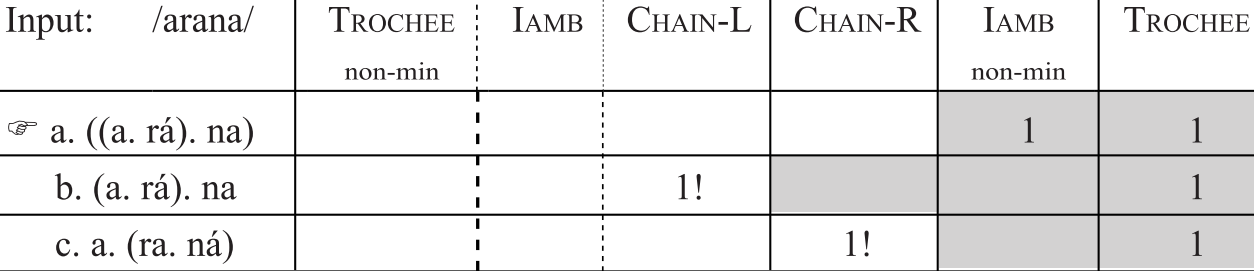
To ensure that arána is parsed with an IL foot [((a.rá).na)] rather than a non-layered foot [(a.rá).na], the constraints on unfooted syllables, Chain-L and Chain-R, must both dominate Trocheenon-min and Iamb. As previously mentioned, the main role of these constraints is to chain unfooted syllables toward the right or left edge of the prosodic word, while favoring exhaustive parsings of syllables. This promotion of exhaustivity indirectly favors the emergence of IL feet as shown in (16), where candidate (16a) beats candidates (16b–c). Since some forms do occasionally leave some unfooted material at the left edge of the prosodic word, we will see that Chain-L must dominate Chain-R (see 18).
(16)
In longer words, alternating ternary rhythmic stresses occur on every third mora preceding the stressed penultimate mora. We propose this is the result of building adjacent IL ternary feet from right to left. The constraint ranking responsible for such parsings is illustrated in (17). Align-L/Rmin must crucially dominate Align-L/Rnon-min so that parsings with IL feet are preferred over parsings with non-layered feet. Here and henceforth, we assume the syllabification patterns reported in Blevins and Harrison (Reference Blevins and Harrison1999); remember that coda nasals and prevocalic long nasals are always moraic.
(17)

Chain-L must dominate Chain-R because forms with 3n+1 morae may leave an unfooted syllable/mora at the left edge of the prosodic word. Furthermore, to ensure that the first mora of these forms does not constitute a unary degenerate foot on its own, Align-Runary must be ranked above Chain-R. This is demonstrated in (18).
(18)

Now that the general metrical constraints responsible for the emergence and distribution of IL feet in Gilbertese have been presented, we need to add a small set of constraints to derive the stress patterns of the language, where moraic information is crucial in the assignment of stress. The list of these constraints and their definition are presented in (19) and (20). First, to promote metrical parsings in which morae rather than syllables are terminal elements of feet, we need to add three high-ranked foot form constraints controlling the particular size of minimal feet (19a-b) and promoting monomoraic adjuncts (19c). The last constraint, which favours IL feet with monomoraic adjuncts, is typologically motivated by the cross-linguistic observation that in ternary stress systems, the syllable in between binary feet must be light (Hayes Reference Hayes1995).
(19)
a. Foot-MinμμMin FtMin must be minimally bimoraic. b. Foot-MinμμMax FtMin must be maximally bimoraic. c. Adjunct=μ The adjunct of FtNonMin must be monomoraic
The constraints in (19a–b) ensure that the maximal and minimal size of FootMin equals two morae and, thus, they can be interpreted as being specific constraints on Binarity. To predict the ternary stress moraic alternations in Gilbertese, the constraints in (19) together with, Non-Finality (banning the head syllable from final position) and Anchor-R, two classical metrical constraints defined in (20a,b), must be high-ranked, crucially dominating the Weight-to-Stress Principle constraint (WSP) and two additional general constraints on prosodic organization (Parse-μ and Exhaustivity-Ft, 20d–e). These constraints are all defined in (20). Note that there is an important difference between Parse-μ (20d) and Exhaustivity-Ft (20e). On the one hand, Parse-μ promotes the footing of morae in general. This constraint is needed in addition to Chain-L/R because the latter exclusively refers to the chaining of unfooted syllables. That is, in comparison, Parse-μ is stricter than Chain-L/R, since it bans all unfooted morae, also when they belong to chained syllables. On the other hand, Exhaustivity-Ft bans feet that directly dominate morae without an intervening syllable. This last constraint is typologically motivated since feet preferably dominate syllables. In (20) we will see that Exhaustivity-Ft is only violated in a few cases in Gilbertese (it is violated by candidates containing a heavy syllable in which the two morae belong to different feet). In other forms, it will be assumed that there is a syllable mediating between morae and feet.
(20)
Metrical constraints a. Non-Finality No head of FtMin is final in PrWd (restricts the head syllable). b. Anchor-R Every PrWd must end with a foot. c. WSP Every bimoraic syllable must be head of a foot. Constraints on prosodic organization, mora parsing constraints d. Parse-μ Every mora must be parsed by a foot. e. Exhaustivity-Ft No foot immediately dominates a mora. Assign a violation mark for every mora that is directly dominated by a foot.
Regarding (20e), we propose that the pressure to build feet on syllables – not morae – is not exclusive to stress systems, but enforced by a universal constraint that is active in metrical systems. The metrical system of Gilbertese strongly suggests the responsible constraint (Exhaustivity-Ft) to be violable (in the sense of Optimality Theory), and to interact with other constraints on metrical well-formedness, in particular foot shape constraints. In Section 4, we will support this hypothesis by an IL foot-based analysis of Tokyo Japanese loanword accentuation, showing that its metrical system can be accounted for by a straightforward re-ranking of constraints motivated for Gilbertese. For this analysis to succeed, it will be crucial that metrical feet are IL, not standard moraic trochees.
In (21) we summarize the particular ranking of these constraints in Gilbertese. Non-Finality and Anchor-R (20a–b) together with Adjunct=μ, FtMin=μμMax, and FtMin=μμMin (19a–c) all dominate WSP to ensure that bimoraic sequences do not always surface with stress – remember that heavy syllables only surface with stress if they contain a mora that is at a ternary interval from another stressed mora or the right edge of the prosodic word. These constraints must also dominate Parse-μ. Finally, Parse-μ must dominate Exhaustivity-Ft, the constraint that bans feet that directly dominate morae.
(21) Non-Finality, Adjunct=μ, FtMin=μμMax, FtMin=μμMin, Anchor-R » Parse-μ » Exhaustivity-Ft, WSP
To illustrate this particular constraint interaction, and demonstrate how it can occasionally give rise to IL moraic feet in Gilbertese, tableau (22) presents the evaluation of a form ending in a sequence of HLL syllables such as teHtákaaHkáro ‘the/a leisure activity.’ This form, with stress on the penultimate and the peninitial mora, is parsed with two adjacent IL feet; for example, [((teH.tá).ka) ((aH.ká).ro)]. Crucially, under the current proposal, the antepenultimate heavy syllable incurs a violation of the Syllable Integrity Principle (henceforth SIP), since the second mora belongs to the final foot and the first mora to the initial. In terms of constraints, this syllable violates Exhaustivity-Ft, because its morae are immediately dominated by a foot. As for the other morae, we assume they are dominated by syllables, which at the same time are dominated by feet.
(22) Form ending in H … LL. SIP Violation: ((teH. tá).ka) ((aH.ká).ro))

In this tableau we see that candidates (22b) and (22d) are ruled out because they violate Anchor-R, but note also that they incur a violation of the previously presented constraint Chain-R, omitted here for the sake of simplicity.
In Gilbertese, violations of the Syllable Integrity Principle (and, consequently, of Exhaustivity-Ft) only occur to ensure purely moraic ternary rhythmic alternations. Hence, in a HL form like aHńti, there is no violation of it; for example, [((aHń).ti)]. This tableau is also enlightening because it illustrates the ranking argument for Anchor-R and Parse-μ » Exhaustivity-Ft, so that candidate (23a) is selected over candidate (23b).
(23)

To sum up, along the lines of Blevins and Harrison’s (Reference Blevins and Harrison1999) original description, we conclude that a ternary constituent is responsible for the iterative rhythmic patterns in the language and, as such, IL feet of the size of three morae arise as a valid option for their representation. Further support for this metrical layered constituent is presented in the next section.
4 Tokyo Japanese Loanword Accentuation
4.1 General Properties of Accentuation
The accentual pattern of Tokyo Japanese has been the subject of numerous phonetic and phonological studies (McCawley Reference McCawley1968, Reference McCawley and Fromkin1978; Poser Reference Poser1984; Pierrehumbert and Beckman Reference Pierrehumbert and Beckman1988; Haraguchi Reference Haraguchi1977, Reference Haraguchi1991; Kubozono Reference Kubozono2006). Traditionally, it is referred to as a “pitch accent system,” in which the lexical accent marks the position where a pitch drop (phonetically realized by a High–Low tonal melody; Haraguchi Reference Haraguchi1977) occurs in a word. The accented syllable is the one just before the pitch drop.Footnote 5 See the trisyllabic nouns in (24), accented on their first, second, and third syllable, combined with the nominative suffix -ga (Kubozono Reference Kubozono2012: 1398), where the pair of syllables that shows the pitch drop is underlined.
(24)
a. í.no.ti-ga ‘life-nom’ b. ko.kó.ro-ga ‘heart-nom’ c. o.to.kó-ga ‘man-nom’Footnote 6
For our current purposes, the interest of Tokyo Japanese resides in its “blended” prosodic character. McCawley (Reference McCawley and Fromkin1978) introduced a distinction between “accent/tone-bearing unit” and “unit of counting,” where the former is the unit that bears the prominence peak, while the latter is relevant for measuring distances from either side of the word.Footnote 7 In Tokyo Japanese, the prosodic unit that bears the prominence (the “accent-bearing unit”) is the syllable. This is because no prominence contrasts occur within heavy syllables: in an accented heavy syllable, the H tone is invariably associated with the first mora, and the L tone with the second mora. McCawley argues that the mora is the “unit of counting.” One of his major arguments is that “accent in recent borrowings goes on the syllable containing the third-last mora.” This suggests a reference to morae regardless of the way morae are grouped into sequences of (light and/or heavy) syllables.
Loanwords are mostly accented, and display considerable variation in the position of the accent, partly lexical and partly phonologically conditioned (by patterns of epenthetic vowels, the position of stress in the source language, etc.). Nevertheless, there is a default accentual pattern for loanwords, which is metrically restricted. This pattern will be our focus.
As reported by Kubozono (Reference Kubozono2006), two patterns of loanword accentuation occur: one dominant among older speakers, which we will refer to as the “conservative pattern,” and another one dominant among younger speakers, which we refer to as the “innovative pattern.”
4.2 The Conservative Pattern
The default pattern for Tokyo loanword accentuation is captured by the well-known “antepenultimate rule” (McCawley Reference McCawley1968, Reference McCawley and Fromkin1978; Yamada Reference Yamada1990; Haraguchi Reference Haraguchi1991; Kubozono Reference Kubozono2006):
(25)
Loanword Accent Rule (“antepenultimate rule”) “Put an accent on the syllable containing the antepenultimate mora.”
This pattern is reported to be “conservative,” being dominant among older speakers (Kubozono Reference Kubozono2006: 1142).
In the examples in (26), the first column lists the quantitative structure of the form as a sequence of L(ight) and/or H(eavy) syllables. The second column shows the place of the accent on the mora carrying the H tone, which is abbreviated as APU (antepenultimate mora) or pre-APU (pre-antepenultimate mora).
(26)
a.i LLL gú.ra.su APU ‘glass’ K1142 LLLL su.tó.re.su APU ‘stress’ K1142 LLLLL ku.ri.sú.ma.su APU ‘Christmas’ K1142 a.ii HL páa.ku APU ‘park’ K1142 LHL gu.róo.bu APU ‘glove’ Kubozono (Reference Kubozono, van de Weijer and Nishihara2001) LLHL ri.ba.púu.ru APU ‘Liverpool’ K1162 HHL man.hóo.ru APU ‘manhole’ K1155 a.iii LH há.wai APU ‘Hawaii’ K1142 LLH a.má.zoN APU ‘Amazon’ K1154 (fluctuates) LLLH e.ne.rú.gii APU ‘energy’ K1154 (fluctuates) a.iv HLH kuu.dé.taa APU ‘coup d’état’ McCawley (Reference McCawley and Fromkin1978) HLH kaa.dí.gaN APU ‘Cardigan’ K1154 (fluctuates) LHLH a.koo.dí.oN APU ‘accordion’ K1154 (fluctuates) b.i HLL dóo.na.tu pre-APU ‘donut’ K1158 LHLL e.díN.ba.ra pre-APU ‘Edinburgh’ K1162 HHLL pai.náp.pu.ru pre-APU ‘pineapple’ K1152 b.ii HH róN.doN pre-APU ‘London’ K1142 LHH wa.síN.toN pre-APU ‘Washington’ K1142 LLHH ba.do.míN.toN pre-APU ‘badminton’ K1142 HHH aN.dáa.soN pre-APU ‘Anderson’ K1142
The theoretical interest of the Loanword Accent Rule is its dual reference to the syllable and the mora: “the syllable containing the antepenultimate mora,” where morae are “counting units” and syllables are “accent-bearing units.” Arguably, its reference to “antepenultimate mora” implies a metrical restriction, highly similar to those found in antepenultimate stress systems (such as Latin), which involve metrical foot parsing. Then the question emerges: which prosodic units are such feet built on? The two options are: (a) feet are built immediately on morae (thus bypassing the syllable level, possibly disrespecting syllable integrity, as in Gilbertese); or (b) feet are built on syllables (respecting syllable integrity, as Hayes Reference Hayes1995 assumes for metrical stress systems).
Under the first view, since Tokyo Japanese is a (metrically restricted) tone system, not a stress system, the assumption of SBU=σ (together with implied syllable integrity) might simply be irrelevant. Hence, there would be no obstacle to assuming the mora to be the unit of parsing. However, this assumption predicts that Tokyo Japanese freely violates syllable integrity just like Gilbertese, with the mora being the accent-bearing unit, incorrectly predicting that prominence contrasts occur within heavy syllables.
Let us now turn to the second view, which we will eventually adopt, and consider its implications for standard analysis with bimoraic feet. Considering that the syllable is evidently the accent-bearing unit in Tokyo Japanese, the syllable might be hypothesized to be the unit of foot parsing as well. Although this view correctly predicts that syllable integrity is respected, it cannot properly account for reference to the antepenultimate mora in the Loanword Accent Rule (25). To show this, we eliminate reference to the mora in (25), re-stating the rule in terms of light and heavy syllables:
(27)
Loanword Accent Rule (syllable-based version) “Put an accent on the antepenultimate syllable in case the word ends in two light syllables; else on the penultimate syllable.”
This statement, while giving the appearance of simplicity, turns out to resist a foot-based analysis into standard moraic trochees, respecting syllable integrity. Although the pattern is seemingly similar to the well-known Latin pattern (“Stress is on the antepenultimate syllable in case the penult is light; else on the penultimate syllable.”), the crucial difference resides in the Tokyo Japanese pattern’s reference to the weight of the final syllable. Unlike Latin, the final syllable cannot be ignored in the assignment of foot structure, that is, be analysed as extrametrical. Two challenges emerge for an analysis in terms of the moraic trochee plus extrametricality. One major challenge is how to parse the material containing the antepenultimate and penultimate mora so as to account for penultimate syllable accentuation in final quantitative sequences as distinct as … HL# and … LH# (e.g. [gu.róo.bu], [a.má.zoN]). Another major challenge is how to account for the relevance of the final syllable’s weight in sequences such as HLL# ([dóo.na.tu], with antepenultimate accent) versus HLH# ([kaa.dí.gaN], with penultimate accent). We will consider these challenges by going through the various weight patterns one by one.
A moraic trochee analysis cum extrametricality is straightforward for cases in which the final syllable is light (e.g. [gúrasu], [guróobu], [dóonatu], [manhóoru]). Note in particular how the assumption that metrical feet are built on syllables correctly rules out antepenultimate mora accentuation (*[doónatu]) in (28c):
(28)
a. LLL (gú.ra).su c. HLL (dóo).na.tu *do(ó.na).tu b. LHL gu.(róo).bu d. HHL man.(hóo).ru
Next, words ending in two heavy syllables ([wasíNtoN] and [aNdáasoN]) are also correctly predicted under a moraic trochee analysis, assuming extrametricality of either the syllable or mora. Observe how, once more, syllable integrity correctly prohibits a bimoraic trochee parsing the second mora of a heavy penult together with the first mora of the final syllable (*[wasiŃtoN], *[aNdaásoN]).
(29)
σ extrametricality μ extrametricality SIP respected SIP violated a. LHH wa.(síN).toN wa.(síN).toN *wa.si(Ń.to)N b. HHH aN.(dáa).soN aN.(dáa).soN *aN.da(á.so)N
However, the moraic trochee analysis runs into serious problems when dealing with forms ending in a light-plus-heavy sequence, such as [amázoN] or [kaadígaN], regardless of whether the syllable or the mora is taken to be the extrametrical unit.
(30)
σ extrametricality μ extrametricality SIP respected SIP violated a. LLH *(á.ma).zoN *(á.ma).zoN a.(má.zo)N b. HLH *(káa).di.gaN *(káa).di.gaNFootnote 8 kaa.(dí.ga)N
Suddenly, it becomes evident that syllable extrametricality fails to derive the … LH# patterns (30a, b). The moraic trochee analysis combined with syllable extrametricality predicts that the penultimate or antepenultimate syllable are uniformly accented regardless of the weight of the extrametrical syllable: if the penult is light, accent falls on the antepenult; if the penult is heavy, this would attract the accent, as in Latin stress. This prediction evidently fails in light of comparing HLL# ([dóonatu]), with accent on the antepenult, and HLH# ([kaadígaN]), where the accent is shifted to the penult. Hence, the final syllable’s weight remains invisible under syllable extrametricality. Alternatively, when assuming mora extrametricality, the correct forms with accent on the penult ([amázoN], [kaadígaN],) are, once more, not generated because syllable integrity prohibits moraic trochees whose second mora constitutes the first half of a heavy syllable.Footnote 9
In sum, Tokyo Japanese loanword accentuation has the syllable as its accent-bearing unit, since heavy syllables show no accentual contrast regarding the position of the pitch drop. Yet the “antepenultimate rule” is difficult to capture while maintaining syllable integrity, at least when adopting an analysis of standard bimoraic feet. One crucial stumbling block is the (unexpected) relevance of the weight of the final syllable in quantitative sequences ending in … HLX#, where X is light versus heavy ([dóo.na.tu] versus [kaa.dí.gaN]). The other problem is how to account for penultimate accent in final three-mora sequences that are mirror-images quantitatively, viz. … LH# and … HL# ([amázoN] and [guróobu]).
These problems can be immediately solved by adopting IL feet. Under this analysis, feet are uniformly and strictly right-aligned with the PrWd. Whether an IL or non-IL foot will be selected depends on the possible satisfaction of foot well-formedness constraints on the size of FtMin and IL foot’s dependent. An IL foot will be selected as a default option, favoring maximal moraic parsing, yet under the strict condition that the dependent of FtMin be monomoraic. This limits its occurrence to cases in which the final syllable is light (31a–b; e–f). In case the final syllable is heavy, a disyllabic non-IL foot will occur (31c–d; g–h) in which FtMin deviates from its bimoraic ideal size. Note that FtMin has bimoraic (31a, b, f), trimoraic (31c, g), and even quadri-moraic (31d, h) shapes.
(31)
a. LLL ((gú.ra).su) e. HLL ((dóo.na).tu) b. LHL gu.((róo).bu) f. HHL man.((hóo).ru) c. LLH a.(má.zoN) g. HLH kaa.(dí.gaN) d. LHH wa.(síN.toN) h. HHH aN.(dáa.soN)
Note how the forms with IL feet (31a, b, e, f) are approximately parallel to the moraic trochee analysis: the final light syllable is either extrametrical (in the moraic trochee analysis) or dependent of FtMin (in the IL foot analysis). However, the parallelism between the analyses breaks down for forms ending in a heavy syllable (31c, d, g, h). Here, as shown in (30), moraic trochees only give the correct result with mora extrametricality while disrespecting syllable integrity; in contrast, our analysis respects syllable integrity by parsing such forms with a disyllabic non-IL foot. This particular set of IL and non-IL feet, whose size of FtMin ranges from two to four morae, follows immediately from the principles of foot well-formedness and moraic parsing as outlined in the analysis of Gilbertese; a simple re-ranking of the same constraints suffices to generate the conservative Tokyo Japanese pattern. We assume that feet must be strictly right-anchored with the PrWd, while dependents of FtMin occur on the right of FtMin, due to undominated Anchor-R, Trocheenon-min, constraints which we omit below.
(32) Ranking for Tokyo Japanese loanword pattern (conservative pattern):
Non-Finality, Exhaustivity-Ft, FtMin=μμMin, Adjunct=μ » WSP » FtMin=μμMax » Parse-μ
In the following tableaux, we show how this analysis predicts the correct accentuations for all eight cases. No candidates that violate undominated Anchor-R or Trocheenon-min will be shown.
(33) … LLL# Parse-μ prefers an IL foot ((LL)L) to maximize parsing

(34) … HLL# WSP » FtMin=μμMax enforces an IL foot ((HL)L) with a trimoraic FtMin

(35) … LHL# WSP » Parse-μ excludes ((LH)L) rendering a perfectly shaped IL foot ((H)L)

(36) … HHL# FtMin=μμMax » Parse-μ enforces a perfectly shaped IL foot ((H)L)

(37) … LLH# Adjunct=μ » FtMin=μμMax, Parse-μ prefers non-IL foot (LH) to IL ((LL)H)

(38) … HLH# Adjunct=μ » Parse-μ prefers non-IL foot (LH) to IL ((HL)H)

(39) … LHH# Adjunct=μ » Parse-μ prefers non-IL foot (HH) to IL ((LH)H)

(40) … HHH# Adjunct=μ » Parse-μ prefers non-IL foot (HH) to IL ((LH)H)

Crucially, it should be noted that this idea (differentiating the syllable weight of the dependent, while varying the size of FtMin) cannot be transposed to a “moraic-trochee-cum-extrametricality” analysis. On the analogous assumption that only final light syllables are extrametrical (41a–b, e–f), the parsing of the quantitative sequence LH becomes inconsistent. That is, LH is evidently metrified as L(H) – an unparsed light syllable plus bimoraic trochee – in L(H)L# (41b); however, in order to derive the correct output, the same sequence needs to be metrified as (LH) – trimoraic trochee (LH) – in L(LH)# (41c).
(41)
a. LLL (gú.ra).su e. HLL (dóo).na.tu b. LHL gu.(róo).bu f. HHL man.(hóo).ru c. LLH a.(má.zoN) g. HLH kaa.(dí.gaN) d. LHH wa.(síN.toN) h. HHH aN.(dáa.soN)
The upshot of the IL foot analysis is that it derives the conservative pattern of loanword accentuation from constraints that are independently motivated for Gilbertese, by means of a re-ranking. Crucially, the IL foot analysis succeeds by imposing a strict condition on the maximal size of the dependent. We now turn to the innovative Tokyo pattern, which will provide further evidence for the IL foot analysis.
4.3 The Innovative Pattern
This pattern is innovative, dominant among younger speakers. It is identical to the conservative pattern except that all forms ending in a light–heavy sequence undergo an accent shift of one mora to the left.Footnote 10
(42)
a.i LLH á.ma.zoN pre-APU ‘Amazon’ K1154 (fluctuates) LLLH e.né.ru.gii pre-APU ‘energy’ K1154 (fluctuates) a.ii HLH káa.di.gaN pre-pre-APU ‘Cardigan’ K1154 (fluctuates) LHLH a.kóo.di.oN pre-pre-APU ‘accordion’ K1154 (fluctuates)
According to Kubozono (Reference Kubozono2006: 1155), “this kind of age-related variation suggests that the following accent changes have been in progress in Tokyo Japanese and are actually almost complete now, with the new patterns overwhelming the old ones in statistical terms”.
| a. | LĹH# | → | ĹLH# | |
| b. | HĹH# | → | H´LH# |
Kubozono (Reference Kubozono1996, Reference Kubozono2006) observes that the innovative pattern is identical to the antepenultimate stress pattern of Latin. This well-known pattern can be captured straightforwardly by a moraic trochee plus syllable extrametricality:
(43)
a. LLL (gú.ra).su e. HLL (dóo).na.tu b. LHL gu.(róo).bu f. LHH wa.(síN).toN c. LLH (á.ma).zoN g. HLH (káa).di.gaN d. HHL man.(hóo).ru h. HHH aN.(dáa).soN
Analogously to the classical extrametricality/non-finality analysis, we set up an IL foot with a bimoraic FtMin to which the final syllable adjoins into FtMax:
(44)
a. LLL ((gú.ra).su) e. HLL ((dóo.na).tu) b. LHL gu.((róo).bu) f. LHH wa.((síN).toN) c. LLH ((á.ma).zoN) g. HLH ((káa.di).gaN) d. HHL man.((hóo).ru) h. HHH aN.((dáa).soN)
We may interpret the shift from the conservative pattern to the innovative pattern as a relaxation of the requirement that the dependent of FtMin be monomoraic, which now includes bimoraic dependents as well as monomoraic ones, while still respecting syllable integrity. A relaxation of the dependent’s size may be interpreted as bringing about consistency in the shape of feet in loanword accentuation; non-IL disyllabic feet, ranging in size from three to four morae, are transformed into IL feet in which FtMin is consistently bimoraic except in (44e, g), where bimoraic FtMin is unattainable due to syllable integrity.
The change from the conservative pattern to the innovative pattern is analysable as a radical demotion of Adjunct=μ to the bottom stratum of the hierarchy, increasing the influence of FtMin=μμMax and Parse-μ.
(45) Ranking for Tokyo Japanese loanword pattern (innovative pattern):
Non-Finality, Exhaustivity-Ft, FtMin=μμMin » WSP » FtMin=μμMax » Parse-μ, Adjunct=μ
(46) … LLL# Parse-μ prefers an IL foot ((LL)L) to maximize parsing

(47) … HLL# WSP » FtMin=μμMax enforces an IL foot ((HL)L) with a trimoraic FtMin

(48) … LHL# WSP » Parse-μ excludes ((LH)L) rendering a perfectly shaped IL foot ((H)L)

(49) … HHL# FtMin=μμMax » Parse-μ enforces a perfectly shaped IL foot ((H)L)

(50) … LLH# FtMin=μμMax » Adjunct-μ enforces an IL foot ((LL)H)

(51) … HLH# WSP » Adjunct-μ enforces an IL foot ((HL)H)

(52) … LHH# FtMin=μμMax » Adjunct-μ enforces an IL foot ((H)H)

(53) … HHH FtMin=μμMax » Adjunct-μ enforces an IL foot ((H)H)

In sum, the two loanword accentuation patterns of Tokyo Japanese can be straightforwardly analysed by means of IL feet, involving a simple re-ranking of a single constraint set which can be understood to improve the consistency between the shapes of FtMin across the range of weight sequences.
4.4 Comparison with Moraic Trochee
Next, in order to facilitate a comparison with the standard bimoraic foot analysis of Tokyo Japanese, we briefly turn to the bimoraic foot analysis of loanword accentuation, as well as additional prosodic (morphological) phenomena: word minimality, loanword truncation, and lengthening and shortening patterns that are observed in a variety of contexts. We will show that these phenomena can be handled straightforwardly under the new analysis even when permitting IL feet with three or four morae. Note that the crucial element that the two analyses share is a bimoraic unit: the moraic trochee in the standard analysis, and the optimal shape of FtMin (confirming to FtMin=μμMin and FtMin=μμMax).
Tokyo Japanese loanword accentuation. The traditional strictly bimoraic foot structures for Tokyo loanword accentuation (e.g. Suzuki Reference Suzuki1995; Shinohara Reference Shinohara2000; Kubozono Reference Kubozono2006) were not included in the previous tableaux for the sake of simplicity. The following examples in (54) and (55) explicitly show how these forms are excluded in our analysis. The examples in (54) present the evaluation of forms in the conservative pattern with strictly bimoraic foot structures, whereas those in (55) illustrate the evaluation of bimoraic forms for the innovative pattern. Their fate is sealed by two undominated constraints, Anchor-R and Align-Rmain, and occasionally by Exhaustivity-Ft:
(54)
Strictly bimoraic analyses of the conservative pattern Anchor-R Align-Rmain Exhaustivity-Ft a. (gú.ra).su * b.i (dóo).(na.tu) * b.ii (dóo).na.tu * c. gu.(róo).bu * d. (maN).(hóo).ru * e. a.(má.zo)N * * f. (kaa).(dí.ga)N * * g.i wa.(síN).(toN) * g.ii wa.(síN).toN * h.i (aN).(dáa).(soN) * h.ii (aN).(dáa).soN *
Note that in cases where the accent falls on the pre-antepenultimate mora (/dóo.na.tu/, /wa.síN.toN/, /aN.dáa.soN/), two strictly bimoraic analyses could be proposed: one in which the last two morae are unparsed, which are excluded by Anchor-R (54b.ii, 54g.ii, 54h.ii), and another in which the last two morae form a weak foot (which are excluded by Align-Rmain, 54b.i, 54g.i, 54h.i). Furthermore, as we already argued in Section 4.2, forms ending in … LH# (/a.má.zoN/, /kaa.dí.gaN/) are intrinsically problematic for any strictly bimoraic analysis. For example, the analyses proposed in (54e, f) violate syllable integrity (Exhaustivity-Ft). Alternatives that satisfy syllable integrity must either fall below the bimoraic foot size, thus violating FtMin=μμMin (e.g. /a.(má).zoN/, /kaa.(dí).gaN/) or else, deviate from trochaic foot shape, thus violating trocheenon-min (e.g. /(a.má).zoN/, /(kaa.dí).gaN/).
The bimoraic analysis of the innovative pattern is identical to (54) except in forms ending in … LH#, which are given in (55).
(55) Strictly bimoraic analyses of the innovative pattern
Anchor-R width-L/Rmain Exhaust-Ft a.i (á.ma).(zoN) * a.ii (á.ma).zoN * b.i (káa).di.(gaN) * b.ii (káa).di.gaN *
We thus conclude that our IL foot analysis straightforwardly excludes the forms posited by the strictly bimoraic analysis, and restate our earlier conclusion that antepenultimate mora accentuation in … LH# forms in the conservative pattern are intrinsically problematic for the strictly bimoraic analysis.
Word minimality. Derived words in Japanese (such as loanword truncations and hypocoristics) must be at least two morae long (Itô Reference Itô1990; Poser Reference Poser1990; Kubozono Reference Kubozono and Tsujimura1999), for example /su.to.rai.ki/ → /su.to/ ‘strike.’ The bimoraic minimality effect is straightforwardly accounted for by our analysis due to undominated FtMin=μμMin.
HL versus LH asymmetry in loanword truncation. Loanwords are shortened to forms that are two to four morae in length. In the case of trimoraic outputs a well-known quantitative asymmetry holds: HL and LLL outputs are permitted, not LH outputs (Itô Reference Itô1990).
(56)
a. /roo.tee.syon/ → /roo.te/ ‘rotation’ b. /pan.fu.ret.to/ → /pan.fu/ ‘pamphlet’ c. /a.ni.mee.shoN/ → /a.ni.me/ ‘animation’ d. /te.re.bi.joN/ → /te.re.bi/ ‘television’ e. /ro.kee.syon/ → /ro.ke/, */ro.kee/ ‘location’ f. /de.mon.su.to.ree.syon/ → /de.mo/, */de.mon/ ‘demonstration’
The same HL versus LH asymmetry is found in various phenomena in Japanese including zuuzya-go formation and baby talk words (Kubozono Reference Kubozono, Féry and van de Vijver2003). The standard analysis of truncation states that the output must conform to the requirement of a PrWd with a left-aligned bimoraic trochee; this licences trimoraic forms [(H)L] and [(LL)L], while excluding *[L(H)], due to left-edge mis-alignment. Under our IL foot analysis, the HL versus LH asymmetry is straightforwardly accounted for. Crucially, licit trimoraic outputs of truncated loanwords are unmarked expansions of the IL foot; for example, HL [((roo).te)], LLL [((a.ni).me)], where “unmarked” means satisfying all major foot form and alignment constraints (FtMin=μμMin, FtMin=μμMax, Adjunct=μ, Trocheenon-min, Chain-L/R). In contrast, LH outputs are not unmarked IL feet, since on any possible analysis, one or more foot form or alignment constraints are violated; for example, *[(ro.kee)] (FtMin=μμMax), *[((ro).kee)] (FtMin=μμMin, Adjunct=μ), or *[ro.(kee)] (Chain-R). Given our constraint ranking, the least damaging way to parse LH is by means of a binary foot (LH), which only occurs under duress of foot form constraints, in particular due to the pressure to build a licit foot without deleting any segments or splitting bimoraic syllables (see tableaux 37–38). In loanword truncation, the factors that enforce a marked parsing (LH) are relaxed, as evidently full segmental faithfulness is not required. The “emergence of the unmarked” is a well-known phenomenon from prosodic morphology, including truncation (McCarthy and Prince Reference McCarthy, Prince, Beckman, Dickey and Urbanczyk1995). Without offering a complete analysis, it suffices to observe that Japanese loanword truncations can be viewed as an emergence of the unmarked, driven by markedness constraints in a specific situation in which segmental faithfulness constraints (penalizing deletion) are low-ranked. Hence we feel safe to conclude that the Japanese loanword truncation templates fall out of our grammar as unmarked expansions of the IL foot.
Lengthening and shortening patterns. Kubozono (Reference Kubozono, Féry and van de Vijver2003) reports several patterns of lengthening and shortening that are found in a variety of contexts, including loanword truncation, zuuzya-go formation, emphatic mimetics, and motherese (baby talk words). These patterns are summarized in (57–58):
(57) Shortenings
a. LH → LL truncation /ro.kee.syon/ → /ro.ke/ ‘location’
b. HH → HL zuuzya-go /koo.hii/ → /hii.ko/, /hii.koo/ ‘coffee’
sporadic /tyoo.tyoo/ → /tyoo.tyo/ ‘butterfly’
(58) Lengthenings
a. LL → HL zuuzya-go /zya.zu/ → /zuu.zya/ ‘jazz’ motherese /ma.ma/ → /mam.ma/ ‘food, to eat’ sporadic /si.ka/ → /sii.ka/ ‘poem’ mimetics /pi.ka.pi.ka/ → /pik.ka.pi.ka/ ‘shiny’ b. LH → HH sporadic /zyo.oo/ → /zyoo.oo/ ‘woman king, queen’ c. L → HL zuuzya-go /hi/ → /ii.hi/ ‘fire, cigarette light’ motherese /ha/ → /pap.pa/ ‘leaf’ d. L → LLL motherese /te/ → /o.te.te/ ‘hand’ e. H → HL zuuzya-go /kii/ → /ii.ki/ ‘love’ f. H → HH motherese /hau/ → /hai.hai/ ‘crawling’ g. LH → HL zuuzya-go /hu.men/ → /men.hu/ ‘taboo’ motherese /o.buu/ → /om.bu/ ‘a piggyback ride’
Interestingly, the target of a considerable number of changes happens to be HL, a perfectly shaped IL foot ((H)L); see (57b, 58a, 58c, 58e, 58g), and occasionally ((LL)L); (58d). Other changes seem to be driven by an avoidance of LH, a non-IL foot (LH), which occurs only under duress of foot form constraints in our analysis of loanword accentuation; see (57a, 58b, 58g), and (L), a degenerate FtMin; (58c, d). Occasionally, HH seems to be the target (58b, f), which in many instances provided involves segmental reduplication in motherese (Kubozono Reference Kubozono, Féry and van de Vijver2003: 107). Without giving a full analysis, we conclude that both the targets of these changes and the forms avoided are expected from our IL foot model.Footnote 11
5 Dihovo Macedonian
Interestingly, the conservative pattern of Tokyo Japanese loanword accentuation finds an exact counterpart in a genuine stress language. In Dihovo Macedonian (Groen Reference Groen1977; Crosswhite Reference Crosswhite2001a, 2001b), stress falls on the syllable that contains the antepenultimate mora. This is the default stress pattern, which holds for native words. Loanwords can have lexical stress within a final three-syllable window (as in Standard Macedonian, for example, Lunt Reference Lunt1952; Hammond Reference Hammond1989; Baerman Reference Baerman1998).
Bimoraic syllables contain (a) long vowels, (b) diphthongs, or (c) a short vowel plus moraic glide /j/.Footnote 12 All other CVC syllables (except Cvj) are monomoraic. Nuclear segments are vowels and syllabic /r/.Footnote 13
(59)
a.i LLL ˈna.ju.baf APU ‘most beautiful’ G 26 LLL ˈpo.jar.no APU ‘best’ G LLLL de.ˈse.ti.na APU ‘the ten’ (collective) G 89 LLLL ba.ˈkṛ.da.nik APU ‘maize porridge’ G 14 LLLLL po.da.ˈro.tsi.te APU ‘the presents’ G 173 a.ii HL ˈpee.ʃe APU ‘you sung’ G 24 ˈvuj.ko APU ‘uncle’ G 60 LHL pro.ˈdaa.ʃe APU ‘to sell’ (2/3 sg. imp.) G 181 po.ˈloj.na APU ‘half’ G 173 LLHL a.ra.ˈmii.te APU ‘the thieves’ G 181 be.lo.ˈglaj.te APU ‘the greyhaired’ G 74 a.iii LH ˈna.praam APU ‘I do, make’ G 24 LH ˈde.noj APU ‘days’ G 63 LLH a.ˈra.mii APU ‘thieves’ G 181 LLH go.ˈlo.glaj APU ‘bareheaded’ (pl.) G 179 LLLH a.ʃla.ˈdi.saa APU ‘to graft’ G 23 b.i HLL ˈnaj.po.ke pre-APU ‘most’ G 77 LHLL po.ˈloj.na.ta pre-APU ‘half’ (pl.) G 173 LLHLL e.di.ˈnaj.se.ti pre-APU ‘eleventh’ G 89 b.ii HH ˈvuj.koj pre-APU ‘uncles’ G 60 LHH o.ˈrao.lii pre-APU ‘oro-dancer’ G 178
Observe that /CVj/ syllables behave identically to /CVV/ syllables in two ways: (a) in penultimate position, both attract stress ([po.ˈloj.na] ‘half’; [pro.ˈdaa.ʃe] ‘to sell’), blocking antepenultimate default stress; while (b) in final position, both syllable types restrict stress to fall on a light penult ([go.ˈlo.glaj] ‘bareheaded’; [a.ˈra.mii] ‘thieves’). Thus the weight sequences … HL# and … LH# both limit stress to the penultimate syllable.
The pattern can be summarized as follows to bring out the match with the “antepenultimate mora” rule.
(60)
a. APU-μ b. pre-APU-μ XˈLLL XˈHLL XˈHL XˈLH XˈHH
Note this is the exact stress counterpart of Tokyo loanword accentuation – the conservative pattern. Accordingly, we propose the same metrical structure, using the same mixture of IL and non-IL feet.
(61)
a. LLLL ((ˈna.ju).baf) e. HLL ((ˈnaj.po).ke) b. LHL pro.((ˈdaa).ʃe) f. HHL unattested c. LLH a.(ˈra.mii) g. HLH unattested d. LHH o.(ˈrao.lii) h. HHH unattested
Interestingly, there is some exceptional stress as well as some stress variation in words whose weight make-up (LLH) matches the locus of change in innovative loanwords in Tokyo Japanese.
(62)
a. LLH ˈbo.jo.svaj ‘to dye’ G 179 b.i LLH ˈo.bi.tʃaj ‘custom’ (sg.) G 180 b.ii LLH o.ˈbi.tʃaj ‘custom’ (pl.) G 180
Exceptional antepenultimate stress in shown in (62a), where stress is shifted one syllable to the left as compared to the standard penultimate pattern. Stress variation within a paradigm is seen in (62b); here the singular form carries antepenultimate stress, while the plural has standard penultimate stress. Such patterns suggest that Dihovo Macedonian is subject to the same incentives to change into a “Latin-like” stress pattern as we proposed for the conservative Tokyo Japanese loanword accentuation pattern: the change results in a more consistent footing pattern, with uniform IL feet in forms of three syllables or longer, and a more consistent size of FtMin.
6 Discussion
Our analysis of antepenultimate mora patterns in Gilbertese, Tokyo Japanese, and Dihovo Macedonian features the IL foot, a minimally recursive prosodic constituent (Kager Reference Kager2012; Martínez-Paricio Reference Martínez-Paricio2013; Martínez-Paricio and Kager Reference Martínez-Paricio and Kager2015) which was originally proposed for binary and ternary rhythmic stress systems and stress window systems. The IL foot unifies antepenultimate mora patterns, creating a link between, on the one hand, metrical systems such as Gilbertese, in which prominence (accent or stress) falls on a particular mora and feet only care about moraic information (occasionally incurring a violation of the Syllable Integrity Principle), and, on the other hand, metrical systems such as Tokyo Japanese loanword accentuation (conservative pattern) and Dihovo Macedonian, where prominence (accent or stress) falls on the syllable containing the antepenultimate mora, while syllable integrity is respected.
For McCawley (Reference McCawley and Fromkin1978), the implication of the loanword accentuation rule locating the accent on the syllable containing the antepenultimate mora was that Tokyo Japanese had a split prosodic system, in which the syllable is the “accent-bearing unit” while the mora is the “unit of counting.” In our analysis, no such split needs to be made. Rather, the metrical system is analysed on the basis of the IL foot, where the choice of parsing unit emerges from Exhaustivity-Ft. while foot form constraints make demands in terms of morae favoring trimoraic feet. Regarding McCawley’s ternary classification of languages into “mora-counting, mora language,” “mora-counting, syllable language,” and “syllable-counting, syllable language,” we find that although this descriptive terminology is similar to ours, it does not exactly match our account. In particular, we do not assume a binary typological distinction between “syllable language” and “mora language.” This distinction carries over into our model as a distinction that is enforced by Exhaustivity-Ft in interaction with other constraints, and hence, becomes soft.
Our representational contribution resides in the prosodic representation of syllable integrity violations: metrical feet can immediately dominate morae under duress of foot well-formedness constraints which enforce maximally bimoraic FtMin and monomoraic dependents (instantiated by the constraints Foot-MinμμMax and Adjunct=μ, respectively). Crucially we do not assume that morae that are immediately dominated by feet are also undominated by syllables; we assume that morae are universally dominated by syllables. That is, a heavy syllable always dominates two morae, yet one or both of these morae can be simultaneously immediately dominated by metrical feet. This is shown in (63). In (63a), a sequence of a light plus a heavy syllable is parsed by an IL foot; the light syllable’s only mora is dominated by the syllable, which is itself dominated by the foot, but the heavy syllable’s morae are both immediately dominated by the foot, while being simultaneously dominated by a syllable. In (63b), in a sequence of two heavy syllables, the first syllable’s morae are both immediately dominated by an IL foot, which also dominates the first (but not the second) mora of the second syllable.
(63)
Feet immediately dominating morae

Accordingly, the constraint to enforce syllable integrity (Exhaustivity-Ft) inspects only the mora’s immediate mother node(s), and assigns a violation mark in case this category is a foot.
Typologically, our contribution resides in a uniform treatment of antepenultimate mora patterns in the languages we analysed, which could be reduced to three metrical systems. The three metrical systems analysed in this study can be arranged in a table that highlights the similarities and differences in their parsings of different quantitative sequences, considering the last three syllables of the word. The mark ‘APU’ indicates an antepenultimate mora pattern.
(64)
“Gilbertese-type” (reversed foot) Conservative Tokyo, Dihovo Macedonian Innovative Tokyo, Latin … LLL … ((ˈLL)L APU … ((ˈLL)L APU … ((ˈLL)L APU … HLL … μ((ˈμL)L) APU … ((ˈHL)L) … ((ˈHL)L) … LHL … L((ˈH)L) APU … L((ˈH)L) APU … L((ˈH)L) APU … HHL … H((ˈH)L) APU … H((ˈH)L) APU … H((ˈH)L) APU … LLH … L((ˈLμ)μ) APU … L(ˈLH) APU … ((ˈLL)H) … HLH … H((ˈLμ)μ) APU … H(ˈLH) APU … ((ˈHL)H) … LHH … Lμ((ˈμμ)μ) APU … L(ˈHH) … L((ˈH)H) … HHH … Hμ((ˈμμ)μ) APU … H(ˈHH) … H((ˈH)H)
Note that these three metrical systems share identical parsings for the quantitative sequences: … LLL# and … XHL#, which always occur with a perfect IL foot, featuring a bimoraic FtMin and monomoraic dependent. None of the remaining five sequences allow for such a perfect IL foot aligned with syllable boundaries, and this is where the systems start diverging in their parsing strategies (indicated in grey cells). Gilbertese adheres to foot perfection, while giving up on syllable integrity. The conservative Tokyo Japanese pattern values the monomoraic dependent, while sacrificing bimoraic FtMin. The innovative Tokyo Japanese pattern pursues a bimoraic FtMin, while giving up on the monomoraic dependent. These three strategies are logically possible ways of dealing with conflicts between moraic foot shape and moraic parsing; these conflicts arise as a consequence of the presence of the syllable in the prosodic hierarchy between foot and mora.
1 Introduction
The idea that word-stress location and word order are correlated has been around since Bally’s (Reference Bally1944) study of French and Germanic languages (cf. Donegan and Stampe Reference Donegan and Stampe1983 for Munda and Mon-Khmer; Plank Reference Plank1998 for an overview of the studies on the correlation between stress and morphosyntax). However, these studies discuss a limited number of languages in a specific area. The typology of word-stress location by Goedemans and van der Hulst (Reference Goedemans, van der Hulst, Haspelmath, Dryer, Gil, Comrie, Dryer and Haspelmath2005a, Reference Goedemans, van der Hulst, Haspelmath, Dryer, Gil, Comrie, Dryer and Haspelmath2005b) together with that of word order by Dryer (Reference Dryer, Haspelmath, Dryer, Gil, Comrie, Dryer and 218Haspelmath2005a, Reference Dryer, Haspelmath, Dryer, Gil, Comrie, Dryer and Haspelmath2005b, Reference Dryer, Haspelmath, Dryer, Gil, Comrie, Dryer and Haspelmath2005c, Reference Dryer, Haspelmath, Dryer, Gil, Comrie, Dryer and Haspelmath2005d, Reference Dryer, Haspelmath, Dryer, Gil, Comrie, Dryer and Haspelmath2005e) give us detailed data for investigating the correlation between word-stress location and word orders in the world’s languages. Tokizaki (Reference Tokizaki2011b) and Tokizaki and Kuwana (Reference Tokizaki, Kuwana, Biberauer and Sheehan2013) show that languages with left-hand stress (e.g. initial) tend to have head-final word order (e.g. object–verb) while languages with right-hand stress (e.g. penultimate) tend to have head-initial word order (e.g. verb–object).
Altaic languages including Turkic, Mongolic, and Tungusic, and possibly Korean and Japanese, are a challenge to the generalization that languages with head-final word order have left-hand stress: Altaic languages have head-final order but a number of them are reported to have right-hand stress or accent by Goedemans, Heinz, and van der Hulst (Reference Goedemans, Heinz and van der Hulst2014) (StressTyp2). This problem suggests that we should reconsider the accent system in languages with pitch or tone. In this chapter, I use “accent” as the general term for prominence, which includes “stress” realized mainly by intensity, and “pitch accent” realized by pitch shift. I argue that most Altaic languages have word-initial stress as the primary accent and right-hand pitch accent as the secondary accent (cf. Duanmu Reference Duanmu2008; Schiering and van der Hulst Reference Schiering, van der Hulst, van der Hulst, Goedemans and van Zanten2010; Tokizaki Reference Tokizaki2011a). Then, Altaic languages also support our hypothesis about the correlation between stress and word order. I also discuss the possibility that tone languages such as Chinese and African languages can be included in the general hypothesis of word stress and word accent.
2 Association of Stress Location and Word Order
The correlation between word-stress location and word order has been discussed in the literature. Bally (Reference Bally1944) describes German and French as anticipatory and progressive: German has word-initial stress and head-final order, such as OV, while French has word-final stress and head-initial order, such as VO. Donegan and Stampe (Reference Donegan and Stampe1983) compare two subfamilies of languages in Austroasiatic. They show that Munda languages have word-initial stress, head-final order, and agglutinative morphology, while Mon-Khmer languages have word-final stress, head-initial order, and analytic morphology. Plank (Reference Plank1998) gives a historical review of the studies on the correlation between phonology and morphosyntax.
These previous studies discuss a limited number of languages in a specific area. Analyzing the stress data in Goedemans and van der Hulst (Reference Dryer, Haspelmath, Dryer, Gil, Comrie, Dryer and 218Haspelmath2005a, Reference Goedemans, van der Hulst, Haspelmath, Dryer, Gil, Comrie, Dryer and Haspelmath2005b) and the word order data in Dryer (Reference Dryer, Haspelmath, Dryer, Gil, Comrie, Dryer and 218Haspelmath2005a, Reference Dryer, Haspelmath, Dryer, Gil, Comrie, Dryer and Haspelmathb, Reference Dryer, Haspelmath, Dryer, Gil, Comrie, Dryer and Haspelmathc, Reference Dryer, Haspelmath, Dryer, Gil, Comrie, Dryer and Haspelmathd, Reference Dryer, Haspelmath, Dryer, Gil, Comrie, Dryer and Haspelmathe, I argued that the stress-order correlation is statistically universal in the world’s languages (Tokizaki (Reference Tokizaki2011b), Tokizaki and Kuwana (Reference Tokizaki, Kuwana, Biberauer and Sheehan2013); Tokizaki and Fukuda (Reference Tokizaki and Fukuda2013)). Goedemans and van der Hulst (Reference Dryer, Haspelmath, Dryer, Gil, Comrie, Dryer and 218Haspelmath2005a, Reference Dryer, Haspelmath, Dryer, Gil, Comrie, Dryer and Haspelmath2005b) subcategorize word-stress location into two types: fixed stress (initial, second, third, antepenult, penult, and ultimate) and weight-sensitive stress (left-edge [initial or second], left-oriented [initial, second, or third], right-edge [penult or ultimate], right-oriented [antepenult, penult, or ultimate], unbounded [anywhere in the word], combined [both right-edge and unbounded] and unpredictable). Combining the feature “fixed stress locations” (#14) and the feature “weight-sensitive stress” (#15) in Dryer and Haspelmath (Reference Dryer and Haspelmath2013), we get a table of word-stress locations (Table 6.1).Footnote 1
Table 6.1 Word-stress locations and the number of languages
| Initial 92 | Second 16 | Third 1 | Antepenult 12 | Penultimate 110 | Ultimate 51 |
| Left-edge (Initial or second) 37 | Right-edge (Ultimate or penult) 65 | ||||
| Left-oriented (One of the first three) 2 | Right-oriented (One of the last three) 27 | ||||
| Unbounded (Stress can be anywhere) 54 | |||||
| Combined (Right-edge and unbounded) 8 | |||||
| Not predictable 26 | |||||
In this chapter, I discuss the head–complement word order shown in (1), which is illustrated with examples in English. I basically follow Dryer’s (Reference Dryer1992) definition of a head as a non-branching constituent and a complement as a (potentially) branching constituent. Here a number (#) shows the feature number in Haspelmath et al. (Reference Haspelmath, Dryer, Gil and Comrie2005) and Dryer and Haspelmath (Reference Dryer and Haspelmath2013), and an underscore shows the complement in the head–complement pair.Footnote 2, Footnote 3, Footnote 4
a. Prefixing versus suffixing in inflectional morphology (Affix–Stem) [#26]: dog-s
b. Order of genitive and noun (N–G) [#86]: John’s house or house of John
c. Order of adposition and noun phrase (P–NP) [#85]: in Leiden
d. Order of object and verb (V–O) [#83]: drink beer
e. Order of adverbial subordinator and clause (C–IP) [#94]: because it’s Saturday
Tables 6.2–6.6 show these head–complement pairs, which are based on Dryer and Haspelmath (Reference Dryer and Haspelmath2013).Footnote 5 Numbers in the tables show the number of languages.
Table 6.2 Prefixing versus suffixing in inflectional morphology (Affix–Stem) [#26]
| Strongly suffixing 406 | Strong prefixing 58 | |
| Weakly suffixing 123 | Equal prefixing and suffixing 147 | Weakly prefixing 94 |
| Little affixation 141 | ||
Table 6.3 Order of genitive and noun (N–G) [#86]
| Genitive–Noun 685 | No dominant order 96 | Noun–Genitive 468 |
Table 6.4 Order of adposition and noun phrase (P–NP) [#85]
| Postpositions 576 | No dominant order 58 | Prepositions 511 |
| Inpositions 8 | ||
| No adpositions 30 |
Table 6.5 Order of object and verb (V–O) [#83]
| OV 713 | No dominant order 101 | VO 705 |
Table 6.6 Order of adverbial subordinator and clause (C–IP) [#94]
| Final subordinator word 96 | Mixed 93 | Initial subordinator word 398 |
| Subordinating suffix 64 | Internal subordinator word 8 | |
The correlation between the stress location and the head–complement order is clear in the cases of Genitive–Noun and Object–Verb. Figure 6.1 and Figure 6.2 show the number of genera with NG or GN order classified by stress locations (fixed stress and weight-sensitive stress, respectively).

Figure 6.1 Fixed stress locations and the order of genitive and noun

Figure 6.2 Weight-sensitive stress and the order of genitive and noun
Figure 6.3 and Figure 6.4 show the number of genera with VO or OV order classified by stress locations (fixed stress and weight-sensitive stress).

Figure 6.3 Fixed stress locations and the order of object and verb

Figure 6.4 Weight-sensitive stress and the order of object and verb
If we group the left-hand-stress locations (initial, second, third, left-edge, and left-oriented) and the right-hand-stress locations (antepenultimate, penultimate, ultimate, right-oriented, and right-edge) as shown in Table 6.7 and Table 6.8, we can arrive at a statistically significant correlation between word-stress location and head–complement order.
Table 6.7 Left/right-hand stress and the order of genitive and noun
| Initial | Second | L-edge | L-ori | Left Total | |
|---|---|---|---|---|---|
| GN | 29 | 5 | 12 | 0 | 46 |
| GN/NG | 5 | 0 | 4 | 0 | 9 |
| NG | 7 | 2 | 0 | 1 | 10 |
| Total | 41 | 7 | 16 | 1 | 65 |
| Antepen | Penult | Ultimate | R-ori | R-edge | Right Total | |
|---|---|---|---|---|---|---|
| GN | 3 | 18 | 14 | 5 | 11 | 51 |
| GN/NG | 1 | 6 | 0 | 1 | 4 | 12 |
| NG | 3 | 18 | 14 | 5 | 9 | 49 |
| Total | 7 | 42 | 28 | 11 | 24 | 112 |
Table 6.8 Left/right-hand stress and the order of object and verb
| Initial | Second | L-edge | L-ori | Left Total | |
|---|---|---|---|---|---|
| OV | 25 | 4 | 15 | 1 | 45 |
| OV/VO | 2 | 0 | 4 | 0 | 6 |
| VO | 19 | 2 | 4 | 0 | 25 |
| Total | 46 | 6 | 23 | 1 | 76 |
| Antepen | Penult | Ultimate | R-ori | R-edge | Right Total | |
|---|---|---|---|---|---|---|
| OV | 1 | 14 | 14 | 6 | 10 | 45 |
| OV/VO | 1 | 7 | 2 | 2 | 3 | 15 |
| VO | 6 | 24 | 14 | 5 | 9 | 58 |
| Total | 8 | 45 | 30 | 13 | 22 | 118 |
Left-hand stress/right-hand stress correlate with the order of the genitive and noun (2 test, p < 0.01), and with the order of the object and verb (p < 0.05).
Similarly, we can get a correlation between left-hand stress/right-hand stress and the order of the adposition and noun (postposition, preposition, inposition, and no dominant order; Table 6.9) (p < 0.01) and left-hand stress/right-hand stress and the order of the affix and stem (strongly suffixing, weakly suffixing, strongly prefixing, weakly prefixing, equally suffixing and prefixing; Table 6.10) (p < 0.05) .
Table 6.9 Number of genera, left/right-hand stress and the order of adposition and noun
| Initial | Second | Third | L-edge | L-ori | Left Total | |
|---|---|---|---|---|---|---|
| Postposition | 23 | 3 | 0 | 9 | 1 | 36 |
| Postpos/Prepos | 4 | 1 | 0 | 2 | 0 | 7 |
| Preposition | 13 | 1 | 0 | 1 | 0 | 15 |
| Inposition | 1 | 0 | 0 | 1 | 0 | 2 |
| Total | 41 | 5 | 0 | 13 | 1 | 60 |
| Antepen | Penult | Ultimate | R-ori | R-edge | Right Total | |
|---|---|---|---|---|---|---|
| Postposition | 2 | 11 | 12 | 6 | 11 | 42 |
| Postpos/Prepos | 0 | 1 | 0 | 0 | 1 | 2 |
| Preposition | 5 | 20 | 15 | 5 | 10 | 55 |
| Inposition | 0 | 0 | 0 | 0 | 0 | 0 |
| Total | 7 | 32 | 27 | 11 | 22 | 99 |
Table 6.10 Number of genera, left/right-hand stress and suffixing/prefixing
| Initial | Second | Third | L-edge | L-ori | Left Total | |
|---|---|---|---|---|---|---|
| Strongly suffixing | 17 | 5 | 0 | 14 | 0 | 36 |
| Weakly suffixing | 7 | 0 | 0 | 0 | 0 | 7 |
| Equal prefixing and suffixing | 7 | 0 | 0 | 0 | 0 | 7 |
| Weakly prefixing | 3 | 0 | 0 | 0 | 1 | 4 |
| Strong prefixing | 3 | 0 | 0 | 0 | 0 | 3 |
| Little affixation | 2 | 1 | 0 | 2 | 0 | 5 |
| Total | 39 | 6 | 0 | 16 | 1 | 62 |
| Antepen | Penult | Ultimate | R-ori | R-edge | Right Total | |
|---|---|---|---|---|---|---|
| Strongly suffixing | 1 | 13 | 9 | 3 | 8 | 34 |
| Weakly suffixing | 1 | 8 | 4 | 5 | 2 | 20 |
| Equal prefixing and suffixing | 2 | 9 | 2 | 0 | 5 | 18 |
| Weakly prefixing | 2 | 9 | 2 | 1 | 3 | 17 |
| Strong prefixing | 1 | 3 | 2 | 0 | 0 | 6 |
| Little affixation | 1 | 7 | 9 | 1 | 5 | 23 |
| Total | 7 | 42 | 19 | 9 | 18 | 95 |
It might seem that Table 6.7 and Table 6.8 show that right-hand-stress languages prefer GN and OV orders as well as NG and VO orders (GN 51:NG 49; OV 45:VO 58). However, the point is that the right-hand-stress languages prefer GN and OV orders significantly less than left-hand-stress languages do (GN 46:NG 10, OV 45:VO 25). Note also that the preference of right-hand-stress languages for a head–complement order increases as the size of the constituents gets larger: GN 51 (51%):NG 49 (49%); OV 45 (43.7%):VO 58 (56.3%). This is what our theory predicts: smaller constituents are more likely to have a complement-head order because the right-hand stress window, such as right-edge or right-oriented, allows a complement–head order with the stress on the complement which is in the window (e.g. gírl’s school versus eat fresh stráwberries/*fresh stráwberries eat). Thus, suffixing (406+123=529 (77.5%)) versus prefixing (58+94=154 (22.5%)); GN 51 (51%):NG 49 (49%); Postposition 576 (50.2%):Preposition 571 (49.8%); OV 45 (43.7%):VO 58 (56.3%); Final adverbial subordinator/suffix 96+64=160 (28.7%) versus Initial adverbial subordinator 398 (71.3%) (see Tokizaki Reference Tokizaki2011b, Tokizaki and Kuwana Reference Tokizaki, Kuwana, Biberauer and Sheehan2013, and Tokizaki and Fukuda Reference Tokizaki and Fukuda2013 for the details of this analysis).
This analysis of order and stress can be extended to compounds. In Tokizaki (Reference Tokizaki2013), I argued that languages with left-hand word stress have head-final compounds (e.g. Germanic languages) while languages with right-hand word stress have head-initial compounds (e.g. Romance languages).Footnote 6
Thus, we can conclude that word-stress location correlates with head–complement orders. In fact, the evidence for the correlation may be even stronger than this. The Altaic languages are sometimes reported as having stress at the right edge, which is accounted for by a distinct accent at the right edge. However, following others, I will argue in Section 4 that in fact stress is based at the left-edge. Before turning to Altaic languages, in the next section we discuss from a theoretical perspective why this correlation holds in the world’s languages.
3 Why Does Word-Stress Location Correlate with Head–Complement Order?
First, let us consider the relation between stress location in a constituent consisting of a head and complement and the order of the head and complement. It has been argued that in a constituent, the main stress falls on the complement rather than the head (cf. Nespor and Vogel Reference Nespor and Vogel1986; Duanmu Reference Duanmu1990; Cinque Reference Cinque1993). For example, in the verb phrase eat cottage cheese, stress falls on the complement cottage cheese, not on the head eat. A verb is a non-branching X°category while a NP may well be complex as in cottage cheese.
The connection between simplex words and derived words is not simple. I have argued that the juncture between the head and the complement is stronger in the complement–head order than in the head–complement order (Tokizaki Reference Tokizaki2011b). That is to say, the complement and the head are tightly connected to each other if the order is complement–head. In other words, constituents with a complement–head order are word-like rather than phrase-like. For example, pástry cook is a compound word with initial stress on the complement, while cook pástry is a verb phrase with final stress on the complement. Then, it is expected that constituents with a complement–head order have the same stress location as a simplex word. Thus, it follows that languages with left-hand word-stress, such as initial stress, have a complement–head order, while languages with right-hand word stress have a head–complement order. For example, Finnic languages have initial stress and a complement–head order such as noun-postposition, while Bantu and Romance languages have right-hand stress and a head–complement order. (See also Rice (Chapter 7 this volume) for Athabaskan languages, which have stem-initial stress and mostly head-final order. For details of the analysis of the correlation between word-stress location and head–complement order, see Tokizaki Reference Tokizaki2011b and Tokizaki and Kuwana Reference Tokizaki, Kuwana, Biberauer and Sheehan2013.)
I argue that stress placement determines word order and not the other way around. I assume the minimalist program of linguistic theory proposed in Chomsky (Reference Chomsky1995, et seq.), where word order is determined at the syntax-phonology interface by the output condition in phonology, not by syntax. Chomsky (Reference Chomsky2012: 55) claims that the head parameter is a linearization parameter, which is probably in the externalization system related to the sensory-motor system.
One of the problems for this analysis is the seeming existence of languages with right-hand stress and head-final word order. The next section discusses whether Altaic languages are counter-examples to the proposed correlation.
4 Stress Location in Altaic
In this section, I argue that Altaic languages, some of which are claimed to have right-hand stress, in fact have stress in word-initial position, and are not counter-examples to the proposed correlation between word-stress location and head–complement order.
Altaic languages consist of three genera: Turkic, Mongolic, and Tungusic. Some researchers argue, somewhat controversially, for a connection between these languages and Korean and Japanese (Ramstedt Reference Ramstedt1952–Reference Ramstedt1966; cf. Poppe Reference Poppe1965, Polivanov Reference Polivanov1927, Miller Reference Miller1971, Robbeets Reference Robbeets and Hickey2017). Also, whether Altaic is a genetic phylum or an areal type of languages is an open question (cf. Robbeets Reference Robbeets and Hickey2017). Here I will not go into this problem and focus on the common features shared by the languages.
There have been three major studies on the word-stress location in the world’s languages, including Altaic: Goedemans and van der Hulst (Reference Dryer, Haspelmath, Dryer, Gil, Comrie, Dryer and 218Haspelmath2005a, Reference Goedemans, van der Hulst, Haspelmath, Dryer, Gil, Comrie, Dryer and Haspelmath2005b), Schiering and van der Hulst (Reference Schiering, van der Hulst, van der Hulst, Goedemans and van Zanten2010), and StressTyp2. These data are shown in Table 6.11, which also shows the word order data in WALS 2013.Footnote 7
Table 6.11 Word-stress location of Altaic languages in WALS, Schiering and van der Hulst (Reference Schiering, van der Hulst, van der Hulst, Goedemans and van Zanten2010) and StressTyp2 with the word order data in WALS 2013
| Genus | Name | WALS | S and H | ST2 | Af–St | N–G | P–N | V–O | C–IP |
|---|---|---|---|---|---|---|---|---|---|
| Turkic | Azerbaijani | U | St–Af | G–N | O–V | ||||
| Turkic | Bashkir | Ultimate | U | U | St–Af | G–N | N–P | O–V | C–IP |
| Turkic | Chuvash | unbounded | L/F | L/F | St–Af | G–N | N–P | O–V | IP–C |
| Turkic | Gagauz | U | |||||||
| Turkic | Karaim | U | |||||||
| Turkic | Kazakh | U | |||||||
| Turkic | Khakas | U | |||||||
| Turkic | Turkish | unbounded | F/L;LEX? | U | St–Af | G–N | N–P | O–V | Mix |
| Turkic | Turkmen | U | G–N | N–P | O–V | ||||
| Turkic | Tuvan | U | St–Af | G–N | N–P | O–V | |||
| Turkic | Uyghur | U | St–Af | O–V | |||||
| Turkic | Uzbek | U | St–Af | G–N | O–V | C–IP | |||
| Turkic | Uzbek (N) | Ultimate | U | U | |||||
| Turkic | Yakut | U | St–Af | G–N | N–P | O–V | |||
| Mongolic | Khalkha | unbounded | F/F | F/F | St–Af | G–N | N–P | O–V | IP–C |
| Mongolic | Moghol | U | St–Af | O–V | C–IP | ||||
| Tungusic | Even | I | St–Af | N–P | O–V | ||||
| Tungusic | Evenki | Right-edge | U/U | U/U | St–Af | G–N | N–P | O–V | IP=C |
| Tungusic | Nanai | U | |||||||
| Tungusic | Oroch | Ultimate | U | U | |||||
| Tungusic | Udihe/Udehe | U | G–N | N–P | O–V |
The stress-location data for Altaic languages in Goedemans and van der Hulst (Reference Goedemans, van der Hulst, Haspelmath, Dryer, Gil, Comrie, Dryer and Haspelmath2005a, Reference Goedemans, van der Hulst, Haspelmath, Dryer, Gil, Comrie, Dryer and Haspelmath2005b) are scarce. Dryer and Haspelmath (Reference Dryer and Haspelmath2013) (WALS 2013) list 65 Altaic languages (41 Turkic, 13 Mongolic, and 11 Tungusic), but stress location is described by Goedemans and van der Hulst for only 7 languages (4 Turkic, 1 Mongolic, and 2 Tungusic).
Schiering and van der Hulst (Reference Schiering, van der Hulst, van der Hulst, Goedemans and van Zanten2010) also describe these languages, as shown in Table 6.11, where F shows first, L last (unbounded system), F/ first heavy, L/ last heavy, U ultimate (bounded system), U/ ultimate heavy, LEX lexical, and x/y = x if heavy, otherwise y (x and y refer to any of the above position codes; for example, L/F in Table 6.11 for Chuvash means “L if heavy, otherwise F”).Footnote 8
StressTyp2 contains data about the stress location in 699 languages (http://st2.ullet.net), including 21 Altaic languages, as shown in Table 6.11.
As Table 6.11 shows, StressTyp2 has most of the Altaic languages with right-hand stress, especially ultimate stress, and head-final word order. If these descriptions are correct, these Altaic languages are counter-examples to the stress-order correlation discussed in the previous sections. Below I argue that Altaic languages have two types of accent: word-initial stress as the primary accent and right-hand pitch prominence as the secondary accent. Then, Altaic languages conform to our generalization that head-final languages have left-hand stress.
5 Arguments for Word-Initial Stress in Altaic
5.1 Double Accent in Altaic Languages
It has been argued that a word in Altaic languages has two types of accent: initial stress and right-oriented pitch accent (Matthews Reference Matthews1951: 60). Poppe’s (Reference Poppe1965: 180–181) observations are cited in (2).Footnote 9,Footnote 10
a. The expiratory, dynamic stress is in all Altaic languages bound to the same syllable. It is fixed and, therefore, non-phonemic. Side by side with the dynamic stress there is also a musical tone.
b. In most Turkic languages, for example, Turkish, Uzbek, Shor, Sagai, Yakut, etc., the expiratory stress falls on the first syllable … The musical tone is independent of the stress and falls on the last syllable, for example, Turkish áyàq ‘foot,’ áyaγìm ‘my foot.’
c. In Mongolian the dynamic, expiratory stress, is usually on the first syllable … The musical tone is on the last syllable in di- and trisyllabic words, for example, Kh[alkha] írsèn ‘one who has come,’ írsendè ‘when he came.’
d. Tungus has a dynamic stress and a musical tone. The first falls on the first syllable, the latter is on the second syllable. When a monosyllabic suffix is added the musical tone shifts upon the latter, for example, Udehe: tɑ́dɑ̀ ‘arrow,’ cf. tɑ́dɑȷı̀ ‘by means of an arrow.’ When a disyllabic suffix is added, the musical tone is on the second and the last syllable, the dynamic stress disappearing, for example, tadàtigı̀.
e. In Korean there is an expiratory stress which is on the first syllable.
Sunik (Reference Sunik, Алпатов, Кормушин, Пюрбеев and Романова1997: 156) also makes some observations about Tungusic-Manchurian languages, as translated in (3).Footnote 11
a. In some languages, especially in Manchu, weak force stress falls on the first syllable of the word, often combined with the lengthening of the accented vowel (Tungus languages).
b. Musical stress falls on the final syllable of the word (as can be judged according to the Nanai, Ulchi, Udehe languages) – a slight increase in tone, in some cases accompanied by emphatic lengthening of the final vowel, which is sometimes mistaken for a force stress (of long-tonic type).
Svantesson et al. (Reference Svantesson, Tsendina, Karlsson and Franzén2005: 94–97) discuss word stress in Mongolian, and list six different opinions in the literature about the position of Mongolian stress.Footnote 12 The first opinion, which Svantesson et al. introduce as the opinion of almost all native Mongolian scholars, is that stress falls on the first syllable (see references cited by Svantesson et al. (Reference Svantesson, Tsendina, Karlsson and Franzén2005: 96–97)).Footnote 13
Similar observations are made about Turkic languages by Johanson (Reference Johanson, Johanson and Csató1998a: 34). He describes pitch accent and dynamic stress in Turkic, as shown in (4).
a. Most Turkic languages have pitch accent, that is an increase of the tone height, on the last syllable of native lexical items.
b. There is also an interesting changeable dynamic stress accent, characterized by more energy of articulation. It tends to fall on the first syllable, and seems to be the original factor of rhyme patterns in Old Turkic poetry. Being sensitive to phonetic factors such as weight, it often falls on heavy syllables, that is, closed syllables or syllables with a long vowel, for example Turkish evde [ˈεvdέ] ‘at home.’
Johanson (Reference Johanson, Johanson and Csató1998a: 35) notes that pitch accent and dynamic stress “are distributed differently in the individual Turkic languages.” He observes that “Central Asian languages often tend to give more prominence to the initial syllable; languages of the Volga-Kama region to the last syllable.” Importantly, he argues that “[t]he differences between pitch and stress accent are usually ignored in studies of Turkic accent systems.”
As for Turkish, Csató and Johanson (Reference Csató, Johanson, Johanson and Csató1998: 207) observe pitch accent on the last syllable and stress on the first syllable as shown in (5).
a. Pitch accent is normally on the last syllable of native lexical stems and expanded forms of them containing accentable suffixes, for example elmá ‘apple,’ elmalár ‘apples,’ elmalardán ‘from apples.’
b. The distribution of dynamic stress, marked with ˈ in front of the syllable, is less predictable. It often falls on the first syllable, in particular if the latter is heavy (closed or with a long vowel), but can also move to other syllables.
This prosodic pattern is also seen in other Turkic languages. Schönig (Reference Schönig, Johanson and Csató1998: 249) observes that in Azerbaijani “[t]here is normally a pitch accent on the last syllable and often expiratory stress on the first one.” Similarly, Kirchner (Reference Kircher, Johanson and Csató1998: 320) observes that “[a]s in most Turkic languages,” Kazakh and Karakalpak have pitch accent (rising tone), which is normally on the last syllable, and stress accent, which normally occurs on the first syllable.Footnote 14
Based on these observations, I argue that a word in Altaic languages has a double accent, namely, initial stress and (near-)final pitch accent, and that the word-initial stress correlates with the head-final word order in Altaic languages (cf. Duanmu Reference Duanmu2008 for the view that Japanese has two types of accent). The question then arises as to why Altaic languages have double accents. The pitch accent in the final part of a word may well be phonemic: it distinguishes one word from another in a language. On the other hand, word-initial stress is neither lexical nor phonemic in the sense that it does not function to distinguish one word from another. Then, what kind of functions does this word-initial stress have? One possibility is that the stress marks the beginning of a word to show the word boundary to hearers. Perhaps word-initial stress has “culminative” and “delimitative” functions, in that it can indicate how many words there are and where the boundaries are (Trubetzkoy Reference Trubetzkoy and Baltaxe1969; Hyman Reference Hyman and Hyman1977; Hayes Reference Hayes1995; cf. Duanmu Reference Duanmu2008: 32). This seems to be a plausible idea because pitch accent may not be sufficient to show the word boundaries especially when pitch is flattened in connected speech. For example, the Japanese tongue twister sumomo-mo momo-mo momo-no uchi ‘plums and peaches are (in the same category of) peaches,’ which consists of unaccented words and is pronounced in a flat pitch LHHH …, can be easier to utter and to be understood if one uses word-initial stress as in sumomo-mo momo-mo momo-no uchi) even though there is no (falling) pitch accent.
It is also interesting to compare the double accent system of Altaic languages with other languages that have both stress and tone. For example, Kager and Martinez-Paricio (Chapter 5 this volume) discuss Gilbertese (a Micronesian language: Oceanic), which has both high pitch and stress. This example shows that Altaic languages are not a typologically isolated case. However, a comparison of the double accent systems in the world’s languages is well beyond the scope of this chapter and I will leave this matter open here. In the following sections, I present some phonological arguments for the word-initial stress in Altaic.Footnote 15
5.2 Vowel Reduction in Non-initial Syllables
First of all, in a number of Altaic languages, vowel reduction occurs in non-initial syllables in a word, but not in initial syllables. Given that vowel reduction universally occurs in unstressed syllables rather than in stressed syllables (e.g. policeman [pəlíːsmən]), vowel reduction in non-initial syllables is consistent with the hypothesis of word-initial stress in Altaic. For example, short vowels in some Altaic languages are reduced in non-initial position but not in word-initial position. This is generally the case in Mongolic languages. In Khalkha, the “short” vowels of non-initial syllables are reduced (centralized) versions of the vowel of the preceding syllable (e.g. xawar [xawər] ‘spring,’ mongol [mɔŋɢəɮ] ‘Mongol,’ guril [ɢurʲəɮ] ‘flour,’ ajil [aʧəɮ] ‘work’) (Svantesson Reference Svantesson and Janhunen2003: 158).Footnote 16 Bläsing (Reference Bläsing and Janhunen2003: 231) observes that in Kalmuck (Mongolic) the opposition between short and long vowels is valid only for the initial syllable and that “[i]n non-initial syllables, original short vowels disappear or are strongly reduced (retaining no phonemically relevant qualitative oppositions), for example pl. ek.nr ‘mothers’ < *eke.ner.” Birtalan (Reference Birtalan and Janhunen2003: 213) observes that vowel reduction in non-initial syllables is seen in spoken Oirat (Mongolic) as well as in Kalmuck and Mongol proper. She also points out that the long vowels of non-initial syllables in written Oirat become short (single) vowels in spoken Oirat; for example, *imaa/n ‘goat’ > Written yamaa/n > Spoken yama/n. Kuribayashi (Reference Kuribayashi1988: 210) discusses the development of reduced vowels in modern Mongolian languages such as Khalkha, Chakhar, Buriat, Kalmuck, and Dagur, and observes that in these languages the initial syllable of a word always receives stress (intensity accent) while the vowels in the other syllables are remarkably reduced. In Bonan (Bao’an), Hugjiltu (Reference Hugjiltu and Janhunen2003: 328) observes that “[i]n non-initial syllables, a regular reductive merger of the high vowels *i *u *ü into e can be observed, as in (*i:) gholer ‘flour’ < *gulir, (*u:) nase ‘age’ < *nasu/n, (*ü:) under ‘high’ < *öndür.” Weiers (Reference Weiers and Janhunen2003: 253) argues that the most important factor lying behind the absence of vowel harmony in Moghol is the diachronic change (neutralization) of the vowel *e into a in all non-initial syllables.
Vowel reduction in non-initial syllables is also seen in Tungusic languages. Ikegami (Reference Ikegami, Kamei, Kohno and Chino1989: 1070) observes that /a/ and /ə/ in Even may be reduced in non-initial syllables. He also observes that short vowels in Solon are pronounced ambiguously in non-initial syllables. Tsumagari (Reference Tsumagari2009: 3) notes that short vowels in non-initial syllables tend to be reduced and sometimes dropped in casual speech.
Turkic languages do not have vowel reduction in non-initial syllables. This seems to be due to their tendency to have vowel harmony instead of vowel reduction. I argue below that left-to-right vowel harmony is due to the stress in the initial syllable.
What is crucial here is the fact that vowel reduction usually does not occur in word-initial position in Altaic languages. Thus, the location of vowel reduction supports the idea that stress falls on the word-initial position rather than non-initial positions in Altaic languages.
One might argue that the word reduction phenomenon should not be attributed to stress but may be attributed to the general observation that word-initial (or root-initial) positions are universally privileged and phonologically more prominent positions than other positions, thus enhancing phonological contrasts (cf. Beckman Reference Beckman1998, among others). However, vowel reduction can readily occur in word-initial syllables if they are not stressed; for example, in languages with right-hand stress. For example, in English, which has right-oriented stress, vowel reduction occurs in unstressed word-initial position (e.g. able [éɪbl] → ability [əbɪ́ləti]), and in Romance, which has right-edge stress (e.g. tɔ́ro ‘bull’ → tor + ɛ́llo ‘bullock’ (the tensing of mid-lax vowels in Standard Italian, Miglio Reference Miglio2005: 56)). Thus, reduction is attributed to word-stress location instead of the alleged universal prominence of the word-initial position.
5.3 The Variety of Vowels in Initial versus Non-Initial Positions
The second argument for word-initial stress in Altaic, which is related to the first argument given in the previous section, is the variety of vowels appearing in the initial position versus the non-initial positions of words (cf. Hayata Reference Hayata and Hayata2005: 17). In some languages, the variety of vowels in stressed positions is larger than that in unstressed positions. For example, Italian has seven vowels in stressed positions (i, e, ε, u, o, ɔ, a) and five in unstressed positions (i, e, u, o, a) because of the neutralization of the contrast between close-mid (/e, o/) and open-mid (/ɛ, ɔ/) vowels (Rogers and d’Arcangeli Reference Rogers and d’Arcangeli2004: 119). Similarly, Russian has five (or six) vowels in stressed positions (i, e, u, o, a, (ɨ)) and three in unstressed positions (i, u, a). Given that this asymmetry of vowels in stressed/unstressed positions is universal (cf. Miglio Reference Miglio2005: 3, 189), comparing the varieties of vowels in a certain position with the other positions shows us the stress location in a language. In Altaic languages, the inventory of vowels is larger in initial position than in non-initial positions, which supports the hypothesis of initial stress in Altaic languages.
In Turkish, eight vowels appear in the word-initial position (i, y, e, a, ɯ, u, ø, o) while only six of them (i, y, e, a, ɯ, u) appear in non-initial positions, with two of them (ø, o) missing in non-initial positions. In Azerbaijani, nine-vowels (i, y, e, ø, ɯ, u, o, ɑ, æ) appear in the word-initial position but one of them (æ) does not appear in non-initial positions.
Mongolic languages also have a greater variety of vowels in the word-initial position than in non-initial positions. For example, in Dagur, five vowels (i, e, u, ɑ, o) occur in the word-initial position while only three of them (i, e, u) occur in non-initial positions (Tsumagari Reference Tsumagari and Janhunen2003: 131). Skribnik (Reference Skribnik and Janhunen2003: 107) describes how in Buryat, “[a]s a sign of incipient vowel reduction, the paradigm of short vowels in non-initial syllables has slightly diminished” and “the high rounded vowels *u *ü have merged with the low vowels *a *e, as in aba ‘father’ < *abu, *üder ‘day’ < *ödür.” Hugjiltu (Reference Hugjiltu and Janhunen2003: 328) observes that in Bonan (Bao’an), “[t]he long vowels are normally attested in the initial syllable only.”
Also in Tungusic languages, the variety of vowels is larger in the word-initial position than in non-initial positions because vowel reduction occurs in non-initial positions as we have just seen. For example, according to Tsumagari (Reference Tsumagari2009: 3), Solon has eight short vowels (e, ö, ü, a, o, u, i, ɛ), which tend to be reduced in non-initial positions.
Note that we cannot show that the reverse is also true: if a language has right-hand stress, we cannot expect it to have a smaller variety of vowels in the word-initial position. For example, in a language with penultimate stress, stress is in fact realized on the word-initial syllable in two-syllable words and on the second syllable in three-syllable words (e.g. rózpraw ‘discussion [gen. pl]’/rozpráwa ‘discussion [nom. sg]’) in Polish (Goedemans, Heinz, and van der Hulst Reference Goedemans, Heinz and van der Hulst2014)). Then, we expect right-hand-stress languages to have the same variety of vowels in the word-initial position as in the non-initial positions. All we can say about these languages is that right-hand-stress languages have a larger variety of vowels in stressed positions than in unstressed positions. This is what Miglio (Reference Miglio2005: 56) observes about Romance languages, which have right-edge stress. She writes that “[i]n less prominent environments, such as unstressed syllables, the Romance languages show a restricted variety of vowel qualities compared to the vowels in stressed syllables.”
5.4 Vowel Harmony
The third argument is that progressive (left-to-right) vowel harmony in Altaic languages also shows that phonological strength is on the word-initial syllable. As is well known, in Turkish and Mongolian languages, vowels in non-initial syllables assimilate to the vowel in the word-initial syllable. For example, Turkish has vowel harmony with respect to front (e, i, ö, ü)/back (a, ı, o, u) distinction: köpek ‘dog,’ quɫak ‘ear,’ aːɫa-ma ‘cry-ing,’ çek-me ‘pull-ing.’ Similarly, Mongolic has pharyngeal vowel harmony with three pharyngeal vowels [ʊ, ɔ, a], three non-pharyngeal vowels [u, o, e], and one neutral vowel [i] (e.g. ugui ‘no,’ tʊɢʊi ‘circle’) (cf. Svantesson et al. Reference Svantesson, Tsendina, Karlsson and Franzén2005: 49). Ikegami (Reference Ikegami, Kamei, Kohno and Chino1989: 1071) observes that in Tungusic languages Class I vowels and Class II vowels usually do not co-occur in the same word (e.g. ice-ken ‘somewhat new,’ dacu-kan ‘somewhat sharp,’ in Written Manchu (cf. Zhang Reference Zhang1996: 49); ’ana-wa ‘boat-Acc,’ zolo-wo ‘stone-Acc’ in Udihe (cf. Nikolaeva and Tolskaya Reference Nikolaeva and Tolskaya2001: 75)).
Hyman (Reference Hyman2002: 14) argues that “a canonical trigger V occurs in a prominent syllable (e.g. root, stressed) with a contrastively specified feature” while “a canonical target V occurs in a non-prominent syllable (e.g. affix, unstressed) with a non-contrasting unspecified feature.” If this generalization holds, we can argue that Turkic and Mongolic languages have stress on the first syllable, which affects the following syllables in the word, including suffixes (for the possibility of non-canonical vowel height harmony initiated by unstressed vowels, see Walker (Reference Walker2005).
One may expect that the reverse happens in languages with right-hand stress. Right-hand-stress languages are expected to have vowel harmony from right to left in a word. This is the case in Ineseño (Chumashan, southern coastal California), which is reported to have penultimate stress (Gordon Reference Gordon2002: 542). Hyman (Reference Hyman2002: 7) gives the examples in (6), where the prefixes /a-/ and /u-/ undergo Vowel Harmony.
a. /qal-wala-tepet/ → [qel-wele-tepet]
of tying-with body/bulky obj.- roll ‘to roll up and tie a bundle’
b. /aqpala-woyoc/ → [oqpolo-woyoc]
of grinding-twist/be crooked ‘to wear down crookedly’
c. /su-yul-c’ɨ/ → [sɨ-yɨ-c’ɨ]
cause-of heat-be sharp ‘to heat’
The right-to-left vowel harmony can also be found in some Bantu languages (Southern Sotho, Northern Sotho, and Tswana) in “Zone S” (Gowlett Reference Gowlett, Nurse and Philippson2003: 612). In Sotho, which has stress on the penultimate syllable in a word, /ɛ/ and /ɔ/ are replaced by /e/ and /o/ when they immediately precede any higher vowel in a word stem, as shown in (7).
a. mʊ̀≠rėk’-í ‘buyer’ < rɛ́k’-à ‘buy’
b. bóf-úw-á ‘be tied’ < bɔ́f-à ‘tie’
The examples in (6) and (7) show that languages with right-hand stress may have vowel harmony from right to left in a word. If it is generally true that the direction of vowel harmony correlates with word-stress location, progressive (left-to-right) vowel harmony in Altaic languages supports the idea that phonological strength is on the word-initial syllable in Altaic languages.
Note here that Sotho also has left-to-right vowel harmony as well as right-to-left vowel harmony: -ɛ and -ɔ in a suffix are replaced by -e or -o when preceded by /e/ in a verb root, as shown in (8a) and (8b).
a. i≠ʧw’éts’-è! ‘Tell yourself!’ < ì≠ʧw’éts’-à ‘tell oneself’
cf. í≠tshɛ́p’-ɛ̀! ‘Trust yourself!’ < ì≠tshɛ́p’-à ‘trust oneself’
b. k’èts’-ò ‘act, action’ < èts’-à ‘do’
cf. k’ɛ̀p’-ɔ̀ ‘digging’ < ɛ̀p’-à ‘dig’
This left-to-right vowel harmony is triggered by the stress on the root, which changes the vowel in the affix. Thus, the left-to-right vowel harmony in Sotho goes well with the idea that the direction of vowel harmony correlates with word-stress location.
5.5 Alliteration in Verse and Wordplay
Next, let us consider rhythm in literature, which can be argued to be related to word-stress location. The change from alliterative to rhymed verse in the history of Germanic and Celtic languages has been attributed to the influence of Romance languages, and in discussing this change Donegan and Stampe (Reference Donegan and Stampe1983: 349) argue that alliteration and rhyme in poetry correspond to falling and rising rhythm in language, which roughly correspond to initial and final stress. They claim that Munda languages have alliterative verse and initial stress while Mon-Khmer languages have rhymed verse and final stress. Meid (Reference Meid1971: 105–106) also proposes a typological generalization shown in (9) (cited in Plank Reference Plank1998: 219).
In fact, alliteration can be seen in (Balto-) Finnic, Icelandic, Germanic, and some other languages, most of which have word-initial stress.Footnote 17 If this generalization is on the right track, the fact that (old) Turkic, Mongolic, and Tungusic languages have alliteration supports the idea that these Altaic languages have stress on the initial syllable of a word.Footnote 18
Johanson (Reference Johanson, Johanson and Csató1998b: 111) claims that “[t]he assumption of a certain accent prominence of the first syllable at early stages of Turkic would help to explain phenomena such as the reduction and partial loss of the final short vowels, the emergence of sound harmony and Old Turkic alliteration patterns.”
Examples of Turkic alliteration can be seen in the Epic of Manas in Kirghiz (taken from Shoolbraid (Reference Shoolbraid1975: 44)):
(10)
a. Altyn erden kashi ikan, He was the bow of the golden saddle. ata[ly] jurtnyn bashi ikan; He was the father of all the people. b. Kuk dunannyn basy bar, The grey horse has a head. Kukotaj-khannyn asy bar, For Kukotaj-khan there is a wake.
In these lines, altyn er (the golden saddle) alliterates with ataly (father), and kuk dunnan (the grey horse) with Kukotaj-khan.Footnote 19
Mongolic languages have alliteration in their poetry, as pointed out by Kara (Reference Kara and Roper2011). He observes that the vowel of the alliterating syllable is usually stressed. Examples are shown in (11).
(11)
namur-un saran metü ‖ naγar-tu buyan-iyar : By the merit as bright as the autumn moon, naciyai eke ‖ nayiran ǰoqiǰu : let Mother Earth be in order and harmony; naγarbai gür ulus ‖ naγadun čenggen-iyer : let the wide empire enjoy forever nasu aburida ‖ nasulan ǰirγatuγai ❖ living in playful joy and pleasure.
In addition, Hashimoto (Reference Hashimoto and Eguchi1990: 288) observes that tongue-twisters in Mongolic use alliteration.
As for Tungusic, Sinor (Reference Sinor and Sinor1968) points out the alliteration in Manchu poetry. Tsumagari (Reference Tsumagari1987) shows that alliteration is found in verses and wordplay in Manchu. An example is shown in (12).
(12)
oncohon tuheci obinngi tucime Falling on her back, froth came out. umušhun tuheci silenngi eyeme Falling on her stomach, saliva flowed. oforo niyaki be oton de waliyame She blew her nose into a tub. yasai muke be yala bira de eyebume Her tears flowed just into a river.
Tsumagari (Reference Tsumagari1995: 168) also shows that Nanai uses alliteration in wordplay (tongue twisters), as shown in (13).Footnote 20, Footnote 21
(13)
ǰəm ǰəm ǰəliski Gem, gem, geliski daxoa gačin, darin morin bought a coat, a pair of horses morin gačin, moktor əǰən bought a horse, King Moktor əǰən gačin, əxən n’akan bought the king, a foolish servant n’akan gačin, n’ombor boso bought a servant, blue cloth bosoa gačin, bombor xoto bought cloth, a bald head xotoa gačin, xoŋgori səǰən bought a bald head, a jingling cart səǰən gačin, sənnə puǰin bought a cart, a beautiful woman puǰin gačin, pudda mama bought a beautiful woman, a trousseau old lady darawa gačin donsi bought fodder things
Kazama (Reference Kazama2011: 43) gives examples of alliteration in Nanay, one of which is shown in (14).Footnote 22
(14)
ǰaarila ǰapargoi, xosiktala xoǰii, əriŋkulə əsəligui the first star grab (cloth) star finish morning lay (the clothes) away ‘grab cloth at the first star, finish (sawing) under the stars, lay (the clothes) away at the morning star’
These examples support the idea that Altaic languages have word-initial stress if we admit the correlation between word-stress location and rhythm in verse.
5.6 Emphatic Stress and Lengthening
Further evidence of word-initial stress in Altaic languages comes from the position of emphatic stress. Although this argument is not as strong as the ones in the sections above, I believe that emphasis is realized best on the stressed syllable. In languages with word stress, emphasis is expressed by putting stronger stress on the stressed syllable, which may well be lengthened, as shown in the examples in (15) in English (cf. Celce-Murcia, Brinton, and Goodwin Reference Celce-Murcia, Brinton and Goodwin1996: 177).
a. I’m NEVer eating clams again.
b. I’m REALly enjoying it!
c. I’m comPLETEly aGAINST the idea.
If this is the case in the world’s languages, then we would expect Altaic languages to have emphatic stress on the initial syllable. In fact, Udihe (Tungus) is one of the languages that has emphatic stress on the initial syllable (Nikolaeva and Tolskaya Reference Nikolaeva and Tolskaya2001: 95).
(16) Bi ‘o:no (<on’o) bagdi-ze-mi?
me how live-Subj-1Sg
ʻHOW should I live?ʼ
In (16), the initial syllable of ono ‘how’ receives emphatic stress and lengthening, although Nikolaeva and Tolskaya (Reference Nikolaeva and Tolskaya2001: 95) describe the unmarked stress location of the word as the second syllable (on’o).
Whether Korean is an Altaic language is also controversial (Polivanov Reference Polivanov1927; Poppe Reference Poppe1965; Greenberg Reference Greenberg, Hegedus, Michalove, Manaster and Ramer1997). However, word order in Korean is mostly head-final. Some scholars observe stress in word-initial syllables in Korean. In this relation, lengthening of the word-initial syllable in Korean may show that Korean has word-initial stress. Sohn (Reference Sohn1999: 196) observes that for emphatic purposes, length is attached to the first syllable of a word to be emphasized, even to an already long vowel (emphatic or connotative length represented by ::).
a. cə.gi ʻover thereʼ
b. cə::.gi ʻway over thereʼ
a. k’ok ‘for sure’
b. k’o::k ‘by all means’
a. no.pha.jo ‘(It) is high.’
b. no::.pha.jo ‘(It) is very high!’
If emphatic lengthening occurs on the stressed syllable cross-linguistically (e.g. very [ve::ri], really [ri::əli], and completely [kəmpı́::tli] in English), then lengthening of the word-initial syllable shows word-initial stress in Korean.
One might argue that emphatic stress can fall on a location different from the unmarked stress-location of a word. It has been pointed out that French changes stress-location for emphasis from the normal word-accented syllable (Tranel Reference Tranel1987: 201; Laver Reference Laver1994: 515). However, Polivanov (Reference Polivanov1927: 1198, fn. 2) argues that this shifted stress-location in French has a historical and phonetic reason: ancient Latin had the accent on the word-initial syllable until it adopted the right-oriented stress system. This stress location matches the fact that the basic word order of Latin is SOV. If this historical explanation of emphatic stress in French is on the right track, we can maintain the idea that emphatic stress falls on the unmarked stress-location (cf. Berg Reference Berg2008 for optional emphatic stress shift in German, which changes primary and secondary stress). Thus, emphatic stress in Udihe (16) supports our idea that word stress in Altaic falls on the initial syllable.
5.7 Emphatic Reduplication
Emphasis can also be expressed by reduplication in Altaic languages.Footnote 23 Assuming that emphasis is realized mostly in the stressed syllable, reduplication provides evidence for the word-initial stress in Altaic languages. In Turkish, a reduplicative prefix is attached to some adjectives and adverbs for emphasis (Sebüktekin Reference Sebüktekin1971: 25).
(20)
a. incé ‘thin’ íp-ince ‘very thin’ b. temíz ‘clean’ tér-temiz ‘spotless’
I observe that a native speaker of Turkish pronounces the syllables marked with (´) in (20) with a high pitch. I argue that in Turkish, word-stress falls on the initial syllable in the non-reduplicated form as well as in the reduplicated form (ˈincé, ˈtemíz). Pitch accent falls on the word-initial syllable in the reduplicated form for emphasis.
According to Janhunen (Reference Janhunen2012: 120), alliterative reduplication is a very regular process in Mongolian.
(21)
a. oulaan ‘red’ oub-oulaan ‘bright red’ b. nogaon ‘green’ nob-nogaon ‘bright green’
Assuming that emphatic reduplication applies to the stressed syllable in the base form, alliterative reduplication provides evidence for the word-initial stress in Mongolian. Tsumagari (Reference Tsumagari and Janhunen2003: 135) also observes that a reduplicated prefix can be lengthened for emphasis in Dagur (Mongolic) as shown in (22b).
(22)
a. cigaang ‘white’ cim-cigaang ‘snow white’ b. xulaang ‘red’ xub-xulaang/xuub-xulaang ‘deep-red’
According to Tsumagari (Reference 223Tsumagari and Shoji1997: 180) and Li and Whaley (Reference Li and Whaley2000), emphatic reduplication can be found in a limited number of Tungusic languages including Kilen, Sibe-Manchu, Solon, and Oroqen (Orochen-Evenki). The following examples of Kilen are taken from Tsumagari (Reference 223Tsumagari and Shoji1997: 180).
(23)
a. tondo ‘straight’ tob tondo ‘extremely straight’ b. uyan ‘thin (liquid)’ ub uyan ‘very thin (liquid)’
Similarly, a demonstrative in Orok (Uilta) (Tungusic) tari ‘it, that’ has the emphatic form taatari ‘that (distal)’ (Ikegami Reference Ikegami1997).
As we have seen in Section 5.5, Meid (Reference Meid1971: 105–106) proposed a typological generalization (9), which claims the correlation between alliteration and productive reduplication and word-initial stress. If this generalization holds in the world’s languages, emphatic reduplication in Altaic languages supports the idea that Altaic languages have word-initial stress.
This idea predicts that languages with right-hand stress can have emphatic reduplication with a right-hand syllable. In fact, data from some Bantu languages show that this is a correct prediction. In Chichewa, which has penultimate stress (Downing Reference Downing, Goedemans, van der Hulst and van Zanten2010: 406), the final two syllables of a noun can be reduplicated to form a word meaning ‘a real X’ as in (24) (Myers and Carleton Reference Myers and Carleton1996: 39).
(24)
a. mnyamatá ‘boy’ mnyamatá-matá ‘a real boy’ b. chibwaná ‘childishness’ chibwaná-bwaná ‘real childishness’
In Kinande, which also has penultimate stress (Downing Reference Downing, Goedemans, van der Hulst and van Zanten2010: 406), the final two syllables of a noun can be reduplicated as in (24) (Mutaka and Hyman Reference Mutaka and Hyman1990: 76).
a. o.ku-gulu ‘leg’
o.ku-gulu-gulu ‘a real leg’
b. o.mú-twe ‘head’
o.mú-twé.mú-twe ‘a real head’
These data support our generalization that emphatic reduplication is related to stressed syllables.
5.8 Gemination
Another piece of evidence for word-initial stress in Altaic languages comes from the position of gemination. In Italian and other Romance languages, gemination often occurs on the consonant immediately after the stressed vowel (Anderson Reference Anderson and Baldi1984: 309; Borrelli Reference Borrelli2002: 21).Footnote 24
a. tútto ‘all’
b. fulíggine ‘spot, soot’
Based on his survey of the Stanford Phonology Archive and additional sources, Thurgood (Reference Thurgood, Ashmore Nevis, McMenamin and Thurgood1993: 2) argues that geminates cross-linguistically tend to occur medially after a stressed vowel (cf. Blevins Reference Blevins2004; Dmitrieva Reference Dmitrieva2012). If gemination universally occurs on the consonant immediately after the stressed vowel, emphatic gemination in Altaic languages supports the idea that Altaic languages have word-initial stress. Although it is controversial to include Korean and Japanese with Altaic languages, these languages have emphatic gemination on the consonant immediately after the first vowel. Cho and Inkelas (Reference Cho, Inkelas and Kim-Renaud1994: 51) give the Korean data in (27) as examples of optional emphatic speech gemination.
(27)
a. ap’a → app’a ‘dad’ b. apha → appha ‘be sick’ c. tok’i → tokk’i ‘ax’
Nasu (Reference Nasu1999) found that in Japanese mimetic words such as (28a), emphatic gemination occurs on the consonant immediately after the first mora as in (28b) rather than after the second mora as in (28c) and (28d).Footnote 25
(28)
a. pika-pika ‘glittering’ b. pikka-pika ‘very glittering’ c. ?pikap-pika ‘very glittering’ d. *pika-pikka ‘very glittering’
The fact that Korean and Japanese have emphatic gemination on the consonant immediately after the first syllable or mora matches the idea that Altaic languages have word-initial stress even though the status of these languages as Altaic is controversial.
5.9 Summary of the Arguments for Word-Initial Stress in Altaic
In this section, I have shown nine arguments for word-initial stress in Altaic: native linguists’ observations, vowel reduction, the paradigm of vowels, vowel harmony, alliteration in poetry, emphatic stress, lengthening, reduplication, and gemination. These facts and observations show that Altaic languages have word stress on the first syllable or mora in addition to pitch accent on a right-hand syllable.
There are different opinions in the literature about the word-stress location in Altaic languages. Some studies argue for word-final stress in Turkic (Kabak and Vogel Reference Kabak and Vogel2001; cf. Fukumori Reference Fukumori2010), Mongolic (cf. Svantesson et al. Reference Svantesson, Tsendina, Karlsson and Franzén2005: 97), and Tungusic (e.g. Nikolaeva and Tolskaya Reference Nikolaeva and Tolskaya2001 for Udehe). However, for Mongolian, Svantesson et al. (Reference Svantesson, Tsendina, Karlsson and Franzén2005: 97) remark that “[t]he reason for this situation is apparently that different criteria and different phonetic correlates have been used for defining stress.” I have shown that this is the case for Altaic languages in general. This study shows that it is important to divide stress and pitch accent in order to understand the accent system of these languages (cf. van Heuven (Chapter 1 this volume) for acoustic correlates and perceptual cues of stress).
To summarize, I show my analysis of stress location as Rev(ised) in Table 6.12, where I+U shows initial stress and final pitch accent, OB observation, BS bibliographic survey, VR vowel reduction, VV varieties of vowels, VH vowel harmony, AL alliteration, EL emphatic lengthening, and GE gemination.Footnote 26
Table 6.12 Stress location in Altaic languages with the word order data in WALS 2013
| Genus | Name | ST2 | Rev | References (evidence) | Af-St | N-G | P-N | V-O | C-IP |
|---|---|---|---|---|---|---|---|---|---|
| Turkic | Azerbaijani | U | I+U | Schönig Reference Schönig, Johanson and Csató1998: 248 OB | St–Af | G–N | O–V | ||
| Turkic | Bashkir | U | St–Af | G–N | N–P | O–V | C–IP | ||
| Turkic | Chuvash | L/F | St–Af | G–N | N–P | O–V | IP–C | ||
| Turkic | Gagauz | U | |||||||
| Turkic | Karaim | U | |||||||
| Turkic | Karakalpak | I+U | Kirchner Reference Kircher, Johanson and Csató1998: 320 OB | St–Af | G–N | N–P | O–V | ||
| Turkic | Kazakh | U | I+U | Kirchner Reference Kircher, Johanson and Csató1998: 320 OB | |||||
| Turkic | Khakas | U | I+U | Poppe Reference Poppe1965: 180 OB | |||||
| Turkic | Shor | I+U | Poppe Reference Poppe1965: 180 OB | ||||||
| Turkic | Turkish | U | I+U | Poppe Reference Poppe1965: 180 OB, Csató and Johanson Reference Csató, Johanson, Johanson and Csató1998: 207 OB | St–Af | G–N | N–P | O–V | Mix |
| Turkic | Turkmen | U | G–N | N–P | O–V | ||||
| Turkic | Tuvan | U | St–Af | G–N | N–P | O–V | |||
| Turkic | Uyghur | U | St–Af | O–V | |||||
| Turkic | Uzbek | U | I+U | Poppe Reference Poppe1965: 180 OB | St–Af | G–N | O–V | C–IP | |
| Turkic | Uzbek (North) | U | |||||||
| Turkic | Yakut | U | I+U | Poppe Reference Poppe1965: 180 OB | St–Af | G–N | N–P | O–V | |
| Mongolic | Bao’an/ Bonan | I | Hugjiltu Reference Hugjiltu and Janhunen2003: 328 VV | N–P | O–V | ||||
| Mongolic | Briat/ Buriad/ Buryat | ? | I+U | Svantessen et al. Reference Svantesson, Tsendina, Karlsson and Franzén2005: 96 OB Kuribayashi Reference Kuribayashi1988: 210 VR | St–Af | G–N | N–P | O–V | |
| Mongolic | Dagur | I+U | Tsumagari Reference Tsumagari and Janhunen2003: 135 OB Kuribayashi Reference Kuribayashi1988: 210 VR | St–Af | G–N | N–P | O–V | IP–C | |
| Mongolic | Kalmyk/ Kalmuck | I | Bläsing Reference Bläsing and Janhunen2003: 231–232 VR, Kuribayashi Reference Kuribayashi1988: 210 VR, Svantessen et al. Reference Svantesson, Tsendina, Karlsson and Franzén2005: 97 BS | St–Af | G–N | N–P | O–V | ||
| Mongolic | Khalkha | F/F | I+U | Svantessen et al. Reference Svantesson, Tsendina, Karlsson and Franzén2005: 96 BS | St–Af | G–N | N–P | O–V | IP–C |
| Mongolic | Mangghuer | U | Slater Reference Slater and Janhunen2003: 310 OB | ||||||
| Mongolic | Moghol | U | I+U | Weiers Reference Weiers and Janhunen2003: 253 VR | St–Af | O–V | C–IP | ||
| Mongolic | Mongghul | U | Georg Reference Georg and Janhunen2003b: 292 OB | ||||||
| Mongolic | Oirat | I | Birtalan Reference Birtalan and Janhunen2003: 213 VR, VH | O–V | |||||
| Mongolic | Ordos | S/IFootnote 27 | Georg Reference Georg and Janhunen2003a: 196 OB | G–N | O–V | ||||
| Tungusic | Even | I | St–Af | N–P | O–V | ||||
| Tungusic | Evenki | U/U | St–Af | G–N | N–P | O–V | IP=C | ||
| Tungusic | Manchu | I+U | Sunik Reference Sunik, Алпатов, Кормушин, Пюрбеев and Романова1997: 156 OB | St–Af | N–P | O–V | IP–C | ||
| Tungusic | Nanai | U | Tsumagari Reference Tsumagari1995: 168; Kazama Reference Kazama2011: 43 AL | ||||||
| Tungusic | Oroch | U | |||||||
| Tungusic | Solon | I+U | Tsumagari Reference Tsumagari2009: 3–4 VR | St–Af | G–N | N–P | O–V | IP=C | |
| Tungusic | Udihe | U | I+U | Poppe Reference Poppe1965: 181 OB | G–N | N–P | O–V |
Table 6.12 shows that a number of Altaic languages have word-initial stress as well as word-final pitch accent.
6 The Uralic-Altaic Relation
Before concluding the discussion, I would like to comment on the possible connection between Altaic languages and Uralic languages. There have been studies on the historical or areal relation between Altaic languages and Uralic languages (Bomhard Reference Bomhard2008; Janhunen Reference Janhunen2009; among others). As this relation is controversial, the Ural-Altaic hypothesis still needs to be discussed in terms of scientific methods (for a recent proposal about Eurasiatic, see Pagel et al. Reference Pagel, Atkinson, Calude and Meadea2013). Here, I point out the fact that word order in Uralic is mostly head-final, as is the case with Altaic: stem-suffix, genitive-noun, NP-postposition, OV/VO, clause-adverbial subordinator/adverbial subordinator-clause (head underscored). Word-stress location in Uralic is mostly word-initial, and unbounded, left-edge, and combined in some languages. The word-stress location and word orders of Uralic languages are shown in Table 6.13.
Table 6.13 The word-stress location and word orders of Uralic languages
| Genus | Name | ST2 | WALS | Af–St | N–G | P–N | V–O | C–IP |
|---|---|---|---|---|---|---|---|---|
| Finnic | Estonian | I | Initial | St–Af | G–N | N–P | V–O | C–IP |
| Finnic | Finnish | I | Initial | St–Af | G–N | N–P | V–O | C–IP |
| Finnic | Karelian | I | Initial | |||||
| Finnic | Liv | I | Initial | |||||
| Finnic | Votic | I | Initial | N–P/P–N | ||||
| Mari | Mari (Hill) | L/L, P/P | Combined | |||||
| Mari | Mari (Meadow) | L/F, IRR | Unbounded | St–Af | G–N | N–P | O–V | |
| Mordvin | Mordvin (Erzya) | St–Af | N–P | V–O | ||||
| Mordvin | Mordvin (Moksha) | Unbounded | ||||||
| Permic | Komi-Permyak | F/L | Unbounded | St–Af | G–N | N–P | O–V | |
| Permic | Komi-Zyrian | F/L | G–N | N–P | V–O | Mix | ||
| Permic | Yazva | F/L | Unbounded | |||||
| Permic | Udmurt | U | St–Af | G–N | N–P | O–V | IP–C | |
| Saami | Saami (North) | I | Initial | St–Af | G–N | N–P | V–O | |
| Samoyedic | Enets | I | St–Af | N–P | O–V | |||
| Samoyedic | Kamass | St–Af | G–N | N–P | O–V | |||
| Samoyedic | Nenets | I | Initial | St–Af | G–N | N–P | O–V | |
| Samoyedic | Nenets (Tundra) | I | ||||||
| Samoyedic | Nganasan | St–Af | O–V | |||||
| Samoyedic | Selkup | L/F | Left-edge | St–Af | G–N | O–V | ||
| Ugric | Hungarian | I | Initial | St–Af | G–N | N–P | V–O | C–IP |
| Ugric | Khanty | St–Af | G–N | N–P | O–V | C–IP | ||
| Ugric | Mansi | I | Initial | St–Af | G–N | N–P | O–V | Mix |
I assume that historically related languages are likely to have the same linguistic features. If this assumption is on the right track, we can expect that Altaic languages share the same stress-location with Uralic languages, in addition to the same word order. If the historical relation between Uralic and Altaic is proven to be true, it is plausible to argue that these languages have word-stress at the same location, namely on the initial syllable.
7 Conclusion
I have argued that stress location in a word correlates with the head–complement order in the world’s languages, including Altaic languages, which have stress in the word-initial position and a head-final word order. Most Altaic languages have two kinds of accent, word-initial stress and word-final pitch accent, the former which correlates with word order and the latter which does not.
One might wonder why word-initial stress, rather than word-final pitch accent, correlates with word order. I argue that word-initial stress is the primary accent while the word-final pitch accent is the secondary accent. The complement on the left needs to have the primary accent in order to be most prominent in a constituent. The head on the right may have the secondary accent as is the case with compound words (e.g. noun–noun compounds: Ń Ǹ or Ń N).
There remains the task of extending this analysis to languages without stress. One possibility is to try to find some accent or prominence in languages with a pitch and tone system. Tokizaki and Nasukawa (Reference Tokizaki and Nasukawa2014) argue that in all Chinese dialects, including Shanghai, citation tone is preserved in the complement position, rather than in the head, where citation tone is changed into sandhi tone. If we assume that citation tone has a similar strength to stress, the correlation between the head–complement order and stress location also holds in Chinese.
African languages are also a challenge to our hypothesis about the stress-order correlation. Some languages in Africa have stress, and for them it seems that the stress-order correlation discussed above generally holds. For example, Kpelle (Western Mande) has initial stress and head-final order; Bantu languages have penultimate stress and head-initial order (Downing Reference Downing, Goedemans, van der Hulst and van Zanten2010). However, many African languages lack a stress system. Hyman (Reference Hyman1981) argues that some African languages use a culminative tone in a word, where only one (main) prominence peak may occur within a particular domain (Hayes Reference Hayes1995; Hyman Reference Hyman and Hyman1977, Reference Hyman1981, Reference Hyman2006: 231; Odden Reference Odden and Kaji1999; van der Hulst Reference Hulst, van Oostendorp, Ewen and Rice2011).Footnote 28 Downing (Reference Downing, Goedemans, van der Hulst and van Zanten2010) discusses accent in African languages and argues that culminative (high) tone, vowel lengthening, and the distribution of tone or segmental contrasts have accentual properties similar to stress (cf. Hyman, Chapter 2 this volume) for the location of prominence and accent). We can investigate the correlation between accent/stress and word order in terms of these features even in languages without stress. I will leave this matter for future study.Footnote 29
To conclude, there are promising signs that we will be able to find a general correlation between word stress/accent and word order in the world’s languages. A refinement of the databases such as StressTyp2 and WALS is desirable in order to pursue this line of research.


