


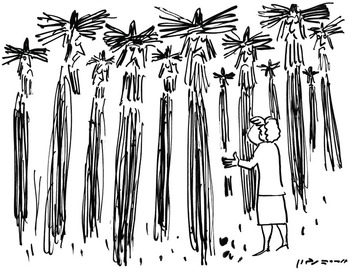
Eight-year-old Yossele Schumacher was kidnapped by his grandparents, Breslaver hasidim, because they were concerned that he would not be brought up in a religious environment. He was hidden in Israel, smuggled out to Europe, brought to New York and finally settled with a religious household in Brooklyn. The Mossad conducted a worldwide search to find him and he was finally located in September 1962.
Schumacher’s mother, Ida, is depicted here, bewildered and anxious, looking for her son in a forest of seemingly indifferent hasidim.
- 1 Jan
Meir Amit appointed head of military intelligence
- 9 Jan
Aharon Cohen sentenced to five years by Haifa court for espionage
- 14 Jan
Israel Beer sentenced to ten years by Tel Aviv court for espionage
- 23 Jan
Health Ministry rejects doctor’s request to test birth control pill on patient
- 30 Jan
Israel supports UN call to Portugal to relinquish power in Angola
- 1 Feb
Chief Rabbinate’s day of prayer for Soviet Jewry
- 6 Feb
Marc Chagall speaks at dedication of 12 stained-glass windows at Hadassah
- 9 Feb
Eshkol announces devaluation of Israeli pound late on Friday afternoon
- 27 Feb
Knesset votes 39–23 to ban pig-farming in Israel
- 8 Mar
El Al planes grounded in pilots’ dispute over hours in the cockpit
- 8 Mar
Syrians open fire on Israeli police patrol boat on Lake Kinneret
- 29 Mar
Supreme Court panel reject request for new witnesses in Eichmann appeal
- 16 Apr
Verwoerd regime withdraws right of local Zionists to transfer funds to Israel
- 29 Apr
National Water Council agrees annual flow of 225,000 litres from Kinneret
- 30 Apr
Oscar Schindler welcomed in Israel by 300 former workers from his factory
- 2 May
Frank Sinatra arrives in Israel to give seven concerts
- 14 May
Israel Prize for education awarded to Joseph Bentwich
- 1 Jun
Adolf Eichmann is hanged at Ramla prison
- 1 July
Yossele Schumacher, abducted three years ago, located in New York
- 1 July
Robert Soblen, convicted in the USA as a Soviet spy, deported from Israel
- 10 July
Yehuda-Leib Maimon, first religious affairs minister and Mizrahi leader, dies aged 86
- 21 July
Egyptians display new Soviet missiles during Revolution Day parade
- 5 Aug
Removal of government subsidies produces a doubling of the price of bread
- 12 Aug
Tel Aviv square named after actor Solomon Mikhoels, murdered by Stalin
- 22 Aug
Giora Josephtal, housing minister and Mapai leader, dies aged 50
- 3 Sept
Malaya follows Indonesia in refusing to issue visas to Israeli athletes
- 4 Sept
El Al carries first aid shipments to Tehran for earthquake victims
- 26 Sept
Israel acquires Hawk ground-to-air missiles from USA
- 7 Nov
Eleanor Roosevelt, long-time supporter of Israel, dies in New York aged 78
- 28 Nov
Yossele Schumacher abduction trial opens in Jerusalem
- 6 Dec
Supreme Court rejects Brother Daniel’s application to be considered a Jew
- 19 Dec
First monarch to visit Israel, Mwambusta IV of Burundi, arrives in Jerusalem
Meir Ya’ari, the Mapam leader, defended Cohen as ‘not a spy and not a traitor to Zionism’. Israel Beer similarly identified with Mapam and had been close to Moshe Sneh. When Sneh broke with Mapam, formed the Left faction and then joined the Communist party, Beer moved to the Right and joined Mapai.
Beer’s story had been ostensibly that he was a Viennese social democrat and Spanish civil war veteran who arrived in Palestine in October 1938. He became a lieutenant colonel in the IDF, an academic and a valued Defence Ministry employee, close to Shimon Peres. He became an official historian of Israel’s war of independence and head of the department of military history at Tel Aviv University. Despite his background history being proved false by his interrogators, he never revealed his real identity or admitted to working for the Soviet bloc. He was found to have passed classified information to Vladimir Sokolov at the Soviet Embassy in Tel Aviv. On appeal, his sentence was increased to fifteen years.
The cases of Cohen and Beer arose as a result of the crisis in international Communism after the death of Stalin, Khrushchev’s revelations at the twentieth party congress and the invasion of Hungary in 1956. The KGB was particularly interested in the development of the nuclear facility at Dimona. This led to the arrest of Kurt Sitte, a Czechoslovak nuclear physicist at the Technion, and his subsequent trial and imprisonment.
At the end of the year, the trial opened which dealt with the abduction of eight-year-old Yossele Schumacher. He and his family had immigrated to Israel from the USSR in 1958. The family, however, had tremendous difficulties in settling into their new country. Yossele’s maternal grandfather, Nachman Shtarkes, a Breslover hasid who had suffered in Stalin’s Gulag, was asked to look after the boy while the parents attempted to secure a foothold in Israeli society. The frustrations of the boy’s father, Alter Schumacher, grew and he threatened to return to the USSR.
Shtarkes believed that the secular father was returning the boy to godless Communism, and following consultation with Jerusalem’s Chief Rabbi, Zvi Pesach Frank, a ruling was obtained so as to prevent him from leaving Judaism. For the next two and a half years, Yossele was separated from his parents in Holon and taken first to a yeshiva in Rishon l’Zion, then to the village of Kommemiut, run under the auspices of the haredi party, Poalei Agudat Israel. Ruth Blau, a French convert to Judaism, chaperoned the boy and took him on false papers to Switzerland – to Moshe Soloveichik’s yeshiva in Lucerne. Yossele then travelled to France and Britain before being looked after by a Satmar hassidic family in the Williamsburg area of Brooklyn.
The Mossad had great difficulty in infiltrating the haredi world, and at Ben-Gurion’s insistence, began to divert more and more resources to find the child – deflecting funds from the search for the Nazi doctor Josef Mengele in Latin America. Yossele was eventually located by the FBI in Brooklyn in the summer of 1962 and returned to Israel. The boy’s grandfather had spent two years in prison in Israel for adamantly refusing to disclose his grandson’s whereabouts.
Yossele’s 23-year-old uncle, Shalom Shtarkes, had falsely denied any involvement in the abduction and was sent to Brixton prison in London before being extradited to Israel. On Yossele’s return, the Israeli government dropped all proceedings against those involved, except for Shalom Shtarkes, who was eventually sentenced to three years for kidnapping plus another two for perjury. Ben-Gurion’s overriding desire was to secure national unity in Israel and avoid an overt eruption of the Kulturkampf between religious and secular. Shalom Shtarkes was pardoned a few months after the trial’s conclusion.
A strike by six thousand public sector engineers, chemists, architects and agronomists was supported by a four-hour stoppage by doctors. Pressure on the government was increased by a rolling strike by engineers who worked in the electric power industry. West German engineers were brought in by AEG to operate the Haifa power plant.
Twelve thousand teachers who had just agreed a pay increase with the Ministry of Education came out on a one-day strike in support of the engineers. Although a stoppage of government lawyers was averted, a state of emergency was declared by the cabinet. The engineers eventually voted 14–13 to accept the government offer of a pay increase of 7 per cent and return to work.
Such industrial unrest was exacerbated by the government’s decision to devalue the currency. One dollar was now worth three Israeli pounds instead of 1.8. Increasing prices and conflicting government statements created chaos in the marketplace. Mortgages increased by two-thirds. The cost of staple foods rocketed. The governing Mapai party advocated a wage freeze – a policy welcomed by the Manufacturers Association, but condemned by major parties to the left of Mapai. While the government hastened to alleviate the effect of devaluation on Israeli workers, such as by cutting the price of diesel for vehicles, this did not prevent the bus cooperatives from asking for higher fares.
Post office workers came out on strike, bringing communications to a halt. El Al pilots refused to work more than eight hours a day. Jerusalem’s sanitation workers went on strike while Haifa’s dockers maintained a go-slow.
Ben-Gurion was concerned about the build-up of Soviet-supplied arms in Egypt and wished to maintain Israel’s qualitative edge. To ignore it was ‘a dangerous complacency’, given Egyptian bellicosity and repeated threats to destroy Israel. In 1962, the USSR decided to send to Egypt missiles originally intended for Cuba. A nuclear reactor was being built with Soviet assistance and Israeli intelligence estimated that Nasser would be able to produce nuclear weapons within a decade. Israel’s standing army numbered 43,000, while the combined forces of Egypt and Syria amounted to 200,000. Similarly, Israel possessed 102 fighters and bombers compared with the 328 possessed by its adversaries.
The Kennedy administration became the first to grant Hawk ground-to-air missiles to a non-NATO country in order to counter this increase of Soviet missiles in Egypt. The White House regarded this as ‘a one-off’ and, given the close call of the Cuban missile crisis, was only too aware of how misinterpretations and accidents could lead to a world war. The USA wanted to resolve the Arab refugee crisis and to link the return of some – possibly 10 per cent – to the delivery of the missiles to Israel.
In November, the Supreme Court heard the case of Oswald Refeisen, aka Brother Daniel, who had converted to Christianity in 1942 in Europe. He argued that his Jewish nationality had not been compromised and insisted that citizenship be awarded to him under the Law of Return.
President Ben-Zvi turned down a plea of clemency for Eichmann to escape the hangman’s noose. His wife, Vera, was permitted to visit him and he was hanged at Ramla prison, cremated and his ashes deposited at sea.
