


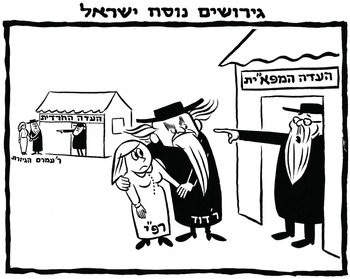
Amram Blau, the head of the Neturei Karta sect of the Satmar Hasidim, aged seventy, married a Catholic convert, Ruth Ben-David, aged forty-four, after his wife had passed away. This caused scandal and controversy in the haredi community, and Blau is seen in the background being admonished for his behaviour.
In the foreground, Ben-Gurion, dressed as a hasid, is bringing his ‘bride’, the new Rafi faction, to effectively challenge Eshkol and the ‘Mapai community’. He too is admonished for his action in a cartoon entitled ‘Divorce: Israeli-Style’.
- 5 Jan
Arab League threatens to blacklist Chase Manhattan Bank over Israel Bonds
- 7 Jan
Knesset agrees to exclude 60,000 low-paid workers from paying income tax
- 19 Jan
Eshkol confirms the presence of Israeli instructors in the Congo
- 25 Jan
Eshkol eulogises Churchill in an address to the Knesset
- 25 Jan
Lavon removed from Histadrut central committee due to leaving Mapai
- 2 Feb
Omar Mahmud Ariffi, Lebanese spy, sentenced to 15 years by Haifa court
- 7 Feb
Liberals agree to establish committee to find way to cooperate with Herut
- 15 Feb
Knesset condemns West Germany’s arms halt due to Egyptian pressure
- 16 Feb
Tenth Mapai annual conference opens, facing factional splits
- 4 Mar
Shimon Agranat nominated as next Supreme Court president
- 7 Mar
Independent Liberal party formed from opposition to Liberal–Herut bloc
- 9 Mar
Ahdut Ha’Avoda conference agrees to alignment with Mapai
- 16 Mar
Knesset votes to accept West German proposal for full diplomatic relations
- 21 Apr
Shrine of the Book, housing Dead Sea Scrolls, formally opened in Jerusalem
- 21 Apr
Tunisian President Bourguiba suggests Israeli–Palestinian peace talks
- 26 Apr
Herut and Liberals agree electoral pact as Gahal
- 11 May
Israel Museum opens in Givat Ram, Jerusalem
- 12 May
Diplomatic relations between Israel and West Germany established
- 18 May
Eli Cohen hanged in Marjeh Square, Damascus for spying for Israel
- 7 June
Eshkol defeats Ben-Gurion in Mapai central committee vote for next PM
- 13 June
Martin Buber dies in Jerusalem aged 87
- 29 June
Ben-Gurion announces split from Mapai to form a new electoral list
- 7 July
Moshe Sharett dies in Jerusalem aged 70
- 19 July
Cabinet approves the establishment of a non-commercial television service
- 16 Aug
Israel’s population stands at 2,525,600, 16 per cent of world Jewry
- 21 Aug
Wolfgang Lotz sentenced to life imprisonment in Cairo for spying for Israel
- 1 Sept
Maki and Rakah established after formal split in the Communist party
- 20 Sept
Mapai–Ahdut Ha’Avoda alignment achieves only 50.8 per cent in Histadrut vote
- 20 Sept
Herut–Liberals list wins 17.5 per cent in Histadrut vote at first attempt
- 2 Nov
Ben-Gurion’s Rafi receives only ten seats in parliamentary election
- 14 Nov
Teddy Kollek becomes new mayor of Jerusalem
- 17 Nov
Israel votes against the admission of Mao’s China to the UN
- 21 Nov
The Swedish vessel Vingeland becomes the first ship to dock at Ashdod
- 2 Dec
Israel opposes Rhodesian Unilateral Declaration of Independence at the UN
- 6 Dec
Ritual slaughterers go on strike in Jerusalem for higher pay
- 21 Dec
El Salam mosque dedicated in Nazareth
- 28 Dec
On 7 January, Fatah attempted to sabotage a water tank at a religious Zionist moshav, Nehusha, at Lachish. Other attacks throughout the year occurred at Rosh Ha’ayin, kibbutzim Beit Nir, Eyal and Metzer, and moshavim Aderet, Zanoah, Givat Yeshayahu and Amatzia. Most attacks were on irrigation and water pumping stations, close to the Jordanian border. This provoked Israeli retaliatory raids at locations in Jordan and an incursion across the Lebanese border – the first since the armistice agreement between the two countries in 1949. Raids such as that against Mis el Jamal in Lebanon were similarly directed at water reserves. This eventually provoked Jordanian suppression of Fatah operations and the closure of its bases – although Syria maintained its support.
In contrast, the Tunisian president, Habib Bourguiba, gave a speech in Jericho which suggested a political solution to the Israel–Palestine problem. This was followed by more concrete proposals and condemnation from Nasser.
The year also marked the beginning of the disintegration of the Israeli Left and the coalescence of the Israeli Right. In January, Levi Eshkol appealed ‘to all parties concerned’ to ‘leave the Lavon affair alone’. Ben-Gurion took no notice. He also continued to be concerned by the prospect of an alignment between Mapai and Ahdut Ha’Avoda and frustrated by his inability to move against Eshkol as he did against Sharett a decade before. Yitzhak Tabenkin, the ideological mentor of Ahdut Ha’Avoda, also opposed a limited alignment of the two parties.
Ben-Gurion had already published a ‘white book’ detailing the Lavon affair, written for him by Haggai Eshed, which also laid out his vision of the future including electoral reform.
At the annual conference of Mapai, which then boasted a membership of 200,000, there were more than two thousand delegates, but a bitter clash took place between the supporters of Eshkol and those of Ben-Gurion, who wanted to establish another judicial review of the Lavon affair despite numerous previous investigations. Rachel Yanait Ben-Zvi, the widow of Yitzhak Ben-Zvi, called for party unity, but asked Ben-Gurion, ‘What is it you want from us?’ while a dying Moshe Sharett was brought in a wheelchair and denounced his former leader in vociferous terms. The foreign minister, Golda Meir, and deputy prime minister, Abba Eban, both criticised Ben-Gurion, while Shimon Peres and Moshe Dayan spoke in his support. Golda Meir pointed to Ben-Gurion’s inconsistency in his dealing with the investigations into the Lavon affair. Ben-Gurion, stung by Golda Meir’s attack, walked out of the conference. A majority of Mapai delegates, however, supported Eshkol in a vote.
In May, at a meeting of the party secretariat, Ben-Gurion raised the possibility of a split in Mapai and publicly stated that Eshkol was not fit to lead the country. This suggestion resulted in the secretariat expressing full confidence in Eshkol. The Tel Aviv branch of Mapai then argued that Ben-Gurion should head the party’s candidates list for the national elections. The Mapai majority responded in the affirmative, with the proviso that Eshkol would remain as prime minister. Eshkol was duly confirmed as the next prime minister by the Mapai central committee and Knesset members by 179 votes to Ben-Gurion’s 103.
Ben-Gurion then asked that his supporters in the cabinet resign from their posts and Shimon Peres and Yosef Almogi subsequently did so. In June, Ben-Gurion threatened to set up his own list for the forthcoming elections. He predicted that any split would bring Menahem Begin’s Herut to power.
Despite frantic efforts over the summer to prevent a split, Rafi (the Israel Workers’ List) came into existence in July, consisting of seven former MKs. Ben-Gurion and his supporters were suspended from Mapai. The party’s court of honour heard Rafi derided as ‘a neo-fascist group based on the leader principle’. The split reduced the government coalition majority to a bare minimum of sixty mandates. Rafi published its own weekly journal, Mabat Hadash.
The Histadrut elections in September indicated a dramatic drop in support for the Mapai–Ahdut Ha’Avoda alignment with just half the vote, but Rafi, which projected itself as ‘the real Mapai’, attained only 12.1 per cent. In contrast the Right, running as Gahal (Herut–Liberals), emerged as the second largest party. Menahem Begin had already reversed Jabotinsky’s policy of not running in Histadrut elections and he remarked that this election result represented a turning point for the Right.
The Knesset election in November resulted in a remarkable victory for Eshkol – some 36 per cent of the vote – while Ben-Gurion’s Rafi attained only 8.2 per cent and a desultory ten seats. Rafi’s sole success was the election of Teddy Kollek as mayor of Jerusalem. Eshkol called upon all members of Rafi to return to Mapai.
The Mapai–Ahdut Ha’Avoda alignment, Rafi and Mapam accounted for sixty-four seats; the Liberals, Herut and the Independent Liberals for thirty-four and the religious parties for seventeen. The possible scenario of a movement from Left to Right by part of the labour movement as well as by the religious parties now became a distinct possibility.
The election also indicated that mergers did not always increase the number of seats. The Labour alignment actually lost five seats – some of which switched to Ben-Gurion’s Rafi. The pact of Herut with the Liberals meant the total loss of eight seats and the emergence of the Independent Liberal party (ILP), which gained five. The ILP was a breakaway from the Liberals because they refused to ally themselves with Herut’s right-wing position.
Despite an attempt by the Kremlin to avert a split, the Communists divided into Maki and Rakah. Maki, under Moshe Sneh and Shmuel Mikunis, effectively repeated the past in that Jewish Communists had been unable to work with Arab Communists regarding the question of Palestine. Rakah was led by Meir Vilner and Tawfik Toubi. The two factions held separate conferences. Maki sang both the Hatikvah and the Internationale at their conference.
The split reflected the growing division within the international Communist movement into the uncritical Kremlin supporters and Eurocommunists. There were also different opinions on the Sino-Soviet clash. Maki was reduced to one seat with Rakah securing three. Uri Avnery’s left-wing party, Meri, picked up a seat from the schism in the Communist party.
The Right also vehemently opposed the establishment of diplomatic relations with West Germany. Angered by Nasser’s invitation to East Germany’s Walter Ulbricht to visit Cairo, West Germany resumed arms supplies to Israel. Although Nasser did not recognise East Germany, the visit prompted West Germany to initiate the establishment of diplomatic relations with Israel. In the Knesset, Herut voted with the Left – Mapam and the Communists – in opposing links with Ludwig Erhard’s West Germany.
The nomination of Rolf Pauls, a former Wehrmacht officer, as ambassador caused protests and repeated arrests of demonstrators in Israel. Alexander Toeroek, the new counsellor at the embassy, had been a Hungarian diplomat in Berlin while deportations and death marches of Jews had taken place in Hungary. When Pauls presented his credentials, the Israeli press reported that President Shazar was ‘agitated’ during the ceremony, while Golda Meir looked down at the floor during the formal speeches.
