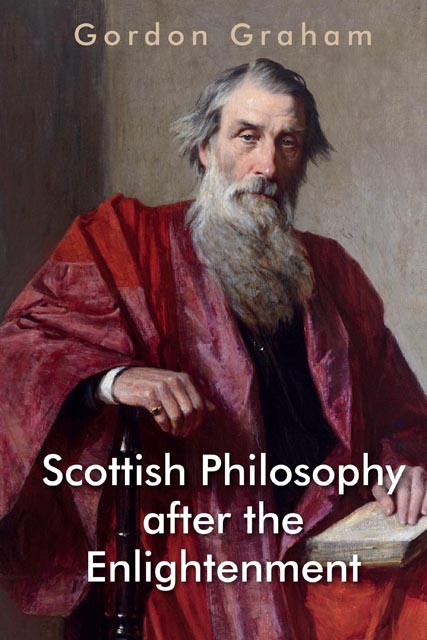
Book contents
- Frontmatter
- Contents
- Preface and Acknowledgements
- Series Editor’s Introduction
- A Note on Women in Scottish Philosophy: Mrs Oliphant
- A Chronology of Scottish Philosophy after the Enlightenment
- 1 An Autobiographical Prologue
- 2 Sir William Hamilton and the Revitalisation of Scottish Philosophy
- 3 James Frederick Ferrier and the Course of Scottish Philosophy
- 4 Psychology and Moral Philosophy: Alexander Bain
- 5 Thomas Carlyle and the Philosophy of Rhetoric
- 6 Hegelianism and its Critics
- 7 Scottish Philosophy’s Progress
- 8 Religion, Evolution and Scottish Philosophy
- 9 The Gifford Lectures and the Re-affirmation of Theism: Alexander Campbell Fraser
- 10 The Culmination of Scottish Philosophy: A. S. Pringle-Pattison
- 11 John Macmurray and the Self as Agent
- Bibliography
- Index
7 - Scottish Philosophy’s Progress
Published online by Cambridge University Press: 07 June 2023

Book contents
- Frontmatter
- Contents
- Preface and Acknowledgements
- Series Editor’s Introduction
- A Note on Women in Scottish Philosophy: Mrs Oliphant
- A Chronology of Scottish Philosophy after the Enlightenment
- 1 An Autobiographical Prologue
- 2 Sir William Hamilton and the Revitalisation of Scottish Philosophy
- 3 James Frederick Ferrier and the Course of Scottish Philosophy
- 4 Psychology and Moral Philosophy: Alexander Bain
- 5 Thomas Carlyle and the Philosophy of Rhetoric
- 6 Hegelianism and its Critics
- 7 Scottish Philosophy’s Progress
- 8 Religion, Evolution and Scottish Philosophy
- 9 The Gifford Lectures and the Re-affirmation of Theism: Alexander Campbell Fraser
- 10 The Culmination of Scottish Philosophy: A. S. Pringle-Pattison
- 11 John Macmurray and the Self as Agent
- Bibliography
- Index
Summary
I
In the Introduction to his Treatise of Human Nature (1739), Hume remarks that it does not take ‘such profound knowledge to discover the present imperfect condition of the sciences … The most trivial question escapes not our controversy, and in the most momentous we are not able to give any certain decision’ (Hume 2007: 3). This state of things, he thinks, warrants a new and different approach.
Here then is the only expedient, from which we can hope for success in our philosophical researches, to leave the tedious lingring method, which we have hitherto followed, and instead of taking now and then a castle or village on the frontier, to march up directly to the capital or centre of these sciences to human nature itself, which being once masters of, we may every where else hope for an easy victory … There is no question of importance, whose decision is not compriz’d in the science of man, and there is none which can be decided with any certainty, before we become acquainted with that science. (Hume 2007: 4)
The study of philosophy had been a marked feature of education in the Scottish universities for over 300 years before Hume wrote this. Nevertheless, with a striking military image, he set philosophy in Scotland in a new direction. His intellectual project, variously called the science of man, the science of human nature or the science of mind, soon became the remit for philosophers in Aberdeen, Edinburgh and Glasgow, with St Andrews following at a rather greater distance in time.
Hume’s Treatise, after a slow start, effectively shaped Scottish philosophy for almost 150 years. One enduring issue across this long period was the question of whether, as Hume hoped, this new approach to the topics that had been the mainstay of philosophy since ancient times could result in genuine intellectual advances. Did the science of human nature as it was pursued by the Scottish philosophers of the eighteenth and nineteenth centuries secure real progress, and if so, in what did that progress consist?
In seeking answers to these two questions, it is worth noting at the outset that for Hume and his contemporaries the terms ‘science’ and ‘philosophy’ were interchangeable. One important feature of the development of Hume’s project over the century that followed his death was the gradual differentiation of these terms.
Information
- Type
- Chapter
- Information
- Scottish Philosophy after the Enlightenment , pp. 128 - 146Publisher: Edinburgh University PressPrint publication year: 2022
Accessibility standard: Unknown
Why this information is here
This section outlines the accessibility features of this content - including support for screen readers, full keyboard navigation and high-contrast display options. This may not be relevant for you.Accessibility Information
Accessibility compliance for the PDF of this chapter is currently unknown
and may be updated in the future.