Book contents
- Frontmatter
- Contents
- Foreword
- Preface
- 1 Conflict in context
- 2 Understanding different types of conflict
- 3 The impact of inter-parental conflict on children
- 4 How does inter-parental conflict affect children?
- 5 Risk and resilience: why are some children affected more than others?
- 6 Review of conflict-based interventions for couples
- 7 Implications for practice: How to help families
- 8 Conclusions and recommendations
- References
- Index
Preface
Published online by Cambridge University Press: 04 February 2022

Book contents
- Frontmatter
- Contents
- Foreword
- Preface
- 1 Conflict in context
- 2 Understanding different types of conflict
- 3 The impact of inter-parental conflict on children
- 4 How does inter-parental conflict affect children?
- 5 Risk and resilience: why are some children affected more than others?
- 6 Review of conflict-based interventions for couples
- 7 Implications for practice: How to help families
- 8 Conclusions and recommendations
- References
- Index
Summary
According to a recent UK government report (Casey, 2012), families experience ‘legacies of trouble’ with serious problems passed on from one generation to the next. Specifically, children who experience early trauma such as parental abuse, maltreatment, poor parenting and high levels of inter-parental conflict and violence are at serious risk not only in terms of their own wellbeing, but also in relation to the perpetuation of these behaviours across generations. Rather than offer quick-fix solutions to addressing endemic family problems, the Casey report concludes what scientific evidence has emphasised for several decades: that if we are to address the needs of children in families, we must look beyond trying to fix single problems in the short term, to addressing multiple causes and multiple outcomes associated with harsh family experiences that cause families and the individuals that comprise them significant difficulties in the short and long term. We must also recognise that remediating these problems such that improvements or positive changes in the quality of life that individuals experience takes time.
With this objective in mind, there cannot be a more important task across the complementary fields of child development research, social work and clinical practice, health and education, intervention development and family policy than the promotion of knowledge and public understanding as to what promotes healthy child development and positive family functioning – as it is recognised that healthy families are the bedrock of a healthy society.
What makes or breaks a healthy family? Many factors contribute to addressing this question of significant social, clinical and policy relevance. One of the strongest predictors of how a family functions however relates to how adults in any given family experienced family life as children. Specifically, the economic and cultural circumstances, levels of parental support and parenting experiences, the compositional type of family (e.g. cohabiting, married, single, divorced, remarried), attributes of parental mental health and the quality of relations between parents/caregivers serve as strong predictors of healthy child development and long-term wellbeing. By understanding how these factors affect children in the short and long term, we are better positioned to understand how we may help troubled families, endorse and help sustain well-functioning families and ultimately remediate the significant personal, economic and societal costs of broken families and the individuals that comprise them.
Information
- Type
- Chapter
- Information
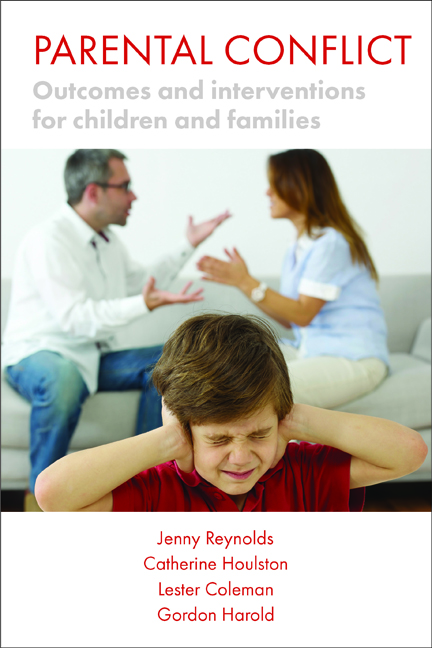
- Parental ConflictOutcomes and Interventions for Children and Families, pp. ix - xiiPublisher: Bristol University PressPrint publication year: 2014
Accessibility standard: Unknown
Why this information is here
This section outlines the accessibility features of this content - including support for screen readers, full keyboard navigation and high-contrast display options. This may not be relevant for you.Accessibility Information
Accessibility compliance for the PDF of this chapter is currently unknown
and may be updated in the future.