Book contents
- Frontmatter
- Dedication
- Contents
- List of figures and tables
- List of abbreviations
- Acknowledgements
- Foreword
- Introduction
- 1 Reproduction: social class inequality in education
- 2 The three schools
- 3 Aspiration, aspiration, aspiration: “The only thing they’ve forced me to do is keep my options open”
- 4 Knowledge, familiarity and physical proximity: “Everyone in my family has gone to university, I don’t see why I shouldn’t”
- 5 Option blocks that block options (GCSEs)
- 6 Packages, facilitating subjects and ‘keeping the options open’ (A levels)
- 7 Institutional concerted cultivation
- 8 Aim lower: leashing aspirations and internalising notions of (in)ability
- 9 Jake’s story: a journey to reflexivity
- Conclusion
- Appendix I Questionnaire
- Appendix II Parental Standard Occupational Classification 2010 groups
- Appendix III Grand Hill Grammar careers event question sheet
- Appendix IV Vignette sample
- Notes
- References
- Index
Introduction
Published online by Cambridge University Press: 18 December 2024

Book contents
- Frontmatter
- Dedication
- Contents
- List of figures and tables
- List of abbreviations
- Acknowledgements
- Foreword
- Introduction
- 1 Reproduction: social class inequality in education
- 2 The three schools
- 3 Aspiration, aspiration, aspiration: “The only thing they’ve forced me to do is keep my options open”
- 4 Knowledge, familiarity and physical proximity: “Everyone in my family has gone to university, I don’t see why I shouldn’t”
- 5 Option blocks that block options (GCSEs)
- 6 Packages, facilitating subjects and ‘keeping the options open’ (A levels)
- 7 Institutional concerted cultivation
- 8 Aim lower: leashing aspirations and internalising notions of (in)ability
- 9 Jake’s story: a journey to reflexivity
- Conclusion
- Appendix I Questionnaire
- Appendix II Parental Standard Occupational Classification 2010 groups
- Appendix III Grand Hill Grammar careers event question sheet
- Appendix IV Vignette sample
- Notes
- References
- Index
Summary
As we crowded into the school hall for our weekly assembly, our new principal stood watching us. In front of him was a table. Lined up neatly across it was a random collection of different objects. We looked on intrigued. After chatter slowly dissolved into silence it was explained to us that this was a careers talk. The principal, pointing to the table of objects, said: “In your life, you won't have one job, you will have a number of different jobs.” Aha, it became clear that the objects represented his career trajectory. At the time this did not seem unusual to me, however it later became a defining moment whereby I look back and recognise the deeply entrenched classed and racialised inequality we were experiencing. Through familiarising us with the notion of having a string of different jobs across one's lifetime, this careers talk was preparing us for a life of insecure and precarious employment. Something rather different to a more traditionally white, middle-class experience of attending university and selecting and training for a specific profession. The only other careers event I recall in my school was run by the British Army recruitment squad. I only began to reflect on how problematic this was when I began working as a researcher on the Paired Peers Project, interviewing university students from different backgrounds and schools. During the first round of interviews with the students in their first year of studies, they told us about their experience of transitioning to university. Through this I discovered that many of my peers had very different experiences of careers advice and support in school to mine. This sparked a deep interest within me to further explore and illuminate the inequalities operating within the institution of education in Britain today and ultimately led to the development of this research project in which I compared three distinct schools in one locality, speaking to pupils and careers advisors in each to explore inequalities in young people's pathways to adulthood. What I found were stark differences, not only in the careers service or advice and guidance on offer, but also in the fabric of the schools, in the opportunity structures at play which either open up or shut down options, in the subjects which could be studied, in the work experience opportunities on offer and in the work conducted on aspirations.
Information
- Type
- Chapter
- Information
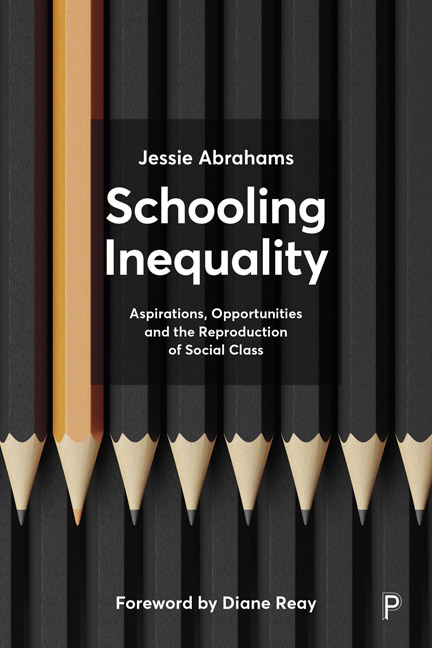
- Schooling InequalityAspirations, Opportunities and the Reproduction of Social Class, pp. 1 - 8Publisher: Bristol University PressPrint publication year: 2024
Accessibility standard: Unknown
Why this information is here
This section outlines the accessibility features of this content - including support for screen readers, full keyboard navigation and high-contrast display options. This may not be relevant for you.Accessibility Information
Accessibility compliance for the PDF of this chapter is currently unknown
and may be updated in the future.